A complete reference blog for Indian Government Employees

Showing posts with label Indian Government. Show all posts

Wednesday, 4 November 2015

Gold Monetisation Scheme (GMS), 2015: Indian Government News

PM to launch Gold Related Schemes on 5th November, 2015; First ever National Gold Coin minted in India with National Emblem of Ashok Chakra engraved to be released among others on the occasion

The Prime Minister Shri Narendra Modi will launch the three Gold related Schemes i.e. Gold Monetisation Scheme (GMS), Gold Sovereign Bond Scheme and the Gold Coin and Bullion Scheme on Thursday, 5th November, 2015 in the national capital.

The salient features of each of the aforesaid scheme are as follows:

Gold Monetisation Scheme (GMS), 2015

The GMS will replace the existing Gold Deposit Scheme, 1999. However, the deposits outstanding under the Gold Deposit Scheme will be allowed to run till maturity unless the depositors prematurely withdraw them.

Resident Indians (Individuals, HUF, Trusts including Mutual Funds/Exchange Traded Funds registered under SEBI (Mutual Fund) Regulations and Companies) can make deposits under the scheme. The minimum deposit at any one time shall be raw gold (bars, coins, jewellery excluding stones and other metals) equivalent to 30 grams of gold. There is no maximum limit for deposit under the scheme.

The gold will be accepted at the Collection and Purity Testing Centres (CPTC) certified by Bureau of Indian Standards (BIS). The deposit certificates will be issued by banks in equivalent of 995 fineness of gold. The designated banks will accept gold deposits under the Short Term (1-3 years) Bank Deposit (STBD) as well as Medium (5-7 years) and Long (12-15 years) Term Government Deposit Schemes (MLTGD). While the former will be accepted by banks on their own account, the latter will be on behalf of the Government of India. There will be provision for premature withdrawal subject to a minimum lock-in period and penalty to be determined by individual banks for the STBD. The interest rate in the STBD will be determined by the banks. The interest rate in the medium term bonds has been fixed at 2.25% and for the long term bonds is 2.5% for the bonds issued in 2015-16.

Interest on deposits under the scheme will start accruing from the date of conversion of gold deposited into tradable gold bars after refinement or 30 days after the receipt of gold at the CPTC or the bank’s designated branch, as the case may be and whichever is earlier. During the period from the date of receipt of gold by the CPTC or the designated branch, as the case may be, to the date on which interest starts accruing in the deposit, the gold accepted by the CPTC or the designated branch of the bank shall be treated as an item in safe custody held by the designated bank.

The Short Term Bank Deposits will attract applicable Cash Reserve Ratio (CRR) and Statutory Liquidity Ratio (SLR). However, the stock of gold held by the banks will count towards the general SLR requirement. The opening of Gold Deposit Accounts will be subject to the same rules with regard to customer identification (KYC) as are applicable to any other deposit account.

The designated banks may sell or lend the gold accepted under STBD to MMTC for minting India Gold Coins (IGC) and to jewellers, or sell it to other designated banks participating in GMS. The gold deposited under MLTGD will be auctioned by MMTC or any other agency authorised by the Central Government and the sale proceeds credited to the Central Government’s account with the Reserve Bank of India. The entities participating in the auction may include the Reserve Bank, MMTC, banks and any other entities notified by the Central Government. Banks may utilise the gold purchased in the auction for purposes indicated above. Designated banks should put in place a suitable risk management mechanism, including appropriate limits, to manage the risk arising from gold price movements in respect of their net exposure to gold. For this purpose, they have been allowed to access the international exchanges, London Bullion Market Association or make use of over-the-counter contracts to hedge exposures to bullion prices subject to the guidelines issued by the Reserve Bank.

Complaints against designated banks regarding any discrepancy in issuance of receipts and deposit certificates, redemption of deposits, payment of interest will be handled first by the bank’s grievance redress process and then by the Reserve Bank’s Banking Ombudsman.

It may be recalled that the Government of India announced the Gold Monetisation Scheme vide its Office Memorandum F.No.20/6/2015-FT dated September 15, 2015. The objective of the Scheme is to mobilise gold held by households and institutions of the country and facilitate its use for productive purposes, and in the long run, to reduce country’s reliance on the import of gold..

The list of CPTCs and Refiners are certified by the Bureau of Indian Standards. Indian Banks Association has finalized the necessary documentation including the tripartite agreements between the designated banks, CPTCs and the Refiners under the Scheme. Banks have put in place the requisite systems and procedures to implement the scheme and will continue to improve them.


Sovereign Gold Bond Scheme
The Government of India has decided to issue Sovereign Gold Bonds. The Bonds will be issued in multiple tranches subject to the overall borrowing limits of GOI. Applications for the bond under the first tranche will be accepted from November 05, 2015 to November 20, 2015. The Bonds will be issued on November 26, 2015. The Bonds will be sold through banks and designated post offices as notified. It may be recalled that the Union Finance Minister had announced in Union Budget 2015-16 about developing a financial asset, Sovereign Gold Bond, as an alternative to purchasing metal gold.

Sovereign Gold Bond will be issued by Reserve Bank India on behalf of the Government of India. The Bonds will be restricted for sale to resident Indian entities including individuals, HUFs, trusts, Universities, charitable institutions. The Bonds will be denominated in multiples of gram(s) of gold with a basic unit of 1 gram. The tenor of the Bond will be for a period of 8 years with exit option from 5th year to be exercised on the interest payment dates. Minimum permissible investment will be 2 units (i.e. 2 grams of gold).The maximum amount subscribed by an entity will not be more than 500 grams per person per fiscal year (April-March). A self-declaration to this effect will be obtained. A mechanism will be put in place for internal verification of the self declarations.

In case of joint holding, the investment limit of 500 grams will be applied to the first applicant only. Each tranche will be kept open for a period to be notified. The issuance date will also be specified in the notification. Price of Bond will be fixed in Indian Rupees on the basis of the previous week’s (Monday–Friday) simple average of closing price of gold of 999 purity published by the India Bullion and Jewellers Association Ltd. (IBJA).Payment for the Bonds will be through electronic funds transfer/cash payment/ cheque/ demand draft. The investors will be issued a Stock/Holding Certificate.

The Bonds are eligible for conversion into demat form. The redemption price will be in Indian Rupees based on previous week’s (Monday-Friday) simple average of closing price of gold of 999 purity published by IBJA. Bonds will be sold through banks and designated Post Offices, as notified, either directly or through agents. The investors will get interest at a fixed rate of 2.75 per cent per annum payable semi-annually on the initial value of investment for the bonds issued in 2015-16.

Bonds can be used as collateral for loans. The loan-to-value (LTV) ratio is to be set equal to ordinary gold loan mandated by the Reserve Bank from time to time. Know-your-customer (KYC) norms will be the same as that for purchase of physical gold. KYC documents such as Voter ID, Aadhaar Card/PAN or TAN /Passport will be required. The interest on Gold Bonds shall be taxable as per the provision of Income Tax Act, 1961 (43 of 1961) and the capital gains tax shall also remain same as in the case of physical gold. Department of Revenue has agreed to ensure tax neutrality between the purchase of physical gold and investment in the gold bonds. This will require amendments in the existing provisions of the Income Tax act , which will be considered in the 2016-17 Budget. Bonds will be tradable on exchanges/NDS-OM from a date to be notified by RBI..The Bonds will be eligible for Statutory Liquidity Ratio (SLR). Commission for distribution shall be paid at the rate of 1% of the subscription amount.


Gold Coin/Bullion Scheme
The Indian gold coin & bullion is a part of the Gold Monetisation Programme. The coin will be the first ever national gold coin minted in India and will have the National Emblem of Ashok Chakra engraved on one side and Mahatma Gandhi on the other side . Initially the coins will be available in denominations of 5 and 10 grams. A 20 gram bullion will also be available. Initially, 15,000 coins of 5gm, 20,000 coins of 10 gm and 3,750 of bullions of 20 gm will be made available through MMTC outlets. The Indian Gold coin & bullion is unique in many aspects and will carry advanced anti-counterfeit features and tamper proof packaging.
The Indian Cold coin & bullion will be of 24 karat purity and 999 fineness. All coins & bullion will be hallmarked as per the BIS standards. These coins will be distributed initially through designated & recognised MMTC outlets and later through specified bank branches and post offices.

PIB
Share:

Friday, 7 August 2015

CCS Rules do not recognise unions based on caste, tribe, religion: Government

CCS Rules do not recognise unions based on caste, tribe, religion: Government

New Delhi: The central civil service rules do not allow recognition of separate associations and unions on the basis of any caste, tribe or religious dominations, Rajya Sabha was informed today.

In his written reply to a question on the issue, Minister of State for Social Justice and Empowerment Krishan Pal Gurjar said the Department of Personnel and Training formulates policy for recognition of service associations of government employees and this is done by the respective Ministries or Departments in terms of CCS(RSA) Rules, 1993.

“Central Civil Services (Recognition of Service Associations) Rules, 1993 do not allow recognition of separate Associations/Unions on the basis of any caste, tribe or religious denominations,” he said.
Replying to another question, the Minister said as per information received from various ministries and departments till date, the representation of Other Backward Classes as on January 1, 2013 in 71 ministries or departments was 5,24,143 employees in the central government ministries or departments.
PTI
Share:

Wednesday, 15 July 2015

Appointment of meritorious Sportspersons in relaxation of the procedure – regarding

Appointment of meritorious Sportspersons in relaxation of the procedure – regarding.
Immediate
No. 14034/1/2015-Estt.D
Government of India
Ministry of Personnel, Public Grievances and Pensions
Department of Personnel & Training
North Block, New Delhi
Dated: 14.07.2015
OFFICE MEMORANDUM

Subject: Appointment of meritorious Sportspersons in relaxation of the procedure-regarding.
***

The undersigned is directed to invite reference to this Department’s OM No. 14015/176-Estt.(D) dated 4th August, 1980 vide which instructions regarding appointment of meritorious sportsmen to Group C and D posts in relaxation of the procedure were circulated. Subsequently, consolidated instructions on incentives for sportspersons were also circulated vide this Department’s OM No. 14034/01/2013-Estt.(D) dated 03.10.2013.

2. All Ministries/Departments are again requested to bring the aforesaid instructions mentioned in the preceding paragraph to the notice of all concerned for appointment of meritorious sportspersons to Central Government Civil posts. Strict compliance of these instructions may be ensured for making appointment of meritorious sportspersons, thereby achieving the desired objectives of encouraging and promoting sports in the country.
(Rakesh Moza)
Under Secretary to the Government of India
Tel. No.-23040339
All Ministries/Departments of the Government of India
Copy to:
1. The President’s Secretariat, New Delhi.
2. The Vice-Presidents, Secretariat, New Delhi.
3. The Prime Minister’s Office, New Delhi.
4. The Cabinet Secretariat, New Delhi.
5. The Najya Sabha Secretariat/Lok Sabha Secretariat, New Delhi.
6. The Comptroller and Auditor General of India, New Delhi.
7. The Secretary Union Public Service Commission, New Delhi.
8. The secretary, Staff Selection Commission, New Delhi.
9 All attached offices under the Ministry of Personnel, Public, Grievances and Pensions.
10.All Officers and Sections in the Department of Personnel and Training.11.NIC (DOP&T) for placing this Office Memorandum on the Website of DOP&T.

Source: Persmin
Share:

Tuesday, 14 July 2015

Kerala Pay Commission Report handed over to Government – Download link

Kerala Pay Commission Report handed over to Government – Download link

Kerala pay panel hands over report to govt

Thiruvananthapuram: The Justice C.N. Ramachandran Nair Commission submitted its report recommending a hike in government employees’ salary here today.

Ramachandran Nair handed over the report to Chief Minister Oommen Chandy. The report recommends a hike ranging between Rs 2,000 to Rs. 12,000. It has been recommended that the revision be implemented with effect from July 1, 2014.

Other major recommendations include; promote high school teachers to the post of deputy headmaster on completion of 28 years and bring in a hike of house allowance ranging from Rs 1,000 to Rs 3,000.

The commission recommends a minimum wage of Rs.17,000 and maximum of Rs 1.2 lakh for the employees working under the state government. It suggests that government increase the retiring age to 58 from the present 56. It also proposes to lower the ceiling of minimum service needed for awarding pension from 30 years to 25.

Proposed scale and existing scale in bracket

LD Clerk: Rs 21,000 – 43,000 ( Rs 9,940-15,380); UD Clerk: Rs 26,500 – 53,000 ( Rs 13,210 -22,370); HSA : Rs 30,700 – 62,000 ( Rs 14,620 – 23,480); Last grade: Rs 17,000 – 35,000 (Rs 8,730 – 12,550)
If the government approves it, the recommendations will be implemented with effect from July 2014. The due amounts are likely to be merged with the provident fund.

Source: www.english.manoramaonline.com
Kerala 10th Pay Commission Report – Download link (Official Website of Pay Revision Commission)
Share:

Monday, 13 July 2015

INDEFINITE STRIKE FROM 23RD NOVEMBER 2015 – SECRETARY, JCM (NC) WRITES TO NEW CABINET SECRETARY

INDEFINITE STRIKE FROM 23RD NOVEMBER 2015 – SECRETARY, JCM (NC) WRITES TO NEW CABINET SECRETARY.

Shri Pradeep Kumar Sinha,
Cabinet Secretary,
(Government of India),
Rashtrapati Bhawan,
New Delhi

Dear Sir,
I, on behalf of Staff Side, National Council(JCM), greet you on your joining as Cabinet Secretary, Government of India.

Sir, you are aware that, more than 26 lakh Central Government Employees, working in the Railways, Defence, Postal and other Central Government Organizations, are facing lots of problems, which are unresolved due to non-functioning of the NC/JCM.

More than 05 years have passed, there has not been a single meeting of the Departmental Council.
Non-resolution of the problems of the Central Government Employees has forced them jointly to resolve for a National Indefinite Strike from 23rd November, 2015.

I hope, you will take keen interest in resolution of the problems, submitted through our agenda as well as Charter of Demands at an earliest to keep industrial peace in the country.

I do not feel good to write all these issues in my first letter, but I am forced by the circumstances to write all this.

With kind regards!
Sincerely yours,
(Shlva Gopal Mishra)
Secretary(Staff Side)
NC/JCM

Encl: Declaration adopted by NJCA on 11.12.2014
Cop to: All Constituents of JCM(Staff Side)- for information.

Source: Central Government Employees News
Share:

Saturday, 11 July 2015

NFIR: List of Holiday Homes on Indian Railways

List of Holiday Homes on Indian Railways

GOVERNMENT OF INDIA
MINISTRY OF RAILWAYS
(RAILWAY BOARD)
No. E(W)2012/WE-2/3
New Delhi, dated 03-07-2015.
General Managers
All Indian Railways & PUs
(as per mailing list enclosed)

Sub:- List of Holiday Homes on Indian Railways
Ref: E(W)WE2/3 dated 06.06.2012

With reference to above, the holiday home facility is available as per details as follows:-

Railway Location No. of Suites (Group wise) Competent authority/official with Telephone no.


A B C D
WCR Maihar (Dist.Satna) 02 02 DRM(P), JBP Division, WCR (Phone – 55726, Fax -2620489)
This may be circulated amongst all officers and staff of your Railway/Unit

Source: NFIR
Share:

Thursday, 18 June 2015

Implementation of OROP likely by the year-end

Implementation of OROP likely by the year-end

“A series of statements and assurances from various ministers and higher officials had increased the expectations and worsened the situation.”

Sources say that the much anticipated and much-delayed One Rank One Pension scheme will come into effect before the end of this year, ahead of the Bihar elections.

For a very long time now, army personnel have been demanding that the OROP scheme be implemented. They have now stepped up their demand now. Relay fast protests were held in 20 cities, including New Delhi, yesterday.

Prime Minister Narendra Modi had assured a number of times before that he is committed to introducing the scheme. But, the ex-servicemen have openly asked why the government is hesitating to implement the scheme and have warned that they would campaign against the BJP in the upcoming state elections in Bihar at the end of the year.

Following the warning, the Government has stepped up its activities implementing the OROP scheme. It has come to our knowledge that the scheme would be implemented as soon as the government lists out the beneficiaries who are going to benefit from the revised pension scale.

Information sources claim that since a mega-coalition has already been formed to counter the BJP in Bihar, the fear of alienating the ex-servicemen has rattled the BJP-government at the centre.
Share:

Saturday, 23 May 2015

All India Bank Officers Association presents Pay & Arrears Calculator for Bank Officers

All India Bank Officers Association presents Pay & Arrears Calculator for Bank Officers

AIBOA has presented a new updated pay and arrears calculator for bank officers through on its official website. Please click here to download the Pay & Arrears Calculator

Joint Note to be signed between Officers Organisations and IBA

As soon as the the joint note is signed we shall up load the full text of the same.

In the meanwhile we furnish here under the HIGHLIGHTS of pay AND other details on which areas of agreement reached for information of members

HIGHLIGHTS
Basic Pay 23700 – 85000
DA @0.10% per slab [ As on date 33.70% ]
Special allowance
Up to Scale III @ 7.75% + DA
Scale IV and V 10% + DA
Scale Vi and VII 11% + DA
HRA @ 7 8 9 %
CCA @ 600 and 870 > 3% and 4% subject to maximum
Medical Aid 8000 up to Scale III & 9050 above ScIII
Stagnation Increment one Additional Increment for Scale II III and IV

Source: AIBOA
Share:

Thursday, 14 May 2015

Indian Government: Black money bill passed; Government warns those having illegal assets

Indian Government: Black money bill passed; Government warns those having illegal assets

New Delhi: A bill to deal with black money stashed abroad was passed by Parliament today with government warning those having such assets to utilise the ‘compliance window’ or have sleepless nights once the global automatic information exchange system comes into effect in 2017.

Finance Minister Arun Jaitley said in Rajya Sabha that the new law, with stringent provisions, will help “squeeze” black money even as he underlined that the option of ‘compliance window’, which may run for a few months, was not an amnesty scheme.

“The world is no longer willing to tolerate tax havens which thrive in secrecy,” he said, just before the ‘Black Money (Undisclosed Foreign Income and Assets) and Imposition of Tax Bill, 2015′ was approved by the House, two days after the Lok Sabha passed it.

Jaitley, however, made it clear that the new law will not cover those having amounts equivalent to Rs 5 lakh in bank accounts abroad, which may belong to students or those working there.

The compliance window will provide an opportunity to people to come clean by declaring overseas assets and paying tax and penalty totalling 60 per cent, Jaitley said while replying to a debate on the bill on the last day of the session.

The timeframe for the compliance window will be notified as part of the rules.

“It is a taxation which is being imposed on an asset or an income outside. Since the tax has been imposed for the first time, we are giving you a compliance period where you pay 30+30 per cent and then you can sleep well.

“And then also remember, if you don’t use this compliance window now, time will run out because by 2017 there will be a realtime automatic disclosure of information taking place,” he said.

The Bill, which seeks to unearth unaccounted funds and assets stashed by Indians abroad and provide for 120 per cent tax and penalty in addition to 10-year jail term, will become law after getting assent of the President.

The government has also armed itself to attach domestic property of equivalent value of such offenders.

PTI
Share:

Sunday, 22 February 2015

MACP Promotion Benefits to Govt Employees at right time – Granting MACP upgradation without delay – Dopt Instructions on 18.2.2015

MACP Promotion Benefits to Govt Employees at right time –  Granting MACP upgradation without delay – Dopt Instructions on 18.2.2015
The nodal agency of Indian Government, Department of Personnel and Training has instructed to all the Ministries/Departments on 18th Feb 2014 regarding the promotional scheme for Central Govt employees is called MACP. Modified Assured Career Progression Scheme for the Central Government Civilian Employees which is operational w.e.f. 01.09.2008. MACP Scheme envisages the three financial upgradations at intervals of 10, 20 and 30 years of continuous regular service to all regularly appointed Group “A”, “B”, and “C” Central Government Civilian Employees.
As per para 6 of DOPT’s O.M. No. 35034/3/2008-Estt.(D) dated 19.05.2009, the Screening Committee would follow a time-schedule and meet twice in a financial year – preferably in the first week of January and first week of July of a year for advance processing of the cases maturing in that half. Accordingly, cases maturing during the first-half (April-September) of a particular financial year would be taken up for consideration by the Screening Committee meeting in the first week of January. Similarly, the Screening Committee meeting in the first week of July of any financial year would process the cases that would be maturing during the second-half (October-March) of the same financial year.
It has come to notice of this Department that the benefits of MACPS are not being granted as per the schedule/provisions in the MACP Scheme leading to dissatisfaction and grievances among the employees. Therefore, Ministries/Departments are advised to ensure strict compliance to the time limits indicated in MACPS for grant of benefits under this scheme as and when the employees become eligible for such benefits.
Share:

Tuesday, 27 January 2015

Age limit of Retirement in Central Government Services – What says FR56..?

Age limit of Retirement in Central Government Services – What says FR56..?

“All Government servants are to retire on the last day of the month in which they attain the age of 60 years, subject to the exceptions mentioned therein”.

The DoPT Minister informed in the Parliament as a written reply to a question to the subject above mentioned as follows…

As per Rule 56 of Fundamental Rules all Government servants are to retire on the last day of the month in which they attain the age of 60 years, subject to the exceptions mentioned therein. A copy of the relevant rule is annexed. Different age of retirement for certain categories has been fixed on functional requirements.
Employees of the Supreme Court retire on attaining the age of 60 years. The employees of Central Universities are not Central Government employees. However, the retirement age of the employees are as under:-

(i) Vice Chancellor – 70 years
(ii) Teachers – 65 years
(iii) Registrar – 62 years
(iv) Finance Officer – 62 years
(v) Controller of Examination – 62 years Different age of retirement is prescribed on functional requirements.

Extracts of Provisions in FR 56

F.R. 56(a) Except as otherwise provided in this rule, every Government servant shall retire from service on the afternoon of the last day of the month in which he attains the age of sixty years.

Provided that a Government servant whose date of birth is the first of a month shall retire from service on the afternoon of the last day of the preceding month on attaining the age of sixty years. Provided further that a Government servant who has attained the age of fifty-eight years on or before the first day of May, 1998 and is on extension in service, shall retire from the service on expiry of his extended period of service. Or on the expiry of any further extension in service granted by the Central Government in public interest, provided that no such extension in service shall be granted beyond the age of 60 years.

(b) A workman who is governed by these rules shall retire from service on the afternoon of the last day of the month in which he attains the age of sixty years.

(bb) The age of superannuation in respect of specialists included in the Teaching, Non-Teaching and Public Health Sub-cadres of Central Health Service shall be 62 years. “Provided that for the specialist included in the Teaching sub-cadres of the Central Health Service who are engaged only in teaching activities and not occupying administrative positions, the age of superannuation shall be sixty-five years: provided further that such specialist of the Teaching Sub-cadres of Central Health Service who are occupying administrative positions shall have the option of seeking appointment to the teaching positions in case they wish to continue in service up to sixty-five years.”

(bbb) The age of superannuation in respect of nursing teaching faculty with M.Sc in Nursing in the Central Government Nursing Institutions shall be 65 years subject to the condition that they continue to function as faculty members after the age of 60 years.
Share:

Monday, 5 January 2015

LIST OF BANK HOLIDAYS FOR ALL INDIAN STATES FOR THE YEAR 2015

LIST OF BANK HOLIDAYS FOR ALL INDIAN STATES FOR THE YEAR 2015
(The file has been updated only for those States for which IBA has released the final list. Will soon be updated)

BANK HOLIDAYS AS NOTIFIED BY IBA / RBI under Negotiable Instruments Act for THE YEAR 2015 FOR DIFFERENT STATES IN INDIA – State Wise Links Are Given Below. These are also called ‘Gazetted Holidays under NI Act’

BANK HOLIDAYS IN INDIA  2015 – STATE WISE LIST OF BANK HOLIDAYS 2015
STATE WISE  –  BANK HOLIDAYS – In India   2015
State/Union Territory January February March April May June July August Sept Oct. Nov Dec
Andaman&Nicobar islands                        
Andhra pradesh 4, 15, 26 17 5, 21 1, 3, 14     18 15 17, 24 2, 20, 22, 24 11 24, 25
Arunachal pradesh *** 14, 26 20 6 1, 3, 15 4   18 15   2, 22 11, 25 1, 25
Assam                        
Bihar 26   5, 6, 22, 28 1, 3, 14,  1   18 15 5, 25 2, 22, 23, 24 11, 17, 18 25
Chandigarah                        
Chattisgarah                        
Daman & Diu 4, 26   6, 28 1, 2, 3     18 15 25 2, 22, 24 11, 25 19, 25
Delhi 26   6 1, 2 4   18 15 5, 25 2, 22, 24 11, 25 24, 25
Goa 26   6, 21 1, 3, 14 1   18 15 17, 18, 25 2, 22,  10 3, 19, 25
Gujarat 4, 14, 26   6 1, 14     18 15, 29 17, 25 2, 22 11, 12 24, 25
Haryana 26 3, 17 6 1, 2, 14     18 15 5 2, 22, 27 11, 25 25
Himachal pradesh 26 3 6, 28 1, 15 4   18 15, 29(w) 5, 25 2, 24, 27, 30(w) 11, 13(w) 25
Jammu&Kashmir 4, 9, 26 17 5, 21 1, 14 4   5, 13, 15, 17, 18 15 5, 25, 26 2, 22, 24 11, 25 5, 25
Jharkhand 4, 26   6, 23, 28 1, 2, 3 4   18 15 24, 25 2, 21, 22, 24 11, 17, 25 24, 25
Karnataka 4, 15, 26 17 21 1, 2, 3, 14, 21 1   18 15 17, 24 2, 12, 22, 23, 24, 27 1, 10, 12, 28 24, 25
Kerala 3, 26 17   1, 3, 5, 14, 15 1   18 15, 27, 28, 30 21, 24  2, 22, 23 10 25
Maharastra 4, 26 17, 19 6, 21, 28 1, 2, 3, 14 1, 4   18 15, 18 17, 25 2, 22, 24 11, 12, 25 24, 25
Manipur 1, 3, 26 15 6, 21 1, 3, 14 1   18 13, 15    2, 21 1, 11, 13 25
Meghalaya                        
Miizoram                        
Madhya pradesh 4, 26 17 6, 28 1, 2  4   18 15 25 2, 22, 24 11, 25 25
Nagaland ***                        
Orissa 24, 26 17 6, 28 1, 3, 14     18 15 5, 17, 18 2, 21, 23, 24 11 25
Puducherry-                        
Puducherry&karaikal Region 1, 3, 15, 16, 26     1, 3, 14 1   18 15, 16 17, 24 2, 21 1, 10 24, 25
Pudecherry-Mahe pegion 1, 3, 26     1, 3, 14, 15 1   17 15, 16, 27, 28 23 2, 15, 21 1 24, 25
Pudecherry-yanam region 1, 3, 15, 26   4, 21 1, 3, 14 1   18 15, 16  17, 24 2 1, 10 24, 25
Punjab                        
Rajasthan 26   6 1, 2, 14     18 15, 29 25 2, 22, 24 11, 25 25
Sikkim                        
Tamil nadu 1, 4, 15, 16, 17, 26   21 1, 2, 3, 14 1   18 15 5, 17, 24 2, 21, 22, 23 10 23, 25
Telangana 4, 15, 26 17 21 1, 3, 5, 14     18 15 17, 24 2, 22, 24 11 25
Tripura 23, 26     1, 14, 15, 21 1   18, 24 8, 15 25 2, 12, 20, 21, 22, 24, 26 11 25
Uttar Pradesh                        
Uttarakhand * 4, 26 17 5, 6, 28 1, 3, 14 4   18 15, 29 5, 25 2, 22 11, 12, 13, 25 25
West Bengal 12, 23, 25, 26   5 1, 3, 14, 15 1, 9   18 15 25 2, 12, 20, 21, 22, 24, 26 10, 25 25
Lakshadeep  Union (UT)                                 

1. Sundays are Holidays under NI Act. Holidays falling on Sundays are mentioned for the Sunday banking Branches.
2. Muslim festivals which are dependent on the sighting of the moon will be decalred as Holidays by the Competent Authority for date on which the festival would be actually observed in lieu of the date originally notified as Holiday for this festival.
3. ‘W’- Holiday for Woman employees only.
4. List of Holidays may have minor variations as some of the states are yet to finalize the same or may announce changes at the last moment.
 
5.*** Holiday list for Aruranchal Pradesh and Nagaland are yet to be officially received and thus are subject to change.      

* For these States, IBA is yet to issue the circular for holidays under NI Act and thus these will be uploaded as and when the information is available

PS : We have tried to update the details as far as possible from authentic sources. However, there may be changes / discrepancy in the list on account of various issues and thus readers are advised to check with their respective banks for final list of holidays.

Most of the State governments consider the holidays declared for Banks under N I Act to be”Public Holidays”.

IBA has notified that ‘Public Holiday’ declared by Central/State Governments/ Union Territory, includes ‘Sundays’ as indicated under the explanation to Section 25 of the Negotiable Instruments Act. Branches of banks working on Sundays observe their weekly-off on any other day of the week as decided by the Bank and notified to members of staff and public. Therefore, all Sundays will be working days for Sunday working branches, except those Sundays declared as holidays by the Central/ State Government/ Union Territory for a specified festival/occasion in a particular year, under the Negotiable Instruments Act.

****************************
RTGS Holidays 2015 by RBI
S No Date Occasion
1 26th January 2015 (Monday) Republic Day
2 1st April 2015 (Wednesday) Annual closing of banks
3 18th July 2015 (Saturday) Id-Ul-Fitre
4 15th August 2015 (Saturday) Independence Day
5 2nd October 2015 (Friday) Mahatma Gandhi Jayanti
6 22nd October, 2015 (Thursday) Dasara / Vijaya Dashami
7 25th December 2015 (Friday) Christmas Day

Who is Supposed to Declare A Holiday under the Negotiable Instruments Act, 1881?
In terms of Section 25 of the Negotiable Instruments Act, 1881, the expression “public holiday” includes Sunday and any other day declared by the Central Government by notification in the Official Gazette to be a public holiday. However, this power has been delegated by the Central Government to State Governments vide the Government of India, Ministry of Home Affairs’ Notification No. 20-25-56-Pub-I dated 8 June, 1957. While delegating the power to declare public holidays within concerned States under Section 25 of the Negotiable Instruments Act, 1881, the Central Government has stipulated that the delegation is subject to the condition that the Central Government may itself exercise the said function, should it deem fit to do so. This implies that when Central Government itself has notified a day as “public holiday” under Section 25 of the Negotiable Instruments Act, 1881, there is no need for banks to wait for the State Government notification.
Source: http://www.allbankingsolutions.com/
Share:

Monday, 1 December 2014

Restriction on third party ATM withdrawal

Restriction on third party ATM withdrawal

While answering to a question in Parliament on 25th Nov 2014 regarding the reduction of number of free withdrawals from other banks ATMs. The Minister of State for Finance Shri Jayant Sinha said, the decision was taken by Reserve Bank of India in view of the Indian Banks’ Association’s plea for removal of free transactions at other banks ATMs at metro centres.

“Reserve Bank of India (RBI) has issued directives to Banks under Section 10(2) read with Section 18 of Payment and Settlement Systems Act, 2007 (Act 51 of 2007), that the number of mandatory free transactions for savings bank account customers at other banks’ ATMs is reduced from the present five to three transactions per month (inclusive of both financial and non-financial transactions) for transactions done at the ATMs located in the six metro centres, viz. Mumbai, New Delhi, Chennai, Kolkata, Bengaluru and Hyderabad. The banks can offer more than three free transactions at other bank ATMs to their account-holders.

The decision was taken by Reserve Bank of India in view of the Indian Banks’ Association’s plea for removal of free transactions at other banks ATMs at metro centres and other large townships in the country in view of the growing cost of ATM deployment and maintenance incurred by banks on the one hand as well as the rising interchange out-go due to these free transactions”.
Share:

Thursday, 25 September 2014

7th Pay Commission invites more staff on deputation basis

7th Pay Commission invites more staff on deputation basis


Ministry of Finance issued orders on the subject of Staff Mobilisation today on its portal that 13 more officials are required to 7th Central Pay Commission on deputation basis.

Filling up of balance vacancies of Under Secretary/ Section Officer/ Assistant/ UDC/ Cashier on deputation basis in the Seventh Central Pay Commission
Under Secretary (PB-3 GP Rs.6600) – 6 Posts
Section Officer (PB-2 GP Rs.5400) – 5 Posts
Assistant (PB-2 GP Rs.4600) – 1 Post
UDC (PB-1 GP Rs.2400) – 1 Post
These posts will be filled up only on deputation basis. The details of qualifications and experience required for the posts are given in the order.

Click to view the complete order…
Share:

Karnataka Makes Aadhaar Card Compulsory for Medical Care

Karnataka Makes Aadhaar Card Compulsory for Medical Care

Aadhaar Card was a controversial issue during the recently concluded Lok Sabha elections. When the new government took charge at the Centre, there were talks that the card might be discontinued. But, now that the Government has given a go-ahead to continue the Aadhaar card, the Karnataka state government has decided to give more value to the card. Henceforth, Aadhaar number has been made mandatory for employees of the Karnataka state government who are utilizing the free medical treatment, ‘Jyothi Sanjeevani’.

There are more than 5.6 lakh state government employees in Karnataka, and 40% of them are yet to receive the Aadhaar cards. Employees without Aadhaar cards and their families have been asked to submit details, including photographs, online at the e-Governance Department. These temporary measures are valid only until the employees and their families get their Aadhaar cards. The department of labour welfare has ordered the employees to get their Aadhaar cards as soon as possible. The district collectors have been given the responsibility of conducting special camps to issue Aadhaar cards to state government employees of each district.

According to the press release issued by the Karnataka Government, Aadhaar card shall be treated as identity card for state government employees and their families to avail of free medical care under the Jyothisanjeevani Scheme. Employees will have to register their Aadhaar number, via the salary disbursing officer, with the Human Resource Department – H.R.M.S.

Employees who do not have Aadhaar cards will have to submit photographs of themselves and their family members, along with details, to the concerned officer and get them registered with the H.R.M.S.

Source: www.employeesnews.in
Share:

Monday, 22 September 2014

Centre’s New Law for Tougher Traffic Rules

Centre’s New Law for Tougher Traffic Rules

Ignoring the red traffic signal at road junctions and not stopping the vehicle shall henceforth attract penalty of Rs. 5000. If the person is violating the rule for the second time, the penalty would be between Rs. 10,000 and Rs. 15,000. Repeat offenders will have their driver’s license revoked.

The Government has decided to get aggressive to prevent the increasing number of road accidents. There are plans to enact a new law in the near future.

As part of its efforts to reduce the number of road accidents, the Government is going to bring in a new law that will toughen the penalties for road safety rule violations. The government has posted an outline of the proposed law and is seeking the opinion of the general public in this regard. The proposed law intends to impose stringent punishments and tougher penalties on traffic rule violators.

Here are the details:
  • When the traffic light has turned red, you cannot speed off anymore just because there are no cops in sight. These violations will be captured on CCTV cameras and fines of Rs. 5000 will be imposed on you.
  • A penalty of Rs. 10,000 will be imposed on second-time violators of the rule. Third-time violators will have to pay a penalty of Rs. 15,000. Drivers license of the repeat violators will be revoked.
  • Talking on the mobile phone while driving will attract a penalty of Rs. 4,000.
  • Driving the vehicle very fast when young children are on board will attract a penalty of Rs. 15,000 and imprisonment.
  • If a child is killed by a speeding vehicle, the driver will have to pay a penalty of Rs. 3 lakhs and face imprisonment.
  • Manufacturers selling defective vehicles will have to pay a fine of up to Rs. 5,00,000. If a dealer delivers a vehicle without obtaining the registration number first, he will have to pay a penalty of Rs. 1,00,000.
  • Drunken driving will attract penalties of between Rs. 15,000 to Rs. 50,000. The fine will vary depending on the level of alcohol in the driver’s blood. If the person is extremely drunk, then he/she will be made to pay the maximum fine of Rs. 50,000.
  •  In addition to the fines, road rule violators could also face prison sentences ranging from 6 months to 3 years.
  • The Centre is planning to constitute a body, like the National Highway Traffic Safety Administration in the US, to oversee the strict imposition of traffic rules in India. The newly constituted commission will also look into the issues related to driver’s license.
  •  There are plans to constitute a separate state-level armed force division called the National Highway Transportation Regulation and Safety Force. The department and its officials will ensure that nobody violates the road rules.
  • A motor vehicle accident fund will be constituted, which will impose mandatory insurance for all two/three/four/heavy vehicle drivers.

According to the data revealed by an official of the Road Transportation Office, more than 1.38 lakh people die each year in road accidents. Of these, more than 63% of the deaths occur on national highways. This is why the Centre is bringing in this new law.

He also added that accidents can be reduced only with the cooperation of the respective state governments.

Source: www.cgstaffnews.in
Share:

Friday, 5 September 2014

Centre May Drop Mandatory Police Verification for Government Jobs

Centre May Drop Mandatory Police Verification for Government Jobs

Prime Minister Narendra Modi has recently sought minimum use of affidavits and a shift to self-certification, so as to benefit the common man.
Centre May Drop Mandatory Police Verification for Govt Jobs
NEW DELHI: The Centre is considering a move to drop mandatory police verification of candidates selected for government jobs and may accept self-attestation certificates from them.

The issue of omitting the need of police verification of people getting selected for government jobs and applying for passports is under consideration of the Ministry of Home Affairs, official sources said. The MHA is likely take a view of state governments and other stakeholders in the matter, they said.

A concept note on the matter by the Ministry of Personnel, Public Grievances and Pensions also favoured replacement of police verification in various works including for the purpose of issuance of passport and for government jobs.

It needs to be considered if this can be eliminated as
(i) the police check is only about any criminal cases for which the persons concerned do provide necessary declarations and remain liable for false declaration;
(ii) the police report is perfunctory as it covers the last place of residence only;
(iii) in any case, neighbours’ affirmation appears to have little meaning, the note says.
As part of its effort to reform the public service delivery system and bridging the governance deficit, the Centre is promoting self attestation in place of notarized affidavits for a big chunk of government-related work.

Prime Minister Narendra Modi has recently sought minimum use of affidavits and a shift to self-certification, so as to benefit the common man.

“In a citizen-friendly initiative, all ministries and departments of the union government, and all state governments, have been asked to make provision for self-certification of documents in place of affidavits.
“The requirement of attestation by gazetted officer is also sought to be replaced by self-certification by the citizen,” the Prime Minister’s Office has said in a release.

The 12th report – ‘citizen centric administration-the heart of governance’ – of the second Administrative Reforms Commission has also suggested simplifying procedures for self-certification provision.

Source : www.deccanherald.com
Share:

Thursday, 28 August 2014

Fixation of pay of State Government Employees on their appointment in Central Government, subsequent to implementation of CCS (RP) Rules, 2008.

Fixation of pay of State Government Employees on their appointment in Central Government, subsequent to implementation of CCS (RP) Rules, 2008.

No.12/1/2009-Estt (Pay-I)
Government of India
Ministry of Personnel, Public Grievances and Pensions
Department of Personnel & Training
New Delhi the 28th August, 2014

OFFICE MEMORANDUM

Subject: Fixation of pay of State Government Employees on their appointment in Central Government, subsequent to implementation of CCS (RP) Rules, 2008.

The undersigned is directed to say that the method of fixation of pay of State Government employees on their appointment under the Central Government has been spelt out in this Department’s OM No.12/1/94-Estt(Pay-I) dated 24 March, 1994, 3rd January, 1996 and OM NO.13/2/99-Estt (Pay-I) dated 18.6.2001.

2. The question of fixation of pay in cases of appointment from State Govt. to Centrat Govt. consequent upon revision of pay scales on acceptance of the recommendations of the VI Central Pay Commission in the revised pay structure has been considered in consultation with the Department of Expenditure and the President is pleased to decide that in cases of appointment of State Government employees in Central Government on or after 1.1.2006, pay will be fixed in the following manner:-
(a) Where the State Government has revised the Pay scales of their employees on the pattern of VI Central pay Commission at the base index of 115.76 as per AICPI (IW) 2001 series w.e.f. 1.1.2006 the pay of these State Government employees on their appointment under the Central Government would be fixed as follows:
(i) When the appointment is to a post carrying higher Grade Pay, one increment equaI to 3% of the sum of the pay in the existing grade pay will be computed and rounded off to the next multiple of 10. This will then be added to the existing pay in the pay band. The grade pay corresponding to the higher post will thereafter be granted in addition to this pay in the pay band. In cases where the appointment involves change in pay band also, the same methodology will be followed. However. if the pay in the pay band after adding the increment is less than the minimum of the higher pay band to which the appointment is takihg place, pay in the pay band will be stepped up to such minimum.

(ii) Where the appointment is to a post involving identical Grade Pay, the individual shall continue to draw the same pay.

(b) Where the State Government have revised the pay scales of their employees after 1.1.2006
beyond the base index of 115.76 as per AICPI (IW) 2001 series, basic pay of the employees is to be determined first in the Central Scale by reducing the element of DA, ADA, IR etc. granted by the State Government after 1.1.2006 (beyond the base index of 115.76 as per AICPI (IW) 2001 series) and thereafter the pay would be fixed as provided in the clause (i) &(ii) under sub para (a) above.

(c) Where the state Government have either not revised or revised the pay scale of their employees on or after 1.1.2006 below the base index of 115.76 as per AlCPl (IW) 2001 series, basic pay of these employees shall be determined first in the Central scale, by adding the element of D.A. ADA upto base index of 115.76 as per AICPI (IW) 2001 series granted by the State Government and thereafter their pay would be fixed as provided in the clause (i) &(ii) under sub-para (a) above.
3. These orders are applicable to employees of the State Government and local bodies under the State including Emergency Divisional Accountants/Divisional Accountants / local bodies under the State Government appointed under Central Government on or after 1.1.2006.

4. In so far as the employees serving in the Indian Audit and Accounts Department are concerned, these orders issue after consultation with the Comptroller and Auditor General of India.

5. Hindi version will follow.
sd/-
(Mukesh Chaturvedi)
Director (Pay)
Source: www.persmin.gov.in
[http://ccis.nic.in/WriteReadData/CircularPortal/D2/D02est/12_1_2009-Estt-Pay-1.pdf]
Share:

Tuesday, 26 August 2014

CGHS orders on issue of medicines, reimbursement of expenditure on investigations, treatment procedures, implants and other medical devices under CGHS

CGHS orders on issue of medicines, reimbursement of expenditure on investigations, treatment procedures, implants and other medical devices under CGHS

No. 2-2/2014/CGl-IS. HQ/PPT/CGHS(P)
Government of India
Ministry of Health & Family Welfare
Department of Health & Family Welfare
Nirman Bhawan, New Delhi
Dated: the 25th August , 2014
OFFICE MEMORANDUM
Sub- Issue of medicines / reimbursement of expenditure on investigations / treatment procedures / implants and other medical devices under CGHS- regarding

With reference to the above mentioned subject the undersigned is directed to state that this Ministry has examined the matter in detail and with a View to streamlines the procedures regarding issue of medicines, reimbursement of expenditure on investigations, treatment procedures, implants and medical devices and with a View to plug the loopholes in the system, it has now been decided that:

a) CGHS shall supply / indent only those medicines, which are included in the CGHS formulary, except for para (b) below. However, for medicines prescribed outside formulary, medicines with identical formulations and /or similar therapeutic effect may be supplied from CGHS formulary against such medicines. CGHS formulary containing 1447 generic and 622 branded medicines is available on CGHS Website at http://msotransparentnic.in/cghsnew/index.asp

b) Anti Cancer and other similar medicines are however supplied on a case to case basis. Only the medicines approved by DCGI for use in India shall be supplied. In case an Indian version is available, which is cheaper than the imported medicine, only the Indian medicine shall be supplied even if, an imported medicine has been prescribed.

c) Medicines shall be supplied for a maximum period of one month.
d)In case of CGHS beneficiaries going abroad, issue of medicines shall be restricted for a maximum period of three months.

e) CGHS shall hereinafter allow only the listed investigations / treatment procedures for which there are prescribed CGHS rates, to be under taken in CGHS empanelled diagnostic centres and hospitals.

f) Similarly, only listed implants / medical devices with a CGHS prescribed ceiling rate shall be permitted for treatment / reimbursement under CGHS.

g) In those cases where any unlisted investigation / treatment procedure is undertaken the reimbursement shall be limited to the rate of nearest similar investigation / treatment procedure under CGHS. Addl. Director of the city /zone shall take a decision based on justification in such cases, in consultation with experts in the field, if necessary.

h) In those cases where any unlisted implant / device is installed reimbursement shall be limited to the CGHS rate of nearest similar implant / device. Addl. Director of the city / zone shall take a decision based on justification in such cases in consultation with experts in the field, if necessary.

i) Registration of Mobile number with CGHS has been made compulsory as a guard against misuse of CGHS Card.

j) In order to provide a mechanism to update the investigations / treatment procedures / implants , etc., as an ongoing process , a Technical Committee is being constituted to consider inclusion / exclusion of investigations /treatment procedures / implants , etc., under CGHS.
sd/-
(RAVI KANT)
Under Secretary to Government of India
011-2306 1441
Source: http://msotransparent.nic.in/writereaddata/cghsdata/mainlinkfile/File738.pdf
Share:

Friday, 15 August 2014

Highlights of Prime Minister’s Address on Independence Day

Highlights of Prime Minister’s Address on Independence Day

HAPPY INDEPENDENCE DAY !

“Those in Government service are not doing a job but a service, this feeling is to be renewed”.
“Right from a peon to the Cabinet Secretary everybody is capable. Everybody has power and experience. I want to harness their power and use it to speed up national welfare. I will certainly do it”.

1. Dear countrymen, on this auspicious occasion of Independence Day, many good wishes from the Prime Servant of India. I am here amidst you not as a Prime Minister but as the Prime Servant.

2. I bow to all freedom fighters who sacrificed and dedicated their lives for country’s independence.

3. Independence Day is an occasion to take a pledge for the welfare of all those who are down trodden, poor, exploited and oppressed and to do something for them.

4. Every action should be tested on the yardstick of national interest. If we resolve to live a life like that, the festival of Independence may become an inspiration to take India to new heights.

5. This country has been built not by the rulers but by farmers, workers, mothers and sisters, youth, sages and saints, teachers, scientists and social workers.

6. A child hailing from a small town and belonging to a poor family is today having the good fortune of bowing before India’s tricolour from the ramparts of the Red Fort. It is the power of India’s democracy and priceless blessing given by the authors of the Indian constitution. I bow to them.

7. All Prime Ministers of the country have contributed to the progress of the country after independence. Likewise, all Governments of the country as well as state Governments have also contributed.

8. Let us move together, think together, resolve together and unitedly take the country forward.125 crore countrymen have taken the country forward with this credo.

9. We are not among those who function on the strength of majority. We want to move forward on a strong base of consensus.

10. I also greet all Members of Parliament and all political parties from the ramparts of the Red Fort with pride. We ended the Parliament session yesterday with an important experiment of taking the nation forward with strong consensus.

11. When I had an insider’s view after coming to Delhi, it looked as if dozens of parallel Governments were running within the Government, each with its own fiefdom. I witnessed conflict and scattering. I have begun an attempt to make the Government an organic unit.

12. The machine called Government or establishment is to be made sharper and swifter for fulfilling aspirations of the people.

13. Right  from a peon to the Cabinet Secretary everybody is capable. Everybody has power and experience. I want to harness their power and use it to speed up national welfare. I will certainly do it.

14. Our great leaders won freedom, do we not have a duty towards the India of their dreams, and don’t we have a national character. A time has come to think seriously over these issues.

15. Should 125 crore countrymen not have a mantra to ensure that their every step is in national interest.

16. Everything is not for self. Some things are also for the nation. One should rise above the self-interest and think about the national interest.

17. Parents ask a number of questions when a daughter goes out, but do they ever have the courage to ask their son about his friends or where is he going or why. After all a rapist is also someone’s son.

18. Nepal provides an example of youth laying down arms and taking to education. It can inspire the youth who have taken to violence, all over the world.

19. Even after independence we sometime face poison of casteism or communalism. How long will it continue and who is going to benefit from it?

20. I appeal to youth of the country that the poison of casteism, communalism or sectarianism is a hindrance to country’s progress. Think and try a ten years moratorium to get a society free of all these tensions.

21. In Commonwealth games our 64 sports persons won medals. These include 29 women. Let us be proud of these daughters.

22. There are two tracks in the country to move forward, good governance and development. We can progress only on these tracks.

23. Crores of families have mobile phones but not a bank account. We have to change this situation.

24. Those in Government service are not doing a job but a service, this feeling is to be renewed.

25. Just imagine, if 125 crore countrymen take a step forward the country will move 125 crore steps forward.

26. Who so ever will open an account under Pradhan Mantri Jan Dhan Yojana will be provided with a debit card and insurance worth Rs.One lakh.

27. We want to link poor people of the country with a bank account facility through Pradhan Mantri Jan Dhan Yojana.

28. Our country is the youngest nation of the world. Skill development is our mission for development of the country.

29. I want to develop such youth who are job creators.

30. If we wish to provide maximum employment to youth we will have to promote manufacturing sector.

31. We have skill, talent and discipline and a will to perform. We want to give a collective opportunity to the world. ….Come, make in India, we have the strength, come to our country, I invite you.

32. A farmer serves the country by filling the granaries in the same way as a soldier defends the motherland. It is also a national service.

33. Youth should resolve that may be at a small level, they will make at least one article that the country imports, so that it may never need be imported in future.

34. Youth belonging to the IT profession have paved the way for establishing India’s new identity in the world.

35. Digital India is our dream for the nation. When I say ‘digital India’ it is not meant for the rich but for those who are poor.

36. If we move with the dream of electronic digital India and manufacturing of electronic goods and become self-reliant, it will be a major gain for the country.

37. There was a time when it was said that Railway unites the country. I say, today IT has the power to unite the country and its people.

38. We want to promote tourism. Tourism provides employment to the poorest of the poor. Even the small vendor, auto driver, chaat seller and tea stall owner earns from it. While talking of tea seller, I feel a degree of affinity.

39. Biggest obstruction to development of national character is the filth seen all around us. The first job in the government I did after coming here, was that of cleaning. People were surprised. Is it the job of a Prime Minister. But for me, it is a very big job.

40. If 125 crore countrymen decide not to ever spread filth, then no power in the world can make our village or town dirty.

41. Let us decide that in 2019 when we observe Mahatma Gandhi’s 150th anniversary, we will not let our village, city, country, school, colony, temple, hospital and all other areas remain dirty. It is not Government’s job, it is to be done by public participation.

42. Presently, our mothers and sisters are forced to defecate in open. Do we like this and is not our responsibility to arrange for toilets at least?

43. I have to launch a Swachch Bharat campaign from 2nd October and we want to carry this forward within four years.

44. One task which I would like to begin today, is toilet in all schools of India and a separate toilet for girls. Only then the girls will not drop out of schools. I urge all Members of Parliament to use their MPLAD fund for construction of toilets in the schools for one year.

45. When we stand here on next 15th August, we should be confident that there is no school left in the country without separate toilets for boys and girls.

46. I today announce a scheme named after the Parliamentarians- ’Saansad Adarsh Gram Yojana’.Every MP has to develop one village in his or her constituency into a model village under this scheme.

47. A Parliamentarian should develop two more villages before going for election after 2016 in the year 2019. After that every MP has to develop at least five villages during a five year tenure.

48. A complete blue print of Saansad Adarsh Gram Yojana will be presented to all MPs and all State Governments by 11th October, Jayprakash Narayan’s Jayanti.

49. We will have to think about giving a new shape to the Planning Commission in order to utilise our federal structure as a heritage of development and better team work between the Centre and states.

50. Strengthen State Governments, federal structure, with new outlook, new body and soul and with new direction, we will create a new institution. Very soon this new institute will start working in place of Planning Commission.

51. India’s divine strength and spiritual heritage will play a major role in world’s welfare. These thoughts were expressed by Shri Aurobindo.

52. As Swami Vivekananda said that once again Mother India has awaken, my mother India will take her place as teacher of the world and every Indian will be a tool of global welfare.

53. Why shouldn’t all SAARC countries fight against poverty and defeat it.

54. I went to Bhutan and Nepal. Dignitaries from SAARC countries came to swearing in ceremony. This is a very good beginning. Definitely there will be good results.

55. I assure you, if you will work for twelve hour I will work for thirteen because I am not a Prime Minister but a Prime Servant. I have come with this government as a servant not as a ruler.

56. I felicitate country’s security forces, para military forces for protecting Mother India and for their determination and sacrifice.

Source: PIB News
Share:

Featured post

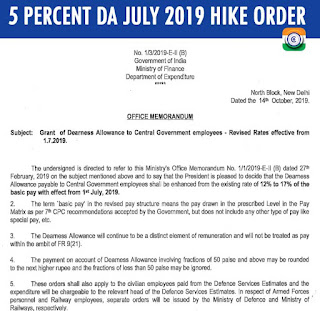
5 Percent DA July 2019 Hike Order - Grant of Dearness Allowance to Central Government employees

Grant of Dearness Allowance to Central Government employees 5 Percent DA July 2019 Hike Order  No. 1/3/2019-E- II (B) Government of...

Blog Archive

About The Author