A complete reference blog for Indian Government Employees

Showing posts with label Pay Commission Report. Show all posts

Saturday, 14 January 2017

Implementation of recommendations of VI CPC - merger of grades-revised classification and mode of filling up of non-gazetted posts-scheme for filling up vacancies after 31/12/2015


NFIR
National Federation of Indian Railwaymen
3, CHELMSFORD ROAD, NEW DELHI - 110 055
Affiliated to :
Indian National Trade Union Congress (INTUC)
International Transport Workers' Federation (ITF)
No. II/2/Part VII
Dated: 09/01/2017
The Secretary (E),
Railway Board,
New Delhi

Dear Sir,
Sub: Implementation of recommendations of VI CPC - merger of grades-revised classification and mode of filling up of non-gazetted posts-scheme for filling up vacancies after 31/12/2015-reg.
Ref: (i) NFIR's letter No. II/2/Part VII dated 19/01/2016.
(ii) Railway Board's letter No. E(NG)I-2008/PM1/15 dated 09/02/2016.

Pursuant to Federation's communication vide letter of even number dated 19/01/2016 on the subject wherein Board was requested to issue instructions extending the validity of the revised classification beyond 31/12/2015, the Railway Board vide letter dated 09/02/2016 though extended the currency of the instructions, but however a restriction has been clamped that the said extension shall be upto 31/12/2016. The said extension period has again expired on 31/12/2016, consequently the processing of promotion of staff has been halted on Zonal Railways etc., from 1st January 2017 onwards.
NFIR, therefore, urges upon the Railway Board to extend the scheme beyond 31/12/2016 for ensuring promotions against vacancies.

Federation may be kept advised of the action taken.
Yours faithfully,
Sd/-
(Dr. M. Raghavaia)
General Secretary
Source: NFIR India
Share:

Friday, 4 March 2016

7th Pay Commission: Government to implement salary hike in FY 2016-17

7th Pay Commission: Government to implement salary hike in FY 2016-17

The Budget documents state that the implementation of the Seventh Pay Commission due from January 1, 2016 is to be implemented during the financial year 2016-17.

“The government has made provisions for the additional liabilities on these count,” it said, without giving the amount allocated for implementation.

With absence of an explicit overall provision for the 7th Pay Commission in budget raising questions, government on Wednesday said the once-in-a-decade pay hike has been built in as interim allocation for different ministries and budget numbers were credible.

Economic affairs secretary Shaktikanta Das said the number cannot be quantified and it has been built up in budget of various ministries. “We cannot really quantify how much we require in 2016-17. Because the Committee of Secretaries have to first give its recommendations, then govt will take a decision and then only we will know what is the requirement in FY17,” he said in New Delhi.

Implementation of the pay commission report is to cost the government Rs.1.02 trillion. “We have the Pay Commission recommendations with us, we have analysed the likely requirement and it has been built into the Budget of various ministries. Some suitable interim provisions have been made,” he said without elaborating.
“Hence the expenditure and revenue numbers are credible.” Das said finance minister Arun Jaitley in his budget speech stated that interim provisions have been made. “And these provisions are there in the Demands for Grants for individual departments and ministries. It is built into and subsumed into those allocations.”
“The Budget reaffirmed the commitment of the government to continue with the process of fiscal consolidation as projected in the Medium Term Fiscal Policy Statement of 2015-16 despite a tough external environment,” the budget documents said. Accordingly, fiscal deficit has been projected at 3.5% of the GDP in 2016-17.

“In accordance with the amended FRBM targets, the fiscal deficit of 3 per cent is projected to be achieved in 2017-18 onwards.” “Keeping in view the challenge of reduction of fiscal deficit by 0.4 per cent of GDP in a difficult year in 2016-17 with substantial additional liabilities on pay revision etc, the government is quite optimistic of fully achieving the fiscal deficit target of 3 per cent or below by March 2018,” the documents said.

With PTI Inputs
Share:

Tuesday, 8 December 2015

Government calls meeting of central secretariat staff today to resolve issues pay commission report

Government calls meeting of central secretariat staff today to resolve issues pay commission report

New Delhi: The government has called a meeting with the all representatives of central secretariat staff today to resolve the protest of staff against the 7th Pay Commission recommendations.

The 7th Pay Commission proposed to restore field staff pay parity with the central secretariat staff for coming under uniform pay package in its 900-page report, the central secretariat staff now get higher pay than field staff.

Unhappy with the recommendations, the representatives of central secretariat staff will meet with senior central government official in North Block on Monday to identify the issue of immediate concern that the Central secretariat brass will take up with the government.

The meeting scheduled to be chaired by Archana Varma, Joint secretary, Department of Personnel and Training (DoPT) would be attended by the representatives of the Associations of Central Secretariat Service (CSS), Central Secretariat Stenographers Service (CSSS) and Central Secretariat Clerical Service (CSCS) as well as Central secretariat Multi Tasking Staff Association representatives.

The Department of Personnel and Training (DoPT) issued above meeting notice on Friday.

The central secretariat staff feel the 7th Pay Commission has lowered their status compared with the field staff in terms of basic pay.

A CCS official said the 7th Pay Commission proposal deprived the staff of central secretariat and the Assistants of the secretariat will get same pay, equivalent to Assistants of field offices.

The Assistants of central Secretariat service now enjoy grade pay Rs 4600 while the Assistants in field offices get pay grade Rs 4200.

The 7th Pay Commission decided similar ranks and salaries for the field staff and central secretariat staff. Hence the commission downgraded grade pay of the Assistants of central Secretariat service from Rs 4600 to Rs 4200.

The recruitment of Assistants in central secretariat and field offices is carried out through a common examination called the Combined Graduate Level Exam (CGLE) on the basis of All India Merit List and there is no difference in the nature of functions discharged by both staff in central secretariat and field offices.
Every pay commission from Fourth Pay Commission to Sixth Pay Commission had recommended for pay parity of Assistants in field offices with Assistants of central secretariat service but the central government had not accepted it. This is elucidated in the table below:

7th Pay Commission Pay Parity


It may be seen from the above table that the recommendations of successive Pay Commissions with regard to pay of Assistants of central secretariat service, even if initially implemented, the central government has invariably modified at a later point and they have been placed at one higher level.

Accordingly, the 7th Pay Commission strongly recommended that the level of Assistants in central Secretariat be brought at par with Assistants in the field offices who are presently drawing Grade Pay 4200.
So, in the new pay matrix the Assistants of both central Secretariat as well as field offices will come to lie in Level 6 in the pay matrix  and pay fixed accordingly. This level corresponds to pre-revised Grade Pay 4200.
The corresponding posts in the Stenographers cadre will also follow similar pay parity between field and central Secretariat staff.

However, the pay of those Assistants and Stenographers who have, in the past, been given higher Grade pay would be protected.

The Commission also recommends withdrawal of non-functional selection grade to Grade Pay 4200 in respect of Upper Division Clerks in central Secretariat, which is not exist in field offices in current  scenario.
The Seventh Pay Commission recommended to make field staff pay parity with central secretariat staff, which has become a bone of contention between both them.

The staff of central secretariat want to enjoy higher salaries and benefits in future like the existing pay structure. Although their salaries and benefits discreased in the proposed structure, the allocation was downgraded one level.

The government may accept  the pay  in Level 7 in the new pay matrix, corresponds to current Grade Pay 4600 for the Assistants of both central Secretariat as well as field offices  as  the dispute between over pay parity is to be permanent settled. 
TST
Share:

Friday, 18 September 2015

Why new Pay Commission report is important?

Why new Pay Commission report is important?

The Seventh Pay Commission report is awaited; it is that time of the decade when Government offices are buzz with expectation and excitement. Revision of salaries of the government employees in the country is a decennial affair. Governments, several of them, have continued with this practice despite the recommendations to the contrary, that is, to reduce the period and have a more frequent pay revision of the government employees. The 7th Pay Commission was appointed in 2014; normally the Commissions have been asked give their reports after due study of pay and allowances of government employees in 18 months. Last month, that is August, the Commission ought to have submitted it’s report.  Revision of pay scales is with effect from 1st. Jan 2016. If there is delay in implementation, which generally is the norm, it will be with retrospective effect without change in the due date.

Starting from the fourth pay commission, award of every commission has bought a virtual bonanza to the employees of the Government. Goa has one of the highest proportion of government employees to population. The all India average relatively is lower. There are 48 lakh Central Government employees and over one crore state and local government staff. Out of a total workforce of 47 Plus crore, almost 44 crore are in the unorganized sector. They are not covered by any Pay Commission; from time to time governments do fix the minimum wage rate which is neither uniform across the country nor is it followed strictly in letter and spirit. Viewed from this perspective, the pay panel’s exercise is not significant.

Yet, the Pay Commission recommendations are important from different perspectives. It has the potential to kick start the economy that has not seen growth revival for quite some time. Latest release of data regarding inflation in the economy indicates the decline of retail inflation for the second successive month. Actually, the WPI is in the red, which is a rare phenomenon.  By putting more money in the hands of the employees, government might succeed in creating more demand for goods and services. With federal states following in the footsteps of the centre, it is likely to sustain the enhanced demand for a longer time. At least with a time lag it is likely to have a rub off effect on pay and allowances in the organized private sector.

Pay and pension of central government employees amount to a full 1% of nation’s GDP. More pay will only further add to the burden of the exchequer. When the last pay commission’s recommendations were implemented, the fiscal deficit doubled to more than 6% in 2008-09.   According to the estimates submitted to the Parliament, government employees are likely to get a pay hike of around 16%. According to an estimate, this would be around 0.2 to 0.3% of GDP. Going by the recommendations of the previous commissions, the average gross increase would be much higher, may even top 40%. The fear of higher fiscal deficit may force the government to effect cuts in spending, with education and healthcare more likely to be the ‘soft’ targets.  This will hurt the poor and lower middle class sections of our society. The government is also likely to go slow on investment in infrastructure; even in normal times government’s expenditure on capital goods is not high. This will impact the recovery process in the economy and adversely impact the GDP growth rate.

Since the appointment of 7th Pay Commission was done well in advance, there is enough lead time for submission of report. Further, if the Government takes an early decision to implement the recommendations of pay revision, it will not have to shoulder the burden of arrears of pay. In all the previous pay commissions, payment of arrears was a huge financial burden; in the last pay commission revision, arrears of salary hikes for up to two years had to be paid by governments.

Apart from pay hike, there are other expectations from this pay panel. Keeping in view the rise in life expectancy and dearth of competent staff, the age of retirement may be tweaked in favour of the employees. Performance-linked pay is another area the commission may take a serious look at. Flexible working hours to facilitate women and persons with certain disabilities deserve consideration by the pay panel.  The recommendations, therefore, are significant and have far-reaching impact.

Source: http://www.navhindtimes.in
Share:

Monday, 20 July 2015

Seventh Central Pay Commission to submit report by October 31

Seventh Central Pay Commission to submit report by October 31

New Delhi: The eyes of the central government employees will be firmly glued on the forthcoming seventh central pay commission reports which is likely to be be submitted by October 31 for implementation from April 2016.

The pay panel is likely to finalise and submit its report on salary and allowance hike by October 31, sources said. The members and officials of the panel had made several field tours and collected valuable suggestions, which are all going to be trashed as the Commission winds up its office within three month.
After getting recommendations, the central government may announce to accept it in the budget 2015-16 to implement it from April 2016.

It is expected that seventh pay panel to suggest hiking the tripled salaries of central government employees.
The salaries of central government employees were roughly tripled with retrospective effect from 1996 and tripled once again with retrospective effect from 2006 by the fifth pay panel and sixth pay panel respectively. This shows the salaries of central government employees have tripled every decade.

According to media report says that investors are expecting car bazar to get a boost from the seventh central pay commission’s recommendations from mid-next year on account of getting arrears of rising salaries of central government employees.

The last Pay Commission report had resulted in car sales rising 18 per cent annually between financial year 2009-10 and financial year 2010-11.

The last pay commission was implemented in August 2008 with retrospective effect from January 2006 which resulted in getting huge salary arrears to central government employees to enable them to purchase car from their arrears on loan basis.

They paid margin amount from arrears and installments from salaries but this pay panel will be implemented from January 2016, hence no such huge arrears will be paid to central government employees this time to pay margin amount for car loan. So car bazar will not get a boost from the seventh central pay commission’s recommendations.

TST
Share:

Tuesday, 14 July 2015

Kerala Pay Commission Report handed over to Government – Download link

Kerala Pay Commission Report handed over to Government – Download link

Kerala pay panel hands over report to govt

Thiruvananthapuram: The Justice C.N. Ramachandran Nair Commission submitted its report recommending a hike in government employees’ salary here today.

Ramachandran Nair handed over the report to Chief Minister Oommen Chandy. The report recommends a hike ranging between Rs 2,000 to Rs. 12,000. It has been recommended that the revision be implemented with effect from July 1, 2014.

Other major recommendations include; promote high school teachers to the post of deputy headmaster on completion of 28 years and bring in a hike of house allowance ranging from Rs 1,000 to Rs 3,000.

The commission recommends a minimum wage of Rs.17,000 and maximum of Rs 1.2 lakh for the employees working under the state government. It suggests that government increase the retiring age to 58 from the present 56. It also proposes to lower the ceiling of minimum service needed for awarding pension from 30 years to 25.

Proposed scale and existing scale in bracket

LD Clerk: Rs 21,000 – 43,000 ( Rs 9,940-15,380); UD Clerk: Rs 26,500 – 53,000 ( Rs 13,210 -22,370); HSA : Rs 30,700 – 62,000 ( Rs 14,620 – 23,480); Last grade: Rs 17,000 – 35,000 (Rs 8,730 – 12,550)
If the government approves it, the recommendations will be implemented with effect from July 2014. The due amounts are likely to be merged with the provident fund.

Source: www.english.manoramaonline.com
Kerala 10th Pay Commission Report – Download link (Official Website of Pay Revision Commission)
Share:

Monday, 6 July 2015

Hike in Retirement age of Kerala State Employees – 10th Pay Revision Commission may recommend to hike to 58 years

Hike in Retirement age of Kerala State Employees – 10th Pay Revision Commission may recommend to hike to 58 years

According to recent reports published in the ‘Manoramaonline’, the 10th Kerala Pay Revision Commission expected to recommend to hike in retirement age for Kerala State Govt employees by two years from 56 to 58.

Kerala may raise retirement age to 58

“Thiruvananthapuram: Increasing the retirement age for Kerala government employees by two years to 58 may be one of the recommendations of the 10th Kerala Pay Revision Commission. The commission, led by Justice C.N. Ramachandran Nair, will submit its report on July 10.

The commission is expected to recommend the increase of retirement age to balance the extra burden on the treasury due to a pay rise across the board. The report recommends a minimum salary of Rs 16,000 and a maximum salary of Rs 1 lakh for employees.

The youth wings of all political parties are against increasing the retirement age in the government service. Even the United Democratic Front government’s policies do not favour later retirement. The retirement age was raised to 56 from 55 during the previous Left Democratic Front rule.

Other recommendations include lowering the minimum eligibility for full pension to 25 years in service from the present 30. Full pension is equivalent to half of the basic pay. The report would also have recommendations intended to raise the efficiency of the employees along with their pay scale.”

Read more at www.english.manoramaonline.com
Share:

Wednesday, 17 June 2015

Pay Commission report to be filed by late June

Pay Commission report to be filed by late June

Even as tenure of the State Pay Commission is drawing to a close on June 30, the Commission is keeping itself on its toes to submit the report in time. The date has not been finalised yet in view of the impending by-election in Aruvikkara.

Since the Commission, headed by Justice C.N. Ramachandran Nair, was unable to take decisions on certain crucial issues, the report carries only recommendations on pay scale and pension of the employees.

The members of the commission had earlier sought to extend the deadline to include recommendations covering all the issues. However, the Justice Ramachandran, and other members of the Commission, K.V. Thomas and T.V. George reached a consensus to file the report in time.

Read more at Manoramaonline
Share:

Featured post

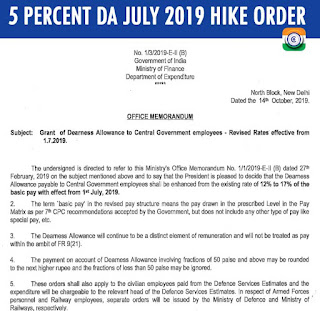
5 Percent DA July 2019 Hike Order - Grant of Dearness Allowance to Central Government employees

Grant of Dearness Allowance to Central Government employees 5 Percent DA July 2019 Hike Order  No. 1/3/2019-E- II (B) Government of...

Blog Archive

About The Author