A complete reference blog for Indian Government Employees

Showing posts with label Arun Jaitley. Show all posts

Monday, 13 February 2017

Central government jobs about 2.83 lakh estimated by 2018


Central government jobs about 2.83 lakh estimated by 2018
As per the budget documents, the workforce of the central government establishments would be 35.67 lakh in 2018

New Delhi: Nearly 2.83 lakh central government jobs are estimated to be generated by next year. This projection has been made in the Union Budget for 2017-18 presented last week by finance minister Arun Jaitley.

As per the budget documents, the workforce of the central government establishments would be 35.67 lakh in 2018, about 2.83 lakh more than the actual head count of 32.84 lakh in 2016. The home ministry will add 6,076 more personnel to take its strength to 24,778 in 2018. About 1.06 lakh more workforce will be added in police departments to take the total head count to 11,13,689 by next year.
The strength of police departments under the central government is 10,07,366, as per the 2016 data. There will be an estimated increase of 2,109 persons in the external affairs ministry as against its actual strength of 9,294 in 2016, it said.

In newly created ministry of skill development and entrepreneurship, the government has estimated to add 2,027 jobs by 2018. Its actual strength in 2016 was 53 only. Minister of state for personnel, public grievances and pensions Jitendra Singh on Sunday said the additional workforce will help in providing more citizen-centric governance.

“The central government is trying to emphasise more on employability of our youths rather then employment. That is why the skill development ministry has been started. It will train more youths to become entrepreneur and be job-ready in changing scenario. “The projection of additional workforce will help in providing more citizen centric governance,” he said.

There would be an estimated 1,045 more staff in 2018 in the ministry of civil aviation from its actual strength of 1,141 in 2016. In the department of posts, there would be 20,442 more workforce from its strength of 4,48,840.

The ministry of environment, forest and climate change will add 2,165 more jobs in next year to take its strength to 5,094. An estimated 91 people will be part of the workforce in the minority affairs ministry in 2018, in addition to its actual strength of 169 in 2016.

The mines ministry will have 1,351 more jobs to take its strength to 9,481 and the department of space will have an estimated 17,894 personnel, 3,068 more than its strength of 14,826. The personnel ministry will have 2,367 more personnel in 2018 than its actual strength of 8,443 in 2016. Whereas, the ministry of water resources, river development and Ganga rejuvenation will have a workforce of 11,407 in 2018, 3,632 more than its actual strength of 7,775 in 2016.

PTI
Share:

Wednesday, 1 February 2017

A simple one- page Income Tax Return form for the category of individuals having taxable income upto Rs 5 lakhs other than business income.


A simple one- page Income Tax Return form for the category of individuals having taxable income upto Rs 5 lakhs other than business income.

"Finance Minister Shri Jaitley said that the present burden of taxation is mainly on honest tax payers and salaried employees who are showing their income correctly. Therefore, post-demonetisation, there is a legitimate expectation of this class of people to reduce their burden of taxation."

Press Information Bureau
Government of India
Ministry of Finance

01-February-2017 14:11 IST

Finance Minister reduces the tax rate from 10 to 5 per cent for individual income between Rs 2.5 to Rs 5 lakh.

Finance Minister appeals to all citizens to contribute to Nation Building by making a small payment of 5 per cent tax if their income is falling in this slab.

A simple one- page Income Tax Return form for the category of individuals having taxable income upto Rs 5 lakhs other than business income


The Union Finance Minister Shri Arun Jaitley reduced the rate of taxation from existing 10 per cent to 5 per cent for individual assesses between income of Rs 2.5 lakhs to Rs 5 lakhs. This would reduce the tax liability of all persons below Rs 5 lakh income either to zero (with rebate) or 50 per cent of their existing liability.

While presenting the General Budget 2017-18 in the Parliament today, the Union Finance Minister Shri Jaitley said that the present burden of taxation is mainly on honest tax payers and salaried employees who are showing their income correctly. Therefore, post-demonetisation, there is a legitimate expectation of this class of people to reduce their burden of taxation. The Finance Minister further said that if a nominal rate of taxation is kept for lower slab, many more people will prefer to come within the tax net. The Finance Minister made an appeal to all the citizens of India to contribute to Nation Building by making a small payment of 5 per cent tax if their income is falling in the lowest slab of Rs 2.5 lakhs to Rs 5 lakhs.

The Union Finance Minister Shri Jaitley said that the Government is trying to bring within tax-net more people who are evading taxes. So, in order to expand tax net, it is decided to have a simple one-page form to be filed as Income Tax Return for the category of individuals having taxable income upto Rs 5 lakhs other than business income. Also, a person of this category who files income tax return for the first time would not be subjected to any scrutiny in the first year unless there is specific information available with the Department regarding his high value transaction.

In his Budget Speech, the Finance Minister further said that in order not to have duplication of benefit, the existing benefit of rebate available to the same group of beneficiaries is being reduced to Rs 2500, available only to assessees upto income of Rs 3.5 lakhs. The combined effect of both these measures will mean that there would be zero tax liability for people getting income upto Rs 3 lakhs per annum. and the tax liability will only be Rs 2,500 for people with income between Rs 3 and Rs 3.5 lakhs. While the taxation liability of people with income upto Rs 5 lakhs is being reduced to half, all the other categories of tax payers in the subsequent slabs will also get a uniform benefit of Rs 12,500 per person. The total amount of tax foregone on account of this measure is Rs 15,500 crore.

In order to make good some of this revenue loss on account of this relief, a surcharge of 10 per cent of tax payable on categories of individuals whose annual taxable income is between Rs 50 lakhs and Rs 1 crore has been proposed. This is likely to give additional revenue of Rs 2,700 crore.

The Finance Minister said that the direct tax proposals for exemptions, etc. would result in revenue loss of Rs 22,700 crore but after counting for revenue gain of Rs 2,700 crore for additional resource mobilisation proposal, the net revenue loss in direct tax would come to Rs 20,000 crore.

PIB
Share:

Sunday, 29 January 2017

GST: Finance Minister may hike service tax to 16-18% in Budget


GST: Finance Minister may hike service tax to 16-18% in Budget

New Delhi: Finance Minister Arun Jaitley may hike service tax rate to 16-18 per cent from the current 15 per cent in the Budget, due on Wednesday, as a precursor to the Goods and Services Tax (GST) rollout.

The move, that will make flying, eating out, phone bills and a host of other services expensive, would be an attempt to take the rates closer to the proposed tax slabs for GST.

GST, which will subsume central and state levies like excise duty, service tax and VAT, is scheduled to be rolled out from July 1.

The tax slabs decided for the GST are 5, 12, 18 and 28 per cent and taking service tax closer to one of the slabs is a logical move in the Budget, tax experts said.

Tax experts say, Jaitley, who had in his previous budget hiked service tax rate by 0.5 per cent to 15 per cent, may raise the levy by at least one percentage point to 16 per cent.

Some others feel there could be different service tax rates with a lower 12 per cent for basic services and a higher 18 per cent for the rest.

Also, a higher service tax for April-June will help the government garner more revenue to meet expenses on schemes and programmes it may be planning to contain the impact of demonetisation.

A service tax rate closer to the GST rate will also help consumers avoid a greater price shock when the new national sales tax is rolled out.

While service tax until now is a central levy, it will be equally split between the Centre and states under the new GST regime. Most services, except essential ones like primary healthcare and basic education, will be covered by GST.

Service tax was budgeted to provide Rs 2.31 lakh crore in 2016-17, more than 14 per cent of the Centre’s total tax revenues of Rs 16.30 lakh crore.

This will be the third time that Jaitley will raise service tax rate. Service tax from June 1, 2015 was hiked from 12.36 per cent to 14 per cent. A 0.5 per cent Swachh Bharat Cess was levied on all services, taking the total incidence of service tax to 14.5 per cent from November 15, 2015.

In the last Budget, he imposed a Krishi Kalyan Cess at the rate of 0.5 per cent on all taxable services to take the levy to 15 per cent.

PTI
Share:

Saturday, 28 January 2017

GST will not lead to job losses at central excise dept, assures Jaitley


GST will not lead to job losses at central excise dept, assures Jaitley

New Delhi: Ahead of the rollout of GST, Finance Minister Arun Jaitley today sought to address concerns of job loss from reduced work of central excise and service tax officials, saying they should have no insecurity as enough work and opportunities will be available to them in the new indirect tax regime.

"I see no reason really for disquiet for the simple reason (that) opportunities which are available to people in service and the matter of policy and constitutional guarantee are all protected," he said at the Investiture Ceremony 2017 and International Customs Day 2017 organised by CBEC here.

Only the nature of activity will change because there will be one national sales tax replacing an array of central and state levies like excise duty, service tax and VAT.

"Important changes and evolutions which take place are never put on the back burner" just because the people who conduct the activity would now have to work in an altered form and environment, he said.

"The number of people required, the kind of opportunity will remain unchanged except that the nature of activity itself changes," he said.

GST, he said, has for last several yeas been considered as a larger part of policy consensus in India and an important taxation reform that will lead to the economic integration of the country.

"Once it takes place you have a situation where taxes (that) are levied by the state (and) by Centre (will) all be integrated into one and therefore resulting in one assessment.

"Multiple systems on assessment which is there at present will evolve into a newer kind of system," he said.

He was responding to Central Board of Excise and Customs (CBEC) Chairman Najib Shah’s remarks drawing his attention to "the rising disquiet in the cadre", saying there were human resource issues in the service.

Jaitley said the revenue to be collected is going to expand and there will be expansion of economic activity as well.

"Therefore even though you have two parallel machineries which could now be converging into similar kind of activities and shared responsibility, I think the future will stand witness to the fact that there will be adequate amount of opportunities to be created and therefore the kind of disquiet in service, the kind of personal pressure I see on you should reduce as there is no real occasion for a fear of this kind or a sense of insecurity for anyone in this service," he said.

The Finance Minister said change and evolution are an integral part of any economic order, and they are never held back because the nature of responsibility is going to change.

"This is an ongoing process it will continue and we will all have to adjust ourselves with this particular change. I can only assure you that there is no reason for disquiet, you can go and have a comfortable sleep tonight,” he told the revenue officials.

Revenue Secretary Hasmukh Adhia told the officers that they will have enough work to do under GST.

The Indian Revenue Service (Customs and Central Excise) Officers Association has asked the government to protect the sanctity of their service amid attempts by officers of state government VAT departments to equate themselves with IRS (Customs and Central Excise) officers.

PTI
Share:

Friday, 27 January 2017

GST - 70,000 Tax Officials warn of non-cooperation movement

GST - 70,000 Tax Officials warn of non-cooperation movement

Opposing some recent decisions taken by GST Council, various indirect tax officials' associations today decided to start non-cooperation movement.

To start with, the employees associations will not celebrate international customs day on Friday. Besides, they will observe 'black day' by wearing black badges on Martyrs' Day, i.E. January 30, as per minutes of meeting held among their representatives here.

The associations said that their members are "highly disappointed" and feel "cheated" over the decisions taken by Finance Minister Arun Jaitley-led GST Council in its meeting on January 16.

The Council had agreed to give states the powers to levy tax on economic activity within 12 nautical miles of territorial waters and to administer 90 per cent of the tax payers under Rs 1.5 crore annual turnover.

"We feel that the biggest tax reform of the century should have been in conformity with the principles of responsibility and authority going together and also in conformity with the Constitutional design. We feel that the decision shall weaken the Centre's ability to ensure its revenues.

"The decision will not only adversely affect the career of revenue officers but it is not in national interest. We oppose the decisions taken by GST Council and requests for deferment and review of above inappropriate and incorrect decisions," as per the minutes of meeting of steering committee of associations representing Group A, B and C employees of Central Board of Excise and Customs (CBEC).

The decision came after a meeting of representatives of Indian Revenue Service (Customs and Central Excise), All India Association of Central Excise Gazetted Executive Officers, All India Central Excise Inspectors' Association and All India Central Excise and Service Tax Ministerial Officers Association, comprising 70,000 personnel, here, office bearers said.
According to them, the decision taken by GST Council in its January 16, meeting will not only weaken the Centre but also adversely affect the Indian economy and revenue collection but also national security.

They have decided to request authorities concerned to take immediate necessary action to resolve the issues and to defer the unjustified decision of GST Council taken under pressure of state VAT officers.

"We feel that if the above genuine demands in national and revenue interest are not considered then this disciplined service will be forced to initiate non-cooperation movement following Gandhian methods of Satyagraha," the associations said.

The Goods and Services Tax (GST) is likely to be rolled out from July 1, as against April 1 decided earlier by the government.

PTI
Share:

Thursday, 19 January 2017

GST: Service tax likely to be hiked to 18 percent this budget


GST: Service tax likely to be hiked to 18 percent this budget

New Delhi: Most services are likely to attract a tax of 18 percent under the Goods and Services Tax (GST) as Union Finance Minister Arun Jaitley presents the Union Budget on February 1.

It will be interesting to witness whether the Centre raises the service tax rate from the existing 15 percent by at least one percentage point to 16 percent as a precursor to the rollout of GST.
However, the Centre and states have agreed to rollout GST from July 1, 2017, after which most services will turn costlier.

Also, a higher service tax, even for three months, will help the Centre partially offset the revenue loss after the GST kicks in, sources indicated.

Under GST, the service tax collections will be divided equally between the Centre and the states. A service tax closer to the GST rate will also help consumers avoid a greater price shock after the new system is rolled out.

Jaitley-headed GST Council has agreed on a four-slab structure -5, 12, 18 and 28 percent-along with a cess on luxury and 'sin' goods such as tobacco.

Within these, two standard rates of 12 percent and 18 percent could extend to a majority of the taxable goods.

ANI
Share:

Thursday, 3 November 2016

GST Council likely to finalise tax rates shortly


GST Council likely to finalise tax rates shortly

New Delhi: The GST Council, which began 2-day deliberations here today, is likely to shortly finalise a 4-tier tax structure with some tinkering of the Centre's proposal.


The Centre has proposed 4-tier tax structure of 6, 12, 18 and 26 per cent, the peak rate being for FMCG and consumer durables.

According to sources, the Council comprising state finance ministers and headed by Union Finance Minister Arun Jaitley may opt for a lower rate of 5 per cent instead of the proposed 6 per cent.

The members may agree to raise the higher slab to 28 per cent rate from the proposed 26 per cent.

They may retain the 12 per cent and 18 per cent rate for certain categories under the Goods and Services Tax regime.

Sources also said that certain states are in favour of 40 per cent tax rate on tobacco.

The meeting will have to sort out the issues concerning tax rate to enable Parliament to approve the Central GST (CGST) and Integrated GST (IGST) legislations in the Winter Session beginning November 16 and pave the way for rollout of the new indirect tax regime from April 1 next year.

A state finance minister said "mood in the meeting is very good" and the Council is expected to seal the rate structure by evening.

On the issue of dual control or cross empowerment, another state minister said that there would be a generic line in the CGST Bill regarding jurisdiction of centre and states on taxes. The final touches would be given by GST Council.

As per the slab proposed the Centre, the items which are currently taxed between 3-9 per cent would fall in the 6 per cent bracket; those in 9-15 per cent range would come under 12 per cent rate.

Those products which are currently taxed between 15-21 per cent would attract 18 per cent levy while those above 21 per cent would be taxed at the peak rate of 26 per cent.
Share:

Thursday, 1 September 2016

Strike September 2 nationwide strike to be bigger than last years: Unions


Sept 2 nationwide strike to be bigger than last year’s: Unions

New Delhi: As many as 10 central trade unions will go ahead with the general strike on Friday saying the government gave no heed to their 12-point charter of demands and is continuing with unilateral labour reforms.

CTUs claimed that over 15 crore workers are likely to participate in the strike and it will be bigger than the one held last year as members of BMS will also support them.

RSS-affiliated Bhartiya Mazdoor Sangh (BMS) is the only major trade union which has opted out of strike – like last year – which was also held on September 2, in view of the assurances given by the government.
“Some leaders of Bmshave decided not to go on strike. But its state units would participate in the strike. Workers will give a befitting reply to the dubious activities inspired by the government,” CITU General Secretary Tapan Sen said here in a joint press conference by 10 CTUs here.

CTUs reiterate the call for countrywide general strike on September 2 against the “anti-worker and anti-people policies” of the government and in view of its “utterly unresponsive and undemocratic attitude”, Sen added.

All India Trade Union Congress (AITUC) Secretary Amarjeet Kaur said the unions view the announcements made by Ministers’ panel, headed by Finance Minister Arun Jaitley, as an eyewash.

“It is like cheating the people,” she said, adding that this time the number will be bigger than 15 crore who participated in the general strike last year and more than 10 states will have bandh-like situation.
Strike is going to be complete in industrial sectors such as transport, financial, power, coal, textile, port and dock, automobile, steel, oil, defence production, scheme, education and Central and State government employees, Kaur added.

Referring to BMS decision not to participate in the strike, Kaur said: “Government has not had a single meeting with the CTUs in over a year and is talking to those (BMS) who have not given a strike notice.”
Indian National Trade Union Congress (INTUC) Vice President Ashok Singh said: “Prime Minister Narendra Modi said his fight is with poverty, but it seems his fight is with the poor in this country. The government’s decision are totally pro-capitalist.”

CTUs expressed dismay over “utterly negative” attitude of the government on basic demands of workers on minimum wages as per consensus formulation of Indian Labour Conference, on universal social security including pension for all workers including those in unorganised sector, among others.
They added that government is dragging its feet over the mass scale contractorisation of permanent and perennial work.

Attacking the government’s initiatives on labour reforms, the unions said: “All these proactive initiatives militate against the basic interests and rights of the working people. Even the non-striking CTU (BMS) also officially recorded its opposition.

PTI
Share:

Wednesday, 31 August 2016

Minimum wage hike for unskilled labourers historic : Arun Jaitley


Minimum wage hike for unskilled labourers historic : Arun Jaitley

NEW DELHI: Finance Minister Arun Jaitley today said the “historic hike” in minimum wages to Rs 350/day is a step forward in transforming India and labour reforms.

To appease trade unions, the government yesterday announced a 42 per cent increase in the minimum wages for unskilled non-agricultural workers to Rs 350 per day from the current Rs 246.

Also, the government employees will be paid a wage bonus as per revised norms, for 2014-15 and 2015-16, a move that will entail a payout of Rs 1,920 crore.

“Historic hike in minimum wages for unskilled non-agricultural workers to Rs 350/day is a step forward in Transforming India and labour reforms,” Jaitley tweeted.

The decision to pay bonus for years 2014-15 and 2015-16 on revised norms reiterates government’s “commitment to work for the benefit of workers”.

Trade unions, which are demanding minimum monthly wage of Rs 18,000 per month or Rs 692 a day and base pension of Rs 3,000 a month have said however that they would go ahead with the day-long strike on September 2.

The strike call is being supported by almost all major labour unions except RSS-affiliated BMS, and may impact banking and insurance services, power supplies and coal mining.

PTI
Share:

Trade unions stick to Sept 2 strike, reject government wage hike

Trade unions stick to Sept 2 strike, reject government wage hike

New Delhi: Trade unions today said they will go ahead with nation-wide strike on September 2, rejecting as “completely inadequate” the government’s 42 per cent hike in minimum wage to Rs 350 per day.

“The government’s minimum wage announcement is completely inadequate. The strike stands and we demand they should enact a Lawto fix minimum (universal) wage,” All India Trade Union Congress General Secretary Gurudas Dasgupta said.

Earlier in the day, Finance Minister Arun Jaitley announced a slew of labour-friendly measures including hiking of minimum wage to Rs 350 a day for unskilled non- agricultural workers for ‘C’ category areas in central sphere.

Calculated monthly, it comes to Rs 9,100 minimum income (for 26 days) which is way below the unions’ demand of Rs 18,000. Initially, the unions had demanded Rs 15,000 as minimum monthly income for daily wagers but the demand was revised after the government accepted the recommendations of the 7th Pay Commission.

Asked whether this will be a benchmark wage for the entire country, Labour Secretary Shankar Aggarwal said that this is for workers in central sphere and states can fix a minimum wage lower or higher than this rate.

Explaining further, Labour Minister Bandaru Dattatreya said that an amendment in the Minimum Wage Act is required for fixing a universal minimum wage and an initiative has been taken in this direction.

“Finance Minister’s statement clearly shows that the government has not considered any of the demands in our 12-point charter. The unions have no other alternative but to fight for their rights,” Indian National Trade Union Congress Vice-President Ashok Singh said.

However, RSS affiliate Bharatiya Mazdoor Sangh has lauded the government’s announcements and decided to abstain from the general strike on September 2.

“We welcome it and are satisfied by the increase in minimum wages. BMS will not participate in the strike,” BMS General Secretary Virjesh Upadhyay said.

PTI
Share:

Tuesday, 30 August 2016

Trade unions stick to Sept 2 strike, reject government wage hike

Trade unions stick to Sept 2 strike, reject government wage hike

New Delhi: Trade unions today said they will go ahead with nation-wide strike on September 2, rejecting as “completely inadequate” the government’s 42 per cent hike in minimum wage to Rs 350 per day.

“The government’s minimum wage announcement is completely inadequate. The strike stands and we demand they should enact a Lawto fix minimum (universal) wage,” All India Trade Union Congress General Secretary Gurudas Dasgupta said.

Earlier in the day, Finance Minister Arun Jaitley announced a slew of labour-friendly measures including hiking of minimum wage to Rs 350 a day for unskilled non- agricultural workers for ‘C’ category areas in central sphere.

Calculated monthly, it comes to Rs 9,100 minimum income (for 26 days) which is way below the unions’ demand of Rs 18,000. Initially, the unions had demanded Rs 15,000 as minimum monthly income for daily wagers but the demand was revised after the government accepted the recommendations of the 7th Pay Commission.

Asked whether this will be a benchmark wage for the entire country, Labour Secretary Shankar Aggarwal said that this is for workers in central sphere and states can fix a minimum wage lower or higher than this rate.

Explaining further, Labour Minister Bandaru Dattatreya said that an amendment in the Minimum Wage Act is required for fixing a universal minimum wage and an initiative has been taken in this direction.

“Finance Minister’s statement clearly shows that the government has not considered any of the demands in our 12-point charter. The unions have no other alternative but to fight for their rights,” Indian National Trade Union Congress Vice-President Ashok Singh said.

However, RSS affiliate Bharatiya Mazdoor Sangh has lauded the government’s announcements and decided to abstain from the general strike on September 2.

“We welcome it and are satisfied by the increase in minimum wages. BMS will not participate in the strike,” BMS General Secretary Virjesh Upadhyay said.

PTI
Share:

Tuesday, 19 July 2016

Seventh pay commission: A Damp squib?

Seventh pay commission: A damp squib?

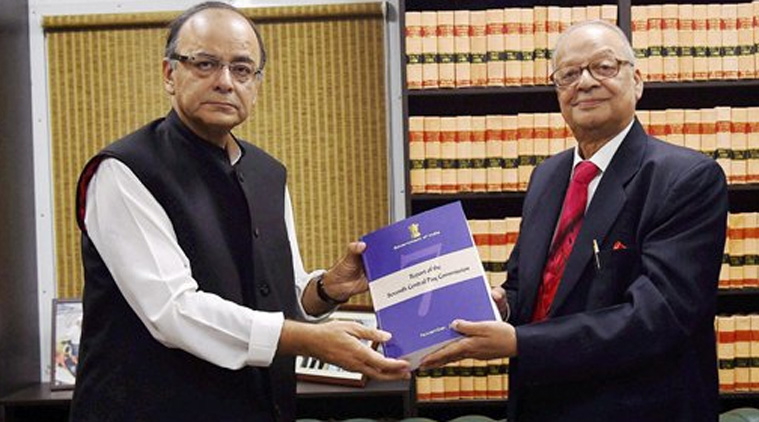
As the NDA government, aims for a double-digit growth trajectory of the Indian economy, a pay hike to almost one crore government employees and pensioners can come handy, as it will push demand. The 7th central pay commission (CPC), submitted its report earlier this year, and finance minister Arun Jaitley welcomed it, terming it ‘historic’. The cabinet accepted the recommendations last month. However, employees are not happy, and have announced plans for a protest strike.

The recommendations by the justice Ashok Kumar Mathur commission for providing a hike of an average 16 percent increase in pay, 63 percent in allowances and 24 percent increase in pension have failed to create excitement.

Officers at higher levels getting better increments are worried about the rising inflation. Moreover, they feel their salaries are not at par with those in the private sector. Meanwhile, the low-rung employees and middle-level officers are unhappy with the wages.

Therefore, soon after the release of the pay commission report, employee unions threatened to go on a nation-wide strike on July 11. Questions have been raised on the calculation of the minimum wage, which as per the latest CPC is Rs 18,000 per month as compared to Rs 7,000 earlier. Almost 33 lakh employees have demanded the minimum wage be increased to Rs 26,000. Undoubtedly, the hike is the lowest in the seven decades.

The strike, though, has been deferred for four months after home minister Rajnath Singh assured them of constituting a high-level committee to look into the demands. A sense of resentment, however, looms over the central government employees, especially among the lower rung.

Jaitley though maintains that the government employees’ salary is higher than the private sector after implementation of the 7th CPC.

“We have semi-skilled workers while private sectors have unskilled labour. Trying to establish the co-relation between the two is not required,” says KKN Kutty, president, Confederation of Central Government Employees and Workers.

“A grade four employee working in a government job hasn’t received enough raise. To their current salary a mere amount of Rs 2,500-3,000 will be added,” says Kutty, who works in the income tax department.
“The calculation of the wages is determined on the basis of the price of 14 commodities, primarily including food items like grains and pulses. In the 7th CPC the price of those commodities has been taken lower than the actual market price.

“The raise is not as it should be,” says Kutty, citing it as a reason for resentment.

A pay commission comes after every 10 years. During their representations before the 7th CPC, Kutty and other central government employees suggested merging dearness allowance (DA) with basic pay, which could give financial benefits to employees. “This was, however, not considered. When we raised the issue, it was said that the commission had already commenced with the work,” he says.

The report prepared on the basis of a study by the Indian Institute of Management-Ahmedabad, calculated the wages by comparing them with the same in the private sector.

“Priority has been given to the corporates in defining our pay scale. It cannot be a prerequisite for our pay scale. The government should have defined our pay scale on the basis of the Aykroyd formula, which reflects the basic average cost of living in the country,” suggests Shiv Gopal Mishra, convener of National Joint Council of Action (NJCA), a platform of several employees unions.

Mishra, who is also the general secretary of All India Railwaymen’s Federation, however, clarifies that 7th CPC is a positive move to boost the economy. “People will start investing in consumer goods like automobiles and electronics, overall pushing the economy,” he says.

Apparently, the CPC is consumer-sentiment driven. It leads to increase in consumption and savings. “When people get more money, it comes back in the system in the form of taxation. Savings will increase… spending will go up,” Arun Jaitley had said while accepting the 7th CPC report.

“There is no sense of excitement among our officers’ group. Though the government has been citing that it will boost economy, we are worried it will raise the inflation rate,” says a senior official in the ministry of agriculture on condition of anonymity.

The CPC is likely to impact the inflation rate. It stood at 5.77 percent in early July as experts warned of a spike in coming months. Still, a good monsoon and improved economy can cushion the inflationary effects.
But civil servants in higher ranks are worried about it.

“The rising consumer demand will not neutralise the inflation rate instead it will stoke the consumer price index. So, until the next pay commission, which will come after 10 years, we will struggle in dealing with the inflation with our current pay package. Inflation eats away minimum wage each year. Therefore, employees at the lower grades will be at the receiving end,” says the senior official.

Vijendra, a grade four employee in the horticulture department of Delhi Development Authority (DDA), says, “I am not happy with the seventh pay commission. Last time we received a hike of almost 50 percent and this year it is somewhere between 14 to 25 percent.”

Meanwhile, the CPC in its report has mentioned that it has attempted to provide wages commensurate with a comfortable living, and it aims to promote efficiency, accountability and responsibility in the work culture.
Vijendra, however, wonders if it possible to create such an environment in the years to come. Clearly, he is hinting that high salary does not guarantee better government services in the coming years.

“The government says they will curb corruption. Is it possible?” Vijendra asks sarcastically.

Via Governance Now
Share:

Sunday, 3 July 2016

Finance Minister Promises 'Minimum Pay' 7th Pay Commission Hikes

Finance Minister Promises 'Minimum Pay' 7th Pay Commission Hikes

New Delhi: Finance Minister Arun Jaitley has promised to consider to hike the minimum pay of central government employees beyond Rs 18,000, a day after the cabinet cleared 7th Pay Commission award for its employees.

Central government employees have been demanding hike in minimum pay since November 19, when 7th Pay Commission headed by Justice A K Mathur submitted its report to Jaitley.

The Finance Minister said he was not ‘rigid’ on the issue and the government will try to rectify some of employees’ demands including minimum pay.

Jaitley met with representatives of central government employees unions at Home Minister Rajnath Singh’s house for two hours till 11pm on Thursday night.

Jaitley, Rajnath Singh and Railways Minister Suresh Prabhu attended the meeting and assured unions leaders of central government employees that their demand would be looked into.

“The minimum pay of central government employees Rs 18,000 was made on recommendations of the 7th Pay Commission. But government will consider hiking it after discussions with all stakeholders,” he said in the meeting.

“Three ministers called us and we met them at Home Minister Rajnath Singh’s house late on Thursday for almost two hours. We have been assured that the minimum pay issue is going to be referred to one of two committees that the government is setting up to rectify any anomalies in the pay commission recommendation implementation,” Shiv Gopal Mishra, General Secretary of the National Joint Council Action (NJCA), a confederation of several central government employees’ unions, told reporters after the meeting.

The council claims a membership of 3.3 million, including the central government employees – Railways, Defence, Postal, Income Tax, Central Customs and Central Excise etc.

NJCA already have rejected Modi government’s overall 23.5 percent pay hike bonanza based on 7th Pay Commission recommendations and would go on indefinite strike from 6 am, 11 July.

They have been demanding Rs 26,000 as minimum pay instead of Rs 18,000 approved by the government based on the 7th Pay Commission’s recommendations.

Mishra also said the Home Minister assured them that “their interaction with us has the blessings of PM Narendra Modi”.

“On minimum pay, we are for a negotiated settlement and it seems there is some consideration at the highest level,” he added.

The increasing the minimum pay will change the salary fitment factor. If the minimum pay is hiked from Rs.18,000 to even Rs.20,000, the fitment factor will be higher than the 2.57 times approved by the government based on the pay commission recommendations.

If the 2.57 fitment formula is tinkered with, then salary and pension in general for all central government employees will go up.

NJCA wrote to all central government employees unions that “government has proposed to refer the issue of minimum pay and fitment factor to a committee for reconsideration. The NJCA will await communication in this regard from the government”.

It said that it will meet on 6 July again to decide on the proposed indefinite strike from July 11.

Source : tkbsen.in
Share:

Friday, 1 July 2016

7th Pay Commission might be issued next week and the government employees will start receiving new pay cheques

7th Pay Commission might be issued next week and the government employees will start receiving new pay cheques

'Notification on ‘7th Pay Commission’ next week’

New Delhi: The notification on 7th Pay Commission might be issued next week and the government employees will start receiving new pay cheques from this month.

The top Finance Ministry officials on Thursday said that notification in this regard is expected to be issued next week.

The union cabinet had on Wednesday approved the he long-awaited 7th pay commission Report’s recommendations hiking salaries of central government employees as well as pensions.

Initially, the public servants will be able to draw the hiked part of their basic pay and they will start receiving the hiked allowances five to six months later.

For example, employees belonging to the minimum pay of the existing 6th Pay Commission scale had so far been drawing a Rs 7,000 basic salary plus allowances. From July, their basic pay will rise to Rs 18,000, but their allowances will remain the same until the committee headed by the Finance Secretary to announce new allowances.

The officials said since the pay scale will be made effective retrospectively from January 1 this year, the public servants will be able to claim their arrears from the day after the notification is issued.

After the cabinet meeting, the Finance Minister Arun Jaitley said government salaries have to be competitive with the private sector, for which the Commission had engaged IIM-Ahmedabad to make the comparison.

“This will attract best talent in the government sector,” said the minister.

However, as per the cabinet approval, the minimum pay is now Rs 18,000 and maximum is Rs 2.5 lakh, but ideally the minimum should have been 1/10th of the maximum, the employees’s union leaders claimed.

The Cabinet ditto with the 7h Pay Commission recommendations, the commission recommended 23.55 per cent hike in salaries, allowances and pensions and a 14.27 per cent increase in basic pay for Central government employees, the lowest in 70 years.

The central government employees are in for disappointment as the cabinet approved a 14.27 per cent hike in basic pay, which is significantly lower than what the 6th pay commission had recommended. Sixth Pay Commission had recommended a 20 per cent hike in basic pay which the government doubled while implementing it in 2008.

The Congress and the Left parties Thursday came out in support of the indefinite strike from July 11 call given by central government employees’ unions to protest the “inadequate” hike in their salaries. While the Congress said the hike was the worst in the last 70 years, the CPM said it was “disappointing.”
Share:

Monday, 27 June 2016

7th Pay Commission: Rs 70,000 cr allocated for its implementation in Budget 2016

7th Pay Commission: Rs 70,000 cr allocated for its implementation in Budget 2016

7cpc-arun-jaitley


7th pay Commission: “We have provisioned for around 60-70 per cent of the total burden that was talked about,” a finance ministry official said. Around Rs 70,000 crore has been provisioned in the Union Budget 2016-17 for the implementation of the Seventh Pay Commission for government employees, a finance ministry official said.

While there’s no explicit overall provision number, the government had said the Seventh Pay Commission hike has been built in as interim allocation for different ministries.

“We have provisioned for around 60-70 per cent of the total burden that was talked about,” a finance ministry official said.

The Budget document states that “the implementation of the Seventh Pay Commission due from January 1, 2016 is to be implemented during 2016-17 fiscal as also the revised One Rank One Pension (OROP)scheme for Defence services.”

The finance ministry has provisioned for this in the Demands for Grants for individual departments and ministries. It is built into and subsumed into those allocations.

In January, the government had set up a high-powered panel headed by Cabinet Secretary P K Sinha to process the recommendations of the Seventh Pay Commission, which will have bearing on the remuneration of 47 lakh central government employees and 52 lakh pensioners.

The Empowered Committee of Secretaries will function as a Screening Committee to process the recommendations with regard to all relevant factors of the Commission in an expeditious detailed and holistic fashion.

Faced with the burden of Pay Commission recommendations, there were concerns on whether the government would be able to stick to the fiscal deficit target of 3.9 per cent for 2016-17. However, in Budget Union Finance Minister Arun Jaitley removed all doubts and promised to adhere to the fiscal consolidation roadmap and stick to the 3.9 per cent deficit target. (With PTI inputs)

Read at: Indian Express
Share:

Saturday, 18 June 2016

7CPC: Good news for government employees! Secretary Panel submits report; recommendations implementation soon

7CPC: Good news for government employees! Secretary Panel submits report; recommendations implementation soon

New Delhi,  There is a good news for central government employees who have been ardently waiting for the implementation of 7th Pay Commission. According to a Dainik Jagran report, “The Cabinet Secretary met the PMO officials on Wednesday and apprised them about the secretaries panel’s recommendations on the salary and allowances hike recommended for central government employees.

The secretaries panel reviewing the 7th pay commission’s recommendations have submitted its report to the Finance Ministry. The Finance Ministry will prepare a note and present it before the Cabinet in the next 15 days.” Whereas according to a India.com report, “The 13-member Committee of Secretaries headed by the Cabinet Secretary Pradeep Kumar Sinha is likely to submit its final report on the recommendations proposed by the 7th Pay Commission on June 18. After panel submits its report, Cabinet is expected to give the green signal for implementation of the revised recommendations. However the government is planning to implement the recommendation made by the 7th Pay Commission regarding the salary hike of government employees from August 1.” According to latest reports, Government staff will get their six months arrears in one installment in the month of October. It is being said that Government will implement Seventh Pay Commission most likely from July. Employees will get increased payout in their July salary and it will be credited in their account on August 1. The recommendations when implemented would have bearing on remuneration of 47 lakh central government employees and 52 lakh pensioners. Subject to acceptance by the government, the recommendations will take effect from January 1, 2016.

OneIndia News
Share:

Sunday, 22 May 2016

7th Pay Commission: Government doctors threaten to go on strike want better salary, allowances

7th Pay Commission: Government doctors threaten to go on strike; want better salary, allowances

7th Pay Commission government doctors strike

The Seventh Pay Commission be implemented anytime now but before that everyone wants their demands to be met in regards with the allowances and wages. If reports are to be believed then, the doctors working in government hospitals in Delhi may go on strike if the Modi government does not meet their demands in connection with the seventh pay commission.

Government is deciding our pay scale, and does not even bother to listen to our demands. They do not even give us appropriate representation in the committee. While no doctor likes to go on strike, we will do exactly so if the existing recommendations of the 7th Pay commission are given a go ahead," Dr Pankaj Solanki, President, Federation of resident doctors association (FORDA) was quoted as saying in a ZeeNews report.

The report further adds, "FORDA is a body of 15000 resident doctors in the capital, and have said that government doctors from other organisations and states have shown their inclination towards the strike opposing the recommendations of the seventh pay commission." Doctors have said that either their demands be met by the end of or they will go on an indefinite strike. Earlier, the central government employees had also said that they are planning to strike work on July 11 so that they get higher wages and allowances under the 7th Pay Commission.

The central government employees lead by the National Council (Staff Side) Joint Consultative Machinery have also said that they will not accept unilateral decision on salary hikes under the seventh Pay Commission and would like to have more say in the way their monthly salaries and allowances are shaped up by the Empowered Committee of Secretaries.

Via OneIndia News
Share:

Wednesday, 18 May 2016

Finmin constitutes Fiscal Responsibility and Budget Management panel, N K Singh to be chairman

Finmin constitutes Fiscal Responsibility and Budget Management panel, N K Singh to be chairman

The Union Finance Ministry on Tuesday constituted a five member Fiscal Responsibility and Budget Management (FRBM) panel.

The panel would be headed by former Revenue and Expenditure Secretary and Member of Parliament N K Singh. Former Finance Secretary Sumit bose, Chief Economic Advisor Arvind Subramanian, Director of National Institute of Public Finance and Policy Rathin Roy and Deputy Governor of RBI Urijit Patel will be its members.

The panel will examine fiscal deficit range instead of fixed targets and look into feasibility of fiscal expansion or contraction in relation to credit expansion and contraction.

The FRBM Act deals with matters of fiscal discipline, such as spending and deficit, along with management of macro-economic factors and public funds.

The FRBM committee would submit its report to the government by October 31.

The panel, which was announced by Union Finance Minister Arun Jaitley in his Budget speech, will look into factors that influence the country’s fiscal targets.

ANI
Share:

Monday, 29 February 2016

Union Budget 2016-17: I-T slabs remain unchanged

Union Budget 2016-17: I-T slabs remain unchanged
HRA deduction increased to Rs. 60,000 per annum; 40% of withdrawal under NPS to be tax exempt; additional exemption for housing loans.
union-budget-2016-17-higlights

Finance Minister Arun Jaitley presents his third Union Budget. With an eye on supporting the small tax-payer and the small investor, the Minister announced a slew of schemes, and income tax exemptions.

As it happened:

12.41 p.m.: Finance Minister Arun Jaitley tables the Union Budget 2016 and the Finance Bill.
12.40 p.m.: Rs. 1,060 crore revenue loss through direct tax proposals, and Rs. 20,670 crore revenue gain through indirect tax proposals. Revenue gain of Rs 19,600 crore in Union Budget 2016 proposals.
12.39 p.m.: 13 different cesses levied by various ministries with collections less than Rs.50 crore a year to be done away with.
12.38 p.m.: No Service Tax for houses built under 60 square metres.
12.35 p.m.: Excise duty on tobacco increased by 10-15 per cent.
12.34 p.m.: Committed to stable taxation regime. No more retrospective amendments.
12.29 p.m.: 4% high capacity tax for SUVs.
12.28 p.m.: Limited period compliance window for domestic taxpayers to declare undisclosed income. Declarations to have immunity from prosecutions.
12.26 p.m.: No changes have been made to existing income tax slabs.
12.25 p.m.: Infrastructure and agriculture cess to be levied.
12.23 p.m.: 1 per cent service charge on purchase of luxury cars over Rs. 10 lakh and in-cash purchase of goods and services over Rs. 2 lakh.
12.22 p.m.: Additional exemption of Rs. 50,000 for housing loans up to Rs. 35 lakh, provided cost of house is not above Rs. 50 lakh.
12.20 p.m.: 40% of withdrawal at the time of retirement under National Pension Scheme to be tax exempt.
12.19 p.m.: Tax holiday for startups for three of five years of setting up the company
12.13 p.m.: Lowering of Corporate IT rate for companies not exceeding Rs. 5 crore turnover to 25% plus surcharge.
12.09 p.m.: People with income less than Rs 5 lakh to get deduction of Rs 5,000, up from Rs 2,000 last year. HRA deduction up from Rs. 24,000 to Rs. 60,000 p.a.
12.08 p.m.: Rs. 100 crore for Deendayal Upadhyay’s birthday celebrations and Guru Gobind Singh 300th birth anniversary.
12.07 p.m.: Classification of expenditure as plan and non-plan to be done away with.
12.06 p.m.: Govt plans to spend Rs 19.78 lakh crore in 2016-17 — Rs 5.5 lakh crore under plan head, Rs 14.28 lakh crore under non-plan head.
12.06 p.m.: Fiscal deficit at 3.5% of GDP in 2016-17.
12.04 p.m.: A bill on targeted delivery of financial services using Aadhar to be introduced.
12.03 p.m.: Amendment to the Companies Act to ensure speedy registration and boost start-ups.
12.02 p.m.: Rs. 900 crore for buffer stock of pulses.
12.01 p.m.: Dept of Disinvestment renamed as Dept of Investment and Public Asset Management.
12 noon: Direct Benefit Transfer for fertiliser subsidy.
11.59 a.m.: EPF at 8.33 per cent for new employees joining the scheme.
11.58 a.m.: Rs. 25,000 crore for recapitalisation of public sector banks. General insurance companies owned by the govt to be listed in stock exchanges.
11.56 a.m.: Amendmends to boost Asset Reconstruction Companies to manage NPAs of public sector banks.
11.55 a.m.: RBI Act to be amended to set up monetary policy committee.
11:53 a.m.: 100% FDI through FAPB route in marketing of food products produced and manufactured in India.
11.49 a.m.: Total outlay on infrastructure in 2016-17 is Rs. 2,21,246 crore
11.47 a.m.: In the power sector, the govt is drawing up a plan for 15-20 years to augment investment in nuclear power. Rs. 3,000 crore per annum for this.
11.45 a.m.: There are 160 airports and airstrips which can be revived.
11.44 a.m.: Motor Vehicles Act to be amended to enable entrepreneurship in the road transport sector.
11.43 a.m.: Total outlay for infrastructure is at Rs. 2.31 lakh crore.
11.42 a.m.: Rs. 97,000 crore for all roads. Total outlay on roads and rails will be Rs. 2.80 lakh crore. 10,000 km of national highways in 2016-17 and 50,000 km state highways to be converted to NH roads.
11.41 a.m.: More than 70,000 road projects were languishing at the beginning of the year. Nearly 85% of these projects have been put back on track.
11.39 a.m.: Small shops should be given the choice to remain open on all 7 days a week.
11.37 a.m.: Rs. 1,700 crore for 1500 multi-skill development centres.
11.35 a.m.: 10 public and 10 private educational institutions to be made world-class. Digital repository for all school leaving certificates and diplomas. Rs. 1,000 crore for higher education financing.
11.34 a.m.: Hub to support SC/ST entrpreneurs.
11.33 a.m.: National dialysis service programme under PPP model. LPG connection for women members of rural homes.
11.30 a.m.: Government to provide health insurance of upto Rs. 1 lakh per family; top up of Rs. 35,000 for people above 60 years. 3,000 stores to be opened for generic drugs.
11.30 a.m.: Total rural sector allocation Rs. 87,769 crore.
11.27 a.m.: Two schemes for digital literacy for rural India to cover 6 crore households in the next three years.
11.26 a.m.: Rs. 9,000 crore for Swachch Bharat Abhiyan.
11.25 a.m.: 5,542 villages have been electrified, more than the last three years combined.
11.24 a.m.: Rs. 38,500 crore for MNREGA. Highest ever for the rural employment scheme.
11.23 a.m.: Rs. 2.87 lakh crore for gram panchayats as per recommendation of 14th finance commission.
11.22 a.m.: Four schemes for animal welfare.
11.19 a.m.: Agricultural credit target of Rs. 9 lakh crore. Govt to allocate Rs 5,500 crore for crop insurance scheme.
11.19 a.m.: Unified e-platform for farmers to be inaugurated on Ambedkar’s birthday.
11.17 a.m.: Paramparagat Krishi Vikas Yojana to bring 5 lakh acres under organic farming.
11.14 a.m.: 28.5 lakh hectares to be brought under irrigation.
11.13 a.m.: Govt will reorganise agricultural policy to double farmer income in five years.
11.11 a.m.: Jaitley announces the nine pillars of his Budget — Agriculture and farmers’ welfare, rural sector, social sector including healthcare, education, skills and job creation, infrastructure, financial sector reforms, ease of doing business, fiscal discipline, tax reforms to reduce compliance burden.
11.11 a.m.: New scheme for BPL families for gas connections. Staturtory backing for Aadhaar platform to ensure delivery of benefits.
11.10 a.m.: CAD is 1.4% of GDP.
11.10 a.m.: FY 16-17 will have the additional burden of implementing the VII pay commission and the defence OROP.
11.08 a.m.: FY 15-16 and 16-17 will be challenging for the government.
11.07 a.m.: Forex reserves are at the highest ever levels — $350 billion.
11.05 a.m.: GDP growth has accelerated to 7.6%. CPI inflation has come down to 5.4%.
11.05 a.m.: Mr. Jaitley says the Indian economy has held strong despite a global slowdown.
11 a.m.: Arun Jaitley rises to present the Budget.
10:46 am: Mr. Jaitley’s Budget speech to begin in 15 minutes.
10:43 am: Union Cabinet clears General Budget for 2016-17.
10:29 am: Cabinet meeting in Parliament ends.
10:05 am: The Sensex falls 59 points in early trade on reduced bets by cautious retail investors amid continued capital outflows by foreign funds ahead of the Budget. More…
9:53 am: Pre-Budget Cabinet meet to begin shortly.
9:40 am: Mr. Jaitley, MoS Jayant Sinha arrive in Parliament.
9:19 am: The stock markets don’t seem very enthused ahead of the Budget — Sensex opens 38.86 points lower, currently at 23,115.44.
9:10 am: The Budget may be given a dash of green with many environment-friendly measures to reduce the carbon footprint, official sources tell The Hindu. The budget is likely to provide incentives to encourage local manufacture and Research & Development (R&D) of electric vehicle components, including lithium-iron batteries.
9:00 am: About 8.5 crore employees whose retirement savings are managed by the Employees’ Provident Fund Organisation (EPFO) could get an option to transfer over a third of their EPF contributions to the National Pension System, regulated by the Pension Fund Regulatory and Development Authority or PFRDA. Read more…
8:54 am: How well do you know your budget history? Here are 11 landmark Union Budgets that you should know about.
8:45 am: Here’s a ready reckoner for some of the terms that will be a part of Mr. Jaitley’s long speech, that some of us may not be familiar with.
8:30 am: How long will this year’s Budget speech be? Which Finance Minister holds the dubious honour of presenting the longest budget speech, in terms of word count? Here’s a clue: it was an 18,650-word speech given 25 years ago!
8:00 am: Budgets are about numbers and best understood using charts and graphics. In case you missed it, here are the highlights of the previous Budget, captured in eight interactive charts.
7:30 am: The event provides us an opportunity to reflect on the proposals and promises that were made during last year’s Budget. We looked at some of them and checked the status of their implementation. Here’s what we found.
7:00 am: Here’s some interesting information. For Budget 2016-17, the government invited suggestions from citizens through Twitter for the first time, even conducting a series of polls to gauge public priorities and expectations from the Budget.

Source: The Hindu
Share:

Limit of Deduction of Rent Increased from Rs.24,000 to Rs.60,000

Limit of Deduction of Rent Increased from Rs.24,000 to Rs.60,000
100% Deduction of Profits for 3 out of 5 Years for Start-Ups

Withdrawal upto 40% of the Corpus to be Tax-Free at the time of Retirement

Deduction of Additional Interest of Rs.50,000 Per Annum for First-Time Home buyers
New Dispute Resolution Scheme to be Introduced

Thirteen Cesses Levied by Various Ministries having Revenue Collection less than Rs.50 Crore to be Abolished

‘E-Sahyog’ and ‘E-Assessment’ to be Expanded Further

100% Deductions for Profits to an undertaking in Housing Project for Flats up to 30 Sq. Mtrs.
The Union Finance Minister Shri Arun Jaitley said that taxation is a major tool available to government for removing poverty and inequality from the society. He enlisted 09 categories of thrust in his text proposals which include (1) Relief to small tax payers (2) Measures to boost growth and employment generation (3) Incentivizing domestic value addition to help Make in India (4) Measures for moving towards a pensioned society (5) Measures for promoting affordable housing (6) Additional resource mobilization for agriculture, rural economy and clean environment (7) Reducing litigation and providing certainty in taxation (8) Simplification and rationalization of taxation (9) Use of technology for creating accountability.

Announcing relief to small tax payers Shri Jaitley proposed to raise the ceiling of tax rebate U/s. 87A from Rs.2000 to Rs.5000. With this, individuals having income up to Rs.5 lakh will get a relief of Rs.3000 in their tax liability. He also proposed to increase the limit of deduction of rent paid U/s.80 GG from Rs.24,000 per annum to Rs.60,000 to provide relief to those who live in rented houses. Shri Jaitley proposed to increase the turnover limit under presumptive taxation scheme U/s.44 AD of the Income Tax Act to Rs.2 Crores from existing limit of Rs.1 Crore which will benefit more than 30 lakh small business people. He also proposed to extend the presumptive taxation scheme with profit deemed to be 50%, to professionals with gross receipts up to Rs.50 lakh.

PIB
Share:

Featured post

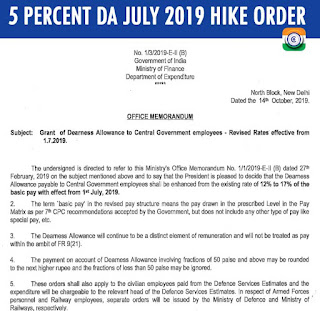
5 Percent DA July 2019 Hike Order - Grant of Dearness Allowance to Central Government employees

Grant of Dearness Allowance to Central Government employees 5 Percent DA July 2019 Hike Order  No. 1/3/2019-E- II (B) Government of...

Blog Archive

About The Author