A complete reference blog for Indian Government Employees

Showing posts with label 7th CPC Latest News. Show all posts

Wednesday, 2 November 2016

7th Pay Commission Latest News: No 'Achhe Din' for govt employees, no hike in basic pay, fatter allowances likely

7th Pay Commission Latest News: No 'Achhe Din' for govt employees, no hike in basic pay, fatter allowances likely

It simply means, the National Anomaly Committee or Committee on Allowances won't suggest or approve any changes in the basic pay or allowance against the recommendations of the 7th Pay Commission.

The ‘Committee on Allowances’, headed by Finance Secretary Ashok Lavasa, is yet to submit its report on fatter allowances recommended by the 7th Pay Commission, however the Finance Ministry sources said the government won’t consider any change in 7th Pay Commission recommendations. Sources confirmed that there will be no changes in basic pay and allowances recommended by the 7th Pay Commission. It simply means, the National Anomaly Committee or Committee on Allowances won’t suggest or approve any changes in the basic pay or allowance against the recommendations of the 7th Pay Commission.

Sources in the Finance Ministry have made it clear that the National Anomaly Committee on behalf of the government won’t consider any hike in basic pay and fatter allowances recommended by the 7th Pay Commission. The latest development contradicts with what Union Finance Minister Arun Jaitley had promised. Those who will hope over these issues will gain nothing but no change on 7th Pay Commission recommendations of pay scales and allowances are very much possible, said sources.

Finance Minister Arun Jaitley had promised the government would consider the demand of an increase in basic pay and allowances of the central government employees. The government had said it will form a High Level Committee to review the new pa scales. However no such committee has been formed till date. Instead, the government formed a 22-member National Anomaly Committee headed by Secretary, Department of Personnel and Training (DoPT) to look into various pay related anomalies arising out of the implementation of the 7th Pay Commission’s recommendations.

Sources said the government has decided to stick to the recommendations of the 7th Pay Commission on basic pay and allowances. They also confirmed that the ‘Committee on Allowances’ won’t suggest any hike and is likely to stick with the recommendations of the 7th Pay Commission. The 7th Pay Commission notification confirmed that central government employees will get 14.27 per cent hike in basic pay at junior levels, which is the lowest in 70 years. The Cabinet also approved the increase in minimum pay Rs 18,000 from existing Rs 7,000. The 7th pay commission had recommended abolition of 51 allowances and subsuming 37 others out of 196 allowances.

Source: india.com
Share:

Tuesday, 16 August 2016

7th Pay Commission latest news: Gratuity limit increased to Rs 20 lakh from Rs 10 lakh

7th Pay Commission latest news: Gratuity limit increased to Rs 20 lakh from Rs 10 lakh

gratiuty-7th-pay-commission


The Central Government has unanimously increased the gratuity limit of more than 47 lakh employees to Rs 20 lakh from Rs 10 lakh. This news brings a smile on Central Government employees as they will get more money for their retirement and will also help them to shape their future plan in a much organised way. Under the 7th Pay Commission, IAS officers to peons all will get enhanced salaries with arrears on September 1. The Narendra Modi government has not yet decided to increase salaries of 14 lakh strong armed forces.

The implementation of 7th Pay Commission is a burden of Rs 1.02 lakh crore on Indian exchequer. Experts believe that Indian economy has been showing “bright” near-term prospects, but reducing fiscal deficit to 3.5% of GDP in 2016-17 is a challenge because of additional liabilities on account of pay revision.

After the Central Government employees union had threatened to carry out an indefinite strike, Centre had set up a high-level committee, comprising of Health, Defence and Home Secretaries. The committee will also look into the demands made by National Joint Action Committee (NJAC) which wants the minimum salary to be scaled up to Rs 26,000, rather than Rs 18,000, which has been currently proposed.

On June 29, the 7th Pay Commission recommendations were accepted by Union Cabinet. Although the basic salary was hiked by 14.3 per cent, the hike in allowances was withheld due to the various anomalies.
Meanwhile, reports suggest that the government employees would also be paid arrears in one-time installment through their salaries in the upcoming months.

Source : India.com
Share:

Sunday, 24 July 2016

7th CPC Notification – CG employees are Expecting Eagerly

7th CPC Notification – CG employees are Expecting Eagerly


It is expected that Finance Ministry will issue necessary order and Notifications to implement the 7th Pay Commission recommendations as soon as possible.

7th Pay Commission is become interesting news for not only CG employees but the people across the country. Very important reason for this is Press Media. Every day at least one Daily writes an Article about 7th CPC news based on hearsay and it never missed to attract everyone.

To defuse the Indefinite strike called by NJCA , the Central Government assured NJCA that the Govt will constitute four committees to look into the important demands raised by NJCA. Based on the Press release issued by Finance Ministry, NJCA decided to defer the Indefinite Strike.

Though there are 26 Demands placed before the government, the issues of Minimum Pay, Fitment factor and HRA are mostly expected to be settled.

How much it will be increased from 18000 is the main point of discussion among CG employees and it is noteworthy that Govt also approved the uniform Fitment factor 2.57 to All grades as recommended by 7th Pay Commission.

In case the Proposed Committee recommends to increase the Minimum Pay to 19000 or more than this, subsequently Fitment factor also may be revised. As recommended by 7th Pay commission, the Committee also can use the following method to arrive the Fitment factor as per the increase in Minimum Pay

18000/7000 = 2.57
19000/7000 = 2.71

20000/7000 = 2.85
21000/7000 = 3.00

If the Minimum Pay is increased, the Fitment factor also has to be increased. Based on the New Fitment factor, the existing pay of CG employees will be revised.


For example If, Basic Pay of a Govt Servant is Rs.10000(including Grade Pay of Rs.1900), His revised pay as per 7 th CPC will be 10000 x 2.57 = 25700 ( to be fixed as 26000 as per Pay Matrix Table)

As per the above fitment factors, the Basic Pay will be revised like this..

10000 x 2.71 =27100
10000 x 2.85 = 28500
10000 x 3 = 30000

From the above example it is obvious that Pay matrix also to be modified as per fitment factor.

There is also expectation on HRA that the 7th CPC recommended rates i.e 8%, 16% and 24% would be restored to the existing rates of 10, 20 and 30 percent respectively.

In the meantime, everybody is thinking about what are all the Provisions are incorporated in the 7th CPC Notification. We will have to wait to see the impact of the Notification to be issued by Finance ministry amidst expectations and doubts.

Share:

Monday, 18 July 2016

7th CPC latest news: From August 1 Central Government employees will get 14.27% hike in basic pay, not overall 23.5%

7th CPC latest news: From August 1 Central Government employees will get 14.27% hike in basic pay, not overall 23.5%
 
The Central Government are also considering the demand made by employees union leaders to increase minimum wage from Rs 18,000 to Rs 26,000.

New Delhi, July 17: The much awaited hiked salary of Central Government employees will be credited to their official salary account bu August 1, 2016, as the recommendations made by 7th Pay Commission was approved on June 29 by Narendra Modi government. More than 47 lakh Central Government employees eagerly waiting for the hike will get 14.27 per cent hike in the basic pay and not 23.5 per cent. The hike in allowance has been delayed by at least four months. For which the government has formed a high level committee headed by Finance Minister Ashok Lavasa to re-examine the hike in HRA, NP, DA and many other allowances for the employees.

As per reports, the salaries government employees would receive from August 1, would be hiked by 14.27 per cent, without any allowances. Which technically makes it a lowest ever salary hike implemented by any Pay Commission since independence. On June 29, Central government had set up a high level committee to examine the anomalies in the 7CPC recommendations related to allowances. The committee will also consider the demand made by Central Government Employees Union leaders to increase minimum wage from Rs 18,000 to Rs 26,000.

The implementations of 7CPC which was done almost six months after Justice A K Mathur and his team submitted its findings and it will positively impact a total of 47 lakh central government employees, along with 53 lakh pensioners. The notification of the salary hike will be issued by the government by the end of this week.

Source: India.com
Share:

Thursday, 30 June 2016

7th Pay Commission calculator to highlights, here’s all you want to know

7th Pay Commission calculator to highlights, here’s all you want to know

The 7th Pay Commission report recommendations have been cleared today by the Cabinet. Earlier in its report, in November last year, the commission itself had recommended 14.27 per cent hike in basic pay at junior levels, the lowest in 70 years.

Here are the 7th Pay Commission report highlights:

1. Recommended Date of implementation: 01.01.2016

2. Minimum Pay – Calculator: Based on the Aykroyd formula, the minimum pay in government is recommended to be set at Rs 18,000 per month.

3. Maximum Pay: Rs 2,25,000 per month for Apex Scale and Rs 2,50,000 per month for Cabinet Secretary and others presently at the same pay level.

4. Financial Implications:
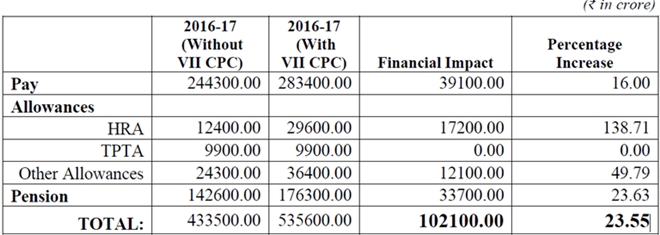
a) The total financial impact in the FY 2016-17 is likely to be Rs 1,02,100 crore, over the expenditure as per the ‘Business As Usual’ scenario. Of this, the increase in pay would be Rs 39,100 crore, increase in allowances would be Rs 29,300 crore and increase in pension would be Rs 33,700 crore.

b) Out of the total financial impact of Rs 1,02,100 crore, Rs 73,650 crore will be borne by the General Budget and Rs 28,450 crore by the Railway Budget.

c) In percentage terms the overall increase in pay & allowances and pensions over the „Business As Usual‟ scenario will be 23.55 percent. Within this, the increase in pay will be 16 percent, increase in allowances will be 63 percent, and increase in pension would be 24 percent.

d) The total impact of the Commission‟s recommendations are expected to entail an increase of 0.65 percentage points in the ratio of expenditure on (Pay+Allowances+ Pension) to GDP compared to 0.77 percent in case of VI CPC.
5. New Pay Structure: Considering the issues raised regarding the Grade Pay structure and with a view to bring in greater transparency, the present system of pay bands and grade pay has been dispensed with and a new pay matrix has been designed. Grade Pay has been subsumed in the pay matrix. The status of the employee, hitherto determined by grade pay, will now be determined by the level in the pay matrix.

6. Fitment: A fitment factor of 2.57 is being proposed to be applied uniformly for all employees.

7. Annual Increment: The rate of annual increment is being retained at 3 percent.

8. Modified Assured Career Progression (MACP):
a. Performance benchmarks for MACP have been made more stringent from “Good” to “Very Good”.
b. The Commission has also proposed that annual increments not be granted in the case of those employees who are not able to meet the benchmark either for MACP or for a regular promotion in the first 20 years of their service.
c. No other changes in MACP recommended.
9. Military Service Pay (MSP): The Military Service Pay, which is a compensation for the various aspects of military service, will be admissible to the Defence forces personnel only. As before, Military Service Pay will be payable to all ranks up to and inclusive of Brigadiers and their equivalents. The current MSP per month and the revised rates recommended are as follows:

7th Pay Commission Report

Present
Proposed
i.Service OfficersRs 6,000Rs 15,500
ii.Nursing OfficersRs 4,200Rs 10,800
iii.JCO/ORsRs 2,000Rs 5,200
iv.Non Combatants (Enrolled) in the Air ForceRs 1,000Rs 3,600

10. Short Service Commissioned Officers: Short Service Commissioned Officers will be allowed to exit the Armed Forces at any point in time between 7 and 10 years of service, with a terminal gratuity equivalent of 10.5 months of reckonable emoluments. They will further be entitled to a fully funded one year Executive Programme or a M.Tech. programme at a premier Institute.

11. Lateral Entry/Settlement: The Commission is recommending a revised formulation for lateral entry/resettlement of defence forces personnel which keeps in view the specific requirements of organization to which such personnel will be absorbed. For lateral entry into CAPFs an attractive severance package has been recommended.

12. Headquarters/Field Parity: Parity between field and headquarters staff recommended for similar functionaries e.g Assistants and Stenos.

13. Cadre Review: Systemic change in the process of Cadre Review for Group A officers recommended.
14. Allowances: The 7th Pay Commission has recommended abolishing 52 allowances altogether. Another 36 allowances have been abolished as separate identities, but subsumed either in an existing allowance or in newly proposed allowances. Allowances relating to Risk and Hardship will be governed by the proposed Risk and Hardship Matrix.
a. Risk and Hardship Allowance: Allowances relating to Risk and Hardship will be governed by the newly proposed nine-cell Risk and Hardship Matrix, with one extra cell at the top, viz., RH-Max to include Siachen Allowance.
The current Siachen Allowance per month and the revised rates recommended are as follows:

7th Pay Commission Table

Present
Proposed
i.Service OfficersRs 21,000Rs 31,500
iii.JCO/ORsRs 14,000Rs 21,000
This would be the ceiling for risk/hardship allowances and there would be no individual RHA with an amount higher than this allowance.
b. House Rent Allowance: Since the Basic Pay has been revised upwards, the Commission recommends that HRA be paid at the rate of 24 percent, 16 percent and 8 percent of the new Basic Pay for Class X, Y and Z cities respectively. The Commission also recommends that the rate of HRA will be revised to 27 percent, 18 percent and 9 percent respectively when DA crosses 50 percent, and further revised to 30 percent, 20 percent and 10 percent when DA crosses 100 percent.
c. In the case of PBORs of Defence, CAPFs and Indian Coast Guard compensation for housing is presently limited to the authorised married establishment hence many users are being deprived. The HRA coverage has now been expanded to cover all.
d. Any allowance not mentioned in the report shall cease to exist.
e. Emphasis has been placed on simplifying the process of claiming allowances.
15. Advances:
a. All non-interest bearing Advances have been abolished.
b. Regarding interest-bearing Advances, only Personal Computer Advance and House Building Advance (HBA) have been retained. HBA ceiling has been increased to Rs 25 lakhs from the present Rs 7.5 lakhs.
16. Central Government Employees Group Insurance Scheme (CGEGIS):  The Rates of contribution as also the insurance coverage under the CGEGIS have remained unchanged for long. They have now been enhanced suitably. The following rates of CGEGIS are recommended:

7th Pay Commission Table

Present
Proposed
i.Service OfficersRs 21,000Rs 31,500
iii.JCO/ORsRs 14,000Rs 21,000

17. Medical Facilities:
a. Introduction of a Health Insurance Scheme for Central Government employees and pensioners has been recommended.

b. Meanwhile, for the benefit of pensioners residing outside the CGHS areas, CGHS should empanel those hospitals which are already empanelled under CS (MA)/ECHS for catering to the medical requirement of these pensioners on a cashless basis.

c. All postal pensioners should be covered under CGHS. All postal dispensaries should be merged with CGHS.
18. Pension: The Commission recommends a revised pension formulation for civil employees including CAPF personnel as well as for Defence personnel, who have retired before 01.01.2016. This formulation will bring about parity between past pensioners and current retirees for the same length of service in the pay scale at the time of retirement.

The past pensioners shall first be fixed in the Pay Matrix being recommended by the Commission on the basis of Pay Band and Grade Pay at which they retired, at the minimum of the corresponding level in the pay matrix.

This amount shall be raised to arrive at the notional pay of retirees, by adding number of increments he/she had earned in that level while in service at the rate of 3 percent.

In the case of defence forces personnel this amount will include Military Service Pay as admissible.
Fifty percent of the total amount so arrived at shall be the new pension.

An alternative calculation will be carried out, which will be a multiple of 2.57 times of the current basic pension.

The pensioner will get the higher of the two.
The financial impact of the recommendations of this Commission will be reflected through increases in expenditure on Pay, Allowances and on Pension. The likely quantum of increase on account of each of these is summarised below:


7CPC TABLE


The total financial impact in the FY 2016-17 is likely to be Rs 1,02,100 crore, an increase of nearly 23.55 percent over the Business As Usual scenario. Based on the current trend, the total expenditure on Pay (including DA, but excluding other allowances), during the year 2016-17, without factoring in the recommendations being made by this Commission, is expected to be Rs 2,44,300 crore. After implementation of the recommendations of the VII CPC, this is likely to rise to Rs 2,83,400 crore, reflecting an increase of Rs 39,100 crore (16.00%).

19. Gratuity: Enhancement in the ceiling of gratuity from the existing Rs 10 lakh to Rs 20 lakh. The ceiling on gratuity may be raised by 25 percent whenever DA rises by 50 percent.

20. Disability Pension for Armed Forces: The Commission is recommending reverting to a slab based system for disability element, instead of existing percentile based disability pension regime.

21. Ex-gratia Lump sum Compensation to Next of Kin: The Commission is recommending the revision of rates of lump sum compensation for next of kin (NOK) in case of death arising in various circumstances relating to performance of duties, to be applied uniformly for the defence forces personnel and civilians including CAPF personnel.

22. Martyr Status for CAPF Personnel: The Commission is of the view that in case of death in the line of duty, the force personnel of CAPFs should be accorded martyr status, at par with the defence forces personnel.

23. New Pension System: The Commission received many grievances relating to NPS. It has recommended a number of steps to improve the functioning of NPS. It has also recommended establishment of a strong grievance redressal mechanism.

24. Regulatory Bodies: The Commission has recommended a consolidated pay package of Rs 4,50,000 and Rs 4,00,000 per month for Chairpersons and Members respectively of select Regulatory bodies. In case of retired government servants, their pension will not be deducted from their consolidated pay. The consolidated pay package will be raised by 25 percent as and when Dearness Allowance goes up by 50 percent. For Members of the remaining Regulatory bodies normal replacement pay has been recommended.

25. Performance Related Pay: The Commission has recommended introduction of the Performance Related Pay (PRP) for all categories of Central Government employees, based on quality Results Framework Documents, reformed Annual Performance Appraisal Reports and some other broad Guidelines. The Commission has also recommended that the PRP should subsume the existing Bonus schemes.

26. There are few recommendations of the Commission where there was no unanimity of view and these are as follows:
i. The Edge: An edge is presently accordeded to the Indian Administrative Service (IAS) and the Indian Foreign Service (IFS) at three promotion stages from Senior Time Scale (STS), to the Junior Administrative Grade (JAG) and the NFSG. is recommended by the Chairman, to be extended to the Indian Police Service (IPS) and Indian Forest Service (IFoS).
Vivek Rae, Member is of the view that financial edge is justified only for the IAS and IFS. Dr. Rathin Roy, Member is of the view that the financial edge accorded to the IAS and IFS should be removed.

ii. Empanelment: The Chairman and Dr. Rathin Roy, Member, recommend that All India Service officers and Central Services Group A officers who have completed 17 years of service should be eligible for empanelment under the Central Staffing Scheme and there should not be “two year edge”, vis-à-vis the IAS. Shri Vivek Rae, Member, has not agreed with this view and has recommended review of the Central Staffing Scheme guidelines.

iii. Non Functional Upgradation for Organised Group ‘A’ Services: The Chairman is of the view that NFU availed by all the organised Group `A‟ Services should be allowed to continue and be extended to all officers in the CAPFs, Indian Coast Guard and the Defence forces. NFU should henceforth be based on the respective residency periods in the preceding substantive grade. Shri Vivek Rae, Member and Dr. Rathin Roy, Member, have favoured abolition of NFU at SAG and HAG level.

iv. Superannuation: Chairman and Dr. Rathin Roy, Member, recommend the age of superannuation for all CAPF personnel should be 60 years uniformly. Shri Vivek Rae, Member, has not agreed with this recommendation and has endorsed the stand of the Ministry of Home Affairs.
Share:

Tuesday, 28 June 2016

Implementation of 7th CPC : Finance Ministry prepared a Cabinet note based on ECoS report – AIDTOA

Implementation of 7th CPC : Finance Ministry prepared a Cabinet note based on ECoS report – AIDTOA

Based on the ECoS report, the Finance Ministry may be preparing a Cabinet note and the VII CPC issue may come up for approval by the Cabinet as early as June 29.
Implementation-of-7th-CPC-AIDTOA
GOVT SHOULD NOT TAKE THE CENTRAL GOVT. EMPLOYEES & OFFICERS FOR A RIDE.
CONFRONTATION WILL BECOME INEVITABLE IF UNILATERAL ORDERS ARE ISSUED

It seems that Govt. is not in favour of a negotiated settlement on the 7th CPC related issues. Based on the ECoS report, the Finance Ministry may be preparing a Cabinet note and the issue may come up for approval by the Cabinet as early as June 29.

The Seventh CPC report was submitted on 19th November 2015 after a delay of about 3 months. The Government especially the Finance Minister had assured that the final decision over the report will be taken within 4 months. On 19th June 2016, the delay has crossed seven months. Till date the Govt. has not come forward for a negotiated settlement. Instead, Empowered Committee of Secretaries (ECoS) headed by Cabinet Secretary conducted a meeting with the staff side on 1st March 2016. In the meeting Govt. did not disclose its mind on any of the demands raised by the staff Side in the charter of demands submitted to Govt. Staff Side explained the justification for each demand but official side didn’t make any comment, either positive or negative. The concluding paragraph of the minutes of the meeting reads as follows:

“After hearing the participants, Cabinet Secretary observed that the deliberations have helped ECoS in understanding the major concerns of the staff side and said that all issues have been taken note of. He assured that fair consideration will be given to all points brought out by JCM before taking final views. He further stated that the ECoS needs to examine the Report of the Commission in entirety as well as the issues raised by JCM in consultation with all other stake holders. As such, it may take some time to take a final call on the recommendations of the Commission.”

It may be seen that, neither did the Govt. side made any commitment on any demands, nor did they indicate in the minutes that further discussion will be held with the staff side to arrive at a negotiated settlement on each demands. It seems that the Govt. is moving ahead to issue unilateral orders taking the staff side for a ride.

The JCM staff side Secretary, in his letter dated 2nd May 2016, addressed to Cabinet Secretary, has made the stand of the staff side clear, without any ambiguity. The letter reads as follows:

“I have been directed to draw your attention towards minutes of the Standing Committee of National Council JCM held on 7th May 2008 and our rejoinder submitted to Govt. in the matter of Report of 6th CPC.
You will kindly find that it was not only a general discussion, but also official side explained their views on each and every issue.

I would therefore request your good self to kindly arrange for similar type of meeting for bi-lateral settlement on each of the issues raised by the staff side, NC/JCM before the Empowered Committee of Secretaries.”
Thus the picture is clear now. The Government, it seems, has a hidden agenda to take the staff side for granted without giving any further opportunity for a negotiated settlement. The staff side on the other hand has taken a position that if unilateral orders are issued, without taking the staff side into confidence, the NJCA shall go ahead with the indefinite strike from 11th July 2016 as already informed to the Govt.

The coming days are crucial. If the Govt. adopts delaying tactics or issue unilateral orders rejecting our demands, then confrontation shall become inevitable. The stand taken by the then Nehru Govt. that “Pay Commission report is an award and is not negotiable” has resulted in the historic indefinite strike of 1960, which commenced on July 11th midnight.

Central Government Employees and Officers comprising Railways, Defence, Postal and other Central Government departments are demanding modification in the recommendations of 7th Central Pay Commissions including minimum wage and fitment formula. Other demands are scrapping of New Contributory Pension Scheme, No FDI in Railways and Defence, filling up of vacancies, No outsourcing, downsizing, contractorisation and corporatisation etc.

The NJCA & CCGGOO had already given strike notice to Government. As the Government is not ready for a negotiated settlement, the Central Government employees and Officers have to intensify the campaign and preparations and make the strike a total success.

About 33 lakhs Central Government Employees and Officers will participate in the strike. 40 lakhs Central Government Pensioners have declared their solidarity with the strike. Central Trade Unions had also extended their full support. State Government Employees Federations have cautioned the Central Government that they will also be compelled to join the strike if Government refuses to settle the demands relating to 7th CPC recommendations as majority of the state Governments are implementing the Central pay parity to their employees also.

On the one hand NJCA & CCGGOO are fighting for the cause of Central Government Employees and Officers and on the other hand rumour mongers are spreading false news through social media. Rumour mongers are coming out daily with different kind of news and pay scales about 7th Pay Commission. Please don’t believe rumour mongers on WhatsApp, Facebook and other social media sources.

There had been no meaningful discussions with the NJCA & CCGGOO so far. The computation of Minimum wage by the 7th CPC deserves to be rejected as the commission has, in a bid to suppress the entitlement doctored the formula itself. The wages of an MTS in civil service, who is a group C employee cannot be less than Rs 26000 on the basis of the formula evolved in 1957 to which the Government is a party. There cannot therefore be any question of reduction in the quantum of minimum wage.

The NPS, which the Government introduced for those joined after 1.1.2004 in Government service has to be construed as a fraud perpetuated and deserves to be abandoned. There cannot be two classes of civil servants in the country; one making contribution but still not getting any assured pension and the other entitled for a statutory defined pension without any contribution. Those who are covered by the NPS in Central Civil Service are now more than 40% of the total personnel. The Government must be bold enough to address this issue.

It is high time, that the Government comes forward, hold meaningful and fruitful discussion with NJCA & CCGGOO and settle the Charter of demands. The continued procrastination is a sure step to confrontation and the Central government employees in the Country will certainly commence the strike action from 11.7.2016.

The entire civil services, which include the Railways, Postal, Defence and all other services of the Government of India, will come to a grinding halt on 11.7.2016.

Share:

Thursday, 23 June 2016

Indefinite Strike Called by NJCA from July 11th will play a vital role to determine the fate of the 7th Pay Commission

Indefinite Strike Called by NJCA from July 11th will play a vital role to determine the fate of the 7th Pay Commission

Govt has to decide on 7th Pay Commission before Indefinite Strike

The Indefinite Strike Called by National Joint Council of Action from July 11th will play a vital role to determine the fate of the 7th Pay Commission. The amount of pressure exerted on the Government through this agitation may change the Govt Views over Pay Commission.

It is evident that the present NDA Government is not in favour of Bapus. And the Public opinion about Government Employee’s attitude and work Culture is too not in favour of CG Employees. So it is now the unity among Central Staffs and their undisputed faith over Unions, Staff Associations and Federations only will get them expected results.

At this juncture, somehow, the call for Indefinite Strike is a timely decision taken by NJCA and it is the only weapon, through which the powerless Central Staffs can intimidate the Government to do Justice for them in respect of Pay Revision and Improving Service Conditions.

That is why Federations are keep on telling the CG Staffs to be prepared for Indefinite Strike. They are, however, alarming the affiliated unions to be vigilant about the rumors about 7th Pay Commission. They informed that Social Media and Some News Agencies are publishing the false news which may deteriorate the Spirit of Govt Servants.

The Success rate of agitation Programs to be conducted by NJCA in order to prepare the Central Government Employees for Indefinite Strike will be the Pressure indicator to the Central Government to take decisions on 7th CPC issues and Pending demands prior to the Strike.

The Indefinite Strike is a well-defined and calculated move by NJCA to give the pressure to the Central Government as the Govt is reluctant to address the issues of CG Staffs and implement the 7th CPC recommendations.

It is inevitable to the Government to take decision on 7th Pay Commission before the commencement of Indefinite Strike.

Share:

Most important demand is that of the CG employees is the minimum wage and fitment formula – P.S.Prasad

Most important demand is that of the CG employees is the minimum wage and fitment formula – P.S.Prasad

“The formal announcement by the of the 7th CPC acceptance is likely to be made by the Government just before the 11th July strike by the CG employees indicating the actual minimum wage and fitment formula.”

7th CPC latest
Comrades,
The empowered committee of Secretaries headed by the Cabinet Secretary had discussion from past five months on the charter of demands raised by the staff side, The finance ministry is working out the financial implications arising out of the improved recommendations of the 7th CPC especially on the minimum wage and fitment formula being improved, granting two increment on promotion and having annual increment on 1st Jan and 1st July instead of just on 1st July. This will benefit a lot of persons on promotion. The other aspect is considering grant of advances, which the 7th CPC has recommended for abolition.

The formal announcement by the of the 7th CPC acceptance is likely to be made by the Government just before the 11th July strike by the CG employees indicating the actual minimum wage and fitment formula.
The cabinet Secretary will present the view of the empowered committee of Secretaries before the Union Cabinet meeting based upon the principle adopted in actual calculation of the minimum wage and fitment formula. The 7th CPC had adopted the Dr Aykroyd formula minimum wage is calculated on the basis of the 15th ILC norms. But erred in many aspects for example the average of prices of last 12 months was taken, The housing weight age , education weight age etc . The prices of essential items are rising from past many years, even in last six months the retail inflation is rising above 5.4%.

Secondly the prices quoted by the GOVERNMENT OF INDIA MINISTRY OF LABOUR & EMPLOYMENT LABOUR BUREAU CLEREMONV, SHIMLA http://labourbureaunew.gov.in/ , the Director of Economic & statics , Ministry of Agriculture and Farmers Welfare, Government of India, New Delhi & the retail market prices are varying .

If we calculate the minimum wage based upon the LABOUR & EMPLOYMENT LABOUR BUREAU taking prices as on 1st July 2015 the minimum wage works out to Rs 21,000 / and fitment formula works to 3.00. This will result in 34% wage hike without allowances.

If we calculate the minimum wage based upon the Director of Economic & statics , Ministry of Agriculture and Farmers Welfare, Government of India, New Delhi taking prices as on 1st July 2015 the minimum wage works out to Rs 23,000 / and fitment formula works to 3.30. This will result in 50% wage hike without allowances.

If we calculate the minimum wage based upon the retail market taking prices as on 1st July 2015 the minimum wage works out to Rs 28,000 / and fitment formula works to 4.00. This will result in 70% wage hike without allowances.

The most important demand is that of the CG employees is the minimum wage and fitment formula.

The Staff side had demand of minimum wage of Rs 26000/- & fitment formula of 3.71. Against this the 7th CPC had recommended minimum wage of Rs 18000/- & fitment formula of 2.57. The 7th CPC recommendations has provided only at 14% wage hike at Group “C” level it is only ranging from Rs 2240/- to Rs 3500/- increase per month, and at Group “B” level ranging from Rs 4000/- to Rs 6500/- increase per month. After deductions & income tax the net increase will be just from Rs 500/- to Rs 3000/- only.

This increase is lowest by any pay commission, hence vast changes are required as the prices of essential commodities have gone up and also the inflation rate has gone up.

Comrades it is the time to struggle, we should educate the members and prepare for struggle, so that we should get at least 50 % wage hike without allowances, as allowances are not taken into pension benefit.
Only struggle will get us benefit. Please don’t believe on rumours. Now it is now or never.

Comradely yours
(P.S.Prasad)
General Secretary
Share:

Monday, 23 May 2016

7th Pay Commission: Euphoric Modi government to give final nod to Increment notification soon

7th Pay Commission: Euphoric Modi government to give final nod to 'Increment'; notification soon

7thCPC Increment notification

As high voltage State Assembly polls have ended now, Government is all set to implement the recommendations of Seventh Pay Commission.

Reportedly, Modi Government which is euphoric after party's victory in Assam and its good show in Kerala, looks in full mood to handover increased payout to Government staff anytime soon.

It is being believed that as model code of conduct is no longer a barrier in the way of implementing salary increment, Government could issue notification in the first week of June. Sources say that all the formalities regarding the implementation process will be done after a Cabinet meet which will be chaired by Prime Minister Narendra Modi soon. Read more: 7th Pay Commission: PMO orders early implementation of 'increment', wants 'maximum payout' for staff A website quoting Finance Ministry sources writes, "the BJP led central government is now in a pleasant mood, accordingly it may announce better pay package that recommended by Pay Commission to central government employees". Reportedly, Modi Government will give 25-30 per cent increment to Central Government employees, Sources say that increment will be handed over in July while arrears from January till that date will be paid in August.

OneIndia News
Share:

Tuesday, 3 May 2016

National Council Staff Side Secretary writes to Cabinet Secretary on 7th Pay Commission

National Council Staff Side Secretary writes to Cabinet Secretary on 7th Pay Commission

Shiva Gopal Mishra
Secretary
Ph.: 23382286
National Council (Staff Side)
Joint Consultative Machinery
Central Government Employees
13-C, Ferozshah Road, New Delhi – 110001
E Mail : nc.jcm.np@gmail.com
No.NC/JCM/2016
Dated: May 2, 2016
The Cabinet Secretary,
Cabinet Secretariat,
(Government of India),
Rashtrapathi Bhavan,
New Delhi

Dear Sir,
Sub: Recommendations of the VII CPC

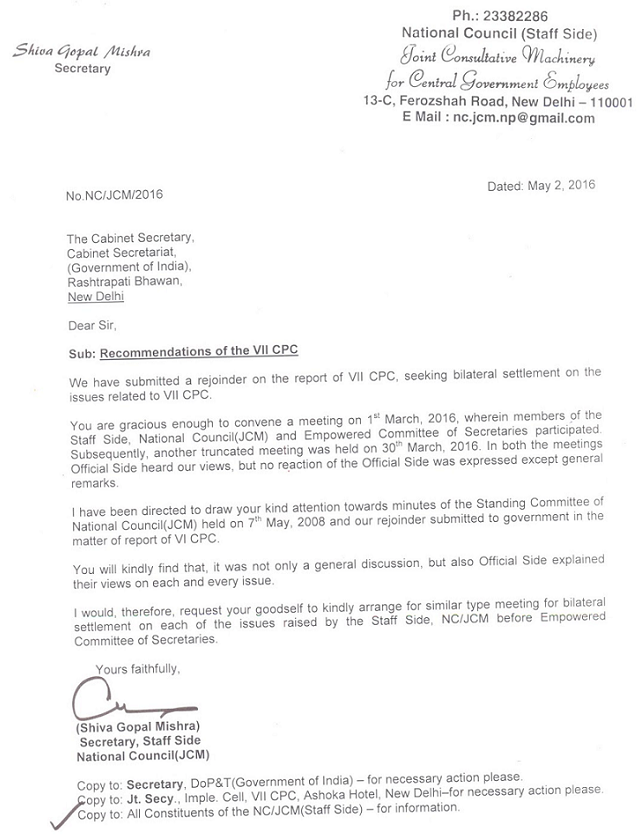
We have submitted a rejoiner on the report of VII CPC, seeking bilateral settlement on the issues related to VII CPC.

You are gracious enough to convene a meeting on 1st March, 2016, wherein members of the Staff Side, National Council(JCM) and Empowered Committee of Secretaries participated. Subsequently, another truncated meeting was held on 30th March, 2016. In both the meetings Official Side heard our views, but no reaction of the Official Side was expressed except general remarks.

I have been directed to draw your kind attention towards minutes of the Standing Committee of National Council(JCM) held on 7th May, 2008 and our rejoiner submitted to government in the matter of report of VI CPC.

You will kindly find that, it was not only a general discussion, but also Official Side explained their views on each and every issue.

I would, therefore, request your goodself to kindly arrange for similar type meeting for bilateral settlement on each of the issues raised by the Staff Side, NC/JCM before Empowered Committee of Secretaries.
Yours faithfully,
sd/-
(Shiva Gopal Mishra)
Secretary, Staff Side
National Council(JCM)
Authority: Confederation Blog
nc-jcm-staff-side-letter-to-7th-cpc


Share:

Monday, 2 May 2016

7th Pay Commission – PK Sinha’s Panel is pushing for higher pay than the Recommendations of the 7th CPC

7th Pay Commission – PK Sinha’s Panel is pushing for higher pay than the Recommendations of the 7th CPC

7th Pay Commission – PK Sinha’s Panel is pushing for higher pay – Now the pay of all central government employees will be fixed Basic Pay multiplying by 3.

A 13 members secretary-level Empowered Committee or Secretaries group, led by cabinet Secretary P K Sinha was formed in January to review the recommendations of 7th Pay Commission before cabinet nod and the Secretaries group is likely to submit its report before June 30.

The 7th Pay Commission headed by Justice A K Mathur proposed the highest salary at Rs 250,000 and the lowest at Rs 18,000. The commission also recommended 14.27 per cent increase in basic pay, 23.55% overall increase in salary, allowances and pensions. The increase in allowances was recommended 63% while pension was proposed to rise 24%.

However, according to reliable sources, the secretaries group review report is that it has pushed for higher pay than the recommendation made by the 7th Pay Commission.

Sources say that the secretaries group has recommended between Rs 2,70,000 and Rs 21,000 hike for the higher and the lower level. This is twenty thousand more in the upper limit prescribed by the 7th CPC and three thousand more in the lower level set by the commission.

The Secretaries group is likely to propose the fitment factor of 3 for all the employees while 7th pay commission had recommended for applying fitment factor of 2.57 to 2.81.

Now the pay of all central government employees will be fixed Basic Pay multiplying by 3, Basic pay means Pay Band plus Grade Pay and it is so much better than the 7th Pay commission recommendations, sources said.

However, the sources added its for the cabinet’s nod and the finance minister who has a key role to play.

Source: Zee News
Share:

Monday, 28 March 2016

Non-IAS officers meet Union minister over 7th Pay Commission Empowered Committee issues

Non-IAS officers meet Union minister over 7th Pay Commission Empowered Committee issues

Jitendra-Singh-7th-Pay-Commission-Issues
A confederation of non-IAS officers association met Union Minister Jitendra Singh on Sunday and requested him to alter the composition of a high-powered panel created recently to process the recommendations of the 7th Pay Commission as they were “apprehensive” of its neutrality.

The confederation members led by the Convenor and General Secretary of the All India IRS (Income Tax) Jayant Mishra, Gen Secretary of the IPS Association P V Ramasastry and President of the Indian Information Service (IIS) Ranjana Dev Sarmah including office bearers of four other services met Singh, the Minister of State for Personnel, Public Grievances and Pensions.

The delegation of the non-IAS officers Associations said Singh, assured them that their concerns will be “appropriately examined.”

“The Government has formed Empowered Committee of Secretaries to examine the Report of the 7th Central Pay Commission.

Unfortunately, eight of the 13 members of the Committee belong to Indian Administrative Service (IAS) and therefore the non-IAS officers Associations is apprehensive of its neutrality on issues related to parity and equality of opportunities.

“We, therefore request the Government to implement inter Service parity related issues as recommended by a majority decision of the Pay Commission as such because the recommendations have been made by a body headed by retired Supreme Court Judge which has meticulously examined the issues for about 20 months after a wide consultation with all the stakeholders.

“If the Government, however, feels the necessity to examine the matter further, it may be done by a Service neutral body and not the present Committee,” the confederation said.

The Centre, in January this year, had set up a high-powered panel headed by Cabinet Secretary P K Sinha to process the recommendations of the 7th Pay Commission which will have bearing on the remuneration of 47 lakh central government employees and 52 lakh pensioners.

The group of civil servants also expressed their grievances in the delay in empanelment of their respective cadres for working in higher government posts.

“It may be recollected that the Commission (7th Pay Commission) recommended with a 2:1 majority, to end the exclusive edge to the IAS in the matters of pay, deputations and promotions.

Inputs from PTI
Share:

Finance Ministry Inspectors Furious over 7th Pay Commission Recommendation

Finance-Ministry-Inspectors-7thCPC
Finance Ministry Inspectors Furious over 7th Pay Commission Recommendation – The agitated inspectors claim that they will be drawing less salary than inspectors attached to other ministries.

The 7th pay commission has recommended for Income Tax, Central Excise and Customs and Service Tax department which works under finance ministry, a grade pay of Rs.4600. However for CBI, IB, Delhi Police inspectors etc the recommended grade pay is Rs.4800.

On an average the Inspectors of various departments of finance ministry bring revenue to the Government to the tune of around 7000 crores in a year.

The Inspectors attached to the finance ministry are not happy with the 7th pay commission recommendations, however they are more furious that their voice has not been listened by their higher officials and by the empowered Committee of Secretaries as well. The agitated inspectors claim that since independence this will be the first time they will be drawing less salary than inspectors attached to other ministries, thanks to the 7th pay commission, they say.

The 7th pay commission has recommended only replacement scale for Income Tax, Central Excise and Customs and Service Tax department which works under finance ministry. In other words, 7th pay commission has proposed the revised pay only on the basis of their present grade pay which is Rs.4600 for these Officers. However for CBI, IB, and Delhi Police inspectors etc 7th pay Commission has recommended revised pay on the basis of upgraded grade pay of Rs.4800.  Presently, CBI, IB, and Delhi Inspectors are getting a grade pay of Rs. 4600 at par with Central Excise, Customs and Income Tax Inspectors.

Inspectors working under the Ministry of Finance feel that the 7th Pay Commission recommendations not only reduces their salary but also breaks their morale, because till date they have been treated equally with their ranks in other departments, however the 7th CPC recommendation makes them inferior, though in the same rank.

Ashok Kumar Knnojia, representing the Group B and Group C employees in the IT department said they are more pained by the response of their own higher officials than the 7th pay commission. He said, though the 7th pay commission did injustice to us, our own higher officials who should have raised the voice strongly lost in presenting our plight to the empowered Committee.

As per Mr. Ashok Kumar, they were unable to get an appointment to meet their own department secretary. After a big struggle he did meet him and expressed the plight of the inspectors, however Mr. Ashok said, till date there is no positive response.

There are more than 32,000 inspectors working in Income Tax, Central Excise and Customs and Service Tax department which comes under finance ministry.

Source: Amarujala
Share:

Saturday, 26 March 2016

Military seethes at 7th Pay Commission Suggestions

The 7th Pay Commission recommendations, have aroused bitter resentment within the military. On March 11, the three service chiefs made a presentation to the “Empowered Committee of Secretaries”.

Military seethes at 7th Pay Commission Suggestions – The military chiefs have argued strongly before the “Empowered Committee” that the military – which they term “the instrument of last resort” – does not have the option of “handing over an adverse situation to any other government agency”.

The 7th Pay Commission recommendations, have aroused bitter resentment within the military. On March 11, the three service chiefs made a presentation to the “Empowered Committee of Secretaries”, a 13-member panel headed by the cabinet secretary, which is looking into the recommendations. The army, navy and air force are waiting to see if this panel will tone down clauses that former army chief VP Malik has termed “a killer for the military.”

This impression is rampant amongst soldiers, sailors and airmen, even though the 7th Pay Commission has raised baseline military salaries by about 15 per cent, taking the pay of a lieutenant (the entry grade for officers) to Rs 56,100 per month; and that of a sepoy (the entry grade for ratings) to Rs 21,700 per month. This is significantly lower than the 40 per cent increases handed out by the Fifth and Sixth Pay Commissions. One of the Seventh Pay Commission members, Rathin Roy, underlining the imperative to curb government spending, has admitted unapologetically: “We are the stingiest pay commission, ever.”

In addition to pay, soldiers get a special allowance called “military service pay”, which exists in most militaries in forms such as the British army’s “X-Factor Pay”. The Seventh Pay Commission raises it for officers from Rs 6,000 to Rs 15,500 per month; and for persons below officer rank from Rs 2,000 to Rs 5,200 per month.

In addition, soldiers get a “risk and hardship allowance”, based on the profile allocated to every military station. The highest grade on the matrix is Rs 25,000 per month, but serving on the Siachen Glacier and Antarctica entitles a soldier to a special grade of Rs 31,500 per month.

Totting up these allowances, the 7th Pay Commission chairman, Justice Ashok Kumar Mathur, in an interview to The Economic Times on December 20, claimed he had recommended 30 per cent higher salaries for the military than civilian services would draw.

His logic was based on the dubious premise that military service pay constitutes a component of salary. In western military salary structures, such allowances are not salary, but compensation for the “intangible hardships” of military service. These include long separation from families, wives being unable to work, and children changing schools frequently and growing up without their father, et cetera.

During its deliberations, the 7th Pay Commission asked the Institute for Defence Studies and Analyses to compare military salaries in India with those of major foreign armed forces. While the IDSA study was relatively unbiased, the Commission chose to interpret them selectively, applying purchasing power parity to boost the value of Indian military salaries; and then comparing them with the per capita income of the concerned country. Given India’s abysmal per capital income, military salaries look good by comparison. The Seventh Pay Commission uses this to argue that India’s military is paid very well by international standards.

Since the hefty raises of the Fifth and Sixth Pay Commissions, few soldiers claim they are poorly paid. Even so, festering resentment stems from the widespread belief that civilian officials, particularly from the Indian Administrative Service (IAS), conspire to whittle away the military’s relative status. Soldiers point to a host of generous allowances and the assured promotion benefits that are triggered for entire civilian batches as a result of the first officer of that batch getting promoted. A key element of this was instituted by the Sixth Pay Commission through a mechanism called “non-functional financial upgrade”.

This mandates that when an IAS officer from a particular batch is promoted to a certain rank, all his batchmates from some sixty Group ‘A’ central services also start drawing the higher pay scale two years later, irrespective of competence or vacancies in that rank. The military had taken up a case for a similar upgrade, but this was not agreed to. The Seventh Pay Commission does not recommend its extension to the military either.

Thus, while practically every civilian central service officer would make it to the top pay grades, the army will remain a sharply pyramidal meritocracy, where less than one per cent of officers are promoted to lieutenant general rank (higher administrative grade, in pay commission scales). Those soldiers who do not make the cut – including meritorious officer, who are held back only because of limited promotion vacancies at each rank – are entitled to neither the power nor the pelf of higher rank since the army has no non-functional financial upgrade. The military’s demand for parity has been one of the five “core anomalies” of the Sixth Pay Commission, and was strongly pressed before the “Empowered Committee” last week.

Adding to the bitterness amongst soldiers is the argument, increasingly voiced by civil service officers, that soldiers’ emoluments should be evaluated in terms of “cost-to-company”, taking into account all their emoluments and facilities. Top generals argue that the armed forces constitute “the cheapest gun fodder”, since they incur the least lifetime cost to the government. They point out that soldiers incur the lowest induction cost, since they do not get paid salary during their training period, unlike civilian officers and the Central Armed Police Forces. They have the lowest retention cost, since they retire early, thus drawing salaries for less time than civilian counterparts; and they also have the lowest advancement cost, since relatively small numbers are promoted to higher rank, leaving many languishing at lower pay grades. Finally, soldiers also incur the lowest pension costs, since their pensions are fixed at 50 per cent of the last pay drawn – at lower pay grades in most cases.

The army has slowly – and sullenly – come to terms with the “first amongst equals” status of the IAS, which has been inexorably institutionalised since the Third Pay Commission noted that “an IAS officer gets an unequalled opportunity of living and working among the people, participating in planning and implementation of developmental programmes, working with the Panchayati Raj institutions, coordinating the activities of government departments in the district and dealing directly with the problems of law and order.” Given this, the Third Pay Commission granted the IAS (and the Indian Foreign Service) three extra increments at each of three successive seniority grades – senior time scale, junior administrative grade and selection grade – to which IAS officers are promoted at four, nine and 13 years of service, respectively. Since the other services got just one increment at these grades, IAS/IFS officers accumulate six extra increments by the time they have served 13 years. This lead in emoluments continues through their service.

However, successive governments have ensured the military remains the “first amongst uniformed services.” The Seventh Pay Commission now upsets this balance by recommending that “the criticality of functions at the district administration level holds good equally for the IAS, Indian Police Service (IPS) as well as the Indian Forest Service (IFoS).” It recommends that six additional increments be extended also to the IPS and IFoS.

The military chiefs have argued strongly before the “Empowered Committee” that the military – which they term “the instrument of last resort” – does not have the option of “handing over an adverse situation to any other government agency”. They have argued that, while the police and central armed police force personnel often lay down their lives, including in cross border firing, they incur a “lower level of risk” compared with the armed forces, which “actively seek encounters with terrorists and close combat with the enemy, despite the high risk of death”. The chiefs have argued that military service demands higher levels of proficiency, commitment and sense of sacrifice.

There is little to suggest, however, that the government is listening. The anomalies of the Sixth Pay Commission still remain unresolved, including the five “core anomalies” that include the military’s demand for non-functional financial upgrade. A committee of secretaries that was constituted in 2011 heard the military for a month and then tossed the ball into the court of the Seventh Pay Commission. There is little to suggest the military’s current representations would be treated with greater sensitivity.

Source: BS
Share:

Wednesday, 9 March 2016

7th Pay Commission – If not Hefty Pay Hike, Government Likely to Restore Allowances

7th Pay Commission – If not Hefty Pay Hike, Government Likely to Restore Allowances

Some good news for government employees anticipating Centre’s response to their demands on salary hike! As per reports, government may agree to reinstate some of the allowances that were subsumed by the 7th Pay Commission’s recommendations.

7th Pay Commission – If not Hefty Pay Hike, Govt Likely to Restore Allowances – The employees have been demanding that allowances which are stated to be subsumed and which are clubbed with others also need to be looked at.

Central government employees have been claiming that the 7th CPC has recommended to abolish large number of allowances and interest free advances without going into the exact relevance in certain departments where the allowances are provided for.

The employees have been demanding that allowances which are stated to be subsumed and which are clubbed with others also need to be looked at.

Pay commission had suggested abolition of many privileges and facilities including risk allowance, small family allowance, festival advance and motor cycle advance etc in its recommendations.

Following are the demands of the central government employees regarding reinstatement of allowances that were hit by the 7th CPC recommendations:
  1. Retain the rate of house rent allowance in place of the recommendation of the Commission to reduce it.
  2. Restructure the transport allowance into two slabs at Rs. 7500 and 3750 with DA thereof removing all the stipulated conditions.
  3. Fixed conveyance allowance: This allowance had no DA component at any stage_ This allowance must be enhanced to 2.25 times with 25% DA thereon as and when the DA crosses 50%
  4. Restore the island Special duty allowance and the Tripura Special compensatory remote locality allowance.
  5. The special duty allowance in NE Region should be uniform for all at 30%
  6. Overtime allowance whenever sanction must be based upon the actual basic pay of the entitled employee.
  7. Cash handling /Treasury allowance. The assumption that every transaction in Government Departments are through the bank is not correct. There are officials entrusted to collect cash and therefore the cash handling allowance to be retained.
  8. Qualification Pay to be retained.
  9. Small family norms allowances to be retained.
  10. Savings Bank allowance to be retained.
  11. Outstation allowance to be retained.
  12. P.O. & RMS. Accountants special allowance.
  13. Risk allowance.
  14. Break-down allowance.
  15. Night patrolling allowance.
  16. Special Compensatory hill area allowance.
  17. Special allowance for Navodaya Vidyalaya Staff.
  18. Dress Allowance ceiling to be raised to Rs. 32,400 per annum.
  19. Nursing Allowance to be raised to 2.25 times of Rs 4800.
  20. All fixed allowances must be raised to 2.25 times as per the principle enunciated by the Commission.

Restore the following advances and revise the same to 3 times.

  • Natural calamity advance.
  • Festival Advance.
  • LTC and TA advances.
  • Medical advance.
  • Education advance.
  • Vehicle advances including cycle advance.
Source: Zee News
Share:

Saturday, 27 February 2016

7th CPC Latest News : BPMS Protest for Minimum Pay 24000 and Fitment formula 3.42

7th CPC Latest News : BPMS Protest for Minimum Pay 24000 and Fitment formula 3.42

BPMS circular for agitation programme from 01.03.2016 to 05.03.2016
BHARATIYA PRATIRAKSHA MAZDOOR SANGH
(AN ALL INDIA FEDERATION OF DEFENCE WORKERS)
(AN INDUSTRIAL UNIT OF B.M.S.)
(RECOGNISED BY MINISTRY OF DEFENCE, GOVT. OF INDIA)
CENTRAL OFFICE: 2-A, NAVEEN MARKET, KANPUR – 208001, PH & FAX : (0512) 2332222
MOBILE: 09415733686, 09235729390, 09335621629, WEB : www.bpms.org.in

REF: BPMS/20/CIR/2015
Dated: 19.02.2016
To,
The President/ General Secretary
Unions Affiliated to Federation

Subject: Agitation Programme from 01 March, 2016 to 05 March, 2016.

Sadar Namaskar
I hope this letter will find to all of you in good health and high spirit and busy in accelerating trade union activities. The meeting of office bearers of BPMS was conducted on dated: 11th and 12th February, 2016. In this meeting the recommendations of 7th CPC was discussed specially. As all of you know that 7th CPC submitted its recommendations to Honorable Finance Minister of Govt. of India on 19.11.2015. After analyzing the recommendations of 7th CPC, BPMS wrote a letter to Govt of India addressing anomalies in recommendations along with conducting a National level protest day on the call of GENC. We met Dr Jitendra Singh/Minister of DoP&T and Prime Minister Office at his office situated in Parliament and discussed the issues and submitted a memorandum. Honorable Minister assured the representatives of GENC and BPMS that all necessary action would be taken at the earliest and a meeting would be fixed with Honorable Finance Minister. But it is matter of concern that the federation has not been apprised about the action taken till date.

Therefore, it was decided in the meeting of office bearers to conduct agitation programmes of gate meetings, sit in, wearing black badges in their respective establishments from 01 March 2016 to 05 March 2016. On 04 March 2016 ‘Dharna’ will be performed and on the last day a memorandum will be presented to the Head of Establishment addressing Honorable Prime Minister and its photocopy should be sent to BMS office and BPMS office.

The demands are as follows-

1. Minimum Pay should be fixed 24000/- rupees in place of 18000/-.
2. The fitment formula should be 3.42 in place of 2.57
3. The ratio of minimum Pay and maximum Pay should be 1:10.
4. Annual increment should be 5% in place of 3%.
5. Five financial upgradations should be granted within the period of 30 years of Service under MACP scheme.
6. Pay Scales of Group ‘C’ employees should be merged and upgraded. Grade Pay 1900 and Grade Pay 2000 should be merged and upgraded to 2400 and Grade Pay 2400 and Grade Pay 2800 should be merged and upgraded to Grade Pay 2800.
7. Risk Allowance, Washing Allowance, Family Planning Allowance should be continued.
8. HRA should be granted at the rate of 15%, 25% and 35%.
9. Minimum two increments should be granted at Promotion.
10.Interest free Advances should be continued.
11.OTA is being granted to the employees posted in offices, directorates etc at the rate of 12 rupees per hour (on the pay scales of 4th CPC). OTA should be granted on the Pay Scales of 7th CPC.
12.Old Pension Scheme should be restored in place of NPS.
13.The employees covered under NPS scheme should be benefited with gratuity.
14.Commuted Pension should be restored on 12th year in place of 15th year.
15.CCL related to women employees should not be reduced.
16.There should not be any educational criteria (High School passed) for grant of compassionate ground appointment.
17.Benefits of 7th CPC should be granted to Centre, State and autonomous body employees equally.
18.Since amendment in Bonus Act has retrospective effect and implemented since 2014, the arrear of 2014-2015 should be granted without any delay.
19.All the employees should be granted Night Duty Allowance without any ceiling.
20.In Ordnance Factories all Piece work employees should be paid OTA (Between 44¾ and 48 hours) on their actual Pay instead of minimum Pay.
21.The employees having equal qualification and same nature of work should be granted equal pay in all ministries.
22.Examiners working in Quality control department in OFB should be granted Incentive Bonus.
23.According to 7th CPC recommendations, civilian employees retiring on same Post or same pay scale should be granted equal Pension.
24.Wards of employees died in harness are unable to find a Job due to 5% ceiling in compassionate appointment. Therefore, waiting dependants should be granted one time relaxation in compassionate appointment.
25.The employees of DRDO should be granted the benefit of PRIS.

Thanking you.

Brotherly yours
(M P Singh)
General Secretary
Copy to:
1. The General Secretary
BMS, New Delhi
2. The Secretary General
GENC, Naveen Market, Kanpur

Source: BPMS
Share:

Tuesday, 24 November 2015

Presenting the 7th CPC Report within the scheduled time and without much anomalies

Presenting the 7th CPC Report within the scheduled time and without much anomalies

One of our genuine reader Mr.M.Dorai says…

The Seventh Central Pay Commission have done an excellent job by presenting the VII CPC Report within the scheduled time and without much anomalies that were vastly found in VI CPC Report. Abolition of Pay Band and Grade Pay System deserve appreciation. Pay matrix have been worked out with brilliance which provide minimum entry scale as well as fitment table for existing employees according to the increments drawn unlike the 3 methods of fixation adopted by VI CPC among new recruits, promotees and existing employees which caused great disparity and anomaly in pay fixation.

The hike granted is also quite substantial which in fact is more than what VI CPC had granted. While the increase granted by VII CPC on pre-revised VI CPC basic pay actually ranges from 32% to 56% of the pre-revised Basic pay, the increase is projected as 15% wrongly by the media including the VII CPC in its comparison table which unnecessarily have been paving the way for resentment and unrest among the central government employees who would not have fully studied the report. While projecting the percentage of increase the VI CPC,had taken into account only the basic pay . Whereas the VII CPC had reckoned D.A. element to project the percentage of increase which gives a wrong picture of around 15% hike.

Therefore there should be no cause for resentment among the central government employees. They should rejoice over the benefits offered by the VII CPC. There is a overall increase of 25% to 40% in the gross emoluments which is more than what they received from the VI CPC. The retention of percentage of pension and percentage of commutation of pension and gratuity of 16.5 months and 300 days EL encashment on retirement shall steeply increase the take home retirement benefits by almost 60 to 70%.

In a nutshell the Chairman and Members of the VII CPC have done a commendable job and fulfilled their mission successfully ensuring justice to all levels of central government employees. Let us hope, the Government of India approve the recommendations without any changes and implement it .

Hats off to the Chairman and Members of the VII Central Pay Commission for presenting such an excellent report unseen in the history of pay commissions constituted so far.

Author: M.DORAI
Share:

Monday, 16 November 2015

7th Pay Commission Minimum Pay 21000 and Fitment Formula from 2.86 to 3.15

7th Pay Commission Minimum Pay 21000 and Fitment Formula from 2.86 to 3.15

“There is a possibility of 7th CPC to submit its report on 20th November 2015 or 23rd November 2015 , but the report will not be to your expectations, The minimum wage taking into prices published by the Government of India shall come to Rs 26,000/-, considering the existing retail prices the minimum wages works out to Rs 28,000/- and fitment formula shall works out to 4.00 , but the minimum wage may be around Rs 21,000/ against the justified demand of Rs 28,000/- the fitment formula may be from 2.86 to 3.15 , also many other important demands of five promotion policy, Increment rate increase, retirement issues, pension issues etc.

We have to wait and watch the 7th CPC report will the 7th CPC accept the staff side demands or not.”

Observance of All India protest day on 19th November 2015 & 7th CPC to submit its report shortly

Comrades
The Confederation and NJCA had given call for holding protest meetings from 2ndNovember 2015 to 6th November 2015 and also Observance of All India protest day on 19th November 2015 in respect of following demands.

Charter of Demands
1. Effect wage revision of Central Government employees from 1.12014 accepting the memorandum of the staff side JCM; ensure 5-year wage revision in future; grant interim relief and merger of 100% of DA. Ensure submission of the 7th CPC report with the stipulated time frame of 18 months; include Grameen Dak Sewaks within the ambit of the 7th CPC. Settle all anomalies of the 6th CPC.

2. No privatisation, PPP or FDI in Railways and Defence Establishments and no corporatisation of postal services;

3. No Ban on recruitment/creation of post.

4. Scrap PFRDA Act and re-introduce the defined benefit statutory pension scheme.

5. No outsourcing; contractorisation, privatization of governmental functions; withdraw the proposed move to close down the Printing Presses; the publication, form store and stationery departments and Medical Stores Depots; regularise the existing daily rated/casual and contract workers and absorption of trained apprentices;

6. Revive the JCM functioning at all levels as an effective negotiating forum for settlement of the demands of the CGEs.

7. Remove the arbitrary ceiling on compassionate appointments.

8. No labour reforms which are inimical to the interest of the workers.

9. Remove the Bonus ceiling;

10. Ensure five promotions in the service career.
We should not let down our struggle path I once again request one and all to participate in the All India protest day on 19th November 2015 at all places including the districts and send me the photos of protest meeting to publish on COC Karnataka website and this will send information to the Central Government on our demands.
Comradely yours
(P.S.Prasad)
General Secretary
Source: www.karnatakacoc.blogspot.in
Share:

Tuesday, 3 November 2015

Removal of Grade Pay System in 7th Pay Commission – A detailed report

Removal of Grade Pay System in 7th Pay Commission – A detailed report

Will the removal of Grade Pay System by the 7th Pay Commission help Central Government employees? – This is the topic of this article.

“Unconfirmed reports say that the 7th Pay Commission is very likely to recommend the abolishing of the Grade Pay System introduced by the 6th Pay Commission.”

Not only the Government, but the Central Government employees too are hoping and wishing that the 7th Pay Commission functions independently, free from interventions. The report of the previous Pay Commissions will guide for determining the revision of pay scale and pay bands, allowances, retirement benefits and other facilities/benefits of more than 50 lakh employees. The Pay Commission also considers the recommendations, suggestions and inputs gathered from employees all over the country and presented as memorandums by federations like the NC JCM and the Confederation.

There is no rule that the new Pay Commission has to follow the same methodology and determination followed by the previous Pay Commissions. Therefore, one cannot state for sure that the 7th Pay Commission will tow the guidelines issued by the 6th or the 5th Pay Commission while deciding the new pay scale and pay bands.

One has to keep in mind the fact that the 6th Pay Commission was radically different from the recommendations and guidelines issued by the 5th Pay Commission. One has to also remember that a number of industry experts, who predicted the recommendations of the 6th Pay Commission based on the trends of the previous Pay Commission, were proved completely wrong.

If one Pay Commission has the right to recommend the splitting of the Pay Scale into two, the next Pay Commission has all the powers to completely abolish the system. But, this is not the issue!

Will the Central Government employees benefit by the removal of the Grade Pay system? This is the question now.

It will definitely be beneficial. Here are the reasons why.

It is unacceptable that a promotion, which comes after waiting for many years, brings with it an increment of just Rs.100.

None has until now accepted the splitting of the promotional hierarchy, which had been followed for years, into two.

The anomalies that prevailed due to the ‘Grade Pay Hierarchy’ which was introduced under the MACP promotional system, still remain unresolved.

When the discussions and debates on MACP system continued to grow unabated during the NC JCM Anomaly Committee meeting, it was decided that a separate meeting ought to be held to analyze this issue.
Most of the individual requests from the Central Government employees this time are about the MACP promotional system. The reason is the Grade Pay structure introduced by the 6th Pay Commission.
And also can list out many reasons to abolish the Grade Pay System.

Source: www.90paisa.org
Share:

Saturday, 3 October 2015

Engineered delay in the submission of the 7th CPC report – NJCA strongly condemns

Engineered delay in the submission of the 7th CPC report – NJCA strongly condemns

National Joint Council of Action decided to defer the Indefinite Strike from 23rd November 2015

NJCA
National Joint Council of Action
4, State Entry Road New Delhi – 110055
No.NJCA/2015
September 30, 2015
All members of the NJCA

Dear Comrade,

The National JCA met today on 30.09.2015. In the background of the engineered delay in the submission of the 7th CPC report, the meeting reviewed the decision to go for indefinite strike action commencing from 23rd Nov.2015 and arrived at the following conclusions.

1.The 7th CPC, as per the indication the NJCA had, concluded its deliberations and finalised its report. But due to the pressure exerted by the GOI the report is not likely to be out till the Bihar election is going to be concluded on 8.11.2015.

2. Even if the report is given, the Government might plead for some more time to consider the same and arrive at conclusions.

3. Even though the charter of demand contain other major issues, viz FDI, outsourcing, New Pension Scheme etc, the CPC related issues especially the revision of wages has its own significance and struggle without the said issue is impracticable.

4. The meeting also noted that after the impressive march to parliament held on 28th April, 2015, no serious programme of action was undertaken, which has created a certain complacency in the movement. The meeting noted the necessity to rejuvenate the NJCA functioning at all levels.

5. It was also noted that there are states which have not held the state level conventions and consequently have not brought into being the state apparatus required to spearhead a serious action like indefinite strike.

6.In view of above mentioned conclusions, the National JCA has decided to defer the strike action slated for 23rd November 2015 to a date during the Budget session of the parliament i.e from Feb to April 2016. The exact date of commencement of the strike will be decided by the National JCA when the 7th CPC report is available.

7.The NJCA also has decided to call upon all Federations of Central Government Employees to organise a massive protest demonstration in front of all work-spots/offices on 19th November 2015 wearies Black Badge to register our anger and resentment over the Government’s action in engineering delay in the submission of the report by the 7th CPC.

8.The National JCA leaders and all standing council members will sit on a day long Dharna at Jantar Man tar on 19.11.2015 by wearies Black Badge to highlight the anti worker attitude of the GOI and its concerted efforts to undermine the functioning of JCM.

We also send herewith the resolution adopted at the meeting which has been Forwarded to the Government already.

With greetings
Enel: Resolution
Comradely yours,
(Shiva Gopal Mishra)
Convener
Share:

Featured post

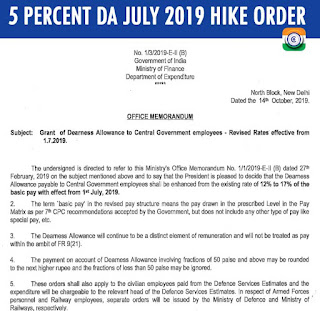
5 Percent DA July 2019 Hike Order - Grant of Dearness Allowance to Central Government employees

Grant of Dearness Allowance to Central Government employees 5 Percent DA July 2019 Hike Order  No. 1/3/2019-E- II (B) Government of...

Blog Archive

About The Author