A complete reference blog for Indian Government Employees

Showing posts with label Central Government Services. Show all posts

Wednesday, 27 March 2019

Frequently Asked Questions (FAQs) on reservation to Persons with Benchmark Disabilities in posts/services under Central Government

FAQ on reservations for disabled persons in Central Government posts / services

No.36035/02/2017-Estt (Res)
Government of India
Ministry of Personnel, Public Grievances & Pensions
Department of Personnel & Training
North Block, New Delhi
dated the 25 March, 2019
Subject: Frequently Asked Questions (FAQs) on reservation to Persons with Benchmark Disabilities in posts/services under Central Government - reg.

This Department receives references from various Ministries/Departments seeking clarification on instructions with regard to reservation for Persons with Benchmark Disabilities issued vide OM of even number dated 15.1.2018; therefore, a set of Frequently Asked Questions (FAQs) have been answered as under for their use:

Q.1 Whether the reservation for Persons with Benchmark Disabilities are vacancy based or post based?
Answer: Reservation for. Persons with Benchmark Disabilities is vacancy based as per Section 34 of the Rights of Persons with Disabilities Act, 2016.

Q.2 What categories of specified disabilities are covered for reservation and what is the percentage allocation of reservation for each category of persons with benchmark disabilities?
Answer: As provided in Para .2 of the OM of even number dated 15.1.2018, categories of specified disabilities covered under reservation in posts and services of the Central Government vis-a-vis category wise percentage of reservation is as under:
a)blindness and low vision;1%
b)deaf and hard of hearing;1%
c)locomotor disability including cerebral palsy, leprosy cured, dwarfism, acid attack victims and muscular dystrophy;1%
d)autism, intellectual disability, specific learning disability and mental illness;1%
e)multiple disabilities from amongst persons under clauses (a) to (d) including deaf-blindness,1%

Q.3 Whether the Persons with Benchmark Disabilities can apply against the posts, which are not identified suitable for Persons with Benchmark Disabilities?
Answer: Persons with Benchmark Disabilities can apply only against the posts identified suitable for the relevant category.

Q.4 Whether any priority has been given in selection to any category of
disability?

Answer: Priority has not been given in selection to any category of Persons with Benchmark disability.

Q.5 Whether a Benchmark Disability candidate can compete for appointment against an unreserved vacancies?
Answer: Yes, Benchmark Disability candidates can compete for appointment by direct recruitment against an unreserved vacancy if selected without relaxed standards along with other candidates for those posts/services which are identified suitable for them.

Q.6 Whether the vacancies which are to be earmarked reserved for Persons with Benchmark Disabilities is to be computed on the total number of vacancies in the cadre strength in identified categories of posts as well as unidentified categories of posts.
Answer: Yes, vacancies which are to be earmarked reserved for Persons with Benchmark Disabilities is to be computed on the total number of vacancies in the cadre strength in identified categories of posts as well as unidentified categories of posts. However, recruitment of persons with benchmark disabilities would only be against the category of posts identified suitable for them.

Q.7 Whether a separate roster is to be maintained for Persons with Benchmark Disabilities irrespective of the post based roster applicable for SC/ST/OBC?
Answer: Yes, every Central Government establishment shall maintain group-wise separate 100 point vacancy based reservation roster register in the prescribed format for determining/effecting reservation for the Persons with Benchmark Disabilities – one each for Group ‘A’ posts filled by direct recruitment, Group ‘B’ posts filled by direct recruitment and Group ‘C’ posts filled by direct recruitment.

Q.8 What to do with vacancies reserved for any particular category(s) of Persons with Benchmark Disabilities cannot be filled due to non-availability of a suitable candidate, or for any other sufficient reasons?
Answer: As per Section 34(2) of the Rights of Persons with Disabilities Act, 2016, if in any recruitment year any vacancy cannot be filled up due to non-availability of a suitable person with benchmark disability or for any other sufficient reasons, such vacancy shall be carried forward in the succeeding recruitment year and if in the succeeding recruitment year also suitable person with benchmark disability is not available, it may first be filled by interchange among the five categories and only when there is no person with disability available for the post in that year, the employer shall fill up the vacancy by appointment of a person, other than a person with disability.
(G. Srinivasan)
Director (Res)
faq_reservation_disabled_persons_central_govt_posts

Share:

Saturday, 26 December 2015

No more affidavits, interviews for central government jobs

No more affidavits, interviews for central government jobs

New Delhi: Path-breaking initiatives like discontinuation of affidavits for host of central government services and ending job interviews for various posts from January 1 among other initiatives kept the Ministry of Personnel in news during 2015.

“The most revolutionary and path-breaking decision is abolition of attestation of certificates by gazetted officers instead promoting self-attestation,” Minister of State for Personnel, Public Grievances and Pensions Jitendra Singh told PTI.

He said the government took this decision as it was willing to trust citizens, more importantly it’s youth who will not give wrong information while submitting self-attested documents.

This decision has come as a big relief to common people, especially those living in rural areas, who had to take lot of pain in getting documents attested.

The Ministry also recently discontinued the practice of submission of affidavit by the family members of deceased government employees for the appointment on compassionate grounds.

Now people are required to submit self-declaration at the time of applying for compassionate appointment. All states and union territories have also been asked by the Centre to do away with practice of getting gazetted officer-signed affidavit and seek self-attestation.

Singh, a Lok Sabha member from Jammu and Kashmir’s Udhampur constituency, said soon after Prime Minister Narendra Modi’s announcement to end interviews from central government jobs, his Ministry has acted on it.

“We have decided that from January 1, next year, the process of interview for Group C and D recruitments will be abolished,” he said, adding that these are some steps which nobody thought of in past over 60 years after country’s independence.
Singh said the Ministry which is held by the Prime

Minister started several measures to increase transparency and simplify governance.

“We have started the process of simplification of various application forms being used in the government. We are converting multi-page application forms into one-page,” the Minister said.

Talking about other initiatives, he said a pension portal has been started. “Those who are getting superannuated can check the status of their pension online. They can also check pension payment orders online,” Singh said.

He said out of 6.5 lakh public grievances received by his ministry during the year, 4.8 lakh were disposed of.

“The ministry will continue to work towards simplifying governance,” Singh said.

In another novel initiative, the ministry started yoga camps for the central government employees and their dependents.

Besides, it exempted the parents of differently-abled children from the mandatory transfers so that they can take proper care of them.

The scheme of interaction of officers with school students has been launched in which the officers of government of India visit schools and share their experiences with the students.

As a pilot project, senior officers of Department of Personnel and Training have visited kendriya vidyalayas in Delhi and interacted with the students.

For the first time in the history of the Indian Administrative Service (IAS), the officers of 2013 batch were posted as assistant secretary in the Central Secretariat for a period of three months.

In order to crack a whip on non-performing bureaucrats, it has started assessing the performance of employees. The government has asked all its departments to identify such public servants and move proposals for their premature retirement.

The Personnel Ministry has formed rules to check unauthorised stay on foreign postings by IAS, IPS and IFS officers.

PTI
Share:

Monday, 30 November 2015

7th Pay Commission – Recommends Abolition of 52 Allowances

7th Pay Commission – Recommends Abolition of 52 Allowances – The list of outdated government perks is pretty long. Sample this: select postal department employees are entitled to a Rs 90-per month cycle allowance.

The 7th Pay Commission, headed by Justice Ashok Kumar Mathur submitted its report to the finance ministry about 10 days back. It has made many recommendations to the Government pertaining to salary, pension etc., etc. It has also recommended abolition of 52 allowances that the 7th Pay Commission found obsolete.

The list of outdated government perks is pretty long. Sample this: select postal department employees are entitled to a Rs 90-per month cycle allowance, if the employee fulfills a number of conditions including the submission of proof that there has been an “extensive use” of the bicycle. Indian Foreign Service officers are given a monetary incentive that’s ridiculously low for learning an optional foreign language — Rs 100 per month if the officer turns “proficient” in that language and Rs 200 per month if the officer becomes “above proficient”.

Sounds odd, but Central Industrial Security Force (CISF) personnel receive a haircutting allowance at the rate of Rs 5 per month, the lowest among 196 government allowances that prevail today. This allowance should have been discarded long ago, as haircutting is very much a part of the CISF cadres’ composite personal maintenance allowance. But no one probably had spotted this till the 7th Central Pay Commission found it “outdated” and recommended its abolition.

So, when the 7th Central Pay Commission chairman Justice AK Mathur along with two members of the Commission had to evaluate the demands of IAS, IFS, IPS, Central government services and defence personnel in several rounds of meetings spanning nearly two years, they encountered a humongous task of rationalising as many as 196 allowances in addition to weighing in on the core issues of pay hike and pay parity. The list of allowances includes the well-known ones like DA and HRA.

And the Central Pay Commission, which submitted its report 10 days ago to the finance ministry, clearly recommended abolition of 52 allowances that they found obsolete. We give below a selected list of a few allowances which have been recommended for abolition:

1. Hair cutting Allowance
2. Cash Handling Allowance
3. Hutting Allowance
4. Secret Allowance
5. Cycle Allowance
6. Diet Allowance
7. Soap Toilet Allowance
8. Funeral Allowance

Source: The Economic Times
Share:

Wednesday, 26 August 2015

Children of Government servants should study only in Government schools – Allahabad High Court

Children of Government servants should study only in Government schools – Allahabad High Court

The Allahabad High Court has issued strict orders that the children of government employees should study only at government schools.

A Public Interest Litigation was filed at the Allahabad High Court stating that in Uttar Pradesh, led by its Samajwadi party Chief Minister Akhilesh Yadav, the government-run schools do not have sufficient teachers. The officials were not taking any steps to improve the standard of education in these schools and infrastructure was poor.

After hearing the arguments, Justice Sudhir Agarwal issued an order, excerpts of which are provided below:
All the government employees shall enroll their children only at government-run schools. The rule is applicable also to the representatives of the people, and the employees of the justice department. The state government can impose penalties to stop them from admitting their children to private schools.

The employees can be made to pay as penalty the sum that they had paid as fees to the private schools. The revenue thus generated can be added to the state exchequer. The Chief Secretary of the state was given six months to submit a report on this reform.

Source: http://www.cgstaffportal.in/
Share:

Thursday, 14 May 2015

Seventh Central Pay Commission team visits North East region to interact with stakeholders

Seventh Central Pay Commission team visits North East region to interact with stakeholders

Guwahati: The Seventh Central Pay Commission visited the North East region for interaction and to obtain inputs/views from the stakeholders, a defence spokesperson said.

Vivek Rae, Member, Seventh Central Pay Commission
The four-member Central Pay Commission (CPC) team headed by its Chairman Justice A K Mathur based its activites out of Shillong in Meghalaya for three days concluding yesterday.

During their visit, the team interacted with a wide array of stakeholders from Central Government services, including the Army, Air Force, Para Military Forces, Central Armed Police Forces and their family members, PRO Defence, Shillong, Group Captain Amit Mahajan said.

The focus of the CPC was to get first-hand information from various central government organisations, troops and their families deployed in different areas of the NE region, he said.

The aim of the deliberations by the CPC was to assess the problems faced by those working in central government organisations, thus providing greater depth and knowledge on the environment before finalising its recommendations, Mahajan said.

The visit of the CPC was facilitated by the Defence Forces and covered areas at forward locations from Arunachal Pradesh to locations in Guwahati and Shillong, he added.

PTI
Share:

Wednesday, 18 March 2015

Digitisation of Government Functioning

Digitisation of Government Functioning

National Informatics Centre (NIC) has developed work flow based application software for visitor management at any office known as eVisitor. It is a web based solution hosted at the NIC data centre and can be accessed / adopted by any Government office just by providing necessary master data for on-boarding.

Government has taken initiative to digitize Government files and documents for its easy accessibility. NIC is providing technical support and consultancy on digitization of files and documents to the various Ministries / departments. Government has conceived Mission Mode Project (MMPs) under National e-Governance Plan (NeGP) to improve service delivery system in the Central /State Government Ministries / Departments. The responsibility of provisioning of funds and digitization of file and documents rests with the concerned Ministry/Department/Organization.

NIC has also developed and implemented eOffice application. The eOffice application aims to support governance by ushering in more effective and transparent inter and intra-government processes. eOffice is Mission Mode Project under the National E-Governance Plan.

This was stated by the Minister of State for Personnel, Public Grievances and Pensions and Minister of State in Prime Minister’s office Dr. Jitendra Singh in a written reply to a question by Shri Ramesh Chander Kaushik in the Lok Sabha today.

Source: PIB
Share:

Tuesday, 27 January 2015

Age limit of Retirement in Central Government Services – What says FR56..?

Age limit of Retirement in Central Government Services – What says FR56..?

“All Government servants are to retire on the last day of the month in which they attain the age of 60 years, subject to the exceptions mentioned therein”.

The DoPT Minister informed in the Parliament as a written reply to a question to the subject above mentioned as follows…

As per Rule 56 of Fundamental Rules all Government servants are to retire on the last day of the month in which they attain the age of 60 years, subject to the exceptions mentioned therein. A copy of the relevant rule is annexed. Different age of retirement for certain categories has been fixed on functional requirements.
Employees of the Supreme Court retire on attaining the age of 60 years. The employees of Central Universities are not Central Government employees. However, the retirement age of the employees are as under:-

(i) Vice Chancellor – 70 years
(ii) Teachers – 65 years
(iii) Registrar – 62 years
(iv) Finance Officer – 62 years
(v) Controller of Examination – 62 years Different age of retirement is prescribed on functional requirements.

Extracts of Provisions in FR 56

F.R. 56(a) Except as otherwise provided in this rule, every Government servant shall retire from service on the afternoon of the last day of the month in which he attains the age of sixty years.

Provided that a Government servant whose date of birth is the first of a month shall retire from service on the afternoon of the last day of the preceding month on attaining the age of sixty years. Provided further that a Government servant who has attained the age of fifty-eight years on or before the first day of May, 1998 and is on extension in service, shall retire from the service on expiry of his extended period of service. Or on the expiry of any further extension in service granted by the Central Government in public interest, provided that no such extension in service shall be granted beyond the age of 60 years.

(b) A workman who is governed by these rules shall retire from service on the afternoon of the last day of the month in which he attains the age of sixty years.

(bb) The age of superannuation in respect of specialists included in the Teaching, Non-Teaching and Public Health Sub-cadres of Central Health Service shall be 62 years. “Provided that for the specialist included in the Teaching sub-cadres of the Central Health Service who are engaged only in teaching activities and not occupying administrative positions, the age of superannuation shall be sixty-five years: provided further that such specialist of the Teaching Sub-cadres of Central Health Service who are occupying administrative positions shall have the option of seeking appointment to the teaching positions in case they wish to continue in service up to sixty-five years.”

(bbb) The age of superannuation in respect of nursing teaching faculty with M.Sc in Nursing in the Central Government Nursing Institutions shall be 65 years subject to the condition that they continue to function as faculty members after the age of 60 years.
Share:

Tuesday, 12 August 2014

IDENTIFICATION OF SENSITIVE POSTS IN CENTRAL GOVERNMENT ORGANIZATION

IDENTIFICATION OF SENSITIVE POSTS IN CENTRAL GOVERNMENT ORGANIZATION

While replying to a question regarding sensitive posts in Central Government Organization in Parliament on 30.7.2014, Minister Dr.Jitendra Singh said that the Central Vigilance Commission and the Government have issued instructions for effecting rotational transfers of officials posted on sensitive posts in each organization which offer scope for corruption. As per Commission’s instructions issued vide letter Nos. 98/VGL/60 dated 15.04.1999, 02.11.2001 and 004/VGL/90 dated 01.05.2008, 04.01.2012 (for public sector banks) and 11.09.2013, it was prescribed that Ministries/Departments/Organizations and CVOs are to identify the sensitive posts and staff working in these posts and also ensure that they are strictly rotated after every two/three years to avoid developing vested interests.

Identification of sensitive posts and effecting rotational transfers are continuous processes, and the Commission has asked the CVOs of the organizations to ensure strict implementation of Commission’s guidelines.

As per the functions and powers of the Central Vigilance Commission under Section 8 (1) (c) of the Act, the Commission shall inquire or cause an inquiry or investigation to be made on a reference made by the Central Government in respect of a public servant. Further, the Commission causes inquiry/investigation on complaints received by it under Section 8 (1) (d) of the CVC Act.

Complaints received are processed as per the Complaint Handling Policy of the Commission. Complaints received in the Commission are scrutinized and wherever specific and verifiable allegations of corruption/having vigilance angle are noticed, the complaint are forwarded to CVO/CBI for conducting investigation/inquiry into the matter and submission of report. Details of complaints received during the last three years and the advice tendered by the commission are annexed.

#Central Government Employees News, #Central Government Services, #Central Govt Employees, #Sensitive Posts in Central Govt Departments, #Indian Government News
Share:

Monday, 16 September 2013

Procedures for Resignation from Central Government Services – Ministry of Home Affairs

Procedures for Resignation from Central Government Services – Ministry of Home Affairs

There is available only one order about the procedures for resigning from Central Government Services, which was issued on 6th May 1958 by the Ministry of Home Affairs. After that no orders will be issued by the Ministry. We have reproduced the content of the Office Memorandum and given below for your ready reference…

Copy of O.M. No.39/6/57-Ests.(A) dated the 6th May, 1958 from Shri.P.Sitaraman, Deputy Secretary to the Government of India, Ministry of Home Affairs, New Delhi to all Ministries of the Government of India etc. etc.
Subject:-  Resignation from service-Procedure in respect of -
Question have been raised from time to time regarding the authority competent to accept a resignation, the circumstances under which resignation should be accepted, the date when a resignation becomes effective, and the authority competent to permit a Government servant to withdraw a resignation which he has already tendered. The following instructions are, therefore, issued for information and guidance of all Ministries:-

(a) Authority competent to accept resignation :-
The appointing authority in respect of the service or post in question is the authority competent to accept the resignation of the Government servant.

(b) Circumstances under which resignation should be accepted:-  It is not in the interest of Government to retain an unwilling officers in service. The general rule, therefore, is that a resignation from service should be accepted except in the circumstance indicated below:-
(i) Where the officer concerned is engaged on work of importance and it would take time to make alternative arrangements for filling the post, the resignation should not be accepted straightaway, but only when alternative arrangement for filling the post have been made.
(ii) Where a Government servant who is under suspension submits a resignation, the competent authority should examine, with reference to the merit of the disciplinary case pending against the Government servant, whether it would be in the public interest to accept the resignation. Normally, as officers are placed under suspension only in cases of grave delinquency, it would not be correct to accept a resignation from an officer under suspension. Exceptions to this rule would be where the alleged offences do not involve moral turpitude or where the quantum of evidence against the accused officer is not strong enough to justify the assumption that the departmental proceedings were continued, the office would be removed or dismissed from service, or here the departmental proceedings are likely to be so protract ant that it would be cheaper to the public exchequer to accept the resignation.
(c) Date when a resignation becomes effective :-
The competent authority should decide the date with effect from which the resignation should become effective. In cases covered by (b) (i) above the date should be that with effect from which alternative arrangements can be made for filing the post. Where an officer is on leave, the competent authority should decide whether he will accept the resignation with immediate effect or with effect from the date following the termination of the leave. Where a period of notice is prescribed which a Government servant should give when he wishes to resign from service, the competent authority may decide to count the period of leave towards the notice period. In other cases also, it is open to the competent authority to decide whether the resignation should become effective immediately or with effect from some prospective date. In the latter cases, the date should be specified.

(d) Authority competent to permit withdrawal of resignation :-
A resignation becomes effective when it is accepted and the officer is relieved of his duties. Where a resignation has not become effective and the officer wishes to withdraw it, it is open to the authority which accepted the resignation to refuse the request for such effective the officer is no longer in Government service and acceptance of the request for withdrawal of resignation would amount to reemploying him in service after condoning the period of break. As this would involve financial commitments, concurrence of the Ministry of Finance should be obtained before a request for withdrawal of resignation which has already become effective is accepted.

Source: www.persmin.nic.in
Via: www.centralgovernmentnews.com
http://www.centralgovernmentnews.com/procedures-for-resignation-from-central-government-services-ministry-of-home-affairs/
Share:

Featured post

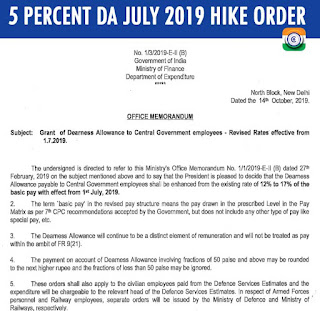
5 Percent DA July 2019 Hike Order - Grant of Dearness Allowance to Central Government employees

Grant of Dearness Allowance to Central Government employees 5 Percent DA July 2019 Hike Order  No. 1/3/2019-E- II (B) Government of...

Blog Archive

About The Author