A complete reference blog for Indian Government Employees

Showing posts with label post offices. Show all posts

Saturday, 11 January 2020

13 lakhs Central Government Employees participated in the nationwide one day strike on 8th January 2020

13 lakhs Central Government Employees participated in the nationwide one day strike on 8th January 2020


PRESS STATEMENT

Dated 8th January, 2020

About thirteen (13) lakhs Central Govt. Employees participated in the nationwide one day strike on 8th January 2020 as per the call given by Confederation of Central Government Employees & Workers. The main demand of the strike is “Scrap New Contributory Pension Scheme (NPS) & Restore Old defined Pension Scheme (OPS)”. The strike is also to express the anger and protest of the Central Government employees and Pensioners against the neo-liberal policies being implemented by the Central Government in the Central Government services, as a result of which the job security, wage structure, social security and the trade union rights of the employees are in danger. None of the 10 points Charter of Demands submitted to the Government by Confederation are settled.

In Postal department about four and half lakhs employees participated in the strike all over the country. 1,55,000 Post Offices and about 400 RMS offices remained closed. Gramin Dak Sevaks of rural post offices also went on strike. Delivery work also affected as Postmen joined the strike.

In Income Tax Department the strike is total in all the States. Work of all Income Tax Offices came to a standstill. Employees of Audit & Accounts department, Civil Accounts, Atomic Energy, Geological Survey of India, Customs and Central Excise, Survey of India, Botanical Survey of India, Postal Accounts, Indian Space Research Organisation (ISRO), Printing and Stationery, Indian Bureau of Mines (IBM), AGMARK, Central Government Health Scheme (CGHS), Medical Stores Depots, Film Division of India, Indian Council for Medical Research, Indian Council for Agricultural Research, Central Food Processing Laboratory, Census Department, National Sample Survey Organisation (NSSO), Defence Accounts, Rehabilitation Department, Central Public Works Department (CPWD), Canteen Employees, Institute of Physics, LNCPE, Sree Chitra Tirunal Institute of Medical Sciences, Employees Provident Fund Organisation (EPFO), Passport Department, Zoological survey of India, Patent Office, Central Drug Laboratory, NADMO, National Library, Marketing Inspection, Commercial Intelligence, Homeopathy Department, Archeological Survey of India and various other autonomous and Scientific Research Institutions participated in the nationwide strike.

Strike is near total in Kerala, West Bengal, Tamilnadu, Maharashtra, Karnataka, Odisha, Telangana, Andhra Pradesh, Chattisgarh, Jharkhand, Assam, North Eastern States including Tripura. 70 to 80% participation in Uttar Pradesh, Madhya Pradesh, Punjab, Haryana and Rajasthan. 60 to 70% strike in Uttarakhand, Bihar, Delhi, Himachal Pradesh, Gujrat and J & K.

Solidarity demonstrations and dharnas are conducted by Central Government Pensioners Organizastions in various states.

National Secretariat of the Confederation thanked and congratulated the Central Government employees for their massive participation and for making the one day nationwide strike a resounding success.

M.Krishnan
Secretary General
Confederation
Email: mkrishnan6854@gmail.com
Share:

Monday, 21 October 2019

Seventh Central Pay Commission Cash Handling and Treasury Allowance

7th CPC Cash Handling and Treasury Allowance

Seventh-Central-Pay-Commission-Cash-Handling-and-Treasury-Allowance

Seventh Central Pay Commission Cash Handling and Treasury Allowance

File No.06-4/2018-PAP
Government of India
Ministry of Communications
Department of Posts
(Establishment Division)
P.A.P. Section

Dak Bhawan, Sansad Marg,
New Delhi -110001
Dated: 17th October, 2019.
To

The Chief Postmaster General,
Mumbai 400001

Sub: Implementation of the recommendations of Seventh Central Pay Commission - Cash Handling and Treasury Allowance - Clarifications.

A reference has been received in the Directorate seeking clarification regarding admissibility of Cash Handing and Treasury Allowance on DOPT OM No - 4/6/2017-Estt. (Pay-II) Date 18.01.2019 ,circulated vide Directorate letter No. 06-04/2018-PAP dated 22.01.2019, on the following issues from Chief Postmaster General Mumbai vide his letter No.Estt/19-1/Cash Handling Allowance/2008-14 dated at Mumbai 28.06.19


Also check: Implementation of the recommendations of Seventh Central Pay Commission - Cash Handling and Treasury Allowance

The matter has been considered in the Directorate and clarified the queries are as under.

Query No.1. Whether the revised rates of 7th CPC for Cash Handling Allowance and Treasury Allowance are also applicable for cash handling to the Sub Postmasters in single and double handed Post offices and to those Sub Postmasters in Post Offices where there is no separate Treasury is justified.

Clarification: Not applicable. Already clarified in para 2 (iv) and (v) of DOPT OM No. 4/6/17- Estt.(Pay-II) dated 18.01.2019.

Query No.2: Whether Rs. 700/- rate of Cash Handling Allowance and Treasury Allowance is to be granted directly to all eligible operative staff as it fixed for amount <=5 lakh average monthly cash handled or whether it is to be calculated and fixed every year based on the statistics of previous financial year’s average quantum cash disbursed for the Treasurers and Sub Postmasters in Post Offices where there is no separate Treasurer is justified.

Clarification: As per para 2(iii) of the said OM dated 18.01.2019 ” the Cash Handling and Treasury Allowance should be reviewed every financial year.”

Query No.3. Whether Cash Handling Allowance and Treasury Allowance will be allowed to all Treasurers in big offices if more than one Treasurer is working in those offices.

Clarification: No. Already clarified in para 2(vi) of the of the aforesaid mention OM dated 18.01.2019 that “not more than one official should be allowed the Cash Handling Allowance and Treasury Allowance in an office.”

(D.K.Tripathi)
Assistant. Director General (Estt.)
Phone No - 011-23096191

View the order

Share:

Monday, 8 October 2018

Review of guidelines for issue & review of Inspection Report - Department of Posts

Review of guidelines for issue & review of Inspection Report - Department of Posts

F.No. 17-01/2018-Inspn.
Government of India
Ministry of Communications
Department of Posts
(Inspection Division)
Dak Bhawan, Sansad Marg
New Delhi, dated 05.10.2018
To
All Heads of Postal Circles
All Directors. Postal Twining Centres
Director, RAKNPA
Army Postal Service Directorate, New Delhi

Subject:  Review of guidelines for issue & review of Inspection Report.

In supersession of all previous orders on the subject issued from time to time, the following guidelines will be followed with immediate effect for issue and review of Inspection Reports :-
Inspection Reports of Post Offices/Mail Offices/other Offices should be issued by strictly observing the following periodicity :-

S.noNo. of days mandated for inspection/verification of an officePeriod within which IR should be issued from the date of commencement of Inspection
11 day15 days
22days & below 8 days30 days
38 days and above45 days

The inspections mandated for more than one day should be completed in one spell and should not be staggered over days.

S.NoOffice inspected byIR reviewed byPeriod of review from the date of commencement of Inspection and intimation to the office reviewedPeriod for initiation of compliance of in-charge/Head of the office inspected & reviewed from the date of intimation of review remarks by higher authority
1IPNext higher authority viz. Asstt. Suptd. (Dn.)/ Asstt. Suptd(HQ)/Dy.60 days(a) For HO/GPO - 45 days
(b) For all other Offices - 30days
2ASPNext higher authority viz. Dy. Suptd. /Divisional Head60 days
3Divisional HeadNext higher authority viz. DPS/PMG/CPMG90 days
4DPSNext higher authority viz. PMG/CPMG90 days
5PMGNext higher authority viz. CPMG90 days

i) The Reviewing Authorities of Inspection Report/Verification Report vis-a-vis the Inspecting Authority shall be:-

The previous IR shall be reviewed at the time of annual inspection by the immediate Inspecting Authority.

The IRS of Heads of Circles need not be sent to Dtte. for review. Compliance on these IRs will however be personally monitored by the Head of the concerned
The cycle of inspection of an office should be complete with action taken for compliance latest, by 4 1/2 months from the date of commencement of inspection of that office.

3. By 28th/29th of February of the year following the inspection calendar year, all Heads of Circles will furnish a certificate in the following format to Directorate:-

"This is to certify that all the inspections allotted for the year ______ have been completed by Inspecting Authorities of ____ Circle and Inspection Reports thereupon have also been issued by all Units in the Circle."

The above certificate will be taken as one of the targets for APAR writing.

4. Orders for submission of all other reports i.e. quarterly, half yearly, annually etc to the Directorate issued from time to time related to completion of inspections/IR issued is hereby discontinued. However, Circles may continue to monitor timely completion of inspections Si issuance of IRs of all the offices under its jurisdiction.

5. This issues with the approval of competent authority.
(SATISH KUMAR)
ADG (PG)
Share:

Wednesday, 29 August 2018

Cabinet approves Revised Cost Estimate for setting up of India Post Payments Bank


India-Post-Payments-Bank-IPPB
Cabinet
Cabinet approves Revised Cost Estimate for setting up of India Post Payments Bank
Boost to Banking Services at Post Offices across the country
29 AUG 2018
The Union Cabinet chaired by Prime Minister Shri Narendra Modi has given its approval for revision of the project outlay for setting up of India Post Payments Bank (IPPB) from Rs. 800 crore to Rs. 1,435 crore. The additional sum of Rs. 635 crore in the revised cost estimates is on account of Rs 400 crore for Technology Costs and Rs 235 crore for Human Resource Costs.

Details:
  • IPPB services shall be available at 650 IPPB branches and 3250 Access Points from 1st September 2018 and in all 1.55 lakh post offices (Access Points) by December 2018.
  • The project will generate new employment opportunity for about 3500 skilled banking professionals and other entities engaged in propagating financial literacy across the country.
  • The objective of the project is to build the most accessible, affordable and trusted bank for the common man; spearhead the financial inclusion agenda by removing the barriers for the unbanked and reduce the opportunity cost for the under banked populace through assisted doorstep banking.
  • The project will supplement Government's vision of "less cash" economy and at the same time promote both economic growth and financial inclusion.
  • The robust IT architecture of IPPB has been built taking into consideration bank grade performance, fraud and risk mitigation standards and in line with the best practices from payments & banking domain
IPPB services:
The IPPB will provide bouquet of payments/financial services through its technology enabled solutions which will be distributed by the Department of Posts (DoP) employees/last mile agents transforming them from mail deliverer to harbinger of financial services.
The IPPB shall pay incentive/commission to the last mile agents ( Postal Staff and Gramin Dak Sewaks) directly in their accounts for providing IPPB services so as to motivate them to promote IPP8 digital services to the customers.

A part of commission to be paid by IPPB to Department of Posts will be used for increasing the wherewithal of Post office.

PIB
Share:

Tuesday, 15 May 2018

E-Pension Payment Order: New Step in the Right Direction


Ministry of Defence
E-Pension Payment Order: New Step in the Right Direction
14 MAY 2018
Furthering the Digital India-initiatives of Govt. of India, Principal Controller of Defence Accounts(Pensions), Allahabad has startedissuance of electronic-Pension Payment Orders (e-PPOs) to the pensioners along with their Pension Disbursement Agencies viz., Banks, Defence Pension Disbursement Offices, Post Offices, etc. What began in the first phase, for all Commissioned Officers and JCOs/ORs of Armed Forces from the month of October 2017, has now been extended to all defence pensioners including defence civilians.
E-Pension Payment Order


Principal Controller of Defence Accounts (Pensions), Allahabad is the sole agency under Ministry of Defence which sanctions Pensions for the Defence Services viz., Army, Coast Guard, Defence Research and Development Organization,General Reserve Engineer Force, Border Roads Organization, Military Engineering Services and other Defence organisations including Defence Account Department and Defence Civilians.

The shift from manual system to e-PPO system is expected to minimize delays in pension disbursement and further revision as and when needed. This initiative also eliminates the occurrence of human errors in data entry at multiple levels.

PIB
Share:

Thursday, 26 April 2018

(IPPB) India Post Payment Banks: to come up in 12 districts under Trichy region by September, 2018


India Post Payment Banks (IPPB) to come up in 12 districts under Trichy region by September, 2018
IPPB-India Post-Payment-Banks

IPPB

A total of 12 India Post payment banks would come up in the 12 districts under Trichy postal division including two in the district before September this year, the director of postal services, central region, A Thomas Lourduraj has said. He also revealed that the region had seen a growth of 8.87 per cent during 2017-18 compared to the previous year in overall business.

According to him, 37 payment banks would be established across the state. In an effort to provide banking services to the people, particularly in rural areas, the Union government had announced the establishment of 650 payment banks. He was speaking at a function to declare open the Trichy postal division’s migration to Core System Integration platform. The head post offices, sub-post offices and branch offices would be linked to the payment banks. The banks would provide banking services like savings accounts, payment and remittance services. However, they would not offer loans or credit cards, they said.

ATMs have been established at 24 centres in Trichy region including two in Trichy. In 2017-18, a total of 83,000 applications were received for Selvamagal Savings Scheme from which the postal department had realised Rs 436 crore across the region. They had received 8,168 applications under the postal insurance scheme and collected Rs 92.45 crore as premium during 2017-18. In the case of rural postal insurance, Trichy region received 40,509 applications and Rs 119.41 crore by way of premium, officials said.
Share:

Saturday, 10 February 2018

India Post Payments Bank (IPPB) to enable Digital Payments in Post Offices by April 2018

Ministry of Communications
India Post Payments Bank (IPPB) to enable Digital Payments in Post Offices by April 2018
India-Post-Payments-Bank-IPPB

10 FEB 2018
India Post Payments Bank (IPPB) Expansion Programme continues to make brisk progress and a nation-wide roll-out is scheduled beginning April 2018. No decision has been taken to revise the timelines as reported in some sections of the media on Tuesday, 06th February 2018. Once the proposed expansion is completed, IPPB will be providing the largest financial inclusion network in the country, covering both urban as well as rural hinterland with ability to provide digital payment services at the doorstep with the help of Postmen and GraminDakSewaks (GDS). IPPB will also enable more than 17 crore active account-holders of Post Office Savings Bank to make interoperable digital payments including the benefit of NEFT, RTGS, UPI and bill payment services. Additionally, the IPPB will enable acceptance of digital payments across post offices in the country in line with the digital payments initiative of the government.

PIB
Share:

Monday, 23 October 2017

GRAMIN DAK SEVAK ISSUE IN LOK SABHA : 22-03-2017


GRAMIN DAK SEVAK ISSUE IN LOK SABHA : 22-03-2017

GOVERNMENT OF INDIA
MINISTRY OF COMMUNICATIONS
DEPARTMENT OF POSTS
LOK SABHA
UNSTARRED QUESTION NO.3450
TO BE ANSWERED ON 22ND MARCH, 2017
GRAMEEN DAK SEVAKS
3450. SHRI RAHUL KASWAN:
SHRI RAMESH BIDHURI:
SHRI BALABHADRA MAJHI:
SHRI TAMRADHWAJ SAHU:

Will the Minister of COMMUNICATIONS be pleased to state:
(a) the total number of postal circles in the country and the number of GPOs, SPOs and EDBOs functioning under these circles alongwith number of these post offices located in rural and urban regions separately;
(b) the number of post offices manned by Grameen Dak Sevaks (GDSs) State/UT-wise alongwith the details about the monthly salary of the GDS;
(c) whether Grameen Dak Sevaks (GDSs) are eligible for pension like other Government employees and if not, the reasons therefor;
(d) whether Government is contemplating to constitute any Committee to look into the salary structure and other service matters of Grameen Dak Sevaks and if so, the details thereof;
(e) whether the said committee has submitted its said report and if so, the salient features of the said report; and
(f) the time by which it is likely to be implemented?

ANSWER

THE MINISTER OF STATE (IC) OF THE MINISTRY OF COMMUNICATIONS & MINISTER OF STATE IN THE MINISTRY OF RAILWAYS (SHRI MANOJ SINHA)
(a) Madam, the total number of Postal Circles in the country is 23. The total number of GPOs is 24, the total number of Sub Post Offices (SPOs) is 24753, the total number of Extra Departmental Branch Offices (EDBOs) is 129346. The details of these post offices rural and urban regions wise is enclosed at Annexure-I.

(b) The number of post offices which are manned by Gramin Dak Sewaks (GDS) is given in the Annexure-II. Details of the monthly wages admissible to various categories of Gramin Dak Sewaks are given in the Annexure-III.

(c) No, Madam. The legal status of the Gramin Dak Sevaks as held in 1977 by Apex Court is that they are holders of the civil posts outside the regular civil service. Being a distinct and separate category, CCS (Pension) Rules, 1972 are not applicable in the case of Gramin Dak Sevaks (GDS).

(d) Yes, Madam. To examine the system of Branch Post Offices, engagement conditions, existing structure of allowances and all other welfare issues pertaining to Gramin Dak Sevaks, a one-man Committee under the Chairmanship of Shri Kamlesh Chandra, Retired Member Postal Services Board was set up.

(e) Yes, Madam. The committee has submitted its report. The salient feature of the report is given in the Annexure-IV.

(f) The recommendations of the committee are being examined by the Department of Posts. No timeline is specified to implement the recommendations of the Committee.
Annexure-I : Distribution of Rural and Urban Post Offices as on 31.03.2016
Annexure-II : State wise list of number of post offices manned by Gramin Dak Sewaks
Annexure-III : Details of the monthly wages admissible to various categories of Gramin Dak Sevaks
Annexure-IV : Salient features of the GDS Report

Source: Confederation
Share:

Tuesday, 18 July 2017

Discontinuation of Commission under Pay Roll Savings Schemes - Department of Posts


Discontinuation of Commission under Pay Roll Savings Schemes - Department of Posts

F.No 113-03/2017-SB
Govt. of India
Ministry of Communication
Department of Posts
(F.S. Division)
Dak Bhawan, New Delhi-110001
Dated: 05.07.2017
To,
All Head of Circles/Regions
Addl. Director General, APS, New Delhi

Subject : Discontinuation of Commission under Pay Roll Savings Schemes.

Sir/Madam,
In continuation of SB Order 09/2016 dated 23.09.2016 the undersigned is directed to say that Ministry of Finance, Department of Economic Affairs (Budget Division) New Delhi, vide its Memorandum No. 1/4/2015-NS.ll dated 12.05 2017, has conveyed that commission on Pay Roll Savings Scheme had been discontinued w.e.f. 01.10.2016. Now MOF has conveyed that only commission on PRSS has been discontinued and not the scheme, willing establishment can operate the scheme voluntarily without claiming commission . However, it needs to be ensured that no commission is paid by any post office to any Pay Roll Savings Group w.e.f. 01.10.2016. Case any commission has been paid after 01.10. 2016, necessary recovery be made.

2. This may kindly be circulated to all CBS and Non-CBS Host Offices for information and necessary guidance. This should also be placed on the Notice Board of all the Post Offices.

3.This issue with the approval of Competent Authority.
Yours faithfully,
sd/-
(P.L. Meena)
Assistant Dire tor (SB-1)
Share:

Thursday, 15 December 2016

Post Offices Exchanged Notes Worth Rs 3,680 Crore Till Dec 7

Post Offices Exchanged Notes Worth Rs 3,680 Crore Till Dec 7

New Delhi: Post offices have exchanged currency worth Rs 3,680.99 crore till December 7, after the government scrapped old Rs 500 and Rs 1,000 notes last month, Parliament was informed today.

"The total amount exchanged in the post offices after demonetisation is Rs 3,680.99 crore till December 7, 2016,” Communications Minister Manoj Sinha said in a written reply to Lok Sabha.

The total amount deposited in the post offices after demonetisation is Rs 38,630.06 crore till December 7, 2016, he added. The demonetisation of high value currency took effect from November 9.

Responding to another query, Sinha said a total of over 79.75 lakh subscribers have ported out and 60.51 lakh subscribers have ported in to the mobile network of Bharat Sanchar Nigam Ltd (BSNL).

"A total of 4,41,879 subscribers have ported out and 1,21,219 subscribers have ported in to the mobile network of Mahanagar Telephone Nigam Ltd (MTNL)," he said.

A total of 2,479 complaints have been received by different TERM Cells against various telecom service providers (TSPs) across the country regarding keeping MNP request of subscribers pending or cancelled and thereby not complying with the MNP scheme during year 2015 and current year 2016 (up to September 30, 2016), he said.

Out of these complaints, a total of 2,320 number of complaints have been received against private cellular operators.

The highest number of complaints was against Airtel (651), followed by Vodafone (555), Idea (444), Reliance (342) and Aircel (195).

PTI
Share:

Saturday, 19 November 2016

Interest rate on the long term saving deposits in post offices

Interest rate on the long term saving deposits in post offices

Interest rates on bank deposits are not uniform and vary from bank to bank. Hence, a one-on-one comparison of interest rates may not be possible.

The interest rates on term deposits are deregulated and they are determined by the banks themselves as per their Board approved policies. In contrast interest rates on Small Savings Schemes are administered interest rates linked to G-Sec rate of comparable maturity.

The percentage of savings in the savings schemes in Post Office as on 31.03.2016 is 14.84% of the deposits in the savings schemes of PSBs.

The Government has taken various steps to popularise all the existing schemes by carrying out publicity through print and electronic/Audio Visual media on an all India basis. Jan Dhan Yojana is a scheme of the Government to encourage deposits in banks and promote savings.

This was stated by Shri Arjun Ram Meghwal, Minister of State in the Ministry of Finance in written reply to a question in Lok Sabha today.

PIB
Share:

Tuesday, 15 November 2016

Banks Jan Dhan Account holders are requested not to allow their accounts to be misused by anyone : Government Press Release

Banks Jan Dhan Account holders are requested not to allow their accounts to be misused by anyone : Government Press Release

The Prime Minister Shri Narendra Modi reviewed the position for the second consecutive day yesterday regarding the smooth supply and availability of currency notes; Among major decisions taken during the Meeting include to continue to give highest importance to ensure convenience for the public

Use of Indelible ink for over the counter exchange against old Rs.500/- and Rs.1000/- notes; Arrangements to make available adequate cash to the Postal Department for their use including the branch Post Offices.

The Prime Minister Shri Narendra Modi reviewed the position with regard to supply and availability of currency notes for the second consecutive day yesterday (14.11.2016) late evening. The Meeting, which went on till about midnight, was attended among others by the Union Minister for Finance and Corporate Affairs, Shri Arun Jaitley, Minister of State (Independent Charge) for Coal & Power, Shri Piyush Goyal, Principal Secretary to the Prime Minister Shri Nripendra Misra and Additional Principal Secretary to the Prime Minister, Dr. P.K.Mishra, Cabinet Secretary, Shri P.K.Sinha, Governor, RBI, Dr. Urjit R Patel, Secretaries from the Finance Ministry and other officials from PMO. A detailed review was made with regard to the steps that have been taken for smooth distribution and dispensing of cash through various channels of disbursement.

After detailed discussions, the following decisions were taken:

1. Highest importance should continue to be given to ensure convenience for the public. Effort should be made to avoid long queues in Bank branches, ATMs, etc. Already separate queues for senior citizens, divyang persons etc. have been announced. The drawing limits against Bank Accounts and from ATMs and over the cash disbursement have also been increased. It was noted that one of the primary reasons for long queues was that the same persons were visiting Bank branches, ATMs etc. repeatedly. It was also noted that certain unscrupulous elements are using the services of poor and innocent people to convert their black money into white.

To prevent such misuse of the facility and enable larger number of persons to draw cash, indelible ink used during elections shall be used for over the counter exchange against old Rs.500/- and Rs.1000/- notes. This is not applicable in the case of withdrawal from or deposit into accounts.
Cash disbursement points, especially Bank branches will be advised to put-up notices outside their branches advising people to avoid exchange of old notes over the counter multiple times.

2. Already instructions have been issued permitting District Central Cooperative Banks (DCCBs) for cash withdrawal from existing accounts, subject to limits applicable in the case of Banks. Arrangements have been made to enhance the availability of cash with the DCCBs.

3. Arrangements have been made to make available adequate cash to the Postal Department for their use including the branch Post Offices. There are 1.3 lakh branch Post Offices having wide coverage in the rural areas. Availability of adequate cash with the branch Post Offices will ensure wider coverage of the rural areas.

4. Contributions are made in hundis and separate boxes in places of worship. Such establishments have their accounts with the Bank branches. Bank branches have been advised to approach the concerned authorities in these establishments to obtain the currency notes, especially of lower denomination and put them back into circulation. This will help in improving the circulation of lower denomination currency notes.

5. Information has been received that there is sudden spurt in the quantum of deposits in several Jan Dhan Accounts. There are also reports of unscrupulous elements using Jan Dhan Accounts of poor and innocent persons to convert their black money into white. Such spurt in deposits will be looked into closely. Jan Dhan Account holders are requested not to allow their accounts to be misused by anyone. Further, it is also clarified that Jan Dhan Account holders will not be put to any kind of inconvenience for carrying-out their legitimate activities.

6. Old Rs.500/- and Rs.1000/- notes are accumulating in Post Offices and Bank branches. Special efforts will be made to shift such notes and create space in the Post Offices and Bank branches to receive new notes.

7. A high level Task Force consisting of representatives from various agencies is being set-up to monitor movement/receipt of fake notes in vulnerable areas. This Task Force will also take special efforts to monitor black money being deposited into Bank/Postal Accounts, especially under fictitious and other names.
8. A technology team is being set-up to popularize the use of e-wallets.

9. Government is closely monitoring the supply of essential commodities.

10. A coordination group chaired by the Cabinet Secretary and including representatives of various Departments and major Banks is holding regular meetings to monitor the implementation of all the steps.


Share:

Wednesday, 4 November 2015

Gold Monetisation Scheme (GMS), 2015: Indian Government News

PM to launch Gold Related Schemes on 5th November, 2015; First ever National Gold Coin minted in India with National Emblem of Ashok Chakra engraved to be released among others on the occasion

The Prime Minister Shri Narendra Modi will launch the three Gold related Schemes i.e. Gold Monetisation Scheme (GMS), Gold Sovereign Bond Scheme and the Gold Coin and Bullion Scheme on Thursday, 5th November, 2015 in the national capital.

The salient features of each of the aforesaid scheme are as follows:

Gold Monetisation Scheme (GMS), 2015

The GMS will replace the existing Gold Deposit Scheme, 1999. However, the deposits outstanding under the Gold Deposit Scheme will be allowed to run till maturity unless the depositors prematurely withdraw them.

Resident Indians (Individuals, HUF, Trusts including Mutual Funds/Exchange Traded Funds registered under SEBI (Mutual Fund) Regulations and Companies) can make deposits under the scheme. The minimum deposit at any one time shall be raw gold (bars, coins, jewellery excluding stones and other metals) equivalent to 30 grams of gold. There is no maximum limit for deposit under the scheme.

The gold will be accepted at the Collection and Purity Testing Centres (CPTC) certified by Bureau of Indian Standards (BIS). The deposit certificates will be issued by banks in equivalent of 995 fineness of gold. The designated banks will accept gold deposits under the Short Term (1-3 years) Bank Deposit (STBD) as well as Medium (5-7 years) and Long (12-15 years) Term Government Deposit Schemes (MLTGD). While the former will be accepted by banks on their own account, the latter will be on behalf of the Government of India. There will be provision for premature withdrawal subject to a minimum lock-in period and penalty to be determined by individual banks for the STBD. The interest rate in the STBD will be determined by the banks. The interest rate in the medium term bonds has been fixed at 2.25% and for the long term bonds is 2.5% for the bonds issued in 2015-16.

Interest on deposits under the scheme will start accruing from the date of conversion of gold deposited into tradable gold bars after refinement or 30 days after the receipt of gold at the CPTC or the bank’s designated branch, as the case may be and whichever is earlier. During the period from the date of receipt of gold by the CPTC or the designated branch, as the case may be, to the date on which interest starts accruing in the deposit, the gold accepted by the CPTC or the designated branch of the bank shall be treated as an item in safe custody held by the designated bank.

The Short Term Bank Deposits will attract applicable Cash Reserve Ratio (CRR) and Statutory Liquidity Ratio (SLR). However, the stock of gold held by the banks will count towards the general SLR requirement. The opening of Gold Deposit Accounts will be subject to the same rules with regard to customer identification (KYC) as are applicable to any other deposit account.

The designated banks may sell or lend the gold accepted under STBD to MMTC for minting India Gold Coins (IGC) and to jewellers, or sell it to other designated banks participating in GMS. The gold deposited under MLTGD will be auctioned by MMTC or any other agency authorised by the Central Government and the sale proceeds credited to the Central Government’s account with the Reserve Bank of India. The entities participating in the auction may include the Reserve Bank, MMTC, banks and any other entities notified by the Central Government. Banks may utilise the gold purchased in the auction for purposes indicated above. Designated banks should put in place a suitable risk management mechanism, including appropriate limits, to manage the risk arising from gold price movements in respect of their net exposure to gold. For this purpose, they have been allowed to access the international exchanges, London Bullion Market Association or make use of over-the-counter contracts to hedge exposures to bullion prices subject to the guidelines issued by the Reserve Bank.

Complaints against designated banks regarding any discrepancy in issuance of receipts and deposit certificates, redemption of deposits, payment of interest will be handled first by the bank’s grievance redress process and then by the Reserve Bank’s Banking Ombudsman.

It may be recalled that the Government of India announced the Gold Monetisation Scheme vide its Office Memorandum F.No.20/6/2015-FT dated September 15, 2015. The objective of the Scheme is to mobilise gold held by households and institutions of the country and facilitate its use for productive purposes, and in the long run, to reduce country’s reliance on the import of gold..

The list of CPTCs and Refiners are certified by the Bureau of Indian Standards. Indian Banks Association has finalized the necessary documentation including the tripartite agreements between the designated banks, CPTCs and the Refiners under the Scheme. Banks have put in place the requisite systems and procedures to implement the scheme and will continue to improve them.


Sovereign Gold Bond Scheme
The Government of India has decided to issue Sovereign Gold Bonds. The Bonds will be issued in multiple tranches subject to the overall borrowing limits of GOI. Applications for the bond under the first tranche will be accepted from November 05, 2015 to November 20, 2015. The Bonds will be issued on November 26, 2015. The Bonds will be sold through banks and designated post offices as notified. It may be recalled that the Union Finance Minister had announced in Union Budget 2015-16 about developing a financial asset, Sovereign Gold Bond, as an alternative to purchasing metal gold.

Sovereign Gold Bond will be issued by Reserve Bank India on behalf of the Government of India. The Bonds will be restricted for sale to resident Indian entities including individuals, HUFs, trusts, Universities, charitable institutions. The Bonds will be denominated in multiples of gram(s) of gold with a basic unit of 1 gram. The tenor of the Bond will be for a period of 8 years with exit option from 5th year to be exercised on the interest payment dates. Minimum permissible investment will be 2 units (i.e. 2 grams of gold).The maximum amount subscribed by an entity will not be more than 500 grams per person per fiscal year (April-March). A self-declaration to this effect will be obtained. A mechanism will be put in place for internal verification of the self declarations.

In case of joint holding, the investment limit of 500 grams will be applied to the first applicant only. Each tranche will be kept open for a period to be notified. The issuance date will also be specified in the notification. Price of Bond will be fixed in Indian Rupees on the basis of the previous week’s (Monday–Friday) simple average of closing price of gold of 999 purity published by the India Bullion and Jewellers Association Ltd. (IBJA).Payment for the Bonds will be through electronic funds transfer/cash payment/ cheque/ demand draft. The investors will be issued a Stock/Holding Certificate.

The Bonds are eligible for conversion into demat form. The redemption price will be in Indian Rupees based on previous week’s (Monday-Friday) simple average of closing price of gold of 999 purity published by IBJA. Bonds will be sold through banks and designated Post Offices, as notified, either directly or through agents. The investors will get interest at a fixed rate of 2.75 per cent per annum payable semi-annually on the initial value of investment for the bonds issued in 2015-16.

Bonds can be used as collateral for loans. The loan-to-value (LTV) ratio is to be set equal to ordinary gold loan mandated by the Reserve Bank from time to time. Know-your-customer (KYC) norms will be the same as that for purchase of physical gold. KYC documents such as Voter ID, Aadhaar Card/PAN or TAN /Passport will be required. The interest on Gold Bonds shall be taxable as per the provision of Income Tax Act, 1961 (43 of 1961) and the capital gains tax shall also remain same as in the case of physical gold. Department of Revenue has agreed to ensure tax neutrality between the purchase of physical gold and investment in the gold bonds. This will require amendments in the existing provisions of the Income Tax act , which will be considered in the 2016-17 Budget. Bonds will be tradable on exchanges/NDS-OM from a date to be notified by RBI..The Bonds will be eligible for Statutory Liquidity Ratio (SLR). Commission for distribution shall be paid at the rate of 1% of the subscription amount.


Gold Coin/Bullion Scheme
The Indian gold coin & bullion is a part of the Gold Monetisation Programme. The coin will be the first ever national gold coin minted in India and will have the National Emblem of Ashok Chakra engraved on one side and Mahatma Gandhi on the other side . Initially the coins will be available in denominations of 5 and 10 grams. A 20 gram bullion will also be available. Initially, 15,000 coins of 5gm, 20,000 coins of 10 gm and 3,750 of bullions of 20 gm will be made available through MMTC outlets. The Indian Gold coin & bullion is unique in many aspects and will carry advanced anti-counterfeit features and tamper proof packaging.
The Indian Cold coin & bullion will be of 24 karat purity and 999 fineness. All coins & bullion will be hallmarked as per the BIS standards. These coins will be distributed initially through designated & recognised MMTC outlets and later through specified bank branches and post offices.

PIB
Share:

Monday, 13 July 2015

2,590 post offices have core banking facilities: India Post

2,590 post offices have core banking facilities

Agartala: Even as the Reserve Bank of India is expected to give Department of Posts (DoP) payment bank licence by September, there are 2,590 post offices in the country with core banking facilities, Communication and IT Minister Ravi Shankar Prasad said today.

“I want to change the profile of the post office by extending its service to the poorer section of the people. We have applied for a payment bank licence with the RBI to bring a large section of unbanked populace of the country into the banking space,” the Union Minister said.

There were only 236 post offices under core banking facilities, but after the current NDA government came to power last year, 2,590 post offices have now core banking facilities, he said.

The minister today dedicated the core banking service of Agartala Post Office and laid the foundation stone for Dimapur Mukhya Dak Ghar in Nagaland here by remote control.

At present, post offices offer savings bank accounts, but cannot have credit or overdraft facilities.
Under payment banking licence an entity would be allowed to accept deposits, facilitate remittances and payments, but cannot lend.

“I want Indian post offices to have all modern and digital facilities. I want a person working at a metropolitan city get the facility to remit money to his mother through the post office. I want women working in village community centres get medical facilities by digitally linking them with good doctors,” he said.

The minister said the Centre wants to convert the country into a Digital India where a poor person can use smartphones and avail all modern facilities.

“At present there are 98 crore mobile phones, which will cross 100 crore soon and there are 30 crore internet connections in the country, which will also increase with the growing demand,” Prasad said adding, all gram panchayats in the country would be connected with optical fibre connections.
PTI
Share:

Friday, 17 April 2015

Money Order Service Continues with Addition of Online Money Transfer

Money Order Service Continues with Addition of Online Money Transfer

The Department of Posts has denied some media reports that its Money Order service has been discontinued. The Money Order service continues to be available to the common man at the same service charge with the same facility of the money being delivered at the door step of the addressee. The Department in a clarification further said that this service had been made more reliable and fast by communicating information about the money to be transferred electronically between the booking and delivery post office. Thus, the money reaches faster to the addressee. The nature of service remains the same and it is also being called an electronic Money Order or eMO.

Department of Posts also has another service offering instant online Money transfer service called as Instant Money Order (iMO), where the receiver can receive payment in cash through Post Office.

Source: PIB News
Share:

Tuesday, 10 March 2015

Mobile Phones available now at Post Offices – Department of Posts has tied up with Pantel Technologies

Mobile Phones available now at Post Offices – Department of Posts has tied up with Pantel Technologies

SALE OF PENTAMOBILES AT IDENTIFIED POST OFFICES
SALE OF PENTAMOBILES
The Department of Posts has tied up with M/s. Pantel Technologies Private Limited for sale of ‘PF 301 – Bharath Phone’ through identified Post Offices in Tamilnadu. Initially the scheme has been launched at 400 Post Offices across Tamilnadu, with effect from 02.03.2015.

PF 301 Bharath Phone is a dual sim phone with 2.8” screen size and built in internet access. The cost of the phone is Rs.1,999/-, with a free talk time of 1999 minutes on BSNL network. The existing BSNL sim can also be recharged with this Damaka Plan.The phone instrument comes with a one year warranty. The phone has the modern features such as Whatsapp, Bluetooth, mobile tracker, torch, internet browsing, etc.
A model phone will be available at all the identified Post Offices for the public to view before their purchase. The public are requested to make use of the opportunity to purchase the mobile phone with exciting features and offers at a very nominal price!

India Post has tied up with M/s. Pantel Technologies Private Limited for the sales of their Bharath Phone through Post Offices and whereas M/s. Pantel Technologies Private Limited will take care of all the other matters like services and complaints.

Click here to download the list of Post Offices selling Bharath Phones
Share:

Friday, 6 February 2015

Capturing Mobile Telephone Number for the booking of eMO

Capturing Mobile Telephone Number for the booking of eMO

G.I., Dep. of Posts., Circular No 3-4/2014-Po, dated 3.2.2015

Subject: Capturing Mobile Telephone Number for the booking of eMO.

Attention is invited to the Directorate memo no.27-6/2014-PO dated 17-07-2014, vide which a combined Money Order Form was introduced.

2. The new Combined Money order form referred to above provides the fields for capturing Mobile Number of the sender as well as that of the addressee/receiver The functionality to enter the mobile number of the sender and addressee also exists in the eMO software. However, these fields have not been made mandatory either in the form or eMO software.

3. Meghtdoot 7.9 2. released by CEPT on 20th December 2014, has a provision to send an SMS to the addressee in case of eMO apart from Speed Post, Registered Post, Parcel and Foreign Money Order The SMS is electronically triggered once the central server receives the message pertaining to the receipt of eMO at the delivery Post Office concerned. However, this would be possible only if mobile number of the addressee is captured in Point of Sale (Meghdoot) at the time of booking of eMO.

4. If the mobile number of the addressee is captured at the time of booking, the auto-populated SMS would intimate the addressee about arrival of the eMO at the delivery Post Office. This would have a major impact on eMO delivery. Therefore, the Circles may sensitize the Postmasters as also officials deployed at the counters to encourage the senders of money orders to provide details of senders as well as addressee’s mobile number in the eMO form. If the customers are informed about the advantages, they are likely to provide the mobile number for the purpose of booking of eMO.

Authority : www.indiapost.gov.in
Share:

Monday, 5 January 2015

Savings Bank allowance to Postal Assistants – Orders issued by Department of Posts

Grant of Savings Bank allowance to Postal Assistants working in Savings Bank/Certificate Branches – clarification by Department of Posts

SB ORDER No.13/2014
F.No. 113-07/2010-SB
Government of India
Ministry of Communications & IT
Department of Posts
(F. S. Division)
Dak Bhawan, Sansad Marg,
New Delhi – 110001
Dated: 24.12.2014
To,
All Heads of Circles/ Regions,
Addl. Director General, APS, New Delhi

Subject : Grant of Savings Bank allowance to Postal Assistants working in Savings Bank/Certificate Branches – clarification reg.

Sir/ Madam,

It has come to notice of this office that some Circles are giving SB allowance to those who have completed one year service and are working in SB / SC branch after qualifying the SB Aptitude Test and some Circles are interpreting it as if the eligibility to appear in the Aptitude Test is completion of one year service but the eligibility for getting SB Allowance is completion of five years service even if the Aptitude Test has been qualified after completion of one year of service and the official is working in the SB / SC Branch.

2 To clear the confusion of circles, the grant of SB allowance at prevailing rates approved by Ministry of Finance, Department of Economic Affairs, to those officials who have passed SB aptitude test after issue of SB Order dated 23.08.2011 with one year service condition and their services are utilized in SB/SC branch of Post Offices has been allowed.

This issues with the concurrence of JS & FA and with the approval of Secretary (Posts).
Yours faithfully,
sd/-
(K. Ramalingaiah)
Assistant Director (SB-I)
Source: www.indiapost.gov.in
Share:

Featured post

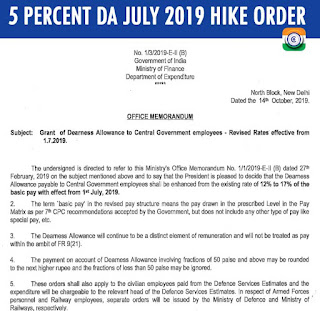
5 Percent DA July 2019 Hike Order - Grant of Dearness Allowance to Central Government employees

Grant of Dearness Allowance to Central Government employees 5 Percent DA July 2019 Hike Order  No. 1/3/2019-E- II (B) Government of...

Blog Archive

About The Author