A complete reference blog for Indian Government Employees

Showing posts with label Latest News. Show all posts

Monday, 13 July 2015

OROP: One Rank One Pension Scheme should be implemented with in six weeks – Hon’ble Supreme Court

OROP: One Rank One Pension Scheme should be implemented with in six weeks – Hon’ble Supreme Court

Hon’ble Supreme Court granted 6 weeks time Central Government to grant One Rank One Pension to retired Armed Forces Personnel on the request of Govt Justice T S Thakur accepted to take up the case after six weeks as per the request made by Additional Solicitor General on behalf of Government Side.

It is expected that time given now may be final as Hon’ble Supreme Court ordered for implementation of One Rank One Pension in the year 2008 itself which is yet to be implemented by Govt. This six weeks was granted on the grounds that Govt needs to work out the modalities for granting OROP.

A contempt petition has been filed by retired Major General S P S Vains in this issue in which hearing is on. Earlier Apex Court has observed that One Rank One Pension is one of the points in Election manifesto of NDA Government. Hon’ble court said “This was part of your manifesto for the Lok Sabha elections. You must keep your word,”

While hearing the Contempt Petition, Defence Ministry has been called upon to provide its explanation for non-implementation of OROP

In Febrary itself, when fixing the next hearing after 3 months Apex Court said “We make it clear that no further time will be granted for the purpose of implementation of the impugned judgment.”

Now, six more weeks have been given as additional time for implementing One Rank One Pension to Ex-Servicemen.

Source: The Indian Express
Share:

Monday, 30 March 2015

What central government employees can expect from the 7th Pay Commission

What central government employees can expect from the 7th Pay Commission

Sounds odd, but the highest paid Indian bureaucrat till 1959 was the railway board chairman and not the cabinet secretary. The top rail bureaucrat, who was earlier called chief commissioner of railways, drew a basic salary of Rs 3,250 per month, a smart 8.3% more than that of the cabinet secretary, the senior-most bureaucrat in India. But as the fortunes of Indian Railways dwindled over the years — its market share in freight movement has shrunk from 90% in 1950 to 30% now — the clout of the rail bosses and their corresponding rank and pay have also slipped.


Today, the railway board chairman and eight other top rail babus receive a salary equivalent to a government of India secretary, a scale which as many as 230 Indian Administrative Service (IAS) and 40 Indian Police Service (IPS) officers also draw. For good measure, the cabinet secretary now not only draws a higher salary than the railway board chairman, his superior rank comes with better perks including a bungalow at Prithviraj Road located in the heart of Lutyens' Delhi.

Meanwhile, the Indian Revenue Service (IRS), a 5,541 officers-strong cadre responsible for collecting direct taxes in India, now claims that IRS should get better pay and perks than IAS. The entry-level salary for all Group A Central services is the same now, but thanks to two more increments and faster promotions, IAS maintains an edge over others. The basis for this claim? "Today, IRS — not IAS — is the revenue collector for the government. So, it's logical that that the edge given to IAS  should be given to us," says Jayant Misra, Income-Tax commissioner and general secretary of IRS Association. In a 58-page-long memorandum to the 7th Central Pay Commission (CPC), which is now examining a pay hike for Central government employees, the IRS Association argued that the primary reason for higher pay to the Indian Civil Service (ICS) of the British era and its successor service, IAS, was that they were revenue collectors. But now, the dynamics have changed, they claim.


IRS has argued that the net direct tax collection has grown 9.35 times between 2000-01 and 2013-14, an impressive piece of statistics in the backdrop of only 5.4 times expansion of GDP during the corresponding period. Also, the cost of revenue collection in India is one of the lowest in the world, which according to IRS officers is yet another reason for demanding a good deal from the CPC. For every Rs 100 they collect, the tax department spends merely 57 paisa. In percentage terms, the cost of  revenue collection in India is one of the lowest in the world, which according to IRS officers is yet another reason for demanding a good deal from the CPC. For every Rs 100 they collect, the tax department spends merely 57 paisa. In percentage terms, the cost of revenue collection in India is 0.57% as against 1.58% in Japan, 1.35% in France, 1.17% in Canada and 1.05% in Australia.


Welcome to the behind-the-scenes manoeuvring before the Big Sarkari Pay Hike. With a new pay scale for 36 lakh Central government employees, and also pensioners, likely to come into effect from January 1, 2016, the officers and non-gazetted staff of various services have been lobbying hard to get a good deal from the 7th CPC. Unlike in the private sector, the pay hike in government is a once-in-10-years-affair, making every CPC, right from the first that submitted its report in 1947, a hugely powerful agency. No doubt, government employees have to undergo an annual appraisal process called Annual Performance Appraisal Report (APAR), but that exercise is important only for promotion, and not for any pay hike. Government employees do get a regular hike in dearness allowance, a measure meant for offsetting inflationary pressure on their earnings, but at the end of the day it is the CPC that fixes the bureaucrats' pay for 10 long years.


That's precisely why officers and staff of every service can't afford to ignore the CPC. Constituted in February 2014 under the chairmanship of retired Supreme Court judge Ashok Kumar Mathur, the 7th CPC has an economist and two bureaucrats as its members. Most of the employees' associations have already had at least one round of talks with the Commission. And some are waiting for Round II.


The Ripple Effects

A cursory glance at the memorandum submitted by IPS Central Association on behalf of Indian Police Service (IPS) will throw light on the importance attached to a pay commission. The 137-page memorandum, a copy of which was reviewed by ET Magazine, is well designed and comparable to any standard report prepared by a global consultancy firm. PV Rama Sastry, an Inspector General of Police at National Investigation Agency (NIA) and secretary of IPS Central Association says the memorandum  is the result of intense in-house research, factoring in the macro environment of growth, development, equity and justice vis-a-vis the role of a police officer. Though Sastry is the spokesperson of 4,720 IPS officers, the memorandum prepared by his team encompasses the role and needs of 30 lakh police personnel across India out of which 10 lakh come under the gamut of the pay commission. As the CPC recommendations are often accepted by the state governments as well, the remaining 20 lakh  police personnel too may eventually benefit.


The IPS memorandum has quoted a number of reports to suggest that the tough life of a cop justifies the demand for a fatter hike. For example, it has quoted articles published in two journals — Global Journal of Medicine and Public Health and International Journal of Pharma and Bio-Sciences — to conclude that one of two cops in India suffers from sleep disturbances and anxiety whereas chances of cardiovascular problems increase by 38% after a person joins as a police officer. Among other demands (see What it Expects), IPS wants better life and health insurance cover, an overtime allowance and also a new perk called allowance for "un-social" hours (for duty between 8 pm and 6 am).

Railway officers too cite round-the-clock work demands as a reason for better salary. "A railway officer may be called to join duty any time during the night. The pressure always remains as it's a 24x7 work," says RR Prasad, an Indian Railway Personnel Service officer and secretary general of Federation of Railways Officers' Association. The Indian Railways is a gigantic organisation with over 13 lakh employees, 16,000 of whom are officers. Both the officers and staff associations have made their representations to the 7th CPC. The officers want non-gazetted staff to get their dues but they demand the proportion of the pay of the lowest and the highestpaid employee should increase from current 1:12 to 1:18


To be sure, a formula towards pay parity has been the hallmark of the last few pay commissions. A government entry-level peon now gets a monthly pay of Rs 14,000, if dearness allowance is factored in. Similarly, a mid-level government driver's monthly salary, including allowances, is Rs 30,000, at least two times that of his counterpart in a private sector company. And that's why the salary gap between the lowest and highest paid government servant has drastically decreased over the last three decades.


The pay commissions have also reduced the disparity among the officers of various services. Till the late 1980s, an IAS officer used to receive a salary that's 25% higher than that of a Group A service officer. Today, the pay for all officers, at least at the entry level, is same. But IAS and Indian Foreign Service (IFS) officers still maintain an edge over others as their empanelment process (a step to get higher posts) is much faster.


Balancing Act

An IPS officer can become a joint secretary to government of India only two years after an IAS of the same batch can reach that level. Similarly, there has been a nine-yearlong gap in joint secretary empanelment between IAS and IRS, something many services claim is a continuation of the British legacy. Today, IAS officers at the level of deputy secretary and director at the Centre constitute about only 13% of the total officers. But as the hierarchy goes up, the percentage of IAS vis-a-vis others also rises. For example, 75% joint secretaries to government of India belong to IAS and IFS, and the percentage of IAS and IFS goes further up to 95 in case of government of India secretaries.

"The edge that the IAS has must continue. Why will a person join the IAS after quitting a job in HSBC Bank if that edge is missing? IAS officers have work experiences at Tehsil, sub-divisions, district, state and Central government levels. We interact with the political executives at all levels. IAS should remain a premium service," says Sanjay R Bhoosreddy, a joint-secretary-ranked officer and secretary to IAS (Central) Association.

On its part, the Indian Economic Service (IES) which has a cadre strength of 511 officers, represented in 55 Central government departments, has demanded parity in pay, perks and promotions of all services, including IAS, so that the "officers deliver what they have been employed for rather than fret over their pay and promotion prospects".

The question is how far the 7th CPC will go in changing the pay and associated service conditions like empanelment and promotions. IAS officers have pulled out a 1991 Supreme Court judgement (Mohan Kumar Singhania and Others vs Union of India and Others) where it was said that other services should not approach the pay commissions and attempt to change the rules of career progressions and push for a case for parity with the premier service. But other services are continuing their demand for pay parity and also for the creation of more departments where the IAS can't dictate. At present, only three major ministries — railways, external affairs and post — are not headed by IAS but run by their own cadres. Now, IPS wants a new department of internal security headed by a cop and IRS wants a separate direct tax department headed by a taxman.

Will the 7th CPC venture into such nuances? Or will it, like the past few pay commissions have, adopt a simple formula of Multiplier 3 under which the basic salary is hiked by three times or more depending on the economic health of the nation. If that is the case, it won't be too hazardous to make a prediction: A secretary to government of India will get a basic monthly salary (excluding DA) of Rs 2.4 lakh (current basic salary multiplied by three) and the cabinet secretary Rs 2.7 lakh from  January 1, 2016. And, yes, perks, DA and other allowances will be extra.

Source: http://economictimes.indiatimes.com/
Share:

Tuesday, 10 February 2015

Interaction Meeting with Seventh Central Pay Commission on NFIR’s Memorandum

Interaction Meeting with Seventh Central Pay Commission on NFIR’s Memorandum

NFIR
National Federation of Indian Railwaymen
3, CHELMSFORD ROAD, NEW DELHI -110055
 
No. IV/NHR/7th CPC/CORRES/Pt. V
Dated: 05/02/2015
The Chairman,
Seventh Central Pay Commission,
Chhatrapati Shivaji Bhawan,
IIFT, Block B (B-14/A),
Qutab Institutional Area,
New Delhi 110016
(Post Box No. 4599-Hauz Khas P.O)
 
Dear Sir,
Sub: Inter-action meeting with the Seventh Central Pay Commission on NFIR’s memorandum-reg.
Ref: NFIR’s letter No.IV/NFIR/7th CPC/CORRES/Pt. V dated 02/08/2014.
 
Federation vide its letter dated 02/08/2014, addressed to the Secretary, Seventh Central Pay Commission had made following suggestions with regard to holding interaction meetings:
a) Inter-action meetings may be fixed giving us reasonable advance intimation to enable us to reschedule our other programmes,

b) Meeting/hearing may be fixed department wise to facilitate us to meet the Pay Commission along with the representatives of the conccrned department/category.

c) In the Railways, there are eight major departments with hundreds of categories. Eight different dates for explaining our case may kindly be considered.

d) Inter-action meetings may also be convened for explaining the case of miscellaneous and isolated categories in Railways.
e) Separate date and time be provided to facilitate the NFIR to explain uniqueness of railways as well unique nature of duties of railway employee in general.
Federation is yet to receive response from the Seventh Central Pay Commission.
 
In this connection, NFIR desires to mention that the 6th CPC had allotted a total time of 28 hours to us in different spells/different dates to explain the case of Railway employees belonging to various categories in different departments. Federation trusts that similar time slots would be provided to us by the 7th CPC as well.
 
NFIR. therefore, once again requests the Hon’ble Chairman Seventh Central Pay Commission to arrange to allot adequate time slots and convey to the Federation.
Yours faithfully,
sd/-
(Dr.M.Raghavaiah)
General Secretary
Source: NFIR
Share:

Wednesday, 31 December 2014

Expected DA from Jan 2015 – AICPIN for the month of September 2014

Expected DA from Jan 2015 – AICPIN for the month of September 2014
No.5/1/2014- CPI
GOVERNMENT OF INDIA
MINISTRY OF LABOUR & EMPLOYMENT
LABOUR BUREAU
‘CLEREMONT’, SHIMLA-171004:
Dated the 31st October, 2014
Press Release

Consumer Price Index for Industrial Workers (CPI-IW) – September, 2014

The All-India CPI-IW for September, 2014 remained stationary at 253 (two hundred and fifty three). On 1-month percentage change, it remained stalic between August, 2014 and September, 2014 when compared with the rise of 0.42 per cent between the same two months a year ago.

The largest downward pressure to the change in current index came from Food group contributing (-) 1.04 percentage points to the total change. At item level, Fish Fresh, Poultry (Chicken), Chitlies Green, Ginger, Onion, Tomato, Brinal, French Beans, Lady’s Finger, Apple, Sugar, Medicine (Allopathie), Petrol, etc. are responsible for the decrease in index.

However, this decrease was restricted to sore extent by Rice, Wheat Atta, Arhar Dal, Potato, Cauliflower, Tea (Readymade), Snack Saltish, Bidi, Cigarette, Electricity Charges, Cinema Charges, Toilet Soap, Tailoring charges. etc.. putting upward pressure on the index.

The year-on-year inflation measured by monthly CPI-IW stood at 6.30 per cent tbr September, 2014 as compared to 6.75 per cent for the previous month and 10.70 per cent during the corresponding month of the previous year. Similarly, the Food inflation stood at 6.46 per cent against 7.63 per cent of the previous month and 13.36 per cent during the corresponding month of the previous year.

At centre level, Goa reported a decrease of 10 points followed by Nagpur (5 points). Among others, 4 points fall was observed in 6 centres, 3 points in 4 centres, 2 points in 9 centres and 1 point in 19 centres. On the contrary, Tripura recorded the maximum increase of 6 points followed by Lucknow & Jalpaiguri (4 points each) and Rourkela & Rangapara-Tezpur (3 points each). Among others, 2 points rise was registered in 8 centres and 1 point in 12 centres. Rest of the 13 centres’ indices remained stationary.

The indices of 37 centres are above and other 41 centres’ indices are below national average.

The next index of CPI-IW fut the month of October, 2014 will be released on Friday, 28 November. 2014.
The sanie will also be available on the office website www.labourbureau.gov.in
sd/-
(S.S.NEGI)
Director
Share:

Sunday, 28 September 2014

Payment of Dearness Allowance to Gramin Dak Sevaks (GDS) at revised retes w.e.f. 01.07.2014 onwards

Department of Posts issued orders for the payment of Dearness Allowance to Gramin Dak Sevaks (GDS) at revised retes w.e.f. 01.07.2014 onwards

No. 14-01/2011-PAP
Government of India
Ministry of Communication & IT
Department of Posts
(Establishment Division)/P.A.P. Section

Dak Bhawan, Sansad Marg, New Delhi – 110001
Dated 25th September, 2014
To,
All Chief Postmaster General
All G.Ms (PAF)/Director of Accounts (Posts).

Subject: Payment of Dearness Allowance to Gramin Dak Sevaks (GDS) at revised retes w.e.f. 01.07.2014 onwards – reg.

Consequent upon grant to another installment of Dearness allowance. With effect from 1st July, 2014 to the Central Government Employee vide Government of India, Ministry of Finance, Department of Expenditure’s O.M. No. 1/2/2014-E-II (B) dated 18.09.2014, duly endorsed vide this Department’s letter No. 8-1/2012-PAP dated 22.9.2014, the Gramin Dak Sevaks (GDS) have also become entitled to the payment of Dearness Allowances on basic TRCA at the revised rate with effect from 01.07.2014. It has, therefore, been decided that the Dearness Allowance payable to the Gramin Dak Sevaks shall be enhanced from the existing rate of 100% to 107% on the basic time related continuity Allowance, with effect from the 1st July,2014.

2. The additional of Dearness Allowance payable under this order shall be paid in cash to all Gramin Dak Sevaks.

3. The Expenditure on this account shall be debited to the head “salaries” under the relevant head of account and should be met from the sanctioned grant.

4. This issue with the concurrence of integrated finance wing vide the dairy No. 159/FA/2014-CS dated 25.09.2014.
(Maj.S.N.Dave)
Assistant Director General (Estt.)
Source : www.indiapost.gov.in
Share:

Thursday, 5 June 2014

Central Government Officers may have to work 6 days a week

News: 6 Days a week workdays in central government offices
Central Government Officers may have to work 6 days a week
Deccan Chronical | June 03, 2014

New Delhi: Speculation is rife in various union ministries that the new government under Narendra Modi may revert back to the six-days a week workdays in central government offices after about three decades.

Although there is no move yet by the government in this regard the issue is subject of much discussion among the bureaucrats. It was former PM Rajiv Gandhi who, in the mid-1980s, had decided to go in for the five-day week.

The aim at that time was to promote efficiency since it gave the bureaucrats much-needed rest over the weekend on the assumption that the work-culture would improve during week-days.

The closure of Government offices on Saturdays also resulted in saving of electricity and other expenses of the Centre. But despite the current five-day week, some of the ministers even in the previous UPA-2 government were known to attend office on Saturdays and attend to files and other important work.


Source: http://www.deccanchronicle.com/140603/nation-current-affairs/article/central-government-officers-may-have-work-6-days-week
Share:

Monday, 16 September 2013

Fixation of pay on functional promotions where feeder and promotional posts have been placed in the same Pay Band and Grade Pay: Railway Board Clarification

Fixation of pay on functional promotions where feeder and promotional posts have been placed in the same Pay Band and Grade Pay: Railway Board Clarification
 Railway Services
(Revised Pay) Rules, 2008- Clarification regarding fixation of pay under rule 13 on functional promotions in various situations where feeder and promotional posts have been placed in the same Pay Band and Grade Pay and where merger is not feasible.
GOVERNMENT OF INDIA
MINISTRY OF RAILWAYS
(Railway Board)
RBE No. 95/2013
S.No. PC-VI/317
No. PC Vl/2011/IC/1
New Delhi, dated 12.09.2013
The GMs/CAOs(R),
All Indian Railways & Production Units
(As per mailing list)

Subject: Railway Services (Revised Pay) Rules, 2008- Clarification regarding fixation of pay under rule 13 on functional promotions in various situations where feeder and promotional posts have been placed in the same Pay Band and Grade Pay and where merger is not feasible.

Both the Federations i.e. AIRF and NFIR have taken up the issue in various fora regarding admissibility of notional increment as per Rule 13 (1) of the Railway Services (Revised Pay) Rules, 2008 in the situations of promotions in identical revised pay structure (viz. same Grade Pay and Pay Band ) consequent upon implementation of recommendations of Sixth Central Pay Commission.

2. Prior to notification of RS (RP) Rules, 2008 (effective from 1.1.2006), fixation of pay in the cases of promotion etc. was governed by the provisions of Railway Fundamental Rules its contained in Indian Railway Establishment Code Vol. II viz. Rule 1313 (FR22)(I)(a)(1) read with sub Rule (III) thereof. Consequent upon deliberations with recognized staff Federations at different fora and consultation with Ministry of Finance / DOPT, fixation of pay under Rule 1313 (FR22(I)(a)( 1)R-II was extended in certain  situations of promotion from one post to another in identical pay scale as an exception to general rules.

3. Fixation of pay on promotion in revised pay structure on or after 1.1.2006 is governed by Rule 13 of Railway Services (Revised Pay) Rules, 2008. As a consequence of implementation of recommendations of Sixth Central Pay Commission, various pre-revised scales have been merged and got replaced by same revised pay structure (same Pay Band and Grade Pay) leading to merger of corresponding posts as indicated in the foot notes of Board’s letter No. PC VI/I/RSRP/1 dt. 11.9.2008 (as further supplemented/modified from time to time). However, there are certain specific situations on the Railways wherein it has not been feasible to merge the feeder and promotional posts placed in same revised pay structure (same Pay Band and Grade Pay) and such categories continue to be operated as separate categories. Further, these posts are part of normal promotional hierarchy of the employee ( i.e. other than the situations arising than to movement of the employee to another cadre in same revised pay structure through option), movement involves assumption of duties and responsibilities of greater importance and benefit of promotional increment was available even prior to implementation of revised pay structure vide RS(RP) Rules, 2008.

4. Various situations of the nature as above have been under examination in consultation with Ministry of Finance and Department of Personnel and Training and accordingly President is pleased to decide that the benefit of promotional pay fixation as per the provisions of Rule 13(i) of RS(RP) Rules, 2008 may be extended in the following situations of promotion from one post to another in same revised pay structure effective from 1.1.2006 onwards:

S.No.
Feeder Category
Promotional category
Revised Pay structure (Pay Band /Grade Pay)
1.
Chief Matron
Assistant Nursing Officer
PB3 GP Rs.5400
2.
Sr. Technician
Jr. Engineer
PB2 GP Rs.4200
3.
(i) Loco Pilots (Goods)
(i) Loco Pilots (Passenger)
PB-2 GP Rs 4200
(ii) Loco Pilots (Passenger)
Loco Pilots(Mail /Express)
PB-2 GP Rs. 4200
(iii) Passenger Guard
(iii) Mail/Express Guard
PB-2 GP Rs. 4200
4.
Sr.P.W. Supervisor
Jr. Engineer
PB2 GP Rs.4200

*All regular posts of Sr. Permanent Way Supervisors in PB-2, Grade pay Rs. 4200 stand merged w.e.f. 03.07.2013 with the cadre of Junior Engineer (P.Way) in terms of Boards letter No.PC-III/2012/FE-II/2 dated 03/07/2013.

4.1 The staff affected by the decision as above may submit the option, within a period of three months from the date of issue of these orders, to have their pay re-fixed from the date of promotion as above or from the date of next increment in the feeder category, as per the methodology illustrated Vide clarification 2 contained in Board’s letter No. PCVI/2008/I/RSRP/1 dr. 25.9 2008 (S.No. PC VI/22; RRF No 132/2008).

5. This issues with the concurrence of the Finance Directorate of the Ministry of Railways.
Hindi version will follow.
sd/-
(M.K. Panda)
Joint Director, Pay Commission
Railway Board.
Source : AIRF
[http://www.airfindia.com/Orders%202013/RBE%2095_2013_12.09.2013.pdf]
Share:

Friday, 2 August 2013

KARNATAKA-Dearness Allowance to the Pensioners/Family Pensioners who were drawing pay in the 2006 NJPC pay scales

KARNATAKA-Dearness Allowance to the Pensioners/Family Pensioners who were drawing pay in the 2006 NJPC pay scales

PROCEEDINGS OF THE GOVERNMENT OF KARNATAKA

Sub:- Sanction of Dearness Allowance to the Pensioners/Family Pensioners who were drawing pay in the 2006 NJPC pay scales.

ORDER NO. FD 12 SRP 2013 (II)

BANGALORE, DATED 12TH JUNE 2013


Government are pleased to sanction increase in the rates of Dearness Allowance from the existing 72% to 80% of the basic pension/family pension with effect from 1st January 2013 to the Pensioners/Family Pensioners who were drawing pay in the 2006 NJPC scales of pay.

2.    The increase in Dearness Allowance admissible under this order is payable in cash until further orders.

3.    The payment on account of the increase in Dearness Allowance as per this order involving fractions of 50 paise and above shall be rounded off to the next rupee and fractions less than 50 paise shall be ignored.

source-http://www.kar.nic.in/finance/gos/fd12srp2013-2.pdf
Share:

Sunday, 21 July 2013

Austrian honour for Karunanidhi with a postage stamp for his 90th Birthday

Austrian honour for Karunanidhi with a postage stamp for his 90th Birthday

 CHENNAI: Austrian government has honoured DMK chief M Karunanidhi with a postage stamp for his 90th birthday, which was celebrated on June 3.

The stamp on the DMK leader was based on requests from 'individuals' in Austria, who drew the attention of the Austrian postal service on the nonagenarian's contributions in the field of public life, cinema and literature.

The international postage stamp has the image of the DMK leader's face with the band of party flag, red and black and numeral 90, denoting his age as a backdrop.

Don Ashok, who has business interests in Austria, and who is one among the enthusiasts who made it possible, told TOI that it was the result of affectionate gestures of a few towards the party chief. "It is a result of love and affection, lakhs of partymen have for Karunanidhi," he said. The stamp, a limited version, comes at a cost of 90 euros.

Source :The Times of India
Share:

Saturday, 20 July 2013

7th CPC, DA Merger, Scrap NPS and Modify Child Care Leave as Family Care Leave(FCL) – AIRF Publishes the demands of Central Government Railway Employees

7th CPC, DA Merger, Scrap NPS and Modify Child Care Leave as Family Care Leave(FCL) – AIRF Publishes the demands of Central Government Railway Employees

All India Railwaymen’s Federation publishes the demands of Railway employees, in this attractive demands applicable to all other Central Government employees is ‘to set up 7th CPC without delay, Merge 80% D.A., Modify Child Care Leave as Family Care Leave(FCL), Scrap New Pension Scheme, GP 2800 Minimum entry pay for clerks, Scrap GP 2000 under MACP, One Increment for retiring on 30th June and rise 59 years to VRS’.

IMPORTANT DEMANDS OF THE RAILWAYMEN TO BE PURSUED BY THE ALL INDIA RAILWAYMEN’S FEDERATION
1. Employment to the wards of all the Railwaymen’s working in Grade Pay up to GP Rs.4600 in the Railways under LARSGESS.
2. Scrapping of New Pension System (NPS) & all the staff, irrespective of their date of appointment, should be covered under the Old Pension Scheme.
3. Merger of Sr. PWS with the J.E(P.Way).
4. Setting up of 7th Pay Commission without any delay.
5. Enhancement in upper age limit up to 59 years for the purpose of Voluntary Retirement under LARSGESS.
6. To earmark at least 20% quota for priority in recruitment of the wards of all the Railwaymen in RRC/RRB, preference to be given to the wards of the Railwaymen retiring by 31st March, 2014.
7. Dispensation of Written Examination from the process of engaging Act Apprentices to facilitate engagement of wards of Railwaymen under this scheme – their(wards of Railwaymen) engagement should only on the basis of viva-voce.
8. There should be full reimbursement of education expenses up to 10+2, which should include cost of transport, and the reimbursement scheme should be enhanced up to Degree and Post Graduate level.
9. 100% service rendered in CPC Scale of casual period should be computed for all pensionery benefits and financial upgradation under MACP Scheme with payment of consequential arrear.
10. Unanimous recommendation of the Jt. Committee on Package and Career Progression for Trackmen should be implemented in toto in regard to promotional percentage, i.e. 10%, 20%, 20% and 50% in GP Rs.2800, 2400, 1900 and 1800 respectively.
11. Pilot Project of promotion on Selection Posts on the basis of “Perusal of ACR and Benchmarking” should be regularized for ever.
12. Unanimous report of Cadre Restructuring Committee for all categories of Railwaymen should be implemented retrospectively w.e.f. 01.05.2010 with payment of consequential arrears.
13. Total working hours of all the categories of the Railwaymen should be limited to 8 hrs. per day, and for the Running Staff, 6 hours a day.
14. Implement decision taken in the Anomaly Committee to grant GP Rs.4200 to ASMs, GP Rs.4800 and Rs.5400 to all Technical and Non-Technical Supervisors presently placed in GP Rs.4600.
15. Grant GP of Rs.2400 for all Grade III Technicians presently in GP Rs.1900.
16. Upgrade Tech II to the level of Grade I and grant GP of Rs.2800. To avoid further Anomaly and till such time upgrade Tech Grade I to the level of GP Rs.4200, pay Rs.3000 as a Special Pay for all Grade I Tech.
17. Grant GP Rs.4600 for all MCMs and JEs.
18. Grant GP Rs.4800 for all Section Engineers.
19. Grant GP Rs.5400 for all Sr. Section Engineers.
20. Scrap GP of Rs.2000 under MACP Scheme and GP Rs.2400 with arrears for MACPS.
21. All grade III Technicians, TNCs, Pointsmen, Accounts Assistants, Junior Clerks, Accounts Clerks, TC, and Paramedical Staff in GP Rs.1900 should be paid GP Rs.2400 with immediate effect.
22. Grant GP Rs.2800 as a Minimum Entry Grade Pay for all the Commercial Clerks present in GP Rs.2000.
23. Encashment of 10 days LAP once in 2 years should be revised and encashment of 10 days LAP should be allowed every year without any condition.
24. Group `C’ employees retire from service in GP Rs.1800 should be issued 2 sets of Post Retirement Complementary Passes, out of which 1 set should be 3rd AC every year.
25. All the employees, both in safety and non-safety categories, presently in GP Rs.1800, should be given career advancement, like Track Maintainers with promotion in GP Rs.1900, Rs.2400 and Rs.2800.
26. All the Railwaymen should be paid a monthly Special Pay of Rs.2000 as “Railway Special Pay” on par with(Ministry’s Special Pay).
27. Scrap New Pension Scheme and convert the accumulated 10% deduction into PF account.
28. Modify Child Care Leave as Family Care Leave(FCL) and extend the same to all the serving female and male employees not only for children care and for health and in emergency reasons.
29. With a view to allow Women Railway Employees to avail Family Care Leave without any restriction, at least 15% Leave Reserve Posts should be created in Office Staff and the percentage of Leave Reserve in open line should be increased from 15% to 25% so that no leave is denied to the Railwaymen.
30. Implement flexi-timings for female Ministerial Staff and there should be no “Night Duty” for open line Women Workers.
31. Sanction Productivity Linked Bonus on the basis of real wages without any upper ceiling limit.
32. Merge 80% D.A. for the purpose of all benefits, including HRA and Transport Allowance.
33. Grant one increment for those retiring from service on 30th June every year.
34. Allow Railway employees born on 1st day of a month to superannuate on the last day of the same month instead of retiring than in previous month.
35. Enhance Nursing Allowance from Rs.4000 p.m. to Rs.10000 pm.
36. Grant bunching of increment benefits to Nurses/Nursing Sisters on par with Matrons.
37. Pay Over Time Allowance to Nurse/Nursing Sisters against vacancy.
38. Remove ban on recruitment in Ministerial Cadre and fill up all promotion under VR Quota on promotion as per seniority.
39. Extend Residential Card Pass facility in all the newly opened sections.
40. Grant 30% HRA to Railway employees working in the vicinity of `A’ Class Cities.
These issues will again be deliberated in the ensuring General Council Meeting of the AIRF to assess the progress, and in case these are not considered by the Ministry of Railways(Government of India) and paid due attention, there will be no way-out left, but to resort to direct action, the entire responsibility of which shall rest with the Railway Administration.

Source: AIRF
Share:

Thursday, 4 July 2013

Booking, Dispatch and Delivery of relief materials to Uttarakhand State by post without charging postage.

Booking, Dispatch and Delivery of relief materials to Uttarakhand State by post without charging postage.

DO from Shri S.K. Sinha, CGM(MB) 

D. O. No. 30-27/2013-D
Dated  : 04-07-2013

Dear
               This is regarding the booking, dispatch and delivery of relief materials to Uttarakhand State by post without charging postage.

 
2.            As you are aware that the recent floods and landslides in the State of Uttarakhand have led to massive damage to the life and property and have rendered many people without a shelter. Relief material such as clothes, blankets, woolens, utensils, edible items, medicines is being sent by people across the country.


3.            The matter of booking, dispatch and delivery of relief material to Uttarakhand State by post without charging postage was considered by the Department. It has been decided to collect the relief material from the general public / institutions / agencies /NGO free of postage and dispatch the same to Uttarakhand State as a goodwill gesture.
                                                                                                
4.            For booking of packages containing relief material, special receipts may be got printed locally immediately with the heading “Relief material for Uttarakhand flood victims” at the top of the receipt. Receipts should be printed in duplicate with Sl. No. ‘0001 to 9999’ along with date. The Original copy may be handed over to the sender and the carbon copy may be kept as office copy. Address of the addressee may be got printed as “Senior Postmaster, Dehradun GPO-248001” and sufficient space may be kept for writing name and address of the sender. Serial number of the receipt and date of booking should be clearly and legibly written on the package and it should be stamped with the name stamp of booking Head Office.


5.            The packages of the relief material so booked should be closed in a bag addressed to the Senior Postmaster, Dehradun GPO-248001 and dispatched by surface mode i.e. Departmental MMS, contractual MMS, RMS Sections, etc.


6.            It is learnt that the Railways are also dispatching relief material to Uttarakhand free of charge up to 09-07-2013. The Railways may extend this date. You are requested to make full use of this facility of Railways of free transmission to bond the efforts and Synergy of Posts and Railways. In this context, you may ask your Region / Division to contact the Sr. Divisional Commercial Manager of Divisional Railway Manager’s office and collect the information as to which authority and where the relief material is to be handed over. For free transmission by trains, relief material should be addressed to the District Magistrate of the concerned district of Uttarakhand State and handed over to the proper railway authority under receipt. 


7.            The relief material would be accepted only in the Head Post Offices up to 20-07-2013. Detailed instructions for booking, dispatch and delivery of relief material are enclosed.


8.            Wide publicity may be given through Press Release and through advertisement in local newspapers.


               I would, therefore, request you to kindly make necessary arrangements in this regard.
Encl: Instructions 

                                                                                                                                                                           Yours sincerely,
                                                                                                               
  (S K Sinha)


Instructions for Booking, Dispatch and delivery of Relief Materials for Uttarakhand


1.    The Relief material containing clothes, blankets, woollens, medicines, tarpaulin, plastic sheets, Torch, long shelf-life food etc. may be sent through the arrangements made by the Department of Posts.
2.    The material should be securely packed by the sender and marked on top as “Relief material for Uttarkhand”. Accordingly, the package should be addressed to “Senior Postmaster, Dehradun GPO, Dehradun-248001 (Uttarakhand)”.
3.    The facility to book the relief material for the sender would be available at all Head Post Offices across the country.
4.    The package containing relief material can be accepted up to 35 Kg. of weight for a single package. The sender would not be required to pay any postage for this purpose.
5.    The facility for booking or providing relief material at Head Post Offices would be provided with immediate effect and up to 20th July, 2013.
6.    It may be ensured by the Circles that wide publicity is given to the initiative through the media. The public may also be made aware that the relief material should not contain liquid, breakable items or any other item prohibited for booking through post offices.
7.    At every HO, a receipt book containing receipts in duplicate and specially printed locally for booking of packages of relief material may be kept in sufficient quantity.
8.    The relief material would be sent in direct bags closed for Dehradun GPO and routed through surface mode. Wherever the Railways are dispatching relief material to Uttarakhand State free of charge, the bags containing packages of relief material should be addressed to the District Magistrate of the concerned district in Uttarkhand State.
9.    The relief material transmitted through postal channel would be delivered by the Senior Postmaster, Dehradun GPO to ‘Centre for Collection & Distribution of Relief Material, Maharana Pratap Sports College, Raipur Road, Dehradun’ set up by Uttarakhand State Government under clear receipt. Special delivery slip containing the details of the packages of relief material i.e. Name of head office of booking, serial number of the package, date of booking and weight may be prepared for delivery.


CGM -Mail Business
Mail Business Development & Operations Division
Department of Posts
Ministry of Communication & Information Technolgy
Government of India
Dak Bhawan, Sansad Marg
New Delhi 110001

Courtesy : http://orissapost.gov.in/
Share:

Scheme for Payment of Pension to Government Pensioners by Authorised Banks: FAQ by Reserve Bank of India (RBI)

Scheme for Payment of Pension to Government Pensioners by Authorised Banks: FAQ by Reserve Bank of India (RBI)

Reserve Bank of India

FAQ: Payment of Pension to Government Pensioners:

    Scheme for Payment of Pension to Government Pensioners by Authorised Banks


Reserve Bank of India (the Bank) oversees disbursement of pension by its agency banks in respect of all Central Government Departments and some State Governments. In the process, it receives queries/ complaints from pensioners in regard to fixation, calculation and payment of pension including revision of pension/ Dearness Relief, transfer of pension account from one bank branch to another, etc. We have analysed the queries/ complaints, and put them in the form of answers to these Frequently Asked Questions. It is hoped that these will cover most of the queries/ doubts in the minds of pensioners.

1. Can the pensioner draw his/ her pension through a bank branch?

Yes. Even the Government employees earlier drawing their pension from a treasury or from a post office have the option to draw their pension from the authorized bank’s branches.

2. Who is the pension sanctioning authority?

The Ministry/ Department /Office where the Government servant last served is the pension sanctioning authority. The pension fixation is made by such authority for the first time and thereafter the refixation of pay, if any, is done by the pension paying bank based on the instructions from the concerned Central/ State Government authority.


3. Is it necessary for the pensioner to open a separate pension account for the purpose of crediting his/ her pension in authorized bank?

The pensioner is not required to open a separate pension account. The pension can be credited to his/her existing savings/ current account maintained with the branch selected by the pensioner.

4. Can a pensioner open a Joint Account with his/ her spouse?

Yes. All pensioners of the Central Government Pensioners and those State Governments which have accepted such arrangement can open Joint Account with their spouses.

5. Whether Joint Account of the pensioner with spouse can be operated either by ''Former or Survivor" or "Either or Survivor".

The Joint Account of the pensioner with spouse can be operated either as ‘‘Former or Survivor" or “Either or Survivor".

6. What is the minimum balance required to be maintained in the pension account maintained with the banks?

RBI has not stipulated any minimum balance to be maintained in pension accounts by the pensioners. Individual banks have framed their own rules in this regard. However, some banks have also permitted zero balance in the pensioners’ accounts.

7. Who sends the Pension Payment Orders (PPOs) to the authorized bank branch?

The concerned pension sanctioning authorities in the Ministries /Departments/ State Governments forward the PPOs to bank branches wherefrom the pensioner desires to draw his/her pension. However, on implementation of CPPCs, pension sanctioning authorities have gradually started sending PPOs to the CPPC of the bank instead of bank branch.

8. When is the pension credited to the pensioner's account by the paying branch?

The disbursement of pension by the paying branch is spread over the last four working days of the month depending on the convenience of the pension paying branch except for the month of March when the pension is credited on or after the first working day of April.

9. Can a pensioner transfer his/ her pension account from one branch to another branch of the same bank or to the branch of another bank?

(a) Pensioner can transfer his/ her pension account from one branch to another branch of the same bank within the same centre or at a different centre;

(b) He/ She can transfer his/ her account from one authorized bank to another within the same centre (such transfers to be allowed only once in a year);

(c) He/ She can also transfer his/ her account from one authorized bank to another authorized bank at a different centre.

10. What is the procedure for payment of pension in the case of the transfer of PPO to another branch or bank, as the case may be?

Pension will be paid for three months on the basis of the photocopy of the pensioner’s PPO at the transferee (new) branch from the date of the last payment made at the transferor (old) branch. Both the branches (old and new) are required to ensure that all the required documents are received by the transferee branch within these three months.

11. Is it necessary for the pensioner to be present at the branch of the bank along with documents for the purpose of identification before commencement of pension?

Yes. Before the commencement of pension, a pensioner has to be present at the paying branch for the purpose of identification. The paying branch shall obtain the specimen signatures or the thumb/toe impression from the pensioner.

12. What is the procedure to be followed by the bank branch if the pensioner is handicapped /incapacitated and is not in a position to be present at the paying branch?

If the pensioner is physically handicapped/incapacitated and unable to be present at the branch, the requirement of personal appearance is waived. In such cases, the bank official visits the pensioner’s residence/hospital for the purpose of identification and obtaining specimen signature or thumb/toe impression.

13. Has the pensioner got right to retain half portion of the PPO for record and to get it updated from paying branch whenever there is a change in the quantum of pension due to revision in basic pension, dearness relief, etc.?

Yes. The pensioner has right to retain half portion of the PPO for record and whenever there is a revision in the basic pension/Dearness Relief (DR), etc. the paying branch has to call for the pensioner's half of the PPO and record thereon the changes according to government orders/notifications and return the same to the pensioner.

14. Whether the paying branch has to maintain a detailed record of pension payments made by it in the prescribed form?

Yes. The pension paying branch is required to maintain a detailed record of pension payments made by it from time to time in the prescribed form duly authenticated by the authorized officer.

15. Can the pension paying bank recover the excess amount credited to the pensioner’s account?

Yes. The paying branch before commencement of pension obtains an undertaking from the pensioner in the prescribed form for this purpose and, therefore, can recover the excess payment made to the pensioner's account due to delay in receipt of any material information or due to any bonafide error. The bank also has the right to recover the excess amount of pension credited to the deceased pensioner’s account from his/her legal heirs/nominees.

16. Is it compulsory for a pensioner to furnish a Life Certificate/Non-Employment Certificate orEmployment Certificate to the bank in the month of November?

Yes. The pensioner is required to furnish a Life Certificate/Non – Employment Certificate or Employment Certificate to the bank in the month of November every year. However, in case a pensioner is unable to obtain a Life Certificate from an authorized bank officer on account of serious illness / incapacitation, the bank official will visit his/her residence/ hospital for the purpose of recording the life certificate.

17. Can a pensioner be allowed to operate his/ her account by the holder of Power of Attorney?

The account is not allowed to be operated by a holder of Power of Attorney. However, the cheque book facility and acceptance of standing instructions for transfer of funds from the account is permissible.

18. Who is responsible for deduction of Income Tax at source from pension payment?

The pension paying bank is responsible for deduction of Income Tax from pension amount in accordance with the rates prescribed by the Income Tax authorities from time to time. While deducting such tax from the pension amount, the paying bank will also allow deductions on account of relief to the pensioner available under the Income Tax Act. The paying branch, in April each year, will also issue to the pensioner a certificate of tax deduction as per the prescribed form. If the pensioner is not liable to pay Income Tax, he should furnish to the pension paying branch, a declaration to that effect in the prescribed form (15 H).

19. Can old, sick physically handicapped pensioner who is unable to sign, open pension account or withdraw his/ her pension from the pension account?

A pensioner, who is old, sick or lost both his/her hands and, therefore, cannot sign, can put any mark or thumb/ toe impression on the form for opening of pension account. While withdrawing the pension amount he/she can put thumb/toe impression on the cheque/withdrawal form and it should be identified by two independent witnesses known to the bank one of whom should be a bank official.

20. Can a pensioner withdraw pension from his/ her account when he/she is not able to sign or put thumb/toe impression or unable to be present in the bank?

In such cases, a pensioner can put any mark or impression on the cheque/ withdrawal form and may indicate to the bank as to who would withdraw pension amount from the bank on the basis of cheque/withdrawal form. Such a person should be identified by two independent witnesses. The person who is actually drawing the money from the bank should be asked to furnish his/her specimen signature to the bank.

21. When does the family pension commence?

The family pension commences after the death of the pensioner. The family pension is payable to the person indicated in the PPO on receipt of a death certificate and application from the nominee.

22. How the payment of Dearness Relief at revised rate is to be paid to the pensioners?

Whenever any additional relief on pension/family pension is sanctioned by the Government, the same is intimated to the agency banks for issuing suitable instructions to their pension paying branches for payment of relief at the revised rates to the pensioners without any delay. The orders issued by Government Departments are also hosted on their websites and banks have been advised to watch the latest instructions on the website and act accordingly without waiting for any further orders from RBI in this regard.

23. Can pensioners get pension slips?

Yes. As decided by the Central Government (Civil, Defence & Railways), pension paying banks have been advised to issue pension slips to the pensioners in prescribed form when the pension is paid for the first time and thereafter whenever there is a change in quantum of pension due to revision in basic pension or revision in Dearness Relief.

24. Which authority the pensioner should approach for redressal of his/ her grievances?

A pensioner can initially approach the concerned Branch Manager and, thereafter, the Head Office of the concerned bank for redressal of his/her complaint. They can also approach the Banking Ombudsman of the concerned State in terms of Banking Ombudsman Scheme 2006 of the Reserve Bank of India (details available at the Bank’s website www.rbi.org.in) This is applicable only in respect of complaints relating to services rendered by banks. For other issues, the complainant will have to approach the respective pension sanctioning authority.

25. Where can a pensioner get information about the changes in the pension/ Dearness Relief or any pension related issue?

The pensioner can visit the Official Website of the concerned Government Department as also Reserve Bank of India Website (www.rbi.org.in) to get the information about pension related issues.

26.  Whether a pensioner is entitled for any compensation from the agency banks for delayed creditof pension/ arrears of pension?

Yes. A Pensioner is entitled for compensation for delayed credit of pension/arrears thereof at the fixed rate 8% and the same would be credited to the pensioner's account automatically by the bank on the same day when the bank affords delayed credit of such pension / arrears etc without any claim from the pensioner.
 

RBI's disclaimer
These FAQs are issued by the Reserve Bank of India (Bank) for information and general guidance purposes only. The Bank will not be held responsible for actions taken and/or decisions made on the basis of the same. For clarifications or interpretations, if any, the readers are requested to be guided by the relevant circulars and notifications issued from time to time by the Bank and the Government.


Source: http://www.rbi.org.in
[http://www.rbi.org.in/scripts/FAQView.aspx?Id=68]
Share:

Monday, 1 July 2013

SBI to charge customers Rs 60 per year for SMS alerts

SBI to charge customers Rs 60 per year for SMS alerts

State Bank of India (SBI) customers will have to pay Rs 60 per year for getting SMS alerts, a move which is likely to be followed by other public sector lenders.

"With effect from quarter ending June 2013, SMS charges of Rs 15 inclusive of service tax per quarter will be recovered," SBI said in an announcement. The country's largest bank, which has about 18.5 crore customers, did not specify whether the charges are for special alerts only or even debit or credit card transaction alerts sent as per regulatory guidelines will also come under this.


Private sector banks ICICI and HDFC are already charging Rs 60 per year, excluding service tax, for sending special SMSes other than withdrawal and deposit alerts to its customers.

At present, service tax rate is 12 per cent and education cess is 3 per cent of the service tax amount. Kotak Mahindra Bank charges Rs 25 per quarter for SMS alerts and updates.

SBI's fee income during the fourth quarter of 2012-13 declined by 8.13 per cent to Rs 3,873 crore as compared to Rs 4,216 crore in the corresponding quarter. On an annual basis, the fee income fell by 5.02 per cent to Rs 11,484 crore as against Rs 12,091 crore in 2011-12.

Last month, Canara Bank announced a levy of about Rs 112 as annual fee on its ATM debit cards from July 1.

The bank, which currently issues the cards free of cost, said in a circular that a need has been felt to offer the services at competitive rates in tune with "market trends".

"It has been decided to charge a nominal fee of Rs 100 per card plus applicable service taxon completion of one year from the date of issue/renewal of the card and thereafter to be charged yearly," it said.

Several other banks, including SBI, also charge an annual fee in the same range.

Canara Bank further said the annual fee will not apply to debit cards issued to customers with Canara Small Savings Account, Basic Savings Bank Account and Financial Savings Bank Account.
Share:

Sunday, 30 June 2013

AIPAEA - POSTAL ACCOUNTS CADRE RESTRUCTURING PROPOSAL ACCEPTED BY POSTAL BOARD

AIPAEA - POSTAL ACCOUNTS CADRE RESTRUCTURING PROPOSAL ACCEPTED BY POSTAL BOARD

The AIPAEA (All India Postal Accounts Employees Association) has intimated through its official website that the proposal of cadre restructuring accepted by the Postal Board, the content of the post is reproduced here under for your information...

POSTAL ACCOUNTS CADRE RESTRUCTURING PROPOSAL ACCEPTED BY POSTAL BOARD COMRADES,

WITH THE CONSTANT PERSUASION AND FOLLOW UP BY AIPAEA AND UNSTINTING SUPPORT FROM NFPE, FINALLY THE SECRETARY, DEPARTMENT OF POSTS HAS APPROVED THE CADRE RESTRUCTURING RECOMMENDATIONS RELATING TO POSTAL ACCOUNTS. THE FILE IS BEING PROCESSED TO SEND IT TO THE NODAL MINISTRY, DOP&T FOR FURTHER NECESSARY ACTION.

AIPAEA CONVEY ITS THANKS TO THE SECRETARY POSTS, JS&FA, DDG (PAF) AND OTHER OFFICERS IN THE DIRECTORATE.

THIS RESTRUCTURING WILL BENEFIT THE SORTERS AND LDCs OF PAOS AS THEY WILL GET THE GRADE PAY OF Rs. 2400/- AND CHANGE IN THE DESIGNATION AS ' ACCOUNTS ASSISTANT'.

THE RESTRUCTURING OF JA, SA AND AAO IS UNDER PERSUASION AT THE LEVEL OF AUDIT AND ACCOUNTS JAC.

AIPAEA IS AWARE OF THE FACT THAT WE HAVE TO GO MILES TO TURN THIS PROPOSAL INTO REALITY. AIPAEA IS CONFIDENT OF ACHIEVING THIS WITH THE HELP OF NFPE AND CONFEDERATION.

THANKS TO THE NFPE LEADERSHIP.

Source: AIPAEA
[http://aipaea09.blogspot.in/2013/06/postal-accounts-cadre-restructuring.html]
Share:

Saturday, 29 June 2013

Dopt orders 2013 : Guidelines regarding grant of vigilance clearance to members of the Central Civil Posts / Central Civil Services

Dopt orders 2013 : Guidelines regarding grant of vigilance clearance to members of the Central Civil Posts / Central Civil Services


No. 11012/11/2007-Estt.A
Government of India
Ministry of Personnel, Public Grievances & Pensions
Department of Personnel & Training


North Block, New Delhi
Dated: 21st June 2013


Office Memorandum


Subject : Guidelines regarding grant of vigilance clearance to members of the Central Civil Services/Central Civil Posts.
The undersigned is directed to refer to this Department’s O.M. of even number dated 14.12.2007 on the above subject and to say that it has been decided to modify Para 2(c) thereof as under:

"(c) Vigilance clearance shall not be withheld unless (i) the officer is under suspension (ii) the officer is on the Agreed List, provided that in all such cases the position shall be mandatorily revisited after a period of one year (iii) a charge sheet has been issued against the officer in a disciplinary proceeding and the proceeding is pending (iv) orders for instituting disciplinary proceeding against the officer have been issued by the Disciplinary Authority provided that the charge sheet is served within three months from the date of passing such order (v) charge sheet has been filed in a Court by the Investigating Agency in a criminal case and the case is pending (vi) orders for instituting a criminal case against the officer have been issued by the Disciplinary Authority provided that the charge sheet is served within three months from the date of initiating proceedings (vii) sanction for investigation or prosecution has been granted by the Competent Authority in a case under the PC Act or any other criminal matter (viii) an FIR has been filed or a case registered by the concerned Department against the officer provided that the charge sheet is served within three months from the date of filing / registering the FIR / case (ix) the officer is involved in a trap / raid case on charges of corruption and investigation is pending."


sd/-
(J.A. Vaidyanathan)
Director (Establishment)


Source : www.persmin.nic.in
[http://ccis.nic.in/WriteReadData/CircularPortal/D2/D02est/11012_11_2007-Estt-A-1.pdf]
Share:

Tuesday, 25 June 2013

Declaration of Written Result - Combined Defence Services Examination (I)-2013

Declaration of Written Result - Combined Defence Services Examination (I)-2013

On the basis of the results of the Combined Defence Services Examination (I)-2013 held by the Union Public Service Commission On 17 February, 2013, 9888 candidates with the following Roll Numbers have qualified for being interviewed by the Service Selection Board of the Ministry of Defence, for admission to

 (i) Indian Military Academy,Dehradun 136th Course commencing in January, 2014 
(ii) Indian Naval Academy, Ezhimala, Course commencing in January, 2014 
(iii) Air Force Academy, Hyderabad (Pre-Flying) Training Course for 195rd F(P) Course commencing in January, 2014 
(iv) Officers’ Training Academy, Chennai  99th SSC Course (for Men) commencing in April, 2014 and 
(v) Officers’ Training Academy, Chennai, 13th  SSC Women (Non-Technical) Course commencing in April, 2014.

        The ratio of candidates shortlisted for the examination per vacancy is 1:18.95


        The candidature of all the candidates, whose Roll Numbers are shown in the lists below, is provisional.  In accordance with the conditions of the admission to the examination, they are required to submit the original certificates in support of age (date of birth), educational qualifications, NCC (C) (Army Wing/Senior Division Air Wing/Naval Wing) etc. claimed by them, alongwith attested copies of thereof, to Army Headquarters, A.G.’s Branch/Rtg./CDSE Entry, West Block 3, Ground Floor, Wing No. I, R.K. Puram, New Delhi-110066, in case of IMA/SSC as their first choice and to Naval Headquarters (R&R Section), Room No. 204, C-Wing, Sena Bhawan, New Delhi-110011 in case of Naval as their first choice, and to PO3 (A) Air Headquarters, ‘J’ Block, Room No. 17, Opp. Vayu Bhawan, Moti Lal Nehru Marg, New Delhi-110011 in case of Air Force as their  first choice.  The original Certificates are to be submitted within two weeks of completion of the SSB Interview and not later than 13th November, 2013 (1st February, 2014 in case of SSC only).  The candidates must not send the original certificates to the Union Public Service Commission.


        In case, there is any change of address, the candidates are advised to promptly intimate directly to the Army Headquarters/Naval Headquarters/Air Headquarters as the case may be.


        The Union Public Service Commission have a Facilitation Counter near Examination Hall Building in its Campus. Candidates may obtain any information/clarification regarding their examination/recruitment on working days between10.00 AM to 5.00 PM, in person or over telephone Nos. 011-23385271, 011-23381125 and 011-23098543 from this Facilitation Counter.  Candidates can also obtain information regarding their result by accessing UPSC website http.//www.upsc.gov.in
        

The marks-sheet of candidates who have not qualified, will be put on the Commission’s website within 15 days from the date of publication of the final result (after conducting SSB interview) and will remain available on the website for a period of 60 days.        


Source : PIB

http://pib.nic.in/archieve/others/2013/jun/d2013062502.pdf
Share:

SPEECH MADE BY MRS. SANDHYA RANI, IPS, POSTMASTER GENERAL, (BUSINESS DEVELOPMENT & TECHNOLOGY) AP CIRCLE, AS CHIEF GUEST IN THE WOMEN’S CONVENTION HELD AT HYDERABAD ON 09.06.2013

SPEECH MADE BY MRS. SANDHYA RANI, IPS, POSTMASTER GENERAL, (BUSINESS DEVELOPMENT & TECHNOLOGY) AP CIRCLE, AS CHIEF GUEST IN THE WOMEN’S CONVENTION HELD AT HYDERABAD ON 09.06.2013 


sPEECH MADE BY MRS. SANDHYA RANI, IPS, POSTMASTER GENERAL,
(BUSINESS DEVELOPMENT & TECHNOLOGY) AP CIRCLE, AS CHIEF GUEST IN THE WOMEN’S CONVENTION HELD AT HYDERABAD ON 09.06.2013, IN CONNECTION WITH THE 9TH FEDERAL COUNCIL OF NFPE
President of the National Federation of Postal Employees Women’s Convention, Mrs. Shakunthala, distinguished guests on the dais, leaders and invitees who have come from across the country to attend the 9th Federal Council meeting of the National Federation of Postal Employees, ladies and gentlemen, my heartfelt greetings to all of you. It is a pleasure to be here with you today and I would like to thank the organizers for inviting me.
From the time I joined the Department of Posts as an young officer some 25 years ago, many changes have come in, especially in the role, approach and scope of Trade union activism. The nature of industrial relations and collective bargaining has also changed in the light of globalization, technology, changed business processes, etc.
I would like to share, my thoughts with you today in the context of three broad themes –
i.      The first one relates to Women & Trade Union movement in the Indian context,
ii.     The 2nd one is about women in Department of posts,
iii.    Thirdly I will touch briefly upon about the significant organizational changes underway in Dept.of Posts and possible responses while balancing our personal aspirations and staff unions’ concerns.
In the context of Women and Trade Union movement, the questions that are often asked are: inadequate women’s participation, equality of women, discrimination in workplace, lack of adequate safeguards for women employees, continuing with the responsibility of housework, etc. Women in our country, as elsewhere in the world, have been discriminated against in every sphere – within the family, at the workplace, in society and in public/political participation. Women are increasingly joining the workforce to supplement family income, especially in urban areas. In rural areas they have always participated in agriculture labour and related works.
According to the Directorate General of Employment and Training in 2005, among the 393 lakh job-seekers enrolled with them, only 106 lakhs are female job seekers. In other words female job seekers account for only about 27% of the total job seekers. This is also indicative of the fact that much of the employment of women is in unorganized sector pushing them into exploitative and low end jobs.
Increased employment in organized sector, while empowering women to earn higher incomes, and take up challenging jobs, has also made them to more vulnerable to stress, struggle to balance work and home life and sometimes to sexual harassment in different forms. Further, either due to personal choices or due to the intangible glass ceiling operating very few women are found in higher managerial positions.
Overall the unionized labour is a very small number in our country, (less than 2% according to ILO in year 2000). According to the National Sample Survey Organisation (NSSO), in 1999-2000 out of total workforce of 397 million, only 28 million workers were employed in the formal sector and thus formally unionized. Active participation of women in labour union movement has been historically very low. In recent times with overall decreasing union memberships, far lesser number of women join them or actively participate in the TU deliberations on regular basis. With few of them attending regular TU meetings it is not unexpected that issues of concern to women employees do not get center stage in union items. Women are also under-represented at all levels of union leadership and decision-making.
I believe that Trade Union leadership can and should do much more to encourage and facilitate participation of women in trade union activities. Being effective home makers ensures that women have certain refined skills, especially at balancing competing interests/concerns, negotiating impossible situations. Hence, they should be encouraged to take up leadership roles in the Union actively. Issues relating to women should also get center stage, like lack of amenities in work places, exploitation, especially of unorganized contingent women employees, often working long hours and not drawing even minimum wages, etc. should be taken up actively. At the policy level, Trade Unions can also take up the case of special investment opportunities for female employees with say higher interest rates. This will help the women become more secure and empowered as well as greater productive investments will be made for development of the country. Another area that TUs can also pushing for a special bench or special sessions of CAT and higher Courts to be held periodically to handle cases field by Women employees on priority, so that they are not required to miss office or use personal/home time in running around CAT and other courts. Trade Unions should facilitate greater leadership development and Training for its Women members.
My second theme relates to women employees in Department of Posts. As per census of Central Govt. Employees, only 7.53% of total Central Govt. Employees are women. However, an interesting aspect of this is that in Communications and IT sector, the share of women employees is 12.20%. It is p[ossible that in some Circles, especially in South India, the percentage of women employees could be 30-50%. Surprisingly in Railways Women employees are only 4.63% of the total work-force. Considering the number of railway employees being the largest of the central govt. work force, in actual numbers this would be much higher than many departments. It is seen that in AP postal Circle less than 15% of total departmental staff are women.
In the Department of Posts there are several issues of concern to women employees working as GDS, Post Women, Postal Assistants, Post masters, Supervisors, Inspectors & Officers. Some of these are lack of basic amenities in post offices, restrictions relating to rule-38 or rotational transfers under spouse category, child care leave not being granted on administrative grounds, posting of women in night sets, increasing number of cases of sexual harassment at work place etc. Issues relating to women GDS employees and especially of the unorganized sector contingent women employees like sweepers, water women, scavengers, etc. which do not even form part of the Trade Union activism.
Women employees face typical unreasonable biases in the department like the perception of not being as capable as men at work. Sometimes one comes across Supervisors asking for male members in the team so that they can sit late hours to complete work! I do not obviously agree with that view. Women employees are by and large committed and sincerely attend to their work. They are the best asset that the department has. However, we do come across instances of lack of adequate sensitivity in dealing with women employees in the department.
For instance, majority of our POs are C class POs, usually located in rural areas, which lack basic amenities or facilities. Instructions exist about hiring good buildings. But sometimes practically such buildings are not available. Ideally, as a policy all Departmental POs should have own buildings with proper facilities, considering that Government is a model employer. While this is not always feasible, considering the resource gaps, the Divisional Heads should ensure that buildings with basic amenities are hired, or landlord should be insisted upon to provide basic amenities. Further, Divisional Head should also keep in mind availability of basic facilities in a PO, while considering posting women employees there.
While the Central govt. rules require posting of spouses to the same station, as far as possible, in practice there are lot of gaps in implementing these instructions. The restrictive handling of Rule 38 requests under Spouse category based on lack of vacancy, non-fulfillment of minimum 5 years condition for granting Rule-38 transfer, etc. should be used sparingly by the competent authority. Sometimes adequate managerial posts may not be available, but for the operative staff as far as possible spouse category requests should be accommodated.
Another service condition that comes to mind is the recognition that women as the principal home maker and allows themchild care leave. Though every women employee is entitled to avail 730 days of child-care leave during her entire service, in practicality it is not being granted owing to various administrative reasons. While the shortage of staff is one reason, the other one is the reluctance of the fellow employees to undertake additional responsibility if one among them is badly in need of child-care leave and wants to avail it immediately. I must confess that I am personally not a great advocate of child care leave as an entitlement, and that it should be taken with great responsibility. However, I do recognize that there will be certain conditions in an employee’s life that may require granting of the same without delay. Women employees should use this privilege judiciously and should be allowed to do so.
It is true that there are certain areas of work where women are given priority in the department. One such thing that comes to my mind relates to Compassionate appointments. Such appointments are restricted to 5% in case of departmental employees, but for Grameen Dak Sewaks there are no such restrictions. While assessing eligibility for compassionate appointment special consideration is given to wife of the deceased employee in terms of calculation of points, as well as selection. Under the definite, accurate and transparent yard-sticks to assess the extent of indigent circumstances of the family of the deceased employee, points are awarded to various attributes relating to indigent circumstances. Any case which scores 51 points merit selection. IN an obvious and encouraging policy guidelines for ensuring that dependent women get a better chance, if the wife of the deceased is the claimant for compassionate appointment and not her children; 15 additional points are awarded in her case automatically. This boosts her chances of getting the compassionate appointment. Trade Unions can do much to promote awareness about this provision among all GDS employees and their families.
There are many women centric issues that TUs should take up provision of Crèche/day care facility at or near work place with more than 10 women employees; rest room/change room facility, annual medical checkup for over 40 years women, taking a clear and uncompromising stand against sexual harassment at work place, etc.
The third and last theme that I would like to touch upon today relates to the significant organizational changes that Department of Posts is undergoing. The issues that I would like to highlight relate to the approach of all officers and employees, especially women employees in meeting the emerging challenges. With an aim to retain the existing customer base and also win new clientele and businesses several innovative technologies are being put in place. Huge amount of technological changes are emerging in the department. The Core System Integration applications, Core Banking Solutions, the new initiatives relating to mail operations are going to herald major changes in the way we do work in the Department. With this, the work culture of the Department will see a sea-change. The departmental employees and GDS at different levels need to rise to the challenge and do their best to make this as smooth as possible. Officers, Post Masters and Supervisors need to work with their SystemAdministrators and PAs as a team to reach higher standards of performance. With an aspiration to provide the last mile connectivity to all kinds of services, 1,30,000 Branch Post Offices are going to be provided with Hand held devises. It will certainly make the life of GDS Branch Post Masters relatively easy, especially in terms of book keeping. But it would also mean greater responsibility.
In the emerging changes in the technological and business environment, we need to work in teams, understand our individual roles, educate and skill our fellow colleagues. Unfair expectations of the administration, if any, could surely be challenged. But we all should work towards realizing the positive objectives of the major projects underway in the Department of Posts. That is the only hope for us to remain relevant as an organization and play significant role in the development of our country.
While at the micro level we all should work towards making work places more safe and secure for women employees, there is an extra responsibility on all of us to welcome the inevitable changes in a positive manner and skill ourselves adequately to meet the changing needs of the internal and external environment. I am sure in the Federal Council meetings all related issues will be discussed in thread bare and based on your respective ideological positions certain policy decisions will be taken. I request that while balancing personal expectations/aspirations of the cross section of employees, the organizational interests/requirements need to be kept in mind.
In the final I believe each one of us should ask ourselves the question to what extent we are making work places safe, empowering and invigorating to women employees. And we each need to do our bit to enhance the same in which ever office we are working in.
I wish all the participants at the Federal Council meeting and especially women employees interesting discussions and courage to take challenging decisions and work towards achieving the same.
I thank the organizers once again for inviting me to this Women’s Convention.
(E-mail ID of Mrs. Sandhya Rani, IPS is pmgbdap@gmail.com)
Source : www.aipeup3chq.com
Share:

Featured post

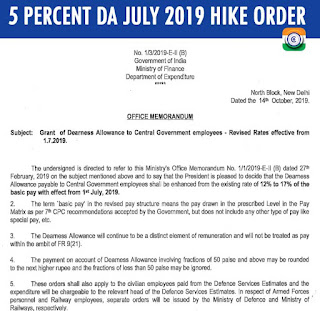
5 Percent DA July 2019 Hike Order - Grant of Dearness Allowance to Central Government employees

Grant of Dearness Allowance to Central Government employees 5 Percent DA July 2019 Hike Order  No. 1/3/2019-E- II (B) Government of...

Blog Archive

About The Author