A complete reference blog for Indian Government Employees

Showing posts with label State Government Employees. Show all posts

Tuesday, 18 September 2018

2% hike in DA for Tamilnadu Government Employees from July 2018


2% hike in DA for Tamilnadu Government Employees from July 2018

The Chief Minister of Tamil Nadu today announced regarding Dearness Allowance for State Government Employees. The Govt decided to increase the Dearness Allowance from the existing rate of 7% to 9% with effect from 1st July 2018.

The arrears for the month of July and August will be paid with Septembers' salary. Formal orders will be published soon and the same will be uploaded here for your information.
2% hike in DA for Tamilnadu Government Employees from July 2018

Share:

Thursday, 26 July 2018

Single Transfer Policy for State & Central Government employees


Single Transfer Policy for State & Central Government employees

There is no proposal to formulate single transfer policy for the Government employees
Single Transfer Policy for both Central & State employees
Transfer Policy
In terms of instructions issued by Department of Personnel & Training (DoPT) on transfer/posting of Government employees, all Ministries/Departments of Government of India are required to have their own guidelines for transfer/posting of their employees providing for the following -
i. minimum tenure;
ii. have a mechanism akin to Civil Services Board for recommending transfer; and
Respective Ministries/Departments are also required to place the transfer policy in public domain.
There is no proposal to formulate single transfer policy for the Government employees as guidelines for transfer/posting of employees depend on the specific requirement of individual Ministries/ Departments. Moreover, the State Public Services are under State List for which the State Governments are competent to make rules and policies. Accordingly, there is no proposal to constitute any commission for single transfer policy for both Central & State employees.

This information was provided by the Union Minister of State (Independent Charge) Development of North-Eastern Region (DoNER), MoS PMO, Personnel, Public Grievances & Pensions, Atomic Energy and Space, Dr Jitendra Singh in written reply to a question in Lok Sabha today.

Source: PIB
Share:

Tuesday, 26 June 2018

Completion of recovery of Temporary Advances from GP Fund before six months prior to retirement on superannuation

Completion of recovery of Temporary Advances from GP Fund before six months prior to retirement on superannuation

GOVERNMENT OF WEST BENGAL
FINANCE DEPARTMENT
AUDIT BRANCH
No.2229-F(J)-W.B.
Date:- 20.06.2018
MEMORANDUM

Subject:- Completion of recovery of Temporary Advances from GP Fund before six months prior to retirement on superannuation

In terms of this department Memo No. 2133-F dated 21.03.1981 regarding the sanction of any temporary advance from GP Fund, the competent authority should fix the number of instalments in such a manner that the recovery of the same is completed prior to six months from the date of retirement on superannuation of any subscriber to the fund.

It has been reported by some Head of Offices that recovery of temporary advances are now continuing in some cases even during the last six months prior to the date of retirement on superannuation of the subscriber which is not coherent with the Memo no 2133 -F dated 24.03.1981.
After careful consideration the Governor is pleased to decide that the Memo No 2133-F dated 21.03.1981 will remain in force in the matter of recoveries of Temporary advance and the irregularities still continuing shall be rectified by the competent authorities to sanction the Temporary advance immediately in any of the following manners.

1. Monthly instalments for recovery of existing temporary advances from the GP Fund may be re-fixed in such number of instalments so that entire recovery is completed prior to six months from the date of retirement on superannuation.
OR
2. Amount of temporary GP Fund Advance remaining outstanding at the time of six months prior to the date of retirement on superannuation may be converted into Non-refundable advance.

Henceforth, the sanctioning authorities shall at the time of sanctioning Temporary Advance from GP Fund shall fix the number of instalments in such a manner so that the recovery of advance is completed prior to six months from the date of retirement on superannuation and in no case Temporary Advance shall be sanctioned during the period of last six months prior to the date of retirement on superannuation.

In addition to the above it is also clarified that:-

1. Subscription to the GP Fund shall be stopped compulsorily prior to three months before the date of retirement on superannuation for all categories of State Government employees as per the provision contained in this Department Memo No. 620-F(J)/W.B. dated- 27.11.2013.

2. Modified versions of Form- 10A and 10B introduced vide this Department Memo No. 1115-F(J)/W.B. dated- 29.03.2018 shall be applicable only for Group-D State Government employees at present until further order.
S/d,
H.K. Dwivedi
Additional Chief Secretary to the
Government of West Bengal
Share:

Friday, 9 February 2018

7th Pay Commission Minimum Pay Calculation: Comparison of Methodology for calculation of minimum Pay of Central Government and a few State Governments as on 1/7/2017


7th Pay Commission Minimum Pay Calculation: Comparison of Methodology for calculation of minimum Pay of Central Government and a few State Governments as on 1/7/2017

7th-Pay-Commission-Minimum-Pay-Calculation


Comparison of Minimum Pay

Comparison of Minimum Pay of Central Government and a few State Governments as on 1/7/2017.

Pay Commission Objective: It is the endeavour of every pay commission to ensure that the pay and allowances of employees should be ‘fair and reasonable'. The pay structure should also motivate the employees to reasonable levels of performance in the tasks assigned to them, so that the general public derive the benefit of their service as intended.

7th CPC of Central Government: The Central Government has been following the practice of pay revision for employees once in ten years. Pay scales of the Central government employees have been revised with effect from 1.1.2016 based on the report of the Seventh Central Pay Commission. The revised minimum pay effective from 01.01.2016 is 2.57 times the pre-revised basic pay. The minimum pay of the central employees has been worked out at Rs.18,000/- per month and represents a real increase of 14.29% of the pre-revised wages. The multiplication factor adopted for revising all the other scales ranges between 2.57 and 2.72 resulting in maximum pay of Rs.2,05,400 corresponding to the highest pre-revised pay scale other than the apex pay scale of Rs.80,000 which is raised to Rs.2,25,000. The Cabinet Secretary's pay is fixed at Rs.2,50,000.
Employees Associations (Staff side JCM) have also sought minimum pay revision to Rs.26,000 with effect from 01.01.2016.

Pay Revision of various State Governments

Government of Kerala Pay Scales: The revised pay structure introduced by the Government of Kerala witheffect from 1.7.2014 is based on the recommendations of the 10th PayRevision Commission and relates to index level of 239.92 points ofAIACPI (IW). Basic Pay of Group "D" employee is fixed at Rs 16500/-
The rates of increment range from Rs.500 to Rs.2,400. The payment of DA formula is unaltered and continues to be as per the central government formula to neutralise the price rise over and above the 239.92 points twice in a year.

Andhra Pradesh Pay Scales: The revised pay structure formulated by Government of Andhra Pradeshon the basis of the recommendation of 10th Pay Revision Commissionrelates to index level of 220.61 points of AIACPI (IW), Basic Pay of Group "D" employee is fixed at Rs 13000/-
The HRA ranges from 30% to 12% of basic pay subject to a maximum of Rs.20,000 depending upon the classification of places and pay.

Karnataka Pay Scales: The revised pay structure formulated by Government of Karnataka on the basis of the recommendation of 6th Pay Revision Commission relates to index level of 276.9 of AIACPI (IW).

Costs of consumable items obtained from the Department of Economics & Statistics, Government of Karnataka are utilised for their calculation.

CLICK HERE FOR REPORT 
http://www.finance.kar.nic.in/6thPay/6thPayComReport .pdf

(For English version read from page number 135 on wards)

The 6th pay commission appointed by the Karnataka Government recommended a 30% increase in the salaries of around 5,20,000 government employees and 73,000 employees from "aided institutions".

The revision of pay and pension is to come into effect from 1 July 2017 with benefits paid from 1 April 2018. The Group "D" minimum basic pay is fixed at Rs 17000/-.

Methodology for calculation of minimum wage adopted by Pay commissions both Central and State Pay Commissions

Central pay commissions as well as pay commissions in some states have adopted the approach of determining the minimum pay for employees based on the cost of a minimum acceptable standard of living for a household. This is calculated on the basis of the current prices of daily necessities like food, clothing, housing, etc., for a family of three consumption units typical in the case of young employees starting their careers in government. The normative consumption requirements of the family as adopted in the 15th Indian Labour Conference in 1957 are considered for this purpose. While the minimum pay is thus worked out on the basis of a set of quantitative norms and based on Dr. Wallace Aykroyd's formula , the maximum pay for employees at the highest levels is to be determined as that required to attract and retain persons of qualifications and skills appropriate for the higher positions in government services.

Comparative picture of pay of Central Government and State Government in regards to minimum wage as on 1.7.2017

Govt. of India
Group "C" Min Basic Pay =Rs 18000/-
DA 5% = Rs 900/-
Total Basic Pay + DA =Rs 18900/-

Andhra Pradesh & Telangana
Group "D" Min Basic Pay =Rs 13000/-
Provide for Skill by adding 25% =Rs 3250-
Total Group "C" Min Basic Pay = Rs 16250/-
DA @ 24.1% = 3916/-
Total Basic Pay + DA=Rs 20166/-

Kerala
Group "D" Min Basic Pay =Rs 16500/-
Provide for Skill by adding 25% Rs 4125/-
Total Group "C" Min Basic Pay =Rs 20625/-
DA @ 14% = 2887/-
Total Basic Pay + DA= Rs 23512/-

Karnataka
Group "D" Min Basic Pay = Rs 17000/-
Provide for Skill by adding 25% = Rs 4250-
Total Group "C" Min Basic Pay = Rs 21250/-
DA = NIL
Total Basic Pay + DA = Rs 21250 /-

Ratios between minimum and maximum pay
The existing ratios between minimum and maximum pay of the central government and the States is as follows:
Government of India 1 :12.5
Andhra Pradesh 1:8.527
Kerala 1 :7
Karnataka 1:8.86

The gap is highest in Central Government should be reduced ratios between minimum and maximum pay to 1: 8

Hence there is need for revision of minimum wage for Central Government employees and also fitment formula on the lines of the State Government Pay Commissions, the State Government economic conditions are not as good as the Central Government still the State Governments are paying more for their employees comparing it to the Central Government, in case of the 7th CPC the Central Government Employees got only 14.29% , the Group "A" and above officers of Central Government got more pay hike due to higher fitment formula of 2.72 . Thus injustice is done for Group "C" and Group "B".

whereas the Karnataka State Government employees got 30% wage hike , Central Government Employees got only 14.29% wage hike , the uniform multiplication factor should be fixed for the Central Government employees and also Central Government Employees should also get 30% wage hike .

Source:www.karnatakacoc.blogspot.in
Share:

Thursday, 26 October 2017

Mizoram panel to study 7th Pay Commission recommendations


Mizoram panel to study 7th Pay Commission recommendations

The Mizoram government has decided to set up a committee to study the Seventh Pay Commission recommendations even as it agreed in principle to implement it in the state.

This was decided at a meeting of the Council of Ministers last evening.

The 42,457 regular state government employees would require additional allocation of Rs 563 crore annually if the Seventh Pay Commission recommendations were implemented, state finance department officials said.

Chief Secretary Lalmalsawma said that at present, 36-37 per cent of the total state annual budget is used for paying off the salaries of the state government employees.

The expenditure on salaries did not include the salaries of employees of Lai, Mara and Chakma autonomous district councils, teachers working in deficit schools and contract and muster roll workers, Lalmalsawma said.

The meeting also approved the proposal for creation of 629 new posts for the proposed establishment of the lone Medical College - Mizoram Institute of Medical Education and Research (MIMER) - at the Falkawn village near Aizawl.

Source: 7cpc.in
Share:

Thursday, 11 May 2017

Fixation of pay of State Government Employees on their appointment in Central Government, subsequent to the implementation of CCS(RP) Rules, 2016

Fixation of pay of State Government Employees on their appointment in Central Government, subsequent to the implementation of CCS(RP) Rules, 2016

No.12/2/2016-Estt.(Pay -I)
Government of India
Ministry of Personnel, Public Grievances and Pensions
Department of Personnel and Training
North Block, New Delhi
Dated the 11th May, 2017
OFFICE MEMORANDUM

Subject: Fixation of pay of State Government Employees on their appointment in Central Government, subsequent to the implementation of CCS (RP) Rules, 2016.

The undersigned is directed to state that the method of fixation of pay of State Government employees on their appointment under the Central Government has been spelt out in this OM Department's OM No.12/1/94-Estt.(Pay-I) dated 24.3.1994, 3.1.1996, OM No.13/2/1999-Estt(Pay-I) dated 18.6.2001 and OM No.12/1/2009-Estt(Pay-I) dated 28.8.2014.

2. The question of fixation of pay in the revised pay structure in cases of appointment from State Government to Central Government consequent upon been implementation of Central Civil Services (Revised Pay) Rules, 2016, has considered in consultation with the Department of Expenditure and the President is pleased to decide that in cases of appointment of State Government employees in Central Government on or after 1.1.2016, pay will be fixed in the following manner:-

(a) Where the State Government has revised the Pay Scales/Grade Pays of their employees on the pattern of Seventh Central Pay Commission at the base index of 261.41 as per AlCPI (IW)2001 series w.e.f.  1.1.2016 , the pay of employees from such State Government on their appointment under the Central Government would be fixed as follows:
(i) When the appointment is to a post in higher Level, one increment shall be given in the Level from which the employee is appointed and he / she would be placed at a Cell equal to the figure so arrived at in the Level of the post to which appointed and if no such Cell is available in the Level to which he/she is appointed, he/ she would be placed at the next higher Cell in that higher Level. However, if the amount so arrived at after adding the increment in lower Level is less than the minimum pay or the first Cell in the higher Level, the pay shall be fixed at minimum pay or first Cell of the higher Level.

(ii) Where the appointment is to a post involving identical Level, the individual shall continue to draw the same pay.
(b) Where the State Government has revised the Pay scales/Grade Pays of their employees after 1.1.206 beyond the base index of 261.41 as per AICPI (IW) 2001 series, the basic pay of the employee is to be determined first in the Central Pay Matrix by reducing the element of DA, ADA, IR etc. granted by the State Government after 1.1.2016 beyond the base index of 261.41 as per AICPI (IW) 2001 series and thereafter the pay would be fixed as provided in the clause (i) and (ii) under sub-para (a) above.

(c) Where the State Government has either not revised or revised the pay scale of their employees on or after 1.1.2016 below the base index of 261.41 as per AICPI (IW) 2001 series, the basic pay of these employees shall be determined first in the Central Pay Matrix, by adding the element of DA, ADA upto the base index of 261.41 as per AICPI (IW) 2001 series, granted by the State Government and thereafter their pay would be fixed as provided in the clause (i) and (ii) under sub-para (a) above.

3. These orders are applicable to employees of the State Government and Local Bodies under the Sta te including Emergency Divisional Accountants/Divisional Accountants appointed under Central Government on or after 1.1.2016.

4. In so far as persons serving in the Indian Audit and Accounts Department are concerned, these orders issue after consultation with the Comptroller 86 Auditor General of India.

5. Hindi version will follow.
(Pushpender Kumar)
Under Secretary to the Government of India
DoPT Order
Share:

Tuesday, 31 January 2017

7th Pay Commission implementation to State Government Employees - Minister's reply in the Parliament


7th Pay Commission implementation to State Government Employees - Minister's reply in the Parliament

7th Pay Commission implementation - State Government employees are not covered within the terms of reference of the 7th central Pay Commission - Minister's reply in the Parliament

Smt.Nirmala Sitharaman in a written reply to a Member states that State Government employees are not covered within the terms of reference of the 7th central Pay Commission

While answering to a question in Parliament on 12th August 2014 regarding the employees working in State Government, Ministry of State for Finance Smt.Nirmala Sitharaman said that the State Government employees are not covered within the terms of reference of the 7th central Pay Commission.

She replied in written form to a question asked by a member that service conditions of State Government employees fall within the exclusive domain of respective State Governments. Therefore, State Government employees are not covered within the terms of reference of the 7th central Pay Commission.

Thus, the recommendations of Commission will not directly apply to State Government employees. Accordingly, it is not possible for the Central Government to indicate the financial burden on State Governments, if they decide to adopt the recommendation of the 7th Central Pay Commission in respect of their employees with or without modification.

She also added, the Central Government had sought the views of the State Governments and till the date of the constitution of the 7th Central Pay Commission on 28.2.2014, only 14 States had responded. These State Governments generally mentioned, inter-alia, that adoption of the recommendations of a Central Pay Commission by them in case of State Government employees adds to substantial financial burden
Since the decision to adopt the recommendations of the 7th Central Pay Commission in case of the State Government employees will exclusively concern respective State Government, the question of any assistance by the Central Government will not arise. However, the Terms of Reference of the 7th Central Pay Commission provide, inter-alia, that while making its recommendations, the Commission will also keep in view the likely impact of the recommendations on the finances of the State Governments, which usually adopt the recommendations with some modifications.
Share:

Saturday, 14 January 2017

Tamil Nadu government announces Pongal bonus for its employees, teachers and others


Tamil Nadu government announces Pongal bonus for its employees, teachers and others

CHENNAI: The Tamil Nadu government on Sunday announced the annual Pongal bonus for its employees, teachers, pensioners and family pensioners.

Group C and Group D government employees as well as teachers will get bonus up to Rs 3,000.
Group A and Group B employees as well as teachers, who have worked for more than 240 days, will get Rs 1,000 as special salary.

Pensioners and family pensioners will get Rs 500 as bonus.

In a statement, chief minister J Jayalalithaa said, "Totally, Rs 326.85 crore will be spent on distributing bonus for government employees and others."
Share:

Saturday, 22 October 2016

Punjab government releases 6 per cent DA for employees, pensioners


Punjab government releases 6 per cent DA for employees, pensioners

Chandigarh: Punjab Finance Minister Parminder Singh Dhindsa today gave his nod to release 6 per cent dearness allowance (DA) with November salary or pension for the government employees and pensioners.

With the release of this DA installment, the state would touch 125 per cent from present 119 per cent of the basic pay/pension, Dhindsa, in a statement issued here, said.

In a relief to foreign settled retired employees, he said DA would continue with their pensions.

The government has decided to take back a letter stopping DA of pensioners who have acquired foreign citizenship, he added.

PTI
Share:

Friday, 26 August 2016

7th Pay Commission – Karnataka CM hints at Setting up New Panel

7th Pay Commission – Karnataka CM hints at Setting up New Panel – The comment raised hopes of state government employees who had gone on a day-long strike on June 2 demanding pay parity with Central government staff.

Karnataka Chief Minister Siddaramaiah gave a strong indication to state government employees on Thursday when he hinted at setting up a pay panel to explore the possibility of salary hike that would benefit about 6.40 lakh employees.

“State government employees have been demanding salaries on a par with the Central government staff. The time has come to set up the next pay commission as the Centre is implementing the recommendations of the th pay commission,” Siddaramaiah was quoted as saying by Deccan Herald.

The chief minister spoke on the sidelines of the diamond jubilee celebration of the Karnataka Government Secretariat Employees’ Association (KGSEA) in Bengaluru.

The comment raised hopes of state government employees who had gone on a day-long strike on June 2 demanding pay parity with Central government staff.

“We are happy that the chief minister is keen on setting up a new pay commission. He also promised to look into our grievances,” KGSEA president Mahadevaiah Matapathii said. The last pay commission was set up by the state government five years ago.

Besides salary hike, the employees also want session allowance for all Vidhana Soudha employees and a site for the association’s building.

The 7th Pay Commission’s (CPC) recommendations hiking salary and allowances for Central government employees is a trigger for many state government employees to seek parity with their Central government counterparts.

The central government has accepted the recommendations pertaining to the hike in the salary component, while a decision on allowances is likely by November this year when a committee set up to examine raising allowances submits its report to the finance ministry.

The salary hike for Central government staff has also prompted employees of public sector undertakings (PSUs) to seek a similar hike for which they will be going on strike on September 2 in which state-run banks will also participate. Besides, pay hike, the strike is also in protest against “anti-labour” reforms of the government such as stake sale in PSUs.

Source: IBT
Share:

Monday, 30 May 2016

Grant of Interim Relief to West Bengal State government employees amounting to 10 percent of their band pay


Grant of Interim Relief to West Bengal State Government Employees Amounting to 10 % of their Band Pay.

After coming to power for the second time, the Mamata Banerjee led government on Friday announced a grant of interim relief to state government employees amounting to 10 percent of their band pay.

"In our first cabinet meeting, we have decided to provide a grant of interim relief to state government employees amounting to ten percent of the band pay drawn by them," said state Finance Minister Amit Mitra.

"This will be effective from July and will cover state employees, teachers, local government employees and pensioners," he said.

"The interim relief is small in nature but the net impact to the state exchequer will be around Rs.3,000 crore," said Banerjee.

The difference in dearness allowance for state employees compared to their central counterparts stands at 50 percent.

Banerjee had announced a 10 percent hike in dearness allowance for the state employees from January reducing the difference to 44 percent. Later in March, the centre hiked the allowance by another six percent.
The government in its first stint had announced the Sixth Pay Commission to review the pay structure of state government employees.
Share:

Tuesday, 24 May 2016

Pay Revision 2014 Payment of salary arrears detailed instructions/guidelines GOVERNMENT OF KERALA

Pay Revision 2014 —Payment of salary arrears -detailed instructions/guidelines — GOVERNMENT OF KERALA

GOVERNMENT OF KERALA
No:46/2016/Fin.
Finance (ARC) Department
Thiruvananthapuram
Dated: 19/05/2016
CIRCULAR

Sub:- Pay Revision 2014 —Payment of salary arrears -detailed instructions/guidelines — issued.
Ref:- G.0.(P) 7/2016/Fin dated 20/01/2016.

As per G.O read above Government have issued orders revising pay and allowances of State Government employees, staff of educational institutions, Teachers, Part Time Contingent employees and Casual Sweepers wherein it was ordered that the arrears on account of pay revision for the period from 01.07.2014 to 31.01.2016 will be paid in cash in four equal instalments each at 25% of the total amount on 01.04.2017,01.10.2017, 01.04.2018 and 01.10.2018 respectively along with interest at the rate applicable to General Provident Fund. Government are now pleased to issue the following guidelines for calculation, accounting and payment of Pay revision arrears for the period from 01.07.2014 to 31.01.2016:

1. All Drawing and Disbursing Officers should calculate month wise arrears of pay revision including surrender of earned leave of all employees for the period from 01.07.2014 to 31.01.2016 with interest from 01/02/2016 at the rate applicable to General Provident Fund as directed at para 46 of the GO read above in the proforma attached with this circular before 30.06.2016. Every employee will be served a copy of the statement of arrears due to him. The DDO should furnish a consolidated statement of pay revision arrears specifying the amount due on each instalment and the head of account from which salary is drawn before 31/07/2016 under his control to the head of the department.

2. In the case of employees who are on deputation to foreign service/Government of India for any period between 01.07.2014 to 31.01.2016 or as the case may be, their arrears should be credited to the Government account.

3. The foreign employer should remit the total amount of arrear in lump for the period from 01.07.2014 to 31.01.2016 or upto the period they have worked on deputation along with interest at the rate 8.7% per annum for the period from 01.02.2016 to the date of remittance, before 31.03.2017. The details of remittance to Government account along with the copy of Pay-in-slip should be forwarded to the Drawing and Disbursing Officer concerned in the parent department.

4. All Heads of Departments should consolidate the arrear amount payable and include the same in the budget proposal for the respective financial year in which the payment will be made.

5. First, second, third and fourth instalments of the arrear amount thus calculated will be paid along with salary for 03/2017,09/2017,03/2018 and 09/2018 respectively.

6. In the case of employees (including those who were on deputation) who retired on or after 01.07.2014 the arrear amonut will be drawn and disbursed by the Drawing and Disbursing Officer of the respective office of the parent department where the employee last worked.

7. In the case of an employee who expired/expires, the entire balance arrear amount along with interest accrued as on the date of death will be paid to the legal heir(s) of the employee.

8. In case where an employee will be on leave without allowance or under suspension as on the date of payment of arrears, arrear will be disbursed along with the first salary after rejoining duty. In such cases government will not be liable to pay interest for the period during which payment is deferred.

9. In case where an employee will be on deputation as on the date of payment of arrears the arrear amount will be drawn and disbursed by the Drawing and Disbursing Officer of the respective office of the parent department where the employee last worked.

10. No employee will be given relaxation on any point’s in the above direct ions and the Heads of Department should not entertain such request under any circumstances.

11. Proforma and illustration for calculation and payment of arrears are appended with this circular. All Drawing and Disbursing Officer should scrupulously follow the instructions in the circular.
sd/-
Dr.K.M.ABRAHAM
Additional chief Secretary (Finance)
Click Here to Download the Original Order
Share:

Friday, 15 April 2016

Rajasthan government announced six per cent hike in the Dearness Allowance (DA) of its employees.

Rajasthan government announced six per cent hike in the Dearness Allowance (DA) of its employees.

Dearness Relief (DR) for the pensioners has also been increased by six per cent. The DA hike would be effective from January 1, 2016, a release said.

The prevalent DA of the state government employees was 119 per cent and has been increased to 125 per cent of the basic pay.

Nearly eight lakh employees and 3.5 lakh pensioners would be benefited by these hikes, it said.
DA hike would also be applicable for employees of the Panchayat Samitis and Zila Parishads, among others.
The increased DA would be paid in cash from April 1.

The arrears on account of the increased DA from January 1 to March 31 would be credited in the GPF accounts of the employees appointed before January 1, 2004 while the arrears of the hiked DA for the three months would be paid in cash to the employees appointed after January 1, 2004.

The increased Dearness Relief to the pensioners and family pensioners would also be paid in cash.
The burden on the state exchequer would be Rs 1,120 crore in the current financial year.

PTI
Share:

Saturday, 12 March 2016

Women employees demand two year leave for raising newborns

Women employees demand two year leave for raising newborns

Like the central government, the female employees of the Tamil Nadu state government have requested the government to give them two years maternity leave to raise their newborns. The proposal was made during the International Women’s Day celebrations.

The International Women’s Day is celebrated all over the world to ensure the safety of women. Women must be treated as equals of men at workplace and in the society. Also, selective abortions of female foetuses, and killing of female babies must be stopped.

Women take care of the health of their entire family, but often neglect their own health. Due to lack of proper nutrition, many women suffer from malnutrition and anaemia. Women can be healthy only if they eat well-balanced food. Only then will they be able to give birth to healthy children.

The Tamil Nadu government must, like the Central Government, give two years maternity leave to its female employees so they can raise their newborns.
Share:

Thursday, 21 January 2016

Kerala Pay Revision Commission Recommendations approved by Cabinet

Kerala Pay Revision Commission Recommendations approved by Cabinet on 20th January 2016.

The Cabinet Committee has approved to revise the salaries of State Government Employees from 1.7.2014.

Yesterday Cabinet Ministry has approved almost all the recommendations made by the Pay Revision Commission 2014. The new revised scale will be calculated from July 2014 and the arrears for about 18 months will be given in four installments from April 2017.

The minimum and maximum pay scale would be between 16,500 and 1,20,000. Some changes has been made in the recommendations of Pay Revision Commission by the Government to reduce the additional burden.

And wait for a week to know the authentic information about the Government decision on the recommendations of Kerala Pay Revision Commission.

Click to view the official website of Kerala Govt Finance Department

Share:

Sunday, 29 November 2015

West Bengal Government Sets Up Pay Commission

West Bengal Government Sets Up Pay Commission

Kolkata: The West Bengal Government has constituted the 6th Pay Commission for its own staff members and certain other categories of employees in the state to revise their salaries.

Economist Abhirup Sarkar, who is a professor of the Indian Statistical Institute, has been appointed chairman of the eight-member Pay Commission, which is scheduled to submit its report within six months.
The state Assembly elections are slated for next year and the setting up of the pay panel was made eight days after the Central Pay Commission submitted its report.

A Finance Department resolution yesterday said the decision was taken considering changes taken place in the structure of emoluments of state government employees in several respects since the 5th Pay Commission submitted its report.

The Commission will also cover employees of local bodies, panchayats, public undertakings, teaching and non-teaching staff of government aided and sponsored educational institutions.

As per its Terms and Reference, the Pay Commission would examine the present structure of pay and conditions of service, among other things.

It would examine the existing promotion policies and related issues and suggest suitable changes.
It would also examine various allowances, besides issues relating to retirement benefits.

To make recommendations on each of the above, the factors which will be considered included the prevailing pay structure under Central government, PSUs and other state governments, the economic condition of the country and the resources of the state government.

The Pay Commission will devise its own procedures and may take help of other departments and make estimate of the cost involved in implementing their recommendations.

“The Commission will submit their recommendations as expeditiously as practicable but preferably within a period of six months from the date of order notifying the constitution of the Commission,” the resolution said.
The Pay Commission may submit interim recommendations if found necessary or if so desired by the state government, it added.
PTI
Share:

Sunday, 15 November 2015

Sanction of 6% dearness Relief on the pension of the pensioners of the state of Madhya pradesh.

Madhya pradesh Dearness Relief 6% July 2015

GOVERNMENT OF MADHYA PRADESH
FINANCE DEPARTMENT
MANTRALAYA – BHOPAL
No.F 9-2/2015/Rule/IV
Bhopal, dated 6th November, 2015
To,
All Department of Government
The president of Board of Revenue, Gwalior
All Commissioners of Divisions
All Heads of Department
All collectors
Madhya Pradesh

Sub: Sanction of 6% dearness Relief on the pension of the pensioners of the state of Madhya pradesh.

The state Government had sanctioned 113% dearness relief w.e.f 01.01.2015 on pension/family pension to their pensioners/family pensioners vide Finance Department Memo No.F 9-1/2015/Rule/IV dated, 28 May, 2015. The state Government has now decided that the dearness relief admissible to pensioners should be sanctioned as given below. The additional pension payable to the pensioner’s aged 80 years or above shall also qualify for dearness Relief.

PeriodRate of Dearness Relief per Month
w.e.f. 01-07-2015 (Pension/family pension for the month of July, 2015 paid in August, 2015119% of Pension/Family Pension
  1. The above dearness Relief shall be payable on the Superannuation, Retiring, Invalid and Compensation Pension. This dearness relief shall also be payable on the Compassionate Allowance sanctioned to the employees discharged or removed from service and the said dearness relief shall also be payable to persons receiving family pension and extra ordinary pension under the restrictions contained in the Finance Department’s Memo No.F.B.6/43/76/R-II/IV dated 5.10.76. The dearness Relief on the pension/family pension shall not be payable in the cases where the pensioners/family pensioners are appointed/re-appointed under the State Government or autonomous institutions. This relief on family pension shall be payable in cases where a person at the time of the death of the spouse was in service and was not appointed on compassionate grounds. This relief on family pension shall not be payable in cases where a person on account of the death of the spouse has been appointed on compassionate grounds. In this connection attention is invited to the provisions contained in Finance Department’s Memo No.F.B.6/10/76/R-II/IV, dated 27.7.76 read with Memo No.F.B.6/10/77/R-II/IV, dated 2.5.77 and Memo No.F-12-5/2007/Rule/IV dated 19.4.2007.
  2. Pensioners, who have commuted a part of their pension, shall be paid the dearness relief on their original pension (Pension before commutation.)
  3. This Order shall be applicable in respect of State Government employees who had drawn lump sum amount on absorption in PSU/Autonomous body/Board/Corporation etc and have become eligible to restoration of 1/3rd commuted portion of pension in terms of this Department’s memo No.F.9/9/2006/Rule/IV dated 5.1.2007.
  4. Fraction of rupee of the amount to be paid as dearness relief shall be rounded off to the next rupee.
  5. All Treasury Officers/Sub Treasury Officers/Pension Disbursing Officers are directed to make payment of the above sanctioned dearness relief to state Government pensioners early, keepin in view the amended provisions of S.R.347 of the M.P.T.C. Volume-1, issued vide Finance Department’s endorsement No.E.-4/1/83/R-V/IV, dated 29th January, 1983. After payment of dearness relief the same may be got checked from the usual payment authority received from the Accountant General, Madhya pradesh. If some inaccuracy/discrepancy comes to the notice. the same may be adjusted in the payment on next month.
By order and in the name of the
Governor of Madhya Pradesh
Sd/-
(Milind Waikar)
Additional Secretary,
Government of Madhya Pradesh
Finance Department
Signed Copy Madhya-Pradesh-Pensioner-DA-July-2015
Share:

Friday, 6 November 2015

Implement 7th Pay Panel, Insist Staff

Implement 7th Pay Panel, Insist Staff

As many as two hundred members of the Confederation of Pondicherry State Government Employees Associations were arrested here, on Wednesday, for attempting to picket the Chief Secretariat demanding the implementation of the yet-to-be submitted seventh pay commission’s recommendations with retrospective effect.

In the meantime, the confederation leaders urged the Central government to announce an interim relief.
Apart from seeking the implementation of its recommendations from the date of the constitution of the commission, the agitators also put forth a 34-charter of demands that included the filling up of vacancies in all the departments, replacement of the new pension scheme with the old one, setting up of grievance cell in all departments and cadre restructuring to improve chances of promotion for employees.

The panel set up on January 1, 2014 by the previous UPA government will take at least 18 to 24 months to submit its final recommendations.

Puducherry government has 25,000 employees, who enjoy similar service conditions as that of their Central government counterparts.

Earlier, members of the confederation took out a rally. As the police did not allow them to proceed beyond the Head Post office, they began demonstrating then and there. After a while, all the agitators were arrested and removed.

The protest was led by Seetharaman. Office bearers of the association C H Balamohanan and Premadasan were among those, who took part in the rally and the subsequent agitation.

Meanwhile, the joint action committee members of the municipality and commune panchayat workers associations, affiliated to the AITUC held a demonstration in front of the Local Administration Department demanding the regularisation of the part time and daily rated employees who are working for more than 15 years.

They also urged the administration to provide Deepavali bonus for part time employees, and make appointments on compassionate grounds to the relatives of those who died.

The joint action committee had planned three phased agitation to press these demands.

Wednesday’s first phase agitation was led by AITUC leader V S Abishegam. The second and third phase of the agitation would be held near Raj Nivas here on November 18 and 25 respectively

Source: http://www.newindianexpress.com/
Share:

Friday, 30 October 2015

DA from 1st July 2015 – Tamilnadu Government GO for Dearness Allowance revision from 01.07.2015 to State Government employees

DA from 1st July 2015 – Tamilnadu Government GO for Dearness Allowance revision from 01.07.2015 to  State Government employees

    GOVERNMENT OF TAMIL NADU
2015
Manuscript Series
FINANCE (ALLOWANCES) DEPARTMENT

G. O. No. 281, Dated 26th October 2015
(Manmatha, Iyppasi-09, Thiruvalluvar Aandu 2046)

ALLOWANCES – Dearness Allowance in the pre-revised scales of pay – Enhanced Rate of Dearness Allowance from 1st July, 2015 – Orders – Issued.

READ – the following papers:
1. G.O.Ms.No.137, Finance (Allowances) Department, dated 30.04.2015.
2. From the Government of India, Ministry of Finance, Department of Expenditure, New Delhi, Office Memorandum No.1-(3)/2008 – E.II (B), dated 01.10.2015.
     *****
ORDER:
    In the Government Order first read above, orders were issued sanctioning revised rate of Dearness Allowance in the pre-revised scales of pay to State Government employees as detailed below:-
Date from which payable Rate of Dearness Allowance in the pre- revised scales of pay (per month)
1st January, 2015
223 per cent of Pay plusDearness Pay

2. The Government of India in its Office Memorandum second read above has enhanced the Dearness Allowance to its employees who continue in the pre-revised scales of pay from 223% to 234% with effect from 1st July 2015.

3. Following the orders issued by the Government of India, the Government sanction the revised rate of Dearness Allowance to the State Government employees who continue to draw their pay and allowances in the pre-revised scales of pay that was in existence prior to 01.01.2006 as indicated below:-
Date from which payable     Rate of Dearness Allowance in the pre-revised scales of pay (per month)
1st July 2015     234 per cent of Pay plusDearness Pay

4. The Government also direct that the Dearness Allowance increase shall be paid in cash with effect from 01.07.2015.

5. While working out the revised Dearness Allowance, fraction of a rupee shall be rounded off to next higher rupee if such fraction is 50 paise and above and shall be ignored if it is less than 50 paise.
6. The Government also direct that the revised Dearness Allowance sanctioned above, shall be admissible to full time employees who are at present getting Dearness Allowance and paid from contingencies at fixed monthly rates. The revised rates of Dearness Allowance sanctioned in this order shall not be admissible to part time employees.

7. The revised Dearness Allowance sanctioned in this order will also apply to the teaching and non-teaching staff working in aided educational institutions, employees under local bodies, employees governed by the University Grants Commission/All India Council for Technical Education scales of pay, the Teachers/Physical Education Directors/Librarians in Government and Aided Polytechnics and Special Diploma Institutions, Village Assistants in Revenue Department, Noon Meal Organisers, Child Welfare Organisers, Anganwadi Workers, Cooks, Helpers, Panchayat Secretaries/Clerks in Village Panchayat under Rural Development and Panchayat Raj Department.

8. The expenditure shall be debited to the detailed head of account `03. Dearness Allowance’ under the relevant minor, sub-major and major heads of account.

9. The Treasury Officers / Pay and Accounts Officers are requested to make payment of the revised Dearness Allowance when bills are presented without waiting for the authorisation from the Principal Accountant General (A&E) Tamil Nadu, Chennai-18.

    (BY ORDER OF THE GOVERNOR)

    K.SHANMUGAM
PRINCIPAL SECRETARY TO GOVERNMENT
Share:

Thursday, 15 October 2015

Air Travel on LTC once in Ten Years to visit foreign countries – WB State Govt Orders issued on 9.10.2015

Air Travel on LTC once in Ten Years to visit foreign countries – WB State Govt Orders issued on 9.10.2015

The state government of West Bengal issued orders on availing of Leave Travel Concession (LTC) to foriegn countires, such as, Thailand, Singapore, Malaysia, Myanmar, Sri Lanka, Bangladesh, Pakistan, Nepal, Bhutan and Maldives…

GOVERNMENT OF WEST BENGAL
FINANCE DEPARTMENT
AUDIT BRANCH
No.7370-F(F)
Dated: 09.10.2015
MEMORANDUM
At present the State Government employees may avail themselves of the benefit of Leave Travel Concession once in service career during the period of five years preceding the actual date of retirement on superannuation for the following kinds of journeys, subject to the conditions as in this department’s Memo Nos. 9924-F dt. 07.12.2005 and 607 -F dt. 20.01.2006.

1. For journeys to respective home town and back, provided the home town is different from the place of posting; and

2. For journeys to any place of India and back.

The employees who have been duly permitted to retire voluntarily are also allowed to avail of the above benefit before their such retirement.

The present provisions of admissibility of Leave Travel Concession have been under consideration for review for sometime past.

Now, after careful consideration of the matter, the Governor has been pleased to decide in partial modification of this department Memo. No. 9924-F dt. 07. 2.2005 read with Memo. No. 607-F dt. 20.01.2006 to allow the following benefits to the State Government employees instead of journeys on LTC as mentioned at (2) above.

(a) One Home Travel Concession once in every five years to visit any place within the State;

(b) One LTC once in ten years to visit any place in the neighboring countries, namely, Thailand, Singapore, Malaysia, Myanmar, Sri Lanka, Bangladesh, Pakistan, Nepal, Bhutan and Maldives or within the Country.

Conditions for admissibility of the same in case the spouse of the Government employee is also employed will be as follows:-

(i) If the spouse of the Government employee is also a State Government employee, the benefit can be availed of either by husband or wife as a one family unit and in that case undertaking shall be submitted by the other that no such claim will be preferred from his/her office and this should be recorded in his/her Service Book.

(ii) If the spouse of the State Government employee is employed in Central/Central PSUs/Corporation/Autonomous Body, the benefit can be availed of either by the husband or wife employed under the State Government as one family unit from the State Government provided no benefit of LTC can be availed of by the other from the Central/Central PSUs/Corporation/ Autonomous Body and in that case letter from the employer there in this respect that he/she has given such undertaking there shall be produced before avaiiing of the above benefit.


(iii) If the spouse of the State Government employee is employed in the State PSUs/Corporation/Non-Government aided Institutions/Autonomous Body where facility of LTC does not exist, the spouse of the Government employee may avail of this benefit along with the Government employee a a member of the family on the condition that declaration to his/her controlling authority shall be furnished that in future he/she will not enjoy the benefit of LTC, if the same is extended in the organization/institution as above in future.
Other conditions regarding admissibility of the benefit will be as in Finance Department Nos.9924-F dt. 07.12.2005 and 607-F dt. 20.01.2006. For the purpose of availing of LTC in foreign countries as mentioned at SI. No. (b) above, the same can be availed of by air in economy class from the nearest international airport of the country on the condition that journeys will have to be performed either by national carrier or private airlines of the country. The part of the journeys to and from the airport will be as per provision in the existing orders.

For journeys in the foreign countries as mentioned above orders issued by the P&AR Department are also to be followed.

This will take effect from 01.11.2015.
Sd/-
H. K. Dwivedi
Principal Secretary to the
Government of West Bengal
Authority: www.wbfin.nic.in
Click to view the order
Share:

Featured post

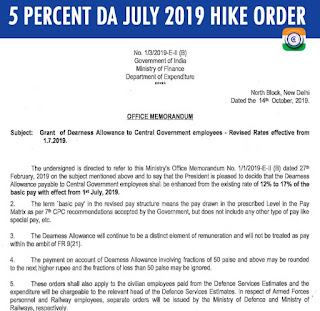
5 Percent DA July 2019 Hike Order - Grant of Dearness Allowance to Central Government employees

Grant of Dearness Allowance to Central Government employees 5 Percent DA July 2019 Hike Order  No. 1/3/2019-E- II (B) Government of...

Blog Archive

About The Author