A complete reference blog for Indian Government Employees

Showing posts with label TDS. Show all posts

Tuesday, 14 January 2020

DoP - Deduction of TDS in respect of Cash Withdrawal above One Crore by a National Savings Schemes account holder


DoP - Deduction of TDS in respect of Cash Withdrawal above One Crore by a National Savings Schemes account holder

 DoP - Deduction of TDS in respect of Cash Withdrawal above One Crore by a National Savings Schemes account holder


SB Order No. 02/2020
F.No 109-27/2019-SB
Govt. of India Ministry of Communication
Department of Posts (F.S. Division)

Dak Bhawan, New Delhi-110001
Dated: 09.01.2020

To,
All Head of Circles / Regions
Addl. Director General, APS, New Delhi

Subject :- Deduction of TDS in respect of Cash Withdrawal above Rs. 1 Crore by an account holder of National Savings Schemes regarding .

Sir / Madam,
The undersigned is directed to inform that Government of India has inserted Section 194 N in the Income Tax Act, 1961, through Finance Act (No.2) 2019 for deduction of TDS @2% on cash withdrawals in excess of Rs. 1 crore in a year, from 1.9.20 19, and the new provision mentioned in Section 194 N is applicable from the financial year 2019·20. Text of the new Section is reproduced below :-

Payment of certain amounts in cash.
194 N. Every person, being,-
  • a banking company to which the Banking Regulation Act, 1949 (10 of 1949) applies (including any bank or banking institution referred to in section 51 of that Act);
  • a co-operative society engaged in carrying on the business of banking; or
  • a post office,
Also check: National Savings Certificates Scheme 2019 - Gazette Notification

who is re possible for paying any sum, or, as the case may be, aggregate of sums, in ca h, in excess of one crore rupees during the previous year, to any person (herein referred to as the recipient) from one or more accounts maintained by the recipient with it shall, at the time of payment of such sum , deduct an amount equal to two per cent of sum exceeding one crore rupees, as income tax:
Provided that nothing contained in this sub-section shall apply to any payment made to,
  • the Government;
  • any banking company or co-operative society engaged in carrying on the business of banking or a post office.
  • any business correspondent of banking company or co-operative society engaged in carrying on the business of banking, in accordance with the guidelines issued in this regard by the Reserve Bank of India Act, 1934 ( 2 of 1934);
  • any white label automated teller machine operator of a banking company or co­ operative society engaged in carrying on the business of banking, in accordance with the authorization issued by the Reserve Bank of India under the Payment and Settlement Systems Act, 2007 (51of 2007);
  • such other person or class of persons, which the Central Government may, be notification in the Official Gazette, specify in consultation with the Reserve Bank of India ;
Further Clarification issued by CBDT on 30.8.2019
(extract from press release of CBDT dated 30.08.2019)

“…..The CBDT, having considered the concerns of the people, hereby clarifies that section 194N inserted in the Act, is to come into effect from 1st September, 2019. Hence any cash withdrawal prior to 1st September, 2019 will not be subjected to the TDS under Section 194N. However, since the threshold of Rs. 1crore is with respect to the previous year, calculation of amount of cash withdrawal for triggering deduction under section 194N shall be counted from 1st April, 20 19. Hence, if a person has already withdrawn Rs. 1crore or more in cash up to 31st August , 2019 from one or more accounts maintained with a banking company or a cooperative bank or a post office, the 2% TDS shall apply on all subsequent cash withdrawals made on or after 1st September, 2019.”

Also read: National Small Savings Schemes 2020 interest rate

2. With this amendment, now TDS @2% will be applicable on all cash withdrawals above Rs. One Crore taken by an account holder in his/ her all type of Small Savings Schemes Accounts / Certificates taken together, from 1.4.2019 onwards. However, for the current financial year (2019-20) as per clarification issued by CBDT, TDS will be deducted on cash withdrawals taken on or after 1.9.2019, even if cash withdrawals are taken in excess of Rs.1 Crore from 1.4.2019 to 31.8.2019. The TDS @ 2% is to be deducted on all subsequent cash withdrawal (from 01.09.2019) to be taken by a customer who has taken cash withdraw als in excess of Rs. lcrore during 2019-20 in his/ her all accounts.

3. Necessary changes in FINACLE will be done in due course to automatically deduct TDS at the time of such cash withdrawal. Till these changes are done, CEPT Team will inform details of such Account Holders in the first week of every month to the respective CPC which will inform the concerned Post Office to deduct TDS @2%. Post Offices have to ensure that PAN number of such account holder are invariably taken and fed in Finacle. TDS so deducted should be accounted under Section 194N and incorporated in TDS return of HO (for HO and its SOs). Account holder should be informed of such deduction at the time of cash withdrawal.

4. It is requested to circulate this amendment to all concerned for information and guidance and necessary action.

5. This issues with the approval of Competent Authority.

Yours Faithfully,
(Devendra Sharma)
Assistant Director (SB)
Share:

Monday, 22 April 2019

Income Tax department revises the (Form 16) TDS certificate format issued by employers


Income Tax department revises the (Form 16) TDS certificate format issued by employers

The Income Tax department has revised Form 16 by adding various details, including income from house property and remuneration received from other employers, thereby making it more comprehensive to help check tax avoidance.

It will also include segregated information regarding deductions under various tax saving schemes, investments in tax savings instruments, different allowances received by the employee as well as income from other sources.

Form 16 is a certificate issued by employers, giving details of employees’ TDS (tax deducted at source) usually by mid June and is used in filing I-T returns.

The revised Form, which has been notified by the Income Tax department, will come into effect from May 12, 2019. This means the income tax returns for financial year 2018-19 will have to be filed on the basis of revised Form 16.

Among other things, the revised Form 16 will also include details of deductions in respect of interest on deposits in savings account, and rebates and surcharge, wherever applicable.

The I-T department has already notified income tax return forms for fiscal 2018-19. Salaried class and those who do not have to get their accounts audited, will have to file their ITRs by July 31 this year.

Meanwhile, the income tax department has also modified Form 24Q, which is furnished by employer to the tax department. It will include additional details like Permanent Account Number (PAN) of non- institutional entities from whom the employee has taken loan for buying or constructing housing property.

Nangia Advisors (Andersen Global) Director Sanjoli Maheshwari said the Form 16 and 24Q have been amended with an intent to make them more elaborative and informative. The same has been done in order to bring the Forms in parity with latest changes made in ITR Forms such as disclosure of standard deduction and exemptions claimed under section 10.

“Earlier, where the disclosure of various deductions were mentioned in a consolidated manner, ranging from 80C, 80CCD, 80E, 80G would now be required to be disclosed separately. These specific disclosures would provide ease to the tax authorities in understanding the various components of income of the taxpayer and thereby, facilitating the conduct of scrutiny more precisely,” Maheshwari said.

The changes in Form 24Q will further help in identifying any fabricated transaction undertaken with an aim of tax avoidance, she added.

PTI
Share:

Friday, 1 February 2019

Income upto Rs 5 Lakh to get full tax rebate; higher standard deduction proposed Relief of over Rs 23,000 crore to estimated 3 Crore small and middle class tax- payers


Ministry of Finance
Income upto Rs 5 Lakh to get full tax rebate; higher standard deduction proposed
Relief of over Rs 23,000 crore to estimated 3 Crore small and middle class tax- payers
TDS threshhold on interests on small savings raised
Boost to housing and real estate sector
FM announces a slew of tax reliefs for middle class and small tax payers
01 FEB 2019
Individual taxpayers having taxable annual income up to Rs.5 lakhs will get full tax rebate and therefore will not be required to pay any income tax. While presenting the Interim Budget 2019-20 in Parliament today the Union Minister for Finance, Corporate Affairs, Railways & Coal, Shri Piyush Goyal said “Because of major tax reforms undertaken by us during last four and half years, both tax collections as well as tax base have shown significant increase, achieving a moderate taxation- high compliance regime. It is, therefore, just and fair that some benefits from the tax reforms must also be passed on to the middle class taxpayers”

As a result, the Finance Minister added that even persons having gross income up to Rs. 6.50 lakhs may not be required to pay any income tax if they make investments in provident funds, specified savings, insurance etc. In fact, with additional deductions such as interest on home loan up to Rs.2 lakh, interest on education loans, National Pension Scheme contributions, medical insurance, medical expenditure on senior citizens etc, persons having even higher income will not have to pay any tax. This will provide tax benefit of Rs.18,500 crore to an estimated 3 crore middle class taxpayers comprising self employed, small business, small traders, salary earners, pensioners and senior citizens.

STANDARD DEDUCTIONS RAISED
For salaried persons, Standard Deduction is being raised from the current Rs.40,000 to Rs.50,000. “This will provide additional tax benefit of Rs.4,700 crore to more than 3 crore salary earners and pensioners”, the Finance Minister informed.

TDS THRESHHOLD INCREASED
Tax Deduction at Source (TDS) threshold on interest earned on bank/post office deposits has been proposed to be raised from Rs.10,000 to Rs.40,000. Shri Goyal said, "This will benefit small depositors and non-working spouses". Further, the TDS threshold for deduction of tax on rent has also been proposed to be increased from Rs.1,80,000 to Rs.2,40,000 for providing relief to small taxpayers.

MORE RELIEF TO RESIDENTIAL HOUSES
It has been proposed to exempt the levy of income tax on notional rent on a second self-occupied house. Currently, income tax on notional rent is payable if one has more than one self-occupied house. Shri Goyal announced the relief considering the difficulty of the middle class having to maintain families at two locations on account of their job, children’s education, care of parents etc.
Further, the Finance Minister proposed to increase the benefit of rollover of capital gains under Section 54 of the Income Tax Act from investment in one residential house to two residential houses for a taxpayer having capital gains up to Rs. 2 crore. This benefit can be availed once in a life time. For making more homes available under affordable housing, the benefits under Section 80-IBA of the Income Tax Act is being extended for one more year, i.e., to the housing projects approved till 31st March, 2020. Also, for giving impetus to the real estate sector, the Finance Minister proposed to extend the period of exemption from levy of tax on notional rent, on unsold inventories, from one year to two years, from the end of the year in which the project is completed.

PIB
Share:

HIGHLIGHTS OF BUDGET 2019


HIGHLIGHTS OF BUDGET 2019

Tax
1. Within 2 years, Tax assessment will be done electronically
2. IT returns processing in just 24 hours
3. Minimum 14% revenue of GST to states by Central Govt.
4. Custom duty has abolished from 36 Capital Goods
5. Recommendations to GST council for reducing GST rates for home buyers
6. Full Tax rebate upto 5 lakh annual income after all deductions.
7. Standard deduction has increase from 40000 to 50000
8. Exempt on tax on second self-occupied house
9. Ceiling Limit of TDS u/s 194A has increased from 10000 to 40000
10. Ceiling Limit of TDS u/s 194I has increased from 180000 to 240000
11. Capital tax Benefit u/s 54 has increased from investment in one residential house to two residential houses.
12. Benefit u/s 80IB has increased to one more year i.e. 2020
13. Benefit has given to unsold inventory has increased to one year to two years.

Other Areas
14. State share has increased to 42%
15. PCA restriction has abolished from 3 major banks
16. 2 lakhs seats will increase for the reservation of 10%
17. 60000 crores for manrega
18. 1.7 Lakh crore to ensure food for all
19. 22nd AIIMS has to be opened in Haryana
20. Approval has to be given to PM Kisan Yojana
21. Rs. 6000 per annum has to be given to every farmer having upto 2 hectare land. Applicable from Sept 2018. Amount will be transferred in 3 installments
22. National kamdhenu ayog for cows. Rs. 750 crores for National Gokul Mission
23. 2% interest subvention for farmers pursuing animal husbandry and also create separate department for fisheries.
24. 2% interest subvention for farmers affected by natural calamities and additional 3% interest subvention for timely payment.
25. Tax free Gratuity limit increase to 20 Lakhs from 10 Lakhs
26. Bonus will be applicable for workers earning 21000 monthly
27. The scheme, called Pradhan Mantri Shram Yogi Mandhan, will provide assured monthly pension of Rs. 3,000 with contribution of Rs. 100 per month for workers in unorganized sector after 60 years of age.
28. Our government delivered 6 crores free LPG connections under Ujjawala scheme
29. 2% interest relief for MSME GST registered person
30. 26 weeks of Maternity Leaves to empower the women
31. More than 3 Lakhs crores for defence
32. One lakh digital villages in next 5 years
33. Single window for approval of India film makers
Share:

Tuesday, 22 January 2019

Central Board of Direct Taxes (CBDT) clarifies regarding issue of Prosecution Notices


Ministry of Finance
Central Board of Direct Taxes (CBDT) clarifies regarding issue of Prosecution Notices
21 JAN 2019
The Central Board of Direct Taxes (CBDT) has stated that certain news items that appeared in a section of media regarding enmasse issue of prosecution notices to small companies for TDS default are completely misleading and full of factual inaccuracies. CBDT clarified that Mumbai Income Tax TDS office has issued prosecution Show Cause Notices only in a limited number of big cases where more than Rs. 5 lakh of tax was collected as TDS from employees etc and yet the same was not deposited with the Income Tax Department in time.

CBDT said that some defaulter companies and vested interests are deliberately misleading the media to thwart action against themselves. Having deducted tax from employees and other taxpayers and not depositing the same in time in the Government Treasury is an offence punishable under the law. It also affects the interest of the employees from whose salary the tax has been deducted by the unscrupulous employers who have not deposited the same in time in the Government Treasury. If the TDS is not deposited in time, the employee would be ineligible for claiming credit of the tax deducted when he files his own return.

CBDT stated that in last one month, only in 50 big cases prosecution notices have been issued by Mumbai IT TDS office. Out of these, in 80% of the cases the TDS tax default is above Rs. 10 lakh and in 10 % cases, TDS default is between Rs. 5 to Rs.10 lakh. In the remaining 10% cases, TDS default is of more than Rs. 1 crore as detected in the survey. Prosecutions have also recently been launched against 4 big business houses where more than Rs 50 Crore of tax was collected by them from the tax payers and yet not deposited with the Government in time. But such legal and rightful action is being unfortunately projected in the media by the vested interests as if the Department is going overboard to harass small employers.

It would be pertinent to note that in a country of 130 Crore people where around 6 Crore returns are filed every year, only a total of 1400 prosecutions have been filed so far for various offences under the Income Tax Act during this financial year. This, by any stretch of imagination, cannot be termed as mass harassment by the income tax department. Therefore, to say that prosecution notices enmasse have been sent to taxpayers for minor defaults is completely incorrect and misleading, the CBDT added.

PIB
Share:

Sunday, 29 July 2018

Calculation of Income tax an Employee Below 60 Age A.Y.2018-19

Calculation of Income tax an Employee Below 60 Age A.Y.2018-19
ANNEXURE-I
SOME ILLUSTRATIONS
Example 1
For Assessment Year 2018-19

(A) Calculation of Income tax in the case of an employee(Male or Female) below the age of sixty years and having gross salary income of:
i) Rs.2,50,000/- ,

ii) Rs.5,00,000/- ,

iii) Rs.10,00,000/-

iv) Rs.55,00,000/-. and

v) Rs. 1,10,00,000/-

(B) What will be the amount of TDS in case of above employees, if PAN is not submitted by them to their DDOs/Offices:

ParticularsRupeesRupeesRupeesRupeesRupees
(i)(ii)(iii)(iv)(v)
Gross Salary Income (including allowances)2,50,0004,00,00010,00,00055,00,0001,10,00,000
Contribution of G.P.F.45,00050,0001,00,0001,00,0001,00,000
Computation of Total Income and tax payable thereon
ParticularsRupeesRupeesRupeesRupeesRupees
(i)(ii)(iii)(iv)(v)
Gross Salary2,50,0004,00,00010,00,00055,00,0001,10,00,000
Less: Deduction U/s 80C45,00050,0001,00,0001,00,0001,00,000
Taxable Income2,05,0003,50,0009,00,00054,00,0001,09,00,000
(A) Tax thereonNil2,500*92,50014,32,50030,82,500
Surcharge1,43,2504,62,375
Add:Nil50185031,51570,898
(i)   Education Cess @ 2%.Nil2592515,75835,449
(ii) Secondary and Higher Education Cess @1%
Total tax payableNil2,57595,27516,23,02336,51,222
* After rebate of Rs 2500 u/s 87A
Share:

Friday, 20 July 2018

Deduction of TDS in respect of Senior Citizens who have Invested In Sr.Citizen Savings Scheme

Deduction of TDS in respect of Senior Citizens who have Invested In Sr.Citizen Savings Scheme

F.No 79-01/2016-SB
Government of India
Ministry of Communications
Department of Posts
DakBhawan, Sansad Marg,
New Delhi-110001
Date: 29.06.2018
To
All Heads of Circles/Regions
Addl. Director General, APS, New Delhi.

Subject - Deduction of TDS in respect of Senior Citizens who have Invested In Sr.Citizen Savings Scheme regarding.

Sir / Madam,
I am directed to say that Government of India has amended Suction 194A of Income Tax Act 1961 through Finance Act 2018 and Inserted below new Proviso below Sub Section 3 of Section 194A:-
[Provided also that in case of payee being a senior citizen, the provisions of sub-clause (a), sub-clause (b), and sub-clause (c) shall have effect as if for tho words "ten thousand rupees", tho words 'fifty thousand rupees" had been substituted.

Explanation.- For the purposes of this clause, "senior citizen" means an Individual resident In India who is of the age of shay years or more at any time during the relevant previous year;)

2. With this amendment, now TDS will not be applicable on the total aggregated Interest Income up to Rs.50.000/- in a Financial year payable In case of all SCSS Accounts opened by Senior Citizens of the age of 60 years and above (who attained age of 60 years anytime during the previous financial year I.e 2017-2018). However, this limit will not be applicable to those SCSS Account holders who had opened SCSS Accounts under the relevant provisions of relaxed SCSS Rules for (I) individuals who attained the age of 65 years or more but less than 60 years and retired on superannuation or (ii) Personnel of Defence Services (excluding Civilian Defence Employees) and not attained age of 60 years during previous financial year i.e 2017.18). For such account holders, current limit of Rs.10,000/- shall continue.

3. Rules reisting to submission of Form 15G (by those who are below the age of 60 Years) and 15H(who are of 60 Years or more age) are not changed. However, due to change of tax exemption limits for certain categories, Form 15G or 15H can be accepted If total Interest payable in a Financial Year of all SCSS Accounts of an individual SCSS account holder is within the Exemption Limit mentioned below:-

Individual TypeForm TypeAgeIncome Exemption Limit
Individual15GBelow 60years2,50, 000
Senior Citizen Individual15H6040 years3,00,000
Super Senior Citizen
(lndividual)
15H80 years above5,00,000

4. It Is requested to circulate this amendment to the concerned staff for Information and necessary action Necessary changes in CBS and Sanchaya Post application* an being canted out to implement the lame In CBS Post Offices

This Meuse with the approval of competent authority
Yours Faithfully,
(P.b. Meena)
Assistant Director(SB-I)
Share:

Monday, 9 July 2018

Filling of Returns by every Government Servant - Income Tax


Filling of Returns by every Government Servant - Income Tax

Government Servant

भारत सरकार /Government of India
आयकर विभाग/Income Tax Department
आयकर आयुक्त चेन्नै-3 का कार्यालय, चेन्नै
Office of the Pr. Commissioner of Income Tax-3, Chennai
कमरा सं.410, चौथातल, आयकर भवन, 121, महात्मागांधी रोड, चेन्नै-34.
4th Floor, Main Building, 121, Mahathma Gandhi Road, Chennai- 34.

P.N.DEVADASAN, IRS
Principal Commissioner.
Chennai
19/06/2018
To
The Drawing & Disbursing Officer
O/O Dy. Director of IT(INV) Unit III
139, IOC Bhavan I Floor IOC Bhavan Nungambakkam High
Road Nungambakkam Chennai - 600034

Dear Sir/Madam,
Sub: Filing of Returns by every Government Servant - Reg.

As you might be aware, every person who is having income more than Rs.2,50,000 is bound to file his/her return of income. This includes the Government Servants also. However, the data of returns filed indicate that more than 50% of the Government Servants at Chennai are not filling their income tax returns. I hope, you will agree that as government servants, we should abide by laws and to be role models to the common citizens of our country. If we, Government servants ourselves are violating law by not filling our income tax returns, we don’t have any moral right to blame other sections of society.

From this year i.e Assessment Year 2018-19 onwards, the Parliament has amended the Income Tax Act by introducing a new section 234F for imposing late fee on every person who is not filling his/her return of income within the due date. For salaried employees, the due date is 31-07-2018. This means all the salaried employees have to file their returns of income for the Financial Year 2017-18 (Assessment Year 2018-19) on or before31-07-2018. Otherwise they all mandatorily have to pay late fee amounting between Rs.1,000 to Rs.10,000 as per the provisions of Section 234 . Also, a penalty of Rs.5,000 can be imposed under section 271F on them. In addition to this, they can be prosecuted under section 276CC of the Income Tax Act for jail termsvarying between three months to seven years.

It may please be noted that these provisions are applicable to all the persons having gross income (excluding deductions) above Rs.2,50,000/-. It is understood that many persons who are claiming deductions under section 80C etc. (on GPF contribution, Life Insurance Policies, Housing Loan Repayment etc.) and adjustment of Interest on Housing Loan are under the impression that they need not file the return as their net income is below taxable limit and no TDS is deducted from their salary.
Therefore, I request you to kindly intimate and advice all the employees to whom the gross salary paid in the last year is more than Rs.2,50,000 to file their returns of income before 31-07-2018. It may also be noted that all the incomes earned by an employee such as rental income (including subletting of house/s), interest incomes, dividend from Co-operative societies and all such incomes should be declared in their returns of income. Later, if found to have omitted any such incomes, they are liable for separate penalty and prosecution for concealing those incomes.

A copy of this letter may be handed over to each of your employees who draw their salary through you. You may also discuss this issue with the Head of your Office/Department and request him/her to issue a circular to all the employees to file their return of income well in time.

In case of any clarification or suggestions, you may please contact the following Officers: Joint Commissioner Smt. Sumathy Venkataraman (8762300298), Assistant Commissioner Ms. N. Abhinaya (8939744880), Smt. Priya Ramakrishnan, ITO (9445954906), Shri Sundaramurthy, ITO (9445955554), Smt. Malarvizhy Kujur ITO (9962383336) or Shri V. Baladandayutham, ITO (9445954896).
Yours faithfully,
(P.N.DEVADASAN)
Source: Confederation
Share:

Friday, 10 November 2017

TA AND SITTING FEE - PAYABLE TO OFFICIAL AND NON - OFFICIAL MEMBERS / EXPERTS


TA AND SITTING FEE - PAYABLE TO OFFICIAL AND NON - OFFICIAL MEMBERS / EXPERTS
UGC

F.No.21-1/2015(FD- 1/B)
Dated: 22.09.2017

OFFICE MEMORANDUM

TA AND SITTING FEE - PAYABLE TO OFFICIAL AND NON - OFFICIAL MEMBERS / EXPERTS

In supersession of UGC.OM.No.21-1/2015(FD-1/B)dated 16th March,2016,the rules for TA and Sitting Fee payable to the official and non-official members/ experts win be as under:

The categories of Official and Non‐Official Members are as fo1lows:

Serving(State/central) Government servants, Semi Government Autonomous Bodies, Employees paid from the consolidated Fund of India or through Grants-in-aid are treated as

Official Members.
AⅡ others including retied Government Servants and retired/ex-member of the University Grants Commission or Statutory Bodies viz.Universities, Institutions, Councils, Boards and Societies etc. are to be treated as Non-Official Members.

NOTE
" Permanent Account Number (PAN) allotted by the Income Tax Authorities has to be indicated by the member/expert variably while filling up the Bill". Payment will be made through E-mode in the bank accounts of members mandatorily. Hence, Experts are required to attach a copy of cancelled cheque leaf with their claims.

1. SITTING FEE
l. Rs. 3,000/- per day for per meeting subject to maximum of Rs. 5,000/- per day irrespective of number of meetings in a day.
2. Rs. 5,000/- per day for inspection/visit of various committees institutions/Universities/organizations.
3. Commission Members would also be entitled for sitting fee @ Rs. 5,000/- per day on the date of Commission Meetings.

NOTE
l. Payment of Sitting Fee is subject to T.D.S

2. Officials of Govt. of India who are nominated as Govt. representatives would not be entitled for sitting fee as they attend the meeting in their official capacity as Govt. / Secretary nominee or on ex-official basis.

2. TRAVELLING ALLOWANCE
Outstation Members/Experts:

(i) Travel by Air: The members (officials as well as non-official) will be entitled to travel by air as per entitlement in service or before retirement as the case may be. Non-entitled members will entitled for journey by air, on specific prior approval of Chairman, UGC. The journey by air is to be performed by Air India on the sectors where it ply. On other sectors, journey by private airlines will be allowed. Any deviation would require prior approval of Chairman, UGC. The member V experts entitled to travel by air may travel by public helicopter in case place is not connected by air. However, hiring of charter helicopter, will not be permissible. The claim for air helicopter journey is to be supported by original boarding cards.

(ii) Travel by Train: The member V experts will be entitled to travel by all trains including Rajdhani Express/Shatabadi Express as per the entitlement in service or before retirement.

NOTE
(a) Air tickets will be arranged by the UGC, Travel Desk whereas train tickets would have to be arranged by the experts.

(b) The cancellation charges/ticket re-scheduling charges shall also be reimbursable in case of cancellation or postponement of meeting by the UGC [For Sl. No.2. (i) & (ii)]. The specific approval for the same would be required for claiming such amount.

(iii) The outstation member/experts for intercity travel from the place of residence/Office to the place of meeting and back or in between the places of residence and meeting place & back (located not more than 350 Kms. each side) may travel either by their own vehicle or by taxi. Documentary evidence of journey performed by Own vehicle will have to be submitted. In case of hired taxi receipt is to be produced, road mileage @ Rs. 20/- per K.M. or amount actually paid which ever is less will be allowed for such journeys on point to point basis. In case of journey undertaken in NER, road mileage would be enhanced by 20% subject to actual expenditure. No night halting or driver allowance will be allowed. If the particular route have toll plazas, the taxi/car claim will be admitted only if it is supported with the receipts of toll taxes or inter-state entry tax. The toll taxes/entry tax etc., will additionally be reimbursed in such cases.

If the distance is more than 350 Kms (each side), either the road mileage will be restricted to 350 Kms or to the fare of train as per entitlement or AC bus as available on that particular route (as per the option of expert).

(iv) The local taxi fee at State Tr&sport Authority (STA) rates applicable in the State from residence office to Airport/Railway Station/Bus Stand and from Place of meeting to Airport/Railway Station/Bus Stand is payable. Where there are no rates notified by State Transport authority, the Taxi or Own Car fare @ Rs.20/- per km shall be reimbursable. The re-imbursement of pre-paid or post-paid taxi fare (including toll taxes) on point to point basis will be allowed on actual basis on production of receipt. Taxi fare for full day will not be reimbursed.

(v) The night charges @ 25% will additionally be allowed if starting the journey by road/by own car or taxi between 11.00 p.m. to 5.00 a.m. [For Sl. No. 2. (iv)].

Local Experts
Local Experts will be reimbursed taxi or own vehicle charges @) Rs.20/- per K.m. from residence/office to the place of meeting & back on point to point basis. Taxi for full day will not be allowed for reimbursement.

3. DAILY ALLOWANCE
(i) Outstation Members/Experts
Following rates of Food & Lodging etc., will be applicable to the Experts:-

ugc-ordres

 *l. Lodging charges are admissible subject to actuals on production of receipts.

2. Food charges will be re-imbursed on self certification.
3. No lodging charges will be paid if self arrangement is made.
4. The rates of food and lodging will further increase by 25o/o automatically
whenever DA in Govt. of India increases by 5A%.

(ii) Local Members/Experts:
No boarding & Lodging charges are payable to Local Members/Experts.

4. UGC Officers/Officials will be covered under FR/SRs (TA) Rules. Hence, these orders would not be applicable to them.

5. This issues with the approval of Chairman, UGC Dy. No. 32811 dated 19.09.2017.
sd/-
(P.K. Thakur)
Secretary
Source: www.ugc.ac.in
Share:

Monday, 19 June 2017

Requirement of tax deduction at source in case of entities whose income is exempted under Section 10 of the Income-tax Act, 1961-Exemption thereof


Requirement of tax deduction at source in case of entities whose income is exempted under Section 10 of the Income-tax Act, 1961-Exemption thereof
CIRCULAR No. 18/2017
F. No. 385/01/2015-IT (B)
Government of India
Ministry of Finance
Department of Revenue
Central Board of Direct Taxes
North Block, New Delhi
29th May, 2017
Subject: Requirement of tax deduction at source in case of entities whose income is exempted under Section 10 of the Income-tax Act, 1961 - Exemption thereof.

The Central Board of Direct Taxes (the Board) had earlier issued Circular No. 4/2002 dated 16.07.2002 and Circular No. 7/2015 dated 23.04.2015 which laid down that in case of such entities, whose income is unconditionally exempt under Section 10 of the Income-tax Act (the Act) and who are also statutorily not required to tile return of income as per Section 139 of the Act, there would be no requirement for tax deduction at source (TDS) from the payments made to them since their income is anyway exempted from tax under the Act. The issue of whether exemption from TDS can be extended to more entities on these principles and whether the exemption is needed to be withdrawn in respect of some of the exempted entities was examined by the Board.


2. Examination of the eligibility of entities for exemption from TDS on the principle of unconditional exemption and no requirement to file return revealed that Circulars No. 4/2002 and 7/2015 are required to be updated to make the following changes:

Entities that meet both the above mentioned conditions but are not mentioned in the aforesaid Circulars need to be included in the list of exempted entities.
Entities that are mentioned in Circular No. 4/2002 but their exemption from income tax has since been withdrawn need to be removed from the list of exempted entities.
Entities that are mentioned in Circular No. 4/2002 but because of subsequent amendment they are now required to mandatorily the their returns of income u/s 139 need to be removed from the list of exempted entities.

3. In view of the above, a revised list of entities exempted from TDS has been drawn by adding entities in the first category listed above to the entities mentioned in Circular No. 4/2002 and Circular No. 7/2015 and removing entities in second and third categories from the list of existing entities eligible for exemption from TDS.

4. Accordingly, it has been decided that in case of below mentioned funds or authorities or Boards or bodies, by whatever name called, referred to in section 10 of the Income-tax Act, whose income is unconditionally exempt under that section and who are also statutorily not required to tile return of income as per section 139 of the Income-tax Act, there would be no requirement for tax deduction at source, since their income is anyway exempt under the Income-tax Act -

(i) "local authority", as referred to in the Explanation to clause (20);

(ii) Regimental Fund or Non-public Fund established by the armed forces of the Union referred to in clause (23AA);

(iii) Fund. by whatever name called, set up by the Life Insurance Corporation of India on or after 1st August, 1996, or by any other insurer referred to in clause (23AAB);

(iv) Authority (whether known as the Khadi and Village Industries Board or by any other name) referred to in clause (23BB);

(v) Body or authority referred to in clause (23BBA);

(vi) SAARC Fund for Regional Projects set up by Colombo Declaration referred to in clause (23BBC);

(vii) Insurance Regulatory and Development Authority referred to in clause (23BBE):

(viii) Central Electricity Regulatory Commission referred to in clause (23BBG);

(ix) Prasar Bharati referred to in clause (23BBH);

(x) Prime Minister's National Relief Fund referred to in sub-clause (i), Prime Minister’s Fund (Promotion of Folk Art) referred to in sub-clause (it), Prime Minister’s Aid to Students Fund referred to in sub-clause (iii), National Foundation for Communal Harmony referred to in sub-clause (ilia), Swachh Bharat Kosh referred to in sub-clause (iiiaa), Clean Ganga Fund referred to in sub-clause (iiiaaa) of clause (23C);

(xi) Provident fund to which the Provident Funds Act, 1925 (19 of 1925) referred to in sub-clause (i), recognized provident fund referred to in sub-clause (ii), approved superannuation funds referred to in sub-clause (iii), approved gratuity fund referred to in sub-clause (iv) and funds referred to in sub-clause (v) of Clause (25);

(xii) Employees' State Insurance Fund referred to in clause (25A);

(xiii) Agricultural Produce Marketing Committee referred to in clause (26AAB);

(xiv) Corporation. body, institution or association established for promoting interests of members of Scheduled Castes or Scheduled Tribes or backward classes referred to in clause (26B);

(xv) Corporation established for promoting interests of members of a minority community referred to in clause (26BB);

(xvi) Corporation established for welfare and economic upliftment of ex-servicemen referred to in clause (26BBB);

(xvii) New Pension System Trust referred to in clause (44).

4. This circular supersedes earlier Circulars on this issue e.g. Circular No. 4/2002 dated 16.07.2002 and Circular No. 7/2015 dated 23.04.2015 with effect from the date of issue of this Circular.

5. Hindi version shall follow.

(Sandeep Singh)
Under Secretary to the Govt. of India
Source: CBDT Circular
Share:

Wednesday, 1 February 2017

Salient Features of Direct Tax Proposals in Union Budget 2017


Salient Features of Direct Tax Proposals in Union Budget 2017

The Union Budget 2017 was laid before the Parliament today by the Hon'ble Finance Minister of India. The salient features of Direct Tax proposals are summarised below:

I. Affordable Housing:
1. Three concessions in the scheme of Income Tax exemption for affordable housing:
(a) Area of 30 and 60 Sq.mtr. to be counted as carpet area and not built-up area;
(b) 30 Sq.mtr. only in 4 metropolitan city limits and 60 Sq.mtr. for the rest of the country;
(c) Completion period extended from 3 years to 5 years.

2. Tax on Notional rental income for builders to be calculated only after 1 year from the end of the year in which completion certificate is received.

3. Changes in Capital Gain taxation for immovable properties:
(a) Holding period reduce for computation of long term capital gain from three years to two years
(b) Base year for counting the cost of property shifted from 1.4.1981 to 1.4.2001 for all classes of assets including immovable property.
4. Basket of financial instrument in which capital gain can be invested without payment of tax to be expanded.

5. For joint development agreement, the liability to pay capital gain tax will arise in the year in which project is completed.

6. For Andhra Pradesh capital, land belonging to owners as on 2.6.2014 to be exempted from capital gain if the same is offered under land-pooling mechanism.

II. Measures for stimulating growth:
1. Concessional withholding rate of 5 per cent. for interest received by foreign entities on loans given in India to be continued for another 3 years beyond 30.6.2017.
2. Start-ups to get two relaxations under the scheme of Income Tax holiday given last year.
(a) The condition of continuous holding of 51 per cent. voting rights to be relaxed as long as the original investment of promoter is not diluted.
(b) Exemption available for three years out of any 7 years from the date of establishment instead of 3 out of 5 years
3. The period of carry forward of MAT/AMT credit increased from 10 years to 15 years.
4. The corporate income tax to be reduced from 30% to 25% for companies with turnover upto Rs.50 crore in 2015-16. This will benefit 96% of existing 6.67 lakh companies. This will result into tax saving of 16.67% for these companies.
5. Deduction for provision for NPA of Banks to be increased from to 8.5% instead of 7.5% of profit.
6. In case of NPA of non-scheduled cooperative banks, interest to be recognised as income only when received.

III Promoting Digital Economy:
1. In the presumptive income tax for small traders, income to be taken as 6% of turnover which is received by digital or banking means.
2. Cash expenditure allowable to be reduced to Rs.10,000 from the existing Rs.20,000.
3. Cash transaction of above Rs.3 lakh not to be permitted. The penalty of equal amount to be levied in case of breach.

IV Transparency in Electoral Funding:
1. The cash donation to political parties from one person limited to Rs.2,000/-.
2. Electoral Bond to be introduced for facilitating donation to political parties from explained sources.
3. Political parties to file their return in time limit prescribed in the Income Tax Act.

V. Ease of Doing Business:
1. Domestic transfer pricing to be applied only if one of the two companies enjoys specified profit-linked deduction.
2. The audit limit for business entities opting for presumptive scheme to be increased from Rs.1 crore to Rs.2 crore.
3. Individuals and HUFs not required to keep books of accounts if their turnover is up to Rs.25 lakhs or income is upto Rs.2.5 lakhs.
4. Investment in Category 1 and 2 foreign portfolio investors registered with SEBI to be exempted from provisions of indirect transfer.
5. TDS of 5% not to be deducted for individual insurance agents if they certify their income to be below taxable limit.
6. Professionals in presumptive scheme to pay advance tax only in one instalment in March instead of four.
7. The time limit for revising a tax return reduced to 12 months. Also time limit for completion of scrutiny will be brought down to 12 months from Assessment Year 2019-20 onwards.

VI Personal Income Tax:
1. Personal income tax for people with income in the slab of 2.5 lakh to 5 lakh to be reduced to 5% instead of 10%. This will reduce their tax liability to half while all other tax payers above this slab will also be benefited in terms of lesser tax of Rs.12,500 per individual (revenue loss ofRs.15,500 crores).
2. Surcharge of 10% to be levied on individuals with income between Rs.50 lakhs to Rs.1 crore (revenue gain of Rs.2,700 crore).

VII. Miscellaneous:
1. TCS exemption for state transport corporation in respect of purchase of vehicles.
2. Income of Chief Minister’s relief fund exempt from tax.
3. Penalty on accountant, registered valuer and merchant banker for furnishing incorrect information.
4. In order to ensure timely filing of return and expeditious issue of refund, a fee shall be levied for delay in filing of return.

PIB
Share:

Saturday, 28 January 2017

TDS on approved Provident and Superannuation Funds as per Income-Tax Act

TDS on approved Provident and Superannuation Funds as per Income-Tax Act

TDS on payment of accumulated balance under recognised provident fund and contribution from approved superannuation fund

Ministry of Finance has issued a circular about details of TDS on approved Provident and Superannuation Funds as per Income-Tax Act

TDS ON PAYMENT OF ACCUMULATED BALANCE UNDER RECOGNISED PROVIDENT FUND AND CONTRIBUTION FROM APPROVED SUPERANNUATION FUND:

    The   trustees of a Recognized Provident Fund, or any person   authorized   by the regulations of the Fund   to  make payment of  accumulated   balances due   to  employees, shall   in   cases where sub-rule(1) of Rule 9 of Part A of the Fourth Schedule   to the Act applies, at the time   when the accumulated   balance due to an employee is paid, make therefrom   the deduction specified in Rule 10 of Part A of the Fourth Schedule to the Act.

The accumulated balance is treated as income chargeable under the head “Salaries”.

Where any contribution   made by an  employer,  including   interest on  such  contributions,  if any, in  an approved Superannuation Fund is paid to the employee,  tax on the  amount so paid shall be deducted by the trustees of the Fund  to the extent provided in Rule 6 of Part B of the Fourth Schedule to the Act. TDS should be at the average rate of tax at which, the employee was liable to be taxed during the preceding three years or during the period, if that period is less than three years, when he was member of the fund.

The deductor shall remain liable to deduct tax on any sum paid on account of returned contributions (including interest, if any)  even if a fund or part of a fund ceases to be an approved Superannuation fund.

As per section 192A of the Act, w. e. f. 01.06.2015 the trustees of the EPF Scheme 1952 framed under section 5 of the EPF & Misc. Provisions Act, 1952 or any person authorized under the scheme to make payment of accumulated balance due to employees, shall, in a case where the accumulated balance due to an employee participating in a recognized provident fund is includible in his total income owing to the provisions of Rule 8  of Part A of Fourth Schedule not being applicable at the time of payment of accumulated balance due to the employee, deduct income tax thereon @ 10% if the amount of such payment or aggregate of such payment exceeds Rs 50,000/-. In case the employee does not provide his/her PAN No., then the deduction will have to be made at maximum marginal rate.

Check the Circular
Share:

Tuesday, 6 September 2016

Income Declaration Scheme 2016 – Government issues Clarifications in the form of Sixth Set of Frequently Asked Questions


Income Declaration Scheme 2016 – Government issues Clarifications in the form of Sixth Set of Frequently Asked Questions (FAQs)

The Income Declaration Scheme, 2016 (the Scheme) provides an opportunity to persons who have not paid full taxes in the past to come forward and declare their undisclosed income and assets. The Scheme has come into effect from 1.6.2016 and is open for declarations up to 30.9.2016. The Income Declaration Scheme, 2016 Rules (the Rules) have been notified on 19.5.2016. The amount payable under the Scheme can be paid in instalments viz. 25% of the total amount payable by 30.11.2016; another 25% by 31.3.2017 and balance 50% by 30.9.2017.

In order to address concerns of the stakeholders and to clarify the queries relating to the provisions of the Scheme, the Rules have been amended from time to time and six set of circulars (FAQs) have been issued. The following major issues addressed through Rules and FAQs are as under:
• The information in respect of a valid declaration is confidential and shall neither be shared with any law enforcement agency nor shall be enquired into by the Income-tax Department.
• The assets declared under the Scheme are to be valued at cost of acquisition or at fair market price as on 1.6.2016 as determined by the registered valuer, whichever is higher. However, an option for valuation of registered immovable property on the basis of stamp duty value of acquisition adjusted with the Cost Inflation Index has also been provided.
• Credit for unclaimed TDS made on declared income shall be allowed.
• Neither any capital gains tax nor any TDS shall be levied on transfer of declared benami property from benamidar to the declarant without consideration.
• The amount of fictitious liabilities recorded in audited balance sheet and not linked to acquisition of an asset can be disclosed under the Scheme as such.
• The period of holding of declared registered immovable assets shall be taken on the basis of the actual date of registration.
• The valuation report obtained by the declarant from a registered valuer shall not be questioned by the department. However, valuer’s accountability will remain.
• No adverse action shall be taken by FIU or the income-tax department solely on the basis of the information regarding cash deposit made consequent to the declaration under the Scheme.
• No enquiry/investigation shall be made in respect of the undisclosed income and assets declared under the Scheme even if the evidence of same is found subsequently during course of search or survey proceedings (circular No.32 dated 01.09.2016).
Further, vide Circular No. 31 dated 30.8.2016 an option has been provided to the declarants to file the declaration under the Scheme electronically under digital signature with the Commissioner of Income-tax, Centralised Processing Centre, Bengaluru [CIT(CPC)]. In case the declarant exercises the said option the declaration shall not be shared with the jurisdictional Principal Commissioner/Commissioner under the Income-tax Act.

In view of the fact that all the major queries and concerns of stakeholders have already been addressed by issue of circulars (FAQs) and also to provide stability and certainty to the Scheme, it is envisaged that no further clarifications on the Scheme shall be issued.

It is reiterated that the Scheme closes on 30.09.2016. The extension of the scheme is out of question.

PIB
Share:

Monday, 30 May 2016

No TDS on Disability Pension to Armed Forces Personnel

No TDS on Disability Pension to Armed Forces Personnel
By Prashant Thakur -February 3, 2016

The tax exemption of disability pension received by Armed Force Personnel are among those exemptions under Income Tax Act for which you may not get a direct reference in the Income Tax Act.

However , such tax exemption are allowed by the executive instruction issued by either Finance Ministry notification or under the delegated powers to CBDT . Armed Forces personnel get the disability pension which is basically aggregate of two components-disability pension and service pension. Previously , this website had posted earlier 3 Types of Pension to Armed Forces Completely Tax Free!

Disability Pension to Armed Forces : What is it ? Update :

The below portion is modified as the government, has issued new circular for minimum disability pension .

The circular is applicable to all Pre-2006 Armed Forces Disability/War Injury Pensioners who were/ are in receipt of Disability Pension/ Liberalized Disability Pension/ War Injury Pension as on 24th September 2012.

Download the Circular 542 dated 27/05/2015

As per the website of Principal Controller of Defence Accounts (Pension), where an Armed Forces Personnel is invalided out of service, which is accepted as attributable to or aggravated by military service, he shall be entitled to disability pension consisting of Service Element & Disability Element as follows:-

Service Element The amount of service element shall be determined as 50% of less emoluments drawn as given in para 6 of MOD letter dt- 12.11.2008 which is subject to minimum Rs 3500/- p.m.

Disability Element The rates of disability elements for 100% disability for various ranks shall be 30% of emolument last drawn subject to Rs. 3510/- per month. Disability lower than 100% shall be computed by reducing proportionately.

Disability Element on Invalidment Where an Armed Force personnel is invalided out of service under circumstances mentioned in para 4.1 of Govt. letter dt. 31.01.01, the extent of disability shall be determined as follows for the purpose of computing the DE :- Percentage as finally assessed by Competent AuthorityPercentage to be reckoned for computing DE Between 1 to 4950 Between 50 & 7575 Between 76 &100100 Disability Element on Retirement/Discharge Where an Armed Forces personnel is retained in service despite disability and subsequently retired/ discharged on completion of tenure or on attaining the age of retirement, he shall be entitled to Disability Entitlement at the rate prescribed for 100% disablement. For disablement less than 100% but not below 20%, the rates shall be reduced proportionately.
No disability element shall be payable for disability less than 20% .

Is Disability Pension to Armed Forces Tax Free ?

Yes, although there is nothing in section 10 of the Income Tax Act , which is a general exemption section under Income tax Act , the disability pension has been made tax free through Finance Ministry notification No 878-F (Income Tax) dated 21-3-1922 .

The following instruction from CBDT explains that the entire disability pension is exempt

INSTRUCTION NO 136F.NO. 34/3/68-IT(AI)GOVT OF INDIA CENTRAL BOARD OF DIRECT TAXES NEW DELHI, DATED THE 14TH JAN 1970
FROM :SHRI S N NAUTIALSECRETARY, CBDT

TO:ALL COMMISSIONERS OF INCOME TAX

SUBJECT : EXEMPTION – SERVICE AND DISABILITY ELEMENT OF DISABILITY PENSION GRANTED TO A DISABLED OFFICER OF THE INDIAN ARMY –

WHETHER EXEMPTED FROM INCOME TAX. REFERENCE IS INVITED TO THE BOARD’S LETTER F NO 42/9/59-IT(AI), DATED THE 5TH SEPT 1960 ON THE ABOVE SUBJECT WHEREIN IT WAS MENTIONED THAT IN THE CASES FALLING UNDER ITEM (29) OF FINANCE DEPTT NOTIFICATION NO 878-F (INCOME TAX) DATED 21-3-1922, THE‘DISABILITY ELEMENT’ OF THE DISABILITY PENSION RECEIVED BY AN OFFICER OF THE ARMY WILL ONLY BE EXEMPTED FROM TAX AND THAT THE ‘SERVICE ELEMENT’ WILL BE SUBJECTED TO TAX.

2. ON RECONSIDERATION OF THE MATTER, IN CONSULTATION WITH THE MINISTRY OF LAW, THE BOARD ARE ADVISED THAT ITEM 29 OF THE NOTIFICATION DOES NOT DIFFERENTIATE BETWEEN TYPES OF PENSIONS. ACCORDINGLY IN THE CASES FALLING UNDER ITEM 29 OF THE ABOVE NOTIFICATION, ENTIRE DISABILITY PENSION WILL BE EXEMPTED FROM INCOME-TAX.

3.THE ABOVE INSTRUCTIONS MAY BE BROUGHT TO THE NOTICE OF ALL ASSESSING OFFICERS IN YOUR CHARGE. YOURS FAITHFULLY,

SD/- (S N NAUTIAL) SECRETARY ,CBDT

Confusion on Exemption Disability Pension & Service Element As the disability pension is aggregate of two elements- disability element and service element- a confusion was created in filed formation of tax authorities , whether the disability element only is tax free and not the service element. CBDT , therefore , in order to wipe out any confusion , issued another instruction

F. No. 200/51/00-ITA-1 dt. 02.7.2001 to stress that both element of disability pension is tax exempt.
Read the instruction below :

[F. NO. 200/51/00-ITA-1 DT. 02.7.2001 FROM MINISTRY OF FINANCE DEPTT. OF REVENUE CENTRAL BOARD OF DIRECT TAXES, NEW DELHI.]

SUBJECT: EXEMPTION FROM INCOME TAX TO DISABILITY PENSION, I.E. ” DISABILITY ELEMENT” AND “SERVICE ELEMENT” OF A DISABLED OFFICER OF THE INDIAN ARMED FORCES- INSTRUCTIONS REGARDING.

REFERENCE HAVE BEEN RECEIVED IN THE BOARD REGARDING EXEMPTION FROM INCOME TAX TO DISABILITY PENSION, I.E. “DISABILITY ELEMENT” AND “SERVICE ELEMENT” OF A DISABLED OFFICER OF THE INDIAN ARMED FORCES.

2. IT APPEARS THAT FIELD FORMATIONS IN CERTAIN CASES ARE NOT UNIFORMLY ALLOWING DISABILITY, PENSION IN SPITE OF BOARD’S INSTRUCTION NO.136 DATED 14TH JANUARY, 970 (F.NO.34/3/68-IT(A.1)).

3. THE MATTER HAS BEEN RE-EXAMINED IN THE BOARD AND IT HAS BEEN DECIDED TO REITERATE THAT THE ENTIRE DISABILITY PENSION, I.E. ” DISABILITY ELEMENT” AND “SERVICE ELEMENT” OF A DISABLED OFFICER OF THE INDIAN ARMED FORCES CONTINUES TO BE EXEMPT FROM INCOME TAX.

4. THIS MAY BE BOUGHT TO THE NOTICE OF ALL THE OFFICERS WORKING UNDER YOU.
SD/- B.L. SAHU OFFICER ON SPECIAL DUTY (ITA .1)

No TDS on Disability Pension to Army Personnel
As it happens in India, everyone becomes the super authorities against the common man. The government received complaint that certain banks are deducting the tax on the disability pension .

So , government issued a press release that no TDS is required on the said disability pension paid to Armed Forces personnel.
Read below the excerpt. PRESS RELEASE, DATED 20-12-2007

IT HAS BEEN REPORTED IN THE PRESS THAT SOME BANKS WERE DEDUCTING TAX FROM PENSION OF DISABLED EX-SERVICEMEN IN VIOLATION OF GOVERNMENT INSTRUCTIONS.

RBI WAS REQUESTED TO HAVE THE MATTER INVESTIGATED AND REMEDIAL ACTION TAKEN. AFTER EXAMINATION, RBI DISCOVERED THAT IN ONE SPECIFIC INSTANCE, DUE TO OVERSIGHT, THE PENSIONER’S DISABILITY PENSION WAS WRONGLY TAKEN INTO ACCOUNT WHILE CALCULATING INCOME-TAX.

RBI HAS ISSUED INSTRUCTIONS TO ALL AGENCY BANKS TO STRICTLY ADHERE TO THE PROVISIONS OF PARA 88.3 OF DEFENCE PENSION PAYMENT INSTRUCTIONS, 2005, REGARDING EXEMPTION OF INCOME-TAX OF THE DISABILITY PENSION OF THE PENSIONERS OF ARMED FORCES.

BANKS HAVE BEEN ADVISED TO ISSUE SUITABLE INSTRUCTIONS TO ALL THEIR PENSION DISBURSING BRANCHES THAT INCOME-TAX SHOULD NOT BE DEDUCTED FROM THE DISABILITY PENSION PAID TO THE PENSIONERS OF THE ARMED FORCES.

Conclusion
The disability pension given to Armed Forces Personnel are having two components-disability element & service element. Both are tax free vide Ministry of Finance notification read with clarification from CBDT and also there can not eb any TDS as the amount is fully tax free.
Share:

Monday, 9 May 2016

New form to claim tax rebate on LTA, HRA

New form to claim tax rebate on LTA, HRA

NEW DELHI: The income tax department has come out with a standard Form 12BB for salaried taxpayers to claim tax deduction on leave travel allowance concession (LTALTC), house rent allowance (HRA) and interest paid on home loans.

Taxpayers will have to furnish to their employers proof of travel in Form 12BB for claiming LTALTC benefits. In case of HRA, the Central Board of Direct Taxes (CBDT) requires employees to furnish details like name, address and PAN number of the landlord if the aggregate rent paid exceeds Rs 1 lakh a year.

For claiming deduction of interest on home loan, the name, address and PAN of the lender will have to be furnished. Evidence of investment or expenditure will have to be provided for claiming tax deduction under Chapter VI-A.

Chapter VI-A pertains to allowable deductions under Section 80C, Section 80CCC, Section 80CCD as well as other sections like 80E, 80G and 80TTA.

The CBDT, in the same order, also extended the time limit for depositing tax deducted at source (TDS) on transfer of immovable property from 7 to 30 days. Also, the due date for filing quarterly TDS returns in Form 24Q, 26Q and 27Q was extended by 15 days.

The amended rules will be applicable from June 1, 2016, the CBDT said. Under section 80C, a deduction of Rs 1.5 lakh can be claimed from total taxable income if invested spent in employee’s share of PF contribution, life insurance, etc.

Source : Economic Times
Share:

Friday, 1 April 2016

Request to Taxpayers to Avail Facility for Online Rectification

Request to Taxpayers to Avail Facility for Online Rectification

Income-tax Act provides the taxpayer with an option to seek rectification of mistakes apparent from record under section 154 of the Act. The e-filing portal of the Income Tax Department provides the utility for online filing and tracking of rectification requests. Taxpayers who are not satisfied with the outcome of processing of their Income Tax Return by the Centralized Processing Centre, Bengaluru can avail of the facility of online filing and tracking of rectification requests available on https://incometaxindiaefiling.gov.in.

In case of any mistake in data entry of Tax payment or TDS details, taxpayer can select the “Rectification Request Type->Taxpayer is correcting data for Tax Credit mismatch only” and the use the option of pre-filling the correct details for the relevant Assessment Year while submitting the rectification request.
In case of data entry mistake in any other Schedule or omission of any details, taxpayer can select the option “Taxpayer is correcting Data in Rectification” and the reason for seeking rectification.

In any other case taxpayer can select the option “No further Data Correction Required, Reprocess the case” where the mistake in processing may have occurred due to non-reporting of TDS by deductor etc.
A detailed user manual for filing online rectification is available at: http://incometaxindiaefiling.gov.in/eFiling/Portal/StaticPDF/Rectifcation_Manual.pdf?0.08833787460862363.

With this utility a taxpayer can also the monitor the status of disposal of rectification request.

CPC, Bengaluru has already processed 6,53,763 online rectification requests in F.Y.2015-16 till 29th February 2016. CBDT is committed to ensuring accuracy in processing of returns and determination of refunds and seeks the active cooperation of taxpayers in ensuring correctness of data while submitting the return or rectification request.

PIB
Share:

Friday, 11 December 2015

Income Tax Department simplifies online rectification of TDS in ITR

Income Tax Department simplifies online rectification of TDS in ITR

New Delhi: Aimed at making life easier for tax payers, the Income Tax department today said it simplified the process of online rectification of incorrect details of tax deducted at source (TDS) filed in the income tax return (ITR).

Earlier, taxpayers were required to fill in complete details of the entire TDS schedule while applying for rectification on the e-filing portal of the I-T Department.

To avoid this, the finance ministry said a new facility has been provided for pre-fillin ..

To avoid this, the finance ministry said a new facility has been provided for pre-filling of TDS schedule while submitting online rectification request on the e-filing portal to facilitate easy correction or up-dating of TDS details.

“This is expected to considerably ease the burden of compliance on the taxpayers seeking rectification due to TDS mismatch,” an official statement said.

Errors due to incomplete TDS details in rectification applications were leading to delays in processing of such applications, thereby causing hardships to taxpayers, it added.

PTI
Share:

Saturday, 5 December 2015

Government sets target to add one crore more Income Tax payers this year

Government sets target to add one crore more Income Tax payers this year

New Delhi: Government targets adding one crore new income tax payers in the current financial year, Minister of State for Finance Jayant Sinha said today.

“The government has set a target of adding one crore new Income tax payers during the financial year 2015-16. The said target has been further distributed among various field units of the Income Tax Department,” Sinha said in a written reply in the Lok Sabha.

Sinha said in this financial year over 2.4 crore income tax returns have been filed till October 31, 2015.
The respective figures for 2014-15 were 3.67 crore; 3.74 crore in 2013-14 and 3.27 crore in 2012-13.
The number of income tax payers in the income bracket of Rs 1 crore and below was 2.39 crore as of October 31, 2015. For 2014-15 it was 3.66 crore; 3.73 crore in 2013-14 and 3.26 crore in 2012-13, said the minister.

“The total net direct collection in the current financial year (up to October 2015) is Rs 3.44 lakh crore showing growth of 13.20 per cent as compared to the collection made during the corresponding period of the previous financial year,” he said.

Sinha said government has taken a number of steps to expand the income tax base.

These steps include developing strategies to identify and add new taxpayers; collection of information about high value transactions; improving compliance to TDS/TCS provisions; encouraging voluntary compliance through education, camps and seminars

PTI
Share:

Saturday, 23 May 2015

EPFO to deduct TDS on PF withdrawals in some cases from June

EPFO to deduct TDS on PF withdrawals in some cases from June

New Delhi: Retirement fund body EPFO will deduct tax at source from next month on PF withdrawals where accumulations are over Rs 30,000 and the employee has worked less than five years.

“The Finance Act, 2015 (20 of 2015) has inserted a new section 192A regarding the payment of accumulated provident fund balance due to an employee. The provision shall take effect from June 1, 2015,” an EPFO circular said today.

“Income Tax shall be deducted at source (TDS)… If at the time of payment of the accumulated PF balance is more than or equal to Rs 30,000 with service less than 5 years,” it added.

According to the circular, TDS will be deducted at the rate of 10 percent provided PAN is submitted.
However, in case Form 15G or 15H is submitted by the member, then no TDS shall be deducted. These forms are to declare that their income would not be taxable after receiving payment of their PF accumulations from EPFO.

While Form 15H is submitted by senior citizens (above 60 years of age), Form 15G is submitted by claimants below the age of 60 years.

As per the circular, TDS will be deducted at the maximum marginal rate of 34.608 percent if a member fails to submit PAN or Form 15G or 15H.

However, there are certain exceptions to deduction of TDS by EPFO. TDS shall not be deducted in case of transfer of PF from one account to another PF account.

Besides, it will not attract TDS if the employee is terminated from service due to ill health of member and discontinuation or contraction of business by employer.

EPFO will also not deduct TDS if the employee withdraws PF after a period of five years of continuous service, including service with former employer.

The body will also not deduct TDS where payment is less than Rs 30,000 but the member has rendered service of less than 5 years.

It would also not deduct TDS if the employee withdraws an amount more than or equal to Rs 30,000 with service of less than 5 years but submits Form 15G/15H along with his/her PAN.

The proposal to deduct TDS on PF withdrawals was part of the Finance Bill, 2015.

PTI
Share:

Monday, 9 March 2015

TDS on Recurring Deposits from June 1

TDS on recurring deposits from June 1 force investors to close down deposits prematurely

NEW DELHI: Days after the Budget announced that tax deducted at source (TDS) will also apply to recurring deposits, banks are witnessing a rush of investors closing down their deposits prematurely.
Though it is fully taxable, the interest from recurring deposits is exempt from TDS. This only applies to interest from fixed deposits if the income exceeds Rs 10,000 in a year. The new rule is proposed to come into force from June 1, so investors are rushing to close their recurring deposits before the taxman gets whiff of their wealth.

"Premature closure of my recurring deposit will fetch me a lower interest rate. But at least there won't be a tax deduction," said an investor at a public sector bank branch in Delhi. Banks may see more premature closures of deposits as more investors become aware of the new rule.

It is not difficult to see why investors are panicky. Since the TDS is credited to the permanent account number of the investor, not mentioning the income in the tax return can lead to problems. The computer-aided scrutiny system of the tax department could pick up the mismatch in the tax credit and income declared by the assessee, which can lead to a detailed scrutiny by the tax authorities. If tax has been deducted at source but returns have not been filed, the tax department may want to know why.
"The new rules on TDS will help nail tax evasion and improve tax collections," declares Sudhir Kaushik, co-founder and CFO, Taxspanner.

TDS rules for fixed deposits are also being changed. Till now, this deduction kicked in only if the income from fixed deposits made in a particular bank branch exceeded the threshold of Rs 10,000 in a financial year. It was common for investors to open fixed deposits at multiple branches of their bank to avoid TDS. The budget has proposed that TDS should be levied if the combined interest income from FDs in all branches of a bank exceeds Rs 10,000 in a year.

The third major change is that co-operative bank deposits will also be subject to TDS. This was more or less expected.

Read more at: Economic Times
Share:

Featured post

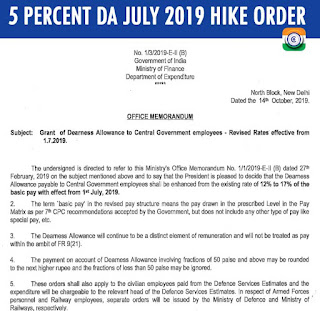
5 Percent DA July 2019 Hike Order - Grant of Dearness Allowance to Central Government employees

Grant of Dearness Allowance to Central Government employees 5 Percent DA July 2019 Hike Order  No. 1/3/2019-E- II (B) Government of...

Blog Archive

About The Author