A complete reference blog for Indian Government Employees

Showing posts with label Employees News. Show all posts

Wednesday, 18 July 2018

225 Group 'A' and 'B' officers punished for non-performance: Central Government


225 Group 'A' and 'B' officers punished for non-performance: Central Government

Central Government

New Delhi: As many as 225 Group 'A' and 'B' officers have been punished for non-performance, the central government said today.

The performance of a total of 25,082 Group 'A' and 54,873 Group 'B' officers has been reviewed up to May 2018, Minister of State for Personnel Jitendra Singh said in a written reply to Lok Sabha.
Of these, the relevant rules were invoked against 93 Group 'A' and 132 Group 'B' officers, he said.
In reply to another question, the minister said during 2017 and March 2018, vigilance clearance has been denied to 80 officers of Indian Administrative Service (IAS) on the ground of filing Immovable Property Returns after prescribed time or failing to file it.

He said that from the year 2014 onwards, sanction for prosecution has been granted against three IAS officers on account of having disproportionate assets.

PTI
Share:

Friday, 12 May 2017

Confederation confirms No Change in the Mass Dharna

Confederation confirms No Change in the Mass Dharna

Confederation confirms No Change in the Mass Dharna
PRO-GOVT AGENCIES ARE SPREADING FALSE NEWS.
MASS DHARNA IN FRONT OF FINANCE MINISTER'S OFFICE WILL BE HELD ON 23RD MAY 2017 ITSELF

It is reported that certain pro-Govt News agencies are spreading false news that Mass Dharna programme in front of Finance Ministers office is cancelled.

This is totally false news.

Last time also just a few days before our 15th December 2016 Parliament March the very same news agencies spread false news that Parliament March is cancelled.

This is a deliberate attempt to defeat our programme. Don’t believe in such false news.

Mobilise maximum employees to participate in the mass Dharna on 23rd May 2017.

 DHARNA NOTICE BY Confederation

23rd MAY 2017
MASS DHARNA IN FRONT OF FINANCE MINISTER’S OFFICE, NEW DELHI
EMPLOYEES & PENSIONERS COME IN LARGE NUMBERS
AND MAKE IT A GRAND SUCCESS

HONOUR THE ASSURANCE GIVEN BY GROUP OF MINISTERS ON 30.06.2016

  • Increase minimum pay and fitment formula.
  • Revise allowances including HRA with effect from 01.01.2016.
  • Grant option-I pension parity recommended by 7th CPC.
  • Revise pension and grant dearness relief to autonomous body pensioners
  • Implement positive recommendations of Kamlesh Chandra Committee on Gramin Dak Sevaks. Grant Civil Servant Status.
  • Regularise all Casual, Part-Time, Contingent and Contract Workers and grant equal pay for equal work.
  • Remove stringent conditions imposed for grant of MACP etc.

All affiliated organisations and COCs are once again requested to mobilise large number of employee and pensioners as per quota fixed in the last circular and make the programme a grand success.


M.Krishnan ,
Secretary General,
Confederation ,
Mob & WhatsApp; 09447068125.
Email : mkrishnan6854@ gmail.com
Source: Confederation News
Share:

Sunday, 17 July 2016

Central government sexual harassment victim employees now get 90 days paid leave

Central government sexual harassment victim employees now get 90 days paid leave

No. 13026/2/2016-Estt(L)
Government of India
Ministry of Personnel, Public Grievances and Pensions
Department of Personnel & Training 

Old JNU Campus, New Delhi 110 067
Dated: 14.07.2016 
OFFICE MEMORANDUM 

Subject: Implementation of leave provision under the Sexual Harassment of Women at Workplace (Prevention, Prohibition & Redressal) Act, 2013 — Reg.

Consequent to the enactment of the 'Sexual Harassment of Women at  Workplace (Prevention, Prohibition and Redressal) Act, 2013', this Department is  considering issuing instructions for the grant of leave to the aggrieved woman during  pendency of inquiry up to a period of three months in addition to the leave which she  is otherwise entitled to.

2. In this regard, it is proposed to insert/incorporate a new Rule in the CCS  (Leave) Rules, 1972. The new rule may read as follows:

"Special Leave connected with inquiry on sexual harassment — Leave up to a maximum of 90 days may be granted to an aggrieved female Government Servant on the recommendation of the Internal Committee or the Local Committee, as the case may be, during the pendency of inquiry under Sexual Harassment of Women at Workplace (Prevention, Prohibition and Redressal) Act, 2013. 

(2) The leave so granted to the aggrieved woman under this rule shall not be debited against the leave account."

(Navneet Misra)
Under Secretary to the Government of India 

Copy to: NIC, DoPT for uploading on the website of the Ministry.
Share:

Friday, 11 March 2016

Khadi on Fridays for Central Government employees?

Khadi on Fridays for Central Government employees?

According to unconfirmed sources, the Centre is giving serious thoughts about making Khadi-wearing compulsory for its employees on Fridays. News continues to flow non-stop about Central Government employees and their offices the past few days. Recently, an order was issued making it mandatory to hoist the national flag atop the Kendriya Vidyalaya school buildings all over the country, everyday.

There are now plans of making the Central Government employees wear Khadi once every week, preferably on Fridays. All the Central Government employees – starting from the top bosses right down to the entry-level staff, will be asked to wear Khadi once a week. Saxena, the director of Khadi Gram Udyog, said that he was planning to discuss this possibility with the government soon. He however added that it wouldn’t be made mandatory, and will be left to the discretion of the employees.

According to sources, the officer also said that the sale of Khadi will increase tremendously if all the Central Government employees come forward to buy at least one dress and hoped that the employees wouldn’t oppose this.
Share:

Saturday, 13 February 2016

Draft Memorandum of NFPE to be submitted on GDS Issue to the Chairman, GDS Committee

Draft Memorandum of NFPE to be submitted on GDS Issue to the Chairman, GDS Committee

From: – …………………………………………
…………………………………………
…………………………………………
…………………………………………
To Shri Kamlesh Chandra
Chairman,
Gramin Dak Sevak Committee
Ministry of Communication & IT
Government of India
Malcha Marg Post office Building
New Delhi – 110021
Sub: – Memorandum on GDS issues,

With due respects and regards, we submit the following for your kind consideration and favourable recommendations to the Government.
  1. Departmentalization of GDS by declaring them as Civil Servants and grant all benefits of regular employees on pro rata basis.
  1. Change the nomenclature of GDS as “Gramin Dak Karmachari” or “Rural Postal Employees”
  1. Considering the need and requirement of Rural Post Offices after modernization viz., Core Banking Solutions (CBS), Core Insurance Solution (CIS) and introduction of handheld computers at BOs and additional responsibilities, the working hours of all BOs may be extended to 8 hours and all GDS may be granted full time Civil Servant status. There should no combination of duties. The illegal condition that GDS shall not on duty for more than five hours should be removed.
  1. Minimum five hour wages should be paid even if the work load is less than 5 hours and if work load is more than five hours wages for full time (8hours) should be paid. Nomenclature of TRCA should be changed and it should be called as ‘Pay’. There should not be any reduction in wages under any circumstances.
  1. The Branch Postmaster shall be paid at the pro rata wages of Postal Assistants; GDSMD/GDSSV shall be paid equal to Postmen; and all other categories with the comparison of MTS. GDS shall be appointed and not engaged and the word ‘engagement’ shall be deleted in the existing rules.
  1. Time bound promotion (ACP) to higher pay scale on completion of 10 years, 20 years and 30 years may be granted to GDS. Point to Point fixation is requested for senior GDS. The pay shall be fixed to the seniors in the revised pay based on the number of years of service rendered to that extent by granting notional annual increments. The percentage of annual increment shall be at par with regular employees to whom the comparison is being made. The nomenclature of increment shall be introduced in the place of ‘future entitlement’.
  1. The GDS may be considered for grant of HRA, Transport Allowance, Split duty Allowance on pro rata basis at par with regular departmental employees whom we are comparing for wage fixation. The rent of the building in which BO is housed may be paid by the department.
  1. TA/DA may be granted to GDS if ordered in the interest of service and all other Allowance like Boat Allowance, SDA, may be extended to GDS.
  1. The GDS shall be covered with the Children Education Allowance and hostel subsidy at par with regular employees.
  1. The GDS shall be covered under the CS (MA) Rules or a new set of rules equal to that which provide full reimbursement of medical expenses to the GDS and their families.
  1. The GDS may be granted leave on the following norms.
(i)           E.L – One Day for each completed calendar month with accumulation.
(ii)          HPL – 20 days per year, with accumulation facility.
(iii)        Commuted leave may be introduced.
(iv)         Maternity leave – 180 days at par with regular employees with full pay & allowances. Pay shall be made from salary head and not from the welfare fund of GDS.
(v)          Child care leave shall be granted at par with regular employees.
(vi)         Special Disability Leave – As applicable to regular employees.
  1. Notwithstanding our claim of introduction of pension scheme at par with regular employees prior to 01-01-2004, we request to modify the S.D.B.S scheme to the extent of 10% recovery from the officials; 20% from the department. Ex-gratia gratuity shall be granted on completion 10 years service. Family pension shall also be introduced.
  1. All vacancies in the departmental posts viz. MTS, Postmen, shall be filled only by GDS and there shall be no other open market direct recruitment. In respect of PA cadre, the GDS possessing Qualifications and computer knowledge shall be permitted to write the competitive exam along with postman & MTS for the Departmental Quota vacancies.
  1. The GDS Conduct & Engagement rules 2011 shall be scrapped and CCS (Conduct) Rules 1964 may be made applicable to GDS also. It shall be covered under Article 309 of the Union Constitution.
  1. 50% of the past services of GDS shall be counted as regular service on promotion for pensionary benefits including gratuity.
  1. GDS shall also be covered under LTC Scheme to have recreation in life.
  1. GDS may be provided with uniforms and also grant of Washing Allowance.
  1. All advances like festival, medical, LTC, Tour TA, scooter, HBA, Motor Cycle Advance shall be extended to the GDS. All incentives, honorariums shall be introduced for the excess work performed by GDS.
  1. Furnishing of security band shall be dropped. Similarly the residential condition may also be dropped in the recruitment rules.
  1. Transfer facilities may further be liberalized; there shall be no loss of service or pay on transfer. Identity cards to GDSs are a must and that shall be supplied to GDS free of cost of the Department.
  1. Compassionate appointment may be granted to the dependents of deceased GDS, removing the existing conditions.
  1. GDS may be granted all Trade Union rights at par with regular employees.
  1. The amount payable under Group Insurance Scheme may be enhanced to five lakhs.
  1. The 50 years age limit for appearing for departmental examination may be removed.
  1. One point may be granted for Rs.4000- of cash handling in BOs.
We submit that these poor and down trodden 2.76 lakhs of Gramin Dak Sevaks should not be neglected and shall be extended with all benefits applicable to departmental employees. As Justice Talwar Quoted that ‘the weak and downtrodden need protection’. We hope that the respected Chairman, GDS Committee will look in to the prayers made by the All India Postal employees Union GDS (NFPE) also we made in the pre paras and render justice to this down-trodden section of the Postal employees.

With profound regards,
Yours sincerely,
Place: -
Date:-
(Name of the GDS with Designation)
Share:

Saturday, 26 December 2015

No more affidavits, interviews for central government jobs

No more affidavits, interviews for central government jobs

New Delhi: Path-breaking initiatives like discontinuation of affidavits for host of central government services and ending job interviews for various posts from January 1 among other initiatives kept the Ministry of Personnel in news during 2015.

“The most revolutionary and path-breaking decision is abolition of attestation of certificates by gazetted officers instead promoting self-attestation,” Minister of State for Personnel, Public Grievances and Pensions Jitendra Singh told PTI.

He said the government took this decision as it was willing to trust citizens, more importantly it’s youth who will not give wrong information while submitting self-attested documents.

This decision has come as a big relief to common people, especially those living in rural areas, who had to take lot of pain in getting documents attested.

The Ministry also recently discontinued the practice of submission of affidavit by the family members of deceased government employees for the appointment on compassionate grounds.

Now people are required to submit self-declaration at the time of applying for compassionate appointment. All states and union territories have also been asked by the Centre to do away with practice of getting gazetted officer-signed affidavit and seek self-attestation.

Singh, a Lok Sabha member from Jammu and Kashmir’s Udhampur constituency, said soon after Prime Minister Narendra Modi’s announcement to end interviews from central government jobs, his Ministry has acted on it.

“We have decided that from January 1, next year, the process of interview for Group C and D recruitments will be abolished,” he said, adding that these are some steps which nobody thought of in past over 60 years after country’s independence.
Singh said the Ministry which is held by the Prime

Minister started several measures to increase transparency and simplify governance.

“We have started the process of simplification of various application forms being used in the government. We are converting multi-page application forms into one-page,” the Minister said.

Talking about other initiatives, he said a pension portal has been started. “Those who are getting superannuated can check the status of their pension online. They can also check pension payment orders online,” Singh said.

He said out of 6.5 lakh public grievances received by his ministry during the year, 4.8 lakh were disposed of.

“The ministry will continue to work towards simplifying governance,” Singh said.

In another novel initiative, the ministry started yoga camps for the central government employees and their dependents.

Besides, it exempted the parents of differently-abled children from the mandatory transfers so that they can take proper care of them.

The scheme of interaction of officers with school students has been launched in which the officers of government of India visit schools and share their experiences with the students.

As a pilot project, senior officers of Department of Personnel and Training have visited kendriya vidyalayas in Delhi and interacted with the students.

For the first time in the history of the Indian Administrative Service (IAS), the officers of 2013 batch were posted as assistant secretary in the Central Secretariat for a period of three months.

In order to crack a whip on non-performing bureaucrats, it has started assessing the performance of employees. The government has asked all its departments to identify such public servants and move proposals for their premature retirement.

The Personnel Ministry has formed rules to check unauthorised stay on foreign postings by IAS, IPS and IFS officers.

PTI
Share:

Sunday, 15 November 2015

Pay Band for Postal Assistant: Postal Department

Pay Band for Postal Assistant: Postal Department
 
A notification is published by the Department of Posts, Government of India in connection with candidates called for the post of POSTAL ASSISTANTS. Based on this, for the post of POSTAL ASSISTANTS they will be applicable for the scale of pay in Pay Band 5200-20200 with Grade Pay 2400.

Let us know approximately, how much Gross pay will be drawn by the newly appointed Postal Assistant.

If appointed in the rural areas,
Basic pay – Rs.7510
Grade Pay – Rs.2400
Dearness Allowance @ 100% – Rs.9910.00
House Rent Allowance @ 10% (BP+GP) – Rs.991.00
Transport Allowance (Rs.800+100%) – Rs.1600.00
Gross – Rs. 22411.00
If appointed in the A1 cities like CHENNAI, CALCUTTA,MUMBAI & DELHI
Basic Pay – Rs. 7510.00
Grade Pay – Rs. 2400.00
Dearness Allowance @ 100% – Rs. 9910.00
House Rent Allowance @ 30% (BP+GP) – Rs.2973.00
Transport Allowance (Rs.1600+100%) Rs. 3200.00
Gross – Rs. 25993.00

If appointed in the B1 cities (list of B1 cities issued by the Central Government)
Basic Pay – Rs. 7510.00
Grade Pay – Rs. 2400.00
Dearness Allowance @ 100% – Rs. 9910.00
House Rent Allowance @ 30% (BP+GP) – Rs .1982.00
Transport Allowance (Rs.800+100%) – Rs.1600.00
Gross – Rs. 23402.00

Apart from this you can draw hill station allowance if you are posted in the hill stations.
Share:

Wednesday, 15 July 2015

Kerala government employees to get hike in salary, retirement age to be raised by 2 yrs

Kerala government employees to get hike in salary, retirement age to be raised by 2 yrs

Thiruvananthapuram: A handsome hike for government employees’ salaries and an increase in their retirement age to 58 from the present 56 are among the key recommendations made by Kerala’s 10th Pay Commission.

The panel, headed by Justice CN Ramachandran, handed its report to Chief Minister Oommen Chandy at a function here today.

Among the various recommendations of the much-awaited report includes a proposal for minimum salary of Rs 17,000 and maximum of Rs 1.2 lakh for government employees under various categories.
High school teachers with service of 28 years should be promoted to the post of deputy headmasters, it proposed, adding that the minimum period of service needed for awarding pension should be lowered to 25 years from the present 30.

Accepting the report, Chandy said that the government would consider the recommendations and take appropriate steps regarding those.

An official release said that the first part of the report, that covers pay revision and pension, has been handed in now with the next part to be submitted within November.

Inputs with PTI
Share:

Monday, 13 July 2015

Method of Night Duty Allowance and Night Shift Bonus Calculation for Industrial Employees

Method of Night Duty Allowance and Night Shift Bonus Calculation for Industrial Employees

Night Duty Allowance & Night Shift Bonus in OFB- Para 196 & 201 of Office Manual Part-VI (Volume-I) Chapter -V (Labour-Methods of Payment and Allocation)

Night Duty Allowance
201. Industrial employees working on night shifts are eligible for Night Duty allowance on the basis of weightage of 10 minutes for every hour of night duty performed between 22.00 hours and 6.00 hours at the rates specified in the Government orders Issued from time to time.

For calculation of weightage, duty for less than half an hour shall be ignored and, duty for half an hour and more but less than one hour shall be reckoned as one full hour. The rounding off of fractions of an hour shall be made with reference to the, actual hours of night, duty performed in a month (i.e. wage period) and not on daily basis.

Night duty allowance not be admissible during overtime hours if any falling within the night duty hours. The allowance will not be treated as `Pay’ for purpose of piece work earnings or for other allowances admissible to the employees. The night duty allowance payable to the industrial employees shall be booked to work order number 02/00003/00 and the work order is exempt from DA levy.

Note: – In the muster rolls, the period of night shift indicating the time of commencement and closing of such a shift in respect of workers on night duty should be specifically indicated by the factory.

The net hours of work between 22.00, hrs and 6.00 hrs. performed by the workers daily during the normal hours of night shift duty (i.e. after excluding the period of recess, shift leave, overtime etc. during that period) ‘,which hours qualify for night duty allowance should be shown separately in muster roll and progressive weekly and monthly Carried over as done in the case of normal booking, of attendance.

Night Shift bonus

196. A night shift represents the hours worked between the termination of the day shift and the normal opening hours of the next day. The piece workers who Perform overtime work under Departmental rules in the night shift will be paid an extra half hour pay termed as ‘Night shift bonus‘ calculated at the hourly rate of 1/200 of the monthly basic pay plus dearness allowance, special pay, personal pay, pension (to the extent taken into account for fixation of pay in the case of re-employed pensioners) and city compensatory allowance for every hour of systematic overtime under Departmental Rules worked on the Night shift in addition to their piece yearnings. This element is not admissible to day workers.

Source: www.bpms.org.in
Click to view the order
Share:

Tuesday, 7 July 2015

FAQs WITH REPLIES/INFORMATION, IN RESPECT OF LOKPAL AND LOKAYUKTAS ACT, 2013

FAQs WITH REPLIES/INFORMATION, IN RESPECT OF LOKPAL AND LOKAYUKTAS ACT, 2013

1. Whether the Lokpal and Lokayuktas Act, 2013 has come into force? Yes, vide Gazette Notification No. S.O. 119(E) dated 16-01- 2014, the Lokpal and Lokayuktas Act, 2013 (1 of 2014 has come into force from the said date. However, the institution of Lokpal is yet to become functional, since the Act needs some amendments, inter alia, so as to resolve certain issues relating to appointment of Chairperson and Members of Lokpal, etc. in the absence of a Leader of Opposition recognized as such in the Lok Sabha. For this purpose, a Bill has been introduced in Parliament and is currently under consideration of the Department Related Parliamentary Standing Committee on Personnel, Public Grievances and Law and Justice.
2. What are the Rules and Orders notified under the provisions of the Lokpal and Lokayuktas Act, 2013? The Rules and Orders notified under the Act so far, are as follows:-
(a) The Public Servants (Furnishing of Information and Annual Return of Assets and Liabilities and the Limits for Exemption of Assets in Filing Returns) Rules, 2014 [notified vide Gazette. Notification No. G.S.R. 501(E) dated 14-07-2014 amended vide Notification No. GSR No. 638(E) dated 08-09-2014]
(b) The Public Servants (Furnishing of Information and Annual Return of Assets and Liabilities and the Limits for Exemption of Assets in Filing Returns) Second Amendment Rules, 2014. [notified vide Gazette Notification No. G.S.R. 9I8(E) dated 26-12-2014]
(c) Search Committee (Constitution, Terms and Conditions of appointment of members and the manner of selection of Panel of Names for appointment of Chairperson and Members of Lokpal) Rules, 2014. [notified vide Gazette Notification No. G.S.R. 31(E) dated 17-01-2014].
(d) Search Committee (Constitution, Terms and Conditions of appointment of members and the manner of selection of Panel of Names for appointment of Chairperson and Members of Lokpal) Amendment Rules, 2014. [notified vide Gazette Notification No. G.S.R. 620(E) dated 27-08- 2014]
(e) The Lokpal and Lokayuktas (Removal of Difficulties) Order, 2014 [notified vide Gazette Notification No. S.O. 409(E) dated 15-02-2014 with subsequent amendments having been made vide Notifications No. S.O. 1840(E) dated 14-07-2014, No. S.O. 2256(E) dated 08-09-2014 and No. S.O. 3272(E) dated 26-12-2014]
The rules and orders as referred to above can be accessed by clicking on the links above.
3. What is the jurisdiction of Lokpal in respect of Inquiry? Please see Section 14 of the Lokpal and Lokayuktas Act, 2013 (I of 2014).
4. Whether the Lokpal and Lokayuktas Act, 2013 is applicable to the employees of State Governments? In terms of provisions of section 14 of the Lokpal and Lokayuktas Act, 2013 the employees of the State Government are not covered unless they have served in connection with the affairs of the Union. The jurisdiction of the Lokpal will extend on the following categories of employees only after obtaining the consent of the concerned State Government. [proviso under section 14(1)(f) refers] inter alia, over the following categories of public servants referred to in section 14(1)(d) & (e):
“(d) any Group ‘A’ or Group ‘B’ officer or equivalent or above, from amongst the public servants defined in subclauses (i) and (ii) of clause (c) of section 2 of the Prevention of Corruption Act, 1988 when serving or who has served, in connection with the affairs of the Union;
(e) any Group ‘C’ or Group ‘D’ official or equivalent, from amongst the public servants defined in sub-clauses (i) and (ii) of clause (c) of section 2 of the Prevention of Corruption Act, 1988 when serving or who has served in connection with the affairs of the Union subject to the provision of sub-section (1) of section 20;”.
Thus, it may be seen that the employees of the State Governments are not under the jurisdiction of the Lokpal.
Further, under section 63 of the Act, the States are under an obligation to establish an institution of Lokayukta, by a law enacted by the State Legislature, if not already done so, within a period of one year from the coming into force of the Act. Employees of the State Government are, inter alia, to be covered under the jurisdiction of the respective Lokayuktas.
5. Whether the Lokpal and Lokayuktas Act, 2013 is applicable on All India Service officers working under the control of the State Government? Yes, as they are public servants within the meaning of clause (o) of sub-section (1) of section 2 of the Act, read with sub-section (1) of section 14 of the Act. However, consent of the State Government would be necessary before Lokpal orders an Inquiry in respect of such an officer if he is employed in connection with the affairs of a State Government. Please see proviso after clause (f) of subsection (1) of section 14.
6. Under what provisions of the Lokpal and Lokayuktas Act and Rules, the information in respect of the Assets and Liabilities is to be furnished by Public Servants. Section 44 of the Lokpal and Lokayuktas Act, 2013 and the Public Servants (Furnishing of Information and annual return containing declaration of Assets and Liabilities by public servants and Limits for Exemption of Assets in filing Returns) Rules, 2014 notified on 14th July 2014 as last amended by the amendment Rules notified on 26th December, 2014, the information in respect of the Assets and Liabilities is required to be furnished by all Public Servants. (For links to the rules referred to above please see S. No. 2 above)
7. What is the difference between the declaration of assets by public servants under the Lokpal and Lokayuktas Act, 2013 and the filing of property returns by public servants under the applicable Conduct Rules? The provisions relating to filing of assets and liabilities by public servants are contained in section 44 of the Lokpal and Lokayuktas Act, 2013. Under the said section, a public servant is required to furnish to the competent authority the information relating to —
(a) the assets of which he, his spouse and his dependent children are, jointly or severally, owners or beneficiaries; and
(b) his liabilities and that of his spouse and his dependent children.
As against this, the general requirement as contained in most of the applicable Conduct Rules for government servants (AIS Conduct Rules, CCS Conduct Rules, etc.), require the public servant to submit a return, giving the full particulars regarding :-
(a) the immovable property owned by him, or inherited or acquired by him or held by him on lease or mortgage, either in his own name or in the name of any member of his family or in the name of any other person;
(b) shares, debentures, postal Cumulative Time Deposits and cash including bank deposits inherited by him or similarly owned, acquired or held by him;
(c) other movable property inherited by him or similarly owned, acquired or held by him; and
(d) debts and other liabilities incurred by him directly or indirectly.
Further, till such time, the relevant Conduct Rules are aligned with the Lokpal law, only those categories of Government servants are required to file their declarations/annual returns under such rules, which are presently covered under them. Under these rules, public servants are generally required to submit annual property returns as on the January of the year, on or before 31′ January of that year. The Lokpal Act [section 44(4)], on the other hand, requires the filing of annual returns as on the 31″ March of the year by each public servant on or before 31′ July of that year. Thus, the requirements of the Lokpal and Lokayuktas Act, 2013 and the relevant Conduct Rules are different in the manner of filing information also.
8. (a) Whether Government has prescribed any formats for the submission of information regarding assets and liabilities by public servants under the Lokpal law? (b) Where can the forms be accessed?
(c) What are the timelines for furnishing such information specific to the years 2014 and 2015, as also for subsequent years?
The form and manner in which information regarding assets and liabilities are required to be furnished by public servants have been prescribed under the Public Servants (Furnishing of information and Annual Return of Assets and Liabilities and Limits for exemption of assets in filing Returns) Rules, 2014, as amended from time to time. A complete set of the formats and clarifications as regards the timelines for filing of such declaration and returns have been provided in this Department’s OM No.407/12/2014-AVD-IV-B dated 18-03- 2015. The timelines for annual returns required to be filed for different years is as follows:
(a) The first return (as on 1 at August, 2014) under the Lokpal Act should be filed on or before thel5th October, 2015;
(b) The next annual return under the Lokpal and Lokayuktas Act, 2013 for the year ending 3Ist March, 2015 should be filed on or before thel 5th October, 2015; and
(c) The annual return for subsequent years as on 31′ March every year should be filed on or before 31″ July of that year.
9. To whom is the information in respect of assets and liabilities required to be furnished? Is it necessary to forward copies of such information to the Lokpal or to the DoPT? Section 44 of the Act mandates that the information regarding assets and liabilities is to be submitted by each public servant to his/her own competent authority (as defined in the Act). There is no requirement for submission of copies of such informationby individual officers to the Lokpal or to DoPT other than those working in DOPT or Lokpal.
10.Is there any requirement that all applicable Conduct Rules for different categories of public servants have to be amended in line with the provisions of the Lokpal and Lokayuktas Act? Please provide complete details. Section 56 of the Lokpal and Lokayuktas Act, 2013 reads as under:-
“56. The provisions of this Act shall have effect notwithstanding anything inconsistent therewith contained in any enactment other than this Act or in any instrument having effect by virtue of any enactment other than this Act.”.
The above provisions mandate that even if there are any provisions in any existing law (which, inter alia, includes relevant Conduct Rules framed under Article 309, etc.) which are inconsistent with the provisions of the Lokpal and Lokayuktas Act, the provisions of the said Act shall have effect, notwithstanding such inconsistency. Thus, the provisions regarding filing of information/annual returns regarding assets and liabilities by public servants under section 44 of the Lokpal and Lokayuktas Act shall have effect, notwithstanding anything inconsistent therewith in the applicable Conduct Rules. In other words, the filing of information/annual return under the Lokpal law in the manner prescribed by rules made under that Act, is a mandatory requirement, and the same cannot be dispensed with under any circumstances, except by an amendment of the Act itself. Attention in this regard is also invited to section 57 of the Lokpal and Lokayuktas Act which reads as under:-
“57. The provisions of this Act shall be in addition to, and not in derogation of, any other law for the time being in force.”.
A combined reading of section 57, along with section 44 of the Act, would make it clear that the requirement of filing returns regarding assets and liabilities under the Lokpal and Lokayuktas Act is in addition to, and not in derogation/supersession of the requirement of filing similar returns under the existing Conduct Rules. In view of this, the requirement of filing of property returns under the existing Conduct Rules is an independent requirement under the applicable rules and the same can be dispensed with, only by amending those rules. In other words, the requirement of filing returns of assets and liabilities under the applicable Conduct Rules has to continue, till such time as the provisions of those rules are harmonised with the relevant provisions of the Lokpal Act and the rules framed thereunder, by carrying out appropriate amendments in them.
Attention is further invited to the Central Government’s notification, S.O. 3272(E) dated 26-12-2014], further amending the Lokpal and Lokayuktas (Removal of Difficulties) Order, 2014, for the purpose of extending the time limit for carrying out necessary changes in the relevant rules relating to different services from “three hundred and sixty days” to “eighteen months”,from the date on which the Act came into force, i.e., 16th January, 2014. In view of this, all Ministries/Departments/cadre authorities are required to complete the necessary exercise for harmonising the provisions of relevant Conduct Rules with the provisions of the Lokpal and Lokayuktas Act and the rules made thereunder, within this extended time of eighteen months. All Ministries/Departments and other cadre controlling authorities have been appraised about this requirement separately through D.O. letters dated 8thSeptember, 2014 and 29″ December, 2014 issued by this Department. In view of this, it is incumbent upon all Ministries / Departments/cadre controlling authorities to ensure that the relevant conduct rules relating to services administered/controlled by them are brought in harmony with the provisions of the Lokpal Act and rules made thereunder within this extended time limit of eighteen months.
11.Whether a public servant/ Government Servant has to submit the Annual Property Return as required under the Conduct Rules applicable and also furnish the details of his Assets and liabilities and also his/her spouse and dependent children under the Lokpal and Lokayuktas Act,2013 Yes, till such time the applicable Conduct Rules are attuned with the relevant provisions of the Lokpal and Lokayuktas Act, 2013.
12. Government proposes to amend the provisions of section 44 of the Lokpal and Lokayuktas Act? If so, the details thereof? Government has introduced a Bill, namely, the Lokpal and Lokayuktas and other related law (Amendment) Bill, 2014, in the Lok Sabha on 18th December, 2014. The said Bill contains, inter alia, a proposal to amend section 44, in order to provide for a scheme wherein the filing of information by public servants under the provisions of the section are proposed to be brought in harmony with the provisions of the respective Acts, Rules or Regulations, as applicable to different categories of public servants. It is also proposed to amend sub-section (6) of section 44 in order to enable the Central Government to prescribe the manner in which information furnished by public servants of different categories is to be published, keeping public interest in view, by the respective competent authorities. The said Bill now stands referred to the Department Related Parliamentary Standing Committee on Personnel, Public Grievances, Law and Justice, for consideration and report.
13. In case, the spouse is also a public servants, whether both, the husband and wife have to file the returns indicating the assets and liabilities of the other spouse, under the Lokpal and Lokayuktas Act, 2013. Yes. Sub-section (1) of Section 44 of the Lokpal and Lokayuktas Act, 2013 makes it mandatory for every public servant to make a declaration of his assets and liabilities in the manner as provided by or under this Act, i.e. as per provisions of section 44(2) of the Act. The requirement is binding on each public servant, irrespective of whether the spouse of the public servant is also a public servant or not.
14. In case, the spouse of a public servant, has assets procured by his/her own income, or has his/her own property, whether, in such a case also, the public servant has to indicate the assets and liabilities of the spouse in the returns under the Lokpal and Lokayuktas Act, 2013. Yes. Clauses (a) and (b) of Sub — section (2) of Section 44 of the Lokpal and Lokayuktas Act,2013 does not make any exception in respect of assets procured by the spouse of the public servant by his/her own income.
15. Whether the assets and liabilities of spouse of a public servant, who is an employee of a private company/ organisation, are to be reflected in the return of the assets and liabilities to be filed by the public servant, under the provisions of the Lokpal and Lokayuktas Act, 2013. Yes. Clauses (a) and (b) of Sub — section (2) of Section 44 of the Lokpal and Lokayuktas Act,2013 does not make any exception for not not furnishing the declaration, in respect of assets procured by the spouse of the public servant by his/her own income.
16. Whether a public servant, who has a share in an undivided property of Hindu Undivided Family, is required to furnish such information and in what manner? Yes. Please see the Note 2 of APPENDIX—I of the Public Servants (Furnishing of Information and annual return containing declaration of assets and liabilities by public servants and Limits for Exemption of Assets in filing Returns) Rules, 2014 [Notification No. G.S.R. 501(E) dated 14-07-2014]. It states that “if a public servant is a member of Hindu Undivided Family with co-parcenary rights in the properties of the family either as a “Karta” or as a member, he should indicate in the return in Form No. III the value of his share in such property.”
The same principle will also have to be followed in respect of movable property belonging to a HUF.
17. In what manner the value of his share in the undivided property of Hindu Undivided Family, is to be indicated by a public servant, particularly if it is not possible to indicate the exact value his share? The approximate value of his share may be indicated with explanatory note wherever necessary, if it is not possible to indicate the exact value of his share.
18.What happens if a public servant fails to furnish information in respect of his assets If a public servant willfully or for the reasons which are not justifiable, fails to declare his assets or gives misleading information in respect of such assets and is found to be possession of assets not disclosed or in respect of which misleading information was furnished, then, such assets shall, unless otherwise proved, be presumed to belong to the public servant and shall be presumed to be assets acquired by corrupt means. [Please see section 45 of the Lokpal and Lokayuktas Act, 2013]
19. Whether the Information furnished by the public servants will be put in public domain? Yes. As per provision of Section 44(6) of the Lokpal and Lokayuktas Act, 2013.
“The Competent authority in respect of each Ministry or Department shall ensure that all such statements are published on web site of such Ministry or Department by 31′ August of that year.”
20.Whether the Public Servants who retire before 15.10.2015 ( Extended last date for submission of revised Returns for 2014 and 2015) are required to file returns of Assets and Liabilities under the Lokpal and Lokayuktas Act,2013 All the Public Servants who held the office as such on the date of commencement of the Lokpal and Lokayuktas Act,2013 i.e. 16.01.2014 are required to file the returns of Assets and Liabilities on or before 15.10.2015
Disclaimer: The above clarifications are for general information and guidance and do not interpret legal provisions of the Act nor tender any legal opinion on issues.
[ File No.407/12/2014-AVD-IV(B) Pt]

Original Order
Share:

Saturday, 27 June 2015

Stoppage of Fixed Medical Allowance to Central Government Employees under CS(MA) Rules who are working in remote areas

Stoppage of Fixed Medical Allowance to Central Government Employees under CS(MA) Rules who are working in remote areas

Ministry of Health and Family Welfare has issued an OM on Stoppage of Fixed Medical Allowance (FMA) being paid to the Central Government employees working in the interior/remote areas and their governance under CS(MA) Rules, 1944.
No.S.14025/09/2013-MS
Government of India
Ministry of Health and Family Welfare
Department of Health & Family Welfare
***********
Nirman Bhawan, NewDelhi
Dated 3rd June, 2015.
OFFICE MEMORANDUM

Subject: Stoppage of Fixed Medical Allowance (FMA) being paid to the Central Government employees working in the interior/remote areas and their governance under CS(MA) Rules, 1944.

Reference is invited to OMNo.S-1402011/88-MS dated 17.07.1990 in which fixed medical allowance to the tune of Rs.25/-per month was granted to employee working in the interior/remote areas where no Authorized Medical Attendant was available within a radius of 5 kms, which was subsequently revised to the tune of Rs.l00/- per month vide OMF.No.14025/33/98-MS dated 18.01.1999.

2. On receiving a proposal from Ministry of Defence on the issue of medical reimbursement to employees who are in receipt of Fixed Medical Allowance, the matter was examined in the Ministry in consultation with Department of Expenditure and Department of Personnel & Training.

3. It has now been decided to stop the above mentioned Fixed Medical Allowance.  Henceforth, the Central Government employees residing in interior/remote areas will be governed by the extant rules as laid down under CS(MA) Rules, 1944.

4. This O.M. will be effective from the date of issue. After issuance of this OM,the above mentioned OMs i.e.,O.M. No.S-1402011/88-MS dated 17.07.1990 and O.M F.No.14025/33/98-MS dated 18.01.1999. stand withdrawn.

5.This issues with the concurrence of the Department of Personnel &Training and Department of Expenditure.
(Bindu Tewari)
Director
Download Ministry of Health and Family Welfare OM No.S.14025/09/2013-MS 03.06.2015
Share:

Monday, 6 April 2015

Tamil Nadu Pay Grievances – Clarification for Higher Start of Pay for the posts of Graduate Junior Assistants/Typists and Record Clerks orders issued

Tamil Nadu Pay Grievances – Clarification for Higher  Start  of  Pay  for the posts of Graduate Junior Assistants/Typists and Record Clerks orders issued

Finance  (CMPC)  Department,
Secretariat,
Chennai – 600 009.
Letter No.2112/CMPC/2015 -1,
dated:05-03-2015
From
Thiru.T.Udhayachandran, I.A.S.,
Secretary to Government.(Expenditure)

To
The Chief Civil Surgeon Medical Officer,
Government Peripheral Hospital,
Tondiarpet, Chennai-600   081.

Sir,
Sub: Tamil Nadu Revised Scales of Pay Rules,2009 – Recommendations of the Pay Grievance  Redressal Cell – Dispensation of Higher Start  of Pay for the  posts  of Graduate Junior Assistants/ Typists and Record Clerks orders issued – Request to clarify certain points about  the eligibility of Higher Start of pay for the post of Typist – Reg.

Ref:
G.O.Ms.No.321, Finance (Pay Cell) Department, dated: 2-07-1998.
G.O.Ms.No.234, Finance (Pay Cell) Department, dated: 1-06-2009.
G.0.Ms.No.241, Finance (Pay Cell) Department, dated: 22–07-2013.

Your letter Ref.No.1255/TPH/2014, dated: 06-01-2015.

I  am to invite your attention to the references cited.

2.  In   your  letter  cited,  a clarification   has been  sought for   as to  whether graduate  Typist is eligible for higher start of pay as the individual  has joined duty before  01-04-2013  and  also  raised presumption  that  all the  graduate Junior Assistant/ Typist who have joined duty during the period  from 01-01-2006  to 31-03-2013 are eligible for higher start of pay.

3.  In  this  connection,  I am to state that in the Government Order third  cited, orders  have been issued to dispense the higher start of pay granted to the Junior Assistants/ Typists   for   possessing   degree   qualification   with   effect   from 1-04-2013.       However,   in  cases where  higher  start  of  pay  has  already been granted between 1-04-2013  to 22-07-2013,  such cases need not be effected any recovery till the date of issue of the Government Order third cited, but the pay of the such individuals shall be re-fixed to the minimum of the Pay Band  (Pay+  Grade Pay) of the said posts and the excess pay sanctioned if any to  the individuals   from 23-07-2013  to till date shall be  recovered from the individual concerned.  Further, I am  also  to  clarify  that  the  graduate  Typist  who  joined   duty  on  or  before 1-04-2013   and  not  sanctioned  higher  start  of  pay  till  the  date  of  issue  of Government Order third cited are also not entitled for the benefit of higher start of pay since the above concession has been dispensed with effect from 1-04-2013. Hence,  I  am to inform-that  your presumption is not correct and the objection raised by the Pay and Accounts Officer (North) is in order.

Yours faithfully,
for Secretary to Government (Expenditure)

Share:

Tuesday, 17 March 2015

Sukanya Samriddhi Account (SSA) Vs Public Provident Fund (PPF): 10 Things to Know

Sukanya Samriddhi Account (SSA) Vs Public Provident Fund (PPF): 10 Things to Know

The recently launched Sukanya Samriddhi Account (SSA) and Public Provident Fund (PPF) can be useful instruments for saving for the future needs of the children. The Sukanya Samriddhi Account can only be opened in the name of the girl child while PPF scheme can be availed by all. Experts say PPF scores over Sukanya Samriddhi Account in terms of liquidity (partial withdrawal facility) and other flexibilities. But Sukanya Samriddhi Account could potentially give higher returns, they add.
Eligibility: A Sukanya Samriddhi Account can be opened by the guardian in the name of a girl child till she attains the age of ten years. Only one account is allowed per girl child. Parents can open this account for a maximum of two children.

Limit:
An investor can open PPF accounts in the name of minors but a maximum of Rs.
1.5 lakh can be deposited every year including all the accounts. In case of Sukanya Samriddhi Account, a maximum of Rs 1.5 lakh can be deposited per account.

Account Opening:
A Sukanya Samriddhi Account can be opened with an amount of Rs.
1,000 while it is Rs 100 for a PPF account. Both these accounts can be opened at post offices and banks.

A charge of Rs 50 will be levied both in Sukanya Samriddhi Account and PPF if the minimum contribution is not made every year.

Minimum and maximum contribution:
In an Sukanya Samriddhi Account, a minimum of Rs. 1,000 has to be deposited every year and the maximum limit is Rs. 1.5 lakh. And there is no limit on number of deposits either in a month or in a financial year.

In case of PPF, an individual but has to deposit a minimum of Rs. 500 in a financial year while the maximum limit is Rs.1,50,000. And deposits can be made in lump-sum or in 12 installments.

Maturity:
The Sukanya Samriddhi Account can be closed after the girl child in whose name the account was opened completes the age of 21. If account is not closed after maturity, the balance will continue to earn interest as specified for the scheme from time to time. The maturity period of a PPF account is 15 years but it can be extended in blocks of five years.

Taxation:
In terms for taxation, deduction up to Rs. 1.5 lakh is allowed under Section 80C in both the Sukanya Samriddhi Account and PPF. Also, both the schemes qualify for tax-free status on withdrawal and interest income.

Withdrawal:
Partial withdrawal is permissible every year from the seventh financial year of opening the PPF account. In case of Sukanya Samriddhi Account, up to 50 per cent of the accumulated amount can be withdrawn after the account holder turns 18 while full withdrawal is possible after she turns 21.

Interest rate:
The interest rate on Sukanya Samriddhi Account and PPF is not fixed. The government will every year declare the interest rate of the scheme. For 2014-15, the government would be paying 9.1 per cent interest on Sukanya Samriddhi Account against 8.7 per cent on PPF.

Loan:
A loan facility is available from the third financial year of opening the PPF account. In Sukanya Samriddhi Account there is no such facility.

What Experts Say:
Anil Rego, CEO of Right Horizons, a wealth management firm, said the choice between Sukanya Samriddhi Account and PPF is a trade-off between more flexibility and higher returns. PPF offers more flexibility while Sukanya Samriddhi Account can potentially give higher returns, he added. Investors with surpluses can look at the distributing their investments in both the schemes, Mr Rego added.

Suresh Sadagopan, the founder of Ladder 7 Financial Advisories, says both the Sukanya Samriddhi Account and PPF are similar schemes in nature in the debt space under Section 80C. The Sukanya Samriddhi Account is a good alternative if investors are comfortable at locking their money for a long time, he added.
Source : NDTV
Share:

Thursday, 12 March 2015

Department of Post launched a scheme named “My Stamp”

My Stamp

Department of Post has launched a scheme named “My Stamp”. My Stamp is a personalised sheets of postage stamps. The personalization is achieved by printing a thumb nail photograph of the customer, images and logos of institutions, or images of artwork, heritage buildings, famous tourist places, historical cities, wildlife, other animals and birds etc., alongside the selected “My Stamp” sheet. Rs. 300 is charged from customers for one My Stamp sheet contacting 12 stamps. My Stamp can be used as valid postage for domestic mail purposes. A customer can choose from a variety of My Stamp themes available.

This information was given by the Minister of Communication and Information Technology Shri Ravi Shankar Prasad in Lok Sabha today.
Share:

Monday, 9 March 2015

Increasing Pension Limits Under Employees Pension Scheme

Increasing Pension Limits Under Employees Pension Scheme

Ministry of Labour & Employment
09-March, 2015 15:00 IST

The Government is not considering to enhance the age limit for Employees Pension Scheme (EPS).The Pension implementation Committee (PIC) has recommended to increase the short service pension entitlement age from 50 years to 55 years. The proposal is under consideration of the Central Board of Trustees (CBT),Employees’ Provident Fund (EPF).The proposal, if accepted is likely to decrease the reduction of pension due to short service.

This was stated by Shri Bandaru Dattatreya, the Minister of State(IC) for Labour and Employment in response to a written question in Lok Sabha today.

PIB
Share:

Thursday, 26 February 2015

NPS – Simplification of Withdrawal process and Documentary requirement for the Government subscriber

Simplification of Withdrawal process and Documentary requirement  for the Government subscriber: PFRDA’s Instructions

PENSION FUND REGULATORY AND DEVELOPMENT AUTHORITY
PFRDA/2015/07/EXIT/02
25 th February, 2015
To,
All Govt depts./PAO’s/PrAO’S/DDO’S/DTO’S & CRA
Dear Sir/ Madam,
SUB: Simplification of Withdrawal process – Documentary requirements 
Currently, the following documents are required to be submitted by the subscribers for processing a withdrawal request by CRA / NPS Trust for various types of withdrawals and which are common across all the sectors of National Pension System.

1. Original PRAN Card or In the absence of PRAN card, notarized affidavit

2. Photo ID proof*

3. Address proof of the Claimant*

4. Cancelled cheque (containing claimant’s Name, Bank Account Number and IFS  Code) or Bank Certificate
* If a document contains both identification and address for compliance with KYC requirements, it would be sufficient for processing the withdrawals. Ex: Passport,Aadhar, Driving license, Ration card etc.
Additionally, the following documents are asked for exits arising out of death of the subscriber

5. Death certificate in original issued by local authorities

6. Legal Heir Certificate/Succession Certificate as applicable in case if nominationis not registered by the subscriber

However, feedback has been received at various meetings conducted by PFRDA with Government officials, subscribers and other stakeholders that the burden of documentation is too heavy and needs to be reduced for a smooth operation of the system. The Authority based on the feedback and also upon reexamination of the procedural requirements at various levels and has decided to simplify the documentary requirements for the Government subscriber sector to begin with. However, the long run goal is to minimise the documentary requirements for all sectors.

The following are the revised requirements for the Government sector subscriber for the Exit and withdrawal requests submitted to CRA / NPS Trust:

1. KYC documents, Bank Passbook/cancelled cheque/bank certificate and Name mis-match certification: The certification provided by the PAO/PrAO/DDO/DTO that
  • the KYC requirements of proper identification of the subscriber has been done (as per Annexure I)
  • that the name as provided in the withdrawal application form be accepted as final.
  • Bank account details as provided in the application form be accepted as final.
Would be accepted and claims dealt accordingly.

2. Nomination – If already existing in CRA system – there is no further requirement to fill in the details, unless the subscriber wishes to change the nomination already provided

3. Original PRAN card or In the absence of PRAN card, notarized affidavit: Not required to be submitted henceforth.

4. Death certificate – Copy of the death certificate duly attested by the concerned PAO/PrAO/DDO/DTO with a specific certification that it is a true copy of the original death certificate and such certificate shall be dated and subscribed by such officer with his name, title and seal of office would be accepted as adequate for the purpose of establishing the death of the subscriber.
Yours faithfully,
Sd/-
Venkateswarlu Peri
General Manager
ANNEXURE I
1. KYC CERTIFICATION
Certified that Shri/Smt …………. Son/Wife of Shri …………………, who is an employee of (office address) ……………. from (date) ……. and is at present holding the post of ……………….. and his/her identity is certified as provided in the NPS withdrawal application form along with the address as provided.
Further, the name and Bank account details as provided in the withdrawal application form by the subscriber shall be accepted as final.
Date ……………..
Name, Designation, Address & Tel No
Of the certifying officer
Source: http://pfrda.org.in/MyAuth/Admin/showimg.cshtml?ID=583
Share:

Monday, 23 February 2015

New Website of National Pension System Trust Launched; To Provide Proper and Effective Information Dissemination to the Stakeholders and Provide Ease of Access to Various Beneficiaries Under NPS

New Website of National Pension System Trust Launched; To Provide Proper and Effective Information Dissemination to the Stakeholders and Provide Ease of Access to Various Beneficiaries Under NPS

The National Pension System Trust has been set-up and constituted by Pension Fund Regulatory Development Authority (PFRDA) for taking care of the assets and funds under the National Pension System (NPS) in the interest of the beneficiaries (subscribers).

The National Pension System Trust has launched its new website www.npstrust.org.in here today.. The website was launched by Shri G. N. Bajpai, Chairman & Trustee of the Board of NPS Trust. The website is aimed to provide proper and effective information dissemination to the stakeholders and provide ease of access to various beneficiaries under NPS.
Share:

Income Tax Expectations – Assocham Survey: Here’s What India Wants

Income Tax Expectations: Here’s What India Wants

A survey carried out by industry body Assocham has found that a majority of salaried employees want Finance Minister Arun Jaitley to increase the income tax exemption in the forthcoming Budget.

A hike in income tax exemption from Rs. 2.5 lakh to Rs. 3 lakh will lead to savings of up to Rs. 5,000 for those who fall in the Rs. 2.5 lakh to Rs. 5 lakh tax bracket. Those in the Rs. 5 lakh to Rs. 10 lakh tax bracket will save up to Rs. 10,000, while those in the highest tax bracket can save up to Rs. 15,000.

Any increase in exemption in income tax would leave more money in the hands of people and will increase their purchasing power, Assocham said.

If Mr Jaitley hikes income tax exemption limit, it will be for the second time in two years that salaried employees will get a relief on taxes.

The other big expectation is about exemption on housing loans. 78 per cent of those surveyed want interest exemption on home loans to go up to Rs. 5 lakh from Rs. 2 lakh.

Property prices in the country have gone up sharply over the years and many individuals have to pay large amounts as interest for home loans. Exemption on interest on home loan was hiked by Rs. 50,000 to Rs. 2 lakh in the previous Budget.

A large number of respondents in the survey also voted for hiking exemption limit under section 80C of the Income Tax Act; the section makes investments worth Rs. 1.5 lakh on saving instruments such as fixed deposits, national saving certificates and public provident funds exempt from taxes.

“Hike in exemption limits will boost the savings rate in the Indian economy to 35 per cent of GDP from below 30 per cent currently,” said Assocham secretary general D S Rawat.

88 per cent of respondents want the government to reduce the record-high duty on gold import. Import duty on gold was hiked to 10 per cent in 2013 when the economy was struggling with a high current account deficit and volatile rupee.

Nearly 82 per cent of the salaried class expects a separate deduction of Rs. 50,000 for the payment towards annuity or pension plans. Deduction of the amount paid towards annuity plans u/s 80CCC and NPS u/s 80CCD come under the threshold limit of section 80C currently.

Around 55 per cent of the survey respondents were between 25 and 29 year-old; 26 per cent fell between 30 and 39 years; 16 per cent were between 40 and 49 years. The survey was carried out among employees from 18 broad sectors, with maximum share contributed by employees from IT/ITes sector (17 per cent). It was conducted across Delhi, Mumbai, Kolkata, Chennai, Ahmedabad, Hyderabad, Pune, Chandigarh, Dehradun, etc. About 500 salaried employees from the different sectors were covered by the survey from each city on an average.

Read at NDTV
Share:

Tuesday, 10 February 2015

Interaction Meeting with Seventh Central Pay Commission on NFIR’s Memorandum

Interaction Meeting with Seventh Central Pay Commission on NFIR’s Memorandum

NFIR
National Federation of Indian Railwaymen
3, CHELMSFORD ROAD, NEW DELHI -110055
 
No. IV/NHR/7th CPC/CORRES/Pt. V
Dated: 05/02/2015
The Chairman,
Seventh Central Pay Commission,
Chhatrapati Shivaji Bhawan,
IIFT, Block B (B-14/A),
Qutab Institutional Area,
New Delhi 110016
(Post Box No. 4599-Hauz Khas P.O)
 
Dear Sir,
Sub: Inter-action meeting with the Seventh Central Pay Commission on NFIR’s memorandum-reg.
Ref: NFIR’s letter No.IV/NFIR/7th CPC/CORRES/Pt. V dated 02/08/2014.
 
Federation vide its letter dated 02/08/2014, addressed to the Secretary, Seventh Central Pay Commission had made following suggestions with regard to holding interaction meetings:
a) Inter-action meetings may be fixed giving us reasonable advance intimation to enable us to reschedule our other programmes,

b) Meeting/hearing may be fixed department wise to facilitate us to meet the Pay Commission along with the representatives of the conccrned department/category.

c) In the Railways, there are eight major departments with hundreds of categories. Eight different dates for explaining our case may kindly be considered.

d) Inter-action meetings may also be convened for explaining the case of miscellaneous and isolated categories in Railways.
e) Separate date and time be provided to facilitate the NFIR to explain uniqueness of railways as well unique nature of duties of railway employee in general.
Federation is yet to receive response from the Seventh Central Pay Commission.
 
In this connection, NFIR desires to mention that the 6th CPC had allotted a total time of 28 hours to us in different spells/different dates to explain the case of Railway employees belonging to various categories in different departments. Federation trusts that similar time slots would be provided to us by the 7th CPC as well.
 
NFIR. therefore, once again requests the Hon’ble Chairman Seventh Central Pay Commission to arrange to allot adequate time slots and convey to the Federation.
Yours faithfully,
sd/-
(Dr.M.Raghavaiah)
General Secretary
Source: NFIR
Share:

Friday, 30 January 2015

Bank DA for the next quarter (February to April 15)

Bank D.A. for the next quarter (February to April 15)
JUST 2 SLABS INCREASE IN DA PAYABLE TO BANK WORKMEN/OFFICERS FOR NEXT QUARTER FEB to APRIL 2015
The AICPIN (IW) Base 2001=100, for the month of December ’14, has been released by Labour Bureau Govt of India, to day, which stood at 253 point which was static from last August 14.

As such, the confirmed All India average Consumer Price Index Numbers for Industrial Workers (Base 1960=100) are as follows:

Months CPI (Base 2001=100) CPI (Base1960=100)
October              253        5774.95
November         253        5774.95
December’14   253        5774.95

The average CPI as above, is 5774.Therefore the DA payable to Bank Workmen/Officers for the quarter February ’15 to April’15 will show an increase of 2 slabs at 110.10 %(From existing 109.80%)
While projecting the likely DA for next quarter, earlier we have mentioned the hike in DA would be nominal from Feb onwards.

Kindly note that this is only for information and official circular from IBA in this regard will be expected to be issued shortly.

Details of Calculation:

Average CPI as above 5774
Less Merged Point in 9th BPS 2836
Slabs 2938
Increase in slabs (New slab 734-Old 732) 2
DA % ( 734 x 0.15) 110.10 %

Source: www.paycommissionupdate.blogspot.in
Share:

Featured post

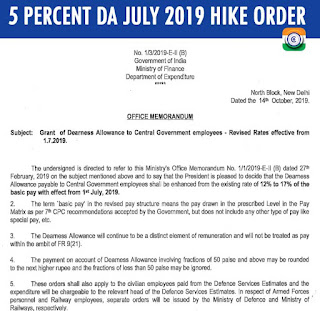
5 Percent DA July 2019 Hike Order - Grant of Dearness Allowance to Central Government employees

Grant of Dearness Allowance to Central Government employees 5 Percent DA July 2019 Hike Order  No. 1/3/2019-E- II (B) Government of...

Blog Archive

About The Author