A complete reference blog for Indian Government Employees

Showing posts with label RAJYA SABHA. Show all posts

Monday, 21 September 2020

NPS to OPS Contract for Old Pension Scheme – Rajya Sabha

NPS to OPS

Contract for Old Pension Scheme – Rajya Sabha

National Pension System (NPS) was introduced for Central Government employees by a Notification of Ministry of Finance (Department of Economic Affairs) dated 22nd December, 2003. NPS is mandatory for all new recruits to the Central Government service from 1st January, 2004 (except the armed forces). However, in some specific court cases, like WP(C) No. 3834/2013 titled Permanand Yadav Vs. Union of India and WP(C) No. 2810/2016 viz.Rajendra Singh Vs. Union of India, where the selection of candidates had been made before 01.01.2004 but their actual appointment in the Government service could be made on or after 01.01.2004 due to various reasons, on the direction of the Hon’ble High Court of Delhi, the benefit of Old Pension Scheme was allowed to the petitioners.

After considering all the relevant aspects and to extend the benefit to similarly placed Government servants in order to reduce further litigation, the Government has decided, vide an Office Memorandum No. 57/04/2019-P&PW(B) dated 17th February, 2020 of the Department of Pension & Pensioners’ Welfare, that in all cases where the results for recruitment were declared before 01.01.2004 against vacancies occurring on or before 31.12.2003, the candidates declared successful for recruitment shall be eligible for coverage under the Central Civil Services (Pension) Rules, 1972. Accordingly, such Government servants who were declared successful for recruitment in the results declared on or before 31.12.2003 against vacancies occurring before 01.01.2004 and covered under the National Pension System on joining service on or after 01.01.2004, may be given a one – time option to be covered under the Central Civil Services (Pension) Rules, 1972.

The advertisements issued before the introduction of the National Pension System may or may not have contained a clause regarding the pension scheme applicable to the selected candidates. In its order dated 27.03.2019 in W.P.(C) 10306/2016 – Union of India & others versus Dr. Narayan Rao Battu& another, Hon’ble High Court of Delhi observed that since the new pension scheme was in effect and a policy decision had already been taken to make the said scheme applicable to all incumbents joining government service on or after 01.01.2004, the Respondent, who was appointed on 25.02.2005, cannot claim the right to be covered by the old pension scheme, merely because the vacancy against which he was appointed was initially advertised at a time when the old pension scheme was in force. Hon’ble Court also observed that once the new pension scheme unambiguously and specifically provided that since all incoming office bearers, whose date of appointment is on or after 01.01.2004, would be governed by the new pension scheme, no reference can be made to either the date of vacancy, or the date of advertisement.

In view of the specific provisions of the Notification dated 22.12.2003, the date of advertisement for the vacancies or the date of examination for selection against those vacancies is not considered relevant for determining the eligibility for coverage under the Old Pension Scheme or the National Pension System. There is no proposal to revise the orders issued vide aforesaid Office Memorandum dated 17.02.2020.

This information was given by the Union Minister of State (Independent Charge), Development of North Eastern Region (DoNER), MoS PMO, Personnel, Public Grievances, Pensions, Atomic Energy and Space, Dr Jitendra Singh in a written reply in Rajya Sabha today.

Share:

Saturday, 10 August 2019

Retirement and death gratuity to Kendriya Vidyalaya Sangathan employees - Rajya Sabha Question & Answers

Retirement and death gratuity to Kendriya Vidyalaya Sangathan employees - Rajya Sabha Question & Answers

GOVERNMENT OF INDIA
MINISTRY OF HUMAN RESOURCE DEVELOPMENT
RAJYA SABHA

UNSTARRED QUESTION NO-3742
ANSWERED ON-25.07.2019

Retirement and death gratuity to KVS employees

3742 . Shri G.C. Chandrashekhar

(a) whether Government has extended the benefit of retirement and death gratuity to employees of autonomous bodies under the Central Government;

(b) if so, whether the Ministry has directed the Kendriya Vidyalaya Sangathan (KVS) for stoppage of retirement and death gratuity to the employees under the National Pension System (NPS);

(c) if so, the reasons therefor;

(d) the details of KVS employees benefitted so far;

(e) whether representations have been received from various stakeholders regarding restoration of the above benefit; and

(f) if so, the steps taken by Government in this regard?

ANSWER

MINISTER OF HUMAN RESOURCE DEVELOPMENT
(SHRI RAMESH POKHRIYAL ‘NISHANK’)

(a) Ministry of Human Resource Development (MHRD) has conveyed approval for revision of pension as per recommendation of the 7th CPC to the employees of Kendriya Vidyalaya Sangathan who retired after 1.1.2016 as well as revision of pension/family pension of those pensioners / family pensioners who retired prior to 1.1.2016. Several other autonomous bodies under the MHRD have also been extended these benefits on a case to case basis in consultation with Ministry of Finance.

(b) Yes, Sir.

(c) As per the Ministry of Finance, Department of Expenditure OM No. F. No. 1/1/2016-E.III(A) dated 13th January, 2017, the benefits implemented by Central Government in respect of Central Government employees (as part of their service conditions) are not directly applicable to the employees working in autonomous organizations. An advisory had accordingly been issued on 12.4.2017 that in case the benefits of retirement gratuity and death gratuity have been extended to the employees of any autonomous bodies / organisations covered under NPS, the same may be withdrawn till a final decision is taken in the matter with the approval of Department of Expenditure.

(d)to (f): Do not arise.
*****

Source: Rajya Sabha
Share:

Wednesday, 7 August 2019

PENSIONARY BENEFITS UNDER NPS ON VOLUNTARY RETIREMENT

PENSIONARY BENEFITS UNDER NPS ON VOLUNTARY RETIREMENT

GOVERNMENT OF INDIA
MINISTRY OF FINANCE
DEPARTMENT OF FINANCIAL SERVICES
RAJYA SABHA
UNSTARRED QUESTION NO.3404
ANSWERED ON JULY 23, 2019/
SHRAVANA 1, 1941 (SAKA)

PENSIONARY BENEFITS UNDER NPS ON VOLUNTARY RETIREMENT
  1. Shri Ravi Prakash Verma
Will the Minister of FINANCE be pleased to state:
(a) whether voluntary retirement is allowed to employees of Central Government covered under NPS after completion of 20 years of service on the lines of old pension scheme;
(b) if so, the details thereof;
(c) the details of pensionary benefits and other retirement benefits available/ allowed under NPS to employees who voluntarily retire;
(d) whether Government would increase its contribution to 20 per cent from 14 per cent under NPS in view of dismal returns on NPS fund to make it more attractive;
(e) if so, the details thereof; and
(f) if not, the reasons therefor?

ANSWER

The Minister of State (Finance) (Shri Anurag Singh Thakur)

(a) and (b) The features and benefits under National Pension System (NPS) and the old pension scheme are independent. Under NPS, there is a provision for voluntary retirement/exit prior to the age of superannuation, without linking it with the minimum number of 20 years of service.
(c) As per Pension Fund Regulatory and Development Authority (Exits and Withdrawals under the National Pension System) Regulations, 2015, and amendments there under, the provisions for voluntary retirement/exit and the benefits available/ allowed under NPS to employees of Central Government who voluntary retires are as follows:

"3(b) where the subscriber who, before attaining the age of superannuation prescribed by the service rules applicable to him or her, voluntarily retires or exits, then at least eighty per cent out of the accumulated pension wealth of the subscriber shall mandatorily be utilized for purchase of annuity and the balance of the accumulated pension wealth, after such utilization, shall be paid to the subscriber in lump sum or he shall have a choice to collect such remaining pension wealth in accordance with the other options specified by the Authority from time to time, in the interest of the subscribers”

Further, as informed by the Department of Pension and Pensioners’ Welfare, the benefit of retirement gratuity and death gratuity has been extended to Government employees covered under NPS on the same terms and conditions as are applicable under CCS (Pension) Rules, 1972.

(d) to (f) Recently, vide Gazette Notification dated 31.01.2019, the mandatory contribution by the Central Government for its employees covered under NPS Tier-I has been enhanced from the existing 10% of basic pay +DA to 14% of basic pay + DA. The employees’ contribution rate would remain at the existing 10% of basic pay + DA. There is no proposal to increase the contribution to 20 per cent from 14 per cent under NPS.

Source: Rajya Sabha
Share:

Friday, 26 July 2019

Rajya Sabha Q&A : Re-fixation of pension under One Rank One Pension

Rajya Sabha Q&A : Re-fixation of pension under One Rank One Pension

GOVERNMENT OF INDIA
MINISTRY OF DEFENCE
RAJYA SABHA
QUESTION NO 2382
ANSWERED ON 15.07.2019

Re fixation of pension under OROP

2382 Shri Rajeev Chandrasekhar

Will the Minister of DEFENCE be pleased to state :-

(a) whether Government is aware of the letter from Controller General of Defence Accounts (CGDA) dated 5th April, 2019 that seeks clarification on Notification 12(1)2014/D(Pen/Pol)-Part II dated 7th November, 2015 on re-fixation of pension under One Rank One Pension (OROP);

(b) steps taken by Government on the queries raised in the letter from CGDA; and

(c) whether Government will implement re-fixation of pension under OROP on 1st July, 2019 as per notification dated 7th November, 2015?

ANSWER

MINISTER OF STATE IN THE MINISTRY OF DEFENCE
SHRI SHRIPAD NAIK

(a) Yes, Sir.

(b) & (c): Ministry of Defence, Department of Ex-Servicemen Welfare vide Order No.1(1)2019/D(Pen/Pol) dated 14.06.2019 has constituted a Committee under the Chairmanship of Controller General of Defence Accounts (CGDA) to work out the modalities & methodology of implementation of next revision of pension under One Rank One Pension (OROP). The composition of the Committee is as under:-

(i) CGDA : Chairperson
(ii) Joint Secretary (ESW) : Member
(iii) Addl FA, Defence (Finance) : Member
(iv) Representative of three Services: Member
(v) Addl CGDA : Member
(vi) PCDA (P), Allahabad : Member
(vii) Joint CGDA (Pension) : Member & Convener

*****

Source: Rajyasabha
Share:

Reduction in number of vacancies in various departments of the central government

Reduction in number of vacancies in various departments of the central government

The government on Thursday told the Rajya Sabha that there has been a reduction in number of vacancies in various departments of the central government.

Replying to supplementaries during Question Hour, Minister of State for Personnel, Public Grievances and Pensions Jitendra Singh said filling up of vacancies in the government was a continuous process and efforts were being made to reduce them further.

“The government is already working in this direction. If you go by the vacancy figures, the percentage of the vacancy strength has been constantly reducing over the past five to six years.

“When this government came in, in the year 2013-14, ending March 31, 2014 before the government took over, the vacancy percentage was 16.2 per cent. The successive year it is 11.57 per cent. Then in 2015-16 it is 11.52 per cent, then in 2016-17 it is 11.36 per cent. In fact, the record is better in the central government than many of the states,” he said.

Singh said the record in the central government was far better than Karnataka where he said it had gone down from 27.3 per cent in 2014-15 to 32.56 per cent in 2018-19.

He also informed the House that steps to fill up almost 4 lakh vacancies in central government departments was underway and would be filled up by 2020.

The minister also pointed out that the Congress had claimed in its manifesto for the recent Lok Sabha polls that it will fill up the 4 lakh vacancies in the central government departments and the PSUs.

But, he said, the party did not mention that the process for filling up the vacancies had already started during the last NDA regime.

Singh said there is a total vacancy of 6,83,823 in all departments of central government, out of which almost half 3,89,069, almost 4 lakh, were already in the process of being filled up in the beginning of the year.

“All of 4 lakh vacancies in central government and PSUs, judiciary and Parliament will be filled up before March 2020.

But the catch is that the process of filling the vacancies had already been in the process. So we are already pro-active in filling up of vacancies,” the minister said.

In his written reply, the minister said vacancies in Central Government Ministries/Departments, their attached and subordinate offices arise due to retirement, resignation, voluntary retirement, promotion, transfer, transfer on deputation, termination of service, dismissal from service, death etc.

Based on the vacancies reported by the user Departments, the SSC has started recruitment process to fill up 1,05, 338 posts during the year 2019 and 2020, the minister said.

“During 2017-18, the Centralised Employment Notifications (CENs) for 1,27,573 combined vacancies of various Group C and Level-1 posts were notified by the Ministry of Railways For new and future vacancies to arise in two years time, another five CENs covering 1,56,138 vacancies of various Group C and Level-1 posts have been issued in 2018-19.

“Thus, recruitment process to fill up 3,89,069 vacancies has already started,” the minister said.

To reduce the recruitment cycle, some recruiting agencies have switched over to computer based on-line test and interview for non-gazetted posts has been discontinued, he said in a written reply.

The minister also said provisional appointment is being made pending verification of antecedents of the candidates.

PTI
Share:

Friday, 19 July 2019

Rules for filing IPRs - Rajya Sabha question


Ministry of Personnel, Public Grievances & Pensions
Rules for filing IPRs
18 JUL 2019
In terms of Rule 18 of the Central Civil Services (Conduct) Rules, 1964, Immovable Property Returns (IPRs) are required to be submitted by all Government servants on their first appointment to any service or post and subsequently to be submitted annually. Similar provisions are also available in All India Services (Conduct) Rules, 1968.

Department of Personnel & Training (DoPT) being the cadre controlling authority for Indian Administrative Service (IAS), Central Secretariat Service (CSS) and Central Secretariat Stenographers Service (CSSS) maintains the data in respect of officers belonging to these services. As per information in respect of these officers, IPRs for the year 2018, have not been filed by 52 IAS officers of the level of Joint Secretary & above, 163 CSS officers of the level of Under Secretary & above and 51 CSSS officers of the level of Principal Private Secretary & above.

DoPT, vide O.M. No. 104/33/2005-AVD-I dated 7.09.2011 and O.M. No. 11012/11/2007-Estt.(A) dated 27.09.2011, has prescribed that vigilance clearance shall be denied to the officers of All India Services and Central Civil Services/ Posts for certain purposes if they fail to submit their annual Immovable Property Returns of the previous year latest by 31st January of the following year.

This information was provided by the Union Minister of State (Independent Charge) Development of North-Eastern Region (DoNER), MoS PMO, Personnel, Public Grievances & Pensions, Atomic Energy and Space, Dr Jitendra Singh in written reply to a question in Rajya Sabha today.

PIB
Share:

Monday, 15 July 2019

Promotion of Sports among Female Students

Promotion of Sports among Female Students

Ministry of Youth Affairs and Sports
Promotion of Sports among Female Students

Posted On: 15 JUL 2019

Khelo India Scheme inter-alia provides for bridging gaps in sports infrastructure. Sports Authority of India (SAI) also implements the Schemes of National Sports Talent Contest (NSTC) and Extension Centres of SAI Training Centres (STC)/Special Area Games (SAG) Centres with the aim of promoting sports. These schemes are applicable for all, including girls schools and colleges. In financial year 2018-19 this Ministry spent Rs. 1297.39 crore for sports development details of which are as below:-

  1.     Scheme: Development in sports Institutions Expenditure (Rs. in crore): 483.83
  2.     Scheme: Encouragement and Awards to Sportsperson Expenditure (Rs. in crore): 312.32
  3.     Scheme: Khelo India – National Programme for Development of Sports Expenditure (Rs. in crore): 501.24

“Sports” being a State subject the responsibility of development Sports, including among girls in schools and colleges across the country rests with the State / Union Territory (UT) Governments. Government of India supplements the efforts of State / UT Governments by providing financial assistance through National Sports Federations, training in Sports Authority of India (SAI) Centres and support under Khelo India Scheme.

This information was given by the Minister of State (I/C) Shri Kiren Rijiju in a written reply in the Rajya Sabha today.

PIB
Share:

Friday, 28 June 2019

Special orders of the appropriate authority pro forma officiating promotion grade - Rajya Sabha


Special orders of the appropriate authority pro forma officiating promotion grade - Rajya Sabha
Ministry of Personnel, Public Grievances & Pensions
Proforma Promotion Under NBR
27 JUN 2019
When an officer in a post (Whether within the cadre of his service or not) is for any reason prevented from officiating in his turn in a post on higher scale or grade borne on the cadre of the service to which he belongs, he may be authorized by special orders of the appropriate authority pro forma officiating promotion into such scale or grade and thereupon be granted the pay of that scale or grade, if that be more advantageous to him, on each occasion on which the officer immediately junior to him in the cadre of his service (or if that officer has been passed over by reason of inefficiency or unsuitability or because he is on leave or serving outside the ordinary line or forgoes officiating promotion of his own volition to that scale or grade, then the officer next junior to him not so passed over) draws officiating pay in that scale or grade.

Proforma Promotion is granted subject to fulfillment of certain conditions under the relevant instructions issued from time to time keeping in view the vacancy position.

To obviate the hardship caused in cases where all the seniors of the officer outside the line are promoted and there is no junior officer eligible for promotion within the cadre despite clear regular vacancies available for making promotions, the benefit of 'Next Below Rule' is allowed to the officers working outside their regular line in dispensation of the requirements of `one for one' and 'promotion of atleast one junior', subject to the fulfillment of the following further conditions: (a) that a post within the cadre remains unfilled for want of an approved person junior to the officer; and (b) the vacancy caused in the cadre is not filled up by making promotion on ad-hoc basis till the release of the next panel when some juniors become eligible for promotion. OM No. 8/4/84-Estt (Pay-I) dated 15th July, 1985, issued in this regard is still in force.

This information was provided by the Union Minister of State (Independent Charge) Development of North-Eastern Region (DoNER), MoS PMO, Personnel, Public Grievances & Pensions, Atomic Energy and Space, Dr Jitendra Singh in written reply to a question in Rajya Sabha today.

PIB
Share:

Thursday, 27 June 2019

Government of India extends bank loans to Economically Weaker Section (EWS) under various Schemes

EWS

Bank loans to Economically Weaker Section under various Schemes

Ministry of Finance
The Government of India extends bank loans to Economically Weaker Section (EWS) under various Schemes.
25 JUN 2019
In terms of Reserve Bank of India (RBI) Guidelines on Priority Sector Lending (PSL), a target of 40 percent of Adjusted Net Bank Credit (ANBC) or Credit Equivalent amount of Off-Balance Sheet Exposures (OBE), whichever is higher, as of preceding March 31st, has been mandated for lending to the priority sector by domestic Scheduled Commercial Banks and Foreign Banks with 20 branches and above. Within this, sub-targets of 10 and 18 percent of ANBC or Credit Equivalent amount of OBE, whichever is higher, as of preceding March 31st, have been mandated for lending to weaker sections and Agriculture respectively. Further, within the 18 percent target for agriculture, a sub-target of 8 percent of ANBC or OBE, whichever is higher has been prescribed for Small and Marginal Farmers.

As per RBI’s notification dated 19.06.2018 loans to individuals up to Rs. 28 lakh in metropolitan centre and Rs. 20 lakh in other centres, are eligible to be classified under priority sector, provided that the cost of dwelling unit does not exceed Rs. 35 lakh and Rs. 25 lakh, respectively. To give a fillip to low-cost housing for the Economically Weaker Sections (EWS) and Low Income Groups (LIG), the housing loan limits for eligibility under priority sector lending have been revised to Rs. 35 lakh in metropolitan centres, and Rs. 25 lakh in other centres with certain conditions. Further, there is provision of loan for construction of house for EWS and LIG wherein the total cost of house does not exceed Rs 10 lakh provided the family income limit is Rs.2 lakh per annum. This income criteria has been revised to Rs. 3 lakh per annum for EWS and Rs. 6 lakh per annum for LIG.

The Government of India extends bank loans to Economically Weaker Section (EWS) under various schemes. Some of the schemes of Government for EWS are as under:

In pursuance of the Government vision of facilitating housing to all by 2022 Government has launched Pradhan Mantri Awas Yojana – Urban (PMAY-U) mission on 25.06.2015. The mission aims to provide assistance to all States/ UTs in addressing the housing requirement of urban poor including EWS/ LIG.

Under the Credit Linked Subsidy Scheme (CLSS) for EWS/ LIG component of PMAY-U an interest subsidy of 6.5% for EWS / LIG, calculated on Housing Loan up to Rs. 6 lakh over a tenure of 20 years is provided by the Government.

III. All Scheduled Commercial Banks have adopted and implemented the IBA Model Educational Loan Scheme for pursuing higher education in India and abroad. The scheme is applicable uniformly to all students’ borrowers including students belonging to weaker sections. However, for the students belonging to EWS whose parental/family income is upto Rs 4.50 Lakh, an Interest Subsidy Scheme, namely Central Sector Interest Subsidy Scheme (CSIS), is operational under which full interest subsidy, on educational loans upto Rs 7.50 lakh, is available during the period of moratorium on loans availed under the Indian Banks' Association (IBA) Model Education Loan Scheme from Scheduled Banks. CSIS scheme benefits all categories of economically weaker students for pursuing professional/ technical courses in lndia and intends to provide affordable higher education.

This was stated by the Union Minister of Finance & Corporate Affairs, Smt. Nirmala Sitharamanin a written reply to a Parliament Question in Rajya Sabha today.

PIB
Share:

Tuesday, 25 June 2019

Pandit Deendayal Upadhyay National Welfare Fund for Sportspersons

RAJYA SABHA

Pandit Deendayal Upadhyay National Welfare Fund for Sportspersons

GOVERNMENT OF INDIA
MINISTRY OF YOUTH AFFAIRS AND SPORTS
RAJYA SABHA
UNSTARRED QUESTION NO-292
ANSWERED ON-24.06.2019

Pandit Deendayal Upadhyay National Welfare Fund for Sportspersons

292 . Dr. Banda Prakash
Will the Minister of Youth Affairs & Sports be pleased to state the details of funds released/ utilized/ disbursed/ sanctioned under the scheme ‘Pandit Deendayal Upadhyay National Welfare Fund for Sportspersons’ to provide for lump sum financial assistance for medical treatment to outstanding sportspersons now living in indigent circumstances, State/ UT-wise?

ANSWER
THE MINISTER OF STATE (INDEPENDENT CHARGE)
FOR YOUTH AFFAIRS AND SPORTS
[KIREN RIJIJU]

The details of the funds sanctioned under the scheme ‘Pandit Deendayal Upadhyay National Welfare Fund for Sportspersons’ for medical treatment of sportspersons during 2017-18, 2018-19 and 2019-20 (as on 20.6.2019), State/UT-wise are given in Annexure.

Source: RAJYA SABHA
Share:

Wednesday, 9 January 2019

10% reservation bill for general category poor - Government introduces Constitution Amendment Bill in Rajya Sabha


10% reservation bill for general category poor - Government introduces Constitution Amendment Bill in Rajya Sabha
Prime Minister's Office


Amendment-Bill-2019-GoI

10% reservation bill for general category poor is a historic step and a reflection of Government's commitment for the poor, says PM

PM assures people of Assam and North East that their rights will be protected

Government's drive against corruption and middlemen will continue: PM

PM dedicates Four lane Section of Solapur-Tuljapur-Osmanabad Highway- New NH-52: to the nation

Solapur-Osmanabad via Tuljapur rail line approved: PM

30,000 houses for poor to be built under Pradhan Mantri Awas Yojana in Solapur


09 JAN 2019
The Prime Minister has said that the constitutional amendment bill providing 10% reservation for general category poor is a historic step for the uplift of the poor and a reflection of the Government’s commitment to Sabka Saath, Sabka Vikas. Addressing a public rally in Solapur, Maharashtra today, he said that the passage of the bill by Loksabha is a strong answer to those who were spreading falsehood in this regard and expressed hope that the bill will be passed by Rajya Sabha. The Prime Minster said, "We have passed a historic bill to provide 10% reservation to Economically Weaker Sections of the General Category in Lok Sabha yesterday. This has strengthened our resolve of Sab Ka Saath Sabka Vikas"

On the Citizenship Amendment Bill, the Prime Minister assured the people of Assam and North East that their rights and opportunities will be protected. He said, "the bill has cleared the decks for grant of Indian citizenship to the sons and daughters of Mother India residing in Pakistan, Bangladesh and Afghanistan. After seeing the ups and downs of history, these brothers and sisters of ours want to be a part and parcel of India."

The Prime Minister said that his Government's drive against corruption and middlemen will continue unabated despite the diatribes against him. He said that he was performing his duty courageously in the fight against corruption and middlemen backed by the support and the blessings of the people..
The Prime Minister was addressing a public rally at Indira Gandhi Stadium in Solapur after launching and laying down foundation stones of several development projects for the region.Prime Minister laid the foundation Stone of 30,000 houses under Pradhan Mantri Awas Yojana. These will primarily benefit poor homeless people like rag pickers, rickshaw drivers, textile workers, beedi workers, etc at a total cost of Rs.1811.33 crores. He said," Today, we have inaugurated a project of 30000 homes meant for the family of poor, labourers. The beneficiaries of this project are those who work in factories, pull rickshaws, drive auto, etc. I ensure you that very soon you will have the keys of your home in your hands." The Prime Minister added that efforts have been made to make housing affordable for the middle class families. Now they can save up to Rs. 6 lakhs on home loans over a period of 20 years which is a reflection of the measures undertaken by the Government for Ease of Living.

In keeping with his commitment that he inaugurates the projects for which foundation stone is laid by him, the Prime Minister dedicated to the nation, 98.717 kms long stretch of the New NH-52 which will help improve the connectivity of Solapur, with the important Marathwada region of Maharashtra.NH-52 is now a four laned section of Solapur - Tuljapur - OsmanabadHighway at an estimated cost of Rs.972.50 crores.PM had laid the foundation for this project in 2014. NH-52 has road safety features like 2 major and 17 minor bridges, 4 vehicular and 10 pedestrian underpasses, besides one 3.4 km bypass at Tuljapur that will help decongest the city.

Highlighting the Government's vision for expansion of highways for better connectivity and ease of living, the Prime Minister said, "Over the past 4 years, nearly 40 thousand kilometers of national highways have been added; at a cost of around 5.5 lakh crore around 52 thousand kilometers of national highways are under construction.":

Announcing a boost to rail connectivity for the region, the Prime Minister said, the government has approved Solapur-Osmanabad via Tuljapur rail line, at an estimated cost of Rs. 1000 crores. He added that efforts are on to start flights from Solapur under the Regional Air connectivity scheme- Udan Yojana.

As a part of his vision of Swachh Bharat and Swastha Bharat, the Prime Minister dedicated to the nation Underground Sewerage System, and three Sewage Treatment Plants in Solapur. This will increase the sewer coverage of the town and improve sanitation in the city.

The Prime Minister also laid the foundation stone of the Combined Project of Improvement in Water Supply and Sewerage System, as part of Area Based Development in Solapur Smart City, Augmentation of Drinking Water Supply from Ujani Dam to Solapur City and Underground Sewerage System under AMRUT Mission. It will bring significant improvement in service delivery and improve public health enabled by technology as a means to create smart outcomes for citizens.
It is expected that these measures will go a long way towards giving a major push to road and transport connectivity, water supply, sanitation, employment generation etc. for the people in Solapur and the adjoining areas.

PIB
Share:

Saturday, 5 January 2019

Categories of Reservation Quotas in Indian Railways

Types of Reservation Quotas in Indian Railways

Ministry of Railways
Categories of Reservation Quotas in Indian Railways

With a view to cater to requirements of different categories of passengers served by Indian Railways, available reserved accommodation is distributed broadly under following types of reservation quotas:

S.NO.QUOTAAVAILABLE FOR
1.GeneralGeneral Public
2.TatkalGeneral Public
3.Premium TatkalGeneral Public
4.Parliament HouseHon’ble Members of Parliament (Sitting and Former)
5.LadiesFemale passenger travelling alone or in a group of female passengers
6.Senior CitizenCombined quota for senior citizens, female passengers above 45 years & pregnant women
7.Foreign TouristForeigners
8.DefenceDefence Personnel
9.RoadsideGeneral Public
10.PooledGeneral Public
11.Cancer PatientCancer Patients
12.RAC(Reservation Against Cancellation)General Public
13.Physically HandicappedDivyangjan
14.Duty PassServing/retired Railway employees travelling on Duty/Privilege/Post retirement complimentary passes etc. in specified trains
15.Railway EmployeesDesignated Railway employees travelling on Duty in trains
16.YuvaUnemployed persons between the age of 15 & 45
17.EmergencyUrgent travel requirement of High Official Requisition (HOR) holders, Members of Parliament, and general public

While booking reserved tickets through the website of Indian Railway Catering & Tourism Corporation(IRCTC), passengers can book tickets under General Quota, Ladies Quota, Foreign Tourist Quota, Premium Tatkal Quota, Tatkal Quota, Senior Citizen Quota, and Physically Handicapped (Divyangjan) Quota. In addition to the above quotas, accommodation can also be allotted under Reservation Against Cancellation(RAC) & Pooled Quota while booking reserved tickets through website of IRCTC. These reservation quotas constitute approximately 94% of total reserved accommodation available on Indian Railways, which can be booked both through internet as well as through computerised Passenger Reservation System (PRS) of Indian Railways.

To avoid any misuse, this facility is generally not extended for those quotas which require prior physical verification of documents. However, recently this facility has been extended to persons with disability, Press correspondents and Defence Personnel. Extension of such facilities to different categories of passengers is a continuous and ongoing exercise.

This information was given by the Minister of State of Railways, Shri Rajen Gohain in a written reply to a question in Rajya Sabha today.

Source: PIB
Share:

Friday, 4 January 2019

Central Government employees - Withdrawal of Pension Facility

Central Government employees - Withdrawal of Pension Facility

Central Government employees - Withdrawal of Pension Facility

Ministry of Personnel, Public Grievances & Pensions

Withdrawal of Pension Facility
03 JAN 2019
Information regarding the number of Central Government employees in the country is not maintained centrally in this Ministry. As per information provided by Department of Expenditure, the total number of Central Government civilian employees, as on 01.03.2016, was 32, 21,183
Total number of Central Government civil pensioners, as on 31.03.2018, is 37, 02,882.

Central Government employees (except Armed Forces personnel) appointed on or after 01.01.2004 are covered under the National Pension System (NPS) notified vide Ministry of Finance (Department of Economic Affair's) Notification No. 5/7/2003-ECB & PR dated 22.12.2003 and Section 20 of PFRDA Act, 2013. Such employees are, therefore, not covered by the Central Civil Services (Pension) Rule, 1972, which are allocable to Central Government civil employees appointed on or before 31.12.2003.

Under NPS a monthly contribution of 10 percent of basic pay plus dearness allowance is required to be made by the employees and a matching contribution is made by the Government. It has since been decided to increase the Government contribution to 14 percent of basic pay and dearness allowance.
On superannuation/retirement, at least 40% of the accumulated pension wealth of such subscriber is mandatorily utilized for purchase of annuity providing for a monthly or any other periodical pension and the balance of the accumulated pension wealth after such utilization is paid to the subscriber in lump sum.

In the event of death of a Government servant of his discharge from service on account of disability or invalidation on medical grounds, the benefit of Central Civil Services (Pension) Rules, 1972 are available to the Government employees of his family members.
Central Government employees covered under NPS are eligible for the benefit of retirement gratuity and death gratuity on the same terms and conditions as are applicable under Central Civil Services (Pension) Rules, 1972.

NPS employees are also eligible for other post-retirement benefits such as leave encashment, group insurance, medical facility, etc., as are applicable to employees appointed before 01.01.2014.
This information was provided by the Union Minister of State (Independent Charge) Development of North-Eastern Region (DoNER), MoS PMO, Personnel, Public Grievances & Pensions, Atomic Energy and Space, Dr Jitendra Singh in written reply to a question in Rajya Sabha today.

PIB
Share:

Wednesday, 2 January 2019

Payment to Contractual Labour through Cheque


Ministry of Labour & Employment
Payment to Contractual Labour through Cheque
02 JAN 2019
The Payment of Wages Act, 1936 has been amended by Payment of Wages (Amendment) Act, 2017 (effective from 28.12.2016) to enable the employers to pay wages to their employees by (a) cash or (b) cheque or (c) crediting to their bank account. The amendment in the Act also enables the appropriate Government to specify the industrial or other establishment, by notification in the Official Gazette, which shall pay to every person employed in such industrial or other establishment, the wages only by cheque or by crediting in his bank account.

Provision for making of payment only by cheque or by crediting in bank account of an employee, in respect of industrial or other establishment in the Central Sphere has been notified on 26.04.2017.
As per information received from the Government of Madhya Pradesh, contract labour are paid through Bank at thermal power station, Chachai in Amarkantak in the district Anuppur, Madhya Pradesh.

This information was given by Shri Santosh Kumar Gangwar, Minister of State (I/C) for Labour and Employment in written reply to a question in Rajya Sabha today.

PIB
Share:

Scheme to partially reimburse employers for Maternity Benefits


Ministry of Labour & Employment
Scheme to partially reimburse employers for Maternity Benefits
Maternity-Benefits-cg-employees
02 JAN 2019
Government is working on an Incentive Scheme wherein seven weeks wages shall be reimbursed to employers who employ women workers and provide the maternity benefit of 26 weeks paid leave, as provided for in the Maternity Benefit (Amendment) Act, 2017.

To enable an entity to avail of the incentive, the women employees working in their entity should be a wage earner of less than Rs.15,000/- per month and a member of Employees’ Provident Fund Organization (EPFO) for at least one year and not covered by Employees’ State Insurance Corporation (ESIC).

A meeting of Stakeholders' Consultation with representatives of concerned Central Ministries, State Governments, Employers', Employees' etc. was held on 14.11.2018 to discuss the matter. The Scheme was supported by and large with the majority of stakeholders.

The scheme is proposed to be administered after obtaining the approval of the competent authorities. The Incentive is proposed to be funded from the budgetary allocations. Government has not made any allocation for the scheme during the current financial year.

This information was given by Shri Santosh Kumar Gangwar, Minister of State (I/C) for Labour and Employment in written reply to a question in Rajya Sabha today.

PIB
Share:

Monday, 31 December 2018

Promotion of sports among rural youth - PIB


Ministry of Youth Affairs and Sports
Promotion of sports among rural youth
31 DEC 2018
'Sports' is a State subject and promotion of sports in the country, including promotion of Sports among rural youth is primarily the responsibility of the State Governments and the National Sports Federations (NSFs) concerned. The Central Government complements/supplements the efforts of the State Governments and the NSFs. Government is already running several schemes to increase participation of the rural youth in sports.

The Khelo India Scheme implemented by the Ministry of Youth Affairs and Sports provides for promotion of sports among entire population including rural youth. Also, the scheme has a dedicated vertical, viz., Promotion of rural and indigenous/tribal games which provides for financial assistance to NSFs / Non Government Organizations (NGOs) etc for promotion of sports in the country including rural areas. Under this vertical, various NSFs have been provided financial assistance to hold competitions in various parts of the country including those in rural areas. During the period from January to October 2018, a total number of 36 such competitions / exhibition events had been held.

Sports Authority of India (SAI), an autonomous organization under the aegis of the Ministry of Youth Affairs & Sports, is implementing following sports promotional schemes across the country to identify talented sports persons in the age group of 8-25 years and nurture them to excel at national and international competitions:
  • National Sports Talent Contest Scheme (NSTC)
  • Army Boys Sports Company (ABSC)
  • SAI Training Centre (STC)
  • Special Area Games (SAG)
  • Extension Centre of STC/SAG
  • Centre of Excellence (COE)
  • National Sports Academies (NSA)
Many of the sports persons identified under SAI Sports Promotional Schemes belong to the rural, tribal, backward, coastal and inaccessible hilly areas of the country and are provided with training facilities in the form of expert sports coaches, requisite playing facilities, boarding & lodging, sports kit, competition exposure, educational expenses, medical/insurance and stipend as per the approved norms.

In addition, Nehru Yuva Kendra Sangathan (NYKS), an autonomous organization under aegis of Ministry of Youth Affairs & Sports, undertakes programmes such as Block and District level Sports Meets, providing sports material to Youth Clubs etc., for popularizing and encouraging sports and develop competitive spirit among youth including rural youth. During 2017-18, a total 2965 Block level sports meets and 556 District level sports meets were conducted by NYKS.

The Government does not have any proposal for starting programme in addition to already existing programmes to increase participation of the rural youth in sports.

This information was given by Minister of State (Independent Charge) for Youth Affairs and Sports Col. Rajyavardhan Rathore (Retd.) in a written reply to the Rajya Sabha today.

PIB
Share:

Thursday, 20 December 2018

7th Pay Commission Fitment Factor and House Rent Allowance - No Change Therein is Envisaged


7th Pay Commission Fitment Factor and House Rent Allowance - No Change Therein is Envisaged

7th CPC Fitment and HRA - No Change Therein is Envisaged
In written reply to a question in Rajya Sabha on 11th December 2018 , Minister of State for Finance Shri P.Radhakrishnan said no change in 7th CPC Fitment Factor and House Rent Allowance.

Increase in Pay Fitment Factor and HRA
"The fitment factor for the purpose of fixation of pay in the revised pay structure based on the recommendations of the 7th Central Pay Commission is 2.57 which is uniformly applicable to all categories of employees. As the same is based on the specific and considered recommendations of the 7th Central Pay Commission, no change therein is envisaged.

The Government vide Resolution dated 6th July, 2017 decided that HRA shall be revised to 27%, 18% and 9% of Basic Pay in X, Y and Z cities when Dearness Allowance (DA) crosses 25% and further to 30%, 20% and 10% of Basic Pay in X,Y and Z cities when DA crosses 50%."

Current Rates of House Rent Allowance for CG Employees
7TH CPC HRA RATES W.E.F. 1.7.2017
City ClassificationHRA Rates
'X' Cities24% of Basic Pay
'Y' Cities16% of Basic Pay
'Z' Cities8% of Basic Pay
Share:

Tuesday, 14 August 2018

Increase of fitment factor from 2.57 to 3.68 under 7th CPC - Latest official statement before PM's Independence Day speech


Increase of fitment factor from 2.57 to 3.68 under 7th CPC - Latest official statement before PM's Independence Day speech

GOVERNMENT OF INDIA
MINISTRY OF FINANCE
RAJYA SABHA
UNSTARRED QUESTION NO-2273
ANSWERED ON-07.08.2018

Increase of fitment factor under 7th CPC

2273 . Shri Ravi Prakash Verma
Shri Neeraj Shekhar
(a) whether Government is contemplating to increase fitment factor from 2.57 to 3.68 under 7th CPC to all pay levels, as demanded by employees associations;
(b) if so, the details thereof and by when it would be announced; and
(c) if not, the reasons for betrayal from assurances given by Home Minister and Railway Minister etc. to employees associations in 2016?

ANSWER
MINISTER OF STATE IN THE MINISTRY OF FINANCE
(SHRI P. RADHAKRISHNAN)
(a) to (c): The Minimum Pay of Rs. 18,000 p.m. and Fitment Factor of 2.57 are based on the specific recommendations of the 7th Central Pay Commission in the light of the relevant factors taken into account by it. Therefore, no change therein is at present under consideration.

Source: Rajya Sabha
Share:

Saturday, 28 July 2018

Wages of daily wagers, casual workers, temporary workers, ad-hoc appointees, contractual employees etc


Wages of daily wagers, casual workers, temporary workers, ad-hoc appointees, contractual employees etc

Wages of contractual employees

The Central and the State Government departments and agencies, on the basis of manpower requirement therein, engage various sets of workmen other than permanent employees viz. daily wagers, casual workers, temporary workers, ad-hoc appointees, contractual employees etc which are engaged by an establishment directly or through contractors. The wages, terms & conditions of service and the period of engagement of such workers in an establishment varies from establishment to establishment. Data in this regard is not centrally maintained.

The principle of "equal pay for equal work" was examined by the Hon'ble Supreme Court in the civil appeal number 213 of 2013. The issue before the Hon'ble Supreme Court was that:

"…..whether temporarily engaged employees (daily-wage employees, ad- appointees, employees appointed on casual basis, contractual employees and the like), are entitled to minimum of the regular pay-scale, alongwith dearness allowance (as revised from time to time) on account of their performing the same duties, which are discharged by those engaged on regular basis, against sanctioned posts…."

The Hon'ble Supreme Court held that:
"….There can be no doubt, that the principle of ‘equal pay for equal work' would be applicable to all the concerned temporary employees, so as to vest in them the right to claim wages, at par with the minimum of the pay-scale of regularly engaged Government employees, holding the same post…."
It is mandatory for the employer/principal employer to comply with the various statutory provisions/Court Orders/Government Instructions including instructions on wage related issues of various categories of employees and apply the principle laid down by the Hon'ble Supreme Court regarding "equal pay for equal work" while paying wages to its workers/labourers.

The instructions regarding equal pay admissible to casual workers already exists in terms of Department of Personnel & Training (DoPT) O.M. No. 49014/2/86 Estt. (c) dated 07.06.1988.
In so far as the contract labour is concerned, the Contract Labour (Regulation & Abolition) Central Rules, 1971 provides for wage parity as stipulated in rule 25(2)(v)(a) which is reproduced below:
"in cases where the workmen employed by the contractor perform the same or similar kind of work as the workmen directly employed by the principal employer of the establishment, the wage rates, holidays, hours of work and other conditions of service of the workmen of the contractor shall be the same as applicable to the workmen directly employed by the principal employer of the establishment on the same or similar kind of work….."

In order to ensure compliance of labour laws and in this regard, there is separate enforcement machinery available in the Central and the State Sphere to which an aggrieved worker can approach for redressal of its grievances.

In the Central sphere there is a well-established Central Industrial Relations Machinery (CIRM) having country-wide network of Dy. Chief Labour Commissioners (Central) and Regional Labour Commissioners (Central) under the control of the Chief Labour Commissioner (Central) for enforcement of labour laws and redressal of grievances/settlement of claims arising out of labour disputes.

The above statement was submitted by the Ministry of Labour and Employment in Rajya Sabha in reply of undermentioned question:-
GOVERNMENT OF INDIA
MINISTRY OF LABOUR AND EMPLOYMENT
RAJYA SABHA
STARRED QUESTION NO-83
ANSWERED ON-25.07.2018

Wages of contractual employees

83 . Shri Sanjay Raut
(a) whether it is a fact that there are lakhs of contractual employees working in Government Departments and agencies who are getting lesser wages than permanent employees;
(b) if so, Government''s respose thereto;
(c) whether Supreme Court in its judgement, in the year 2016, has ordered that temporary workers are entitled to get wages at par with permanent employees;
(d) if so, Government''s reaction thereto; and
(e) whether the Ministry of Law and Justice has advised the various Ministries and Departments to abide by the SC judgement?

ANSWER

MINISTER OF STATE (IC) FOR LABOUR AND EMPLOYMENT
(SHRI SANTOSH KUMAR GANGWAR)

(a) to (e): A Statement is laid on the Table of the House.
*******
STATEMENT REFERRED TO IN REPLY TO PART (a) to (e) OF THE RAJYA SABHA STARRED QUESTION NO. *83 FOR 25.07.2018 BY SHRI SANJAY RAUT REGARDING WAGES OF CONTRACTUAL EMPLOYEES.
******
(a) to (e):
- as above -

Source:RAJYA SABHA
Share:

Saturday, 17 February 2018

Loco Running Staff - Rajya Sabha Q&A


Loco Running Staff - Rajya Sabha Q&A

GOVERNMENT OF INDIA
MINISTRY OF RAILWAYS

RAJYA SABHA
UNSTARRED QUESTION NO. 960
ANSWERED ON 09.02.2018

LOCO RUNNING STAFF
960. SHRI C.P. NARAYANAN:

Will the Minister of RAILWAYS be pleased to state:

(a) the number of loco running staff in Railways at present;

(b) their average work load per week;

(c) the maximum hours of continuous work they have to do in a week;

(d) how much increase in their emoluments have been given during the last three years; and

(e) how do they compare with emoluments of other railway staff?

ANSWER
MINISTER OF STATE IN THE MINISTRY OF RAILWAYS
(SHRI RAJEN GOHAIN)

(a) to (e): A Statement is laid on the Table of the House.

STATEMENT REFERRED TO IN REPLY TO PARTS (a) TO (e) OF UNSTARRED QUESTION NO. 960 BY SHRI C.P. NARAYANAN ANSWERED IN RAJYA SABHA ON 09.02.2018 REGARDING LOCO RUNNING STAFF

(a) As on 01.04.2017, over Zonal Railways, total number of employed staff in loco running category is 87196.
(b) & (c) As per the provision of the Railways Act, 1989 and the Railway Servants (Hours of Work & Period of Rest) Rules, 2005, Loco running staff on the Railways are classified as ‘Continuous’ and as such, their rostered hours of work is 54 hours a week on an average in a two-weekly period of 14 days.

(d) & (e) After the Seventh CPC (Central Pay Commission) recommendations, the basic pay of the non-running staff has been increased by a multiplication factor of 2.57 with effect from 01.01.2016 and then fixed in the appropriate cell of the relevant Level in the Seventh CPC pay matrix, while for the running staff the multiplication factor of 2.945 was used. Further, the actual raise in the pay of the running staff has been ensured at a minimum of 14.29 percent with the Ministry of Finance (MoF) concurrence. This has resulted in an effective multiplication factor of around 3.01 for Running Staff. The running staff also get allowances like Dearness Allowance and House Rent Allowance on the basic pay enhanced by 30%.

Source : Rajya Sabha
Share:

Featured post

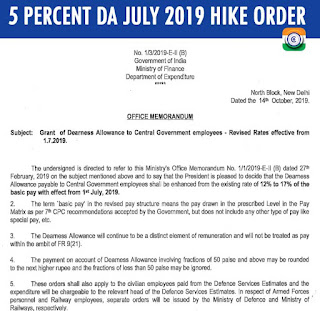
5 Percent DA July 2019 Hike Order - Grant of Dearness Allowance to Central Government employees

Grant of Dearness Allowance to Central Government employees 5 Percent DA July 2019 Hike Order  No. 1/3/2019-E- II (B) Government of...

Blog Archive

About The Author