A complete reference blog for Indian Government Employees

Showing posts with label DA Merger. Show all posts

Tuesday, 16 August 2016

BSNL Pensioners will get Merger of 50% DA / DR with Basic Pay / Pension


Revision of pension of BSNL pensioners/ family pensioners, who retired prior to 10.06.2013 by allowing the benefit of merger of 50% DA/ DR with Basic Pay/ pension, effectively amounting to 78.2% DA/ DR for the purpose of fitment

BSNL Pensioners will get Merger of 50% DA / DR with Basic Pay / Pension

No.40-13/2013-Pen (T)
Government of India
Ministry of Communications
Department of Telecommunications
Dated 18.07.2016
OFFICE MEMORANDUM

Sub: Revision of pension of BSNL pensioners/ family pensioners, who retired prior to 10.06.2013 by allowing the benefit of merger of 50% DA/ DR with Basic Pay/ pension, effectively amounting to 78.2% DA/ DR for the purpose of fitment

The pension to combined service optee absorbed employees in BSNL is paid by Government as per sub-rules 21 to 23 of Rule 37-A of CCS(Pension) Rules 1972.

2. Consequent to the Department of Public Enterprises (DPE) orders dated 26.11.2008, revision of pay of employees of BSNL was allowed with effect from 1.1.2007 vide Letter No. 61-01/2009-SU dated 27.02.2009. Subsequently, pension/family pension of employees retired from BSNL who retired between 01.10.2000 and 1.1.2007, was revised vide this office O.M No. 40-17/2008-Pen (T) Vol.III dated 15.3.2011.

3. Further to Department of Public Enterprises O.M. No. 2(70)/08-DPE (WC)-GL- VII/09 dated 02.04.2009, the benefit of merger of 50% DA with Basic Pay effectively amounting to 78.2% IDA as on 1.1.2007 for the purpose of fitment, was granted to the BSNL serving employees w.e.f. 10.6.2013 vide Order No. 61-01/2012-SU dated 10.6.2013.

4. The issue regarding revision of pension/ family pension of BSNL IDA pensioners/ family pensioners, who retired prior to 10.06.2013 has been considered by the Government, and the following has been decided:
(a)The pension/ family pension of BSNL IDA pensioners/ family pensioners, who retired prior to 01.01.2007, may be revised as on 01.01.2007 notionally with actual benefit w.e.f. 10.06.2013 by adding together
  1. Existing basic pension/ family pension including commuted portion of pension, if any
  2. Dearness relief (IDA) @ 78.2%
  3. Fitment weightage @ 30% of the existing pension/ family pension and dearness relief (IDA) thereon.
The amount so arrived will be regarded as consolidated pension/ family pension with effect from 10.06.2013.
(b)The pension/ family pension of BSNL IDA pensioners/ family pensioners, who retired between 01.01.2007 and 09.06.2013, their pay may be revised notionally with effect from 01.01.2007 by allowing the benefit of merger of 50% DA/DR with Basic Pay/ Pension effectively amounting to 78.2% IDA for the purpose of fitment, and consequential revision of pension on notional pay with actual benefit w.e.f. 10.06.2013, at par with the serving employees of BSNL. However, these pensioners do not get actual benefit of increase in pay/ pension during the period between 01.01.2007 to 09.06.2013, and they would not get increase in the amount of DCRG, leave encashment and commutation of pension on this account.
5.The other conditions with regard to commuted portion of pension, minimum pension and increase in the quantum of pension/ family pension to the old pensioners/ family pensioners, as mentioned in this office O.M. No. 40-17/2008-Pen (T) Vol.III dated 15.3.2011 shall remain the same.

6.Action to revise pension/ family pension in terms of these provisions may be initiated suo-moto by the concerned Heads of offices. All administrative offices of BSNL handling preparation of pension papers of BSNL pensioners may be directed to initiate the process of consolidation of pension/ family pension to the BSNL IDA pensioners/ family pensioners, who retired prior to 10.06.2013, at the consolidated rates in terms of para 4 above immediately and forward the same to the concerned CCAs for consolidation and issue of revised Pension Payment Orders (PPOs).

7. The exercise to extend benefit of these orders to the pensioners/ family pensioners should be completed by 31.12.2016.
(S K Jain)
DDG (Establishment)
Download DOT OLM No.40-13/2013-Pen (T) dated 18.07.2016
Share:

Saturday, 6 August 2016

7th Pay Commission – DA Merger Would have been more Beneficial

7th Pay Commission – DA Merger Would have been more Beneficial – Whether enough organizational pressure was there to get the demand accepted is now an academic issue for discussion only.

The 7th Pay Commission submitted its report in November 2015. The Empowered Committee of Secretaries blocked it for 7 long months. Finally the cabinet approved the report without any modification, The Gazette Notification on the pay and allowances of employees was issued on 25-07-2016. The same minimum pay of Rs.18000/- The same multiplication factor of 2.57. Absolutely no change.

Let us now analyse what would have been the case, had 50% of Dearness Allowance / Dearness Relief been merged with pay / pension with effect from 01-11-2011. DA merger had taken place before implementation of 5th and 6th CPC Recommendations.

Though we had demanded it this time also, it was not agreed to. Whether enough organizational pressure was there to get the demand accepted is now an academic issue for discussion only. The DA / DR was 51% in January 2011. The percentage rates of DA/DR were 58, 65, 72, 80, 90, 100 107, 113, 119 and 125 during subsequent six monthly periods up to January 2016.

Now we shall workout the financial implication of the 50% DA/DR merger notionally.  A person with a basic pay / pension of Rs. 10,000/- would have got Rs. 1,06,500/- as difference in DA/DR for the period 01-01-2011 to 31-12-2015. That is the notional loss. It is easy to workout. For every 1,000 rupee as pay / pension, the benefit would have been Rs. 10650/- We cannot even dream of such an amount as pay revision “bonanza”.

The pay + DA of the lowest paid employee who was drawing Rs. 7,000/- (5,200 +1,800). On 01-01-2016 would have been Rs. 1,8375/- In that case, no Pay  Commission would have dared to recommend Rs. 18000/- as minimum pay as it would have been less than the actual pay + DA drawn by the employee.
Even if we accept the 14.29% increase recommended by the 7th pay commission, the minimum pay would have been Rs. 21,000/- and so the multiplication factor would have increased to 3 instead of 2.57.
Employees and pensioners would have been benefitted significantly.

We were after the euphoria of a Pay Commission. We thought the 7th pay commission and the Government will deliver us good. It was a folly on our part in not clinching the demand of merger of 50% DA with effect from 01-01-2011. We shall blame ourselves for that. This is a lesson for us to be cautious in future.

Source: CGPA Kerala
Share:

Thursday, 4 August 2016

DA MERGER WOULD HAVE BEEN MORE BENEFICIAL THAN PAY COMMISSION


DA MERGER WOULD HAVE BEEN MORE BENEFICIAL THAN PAY COMMISSION – G. SAHARAJAN, SECRETARY, CGPA, KERALA

The 7th CPC submitted its report in November 2015. The Empowered Committee of Secretaries blocked it for 7 long months. Finally the cabinet approved the report without any modification, The Gazette Notification on the pay and allowances of employees was issued on 25-07-2016. The same minimum pay of Rs.18000/- The same multiplication factor of 2.57. Absolutely no change.

Let us now analyse what would have been the case, had 50% of Dearness Allowance / Dearness Relief been merged with pay / pension with effect from 01-11-2011. DA merger had taken place before implementation of 5th and 6th CPC Recommendations.

Though we had demanded it this time also, it was not agreed to. Whether enough organizational pressure was there to get the demand accepted is now an academic issue for discussion only. The DA / DR was 51% in January 2011.

The percentage rates of DA/DR were 58, 65, 72, 80, 90, 100 107, 113, 119 and 125 during subsequent six monthly periods up to January 2016. Now we shall workout the financial implication of the 50% DA/DR merger notionally. A person with a basic pay / pension of Rs. 10,000/- would have got Rs. 1,06,500/- as difference in DA/DR for the period 01-01-2011 to 31-12-2015. That is the notional loss. It is easy to workout.

For every 1,000 rupee as pay / pension, the benefit would have been Rs. 10650/- We cannot even dream of such an amount as pay revision “bonanza”. The pay + DA of the lowest paid employee who was drawing Rs. 7,000/- (5,200 +1,800). On 01-01-2016 would have been Rs. 1,8375/- In that case, no Pay Commission would have dared to recommend Rs. 18000/- as minimum pay as it would have been less than the actual pay + DA drawn by the employee. Even if we accept the 14.29% increase recommended by the 7th CPC, the minimum pay would have been Rs. 21,000/- and so the multiplication factor would have increased to 3 instead of 2.57. Employees and pensioners would have been benefitted significantly.

We were after the euphoria of a Pay Commission. We thought the CPC and the Government will deliver us good. It was a folly on our part in not clinching the demand of merger of 50% DA with effect from 01-01-2011. We shall blame ourselves for that. This is a lesson for us to be cautious in future.

 Source: http://cgpakerala.blogspot.in/
Share:

Saturday, 18 June 2016

7th Pay Commission – Non-settlement of demands – 11th July Indefinite Strike – NJCA writes to PM for intervention

7th Pay Commission – Non-settlement of demands – 11th July Indefinite Strike – NJCA writes to PM for intervention

Ph.: 23382286
National Council (Staff Side)
Joint Consultative Machinery
for Central Government Employees
13-C, Ferozshah Road, New Delhi – 110001
EMail: nc.jcm.np@gmail.com

NO.NC/JCM/2016/CS/PM
Dated: 14.06.2016
Hon’ble Prime Minister of India,
152, South Block,
Raisina Hill,
New Delhi-110011
Respected Sir,

Sub: Non-settlement of our demands – Decision to go on “Indefinite Strike” commencing from 11.07.2016 – Request for your intervention and support.

I write this on behalf of the apex level body of all the Central Government Employees Organizations who are participating in the Negotiating Forum; called the Joint Consultative Machinery. The JCM as a Negotiating Forum was conceived and implemented in 1966 after the prolonged discussions with the Staff Associations and the Federations in the Central Services in the wake of first industrial action in 1960. The idea of setting up the JCM was in realization of the absence of a platform to discuss, deliberate and settle the demands/issues/grievances/problems of the Civil Servants. Up to 1995-96 the JCM, which has a three level negotiating platform was functioning well, meetings were regular. However, after the promulgation of the new recognition Rules in 1993, the meetings at the Ministry level became few and far between and at the national level, the deterioration stepped in a little latter. The National Council, which was to meet thrice in a year did not meet even once in a year. The last meeting of the National Council was held on 15.05.2010 The organizations participating in the JCM were demanding the meeting to be held, but the pleas were ignored by the successive Cabinet Secretaries. The Charter of Demands (copy enclosed), in pursuance of which the strike is decided to be organized, has arisen due to long neglect of the grievances of the employees/workers.

When the 7th CPC was set up in February, 2014, no announcement for Interim Relief or DA Merger was made by the then government, which had all along been the practice whenever the government had set-up the Pay Commissions earlier. We fully co-operated with the Commission, submitted a memorandum detailing the issues and explained the reasoning behind each demand. The 7th CPC submitted report on 19.11.2015 to the government. In our communication dated 10.12.2015 (copy enclosed), we sought
improvement/amendment over the recommendations of the 7th CPC and explained our demands both in writing and orally before the Empowering Committee. Most of the meetings were monologues except perhaps the last one. What we have understood, is that, the Empowering Committee might not come forward to make any major changes. A fruitful meeting is supposed to be a dialogue where both parties at the negotiating table exchange their understanding, views and difficulties and reach a mutually acceptable position. In 1998, when the then Cabinet Secretary decided not to have such a dialogue with the Staff Side and unalterably issued the Government Notification on the 5th CPC recommendations, the then government did set up a committee of Group of Ministers. The GoM held discussions on all issues and averted the strike action. The 1998 situation establishes, without an iota of doubt, that, the Staff Side has always taken reasonable stand on all the issues and paved way for settlement.

The one and only recommendation made by the 7th CPC was to provide some relief to the past old pensioners. The Department of Pension & Pensioners’ Welfare has unfortunately recommended to the Cabinet Secretary that, even that recommendation must be rejected on the specious plea that the requisite relevant records might not be available.

These developments have caused anguish, anxiety and anger amongst the workers. It is now more than six months that the Commission submitted its report. If the government comes forward to hold a meaningful discussion with the leaders of the NJCA, a mutually acceptable settlement can be brought about and the impending strike, slated to commence from 11.07.2016, can ultimately be avoided.

We seek your co-operation, supports and intervention in the matter
Yours faithfully,
sd/-
(Shiva Gopal Mishra)
Secretary(Staff Side),
NC/JCM
Source : National Council (Staff Side)
Share:

Saturday, 26 March 2016

6th Pay Commission Dearness Allowance ends with 6% hike at 125%

6th Pay Commission Dearness Allowance ends with 6% hike at 125%

Cabinet approves 6 percent Dearness Allowance hike for Central Government employees

“In the 7th Pay Commission report, submitted to the government on 19.11.2015, it was mentioned that the DA is assumed to be 125 percent as on 1 January, 2016, the day from which the
Commission expects its recommendations to be implemented by the government. As calculated by the 7th Pay Commission, a six percent Dearness Allowance hike is being given to the Central Government employees.”


The Dearness Allowance (DA) is paid to Central Government employees to adjust the cost of living and to protect their Basic Pay from erosion in the real value on account of inflation. Presently, DA is based on the All India Consumer Price Index (Industrial Workers).

On 23.03.2016, Wednesday, the Centre decided to give a Dearness Allowance of 6 percent to the Central Government employees in order to enable them to manage the price rise and inflation.

On the occasion of Holi, a special cabinet meeting, under the leadership of Prime Minister Narendra Modi, was held in New Delhi on 23rd March 2016. At the end of the meeting, Mr. Ravishankar Prasad, the Minister of Communications and Information Technology, spoke to the reporters. He said, “The cabinet has decided to issue a Dearness Allowance of six percent to the Central Government employees and pensioners.”

The Dearness Allowance is expected to be calculated from January 1, 2016 onwards. This increases the total Dearness Allowance from 119 percent to 125 percent. More than 50 lakh Central Government employees and 58 lakh pensioners will benefit from this. The government will incur an additional financial burden of Rs.14,725 crores. Dearness Allowance is issued twice a year, based on inflation. The previous Dearness Allowance hike, of six percent, was issued in the month of September 2015, and had a retrospective effect from July 2015 onwards.

This is the last and final instalment of Dearness Allowance calculated by the recommendations of 6th Pay Commission. And, after implementation of 7th Pay Commission the new and first Dearness allowance from 1.7.2016 will be approved by the Cabinet in the middle of September 2016.
Share:

Monday, 15 February 2016

Merge DA with Basic this year and Defer Increments: Pay Panel Member

Merge DA with Basic this year and Defer Increments: Pay Panel Member

merge-DA-basic-pay-pay-panel


Member of the Seventh Central Pay Commission Rathin Roy has suggested that to meet its fiscal deficit target the Government should merge the basic pay and dearness allowance (DA) of central government employees in the current year and defer implementing any real increases in pay and pensions. This, the member has said, could be done by compensating those who would have to bear the burden of the deferred effect by giving them a “more generous award distributed over several years”.

“I am saying that the increment need not all be given at one go… It can be staggered and made more generous… So this could be done for pay and for pension,” Dr. Roy told The Hindu in an exclusive interview. “Now I am not competent to say whether this is politically feasible or not,” he, however, added.

Last month, the Union Cabinet set up an empowered committee of secretaries under the Cabinet Secretary for processing the recommendations of the Commission.

The pay and pension revision recommendations of the Commission are scheduled to take effect from January 1, 2016, but Dr. Roy, who is also the National Institute of Public Finance and Policy’s Director, has suggested that the implementation should be pushed to April 1.

What they should get, from April 1, 2016, is what they would get if we merge the basic pay and the DA, which is more or less what they are already getting, he said. “That will mean some increase in allowances but other than house rent allowance the burden of that [on the government budget] will not be very high.” He has also recommended that the Government defer allowances, principally the house rent allowance. “The case for that is strong because we are in the midst of fairly flat growth in consumption expenditure and rents are not going up much.”

Ahead of the presentation of Union Budget 2016-17, the Government is considering options for keeping the fiscal deficit for the next year within the Fiscal Responsibility and Budget Management target. The Government’s fiscal deficit in 2008-09, the year the Sixth Central Pay Commission award was implemented, doubled to 6 per cent, though not all of the increase was on account of the pay and pension hikes. Currently, Central government pay and allowances account for 1 per cent of the country’s GDP.

The Seventh Pay Commission, which submitted its report in November 2015, estimated that the total financial impact due to the hike in pay and allowances of central government employees recommended by it would be Rs 1,02,100 crore. Of this, Rs 73,650 crore will be borne by the General Budget and Rs. 28,450 crore by the Railway Budget. The Commission was set up by the UPA government in February 2014 to recommend revisions of remuneration for 48 lakh central government employees and 55 lakh pensioners.

Source: The Hindu
Share:

Monday, 9 November 2015

Merger of the pre-revised pay scales of the promotional and the feeder posts in a common Grade fixation of pay

Cases of promotion taking place in the pre-revised pay structure between 1.1.2006 and the date of notification of CSS(RP) Rules, 2008 and the subsequent merger of the pre-revised pay scales of the promotional and the feeder posts in a common Grade fixation of pay-reg.,

NFIR
National Federation of Indian Railwaymen
3, CHELMSFORD ROAD, NEW DELHI – 110 055
Affiliated to :
Indian National Trade Union Congress (INTUC)
International Transport Workers’ Federation (ITF)
No. I/2/Part III
Dated: 05/11/2015
The Secretary (E),
Railway Board,
New Delhi

Dear Sir,

Sub: Cases of promotion taking place in the pre-revised pay structure between 1.1.2006 and the date of notification of CSS(RP) Rules, 2008 and the subsequent merger of the pre-revised pay scales of the promotional and the feeder posts in a common Grade fixation of pay-reg., 

Ref: MoF (Dept. of Exp.)’s O.M. No. F-2-l/2015-E. III (A) dated 16 October 2015.

The Federation has come across an O.M. Dated 16th October 2015, on the subject issued by the Ministry of Finance (Department of Expenditure) wherein it has been decided by the Government of India that in cases where promotion took place in the pre-revised pay structure during the period between 01/01/2006 and the date of notification of CCS (RP) Rules, 2008 when the pre-revised and revised pay scales were different and the posts carried the character of feeder and promotional grades,pay fixation on such promotion shall be allowed under Rule 13 of the CCS(RP)Rules,2008 subject to certain conditions. A copy of the O.M. Referred to above is enclosed.

NFIR requests the Railway Board to issue corresponding instructions to all GM’s etc., in respect of Railway employees at an early date.
Yours faithfully,
(Dr. M. Raghavaiah),
General Secretary
Click Here to View the Order
Share:

Thursday, 24 September 2015

50% DA Merger and Retirement age 58 : Rumor Spreading in Social Networks

50% DA Merger and Retirement age 58 : Rumor Spreading in Social Networks

Order for Merger of 50% DA, Retirement age news.
Recently rumour mill went overdrive in social media with the following news that

1. Central Government decided to merge 50% DA with basic pay with effect from 1.1.2015.

2. It went on to say that age of Retirement will be on completion of 33 Years of service or at the age of 58 Years whichever is earlier.

The 7th CPC is expected to submit its report shortly and due to Bihar elections the Central Government cannot take any policy decisions in this regard. Hence it is clarified that none of the above news are correct.

Source: http://karnatakacoc.blogspot.in/
Share:

Monday, 22 June 2015

Denial of interim relief and the benefit of merger of DA with Pay must be viewed very seriously – NC JCM

Denial of interim relief and the benefit of merger of DA with Pay must be viewed very seriously – NC JCM
NATIONAL JOINT COUNCIL OF ACTION
4, State Entry Road New Delhi–110055
No.NJCA/2015
Dated: June 15, 2015
All the Members of the NJCA,

Dear Comrades,
Sub: National JCA Meeting held on 8th June

The National JCA, which met at the Staff Side Office on 8th June, 2015, took note of the fact that quite a few states are yet to hold the State Level Conventions. The meeting also noted that the strike decision taken on 28th April, 2015 has not been percolated down to the rank and file of the workers. The meeting wanted the affiliate to realize that the denial of the demand for wage revision to be effective from 01.01.2014 and the consequent denial of interim relief and the benefit of merger of DA with Pay must be viewed very seriously as the said decision will have far reaching consequence. The Government would discard the age old practice of grant of I.R. and merger of DA forever. It has decided to appeal to all the affiliates to chalk out independent programmes of actions in the months to come and to carry out the same in all seriousness so that the employees become fully aware of the possible outcome of the 7th CPC. The Chairman and Convenor of the National JCA will get in touch with those States, where the convention has not been held so far. The meeting decided to convey to members that the minimum wage computation, in the given situation would be on an imaginary basis. The National JCA was of the opinion that a meeting of all office bearers of the participating organizations must be convened at Delhi somewhere in the month of July to chalk out programmes of action to be pursued by the CGEs together. It was informed at the meeting that both Defence and Railways would be taking their strike ballot and would be concluded in the first week of October. The meeting, therefore, decided to advise the other units to chalk out progammes of action in July so that an ambience of struggle could be created. The NJCA also took note of the painful fact that despite assurances, Government was not convening the National Council and Departmental Councils and the JCM has been allowed to become defunct. The National JCA in conclusion decided to appeal to all affiliates to take concrete steps to invigorate the joint movement of the Central Government employees and meet the challenge that is likely to arise on receipt of the recommendations of the 7th CPC by creating an atmosphere of Unity, and determination to carry out the call of indefinite strike action scheduled to commence on 23rd November, 2015.
With greetings,
(Shiva Gopal Mishra)
Secretary (Staff Side)
NC JCM & Convener
Source: www.ncjcmstaffside.com
Share:

Thursday, 14 May 2015

Dearness Allowance from January, 2015 to CDA pattern employees of CPSEs

DA from Jan-2015 to CDA pattern employees of CPSEs – @ 273% for without 50% DA Merger and 223% with 50% DA merger

Dearness Allowance from January, 2015 to CDA pattern employees of CPSEs governed by HPPC recommendation enhanced from 262% to 273% for without 50% DA Merger and 212% to 223% for 50% DA merger scale:-

No. 2(42)/97-DPE (WC)-GL-VIII/15
Government of India
Ministry of Heavy Industries & Public Enterprises
Department of Public Enterprises

Public Enterprises Bhawan,
Block 14, CGO Complex, Lodi Road.
New Delhi-110003, 29thApril, 2015
OFFICE MEMORANDUM

Subject: – Payment of DA to the CDA pattern employees of CPSEs governed by HPPC recommendations.

The undersigned is directed to refer to Para No. 2 and Annexure-III to this Department’s OM. dated 24.10.1997 wherein the rates of DA payable to the employees of CPSEs following CDA pattern pay scales, which are governed by HPPC recommendations had been indicated.

2. In continuation of this Department’s OM of even number dated 9.10.2014, the rates of Dearness Allowance w.e.f. 01.01.2015 payable to the employees of CPSEs governed by the recommendations of HPPC. which have not revised their pay scales in terms of DPE O.M. No. 2(54)/2008-DPE(WC) dated 14.10.2008 may be as follows:-

a) In case of CPSEs who have not allowed the benefit of merger of 50% of DA with basic pay as contained in DPE QM. dated 24.05.2005 to their employees. the DA payable may be enhanced from existing rate of 262% to 273%.

b) In case of CPSEs who have allowed the benefit of merger of 50% of DA with basic pay as contained in DPE QM. dated 24.05.2005 to their employees, the DA payable may be enhanced from existing rate of 212% to 223%.

3. The payment of Dearness Allowance involving fractions of 50 paise and above may be rounded off to the next higher rupee and the fractions of less than 50 paise may be ignored.

4. All administrative Ministries/Department of Government of India are requested to bring the foregoing to the notice of the Central Public Sector Enterprises under their administrative control for action at their end.
sd/-
(Samsul Haque)
Under Secretary
Source: http://dpe.nic.in/sites/upload_files/dpe/files/29_04_2015_CDA_5th_CPC0001.pdf
Share:

Tuesday, 5 May 2015

Order for Merger of 50% DA, Retirement age news goes viral in Social Media

Order for Merger of 50% DA, Retirement age news goes viral in Social Media

Recently rumour mill went overdrive in social media with the following news that
1. Central government decided to Merge 50% DA with basic pay with effect from 1.1.2015 and order will be issued within 15 days
2. Encashment of Earned Leave to be curtailed to 180days instead of existing 300 days.
3. It went on to say that age of Retirement will be on completion of 33 Years of service or at the age of 58 Years whichever is earlier
According to the Social Media , the above strong decisions were taken in last three meeting of cabinet committee to recommend 7th pay commission. Further the post published in social media warned the central government employees that if above decisions are implemented; they should not expect more from 7th Pay Commission. Since it is considered to be the indication of what the think tank of central government will do for its employees.

We enquired about this rumour with one of the Member to the National council JCM, who recently met the 7th Pay Commission. According to him, the central government has firm on its decision not to accept the Merger of DA with Pay, since the due date of the 7th Pay Commission to submit its recommendation is nearing and the central government in many occasions cleared that the recommendation of 7th pay commission will be implemented from 1.1.2016. So there is no question of issuing order for merger of 50% DA with effect from 1.1.2015.

Further he clarified that the present government wanted to use the man-hours of central government employees productively by introducing new systems like bio metric attendance etc. Hence curtailing EL Encashment will lead the central government employees to take more leave if it is not allowed for encashment. So there is no need to implement such proposal as government point of view is against taking leave by Govt officials.

There is mixed response from the sources whether the retirement age of central government employees will be revised or not. It is believed that the present government is in favour of reducing retirement age to 58. But at the same time government doesn’t want loose resources of knowledge gained through experience by reducing retirement age of Government employees. Since the work culture of government service is deteriorating day by day due to various factors , govt would like to retain the experience of the senior Government officials . Anubhav is the one of the initiative introduced by the central government to improve the work culture of youngsters in government service. So there will not be any change in retirement age of central government employees at present.

Share:

Saturday, 2 May 2015

NFIR View on Expected DA from July 2015

NFIR View on Expected DA from July 2015

‘National Federation of Indian Railwaymen’ – NFIR circulated to its all affiliated unions regarding the ‘Expected DA from July 2015′ after the announcement of AICPIN for the month of March 2015 yesterday by the Labour Bureau. It is expected that the additional dearness allowance is likely to be 118% of pay from July 2015. The letter is reproduced and given below for your information…

EXPECTED DEARNESS ALLOWANCE FROM 01st July 2015

NFIR
National Federation of Indian Railwaymen
3. CHELMSFORD ROAD, NEW DELHI – 110 055
No.1/5(A)Part.1
Dated: 01/05/2015
The General Secretaries of Affiliated Unions of NFIR
Dear Brother,

Sub: Dearness Allowance with effect from 01.07.2015 – reg.

The All India Consumer Price Index for March 2015 was 254 and if it remains as it is for next three (3) months or if it rises to 256, the average is expected to be 253. Consequently, the Dearness Allowance increase is likely to be 118% of pay from July 2015.

The above is for information of affiliates. You are aware that the Government normally announces D.A. revision in September, to be given effect from July.
Yours fraternally,
sd/-
(Dr. M. Raghavaiah)
General Secretary
Source: NFIR
Share:

Friday, 1 May 2015

NC JCM writes to PM regarding the pending demands of Central Government Employees – DA Merger, NPS, Interim Relief, Promotion and Bonus issues

NC JCM writes to PM regarding the pending demands of Central Govt Employees – DA Merger, NPS, Interim Relief, Promotion and Bonus issues

The letter is translated to English and given below for your kind consideration…

Shiv Gopal Mishra
Secretary
Ph: 2338226
National Council (Staff side)
Joint Cumulative Machinery
For Central Government Employees
13-C Feroz Shah Road, New Delhi – 110001
Email: nc.jcm.np@gmail.com
Letter No: NJC/2015
Date: 27.4.2015
Respected Prime Minister,
Government of India,
New Delhi

Sub: Reg. the grievances of Central Government Employees

Sir,
For the past few years, a solution hasn’t been found to the problems faced by the Central Government Employees. The National council JCM formed for the grievances of Central Government Employees has been totally disabled and the NC JCM meeting has not been held for the past five years.

The Pending demands of the Central Government, which include the merge of Dearness Allowance with Basic Pay, the enforcement of Old Pension Scheme in the place of New Pension Scheme, Interim Relief, Filling up of Vacancies, Increasing the bonus range, Promotion Opportunities, etc didn’t yield to a decision, hence the Railway, Defence (Civil Employees), Postal, other Central Government Sectors are forced to give a presentation in the Parliament under NC J.C.M. on 28th April 2015.

We Central Government Employees whether in Railways, Defence, Postal Department or other Central Government Sectors, are working with complete devotion towards service to the society and progress to the country. Being an integral part of your administration, we hope that you would provide us an opportunity to meet you as well as extend your help to solve our problems.

Yours Faithfully,
(Shiv Gopal Mishra)
Coordinator and Secretary
Employee Division
N.C. J.C.M.
Click to view the original letter in Hindi

Source: NC JCM Staff Side Website
Share:

Thursday, 16 April 2015

Pensioners seek 50% da merger and Bus travel concession

Pensioners seek merger of 50 p.c. DA with pay

The Tamil Nadu Government Education Department Retired Ministerial Employees’ Association has urged the State government to merge 50 per cent of dearness allowance with pay to benefit both in service employees and retired personnel.

A resolution adopted at its state executive meeting here on Sunday wanted the Treasury Officers to issue identity cards to pensioners.

Another resolution wanted some concession in the bus fare for the retired employees.

The following were elected state office-bearers of the association: B. Viswanathan – president; N. Subbiah vice-president, and A. Janarthanam – general secretary.

Read more at The Hindu
Share:

Thursday, 26 March 2015

Meeting of NC JCM Staff Side with 7th Pay Commission – Detailed report including about DA Merger, Interim Relief

Meeting of NC JCM Staff Side with 7th Pay Commission – Detailed report including about DA Merger, Interim Relief

 Feedback of the meeting of NC JCM Staff Side with 7th CPC
No.NC/JCM/2015
Dated: March 25, 2014
Dear Comrades,

The 7th CPC had asked the JCM Staff Side to present their case before the Commission for wage revision on 23rd and 24th March 2015. Accordingly, the Standing Committee of the Staff Side met on 22nd March and again 23rd March 2015. The presentation was made on 23rd and 24th March 2015 before the Commission.

We have discussed the memorandum, chapter wise and the Commission made a very patient hearing and interacted with us seeking clarifications on certain matters. It is not possible to provide a detailed account of the discussions. However, we are to inform you that we came out of the discussion with a very good impression and satisfaction.

1. The Commission will adopt Minimum Wage Concept(Dr. Aykhrod Formula) as the principle of wage determination. They will however, collect the retail rates of the commodities that go into the basket.

2. We have pleaded for the adoption of the best international practices while fixing the highest salary.

3. On the demands for Interim Relief and Merger of DA, the Commission finally said that those can only be considered if Terms of Reference are amended.

4. The Commission agreed that there had been reduction in the sanctioned strength and working strength over the years despite the increased workload.

5. They have also noted that there was substantial reduction in percentage terms of the expenses on salary and wages over the years.

6. The Commission enquired, as to how multiplication factor of 3.7 was arrived at. The same was explained in detail.

7. Fitment Formula and the demand on Fixation of Pay on Promotion, were appreciated as the rationale was explained.

8. Date of effect: No commitment or comment was made by the Commission. The Staff Side explained, as to how they compromised by shifting the date from. 01.01.2011 to 01.01.2014.

9. The institution of Special Pay, especially in the wake of de-layering was explained.

10. Common Categories: We have requested the upgradation and amalgamation of the cadres of LDC with UDC and the need for bringing about parity in pay scales of the Subordinate Offices with the Central Secretariat. The problems of Staff Car Drivers were also elaborated. The contractorisation and casualisation at lower level positions and the consequent exploitation of the labour were discussed at length. The Commission has made a proposal to do away with the contractorisation/casualisation. Staff side will discuss the proposal and will send its views to the Commission in due course.

11. Classification of Posts: Our proposal has not been found favour.

12. GDS: While sympathizing with the Staff Side, the Commission wanted them to approach the Government with a view to amend the Terms of Reference.

13. Allowances and Advances: Detailed discussions were held on HRA, CCA, Transport Allowance, CEA and Special Allowance for personnel posted at North East Region. Chapters dealing with the facilities was also discussed at length, including compassionate appointment. On holidays, we have requested to include May Day in the list of holidays. The background of observance of May Day was enquired by the Commission and explained.

14. Pension and Retirement Benefit – NPS: Commission stated categorically that NPS being an Act of Parliament, they will not make any comment thereon.

Pension Computation: The rationale of 67% was explained and appreciated.
Minimum Pension: our demand for 2/3rd of the Minimum Wage was also explained.

Parity in pension of past and present pensioners was fully explained, linked with one rank -one pension scheme for Defence Personnel. We have pleaded that Civilian Pensioners should not be discriminated against. Demand for Additional Pension for both Pensioners and Family Pensioners was explained. All matters concerning Family Pension were also discussed. So also, gratuity to be computed in accordance with the Gratuity Act.

There was good response for the demands from the Commission.
Restoration of commuted value of pension: The Commission will enquire the views of the Government as to what is their objection to the demand.

Medical facilities for pensioners and discrimination between Pensioners in CGHS area and CCS(MA) Area as also the Postal Pensioners was brought home including the higher Fixed Medical Allowance for ESI persons.

Certain clarifications/elucidations have been asked for by the Commission. To provide such clarifications, another meeting with the Commission might be held after the Commission’s interaction with other organizations. The Staff Side may meet the Commission after their interaction with the other organizations are over.
With greetings,
(Shiva Gopal Mishra)
Secretary/Staff Side NC JCM
PDF file regarding feedback of the meeting is reproduced underneath:-
Share:

Thursday, 12 March 2015

Chances of implementation of 7th Pay Commission report in FY 2016-17 – Budget 2015 documents indicates

“7th Pay Commission impact may have to be absorbed in 2016-17″ – Says Medium Term Fiscal Policy papers presented by Finance Minister

Chances of implementation of 7th Pay Commission report in FY 2016-17 – Budget 2015 documents indicates.

Budget 2015 documents such as Para 12 and 42 of Medium Term Fiscal Policy for further 3 years, and Para 23 of Fiscal Road Map indicate the Chances of implementation of 7th Pay Commission in the Financial Year 2016-17.

7th CPC was formed in February 2014 with the time of 18 months for submission of its report. We could also see that 7CPC is already in full swing in examining the pay structure and service conditions of various cadres of Central Government Employees, Railway Employees and Defence Services personnel.

It has conducted as many as 38 meetings with organisations that represent employees, servicemen and pensioners at many places in India. Oral evidences of leading federations such as Confederation of Central Government Employees, AIRF, NFIR etc are also to be recorded soon as possible. As such we may expect that 7th Pay Commission may submit its report in time. Sixth Pay Commission also submitted its report within stipulated time of 18 months.

DA of central government employees has already crossed 100%. Previous Pay Commissions have merged entire DA with pre revised pay and also provided fitment benefit up to 40%. In these lines, we may expect that 7th CPC pay would be at least 2.5 times of Pre revised pay as on 01.01.2016. As DA rate would start at Nil rate once 7th Pay Commission is implemented, net increase in pay of Central Government Employees including Railways is expected to be 40%.

Considering the recent pay hike of 15% approved for Bank Employees in the recent Bipartite Wage Settlement which is due every four years, 40% pay hike for Central Government Employees can be rightly justified since their pay revision is due evey ten years.

While Govt is yet accept the 6th CPC’s recommendations for Performance Related Increment System (PRIS), 14th Finance Commission has recently recommended for productivity based Pay Fixation. In these circumstances it is up to 7th Pay Commission to moot out performance based pay fixation for Central Government Employees.
Share:

Thursday, 26 February 2015

JCM Staff Side Meeting with 7th Pay Commission – Discussion about DA Merger and Interim Relief

Discussion about DA Merger and Interim Relief - JCM Staff Side Meeting with 7th Pay Commission

The JCM Staff Side delegation met the Chairman, Seventh Central Pay Commission, 25/02/2015 at 11:00 hrs. The detailed report as follows…
NFIR
National Federation of Indian Railwaymen
3, CHELMSFORD ROAD, NEW DELHI . 110055

No.IV/NFIR/7th CPC/Corres/Pt.V
Dated 25/02/2015
Sub: JCM Staff Side Meeting with the Chairman, 7th CPC.
 
The JCM Staff Side delegation met the Chairman, Seventh Central Pay Commission, 25/02/2015 at 11:00 hrs. The following issues were raised :-
 
i. Merger of DA with Pay and grant of Interim Relief :-
The JCM Staff Side insisted that the Pay Commission should consider Staff Side memorandum submitted in the month of June 2014 and recommend DA merger. The Chairman, 7th CPC replied that there is no communication from the Government of India to give interim report on DA merger demand. After discussion, the Chairman 7th CPC has decided to send D.O. letter to the Government today conveying the strong protest of Staff Side/JCM.
With regard to grant of Interim Relief, the Chairman heard the point of view of the Staff Side JCM that it is only “provisional payment in view of market situation and urged upon the Commission to send suo-moto recommendation to the Government.
ii. Allotment of time slots for explaining the case of Central Government Employees as well ‘ Departments like Railways, Postal, Defence (Civil side) etc.,
The Chairman suggested that small committees may be constituted by the Staff Side for meeting the Pay Commission for deliberations and enough time will be given. He also said that the Memorandums given by JCM, Federations/Unions/Associations have been gone into by the Pay Commission fully. He further said that VII CPC will meet the teams from each department and hear their proposals.
 
Responding to this, the JCM Staff Side has agreed to make out the proposal for the purpose of facilitating the Pay Commission to hear the views/submissions of the Federations/Unior/Associations. The deliberations may commence somewhere after 15th March, 2015. Staff Side JCM will prepare time schedule proposal and send to Pay Commission accordingly.
 
iii. Gramin Dak Sewaks – The case was explained. The Pay Commission was suggested that the copy of Supreme Court Judgment may be made available for examination.
On behalf of NFIR S/Shri M.Raghavaiah (JCM Staff Side/Leader), Guman Singh, R.P.Bhatnagar and B.C. Sharma have participated in the meeting.
sd/-
(Dr M.Raghavaiah)
General Secretary
Source: NFIR
Share:

Wednesday, 25 February 2015

NFIR’s 55 Point Charter of Demands Including DA Merger, Interim Relief and Scrap NPS

NFIR’s 55 Point Charter of Demands Including DA Merger, Interim Relief and Scrap NPS

1. Withdraw FDI, PPP in Railways – Stop Out Sourcing, Contractorisation and Privatization.

2. Scrap New Pension Scheme in Railways and restore liberalised pension scheme.

3. DA merger with pay with retrospective effect and payment of Interim Relief to Central Government employees (serving and retired).

4. Calculation and payment of Productivity Linked Bonus (PLB) on actual wages.

5. Transport Allowance be exempted from the purview of Income Tax.

6. Increase contribution to Group Insurance Scheme (GIS) by atleast 10-times for all Government employees.

7. Merge Technician-II with Technician-1 with Grade Pay Rs.2800/- (PB-I) in Railways.

8. Revise entry grade pay of Station Masters as Rs.4200/- in PB-2.

9. Replacement of Grade Pay Rs.4600/- with Rs.4800/- (PB-2) w.e.f. 01/01/2006.

10. Revise upwardly the kilometrage rates of Running Staff w.e.f. 01/01/2006 – Settle Running Staff issues as per agreement dated 7th February, 2014.

11. Implement agreement for Up-gradation of Apex Group ‘C’ posts to Group ‘B’ Gazetted in Railways.

12. Allotment of higher Grade Pay to the Loco Pilots and Guards.

13. Count Temporary status Casual Labour Service in full as qualifying service for retirement and other purposes.

14. Allot entry Grade Pay of Rs.5400/- to the Group ‘B’ Gazetted staff.

15. LARSGESS be extended to GP Rs. 2400/- and above.

16. Track patrolling – Support man provision be complied with.

17. Rectify MACPS anomalies.

18. Rectify Sixth CPC anomalies.

19. Enhance Fixed Medical Allowance of Rs.500/- p.m. to not less than Rs.2000/- p.m., for all retired employees.

20. Extend special privileges and facilities for Women employees for their empowerment.

21. Ensure full implementation of the report of Joint Committee for career growth of Track Maintainers.

22. Abolish 12/- Hours duty in Railways – Introduce 8 hours duty roster for Running and Safety categories staff. Classify Running Staff working high speed trains as “Intensive” – NFIR’s proposals on the recommendations of High Power Committee (R&S) be considered for reaching negotiated settlement.

23. Remove hardships being faced by Train Controllers.

24. Reduce Duty Hours of Nursing Staff, thus honour Government’s decision.

25. Create ticket checking staff posts for manning trains.

26. Casual Labour acquired temporary status prior to 01/01/2004 should be covered under Liberalised Pension Scheme.

27. Implement norms approved by Railway Board and sanction new posts of SSE/JE (Signal), ESM, Helper (Signal) etc.

28. Amend Rules for providing employment to Wards of Employees.

29. Provide quality Health care to employees, their families besides retired employees.

30. Fill vacancies of Doctors, Para Medical Staff and provide Super specialists in all Railway Hospitals — enhance superannuation age of Railway Doctors.

31. Cover all Railway employees under Incentive Scheme in Workshops, PUs etc., wherever not covered.

32. Grant parity in Pay Structure for Stenographers in Railways at par with CSS/RBSS.

33. Training Allowance should be revised to 30% of pay in all Training Centres/Schools.

34. Implement agreement on stepping up of pay of Loco Inspectors.

35. Review SPAD definition – Prevent harassment and victimisation of Running and safety categories staff.

36. Make upward revision of Income Tax exemption limit in the case of running staff.

37. Running Rooms should be improved, air-conditioned and upgraded on priority.

38. Grant Project incentive allowance to the staff working in projects on Indian Railways.

39. Negotiating foras of PNM, DC/JCM & NC/JCM should be made effective for resolving issues speedily – Implement agreements reached in PNM, DC/JCM & special meetings etc., immediately.

40. Ensure creation of posts in safety/operational/public image categories for manning new services and maintaining new assets without linking to matching surrender.

41. Grant Daily Allowance to Staff Car Drivers.

42. Absorb quasi administrative units/offices staff against posts in GP Rs. 1800/- PB-1.

43. Induct Course Completed Act Apprentice against vacancies.

44. Ensure quality Uniform to all employees and supply of quality protective gears — concede NFIR’s proposals.

45. Grant Patient Care Allowance to all para-medical staff.

46. Provision of single woman Hostel facility at all Divisional Headquarters and important stations.

47. Setting up of a multi-disciplinary training institute for imparting training in rail related electronic technologies for the wards of Railway Employees.

48. Extension of medical facilities to the dependent parents of railway employees.

49. Liberalize compassionate appointment provisions.

50. Remove restrictions on payment of Children Education Allowance/Hostel subsidy.

51. Allot adequate funds for maintenance of Railway Quarters as well as construction of new quarters.

52. Introduce warning/ Hooter system to prevent deaths of Track Maintainers etc., while on duty.

53. Grant Study leave with attendant incentives liberally o the employees for pursuing higher studies.

54. Enhance Night Patrolling Allowance for Track Maintainers.

55. Allot Pay Band-4 to Junior Administrative Grade Officers in Railways.
Share:

Wednesday, 21 January 2015

Central Trade Unions submits Joint Memorandum including DA Merger and 5 Lakh IT Exemption to Finance Minister

Central Trade Unions submits Joint Memorandum including DA Merger and 5 Lakh IT Exemption to Finance Minister
CENTRAL TRADE UNIONS SUBMITS JOINT MEMORANDUM TO FINANCE MINISTER
17th January 2015
The Hon’ble Minister of Finance, Govt. of India,
North Block, New Delhi

Dear Sir,
We thank you for inviting the central trade unions representing the working people in the country in both organized and unorganized sector for this pre-budget consultation.

In the previous pre-budget consultation meeting with you held on 6th June 2014, we urged upon you to please consider a directional change in the economic policy regime from that pursued during the previous government which, you have also admitted, had landed the country’s economy in a bad situation. In fact, we had articulated our views and proposals on that premise. But we like to submit candidly that our proposals did not receive a positive response and the economic policies followed the same trajectory and made situation worse for the mass of the people during the intervening period.

Sir, the Mid Term Economic Analysis (2014-15) by Govt of India itself admitted that for the period under review despite increase in GDP growth rate, and a much bigger increase in profit of the corporate sector and big business lobby, the wages for the working people who actually create the GDP in both rural and urban areas plunged on the average. Overall standard of living of people deteriorated and unemployment situation in the country has not improved in the least. Much more jobs were lost owing to closure/lockout, retrenchment than created during the intervening period. And in the midst of such situation, the Govt has already decided to cut already budgeted expenditure in the social sector such as MNREGA, Health, Education etc which we strongly deplore. Such a phenomenon warranted serious reconsideration on directional change in the economic policy regime and we again urge you for the same.

We express our serious concern and dismay over the manner the Govt have been pushing various major economic policy related decisions through promulgation of Ordinances. At least eight Ordinances were promulgated during last eight months of the new Govt. We record our determined opposition to such practice of Ordinance route of governance. In particular we also oppose the Ordinance on coal sector, insurance sector and on Land Acquisition Act and want you to please take note of the rousing opposition and struggles by the workers and the farmers against such disastrous exercises. We demand all such Ordinances should be withdrawn forthwith.

We wish that our candid observations, considered views and concrete proposals are taken in the justify spirit and responded with all seriousness and given appropriate reflections in the ensuing budget 2014-15.

Our proposals:

Some of these specific proposals have time and again been placed by us in various policy making fora including the earlier pre-budget consultations. However, we would like to reiterate them, urging your positive response:

Take effective measures to arrest the spiraling price rise and to contain inflation; Ban speculative forward trading in commodities; Universalise and strengthen the Public Distribution System; Ensure proper check on hoarding; Rationalise, with a view to reduce the burden on people, the tax/duty/cess on petroleum products.
There must be massive investment in the infrastructure in order to stimulate the economy for job creation. The Mid Term Economic Analysis(2014-15) published by Govt of India has clearly mentioned about the failure of the PPP experiments in infrastructure development and opined for public investment. It is our considered view that the Public sector should take the leading role in this regard. The plan & non-plan expenditure should be increased in the budget to stimulate jobs creation and guarantee consistent income to people.

Minimum wage linked to Consumer Price Index must be guaranteed to all workers, taking into consideration the recommendations of the 15th Indian Labour Conference as enriched by Apex Court of the country as reiterated in 44th ILC in 2012. In any case, it should not be less than Rs.15,000/- p.m.

FDI should not be allowed in crucial sectors like defence production, telecommunications, Railways, financial sector, retail trade, education, health and media.

The public sector units played a crucial role during the year of severe contraction of private capital investment immediately following the outbreak of global financial crisis. PSUs should be strengthened and expanded. Disinvestment of shares of profit making public sector units should be stopped forthwith. Budgetary support should be given for revival of potentially viable Sick CPSUs In view of huge joblosses and mounting unemployment problem, the ban on recruitment in Govt. deptts, PSUs and autonomous institutions (including recent Finance Ministry’s instruction to abolish those posts not filled for one year) should be lifted as recommended by 43rdSession of Indian Labour Conference.
Condition of surrender of posts in govt. departments and PSUs should be scrapped and new posts be created keeping in view the new work and increased workload.

Proper allocation of funds be made for interim relief of 20% and 100% DA merge with basic pay and allowances including neutralization percentage be paid on merged DA in view of 7th CPC to all Govt. employees. Similarly, 100% DA of PSU employees be also merged with basic pay.

The scope of MGNREGA be extended to agriculture operations and urban areas as well and employment for minimum period of 200 days with guaranteed statutory wage be provided, as unanimously recommended by 43rd Session of Indian Labour Conference. The drastic cut already inflicted on the MNREGA allocation should be restored.

The massive workforce engaged in ICDS, Mid-day meal scheme, Vidya volunteers, Guest Teachers, Siksha Mitra, the workers engaged in the Accredited Social Health Activities (ASHA) and other schemes be regularized. No to privatization of centrally funded schemes. Universalisation of ICDS be done as per Supreme Court directions by making adequate budgetary allocations.

Steps be taken for removal of all restrictive provisions based on poverty line in respect of eligibility coverage of the schemes under the Unorganised Workers Social Security Act 2008 and allocation of adequate resources for the National Fund for Unorganised Workers to provide for Social Security to all unorganized workers including the contract/casual and migrant workers in line with the recommendations of Parliamentary Standing Committee on Labour and also the 43rd Session of Indian Labour Conference.

Remunerative Prices should be ensured for the agricultural produce and Govt. investment public investment in agriculture sector must be substantially augmented as a proportion of GDP and total budgetary expenditure. It should also be ensured that benefits of the increase reach the small, marginal and medium cultivators only;

Budgetary provision should be made for providing essential services including housing, public transport, sanitation, water, schools, crèche health care etc. to workers in the new emerging industrial areas. Working women’s hostels should be set up where there is a concentration of women workers.

Requisite budgetary support for addressing crisis in traditional sectors like Jute, Textiles, Plantation, Handloom, Carpet and Coir etc.

Budgetary provision for elementary education should be increased, particularly in the context of the implementation of the ‘justify to Education’ as this is the most effective tool to combat child labour.
The system of computation of Consumer Price Index should be reviewed as the present index is causing heavy financial loss to the workers.

Income Tax exemption ceiling for the salaried persons should be raised to Rs.5 lakh per annum
and fringe benefits like housing, medical and educational facilities and running allowances, Railways Running Staff and a staff in other deptts should be exempted from the income tax net in totality.
Threshold limit of 20 employees in EPF Scheme be brought down to 10 as recommended by CBT-EPF. Pension benefits under EPS unilaterally withdrawn by the Govt. should be restored. Govt. and Employers contribution be increased to allow sustainability of Employees Pension Scheme and for provision of minimum pension of Rs.3000/- p.m.

New Pension Scheme be withdrawn and newly recruited employees of central and state govts on or after 1.1.2004 be covered under Old Pension Scheme;

Demand for Dearness Allowance merger by Central Govt. and PSUs employees be accepted and adequate allocation of fund for this be made in the budget;

All interests and social security of the domestic workers to be statutorily protected on the lines of the ILO Convention on domestic workers.

The Cess Management of the construction workers is the responsibility of the Finance Ministry under the Act and the several irregularities found in collection of cess be rectified as well as their proper utilization must be ensured.

In regard to resource mobilization, we would like to emphasize the following:

A progressive taxation system should be put in place to ensure taxing the rich and the affluent sections who have the capacity to pay at a higher degree. The corporate service sector, traders, wholesale business, private hospitals and institutions etc. should be brought under broader and higher tax net. Increase taxes on luxury goods and reduce indirect taxes on essential commodities as at present the overwhelming majority of the populations are subjected to Indirect taxes that constitute 86% of the revenue.

Concrete steps must be taken to recover huge accumulated unpaid tax arrears which has already crossed more than Rs.5 lakh crore on direct and corporate tax account alone, and has been increasing at a geometric proportion. Such huge tax-evasion over and above the liberal tax concessions already given in the last two budgets should not be allowed to continue.

The SIT constituted for unearthing black money must deliver visible result which is yet to be seen. Effective measures should be taken to unearth huge accumulation of black money in the economy including the huge unaccounted money in tax heavens abroad and within the country. Finance Minister should make provisions to bring back the illicit flows from India which are at present more than twice the current external debt of US $ 230 billion. This money should be directed towards providing social security.

Concrete measures be expedited for recovering the NPAs of the banking system which is on the increasing trend again from the willfully defaulting corporate and business houses. By making provision in Banking Regulations Act, CMDs and Executives to be made accountable for creation of NPAs.

Tax on Long term capital gains to be introduced; so also higher taxes on the security transactions to be levied.

The rate of wealth tax, corporate tax, gift tax etc. to be expanded and enhanced.

ITES, outsourcing sector, Educational Institutions and Health Services etc. run on commercial basis should be brought under Service Tax net. Govt.

Small saving instruments under postal and other agencies be encouraged by incentivizing commission agents of these scheme

OUR SERIOUS CONCERN:

We would like to express our strong resentment that the previous Govt. failed to positively respond to the collective voice of the Central Trade Unions on the very important issues concerning the working people of India, both organized and unorganized, consistently repeated in the form of a ‘10 point charter’ backed by several collective nationwide programmes. We expect that this Govt. will take initiative to discuss these issues with the Central Trade Unions in order to find a solution.

We also express our opposition to the so called Banking Reforms encouraging private sector/capitalists banking at the cost of public sector banks which saved the economy to an extent during the last global financial meltdown. We also oppose increase in limit of FDI and disinvestment of equity in insurance sector and FDI in pension. We strongly oppose the FDI in Defence and Retail Sector. Several such measures against the working men and women in this country including anti workers proposals contained in the New Manufacturing Policy have our strong opposition, as in our experience these kinds of measures have helped the growth of only a small section of the capitalists while the larger sections of the working population continue to be marginalized and impoverished.

We also oppose the hectic measures of changing labour laws in the name of labour reform both by the central and the state governments which are basically aimed at legitimizing ongoing widespread violations by the employers’ class and also throw out overwhelming majority of the workforce of the purview of the labour laws themselves at the total mercy of the employers.

POST BUDGET MEETING WITH TRADE UNIONS

Successive Finance Ministers have agreed to hold post budget meetings / consultations with the central trade unions. However, it has not been materialized except for one occasion. We understand such meetings did take place with the Corporate Associations/Employers Federations. We would like to importunate upon you to arrange such post budget meeting with trade unions also.
With regards,
Yours sincerely,
Brijesh Upadhyay-BMS S Q Jama- INTUC, Harbhajan Singh Sidhu-HMS, D L Sachdeva-AITUC
Tapan Sen-CITU, R K Sharma-AIUTUC,  S P Tewari-TUCC,  Monali-SEWA,  Santosh Roy-AICCTU
Ashok Ghosh-UCTU, Shanmugan-LPF
Source: http://aiamshq.blogspot.in/
Share:

Saturday, 10 January 2015

Railway union toughened stands on scrapping of NPS and DA Merger

Railway union toughened stands on scrapping of NPS and DA Merger

Prime Minister Narendra Modi’s persuasive pitch to railway employees unions has cleared the decks for more FDI inflows and private capital in national transporter that may be reflected in the rail budget.
After Modi’s statement that there would be no privatization of railways, the workers’ unions have softened their stand over several issues including FDI in the transport behemoth. However, the unions are sticking to demands relating to scrapping of new pension scheme (NPS) and DA mergers.

The PM has said that he had a “deep connection” with the railways. “I love railways. My life is what it is because of railways,” Modi said. “The government will not go in the direction of railway privatization ..

People are spreading rumors about privatization of railways. It is not true,” Modi had said. The change of heart came after railway minister Suresh Prabhu’s  reassurance that FDI or public-private partnership (PPP) will not affect the ownership of railways. During the meeting of general managers last week where union representatives were also present, the minister argued that the government wants to attract private investment in cash-strapped railways and it was not for privatization of railways. After Modis categorical assurance, Prabhu’s persuasive skills worked in convincing the union leaders, said a senior railways official. The union representatives were also satisfied with the ministers’ assurance that the railways would not sell any piece of land but instead try to exploit the land commercially. Shiv Gopal Mishra of All India Railway men Federation said,

“Our opposition is not politically I motivated. We demanded that there should not be privatization of railways and the ‘ issue of FDI must be discussed with full transparency.” At the same time, Mishra warned the minister and railways official that the transporter should not invite FDI or money from national resources which could harm the railways because of overcapitalization or payment of interest on the borrowed capital. However, the deadlock over the employees’ demands such as scrapping of NPS and DA merger continues. The unions have been demanding the restoration of old pension scheme as had been done in case of defence because the working conditions in the transporter are risky and large number of employees die on duty.

The NPS is without social guarantee. The unions have also hinted at opposing any radical restructuring of the railway board. The union leaders admitted that there were problems, but blamed politicians at the helm of affairs for the mess. A leader said ministers did not raise passenger fares for years and announced ‘unviable projects which pushed the state- run transporter into bankruptcy.

Source: http://www.airfindia.com/
Share:

Featured post

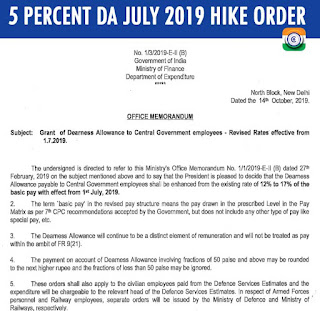
5 Percent DA July 2019 Hike Order - Grant of Dearness Allowance to Central Government employees

Grant of Dearness Allowance to Central Government employees 5 Percent DA July 2019 Hike Order  No. 1/3/2019-E- II (B) Government of...

Blog Archive

About The Author