A complete reference blog for Indian Government Employees

Showing posts with label CPC. Show all posts

Monday, 19 June 2017

Financial impact of 7th CPC on medical institutes

Financial impact of 7th CPC on medical institutes

GOVERNMENT OF INDIA
MINISTRY OF  HEALTH AND FAMILY WELFARE
RAJYA SABHA
UNSTARRED QUESTION NO-4426
ANSWERED ON-11.04.2017

Financial impact of 7th CPC on medical institutes

4426 .    Shri K. R. Arjunan
Will the Minister of HEALTH AND FAMILY WELFARE be pleased to state:

(a) whether medical institutes are finding difficulty to comply with Governments circular to generate 30 per cent of additional financial impact incurred on implementing 7th Central Pay Commission (CPC);

(b) whether most of the medical institutes have said that it will not be possible to generate the 30 per cent of additional financial impact without burdening patients and for them Government hospitals are the last hope especially for the poorer section of our society;

(c) whether most institutions have now written to Government explaining the difficulty; and

(d) if so, details thereof and steps proposed to be taken up by Government thereon?
ANSWER
ANSWER
THE MINISTER OF STATE IN THE MINISTRY OF HEALTH AND
FAMILY WELFARE
(SHRI FAGGAN SINGH KULASTE)

(a) to (d): Government has not put any mandatory condition on Medical Institutes to generate 30% of the additional financial impact incurred on implementing the 7th Central Pay Commission (CPC). Most Medical Institutes have expressed inability to meet 30% of the additional financial impact. Therefore, the Ministry has submitted 13 proposals so far to Ministry of Finance for relaxation in the condition to bear 30% of additional financial impact.

7th Central Pay Commission
Share:

Saturday, 4 February 2017

Clarification regarding pay fixation under 7th CPC for the post of 'Trainee' appointed on compassionate grounds

Clarification regarding pay fixation under 7th CPC for the post of 'Trainee' appointed on compassionate grounds
CGDA, Ulan Batar Road, Palam, Delhi Cant-110010

No.AN/XlV/14164/7th CPC/corrsp/Vol-I
Dated 01/02/2017
To
All PCsDA/CsDA/PCof A(Fys)Kolkata

Subject: Clarification regarding pay fixation under 7th CPC for the post of 'Trainee' appointed on compassionate grounds.

This office is receiving several references frorn various controller offices seeking clarification regarding pay fixation under Seventh CPC in respect of 'Trainee-appointed on ground without acquiring minimum educational qualification in the pay scale of Rs 4440/-7440/- (pre-revised ) without any Grade Pay. Such trainees are to be placed in the pay band-I (5200-20200) With Grade pay of Rs 1800/- only on acquiring the minimum qualification prescribed under the recruitment rules. However, under the CPC, neither any specific pay matrix level nor the manner for fixation of pay in respect of MTS Trainee has been prescribed.

2. In this regard, it is intimated that matter already stands referred to the Ministry for furnishing necessary clarification/guidelines to regulate the pay fixation of trainees under Seventh CPC. Reply of the same is still awaited. As and when , reply is received from the Ministry, the same will be widely publicized. Hence, it is requested to await for orders/ clarification from the Ministry in this regard.

3. This is for your information and necessary action please.

sd/-
(Kavitha Garg)
Sr.Dy.CGDA(AN)
Authority: http://cgda.nic.in/
Share:

Friday, 30 January 2015

Gold award for the Income Tax Department under National Award on E-Governance 2014-15

Gold award for the Income Tax Department under National Award on E-Governance 2014-15

The Income Tax Department has been awarded GOLD by the Government of India under category “Cat-I-Excellence in Government Process Re-engineering” for National Award on e-governance 2014-15. The award has been conferred for “TDS Reconciliation Analysis & Correction Enabling System (TRACES)” project launched by the Department. The Project marks a major step in ensuring TDS compliance through the processing of TDS returns and comprehensive data processing of TDS statements using technology driven end-to-end processes. At present 15 Lakh deductors and 2.5 crore tax payers are using various e-enabled online services through the CPC (TDS). The award was presented today during the 18th National Conference on e-governance held at Mahatma Mandir, Gandhinagar, Gujarat. This third award on e-governance to the Income Tax Department in the last 5 years speaks volumes about the commitment of the Department to e-governance and to move towards a non-adversarial and tax-payer friendly regime.

- PIB
Share:

Monday, 19 January 2015

Review of Model RRs for the Store Keeping staff category of posts

Review of Model RRs for the Store Keeping staff category of posts

No. AB-14017/11/2014-Est(RR)
Government of India
Ministry of Personnel, PG and Pensions
Department of Personnel & Training
New Delhi
Dated the 16th January, 2015
OFFICE MEMORANDUM

Subject:- Review of Model RRs for the Store Keeping staff category of posts.

The Model RRs for the Store Keeping staff category of posts issued in this Department OM No. AB-14017/41/87-Estt. (RR) dated 23.3.1987 have been reviewed in the light of 6% CPC recommendations on revision of pay scales, instructions issued by this Department, etc. Accordingly, the revised Model Recruitment Rules for the same are enclosed as Annexure to this Office Memorandum.

2. Ministries / Departments may review the existing recruitment rules and notify the revised rules conforming to the Model Recruitment Rules. These may also be forwarded to all autonomous/ statutory bodies for adoption. The Ministry of Home Affairs is also requested to forward these Model RRs to the UT Administrations for appropriate action.

3. Hindi version will follow,
(Mukta Goel)
Director (E-I)
Tel: 2309 2479
DOWNLOAD MODEL RECRUITMENT RULES FOR THE POST OF STORE KEEPER GRADE-II
Share:

Monday, 1 December 2014

Need to convert Central Pay Commission into National Pay Commission

Need to convert Central Pay Commission into National Pay Commission

Dear Editor

The Central government has setup 7th Central Pay Commission for the reviewal & revision of Pay & Perks of its employees afresh. It has been observed that after 4th C.P.C the employees of most of the States demanded implementation of its recommendations in their favour. In J&K State, too, its recommendations were implemented in two phases in 1987 and 1992 though not fully. Similarly, 5th and 6th C.P.C’s recommendations too were implemented in a way that suited the then rulers in J&K State. Besides, the recommendations of CPCs do not accommodate the view point of employees organizations of States as such there has been a demand for implementation of CPCs recommendations as per Central pattern.

All J&K Low Paid Employees Federation headed by a veteran trade union leader Com. Abdul Majid Khan held the view the Pay structure should be based upon “Need based minimum wage” accepted in the 15th Indian Labour Conference held in 1957 chaired by the then Prime Minister of India Pt. Jawahar Lal Nehru and treating D.A as a deferred wage. This view has not been reflected in the recommendations of successive pay Commissions so far. With a view to restructure Pay & Perks on uniform basis there is thus justifiable need to convert 7th CPC into National Pay Commission so that state employees organizations too have an opportunity to represent their respective view point before it before the Pay commission formulate its recommendations.
—Krishan Singh,
A Pensioner of J&K State
Source: Kashmir Times
Share:

Tuesday, 18 February 2014

Challenges before the Seventh Pay Commission : Central Government Employees

Challenges before the Seventh Pay Commission : Central Government Employees

- by Raj Kumar Ray (Financial Express)

 SUMMARY

Growth has fallen in the last couple of years eroding revenue while inflation remains stubbornly high. The new pay commission will have to factor in both concerns

Why does the government appoint a pay commission every decade?
A pay panel is appointed every decade to review and recommend the pay structure for central government employees taking into account various factors such as cost of living, inflation rate, revenue growth and fiscal deficit of the government, growth in workforce, private sector job scenario and wages, and economic growth. The government has so far appointed six pay commissions. The demand for a permanent pay commission set up through an Act of Parliament has been raised once but it was not accepted by the government.

Earlier this month, Prime Minister Manmohan Singh approved the constitution of the Seventh Pay Commission—to be headed by retired Supreme Court judge Ashok Kumar Mathur—to suggest the extent of hike in salaries of the 7-million-plus central government staff and pensioners with effect from 2016. Petroleum secretary Vivek Rae has been appointed as a full-time member, NIPFP director Rathin Roy will be part-time member and Meena Agarwal will be member-secretary of the new pay panel.

How did the process of pay hikes evolved?

The pay panel recommendations have evolved with time. The first central pay commission (CPC) adopted the concept of “living wage” to determine the pay structure of the government staff. The third CPC adopted the concept of “need-based wage”. The fourth CPC had recommended that the government constitute a permanent machinery to undertake periodical review of pay and allowances of its employees, but this was not accepted by the government. The sixth CPC suggested performance related incentive scheme (PRIS) to replace the ad hoc bonus and productivity-linked bonus schemes. The pay panel also suggested that the running pay band be extended to all grades of officers. Also, the sixth pay panel suggested slashing of the number of grades to 20 and one distinct pay scale for secretaries from the 35 existing earlier.

By how much have the public sector salaries increased every decade following the pay panels’ recommendations?

By and large, the salaries of central government staff have tripled every decade. The sixth CPC suggested 3 times increase in salaries from that of fifth CPC levels—it was 2.6 times for lower grade officials and slightly above 3 for higher grade staff. The increase in salary during fifth CPC was 3-3.5 times the fourth CPC levels.

What has been the fiscal implication of pay hikes?
Government finances have come under strain after implementations of each CPC. After the fourth CPC, the combined fiscal deficit of centre and states rose to 9.5% of GDP in FY87 from 7.7% in FY86. The impact was significantly harsh during the fifth CPC, especially for states—the combined fiscal deficit rose from 6.1% in FY97 to 7% in FY98 and then to 8.7% in FY99 with the aggregate deficit of states surging from 2.6% to over 4%.

In the case of the sixth CPC, the government expenditure increased by about Rs 22,000 crore during 2008-09—Rs 15,700 crore on the general budget and Rs 6,400 crore on the rail budget. The Rs 18,000 crore arrears were distributed in two years—40% in FY09 and 60% in FY10. The fiscal implication of sixth CPC coupled with fiscal stimulus in the form of higher spending and tax cuts after the Lehman crisis, increased Centre’s fiscal deficit to 6% in FY09 and 6.5% in FY10 from less than 3% in FY08.


What are the challenges before seventh CPC?
The new pay panel faces many challenges when it starts the process of reviewing the pay structures of babus. First, the economic growth has slowed sharply in the last 10 years—from over 9% between FY06 and FY08 to 4.5% in FY13. This means slower revenue growth and little room for scaling up expenditure on salaries.

Second, the Fiscal Responsibility and Budget Management (FRBM) target has already been revised more than twice after the Lehman crisis and the new target for lowering the fiscal deficit target to 3% of GDP is FY17. This again binds the government to restrict spending on salaries and wages.

Third and the most important factor, inflation has stayed high in the past few years—the CPI inflation (CPI-Industrial Workers and the new CPI) has averaged over 9% in the past eight years, which means cost of living has gone up significantly and hence necessitates higher compensation for workers. The dearness allowance of government staff has already touched 100%, which along with the rise in other allowances have more than doubled salaries since 2006.

Analysts expect the seventh pay panel to suggest 3-3.5 times hike in salaries across various grades from sixth CPC levels apart from a further rationalisation of government staff. Already, direct or permanent jobs in public sector have been shrinking while engagement of contract labour and outsourcing is on the rise. This trend is likely to continue given the fiscal imperatives of the government.

There is a perception that government salaries should rise faster at the higher grades and slowly at the lower grades to keep pace with private sector. It needs to be seen whether the seventh CPC retains the minimum:maximum ratio at sixth CPC level of 1:12. A hike in the ratio should not impinge the fisc much as the top level officials—joint secretaries and above—comprise less than 5% of the overall public sector workforce. The performance related incentives could also be reviewed to retain talent within the public sector. More than the fiscal implication, what matters is the productivity of the public sector. For instance, sluggish clearances needed for large projects have ruined investment and halved the growth rate in last three years. The silver-lining of the next CPC could be that it may boost the services sector growth and help revive the faltering economy from 2016 as higher salaries boost spending on housing, automobiles and consumer electronics.

Source: Challenges before the Seventh Pay Commission
[http://www.financialexpress.com/news/challenges-before-the-seventh-pay-commission/1226949/0]
Share:

Sunday, 29 September 2013

CONFEDERATION NATIONAL SECRETARIAT WILL MEET ON 23.10.2013 - STRIKE BALLOT DEFERRED

CONFEDERATION OF CENTRAL GOVERNMENT EMPLOYEES & WORKERS
(Central Head Quarters)
1st Floor, North Avenue Post Office Building, New Delhi - 110001


CIRCULAR NO. 8/2013                                                                                      DATED – 28.09.2013


IMPORTANT CIRCULAR


CONFEDERATION NATIONAL SECRETARIAT WILL MEET ON 23.10.2013 TO DECIDE FUTURE COURSE OF ACTION
STRIKE BALLOT DEFERRED

Dear Comrades,

            The National Secretariat of the Confederation congratulate the affiliates and State Committees for the strenuous efforts put in by them to propagate and campaign amongst the mass of the employees of the need for an immediate wage revision and setting up of the 7th CPC and enlist the massive participation of the Central Govt. employees for a long drawn out struggle, which commenced in 2011 and the first phase of which was culminated on 12th December, 2012 in a one day strike action.  We are proud of the fact that our efforts has borne fruit  as the Government  had to announce the setting up of the 7th CPC  on 25th. Confederation, as you are aware, had always been in the forefront in formulating demands of the CGEs, presenting and articulating the issues in spearheading struggles and negotiating the demands to reach settlement.  This time also Confederation was the organization which raised the setting up of the 7th CPC and wage revision; demanded that the 7th CPC’s recommendation must be effective from 1.1.2011; insisting that the tenure of the recommendation of the 6th CPC must be ended on the expiry of the five years on par with the wage tenure of the Public Sector undertaking workers as early as in 2010.  It could justify the demands with facts and figures of the unprecedented erosion of the real value of the wages of the Central Government employees due to the high rate of inflation in the economy and shooting up of the prices of all essential commodities.  The campaign and propaganda unleashed by us together had its salutary impact on the thinking process of other sister organizations, compelled them to take note of the growing discontent amongst the rank and file of their membership and to realize the fact that the wage structure had become incapable of making both ends meet especially for those employees at the lower levels of the hierarchy. They had to perforce take up the issue of wage revision  and setting up the 7th CPC due to the ambience created by the Confederation and its affiliates by organizing series of struggles during  the period and at the same time spurning every of our attempt for a joint action. We are quite aware that sanctions cannot be generated without joint and united action of the workers.  This dichotomy practiced by the predominant organizations in the JCM inflicted irreparable damage to the cause of the Central Government  employees.

We are happy that the Government of India having realized that the large majority of the Central Government employees have become mentally attuned to the path of an inevitable struggle on wage revision  decided to avert a confrontation by announcing the setting up of the 7th CPC.   We must, however, realize that the decision of the Government  tantamount to a post dated cheque which is capable of encashment only after a long period of two and half years.  We must not take it lying down.  The agony and sufferings of the employees, especially those at the lower levels cannot be mitigated by promises and assurances.  There must be a rise in their emoluments to make them capable of meeting the ever increasing cost of essential needs.  The Government must be told categorically and compelled to agree for the merger of DA with pay; and interim relief, which had all along been the case ever since the advent of the system of Pay Commission for wage revision.  We must bring home the fact that there will be no question of any arrears arising from the recommendation of the 7th CPC as the Commission is mandated to make its recommendation before the crucial date of 1st January, 2016.

Even though, it is stated that the terms of reference would be finalized in consultation with all stake holders, the question of inclusion of GDS within the ambit of the Pay Commission, in all probabilities would be resisted by the Government. In the light of the passage of the PFRDA Bill in the Parliament, the Government might not agree to include the retirement benefits in the terms of reference.  This apart, the Government will now refer all pending matters, be it at the National Anomaly Committee, National Council or various Departmental Councils  or taken up through inter departmental references  to the 7th CPC.  In other words for the next two and half years none of the issues of the CGEs will be either discussed or settled.  We must not allow the Government to succeed in this nefarious objective.

We must note that the present announcement of setting up of the 7th CPC has also the hidden political agenda, for  many States including  Delhi  are to go to polls in the next few months.  The National Secretariat of the Confederation will meet on 23.10.2013 at Delhi. Formal notice is being sent separately. The Sectt. will decide upon the future course of action. In view of the present announcement of the Government setting up the 7th CPC it is necessary that we should defer the strike ballot decision, which is scheduled to be held on 11th to 13th November, 2013.  It is however, our considered opinion that unless we tread the path of struggle the demand for merger of DA with pay, date of effect, inclusion of GDS within the ambit of the 7th CPC and other issues in our charter of demands will not be settled at all.   The campaign chalked out must, therefore, be carried out with determination and understanding that we will succeed.   We request the leaders of the affiliates, State Committees and National Sectt. Members to ensure that the campaign programmes are implemented as planned.
With greetings,

Yours fraternally,


(K. K. N. Kutty)                                                                                                  (M. Krishnan)

President                                                                                                            Secretary General

 Source: http://confederationhq.blogspot.in/
Share:

Thursday, 4 July 2013

Railway staff seek constitution of Seventh Pay Commission (7CPC)

Railway staff seek constitution of Seventh Pay Commission (7CPC)

All India Railwaymen Federation, Confederation of Central Government Employees’ Association and All India Defence Employees Association have threatened to go on strike if the Centre fails to meet their charter of demands, including constitution of the Seventh Pay Commission.

Addressing a meeting of Southern Railway Mazdoor Union members here, its zonal president C.A.Raja Sridhar said the three trade bodies will wait till August for a positive response from the Centre, and will go on a nation-wide strike if they did not get any.


Around 25 lakh employees will join the agitation, he noted. Among the demands are merger of dearness allowance with basic pay, regularisation of services of gramin dak sevaks, rolling back of new pension scheme, scrapping of ceiling on bonus and appointment on compassionate ground.


Move flayed
Southern Railway Mazdoor Union has also condemned the Railway Ministry’s move to provide the drawings and designs of coaches of Integral Coach Factory (ICF), Chennai, to five private coach manufacturing factories to come up in the country.


“This move is nothing but plundering of the national wealth for the benefit of private companies,” said Mr.Sridhar.


He wondered what was the necessity for the railways to have private coach factories, when the Ministry had proposed to set up its own units at Rai Bareilly and Palghat and a second unit of the ICF.
“The process of recruitment of around 700 employees at Rai Bareilly unit was under way, while the certificate for production from the Ministry was awaited for the Palghat unit,” Mr.Sridhar said, and added that the budget proposal had been made for the second unit of the ICF, he said.


Stating that the Railways had paid Rs.150 crore to Germany to get patent right for the design of LBH coaches in the past, Mr.Sridhar asked why should the decades of toil of the ICF employees go free of cost to private companies in the form of its drawings and design.


The conditions laid for the five coach factories were highly favourable to private companies. Private companies would be making only steel shells while specialised tasks like manufacturing axle, wheel and traction equipment would be done by the ICF, he added.

Source :http://www.thehindu.com
Share:

Featured post

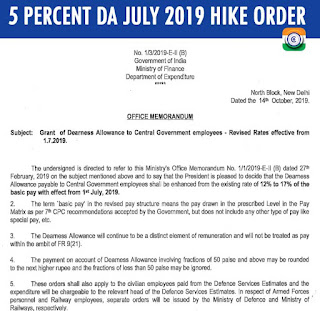
5 Percent DA July 2019 Hike Order - Grant of Dearness Allowance to Central Government employees

Grant of Dearness Allowance to Central Government employees 5 Percent DA July 2019 Hike Order  No. 1/3/2019-E- II (B) Government of...

Blog Archive

About The Author