A complete reference blog for Indian Government Employees

Showing posts with label Modi Government. Show all posts

Friday, 1 February 2019

HIGHLIGHTS OF BUDGET 2019


HIGHLIGHTS OF BUDGET 2019

Tax
1. Within 2 years, Tax assessment will be done electronically
2. IT returns processing in just 24 hours
3. Minimum 14% revenue of GST to states by Central Govt.
4. Custom duty has abolished from 36 Capital Goods
5. Recommendations to GST council for reducing GST rates for home buyers
6. Full Tax rebate upto 5 lakh annual income after all deductions.
7. Standard deduction has increase from 40000 to 50000
8. Exempt on tax on second self-occupied house
9. Ceiling Limit of TDS u/s 194A has increased from 10000 to 40000
10. Ceiling Limit of TDS u/s 194I has increased from 180000 to 240000
11. Capital tax Benefit u/s 54 has increased from investment in one residential house to two residential houses.
12. Benefit u/s 80IB has increased to one more year i.e. 2020
13. Benefit has given to unsold inventory has increased to one year to two years.

Other Areas
14. State share has increased to 42%
15. PCA restriction has abolished from 3 major banks
16. 2 lakhs seats will increase for the reservation of 10%
17. 60000 crores for manrega
18. 1.7 Lakh crore to ensure food for all
19. 22nd AIIMS has to be opened in Haryana
20. Approval has to be given to PM Kisan Yojana
21. Rs. 6000 per annum has to be given to every farmer having upto 2 hectare land. Applicable from Sept 2018. Amount will be transferred in 3 installments
22. National kamdhenu ayog for cows. Rs. 750 crores for National Gokul Mission
23. 2% interest subvention for farmers pursuing animal husbandry and also create separate department for fisheries.
24. 2% interest subvention for farmers affected by natural calamities and additional 3% interest subvention for timely payment.
25. Tax free Gratuity limit increase to 20 Lakhs from 10 Lakhs
26. Bonus will be applicable for workers earning 21000 monthly
27. The scheme, called Pradhan Mantri Shram Yogi Mandhan, will provide assured monthly pension of Rs. 3,000 with contribution of Rs. 100 per month for workers in unorganized sector after 60 years of age.
28. Our government delivered 6 crores free LPG connections under Ujjawala scheme
29. 2% interest relief for MSME GST registered person
30. 26 weeks of Maternity Leaves to empower the women
31. More than 3 Lakhs crores for defence
32. One lakh digital villages in next 5 years
33. Single window for approval of India film makers
Share:

Monday, 14 January 2019

PM greets the people on the occasion of various festivals across India

Prime Minister's Office
PM greets the people on the occasion of various festivals across India
14 JAN 2019
The Prime Minister, Shri Narendra Modi has greeted the people on the occasion of various festivals across India.

"Happy Makar Sankranti to everyone!
Best wishes on Pongal!
Greetings on the special occasion of Magh Bihu.
Happy Uttarayan.
May you all scale new heights of progress in the times to come", the Prime Minister said.

PIB
Share:

Saturday, 21 January 2017

7th pay commission: This is why Modi government not giving hike to 47 lakh employees


7th pay commission: This is why Modi government not giving hike to 47 lakh employees

Reports suggest that the committee under the chairmanship of finance secretary Ashok Lavasa has finalised its report for salary hike in accordance with the recommendations of the seventh CPC, but the government is unable to pay the allowances to its employees due to cash crunch.

More than 14 months have passed since the seventh pay commission report was submitted and little less seven months have elapsed since the union cabinet approved implementation of the salary hike recommendations, but the central government employees are still awaiting the good news.
Demonetisation is said to be the reason behind the delay in announcing allowances by the Narendra Modi government for the 47 lakh employees and 53 lakh pensioners. The number of beneficiaries includes 14 lakh employees and 18 lakh pensions from the armed forces.

HOW DEMONETISATION AFFECTS PAY HIKE: THINGS TO KNOW
  1. The government has announced that it will implement the seventh pay commission's recommendations from January 1 last year. But, in the aftermath of demonetisation, the government is not in position to make the final decision.
  2. The seventh pay commission proposed a 138.71 per cent hike in housing allowance (HRA) and 49.79 per cent for other allowances.
  3. The pay commission estimated that during the current fiscal, the hike in allowances would add a burden of Rs 29,300 crore (Rs 17,200 crore under HRA and Rs 12,100 crore under other allowances). This is a huge sum but after demonetisation, the government is working hard to stave off the cash crunch that set in.
  4. The Modi government has constituted a committee to look into the recommendations regarding allowances and the manner of their implementation.
  5. Some reports suggest that the committee under the chairmanship of finance secretary Ashok Lavasa has finalised its report, but the government is unable to pay the allowances to its employees due to cash crunch.
  6. The employees' unions have been putting pressure on the finance ministry to announce hike in allowances at the earliest.
  7. The announcement of assembly elections in five states has given some time for the government as it cannot announce pay hikes till the model code of conduct is in place.
  8. The assembly elections have given the government time till March 8, by when there would be some additional cash in circulation. But, by then the budget would have been presented and accommodating over Rs 29,000 crore for salaries and pensions in the budge may pose a problem.
  9. The delay in implementation of the seventh pay commission's recommendations has caused tremendous irritation and frustration among employees.
  10. The BJP may have to face a backlash in the assembly elections in the five states, two of which is ruled by the party either directly or in alliance. Thus, demonetisation move by the Modi government may strike a double blow to the BJP in polls.
Source: Indiatoday
Share:

Saturday, 12 November 2016

What is the procedure to change the 500, 1000 notes through representative ?

What is the procedure to change the 500, 1000 notes through representative ?

In case you are not possible for you to visit the bank you may send your representative with an express mandate i.e. a written authorisation. The representative should produce authority letter and his / her valid identity proof while tendering the notes.

Proof of identity: Valid Identity proof is any of the following: Aadhaar Card, Driving License, Voter ID Card, Pass Port, NREGA Card, PAN Card, Identity Card Issued by Government Department, Public Sector Unit to its Staff.

Authority letter for change the 500, 1000 notes through representative


REQUEST LETTER FOR EXCHANGE OF OLD HIGH DENOMINATION BANK NOTES OF Rs.1000 AND Rs.500

Request-slip-for-exchange-of-old-notes


Click to download the form
Share:

Wednesday, 22 June 2016

Ministry of Railways Observes The International Day of Yoga

Ministry of Railways Observes The International Day of Yoga

Ministry of Railways organised the International Day of Yoga today on 21st June, 2016 in Rail Bhawan as per the direction of the Ministry of AYUSH.

The Union Minister for Railways, Shri Suresh Prabhakar Prabhu participated in the Yoga session along with the Chief Minister of Andhra Pradesh, Shri N. Chandra Babu Naidu, on the occasion of the 2nd International Day of Yoga at Vijayawada.

A Yoga session was organized at Rail Bhawan headquarters in new Delhi by engaging Shri Chakardhar Kushwaha, Yoga Instructor of the Morarji Desai National Institute of yoga, New Delhi. This event was attended by Railway Board officials including Chairman Railway Board Shri A. K. Mital and other Board Members.

International Yoga day was also observed in the entire Indian Railway System which included zonal Railway Headquarters, Division Railway Headquarter, Production Unit Headquarters, Railway Training Institutes and Centres, and all other Railway establishments.

Source: PIB
Share:

Saturday, 18 June 2016

7CPC: Good news for government employees! Secretary Panel submits report; recommendations implementation soon

7CPC: Good news for government employees! Secretary Panel submits report; recommendations implementation soon

New Delhi,  There is a good news for central government employees who have been ardently waiting for the implementation of 7th Pay Commission. According to a Dainik Jagran report, “The Cabinet Secretary met the PMO officials on Wednesday and apprised them about the secretaries panel’s recommendations on the salary and allowances hike recommended for central government employees.

The secretaries panel reviewing the 7th pay commission’s recommendations have submitted its report to the Finance Ministry. The Finance Ministry will prepare a note and present it before the Cabinet in the next 15 days.” Whereas according to a India.com report, “The 13-member Committee of Secretaries headed by the Cabinet Secretary Pradeep Kumar Sinha is likely to submit its final report on the recommendations proposed by the 7th Pay Commission on June 18. After panel submits its report, Cabinet is expected to give the green signal for implementation of the revised recommendations. However the government is planning to implement the recommendation made by the 7th Pay Commission regarding the salary hike of government employees from August 1.” According to latest reports, Government staff will get their six months arrears in one installment in the month of October. It is being said that Government will implement Seventh Pay Commission most likely from July. Employees will get increased payout in their July salary and it will be credited in their account on August 1. The recommendations when implemented would have bearing on remuneration of 47 lakh central government employees and 52 lakh pensioners. Subject to acceptance by the government, the recommendations will take effect from January 1, 2016.

OneIndia News
Share:

Monday, 23 May 2016

7th Pay Commission: Euphoric Modi government to give final nod to Increment notification soon

7th Pay Commission: Euphoric Modi government to give final nod to 'Increment'; notification soon

7thCPC Increment notification

As high voltage State Assembly polls have ended now, Government is all set to implement the recommendations of Seventh Pay Commission.

Reportedly, Modi Government which is euphoric after party's victory in Assam and its good show in Kerala, looks in full mood to handover increased payout to Government staff anytime soon.

It is being believed that as model code of conduct is no longer a barrier in the way of implementing salary increment, Government could issue notification in the first week of June. Sources say that all the formalities regarding the implementation process will be done after a Cabinet meet which will be chaired by Prime Minister Narendra Modi soon. Read more: 7th Pay Commission: PMO orders early implementation of 'increment', wants 'maximum payout' for staff A website quoting Finance Ministry sources writes, "the BJP led central government is now in a pleasant mood, accordingly it may announce better pay package that recommended by Pay Commission to central government employees". Reportedly, Modi Government will give 25-30 per cent increment to Central Government employees, Sources say that increment will be handed over in July while arrears from January till that date will be paid in August.

OneIndia News
Share:

Sunday, 22 May 2016

7th Pay Commission: Government doctors threaten to go on strike want better salary, allowances

7th Pay Commission: Government doctors threaten to go on strike; want better salary, allowances

7th Pay Commission government doctors strike

The Seventh Pay Commission be implemented anytime now but before that everyone wants their demands to be met in regards with the allowances and wages. If reports are to be believed then, the doctors working in government hospitals in Delhi may go on strike if the Modi government does not meet their demands in connection with the seventh pay commission.

Government is deciding our pay scale, and does not even bother to listen to our demands. They do not even give us appropriate representation in the committee. While no doctor likes to go on strike, we will do exactly so if the existing recommendations of the 7th Pay commission are given a go ahead," Dr Pankaj Solanki, President, Federation of resident doctors association (FORDA) was quoted as saying in a ZeeNews report.

The report further adds, "FORDA is a body of 15000 resident doctors in the capital, and have said that government doctors from other organisations and states have shown their inclination towards the strike opposing the recommendations of the seventh pay commission." Doctors have said that either their demands be met by the end of or they will go on an indefinite strike. Earlier, the central government employees had also said that they are planning to strike work on July 11 so that they get higher wages and allowances under the 7th Pay Commission.

The central government employees lead by the National Council (Staff Side) Joint Consultative Machinery have also said that they will not accept unilateral decision on salary hikes under the seventh Pay Commission and would like to have more say in the way their monthly salaries and allowances are shaped up by the Empowered Committee of Secretaries.

Via OneIndia News
Share:

Friday, 18 December 2015

Abolishment of the practice of interview for Group B and C posts

Abolishment of the practice of interview for Group B and C posts

The Central Government has decided to dispense with the interview for all Group ‘C’ and non-gazetted Group ‘B’ category in Central Government by 31.12.2015. If a Department considers interview absolutely necessary for any specific posts, then clearance of Department of Personnel & Training is necessary.

Further, the State Governments have also been requested on 4th September 2015 and 29th September, 2015 to undertake similar exercise in respective States in consultation with State Public Service Commissions or other agencies involved in the recruitment for junior level posts. This issue was also deliberated during a meeting held on 8th September, 2015 and in a one day workshop organized on 16th November, 2015 in which the State Secretaries of Personnel/General Administration Department were invited.

This was stated by the Minister of State in the Ministry of Personnel, Public Grievances and Pensions and Minister of State in the Prime Minister’s Office Dr. Jitendra Singh in a written reply to a question by Shri Anil Desai in the Rajya Sabha today.
Share:

Friday, 11 December 2015

Minimum Government and Maximum Governance

Minimum Government and Maximum Governance

A citizen friendly and accountable administration is the focus of the government. A series of steps to achieve this goal have been initiated. These include simplification of procedures, identification and repeal of obsolete/archaic laws/rules, identification and shortening of various forms, leveraging technology to bring in transparency in public interface and a robust public grievance redress system.

Doing away with the practice of submitting Affidavits for small level executive jobs in the Government and allowing Self-Certification of certificates is one important step in this regard. This has greatly led to the reduction in time and effort on the part of both the citizen as well as the officials in many Government offices.
Leveraging the power of information technology brings with it the advantage of transparency and speed for the benefit of the citizens. In this regard the Government has embarked upon a time bound Digital India Plan. The details of this plan are available on the Website of the Department of Electronics & Information Technology (www.deity.nic.in). As a part of Digital India Plan, the Department of Administrative Reforms & Public Grievances has been made the nodal ministry for implementation of e-Office in Central Ministries/Departments. The Department is regularly monitoring implementation of the e-Office project. The Ministry of Panchayati Raj has moved into 100% e-Office platform.

The Central Secretariat Manual of Office (CSMOP) has been revised and the 14th Edition of the CSMOP was brought in the form of e-Book form on 22nd May, 2015, which is available on the website www.darpg.nic.in. This is a much reduced and simplified version of the manual in comparison to the earlier editions. A number of redundant and repetitive literatures and words have been removed.

The Government of India has also taken a number of initiatives for improving ‘Ease of Doing Business’. The emphasis has been on simplification and rationalization of the existing rules and introduction of information technology to make governance more efficient and effective.

One of the focus areas of Government is to reduce the decision making layers to the minimum while allowing for faster means of information sharing/dissemination. The Government has launched a website mygov@nic.in and india.gov.in for this purpose. This is a citizen centric platform to empower people to connect with the Government and contribute towards good governance. Suggestions are also received on the PMO website. It also seeks expert advice from the people, thoughts and ideas on various topics that concern India. Citizens can join the discussion to share, debate and add value.

This was stated by Minister of State in the Ministry of Personnel, Public Grievances and Pensions and Minister of State in the Prime Minister’s Office Dr. Jitendra Singh in Lok Sabha today in a written reply to a question by Shri Nalin Kumar Kateel, Shri B.N. Chandrappa, Shri D.K. Suresh and Shri R.K. Bharati Mohan.

PIB
Share:

Friday, 25 September 2015

7th Pay Commission: Salary rises should be based on performance

7th Pay Commission: Salary rises should be based on performance

New Delhi: The Seventh Pay Commission is likely to recommend to rise the salary of central government employees should be based on performance in the office, rather than just time served.

The central government urged the Seventh Pay Commission to make proposal for enhanced pay and special incentives as performance based annual increments.

Appraisals for government employees were introduced since British period but didn’t affect pay. Eight years ago, the Sixth Pay Commission asked to link the performance of central government employees with their pay.

The Sixth Pay Commission had carried out a study through the Indian Institute of Management, Ahmedabad, on a performance-based incentive system, to ostensibly improve the performance outputs of Central government employees.

The study was aimed at working out a model whereby a base salary is attached to each post based on skills and responsibility and simultaneously, a second component would be payable over and above the salary on the basis of the productivity and performance of employees, either individually or as a group.

The government employees believe pay should reflect the cost of living while private sector workers believe pay should reflect performance.

Accordingly, the Narendra Modi government plans to move towards making increment programmes based on performance rather than on time-served through the Seventh Pay Commission and automatic annual incremental pay progression would be scrapped in central government ministries and departments.

The original idea behind performance incremental pay is that every central government employee takes a while to become fully competent in a role, so government can reward them as they grow in competence and experience.

Despite the government having powers to withhold increments, but nowadays, very few do, so there is a culture of government employees moving up the pay scale irrespective of their performance.

The bottom line is if government doesn’t get rid of automatic incremental progression, the government can’t control pay, and that is what the Modi government has realised.

The central government employees can play a vital role in this way in nation building.

Therefore, the Seventh pay commission may recommend up to 5 percent performance-based increment instead of automatic annual increment for central government employees.

TST
Share:

Sunday, 7 June 2015

Bonus: Modi government to raise the salary threshold from Rs.10,000 to 15,000, ceiling limit from Rs. 3500 to 4500

Bonus: Modi government to raise the salary threshold from Rs.10,000 to 15,000, ceiling limit from Rs. 3500 to 4500
In bonus to workers, cap on salary set to be raised: Financial Express News
Several lakhs of workers in the organised sector will benefit as the Narendra Modi government is set to raise the salary threshold for mandatory bonus for workers from Rs 10,000 a month at present to Rs 15,000 and the minimum bounty from an annual Rs 3,500 now to Rs 4,500. The proposal, agreed to by employers’ associations at a recent meeting of an inter-ministerial group, would require Parliament’s approval as the Payments of Bonus Act, 1965, requires to be amended for this purpose.
While the minimum bonus is a legal liability on the firms concerned, whether or not they make a profits, these firms are also required to pay the workers a higher bonus if their “allocable surplus” exceeds the amount payable as minimum bonus, subject to a cap (20%) of the salaries.


If the new proposal takes affect, the maximum bonus payable by profit-making ventures would be close to Rs 11,000 as against Rs 8,400 now.

minimum+salary+for+bonus+minimum+annual+bonus 
The salary ceiling for mandatory bonus eligibility was last fixed in 2007 and made effective retrospectively from April 1, 2006. While industry associations demanded exempting sick units from the requirement of paying bonus, trade unions have pitched for removal of the ceilings as “profits are not capped”, official sources said. The unions also asked for extending the benefit to workers under the Industrial Disputes Act, they added.

The revision of the bonus eligibility and the amounts is being done by factoring in the relevant price increases, the gauge used being the consumer price index-industrial workers or CPI(IW). This index stayed in the range of 6.4-12% since 2008. After hitting as high as 12% in 2010, CPI(IW) has maintained a roller-coaster ride — it eased to 8.9% in 2011 before rising to 10.9% in 2013 and dropping again to 6.4% in 2014. In the current calendar year, it has slowed almost consistently from 7.2% in January to 5.8% in April.
annual+change+in+consumer+prince+indexAn estimate is two-thirds of the 6 crore organised sector workforce in the country are eligible for the mandatory bonus given their salary levels. Analysts, however, say that actual number of beneficiaries could be less as many units practically circumvent the norm.Under Section 10 of Payments of Bonus Act, “every employer (as defined in the Act) shall be bound to pay to every employee in respect of every accounting year, a minimum bonus which shall be 8.33% of the salary or wage earned by the employee during the accounting year”. All factories and establishments employing 20 or more persons are expected to pay the bonus compulsorily, provided the worker has worked in the establishment for at least 30 days. Employees in Life Insurance Corporation, seamen, dock workers and university employees are outside the Act’s ambit.


Although the country witnessed high inflation between 2009 and 2014, the move to raise the bonus amounts comes at a time inflation has come down (consumer price inflation is now below 5%). Consumer confidence is yet to be restored to the pre-2008-09 levels, while in recent months rural income growth has slowed.
Read at: Financial Express

Share:

Tuesday, 3 February 2015

Know how the Railway budget will be this year?

Know how the Railway budget will be this year?

Sources Said: The Narendra Modi government’s first full-fledged railway budget to be announced on February 26 could be a muted exercise with no big-ticket announcements of new projects or railway lines, as has been the practice. Rationalisation of passenger fares or freight rates is also unlikely, according to sources.

However, what is likely is a focus on infrastructure creation in the northeast and improving passenger amenities such as introduction of vacuum toilets and dedicated freight services for farmers. The new railway minister, Suresh Prabhakar Prabhu, will lay greater emphasis on early and timely completion of all big existing projects rather than on new announcements.

According to officials who are part of this year’s budget preparations, the minister, who has a reputation for being a doer, might not tinker with fares or freight rates. A committee headed by D K Mittal, former secretary, financial services, has recommended an increase of two-paise per km in passenger fare. “The main thrust will be to increase the share of railways in the overall freight traffic, which is sliding at a fast rate,” said a senior official, who participated in some of the prebudget discussions.

The railway budget will not have announcements of too many new lines or projects – as is done every year based on political considerations – said another senior official from the rail ministry, who did not wish to be named. “These projects become an economic liability on us. So this time, the ministry is not entertaining specific requests for rail lines from members of Parliament (MPs),” he added. The first official said a key focus area in the coming railway budget could be infrastructure creation in north-eastern parts of the country, where a large number of projects are due for completion or about to take off in states such as Meghalaya and Mizoram. Prime Minister Modi had, during a tour to the north-eastern states in December 2014, announced Central funding for new railway lines in the region. “This is the best destination for tourists. But for that we require connectivity. For the development of this area and tourism, Rs 28,000 crore will be provided for a new railwayline project and 14 new railway lines,” he had said. According to officials, the overall thrust of the budget could also be on exploring and listing alternative sources of funding for the Indian Railways as the current traditional sources of non-Budgetary support including Indian Railways Finance Corporation bonds have been found to be inadequate.

The rail ministry has already decided to tap foreign pension funds as part of its resource mobilisation plan to bailout the Railways from its financial woes. “We will invite foreign pension funds to invest in Indian Railways. This could be in the form ofloans at a cheaper rate.

We have to bring in investments both from within and outside the country,” Prabhu had said last month. Prabhu, who took over as railway minister from Sadananda Gowda on November 10, 2014, will present his maiden rail budget in Parliament at a time the transporter is facing cost overruns to the tune of Rs1.11 lakh crore across 288 projects, Rs 30,000 crore annual losses on passenger service that is crosssubsidised with freight resulting into loss of freight market share; rising expenditure on fuel and pay for employees, dip in passenger volumes, slow progress of privatepublic partnership (PPP) projects and a lack of upgradation of infrastructure leading to accidents. Gowda, while presenting the railway budget in July 2014, had not touched fares but promised a turnaround through infusion of private investment and monetising railways ‘ vast land assets. Gowda’s budget also had fewer populist measures than other ministers in the past..

Source: News paper article published in FE
Share:

Friday, 30 January 2015

Commemorative Postage Stamp on Swachh Bharat

Commemorative Postage Stamp on Swachh Bharat

The Minister for Communications & Information Technology, Shri Ravi Shankar Prasad along with the Minister for Urban Development & Parliamentary Affairs  Shri Venkaiah Naidu and  the Minister for Rural Development Shri Chaudhary Birender Singh released Commemorative Postage stamps on the theme of  Swachh Bharat  to mark the Martyrdom Day of Mahatma Gandhi today..

Shri Ravi Shankar Prasad speaking on the occasion said the Government intends to make cleanliness a part culture of this country under the leadership of Shri Narendra Modi . He pointed out that the design for the stamps were selected through a competition among the children on the theme. The Minister for Urban Development Shri Venkaiah Naidu also appreciating the idea said that if the practice of cleanliness catches with our children, it would spread as a mass movement in the country. He hoped that Swachhatha will become a Jan Andholan. Shri Chaudhary Birender Singh said the release of the stamps on the Martyrdom Day on this subject of cleanliness, which is very close to the heart of the Father of the Nation, is an apt tribute to him.

The Department of Posts, at a function this morning issued a set of these three Commemorative Postage Stamps on the theme of Swachh Bharat.

Swachh Bharat Mission was launched by the Prime Minister on the 2nd October, 2014 on the occasion of Birth Anniversary of Mahatma Gandhi. This all encompassing Mission covering our surroundings seeks to achieve “Clean India” and aims to provide access to toilets to all households in the country, and making adequate arrangements for Solid and Liquid Waste Management.

Release of a set of three stamps and a miniature sheet on the theme Swachh Bharat is a part of this effort to achieve the vision of Clean and Healthy India.


Share:

Friday, 2 January 2015

AIRF General Secretary writes to PM about stopping 100% FDI and Privatization in Railways

AIRF General Secretary writes to PM about stopping 100% FDI and Privatization in Railways.

The letter is reproduced and given below for ready reference for our blog viewers…

Com. Shiva Gopal Mishra writes Hon’ble Prime Minister Sh. Narendra Modi about stopping 100% FDI and Privatization in Railways

Respected Shri Narendra Modi Ji,

During recent past, Railwaymen had been feeling highly demoralized and disgusted on account of apprehensions of privatization of the Indian Railways owing to 100% Foreign Direct Investment(FDI) and constitution of a High Level Railway Restructuring Committee for Restructuring of Ministry of Railways(Railway Board). Yesterday, on 25th December, 2014, while celebrating the 91st Birth Anniversary of Hon’ble Shri Atal Bihari Vajpayee as “Sushasan Diwas” in Diesel Locomotive Workshop, Varanasi, you publically announced that there would be no privatization of the Indian Railways, rather number of Railway employees shall be increased during the time to come, for which, we, on behalf of around 13 lakh Railway employees, express our heartily thanks for giving this assurance.

Sir, though the assurance given by you that the Indian Railways shall not be privatized, has provided some relief to the Railwyamen, who were feeling hurt and discouraged for the last six months, at the same time you have mentioned that FDI is essentially required in the Indian Railways, still creates some confusion. Although, there have been constructive discussions with the Hon’ble MR, which we hope, shall continue in future also.
AIRF has always supported and contributed a lot in the development and modernization of the Indian Railways through transparent process, as such, we would urge further assurance, so that the moral of lakhs of Railwaymen is kept high. Your goodself very-well know that there has been all round development in the Indian Railways after the Independence, and not only the Indian Railways have expanded a lot, but also have touched new horizons by adopting latest technology in different spheres, by virtue of which, Indian Railways are now running over 19,000 pairs of trains per day transporting more than 20 million passengers and around 35 lakh tonne freight everyday. Obviously, there has been dedicated contribution of the Railwaymen in this endeavour, not only this, but also the dedication of the Railwaymen can be adjudged from the fact that, while performing their duties, they even sacrifice their lives, and it has been established that hundreds of Railway staff loose their lives every year, as endorsed by the High Powered Committee, headed by Dr. Anil Kakodkar, in it’s report.

We, therefore, once again request you that, with a view to boosting morale of the Railwaymen, there should be clear and specific assurance by the government that the Indian Railways shall in no way be privatized, so that the staff shall be motivated to perform their duties with even more dedication and sincerity.

Wishing you very-very Happy New Year on behalf of all the Railwaymen and their family members!

With kind regards!
Yours Sincerely,
sd/-
(Shiva Gopal Sharma)
General Secretary
Shri Narendra Modi Ji,
Hon’ble Prime Minister,
Government of India,
New Delhi

Copy to: Hon’ble MR(Government of India), Ministry of Railways, Rail Bhawan, New Delhi.
Copy to: Hon’ble MoSR(Government of India), Ministry of Railways, Rail Bhawan, New Delhi.
Copy to: GSs, all affiliated unions – for information.
Share:

Monday, 1 December 2014

NDA AND UP TWO SIDES OF SAME COIN – EDITORIAL POSTAL CRUSADER DECEMBER-2014

NDA AND UP TWO SIDES OF SAME COIN – EDITORIAL POSTAL CRUSADER DECEMBER-2014

New Central Govt. under the leadership of our Hon’ble Prime Minister Shri. Narendra Modi has completed six months in office. As far as the common people and working class of this country is concerned, no positive action has been taken by the Govt. to mitigate their woes and grievances. Instead much negative steps are taken during this six months period.

Government has withdrawn the guidelines which controls the pricing of essential medicines through National Pharmaceutical Pricing Authority. As a result, the prices of essential medicines for treatment of cancer, blood pressure, colestorol, diabetics, heart-deceases etc will shoot up in the market. Prices of medicines for treatment of cancer itself which now costs Rs.8500 may go upto Rs.1,08,000/-. Pharmaceutical corporate companies are the beneficiaries.

Government has made its intention clear that the number of gas cylinders (LPG) per year will be reduced from existing 12 to 9 and also to link it to Aadhar and subsidies through direct cash transfer to Bank accounts. Earlier UPA Govt. has reduced the gas cylinders from 12 to 9 but subsequently it has been withdrawn the order due to widespread protests.

Govt. has deregularised the pricing of diesel. Earlier UPA Govt. has deregulated petrol prices and now the NDA Govt. has deregularised diesel price. Petroleum companies will now be free to decide the prices of petrol and diesel. Even-now the prices of petrol and diesel in India are 40% higher than the prices in the international market.

Govt. has decided to allow 100% Foreign Direct Investment (FDI) in Defence Production. Earlier this move of the UPA Govt. was opposed by NDA saying that it is against the national interest and security of the country. Defence production will now be completely privatised.

Govt. has decided to allow 100% FDI in Railways and also public-private-partnership (PPP). During his speech delivered in Australia Prime Minister has called upon the Industrialists of that country to country to invest in Indian Railways. Doors for privatisation of Railways is opened.

Govt. has decided to allow 49% FDI in Insurance sector. The bill for amending the Insurance Act for this purpose is pending in the Parliament and Govt. spokes person has hoped that the bill will be passed in this winter session of Parliament.

Govt. has decided to disinvest the share of all public sector nationalised banks upto 48%. Road map for privatisation of banking sector is drawn.

Govt. has made it clear that 100% FDI will be allowed in Pension Funds. The future of those who are under the New Pension Scheme will be uncertain due to Pension Fund Privatisation.

Govt has decided to sell the shares of profit making public sector undertakings such as ONGC, BHEL, coal India Ltd. etc to the tune of 25%.

Govt. has made it clear that Indian Post Office Act 1898 will be amended to facilitate grant of licences to multi-national courier services. This will pave way for privatisation of postal sector.

While extending red-carpet welcome to the corporates and multinational companies, the Govt. has declared that all the labour laws which put hurdles before them will be amended. Govt. has already moved in Parliament Labour Law amendments to remove all the protections and justifys now enjoyed by the working class including justify to strike and justify to form unions.

Government has declared that all the loss-making public sector undertakings will be closed or privatised. Air India, BSNL etc. are all in the hit-list.

Government has made it clear that its slogan is “minimum government and maximum governance”. It has imposed a total ban on creation of new posts and for filling up of posts which are lying vacant for more than one year.

Regarding Central Government Employees, none of their legitimate demands are conceded by the Government. DA merger, Interim Relief, Inclusion of Gramin Dak Sevaks (GDS) under 7th CPC, Date of effect of 7th CPC as 1-1-2014, Removal of 5% condition for compassionate appointment – everything stands rejected.

Regarding Postal employees none of the 39 demands raised by Postal JCA (NFPE & FNPO) is settled. Three lakhs GDS are still not included in the 7th CPC and their future is uncertain, Revision of wages of Casual, Part-time, contingent employees with effect from 01-01-2006 is pending before the Government from 2008 onwards. Cadre Restructuring, issues of Postmaster Cadre, Accountants, System Administrators, MMS etc. all pending or rejected.

It is in the above background the Central Trade Unions, JCM National Council staff-side, Confederation of Central Govt. Employees & Workers and Postal JCA has decided to organise following agitational programmes.

1. As a part of nation-wide agitation by all Central Trade Unions including BMS, INTUC, HMS, AITUC, CITU etc. has decided to organise Parliament March on 5th December, 2014 to protest against the anti-people, anti-labour policies of the NDA Government. In the march they will declare future struggle programmes.

2. All the organisations in the JCM National Council (Staff side) including Railways, Defence and Confederation has decided to organise a National Convention on 11th December, 2014 to decide future course of action for realisation of the legitimate demands of the Central Government employees.

3. Postal JCA comprising NFPE, FNPO, AIPEU-GDS (NFPE) and NUGDS has decided to organise a massive Parliament March of 20000 Postal& RMS employees including Gramin Dak Sevaks and Casual, Part-Time, Contingent employees on 4th December, 2014 demanding settlement of 39 point charter of demands. PJCA has decided to go for indefinite strike.

NFPE calls upon the entirety of five lakhs Postal employees to participate in all the above programmes and make it a grand success. Let us pledge that we shall continue our struggle till success.

Source : http://confederationhq.blogspot.in/2014/12/editorial-postal-crusader-december-2014.html
Share:

Monday, 10 November 2014

"Jeevan Pramaan" – an "Aadhar-based Digital Life Certificate" for pensioners

"Jeevan Pramaan" – an "Aadhar-based Digital Life Certificate" for pensioners

The Prime Minister, Shri Narendra Modi, today launched "Jeevan Pramaan" – an "Aadhar-based Digital Life Certificate" for pensioners, in a move that could eventually benefit over a crore pensioners.

Press Information Bureau
Government of India
Prime Minister's Office
10-November-2014 17:37 IST

PM launches Jeevan Pramaan – Digital Life Certificate for Pensioners

Huge relief for senior citizens who have to produce Life Certificates each year to continue receiving pension
The Prime Minister, Shri Narendra Modi, today launched "Jeevan Pramaan" – an "Aadhar-based Digital Life Certificate" for pensioners, in a move that could eventually benefit over a crore pensioners. The Prime Minister said that after the push towards self-certification, this digital life certificate was another enabling mechanism which would benefit the common man.

The proposed digital certification will do away with the requirement of a pensioner having to submit a physical Life Certificate in November each year, in order to ensure continuity of pension being credited into his account. The Department of Electronics and IT has developed a software application which will enable the recording of the pensioner's Aadhar number and biometric details from his mobile device or computer, by plugging in a biometric reading device. Key details of the pensioner, including date, time, and biometric information will be uploaded to a central database on real-time basis, ultimately enabling the Pension Disbursing Agency to access a Digital Life Certificate. This will conclusively establish that the pensioner was alive at the time of authentication.

The earlier requirement entailed that a pensioner either personally presents himself before the Pension Disbursing Agency, or submits a Life Certificate issued by authorities specified by the Central Pension Accounting Office (CPAO).

At present, 50 lakh individuals draw pension from the Central Government alone. A similar number draw pension from State and Union Territory Governments. Several PSUs also provide pension benefits. Over 25 lakh retired personnel draw pension from the Armed Forces. The Aadhar-Based Digital Life Certificate will go a long way in reducing hardship which so many senior citizens have to go through to produce a Life Certificate every year.

The software application system will be made available to pensioners and other stakeholders on a large scale at no extra cost. It can be operated on a personal computer or a smartphone, along with an inexpensive biometric reading device. This facility will also be made available at Common Service Centres being operated under the National e-Governance Plan, for the benefit of pensioners residing in remote and inaccessible areas.
Share:

Friday, 24 October 2014

PM’s surprise visit to Siachen – Celebrates Diwali with Officers and Jawans

PM’s surprise visit to Siachen; celebrates Diwali with officers and jawans of the Indian Armed Forces
PM to jawans: I come to celebrate my first Diwali as PM with you. Happy to be among my own.
PM to jawans: You make it possible for 125 crore Indians to celebrate Diwali happily.

“Your dreams and responsibilities are the responsibility of us all. The entire nation stands shoulder to shoulder with you.”

The Prime Minister, Shri Narendra Modi, today made a surprise visit to Siachen. Addressing officers and jawans of the Indian Armed Forces at Siachen Base Camp at a height of over 12,000 feet, he praised their valour and courage, saying that 125 crore Indians could celebrate Diwali today, and go about their lives in comfort, because the jawans stood guard at the borders, prepared to make every sacrifice for the nation. The nation is proud of all three wings of the armed forces, the Prime Minister added.

The Prime Minister said he had come unannounced, and the jawans may be surprised, but one does not need to announce arrival when coming to one’s own (family).

The Prime Minister said the jawans at Siachen worked in one of the remotest places in the world. It is a rare opportunity to be called upon to defend the country in such difficult conditions, he said.

Shri Narendra Modi said that he comes to Siachen as a representative of the family members of the jawans who are busy serving Mother India on the borders.

He said he is privileged that his first Diwali as Prime Minister will be spent partly with the jawans of Siachen, and partly with those affected by the floods in Srinagar.

The Prime Minister said the Indian Armed Forces were unique – because while they spelt trouble for the enemy on the battlefield, they spelt life for all the countrymen affected by disasters or natural calamities. He recalled the immense contribution made by the Armed Forces during the recent floods in Srinagar.
The Prime Minister also appreciated the fact that women too were now contributing to the Indian Armed Forces in a significant way.

Sharing the pain and anguish of those who lose their loved ones in these difficult conditions, the Prime Minister said sometimes a body is found years later, and many still wait. He said one has to witness first-hand, the conditions at Siachen to appreciate the hardship that the jawans go through.

The Prime Minister assured the jawans that wherever they are, and serving or retired, the country stands shoulder to shoulder with them. He said their dreams and responsibilities are the entire country’s responsibility. He said he would do his utmost to ensure a life of dignity for them. The Prime Minister said the promise of One Rank, One Pension had been fulfilled, and preparations were being made for a National War Memorial, that we could all be proud of. The Prime Minister wished the entire country “Happy Diwali” from the icy heights of Siachen, adding that as countrymen light diyas today, they should recall that the warmth of the earthen lamps has been fuelled by the sweat and toil of the jawans of the Indian Armed Forces. Let those jawans inspire the rest of the country to work towards achieving the dreams and aspirations of the common man, he added.

The Prime Minister later handed over a cheque for Rs. 5 lakh for the welfare of the jawans, and personally offered sweets to the jawans. He wrote in the visitors’ book, saying that the soldiers in uniform who guarded the nation’s frontiers in such difficult conditions were no less than ‘rishis’ and sages. The Prime Minister was at Siachen Base Camp for over an hour.

Source: PIB News
Share:

Modi Government is committed to increase employment opportunities

Union Government is Committed to Protect the Interests of Workers: Sh Narendra Singh Tomar

The Union Government is committed to protect the interests of the workers in the country. The Union Minister of Labour & Employment, Steel and Mines, Shri Narendra Singh Tomar said this while chairing a discussion on Bill for participation of Workers in Management here today. He said that to protect the interests of the workers, proper steps will continue to be taken in future. Shri Tomar said that conducive environment will be created simultaneously for working of industrial establishments to generate more jobs, as the government is committed to increase employment opportunities.

Shri Tomar said that this meeting was convened to build a consensus on finalising the content of the Workers’ participation in Management Bill, 1990. He said, “There had been attempts in the past to formulate schemes for workers’ participation in varying forms but the schemes were mainly to be implemented on a voluntary basis.” He further added that adopting the participation of workers at apex level should remain voluntary for industry and not statutory.

The meeting aimed to get feedback from the management of leading CPSUs and apex Employer’s Organisations like CII, FICCI, CIE, ASSOCHAM and Trade Unions for arriving at a consensus on the issue of workers participation in management at the board/ apex level.

Present on the occasion were Secretary, Ministry of Labour and Employment, Smt. Gauri Kumar, senior officials of various central ministries, representatives of the CPSUs and central trade unions.

Source: PIB
Share:

Sunday, 19 October 2014

Fulfill the promises made on One Rank One Pension – Assurance given by PM

Prime Minister Narendra Modi assured the Commanders that he would do everything to fulfill the promises made on One Rank One Pension; improving service conditions; and, creating better safety nets and opportunities for services after retirement.

PM’s Address at the Combined Commanders Conference

Prime Minister Narendra Modi addressed the Combined Commanders` Conference 2014 in New Delhi today.

Prime Minister said that India`s Armed Forces, which represent the world`s largest democracy, were second to none in professionalism, valour, commitment, service and duty. The Armed Forces have always vindicated the faith and confidence that people of India placed in them, whether it is for our nation`s security or for relief in times of natural calamities. He thanked the Armed Forces for their extraordinary service to the people during the floods in Jammu and Kashmir and the cyclone on the East Coast. He paid tribute to the tradition and training that inculcated the highest ideals and professional capabilities in our Armed Forces. The nation`s trust was the biggest strength of our Armed Forces.

Prime Minister noted that the world was looking at India with renewed interest, confidence and excitement and there was a universal current of expectation from India to emerge not only as one of the poles of the global economy, but also as one of the anchors of regional and global security.

Prime Minister emphasized that an atmosphere of peace and security was essential to enable India to achieve its goals of economic development. For this purpose, he said, his Government has focused on creating a favourable external environment and on strengthening India`s security.

Prime Minister outlined India`s key strategic and security challenges and priorities. He also observed that in addition to the familiar challenges, India had to be prepared for a changing world, which demanded new thinking on our part with regard to economic, diplomatic and security policies.

Prime Minister noted, that “beyond the immediate, we are facing a future where security challenges will be less predictable; situations will evolve and change swiftly; and, technological changes will make responses more difficult to keep pace with. The threats may be known, but the enemy may be invisible. Domination of cyber space will become increasingly important. Control of space may become as critical as that of land, air and sea. Full scale wars may become rare, but force will remain an instrument of deterrence and influencing behavior, and the duration of conflicts will be shorter.”

Prime Minister assured the Armed Forces of his commitment to provide adequate resources to ensure full defence preparedness, overcome shortages and meet modernization needs. He also asked the defence establishment, including the Armed Forces, to reform procurement processes as also suggest corrective measures to avoid delays in domestic development and production of defence equipment.

Prime Minister urged the Armed Forces to focus on efficiency and economy in the use of resources and our military assets, including by greater integration and sharing of resources among the Services and draw up long term acquisition plans keeping in view availability of resources, future operational requirements and technology trends.

Prime Minister also noted, “We should remember that what matters is capability of the force.” He also said, “When we speak of Digital India, we would also like to see a Digital Armed Force,” and asked the Services to give serious thought to upgrade technological skills for effective projection of power by men.

The most important task, Prime Minister observed, was to transform our defence forces. He called for increased jointness and urged the three wings of the Services to work as a team all the way from the lowest levels of the Services to the top. He suggested a number of practical steps to achieve that goal. He also felt that Commanders Conferences should be organized alternately on sea, in forward Army camps and at air bases, and not just in Delhi. Prime Minister also assured the Commanders that he would continue the practice that he had started of meeting the three Chiefs at least once a month.

Outlining his vision of expanding domestic defence industrial base, he stressed the important role that the Services, as users, can play in this, both by committing to targets for domestic procurement and participating in innovation and improvements in domestically produced equipment.

Prime Minister also mentioned that he attached the highest priority to the welfare of Armed Forces personnel, both during and after their service careers. He assured the Commanders that he would do everything to fulfill the promises made on One Rank One Pension; improving service conditions; and, creating better safety nets and opportunities for services after retirement.
Share:

Featured post

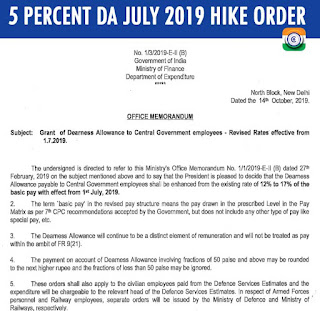
5 Percent DA July 2019 Hike Order - Grant of Dearness Allowance to Central Government employees

Grant of Dearness Allowance to Central Government employees 5 Percent DA July 2019 Hike Order  No. 1/3/2019-E- II (B) Government of...

Blog Archive

About The Author