A complete reference blog for Indian Government Employees

Showing posts with label VII CPC. Show all posts

Thursday, 24 January 2019

AIRF Meeting with Railway Minister - Burning Issues Discussed

AIRF Meeting with Railway Minister - Burning Issues Discussed

AIRF Meeting with Railway Minister

  Brief of the meeting held today with Hon'ble Minister for Railways on the burning issues of the Railwaymen

A.I.R.F.
All India Railwaymen's Federation
4, State Entry Road, New Delhi - 1100055
No.AIRF/24(C)
Dated: January 22, 2019
The General Secretaries,
All Affiliated Unions

Dear Comrades,
Sub: Brief of the meeting held today with Hon'ble Minister for Railways on the burning issues of the Railwaymen

Today I had detailed discussions on the pending major issues in a meeting with Hon'ble Minister for Railways in the presence of CRB and Member Staff. The meeting was held in a very cordial atmosphere and I noticed quite positive attitude of Hon'ble MR on almost all the major issues. Brief details of the discussions held is as under:-

(i) Revision of rates of Running Allowances and other allowances related to Running Staff - This issue was discussed threadbare and Hon'ble MR had reservations about the proposed rates on the plea that, it will result in further increase in operating ratio. He also said that, according to Finance it comes to Rs.398/-. I explained the matter in detail and also advised him about the formula, on the basis of which it comes out to Rs.648/-. Finally, he agreed to further process the case file to MoF for Rs.525/- and advised the CRB and MS accordingly. It is expected that the case will be sent to MoF shortly.

(ii) Four-grade structure(in the ratio of 10:20:20:50) to Track Maintainers - This issue was also discussed in details and it was explained to Hon'ble MR that; the entire process is financially neutral. He directed the MS to issue orders immediately, because it has been already agreed with the AIRF in previous negotiations.

(iii) Restructuring of IT Cadre - I explained that, all the Cadre Restructuring have always been based on the sanctioned strength of the cadre and not on roll as also entire process of Cadre Restructuring is always with financial neutrality, as such, same principle should be applied in case of Cadre Restructuring of IT Cadre also. I also reminded him that, this issue has been agreed by the FC in his chamber during discussions. Hon'ble MR agreed to it and advised the MS to take action accordingly.

(iv) Promotional prospects of educated staff working in lower grades in GP Rs.1800(Level-1 of VII CPC) - I mentioned that, a large-number of highly educated people are available now in the lowest grade, who are very much curious for their career advancement. I further mentioned that, AIRF has already proposed the Railway Board to divert 10% posts, earmarked for Direct Recruitment, to LDCE open to all, so that, qualified Track Maintainers and staff of all departments and categories, who are having academic qualification, prescribed for Direct Recruitment on these higher grade posts, can be considered for promotion, which will definitely give some relief to such staff. Hon'ble MR was in an agreement with this proposal and asked the CRB and MS to take necessary action in the matter.

(v) Advancement prospects for the staff in erstwhile GP Rs.1800 and GP Rs.4600 - I explained to Hon'ble MR that, in view of poor prospects of advancement, there is serious discontentment amongst the staff working in the said two grade pay. AIRF has, therefore, proposed that, 50% posts in GP Rs.1800, i.e. Level-1 of VII CPC, be upgraded to GP Rs.1900, i.e. Level-2 of VII CPC, with financial neutrality. Hon'ble MR also agreed to this proposal and advised the CRB and MS to take necessary action in the matter.
So far as promotional prospects of the staff in GP Rs.4600 is concerned, it was informed that, Board is working out some solution to convert some posts of GP Rs.4600 to Gazetted Cadre.

(vi) LARSGESS - On the issue of LARSGESS, Hon'ble MR said, that, the Attorney General has very clearly written that, this scheme is unconstitutional, hence will not sustain before the Hon'ble Supreme Court. In the wake of this, we are proceeding to Hon'ble Supreme Court with those cases who have completed all formalities. On the issue of LARSGESS, AIRF is also likely to file a petition in the Hon'ble Supreme Court, and for that we are in consultation with the eminent lawyer.

Apart from the above, I also discussed the issues of Guaranteed Pension to NPS covered employees and improvement in Minimum Wage and Fitment Formula and requested Hon'ble MR to convene a meeting with Hon'ble Prime Minister on these significant issues. He assured that he would take these issues with all seriousness and would try to arrange a meeting with Hon'ble Prime Minister.
Yours faithfully,
sd/-
(Shiva Gopal Mishra)
General Secretary
Source: AIRF
Share:

Monday, 4 December 2017

AIRF: Brief on the discussion with the CRB on date


AIRF: Brief on the discussion with the CRB on date

No.AIRF/24(C)
Dated: December 1, 2017
The General Secretaries,
All Affiliated Unions,

Dear Comrades!
Sub: Brief on the discussion with the CRB on date

I met the CRB in the forenoon on date and had discussion on the following issues:
1. Benchmarking for financial upgradation under MACPS consequent upon implementation of VII CPC - I explained the CRB that, prior to implementation of VII CPC recommendations, benchmarking for financial upgradation under MACPS, and that for regular promotion had been similar. With the implementation of higher benchmarking for financial upgradation under MACPS, there is serious resentment among the Railwaymen as majority of them is deprived of this legitimate benefit. The CRB assured to look into the matter on priority.

2. Appointment on Compassionate Ground of the wards/widows of the Railwaymen either died in harness or medically incapacitated - With the direct recruitment qualification for open market recruitment in erstwhile GP Rs.1800 having been upgraded to High School + ITI or Course Completed Act Apprenticeship, appointment on Compassionate Ground to those wards of the Railwaymen who are not in possession of this qualification is being denied. I had, therefore, raised this issue and the CRB has assured us that this issue shall also be dealt with on priority and the provision as existed earlier, i.e. placing them in -1S pay scale would be considered.
On the issue of Compassionate Ground Appointment, in general, the CRB said that, it would continue on Indian Railways on 1:1 basis.

3. Implementation of upgraded pay scales as recommended by the VII CPC to certain categories of Railwaymen - I had also discussed this issue with the CRB, explaining that the VII CPC has recommended upgraded pay scales to certain categories of Railwaymen, viz. SSO(A/Cs)/Sr. Travelling Inspector(A/Cs)/ Sr. Inspector(Stores A/Cs), Chemical & Metallurgical Asstt., Chemical & Metallurgical Supdt., Asstt. Chemist & Metallurgist, but the same are yet to be implemented, and the Ministry of Railways have unnecessarily referred the issue to the DoP&T, which is quite unfair and urged upon the CRB to implement the same without further delay. He also assured a positive action in the matter.

4. Absorption of Course Completed Act Apprentices in the Railways - AIRF has raised this issue many times, wherein we have requested that, the Apprentices who have completed their course before making quota of 20% should be regularized without subjecting them to any RRCs examination as has been done earlier with paper screening. The CRB assured that he would definitely do the needful and would try that this skilled workforce should join the Indian Railways at an earliest.

5. Improvement in the condition of Railway Quarters and Colonies - Regarding complaints pertaining to maintenance of railway quarters and colonies, I suggested the CRB to think on the subject out of the box. He appreciated the sincere suggestion given by me that, old railway colonies should be demolished and replaced with multi-story railway colonies, equipped with lift, CCTVs, boundary etc., so that, the employees and their families, living therein, should feel secure. I also mentioned that, till they get proper railway quarter maintenance, the staff should be paid “Maintenance Allowance” for petty repairs, whitewash and painting etc.
This is for information and wide publicity.
Comradely yours,
sd/-
(Shiva Gopal Mishra)
General Secretary
Source: AIRF
Share:

Friday, 10 November 2017

7th Central Pay Commission as accepted by the Government Health and Malaria Allowance


7th Central Pay Commission as accepted by the Government Health and Malaria Allowance

GOVERNMENT OF INDIA
(MINISTRY OF RAILWAYS)
(RAILWAY BOARD)

PC-VII No. 7 0

RBE No. 159/2017
New Delhi, dated 27.10.2017
No. E(P&A)I-2017 /SP-1/Genl-2

The General Managers and Principal Financial Advisers,
All Indian Railways & Production Units.

Sub: Implementation of recommendations of Seventh Central Pay Commission as accepted by the Government- Health and Malaria Allowance.

Consequent upon the decisions taken by the government on the recommendations of the Seventh Central Pay Commission relating to revision of allowances, the President is pleased to revise the rates of Health and Malaria Allowance, granted to Health and Malaria Inspectors (Health Inspectors) in Indian Railways. The allowance will be paid as per cell R3H3 of the Risk and Hardship Matrix. The rate of this allowance will be Rs. 1000/- per month upto level 8 in Pay Matrix (VII CPC) and - 1200/per month for level 9 and above in Pay Matrix (VII CPC).

2. The rate of this allowance will further increase by 25 percent each time DA rises by 50 percent.

3. The revised rates of allowance shall be admissible with effect from 1st July, 2017.

4. This issues with the concurrence of the Finance Directorate of the Ministry of Railways.

5. Please acknowledge receipt.

No. E(P&A)I-2017 /SP-1/Genl-2
(Anil Kumar)
Dy. Director/E(P&A)-1
Railway Board
New Delhi, dated 27 .10.2017

Source: AIRF
Share:

Monday, 13 March 2017

Anti-labour steps of the Railway Board (Ministry of Railways)


Anti-labour steps of the Railway Board (Ministry of Railways)

No.AIRF/24(C)
Dated: March 7, 2017
The General Secretaries,
All Affiliated Unions

Dear Comrades!
Sub: Anti-labour steps of the Railway Board (Ministry of Railways)

In the DC/JCM Meeting, held today with the Railway Board, AIRF strongly lodged its protest against anti-labour steps of the Railway Board(Ministry of Railways) in general and encroachment on trade union rights by way of issuing orders dated 30.01.2017, in particular, debarring the Supervisory Staff, belonging to Safety Category, working in Grade Pay of Rs.4200 and above from becoming officebearers of the railway unions.

General Secretary AIRF, while expressing his anguish on the attitude of the Ministry of Railways, also pointed out that, despite already arrived at agreements on the following issues, Railway Board have failed to issue instructions for implementation thereof despite lapse of substantial period of time:-

(i) Upgradation of apex level Group 'C' staff to Group 'B' Gazetted.
(ii) Placement of the Supervisors in the erstwhile Grade Pay of Rs.4800 in place of GP Rs.4600 .
(iii) Non-implementation of the agreed structure of the Trackmen in the ratio of 10:20:20:50 and
their promotional avenue.
(iv) Stepping-up of pay of the Loco Inspectors.
(v) Issues related to Running Staff, already agreed upon in the Fast Track Committee.
(vi) For financial upgradation under MACPS and regular promotions, existing Benchmark(prior to VII CPC) should continue.
(vi) Regularization of Course Completed Act Apprentices, trained in Railway Establishments, in the Railways, etc. etc.

General Secretary, while expressing serious discontentment over these issues specifically, mentioned that, Ministry of Railways is directly interfering in the functioning of the trade union by issuing dictatorial instructions, which AIRF and the entire Staff Side is not going to tolerate, and that is why, meeting of the DC/JCM is bycotted.

Pursuant to the above, it has been jointly decided by both the recognized federations to launch undernoted agitational programme all over the Indian Railways:-
(a) 16th March, 2017 - Mass agitations, dharnas, demonstrations at the Branch and Depot levels.
(b) 23rd March, 2017 - Mass agitations by holding dharnas, demonstrations, rallies at the Divisional level.
(c) 30th March, 2017 - Massive demonstrations at the Zonal Headquarters, wherein memorandum addressed to Minister of Railways be handed over to the respective GMs, mentioning therein that, if no corrective action is taken by the Ministry of Railways, organized labour shall be at liberty to go for direct action, entire responsibility of which shall squarely rest with the Railway administration.
All of you are requested to take appropriate action accordingly, and report of the same may be forwarded to AIRF for better appreciation.
With Good Wishes of Holi!
Comradely yours,
sd/-
(Shiva Gopal Mishra)
General Secretary
Source: AIRF
Share:

Sunday, 8 January 2017

Meeting with the Committee on Allowances


Meeting with the Committee on Allowances
Shiva Gopal Mishra
Secretary
Ph.: 23382286
National Council (Staff Side)
13-C, Ferozshah Road, New Delhi -  110001
E Mail : nc.jcm.np@gmail.com
No.NC-JCM-2016(Allowances)
The Secretary(Expenditure),
Ministry of Finance,
(Government of India),
North Block,
New Delhi
Dated: December 29, 2016
Dear Sir,
Sub: Meeting with the Committee on Allowances

The Staff Side, National Council(JCM) had a meeting with the Committee on Allowances on 1st September, 2016, wherein it was advised us to send the committee a detailed note. Subsequently, on 16th September, 2016 we sent a detailed note on the allowances to your goodself with the hope that the Committee on Allowances would consider the same, and in case of reservations, they would at least hold a meeting on the detailed memorandum submitted by the Staff Side(JCM).

Almost four months have passed without any outcome. All the Central Government Employees' are quite agitated as well as are having mental agony because allowances of the VII CPC, have not been implemented.

You are, therefore, requested to fix-up a meeting of the Committee on Allowances, at an earliest to resolve the issues placed in the memorandum of the Staff Side(JCM) on various allowances.

Here it is worth-mentioning that, the issues related to DoP&T were discussed by the Secretary (DoP&T) with the Staff Side on 25th October, 2016. The Staff Side is of firm opinion that, there should be resolution to the demands, and these Allowances should be implemented with effect from 01.01.2016, i.e. the date from which VII CPC has been implemented.
Sincerely yours
(Shiva Gopal Mishra)
Secretary(Staff Side)
Source : http://ncjcmstaffside.com
Share:

Tuesday, 13 December 2016

ALL INDIA KENDRIYA VIDYALAYA TEACHERS ASSOCIATION F.01.AIKVTA(HQ)/GS/222

ALL INDIA KENDRIYA VIDYALAYA TEACHERS ASSOCIATION F.01.AIKVTA(HQ)/GS/222
 
Dated : 09.12.2016

Mr.M.Krishnan Secretary General, Confederation, CONFEDERATION OF CENTRAL GOVT. EMPLOYEES & WELFARE 1st Floor, North Avenue PO Building, New Delhi-110001

Subject: Disappointment for not extending the benefits of revised pay structure of VII CPC as per CCS (RP) Rules 2016 and Bonus of 2015-16 to the employees of Autonomous Bodies-reg

Respected Sir,

At the very outset All India Kendriya Vidyalaya Teachers' Association (short title "AIKVTA") extends its full moral support both in principle & in action to your endeavors and action to protest/ agitation Programmes "MASSIVE PARLIAMENT MARCH" on 15 December 2016 at Jantar Mantar (Parliament Street), New Delhi against the recommendations of VII CPC which are entirely against the genuine expectations for not extending the benefits of revised pay structure of VII CPC as per CCS (RP) Rules 2016 and Bonus of 2015-16 to the employees of Autonomous Bodies. KV is going to celebrate its Foundation Day on 15th December as celebrated every year. We extend our full moral support to your endeavors. We assure you that we will stand with you shoulder to shoulders in all your future exploits undertaken to secure our legitimate rights.

AIKVTA extend its full moral support to your movement. Thanking you,

Yours faithfully
(M.B. AGRAWAL) General Secretary, AIKVTA Leader (Staff Side) JCM (KVS)

Source : Confederation
Share:

Tuesday, 23 August 2016

Need for revision of hourly rates of incentive bonus and incentive allowance in favour of Railway Staff: NFIR


Need for revision of hourly rates of incentive bonus and incentive allowance in favour of staff of Workshops/Production Units under CRJ Pattern/GIS: NFIR Reference to Railway Board
NFIR
National Federation of Indian Railwaymen
3, CHELMSFORD ROAD, NEW DELHI – 110 055
No.I/11/Part I
Dated: 16-08-2016
The secretary (E),
Railway Board,
New Delhi.
Dear Sir,
Sub: Need for revision of hourly rates of incentive bonus and incentive allowance in favour of staff of Workshops/Production Units under CRJ Pattern/GIS- reg.
Pursuant to the decisions of the Government on the recommendations of the VII CPC, the Railway Board vide letter No.PC-VII/2016/RSRP/2 dated 02/08/2016 (RBE No.93/2016) has circulated “Schedules for revised scales of Pay” in respect of Railway employees to be given effect from 01-01-2006.
II. In this connection, NFIR desires to state that after implementation of 6th CPC grade pay/pay band, the Railway Board had in consultation with the Federations issued instructions vide letter No.2008/M(W)/814/38 dated 29-10-2009 (RBE No.194/2009) revising hourly rates of incentive bonus under CRJ Pattern/GIS for staff in Workshops and production Units and also PCO allowance. Upward revision of rates was also granted vide RBE No.142/99 dated 21-06-1999 (i.e. after implementation of V CPC Pay Scales). A chart showing the revision of hourly rates granted by the Railway Board is placed below:
S. No
DESIGNATION
V CPC PAY SCALES & INCENTIVE HOURLY RATES AS PER RBE NO.142/99 Dt: 21-06-1999
VI CPC PAY BAND/GRADE PAY INCENTIVE HOURLY RATES AS PER RBE No.194/09 Dt: 29-10-2009
Pay ScaleHourly Rates under CRJ Pattern
(Rs.)
Incentive Bonus Under GIS Pattern
(Rs.)
Pay ScaleHourly Rates under CRJ Pattern
(Rs.)
Incentive Bonus under GIS Pattern at 100% earnings
(Rs.)
1
2
3
4
5
6
7
8
1Junior Engineer Grade I5500-900026.4571509300 – 34800
+ GP 4200
49.6513440
2Junior Engineer Grade II5000-800024.006500
3Senior Technician5000-800024.00
4Supervisor4500-700021.6558505200-20200

+ GP 2800
43.3011700
5Technician Grade I4500-700021.65
6Technician Grade II4000-600019.2552005200-20200
+ GP 2400
38.5010400
7Technician Grade III3650-459017.5539655200-20200
+ GP 1900
32.207930
8Technician Grade III3050-357514.65
9Semi Skilled2750-440013.2035755200-20200
+ 1800
25.456760
10Unskilled2550-320012.5033154440-7440
+ GP 1300
24.506630
Note:
  • Incentive Bonus earnings under GIS Pattern on the basis of V CPC structure was arrived at by multiplying minimum pay of pay scale X 1.3 times (in the year 1999).
  • Incentive Bonus earning under GIS pattern on the basis of VI CPC was arrived at by just doubling the values & fixing it a 100% earning level (in the year 2009).
  • In case of Hourly rates earning under CRJ pattern, the Hourly rate values of V CPC were just doubled and fixed as hourly rate earnings after implementation of VI CPC.

III. NFIR now wants the Railway Board to appreciate that similar upward revision of hourly rates of incentive bonus is needed to be granted as the revised pay matrices of VII CPC have been given effect from January 1, 2016. The SSEs of Indian Railways Workshops and Production Units are presently paid incentive allowance on VI CPC pay. This also needs to be revised upwardly duly taking into consideration the revised Pay Matrix allotted to them.
NFIR, therefore, requests the Railway Board to take action for revision the rates early as was done during the year 1999 and 2009. It is also relevant to take note of the fact that there is already heavy shortage of staff in all Railway Workshops and Production Units with increased activity resulting additional workload burden on the existing staff. This aspect be given due weightage for the purpose of hiking the hourly rates of incentive bonus, PCO allowance and incentive allowance to the staff as well SSEs.

Yours faithfully,
(Dr.M.Raghavaiah)
General Secretary.
Source: NFIR
Share:

Monday, 8 August 2016

Implementation of recommendations of the VII CPC – issue of Resolution by the Ministry of Finance (Deptt of Expenditure)

Implementation of recommendations of the VII CPC – issue of Resolution by the Ministry of Finance (Deptt of Expenditure)

 Government of India
Ministry of Defence
D(Civ-I)

Subject : Implementation of recommendations of the VII CPC – issue of Resolution by the Ministry of Finance (Deptt of Expenditure)

Ministry of Finance has issued the Resolution dt. 25.07.2016 regarding acceptance of the recommendations of the VII CPC by the Government of India. The Resolution provides, interalia, as under

(a) The Government, after consideration, has decided to accept the recommendations of the Commission in respect of the categories of employees covered in its Terms of Reference contained in the aforesaid Resolution dated the 28th February, 2014 in the manner as specified hereinafter.

(b) The recommendations on allowances (except Dearness Allowance ) will be referred to a Committee comprising Finance Secretary and Secretary (Expenditure) as Chairman and Secretaries of Home Affairs, Defence, Health and Family Welfare, Personnel and Training, Posts and Chairman, Railway Board as Members, The Committee will submit its report within a period of four months. Till a final decision on Allowances is taken based on the recommendations of this committee, all Allowances will continue to be paid at existing rates in existing pay structure, as if the pay had not been revised with effect from 1st January, 2016.

(c) The Government has accepted the recommendations of the Commission on upgrading of posts except for those specified at Annexure III of the Resolutions. The recommendations on the upgradations specified at Annexure Ill will be separately examined by Department of Personnel and Training for taking a comprehensive view in the matter. These are as under:

SI. No.Name of Posts
(Para No. of 7 CPC Report)
Present
Grade
Pay
Grade Pay recommended by 7th CPC
Upgradation other than Apex Level
1.Assistant Accounts Officer,Finance Div of Defence, MoD
(11.12.140)
48005400 (PB-2) on completionof 4 years service
Up-gradation to Apex scale
2.       Director General (Indian Coast Guard) (11.12.27)

(d) Recommendations not relating to pay, pension and allowances and other administrative issues specific to Departments/Cadres/Posts will be examined by the Ministries/Departments concerned as per the Allocation of Business Rules or Transaction of Business Rules.

(e) Anomalies committees will be set up by Department of Personnel and Training to examine individual, post-specific and cadre-specific anomalies arising out of implementation of the recommendations of the Commission.

2. The above provisions of the Resolution are brought to the knowledge of all the Administrative Division of MoD for their information and for taking necessary action in respect of the posts/cadres existing under their control. The copy of the Resolution is available for download at the website of finmin.nic.in.
sd/-
(Gurdeep Singh)
Under Secretary to the Govt. of India
Share:

Thursday, 30 June 2016

No improvement in Minimum Wage and Multiplying Factor – AIRF

No improvement in Minimum Wage and Multiplying Factor – AIRF

We should go ahead with our preparations for “Indefinite Strike – Com. Shiva Gopal Mishra
It is quite unfortunate that, our demand for improvement in the report of the VII CPC has not been considered by the government.

Therefore, it would be quite appropriate that, we should go ahead with our preparations for “Indefinite Strike”, slated to be commended from 06:00 hrs. on 11th July, 2016…. Complete letter is uploaded below:-

A.I.R.F
All India Railwaymen Federations
4,STATE ENTRY ROAD, NEW DELHI-110055
No.AIRF/160
Dated: June 29, 2016
The General Secretaries,
All Affiliated Unions,

Dear Comrades!
Sub: Cabinet approval on the VII CPC report

As all of you are aware that the Union Cabinet has accepted the report of the VII CPC today.

It has been noticed that there is no improvement in Minimum Wage and Multiplying Factor as well, which was our hard pressed demand. Instead, wages, as recommended by the VII CPC have been accepted as it is, which is highly disappointing.

Only two committees have been formed, one to take care of the allowances and another for National Pension Scheme, which will submit their reports within four months time.

It is quite unfortunate that, our demand for improvement in the report of the VII CPC has not been considered by the government.

Therefore, it would be quite appropriate that, we should go ahead with our preparations for “Indefinite Strike”, slated to be commended from 06:00 hrs. on 11th July, 2016.

You are also advised to intensify the mass mobilization.
With fraternal greetings!
Yours faithfully
(Shiv Gopal Mishra)
General Secretary
Source: AIRF
Share:

Thursday, 5 May 2016

Recommendations of 7th Pay Commission – Rejoinder submitted by NCJCM staff side

Recommendations of 7th Pay Commission – Rejoinder submitted by NCJCM staff side

We have submitted a rejoinder on the report of VII CPC, seeking bilateral settlement on the issues related to VII CPC.

You are gracious enough to convene a meeting on 1st March, 2016, wherein members pf the Staff Side, National Councii(JCM) and Empowered Committee of Secretaries participated.

Subsequently, another truncated meeting was held on 30th March, 2016. In both the meetings Official Side heard our views, but no re.action of the Official Side was expressed except general remarks.

I have been directed to draw your kind attention towards minutes of the Standing Committee of National Councii(JCM) held on t h May, 2008 and our rejoinder submitted to government in the matter of report of VI CPC.
You will kindly find that, it was not only a general discussion, but also Official Side explained their views on each and every issue.

I would , therefore, request your goodself to kindly arrange for similar type meeting for bilateral settlement on each of the issues raised by the Staff Side, NC/JCM before Empowered Committee of Secretaries.

Source-http://ncjcmstaffside.com/
Share:

Tuesday, 3 May 2016

National Council Staff Side Secretary writes to Cabinet Secretary on 7th Pay Commission

National Council Staff Side Secretary writes to Cabinet Secretary on 7th Pay Commission

Shiva Gopal Mishra
Secretary
Ph.: 23382286
National Council (Staff Side)
Joint Consultative Machinery
Central Government Employees
13-C, Ferozshah Road, New Delhi – 110001
E Mail : nc.jcm.np@gmail.com
No.NC/JCM/2016
Dated: May 2, 2016
The Cabinet Secretary,
Cabinet Secretariat,
(Government of India),
Rashtrapathi Bhavan,
New Delhi

Dear Sir,
Sub: Recommendations of the VII CPC

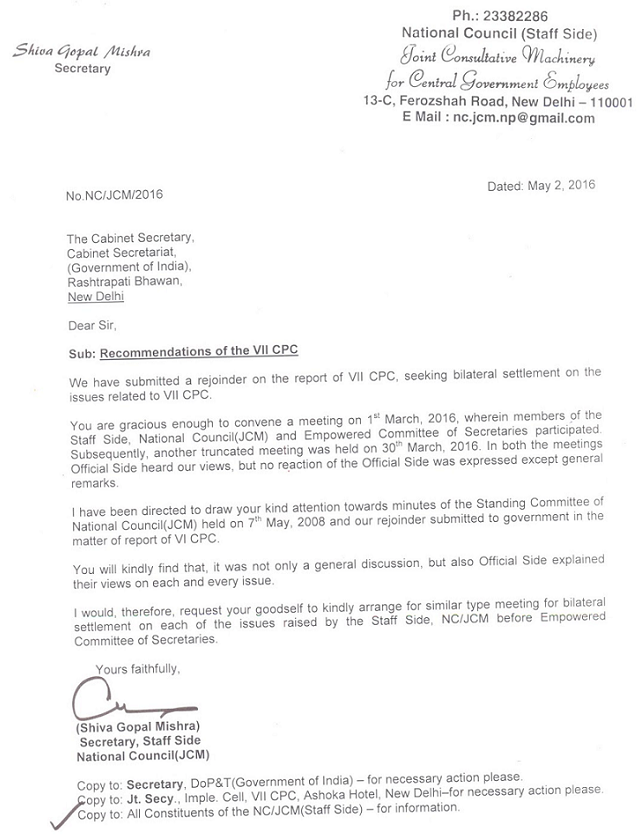
We have submitted a rejoiner on the report of VII CPC, seeking bilateral settlement on the issues related to VII CPC.

You are gracious enough to convene a meeting on 1st March, 2016, wherein members of the Staff Side, National Council(JCM) and Empowered Committee of Secretaries participated. Subsequently, another truncated meeting was held on 30th March, 2016. In both the meetings Official Side heard our views, but no reaction of the Official Side was expressed except general remarks.

I have been directed to draw your kind attention towards minutes of the Standing Committee of National Council(JCM) held on 7th May, 2008 and our rejoiner submitted to government in the matter of report of VI CPC.

You will kindly find that, it was not only a general discussion, but also Official Side explained their views on each and every issue.

I would, therefore, request your goodself to kindly arrange for similar type meeting for bilateral settlement on each of the issues raised by the Staff Side, NC/JCM before Empowered Committee of Secretaries.
Yours faithfully,
sd/-
(Shiva Gopal Mishra)
Secretary, Staff Side
National Council(JCM)
Authority: Confederation Blog
nc-jcm-staff-side-letter-to-7th-cpc


Share:

Tuesday, 26 April 2016

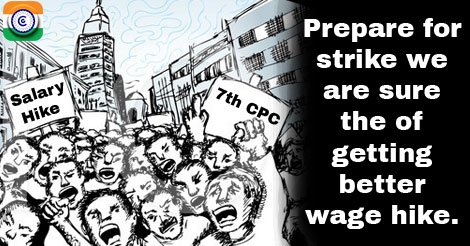
Prepare for strike we are sure the of getting better wage hike.

7th-CPC-Salary-Hik-Strike
Comrades,
The flash strike against the recent PF Rules, 2016 of the Central Government (i.e., Centre’s new rule on Provident Fund withdrawal) by large section of Garment Factory Workers and other Industrial Workers of Karnataka State on 18th and 19th April 2016 received immense response and there was a massive protest which resulted in road blocks for hours together, thereby the entire traffic of Bengaluru City was paralyzed. The traffic was also severely affected on Mysore, Tumkur and Hosur roads.

The COC Karnataka extended moral support and sympathy for this Labour Movement. The February 10th notification was under attack from trade unions from the beginning. The notification was published in the gazette on February 26 and created technical problems.

The violence in Bengaluru prompted the Labour Ministry, Govt. of India to cancel the February 10 notification which put restrictions on 100% withdrawal from the PF account.

Within few hours of protest in Bengaluru and other parts of Karnataka state , the Hon’ble Minsiter for Labour, Shri.Bandaru Dattatreya acted upon and withdrawn the notification issued on February 10th and informed that the old system will continue. This is a victory for the workers of the country.

This clearly shows that the Government of India does not want to antagonize the workers. If the Central Government employees also participate in trade union action against the retrograde recommendations of the VII CPC similar to the Garment Workers of Karnataka, we too can get similar results and hope for a better wage revision and a decent wage hike.

This Labour movement of the Garment Workers of Karnataka state is an eye-opener for all other working class in the entire country, Comrades if one state and one particular working class movement can bring changes to the policy of the Central Government, if the entire the entire country the Central Government employees agitate against the retrograde recommendations of the 7th CPC (where only 14 % wage hike was provided against the staff side demand of 80% wage hike and also reducing the number of allowances and reduction in HRA rates) then the Central Government shall provide the decent wage hike by settling the issue of wage hike with the staff side NJCA like the PF issue being settled.

Comrades it is high time to prepare for 11th July strike of Central Government employees under the banner of NJCA. We shall get good results and Central Government shall grant better wage hike than the 7th CPC recommendations. Better we prepare for 11th July strike better wage hike we get.
Comradely yours
(P.S.Prasad)
General Secretary
Source: karnatakacoc.blogspot.in
Share:

Friday, 18 March 2016

Posting of ASO in the VII CPC Implementation Cell – regarding

Posting of ASO in the VII CPC Implementation Cell – regarding

VII-CPC-Implementation-Cell-7CPC

F. No.7 16/2016-CS.I(A)
Government of India
Ministry of Personnel, Public Grievances and Pension
(Department of Personnel & Training)
2nd Floor, Lok Nayak Bhawan,
Khan Market, New Delhi-11 0003
Dated the 16th March, 2016.
ORDER

In exercise of powers conferred under Rule 19 of Central Secretariat Service Rules, 2009, the competent authority in this Department hereby orders the inter-cadre transfer of Shri Ashish Sharma, Assistant Section Officer (DR-2011), presently posted in the Ministry of Health and Family Welfare to the Implementation Cell, 7th CPC upto 31.12.2016 or till further order.

2. Ministry of Health and Family Welfare is requested to relieve the concerned officer immediately.

(V. Srinivasaragavan)
Under Secretary to the Government of India
Tel: 24642705
Copy to:
1. Shri Ashish Sharma, ASO, M/o Health & Family Welfare – for compliance.
2. M/o Health & Family Welfare, (US, Admn), Nirman Bhavan, New Delhi-11 0011.
3. Department of Expenditure, (US, Admn), North Block, New Delhi.
4. Implementation Cell, 7th CPC, North Block, New Delhi, with reference to their D.O. Letter dated 03.03.2016. It is also informed that 4 ASOs have already been posted to Department of Expenditure against newly created post of Implementation Cell vide order no.7/1 0/2015-CS.I(A) dated 03.03.2016.
Share:

Saturday, 8 August 2015

7th CPC promised for 28.8.2015, may be delayed by one month – NC JCM Staff Side

7th CPC promised for 28.8.2015, may be delayed by one month – NC JCM Staff Side

NC JCM Staff Side Secretary said that it was assumed that the report of the VII CPC, as was promised for 28th August this year, may be delayed by one month. The letter is reproduced and given below for your information…

Brief of the meeting held today with the VII Central Pay Commission

No. NC/JCM/VII(CPC)
Dated: August 7, 2015
All Constituents Organizations,
National Councii(JCM)(Staff Side)

Dear Comrades,
Sub: Brief of the meeting held today with the VII CPC

Today morning I met the Chairman, Seventh Central Pay Commission, Shri Ashok Kumar Mathur and Secretary, Mrs. Meena Agarwal.

It was assumed that the report of the VII CPC, as was promised for 28th August this year, may be delayed by one month.

I have impressed upon him once again for improvement in the service conditions of all the Central Government Employees working in different sectors with special emphasis in the matter of fixation of Minimum Wage and other benefits.

This is for your information.
Comradely yours,
(Shiva Gopal Mishra)
Secretary Staff Side
NC/JCM

Source: 7thpaycommissionnews.in
Share:

Tuesday, 4 August 2015

National Holiday Allowance – Upward revision of rates

National Holiday Allowance – Upward revision of rates: Railway Board's reply on NFIR Reference
GOVERNMENT OF INDIA
MINISTRY OF RAILWAYS
RAILWAY BOARD
No. E(P&A)I-2013/FE-4/3
New Delhi dated 29 -07-2014.
 The General Secretary
NFIR,
3, Chelmsford Road,
New Delhi.
Sir,

Sub: National Holiday Allowance – Upward revision of rates – reg.
*******

The undersigned is direct to refer to your letter No. I/5(g)/Part V dated 03.07.2015 on the above demand cited subject and to state that VII CPC is examining the issue in respect of rate of NHA along with rates of other allowances. As such, it is perhaps not an appropriate time to consider any kind of revision or deviation from the existing rates NHA. In the circumstances the final report/recommendations of VII CPC may be awaited. The PNM Item No. 5/2013 may be closed.
For Secretary,
Railway Board.
Source: NFIR
Share:

Thursday, 5 June 2014

Memorandum to 7th CPC on merger of DA with Pay and Interim Relief

Memorandum to VII CPC on merger of DA with Pay and Interim Relief

National Council (Staff Side)
Joint Consultative Machinery
for Central Government Employees
13-C, Ferozshah Road, New Delhi – 110001
Shiva Gopal Mishra
General Secretary
No.NC4JCM/2O14/VII CPC
Dated: June 3, 2014
Justice Shri Ashok Kumar Mathur,
Chairman,
Seventh Central Pay Commission,
New Delhi

Dear Sir
Sub: Memorandum to VII CPC on merger of DA with Pay and Interim Relief

As was decided in the Preliminary Discussion Meeting, held on 28”‘ May, 2014, with the VII CPC, we submit herewith Memorandum on Merger of Dearness Allowance with Pay and Interim Relief, on behalf of Staff Side, National Council(JCM).
Yours faithfully,
sd/-
(Shiva Gopal Mishra)

Copy to: Ms Meena Agarwal, Secretary, Seventh Central Pay Commission (Government of India), New Delhi, along with a copy of above cited memorandum.
Encl: As above
Copy to: All Constituent Organizations of the NC/JCM(Staff Side), along with a copy of above cited memorandum.
Encl: As above

MEMORANDUM  ON MERGER OF DA WITH PAY AND INTERIM RELIEF.

We solicit the kind reference of the 7th Central Pay Commission to the discussion during the informal interaction the staff side of the National Council had with the Commission on 28.5.2014, when we inter alia raised the issue of merger of Dearness allowance and Interim Relief.

2. Before we dwell upon the issues, it may not be out of place to refer to the evolution of the JCM which later became the negotiating platform for the entirety of Central Government employees and workers It was conceived to bring about a conflict free industrial climate in Civil Service in the wake of the tumultuous experience of an industrial strike action in 1960. The National Council, the apex forum under the three tier system headed by the Cabinet Secretary was empowered to deliberate upon the common issues of the Central Government employees. The Staff Side, National Council, thus became the united voice of the entirety of the Central Government employees on fundamental issues like Wages, Pay Scales, Rate of increment, Dearness compensation and other general allowances.

3. However, over the years, JCM became an ineffective instrument to address the basic issues and demands of the employees. We shall detail the requirements to empower and streamline the functioning of the JCM as a negotiating forum in our Main Memorandum to the Commission.

4. The twin issues viz. Merger of DA and Interim relief had been the subject matter of discussion with the Government when the Staff side was called upon to present their views in the matter of finalization of the terms of reference for the 7th CPC by the Secretary, Personnel, (Department of Personnel and Training) in his capacity as Chairman, Standing Committee, National Council JCM. Though we pleaded for the specific reference of the above two issues, to the 7th CPC, the final 1 version of the terms of reference approved by the Government did not find a place for our views. We have, therefore, been constrained to take recourse to clause 5 in the terms of reference, which enables the Commission to send interim report to the Government.

MERGER OF DA WITH PAY:

5. Dearness allowance is considered as a device to protect, to a greater or lesser extent, the real income of wage earners and salaried employees from the effects of rise in prices. As per the vagaries of price fluctuation in the market, the allowances are bound to go up and down. Constant rise in the price level, might bring about a situation whereby the quantum of allowance shall go up. Such a phenomenon of constant increase of prices of commodities gave rise to the demand for merger of Dearness allowances with pay so as to make it pay, rather than an allowance, with all concomitant benefits. A committee to advice the Govt. on the portion of such DA to be treated as pay was appointed on 15th July, 1952 (Resolution No. F6(6)E-II/52). The terms of reference of the Committee was :

“Taking in to consideration the rates of dearness allowance that have been sanctioned to date for Central Govt. servents, and the level at which cost of living index are likely to stabilize in the foreseable future, to recommend the percentage of dearness allowance now given to the Central Govt. servents which should be allowed to be treated as pay for all purposes in future, provided that by doing so the present total pay and dearness allowance is not enhanced:”

6. The said committee was headed by Shri N.V. Gadgil, Member of Parliament. The Committee in its report concluded that
“We have recorded the various reasons which we have taken into account in arriving at the conclusion that the appropriate level below which the All India cost of living index is not likely to fall, should be taken as 265-284. We find that for the index figure of 265, the Central Pay Commission formula allows Govt. Employees in the lowest pay group a dearness allowance of Rs.20/- and this amount remain unchanged until the cost of living index go above the index of the next level i.e. 285. We, therefore, consider that the employees in this pay group, a sum of Rs. 20/- which represents 50% of the present dearness allowance of Rs. 40 per month should be treated as pay (page 22 chapter V Report of the Dearness allowance Committee).”

7. The Committee also enumerated in their report the purposes for which the DA shall be treated as pay as under:-
Retirement Benefits
Travelling allowance
Compensatory allowance
House rent allowance
Compensation of Leave Salary etc.

8. The 3rd CPC, whose recommendations were implemented with effect from 1.1.1973 had no reference from the Govt. on the question of merger of DA. Still while dealing with the issue of Dearness allowance (vol.IV – Page 1 Ch.55) the Commission noted that “no other country in the world (except Ceylon and Pakistan) seems to be following the practice of paying dearness allowance or cost of living allowance as a separate element of wage. In most of the countries compensation to Govt. employees for the increase in the price level is given by way of periodical salary revisions Prior to the setting up of the 3rd CPC, pursuant to the discussion in the National Council, JCM, the entire dearness allowance as on 1.8.1966 was treated as Dearness pay and the consequent increase in allowance was granted by the Government with effect from 1.12.1968. In para 16, the Commission recommended that should the price level rise above twelve monthly index of 272 ( 1960=100) the Government should review the position and decide whether the Dearness allowance Scheme should be extended further or the pay scale themselves should be revised. ( Page 4 Chapter 55. Vol. 4 3 rd CPC report). On crossing the index point of 272, the Government conceded the demand for merger of 36% of DA with pay. Later, based on an agreement reached at the National Council JCM the DA granted upto the index level of 320 points i.e. 60% of the Basic Pay was merged through executive instructions for purpose of allowances and pension. Before the 4th CPC was set up in 1983, the issue of further merger of DA with Pay was raised by the employees. Conceding the demand the Government decided that DA entitled to be drawn upto the index average of 568 points be treated as pay for all purposes.

9. Since the Pay Scales were to be constructed with reference to the consumer price index as on the date of revision, every Commission had to perforce merge the entire DA when the actual revision was made. The DA on such revised pay is to be computed on the basis of annual average rise of index after every six months interval. Therefore, the question of merger of DA again rose at the time of negotiation with the Government for setting up the 5th CPC. An agreement was reached on merger of certain percentage of DA and interim relief. (Rs. 100/-) in September, 1993. In April, 1994, the Government issued notification setting up the 5 th CPC (resolution No. 5(12)E-III/93 dated 9.4.1994).

10. The Staff Side placed before the 5th CPC the necessity to merge DA with Pay at an index level below which prices were not likely to move downwards. Pointing out that in the last two decades i.e. 1980s and 1990s there had been not a single occasion when the annual average index had fallen consequent upon which the DA rates were to be reduced, they requested the Commission to merge the entire DA which had been at 97% of the Basic pay as on 1.7. 1993. (The AICPI index being 1201.66). The Commission after deliberations on the memorandum and discussion with the staff Side, recommended that 97% of Basic Pay as DA admissible from. 1.7. 1993 be treated as Pay for all purposes. However, they suggested that the said merger might be given effect only from 1.4. 1995.

11.The 5th CPC submitted its final report to the Government on 19th January, 1997. Before the Commission, the Staff side had demanded that as and when the consumer price index exceeds 25% of the base index at which the pay is fixed that proportion of Dearness allowance should be treated as Pay for all purposes and the decision on this must not be left at the discretion of the Government. The Commission considering this demand observed that:

“From the past trend of CPI given in annexure 11’8.1 it is observed that 50% increase in prices generally takes around five years to materialise. A mid-term quinquennial revision of salaries of the Government employees is not something the Government should grudge. In view of the above, we recommend that DA should be converted into Dearness Pay each time the CPI increases by 50% over the base index used by the last Pay Commission. Such DA should be termed as Dearness Pay and be counted for all purposes including retirement benefits. (Chapter 105 page 157)”. The 5th CPC thus regularised the periodical merger of DA into a well thought 11. out scheme. They also established that wage revision is needed either when the DA exceeds 50% over the base index or after five years .

12. The Government, however, did not act upon this recommendation, when the percentage of DA exceeded 50( 52%) as on 1.7.2002, though it had accepted the recommendation in 1997. With the persistent persuasion, ultimately, the Government issued orders treating 50% DA as Dearness Pay for all purposes with effect from.1.4.2004.

13. Even though the 5th CPC had brought about a finality on the approach to the question of merger of DA with pay, the 6th CPC reopened the issue afresh. The Commission made the following observation-

“This conversion (merger of DA with Pay) is however not necessary in the revised structure being recommended where increments are payable as a percentage of Pay in the Pay Band and Grade Pay thereon and provision has been made for all allowances/benefits to be revised periodically, linked to the increase in the price index. The Commission is, therefore, not recommending merger of DA with Basic pay at any stage.”

14. The 3rd, 4th and 5th Central Pay Commissions had approvingly endorsed the recommendations made by Gadgil Committee in 1952. The practice of periodical merger had been followed as a device to protect the erosion in the real value of wages (including allowances) especially at the lowest level of employees. This erosion becomes unbearable when DA crosses over 50%. To say that the increment rate which is presently 3% of pay would take care of the erosion is to say the least, atrocious. Increment is granted as a legitimate reward for the service rendered by an employee for a year. It has nothing to do with the erosion in the real value of wages. No doubt, the 6th CPC has recommended that a few allowances should be revised by 25% as and when the DA crosses over the stipulated 50%. Such allowances are very in number. Moreover, 25% rise as a compensation when the DA itself rises to 50% is arbitrary and conceived to compensate the worker with lesser amount than what he is entitled to.

15. We, therefore, strongly plead before the Commission, for the reasons enumerated in the foregoing paras, that the Dearness allowance as on 1.1.2014 which stood at 100% may be recommended to be merged and treated as Dearness Pay for grant of all benefits, allowances, pension and other retirement entitlements.

16. We further submit that Merger of D.A. as on 1.1.2014 may also be recommended in respect of pensioners and Gramin Dak Sewaks of Postal Departments.

INTERIM RELIEF.

Barring the 6th Central Pay Commission, all other Commissions had recommended grant of Interim Relief to the Central Government Employees. As per the 5thCPC, Interim relief represented a provisional arrangement during the period between setting up of a Pay Commission and submission of a report by the Commission and its acceptance by the Government. Most of the earlier Commissions with the exception of Ist and 6th Central Pay Commission had taken 2-3 years and sometimes more to finalise their recommendations. Despite the specific reference made to the 6th CPC, by the Government to consider grant of Interim Relief the Commission took the position that having decided to submit its recommendation within the stipulated period of eighteen months and having arrived at a view that its recommendations must be effective from 1.1.2006, it shall not waste time on the question of interim relief. What the 6th CPC failed to appreciate was the erosion in the real value of wages that had taken place over the years due to inflation and rise in prices of essential commodities and the inability especially of the employees at the lower level to make the both ends meet with the available wages. No doubt, the employees had been to some extent benefitted by the decision of the Government to merge 50% Dearness allowance and treat it as pay for all purposes including DA thereon.

2. Every Pay Commission which had recommended Interim Relief had made it amply clear that it was intended to provide some relief to the employees pending a comprehensive determination of their salary structure and other benefits. The relief granted was treated as sui generis (one of its own kind, unique) and it was not taken into account for determining any allowance or benefit.

3. We give below briefly the course of negotiation and approach of various earlier Pay Commissions on the question of grant of interim relief.

4. The Second Pay Commission gave a report within a month’s time and recommended an Interim Relief of Rs. 5/-. The third pay Commission gave three instalments of Interim Relief on varying rates. After appoint of the 4th CPC in July, 1983, Government sanctioned (Vide Department of Expenditure O.M.No. 7(39)-E III/83 dated 2nd August, 1983) on their own initiative Interim Relief at varying rates of Rs. 50 and Rs. 100 per month. In March, 1985, 4th CPC submitted a report and granted a further interim relief at 10% of Basic pay subject to a minimum of Rs. 50 per month. Again before the setting up of the 5th CPC, the Government sanctioned Rs. 100 as interim Relief. As it was not considered adequate, the staff side of the National Council, JCM submitted a memorandum to the 5th CPC demanding additional interim relief. The Govt. vide their Department of Expenditure, Resolution No. 5(12)EIII/93 dated 12.01.1995 amended the terms of reference to enable the Commission to decide upon the additional interim relief. The 5th Central Pay Commission in their interim report submitted on 2 nd May, 1995, recommended Interim Relief equal to 10% of Basic Pay subject to a minimum of Rs. 100/-. The terms of reference of 6th CPC on the issue of Interim Relief was as under:-

“2.g. To examine desirability and need to sanction any interim relief till the time the recommendations of the Commission are made and accepted by the Government”

5. It has to be recalled that the Government did not initially refer the question of Interim Relief to the 5th CPC but when the Staff Side submitted their memorandum to the Commission on I.R., the Government had to amend the terms of reference and refer the issue to the Commission for their decision.

6. These go to establish the need for a relief in view of the erosion in the real value of wages, the need to fill the widening gap in wages when compared to outside rates and the fact that final recommendations of the 7 th Pay Commission are bound to revise the wage structure and above all the need to provide some relief to the employees who would retire before the Commission’s recommendations are finally submitted to the Government and accepted by them.

7. We give hereunder a table indicating the retail prices of the commodities which goes into the computation of minimum wage as per Dr.Ackroyd formula as on 1.1.2006 (quoted by the 6th CPC in their report. Page 53. Table 2.1`.1 Chapter 2.2.) and the actual retail price of those very commodities as on 1.1.2011. The percentage increase in the prices of each commodity is also given in the table. The average rise in prices was of the order of 174%, whehreas the Dearness allowance entitlement was only 51%.. The table clearly indicate the erosion in the real value of the wages.

Sl.No Name of articles Price as on 1.1.2006     As on date      %increase
1  Rice   18 38 120
2 Dhall 4 varieties average   40 87 120
3 Raw vegetables 10  40  400
4 Green veg . 10 56 560
5 Other veg 10  40  400
6 Fruits 30 100  330
7 milk 24 32 40
8 Sugarjiggery Average 24 43 95
9 Edibleoil.3varieties.average 50 95 95
10 Fish 120 300 150
11 meat 120 240 100
12 egg 2 3 50
13 Detergents/soap 200 350 75
14 Cloth 80 120 50

Average increase : 174

8. The need based minimum wage computed on the basis of Dr Ackroyd formula as on 1.1.2014 will be around Rs. 26,000 bringing about a gap of almost 12,000 at the level of an MTS. We shall submit the details thereof in our main memorandum.

9. The only Public Sector undertaking in which the wage agreement has been reached in 2013 is the Coal India Limited. As per the said agreement, the minimum wage at the lowest level of the worker as on 1.12014 is:
Basic Pay ——————————–Rs. 15, 712
Dearness allowance: ——-29.6%
Special allowance: ——— 4.0%
Special DA: ——————1.795%
Attendance bonus: ——-10%
Total: 49.395%————————– Rs. 7132.46
Total salary: —————————–Rs.22844.46
At the MTS level 22.844.46 x 130% —- Rs.29697.


10. As per the formula adopted by the 5th CPC, the minimum wage will work out to Rs. 22,857 as under:

A. Per Capita NNP at constant price for 2004-05 – Rs. 24,143
B. Per capita NNP at constant price for 2011-12 – Rs. 38,037
C. The increase registered over 8 years. – Rs. 13,894.
D. Percentage increase over 2004-05 – 57.54877.
E. Emoluments of an MTS as on 1.1.2014 – Rs. 14,000
F. 57.55% of Rs. 14,000. – Rs. 8,857.
G. Wage to be fixed in thecase of MTS as on1.1.14. – Rs. 22857.

From the above it is seen that Central Government employees presently have a very depressed salary structure. The final outcome of the deliberations of the 7 th CPC will become available only by 2016. It is, therefore, needed that the employees have to be compensated in the form of Interim Relief. In our opinion the Commission may, as has been done by the various earlier Pay Commissions, recommend atleast 25% of Pay in Pay Band plus Grade Pay as Interim Relief subject to a minimum of Rs. 4000/-. Incidentally we may point out that the grant of interim relief will enable the Government to spread out the financial outlay on account of wage revision over a period of more than three years.

We further urge that the Commission may kindly recommended Interim Relief at the above rate subject to minimum of Rs.2000/- to as pensioners and Gramin Dak Sevaks of Postal Department.

SHIVA GOPAL MISHRA
Secretary, Staff Side, National Council JCM.

Source: http://ncjcmstaffside.com/wp-content/uploads/2014/06/Memorandum-for-IR-and-DA-merger_03.06.2014.pdf
Share:

Sunday, 21 July 2013

7th PAY COMMISSION (7CPC)

Time to setup Seventh Pay Commission  

(A paper for Discussion & consideration of National convention of Railway Pensioners Associations, at Secunderabad on 13-2-2011)
There is a long pending demand for a wage revision every 5 years or rather a continuous process of wage revision through a Permanent Pay Body and the demand was rightly conceded by Fifth Pay Commission – though not accepted by the Government. Date of implementation of 6th CPC has completed 5 year on 1-1-2011. It is, as such, time to set up Seventh Pay Commission.
PARITY OF PERIODICITY FOR WAGE REVISION WITH PSUs 
The Government has already conceded to effect wage revision in PSUs after every 5 years. The disparities with PSUs & Corporate Sector have increased further since Sixth Pay Commission submitted its Report as the PSUs got a big wage hike w.e.f. 2007 thus increasing the gap further with Central Government employees. The disparity will be further increased as the next wage review in PSUs is due in 2012 and the wage disparity can be just visualized especially due to fast improvement in economy.
It is imperative that the same criteria for revision of wages every 5 years as adopted in PSUs, should be adopted for revision of wages and pension of Central Government Employees and Pensioners.
DA component in the wages would exceed 50% w.e.f. January, 2011. But merger of DA will not be done (as in the past) due to retrograde recommendations of the Sixth Pay Commission not to merge the DA on reaching 50% but to give only a nominal increase of 25% in some Allowances – other than DA & HRA.
Anomalies in Sixth CPC Report are not expected to be removed - except by a Pay Commission - since the Government is apparently not ready to agree on any of the major issues of concern.  The other view point on demand for Seventh CPC is that since decision on some of the issues arising after Sixth Pay Commission and its anomalies are pending for a final decision and as such it is not appropriate to demand Seventh Pay Commission at this stage. But the Government may take its own time in accepting the demand for Seventh Pay Commission. In the meanwhile the pending issues could be sorted out in the Anomalies Committees or other Forums (like JCM or DC). In any case, the outstanding issues can be referred to the next Pay Commission. As such, the demand for Seventh Pay Commission needs to be pursued effectively – especially keeping in view the heavy inflation and other aspects mentioned above.
Fourth CPC recommended a Permanent Machinery to undertake periodical review of the pay, allowances and conditions of service of Central Government employees.
VIEWS OF PREVIOUS PAY COMMISSIONS 
Fifth CPC in Chapter 171 had recommended that the “Government may set up a Constitutional body, which should be responsible for maintaining and updating the basic data on pay and allowances of Government employees and to review the pay scales and rates of allowances and other related matters on a continuing basis.”
Fifth CPC further proposed that the mandate for such a Pay Body should be to suggest revision of pay scales every year by merger of dearness allowance or with reference to the cost of living index.  
The only argument that Govt. can possibly have against the suggestion is that the Govt. will be required to spend more on pay and allowances than it does now, because of the lag between the need for pay revision and the actual revision itself. This is a false argument and fails to take into account the simmering discontent that such a palpably unjust mechanism engenders among its employees.
Fifth Pay Commission recommended that “It would be in the fitness of things if the Permanent Pay Body is given a constitutional status and authority, as is the case with the Finance Commission.” Fifth CPC also mentioned in Para 171.13 in its report that: “In the Chapter on Dearness Allowance we have suggested that each time the CPI increases by 50% over the basic index used by the last Pay Commission it should be converted into Dearness Pay. Such DP should be counted for all purposes, including retirement benefits.” 
It is regrettable that the Sixth Pay Commission  in Para 4.1.18 of its report, had recommended that the DA should not be merged on reaching 50% (and an increase of 25% in some Allowances be given – other than DA & HRA). The Merger of DA on crossing 50% was proposed to be discontinued on the ground that the Increments had been recommended to be on percentage basis (instead of fixed ones in each Scale earlier). It was further contended by the Sixth Pay Commission that the Base point for calculating the Consumer Price Index should also be raised if the DA was to be merged.
Both these contentions of Sixth Pay Commission were not only inconsistent with the recommendations of the previous Pay Commissions; these were also against the established laws of economics on which the very concept of grant of DA and merger thereof after reaching a reasonable level were based – to avoid wage erosion and its distortion.
The demands for Merger of DA after reaching 25% and revision of DA after every 3 months instead of 6 months were also summarily rejected by the Sixth CPC. But the worst part of it was that while the Sixth Pay Commission found merit in the recommendations of the Fifth Pay Commission that the “DA should be paid net of Taxes”, Sixth CPC failed to make any further comment or recommendation thereon. As such the Government found it convenient to ignore it all together.
As mentioned earlier, there seems to be no possibility to get the anomalies of Sixth Pay Commission removed – keeping in view the response of the Government in various Forums – including JCM – National Council, National Anomalies Committee (NAC) & SCOVA etc.
Seventh Pay Commission should therefore be set up forthwith for revision of wages and Pensions from 1st January, 2011. There is strong justification for the same and we hope that this will soon find many Trade Unions to take up the issue in right earnest.
As it happens always - whenever a new idea is floated it takes time for the people to accept it. But the efforts must go on sincerely and earnestly. This is one such issue which needs to be pursued effectively to its logical conclusion at the earliest
(By Harchandan Singh, Vice President BPS, Secretary General RSCWS & Secretary General CCCGPA) 
(Ph: 0172  2228306, M: 09316131598, M: 09569631598, Email ID: cccgpa@yahoo.in) 
  
 Source: 90paisa
Share:

Featured post

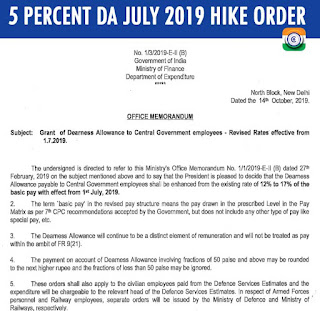
5 Percent DA July 2019 Hike Order - Grant of Dearness Allowance to Central Government employees

Grant of Dearness Allowance to Central Government employees 5 Percent DA July 2019 Hike Order  No. 1/3/2019-E- II (B) Government of...

Blog Archive

About The Author