A complete reference blog for Indian Government Employees

Showing posts with label Government Servants. Show all posts

Sunday, 2 August 2020

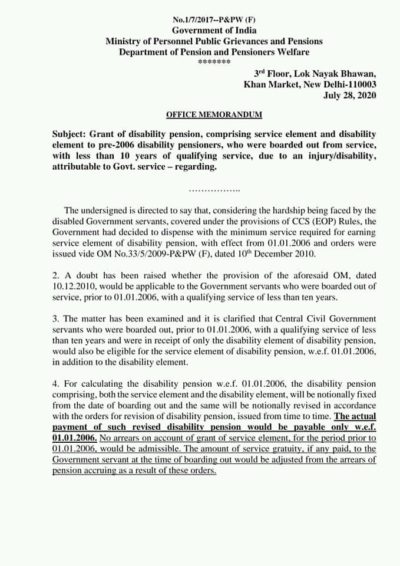
Grant of disability pension, comprising service element and disability clement to pre-2006 disability pensioners, who were boarded out from service, with less than 10 years of qualifying service, due to an injury/ disability, attributable to Govt. service

Central Government Pension News

No.1/7/2017- P&PW (F)
Government of India
Ministry of Personnel Public Grievances and Pensions
Department of Pension and Pensioners Welfare

3nd Floor, Lok Nayak Bhawan,
Khan Market, New Delhi-110003
July 28, 2020

OFFICE MEMORANDUM

Subject: Grant of disability pension, comprising service element and disability clement to pre-2006 disability pensioners, who were boarded out from service, with less than 10 years of qualifying service, due to an injury/ disability, attributable to Govt. service – regarding.

The undersigned is directed to say that, considering the hardship being faced by the disabled Government servants, covered under the provisions of CCS (EOP) Rules, the Government had decided to dispense with the minimum service required for earning service element of disability pension, with effect from 01.01.2006 and orders were issued vide OM No.33/5/2009-P&PW (F). dated 10th December 2010.

Also check: 7th CPC Concordance Table – Revision of pension pre-2016 pensioners/family pensioners
  1. A doubt has been raised whether the provision of the aforesaid OM, dated 10.12.2010, would be applicable to the Government servants who were boarded out of service, prior to 01.01.2006, with a qualifying service of less than ten years.
  2. The matter has been examined and it is clarified that Central Civil Government servants who were boarded out, prior to 01.01.2006, with a qualifying service of less than ten years and were in receipt of only the disability element of disability pension, would also be eligible for the service element of disability pension, w.e.f. 01.01.2006, in addition to the disability clement.
  3. For calculating the disability pension w.e.f. 01.01.2006, the disability pension comprising, both the service element and the disability clement, will be notionally fixed from the date of boarding out and the same will be notionally revised in accordance with the orders tor revision of disability pension. issued from time to time. The actual payment of such revised disability pension would be payable only w.e.f. 01.01.2006, No arrears on account of grant of service element, for the period prior to 01.01.2006, would be admissible. The amount of service gratuity, if any paid, to the Government servant at the time of boarding out would be adjusted from the arrears of pension accruing as a result of these orders.
  4. This issues with the concurrence of the Ministry of Finance, Department of Expenditure, vide their ILD. Note No. 1(9)/EV/2019 dated 25/06/2020.
  5. In their application to the persons belonging to Indian Audit and Accounts Department, these orders are issued under Article 148(5) of the Constitution and after consultation with the Comptroller and Auditor General of India.
  6. The Administrative Divisions of all Ministries / Department & attached / subordinate offices are requested to bring the contents of these instructions to the notice of all concerned for compliance.
(Seema Gupta)
Director
Grant of disability pension comprising service element to pre-2006 disability
Share:

Friday, 8 May 2020

Age of superannuation of Government servants from 58 years to 59 years

Age of superannuation of Government servants from 58 years to 59 years

PERSONNEL AND ADMINISTRATIVE REFORMS (S) DEPARTMENT

Age of superannuation of Government servants from 58 years to 59 years
G.0.(Ms)No.51

Dated: 07.05.2020

G.O.(Ms)No.532, Personnel and Administrative Reforms (Personnel-M) Department, dated 25.04.1979.

ORDER:

The Government have decided to increase the age of superannuation of Government servants from 58 years to 59 years and orders accordingly. This will apply to all those who are in regular service as on date and due to retire on superannuation from 31.05.2020.

The retirement age of Tamil Nadu state government employees increased from 58 to 59

This order shall also be applicable to all teaching and non-teaching staff working in aided educational institutions and employees of all Constitutional / Statutory Bodies, Public Sector Undertakings including all State Corporations. Local Bodies, Boards. Commissions, Societies, etc.

The relevant provisions under rule 56 of Tamil Nadu Fundamental Rules will be modified to the above extent. Necessary amendment to the above rules will be issued accordingly.

(BY ORDER OF THE GOVERNOR)
K. SHANMUGAM,
CHIEF SECRETARY TO GOVERNMENT
Share:

Saturday, 8 February 2020

Earned Leave (EL) accumulation by Central Government Employees

Earned Leave (EL) accumulation by Central Government Employees beyond 300 days?

Earned Leave (EL) accumulation by Central Government Employees


GOVERNMENT OF INDIA
MINISTRY OF PERSONNEL, PUBLIC GRIEVANCES AND PENSIONS
LOK SABHA
UNSTARRED QUESTION NO: 573
ANSWERED ON: 05.02.2020

Accumulation of Earned Leave

Upendra Singh Rawat:
Will the PRIME MINISTER be pleased to state:-

(a) whether the Government is considering any proposal to allow Earned Leave accumulation by Government servants beyond 300 days and discontinue with the practice of lapse of Earned Leave to enable Government servants to avail these leaves in case of medical emergencies;
(b) if so, the details thereof; and
(c) if not, the reasons therefor?

ANSWER
MINISTER OF STATE IN THE MINISTRY OF PERSONNEL, PUBLIC GRIEVANCES AND PENSIONS AND MINISTER OF STATE IN THE PRIME MINISTER’S OFFICE (DR. JITENDRA SINGH)

(a) to (c): No Sir. The existing provisions of the Central Civil Services (Leave) Rules, 1972 with regards to medical emergencies for Government servants, are considered adequate.

Also check: TYPES OF LEAVE ADMISSIBLE: Leave Rules - CCS (Leave) Rules, 1972

UNSTARRED LOKSABHA QUESTION
Share:

Sunday, 12 January 2020

DoPT 2020 - Submission of Immovable Property Return (IPR) for the year 2019 (as on 31.12.2019) by the Officers of CSSS & CSCS


DoPT 2020 - Submission of Immovable Property Return (IPR) for the year 2019 (as on 31.12.2019) by the Officers of CSSS & CSCS

Latest DoPT Orders 2020

No.25/4/2020-CS.II(A)
Government of India
Ministry of Personnel, Public Grievances and Pensions
Department of Personnel and Training

3rd Floor, Lok Nayak Bhavan,
Khan Market, New Delhi-110 003.
Date: 10.01.2020

OFFICE MEMORANDUM

Subject: Submission of Immovable Property Return (IPR) for the year 2019 (as on 31.12.2019) by the Officers of Central Secretariat Stenographers’ Services (CSSS) & Central Secretariat Clerical Service (CSCS) - regarding.

In terms of Rule 18 of CCS (Conduct) Rules, 1964 and instructions issued by this Department vide OM No,11013/7/2014-Estt,A- III dated 05.01.2016, the Immovable Property Return (IPR) is required to be furnished by all the Government Servants belonging to Group-A, B and C. Accordingly, IPR should be submitted by all the CSCS/ CSSS Officials/ Officers latest by 31.01.2020. CSSS Officers in the grade of Principal Private Secretary (PPS) and above should submit their IPR through Web Based Cadre Management System hosted at cscms.nic.in, A copy of the print out of IPR submitted online should also be signed and submitted to CS.II(A) Section, which is the custodian of Immovable Property Return (IPR) of these Officers. Stenographer Grade-13, Personal Assistants and Private Secretaries of CSSS & Junior Secretariat Assistants and Senior Secretariat Assistants of CSCS will also submit their IPR to their respective Admin./ Vigilance Division.

2. Ministries/ Departments are therefore, requested that the contents of this O.M. may be widely circulated to the notice of all CSCS/ CSSS Officials/ Officers working under their respective control. They should also ensure that the IPR for the year 2019 (as on 31.12.2019) is submitted within the stipulated time by all the CSCS/ CSSS Officials/ Officers. All the officials/officers are informed that non-submission of IPR within the stipulated date, would invite the denial of Vigilance Clearance for Empanelment, Deputation., assignment to training programme (except mandatory training), applying to sensitive posts etc. as the IPR status needs to be checked for the said purpose(s).

3. It is, therefore, requested that all the CSCS/ CSSS Officers may be directed to file their Immovable Property Return (IPR) for the year 2019 (as on 31.12.2.019) well in time, latest by 31.01.2020. IPRs received beyond the stipulated date, shall not be regarded as conforming to the extant guidelines. Filing of IPR has already been started from 01.01.2020 and the “Immovable Property Returns” window has been operative at cscms.nic.in.

4. In case of any doubt/ difficulty about filing the IPR, Shri Sumit Kumar and Shri Batram Yadav, Assistant Section Officer of CS.II Division may be contacted at Telephone No, 2462 0118.

(Dinesh)
Under Secretary to the Govt. of India
E-mail dinesh.d13@gov.in
Phone: 2465 4020
Share:

Thursday, 3 October 2019

Pay Fixation for Government servants searching transfer from higher post to lower post under FR 15 (a)

Pay Fixation for Government servants searching transfer from higher post to lower post under FR 15 (a)
Government of India
Ministry of Railways
(Railway Board)
RBE No. 161
No. 2019/F(E)II/3/3/1
dated: 30.09.2019
The General Manager
All India Railways and Production Units
(As per standard list)

Sub: Fixation of pay in case of employees who seek transfer to a lower post under FR 15(a) - clarification regarding.

Ref: (i) Letter No. F(E)/II/91/Misc./2 dated 20.08.1999. Op Letter No. F(E)II/ 2009/ FOP/ 1/ Misc. dated 30.11.2009. (iii) Letter No. 2017/F(E)II/3/3/1 dated 06.04.2017.

Also check: 7th Pay Commission Pay Fixation : 7th CPC Pay Fixation with examples

In the letters referred above, mention has been made “of an employee holding a higher post on regular basis and has completed a minimum period of 24 months in that higher post” / “Government Servant holding a post on regular basis.”

In this regard clarification was sought from the Establishment Directorate, who have clarified as follows:-
“ Vide E(NG)’s letter no. E(NG)1-98/CN5/i. dated 02,08.2001 probation period is now 12 months in each grade (non-gazetted staff). Therefore, for the purpose of protection of pay as circulated by F(E)’s instructions on own request transfer from higher post to _lower post, “regular” service will denote 12 months completion of service (i.e, probation period) in the higher post without any adverse action, unless duration of probation has specifically been provided for a particular post in rules ”.
As mentioned further in Establishment Directorate’s clarification, this will not operate to re-open past /settled cases.

Hindi version is enclosed.

Please acknowledge receipt.

Also read: 7th CPC Pay Fixation Method for all Central Government Employees with Illustration
Fixation of pay in case of employees who seek transfer to a lower post under FR 15(a)


Share:

Monday, 16 September 2019

HBA - Central Government employees have a low-interest house construction advance

House Building Advance (HBA)

Central Government employees have a low-interest house construction advance
Finance Minister Nirmala Sitharaman said the lowering of interest rates will encourage more government employees to buy new houses as they were “a major contributor” to the overall demand.
Also Read: 7th Pay Commission House Building Advance

New Measures to Boost Housing Sector

Relaxation of ECB guidelines for Affordable housing
  • ECB guidelines will be relaxed to facilitate financing for home buyers who are eligible under the PMAY, in consultation with RBI.
  • This is in addition to the existing norms for ECB for affordable housing.
House Building Advance
  • The interest rate on House Building Advance shall be lowered and linked with the 10 Year G Sec Yields.
  • Government servants contribute to a major component of demand for houses. This will encourage more government servants to buy new houses
Also Check: Clarifications regarding House Building Advance - HBA

house-building-advance-central-government-employees


Share:

Wednesday, 7 August 2019

Amendment in Central Civit Services (Conduct) Rules, 1964 regarding acceptance of gifts by Government servants

DoPT Orders 2019

F. No. 11013 / 02 / 2019-Estt.A-III
Government of India
Ministry of Personnel, Public Grievances and Pension
Department of Personnel & Training
(Establishment A-III Desk)

North Block, New Delhi – 11001
Dated: 6 August, 2019

OFFICE MEMORANDUM

Subject: Amendment in Central Civit Services (Conduct) Rules, 1964 regarding acceptance of gifts by Government servants.

The undersigned is directed to say that the following rules of Central Civil Services (Conduct) Rules, 1964 prescribing ceiling for receiving gifts by Government servants, have been amended vide G.S.R. No. 531 (E) dated 29.07.2019 (copy enclosed) so as to bring the uniformity in provisions of CCS (Conduct) Rules, 1964, AIS (Conduct) Rules, 1968 and Foreign Contribution (Acceptance or Retention of Gifts or Presentations) Rules, 2012:

Before AmendmentAfter Amendment
Sub-rule (3) of Rule 13
In any other case, a Government servant
shall not accept any gift without the
sanction of the Government, if the value
exceeds –

(i) rupees one thousand Five hundred in
the case of Government servants
holding any Group A’ or Group B’
post; and

(ii) rupees five hundred in the case of
Government servant holding any Group
‘C’ or Group ‘D’ posts.
Sub-rule (3) of Rule 13
In any other case, a Government servant shall not accept any gift without the sanction of the Government, if the value exceeds –

(i) rupees five thousand in the case of Government servants holding any Group ‘A’ or Group B’ post: and

(ii) rupees two thousand in the case of Government servant holding any Group ‘C’ post.
Sub-rule (4) of Rule 13
Notwithstanding anything contained in sub-rule (2) and (3), a Government servant, being a member of India delegation or otherwise, may receive and retain gifts from foreign dignitaries, if the market value of gifts received on one occasion does not exceed rupees one thousand. In all other
cases, the acceptance and retention of such gift shall be regulated by the instructions issued by the Government in this regard from time to time.
Sub-rule (4) of Rule 13
Notwithstanding anything contained in
sub-rule (21 and (3), a Government servant, being a member of the Indian delegation or otherwise, D&y receive and retain gifts from foreign dignitaries in accordance with the
provisions of The Foreign Contribution (Acceptance or Retention of Gifts or
Presentation) Rules, 2012, as amended from time to time.

2. All Ministries/ Departments/ Offices are requested to bring the above amendments to the notice of all administrative authorities under their control.

3. Hindi version will follow.
(Satish Kumar)
Under Secretary to the Govt. of India
To
The Secretaries of All Ministries/ Departments
(as per the standard list)

Source: DoPT
Share:

Friday, 19 July 2019

Rules for filing IPRs - Rajya Sabha question


Ministry of Personnel, Public Grievances & Pensions
Rules for filing IPRs
18 JUL 2019
In terms of Rule 18 of the Central Civil Services (Conduct) Rules, 1964, Immovable Property Returns (IPRs) are required to be submitted by all Government servants on their first appointment to any service or post and subsequently to be submitted annually. Similar provisions are also available in All India Services (Conduct) Rules, 1968.

Department of Personnel & Training (DoPT) being the cadre controlling authority for Indian Administrative Service (IAS), Central Secretariat Service (CSS) and Central Secretariat Stenographers Service (CSSS) maintains the data in respect of officers belonging to these services. As per information in respect of these officers, IPRs for the year 2018, have not been filed by 52 IAS officers of the level of Joint Secretary & above, 163 CSS officers of the level of Under Secretary & above and 51 CSSS officers of the level of Principal Private Secretary & above.

DoPT, vide O.M. No. 104/33/2005-AVD-I dated 7.09.2011 and O.M. No. 11012/11/2007-Estt.(A) dated 27.09.2011, has prescribed that vigilance clearance shall be denied to the officers of All India Services and Central Civil Services/ Posts for certain purposes if they fail to submit their annual Immovable Property Returns of the previous year latest by 31st January of the following year.

This information was provided by the Union Minister of State (Independent Charge) Development of North-Eastern Region (DoNER), MoS PMO, Personnel, Public Grievances & Pensions, Atomic Energy and Space, Dr Jitendra Singh in written reply to a question in Rajya Sabha today.

PIB
Share:

Thursday, 2 May 2019

VOLUNTARY RETIREMENT SCHEME FOR CENTRAL GOVERNMENT EMPLOYEES

VOLUNTARY RETIREMENT SCHEME APPLICABLE TO CENTRAL GOVERNMENT EMPLOYEES – UPDATED PROCEDURE AND INSTRUCTIONS FOR VRS

Introduction:

The Government has extended facility to Government servants to take retirement from service voluntarily with full pensionary benefits before attaining the age of superannuation.

Employee has Right to take Retirement:

The Administrative Reforms Commission had recommended in its report on Personnel Administration, as follows
“59(1): A Civil servant may be allowed to retire voluntarily if he has completed 15 years of service and given proportionate pension and gratuity.”
The above recommendation of the Administrative Reform Commission was considered by Government and it has been decided that Government servants may be allowed to retire voluntarily after 20 years of qualifying service on proportionate pension and gratuity with a weightage of up to 5 years towards qualifying service where applicable, subject to certain condition.
Entry in ServiceAge of Voluntary Retirement
Group A and Group B officers who had entered service before attaining the age of 35 YearsAfter attaining the age of 50 years
Group A and Group B officers other than above and All Group C employeesAfter attaining the age of 55 year
All employeesOn completion of 30 years of qualifying Service
Scientist or technical experts who is :
(i) On assignment under the Indian Technical and Economic Co-operation (ITEC) programme of Ministry of External Affairs and other aid programmes
(ii) Posted abroad in foreign based office of a ministry /Department
(iii) Specific contract assignment to a foreign government
After having been transferred to India resumed the charge of the post in India and served for a period of not less than one Year with fulfilling other conditions.
The following instructions will regulate the voluntary retirement of Central Government Servants pursuance of the Government decision
(i) Government servants who have put in not less than 20 years qualifying service may, by giving notice of three months in writing to the appointing authority, retire from service voluntarily. The scheme is purely voluntary the initiative resting with the Government servant himself. The Government does not have the reciprocal right to retire Government servant on its own, and or this scheme.
(ii) The benefit of retiring pension will be admissible to Government servant retiring under this scheme.
(iii) A notice of less than three months may also be accepted by the appointing authority in deserving cases, with the concurrence of the Ministry of Finance (Department of Expenditure).
(iv) If a Government servant retires under the Scheme of voluntary retirement while he is on leave not due, without returning to duty, the retirement shall take effect from the date of commencement of the leave not due and the leave salary paid in respect of such leave not due shall be recovered as provided in Rule 31 of the CCS (Leave) Rules, 1972.
(v) Before a Government servant gives notice of voluntary retirement with reference to these instructions, he should satisfy himself by means of reference to the appropriate administrative authority that he has, in fact, completed 20 years’ service qualifying for pension.
Note: Appropriate authority means the authority which has the power to make substantive appointments to the post or service from which the Government servants is required or wants to retire.
(vi) A notice of voluntary retirement may be withdrawn subsequently only with the approval of the appointing authority provided the request for such withdrawal is made before the expiry of the notice.
(vii) A notice of voluntary retirement given after completion of 20 years’ qualifying service will required acceptance by the appointing authority if the date of retirement on the expiry of the notice would be earlier than the date on which the Government servant concerned could have retired voluntarily under the existing rules applicable to him. ( e.g. FR 56(k), Rule 48 of the Pension Rules, Article 459(1) of SSRs or any other similar rules) such acceptance may be generally given in all cases except those (a) in which disciplinary proceedings are pending or contemplated against the Government servant concerned for the imposition of a major penalty and the disciplinary authority, having regard to the circumstances of the case, is of the view that the imposition of the penalty or removal or dismissal from service would be warranted in the case for (b) in which persecutions is contemplated or may have been launched in a Court of Law against the Government servant concerned. If it is proposed to accept the notice of voluntary retirement even in such cases, approval of the Minister-in-charge should be obtained in regard to Group ‘A’ and Group ‘B’ Government servants and that of the Head of the Department in the cases of Group ‘C’ and Group ‘D’ Government servants. Even where the notice of voluntary retirement given by a Government servant requires acceptance by the appointing authority, the Government servant giving notice may presume acceptance and the retirement shall be effective in terms of the notice unless the competent authority issues an order to the contrary before the expiry of the period of notice.
(viii) While granting proportionate pension to a Government servant retiring voluntarily under this scheme, weightage of upto five years would be given as an addition to the qualifying service actually rendered by him. The grant, of weightage of upto five years will, however, subject to the following conditions:
a) The total qualifying service after allowing the weightage should not, in any event exceed 30 years’ qualifying service and
b) The total qualifying service after giving the weightage should not exceed the qualifying service which he would have had, if he had retired voluntarily at the lowest age/ minimum service limit applicable to him for voluntary retirement prescribed under FR 56(k) or article 459 (1) of the CSRs or Rule 48 of the CCS (Pension) Rules or any other similar rule applicable to him.
ILLUSTRATIONS:
(a) If a Government servants who could be prematurely retired under FR 560)(1) or could have voluntarily retired under FR 56(k) seeks voluntary retirement under this scheme after he has attained the age of 47 years and has rendered 22 years of service, the weightage in pension would be limited only upto three years.
(b) If a Government servants who could be prematurely retired under FR 56 G) (ii) or could have voluntarily retired under FR 56 (k) seeks voluntary retirement under this scheme after he has attained the age of 51 years and has rendered 24 years of service, the weightage in pension would be admissible upto four years.
(c) If a Government servants belonging to Group ‘C’ who could have voluntary retired under Rule 48 of the CCS (Pension) Rules, 1972 seeks voluntary retirement under this scheme after he has rendered 28 years of service and has attained the age of 48 years, the weightage in pension would be admissible upto five years.
(ix) The weightage given under this scheme will be only an addition to the qualifying service for purpose of pension and gratuity. It will not entitle of pension the Government servants retiring voluntarily to any additional fixation of pay for purposes of calculating the pension and gratuity which will be based on the actual emoluments calculated with reference to the date of retirement.
(x) The amount of pension to be granted after giving the weightage will be a subject to the provisions of Rule 6 of the CCS (Pension) Rules, 1972. The pension will also be subject to the provisions of Rules 8 and 9 of these Rules.
(xi) The scheme of voluntary retirement under these orders will not apply to those who retire voluntarily under the provisions of Rule 29 of the CCS (Pension) Rules, 1972.
(xii) The scheme of voluntary retirement under these orders will also not apply to those Government servants on deputation to autonomous bodies/ public undertakings etc. The absorption of Government servants on deputation to public undertakings/ autonomous bodies etc. in such autonomous bodies/ public undertakings etc. and the grant of retirement benefits to them in respect of their service under government will continue to be governed by the separate set of instructions issued by the Ministry of Finance in this regard.
(xiii) A Government servants giving notice of voluntary retirement may also apply, before the expiry of the notice, for the leave standing to his credit which may be granted to him to run concurrently with the period of notice. The period of leave, if any, extending beyond the date of retirement on expiry of notice but not extending beyond the date on which the Government servants should have retired on attaining the age of superannuation may be allowed as terminal leave as per Rule 39*6) of the CCS (Leave) Rules, 1972 .the leave salary for such terminal leave shall be payable in accordance with the provisions of the para 5 of Ministry of Finance (Department of Expenditure) O.M. No. 16(1) E-IV(A)/76 dated the 23.12.1976.
(xiv) Group ‘A’ Government servants retiring voluntarily under this scheme would continue to be subject to the provisions in the Pension Rules relating to post retirement commercial employment. However, in their cases, permission for the post retirement commercial employment will be granted more liberally than in the case of other Govt. servants retiring under the provisions of FR 56 or Rule 48 of the Pension Rules.
[DP&AR OM No. 25013/7/77 Estt.-(A), dated 26-08-1977]

Special Provisions to Accept Notice for VRS under FR 56(k) or 56 (m)

The provisions of Fundamental Rule 56(k), 56(m) and Rule 48 of CCS (Pension) Rules, 1972 relating to acceptance of request of voluntary retirement have been revisited as per the Central Administrative Tribunal, Principal Bench judgement dated 4th August, 2010 in O.A. No.1600/2009 filed by Shri Gopal Singh Purohit v / s UOI & Others to bring them at par with each other.
The matter has ‘been examined in consultation with Department of Pension and Pensioners Welfare and the Ministry of Law. FR 56(k) and 56 (m) have been amended vide Extra Ordinary Gazette Notification No. GSR 27(E), dated 17 January 2014. It shall be open to the appropriate authority to withhold permission to a Government servant who seeks to retire under FR 56(k) or 56 (m) in the following circumstances:
  • If the Government servant is under suspension ; or
  • If a charge sheet has been issued and the disciplinary proceedings are pending; or
  • If judicial proceedings on charges which may amount to grave misconduct, are pending.
Explanation: For the purpose of this clause, judicial proceedings shall be deemed to be pending, if a complaint or report of a police officer, of which the Magistrate takes cognizance, has been made or filed in a criminal proceedings.
[DOPT OM No. No.25013/3/2010-Estt (A), dated 27-02-2014]

Request for Voluntary retirement from persons suffering from disability

The undersigned is directed say that vide Department of Personnel and Training’s OM No.18017 /1/2014-Estt.(L), dated 25 February 2015 certain clarifications regarding treatment of leave and absence of disabled Government servants have been issued.
Instances have come to notice where Government servants apply for voluntary retirement under various provisions like Rules 38, Rule 48 and 48A of CCS (Pension) Rules, 1972 or Rule 56 of the Fundamental Rule on account of hardships faced by them due to a disability, as they are unaware of the protection provided by the Section 47 of the Persons with Disabilities (Equal Opportunities, Protection of Rights and Full Participation) Act, 1995 (PWD Act). Section 47 of the PWD Act, 1995 is reproduced below for reference:
“Non-discrimination in Government Employment-(1) No establishment shall dispense with, or reduce in rank, an employee who acquires a disability during his service.
Provided that, if an employee, after acquiring disability is not suitable for the post he was holding, could be shifted to some other post with the same pay scale and service benefits; provided further that if it is not possible to adjust the employee against any post, he may be kept on a supernumerary post until a suitable post is available or he attains the age of superannuation, whichever is earlier.
No promotion shall be denied to a person merely on the ground of his disability; provided that the appropriate Government may, having regard to the type of work carried on in any establishment, by notification and subject to such conditions, if any, as may be specified in such notification, exempt any establishment from the provisions of this section.
The issue had come up in Bhagwan Dass & Anr v / s Punjab State Electricity Board (2008) 1 SCC 579, decided by the Hon’ble Supreme Court where the employee who had during his service suffered from blindness, had applied for voluntary retirement. The Hon’ble Supreme court has observed that the Petitioner was not aware of any protection that the law afforded him and apparently believed that the blindness would cause him to lose his job, which was the source of livelihood of his family. In those circumstances, it was the duty of the superior officers to explain to him the correct legal position and to tell him about his legal rights.
Keeping in view the provisions of the Section 47 of the PWD Act, 1995 and the above mentioned judgement, it has been decided that whenever a Government servant seeks voluntary retirement citing medical grounds, or when the said notice has been submitted due to a disability, the administrative authorities shall examine as to whether the case is covered under Section 47 of PWD Act, 1995. In case the provisions are applicable, the Government servant shall be advised that he/ she has the option of continuing in service with the same pay scale and service benefits.
In case a disabled Government servant reconsiders his decision and withdraws the notice for voluntary retirement, his case shall be dealt with under the provisions of the Section 47 read with the DOPT OM dated 25 February 2015 mentioned above. If however, in spite of being so advised, such Government servant still wishes to take voluntary retirement, the request may be processed as per the applicable rule.
[DOPT OM No.25012/1/2015-Estt (A-IV), dated 19-05-2015]

Special Voluntary Retirement Scheme for Surplus Central Government Employees

The Expenditure Reforms Commission (ERC) set up by the Government of India has suggested a liberal voluntary Retirement Scheme (VRS) for the employees’ declared surplus. This recommendation, contained in Commission’s second Report on ‘ Optimising Government’s Staff Strength – Some General issues’ has been considered carefully and the Central Government have decided to introduce a special Voluntary Retirement Scheme (VRS) as per details given herein under for the permanent employees declared surplus in any Ministry /Department as a consequence of one or more of the following:-
  • Implementation of decisions of the Cabinet regarding restructuring of Ministries /Departments;
  • Implementation of the recommendations of the Expenditure Reforms Commission;
  • Implementation of the decision of a Ministry /Department relating to downsizing/ rightsizing including, Inter alia, restructuring of an organization, transfer of an activity to a State Government, Public Sector undertaking or other Autonomous Organisation, discontinuation of an ongoing activity and introduction of changes in technology; or
  • Implementation of work study reports undertaken by the Staff Inspection Unit of the Ministry of Finance or any other body set up by the Central Government or the Ministry /Department concerned.
The features of the Special VRS for the employees declared surplus are as under:-
(a) All permanent employees rendered surplus irrespective of their age and qualifying service can opt for the scheme.
(b) An optee of Special VRS will be entitled to receive an ex-gratia’ amount equal to basic pay plus dearness allowance for the number of days worked out on the basis of length of service @ 35 days for each completed year and 25 days for each remaining year. For any part of a year, the number of days, for ex-gratia amount, will be worked out on the basis of 365 days in a year. The ex -gratia amount will be further subject to the following conditions:
  • i. total number of years to be counted for payment of ex-gratia will not exceed 33 years;
  • No weightage of additional service will be given for the purpose of calculation of ex- gratia;
  • The ex-gratia will be subject to a minimum of Rs.25000 or 250 days emoluments, whichever is higher;
  • The ex-gratia amount should not exceed the sum of the basic pay plus DA that the employee would draw at the prevailing level for the balance of the period of service left before superannuation.
  • The ex-gratia amount will be paid in lump-sum;
  • The ex-gratia amount upto Rs 5.00 lakhs will be exempted from Income Tax;
(c) A weightage of five years to the qualifying service shall be given under CCS (Pension-) Rules, 1972 to such permanent surplus employees who have rendered a minimum of 15 years of qualifying service on the date they are declared surplus. However, as provided in rule 29 of CCS (Pension) Rules, 1972, the qualifying length of service after taking into account the aforesaid weightage should not be more than the service he would have rendered had he retired on the date of his superannuation.
(d) Encashment of Earned Leave accumulated in the date of relief as per CCS (Leave) Rules, 1972;
(e) Payment of savings element with interest in the Central Government Employees Group insurance Scheme as per rules;
(f) TA/DA as on retirement for self and family for settling down anywhere in India as per Travelling Allowance Rules;
(g) Group A officials opting for the special VRS will be exempted from the operation of rule 10 of the CCS (pension) Rules which stipulates previous sanction of the Government for accepting commercial employment.
  1. Payment of ex-gratia to the employees declared surplus and opting for the special VRS within the specified three months period will be over and above the normal retirement entitlements under CCS (Pension) Rules, 1972.
  2. The order of voluntary retirement in each case should clearly stipulate that the surplus post held by the retiring incumbent will stand abolished from the date of his/her voluntary retirement.
  3. The Identification of surplus employees for the purpose of VRS would be guided by procedure given in item 3 of Annexure-1 under the heading “Steps for Identification of Surplus staff” to the revised scheme of the disposal of personnel rendered, surplus due to reduction of establishment of Central Government Department/Offices notified vide Circular No 1/18/88-CS-III of DOPT dated 1 April 1989.
  4. The permanent employees declared surplus will have to exercise option for special VRS within three months from the date he or she has been declared surplus in any Ministry /Department. Surplus employees presently on the Rolls of the Surplus Cell (Re-designated as the division of Retraining and Redeployment ) of the Department of Personnel & Training as on the date of this OM can also opt for special VRS within three months from this date.
  5. In order to facilitate the maintenance of a close watch on the implementation of the scheme, all Ministries/Departments are required to submit quarterly returns to the Surplus Cell of Department of Personnel & Training that may be prescribed by that Cell.
  6. Ministry of Finance, etc. are requested to give wide publicity to the contents of this O.M. to the employees declared surplus.
[DOPT OM No. 25013/6/2001-Estt.(A), dated 28-02-2002]

Share:

Saturday, 27 April 2019

Frequently Asked Questions on Authorised Medical Attendant (AMA)

Frequently Asked Questions on Authorised Medical Attendant (AMA)

Who are covered by CS (MA) Rules?
They shall apply to all Government servants other than (i) these in railway
service and (ii) those of non-Gazetted rank stationed in or passing through Calcutta, whose conditions of service are prescribed by Rules made or demand to be made by the Central Government, when they are on duty, leave or Foreign Service in India or which under suspension.

Who is an AMA?
Authorised Medical Attendant (AMA) is Medical Officer in the employee of Central Government or Private Medical Practitioner appointed/ nominated by the Ministry/Department for providing medical attendance to its employees.

What is the Reimbursement in case of treatment taken under emergency at private hospital?
CS(MA) beneficiaries are being reimbursed as per the prevailing non NABH CGHS as applicable to a CGHS covered city and non-NABH rates applicable
to the nearest CGHS covered city in case of non-CGHS city, as the case may be, or the actual, whichever is less, for treatment undertaken at private hospitals under emergent condition.

What are the hospitals in which CS(MA) beneficiary are entitle for treatment under normal conditions?
CS(MA) beneficiaries and their dependent family members can get treatment from any of the Central Government hospitals/ State Government hospitals/ private hospitals and diagnostic centers recognized under CGHS/ CS(MA) Rules as per provisions.

Can a Central Government Employee gets reimbursement is treatment
undertaken aboard?

Treatment abroad is considered under CS (MA) Rules, 1944, on receipt of application in the prescribed format through the employee’s Ministry/ Department. However, approval depends on the opinion of the standing Committee constituted under these rules.

Share:

Thursday, 7 March 2019

DoE: Reimbursement of rent to Government servants during their temporary stay upto a maximum period of six months

DoE: Reimbursement of rent to Government servants during their temporary stay upto a maximum period of six months
No.2/05)2018-E.II(B)
Government of India
Ministry of Finance
Department of Expenditure
North Block, New Delhi
Dated: 01 February 2019,
OFFICE MEMORANDUM

Subject: Reimbursement of rent to Government servants during their temporary stay (upto a maximum period of six months) in State Bhavans/Guest Houses/ Departmental Guest Houses run by Central Government/State Governments /Autonomous Organizations etc.

Several references are being received in this Department seeking clarification regarding applicability of instructions contained in this Departments O.M.No.2(25)/2004-E.II(B) dated 15.12.2011 to Central Government officials on their stay in State Bhavans/Guest Houses and also in cases where Central Government off and also stay in Departmental Guest Houses.

2. The matter has been considered in this Department. In supersession of the instructions contained in aforesaid O.M. dated 15.12.2011, it has been decided that tie official on their pasting to the Centre and the Central Government officials on their transfer/posting to a new station; necessitating change of residence if they temporarily stay in State Bhavans/ Guest Houses/Departmental Guest houses run by Central Government / State Government / Autonomous Organizations etc., may be reimbursed the amount of rent paid subject to fulfillment of the following conditions:
(a) The official has applied for accommodation of his entitlement, but has not been allotted residential accommodation by the Government.
(b) The concerned Guest House, should be located at the place of posting of the official.
(c) The official must have stayed in State Bhavans/Guest Houses/Departmental Guest Houses run by Central Government/State Government/Autonomous Organizations etc and submit rent receipts in support of payment of rent.
(d) Reimbursement of rent shall be admissible up to a maximum period of six months.
(e) No House Rent Allowance (HRA) shall be admissible during this period,
These orders shall be effective from the date of issue.

In so far as the persons serving in the India Audit and Accounts Department are concerned, these orders issue in consultation with the Comptroller & Auditor General of India.

Hindi version is attached.
(Nirmala Dav)
Deputy Secretary to the Government of India
Share:

Tuesday, 5 February 2019

Reimbursement of Rent to Government Servants - Finmin Orders 01.2.2019


Reimbursement of Rent to Government Servants - Finmin Orders 01.2.2019

Reimbursement of rent to Government servants during their temporary stay (upto a maximum period of six months) in State Bhavans/Guest Houses/Departmental Guest Houses run by Central Government/State Governments/Autonomous Organizations etc.

No.2/05/2018-E.II(B)
Government of India
Ministry of India
Department of Expenditure
North Block, New Delhi,
Dated, 01st February 2019
Office Memorandum
Subject: Reimbursement of rent to Government servants during their temporary stay (upto a maximum period of six months) in State Bhavans/Guest Houses/Departmental Guest Houses run by Central Government/State Governments/Autonomous Organizations etc.

Several references are being received in this Department seeking clarification regarding applicability of instructions contained in this Department’s O.M. No.2(25)/2004-E.II(B) dated 15.12.2011 to Central Government officials on their stay in State Bhavans/Guest Houses and also in cases where Central Government officials stay in Department Guest Houses.

2. The matter has been considered in this Department. In supersession of the instructions contained in aforesaid O.M. Dated 15.12.2011, it has been decided that the officials on their posting to the Centre and the Central Government Officials on their transfer/posting to a new station, necessitating chages of residence if they temproarily stay in State Bhavans/Guest Houses/Departmental Guest Houses run by Central Government / State Government/Autonomous Organizations etc., may be reimbursed the amount of rent paid subject to fullfillment of the following conditions:
(a) The official has applied for accommodation of his entitlement, but has not been alloted residential accommodation by the Government
(b) The concerned Guest House should be located at the place of posting of the official.
(c) The official must have stayed in State Bhavans/Guest Houses/Departmental Guest Houses run by Central Government / State Government/Autonomous Organizations etc.and submit rent receipt in support of payment of rent.
(d) Reimbursement of rent shall be admissible up to a maximum period of six months.
(e) No House Rent Allowance (HRA) shall be admissible during this period.
3. These orders shall be effective from the dated of issue.
4. In so far the persons serving in the India Audit and Accounts Department are concerned, these orders issue in consultation with the Comptroller and Auditor General of India.
Hindi version is attached.
sd/-
(Nirmala Dev)
Deputy Secretary to the Government of India
Source: DoE
Share:

General Elections/Bye-elections - Guidelines for the conduct of Government servants


General Elections/Bye-elections - Guidelines for the conduct of Government servants
GUIDELINES FOR GOVT. PERSONNEL REGARDING CONDUCT OF ELECTIONS
Guidelines for the Conducts of Govt. Servants (dt. 06.11.1984).

Election Commission's Letter No. 62/84, dated 6th November, 1984 to Chief Secretaries to State/Union Territories, all Chief Electoral Officers and Ministries of Home Affairs and Law and Justice.

Subject:- General Elections/Bye-elections - Guidelines for the conduct of Government servants.
I am directed to invite your attention to sections 129 and 134 of the Representation of the People Act, 1951, relating to the conduct of Government servants during elections and to say that the Government of India as well as the State Government have been, before conduct of a general election, issuing instructions regarding the conduct of Government servants in relations to an election, stressing that all the Government employees should maintain an attitude of strict impartiality.

2. The Government employees should not only be impartial but should also appear to be so in relation to the elections. They are required to conduct themselves in such a manner as to inspire confidence in the public in regard to their impartiality so that there might not be any occasion for the people to think that the elections would not be held in a free, fair and pure atmosphere. It should be stressed that they should avoid giving room for any suspicion that they are favoring any party or any candidate. They are not expected to take part in any election campaign or canvassing and should take scrupulous care not to lend their names, official position or authority to assist one individual as against another or one group as against another.

3. With particular reference to the tours that the Ministers might undertake on the eve of the elections, it is necessary that while Government Officers should make all the usual arrangements to enable the Ministers to carry out their responsibilities as Ministers, the Government Officers should not themselves organise any election meetings or be present in person during any such meetings except those who may have to be present to the extent necessary for maintaining law and order and making necessary security arrangements.

The question as to whether a public meeting addressed by a Minister is officially sponsored or is held for election propaganda has to be decided by the Minister himself. In the meeting, the arrangement for organising it is to be made on the Minister's behalf unofficially and the expenditure in that connection is to be borne by him or his party.

It is further made clear that a public meeting held on the eve of an election is normally to be considered to be an election meeting and the expenses thereof are not to be borne from public funds. The preservation of law and order at every meeting will, however, be the responsibility of the Government officials responsible for law and order.

4. In this connection I am also to enclose a copy of the Ministry of Home Affairs’ O.M. No. 25/44/49-Ests, dated 10th October 1949, which clarifies the position regarding the participation of Government servants in political activities vis-a-vis the attendance by Government servants at political meetings, for your information. The contents of the said O.M. may also be brought to the notice of all Government servants for their guidance.

5. In the matter of election meetings in a public place, the Government officers should not make any distinction between one political party and another in granting permission to hold such meetings. If more parties than one apply for holding a meeting at any place on the same day and at the same hour, the party which applies first should be given preference.

6. Further your attention is specially invited to the provisions of section 134-A of the Representation of the People Act, 1951, which reads as follows :-
"134-A Penalty for Government Servants for acting as Election Agent, Polling Agent or Counting Agent :
If any person in the service of the Government acts as an election agent or a polling agent or a counting agent of a candidate at an election he shall be punishable with imprisonment for a term which may extend to three months with fine, or with both."

7. In this connection, I am also to forward herewith an extract of rule 5 of the Central Civil Service (Conduct) Rule, 1964, which inter alia prohibits the Government servants from taking part in politics and elections. It is presumed that similar provisions exist in the rules governing the conduct of Government servants of your State.

8. I am, therefore, to request that necessary instructions in the above regard may kindly be issued by the State Governments emphasising upon the Government servants that any disregard of instructions would be considered by the Government as a serious act of indiscipline and that in cases of doubt a Government servant should not hesitate to consult his superior officer.

9. A copy of the instructions issued by the State Government may be forwarded for the Commission's record.

The receipt of this letter may please be acknowledged.
[The Commission's letter No. 62/79, dated the 13th November 1979 is hereby superseded.]
Share:

Sunday, 30 December 2018

Railway Services (Revised Pay) Rules, 2016 - opportunity for revision of option to come over to revised pay structure

Railway Services (Revised Pay) Rules, 2016 - opportunity for revision of option to come over to revised pay structure

GOVERNMENT OF INDIA (BHARAT SARKAR)
Ministry of Railways (Rail Mantralaya)
(Railway Board)
PC-VII No. 123
File No. PC-VII/2018/RSRP/1
RBE No.19/2018
New Delhi, dated 17.12.2018
The General Managers/CAOs(R),
All Indian Railways & Production Units,
(As per mailing list)

Sub: Railway Services (Revised Pay) Rules, 2016 - opportunity for revision of option to come over to revised pay structure.

Please refer to Rule 5 & 6 af RS(RP) Rules,2016 regarding exercise of option to come over to revised pay structure effective from 01.01.2016 as notified by the RS(RP) Rules,2016. The said option was to be exercised within 3 months of the date of notification i.e. 28.07.2016 of the said Rules. The Rule 6(4) thereof provides that the option once exercised shall be final.

2. In this context, it is stated that Ministry of Finance, Department of Expenditure vide their permitted opportunity to Government Servants to revise their initial option in terms of Rule 5 & 6 of CCS(RP) Rules,2016. These orders issued by Ministry of Finance, Department of Expenditure shall be applicable mutatis mutandis in Railways with respect to RS(RP) Rules, 2016.

3. The 'three months' period mentioned in para 3 of aforesaid OM of Ministry of Finance, Department of Expenditure dated 12.12.2018 shall be three months from the date of issue of these instructions.

4. The matter has also been raised by both recognised Staff Federations AIRF and NFIR.

5. Hindi version will follow.
(Jaya Kumar G)
Deputy Director, PayCommission-VII
Railway Board
Source: NFIR
Share:

Friday, 28 December 2018

Departmental proceedings against Government Servants - Procedure for consultation with the Union Public Service Commission

Departmental proceedings against Government Servants - Procedure for consultation with the Union Public Service Commission

No. 39011/08/2016-Estt(B)
Government of India
Ministry of Personnel, Public Grievances and Pensions
Department of Personnel & Training
North Block, New Delhi
Date: 28th December, 2018
OFFICE MEMORANDUM
Subject: Departmental proceedings against Government Servants - Procedure for consultation with the Union Public Service Commission - reg

The undersigned is directed to refer to this Department's OM No. 39011/12/2009-Estt(B) dated 10.05.2010 on the subject mentioned above vide which a Proforma/Checklist was forwarded to all Ministries/Departments for referring disciplinary cases to Union Public Service Commission (UPSC) in terms of Article 320(3) (c) of the Constitution of India read with Regulation 5 of the UPSC (Exemption from Consultation) Regulations, 1958 (as amended from time to time).

2. The Proforma/ Checklist has been revised in consultation with UPSC so as to ensure that there are no shortcomings while sending the requisite information/ documents to the Commission. It is also expected that the complete reference is received in the Commission at least three months prior to the retirement of the charged officer in case of minor penalty proceedings and at least six months prior to retirement in case of major penalty proceedings in order to get advice of the Commission and the implementation thereof. Wherever the time is less than three months/ six months from the retirement of the Government servant, cogent reasons justifying late submission of case to UPSC are also required to be indicated.

3. The modified Proforma/Checklist for forwarding disciplinary cases to the  UPSC is enclosed for guidance! compliance by all concerned.

Encl: As above
(Pramod Kumar Jaiswal)
Under Secretary to the Government of India
Tel. No.: 23093175

Download the PROFORMA / CHECK LIST FOR FORWARDING DISCIPLINARY CASES TO THE UNION PUBLIC SERVICE COMMISSION
Share:

Thursday, 29 November 2018

Proceeding on adoption of Resolution on Abolishing NPS

National Pension System to Old Pension Scheme
Proceeding on adoption of Resolution on Abolishing NPS
Proceeding on adoption of Resolution on Abolishing NPS by Delhi Assembly- एन.पी.एस को समाप्त करने के संकल्प पर दिल्ली विधान सभा की कार्यवाही
LEGISLATIVE ASSEMBLY
NATIONAL CAPITAL TERRITORY OF DELHI
Bulletin Part-I
delhi-assembly-proceeding-on-nps-resolution
(Brief summary of proceedings)
Monday, 26 November 2018 / 05 Margshirsha 1940 (Saka)
No. 91
10. 6.51 PM Calling Attention (Rule-54) :
Shri Ajay Dutt called the attention of the Government towards "Abolishing National Pension System (NPS) and reinstate the old Pension System in the interest of lakhs of Government Servants".
Sh. Arvind Kejriwal, Hon'ble Chief Minister made a brief statement.
The following Resolution moved by Sh. Ajay Dutt was put to vote and adopted by voice-vote :
"The Legislative Assembly of NCT of Delhi, having its sitting on 26 November 2018 :
Taking note of the negative consequences of the anti-employee National Pension System (NPS) that is imposed on the Government Servants by the then NDA Government in 2004 and sustained by the UPA-I, UPA-II and NDA-II Governments,
Given the fact that, unlike the old pension scheme, the NPS :
  • does not give any guarantee to the employees either for assured returns on investments or for minimum pension.
  • does not provide for family pension or social security,
  • does not provide for loan facility when in dire need,
  • does not provide for annual increments and hike in DA,
  • does not allow the employees to withdraw enough money from their own pension fund to meet the medical emergencies,
  • leaves the employees at the mercy of volatile markets and the forces that have notoriously been manipulating the markets,
  • imposes draconian restrictions on withdrawals from pension fund,
  • allows the insurance companies to exploit employees by way of forcing them to buy annuity for a minimum of ten years even after retirement, and
  • runs contrary to the spirit of welfare state as enshrined in the Constitution,
Given the fact that the pro-people and welfare oriented Government of NCT of Delhi is strongly in favour of restoring the rights and privileges of its employees by way of replacing the NPS with the time tested old pension scheme,
Resolves to urge upon the Government of India to scrap the NPS with immediate effect and bring at once all the Government Servants working under the Government of NCT of Delhi under the old pension scheme and restore to them all the benefits of the old pension scheme wherein the fair and legitimate pensions’ benefits are disbursed through the Consolidated Fund of India, so that the dedicated work force of the Government of NCT of Delhi and their families will be able to lead their lives with sense of security and dignity, and
Further resolves to urge upon the Government of India to restore t he old pension scheme in place of NPS or the benefit of all the Government Servants working under the Government of India and also to actively encourage other States to follow this true welfare measure"
Source: Delhi Assembly
Share:

Wednesday, 28 November 2018

NPS to OPS: Resolution adopted by Legislative Assembly of NCT of Delhi


NPS to OPS: Resolution adopted by Legislative Assembly of NCT of Delhi

National-Pension-System-Old-Pension-System


Resolution adopted by the Legislative Assembly of NCT of Delhi - Abolish National Pension System (NPS) and reinstate the old Pension System

NPS to OPS: Resolution adopted by Legislative Assembly of NCT of Delhi
Resolution adopted by the Legislative Assembly of NCT of Delhi - Abolish National Pension System (NPS) and reinstate the old Pension System

LEGISLATIVE ASSEMBLY SECRETARIAT
NATIONAL CAPITAL TERRITORY OF DELHI
Old Secretariat, Delhi - 110054

No.F.22(3)/Resolutions/2015/LAS-VI/Leg./
Dated: /11/2018
To
1. The Hon'ble Minister of Personnel, Public Grievances and Pensions
Government of India
North Block, New Delhi - 110 001
2. The Hon'ble Deputy Chief Minister,
Government of NCT of Delhi
I.P. Estate, New Delhi - 110002

Sub: Resolution adopted by the Legislative Assembly of NCT of Delhi to call the attention of Hon'ble Deputy Chief Minister to abolish National Pension System (NPS) and reinstate the Old Pension System in the interest of lakhs of Government Servants'.

Sir,
The Legislative Assembly of the National Capital Territory of Delhi unanimously adopted the following resolution moved by Shri Ajay Dutt, Hon'ble Member of Legislative Assembly in its sitting held on 26/11/2018:
"The Legislative Assembly in its sitting on 26 November 2018 resolves that:
Taking note of the negative consequences of the anti-employee National Pension System (NPS) that is imposed on the Government Servants by the then NDA Government in 2004 and sustained by the UPA-1, UPA-II and NDA-II Governments,
given that fact that, unlike the old pension scheme, the NPS;
does not give any guarantee to the employee either for assured returns on investments or for minimum pension,
does not provide for family pension or social security,
does not provide for loan facility when in dire need,
does not provide for annual increments and hike in DA,
does not allow the employees to withdraw enough money from their own pension fund to meet their medical emergencies,
leaves the employees at the mercy of volatile markets and the forces that have notoriously being manipulating the markets,
imposes draconian restrictions on withdrawals from pension fund,
allows the insurance companies to exploit employees by way of forcing them to buy annuity for minimum of ten years even after retirement, and
runs contrary to the spirit of welfare state as enshrined in the Constitution.
Given the fact that the pro-people and welfare oriented Government of NCT of Delhi is strongly in favour of restoring the rights and privilleges of its employees by way of replacing the NPS with the time tested old pension scheme.
Resolves to urge upon the Government of India to scrap the NPS with immediate effect and bring at once all the Government Servants working under the Government of NCT of Delhi under the old pension scheme and restore to them all the benefits of the old pension scheme wherein the fair and legislative pensions benefits are disbursed through the Constitutinal Fund of India, so that the dedicated work force of the Government of NCT of Delhi and their families will be able to lead their lives with sense of security and dignity, and further resolves to urge upon the Government of India to restore the old pension scheme in place of NPS or the benefit of all the Government Servants working under the Government of India and also to activity encourage other States to follow this true welfare measure."
Yours sincerely,
(C.Velmurugan)
Secretary (L.A.)
No.F.22(3)/Resolutions/2015/LAS-VI/Leg./2982
Dated: 27.11.2018

Copy for information and necessary action to:
1. Chief Secretary, Govt. of NCT of Delhi, Delhi.
2. Principal Secretary to Lt. Governor, Govt. of NCT of Delhi, Delhi.
3. Principal Secretary (Services), Govt. of NCT of Delhi, Delhi.
4. Additional Secretary to the Chief Minister, Govt. of NCT of Delhi, Delhi.
sd/-
(Shnil Dutt Sharma)
Deputy Secretary (Legislation)
Source: Confederation
Share:

Thursday, 18 October 2018

Travel entitlements of Government employees for the purpose of LTC post Seventh Central Pay Commission


Travel entitlements of Government employees for the purpose of LTC post Seventh Central Pay Commission - clarification reg.
Travel entitlements of Government employees for the purpose of LTC post Seventh Central Pay Commission

No. 31011/8/2017-Estt.A-IV
Government of India
Ministry of Personnel, Public Grievances & Pensions
Department of Personnel & Training
Establishment A-IV Desk
North Block New Delhi.
Dated October 18, 2018
OFFICE MEMORANDUM

Subject: Travel entitlements of Government employees for the purpose of LTC post Seventh Central Pay Commission - clarification reg.

The undersigned is directed to refer to this Department's O.M.of even no. dated 19.09.2017 on the subject noted above, which inter-alia provides that the travel entitlements of  Government servants for the purpose of LTC shall be the same as TA entitlements as notified vide Ministry of Finance's O.M. No. 19030/1/2017-E.lV dated 13.07.2017, except the air travel  entitlement for Level 6 to Level 8 of the Pay Matrix, which is allowed in respect of TA only and not for LTC.

2. It is observed that many Government employees in Level 6 to Level 8 of the Pay Matrix had inadvertently travelled by air on LTC during the intervening period from 13.07.2017  to 19.09.2017 (i.e. post issue of MoF's O.M. dated 13.07.2017 and before the issue of DoPT's  O.M. dated 19.09.2017) under the impression that they were entitled for air travel as per the  revised TA rules. This Department is in receipt of references from the Government employees  and various Ministries/Departments seeking relaxation in respect of such Government  employees in view of the hardships faced by them in settlement of their LTC claims.

3. The matter has been examined in this Department in consultation with Department of Expenditure. In relaxation to this Department's O.M. of even no. dated 19.09.2017, it has been decided to allow the claims of the Government employees in Level 6 to Level 8 of the Pay Matrix, who had travelled by air as per the revised TA rules while availing LTC during 13.07.2017 to 19.09.2017. This shall be subject to the fulfillment of other conditions of air travel on LTC such as booking of air tickets through the authorised modes, fare limit of LTC-80, etc.

4. Hindi version will follow.
(Surya Narayan Jha)
Under Secretary to the Government of India
To
The Secretaries
All Ministries/Departments of Government of India
(As per the standard list)

Source: 7cpc.in
Share:

Monday, 17 September 2018

Prohibition on bringing any political or outside influence by Govt. servant or by their close relatives

Prohibition on bringing any political or outside influence by Govt. servant or by their close relatives
CGDA-Government-servant

Controller General of Defence Accounts
Ulan Batar Road, Palam, Delhi Cantt 110010
No. AN/XIII/13006Nol-XXII
Dated 12.09.2018
To
The PCsDA/CsDA
The PIFAs/IFAs
(Through website)

Subject: Prohibition on bringing any political or outside influence by Govt. servant or by their close relatives in respect of service matters.
Reference: This HQrs letter bearing No. even dated 30.05.2017.

Please refer to the communication cited under reference containing guidelines regarding representation from Government servants on service matters. As per existing instructions, wherever, in any matter connected with his service rights or conditions, a Government servant wishes to press a claim or to seek redressal of a grievance, the proper course for him is to address his immediate official superior, or Head of his office, or such other authority at the appropriate level who is competent to deal with the matter in the organization.

2. However, it has been observed that instances of bringing outside as well as political influence by the official and their close relatives in matters like transfer etc. are on the rise. Such trend has been viewed seriously and the officials concerned may be liable for disciplinary action for such transgression and violation of provisions of CCS (Conduct) Rules, 1964.

3. In this context, attention is also invited to DOP&T OM bearing F.No.11013/08/2013-Est(A-111) dated 31.08.2015.

4. The contents of this communication may be disseminated to all officers/ staff serving in your organization.
(Mustaq Ahmad)
Dy. CGDA(Admin)
Source:cgda.nic.in
Share:

Friday, 20 July 2018

Reversion to old pension scheme

Reversion to old pension scheme

Ministry of Personnel, Public Grievances & Pensions
Reversion to old pension scheme

In accordance with the scheme for National Pension System (NPS), as notified vide Ministry of Finance (Department of Economic Affairs)’s Notification No. 5/7/2003-ECB & PR dated 22.12.2003, the System is mandatory for all new recruits to the Central Government service (except armed forces) from 01.01.2004.

Accordingly, as per Rule 2 of the Central Civil Services (Pension) Rules, 1972, as amended on 30.12.2003, these rules are applicable to Government servants appointed to civil posts on or before 31.12.2003. The date on which the vacancies arose or the date on which the examination was conducted for filling up the vacancies is not relevant for deciding the applicability of the Central Civil Services (Pension) rules, 1972.

Ministry of Home Affairs have not sought any advice from Department of Pension and Pensioners Welfare on the question of having a policy to cover the paramilitary personnel appointed after 01.01.2004 under the Old Pension Scheme on the ground that the vacancies arose, or the examination was conducted, in the year 2003. However, a reference was received from Ministry of Home Affairs in a specific case relating to appointments as Sub-Inspector in various Central Para Military Forces after selection in August, 2003 on the basis of an Examination conducted in 2002.

Appointments on the basis of these selections were made in Central Reserve Police Force in 2003 and the candidates appointed were covered by the pension scheme under Central Civil Service (Pension) Rules, 1972. However, in the Border Security Force, offers of appointment on the basis of the same examination/selection were issued in January, 2004.

On a petition filed by some personnel appointed in the Border Security Force on the basis of that examination, Hon’ble High Court of Delhi directed to cover the petitioners under the Central Civil Service (Pension) Rules, 1972 on the grounds of administrative delay on the part of Border Security Force in making appointments.

The order of Hon'ble High Court of Delhi was implemented by the Ministry of Home Affairs/Border Security Force in view of the peculiar circumstances of that case. The decision taken in that case is, however, not relevant for deciding applicability of Central Civil Service (Pension) Rules to all appointments made on or after 01.01.2004 in the Central Para Military Forces or in any other Department/organization on the basis of year of examination/selection.

This information was provided by the Union Minister of State (Independent Charge) Development of North-Eastern Region (DoNER), MoS PMO, Personnel, Public Grievances & Pensions, Atomic Energy and Space, DrJitendra Singh in written reply to a question in Rajya Sabha today.

PIB
Share:

Featured post

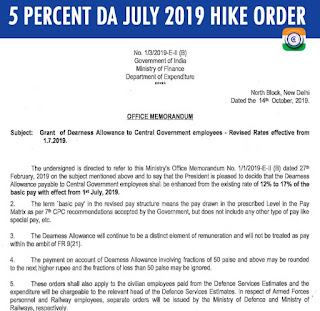
5 Percent DA July 2019 Hike Order - Grant of Dearness Allowance to Central Government employees

Grant of Dearness Allowance to Central Government employees 5 Percent DA July 2019 Hike Order  No. 1/3/2019-E- II (B) Government of...

Blog Archive

About The Author