A complete reference blog for Indian Government Employees

Showing posts with label National Pension Scheme. Show all posts

Tuesday, 24 September 2019

NPS - State government conference about benefits of National Pension System by PFRDA

NPS

NPS - State government conference about benefits of National Pension System by PFRDA

PENSION FUND REGULATORY AND DEVELOPMENT AUTHORITY

PRESS RELEASE

Conference on Implementation of National Pension System by State Governments

A conference on implementation of National Pension System by State Governments was organized by PFRDA on 10th Sept 2018 at IHC, New Delhi. The prime objective was to provide a forum to all State Governments, where the progress in the implementation of NPS with respect to compliance of timelines in various NPS related activities could be brought to the fore and a way forward could be provided. Higher officials from all State Governments attended the conference.

Also check: National Pension System (NPS) : PFRDA

Dr. Badri Singh Bhandari, Whole Time Member (Economics) in his opening address informed the state government officials about the features and benefits of NPS and various initiatives undertaken by PFRDA. He emphasised the use of online generation of PRAN, dashboard facility for effective monitoring of nodal officers and timely submission of subscriber registration forms and regular remittance of subscriber contribution. He reiterated about the issuance of guidelines by State Governments regarding procedure and timelines to be followed by State Governments for registration of new employees, upload of SCFs and remittance of the NPS contributions. He also touched upon the need of resolving pending grievances and withdrawals on priority by the nodal officers.
Sh. Ajay Narayan Jha, Secretary, Dept of Expenditure, Govt. of India in his address stated that the need of contributory system of pension arose due to the twin objectives to ensure fiscal prudence and secure old age income security in the country. Fiscally strong States are important for progress and development as the pension liabilities of the government has been increasing in terms of proportion of GDP. He advised participating State Governments to monitor the performance of NPS implementation with respect to timely completion of NPS related activities at nodal office level.

Read more on NPS - National Pension Scheme - CENTRAL GOVERNMENT EMPLOYEES

Chairman, PFRDA, Sh. Hemant G. Contractor, emphasized on the need for the government officials to be aware of the determinants of pension. NPS, being a contributory and market driven scheme, is different from the earlier pension system in the government, which was a formula based PAYG (Pay As You Go) scheme. In NPS, pension is dependent on various factors, such as the contribution amount, period of contribution, regularity in remittances, returns on investment, withdrawals, deferment options and choice of annuity. He urged the State governments to adopt online PRAN generation Module (OPGM) and to ensure effective implementation and monitoring of NPS. He also urged State Governments to ensure extending choices similar to those available to non-government subscribers and also to frame Rules for the guidance of government staff handling NPS in the States.
Quite a few presentations were made by various stakeholders under NPS for the benefit of the participants. As on 31st August, 2018, 28 States have implemented NPS and there are 32.51 Lakh subscribers with asset under management of Rs 1,16,227.49 Cr.
Share:

Thursday, 12 September 2019

National Pension Scheme for Traders and Self Employed Persons

NPS

Ministry of Labour & Employment
Prime Minister launches National Pension Scheme for Traders and Self Employed Persons
12 SEP 2019

The Prime Minister of India, Shri Narendra Modi launched at Ranchi today, the National Pension Scheme for Traders and Self Employed Persons, a pension scheme for the Vyaparis (shopkeepers /retail traders and self-employed persons) with annual turnover not exceeding Rs 1.5 crore. The Governor of Jharkhand Smt. Draupadi Murmu, Chief Minister of Jharkhand Shri Raghubar Das, Minister of Tribal Affairs Shri Arjun Munda, Minister of State for Labour & Employment (I/C) Shri Santosh Kumar Gangwar and other dignitaries were also present on the occasion. With this nation-wide launch, the facility for enrollment under the scheme has been made available to the prospective beneficiaries through 3.50 lakh Common Service Center (CSCs) across the country. In addition people can also self-enroll by visiting the portal maandhan.in/vyapari. The eligible Vyaparis can visit their nearest CSCs and get enrolled under the scheme. At the time of enrollment, the beneficiary is required to have an Aadhaar card and a saving bank/ Jan-dhan Account passbook only. He/ She should be within 18 to 40 years of age group. GSTIN is required only for those with turnover above Rs. 40 lakhs. The enrolment under the scheme is free of cost for the beneficiaries. The enrolment is based upon self- certification.

Government has approved National Pension Scheme for Traders and Self Employed Persons in acknowledgement of notable contribution of Vyaparis (shopkeepers/ retail traders and self-employed persons). It is a voluntary and contributory pension scheme for entry age of 18 to 40 years with a provision for minimum assured pension of Rs 3,000/- monthly on attaining the age of 60 years. The beneficiary should not be income tax payer and also not a member of EPFO/ ESIC/ NPS (Govt.)/ PM-SYM. The Central Government shall give 50 % share of the monthly contribution and remaining 50% contribution shall be made by the beneficiary. The monthly contribution is kept low to make it affordable. For example, a beneficiary is required to contribute as little as Rs.100/- per month at a median entry age of 29 years.

This pension scheme is one of the top priorities of Prime Minister Narendra Modi’s Government in its second term. According to the Ministry’s 100-day plan, this scheme will target enrolling 25 lakh subscribers in 2019-20 and 2 crore subscribers by 2023-2024. An estimated 3 crore Vyaparis in the country are expected to be benefited under the pension scheme.

PIB
Share:

Wednesday, 27 March 2019

Government employees proposed protesting against the NPS and to demand hike in Minimum pay and fitment factor under the 7th CPC - DoPT Order

Government employees proposed protesting against the NPS and to demand hike in Minimum pay and fitment factor under the 7th CPC - DoPT Order


No.45018/1/2017-Vig.
Government of India
Ministry of Personnel, P.G. & Pensions
Department of Personnel & Training
North Block, New Delhi,
Dated the 26th March, 2019

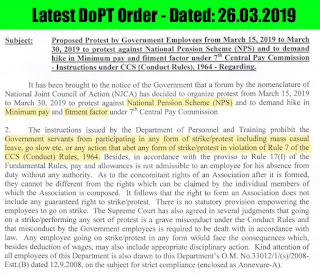
Subject: Proposed Protest by Government Employees from March 15, 2019 to March 30, 2019 to protest against National Pension Scheme (NPS) and to demand hike in Minimum pay and fitment factor under 7th Central Pay Commission - Instructions under CCS (Conduct Rules), 1964 - Regarding.

It has been brought to the notice of the Government that a forum by the nomenclature of National Joint Council of Action (NJCA) has decided to organize protest from March 15, 2019 to March 30, 2019 to protest against National Pension Scheme (NPS) and to demand hike in Minimum pay and fitment factor under 7th Central Pay Commission

The instructions issued by the Department of Personnel and Training prohibit the Government servants from participating in any form of strike/protest including mass casual leave, go slow etc. or any action that abet any form of strike/protest in violation of Rule 7 of the CCS (Conduct) Rules, 1964. Besides, in accordance with the proviso to Rule 17(I) of the Fundamental Rules, pay and allowances is not admissible to an employee for his absence from duty without any authority. As to the concomitant rights of an Association after it is formed, they cannot be different from the rights which can be claimed by the individual members of which the Association is composed. It follows that the right to form an Association does not include any guaranteed right to strike/protest.

There is no statutory provision empowering the employees to go on strike. The Supreme Court has also agreed in several judgements that going on a strike/performing any sort of protest is a grave misconduct under the Conduct Rules and that misconduct by the Government employees is required to be dealt with in accordance with law. Any employee going on strike/protest in any form would face the consequences which, besides deduction of wages, may also include appropriate disciplinary action. Kind attention of all employees of this Department is also drawn to this Department’s O.M. No.33012/1/(S)/2008 Estt.(B) dated 12.9.2008, on the subject for strict compliance (enclosed as Annexure-A).

All officers are requested that the above instructions may be brought to the notice of the employees working under their control. All officers are also requested not to sanction Casual Leave or any other kind of leave to the officers and employees, if applied for, during the period of proposed Dharna/demonstration, and ensure that the willing employees are allowed hindrance free entry into the office premises.

In case employees go on protest anytime during the period 15.03.2019 to 30.03.2019, all Divisional Heads are requested to forward a report indicating the number and details of employees, who are absent from duty during the period of said protest, i.e. from 15.03.2019 to 30.03.2019.
Sd/-
(Juglal Singh)
Deputy Secretary
Source: DoPT

Central_Government_employees_NPS_7CPC_DoPT_2019

Share:

Monday, 18 March 2019

14 percent of the Basic Pay plus DA by the Central Government Contribution in NPS - Gazette Notification

14 percent of the Basic Pay plus DA by the Central Government Contribution in NPS - Gazette Notification
The monthly contribution would be 10 percent of the Basic Pay plus Dearness Allowance (DA) to be paid by the employee and 14 percent of the Basic Pay plus DA by the Central Government
MINISTRY OF FINANCE
(Department of Financial Services)

NOTIFICATION
New Delhi, the 31st January, 2019

F. No. 1/3/2016-PR - In partial modification of para 1(i) of Ministry of Finance’s Gazette Notification No. 5/7/2003-ECB-PR dated 22nd December, 2003, based on the Government’s decision on 6th December, 2018 on the recommendations of a Committee set up to suggest measures for streamlining the implementation of National Pension System (NPS), the Central Government makes the following amendments in the said notification, namely :-

(1) In para 1(i) of the said notification, for the words “The monthly contribution would be 10 percent of the salary and DA to be paid by the employee and matched by the Central Government”, the words “The monthly contribution would be 10 percent of the Basic Pay plus Dearness Allowance (DA) to be paid by the employee and 14 percent of the Basic Pay plus DA by the Central Government” shall be substituted.

(2) The following provisions shall be inserted after para 1(v) of the said notification, namely:-
CHOICE OF PENSION FUND AND INVESTMENT PATTERN IN TIER-I OF NPS AS UNDER:

(vi) Choice of Pension Fund: As in the case of subscribers in the private sector, the Government subscribers may also be allowed to choose any one of the pension funds including Private sector pension funds. They could change their option once in a year. However, the current provision of combination of the Public-Sector Pension Funds will be available as the default option for both existing as well as new Government subscribers.

(vii) Choice of Investment pattern: The following options for investment choices may be offered to Government employees :
  • The existing scheme in which funds are allocated by the PFRDA among the three Public Sector Undertaking fund managers based on their past performance in accordance with the guidelines of PFRDA for Government employees may continue as default scheme for both existing and new subscribers.
  • Government employees who prefer a fixed return with minimum amount of risk may be given an option to invest 100% of the funds in Government securities (Scheme G).
  • Government employees who prefer higher returns may be given the options of the following two Life Cycle based schemes.
(A) Conservative Life Cycle Fund with maximum exposure to equity capped at 25% - LC-25.

(B) Moderate Life Cycle Fund with maximum exposure to equity capped at 50% - LC-50.

(viii) Implementation of choices to the legacy corpus: Transfer of a huge legacy corpus of more than Rs. 1 lakh crore in respect of the Government sector subscribers from the existing Pension Fund Managers is likely to impact the market. It may be practically difficult for the PFRDA to allow Government subscribers to change the Pension Funds or investment pattern in respect of the accumulated corpus, in one go. Therefore, for the present, change in the Pension Funds or investment pattern may be allowed in respect of incremental flows only.

(ix) Transfer of legacy corpus in a reasonable time frame: PFRDA may draw up a scheme for transfer of accumulated corpus as per new choices of Government subscribers in a reasonable time frame of say five years. Once PFRDA draws up this scheme, change in the Pension Funds or investment pattern may be allowed in respect of the accumulated corpus in accordance with that scheme.

4 THE GAZETTE OF INDIA : EXTRAORDINARY [PART I-SEC. 1] COMPENSATION FOR NON-DEPOSIT OR DELAYED DEPOSIT OF CONTRIBUTIONS DURING 2004-2012:

(x) In all cases, where the NPS contributions were deducted from the salary of the Government employee but the amount was not remitted to CRA system or was remitted late, the amount may be credited to the NPS account of the employee along with interest for the period from the date on which
the deductions were made till the date the amount was credited to the NPS account of the employee, as per the rates applicable to GPF from time to time, compounded annually.

(xi) In all cases where the NPS contributions were not deducted from the salary of the Government employee for any period during 2004-2012, the employee may be given an option to deposit the amount of employee contribution now. In case he opts to deposit the contributions now, the amount may be deposited in one lump sum or in monthly installments. The amount of installment may be deducted from the salary of the Government employee and deposited in his NPS account. The same may qualify for tax concessions under the Income Tax Act as applicable to the mandatory contributions of the employee.

(xii) In all cases where the Government contributions were not remitted to CRA system or were remitted late (irrespective whether the employee contributions were deducted or not), the amount of Government contributions may be credited to the NPS account of the employee along with interest for the period from the date on which the Government contributions were due till the date the amount is actually credited to the NPS account of the employee, as per the rates applicable to GPF from time to time. Instructions to this effect may be issued by the Department of Expenditure/ Controller General of Accounts. All such cases of delay may be resolved within a period of three months.
The above provisions shall come into force with effect from 1st April, 2019.

MADNESH KUMAR MISHRA, Jt. Secy.

Note : The main notification was published in the Gazette of India, Extraordinary, Part-I, Section 1, vide notification No. 5/7/2003-PR dated the 22nd December, 2003

Share:

Thursday, 7 March 2019

Proposed Nationwide Dharna/Demonstration by National Joint Council of India (NJCA) on 13th March, 2019 against National Pension Scheme (NPS) - Instructions under CCS (Conduct Rules), 1964


DoPT Orders 2019: Nationwide protest by Central Government employees against National Pension Scheme (NPS) on 13.03.2019 :
MOST IMMEDIATE
OUT TODAY
No.45018/1/2017-Vig.
Government of India
Ministry of Personnel, P.G. & Pensions
Department of Personnel & Training
North Block, New Delhi,
Dated the 05th March, 2019

Subject: Proposed Nationwide Dharna/Demonstration by National Joint Council of India (NJCA) on 13th March, 2019 against National Pension Scheme (NPS) - Instructions under CCS (Conduct Rules), 1964 - Regarding.

1. It has been brought to the notice of the Government that a forum by the nomenclature of National Joint Council of Action (NJCA) has decided to organize Dharna/Demonstrations in front of Jantar Mantar, New Delhi and all across the country on 13th March, 20 19 in order to protest against New Pension Scheme (NPS).

2. The instructions issued by the Department of Personnel and Training prohibit the Government servants from participating in any form of strike/protest including mass casual leave, go slow etc. or any action that abet any form of strike/protest in violation of Rule 7 of the CCS (Conduct) Rules, 1964. Besides, in accordance with the proviso to Rule 17(1) of the Fundamental Rules, pay and allowances is not admissible to an employee for his absence from duty without any authority. As to the concomitant rights of an Association after it is formed, they cannot be different from the rights which can be claimed by the individual members of which the Association is composed. It follows that the right to form an Association does not include any guaranteed right to strike/protest. There is no statutory provision empowering the employees to go on strike. The Supreme Court has also agreed in several judgements that going on a strike/performing any sort of protest is a grave misconduct under the Conduct Rules and that misconduct by the Government employees is required to be dealt with in accordance with law. Any employee going on strike/protest in any form would face the consequences which, besides deduction of wages, may also include appropriate disciplinary action. Kind attention of all employees of this Department is also drawn to this Department's O.M. No.33012/ 1/(s)/2008- Estt.(B) dated 12.9.2008, on the subject for strict compliance (enclosed as Annexure-A).

3. All officers are requested that the above instructions may be brought to the notice of the employees working under their control. All officers are also requested not to sanction Casual Leave or any other kind of leave to the officers and employees, if applied for, during the period of proposed Dharna/demonstration, and ensure that the willing employees are allowed hindrance free entry into the office premises.

4. In case employees go on Dharna/demonstration, all Divisional Heads are requested to forward a report indicating the number and details of employees, who are absent from duty on the day of Dharna/demonstration, i.e., 13.03.2019.
To
(G. Srinivasan)
Director (Reservation)
Source: DoPT
Share:

Friday, 7 December 2018

National Pension Scheme: Good News for central government employees!


National Pension Scheme: Good News for central government employees! 

Government contribution to NPS to rise to 14% of basic salary

In a bonanza for government employees, the Cabinet Thursday raised the government's contribution to National Pension Scheme (NPS) to 14 per cent of basic salary from the current 10 per cent, sources said. Minimum employee contribution will, however, remain at 10 per cent. The Cabinet also approved tax incentives under 80C of the Income Tax Act for employees’ contribution to the extent of 10 per cent, they added. Presently, the government and employees contribute 10 per cent of basic salary each to NPS.

While the minimum employee contribution remains at 10 per cent, the government contribution has been increased from 10 per cent to 14 per cent. The Cabinet, headed by Prime Minister Narendra Modi, also allowed government employees to commute 60 per cent of the fund accumulated at the time of retirement, up from 40 per cent at present. Also, employees will have the option to invest in either fixed income instruments or equities, sources said.

As per the Cabinet decision, if the employee decides not to commute any portion of the accumulated fund in NPS at the time of retirement and transfers 100 per cent to annuity scheme, then his pension would be more than 50 per cent of his last drawn pay, sources said. The government did not announce the decision in view of the ensuing polls in Rajasthan Friday. While the government is yet to decide on the date of notification of the new scheme, sources said such changes usually come into effect from the beginning of a financing year, meaning April 1, 2019. This formula for changes in the NPS was worked out by the Finance Ministry based on the recommendation of a government-appointed committee.

Source: www.centralgovernmentnews.com
Share:

Thursday, 29 November 2018

Proceeding on adoption of Resolution on Abolishing NPS

National Pension System to Old Pension Scheme
Proceeding on adoption of Resolution on Abolishing NPS
Proceeding on adoption of Resolution on Abolishing NPS by Delhi Assembly- एन.पी.एस को समाप्त करने के संकल्प पर दिल्ली विधान सभा की कार्यवाही
LEGISLATIVE ASSEMBLY
NATIONAL CAPITAL TERRITORY OF DELHI
Bulletin Part-I
delhi-assembly-proceeding-on-nps-resolution
(Brief summary of proceedings)
Monday, 26 November 2018 / 05 Margshirsha 1940 (Saka)
No. 91
10. 6.51 PM Calling Attention (Rule-54) :
Shri Ajay Dutt called the attention of the Government towards "Abolishing National Pension System (NPS) and reinstate the old Pension System in the interest of lakhs of Government Servants".
Sh. Arvind Kejriwal, Hon'ble Chief Minister made a brief statement.
The following Resolution moved by Sh. Ajay Dutt was put to vote and adopted by voice-vote :
"The Legislative Assembly of NCT of Delhi, having its sitting on 26 November 2018 :
Taking note of the negative consequences of the anti-employee National Pension System (NPS) that is imposed on the Government Servants by the then NDA Government in 2004 and sustained by the UPA-I, UPA-II and NDA-II Governments,
Given the fact that, unlike the old pension scheme, the NPS :
  • does not give any guarantee to the employees either for assured returns on investments or for minimum pension.
  • does not provide for family pension or social security,
  • does not provide for loan facility when in dire need,
  • does not provide for annual increments and hike in DA,
  • does not allow the employees to withdraw enough money from their own pension fund to meet the medical emergencies,
  • leaves the employees at the mercy of volatile markets and the forces that have notoriously been manipulating the markets,
  • imposes draconian restrictions on withdrawals from pension fund,
  • allows the insurance companies to exploit employees by way of forcing them to buy annuity for a minimum of ten years even after retirement, and
  • runs contrary to the spirit of welfare state as enshrined in the Constitution,
Given the fact that the pro-people and welfare oriented Government of NCT of Delhi is strongly in favour of restoring the rights and privileges of its employees by way of replacing the NPS with the time tested old pension scheme,
Resolves to urge upon the Government of India to scrap the NPS with immediate effect and bring at once all the Government Servants working under the Government of NCT of Delhi under the old pension scheme and restore to them all the benefits of the old pension scheme wherein the fair and legitimate pensions’ benefits are disbursed through the Consolidated Fund of India, so that the dedicated work force of the Government of NCT of Delhi and their families will be able to lead their lives with sense of security and dignity, and
Further resolves to urge upon the Government of India to restore t he old pension scheme in place of NPS or the benefit of all the Government Servants working under the Government of India and also to actively encourage other States to follow this true welfare measure"
Source: Delhi Assembly
Share:

Friday, 10 August 2018

Defined Contribution Pension Scheme (National Pension System) (Salient Features)

Defined Contribution Pension Scheme (National Pension System)
(Salient Features)


  • The National Pension System works on defined contribution basis and will have two tiers - Tier-I and II. Contribution to Tier-I is mandatory for all Government servants joining Government service on or after 1-1-2004 (except the armed forces in the first stage), whereas Tier-II will be optional and at the discretion of Government servants.
  • In Tier-I, a Government servant will have to make a contribution of 10% of his basic pay plus DA, which will be deducted from his salary bill every month by the PAO concerned. The Government will make an equal matching contribution. However, there will be no contribution from the Government in respect of individuals who are not Government employees.
  • Tier-I contributions (and the investment returns) will be kept in a limited partial withdrawable Pension Tier-I Account. Tier-II contributions will be kept in a separate account that will be withdrawable at the option of the Government servant. Government will not make any contribution to Tier-II account.
  • The existing provisions of Defined Benefit Pension and GPF would not be available to the new recruits in the central Government service, i.e. to the Government servants joining Government service on or after 1-1-2004. However, retirement gratuity and death gratuity would be extended to the central government employees covered under NPS on the same terms and conditions as applicable under CCS(Pension) Rules, 1972.
  • In order to implement the Scheme, there will be a Central Record Keeping Agency (CRA) and several Pension Fund Managers (PFM) to offer three categories of Schemes to Government servants, viz., options A,B and C based on the ratio of investment in fixed income instruments and equities. The participating entities (PFMs and CRA) would give out easily understable information about past performance, so that the individual would be able to make informed choices about which scheme to choose.
  • An independent Pension Fund Regulatory and Development Authority (PFRDA) will regulate and develop the NPS.
  • A Government servant can exit at or after the age of 60 years from the Tier-I of the Scheme. At exit, it would be mandatory for him to invest 40 per cent of pension wealth to purchase an annuity (from an IRDA-regulated Life Insurance Company) which will provide for annuity for the lifetime of the employee and his dependent parents/spouse. He would receive a lump-sum of the remaining pension wealth which he would be free to utilize in any manner. In the case of Government servants who leave the Scheme before attaining the age of 60, the mandatory annuitization would be 80% of the pension wealth.
  • Provisionally, central government employees covered under NPS has option to choose benefits under old pension scheme or NPS in the event of their death or discharge from service on invalidation.
2. FAQs about the National Pension System
Frequently Asked Questions (FAQs)
(National Pension  System)

Last updated/Reviewed:  18.12.2017
NPS.1 The  CCS(P)  Rules are applicable to govt. servants appointed on  or  before 31.12.2003. Are the employees who joined pensionable establishments  of  Govt. of India after 31/12/2003 eligible for any benefits under these rules?

In  accordance with DoP&PW O.M. No.  38/41/06 - P&PW(A) dated 5.5.2009 such  employees  who  joined  after  31/12/2003  and/or  their families may be given the benefit of disability pension  or  family  pension  provisionally  till  the finalization of rules under the National Pension System   (NPS) on death/injury.
Further,  the  benefit of Retirement Gratuity and Death Gratuity have  been extended to the Central Government civil employees covered under NPS in the  same  terms  and conditions  as applicable under CCS Pension Rules, 1972 vide this OM no. 7/5/2012 - P&PW(F)/B dated 26/08/2017.

NPS.2 What are the guidelines/orders in regard to settlement of dues of the deceased Government employees covered under NPS?
As per the Department of Pension & PW O.M. No.38/41/06 - P&PW(A) dated 5.5.2009 (available on website) the benefits under the CCS(Pension) Rules has  been  provisionally  extended to the families of deceased employees covered under NPS. Family Pension/gratuity in terms of O.M. dated 5.5.2009 shall  be  payable  to  the  family of the deceased employee if the deceased  employee was  covered  under  NPS  and fulfils the conditions. These payments are provisional and  will  be  adjusted  as  per the final provisions. As per Para 7 of the O.M., the accumulations in pension wealth of deceased employee under NPS  will not be paid during the period provisional benefits under the aforementioned O.M. are payable. The Head of Office will prepare the pension papers as per provisions of the relevant rules and proceed as per the procedure for making the provisional payments to  eligible  Government  servants families explained in Ministry  of  Finance O.M. No.1(7)/DCPS(NPS)/2009/TA/221 dated 2.7.2009 read with corrigendum dated 29.9.2009.

Source: pensionersportal.gov.in
Share:

Wednesday, 7 March 2018

Partial Withdrawal under NPS


Ministry of Finance

Partial Withdrawal under NPS

06 MAR 2018

The Pension Fund Regulatory Development Authority (PFRDA) has relaxed the norms for partial withdrawal under the National Pension Scheme (NPS). In accordance with the PFRDA (Exits and Withdrawals under the National Pension System) (First Amendment) Regulations 2017, the subscriber ought to be subscribed to the National Pension System, at least for a period of three years from the date of his or her joining to such system, to be eligible to make partial withdrawals, under specific circumstances as specified in such regulations.

The NPS subscribers can withdraw after three years from the date of joining the system and a maximum of three times during the entire tenure of subscription under NPS, but the partial withdrawal is linked with contributions made by the subscriber. The subscriber shall be permitted to withdraw accumulations not exceeding twenty-five per cent of the contributions made by him or her and standing to his or her credit in his or her individual pension account, as on the date of application for withdrawal.

Earlier the subscriber under NPS was permitted to withdraw accumulations not exceeding twenty-five per cent of the contributions made by him or her after 10 years from the date of his or her joining the system, and a maximum of three times during the entire tenure of subscription under NPS.

This was stated by Shri Shiv Pratap Shukla, Minister of State for Finance in written reply to a question in Rajya Sabha today.

PIB
Share:

Wednesday, 1 November 2017

Maximum age of joining National Pension System (NPS) increased from the existing 60 years to 65 years under NPS - Private Sector


Maximum age of joining National Pension System (NPS) increased from the existing 60 years to 65 years under NPS - Private Sector

In continuance of the several initiatives under taken by Pension Fund Regulatory and Development Authority (PFRDA) during the last few years to increase the pension coverage in the country, PFRDA has now increased the maximum age of joining under NPS-Private Sector (i.e. All Citizen and Corporate Model) from the existing 60 years to 65 years of age.

Now, any Indian Citizen, resident or non-resident, between the age of 60- 65 years, can also join NPS and continue up to the age of 70 years in NPS. With this increase of joining age, the subscribers who are willing to join NPS at the later stage of life will be able to avail the benefits of NPS.

NPS provides a very robust platform to the subscriber to save for his/her old age income security. Due to the better healthcare facilities and increased fitness, along with the opportunities and avenues available in the private sector as well as in the capacity of self-employment, more and more people in their late 50s or 60s are now living an active life allowing them to be employed productively.

The subscriber joining NPS beyond the age of 60 years will have the same choice of the Pension Fund as well as the investment choice as is available under the NPS for subscribers joining NPS before the age of 60 years.

Subscriber joining NPS after the age of 60 years will have an option of normal exit from NPS after completion of 3 years in NPS. In this case, the subscriber will be required to utilize at least 40% of the corpus for purchase of annuity and the remaining amount can be withdrawn in lump-sum.

In case of such subscriber willing to exit from NPS before completion of 3 years in the NPS, he/she will be allowed to do so, but in such case, the subscriber will have to utilize at-least 80% of the corpus for purchase of annuity and the remaining can be withdrawn in lumpsum.

In case of unfortunate death of the subscriber during his stay in NPS, the entire corpus will be paid to the nominee of the subscriber.

The increase in joining age will provide the options to the subscribers who are at the fag-end of the employment and expecting lump-sum amount at the time of retirement, but willing to defer their retirement planning for future, to open the NPS account and contribute the lump-sum corpus to NPS for better fund management by Professional Fund Manager to fetch better returns and plan for the regular income after some time. The Annuity rates available in the older age fetch better annuities than that at the age of 60 or less age.

This initiative will allow a larger segment of the society particularly senior citizens to reap the benefits of NPS and plan for their regular income.

PIB
Share:

Wednesday, 14 June 2017

PFRDA conducts workshop on National Pension System (NPS) for Corporates in coordination with FICCI at Ahmedabad


PFRDA conducts workshop on National Pension System (NPS) for Corporates in coordination with FICCI at Ahmedabad; Overall number of NPS and APY subscribers have crossed 1.60 crores with overall Asset under Management (AUM) of more than 1,87,000 crores

Pension Fund Regulatory Development Authority (PFRDA) in its endeavor to promote NPS among the Corporates have embarked upon conducting NPS Workshops at various locations across the country. A Corporate Meet was conducted at Ahmedabad,Gujarat today in association with Federation of Indian Chambers of Commerce and Industry (FICCI), Gujarat State Council.

Addressing the participants, Shri Akhilesh Kumar, Deputy General Manager, PFRDA informed them about the longevity scenario across the world and the need of pension in old age and sounded the importance of pension to be considered by everyone. National Pension System (NPS) promoted by the Central Government provides the platform to every segment of the society for savings for retirement and briefed the contours of NPS for old age income security. He requested the participants to utilize this meet for better understanding of NPS and implementing the same in their respective organizations. He highlighted the key factor of low cost pension product - NPS for a valuable pension in the old age.

Shri Kumar Sharadindu, MD & CEO, SBI Pension Fund Management Company Limited briefed the role of the Pension Funds under NPS architecture and the benefits of long term investment and the optimal return being generated by the Pension Fund following the investment guidelines issued by PFRDA.

Dr Param Shah, Head, FICCI Gujarat State Council in his welcome address lauded the efforts of PFRDA for organizing such meetings across the country and creating awareness about NPS which can be effective platform for corporates to provide pension to their employees.

As on 09th June 2017, more than 6.09 lacs employees of 3,593 Registered Corporates have joined NPS under NPS Corporate Model. More than 4.62 lacs subscribers have joined NPS under NPS-All Citizen Model. The overall number of NPS and APY subscribers have crossed 1.60 crores with overall Asset under Management (AUM) of more than 1,87,000 crores.

More than 80 participants from around 50 corporates attended the workshop. Ahmedabad / Gujarat based POPs were also present for the workshop. PFRDA official gave a detailed presentation on NPS and informed the participants about the features, benefits and the process of joining NPS to the employees as well as to the employers. Official of Deloitte Haskins & Sells LLP gave a presentation on Tax benefits of NPS as compared to other financial products. Two Ahmedabad based Registered Corporates- namely Adani Power and Arvind Limited, informed the participants about their experience of facilitating NPS to their employees and the need and benefits of implementing NPS in the organization.
PFRDA officials clarified the queries regarding joining of NPS, tax benefits, POPs details, timelines, transfer of superannuation fund to NPS, annuity etc to the participants.
The recent developments under NPS-Private Sector (All citizen and Corporate) are listed below:
  1. Process of Transfer of Superannuation / Recognised Provident Fund to National Pension System.
  2. Allowing option to change the investment choice or asset allocation ratio  twice in a financial year
iii.  Dispensing of requirement of submission of physical application form in case of subscriber opening account online and e-Signing the document.
  1. Introduction of Alternative Investment Fund-a separate class of Asset 'A'
  2. Introduction of two new life cycle funds (LC 75 and LC 25)
  3. Under Tier-I account, minimum contribution requirement in a financial year is reduced from Rs 6,000/- to Rs 1,000/-
PFRDA's endeavor is to significantly scale-up these segments during the ongoing months.

PIB
Share:

Wednesday, 12 April 2017

Centre introduces provision of taxation on NPS in Income Tax Act


Centre introduces provision of taxation on NPS in Income Tax Act

Press Information Bureau
Government Of India
Ministry Of Defence
Dated: 11-04-2017
Tax on NPS

The provision that the withdrawal from National Pension Scheme is taxed to the extent of 60 per cent has been introduced into the Income Tax Act, 1961 (Act) vide Finance Act, 2016 by inserting clause (12A) in Section 10 of the Act.

Prior to Finance Act, 2016, National Pension Scheme (NPS), referred to in section 80CCD, was under Exempt, Exempt and Tax (EET) regime i.e., the monthly/periodic contributions during the pension accumulation phase were allowed as deduction from income for tax purposes; the returns generated on these contributions during the accumulation phase were also exempt from tax but the terminal benefits on exit or superannuation, in the form of lump sum withdrawals, were taxable in the hands of the individual subscribed or his nominee in the year of receipt of such amounts unlike PPF and EPF which have been enjoying EEE regime i.e. Exempt, Exempt, Exempt.

In order to rationalize the taxability of receipts from pension plans, vide Finance Act, 2016, section 10 of the Act was amended to provide that any payment from National Pension Scheme to an employee on account of closure or his opting out of the NPS shall also be exempt from tax, to the extent it does not exceed forty percent of the total amount payable to him at the time of closure or his opting out of the scheme. Further, Finance Act, 2017 has amended section 10 of the Income-tax Act to exempt partial withdrawals by employees (to the extent of 25% of the employee’s contribution) from their NPS accounts in accordance with the guidelines prescribed under Pension Fund Regulatory and Development Authority Act, 2013.

This was stated by Shri Santosh Kumar Gangwar, Minister of State in the Ministry of Finance in written reply to a question in Rajya Sabha today.

Source: PIB
Share:

Sunday, 26 March 2017

RESTORATION OF OLD PENSION SYSTEM IN PLACE OF CONTRIBUTORY PENSION SYSTEM

RESTORATION OF OLD PENSION SYSTEM IN PLACE OF CONTRIBUTORY PENSION SYSTEM
GOVERNMENT OF INDIA
MINISTRY OF FINANCE
DEPARTMENT OF FINANCIAL SERVICES
RAJYA SABHA
UN STARRED QUESTION NO. 2130
TO BE ANSWERED ON MARCH 21, 2017/PHALGUNA 30, 1938 (SAKA)
RESTORATION OF OLD PENSION SYSTEM IN PLACE OF CONTRIBUTORY PENSION SYSTEM

2130. Shri T. G. Venkatesh

Will the Minister of FINANCE be pleased to state:

(a) whether it is a fact that the newly introduced Contributory Pension System is not beneficial to the employees and so the employees unions are requesting Government to re-introduce the old pension system in its place, if so, the details thereof; and

(b) whether any representation has been received in this regard by Government, if so, the details thereof and the stand of Government in this regard?

ANSWER

The Minister of State in the Ministry of Finance
(Shri Santosh Kumar Gangwar)

(a) & (b) National Pension System (NPS), which is a contributory pension system, has, inter alia, the following features which benefit the employees:
  • NPS is a well designed pension system managed through an unbundled architecture involving intermediaries appointed by the Pension Fund Regulatory and Development Authority (PFRDA) viz. Pension Funds, Custodian, Central Recordkeeping and Accounting Agency, National Pension System Trust, Trustee Bank, Points of Presence and Annuity Service Providers. It is prudently regulated by PFRDA which is a statutory regulatory body established to promote old age income security and to protect the interests of subscribers of NPS.
  • Dual benefit of Low Cost and Power of Compounding: The pension wealth which accumulates over a period of time till retirement grows with a compounding effect. The all-in-costs of the institutional architecture of NPS are among the lowest in the world.
  •  Tax Benefits: Tax benefits are available to the NPS subscribers under various provisions of the Income- tax Act, 1961.
  • Transparency and Portability is ensured through online access of the pension account by the NPS subscribers, across all geographical locations and portability of employments.
  • Partial withdrawal: Subscribers can withdraw up to 25% of their own contributions towards their pension account, before attaining superannuation age for certain specified purposes subject to certain conditions.

Representations have been received from certain quarters regarding the implementation of NPS which, inter alia, include the demand that NPS may be scrapped and the Government may revert to old defined benefit pension system. However, there is no proposal to replace the NPS with old pension scheme in respect of Central Government employees recruited on or after 01.01.2004.

Source: RAJYA SABHA
Share:

Saturday, 18 March 2017

7th Pay Commission : From Higher Allowance to Implementation where does the story Stands


7th Pay Commission : From Higher Allowance to Implementation where does the story Stands

7th Pay Commission : On Friday senior officials of Union Cabinet were expected to meet members of the panel over Higher Allowance and National Pension Scheme (NPS).

However sources indicate that the meeting did not take place.

As almost a year has passed, we try to figure out where does the story of 7th Pay Commission stand today. The panel was constituted a day after the implementation of the 7th Pay Commission recommendations.
This panel on the higher allowance, named 'Committee on Allowance' was also expected to make a major announcement on Friday following the submission of the report to the government. However that too didn’t happen.

As we all know, Prime Minister gave the nod for an additional 2 per cent increase in Dearness Allowance(DA) for all Central Government employees. Moreover, along with the DA, for pensioners, the Dearness Relief (DR) has been increased by 2 per cent with effect from January 1, 2017.

While reports claim that the increasing of the Dearness Allowance has benefited 48.85 lakh employees and 55.51 lakh pensioners, the central Government employees are now concerned about the Committee on Allowance’s decision.

But more importantly, although the DA has been hiked, the Committee headed by Finance Secretary Ashok Lavasa is yet to submit the reports on other allowances, which were also scheduled to be increased once the 7th Pay Commission was implemented.

However, the National Joint Council of Action (NJCA) on behalf of the Central Government employees expressed their dissatisfaction over the hiked 2% DA and said it should have been increased by at least 3%.

April 1, 2017, was the rumoured date for implementing the allowance hike but now that the report has not yet been submitted, it seems the rumour is to stay as it is.

Following this, the NJCA has warned of dire consequences if the Centre fails to implement the allowance hike from April 1.

Source: India.com
Share:

Tuesday, 7 February 2017

NPS COMMITTEE - HOPES for younger generation of Central Government Employees Shattered


NPS COMMITTEE - HOPES for younger generation of Central Government Employees Shattered

NPS committee constituted by the Government to streamline the National Pension System has called the JCM Staff Side for second round of discussion on 10.02.2017. As per the notified agenda, the committee is proposing discussion on only cosmetic changes in NPS. Basic issues such as (1) scrapping of NPS (2) Guaranteed Minimum pension to NPS Pensioners ie; 50% of the last pay drawn should be guaranteed by Government as minimum pension even if the returns from annuity insurance scheme amount is less than the 50%. and (3) Exemption of Central Govt. Employees from the purview of NPS, are not included in the agenda of the meeting even though the Cabinet Secretary has assured JCM Staff Side Chairman and Secretary Shri. Raghavayya and Shri Shiv Gopal Misra on 19th January 2017 that  "so far as issue of NPS is concerned he has already directed the Committee to hold meeting with Staff Side". From reading the agenda it can be seen that main demands of the Staff Side are avoided, thus betraying the cause of thousands of younger generation Central Government Employees who joined service after 01.01.2004. Their hopes are shattered and belied. NJCA should revive the deferred strike to protect the interest of younger generations. Let us make the 16th March 2017 Confederation Strike a grand success.
M. Krishnan
Secretary General
Confederation of Central Govt. Employees & Workers.
Mob & WhatApp: 09447068125.
Email: mkrishnan6854@gmail.com
Source: http://confederationhq.blogspot.in
Share:

Friday, 23 September 2016

EPFO plans to hike minimum pension to Rs.2000

EPFO plans to hike minimum pension to Rs.2000

The Employees Provident Fund Organization (EPFO) is considering an option to double the minimum pension amount to Rs.2,000. The financial implications of the move are being measured. There were plans to announce the decision before the strike of central trade unions on September 2. However, sources said, the move might have been held back for a rethink on the financial impact in case of hike in pension.

It started when revised actuarial calculations showed that there was a marginal surplus in the pension fund. EPFO caters to the pension of private sector employees and some PSUs. On the basis of the surplus, it was earlier planned to either increase the pension marginally, taking it to Rs.1,250 or provide a one-time benefit. There was also a pending demand to hike the pension to Rs.3,000 a month. This led to the option of hiking the pension to at least Rs.2,000 a month being considered, said a source. There are around 20 lakh pensioners who get the minimum amount of Rs.1,000 at present.

However, the ministry of finance has to be taken into confidence before initiating such a move, said a source. The gap is filled by MoF even for paying Rs.1,000 as minimum pension. This comes to around Rs.1,000 crore a year which is given on piecemeal basis. Once the pension is hiked, the impact will be more. Though the idea has not been entirely shelved, a rethink is under way, said a source.

Meanwhile, the Employees Pension Scheme (1995) Coordination Committee, an association of retired employees, has demanded that government should merge the National Pension Scheme (NPS) with EPS. The former is a contributory pension scheme applicable to government employees having joined service after 2004. "The association argues that since returns on NPS are based on returns on investment which are uncertain, EPS should be preferred. This is because EPS at least guarantees a minimum pension," said Prakash Pathak, general secretary of the coordination committee.

The coordination committee has been lobbying for implementation of the Bhagatsingh Koshiari Committee recommendations which call for taking the minimum pension to Rs.3,000 and also adding dearness allowance to it. The committee's recommendations also call for adding a health benefit, said Pathak.
The recommendations have been lying with the government since 2013 for want of a decision. Our association has been taking up the issue at various fora, said Pathak.

Source : TOI
Share:

Monday, 29 February 2016

Measures for moving towards a pensioned society

Measures for moving towards a pensioned society

While presenting the General Budget 2016-17 in Lok Sabha today, the Union Finance Minister Shri Arun Jaitley said that pension schemes offer financial protection to senior citizens. He proposed to make withdrawal up to 40% of the corpus at the time of retirement tax exempt in the case of National Pension Scheme(NPS). In case of superannuation funds and recognized provident funds, including EPF, the same norm of 40% of corpus to be tax free will apply in respect of corpus created out of contributions made after 1.4.2016. Further, the annuity fund which goes to the legal heir after the death of pensioner will not be taxable in all three cases.

He also proposed a monetary limit for contribution of employer in recognized Provident and Superannuation Fund of Rs. 1.5 lakh per annum for taking tax benefit.

He proposed to exempt from service tax the Annuity services provided by the National Pension Scheme (NPS) and Services provided by EPFO to employees. Also, he proposed to reduce service tax on Single premium Annuity (Insurance) Policies from 3.5% to 1.4% of the premium paid in certain cases.

PIB
Share:

Thursday, 26 November 2015

New Pension Scheme : Analysis of the Issues by the 7th Pay Commission

New Pension Scheme : Analysis of the Issues by the 7th Pay Commission

10.3.12 The Commission has examined these concerns raised by the stakeholders. The Commission also interacted with Chairman, PFRDA, and representatives of the Department of Pensions and Pensioners Welfare (DPPW), Department of Personnel and Training (DoPT), Department of Expenditure (DoE) and the Department of Financial Services (DFS).

10.3.13 In so far as the future value of pension under NPS is concerned, the Commission notes that this would depend upon a combination of factors:
(i) performance of the invested fund, which in turn would depend on the asset mix of the investment and general economic situation of the country,
(ii) cost of financial intermediation,
(iii) contribution rates,
(iv) period of contribution,
(v) performance of the fund manager and
(vi) development of the annuity market.
Grievances against the NPS

The NPS has now been in effect for over 10 years. During this period, there has been perceptible progress in putting together the architecture and providing information to subscribers. Major concerns, however, remain. Broadly, these are as under:
i. The larger federations and staff associations advocated scrapping the NPS on the ground that it discriminates between two sets of government employees.
ii. Individuals covered under NPS have pleaded for reverting to the OPS on the grounds of uncertainty regarding the actual value of their future pension in the face of market related risks.
iii. Individuals have pointed out that under NPS, the effective salary becomes less since the employee has to mandatorily contribute 10 percent of pay towards the pension fund.
iv. Individuals have stated that grievance redressal facility is not effective and consultation with stakeholders has been non-existent. This communication gap has generated insecurity in the minds of stakeholders including staff and Group ‘A’ officers of Central Government as well as All India Service Officers.
v. Associations have complained that Family Pension after the death of the employee is not ensured in the NPS. Moreover, if an employee dies at an early age, the family would suffer since annuity from the contribution would be grossly inadequate.
vi. Individuals have complained that NPS subscribers have no recourse to GPF for their savings. Their personal savings (10% of salary) are considered part of a larger corpus. It has been pointed out that the justify approach would be to consider only government’s contribution and the returns earned on it as the effective amount available for purchase of annuities.
vii. Associations have pointed out that unlike the facility under GPF, it is not possible to take refundable advances under NPS, even to meet obligatory social expenditure. This forces employees towards increased indebtedness as they have to borrow from elsewhere.

viii. Grievances also relate to tax treatment under NPS. While contributions and accumulations in NPS are exempt, lump sum withdrawals from NPS at any time are taxable at par with any other income. In addition, there is a service tax liability on any amount utilised for purchase of annuity.

ix. It has been pointed out that though NPS became effective from 2004, detailed instructions were issued only in late 2009 and in many cases the credit of contributions began from 2012. In the case of AIS officers in some States, contributions by the concerned State Government are yet to be fully made and deployed. The net result of this has been that contributions for the period 2004-2012 have not been made in full or have earned simple interest and did not get any market linked returns. Because of the prevailing confusion, contributions made by some AIS officer have been returned to them without interest. This will have a huge impact on the eventual corpus as the benefits of compounding were not available for the first 8 -9 years.

x. Individuals, in their presentation before the Commission, stated that annuities under NPS have no compensation for inflation unlike dearness relief under OPS. Further, in the case of OPS there is a revision in basic pension itself after every Pay Commission. This too is not available in respect of annuity of NPS subscribers.

xi. It has been pointed out that government employees are not given freedom of choice in choosing their fund manager based on performance and track record as the contributions are divided in a pre-specified ratio among selected Pension Fund Managers. It has been stated that government employees have no say in asset allocation
of their money.

xii. Concerns were raised that the contribution of 10% + 10% will not be sufficient to create a corpus which provides reasonable assurance that pension will be 50 percent of the last pay drawn.
Authority : http://7cpc.india.gov.in/
Share:

Tuesday, 3 November 2015

Recovery of NPS subscription fee/charge – NC JCM writes to DoPT

Recovery of NPS subscription fee/charge – NC JCM writes to DoPT
Ph: 23382286
National Council (Staff Side)
Joint Consultative Machinery for Central Government Employees
13-C, Ferozshah Road, New Delhi – 110001
E-Mail: nc.jcm.ni@gmail.com
No.NC/JCM/2015
Dated: October 31, 2015
Shri Sanjay Kothari,
Secretary,
Ministry of Personnel, Public Grievances & Pensions,
(Government of India)
North Block,
New Delhi – 110001

Dear Sir,
Sub: Recovery of NPS subscription fee/charge
Ref : Dy. General Manager, NPS Trust, New Delhi’s notice dated 19.10.2015

It has come to our notice that, @0.01% of the AUM on daily accrual basis is proposed to be imposed on the NPS Subscribers.

In this connection, it is worth-mentioning that, in the past, it was assured to the Central Government Employees that, no Administrative Charge/Fee would be imposed on any of the Government employees.
Orders to this effect, if so issued, should immediately be withdrawn.
Comradely yours,
sd/-
(Shiva Gopal Mishra)
Secretary(Staff Side) NC/JCM & Convener
Authority: www.ncjcmstaffside.com
Click to view the letter
Share:

Wednesday, 3 June 2015

Outcome of NAC Meeting held today under chairmanship of Jt. Secretary(E), DoP&T

Brief on the meeting of the NAC held today under the chairmanship of Jt. Secretary(E), DoP&T, Government of India

Shiva Gopal Mishra
Secretary
Ph: 23382286
National Council (Staff Side)
Joint Consultative Machinery
13-C, Ferozshah Road, New Delhi – 110001
E-Mail: nc.jcm.ni@gmail.com
No.AIRF/NAC
Dated: May 29, 2015
All Constituents of the
National Council(JCM)(Staff Side),
Dear Comrades,

Sub: Brief on the meeting of the NAC held today under the chairmanship of Jt. Secretary(E), DoP&T, Government of India

As per notification No.11/1/2015-JCA dated 12.05.2015 of the DoP&T(Government of India), meeting of the National Anomaly Committee was held today under the Chairmanship of Jt. Secretary(Estt.), Jt. Secretary(Pers.) and officials from other establishments and Ministry of Railways were also present.

At the outset, Secretary(Staff Side), National Council(JCM), Shri Shiva Gopal Mishra, expressed anguish for communication gap and non-finalization of the issues raised by the Staff Side JCM at various levels, and that is the reason, the staff working in the Central Government is quite agitated.

He also mentioned that, when we met the Secretary, DoP&T, we were given assurance that very soon meeting of the NC/JCM would be held, but unfortunately could not.

NAC was formed seven years back, and up-till now whatsoever had been agreed, that is not implemented, and wherever disagreement, items have not been sent for arbitration.

Out of 60 items, only 48 were discussed, and most of them are under review, and there are 12 items which are still pending, require urgent meeting on pending items.

Leader, Staff Side, Shri M. Raghaviah also shown his anguish and demanded meetings more frequently. Shri K.K.N. Kutty, Shri Sri Kumar and other members of the Staff Side also expressed their anguish on inordinate delay.

The J.S.(E) assured that the meeting on the pending items would be held soon. On the insistence of the Secretary(Staff Side), she agreed for the meeting on the pending items in the afternoon of 9th June, 2015. She also agreed for giving status papers.

Agenda Items

Item No.1 – Review of MACP to GP of Rs.2000 where there is no such grade pay in Railways
Though the Official Side was not in the mood to make any change, but on the insistence of the Staff Side, they agreed to review the matter once again.

Item No.2 – Granting of Additional Pay to Loco & Traffic Running Staff
The Jt. Secretary(Pers.) asked the Railways to give some more logical arguments, so that they can reconsider the issue of Additional Pay to Loco Pilots and Guards of the Goods Trains.

Item No.3 – Treatment of employees selected under LDCE/GDCE Scheme
The Official Side informed that, they have already sent a letter on 27.09.2012, that whatsoever benefit is available to the employees selected under LDCE and GDCE in the ACP, that will continue in the MACPS also. The item is closed.

Item No.4 – Grant of minimum entry pay meant for Direct Recruits to Promotees
There had been lots of arguments and when the Staff Side insisted that, in the JCM Scheme, once the items have been finalized and we reach to an agreement in the Standing Committee, there is no provision of referring back the issue to JCM again. The Secretary Staff Side told pointblank to the Official Side that we are not going to yield on this issue, and if the Official Side feels that the Hon’ble Finance Minister has some specific objection for implementing this issue where Promotee should get bottom of the grade where Direct Recruitment is available, we would like our meeting with Hon’ble Finance Minister. The Official Side agreed that they will put up the case to the competent authority to approach the Hon’ble Finance Minister once again.
Comradely yours,
sd/-
(Shiva Gopal Mishra)
Secretary (Staff Side)
NC/JCM & Convener
Source: Confederation
Share:

Featured post

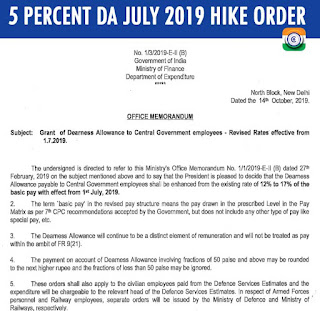
5 Percent DA July 2019 Hike Order - Grant of Dearness Allowance to Central Government employees

Grant of Dearness Allowance to Central Government employees 5 Percent DA July 2019 Hike Order  No. 1/3/2019-E- II (B) Government of...

Blog Archive

About The Author