A complete reference blog for Indian Government Employees

Showing posts with label VRS. Show all posts

Friday, 11 September 2020

VRS from Persons With Disabilities – Supreme Court – Latest DoPT Order


Latest DoPT Orders 2020


VRS from Persons With Disabilities - Supreme Court - Latest DoPT Order

No. 25012/I/2015-Estt.A-IV
Government of India
Ministry of Personnel, Public Grievances and Pensions
Department of Personnel and Training
Establishment A-IV Desk
North Block, New Delhi-110 001
Dated: September 7, 2020
OFFICE MEMORANDUM
Subject:- Request received for Voluntary retirement from service (VRS) from Persons With Disabilities – Supreme Court Order in Bhagwan Dass & Anr Vs Punjab State Electricity Board, (2008) 1 SCC 579 – clarification reg.
The undersigned is directed to refer to this Department’s O.M. of even no. dated 19.05.2015 on the subject noted above regarding the treatment of VRS notice given by a Government servant on medical grounds or on account of disability.
  1. In this regard, it is stated that the Persons with Disabilities (Equal Opportunities, Protection of Rights and Full Participation) Act, 1995 (PWD Act) has been repealed by the Rights of Persons with Disabilities Act, 2016 (RPWD Act, 2016), which came into force on 19th April, 2017. Hence, section 47 of PWD Act, 1995 as stated in DoPT’s O.M. of even no. 19.05.2015 is replaced by the provisions of section 20 of the RPWD Act, 2016.
  2. Section 20 of Rights of Persons with Disabilities Act, 2016 provides as under:
  • “20. (1) No Government establishment shall discriminate against any person with disability in any matter relating to employment: Provided that the appropriate Government may, having regard to the type of work carried on in any establishment, by notification and subject to such conditions, if any, exempt any establishment from the provisions of this section.
    (2) Every Government establishment shall provide reasonable accommodation and appropriate barrier free and conducive environment to employees with disability.
    (3) No promotion shall be denied to a person merely on the ground of disability.
    (4) No Government establishment shall dispense with or reduce in rank, an employee who acquires a disability during his or her service:
    Provided that, if an employee after acquiring disability is not suitable for the post he was holding, shall be shifted to some other post with the same pay scale and service benefits: provided further that if it is not possible to adjust the employee against any post, he may be kept on a supernumeraty post until a suitable post is available or he attains the age of superannuation, whichever is earlier.
    (5) The appropriate Government may frame policies for posting and transfer of employees with disabilities.
  1. In view of the above provision of RPWD Act, 2016 and Hon’ble Supreme Court’s judgement in case of Bhagwan Dass & anr vs Punjab State Electricity Board (2008) 1 Scc 579, it is stated that whenever a Government servant seeks voluntary retirement citing medical grounds, or when the said VRS notice has been submitted due to a disability, the Administrative authorities shall examine as to whether the case is covered under Section 20 .
    (4) of RPWD Act, 2016. In case the provisions are applicable, the Government servant shall be advised that he/she has the option of continuing in service with the same pay scale and service benefits. In case a disabled Government servant reconsiders his decision and withdraws the notice for voluntary retirement, his case shall be dealt with the aforesaid provisions of Section 20 of RPWD Act, 2016. If however, in spite of being so advised, such Government servant still wishes to take voluntary retirement, the request may be processed as per the applicable rules.
  1. All the Ministries and Departments are requested to keep the above in view while processing cases of requests for voluntary retirement from disabled Government servants.
(Surya Narayan Jha)
Under Secretary to the Government of India
To
The Secretaries
All Ministries /Departments of Government of India
(As per the standard list)
Source: DoPT
Share:

Monday, 30 December 2019

Leave Encashment of Central Government Employees


Central Government servant resigns or quits service, the maximum encashment of leave allowed is 150 day

Maximum of 300 Days Leave Allowed to Encash at the time of regular Retirement for Central Government employees

Leave Encashment of Employees

As per Rule 39 of the CCS (Leave) Rules, 1972, a Central Government servant is entitled to cash equivalent of leave salary for both earned leave and half pay leave at his / her credit on the date of retirement, subject to a maximum of 300 days including the period of encashment allowed in the previous employment under the Central Government.

In case a Government servant resigns or quits service, the maximum encashment of leave allowed is 150 days.

The above information was given by the Minister Shri Jitendra Singh in a written reply in the Rajya Sabha on 5.12.2019.
Share:

Thursday, 12 December 2019

Voluntary Retirement Scheme for Central Government Employees

Ministry of Personnel, Public Grievances & Pensions
Voluntary Retirement Scheme for Employees

12 DEC 2019

Presently, there is no proposal in the Government to reduce the retirement age of Government employees below 60 years.

There is no such proposal of Golden Voluntary Retirement Scheme under consideration of the Government.

Also check: VOLUNTARY RETIREMENT SCHEME FOR CENTRAL GOVERNMENT EMPLOYEES

This information was provided by the Union Minister of State (Independent Charge) Development of North-Eastern Region (DoNER), MoS PMO, Personnel, Public Grievances & Pensions, Atomic Energy and Space, Dr Jitendra Singh in written reply to a question in Rajya Sabha today.

PIB
Share:

Tuesday, 10 September 2019

Guidelines on Counselling, Retraining and Redeployment Scheme CRR Scheme 2019-2020 Objective

Guidelines on Counselling, Retraining and Redeployment Scheme CRR Scheme 2019-2020
Objective

1.1 The objective and scope of the Counselling, Retraining and Redeployment Scheme (CRR) is to provide opportunities of counselling, retraining and redeployment to the separated employees of Central Public Sector Enterprises (CPSEs) rendered surplus as a result of modernization, technology upgradation and manpower restructuring in the PSEs. The aim of retraining of the employees is to reorient them through short duration training programmes to enable them to adjust to the new environment and adopt new avocations after their separation from the PSEs due to VRS/VSS or retrenchment due to closure / restructuring of the enterprise. While it will not be possible to commit that the employees so restructured or retrenched would be provided with alternative employment, yet it should be desirable to reorient such employees so that they may engage themselves in income generating activities.

1.2 The counselling and training programmes will accordingly be planned in order to equip them with skills and orientation to engage themselves in self- employment/wage employment activities and rejoin the productive process even after their separation from the CPSEs. Redeployment of separated employees in gainful activities implies that they have been brought into the mainstream of economy. This also implies that they are contributing to national income.

Background

2.1 Government had setup a National Renewal Fund (NRF) in February, 1992 as a safety net for workers affected by re-structuring arising out of the new industrial policy. The objective was to provide funds, where necessary, for continuation of employees affected by restructuring or closure of industrial units both in the public and private sector and to provide funds for employment generation schemes both in the organized and unorganized sectors to provide social safety net. Counselling, Retraining and Redeployment of rationalized employees formed a part of NRF, which had been meeting expenses towards voluntary retirement of CPSE employees as also for rehabilitation of employees of the organized sector consisting of CPSEs, State PSEs and private sector.

2.2 The Voluntary Retirement Scheme (VRS) for employees of central PSEs was revised in May, 2000. With the revision of VRS Scheme, the NRF being administered by the Department of Industrial Policy & Promotion ceased to exist and the activities of counseling, retraining and redeployment provided to separated employees from CPSEs and the organized sector under NRF converged under the Scheme of Counselling, Retraining and Redeployment (CRR) for the rationalized employees of Central Public Sector Enterprises under implementation by Department of Public Enterprises (DPE) since 2001- 02.

Salient Features of the Scheme

3.1 The three main elements of the CRR Scheme and the eligibility criteria are as follows:-

3.2 Counselling: 

Counselling is the basic pre-requisite of the rehabilitation programme of the separated employees. The separated employee needs psychological counselling to absorb the trauma of loss of assured livelihood and to face the new challenges both for himself and for the members of his family who may continue to depend upon him. He /she particularly needs support to plan his compensation amount and other financial benefits he receives from the CPSE due to his separation, so that his limited funds are managed prudently and not wasted on immediate consumption or non-productive expenditure. Thirdly, he needs to be made aware of the new environment of market opportunities so that he may, depending upon his aptitude and expertise, take up economic activities and continue to be in the production process.

3.3 Retraining:

The objective of such training is to help the separated employees for rehabilitation. The trainees will be helped to acquire necessary skills/expertise/orientation to start new avocations and re-enter the productive process after loss of their jobs. These training programmes will be short duration programmes according to the trade or activity as decided.

3.4 Redeployment: 

It will be the endeavor to redeploy such rationalized employees in the production process through the counselling and retraining efforts. At the end of the programme, VRS/VSS optees/ dependents should be able to engage themselves in alternate vocations of self/wage employment. Although there cannot be any guarantee that the separated employee will be assured of alternate employment, yet possible help from the identified nodal training agencies as well as from the CPSEs concerned would be extended to them for starting new avocations.

3.5 Eligibility:

In order to be eligible to be included in the Scheme, the VRS optee should be below 58 years of age, if he/she wants training himself/herself. If VRS Optee does not want to come forward for training, the benefit of the Scheme could be extended to the dependent of VRS Optee and one person per family of a VRS optee could also be considered in lieu of VRS Optee having age of upto 60 years. However, VRS optees would be given priority over the family members. Following eligibility criteria will apply for including the dependents of VRS optees under CRR Scheme:
  • Minimum age - 18 years
  • Maximum age - 45 years (in case wife of VRS Optee is a dependent,there would be no age bar)
  • Only one dependant, that too who is unemployed, will be considered from each family.[Note: In case of deceased VRS Optee (upto 60 years of age), his/her dependent, if not earlier undergone training under CRR Scheme, will be considered for the benefit of the Scheme.]
Share:

Thursday, 2 May 2019

VOLUNTARY RETIREMENT SCHEME FOR CENTRAL GOVERNMENT EMPLOYEES

VOLUNTARY RETIREMENT SCHEME APPLICABLE TO CENTRAL GOVERNMENT EMPLOYEES – UPDATED PROCEDURE AND INSTRUCTIONS FOR VRS

Introduction:

The Government has extended facility to Government servants to take retirement from service voluntarily with full pensionary benefits before attaining the age of superannuation.

Employee has Right to take Retirement:

The Administrative Reforms Commission had recommended in its report on Personnel Administration, as follows
“59(1): A Civil servant may be allowed to retire voluntarily if he has completed 15 years of service and given proportionate pension and gratuity.”
The above recommendation of the Administrative Reform Commission was considered by Government and it has been decided that Government servants may be allowed to retire voluntarily after 20 years of qualifying service on proportionate pension and gratuity with a weightage of up to 5 years towards qualifying service where applicable, subject to certain condition.
Entry in ServiceAge of Voluntary Retirement
Group A and Group B officers who had entered service before attaining the age of 35 YearsAfter attaining the age of 50 years
Group A and Group B officers other than above and All Group C employeesAfter attaining the age of 55 year
All employeesOn completion of 30 years of qualifying Service
Scientist or technical experts who is :
(i) On assignment under the Indian Technical and Economic Co-operation (ITEC) programme of Ministry of External Affairs and other aid programmes
(ii) Posted abroad in foreign based office of a ministry /Department
(iii) Specific contract assignment to a foreign government
After having been transferred to India resumed the charge of the post in India and served for a period of not less than one Year with fulfilling other conditions.
The following instructions will regulate the voluntary retirement of Central Government Servants pursuance of the Government decision
(i) Government servants who have put in not less than 20 years qualifying service may, by giving notice of three months in writing to the appointing authority, retire from service voluntarily. The scheme is purely voluntary the initiative resting with the Government servant himself. The Government does not have the reciprocal right to retire Government servant on its own, and or this scheme.
(ii) The benefit of retiring pension will be admissible to Government servant retiring under this scheme.
(iii) A notice of less than three months may also be accepted by the appointing authority in deserving cases, with the concurrence of the Ministry of Finance (Department of Expenditure).
(iv) If a Government servant retires under the Scheme of voluntary retirement while he is on leave not due, without returning to duty, the retirement shall take effect from the date of commencement of the leave not due and the leave salary paid in respect of such leave not due shall be recovered as provided in Rule 31 of the CCS (Leave) Rules, 1972.
(v) Before a Government servant gives notice of voluntary retirement with reference to these instructions, he should satisfy himself by means of reference to the appropriate administrative authority that he has, in fact, completed 20 years’ service qualifying for pension.
Note: Appropriate authority means the authority which has the power to make substantive appointments to the post or service from which the Government servants is required or wants to retire.
(vi) A notice of voluntary retirement may be withdrawn subsequently only with the approval of the appointing authority provided the request for such withdrawal is made before the expiry of the notice.
(vii) A notice of voluntary retirement given after completion of 20 years’ qualifying service will required acceptance by the appointing authority if the date of retirement on the expiry of the notice would be earlier than the date on which the Government servant concerned could have retired voluntarily under the existing rules applicable to him. ( e.g. FR 56(k), Rule 48 of the Pension Rules, Article 459(1) of SSRs or any other similar rules) such acceptance may be generally given in all cases except those (a) in which disciplinary proceedings are pending or contemplated against the Government servant concerned for the imposition of a major penalty and the disciplinary authority, having regard to the circumstances of the case, is of the view that the imposition of the penalty or removal or dismissal from service would be warranted in the case for (b) in which persecutions is contemplated or may have been launched in a Court of Law against the Government servant concerned. If it is proposed to accept the notice of voluntary retirement even in such cases, approval of the Minister-in-charge should be obtained in regard to Group ‘A’ and Group ‘B’ Government servants and that of the Head of the Department in the cases of Group ‘C’ and Group ‘D’ Government servants. Even where the notice of voluntary retirement given by a Government servant requires acceptance by the appointing authority, the Government servant giving notice may presume acceptance and the retirement shall be effective in terms of the notice unless the competent authority issues an order to the contrary before the expiry of the period of notice.
(viii) While granting proportionate pension to a Government servant retiring voluntarily under this scheme, weightage of upto five years would be given as an addition to the qualifying service actually rendered by him. The grant, of weightage of upto five years will, however, subject to the following conditions:
a) The total qualifying service after allowing the weightage should not, in any event exceed 30 years’ qualifying service and
b) The total qualifying service after giving the weightage should not exceed the qualifying service which he would have had, if he had retired voluntarily at the lowest age/ minimum service limit applicable to him for voluntary retirement prescribed under FR 56(k) or article 459 (1) of the CSRs or Rule 48 of the CCS (Pension) Rules or any other similar rule applicable to him.
ILLUSTRATIONS:
(a) If a Government servants who could be prematurely retired under FR 560)(1) or could have voluntarily retired under FR 56(k) seeks voluntary retirement under this scheme after he has attained the age of 47 years and has rendered 22 years of service, the weightage in pension would be limited only upto three years.
(b) If a Government servants who could be prematurely retired under FR 56 G) (ii) or could have voluntarily retired under FR 56 (k) seeks voluntary retirement under this scheme after he has attained the age of 51 years and has rendered 24 years of service, the weightage in pension would be admissible upto four years.
(c) If a Government servants belonging to Group ‘C’ who could have voluntary retired under Rule 48 of the CCS (Pension) Rules, 1972 seeks voluntary retirement under this scheme after he has rendered 28 years of service and has attained the age of 48 years, the weightage in pension would be admissible upto five years.
(ix) The weightage given under this scheme will be only an addition to the qualifying service for purpose of pension and gratuity. It will not entitle of pension the Government servants retiring voluntarily to any additional fixation of pay for purposes of calculating the pension and gratuity which will be based on the actual emoluments calculated with reference to the date of retirement.
(x) The amount of pension to be granted after giving the weightage will be a subject to the provisions of Rule 6 of the CCS (Pension) Rules, 1972. The pension will also be subject to the provisions of Rules 8 and 9 of these Rules.
(xi) The scheme of voluntary retirement under these orders will not apply to those who retire voluntarily under the provisions of Rule 29 of the CCS (Pension) Rules, 1972.
(xii) The scheme of voluntary retirement under these orders will also not apply to those Government servants on deputation to autonomous bodies/ public undertakings etc. The absorption of Government servants on deputation to public undertakings/ autonomous bodies etc. in such autonomous bodies/ public undertakings etc. and the grant of retirement benefits to them in respect of their service under government will continue to be governed by the separate set of instructions issued by the Ministry of Finance in this regard.
(xiii) A Government servants giving notice of voluntary retirement may also apply, before the expiry of the notice, for the leave standing to his credit which may be granted to him to run concurrently with the period of notice. The period of leave, if any, extending beyond the date of retirement on expiry of notice but not extending beyond the date on which the Government servants should have retired on attaining the age of superannuation may be allowed as terminal leave as per Rule 39*6) of the CCS (Leave) Rules, 1972 .the leave salary for such terminal leave shall be payable in accordance with the provisions of the para 5 of Ministry of Finance (Department of Expenditure) O.M. No. 16(1) E-IV(A)/76 dated the 23.12.1976.
(xiv) Group ‘A’ Government servants retiring voluntarily under this scheme would continue to be subject to the provisions in the Pension Rules relating to post retirement commercial employment. However, in their cases, permission for the post retirement commercial employment will be granted more liberally than in the case of other Govt. servants retiring under the provisions of FR 56 or Rule 48 of the Pension Rules.
[DP&AR OM No. 25013/7/77 Estt.-(A), dated 26-08-1977]

Special Provisions to Accept Notice for VRS under FR 56(k) or 56 (m)

The provisions of Fundamental Rule 56(k), 56(m) and Rule 48 of CCS (Pension) Rules, 1972 relating to acceptance of request of voluntary retirement have been revisited as per the Central Administrative Tribunal, Principal Bench judgement dated 4th August, 2010 in O.A. No.1600/2009 filed by Shri Gopal Singh Purohit v / s UOI & Others to bring them at par with each other.
The matter has ‘been examined in consultation with Department of Pension and Pensioners Welfare and the Ministry of Law. FR 56(k) and 56 (m) have been amended vide Extra Ordinary Gazette Notification No. GSR 27(E), dated 17 January 2014. It shall be open to the appropriate authority to withhold permission to a Government servant who seeks to retire under FR 56(k) or 56 (m) in the following circumstances:
  • If the Government servant is under suspension ; or
  • If a charge sheet has been issued and the disciplinary proceedings are pending; or
  • If judicial proceedings on charges which may amount to grave misconduct, are pending.
Explanation: For the purpose of this clause, judicial proceedings shall be deemed to be pending, if a complaint or report of a police officer, of which the Magistrate takes cognizance, has been made or filed in a criminal proceedings.
[DOPT OM No. No.25013/3/2010-Estt (A), dated 27-02-2014]

Request for Voluntary retirement from persons suffering from disability

The undersigned is directed say that vide Department of Personnel and Training’s OM No.18017 /1/2014-Estt.(L), dated 25 February 2015 certain clarifications regarding treatment of leave and absence of disabled Government servants have been issued.
Instances have come to notice where Government servants apply for voluntary retirement under various provisions like Rules 38, Rule 48 and 48A of CCS (Pension) Rules, 1972 or Rule 56 of the Fundamental Rule on account of hardships faced by them due to a disability, as they are unaware of the protection provided by the Section 47 of the Persons with Disabilities (Equal Opportunities, Protection of Rights and Full Participation) Act, 1995 (PWD Act). Section 47 of the PWD Act, 1995 is reproduced below for reference:
Non-discrimination in Government Employment-(1) No establishment shall dispense with, or reduce in rank, an employee who acquires a disability during his service.
Provided that, if an employee, after acquiring disability is not suitable for the post he was holding, could be shifted to some other post with the same pay scale and service benefits; provided further that if it is not possible to adjust the employee against any post, he may be kept on a supernumerary post until a suitable post is available or he attains the age of superannuation, whichever is earlier.
No promotion shall be denied to a person merely on the ground of his disability; provided that the appropriate Government may, having regard to the type of work carried on in any establishment, by notification and subject to such conditions, if any, as may be specified in such notification, exempt any establishment from the provisions of this section.
The issue had come up in Bhagwan Dass & Anr v / s Punjab State Electricity Board (2008) 1 SCC 579, decided by the Hon’ble Supreme Court where the employee who had during his service suffered from blindness, had applied for voluntary retirement. The Hon’ble Supreme court has observed that the Petitioner was not aware of any protection that the law afforded him and apparently believed that the blindness would cause him to lose his job, which was the source of livelihood of his family. In those circumstances, it was the duty of the superior officers to explain to him the correct legal position and to tell him about his legal rights.
Keeping in view the provisions of the Section 47 of the PWD Act, 1995 and the above mentioned judgement, it has been decided that whenever a Government servant seeks voluntary retirement citing medical grounds, or when the said notice has been submitted due to a disability, the administrative authorities shall examine as to whether the case is covered under Section 47 of PWD Act, 1995. In case the provisions are applicable, the Government servant shall be advised that he/ she has the option of continuing in service with the same pay scale and service benefits.
In case a disabled Government servant reconsiders his decision and withdraws the notice for voluntary retirement, his case shall be dealt with under the provisions of the Section 47 read with the DOPT OM dated 25 February 2015 mentioned above. If however, in spite of being so advised, such Government servant still wishes to take voluntary retirement, the request may be processed as per the applicable rule.
[DOPT OM No.25012/1/2015-Estt (A-IV), dated 19-05-2015]

Special Voluntary Retirement Scheme for Surplus Central Government Employees

The Expenditure Reforms Commission (ERC) set up by the Government of India has suggested a liberal voluntary Retirement Scheme (VRS) for the employees’ declared surplus. This recommendation, contained in Commission’s second Report on ‘ Optimising Government’s Staff Strength – Some General issues’ has been considered carefully and the Central Government have decided to introduce a special Voluntary Retirement Scheme (VRS) as per details given herein under for the permanent employees declared surplus in any Ministry /Department as a consequence of one or more of the following:-
  • Implementation of decisions of the Cabinet regarding restructuring of Ministries /Departments;
  • Implementation of the recommendations of the Expenditure Reforms Commission;
  • Implementation of the decision of a Ministry /Department relating to downsizing/ rightsizing including, Inter alia, restructuring of an organization, transfer of an activity to a State Government, Public Sector undertaking or other Autonomous Organisation, discontinuation of an ongoing activity and introduction of changes in technology; or
  • Implementation of work study reports undertaken by the Staff Inspection Unit of the Ministry of Finance or any other body set up by the Central Government or the Ministry /Department concerned.
The features of the Special VRS for the employees declared surplus are as under:-
(a) All permanent employees rendered surplus irrespective of their age and qualifying service can opt for the scheme.
(b) An optee of Special VRS will be entitled to receive an ex-gratia’ amount equal to basic pay plus dearness allowance for the number of days worked out on the basis of length of service @ 35 days for each completed year and 25 days for each remaining year. For any part of a year, the number of days, for ex-gratia amount, will be worked out on the basis of 365 days in a year. The ex -gratia amount will be further subject to the following conditions:
  • i. total number of years to be counted for payment of ex-gratia will not exceed 33 years;
  • No weightage of additional service will be given for the purpose of calculation of ex- gratia;
  • The ex-gratia will be subject to a minimum of Rs.25000 or 250 days emoluments, whichever is higher;
  • The ex-gratia amount should not exceed the sum of the basic pay plus DA that the employee would draw at the prevailing level for the balance of the period of service left before superannuation.
  • The ex-gratia amount will be paid in lump-sum;
  • The ex-gratia amount upto Rs 5.00 lakhs will be exempted from Income Tax;
(c) A weightage of five years to the qualifying service shall be given under CCS (Pension-) Rules, 1972 to such permanent surplus employees who have rendered a minimum of 15 years of qualifying service on the date they are declared surplus. However, as provided in rule 29 of CCS (Pension) Rules, 1972, the qualifying length of service after taking into account the aforesaid weightage should not be more than the service he would have rendered had he retired on the date of his superannuation.
(d) Encashment of Earned Leave accumulated in the date of relief as per CCS (Leave) Rules, 1972;
(e) Payment of savings element with interest in the Central Government Employees Group insurance Scheme as per rules;
(f) TA/DA as on retirement for self and family for settling down anywhere in India as per Travelling Allowance Rules;
(g) Group A officials opting for the special VRS will be exempted from the operation of rule 10 of the CCS (pension) Rules which stipulates previous sanction of the Government for accepting commercial employment.
  1. Payment of ex-gratia to the employees declared surplus and opting for the special VRS within the specified three months period will be over and above the normal retirement entitlements under CCS (Pension) Rules, 1972.
  2. The order of voluntary retirement in each case should clearly stipulate that the surplus post held by the retiring incumbent will stand abolished from the date of his/her voluntary retirement.
  3. The Identification of surplus employees for the purpose of VRS would be guided by procedure given in item 3 of Annexure-1 under the heading “Steps for Identification of Surplus staff” to the revised scheme of the disposal of personnel rendered, surplus due to reduction of establishment of Central Government Department/Offices notified vide Circular No 1/18/88-CS-III of DOPT dated 1 April 1989.
  4. The permanent employees declared surplus will have to exercise option for special VRS within three months from the date he or she has been declared surplus in any Ministry /Department. Surplus employees presently on the Rolls of the Surplus Cell (Re-designated as the division of Retraining and Redeployment ) of the Department of Personnel & Training as on the date of this OM can also opt for special VRS within three months from this date.
  5. In order to facilitate the maintenance of a close watch on the implementation of the scheme, all Ministries/Departments are required to submit quarterly returns to the Surplus Cell of Department of Personnel & Training that may be prescribed by that Cell.
  6. Ministry of Finance, etc. are requested to give wide publicity to the contents of this O.M. to the employees declared surplus.
[DOPT OM No. 25013/6/2001-Estt.(A), dated 28-02-2002]

Share:

Thursday, 28 December 2017

Voluntary Retirement in Paramilitary Forces

Voluntary Retirement in Paramilitary Forces

PERSONNEL OF PARAMILITARY FORCES TAKING VOLUNTARY RETIREMENT

Minister of State for Home Affairs replied in Parliament(Rajya Sabha) on 27.12.2017 regarding Voluntary Retirement in Paramilitary Forces.

“As per information provided by Central Armed Police Forces and Assam Rifles (CAPFs & AR), 19239 personnel have taken voluntary retirement from service since January, 2016.

Improvement in service conditions/ amenities and welfare of the force personnel is a continuous endeavour. A study was got conducted through Bureau of Police Research & Development (BPR&D) into the factors causing stress and suggest remedial measures and another similar study was got conducted though Indian Institute of Management, Ahmedabad (IIMA) for BSF & CRPF”. Based on the above study report, the measures, which have been taken to boost the morale and improve the working conditions and reduce stress among the force personnel, are at Annexure-‘A’.

ANNEXURE – ‘A’
R.S.US.Q.NO.1034 FOR 27.12.2017

Measures taken to improve the working conditions and reduce stress among the force personnel

(i) Transparent policies pertaining to transfer and leave of CAPFs and AR personnel. The hospitalization period due to injuries while on duty is treated as on duty. Choice posting is considered to the extent possible after the personnel served in hard area.

(ii) Regular interaction of officers with troops to find out and redress their grievances.

(iii) Ensuring adequate rest and relief by regulating the duty hours.

(iv) Improving living conditions for troops, providing adequate recreational/ entertainment, sports, communication facilities etc. Crèche facility is also provided at various establishments (where feasible) to facilitate the female employees.

(v) Facility of retention of government accommodation at the place of last posting (for keeping the family) while posted in NE State, J&K and LWE affected areas (except State Capitals).

(vi) Providing better medical facilities, also organizing talks with specialists to address their personal and psychological concerns and organizing Meditation & Yoga routinely for better stress management.

(vii) Adequately compensating the troops deployed in difficult areas.

(viii) Other welfare measures like facility of Central Police Canteen (CPC), scholarship for wards etc. Also air courier service has been provided to CAPF personnel deployed in NE States, J&K and LWE affected areas as welfare measure.

(ix) Designating retired CAPF personnel as ex-CAPF personnel for better identity and community recognition.

(x) Promotions are released regularly to eligible personnel as & when the vacancies arise. Financial benefits under Modified Assured Career Progression (MACP) are given in case promotion does not take place for want of vacancies at 10, 20 & 30 years of service.

Besides above, implementation of suitable model for improvement of working conditions of CAPFs & AR is a continuous process and instructions in this regard are issued from time to time by this Ministry.
Share:

Thursday, 29 September 2016

DPE issues guidelines to expedite the process for clousure of CPSEs


DPE issues guidelines to expedite the process for clousure of CPSEs.

Department of Public Enterprises (DPE), Ministry of Heavy Industries & Public Enterprise has recently issued guidelines to expedite the process for closure of CPSEs so that all administrative Ministries would follow uniform procedure for closure of the CPSEs. Earlier, DPE had issued guidelines for “streamlining the mechanism for revival and restructuring of sick/ incipient sick and weak Central Public Sector Enterprises: General principles and mechanism of restricting”. As per these guidelines, the CPSEs were to be categorized into strategic and non-strategic and revival/restructuring strategy was prescribed. However, there are certain CPSEs in non-strategic sector which have no scope for revival and are to be closed in a time bound manner. Since there are employees working in these CPSEs, Government decided that closure should not cause hardship to them and has now laid down a uniform policy to give workers VRS at 2007 notional pay scale irrespective of the pay scale in which they are working.

The guidelines also prescribe the modalities for disposal of movable assets and immovable assets. The guidelines prescribe that leasehold land would be dealt as per the terms of the lease and freehold land would be offered in following order of priority:-

(i) Central Government Departments.

(ii) Central Government bodies/CPSEs.

(iii) State Government Departments.

(iv) State Government bodies/State PSEs/State authorities.

In case the above categories are not interested in taking the land for six months, then the land would be auctioned through MSTC to any entity so that it can be put to productive use.

Source: PIB News
Share:

Tuesday, 8 September 2015

Wait for final OROP order for clarity: Parrikar

Wait for final OROP order for clarity: Parrikar

Mumbai: With confusion surrounding who among the retirees will get the benefits of One Rank One Pension, Defence Minister Manohar Parrikar today asked all those concerned to wait for the final order, which will “explain it properly”.

“You have to wait for the final order (on OROP) which will come. Why is there so much excitement till then the PM has made it amply clear that those who are being allowed to retire through proper procedure will not be (adversely) impacted. You need to wait for the exact wording,” he told reporters on the sidelines of an Engineers’ Conclave.

He also clarified that the concept of ‘Voluntary Retirement Scheme (VRS) does not exist in the Armed Forces.

“In the Armed Forces even if you apply, you may not get voluntary retirement, unlike (in) civilian (service), where you can get it. In the Armed Forces, you can be refused. There are many people who because of health reasons apply and the Armed Forces also want them to retire and, if that happens before the minimum service requirement, then they don?t get pension.

“We will explain this properly, no one should unnecessarily create confusion on it,” Parrikar said.

Parrikar said many things needed to be considered before Rs 8000 crore is sanctioned for implementing OROP.

“A lot of things have to be considered before sanctioning Rs 8,000 crore…it is not a matter of Rs 8. There were a lot of issues involved with it, why blame someone? It is very easy to say that give it (money), but when one has to give the money, it is not easy,” he said.

He was asked whether differences between bureaucracy and the political leadership had delayed the announcement.

Prime Minister Narendra Modi had yesterday said those who had had to quit the defence forces prematurely would also be entitled to OROP benefits.
PTI
Share:

Tuesday, 28 July 2015

Revision of Pay of Employees & Modified voluntary Retirement Scheme

Revision of Pay of Employees & Modified voluntary Retirement Scheme


GOVERNMENT OF INDIA
MINISTRY OF TEXTILES
LOK SABHA
UNSTARRED QUESTION NO 541
ANSWERED ON 23.07.2015

Revision of Pay of Employees

541 . N.K. PREMACHANDRAN

Will the Minister of TEXTILES be pleased to state:-

(a) whether the Government has revised the pay, wages and other service benefits available to the employees working in the mills under the National Textile Corporation (NTC) time to time and if so, the details thereof;


(b) whether the Government has implemented VRS and MVRS scheme for the employees working in the mills under the NTC and if so, the details thereof;

(c) whether the Government proposes to extend the benefit of MVRS scheme implemented for the employees of Minarva Mills for the similarly placed other mills and if so, the details thereof;

(d) whether the Government proposes to implement the MVRS scheme implemented in Minarva Mills to the employees of Parvathi Mills, Kollam and if so,the details thereof; and

(e) the details regarding the proposals pending with the Government for the welfare of employees in Parvathi Mills, Kollam?

ANSWER

MINISTER OF STATE (INDEPENDENT CHARGE) IN THE MINISTRY OF TEXTILES
(SHRI SANTOSH KUMAR GANGWAR)

(a): Pay, wages and other benefits has been revised by NTC Ltd. of the on roll employees of the working mills from time to time i.e. during the year 1992, 1997 and 2007 to the employees governed by Industrial Dearness Allowance pay pattern and during the year 1986, 1996 and 2006 to the employees governed by Central Dearness Allowance pay pattern.

(b): VRS and MVRS has been implemented by NTC to the employees in the units identified for closure and surplus employees of working units, Head Office, Regional Offices and Retailed Marketing Division of NTC. So far NTC has given MVRS to 63297 employees at a total cost of Rs.2373.86 crores, details as given in Annexure – I.

(c): Modified Voluntary Retirement Scheme (MVRS) has been uniformly applied for similarly placed mills. A copy of the scheme is at Annexure – II.

(d): Modified Voluntary Retirement Scheme (MVRS) has been uniformly applied to the employees of Parvathi Mills, Kollam and so far 644 employees has availed the benefit at a total cost of Rs.16.81 crores.

(e): No such proposal is pending.
Annexure-I

NATIONAL TEXTILE CORPORATION LIMITED
30.06.2015
Sl. No. NAME OF THE SUBSIDIARY
NO. OF EMPLOYEES RETIRED UNDER MVRS
AMOUNT PAID
(RS. IN CRORES)
WORKERS STAFF SUP. OFFICERS TOTAL
1 NTC (HC) 0 67 0 47 114 9.34
2 NTC (APKKM) 4403 573 140 65 5181 179.00
3 NTC (DPR) 3464 406 44 53 3967 101.29
4 NTC (GUJARAT) 7128 681 298 38 8145 296.63
5 NTC (WRO) 19870 1564 319 77 21830 1042.97
6 NTC (MP) 6784 577 121 47 7529 198.00
7 NTC (TN&P) 2898 288 5 48 3239 87.84
8 NTC (UP) 7073 1318 236 85 8712 260.12
9 NTC (WBABO) 3117 1366 30 67 4580 198.67

TOTAL 54737 6840 1193 527 63297 2373.86
Share:

Tuesday, 2 June 2015

Central government has decided not to accept voluntary retirement (VRS)

Don’t accept VRS of disabled employees: Indian Government

New Delhi: Central government has decided not to accept voluntary retirement (VRS) notice of its disabled employees in reference to Supreme Court order in the case Bhagwan Dass & Anr Vs Punjab State Electricity Board.

The Persons with Disabilities (PWD) Act, 1995, states that no establishment shall dispense with the services of a disabled employee.

“It has been decided that whenever a government servant seeks voluntary retirement citing medical grounds or due to disability, administrative authorities shall advise him or her about the option of continuing in service with the same pay scale and service benefits,” said Office Memorandum F.No.25012/1/2015-Estt (A-IV) dated May 19 issued by Department of Personnel and Training (DoPT).

“If however, despite being so advised, such government servant still wishes to take voluntary retirement, the request may be processed,” it added.

The DoPT said in this order that no establishment shall dispense with or reduce in rank an employee who acquires a disability during service.

“No promotion shall be denied to a person merely on the grounds of disability,” Office Memorandum says.

“It has been noticed that in many instances, persons suffering from physical or mental disability seek voluntary retirement owing to inability to attend to duty and not being aware of the protection afforded to them by the PWD Act” the Office Memorandum added.

According to the Office Memorandum, all the ministries, departments, subordinate offices, central public sector undertakings and autonomous bodies are requested to inform disabled employees about the protection available to them under the PWD Act and must be encouraged them to continue work instead of taking VRS.

Central Government News
Share:

Wednesday, 20 May 2015

Request for Voluntary retirement from persons suffering from disability

Request for Voluntary retirement from persons suffering from disability – Dopt Orders

Request for Voluntary retirement from persons suffering from disability — Supreme Court Order in Bhagwan Dass & Anr Vs Punjab State Electricity Board, (2008) 1 SCC 579

G.I., Dept. of Per. & Trg., O.M.F.No.25012/1/2015-Estt (A-IV), dated 19.5.2015

Subject: Request for Voluntary retirement from persons suffering from disability — Supreme Court Order in Bhagwan Dass & Anr Vs Punjab State Electricity Board, (2008) 1 SCC 579.

The undersigned is directed say that vide Department of Personnel and Training’s OM No.18017/1/2014-Estt(L) dated the 25 th February, 2015, certain clarifications regarding treatment of leave and absence of disabled Government servants have been issued.

2. Instances have come to notice where Government servants apply for voluntary retirement under various provisions like Rules 38, Rule 48 and 48A of CCS (Pension) Rules, 1972 or Rule 56 of the Fundamental Rule on account of hardships faced by them due to a disability, as they are unaware of the protection provided by the Section 47 of the Persons with Disabilities (Equal Opportunities, Protection of justifys and Full Participation) Act, 1995 (PWD Act). Section 47 of the PwD Act, 1995 is reproduced below for reference:

“Non-discrimination in Government Employment — (1) No establishment shall dispense with, or reduce in rank, an employee who acquires a disability during his service.

Provided that, if an employee, after acquiring disability is not suitable for the post he was holding, could be shifted to some other post with the same pay scale and service benefits;

Provided further that if it is not possible to adjust the employee against any post, he may be kept on a supernumerary post until a suitable post is available or he attains the age of superannuation, whichever is earlier. No promotion shall be denied to a person merely on the ground of his disability;

Provided that the appropriate Government may, having regard to the type of work carried on in any establishment, by notification and subject to such conditions, if any, as may be specified in such notification, exempt any establishment from the provisions of this section”.

3. The issue had come up in Bhagwan Dass & Anr Vs Punjab State Electricity Board (2008) 1 SCC 579, decided by the Hon’ble Supreme Court where the employee who had during his service suffered from blindness, had applied for voluntary retirement. The Hon’ble Supreme court has observed that the Petitioner was not aware of any protection that the law afforded him and apparently believed that the blindness would cause him to lose his job, which was the source of livelihood of his family. In those circumstances, it was the duty of the superior officers to explain to him the correct legal position and to tell him about his legal justifys.

4. Keeping in view the provisions of the Section 47 of the PwD Act, 1995 and the above mentioned judgement, it has been decided that whenever a Government servant seeks voluntary retirement citing medical grounds, or when the said notice has been submitted due to a disability, the administrative authorities shall examine as to whether the case is covered under Section 47 of PWD Act, 1995. In case the provisions are applicable, the Government servant shall be advised that he/she has the option of continuing in service with the same pay scale and service benefits.

5. In case a disabled Government servant reconsiders his decision and withdraws the notice for voluntary retirement, his case shall be dealt with under the provisions of the Section 47 read with the Department of Personnel and Training OM dated 25th February, 2015, mentioned above. If however, in spite of being so advised, such Government servant still wishes to take voluntary retirement, the request may be processed as per the applicable rule.

6. All the Ministries and Departments are requested to keep the above in view while processing cases of requests for Voluntary retirement from disabled Government servants.
Hindi version follows.
sd/-
(Mukesh Chaturvedi)
Director
Authority: www.persmin.gov.in
Voluntary retirement from persons suffering from disability – Dopt Orders
Share:

Monday, 19 August 2013

VRS (Voluntary Retirement Scheme) in BSF, CRPF, ITBP, SSB, CISF and AR

VRS (Voluntary Retirement Scheme) in BSF, CRPF, ITBP, SSB, CISF and AR

The below information was submitted in Parliament as a written reply by the Minister of Home Affairs on 6th August, the table of CAPF personnel proceeded on Voluntary Retirement during each of the last three years and the current year. And the action taken by the Central Government as remedial measures to stop such cases and improve the service and working of CAPF.

Last three years and current year report is given below...


YEAR
 
OFFICERS/GOs#
JCOs/SOs#
ORs#
Total
 
 
Male
Female
Male
Female
Male
Female
Total
2010CRPF16123082522272804
 BSF18#171#5254#5443
 ITBP2#422418#464
 SSB7#49#391#447
 CISF291235261110888
 AR##18#7153736
2011CRPF26#280252026262383
 BSF26#202#5649#5877
 ITBP4#421342#389
 SSB1#35II276#313
 CISF231252468211973
 AR##2027744800
2012CRPF201321204491234876
 BSF19#225#3227#3471
 ITBP8#782256#344
 SSB4#62#381#447
 CISF231230177871040
 AR##2413512378
2013
(upto June,
2013)
CRPF17112951177141343
 BSF14#108#1117#1239
 ITBP 334198#136
 SSB1#18 941114
 CISF116112564324
 AR##812732284
Total
 
262
7
2874
77
32159
134
35513

(GOs-Gazetted Officer, JCO/SOs-Junior Commanding Officer/Subordinate Officers, # ORs- Other Ranks)

From the above, it may be seen that the total number of personnel who have proceeded on voluntary retirement during last three years and the current year is only 35513, which is about 1.18% of the Forces posted strength per year. The personnel proceed on voluntary retirement from service mainly due to various personal and domestic reasons including children/family issues, health/illness of self or family, social/family obligations and commitments etc. The Government has taken following steps to improve the service and working conditions of the personnel:

(i) Implementing a transparent, rational and fair leave policy;

(ii) Grant of leave to the Force personnel to attend to their urgent domestic problems/issues/needs;

(iii) Regular interaction, both formal and informal, among Commanders, officers and troops to find out and address their problems;

(iv) Revamping of grievances redressaI machinery;

(v) Regulating duty hours to ensure adequate rest and relief;

(vi) Improving living conditions through provision of basic amenities! facilities for troops and their families;

(vii) Motivating the forces through increased risk, hardship and other allowances;

(viii) Provision of STD telephone facilities to the troops to facilitate being in touch th their family members and to reduce tension in the remote locations;

(ix) Better medical facilities for troops and their families including introduction of Composite Hospitals with specialized facilities;

(x) Organising talks by doctors and other specialists to address their personal and psychological concerns;

(xi) Yoga and meditation classes for better stress management;

(xii) Recreational and sports facilities and provision of team games and sports etc;

(xiii) Providing welfare measures like Central Police canteen facility to the troops and their families, scholarships to their wards, etc;

(xiv) Giving status of ex-CAPFs personnel to the retired personnel of CAPFs, which is expected to boost the morale of the existing CAPFs personnel and also expected to provide better identity, community recognition and thus higher esteem and pride in the society to the Ex-CAPFs personnel.

Source: Central Government News
Share:

Featured post

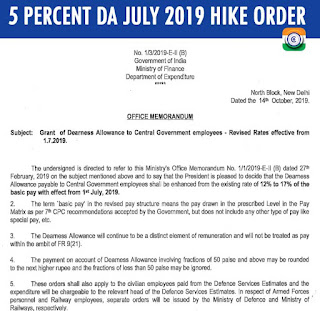
5 Percent DA July 2019 Hike Order - Grant of Dearness Allowance to Central Government employees

Grant of Dearness Allowance to Central Government employees 5 Percent DA July 2019 Hike Order  No. 1/3/2019-E- II (B) Government of...

Blog Archive

About The Author