A complete reference blog for Indian Government Employees

Showing posts with label Amendment. Show all posts

Wednesday, 7 August 2019

Amendment in Central Civit Services (Conduct) Rules, 1964 regarding acceptance of gifts by Government servants

DoPT Orders 2019

F. No. 11013 / 02 / 2019-Estt.A-III
Government of India
Ministry of Personnel, Public Grievances and Pension
Department of Personnel & Training
(Establishment A-III Desk)

North Block, New Delhi – 11001
Dated: 6 August, 2019

OFFICE MEMORANDUM

Subject: Amendment in Central Civit Services (Conduct) Rules, 1964 regarding acceptance of gifts by Government servants.

The undersigned is directed to say that the following rules of Central Civil Services (Conduct) Rules, 1964 prescribing ceiling for receiving gifts by Government servants, have been amended vide G.S.R. No. 531 (E) dated 29.07.2019 (copy enclosed) so as to bring the uniformity in provisions of CCS (Conduct) Rules, 1964, AIS (Conduct) Rules, 1968 and Foreign Contribution (Acceptance or Retention of Gifts or Presentations) Rules, 2012:

Before AmendmentAfter Amendment
Sub-rule (3) of Rule 13
In any other case, a Government servant
shall not accept any gift without the
sanction of the Government, if the value
exceeds –

(i) rupees one thousand Five hundred in
the case of Government servants
holding any Group A’ or Group B’
post; and

(ii) rupees five hundred in the case of
Government servant holding any Group
‘C’ or Group ‘D’ posts.
Sub-rule (3) of Rule 13
In any other case, a Government servant shall not accept any gift without the sanction of the Government, if the value exceeds –

(i) rupees five thousand in the case of Government servants holding any Group ‘A’ or Group B’ post: and

(ii) rupees two thousand in the case of Government servant holding any Group ‘C’ post.
Sub-rule (4) of Rule 13
Notwithstanding anything contained in sub-rule (2) and (3), a Government servant, being a member of India delegation or otherwise, may receive and retain gifts from foreign dignitaries, if the market value of gifts received on one occasion does not exceed rupees one thousand. In all other
cases, the acceptance and retention of such gift shall be regulated by the instructions issued by the Government in this regard from time to time.
Sub-rule (4) of Rule 13
Notwithstanding anything contained in
sub-rule (21 and (3), a Government servant, being a member of the Indian delegation or otherwise, D&y receive and retain gifts from foreign dignitaries in accordance with the
provisions of The Foreign Contribution (Acceptance or Retention of Gifts or
Presentation) Rules, 2012, as amended from time to time.

2. All Ministries/ Departments/ Offices are requested to bring the above amendments to the notice of all administrative authorities under their control.

3. Hindi version will follow.
(Satish Kumar)
Under Secretary to the Govt. of India
To
The Secretaries of All Ministries/ Departments
(as per the standard list)

Source: DoPT
Share:

Wednesday, 20 December 2017

Amendment in Maternity Benefit Act


Amendment in Maternity Benefit Act

The working women already on maternity leave are entitled to enhanced maternity leave subject to fulfillment of other conditions.

As per the Maternity Benefit (Amendment) Act, 2017, it has been made mandatory for the establishments employing 50 or more employees to provide crèche facility, either separately or along with common facilities within a prescribed distance.

This information was given by Shri Santosh Kumar Gangwar, Union Minister of State (I/C) for Labour and Employment in written reply to a question in Rajya Sabha today.

PIB
Share:

Friday, 10 April 2015

Step guide for processing of the proposal for framing/amendment of Recruitment Rules

Step guide for processing of the proposal for framing/amendment of Recruitment Rules

Press Information Bureau,
Government of India
Ministry of Personnel, Public Grievances & Pensions
10-April, 2015

The Department of Personnel & Training (DoPT) has reiterated five-year-old guidelines on framing/amendment/relaxation of Recruitment Rules to various posts. A detailed step guide (column-wise) for processing of the proposal for framing / amendment of Recruitment Rules has been reissued. The step guide material is to be used for filling up the thirteen-column Schedule to be annexed with the notification part of the Recruitment Rules for various posts under Ministries / Departments.

The step guide is available on the DoPT website with the following link:

No. AB.14017/13/2013-Estt.(RR)
Government of India
Ministry of Personnel, PG & Pensions
(Department of Personnel & Training)
***
New Delhi the 31 st March, 2015
OFFICE MEMORANDUM

Sub: Step guide for processing of the proposal for framing / amendment of Recruitment Rules.

The undersigned is directed to state that this Department has issued guidelines on framing/amendment/relaxation of Recruitment Rules vide OM No. AB-14017/48/2010-Estt.(RR) dated 31.12.2010 which inter-alia provides thirteen column Schedule (Annexure-I) to be annexed with the notification of the Recruitment Rules. A detailed step guide (column-wise) for processing of the proposal for framing / amendment of Recruitment Rules is enclosed. The step guide material may be used for filling up thirteen columns Schedule (Annexure-I) to be annexed with notification part of the recruitment rules for various posts under Ministries / Departments.

2. Hindi Version will follow.
Under Secretary to the Government of India

*(Link: Circular -*Establishment4 Recruitment Policies) 

http://ccis.nic.in/WriteReadData/CircularPortal/D2/D02est/AB-14017_13_2013-Estt.RR-31032015.pdf
Share:

Tuesday, 17 March 2015

Maternity Benefit Act for Women Employees

Maternity Benefit Act for Women Employees

The main provisions of the Maternity Benefit Act are:
i) No employer shall knowingly employ a woman in any establishment during the six weeks immediately following the day of her delivery or her miscarriage. Also, no woman shall work in any establishment during the six weeks immediately following the day of her delivery or her miscarriage.

ii) Every woman shall be entitled to, and her employer shall be liable for, the payment of maternity benefit at the rate of the average daily wage for the period of her actual absence immediately preceding and in- cluding the day of her delivery and for the six weeks immediately following that day.

iii) No woman shall be entitled to maternity benefit unless she has actually worked in an establishment of the employer from whom she claims maternity benefit, for a period of not less than eighty days in the twelve months immediately preceding the date of her expected delivery.

iv) The maximum period for which any woman shall be entitled to maternity benefit shall be twelve weeks, that is to say, six weeks up to and including the day of her delivery and six weeks immediately following that day.

v) No deduction from the normal and usual daily wages of a woman entitled to maternity benefit shall be made by reason only of –
(i) the nature of work assigned to her by virtue of the provisions of the Act; or
(ii) breaks for nursing the child allowed to her under the provisions of the Act.

vi) If a woman works in any establishment after she has been permitted by her employer to absent herself for any period, during such authorised absence, she shall forfeit her claim to the maternity benefit for such period.
The above said statement is the part of undermentioned Lok Sabha Q&A:-

GOVERNMENT OF INDIA
MINISTRY OF LABOUR AND EMPLOYMENT
LOK SABHA
STARRED QUESTION NO 167
ANSWERED ON 09.03.2015
AMENDMENT TO MATERNITY BENEFITS ACT
167 . Pal Shri Jagdambika
Will the Minister of LABOUR AND EMPLOYMENT be pleased to state:-
(a) the key provisions of the Maternity Benefits Act, 1961;
(b) whether the Government has any proposal to bring amendments to the Act;
(c) if so, the details thereof and the reasons therefor; and
(d) the time by which the proposed amendments are likely to be implemented along with the extent to which the same would be beneficial for working women in the country?

ANSWER

MINISTER OF STATE (IC) FOR LABOUR AND EMPLOYMENT (SHRI BANDARU DATTATREYA)

(a) to (d): A statement is laid on the Table of the House.
STATEMENT RERERRED TO IN REPLY TO PARTS (a) TO (d) OF LOK SABHA STARRED QUESTION NO.167 FOR 09.03.2015 BY SHRI JAGDAMBIKA PAL REGARDING AMENDMENT TO MATENITY BENEFITS ACT.
(a): The main provisions of the Maternity Benefit Act are: —As mentioned above
(b): No, Madam.
(c) & (d): Does not arise in view of facts mentioned at (b) above.

Source: http://164.100.47.132/LssNew/psearch/QResult16.aspx?qref=12590
Share:

Wednesday, 25 February 2015

Amendment to Central Civil Service (Leave) Rules, 1972 – Persons with Disabilities (Equal Opportunities, Protection of Rights and Full Participation) Act, 1995 (PWD Act, 1995)-regarding

No.18017/1/2014-Estt(L)
Government of India
Ministry of Personnel, Public Grievances & Pensions
Department of Personnel & Training

New Delhi, the 25th February, 2015
OFFICE MEMORANDUM

Subject: Amendment to Central Civil Service (Leave) Rules, 1972 – Persons with Disabilities (Equal Opportunities, Protection of Rights and Full Participation) Act, 1995 (PWD Act, 1995)-regarding

The Central Civil Services (Leave) Rules, 1972 were amended vide the Department of Personnel and Training Notification No. 13026/1/2002-Estt(L) dated the 15/16thJanuary, 2004 consequent to the Persons with Disabilities (Equal Opportunities, Protection of Rights and Full Participation) Act, 1995 (PWD Act, 1995) which came into force from 7thFebruary, 1996.

2. Section 47 of the PWD Act, 1995 provides that services of no employee can be terminated nor can he be reduced in rank in case the employee has acquired a disability during his service. The first proviso to the Section 47 lays down that if such an employee is not suitable for the post he was holding, he could be shifted to some other post.

However, his pay and service benefits would be protected. The second proviso provides that if it is not possible to adjust such an employee against any post, he would be kept on a supernumerary post until a suitable post is available or he attains the age of superannuation, whichever is earlier. Further, the Clause (2) of Section 47 provides that no promotion shall be denied to a person merely on ground of his disability. In Kunal Singh v. Union of India, [2003] 4 SCC 524, Hon’ble Supreme Court has observed that the very frame and contents of Section 47 of the PWD Act, 1995 clearly indicate its mandatory nature.

3. The issues relating to leave or absence of Government servants who have acquired a disability while in service are required to be dealt with in the light of the provisions of the Section 47 of Persons with Disabilities (Equal Opportunities, Protection of Rights and Full Participation) Act, 1995. The case of a disabled government servant who is declared fit to resume duty but who may not able to perform the duties of the post he was holding earlier may be dealt with as per the first proviso to Section 47 of the PWD Act, 1995. The second proviso shall apply if it is not possible to adjust him against any existing post. In all such cases, the Government servant so adjusted shall be entitled to the pay scale and other service benefits attached to the post he was holding.

4. A disabled Government servant who is not fit to return to duty shall be adjusted as per second proviso to the Section 47 mentioned above, until he is declared fit to resume duty or attains the age of superannuation whichever is earlier, with the same pay scale and service benefits. On being declared fit for resuming duty, the Government servant who is not fit for the post he is holding, may be adjusted as per the first proviso to Section 47.

5. Leave applied on medical certificate in connection with disability should not be refused or revoked without reference to a Medical Authority, whose advice shall be binding. The ceiling on maximum permissible leave laid down in Rule 12 may not be applied to leave on medical certificate applied in connection with the disability. Any leave debited for the period after a Government servant is declared incapacitated shall be remitted back into his/her leave account.

6. For a government servant who is unable to submit an application or medical certificate on account of disability, an  application/medical certificate submitted by a family member may be accepted. The provisions relating to examination of  disabled Government servants and the Medical Authorities competent to issue such certificates are also being amended.

7. Necessary amendments to the Central Civil Services (Leave) Rules, 1972 are being notified separately.

(Mukesh Chaturvedi)
Director
Tel: 23093176
Source: http://ccis.nic.in/WriteReadData/CircularPortal/D2/D02est/18017_1_2014-Estt.L-25022015.pdf
Share:

Featured post

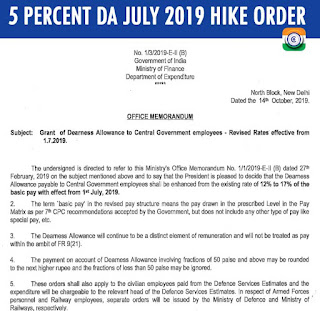
5 Percent DA July 2019 Hike Order - Grant of Dearness Allowance to Central Government employees

Grant of Dearness Allowance to Central Government employees 5 Percent DA July 2019 Hike Order  No. 1/3/2019-E- II (B) Government of...

Blog Archive

About The Author