A complete reference blog for Indian Government Employees

Showing posts with label CG News. Show all posts

Wednesday, 15 March 2017

7th Pay Commission: Committee on Allowances yet to submit report: Minister of State for Finance


7th Pay Commission: Committee on Allowances yet to submit report: Minister of State for Finance

New Delhi: The Committee on Allowances, tasked with reviewing the recommendations of the 7th Pay Commission on allowances, was given four months to submit its report. Later, the deadline was extended to February 22, 2017, has not yet submitted its report to the government.

In a written reply to a question on 7th Pay Commission in Lok Sabha on March 10, Minister of State for Finance Arjun Ram Meghwal said the Committee, under Finance Secretary Ashok Lavasa, is yet to submit its report.

The minister said that the deliberations of the committee are in the final stages.

The Committee on Allowances was formed in July 2016 following protests by government employees over recommendations of the 7th Pay Commission on allowances.

The 7th Pay Commission had recommended of abolishing 51 allowances and subsuming 37 others out of 196 allowances.

In July, the Finance Minister Arun Jaitley constituted a committee under Finance Secretary Ashok Lavasa to review the recommendations. The committee was given four months’ time to submit the report to Finance Minister.

In October, Ashok Lavasa was quoted by some agencies as saying that he was ready with the report.

Later, the Finance Minister extended the deadline for report submission to February 22, 2017. Now, going by Minister of State for Finance’s reply, it seems government employees will have to wait longer before they can hear some news on hike in allowances.

According to some reports, the Committee on Allowances has decided that the current HRA slab, which is 30 per cent of basic pay, for metros would continue against reducing the House Rent Allowance (HRA) for central government employees. The 7th Pay Commission suggested bringing down the HRA to 24 per cent, 16 per cent and 8 per cent respectively depending on type of cities.

The transport allowance is likely to remain constant as certain reports said the Committee on Allowances agreed with 7th Pay Commission’s recommendation, which had already factored in the Dearness Allowance at 125 per cent assuming the date of implementation to be January 1 next year.

TST
Share:

Friday, 3 March 2017

7th Pay Commission: Higher allowances woes plague central govt employees

7th Pay Commission: Higher allowances woes plague central govt employees

New Delhi: Central government employees have not got their higher allowances under the 7th Pay Commission recommendations over the last seven to eight months.

A central government employees union leader, said the government has not released the higher allowances for central government employees for last seven months.

He said the higher allowances issue has affected about 48 lakh serving central government employees and 52 lakh pensioners, who could not pay their house rents, tuition fees of children, installments of home and vehicle loans and insurance premiums.

We were promised in August, 2016 that the higher allowances (as per the 7th Pay Commission) would be given to us within four months, but we haven't got its till now.

They (the government) tell us that the model code of conduct has come into effect from January 4 to March 8 for five states assemblies poll process, so they can’t announce the higher allowances. Actually they do not intend to pay the higher allowances in time. In October last year, the Finance Secretary Ashok Lavasa, who is the head of the Committee on Allowances, said, he was ready with the report to submit the Finance Minister Arun Jaitley but Jaitley didn't receive the report of allowances, the union leader told.

The union leader said even though the 7th Pay Pay Commission was implemented in August, 2016, the central government employees have not yet been given the higher allowances till date.

Earlier, the government has given higher basic pay in August 2016 with arrears, effective from January 1, 2016 to its employees on the recommendations of the 7th pay commission but the hike in allowances other than dearness allowance referred to the Committee on Allowances for examination as the pay commission had recommended of abolishing 51 allowances and subsuming 37 others out of 196 allowances.

Accordingly, existing allowances are now paid to the central government employees according to the 6th Pay Commission recommendations until issuing of higher allowances notification.

However, the Finance Minister Arun Jaitley, promised to address the issue of higher allowances after the completion of the polls of the five states.

TST
Share:

Thursday, 22 December 2016

7th pay commission: Government mulling over higher allowances without arrears


7th pay commission: Government mulling over higher allowances without arrears

7th-Pay-Commission


New Delhi: The government is considering to give relief to central government employees amid cash crunch, which refusing to ease on even after six weeks of the demonetisation announcement, official sources today said.

“We can expect the higher allowances without arrears under 7th pay commission recommendations in the coming days as the PMO thinks payment of the higher allowances with salaries on salary day cannot be “chaotic”, a close aide of the Finance Minister told The Sen Times.

“The PMO might ask the Finance Ministry to ready the higher allowances proposal without arrears before the budget. The Finance Minister Arun Jaitley can also take some time to formalise this announcement. The issue of arrears of higher allowances may not be reconsidered”, he said.
Another official said the government is considering to make only allowances hike for its employees. “The financial advisors of the government believe it could be tough to give arrears of the higher allowances as millions will queue outside the money dispensers to get higher allowances as the cash crunch may be normalised in three to four months.”, the official revealed.

In the current financial year, the government has given higher basic pay with arrears, effective from January 1, 2016 to its employees on the recommendations of the 7th pay commission but the hike in allowances other than dearness allowance referred to the ‘Committee on Allowances’ headed by the Finance Secretary Ashok Lavasa for examination as the pay commission had recommended of abolishing 51 allowances and subsuming 37 others out of 196 allowances.

Existing allowances are now paid to the central government employees according to the 6th Pay Commission recommendations until issuing of higher allowances notification.

Earlier, Finance Secretary Ashok Lavasa said, “We are ready to submit our report, when the Finance Minister Arun Jaitley calls up.”

But the government gave extension to the committee up to February 22, 2017 to take cash crunch turn for better.

“The government would comply with the cash crunch to give higher allowances without arrears. The government wishes to give the higher allowances with arrears from August to its employees”, said the sources.

They said the PMO still wants to somehow bring out the higher allowances without arrears for the central government employees now, “but the Finance Ministry cannot take emotional decisions. We hope the announcement for the higher allowances will come with arrears soon after the budget.”
“The committee on allowances proposed higher allowances from August 2016 but the central government employees unions demanded for implementation of the allowances with retrospective effect from January 2016,” the sources also said.

TST
Share:

Thursday, 15 December 2016

Central Govt Employees, don't need to file assets declaration in 2016

Central Govt Employees, don't need to file assets declaration in 2016

New Delhi: Central government employees need not to file a declaration of their assets and liabilities this year because the new rules under the Lokpal and Lokayuktas (Amendment) Act, 2016 are not ready yet.

So, the extension of deadline for submission of declaration of assets and liabilities till December 31 has become fruitless.

“The extension was given under the old Act of 2014, which is now redundant…We are in the process of drafting the final proforma which only will be valid,” an official in Ministry of Personnel said.

The Lokpal and Lokayuktas (Amendment) Act, 2016 says, “On and from date of commencement of this Act every public servant shall make a declaration of his assets and liabilities in such form and manner as may be prescribed.” Since the filing rules have not been firmed up, there is no requirement for filing of declarations by central government public servants, he added.

The government had extended the deadline of filing assets declaration for the fifth time since the Act came into force.

The Department of Personnel and Training (DoPT) is consulting the law ministry over the final draft of the form for declaration of assets by public servants, so, no fresh deadline fixed yet.

The public servants will now not be required to provide the details of assets of their spouses and other dependents, according to the amendment of the Act, 2016.

TST
Share:

Wednesday, 16 November 2016

Web Based Cadre Management System - Updation of data

Web Based Cadre Management System - Updation of data

GOVERNMENT OF INDIA
DEPARTMENT OF PERSONNEL & TRAINING
MINISTRY OF PERSONNEL, PUBLIC GRIEVANCES
AND PENSIONS
NORTH BLOCK NEW DELHI-110001
D. O. No. 21/01/2016/CS-I(PR/CMS)
Dated , November 16th, 2016.
Dear Sir/ Madam
As you are aware, this Department has been issuing instructions from time to time for regular updation of data of Central Secretariat Service Officers in the Web Based Cadre Management System. These instructions are available on the website of this Department at the link - http://persmin .nic.in/DOPT CSDivision.Index.asp under the classification - 'Web Based Cadre Management'. I am enclosing a copy of
one such OM issued in December, 2015 for perusal , wherein the Nodal Officers in the departments were requested to do the needful to ensure that complete data is made available.

2. As you are further aware, a dashboard for CSS officers is to be operationalised , which will display the incumbency position in various departments, along with the service particulars/ vigilance status/ APARs entries of the incumbent CSS Officers. This Department has accordingly requested the Ministries/ Departments on 19.08.2016, 05.10.2016 and 21.10.2016 to provide the incumbency position/names of CSS Officers and the status of updation of data. I am enclosing a copy of the said OM dated 19.08.2016 as well.

3. It is noted that despite requests , the Nodal Officers have not followed the instructions issued from time to time. It is, therefore, requested that necessary directions may be issued to the concerned officials so that the task is completed in a time bound manner.
Encl: As above.
Yours sincerely,
(Archana Varma)
To
Joint Secretary (Administration) of all Ministries/ Departments
(Through website of Department of Personnel & Training)


21/1/2014-CS.I (PR/CMS)
Government of India
Ministry of Personnel, PG and Pensions
Department of Personnel & Training

2nd Floor, Lok Nayak Bhavan, New Delhi-11 0003
Dated the December, 2015
OFFICE MEMORANDUM

Subject: Web Based Cadre Management System - updation of data of CSS/CSSS/CSCS officers

As Ministries/Departments are aware, the Web Based Cadre Management System for CSS, CSSS and CSCS has been operational since January, 2013. The system is hosted at cscms.nic.iu. Despite lapse of more than two years, complete and upto date data is still not available in the system in respect of several officers. The prime objective of the web based system is to ensure accurate real time data of all the officers to enable quicker decisions relating to cadre management functions. Unless the data is maintained upto date, the purpose of the web based system will be defeated.

2. Nodal Officers in all the Ministries/Departments are, therefore, requested as under:

(a) Employee module: Nodal officers should ensure that correct and up to date personal information in respect of all personnel posted there is available. Nodal officers have been empowered to modify/correct (i) Employee details (ii) Basis Details (iii) Address details (iv) Training details and (v) qualification details. All the officers belonging to CSS/CSSS/CSCS may also be advised to verify their data in the system and bring discrepancies to the notice of the nodal officers for correction. If there is any difficulty in this regard, nodal officers should call CMC Ltd. Engineers at Tele: 24629890.

(b) Experience and Promotion data: CS.I Division will modify data in these two fields. If any modification is required duly certified information may be sent to CS Division for correction.

(c) Pay: Please ensure that pay of the officer is correctly indicated in the system. After drawl of increment on 151 July every year the data should be corrected.

(d) APAR: Ensure that APAR grading is entered in the system and the APAR is scanned and uploaded in the system. If there is any difficulty in this regard, please call the CMC Ltd. Engineers at Tele: 24629890.

(e) IPR and Lokpal return: All the officers of CSS/CSSS/CSCS are requested to file their returns online. It may be noted that defaulting officers will not be granted cadre clearance for deputation, foreign training, empanelment etc.

(f) Deputation: Ensure that all Officers apply for cadre clearance through the system. If any application is received in CS.l Division without online application it will not be entertained. Prior to forwarding application online, nodal officers should also ensure that correct and up to date information of the officer concerned is available in the system.

(g) Foreign Training: All nominations for foreign training should be processed through the web based cadre management system in respect of all Officers. Their reliving for the training will also be updated in the system to capture the details of foreign trainings attended. If the training period is more than three months, the nodal officers will forward the online request to CS.I Division for cadre clearance in respect of US and above level officers.

(h) Domestic Training: All nominations for domestic training should be processed through the web based cadre management system in respect of all officers. If the training period is exceeding one year, the nodal officers will forward the online request to CS.I Division for further processing in respect of US and above level officers.

(i) Permission to visit a broad: All requests for private foreign visits should be processed through the web based cadre management system to capture such information.

j) Furnishing of information of death of an employee: In case of death of an employee, the nodal officer of the Ministry/Department concerned will henceforth immediately update the information in the web based system to enable capture of the vacancy to facilitate provision of a substitute.

(k) Furnishing of information of long leave of an employee: If any employee proceeds on leave for six months or more, the nodal officer concerned should update the information in the web based system immediately to capture the vacancy to facilitate provision of a substitute.

(I) Voluntary Retirement: CS.I Division conveys approval of MoS (PP) for voluntary retirement of US and above level officers of CSS. Henceforth, if the request for voluntary retirement is not received through the system, the same will not be entertained.

(m) Resignation: Resignation requests from employees should be obtained and processed in the web based system so that such vacancies are brought to the notice of the cadre controlling authority immediately.

(n) Technical resignation: Requests for technical resignation to Join another employment under the Government should also be obtained and processed in the web based cadre management system.

(0) Vigilance status: Vigilance clearance whenever required in connection with cadre management activities will be sought and obtained through the system. In respect of US and above level officer it will be updated both by the Ministries/Department and by A VD.I of DoP&T. Upto SO level, Ministries/Departments will update the system.

3. This circular may be brought to the notice of all CSS Officers for their information and active cooperation to ensure correctness of data.

4. Nodal officers may also depute their subordinates to CS.I Division to clear doubts if any about the functioning of the system.

Click to get the Full Circular
Share:

Saturday, 5 November 2016

7th CPC DA Order - Finmin issued DA Orders effective from 1.7.2016


7th CPC DA Order - Finmin issued DA Orders effective from 1.7.2016

Recommendations of the Seventh Central Pay Commission - Decision of Government relating to grant of Dearness Allowance to Central Government employees - Rates effective from 01.07.2016

No.1/2.2016-E-II
Government of India
Ministry of Finance
Department of Expenditure
New Delhi, the 4th November, 2016

OFFICE MEMORANDUM

Subject: Recommendations of the Seventh Central Pay Commission - Decision of Government relating to grant of Dearness Allowance to Central Government employees - Rates effective from 1.7.2016.

The undersigned is directed to say that consequent upon decision taken by the Government on the recommendations of the Seventh Central Pay Commission relating to Dearness Allowance, the President is pleased decide that the Dearness Allowance (DA) to all categories of Central Government employees shall be admissible at rate of 2 percent of basic pay per month, w.e.f.01.07.2016.

2. The revised pay structure effective from 01.01.2016 includes the Dearness Allowance of 125% sanctioned from in the pre-revised pay structure. Thus, Dearness Allowance in the revised pay structure shall be zero from 01.01.2016.

3. The term ‘basic pay’ in the revised pay structure means the pay drawn in the prescribed Level in the Pay Matrix but does not include any other type of pay like special pay. etc.

4.  The Government vide Resolution No.1-2/2016-IC, dated 25/07/2016 has decided that till a final decision Allowances is taken based on the recommendations of the Committee constituted under the Chairmanship of Finance Secretary & Secretary (Expenditure), all Allowances will continue to be paid at existing rates.

5.  The Dearness Allowance will continue be a distinct element of remuneration and will not be treated as pay with in the ambit of FR 9(21).

6.  The payment on account or Dearness Allowance involving fractions of 50 paise and above may be rounded to the next higher rupee and the fractions of less than 50 paise may be ignored.

7. These orders shall also apply to the civilian employees paid from the Defence Services Estimates and the expenditure will be chargeable to the relevant head of the Defence Services Estimates. In respect of Armed Forces personnel and Railway employees, separate orders will be issued by the Ministry of Defence and Ministry of Railways, respectively.

8. In so far as the employees working in the 'Indian Audit and Accounts Department are concerned, these orders are issued in consultation with the Comptroller and Auditor General of India.
sd/-
(Annie George Mathew)
Joint Secretary to the Government of India
Click to view the order
Authority: www.finmin.nic.in
Share:

Friday, 12 August 2016

2016 SEPTEMBER 2nd GENERAL STRIKE – CONFEDERATION SERVED STRIKE NOTICE TO GOVT. OF INDIA


2016 SEPTEMBER 2nd GENERAL STRIKE – CONFEDERATION SERVED STRIKE NOTICE TO GOVT. OF INDIA

All affiliated organisations are once again requested to serve Strike Notice to their respective Departmental Heads today itself. If any organisation could not serve today, they should serve it before 17th August 2016 without fail. Copy of the Strike Notice should be sent to Confederation CHQ.

M. Krishnan
Secretary General
Confederation
Mob: 09447068125
E-mail: mkrishnan6854@gmail.com
confederationhq@gmail.com


No. Confdn/Strike/2016
Dated: 12th August 2016
To
The Cabinet Secretary,
Cabinet Secretariat,
Government of India,
Rastrapathi Bhawan,
NEW DELHI – 110004
Sir,
This is to give notice that the employees who are members of the affiliated organisations of the Confederation of Central Government Employees and Workers will go on one-day strike on 2nd September 2016. The Charter of demands in pursuance of which the employees will embark upon the one-day Strike action is enclosed.
Thanking you,
Yours faithfully,
(M. Krishnan)
Secretary General
Encl : Charter of demands

ANNEXURE

CHARTER OF DEMANDS

PART – A

1. Urgent measures for containing price rise through universalization of public distribution system and banning speculative trade in commodity market.

2. Containing unemployment through concrete measures for employment generation.

3. Strict enforcement of all basic labour laws without any exception or exemption and stringent punitive measures for violation of labour laws.

4. Universal social security cover for all workers.

5. Minimum wage of not less than 18000/- per month with provisions of indexation (for unskilled worker).

6. Assured enhanced pension not less than 3000 p.m for the entire working population (including unorganized sector workers).

7. Stoppage of disinvestment in Central/state public sector undertakings.

8. Stoppage of contractorisation in permanent/perennial work and payment of same wage and benefits for contract workers as that of regular workers for the same and similar work.

9. Removal of all ceilings on payment and eligibility of bonus, provident fund and increase in quantum of gratuity.

10. Compulsory registration of trade unions within a period of 45 days from the date of submitting application and immediate ratification of ILO conventions C-87 and C-98.

11. No FDI in Railways, Defence and other strategic sectors.

12. No unilateral amendment to labour laws.

PART – B

Demand of the Central Govt. Employees

1. Avoid delay in implementing the assurances given by Group of Ministers to NJCA on 30thJune 2016, especially increase in minimum pay a fitment formula. Implement the assurance in a time bound manner.

2. Settle issues raised by the NJCA, regarding modifications of the 7th CPC recommendations, submitted to Cabinet Secretary on 10th December 2015.

3. Scrap PFRDA Act and New Pension System (NPS) and grant Pension/Family Pension to all Central Government employees under CCS (Pension) Rules 1972.

4. No privatization, outsourcing, contractorisation of Government functions.

5. (i) Treat Gramin Dak Sevaks as Civil Servants and extend all benefits on pay, pension and allownaces of departmental employees.
(ii) Regularise casual, contract, contingent and daily rated workers and grant equal pay and other benefits.

6. Fill up all vacant posts by special recruitment. Lift ban on creation of new posts.

7. Remove ceiling on compassionate appointments.

8. Extend benefit of Bonus Act amendment 2015 on enhancement of payment ceiling to the Adhoc bonus/PLB of Central Govt. employees with effect from the financial years 2014-15. Ensure payment of revised bonus before Pooja holidays.

9. Revive JCM functioning at all levels.

Source : Confederation
Share:

Saturday, 9 April 2016

Dealing with incompetent Officers at Central Government Offices

Dealing with incompetent Officers at Central Government Offices

Everyone who’s ever had a officer has experienced frustration, but most of the officers at central government offices earn their position based on intelligence.

Sometimes the disgruntled employees are right — some officers can be truly incompetent. There are as many types of incompetent officers, who on their way to humiliate employees in front of clients.

A research showing that officers who feel incompetent really do lash out at others to temper their own inferiority.

Some officers feel they need to be superior and competent. When they don’t feel they can show that legitimately, they’ll show it by taking people down a notch or two.

Flattery seems to temper the aggressive urges of insecure officers. It is often seen incompetent officers are aggressive because of a hurt ego, for a simply threat to their power.

This might also explain why officers in their offices both big and small surround themselves with yes-men.
Blind flattery may not be the best solution for the 4.8 million central government employees estimated to have experienced in offices. But easing officers into new positions of power, or telling them that it’s natural to feel daunted, could prevent future outbursts.

It’s important central government employees remain solution-minded when dealing with incompetent officers, especially those lacking initiative.

However, keep in mind that senior enforcers are notoriously resistant to change, so don’t bother introducing any groundbreaking ideas until a few allies ready to back up.

It’s also best to wait for a large meeting before making any proposal.
Share:

Sunday, 11 October 2015

Central Government Employees Likely To Get 30-Day Bonus in Festive Season

Central Government Employees Likely To Get 30-Day Bonus in Festive Season


New Delhi: Ahead of the festival season, the government is likely to give an ad-hoc bonus of up to Rs 3,500 to Group C central government employees and personnel of the armed and para military forces.


The government may sanction grant of non-productivity linked bonus (ad-hoc bonus) equivalent to 30 days emoluments for the accounting year 2015-16 to the central government employees (Group C) and the notification in this regad will be issued next week, a senior official of Finance Ministry said.


“Since the election code of conduct for Bihar Assembly polls is in force, but announcement of bonus a routine administrative matter for which permission of the Election Commission not required to go ahead with,” he added.

“The limit for bonus is Rs 3,500,and the bonus will also be given to all non-gazetted employees in Group B, who are not covered by any productivity- linked bonus scheme,” he also told us.

The payment will also be admissible to the central Police and para-military personnel and personnel of armed forces.

Employees of the Union Territory Administration, which follows the central government pattern of emoluments and not covered by any other bonus or ex-gratia scheme would also be eligible for this ad-hoc bonus.

The expenditure incurred on this account will be debitable to the respective heads to which the pay and allowances of these employees are debited, the Finance Ministry official said.
7cpc.in
Share:

Sunday, 26 July 2015

Popular News: Central Government Employees DA from July 2015 will be 119%

Popular News: Central Government Employees DA from July 2015 will be 119%
Two Point increase in CPI (IW) provides scope for 6% likely increase in DA payable to Central Government Employees and Pensioners from July 2015
Rewind Central Government Employees DA from July 2015 will be 119% – All India Consumer Price Index (Industrial Workers) for May 2015 released by Labour Bureau – Two Point increase in AIPCI(IW)

DA from July 2015 – As estimated in our article on 30th May 2015, Dearness Allowance for Central Government Employees with effect from July 2015 will be increased by 6% thanks to two point increase in All India CPI (IW) for May 2015.

Except CPI for June-2015, all data for calculation of Dearness Allowance from July 2015 are available now.

Month Actual AICPI-IW
Jul-2014 252
Aug-2014 253
Sep-2014 253
Oct-2014 253
Nov-2014 253
Dec- 2014 253
Jan-2015 254
Feb-2015 253
Mar-2015 254
Apr-2015 256
May-2015 258
Jun-2015 To be released

We have to take the assumed value for CPI-IW only for June 2015. It is found that even for increase of 6 points in June 2015 from the existing CPI of 258, DA from July 2015 will be 119%. Only when CPI is increased to 265 from the existing level of 258, DA from July 2015 will be increased to 120%.

DA from Jul 2015 [(252+253+253+253+253+253+254+253+254+256+258+265)-115.76]*100/115.76
= 120% (7% increase in DA from July 2015)

On the lower side, we found that only when Consumer Price Index fell down to 250 i.e when CPI (IW) is getting decreased by 8 Points, Central Government Employees DA from July 2015 will be fixed at 118%.

DA from Jul 2015 [(252+253+253+253+253+253+254+253+254+256+258+250)-115.76]*100/115.76
= 118 % (5% increase in DA from July 2015)

From the above, it is clear that chances for decrease of 8 Points in CPI in a single month  or increase of 7 points in same period are very remote. So, we can very well conclude that DA from July 2015 will be 119%.

Source: Central Government News
Share:

Wednesday, 17 June 2015

INDWF: Discussion Points of National Anomaly Committee Meeting held on 9.6.2015

INDWF: Discussion Points of National Anomaly Committee Meeting held on 9.6.2015

The National Anomaly Committee Meeting was held on 9.6.2015 under the Chairmanship of Joint Secretary(E) DOP&T alongwith Joint Secretary(Pers), Dept. of Expenditure, M of Finance and JS DOP&T (Pers) with the staff side members of National Council JCM Standing Committee from 15.00 Hrs to 17.00 Hrs on the agenda already submitted. The undersigned being the Member Standing Committee of JCM NC also attended the meeting.

NAC Meeting details
Share:

Sunday, 7 June 2015

Investment guidelines for NPS Schemes (Applicable to Scheme CG, Scheme SG, Corporate CG and NPS Lite schemes of NPS and Atal Pension Yojana) w.e.f, 10th June, 2015

Investment guidelines for NPS Schemes (Applicable to Scheme CG, Scheme SG, Corporate CG and NPS Lite schemes of NPS and Atal Pension Yojana) w.e.f, 10th June, 2015.

Pension Fund Regulatory
& Development Authority
1st Floor, ICADR Building,
Plot No. 6, Vasant Kunj
Institutional Area, Phase-I,
New Delhi – 110070
 
CIRCULAR
PFRDA/2015/16/PFM/7
Date: 03rd June, 2015
Sub: Investment guidelines for NPS Schemes (Applicable to Scheme CG, Scheme SG, Corporate CG and NPS Lite schemes of NPS and Atal Pension Yojana) w.e.f, 10th June, 2015.
Category
Investment Pattern
Percentage amount to be invested
(i)
Government Securities and Related Investments
(a) Government Securities,
(b) Other Securities {‘Securities’ as defined in section 2(h) of the Securities Contracts (Regulation) Act, 1956} the principal whereof and interest whereon is fully and unconditionally guaranteed by the Central Government or any State Government.
The portfolio invested under this sub-category of securities shall not be in excess of 10% of the total portfolio of the G-Sec in the concerned NPS Scheme of the pension fund at any point of time.
(c) Units of Mutual Funds set up as dedicated funds for investment in Govt. securities and regulated by the Securities and Exchange Board of India:
Provided that the portfolio invested in such mutual funds shall not be more than 5% of the of the G-Sec in the concerned NPS Scheme of the pension fund at any point of time and fresh investments made in them shall not exceed 5% of the fresh accretions in the year.
Upto 50%
(ii)
Debt Instruments and Related Investments
(a) Listed (or proposed to be listed in case of fresh issue) debt securities issued by bodies corporate, including banks and public financial institutions (Public Financial Institutions’ as defined under Section 2 of the Companies Act, 2013), which have a minimum residual maturity period of three years from the date of investment.
(b) Basel III Tier-1 bonds issued by scheduled commercial banks under RBI Guidelines:
Provided that in case of initial offering of the bonds the investment shall be made only in such Tier-I bonds which are proposed to be listed.
Provided further that investment shall be made in such bonds of a scheduled commercial bank from the secondary market only if such Tier I bonds are listed.
Total portfolio invested in this sub-category, at any time, shall not be more than 2% of the total portfolio of the fund.
No investment in this sub-category in initial offerings shall exceed 20% of the initial offering. Further, at any point of time, the aggregate value of Tier I bonds of any particular bank held by the fund shall not exceed 20% of such bonds issued by that Bank
(c) Rupee Bonds having an outstanding maturity of at least 3 years issued by institutions of the International Bank for Reconstruction and Development, International Finance Corporation and Asian Development Bank.
(d) Term Deposit receipts of not less than one year duration issued by scheduled commercial banks, which satisfy the following conditions on the basis of published annual report(s) for the most recent years, as required to have been published by them under law:
(i) having declared profit in the immediately preceding three financial years;
(ii) maintaining a minimum Capital to Risk Weighted Assets Ratio of 9%, or mandated by prevailing RBI norms, whichever is higher;
(iii) having net non-performing assets of not more than 4% of the net advances;
(iv) having a minimum net worth of not less than Rs. 200 crores. (e) Units of Debt Mutual Funds as regulated by Securities and Exchange Board of India:
(f) The following infrastructure related debt instruments:
(i) Listed (or proposed to be listed in case of fresh issue) debt securities issued by body corporates engaged mainly in the business of development or operation and maintenance of infrastructure, or development, construction or finance of low cost housing.
Further, this category shall also include securities issued by Indian Railways or any of the body corporates in which it has majority shareholding.
This category shall also include securities issued by any Authority of the Government which is not a body corporate and· has been formed mainly with the purpose of promoting development of infrastructure.
It is further clarified that any structural obligation undertaken or letter of comfort issued by the Central Government, Indian Railways or any Authority of the Central Government, for any security issued by a body corporate engaged in the business of infrastructure, which notwithstanding the terms in the letter of comfort or the obligation undertaken, fails to enable its inclusion as security covered under category (i) (b) above, shall be treated as an eligible security under this sub-category.
(ii) Infrastructure and affordable housing Bonds issued by any scheduled commercial bank, which meets the conditions specified in (ii)(d) above.
(iii) Listed (or proposed to be listed in case of fresh issue) securities issued by Infrastructure debt funds operating as a Non-Banking Financial Company and regulated by Reserve Bank of India.
(iv) Listed (or proposed to be listed in case of fresh issue) units issued by Infrastructure Debt Funds operating as a Mutual Fund and regulated by Securities and Exchange Board of India.
It is clarified that, barring exceptions mentioned above, for the purpose of this sub-category (f), a sector shall be treated as part of infrastructure as per Government of India’s harmonized master-list of infrastructure sub-sectors:
Provided that the investment under sub-categories (a), (b) and (f) (i) to (iv) of this category No. (ii) shall be made only in such securities which have minimum AA rating or equivalent in the applicable rating scale from at least two credit rating agencies registered with Securities and Exchange Board of India under Securities and Exchange Board of India (Credit Rating Agency) Regulation, 1999. Provided further that in case of the sub-category (f) (iii) the ratings shall relate to the Non-Banking Financial Company and for the subcategory (f) (iv) the ratings shall relate to the investment in eligible securities rated above investment grade of the scheme of the fund.
Provided further that if the securities/entities have been rated by more than two rating agencies, the two lowest of all the ratings shall be considered.
Provided further that investments under this category requiring a minimum AA rating, as specified above, shall be permissible in securities having investment grade rating below AA in case the risk of default for such securities is fully covered with Credit Default Swaps (CDSs) issued under Guidelines of the Reserve Bank of India and purchased along with the underlying securities. Purchase amount of such Swaps shall be considered to be investment made under this category.
For sub-category (c), a single rating of AA or above by a domestic or international rating agency will be acceptable.
It is clarified that debt securities covered under category (i) (b) above are excluded from this category (ii).
Upto 45%
( iii)
Short-term Debt Instruments and Related Investments 
Money market instruments:Provided that investment in commercial paper issued by body corporates shall be made only in such instruments which have minimum rating of A 1 + by at least two credit rating agencies registered with the Securities and Exchange Board of India.
Provided further that if commercial paper has been rated by more than two rating agencies, the two lowest of the ratings shall be considered.
Provided further that investment in this sub-category in Certificates of Deposit of up to one year duration issued by scheduled commercial banks, will require the bank to satisfy all conditions mentioned in category (ii) (d) above.
(b) Units of liquid mutual funds regulated by the Securities and Exchange Board of India with the condition that the average total asset under management of AMC for the most recent six month period of atleast Rs. 5000/- crores
(c) Term Deposit Receipts of up to one year duration issued by such scheduled commercial banks which satisfy all conditions mentioned in category (ii) (d) above.
Upto 5%
(iv)
Equities and Related Investments 
Shares of body corporates listed on Bombay Stock Exchange (B SE) or National Stock Exchange (NSE), which have:
(i) Market capitalization of not less than Rs. 5000 crore as on the date of investment and
(ii) Derivatives with the shares as underlying traded in either of the two stock exchanges.
(b) Units of mutual funds regulated by the Securities and Exchange Board of India, which have minimum 65% of their investment in shares of body, corporates listed on BSE or NSE.
(c) Exchange Traded Funds (ETFs)/lndex Funds regulated by the Securities and Exchange Board of India that replicate the portfolio of either BSE Sensex Index or NSE Nifty 50 Index.
(d) ETFs issued by SEBI regulated Mutual Funds constructed specifically for disinvestment of shareholding of the Government of India in body corporates.
(e) Exchange traded derivatives regulated by the Securities and Exchange Board of India having the underlying of any permissible listed stock or any of the permissible indices, with the sole purpose of hedging.
Provided that the portfolio invested in derivatives in terms of contract value shall not be in excess of 5% of the total portfolio invested in sub-categories (a) to (d) above.
Upto 15%
(v)
Asset Backed, Trust Structured and Miscellaneous Investments
(a) Commercial mortgage based Securities or Residential mortgage based securities.
(b) Units issued by Real Estate Investment Trusts regulated by the Securities and Exchange Board of India.
(c) Asset Backed Securities regulated by the Securities and Exchange Board of India.
(d) Units of Infrastructure Investment Trusts regulated by the Securities and Exchange Board of India.
Provided that investment under this category No. (v) shall only be in listed instruments or fresh issues that are proposed to be listed.
Provided further that investment under this category shall be made only in such securities which have minimum AA or equivalent rating in the applicable rating scale from at least two credit rating agencies registered by the Securities and Exchange Board of India under Securities and Exchange Board of India (Credit Rating Agency) Regulations, 1999. Provided further that in case of the sub-categories (b) and (d) the ratings shall relate to the rating of the sponsor entity floating the trust.
Provided further that if the securities/entities have been rated by more than two rating agencies, the two lowest of the ratings shall be considered.
Upto 5%
 
2. Fresh accretions to the fund will be .invested in the permissible categories specified in this investment pattern in a manner consistent with the above specified maximum permissible percentage amounts to be invested in each such investment category, while also complying with such other restrictions as made applicable for various sub-categories of the permissible investments.
 
3. Fresh accretions to the funds shall be the sum of un-invested funds from the past and receipts like contributions to the funds, dividend/interest/commission, maturity amounts of earlier investments etc., as reduced by obligatory outgo during the financial year.
 
4. Proceeds arising out of exercise of put option, tenure or asset switch or trade of any asset before maturity can be invested in any of the permissible categories described above in the manner that at any given point of time the percentage of assets under that category should not exceed the maximum limit prescribed for that category and also should not exceed the maximum limit prescribed for the sub-categories, if any. However, asset switch because of any RBI mandated Government debt switch would not be covered under this restriction.
 
5. If for any of the instruments mentioned above the rating falls below the minimum permissible investment grade prescribed for investment in that instrument when it was purchased, as confirmed by one credit rating agency, the option of exit shall be considered and exercised, as appropriate, in a manner that is in the best interest of the subscribers.
 
6. On these guidelines coming into effect, the above prescribed investment pattern shall be achieved separately for each successive financial year through timely and appropriate planning.
 
7. The prudent investment of the funds within the prescribed pattern is the fiduciary responsibility of the Pension Funds and Trust and needs to be exercised with appropriate due diligence. The Trust and Pension Fund would accordingly be responsible for investment decisions taken to invest the funds
 
8. The Pension Funds and trust will take suitable steps to control and optimize the cost of management of the fund.
 
9. i. The trust and Pension Funds will ensure that the process of investment is accountable and transparent.
ii. It will be ensured that due diligence is carried out to assess risks associated with any particular asset before investment is made by the fund in that particular asset and also during the period over which it is held by the fund. The requirement of ratings as mandated in this notification merely intends to limit the risk associated with investments at a broad and general level. Accordingly, it should not be construed in any manner as an endorsement for investment in any asset satisfying the minimum prescribed rating or a substitute for the due diligence prescribed for being carried out by the fund
 
10. Due caution will be exercised to ensure that the same investments are not churned with a view to enhancing the fee payable. In this regard, commissions for investments in Category Ill instruments will be carefully charged, in particular.
 
11. Following restrictions/filters are being imposed for Government NPS schemes (Applicable to Government Sector, Corporate CG and NPS Lite schemes of NPS and Atal Pension Yojana) to reduce concentration risks in the NPS investment of the subscribers:
a) NPS investments have been restricted to 5% of the ‘paid up equity capital’* of all the sponsor group companies or 5% of the total AUM under Equity exposure whichever is lower, in each respective scheme and 10% in the paid up equity capital of all the non-sponsor group companies or 10% of the total AUM under Equity exposure whichever is lower, in each respective scheme.
*’Paid up share capital': Paid up share capital means market value of paid up and subscribed equity capital. 
b) NPS investments have been restricted to 5% of the ‘net-worth” of all the sponsor group companies or 5% of the total AUM in debt securities (excluding Govt. securities) whichever is lower in each respective scheme and 10% of the net-worth of all the non-sponsor group companies or 10% of the total AUM in debt securities (excluding Govt. securities) whichever is lower, in each respective scheme. 
#Net Worth: Net worth would comprise of Paid-up capital plus Free Reserves including Share Premium but excluding Revaluation Reserves, plus Investment Fluctuation Reserve and credit balance in Profit & Loss account, less debit balance in Profit and Loss account, Accumulated Losses and Intangible Assets. 
c) Investment exposure to a single Industry has been restricted to 15% under all NPS Schemes by each Pension Fund Manager as per Level-5 of NIC classification. Investment in scheduled commercial bank FDs would be exempted from exposure to Banking Sector.
 
d) if the PF makes investments in Equity/Debt instruments, in addition to the investments in Index funds/ETF/Debt MF, the exposure limits under such Index funds/ETF/Debt MF should be considered for compliance of the prescribed the Industry Concentration, Sponsor/ Non Sponsor group norms. (For example, if on account of investment in Index Funds/ ETFs/Debt MFs, if any of the concentration limits are being breached than further investment should not be made in the relative Industry /Company).
12. These instructions supersede only part of Investment Guidelines for NPS Schemes Applicable to Government Sector, Corporate CG and NPS Lite schemes of NPS prescribed by PFRDA vide Circular No. PFRDA/2014/02/PFM/1 dated 29.01.2014 and will be effective from 101h June 2015.
 
13. Investment Guidelines for NPS Private Sector {applicable to E(Tier-1& II), C (Tier-I & 11) and G (Tier-I & II)} will be unchanged until further orders .
(Sumeet Kaur Kapoor)
General Manager
Source: http://pfrda.org.in/MyAuth/Admin/showimg.cshtml?ID=705
Share:

Saturday, 6 June 2015

One Rank One Pension (OROP): Madras High Court issues notice to Centre.

Madras High Court issues notice to Centre on One Rank One Pension

Madurai: The Madras High Court today issued notice to the Centre on a petition seeking a direction to issue a notification to implement the One Rank One Pension (OROP) scheme within a stipulated period.
Acting on the petition by ex-serviceman S Chinnadurai, Justice S Vaidyanathan ordered notice to the Cabinet, Finance and Defence secretaries and sought their reply within two weeks.

The petitioner contended that 90 per cent of the ex- servicemen are living below the poverty line.
Previous governments had already announced OROP and allocated Rs 500 crore for it. On May 1, Prime Minister Narendra Modi had also assured that OROP would be implemented by the government but no timeframe had been given, he alleged.

The Indian ex-servicemen movement had also sent a memorandum and he had also submitted a representation.

Chinnadurai said it was mandatory on the part of the government to implement OROP before the fiscal 2014-15 after announcing the scheme.

The delay in implementing the scheme would demoralise serving soldiers and ex-serviceman and adversely affect the integrity of the country, he said.

He said that army men, who sacrificed the better part of their youth for the country, were not even getting proper jobs after they retired between 30 and 40 years of age.

PTI
Share:

Tuesday, 2 June 2015

7th Central Pay Commission’s Final Meeting with JCM Staff Side National Council on 9th June 2015

7th Central Pay Commission’s Final Meeting with JCM Staff Side National Council on 9th June 2015 at 11 AM at New Delhi

Confederation published the letter received from 7th Central Pay Commission regarding the final meeting with NC JCM Staff Side on 9.6.2015. The letter is reproduced and given below for your information…

Jayant Sinha
Joint Secretary
GOVERNMENT OF INDIA
SEVENTH CENTRAL PAY COMMISSION
D.O.No.7CPC/158/Meetings/2015
27 May 2015

Dear Shri Mishra,
The Seventh Central Pay Commission has had wide ranging interactions with a variety of Stakeholders. It has had a series of meetings with National Council and the Constituents of the JCM from March 2015 onwards. The Commission has also sought the views of Individual Ministries / Departments on the issues posed, in relation to matters that are relevant to the Ministries.

The Commission has scheduled a final meeting of the National Council with the 7th Central Pay Commission at 11.00 am on 9 June, 2015, in the Conference Room, 1st Floor, B-14/A. Chatrapati Shivaji Bhawan, Qutub Institutional Area, New Delhi.

With Regards,
Yours Sincerely
sd/-
(Jayant Sinha)
Shri.Shiv Gopal Mishra
Secretary
National Council (Staff Side)
Joint Consultative Machinery for Central Government Employees
13-C, Ferozshah Road,
New Delhi – 110001

Share:

Monday, 18 May 2015

IPS officers, IRS officers seek pay parity with IAS officers from 7th pay panel

7CPC: IPS officers, IRS officers seek pay parity with IAS officers from 7th pay panel

New Delhi: Various service associations of All India Services and allied services have represented to the Seventh Pay Commission seeking pay parity with IAS officers and adequate representation in central government’s policy making positions.


Officers associations of Indian Police Service (IPS), Indian Revenue Service (IRS), Indian Audit and Accounts Service (IA&AS) and Indian Forest Service (IFoS) have made detailed presentations to the Pay Commission about their grievances and suggestions for the future.

Though made separately, the associations’ presentations unanimously voiced their demand for ensuring pay parity with IAS officers and a share in Joint Secretary-level posts at the Centre.

Though made separately, the associations’ presentations unanimously voiced their demand for ensuring pay parity with IAS officers and a share in Joint Secretary-level posts at the Centre.

The Indian Revenue Service officials demanded that top level posts be increased to accommodate them on par with IAS officers. Asserting that they were involved in the important task of collecting revenue for the government, the IRS officers association said the superiority of IAS and Indian Foreign Services (IFS) officers should go as they did not face any hardships.

Listing out the “disparities”, the associations complained about delay in empanelment of officers of their services as Joint Secretaries at the centre vis-a-vis IAS officers. For example, they said, while a 1997 batch IAS officer is empanelled as Joint Secretary, for empanelment of an IPS officer he has to be of the 1993 batch, 1994 batch for IA&AS and 1989 for IFoS.

These organisations deprecated IAS officers deciding the fate of other All India Services and Allied services officers.

The IRS officers also demanded positions ranging from Superintendents of Police to Joint Directors in the CBI for its officers, claiming they were equipped to deal with economic crimes.

IA&AS memorandum also sought equality in rules governing central deputation and allowances.

In its representation, the IPS Officers Association deplored that its demand for pay parity with IAS and IFS has been ignored by successive Pay Commissions.

“But the same (their demand) has not found favour with the Commission. Unfortunately, the reasons for turning down the request were never based on merit but through direct acceptance of flawed arguments made by the other side on the basis of specious premises,” it said.

The IPS officers also demanded that there be more options for them in central staffing and policy making, especially police-specific jobs like internal security division under the Union Home Ministry.

There are hardly any joint secretary or secretary level officers in the bureaucracy from IPS. The memorandum also said that out of 111 posts of Central Vigilance Officers, only 21 were occupied by IPS officers.

It also spoke about the duty of a police officer which went beyond his ordinary scheduled work hours. “A police officer is subject to restrictions on his private life, one of which is the obligation to obey an order to return to duty,” it said.

The duty hours spanned more than 16 hours a day and, therefore, there was a need to introduce an ‘Overtime Allowance’ for police personnel.

Previous UPA regime had announced the Seventh Pay Commission which was constituted on February 28, 2014. Chaired by Justice Ashok Kumar Mathur, it has Vivek Rae as full-time Member, Ratin-Roy as part time Member and Meena Agarwal as Secretary.

The Commission has been given 18 months to submit its recommendations and its term expires in October this year.

PTI
Share:

Friday, 24 April 2015

7th Pay Commission Team to visit North-eastern states

7th Pay Commission Team to visit North-eastern states

7th Pay Commission has proposed to visit North-eastern states between 7th to 15th May 2015.

Commission’s visit to North-Eastern States

The Commission, headed by its Chairman, Justice Shri A. K. Mathur, proposes to visit North-eastern states in the second week of May, 2015.

The Commission would like to invite various entities/associations/federations representing any/all categories of employees covered by the terms of reference of the Commission to present their views.

Your request for a meeting with the Commission may be sent through e-mail to the Secretary, 7th Central Pay Commission at secy-7cpc@nic.in. The memorandum already submitted by the requesting entity may also be sent as an attachment with this e-mail.

The last date for receiving request for meeting is 6th May 2015 (1700 hours)

Source: www.7cpc.india.gov.in
Share:

Wednesday, 4 February 2015

Review of progress of NPS (National Pension System) Implementation

Review of progress of NPS (National Pension System) Implementation

KENDRIYA VIDYALAYA SANGATHAN
18, Institutional Area, Shaheed feet Singh Marg,
New Delhi-110 016 (India)
Tel.:91-11-26855532,Fax : 91-11-26514179, 26565536
E-mail:addl.com.admn@ gmail.com ,
Website : www.kvsangathan.nic.in
 
 F.No.110126125/2012/KVS-NPS/PF/75-107
Dated:03.02.2015
To,
Deputy Commissioner/Director,
Kendriya Vidyalaya Sangathan,
All Regional Offices / ZIETs
 
Subject: Review of progress of NPS (National Pension System) implementation.
 
I am to inform that the Pension Fund Regulatory and Development Authority (PFRDA), New Delhi organised a review meeting on NPS (National Pension System) on 15th January 2015 from 10.30 A.M. to 12.30 P.M.. The following points were discussed in the above meeting:
 
(a) Subscriber coverage – It is intimated that all the employees who join in service on or after 01.01.2004 will come under New Pension System as per the policy of the Government. They also advised that as and when a candidate joins the service, the process for joining in NPS is to be completed immediately & efforts are to be made to enhance subscriber’s awareness by distributing brochures, updating S2 Form, issuing statement of transactions and redressing grievances in February 2015.
 
(b) Delay in uploading/remitting contributions – PFRDA took serious note for delays in uploading or remitting contributions. As per existing policy NPS contribution (Own and management share) is to be uploaded by 5th of  month vide Min. Of Fin. Deptt of Expenditure, New Delhi 0.M No following 1(7)(2003/TA/Part File/279) dt 02.09.2008. The delay in this matter will have serious consequences. Statutory penal provisions may also be enacted soon. So appropriate priority and extra attention is to be given.
 
(c) Confirmation of uploading legacy amount – The legacy amount is to be uploaded immediately and necessary confirmation to be obtained from the Pay & Accounts Office so that no legacy amount is left pending for uploading.
 
(d) Resolution of pending grievances under CGMS (Centralized Grievance Management System) – The grievances pending with PAO are to be resolved immediately. The delay in this matter will not be tolerated.
 
 (e) Nomination details for subscribers — PFRDA advised that all the subscribers should provide the nomination details in the S2 form. Once the nomination details are provided by the subscribers, these details can be updated in the CRA system. This facility has been extended to subscriber also i.e. subscriber can himself revise nomination, address and mobile number.
 
(f) Refund of NPS contribution — PFRDA advised that employee’s contribution with management contribution along with interest up to the date of settlement may be returned to the official who has tendered resignation/expired while in service if their contribution is lying with office. And amount may be transferred to the concerned organization where the official is presently working in case of technical resignation. In this regard it is relevant to comply KVS(HQ) letter No.1101260125/2010/KVS/NRDCPS/Allot/PPAN/PF/1159-1232 dated 29.12.2010.
 
(g) Assessment of the performance of KVS in the field of NPS reveals that much more priority and attention is required by your Regional Office/ZIETs to achieve the ideal target of 100% uploading in time and zero grievances. In view of this it is advised to earmark one staff and one computer with Internet facility for the same at RO level and monitor the same personally and ensure regular compliance, positively, to avoid penal consequences.
 
(h) Please sensitize your office and all KVs under your control in this matter and a report be sent to the undersigned by 28.02.2015.
Yours sincerely
Sd/-
G.K. Srivastava, I.A.S
Addl. Commissioner (Admn. & Vig.)
 
Source: http://kvsangathan.nic.in/GeneralDocuments/ANN-03-02-15.PDf
Share:

Wednesday, 20 August 2014

Upgradation of LDC as Accounts Assistant, Merger of Accounts/Sr. Accountant, GP 5400 to AAO and Projected 7th CPC Pay by NFCCA

Upgradation of LDC as Accounts Assistant, Merger of Accounts/Sr. Accountant, GP 5400 to AAO and Projected 7th CPC Pay by NFCCA.  

Following is the extract of Brief Resume and Decisions of extended Federal Executive Meeting held on 17th & 18th July, 2014 of National Federation of Civil Accounts Association :-

            Initiating the discussion, Secretary General reported about the pay scales devised and recommended by the staff side National Council (JCM) to the 7th CPC. Further,  he stated that as per the demand adopted by the apex JAC necessary documents had been placed before CGA.

The demands are:- 
1. Upgradation LDC as Accounts Assistant with grant of Grade Pay of Rs: 2400/-.
2. Merger of Accountant/Sr. Accountant and grantof Grade Pay of Rs: 4600/-.
3. Grant of Grade Pay of Rs: 5400/- to AAOs.

Accordingly CGA vide letter dated 14.07.2014 recommended to Ministry of Finance to Grade Pay of Rs:- 4600/- to Sr.Accountant and Rs:- 5400/- to AAO with effect from 1.1.2006. 

The apex JAC meeting held on 28th May 2014 reversed its earlier stand and decided to demand following Pay Scales to different categories before the 7th CPC.

1 LDC(Redesignated  as Audit/Accounts Assistant) GP 1900, PB1 GP 2400  PB1 41000
2 Auditor/Accountant -20% GP 2800, PB 1 GP  4200 PB2 56000
3 Sr. Auditor/Accountant - 80% & Stenographer Gr. I/Steno Gr. II (P. S.) GP 4200, PB 2 GP 4600 PB2 66000
4 Sr. Auditor/Sr Accountant- on completion of 4 years GP 4800 PB 2 74000
5 Asstt. Audit/Accounts Officer/ Supervisor/ Sr. Private Secretary & DivisionalAccountant (35% existing & reduce to 20% for DA Cadre) GP 4800, PB 2 GP 5400 PB2 78000
6 AAO Grade II on completion of 4 years /Divisional Accounts Officer Gr II (25%) - GP 5400, PB3 88000
7 Audit/Accounts Officer (20%)/DAO Gr I (25%) GP 5400, PB2 GP 6600P B3 102000
8 Sr. Audit/Accounts Officer (80%)/DAO (15% existing & enhance to 30% for DA Cadre) GP 5400,   PB 3 GP  7600  PB 3 120000
 
It was also reported by the Secretary General to the house that the representatives of NFCAA held repeated dialogue over this matter with the leaders of other constituent of apex JAC, but there could not be any common understanding.
 
            On this agenda item, 26 (twenty six) Federal Executive members took part in the discussion. 25 members were of the opinion that the earlier stand of merger of Accountant and Senior Accountant was most justified and reasonable. Merger would be more beneficial and carrer boosting for all cadres of Civil Accounts Organization as a whole.
 
            However, after hours long discussion, following decisions were taken by the meeting
 
1. A resolution shall be forwarded to CGA conveying the resentment against forwarding the half hearted proposal of cadre restructuring to Ministry of Finance and that too without taking the Associations into confidence. In the same resolution it shall also be demanded to make suitable recommendations for rest of the cadres.
 
2. In the National Convention of Accounts and Audit Employees on 19th July 2014, the representatives of AICAEA and AICAEA Cat-II would unitedly place their views with regard to merger of Accountant and Senior Accountant and also plead for taking this approach before 7th CPC by the apex level JAC. 
 
However, in case the proposal is not accepted in the convention, the AICAEA and AICAEA Cat-II shall obey the majority decision of the National convention so that total unity among the officers and employees and officers of Accounts and Audit departments is maintained.
 
            Secretary General informed that, so far as departmental memorandum for submission to 7CPC in concerned, draft of the same was circulated to all seeking suggestions and proposals from Federal Executive members, Branches and even individuals. Further, Presidents and Secretary General of both Associations and President NFCAA are Co-ordinating among each other on this matter.
 
            The meeting observed that the discussion on this item of agenda had already taken place while discussing the previous agenda. It was therefore decided that, the memorandum shall be finalized after finalization of the approach taken by the National Convention of Accounts and Audit Employees and Officers Organization on 19thJuly 2014. The meeting also directed Presidents and Secretary Generals of both AICAEA and AICEA Cat-II to finalize the memorandum.
 
To Read full click here
 
#7th CPC, #Upgradation LDC, #Grade Pay, #Merger of Accountant, #Grant of Grade Pay, #CGA, #LDC, #NFCCA, #7th CPC memorandum, #AICAEA
Share:

Featured post

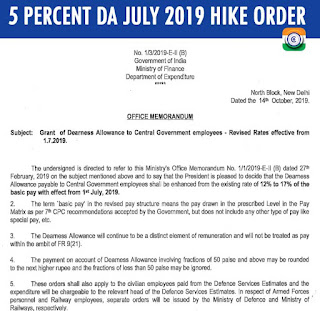
5 Percent DA July 2019 Hike Order - Grant of Dearness Allowance to Central Government employees

Grant of Dearness Allowance to Central Government employees 5 Percent DA July 2019 Hike Order  No. 1/3/2019-E- II (B) Government of...

Blog Archive

About The Author