A complete reference blog for Indian Government Employees

Showing posts with label PTI News. Show all posts

Friday, 29 July 2016

Deadline for central government employees to declare assets extended

Deadline for central government employees to declare assets extended

New Delhi: Central government employees and NGOs receiving government funds now need not declare their assets by the deadline of July 31 as Parliament today approved an amendment in the Lokpal Act to extend the timeline.

The amendment to Section 44 of the Lokpal Act was approved by voice vote by the Rajya Sabha today, a day after the Lok Sabha did the same.

While moving the bill to amend the Lokpal Act for consideration of the House, Minister of State for Personnel Jitendra Singh said it is an immediate necessity and the provision will be examined in detail by a Parliamentary Standing Committee which will possibly submit its report before next session of Parliament.
During a brief discussion, the Opposition asked the government to adopt this law without any dilution.
Naresh Agrawal of Samajwadi Party said he was opposed to the Lokpal Act as this is not good for democracy and constitution. “Can the country’s Prime Minister be dishonest and Lokpal be honest,” he asked.

Replying to the concerns raised by the members, Singh said: “There is no intention to dilute or to delay the Lokpal Act. The government is committed to implement this law in letter and spirit”.

He also said the message should not go out that members of this House have joined hands to prevent declaration of their assets.

“Under the People Representation Act, what we declare is more than enough, regardless of the fact that we have Lokpal Act or not,” Singh said, adding that exercise to amend this Act has been done in good faith and is only to extend the deadline with only two days left. It gives relief to 50 lakh government employees.

The amendment pertains to Section 44 of the Lokpal Act which deals with declaration of assets and provision of making the assets public, he said.

As per the rules notified under the Lokpal and Lokayuktas Act 2013, every public servant shall file declaration, information and annual returns pertaining to his assets and liabilities as well as for his spouse and dependent children on March 31 every year or on or before July 31 of that year.

In April, the government had extended the date of filing returns by public servants from April 15 to July 31. This is the fifth extension in the deadline since the Act came into force in January 2014.

As per rules, organisations receiving more than Rs 1 crore in government grants and donations above Rs 10 lakh from abroad fall under the ambit of Lokpal.

PTI
Share:

Tuesday, 12 July 2016

Public Sector Bank Employees Defer Strike After High Court Order

Public Sector Bank Employees Defer Strike After High Court Order

New Delhi: A section of public sector bank employees today deferred its proposed two-day nationwide strike from tomorrow following a retrain order from the Delhi High Court.

“In view of Delhi High Court restrain order our strike on July 12 and 13 stands deferred,” All India Bank Employees’ Association General Secretary C H Venkatachalam said.

Earlier, the employee union had announced to go on strike to protest against the proposed merger of SBI associates and privatisation of IDBI Bank.

All India Bank Officers’ Association and State Sector Bank Employees’ Association had also announced their support to the strike.

In the event of the strike, normal banking operations could have been affected on July 12 and 13.

The high court in its order on a plea of State Bank of Patiala and four other subsidiary banks of SBI restrained State Sector Bank Employees Association (SSBEA) and All India Bank Employees’ Association (AIBEA) from proceeding ahead with the two-day strike till the next date of hearing.

The HC listed the matter for further hearing on July 20.

The five associate lenders of SBI are State Bank of Bikaner and Jaipur, State Bank of Travancore, State Bank of Mysore, State Bank of Patiala and State Bank of Hyderabad.

PTI
Share:

Monday, 20 June 2016

More delay in OROP, as government gives 6 month extension to panel

More delay in OROP, as government gives 6 month extension to panel

OROP-Scheme


The tenure of the committee formed on implementation of One Rank One Pension (OROP) scheme has been extended by six months upto the middle of December this year.

The government recently amended the gazette notification issued last year under which the committee headed by former Chief Justice of Patna High Court Justice (Retd) L Narasimha Reddy was scheduled to submit its report by June 14.

With the extension, the implementation of OROP may take more time as the panel can submit its report by December 14, official sources said.

The government had announced implementation of OROP on November 7, 2015 to benefit over 25 lakh ex-servicemen and war widows. The OROP mandates payment of uniform pension to the armed forces personnel retiring in the same rank with the same length of service, regardless of their date of retirement, which implies that bridging the gap between the rate of pension of current and past pensioners at periodic intervals.

The other Terms of Reference of the Committee will continue which include measures for the removal of anomalies that may arise in the implementation of the OROP as notified by the government.

The panel is also looking into the measures for the removal of anomalies that may arise out of inter-services issues of the three forces due to implementation of OROP besides implications on service matters.
The Committee is examining all other matter referred to it by the central government on implementation of the OROP or related issues.

In making its recommendations, the Committee shall take into account the financial impact of its recommendations, as per its Terms of Reference.

The panel, if necessary, may give interim reports to the government on any of the matters related to its terms of reference.

PTI
Share:

Thursday, 12 May 2016

Digital India to offer passport, pension, driving license online

Digital India to offer passport, pension, driving license online

Government is implementing the Digital India programme to transform the country into a digitally empowered and knowledge economy so that various services like passport, pension and driving licenses could be delivered online, Lok Sabha was informed today.

Telecom and IT Minister Ravi Shankar Prasad said one of the primary focus areas of Digital India is Pillar 5: eKranti – electronic delivery of services.

“e-Kranti aims to ensure a government wide transformation by delivering all services electronically to the citizens through integrated and interoperable systems via multiple modes while ensuring efficiency, transparency and reliability of such services at affordable costs,” he said during Question Hour.

In e-Kranti, 44 Mission Mode Projects (MMP) – 13 central, 17 state and 14 integrated MMPs – are being implemented. Under the 25 operational MMPs 222 services are being provided. More than 192 e-transactions have been reported since January 1, 2016.

“Under e-Kranti, the government of India has made concerted effort to make offline government services to be also delivered through online mode, ensuring that all citizens would have access to them, thereby improving the quality of basic governance on an unprecedented scale,” he said.

Prasad said services being provided online include income tax, passport, immigration, core banking, pension grievance redressal, courts, police, RTI, utility payments, licenses, social welfare schemes, agriculture, municipality, land record, vehicle registration, driving license, public distribution system etc.

The Minister said so far more than 100 crore Aadhaar enrollments have been processed and that resulted in extensive use of Direct Benefit Transfer (DBT) scheme for subsidies and saving of Rs 21,000 crore.

Prasad said around 1.99 lakh common service centres have been made operational and 1,40,751 KMs OFC pipe laid and over 1,12 lakh KMs optical fibre laid for connectivity to 50,465 gram panchayats to deliver services to citizens in rural areas.

Rural tele-density has crossed 50.09 per cent. Guidelines for spectrum sharing and trading and liberalisation of spectrum have been issued. More than 2 crore passport applications have been processed, he said.

PTI
Share:

Wednesday, 11 May 2016

PMO gets over 61,000 public grievances per month

PMO gets over 61,000 public grievances per month

Over 61,000 public grievances related to a range of issues are received by Prime Minister’s Office (PMO) every month, Union Minister Jitendra Singh said today.

The grievances include concerns related to employees, quality of service, amenities, police, allegation of corruption or malpractices, labour issues, education, land-related problem and financial services.
According to the data available on the online Centralised Public Grievance Redress and Monitoring System (CPGRAMS), the average number of grievances received every month in PMO is 61,919, said the Minister of State in the PMO in a written reply in Lok Sabha.

There are 11,028 grievances pertaining to Delhi, he said.

The total number of grievances disposed of and pending as on May 5, 2016 were 7,18,241 and 2,72,466 respectively, the minister said.

The government has established CPGRAMS to facilitate citizens to lodge their grievances from anywhere, anytime for redressal.

PTI
Share:

Tuesday, 22 March 2016

4 Days Bank Holiday from Thursday Onward

4 Days Bank Holiday from Thursday Onward

Customers won’t be able to conduct bank transactions at branches for 4 days in a row this week as all banks will be closed from Thursday, although the lenders assure that they will fully load ATMs for meeting people’s cash needs.

Thursday will be a holiday for celebrating the Holi festival, followed by Good Friday and the weekend.
Banks are closed on second and fourth Saturdays every month. Hence, 4 continuous offs for the bank employees.

Banks are trying to ensure that ATMs remain operational during these days so that people don’t have any cash problem, a senior public sector bank official said.

They are trying to put higher denomination notes in ATM machines to ensure meeting the cash demand, the official added.

IDBI Bank may be closed for an extra day if the strike call given by a section of officers and employees of the bank on March 28 (Monday) materialises.

The staffers, belonging to the All India Bank Employees Association (AIBEA) and All India Bank Officers Association (AIBOA), have given the strike call to protest against the government move to privatise IDBI Bank.

The government owns around 80 per cent stake in the bank.

In Budget 2016-17, Finance Minister Arun Jaitley had said the government was open to bringing down its stake in IDBI Bank to below 50 per cent.
PTI
Share:

Thursday, 18 February 2016

West Bengal Government allows child care leave to male government employees

West Bengal Government allows child care leave to male government employees

In a major policy decision, West Bengal Government today allowed paternity-cum-child care leave of 30 days for its male employees which can be availed either during child birth or until their children turn 18.

Announcing this at the State Secretariat Nabanna, Chief Minister Mamata Banerjee said the decision was taken at a cabinet meeting today to enable male employees to discharge their parental responsibilities.

The state government had earlier allowed maternity leave for 180 days and child care leave for 730 days to female employees of the state government and Panchayat Raj, besides other local bodies, boards, corporations, undertakings, companies, state aided universities, sponsored and non-government aided schools and colleges, Banerjee said.

The scheme would be implemented with immediate effect, she added.

PTI
Share:

Sunday, 10 January 2016

Government considering Aadhaar Card for NRIs: Swaraj

Government considering Aadhaar Card for NRIs: Swaraj

The government is considering giving Aadhaar cards to Non-Resident Indians and a decision on it will be taken soon, External Affairs Minister Sushma Swaraj said today while inviting the diaspora community to actively participate in India’s growth story.

In her address to the first limited edition of Pravasi Bhartiya Divas, Swaraj said it has been decided that women workers will be allowed to go to Gulf countries for employment only through government agencies to ensure they are not duped by recruiting agents or firms.

The PBD, webcast by almost all Indian Missions and Posts, was organised for the first time by External Affairs Ministry (MEA) after the government’s decision to merge Ministry of Overseas Indian Affairs (MOIA) with it.

Earlier MOIA used to host the event. January 9 was chosen as the day for PBD as it was on this day in 1915 that Mahatma Gandhi, the “greatest Pravasi”, returned home from South Africa to lead India’s freedom struggle.

Asking the diaspora to participate in government’s various flagship programmes including Skill India, Digital India and Clean Ganga initiatives, she said Prime Minister Narendra Modi wants the Aadhaar card scheme to be extended to NRIs.

“So far Aadhar card has been given to those Indians who live in India. It is not for non-resident Indians. But you will be happy to know that the Prime Minister wants the card to be given to the NRIs the way it is issued to people living in India.

“He even wants it for OCI (Overseas Citizens of India card) holders. The matter is under our consideration. No decision has been taken as discussions on it are underway. I hope soon you will hear about it,” Swaraj said during an interaction following her address.

The government has so far issued Aadhaar cards to over 92 crore citizens. Under the programme, every citizen is to be provided with a 12-digit unique identification number for which biometric information is collected.

On restricting women from going to Gulf countries through the recruiting agencies, she said the decision has been taken to stop them from getting duped.

“We will send women only through government agencies,” Swaraj said during an interactive session with Indian missions abroad.

Calling upon the diaspora to be part of the India growth story, she said “It is time for you to come back to India.”

Effusive in praise of the Prime Minister, Swaraj said India’s engagement with the overseas Indians has increased manifold because of his constant endevour to reach out to the community. Swaraj also mentioned Modi’s Madison Square address in the US and at the Wembly in London.

“Your achievements in the countries of your adoption are a matter of pride… It is our responsibility to protect you and take care of you. Indeed, we are you and you are us,” she said.

PTI
Share:

Wednesday, 6 January 2016

No transfer for central government employees with Thalassemia, Haemophiliac kids

No transfer for central government employees with Thalassemia, Haemophiliac kids

Central government employees who have children suffering from Thalassemia and Haemophilia will be exempted from routine transfers and will not be asked to take voluntary retirement on refusing such postings, as per the new rules announced today by the Centre.

The matter regarding the scope of ‘disabled’ has been examined by the Department of Personnel and Training (DoPT) in consultation with the Department of Empowerment of Persons with Disabilities.

Considering the fact that the child suffering from Thalassemia and Haemophilia requires constant caregiver support and it would be imperative for government employees to take care of their child on continuous basis, it has been decided to include Thalassemia and Haemophilia in the category of disabled child, the new rules issued by the DoPT said.

At present, employees with kids suffering from blindness or low vision, hearing impairment, locomotor disability or cerebral palsy, leprosy, mental retardation, mental illness, multiple disabilities and autism are spared from routine transfers.

A government employee with a disabled child serves as the main caregiver and any displacement of such employee will have a bearing on the systemic rehabilitation of the child since the new environment or set up could prove to be a hindrance for rehabilitation process, as per the existing policy.

“Therefore, a government servant who is also a caregiver of disabled child may be exempted from the routine exercise of transfer or rotational transfer subject to the administrative constraints,” DoPT Office Memorandum No.42011/3/2014-Estt.(Res) dated January 5 said.

Upbringing and rehabilitation of disabled child requires financial support. Making the government employee to choose voluntary retirement on the pretext of routine transfer or rotation transfer would have adverse impact on the rehabilitation process of the child, the DoPT policy says and exempts such employees from routine transfers and seeking voluntary retirements.
PTI
Share:

Raise income tax exemption limit to Rs 5 lakh: Unions

Raise income tax exemption limit to Rs 5 lakh: Unions

New Delhi: Trade unions today asked the government to increase the income tax exemption limit to Rs 5 lakh and the minimum wage to Rs 18,000 besides raising the minimum monthly pension to Rs 3,000 for all.
They also sought a special package for victims of the recent Tamil Nadu floods.

These demands were raised under a 15-point charter submitted by 11 central trade unions to Finance Minister Arun Jaitley during pre-Budget consultations held here. The Union Budget for the next financial year, 2016-17, is slated to be presented in Parliament in February end. It will take effect from April 1.

“We have demanded a minimum wage of Rs 18,000 per month which is higher than our earlier demand of Rs 15,000,” Bharatiya Mazdoor Sangh Zonal Organisation Secretary Pawan Kumar said after the meeting.
The Seventh Pay Commission has recommended Rs 18,000 as minimum monthly wage for central government employees and it should be the benchmark, he said.

All Indian Trade Union Congress Secretary D L Sachdev said: “We have also demanded Rs 3,000 minimum monthly pension for all and asked for a special package for flood ravaged Tamil Nadu to provide relief to workers as well as industry in the next Budget.”

Sachdev said that in view of price rise “we have also demanded from the government to increase the income tax exemption limit to Rs 5 lakh per annum”.

The union have also asked that fringe benefits like housing, medical and educational facilities and running allowances in railways should be exempted from Income Tax.

Unions also demanded that PSUs should be strengthened and expanded and the disinvestment of government shares in profit making PSUs should be stopped.

Besides, they said that the budgetary support should be provided for revival of potentially viable sick PSUs.
On the price rise, the charter said: “Take effective measures to arrest the spiralling price rise especially of food and essential items of daily use. Ban speculative forward trading in essential commodities, check on hoarding and universalise and strengthen Public Distribution System.”

Expressing concerns over steel and aluminium sectors, the unions said: “Relentless and increasing flow of import of industrial commodities including capital goods must be contained and regulated to prevent dumping and also to protect and promote domestic industries and prevent loss of employment.”

It also said that “FDI should not be allowed in crucial sectors like defence production, Railways, financial sector, retail trade and other strategic sectors. In other areas, terms and conditions for FDI should be made public.”

PTI
Share:

Sunday, 3 January 2016

Ex-servicemen meet FM Jaitley, seek changes in OROP notification

Ex-servicemen meet FM Jaitley, seek changes in OROP notification

New Delhi: A delegation of ex-servicemen on Sunday met Finance Minister Arun Jaitley and submitted a memorandum seeking “corrections” in the One Rank One Pension (OROP) notification, as their protest on the issue entered the 203rd day.

“A five-member delegation met the Finance Minister and told him that the actual OROP has not been granted.

The notification issued has serious flaws and we requested him for corrections in it and granting of actual OROP as per the approved definitions,” retired General Satbir Singh said.

“The minister has assured us that he will speak to the Defence Minister about our demands,” he added.
A group of 100 ex-servicemen including those from Haryana, Punjab, UP and NCR area also protested outside Jaitley’s residence and then moved to Jantar Mantar.

“For last 6 months, our ex-servicemen are protesting at Jantar Mantar demanding OROP which has been passed by both Houses of Parliament. But the government has been neglecting our demands again and again. It is our request to give us our real OROP,” Arif Ali Khan, one of the protesters, said.

“We had given a notice to the government 21 days ago that we have been protesting peacefully so far. But we have been forced now to go beyond Jantar Mantar. We will now resort to blocking traffic, train and roads if they remain deaf to our demands. We will also disrupt Parliament if need be”, he said.

Another veteran Lieutenant Kameshwar Pandey said, “we feel cheated as this is not the real OROP what government has promised. A proper parliamentary procedure must be followed to make any amendments. We just want the government to refrain from such manipulations”.
PTI
Share:

Thursday, 24 December 2015

Lok Sabha passes bill to hike bonus

Lok Sabha passes bill to hike bonus

New Delhi: The Lok Sabha today passed a bill allowing doubling of wage ceiling for calculating bonus to Rs 7,000 per month for factory workers with establishments with 20 or more workers, with the benefits being applicable retrospectively from April 2014.

The Payment of Bonus (Amendment) Bill, 2015, was passed by a voice vote, with some members objecting to the raising of eligibility limit for payment of bonus from a salary of Rs 10,000 per month to Rs 21,000.

Replying to a debate on the legislation, Labour Minister Bandaru Dattatreya said the Government has ensured that the interest of workers are protected and there is no infringement on their rights.

“Because of Bihar Elections this bill got delayed… The Prime Minister spoke to me and asked why should the benefits of this Act should accrue to workers from 2015. It should be made available from the April 2014,” he said while moving an official amendment to the Bill.

The official amendment provides that the benefits of the Act would be deemed to have come into force on April 1, 2014, instead of April 1, 2015.

Dattatreya said the Ministry has held 21 tripartite meetings with all central trade unions while arriving at a decision.

The Bill provides for enhancing monthly bonus calculation ceiling to Rs 7,000 per month from the existing Rs 3,500. It also seeks to enhance the eligibility limit for payment of bonus from Rs 10,000 per month to Rs 21,000 per month.

“The Government’s paramount intention is to safeguard the interest of workers… There is no infringement of workers’ rights and whatever the government does will be in the interest of workers,” Dattatreya said.

After the bill was passed, Deputy Speaker M Thambidurai, who was in the Chair, said the government should be congratulated for bringing the measure as also for effecting the benefits retrospectively.

PTI
Share:

Centre says goodbye to clerk era, changes designation for its staff

Centre says goodbye to clerk era, changes designation for its staff

Lower Division Clerk (LDC) and Upper Division Clerk (UDC)


New Delhi: Designations like Lower Division Clerk (LDC) and Upper Division Clerk (UDC) in central government’s employee hierarchy have been replaced with new nomenclature.

The posts of UDC and LDC under Central Secretariat Clerical Service (CSCS) have been rechristened as Senior Secretariat Assistant and Junior Secretariat Assistant, respectively, Order F.No.21/12/2010-CS.I(P) dated December 21 issued by the Department of Personnel and Training (DoPT) said.

Besides, the post of Assistant under Central Secretariat Service (CSS) has been renamed as Assistant Section Officer, it said.

Both the CSCS and CSS form the backbone of administrative work in the central government.
The total sanctioned strength of CSS and CSCS is 11,467 and 5,933 respectively.

Earlier in March, the DoPT had decided to replace the ‘class’ categorisation for specifying the seniority of its employees with new alphabetical groupings.

The posts under the central government will be denoted as groups A, B, C and D instead of classes I, II, III and IV in the service rules, it had said.

The Class-III (Group C) employees had expressed concern that they were taunted as ‘third-class’ employees due to the categorisation.

The Class-I classification is for gazetted officers while Class-II refers to mainly the non-gazetted officers, though there are some gazetted officers in this category too.

Class-III comprises clerical staff and Class-IV (which is now subsumed in Class III or Group C) includes peons and helps or multi-tasking staff in the government hierarchy.
PTI
Share:

Sunday, 20 December 2015

Former Defence Secretary R K Mathur appointed new CIC

Former Defence Secretary R K Mathur appointed new CIC

New Delhi: Former Defence Secretary R K Mathur has been appointed as Chief Information Commissioner (CIC), breaking away from the convention of appointing the head from among the serving Information Commissioners.

The post had fallen vacant after Vijai Sharma completed his tenure on December 1.

“R K Mathur has been selected as Chief Information Commissioner,” Minister of State for Personnel Jitendra Singh told PTI.

He will have tenure of about three years, till he attains the age of 65 years.

62-year-old Mathur, a retired IAS officer of Tripura cadre, was made Defence Secretary for a fixed two-year term on May 28, 2013.

Mathur, who did his graduation from Indian Institute of Technology, Kanpur and post graduation from IIT, Delhi, has held various positions in his cadre state and at the Centre.

He had been Secretary in both Ministry of Micro, Small and Medium Enterprises, and Defence Production and Supplies.

Prime Minister Narendra Modi-led selection committee, which has Finance Minister Arun Jaitley and leader of Congress Party in Lok Sabha, Mallikarjuna Kharge, as its members, had on Wednesday finalised Mathur’s name.

President Pranab Mukherjee has given his assent for appointment of Mathur as CIC, official sources said.
As per RTI Act, CIC is appointed by the President on the recommendation of the selection committee.
The Central Information Commission had been headless twice since the BJP government came into power in 2014.

Earlier, it was without a chief for nearly 10 months after completion of the tenure of the then Chief Information Commissioner Rajiv Mathur in August 2014.

At present, there are seven Information Commissioners– Basant Seth, Yashovardhan Azad, Sharat Sabharwal, Manjula Prasher, M A Khan Yusufi, Madabhushanam Sridhar Acharyulu and Sudhir Bhargava.
As per convention, the senior most Information Commissioner is chosen as chief. Presently, Seth is the senior-most Information Commissioner.

The Commission comprises of one chief and ten Information Commissioners. There is still vacancy of three Information Commissioners.

A total of 33,724 complaints and appeals are pending in the Commission, as per official data.

“It is for the first time that government has appointed somebody other than a serving Information Commissioner to the post,” said Commodore (Rtd.) Lokesh Batra, RTI activist.

PTI
Share:

Thursday, 17 December 2015

Central paramilitary forces have demanded One Rank One Pension (OROP): Government

Central paramilitary forces have demanded One Rank One Pension (OROP): Government

New Delhi: Central paramilitary forces and troops in the Assam Rifles have demanded granting of One Rank One Pension (OROP) on par with defence personnel, the Rajya Sabha was informed today.

“There are demands from the in-service and retired Central Armed Police Forces (CAPFs) and Assam Rifles personnel for extending One Rank One Pension (OROP) on par with defence personnel.

“CAPFs and Assam Rifles retire only on attaining the age of 57/60 years and they are entitled for pension and other pensionary benefits as per Central Civil Services (Pension) Rules, 1972. These rules are different from the pension rules applicable to ex-servicemen.

“Further, CAPF and AR personnel, who are appointed on or after January 1, 2004 are covered under New Pension System,” Minister of State for Home Kiren Rijiju said in a written reply in Rajya Sabha.

He was responding to a question on whether the government has taken any steps to address this issue.
PTI
Share:

Friday, 11 December 2015

Income Tax Department simplifies online rectification of TDS in ITR

Income Tax Department simplifies online rectification of TDS in ITR

New Delhi: Aimed at making life easier for tax payers, the Income Tax department today said it simplified the process of online rectification of incorrect details of tax deducted at source (TDS) filed in the income tax return (ITR).

Earlier, taxpayers were required to fill in complete details of the entire TDS schedule while applying for rectification on the e-filing portal of the I-T Department.

To avoid this, the finance ministry said a new facility has been provided for pre-fillin ..

To avoid this, the finance ministry said a new facility has been provided for pre-filling of TDS schedule while submitting online rectification request on the e-filing portal to facilitate easy correction or up-dating of TDS details.

“This is expected to considerably ease the burden of compliance on the taxpayers seeking rectification due to TDS mismatch,” an official statement said.

Errors due to incomplete TDS details in rectification applications were leading to delays in processing of such applications, thereby causing hardships to taxpayers, it added.

PTI
Share:

Sunday, 6 December 2015

Central Government Employees can go skiing, rock climbing at government’s expense

Central Government Employees can go skiing, rock climbing at government’s expense

Central Government Employees

New Delhi: Central government employees can now go skiing in the sylvan surroundings of Gulmarg or rock climbing in Manali, all while enjoying a special casual leave granted by the government which will also bear the expenses for their outing.

To foster the spirit of risk-taking and team work, the Modi government has asked the 50 lakh central government employees to participate in adventure sports.

The measure was also aimed at tackling “the alarming situation of stress and impact of sedentary life” on them.

“It would create and foster spirit of risk taking, cooperative team work, capacity of readiness and vital response to challenging situations and endurance,” the Office Memorandum No.125/1/2015-16/CCSCSB dated December 4 issued by Department of Personnel and Training (DoPT) said.

As per the scheme, the DoPT will sponsor programmes for five to seven days by six institutes–including Atal Bihari Vajpayee Institute of Mountaineering and Allied Sports, Manali, Himachal Pradesh, Indian Institute of Skiing and Mountaineering, Gulmarg, Jammu and Kashmir, National Institute of Water Sports, Vasco da Gama, Goa and Nehru Institute of Mountaineering, Uttarkashi–for this purpose.

The activities under the programme will include trekking, mountaineering, rock-climbing, cycling in a difficult terrain, skiing, surfing, boat sailing, snorkeling, rafting, parasailing, ballooning, paragliding, jungle safari, desert safari, beach trekking and environmental awareness camps.

An expense of upto Rs 20,000 will be reimbursed by the government, besides grant of special casual leave to the employees to help them participate in these activities, an order issued by the Department of Personnel and Training on Friday said.

Financial assistance of 100 per cent of programme fee would be provided in a calendar year to two officials of each ministry or department who have been awarded for excellence in service and nominated for the programme.

PTI
Share:

Saturday, 5 December 2015

Government sets target to add one crore more Income Tax payers this year

Government sets target to add one crore more Income Tax payers this year

New Delhi: Government targets adding one crore new income tax payers in the current financial year, Minister of State for Finance Jayant Sinha said today.

“The government has set a target of adding one crore new Income tax payers during the financial year 2015-16. The said target has been further distributed among various field units of the Income Tax Department,” Sinha said in a written reply in the Lok Sabha.

Sinha said in this financial year over 2.4 crore income tax returns have been filed till October 31, 2015.
The respective figures for 2014-15 were 3.67 crore; 3.74 crore in 2013-14 and 3.27 crore in 2012-13.
The number of income tax payers in the income bracket of Rs 1 crore and below was 2.39 crore as of October 31, 2015. For 2014-15 it was 3.66 crore; 3.73 crore in 2013-14 and 3.26 crore in 2012-13, said the minister.

“The total net direct collection in the current financial year (up to October 2015) is Rs 3.44 lakh crore showing growth of 13.20 per cent as compared to the collection made during the corresponding period of the previous financial year,” he said.

Sinha said government has taken a number of steps to expand the income tax base.

These steps include developing strategies to identify and add new taxpayers; collection of information about high value transactions; improving compliance to TDS/TCS provisions; encouraging voluntary compliance through education, camps and seminars

PTI
Share:

Defence Forces up in arms against 7th Pay Commission Report

Defence Forces up in arms against 7th Pay Commission Report
 
Defence_Forces_7th_Pay_Commission_Report

New Delhi: The Defence forces forces have raised their concerns with the defence ministry about the ‘shortcomings’ in the Seventh Pay Commission report, Indian Navy chief Admiral R K Dhowan said on Thursday.

The navy chief, addressing the customary annual press conference in Delhi on the eve of Navy Day, was asked if there was discontent in the armed forces on the recommendations of the Seventh Pay Commission.
“Whatever we feel are the shortcomings are being taken up by the three services with the defence ministry to see that whatever we feel is necessary for our men, our officers, our civilians, is made available to them,” Admiral Dhowan said.

He said all issues of “concern” were being taken up with the ministry.

Officers of the armed forces feel the current Pay Commission’s recommendations were less rewarding.
Among the concerns was the way pension was calculated on the basis of the number of years served in a particular rank.

A senior official who did not want to be named said: “The rank of major general is equivalent to Joint Secretary. But an IAS officer becomes Joint Secretary sooner than an armed forces personnel would reach that rank. And the percentage of those who reach that rank in the forces is also less, which makes the system unfair.”

Another grudge is the risk-hardship matrix.

While a soldier posted at the Siachen Glacier gets an allowance of Rs.31,500 per month, a civilian bureaucrat draws 30 per cent of his salary as “hardship allowance”.

PTI
Share:

Tuesday, 1 December 2015

Check out top 10 points to clear all doubts in mind regarding the 7th Pay Commission pension, pay scales, MSP, MACP and more

7th Pay Commission pension, pay scales, MSP, MACP
Check out top 10 points to clear all doubts in mind regarding the 7th Pay Commission pension, pay scales, MSP, MACP and more:


7th Pay Commission pension, pay scales – highlights, more: 
The 7th Pay Commission report has recommended an average 23.55% hike in salaries and allowances of Central government staff and the same is likely to be replicated in all the states too, except Puducherry where the same system as in Centre is already applicable – minimum pay set at Rs 18,000 per month and maximum pay at Rs 2,50,000 per month – recommended date of implementation: 01, January, 2016.

Here we provide all you ever wanted to know in 10 points on most crucial aspects of the 7th Pay Commission report:
1. 7th Pay Commission pension, pay scales, allowances – Minimum Pay:
Based on the Dr Wallace Aykroyd formula (nutrition) , the minimum pay (salary) in government is recommended to be set at Rs 18,000 per month; Maximum Pay: Rs 2,25,000 per month for Apex Scale and Rs 2,50,000 per month for Cabinet Secretary and others presently at the same pay level. If passed, the salary hikes this report is recommending are likely to boost demand for consumer goods across the spectrum, even though it could also be inflationary. (Reuters)
2. 7th Pay Commission pension, pay scales, allowances – Advances:
a. All non-interest bearing Advances have been abolished; b. Regarding interest-bearing Advances, only Personal Computer Advance and House Building Advance (HBA) have been retained. HBA ceiling has been increased to Rs 25 lakhs from the present Rs 7.5 lakhs. (PTI)
3. 7th Pay Commission pension, pay scales, allowances – Pension:
The Commission recommends a revised pension formulation for civil employees including CAPF personnel as well as for Defence personnel, who have retired before 01.01.2016. This formulation will bring about parity between past pensioners and current retirees for the same length of service in the pay scale at the time of retirement. The 7th Pay Commission received many grievances relating to New Pension System (NPS). It has recommended a number of steps to improve the functioning of NPS. It has also recommended establishment of a strong grievance redressal mechanism. (PTI)
4. 7th Pay Commission pension, pay scales, allowances – Performance Related Pay:
The Commission has recommended introduction of the Performance Related Pay (PRP) for all categories of Central Government employees, based on quality Results Framework Documents, reformed Annual Performance Appraisal Reports and some other broad Guidelines. The Commission has also recommended that the PRP should subsume the existing Bonus schemes. (PTI)
5. 7th Pay Commission pension, pay scales, allowances – New Pay Structure:
Considering the issues raised regarding the Grade Pay structure and with a view to bring in greater transparency, the present system of pay bands and grade pay has been dispensed with and a new pay matrix has been designed. Grade Pay has been subsumed in the pay matrix. The status of the employee, hitherto determined by grade pay, will now be determined by the level in the pay matrix. The rate of Annual Increment is being retained at 3 percent. (PTI)
6. 7th Pay Commission pension, pay scales, allowances – Modified Assured Career Progression (MACP):
a. Performance benchmarks for MACP have been made more stringent from “Good” to “Very Good”; b. The Commission has also proposed that annual increments not be granted in the case of those employees who are not able to meet the benchmark either for MACP or for a regular promotion in the first 20 years of their service; c. No other changes in MACP recommended. (Thinkstock)
7. 7th Pay Commission pension, pay scales, allowances – Military Service Pay (MSP):
The Military Service Pay, which is a compensation for the various aspects of military service, will be admissible to the Defence forces personnel only. As before, Military Service Pay will be payable to all ranks up to and inclusive of Brigadiers and their equivalents. The current MSP per month and the revised rates recommended are as follows: (Reuters)
8. 7th Pay Commission pension, pay scales, allowances – Short Service Commissioned Officers:
Short Service Commissioned Officers will be allowed to exit the Armed Forces at any point in time between 7 and 10 years of service, with a terminal gratuity equivalent of 10.5 months of reckonable emoluments. The Seventh Pay Commission also says they will further be entitled to a fully funded one year Executive Programme or a M.Tech. programme at a premier Institute to better their prospects in later life. (PTI)
9. 7th Pay Commission pension, pay scales, allowances – Allowances:
The Commission has recommended abolishing 52 allowances altogether. Another 36 allowances have been abolished as separate identities, but subsumed either in an existing allowance or in newly proposed allowances. Allowances relating to Risk and Hardship will be governed by the proposed Risk and Hardship Matrix. a. Risk and Hardship Allowance: Allowances relating to Risk and Hardship will be governed by the newly proposed nine-cell Risk and Hardship Matrix, with one extra cell at the top, viz., RH-Max to include Siachen Allowance. (PTI)
10. 7th Pay Commission pension, pay scales, allowances – Financial Implications:
The total financial impact in the FY 2016-17 is likely to be Rs 1,02,100 crore, over the expenditure as per the “Business As Usual” scenario. Of this, the increase in pay would be Rs 39,100 crore, increase in allowances would be Rs 29,300 crore and increase in pension would be Rs 33,700 crore. In percentage terms the overall increase in pay & allowances and pensions over the “Business As Usual” scenario will be 23.55 percent. Within this, the increase in pay will be 16 percent, increase in allowances will be 63 percent, and increase in pension would be 24 percent. (Image by PTI)

Source:  financialexpress.com
Share:

Featured post

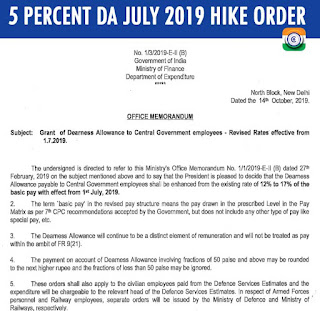
5 Percent DA July 2019 Hike Order - Grant of Dearness Allowance to Central Government employees

Grant of Dearness Allowance to Central Government employees 5 Percent DA July 2019 Hike Order  No. 1/3/2019-E- II (B) Government of...

Blog Archive

About The Author