A complete reference blog for Indian Government Employees

Showing posts with label 7th Pay Commission Latest News. Show all posts

Friday, 3 January 2020

Payment of 7th CPC Leave Salary to the Running Staff - Railway Employees NFIR

Payment of 7th CPC Leave Salary to the Running Staff - Railway Employees NFIR


NFIR

No.IV/NFIR/7th CPC (Imp)/ Allowance/2016/Part I
Dated: 27/12/2019

The Secretary(E),
Railway Board
New Delhi

Dear Sir,

Subject: Payment of Leave Salary to the Running Staff after implementation of 7th CPC recommendations-reg.

Ref: (i) NFIR’s PNM Items No. 47/2018 & 57/2016.
(ii) Railway Board’s letter No. E(P&A)II/2017/RS-22 dated 28/12/2018 (RBE No.2204/2018).
(iii) NFIR’s letter No. IV/NFIR/7th CPC (Imp)/Allowance/2016/Part II dated 12/01/2019, 18/03/2019, 28/05/2019 & 17/08/2019.

Federation invites kind attention of the Railway Board to the references cited above relating to payment of Leave Salary to the Running Staff pursuant to the implementation of the recommendations of 7th Central Pay Commission. Federation once again reiterates that though the Railway Board have issued orders vide RBE No. 204/2018 dated 28/12/2018 but, however, there is no clarity in the said orders regarding date of effect i.e. from 01/01/2016, consequently in the provision in IPAS, date of effect has been taken as 01/07/2017 and the Running Staff have been put to recurring financial loss for 18 months (from 01/01/2016 to 30/06/2017) leave salary. Though the Federation has been making efforts to persuade the Railway Board to set right the technical snag but however action to correct/up-date IPAS has no been taken yet with the result Federation continues to receive grievances from the Running Staff from Zonal Railways.

Also check: 7th CPC: Payment of leave salary to the running staff after the implementation of 7th CPC recommendations

NFIR, therefore, once again urges upon the Railway Board to kindly intervene and issue suitable instructions to all concerned to rectify/up-date the IPAS giving effect to the instructions vide RBE No. 204/2018 dated 28/12/2018 from 01/01/2016 repeat from 01/01/2016 and not from 01/07/2017.
Action taken in the matter may kindly be apprised to the Federation.

Yours faithfully
(Dr. M. Raghavaiah)
General Secretary

Share:

Monday, 14 October 2019

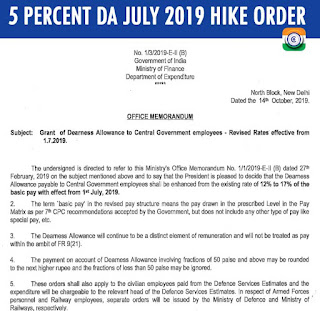
5 Percent DA July 2019 Hike Order - Grant of Dearness Allowance to Central Government employees

Grant of Dearness Allowance to Central Government employees
5 Percent DA July 2019 Hike Order 

No. 1/3/2019-E- II (B)
Government of India
Ministry of Finance
Department of Expenditure

North Block, New Delhi
Dated the 14th October, 2019.
OFFICE MEMORANDUM

Subject: Grant of Dearness Allowance to Central Government employees- Revised Rates effective from 1.7.2019.

The undersigned is directed to refer to this Ministry's Office Memorandum No, 1.11/2019-E II (B) dated 27th February, 2019 on the subject mentioned above and to say that the President is pleased to decide that the Dearness Allowance payable to Central Government employees shall be enhanced from the existing rate of 12% to 17% of the basic pay with effect from 1st July, 2019.

2. The term 'basic pay' in the revised pay structure means the pay drawn in the prescribed Level in the Pay Matrix as per 7th CPC recommendations accepted by the Government, but does not include any other type of pay like special pay, etc.

3. The Dearness Allowance will continue to be a distinct element of remuneration and will not be treated as pay within the ambit of FR 9(21).

Also check: Cabinet approves 5% additional DA/DR to Central Government employees due July, 2019

4. The payment on account of Dearness Allowance involving fractions of 50 paise and above may be rounded to the next higher rupee and the fractions of less than 50 paise may be ignored.

5. These orders shall also apply to the civilian employees paid from the Defence Services Estimates and the expenditure will be chargeable to the relevant head of the Defence Services Estimates. In respect of Armed Forces personnel and Railway employees, separate orders will be issued by the Ministry of Defence and Ministry of ( Railways, respectively.

6. In so far as the employees working in the Indian Audit and Accounts Department are concerned, these orders are issued with the concurrence of the Comptroller and Auditor General of India.

(Nirmala Dev)
Deputy Secretary to the Government of India
5-Percent-DA-July-2019-Hike-Order-CG-Employees


Download 5 Percent DA July 2019 Hike Order
Share:

Wednesday, 9 October 2019

DA Announcement before Diwali – 5% Hike in DA for Central Government Employees before Diwali

DA Announcement before Diwali – 5% Hike in DA for Central Government Employees before Diwali


DA Announcement before Diwali – 5% Hike in DA for Central Government Employees before Diwali
7th Pay Commission Latest News Today 2019 – 5% Hike in DA for Central Government employees and pensioners before Diwali

DA Announcement before Diwali

More than one crore Central Government employees and pensioners are looking for DA announcement from the month of September. The Central Government has not taken any decision on DA yet. We hope that the announcement of 5% increase in DA additionally from July 2019 will be declared before the grand festival of Diwali.

Also read: 7th CPC DA Hike will announce today for central government employees and pensioners


17% of 7th CPC Matrix Pay


At present, all Central government employees are getting 12% Dearness allowance of their matrix pay and if Govt declare 5% hike in DA, the total DA will become 17%. For example, if an employee gets Rs. 49000 matrix basic pay, he will get enhanced DA will be Rs. 8330 per month (Rs. 5880 + Rs. 2450 = Rs. 8330).

First Time 5% DA

After implementation of 7th Pay Commission, this is the first time 5% increase in DA

Also check: 5% DA increase from July 2019 confirmed for Central Government Employees. 12% becomes 17% due to high inflation


M/YEnhanced DADA %
Jul-162%2%
Jan-172%4%
Jul-171%5%
Jan-182%7%
Jul-182%9%
Jan-193%12%

Share:

Saturday, 5 October 2019

Central government employees bonus news – Calculation ceiling for payment of ad-hoc Bonus

Central government employees bonus news – Calculation ceiling for payment of ad-hoc Bonus

Central government employees bonus news – Calculation ceiling for payment of ad-hoc Bonus


Bonus Amount for Central Government Employees – 7th Pay Commission Latest News 2019
Bonus Amount for Central Government Employees


Calculation ceiling for payment of ad-hoc Bonus shall be monthly emoluments of Rs.7000 for Central Government employees.

Non-PLB (Ad-hoc Bonus) for thirty days would work out to Rs. 7000 × 30 / 30.4 = Rs.6907.89 (rounded off to Rs.6908/-).

Bonus Order: Non-Productivity Linked Bonus (Ad-hoc Bonus) granted to Central Government Employees for the year 2018-19

Bonus Amount for Railway Employees

Calculation ceiling for payment of Productivity Linked Bonus shall be monthly emoluments of Rs.7000 for Railway employees.

PLB 78 Days – Bonus amount Rs. 17,951

Railway Bonus Order: Payment of PLB to railway employees for the FY 2018-19

Bonus Amount for Casual Labour
Casual labour who have worked in offices following a 6 day week for at least 240 days for each year for 3 years or more (206 days in each year for 3 years or more in the case of offices observing 5 day week), will be eligible for this Non-PLB (Ad-hoc Bonus) Payment.

The amount of Non-PLB (ad-hoc bonus) payable will be (Rs.1200×30/30.4 i.e.Rs.1184.21 (rounded off to Rs.1184/-).
Share:

Tuesday, 23 July 2019

Grant of Dress allowance to eligible Railway Officers, PBOR of RPF, Station Masters and Others

Grant of Dress allowance to eligible Railway Officers, PBOR of RPF, Station Masters and Others

As per the orders issued by the Railway Board, Dress Allowance to the personnel previously being granted Uniforms and certain associated allowances like Uniform Allowance, Washing Allowance, Shoe Allowance, Kit Maintenance Allowance etc., to certain categories of employees working in Indian Railways.


S.No.Category of employeeRate (in Rs.)
1Officers of RPF/ RPSF20,000/-per annum
2Personnel Below Officer Rank of RPF, Station masters of Indian Railways10,000/- per annum
3Other categories of staff who were supplied Uniforms and are required to wear them regularly like trackmen, Running Staff of Indian Railways, Staff Car Drivers, MTS, Canteen staff of Non-Statutory departmental Canteens, etc.5,000/- per annum
4Nurses1800/- per month

Eligibility criteria to receive Dress Allowance as recommended by 7th Pay Commission:

The personnel of the said category should be required to wear a specific uniform daily (excluding any special clothing) as a part of their duty as specified by the Dress Regulations of Ministry of Railways.

The personnel of the said category should have had been receiving uniform material and associated Allowances like Uniform Allowance, Washing Allowance, Kit Maintenance Allowance, Shoe Allowance etc. prior to 1st July, 2017 i.e. date of admissibility of Dress Allowance.

The personnel of the said category should have ceased to be granted the uniform materials and associated allowances w.e.f. the date of issue of RBE 141/2017.
Share:

Tuesday, 31 January 2017

7th Pay Commission implementation to State Government Employees - Minister's reply in the Parliament


7th Pay Commission implementation to State Government Employees - Minister's reply in the Parliament

7th Pay Commission implementation - State Government employees are not covered within the terms of reference of the 7th central Pay Commission - Minister's reply in the Parliament

Smt.Nirmala Sitharaman in a written reply to a Member states that State Government employees are not covered within the terms of reference of the 7th central Pay Commission

While answering to a question in Parliament on 12th August 2014 regarding the employees working in State Government, Ministry of State for Finance Smt.Nirmala Sitharaman said that the State Government employees are not covered within the terms of reference of the 7th central Pay Commission.

She replied in written form to a question asked by a member that service conditions of State Government employees fall within the exclusive domain of respective State Governments. Therefore, State Government employees are not covered within the terms of reference of the 7th central Pay Commission.

Thus, the recommendations of Commission will not directly apply to State Government employees. Accordingly, it is not possible for the Central Government to indicate the financial burden on State Governments, if they decide to adopt the recommendation of the 7th Central Pay Commission in respect of their employees with or without modification.

She also added, the Central Government had sought the views of the State Governments and till the date of the constitution of the 7th Central Pay Commission on 28.2.2014, only 14 States had responded. These State Governments generally mentioned, inter-alia, that adoption of the recommendations of a Central Pay Commission by them in case of State Government employees adds to substantial financial burden
Since the decision to adopt the recommendations of the 7th Central Pay Commission in case of the State Government employees will exclusively concern respective State Government, the question of any assistance by the Central Government will not arise. However, the Terms of Reference of the 7th Central Pay Commission provide, inter-alia, that while making its recommendations, the Commission will also keep in view the likely impact of the recommendations on the finances of the State Governments, which usually adopt the recommendations with some modifications.
Share:

Monday, 16 January 2017

7th Pay Commission recommendations on CGHS - Govt orders will be effective from 1st February 2017 - Ministry of Health issues modification OM


7th Pay Commission recommendations on CGHS - Govt orders will be effective from 1st February 2017 - Ministry of Health issues modification OM

No. S.11011/11/2016- CGHS (P)/EHS
Government of India
Ministry of Health and Family Welfare
EHS Section
Nirman Bhawan, New Delhi
Dated the 13th January, 2017
OFFICE MEMORANDUM

Sub: Revision of rates of subscription under Central Government Health Scheme due to revision of pay and allowances of Central Government employees and revision of pension/ family pension on account of implementation of recommendations of the Seventh Central Pay Commission.

In partial modification to this Ministry's OM of even No. dated 9th January, 2017 on the subject mentioned above, the undersigned is directed to say that the revised rates will be effective from 1st February 2017 instead of 1st January, 2017.

2. Other contents of the above said OM will remain unchanged.
(Sunil Kumar Gupta)
Under Secretary to the Government of india

Download Office Memorandum No. S .11011/11/2016- CGHS (P)/EHS dated 13.01.2017 issued by Ministry of Health and Family Welfare
Share:

Saturday, 7 January 2017

7th CPC Pay Matrix level to the RRB empanelled candidates


7th CPC Pay Matrix level to the RRB empanelled candidates

Grant of pay fixation under 7th CPC Pay Matrix level to the RRB empanelled candidates who have completed training - case of SSEs (S&T)-reg

NFIR
National Federation of Indian Railwaymen
3, Chemlmsford Road, New Delhi - 110 055

No. IV/NFIR/7 CPC (Imp)/2016/R.B.
Dated: 28/12/2016
The Secretary (E),
Railway Board,
New Delhi

Dear Sir,
Sub: Grant of pay fixation under 7th CPC Pay Matrix level to the RRB empanelled candidates who have completed training - case of SSEs (S&T)-reg.

Representations have since been received that RRB empanelled candidates for the post of SSE (S&T) have completed the prescribed induction training on 1st June 2016 particularly on North Central Railway, but however, they have not been granted pay fixation in 7th CPC Pay Matrix till date. It has further been represented by the recruitees that similarly recruited candidaies as SSE, P. Way, C&W etc., have already been granted pay fixation 7th CPC Pay Matrix. The discrimination against directly recruited SSEs (S&T) has been causing disappointment and resentment among them, who feel that the Administration has been indifferent towards their entitlements of 7th CPC Pay Matrix.

NFIR, therefore, requests the Railway Board to kindly intervene and issue suitable instructions to the GMs of Zonal Railways (more particularly General Manager, N.C. Railway) for ensuring that all such SSE (S&T) trainees who have completed training are granted 7th CPC pay from the date subsequent to the date of completion of training without loss of time.
Yours faithfully
(Dr. M. Raghavaiah)
General Secretary
Source : NFIR
Share:

Sunday, 25 December 2016

Revision of Pension and grant of DR to the pensioners of Autonomous Bodies


Revision of Pension and grant of DR to the pensioners of Autonomous Bodies

CONFEDERATION OF CENTRAL GOVT. EMPLOYEES & WORKERS
1st Floor, North Avenue PO Building, New Delhi- 110001

Ref: Confdn/Pen/2016-19
Dated - 19.12.2016
To
The Secretary
Department of Pension & Pensioners Welfare
Government of India
Sardar Patel Bhawan,
New Delhi - 110001

Sub :- Revision of Pension and grant of Dearness Relief to the pensioners of Statutory/Autonomous Bodies.

The Government of India - vide the resolution dated 4th August 2016, accepted the recommendations of the 7th Central Pay Commission on pensionery benefits and have granted the benefits of revised pension with retrospective effect from 01.01.2016 to all the Central Government Pensioners.
Accordingly, in terms of OM dated 04.08.2016, Central Government pensioners have been paid arrears of pension due to them on 31.08.2016 along with their revised pension for the month of August 2016. Recently they have been granted the Dearness Relief with effect from 01.07.2016. Similarly, the employees of Autonomous Bodies have been granted Dearness Allowance with effect from 01.07.2016 based on the orders issued by the Finance Ministry.

It has been brought to our notice by the pensioners/family pensioners of Statutory/Autonomous Bodies that they have neither been granted revised pension in terms of 7th CPC orders contained in OM dated 04.08.2016 nor the Dearness Relief, though the Central Government pensioners have already got their revised pension and dearness relief. We wish to bring to your kind information that, hither to, pensioners/family pensioners of Statutory/Autonomous Bodies were getting revised pension as per the CPCs recommendations, as and when accepted by the Government, and Dearness Relief, as and when sanctioned, simultaneously along with the Central Government pensioners. This time, unfortunately, both these revised pension, in term of 7th CPC orders, and Dearness Relief have not been sanctioned to the pensioners of autonomous/statutory bodies. We fail to understand why such discrimination is meted out in respect of pensioners of Autonomous/Statutory Bodies.

We also wish to bring to your kind information that, immediately on issue of orders by the Finance Ministry granting Dearness Allowance to the staff of Central Government/Autonomous Bodies, the Department of pension was issuing orders granting Dearness Relief to pensioners of Central Government and Autonomous Bodes. While the DOPT has already issued the orders granting Dearness Relief to the pensioners of Central Government w.e.f. 01.07.2016, similar orders have not been issued in respect of pensioners of Autonomous/Statutory Bodes.

While the pensioners/family pensioners of Statutory/Autonomous Bodes, most of whom are in the evening of their lives yearning for betterment of their finances for a peaceful retired life, have been disappointed/frustrated, on the one hand, by the inordinate delay in the extension of 7th CPC orders to them, they have been further disappointed by the Government in not granting the Dearness Relief due to them with effect from 01.07.2016.

We, therefore, request you to issue the orders granting the 7th CPC benefits as also Dearness Relief due to the pensioners of Autonomous/Statutory Bodies, without any further delay, thereby facilitating the pensioners to lead their retired life, peacefully.

Thanking you,
Yours faithfully,
(M. Krishnan)
Secretary General
Confederation
Source : Conferderation
Share:

Tuesday, 20 December 2016

7th Pay Commission benefits to autonomous bodies and Contract Employees - Government reply

7th Pay Commission benefits to autonomous bodies and Contract Employees - Government reply

Minister's reply to Loksabha on 7th Pay Commission benefits to autonomous bodies and Contract Employees

Loksabha has published Shri Arjun Ram Meghwal reply regarding 7th Pay Commission benefits to autonomous bodies and Contract Employees.

GOVERNMENT OF INDIA
MINISTRY OF FINANCE
LOK SABHA
UNSTARRED QUESTION NO: 4128
ANSWERED ON: 09.12.2016
R.P. MARUTHARAJAA
JANARDAN SINGH SIGRIWAL
LALLU SINGH

Will the Minister of FINANCE be pleased to state:-

(a) whether the Government proposes to implement the recommendations of the Seventh Central Pay Commission(CPC) also for the employees of the autonomous bodies including the Council of Advancement of Peoples Action and Rural Technology(CAPART) and the employees working on contract basis under Central Government;

(b) if so, the details thereof and if not, the reasons therefor; and

(c) the details of the amount paid to the employees after implementing the recommendations of the Commission?

ANSWER

MINISTER OF STATE FOR FINANCE
(SHRI ARJUN RAM MEGHWAL)

(a) to (c): An appropriate decision in regard to extension of the recommendations of the 7th Central Pay Commission pertaining to pay matters, as already accepted and notified by the Central Government in respect of Central Government employees, in regard to employees of the Quasi-Government Organizations, Autonomous Organizations and Statutory Bodies, etc set up and funded/controlled by the Central Government, would be taken having regard to all relevant factors. However, there is no proposal at present under consideration to extend revised pay based on the 7th Central Pay Commission, as accepted by the Government in case of regular Central Government employees, in regard to contract employees.

Source : Loksabha
Share:

Tuesday, 6 December 2016

7th Pay Commission Pension revision – Interpretation of Proposed Option 3

7th Pay Commission Pension revision – Interpretation of Proposed Option 3

7th Pay Commission Pension revision – Interpretation of Proposed Option 3 by RSCWS for revised Pension as per 7th CPC recommendations as an alternate to Option 1 recommended by 7th Pay Commission

INTERPRETATION OF PROPOSED OPTION 3 FOR REVISED PENSION HOW FAR IS IT AN ALTERNATIVE TO OPTION 1 RECOMMENDED BY 7Tth CPC? By N. P. MOHAN, President, RSCWS

 The most significant recommendation of 7th CPC is to bring parity between past pensioners with those retiring after 1-1-2016 (Para 10.1.67). A long standing demand of the pensioners, who have been the victim of Modified Parity in the last two decades from 1-1-1996 (5th CPC), has been addressed by the Commission The parity is sought to be achieved by the recommendation of Option 1 for revised pension which provides for consideration of increments earned in the last Level by a pensioner while in service. Recognizing the delay in checking record for ascertaining the increments for implementation of this option, revised pension in the interim phase was recommended to be fixed by multiplying the pension fixed after 6th CPC by MF of 2.57 (Option 2). This option has already been implemented.

While accepting the above recommendations, Govt. had constituted a 5 member Committee under the chairmanship of Secretary (Pension) to examine the feasibility of implementation of Option 1. The Committee in its meeting with JCM on 6th October has suggested an alternative option (Option 3) to overcome the difficulty of tracing record in some cases. It has been indicated in Para 5 of the minutes of the meeting “that the Committee has found that the alternative method of arriving at notional pay in Seventh CPC by applying formula for pay revision for serving employees in each Pay Commission and giving 50% of this as pension to be beneficial to all pensioners in comparison to the fitment method.”

Dispensation of revised pension under alternative Option 3 will depend on the decision of the Govt on the recommendations of this Committee. The impact of Option 3 as understood from the proposal of the Committee mentioned in above is reflected in the 3 tables indicating the revised pension.


EXAMPLE OF REVISED PENSION UNDER OPTIONS 1 & 2 of 7th CPC & OPTION 3 BASED ON NOTIONAL PAY IN SUCCESSIVE PAY COMMISSIONS

  (As proposed in Para 5 of the minutes of the meeting of Feasibility Committee held with JCM on 6-10-2016)

FOR PENSIONERS RETIRING IN 5TH CPC REGIME (1.1.1996 TO 31-12-2005) FROM SCALE S 13 (7450-11500)-LEVEL 7 Average Pay on retirement Pension after 5th CPC (Higher of Mod. Parity or with factor of 2.26) – whichever is higher Notional pay-6th CPC (As per Fitment table-6th CPC) Notional pay-7th CPC with MF OF 2.57-3rd option (col.2xMF) Pay in the next cell of 7th CPC Pay Matrix- 3rd Option Pay based on option 1 with no. 0f increments (7th CPC pay matrix- (7th CPC pay matrix- Level 7)Revised Pension as per Option 3 (col.4/2) Revised Pension as per Option 1 (col.5/2) Revised Interim Pension as per Option 2 of 7th CPC (Col.2×2.57)

1
2
3 18460
4
5
6 44900
7
8
9
7450 9230 47442 47600 23800 22450 23721
7675 9230 18880 48522 49000 46200 24500 23100 23721
7900 9230 19300 49601 50500 47600 25250 23800 23721
8125 9230 19720 50680 52000 49000 26000 24500 23721
8350 9436 20144 51770 52000 50500 26000 25250 24249
8575 9690 20550 52814 53600 52000 26800 26000 24903
8800 9944 20970 53893 55200 53600 27600 26800 25556
9025 10198 21390 54972 55200 55200 27600 27600 26210
9250 10453 21810 56052 56900 56900 28450 28450 26863
9475 10707 22230 57131 58600 58600 29300 29300 27516
9700 10961 22650 58211 58600 60400 29300 30200 28170
9925 11215 23070 59290 60400 62200 30200 31100 28823
10150 11470 23480 60344 60400 64100 30200 32050 29477
10375 11724 23900 61423 62200 66000 31100 33000 30130
10600 11978 24320 62502 64100 68000 32050 34000 30783
10825 12232 24740 63582 64100 70000 32050 35000 31437
11050 12487 25160 64661 66000 72100 33000 36050 32090
11275 12741 25580 65741 66000 74300 33000 37150 32744
11500 12995 25990 66794 68000 76500 34000 38250 33397

NOTES:- 1. This table is illustrative under option 3 which is as per understanding of the proposal indicated by the Feasibility Committee based on Notional pay fixation in successive Pay Commissions.

 2. Actual fixation of revised pension will depend on Govt’s decision in the matter. 3. The figures of revised pension under Option 1 (Col. 8) are for each stage of increment. Compiled by: N. P. Mohan, President, RSCWS
Source : RSCWS
Share:

Wednesday, 2 November 2016

7th Pay Commission Latest News: No 'Achhe Din' for govt employees, no hike in basic pay, fatter allowances likely

7th Pay Commission Latest News: No 'Achhe Din' for govt employees, no hike in basic pay, fatter allowances likely

It simply means, the National Anomaly Committee or Committee on Allowances won't suggest or approve any changes in the basic pay or allowance against the recommendations of the 7th Pay Commission.

The ‘Committee on Allowances’, headed by Finance Secretary Ashok Lavasa, is yet to submit its report on fatter allowances recommended by the 7th Pay Commission, however the Finance Ministry sources said the government won’t consider any change in 7th Pay Commission recommendations. Sources confirmed that there will be no changes in basic pay and allowances recommended by the 7th Pay Commission. It simply means, the National Anomaly Committee or Committee on Allowances won’t suggest or approve any changes in the basic pay or allowance against the recommendations of the 7th Pay Commission.

Sources in the Finance Ministry have made it clear that the National Anomaly Committee on behalf of the government won’t consider any hike in basic pay and fatter allowances recommended by the 7th Pay Commission. The latest development contradicts with what Union Finance Minister Arun Jaitley had promised. Those who will hope over these issues will gain nothing but no change on 7th Pay Commission recommendations of pay scales and allowances are very much possible, said sources.

Finance Minister Arun Jaitley had promised the government would consider the demand of an increase in basic pay and allowances of the central government employees. The government had said it will form a High Level Committee to review the new pa scales. However no such committee has been formed till date. Instead, the government formed a 22-member National Anomaly Committee headed by Secretary, Department of Personnel and Training (DoPT) to look into various pay related anomalies arising out of the implementation of the 7th Pay Commission’s recommendations.

Sources said the government has decided to stick to the recommendations of the 7th Pay Commission on basic pay and allowances. They also confirmed that the ‘Committee on Allowances’ won’t suggest any hike and is likely to stick with the recommendations of the 7th Pay Commission. The 7th Pay Commission notification confirmed that central government employees will get 14.27 per cent hike in basic pay at junior levels, which is the lowest in 70 years. The Cabinet also approved the increase in minimum pay Rs 18,000 from existing Rs 7,000. The 7th pay commission had recommended abolition of 51 allowances and subsuming 37 others out of 196 allowances.

Source: india.com
Share:

Wednesday, 12 October 2016

7th Pay commission Allowances meeting postponed to 25th October 2016


7th Pay commission Allowances meeting postponed to 25th October 2016

Shri. M.Krishnan,Secretary General, Confederation of central Government Employees and Workers, has informed in his blog that the Government has Postponed the Meeting of Allowance Committee meeting from 13-10-2016 to 25-10-2016. The message posted in official website of Confederation of Central Government Employees and workers is as follows

7th Pay commission Allowances


7th PAY COMMISSION ALLOWANCE COMMITTEE MEETING & JCM NATIONAL COUNCIL STANDING COMMITTEE MEETINGS POSTPONED TO 25th OCTOBER 2016

GOVERNMENT INFORMED THAT MEETINGS OF THE ALLOWANCE COMMITTEE AND JCM NATIONAL COUNCIL STANDING COMMITTEE SCHEDULED TO BE HELD ON 13TH OCTOBER 2016 STANDS POSTPONED TO 25th OCTOBER 2016


M.Krishnan
Secretary General
Confederation
Mob: 09447068125
Email: mkrishnan6854@gmail.com
Source: Confederation
Share:

Tuesday, 30 August 2016

7th Pay Commission Latest News – Three important demands of NJCA


7th Pay Commission Latest News – Three important demands of NJCA which are likely to be discussed in the 7th CPC Meeting to be held on 1st September 2016

To discuss the anomalies related to the implementation of 7th Pay Commission, the high-powered Committee of Secretaries formed by Centre has invited leading employee union National Joint Council of Action (NJCA) for a meeting on September 1.

NJCA would be represented at the meet by it’s current convenor Shiv Gopal Mishra. Aggrieved Central Government employees pin their final hope in the outcome of the Sept 1 meeting. If the Government constituted body fails to incorporate their demand, a large section of the organized workforce would call a strike.

Although, it has not been revealed whether the Committee of Secretaries would attempt to negotiate the demands at the upcoming meet, it has been assured that grievances of the employees, as raised by the Unions, would be noted down in a detailed manner by the Secretaries. Representing NJCA, Shiv Gopal Mishra is expected to show an uncompromising stand on at least the following three demands: 1) Hike in Fixed Medical Allowance (FMA),  2) Revision in the hike of minimum salary, 3) Availability of ‘Option 1′ for pensioners.

Hike in Fixed Medical Allowance (FMA): 

Central Government employees had demanded the 7th Pay panel led by Justice (retd) AK Mathur to raise FMA from current Rs 500 per month to Rs 2,000 per month. The demand appears legit to the employee unions as even many of the private sector companies are paying Rs 1200 to Rs 1800 per month as medical allowance to lower-middle level employees.

Revision of hike in minimum salary: 

NJCA, along with other employee unions have raised the demand to restructure the hike in minimum salary using 3.68 fitment factor. The entry-level pay as per 6th Pay Commission was Rs 7,000. The AK Mathur-led panel increased the minimum salary by multiplying with 2.57 fitment factor. This increased the salary to Rs 18,000. If the 3.68 fitment factor would be used, the minimum salary would be restructured to Rs 26,000.

Availability of ‘Option 1′: 


The All India Postal & RMS Pensioners Association (AIPRPA) has demanded the Government to enable Option 1 for hiking their pensions. According to Option 1, the hiked pensions would be fixed in the pay matrix on basis of the grade and and pay band in which they were enrolled at the time of retirement. According to the second option, the pay panel has recommended the pension hike by using 2.57 fitment factor. The second option would multiply their existing pensions by 2.57.

Despite Shiv Gopal Mishra appearing as the leading voice among those who are articulating the cause of aggrieved employees, a number of central government employees have raised doubts against him. His decision to roll back the July 11 mass strike, which was expected to evoke the participation of 33 lakh central government employees, has not gone down well with those among the dissidents. Several employees have straightaway asserted that if the government fails to pay heed to at least the above three demands, a rejuvenated call for strike should be made.

Source: India.com
Share:

Saturday, 27 August 2016

7th Pay commission latest news – Group A cadre restructure to be reviewed – Govt forms task force headed by additional secretary of DOPT


7th Pay commission latest news – Group A cadre restructure to be reviewed – Govt forms task force headed by additional secretary of DOPT

The 7th Pay Commission report is still grabbing headlines as the various permutations and combinations are still being bandied about and discussed threadbare and now it spans a big controversy that has to do with the near monopoly currently enjoyed by the IAS and how to end it, once and for all.

Moving forward, as per the requirement of the report, the Narendra Modi government has set up a task force to review the cadre structure of all Organised Group A Central Services.

This controversy has acquired increased urgency after the turf war between the officers of the Indian administrative and revenue services (IAS and IRS) recently reached a flashpoint after several IRS officers huddled together in Mumbai last month bringing matters to a head and this set alarm bells ringing at the highest echelons of the government.

The 7th Pay Commission task force will be headed by Department of Personnel and Training additional secretary T Jacob and he will submit the report in 3 months. What he will have on his hands will deal with 4 basic factors that include 1) the ideal structure for posts of joint secretary and above, 2) percentage of reserves in organised Group A services, 3) ideal recruitment policy and 4) way forward in mitigating stagnation level.

There are 49 Organised Group A Services ranging from the IFS, the Indian Postal Service, the five Accounts services and Indian Revenue Service (IT) to the 13 engineering services under the railways, CPWD, telecom, power, water and defence forces.

This move comes courtesy 7th Pay Commission panel chairman, Justice (retired) A K Mathur calling for an end to the dominance of IAS officials. However, there were divergent views in the panel on ending the IAS superiority.

Under the scanner especially was the joint secretary-and-above-level positions in the central staff. The 7th Pay Commission threw up the data: out of a total of 91 secretary level posts, 73 (80%) were occupied by IAS; out of 107 additional secretary level posts, 98 (92%) were with the IAS and of 391 joint secretary level posts, 249 (64%) were with the IAS.

The 7th Pay Commission said IAS officers get two extra increments at promotion stages and it wanted to extend the same to the IPS and the Indian Forest Service. Other all-India services and central services (Group A) are not getting proper representation either. The IAS officers always had a two-year edge compared to other services

The solution that the 7th Pay Commission panel unveiled said that all personnel who have put in 17 years of service should be given equal opportunity for central staff. The panel was overwhelmed by the reactions of Group A Services, who demanded that the services should have equal opportunities to man the senior-most posts and it should not be the preserve of a small group.

(PTI)

Source: The Financial Express
Share:

Tuesday, 16 August 2016

7th Pay Commission latest news: Gratuity limit increased to Rs 20 lakh from Rs 10 lakh

7th Pay Commission latest news: Gratuity limit increased to Rs 20 lakh from Rs 10 lakh

gratiuty-7th-pay-commission


The Central Government has unanimously increased the gratuity limit of more than 47 lakh employees to Rs 20 lakh from Rs 10 lakh. This news brings a smile on Central Government employees as they will get more money for their retirement and will also help them to shape their future plan in a much organised way. Under the 7th Pay Commission, IAS officers to peons all will get enhanced salaries with arrears on September 1. The Narendra Modi government has not yet decided to increase salaries of 14 lakh strong armed forces.

The implementation of 7th Pay Commission is a burden of Rs 1.02 lakh crore on Indian exchequer. Experts believe that Indian economy has been showing “bright” near-term prospects, but reducing fiscal deficit to 3.5% of GDP in 2016-17 is a challenge because of additional liabilities on account of pay revision.

After the Central Government employees union had threatened to carry out an indefinite strike, Centre had set up a high-level committee, comprising of Health, Defence and Home Secretaries. The committee will also look into the demands made by National Joint Action Committee (NJAC) which wants the minimum salary to be scaled up to Rs 26,000, rather than Rs 18,000, which has been currently proposed.

On June 29, the 7th Pay Commission recommendations were accepted by Union Cabinet. Although the basic salary was hiked by 14.3 per cent, the hike in allowances was withheld due to the various anomalies.
Meanwhile, reports suggest that the government employees would also be paid arrears in one-time installment through their salaries in the upcoming months.

Source : India.com
Share:

Thursday, 21 July 2016

7th Pay Commission Multiplication Factor – Govt has no proposal to increase multiplication factor to 3 – Minister replies in Rajya Sabha on question relating to 7th CPC

7th Pay Commission Multiplication Factor – Govt has no proposal to increase multiplication factor to 3 – Minister replies in Rajya Sabha on question relating to 7th CPC

We all know that Central Government has promised to form a Committee to consider the increase in minimum pay and fitment formula (multiplication factor) for fixation of 7th cpc pay for existing central government employees based on which indefinite strike action proposed on 11th July 2016 was postponed.
Now, Shri. Arun Jaitli, Finance Minister has replied to a Parliament Query on the implementation of 7th Pay Commission recommendations to the effect that In view of the multiplication factor having been accepted based on the recommendations of the 7th Central Pay commission, no proposal to apply 7th Pay commission multiplication factor of at least 3, is under consideration of the Government.

GOVERNMENT OF INDIA
MINISTRY OF FINANCE
RAJYA SABHA
QUESTION NO 28
ANSWERED ON 19.07.2016

7th Central Pay Commission recommendations
Shri Neeraj Shekhar

Will the Minister of FINANCE be pleased to satate :-

(a) whether Government has implemented the 7th Central Pay Commission recommendations;

(b) if so, the details thereof along with the date of notification thereof;

(c) whether increase in pay of Central Government Officials is historically low under 7th CPC; if so, the reasons thereof;

(d) whether employees unions/trade unions have announced to go on indefinite strike against the historically low revision of salaries by Government, if so, the response of Government thereto; and

(e) whether uniform multiplication factor of at least 3 is proposed to be applied for revision of pay under 7th CPC; if not, the reasons therefor?

ANSWER
THE FINANCE MINISTER
(SHRI ARUN JAITLEY)

A statement is being laid on the Table of the House
Statement Annexed with the Rajya Sabha Starred Question No. 28 for 19.07.2016 by Shri Neeraj Shekhar on 7th Central Pay Commission Recommendations

(a) & (b): The Government has decided to implement the recommendations of the 7th Central Pay Commission relating to pay, pension and related issues. The requisite notifications are being issued shortly.

(c) The increase in pay as recommended by the 7th Central Pay commission is based on the detailed deliberations by the Commission keeping in view all relevant factors having a bearing upon the prevailing circumstances.

(d) Employee Associations of Central Government had given a call for strike with effect from 11.07.2016 which has since been deferred. However, the Government is responsive to the concerns of the Employees’ Association and it would be the endeavour of the Government to ensure that the eventuality of a strike does not arise.

e) In view of the multiplication factor having been accepted based on the recommendations of the 7th Central Pay commission, no such proposal is under consideration of the Government, at present.

Source: Rajyasabha.nic.in
Share:

Monday, 18 July 2016

7th CPC latest news: From August 1 Central Government employees will get 14.27% hike in basic pay, not overall 23.5%

7th CPC latest news: From August 1 Central Government employees will get 14.27% hike in basic pay, not overall 23.5%
 
The Central Government are also considering the demand made by employees union leaders to increase minimum wage from Rs 18,000 to Rs 26,000.

New Delhi, July 17: The much awaited hiked salary of Central Government employees will be credited to their official salary account bu August 1, 2016, as the recommendations made by 7th Pay Commission was approved on June 29 by Narendra Modi government. More than 47 lakh Central Government employees eagerly waiting for the hike will get 14.27 per cent hike in the basic pay and not 23.5 per cent. The hike in allowance has been delayed by at least four months. For which the government has formed a high level committee headed by Finance Minister Ashok Lavasa to re-examine the hike in HRA, NP, DA and many other allowances for the employees.

As per reports, the salaries government employees would receive from August 1, would be hiked by 14.27 per cent, without any allowances. Which technically makes it a lowest ever salary hike implemented by any Pay Commission since independence. On June 29, Central government had set up a high level committee to examine the anomalies in the 7CPC recommendations related to allowances. The committee will also consider the demand made by Central Government Employees Union leaders to increase minimum wage from Rs 18,000 to Rs 26,000.

The implementations of 7CPC which was done almost six months after Justice A K Mathur and his team submitted its findings and it will positively impact a total of 47 lakh central government employees, along with 53 lakh pensioners. The notification of the salary hike will be issued by the government by the end of this week.

Source: India.com
Share:

Thursday, 14 July 2016

7th Pay Commission allowances – Common allowances to be examined separately

7th Pay Commission allowances – Common allowances to be examined separately

Govt has formed a committee to examine the recommendations of 7th Pay Commission relating to all 196 allowances. Here is an analysis on why Common allowances should not be clubbed with other allowances

7th Pay Commission Allowances – Clubbing of examination of Common Allowances such as House Rent Allowance, Dearness Allowance, Children Education Allowance, Transport Allowance etc with lesser known and paid to few only allowances would cause more delay

7th Pay Commission Allowances – It may be recalled that 7th Pay Commission abolished as many as 51 allowances after examining 196 existing Allowances and also subsumed 37 Allowances.

As a result of such major change in 7th Pay Commission Allowances, Cabinet has decided that recommendations in respect of all the allowances are to be examined by a Committee headed by Finance Secretary.

What are those 196 allowances ?

Now, let us have a look at the a summary of recommendations in respect of all 196 allowances which have been taken for examination by 7th Pay Commission.

It could be seen that excepting certain common allowances that are granted to all Central Government Employees such as Dearness Allowance, House Rent Allowances, Transport Allowance, Children Education Allowance, Tour Travelling Allowance, etc, many of the allowances are payable only to very few employees on the basis of nature of work, qualification, risk involved, place of work etc.

So, those common allowances could be examined separately without causing delay in revision and payment of these allowances.

It is of the opinion all benefiting employees out of implementation of 7th Pay Commission that clubbing these common allowances with other cadre specific allowances, examination of which involve considerable technical study. Hence it would result in more delay in taking decision on Common allowances as well by Govt.

Ultimately, it would result in considerable monetory loss to Central Government Employees as revision in allowances are paid on prospective basis only.

In fact, 7th Pay Commission itself has categorised these 196 allowances under 15 categories.

Sl
No.
Category No. of
Allowances
1 Allowances payable for Additional/Extra Duty 14
2 Allowances related to Knowledge Updates 3
4 Allowances related to Working on Holidays 3
5 Allowances related to Housing 7
6 Allowances related to Good Service 4
8 Allowances related to Risk and Hardship 51
9 Allowances for Running Staff of Indian Railways 13
10 Allowances related to Sports 2
11 Sumptuary Allowances 5
12 Allowances related to Training 2
13 Allowances related to Travel 13
14 Allowances related to Uniform 9
15 Other Allowances 52

Total: 196

It is found that all the common allowances viz., Dearness Allowance, House Rent Allowance, Transport Allowance, Tour Travelling Allowance and Children Education Allowance, fall under 3 categories only out of 15 categories of Allowances discussed in detail by 7th Pay Commission.

Those categories are
1. Allowances related to Housing,
2. Allowances related to Travel and
3. Other Allowances
Even if allowances under these 3 categories are given priority in examination, all the main allowances could be examined by the Committee formed by the Govt well in prior, so that there will not be more delay for revision of Common Allowances.

We hope all Staff Unions and associations would take this aspect in to consideration to get the revision of common allowances as early as possible.
Share:

7th Pay Commission: Key things you should avoid doing with the additional money

7th Pay Commission: Key things you should avoid doing with the additional money

New Delhi: Very soon fresh hike in salaries will be visible due to implementation of recommendations made by the 7th Pay Commission to the government. However, it’s highly recommended that the additional money you receive is invested wisely. You should not indulge in impulsive purchases and ensure the money is used to meet your long-term financial goals. So, the money should be utilized judiciously.

Here are key things you should avoid doing with the additional money:


1) Don’t purchase additional vehicle, house
It’s advisable that you must not go for a fresh purchase of vehicle when the current one is already serving your purpose and you have other important financial goals to meet. Value of vehicle only depreciates with time and hence, doesn’t qualify as a very good choice.

What for are you purchasing a new house, if you already have a good enough residential area to live in? In case you are planning to rent a house, idea is not bad, but not best even. If you are a wise man, you will always go for a loan in addition to an amount you already have so as to observe tax benefits. However, on rough calculation, rent will only provide you yield of 2 percent against the loan cost of about 10 percent in addition to the processing fees. Also, there is no guarantee, the area that you want to rent finds a tenant as soon as you want. Same is true in the case you wan to sell the apartment considering weak realty market.

2) No need for additional foreign holiday
No logic justifies spend on additional foreign holiday in place of important financial investments. Although, you can avail tax relief on vacations in India, twice in four years, it’s not a good idea by any means.

3) Avoid unnecessary shopping
This is the common ailment that almost every Indian suffers from. When on shopping spree, we generally forget, when to start and where to stop.

4) Be judicious in gold purchase
Financial advisors always advise to only buy gold as safe haven. If you have better investment options in front of you such as tax-free bonds, ETFs and mutual funds, avoid purchase of the bullion as the returns are much less here.

5) No need for prepayment of home loans
It’s always advised that you should not prepay home loan since it provides tax benefits that actually make the loan cheap. You better pay your outstanding loans in form of credit card balances and others.
Share:

Featured post

5 Percent DA July 2019 Hike Order - Grant of Dearness Allowance to Central Government employees

Grant of Dearness Allowance to Central Government employees 5 Percent DA July 2019 Hike Order  No. 1/3/2019-E- II (B) Government of...

Blog Archive

About The Author