A complete reference blog for Indian Government Employees

Showing posts with label SUPREME COURT ORDER. Show all posts

Friday, 11 September 2020

VRS from Persons With Disabilities – Supreme Court – Latest DoPT Order


Latest DoPT Orders 2020


VRS from Persons With Disabilities - Supreme Court - Latest DoPT Order

No. 25012/I/2015-Estt.A-IV
Government of India
Ministry of Personnel, Public Grievances and Pensions
Department of Personnel and Training
Establishment A-IV Desk
North Block, New Delhi-110 001
Dated: September 7, 2020
OFFICE MEMORANDUM
Subject:- Request received for Voluntary retirement from service (VRS) from Persons With Disabilities – Supreme Court Order in Bhagwan Dass & Anr Vs Punjab State Electricity Board, (2008) 1 SCC 579 – clarification reg.
The undersigned is directed to refer to this Department’s O.M. of even no. dated 19.05.2015 on the subject noted above regarding the treatment of VRS notice given by a Government servant on medical grounds or on account of disability.
  1. In this regard, it is stated that the Persons with Disabilities (Equal Opportunities, Protection of Rights and Full Participation) Act, 1995 (PWD Act) has been repealed by the Rights of Persons with Disabilities Act, 2016 (RPWD Act, 2016), which came into force on 19th April, 2017. Hence, section 47 of PWD Act, 1995 as stated in DoPT’s O.M. of even no. 19.05.2015 is replaced by the provisions of section 20 of the RPWD Act, 2016.
  2. Section 20 of Rights of Persons with Disabilities Act, 2016 provides as under:
  • “20. (1) No Government establishment shall discriminate against any person with disability in any matter relating to employment: Provided that the appropriate Government may, having regard to the type of work carried on in any establishment, by notification and subject to such conditions, if any, exempt any establishment from the provisions of this section.
    (2) Every Government establishment shall provide reasonable accommodation and appropriate barrier free and conducive environment to employees with disability.
    (3) No promotion shall be denied to a person merely on the ground of disability.
    (4) No Government establishment shall dispense with or reduce in rank, an employee who acquires a disability during his or her service:
    Provided that, if an employee after acquiring disability is not suitable for the post he was holding, shall be shifted to some other post with the same pay scale and service benefits: provided further that if it is not possible to adjust the employee against any post, he may be kept on a supernumeraty post until a suitable post is available or he attains the age of superannuation, whichever is earlier.
    (5) The appropriate Government may frame policies for posting and transfer of employees with disabilities.
  1. In view of the above provision of RPWD Act, 2016 and Hon’ble Supreme Court’s judgement in case of Bhagwan Dass & anr vs Punjab State Electricity Board (2008) 1 Scc 579, it is stated that whenever a Government servant seeks voluntary retirement citing medical grounds, or when the said VRS notice has been submitted due to a disability, the Administrative authorities shall examine as to whether the case is covered under Section 20 .
    (4) of RPWD Act, 2016. In case the provisions are applicable, the Government servant shall be advised that he/she has the option of continuing in service with the same pay scale and service benefits. In case a disabled Government servant reconsiders his decision and withdraws the notice for voluntary retirement, his case shall be dealt with the aforesaid provisions of Section 20 of RPWD Act, 2016. If however, in spite of being so advised, such Government servant still wishes to take voluntary retirement, the request may be processed as per the applicable rules.
  1. All the Ministries and Departments are requested to keep the above in view while processing cases of requests for voluntary retirement from disabled Government servants.
(Surya Narayan Jha)
Under Secretary to the Government of India
To
The Secretaries
All Ministries /Departments of Government of India
(As per the standard list)
Source: DoPT
Share:

Friday, 6 December 2019

Benefit of pensioners who retired on 30th June

Supreme Court Order

Benefit of pensioners who retired on 30th June

GOVERNMENT OF INDIA
MINISTRY OF PERSONNEL, PUBLIC GRIEVANCES AND PENSIONS
(DEPARTMENT OF PERSONNEL & TRAINING)

RAJYA SABHA UNSTARRED QUESTION NO. 2027 (TO BE ANSWERED ON 05.12.2019)

IMPLEMENTATION OF SUPREME COURT ORDER BENEFITTING PENSIONERS

SHRI C.M. RAMESH:
Will the PRIME MINISTER be pleased to state:

(a) whether Government had filed a Review Petition in the Supreme Court of India against Court’s order dated the 23rd July, 2018 [RP (c) No. 1731/2019 in SLP (c) No. 22008/2018] and the Court had dismissed the SLP on 8th August, 2019, if so, the details thereof; and

(b) whether in the light of the said order of the Supreme Court. Government has issued any order to implement it for the benefit of pensioners who retired on 30th June, if not, whether any timeline has been fixed and if not, the reasons therefor?

ANSWER

MINISTER OF STATE IN THE MINISTRY OF PERSONNEL, PUBLIC GRIEVANCES AND PENSIONS AND MINISTER OF STATE IN THE PRIME MINISTER'S OFFICE

(DR. JITENDRA SINGH)

(a): Yes, Sir. Union of India filed SLP (C) No. 22008/2018 in the Supreme Court of India against Order dated 15-09-2017 in WP No. 15732/2017 passed by the High Court of Judicature at Madras. The said SLP was dismissed by the Supreme Court of India by its Order dated 23-07- 2018. Against the said Order, Union of India filed Review Petition (C) No. 1731/2019 which was dismissed by the Supreme Court of India vide its Order dated 08-08-2019.

(b): As the judgment is in personnel and is contrary to the personnel policy of Government of India, no general order has been issued.
Share:

Friday, 16 August 2019

Increment Issue: for those retired on 30th June, due increment is 1st July. Supreme Court of India dismissed Review petition No.1731/2019


Increment Issue: for those retired on 30th June, due increment is 1st July. Supreme Court of India dismissed Review petition No.1731/2019

Text of the Supreme court judgement follows:

IN THE SUPREME COURT OF INDIA
INHERENT JURISDICTION

R.P.(C) No. 1731/2019 in S.L.P. (C) No.22008/2018

UNION OF INDIA & ORS.
Petitioner(s)
VERSUS
P. AYYAMPERUMAL
Respondent(s)

O R D E R

Delay in filing the Review Petition is condoned.

This review petition has been filed against Order dated 23rd July, 2018 whereby the Special Leave Petition was dismissed.

We have considered the review petition on merits. In our opinion, no case for review of Order dated 23rd July, 2018 is made out. Consequently, the review petition is dismissed on merits.

Pending application filed in the matter also stands disposed of.

(N.V. RAMANA)

(DEEPAK GUPTA)

NEW DELHI;
8TH AUGUST, 2019.
Digitally signed by
VISHAL ANAND
Date: 2019.08.09
16:55:01 IST
ITEM NO.1004
SECTION XII

S U P R E M E C O U R T O F I N D I A

RECORD OF PROCEEDINGS

R.P.(C) No. 1731/2019 in SLP(C) No. 22008/2018

UNION OF INDIA & ORS.
Petitioner(s)
VERSUS

P. AYYAMPERUMAL
Respondent(s)

(FOR ADMISSION and IA No.98411/2019-STAY APPLICATION and IA No.98414/2019-CONDONATION OF DELAY IN FILING REVIEW PETITION )

Date : 08082019 This petition was circulated today.

CORAM :
HON’BLE MR. JUSTICE N.V. RAMANA
HON’BLE MR. JUSTICE DEEPAK GUPTA

By Circulation
UPON perusing papers the Court made the following

O R D E R

Delay in filing the Review Petition is condoned.

The review petition is dismissed on merits in terms of the signed order.
Pending application filed in the matter also stands disposed of.

(VISHAL ANAND)
COURT MASTER (SH)
(RAJ RANI NEGI)
ASSISTANT REGISTRAR

(Signed Order is placed on the file)

Message by JVSR Krishna – 9441903448 (jvsrkrishna@gmail.com)
Flash….Flash….Flash…..Flash,

Increment Issue: for those retired on 30th June, due increment is 1st July. Supreme Court of India dismissed Review petition No.1731/2019 judgement dt.8th Aug. 2019 filed by the Government, indicated based on the merit, review petition submitted by Government was dismissed. Now, the national forums responsibility is to insist the government to implement the same to all the central government servants who are similarly placed, instead of everybody approaching the court of law for justice and it is shear waste of money and time.

Source: SUPREME COURT ORDER
Share:

Wednesday, 24 October 2018

Supreme Court Order in respect of grant of Special Pension - DESW Order dt. 22.10.2018


Supreme Court Order in respect of grant of Special Pension - DESW Order dt. 22.10.2018

Implementation of Honourable Supreme Court Order dated 27.09.2018 in respect of grant of Special Pension under Regulation 95 of Navy (Pension) Regulations, 1964. Dated 22.10.2018.

No.4(10)/2017-D(Pen/Legal)
Government of India
Ministry of India
Department of Ex-Servicemen Welfare
D(Pension/Legal)
Sena Bhawan, New Dehi
Dated 22.10.2018
To
The Chief the Naval Staff

Subject: Implementation of Hon'ble Supreme Court Order dated 27.09.2018 in Contempt No.1860/2017 and 924/2018 and MA No. 1067/2018 in Civil Appeal No.2147/2011 with Contempt Petition (C) No.04/2018 in SLP(C) No.19790/2010 for grant of Special Pension under Regulation 95 of Navy (Pension) Regulations, 1964.

Sir,
I am directed to refer the cited Hon'ble Supreme Court Order dated 27.09.2018 and convey sanction of the Competent Authority for grant of Special Pension under Regulation 95 of Navy (Pension) Regulations, 1964 to the ex-sailors appointed prior to 03.07.1976 and discharged on or after 03.07.1976 on expiry of 10 years of service.

2. The amount of pension payable is Rs.9000 (Rupees Nine thousand) per month to each of the ex-sailors under Regulation 95 Navy (Pension) Regulations, 1964, payable September 2018 as per the Court Order under reference.

3. The amount of gratuity and DCRG paid, be adjusted the amount payable. Necessary PPO may be issued immediately.

4. The expenditure incurred on this account will be paid under Charged Expenditure and be debited to the relevant Head of Account.

5. This issues with concurrence of Ministry Defence vide their U.O. No. 1023/Fin/Pen Dated 17.10.2018.

6. Govt of India, Ministry of Defence letter No. 4(10)/2017-D (Pen/Legal) dated 26th September, 2017 may be treated as cancelled.
Yours faithfully,
sd/-
(Ajay Kumar Agrawal)
Under Secretary to the Govt of India
View order
Source: http://www.desw.gov.in
Share:

Tuesday, 24 March 2015

Supreme Court: Government Welcomes Court Decision on 66A

Government Welcomes Court Decision on 66A

Press Information Bureau,
Government of India
Ministry of Communications & Information Technology
24th March, 2015

Following is the text of the statement made by the Union Minister for Telecom & IT, Sh Ravi Shankar Prasad on Supreme Court judgement on section 66-A of IT act:

“The Union Government welcomes Hon’ble SC’s decision on 66A. When the UPA Govt came out with draconian provisions under 66A, BJP in opposition firmly opposed it and said that ’66 is unacceptable in current form’. BJP resolutely stood up against the censorship and blocking on social media done by UPA Govt.

Once in Govt, it took its opposition to the draconian provisions of 66A on record in Court Proceedings. New Affidavits filed by NDA Govt in Hon’ble Supreme Court clearly show the marked difference in the approach from UPA Govt.

NDA Govt, in what can be dubbed as a landmark moment in India’s Internet history, has accorded the same amount of freedom of speech and expression that a citizen of India is granted in normal life under our constitution by our founding fathers .

After detailed discussion with the Central Government at the highest possible level, the Central Government filed an Affidavit before the Hon’ble Supreme Court making its stand absolutely clear that the Government respects the freedom of speech and expression. The relevant paragraphs are verbatim quoted:
A. “This counter affidavit is being filed only for the purpose of assisting this Hon’ble Court and to satisfy this Hon’ble Court that the impugned Sections of the IT Act neither seeks to curtail nor the Central Government desires any interpretation which seeks to curtail any of the fundamental rights guaranteed to the citizens including the right under Article 19(1)(a) i.e. fundamental right to free speech and expression.

B. This counter affidavit seeks to point out the necessity and desirability of the provisions which are challenged in these petitions and to bring it on record that the usage of cyber space either by social media or otherwise is not even remotely intended to be curtailed either totally or partially at instance of Union of India.

C. Central Government encourages beneficial use of cyber space and the Act only seeks to regulate the use of cyberspace which would fall within any of and/ or all categories stipulated under Article 19(2) of the Constitution of India.

D. That the penal provisions of the Act can never be interpreted so as to take within its sweep political debate, any form of honest decent, decent humour, political satire etc. With a view to avoid possibility of any misconstruction of the expressions used in the penal provisions of the Act, the Central Government has prepared an advisory / guidelines to be strictly followed by law enforcement agencies which would ensure that the honest and legal use of cyber space does not result into any harassment to any citizen of the country.”
Thus in a layman’s language, the Government absolutely respects the right to freedom of speech and expression on social media and has no intention of curbing it. Only reasonable restrictions apply on social media, as they do in routine normal day to day life in the physical world under Article 19 (2) of the constitution of India. We will have to understand that we cannot set a different standard of Public Morality for Speech & Expression in Cyberspace from Speech in other mediums and in the Public Domain
It is important to understand that Section 66A is in several parts and only a portion of it deals with issues which can raise question of freedom of speech and expression.

During the course of oral submissions also, it was categorically pointed out that the Central Government shares the anxiety that expressions like “grossly offensive” etc. referred above may be abused at some local level. The Central Government, therefore, requested the Hon’ble Supreme Court that the said expressions be read confined to Article 19(2) of the Constitution only and to ensure that no right of any citizen is scuttled, the said phrases be narrowly tailored by the Hon’ble Supreme Court itself to obviate any possibility of any abuse of any law enforcing agency to scuttle the free speech and expression of the citizens.

There can be no parallel of our stand on this matter with that of the previous UPA regime. We have in writing confirmed that we stand for freedom of speech and expression, while the previous UPA Govt tried to make this law an instrument to curb dissent, satire and anything else which did not suit it. “

I have myself set an example by standing up for free speech and rights of a teenager recently arrested at the complain of Azam Khan for posting on Twitter and Facebook.

https://twitter.com/rsprasad/status/578921257376165888

https://www.facebook.com/RaviShankarPrasadOfficial/photos/a.10150653350208329.407036.68315058328/10153108500593329/?type=1&theater
Share:

Wednesday, 18 February 2015

Supreme Court sets bar on suspension of government employees

Supreme Court sets bar on suspension of government employees
 
A government employee can’t be kept suspended for more than three months if not formally informed about the charges, the Supreme Court said Monday.
 
Based on the principle of human dignity and the right to speedy trial, the landmark verdict is expected to affect lakhs of government employees across India, many of whom are under suspension for years pending departmental proceedings.
 
“Suspension, specially preceding the formulation of charges, is essentially transitory or temporary in nature, and must perforce be of short duration,” a bench headed by justice Vikramjit Sen said.
 
If the charge sheet or memorandum of charges was served within three month, the suspension could be extended, it ruled.
 
“If it (suspension) is for an indeterminate period or if its renewal is not based on sound reasoning…, this would render it punitive in nature,” the court said.
 
It agreed with petitioner’s senior counsel Nidhesh Gupta that a suspension order can’t continue for an unreasonably long period.
 
Protracted periods of suspension had become the norm and not the exception that they ought to be, the court said. It drew a parallel with criminal investigation wherein a person accused of heinous crime is released from jail after the expiry of 90 days if police fail to file the charge sheet.
 
The suspended persons suffers even before being charged and “his torment is his knowledge that if and when charged, it will inexorably take an inordinate time for the inquisition or inquiry to come to its culmination”. “Much too often this has now become an accompaniment to retirement,” the court said, setting aside a direction of the central vigilance commission that required departmental proceedings to be kept in abeyance pending a criminal investigation.
 
The government, however, was free to transfer the officer concerned to any department in any of its offices to ensure the employee did not misuse contacts for obstructing the probe, the court said.
 
The order came on a petition filed by defence estate officer Ajay Kumar Choudhary, who was suspended in September 2011 for allegedly issuing wrong no-objection certificates for the use of a four-acre land parcel in Kashmir. After failing to get relief from the Delhi high court, Choudhary had moved the top court in 2013.
Since a charge sheet had already been served on Choudhary, these directions would not apply to his case, the court said.
 
Read at Hindustan Times
Share:

Featured post

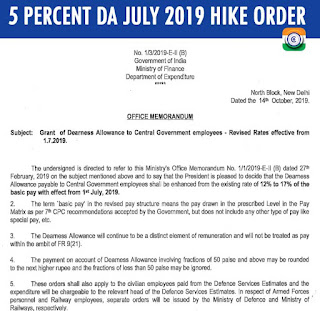
5 Percent DA July 2019 Hike Order - Grant of Dearness Allowance to Central Government employees

Grant of Dearness Allowance to Central Government employees 5 Percent DA July 2019 Hike Order  No. 1/3/2019-E- II (B) Government of...

Blog Archive

About The Author