A complete reference blog for Indian Government Employees

Showing posts with label 7th CPC Pay Scale. Show all posts

Friday, 27 September 2019

NFIR President raised following issues in Railway Board Meeting 2019

NFIR President raised following issues in Railway Board Meeting 2019

Every Railwayman should work to curb avoidable expenses, he said and raised following issues for taking speedy action:
Highlights of PNM Meeting Shri Guman Singh, President NFIR

Also read: Highlights of PNM Meeting Dr. M. Raghavaiah, General Secretary / NFIR
  • The allowances to all the staff was paid from 1st of July 2016 but the KMA and other related allowances to running staff have not been decided. Such delay is a cause of Railwaymen blaming the Federation and gives room for staff agitations. This type of situation cannot do well to the institution. The Railway Board should seriously think and resolve the issues quickly.
  • Railway Board constituted a Task Force Safety Committee consisting of five very senior officers (General Managers), the Committee gave recommendations on 10th January 2017 wherein it has been mentioned that the running staff who join duty after leave at 0:00 hours and worked train immediately after resumption, commit accidents. Therefore, the Committee recommended that the running staff should not be booked to work train before 8 ‘o’ clock in the morning when they resume duty after availing leave.
    Unfortunately recommendations of the Committee are not being followed and the running staffs are booked invariably to work first train after 0:00 hours on resumption from leave. He urged the Member Staff to see that suitable instructions are issued to the Zonal Railways to follow the recommendations of the Committee to avoid situations which may cause accidents.
  • The Railway Board issued orders in the year 2004, as a result of decision arrived at, in the DC/JCM meeting, but unfortunately this decision has been changed unilaterally in the year 2007 by the Board. This change has created adverse situation like denial in granting appointment on compassionate grounds. He urged the MS that the order of 2004 be restored without delay.
  • Time and again the Railway Board had issued detailed guidelines, not to retain money from settlement dues of railway employees on superannuation, but unfortunately these orders are being violated by withholding heavy amounts from settlement despite the fact that employees are not in occupation of Railway quarter and equally no disciplinary action pending against them.
  • Retired Railway employees have been re-engaged against vacancies, but they are not paid Night Duty Allowance though they perform night duty. OT Allowance is also not paid to these re-engaged staff when they work over hours of duty at out stations. He empathetically stated that injustice is being caused to the retired Railway employees who are re-engaged as all such rules are equally applicable to them when they have been re-engaged to Railway service.
  • The PPOs of running staff are not being revised because concordance tables have not been provided although orders have been issued to revise their pension pay orders by sighting illustrations, but it is not working as the staff have developed habit of working with the assistance of concordance table, as such concordance tables be
    prepared and issued.
  • Regarding filling up of vacancies, he expressed satisfaction on the information given by Member Staff that by the end of May 2019, a panel of 62,960 selected candidates of Pay Matrix Level-I and similarly panels of ALPs and SMs will also be made available. He stated that occurrence of 3% vacancies of total cadre is through natural attrition, therefore the sequence of formation of panels should be planned and followed in a methodical manner as a regular course.
  • Case of payment of honorarium to cashiers and other accounts staff of NWR for the year 2008, 2009 and 2010, is pending in the Railway Board for sanction. The inordinate delay in payment is a matter of concern for everyone. He requested Member Staff for early communication of sanction to the NWR for which NFIR has also made reference.
    Get More Indian railway news for railway employee
  • The condition of railway quarters continues to remain deplorable as there is no maintenance. Our position becomes very embarrassing when staff complain about differential treatment as there is zero maintenance of staff quarters while on the other hand the quarters of officers are well maintained. He requested that immediate action be taken in the matter to mitigate the staff complaints.
Source: NFIR
Share:

Wednesday, 28 August 2019

Revised proposal for filling up of the 11 posts of Deputy Director of Airworthiness in Level 12, Rs.78800-209200/- of the pay matrix on Deputation basis in DGCA

DoPT Orders 2019

Revised proposal for filling up of the 11 posts (subject to change) of Deputy Director of Airworthiness in Level 12, Rs.78800-209200/- of the pay matrix on Deputation (including short term contract) basis in DGCA
F.No.21/07/2019-CS-I(P)
Ministry of Personnel, Public Grievances Pension
Department of Personnel & Training
(C.S.l Division)
2nd Floor, 'A' wing,
Lok Nayak Bhawan,
Khan Market, New Delhi
Dated 27th August, 2019
OFFICE MEMORANDUM

Subject:- Revised proposal for filling up of the ll posts ( Subject to change) of Deputy Director of Airworthiness in Level 12, Rs.78800-209200/- of the pay matrix on Deputation (including short term contract) basis in DGCA - reg

The undersigned is directed to circulate office Memorandum No. A-60015/1268/2015.D G Section-MoCA dated 18/08/2019 received from Ministry of Civil Aviation (along with enclosures) for filling up of posts Deputy Director of Airworthiness.

It may be noted that cadre clearance from c.S.l Division will be required in case of Under Secretary and above level officers of CSS applying for deputation.

In case of any further clarification, applicants are requested to contact the concerned Ministries / Departments.
(Sanjay Kumar Das dupta)
Under Secretary to the Government of India
Tele:- 24629412
To,
All Ministries/ Departments (through DoPT's website)
Name of Post - Deputy Director Airworthiness
No.of Post - 11 (subject to change)
Pay Scale - Pre-revised scale of PB-3, Rs. 15600 - 39100 with GP of Rs. 7600/- (Level - 12, Rs. 78800 -209200/-of the Pay Matrix as per the recommendations of 7th CPC)
Source: DoPT Orders 2019

Share:

Friday, 8 February 2019

Bunching of stages of pay in the pre-7th CPC pay scales consequent upon fixation of pay in the revised pay scales based on 7th CPC­

7th CPC Pay Fixation on Bunching - Clarification Orders issued by Finmin
Bunching of stages of pay in the pre-7th CPC pay scales consequent upon fixation of pay in the revised pay scales based on 7th CPC
No.1-6/2016-IC/E-IIIA
Govt. of India
Ministry of Finance
Department of Expenditure
North Block, New Delhi
Dated the 07th February, 2019
OFFICE MEMORANDUM

Subject: Bunching of stages of pay in the pre-7th CPC pay scales consequent upon fixation of pay in the revised pay scales based on 7th CPC­ Regarding

The undersigned is directed to invite attention to this Departments OM No. 1-6/2016-IC dated 3rd August, 2017, explaining in detail the methodology for applying the principle of “bunching” consequent upon pay fixation in the revised pay scales (applicable Levels of the Pay Matrix) effective from 1.1.2016 based on implementation of the recommendations of the 7th Pay Commission.

2. Notwithstanding the fact that the said OM dated 3.8.2017 has elaborately explained the issue of bunching in the context of the revised pay scales based on 7th Central Pay Commission, references are being received in this Ministry seeking clarification as to the methodology to carry out the principle of bunching. It is seen that some of the clarifications received seem to arise out of the position on bunching as obtaining during the pay structure in vogue based on 6th Pay Commission before 1.1.2016 vis-a-vis the position explained in terms of this Ministry’s aforesaid OM dt. 3.8.2017 in the context of pay structure currently in vogue from 1.1.2016 based on the recommendations of the 7th Pay Commission.

3. Therefore, the matter has been considered keeping in view the clarifications sought and the issue is clarified heretofore. At the very outset, bunching as a sequel to pay fixation based on the formula for such pay fixation on the date of effect of revised pay scales based on the recommendations of the 7th Pay Commission, is to be considered strictly as per the recommendations of the 7th Pay Commission, as illustrated in para 5.1.37 of its report. The principle of bunching as recommended by the 7th Pay Commission, as accepted by the Government in terms of the erstwhile Implementation Cell’s OM dt. 7.9.2016 and 3.8.2017, is different from the principle recommended by the 6th Pay Commission and as accepted by the Government based thereon. Therefore,the principle of bunching in the revised pay structure based on the recommendations of the 7th Pay Commission is independent of the principle followed earlier and has no link thereto.

4. The 6th Central Pay Commission in para 2.2.21 of its Report recommended - “To alleviate the problem of bunching in these cases,the Commission has allowed the benefit of one extro increment wherever two or stages in any of the pre-revised pay scales were getting bunched together at one level in the revised pay bands…. The Commission has prepared a detailed fixation chart which gives the fitment in the revised running pay bands in every stage”. However . in the fitment charts prepared by the 6th Pay Commission, the Commission illustrated the bunching meant by it. The examples from the fitment tables prepared by the 6th Pay Commission are given in Annexure I 

5. The same principle of bunching was adopted in terms of the fitment table prescribed by the Ministry of Finance, Department of Expenditure, as per the OM No.1-1/2008-IC dated 30.8.2008. The examples of which are given in Annexure II.

6. The 7th Pay Commission has dealt with the issue of bunching in paras 5.1.36 and 5.1.37, which are reproduced below.

“5.1.36 Although the rationalisation has been done with utmost care to ensure minimum bunching at most levels, however if situation does arise whenever more than two stages are bunched together ,one additional increment equal to 3 percent may be given for every two stages bunched, and pay fixed in the subsequent cell in the pay matrix.

5.1.37 For instance , if two persons drawing pay of Rs. 53 ,000 and Rs. 54,590 in the GP 10000 are to be fitted in the new pay matrix , the person drawing pay of Rs. 53.000 on multiplication by a factor of 2.57 will expect a pay corresponding to Rs. 1,36,210 and the person drawing pay of Rs. 54,590 on multiplication by a factor of 2.57 will expect a pay corresponding to Rs. 1,40 .296 . Revised pay of both should ideally be fixed in the first cell of level 15 in the pay of Rs.1.44,200 but to avoid bunching the person drawing pay of Rs. 54.590 will get fixed in second cell of level 15 in the pay of Rs.1.48,500.”

7. Accordingly, the essence of the recommendations of the 7th Pay Commission is contained in the above illustration given by the 7th Pay Commission. As per this illustration, the pay of Rs. 53,000 and Rs. 54,590 were the pay applicable in PB-4 plus Grade Pay of Rs. 10.000 as applicable prior to 1.1.2016, which corresponds to Level-14 of the Pay Matrix applicable from 1.1.2016. The pay of Rs. 54,590 was 3% more than the pay of Rs. 53,000. That is, these two Pays were separated by a difference of 3% of Rs. 53 ,000. Thus, the pay of Rs. 54,590 was the stage next to the pay of Rs. 53 ,000. Considering that the 7th Pay Commission allowed the benefit of bunching at the level of the pay of Rs. 54,590 itself , it materially departed from the principle followed at the time of 6th Pay Commission because in the 6th Pay Commission regime the benefit was allowed at the 3rd consecutive stage and not at the 2nd stage itself (next stage) for the purpose of bunching. 

8. Furthermore. in the illustration given in para 5.1.37 of its report, the 7th Pay Commission has not mentioned about the pay in respect of pre-revised pay of Rs. 56,230 , which is 3% more than the pay of Rs. 54,590. The revised pay fixed in the Level 14 with reference to the pre-revised pay of Rs. 56 ,230 will be Rs. 1.48,500. This will be the same as the pay to be given with reference to the pre-revised pay of Rs. 54,590 after allowing bunching. However , the 7th Pay Commission did not recommend any additional benefit in such cases, as it did not include in its illustration for any benefit in case of the further stages of pre-revised pay, consequent upon bunching at the lower stage.

9. In view of the above, the benefit of bunching consequent upon fixation of pay in the revised pay structure effective from 1.1.2016 based on the recommendation of the 7th Pay Commission is to be considered in the light of the above and the clarifications already issued in terms of the aforesaid letter dated 3.8.2017. Accordingly: 

(i) Where consequent upon fixation of pay in terms of Rule 7 (1) (A)(i) of the CCS (RP) Rules, 2016, two different pay drawn in the pay structure obtaining immediately before 1.1.2016, which were separated by one another by 3% of the previous stage, are fixed at the same cell of the applicable Level of the Pay Matrix effective from 1.1.2016, then the benefit of bunching by way of one additional increment as on 1.1.2016 shall be admissible in respect of the pay which is more than 3% of the previous pay, as per the illustration given by the 7th Pay Commission in para 5.1.37, as mentioned above. This is further illustrated as below: 

6th CPC Pay scale : PB-4 (37.400-67,000) + Grade Pay Rs.8,700/- 7th CPC Pay Scale – Level-13 (1,23,100-2,15,900)
6th CPC Pay Structure (PB-4 and GP of Rs. 8,700) Pay fixation in 7th CPC Pay Matrix (Level – 13)
Pay Consolidation based on 2.57 multiple Pay fixed as on 1.1.2016 Pay after bunching
46 ,100 Rs.1,18,477 Rs.1,23,100/- Rs.1,23 ,100/-
47,490
(46 ,100+3%)
Rs.1,22,049 Rs.1,23,100/- Rs.1,26,800/-
(ii) In view of the position explained in para 8 above and the specific recommendation of the 7th Pay Commission as per its illustration given in para 5.1.37 of its report, no further action is to be taken after the benefit of bunching as a result of application of Rule 7(1)(A)(i), as indicated above. This is as illustrated below:
6th CPC Pay Structure (PB-4 and GP of Rs. 8,700) Pay fixation in 7th CPC Pay Matrix (Level – 13)
Pay Consolidation based on 2.57 multiple Pay fixed as on 1.1.2016 Pay after bunching Remarks
46 ,100 Rs.1,18,477 Rs.1,23,100/- Rs.1,23,100/-
47,490
(46 ,100+3%)
Rs.1,22,049 Rs.1,23,100/- Rs.1,26,800/- Pay raised because of bunching
48,920
(47,490+3%)
Rs. 1,25,724 Rs.1,26,800 Rs.1,26,800 No change

10. In the light of the above, the points of clarification as referred to this Ministry are explained in the Annexure III.

11. These orders are issued after consultation with the Comptroller and Auditor General of India in their application to the employees belonging to the Indian Audit and Accounts Department.

12. Hindi version of these orders is attached.

sd/-
(Amar Nath Singh)
Director
Share:

Friday, 14 September 2018

CPSE: DA from July, 2017 to the CDA pattern employees of CPSEs, drawing pay in 7th CPC Scale

CPSE: DA from July, 2017 to the CDA pattern employees of CPSEs, drawing pay in 7th CPC Scale

F. No. W-02/0038/2017-DPE (WC)-GL-XXI/ 18
Government of India
Ministry of Heavy Industries & Public Enterprises
Department of Public Enterprises

Public Enterprises Bhawan,
Block 14, CGO Complex, Lodi Road,
New Delhi-l 10003, the 10th September, 2018


OFFICE MEMORANDUM


Subject: Payment of DA to the CDA pattern employees of CPSEs, drawing pay in 7th CPC pay scales.
The undersigned is directed to refer to Para No. 3 and Annexure-II(a) and II(b) to this Department’s O.M. No. W-02/0058/2016-DPE(WC) dated 17.08.2017 wherein the rates of DA payable to the employees who are following CDA pattern pay scales have been indicated.

2. The DA payable to the employees may be enhanced from the existing rate of 7% to 9% with effect from 01.07.2018.

3. The payment of Dearness Allowance involving fractions of 50 paise and above may be rounded off to the next higher rupee and the fractions of less than 50 paise may be ignored.

4. These rates are applicable in the case of CDA employees whose pay have been revised with effect from 01.01 2016 as per DPE’s O.M. dated 17.08.2017.

5. All administrative Ministries/Departments of Government of India are requested to bring this to the notice of Central Public Sector Enterprises under their administrative control for action at their end.

Sd/-
(Samsul Haque)
Under Secretary


Source: dpe.gov.in
Share:

Thursday, 12 April 2018

Cabinet approves revision of pay and allowances of Lieutenant Governors of Union Territories

Cabinet

Cabinet approves revision of pay and allowances of Lieutenant Governors of Union Territories
11 APR 2018

  The Union Cabinet chaired by Prime Minister Shri Narendra Modi has given its approval for revision of pay and allowances of Lieutenant Governors of Union Territories. It will bring the pay and allowances of LGs at par with that of the Secretary to the Government of India.

Details:
The Cabinet has approved the proposal for increasing the pay and allowances of Lieutenant Governors of Union Territories with effect from 1st January, 2016 from Rs.80,000/- per month plus dearness allowance, sumptuary allowance at the rate of Rs.4,000/- per month and local allowances to Rs. 2,25,000/- plus dearness allowance, sumptuary allowance at the rate of Rs.4,000/- per month and local allowances at the same rate as applicable to the officers of the rank of Secretary to the Govt. of India It will be subject to the condition that the total emoluments (excluding sumptuary allowance and local allowances) shall not exceed the total emoluments drawn by the Governor of a State.

Background:
The pay and allowances of Lieutenant Governors of Union Territories remain at par with those of officers of the rank of Secretary to the Government of India. The pay and allowances of Lieutenant Governors of Union Territories was last revised with the approval of the Cabinet with effect from 1st January, 2006 from Rs. 26,000/- (fixed) per month to Rs.80,000/- (fixed) per month plus dearness allowance, sumptuary allowance at the rate of Rs.4,000/- per month and local allowances.

The pay of officers of the rank of Secretary to the Government of India has been revised from Rs. 80,000/- to Rs. 2,25,000/- per month with effect from 01.01.2016 as per CCS (Revised) Pay Rules, 2016.

Source: PIB
Share:

Tuesday, 28 February 2017

Sources Confirmed Allowance Committee Report Submitted


Sources Confirmed Allowance Committee Report Submitted

One of the NJCA leader, On Condition of Anonymity, told that the committee constituted to examine the allowance has finalized its reports and submitted it to the Government on 22nd February 2017.
On asking whether the NJCA knew the details of the committee report, he said that they were not provided with the committee report. But the committee has informed them that their demand on allowance would be considered favorably.

Hence it is expected the HRA will be retained in old rates (Sixth CPC rates) from the beginning itself and will be paid in 7th CPC Pay Scale when revised allowances come into effect. However, the news of revised allowances would be implemented with effect from 1.4.2017 is not reliable. NJCA will not accept this and clearly said that it should be implemented with effect from 1.1.2016 retrospectively.

X cities- 30%
Y cities- 20%
Z cities- 10%
7thCPC-hra-table


Transport Allowance may be split into two elements as CCA and TA as it was paid in fifth CPC. The Rates will be delinked from DA and will Fixed in slab rates.

The Government will announce its decision over the committee report after the last phase of state elections ie after 8th March 2017.

Source: http://govtstaffnews.in/
Share:

Friday, 18 November 2016

7th CPC pay scale to Temporary Status Casual labourers : Confederation writes to Ministry of Personnel, Public Grievances & Pension.

7th CPC pay scale to Temporary Status Casual labourers : Confederation writes to Ministry of Personnel, Public Grievances & Pension.

CONFEDERATION OF CENTRAL GOVT. EMPLOYEES & WORKERS
1St Floor, North Avenue PO Building, New Delhi - 110001

Ref: Confdn/7th CPC/2016
Dated - 16.11.2016
To
The Secretary
Ministry of Personnel,
Public Grievances & Pension
Department of Personnel & Training
North Block, New Delhi - 110001

Sir,
Sub:  Grant of 7th CPC pay scale to Temporary Status Casual labourers - reg.

At present Temporary status Casual Labourers are being paid minimum of the pre-revised 6th CPC pay scale. Consequent on implementation of 7th CPC pay scales with effect from 01.01.2016, their pay scale is to be revised.

I request you to take necessary action for revising the pay of the Temporary status casual labourers at an early date.
Yours faithfully,

(M. Krishnan)
Secretary General
Confederation
Member, JCM National Council
Standing Committee
Source : Confederation
Share:

Wednesday, 26 October 2016

Seventh Central Pay Commission's recommendations - revision of Pay scales - amendment of Service Rules/Recruitment Rules


Seventh Central Pay Commission's recommendations - revision of Pay scales - amendment of Service Rules/Recruitment Rules

File No.AB-14017/13/2016-Estt.(RR)
Government of India
Ministry of Personnel, P.G. & Pensions
Department of Personnel and Training
Estt(RR) Section
***
North Block, New Delhi
Dated: 25th Oct, 2016
OFFICE MEMORANDUM

Subject: Seventh Central Pay Commission's recommendations - revision of Pay scales - amendment of Service Rules/Recruitment Rules.

The undersigned is directed to refer to the OM of even number dated 03.10.2016 on the above mentioned subject informing about the meeting scheduled to be taken by Joint Secretary (Establishment) to review the position with respect to the amendment in Service Rules/Recruitment Rules for various posts.

2. In this regard it is stated that the meetings scheduled to be held on 25.10.2016 and 26.10.2016 for the Ministries starting with alphabets R-V and W-Z respectively has been postponed due to some unavoidable circumstances. The fresh date for the meeting will be communicated in due course of time.
(G.Jayanthi)
Director (E-1)
To
Joint Secretary (Administration/Establishment)
All concerned Ministries/Departments

7th CPC DoPT Order
Share:

Tuesday, 30 August 2016

Seventh Central Pay Commission recommendations — revision of pay scales- amendment of Service Rules/Recruitment Rules

Seventh Central Pay Commission's recommendations — revision of pay scales- amendment of Service Rules/Recruitment Rules

No. AB.14017/13/2016-Estt. (RR)
Government of India
Ministry of Personnel, Public Grievances and Pensions
Department of Personnel and Training
New Delhi
Dated: 29th August, 2016
OFFICE MEMORANDUM

Seventh Central Pay Commission's recommendations — revision of pay scales- amendment of Service Rules/Recruitment Rules

The undersigned is directed to refer to the Office Memorandum of even number dated 9.8.2015 on the above mentioned subject wherein it was requested that as per the CCS (Revised Pay) Rules 2016 issued by Department of Expenditure vide Notification dated 25th July, 2016, consequential amendment in the existing Service Rules/Recruitment Rules shall be made by the Ministries/Departments by substituting the existing Pay Band and Grade Pay by the new pay structure i.e. "LEVEL in the PAY MATRIX" straightaway without making a reference to the Department of Personnel and Training (DOP&T)/Union Public Service Commission (UPSC).

2. In this regard, a confirmation meeting is scheduled to be taken by Joint Secretary (Establishment) to take stock of the latest position of amendment in Service Rules/Recruitment Rules. Joint Secretary (Administration/Establishment) of all Ministries/Departments along with the cadre controlling officers is requested to attend the meeting as per the schedule Annexed or depute a senior officer conversant with the matter to brief the progress.

3. The meetings would be held in Room No. 190, Ist Floor, North Block.
(G. Jayanthi)
Director (E-1)
To
Joint Secretary (Administration/Establishment)
All Ministries/Departments of Government of India
Annexure
Scheduled of the meeting to be taken by Joint Secretary (Establishment) to take stock of the latest position of amendment in Service Rules/Recruitment Rules
S. No.Ministries starting with alphabets Date and time
1.A - C3rd October, 2016 at 4.30 PM
2.D - E4th October, 2016 at 4.30 PM
3.F - H5th October, 2016 at 4.30 PM
4.I - L6th October, 2016 at 4.30 PM
5.M-Q7th October, 2016 at 4.30 PM
6.R-V13th October, 2016 at 4.30 PM
7.W-Z14th October, 2016 at 4.30 PM

Click to view the order
Share:

Wednesday, 27 January 2016

7th CPC Report : Indian Army is one of the largest professional volunteer land forces in the world

7th CPC Report : Indian Army is one of the largest professional volunteer land forces in the world

Cadres of Defence Forces Personnel : Junior Commissioned Officers (JCO)/ Other Ranks (OR)

Junior Commissioned Officers (JCO) and Other Ranks (OR) number 13.2 lakh across the three Services. JCOs/ORs can be broadly categorised in terms of their roles and skills. Roles

Army : With a strength of approximately 11 lakh, the Indian Army is one of the largest professional volunteer land forces in the world.

The cadre of the Army consists of:
i. Combat Arms (Armoured Corps, Artillery, Infantry and Mechanised Infantry)
ii. Combat Support Arms (Engineers and Signals)
iii. Specialised Cadres (AMC, ADC, RVC, AEC, CMP and APS)
iv. Logistic and Maintenance Services (ASC, AOC, EME and Pioneers).

Air Force : ‘Airmen’ comprise all ranks of combatants other than commissioned officers in the IAF. They perform a variety of functions ranging from aircrew duties on board helicopters and transport aircraft, maintenance of the most sophisticated and complex aircraft, radar, weapons and other equipment, secretariat and administrative duties involving maintenance of accounts of cash and stores, personnel documents, catering, discipline and medical care.

Navy : Every sailor is basically a seaman, irrespective of the branch to which he belongs or his trade specialisation. Seamanship duties comprise ship husbandry, hull maintenance, handling of small arms and ammunition, elementary store keeping, boat handling, firefighting, nuclear, biological and damage control as also first-aid, besides being proficient in a host of other seamanship activities such as anchor-work, rope-work, replenishment of fuel etc.

Skills

Every soldier is allotted a trade which becomes intrinsically linked to his subsequent career progression. There are numerous trades in the Army, Navy and Air Force. These have been grouped in two pay groups X and Y, as detailed in the table below:

Services Total Number of Trades and % age of Total Strength
X Y
Army 28 (2.58%) 96 (97.42%)
Navy 11 (12.00%) 42 (88.00%)
Air Force 23 (47.72%) 28 (52.28%)

The trades grouped under X require higher entry level qualification (Class XII). Entrants in group X also receive more intensive training. As against this entry level qualification for group Y is Class X only and the training.
Share:

7th CPC Recommendations : Upgradation of GP 4200, 4600 and 4800 for the Employees of the Supreme Court

7th CPC Recommendations : Upgradation of GP 4200, 4600 and 4800 for the Employees of the Supreme Court

Officers and Employees of the Supreme Court : Upgradation of Pay in Selected Posts in Existing GP 2800

Upgradation of pay has been sought for the group of posts in the present pay scale with GP 2800 to GP 4200. These include Junior Court Assistant, Chauffer, Special Process Server, Restorer Gr. I /Library Attendant Gr. I/Gestetner Operator Gr. I.

Analysis and Recommendations : The Commission has noted the recommendations made by the Committee of Judges in this regard. The Committee of Judges after examination of demands made has pointed out that in view of basic qualification, nature of duties and degree of efficiency, integrity and confidentiality the post of Junior Court Assistant can be considered for an upgradation in pay.
The Commission further notes that the educational qualifications for direct recruitment to the post of Junior Court Assistant is a degree from a recognised University and knowledge of computer operations with a stipulated typing speed in computers. The information furnished to the Commission with respect to the Recruitment Rules of various posts also indicates that in all other posts carrying a GP 2800 the educational qualifications is lower than graduation and therefore equating Junior Court Assistants with these posts would not be correct. In view of the foregoing the Commission is in agreement with the views of the Committee of Judges. Accordingly, the Commission recommends upgradation in the pay for the post of Junior Court Assistant to GP 4200 from the existing GP 2800.

Upgradation of Pay in Selected Posts in Existing GP 4200

For the group of posts covering Court Assistant, Personal Assistant, Accountant, Cashier, the Association requested pay parity with the holders of analogous/equivalent posts in the High Court of Delhi, who are drawing pay with GP 4600.

Analysis and Recommendations : The Commission has noted the recommendations made by the Committee of Judges in this regard. The Committee of Judges, after examination of demands made, agrees with the recommendation of upgradation in pay to conform to the pay of the holders of analogous posts in the High Court of Delhi.

The Commission recognises that the Supreme Court is at the apex of the hierarchy of Courts in India and hence its personnel should not be disadvantageously placed vis-à-vis the High Court of Delhi.
Accordingly, the Commission recommends upgradation for the post of Court Assistant, Personal Assistant, Accountant and Cashier to GP 4600 from the existing GP 4200.

Upgradation of Pay in Selected Posts in Existing GP 4600

Upgradation of pay has been sought for pay of the group of posts in the present GP 4600 to GP 4800. These include posts of Private Secretary to Additional Registrar, Sr. Personal Assistant, Senior Court Assistant, Court Associate, Editor of Paper books, Assistant Librarian,

Proof Reader, Assistant Accounts Officer (Concurrent Audit) and Building Supervisor. The justification for upgradation is that the holders of analogous posts in the High Court of Delhi are in GP 4800.

Analysis and Recommendations : The Commission has been informed that the Committee of Judges, after examination of demands made, have endorsed the upgradation in pay to conform with the pay of the holders of analogous posts in the High Court of Delhi.

The Commission recognises that the Supreme Court is at the apex of the hierarchy of Courts in India and hence its personnel should not be disadvantageously placed vis-à-vis the High Court of Delhi. Accordingly, the Commission recommends upgradation in the pay for the post of Private Secretary to Additional Registrar, Sr. Personal Assistant, Senior Court Assistant, Court Associate, Editor of Paper Books, Assistant Librarian, Proof Reader, Assistant Accounts Officer (Concurrent Audit) and Building Supervisor to GP 4800 from the existing GP 4600. However on completion of four years approved service further non-functional upgrade to GP 5400 (PB-2) is also recommended for these posts.
Share:

Tuesday, 8 December 2015

Standard Pay Scales of 7th Pay Commission

Standard Pay Scales of 7th Pay Commission

On the recommendations of the 7th Central Pay Commission, the Scales of Pay (Table 1) existing from 1.1.2006 may be replaced by the Scales of pay (Table 2) with effect from 1.1.2016.

Table-1
Pay Band Corresponding Pay Bands Grade Pay
PB – 1 5200 – 20200 1800
PB – 1 5200 – 20200 1900
PB – 1 5200 – 20200 2000
PB – 1 5200 – 20200 2400
PB – 1 5200 – 20200 2800
PB – 2 9300 – 34800 4200
PB – 2 9301 – 34800 4200
PB – 2 9302 – 34800 4200
PB – 2 9303 – 34800 4200
PB – 2 9304 – 34800 4600
PB – 2 9305 – 34800 4800
PB – 2 9306 – 34800 5400
PB – 3 15600 – 39100 5400
PB – 3 15601 – 39100 5400
PB – 3 15602 – 39100 6600
PB – 3 15603 – 39100 6600
PB – 3 15604 – 39100 6600
PB – 3 15605 – 39100 7600
PB – 3 15606 – 39100 7600
PB – 3 15607 – 39100 7600
PB – 4 37400 – 67000 8700
PB – 4 37401 – 67000 8700
PB – 4 37402 – 67000 8900
PB – 4 37403 – 67000 8900
PB – 4 37404 – 67000 10000
PB – 4 37405 – 67000 10000
HAG 67000
(3% Increment – 79000)
HAG + Scale 75500
(3% Increment – 80000)
75500
(3% Increment – 80000)
Apex Scale 80000
Cab. Sec 90000

Table-2

Pay Band Grade Pay Entry Pay (EP) Level 1
5200 – 20200 1800 7000 1
1900 7730 2
2000 8460 3
2400 9910 4
2800 11360 5
9300 – 34800 4200 13500 6
4600 17140 7
4800 18150 8
5400 20280 9
15600 – 39100 5400 21000 10
6600 25350 11
7600 29500 12
37400 – 67000 8700 46100 13
8900 49100 13A
10000 53000 14
67000 – 79000
67000 15
75500 – 80000
75500 16
80000
80000 17
90000
90000 18


Source: 7thpaycommissionnews.in
Share:

Monday, 23 November 2015

7TH PAY COMMISSION RECOMMENDATION LDC-UDC ISSUE

7TH PAY COMMISSION RECOMMENDATION LDC-UDC ISSUE-GOVERNMENT STAND REITERATED

On the issue of LDC/UDC 7th Pay Commission reiterated the deceiving stand of the Government. Despite of realizing the issue as genuine, Government had not taken a positive decision at their level. The tens of thousands of LDC & UDC, solely responsible for the smooth running of many of the subordinate offices, were hoping that 7th Pay Commission will study the problem faced by them and take a positive decision. Staff Side JCM having convinced the importance of the issue, had also recommended merger & upgradation of the Grade Pay of LDC & UDC to Rs. 2800. But here we see that 7th Pay Commission has not taken any decision on the issue except giving some confusing and misleading statements to vindicate the stand taken by the Government as true. Extracts of some of their views on LDC UDC issue spread over various chapters of the reports is given below:

Higher GP 2400 to LDC and consequent upgradation of pay for other civilian posts in the Ministerial hierarchy.

11.22.100 The Academy has urged that LDC should be placed in higher GP 2400 as against the existing GP 1900 at par with grade pay of Data Entry Operator (DEO), on the grounds that both LDC and DEO enter service on the basis of same educational qualification i.e., Class XII and that the functions of LDC are more complex than that of a DEO. This issue has been dealt in Chapter 7.7. Recommendations made there would apply in this case also.

11.52.32 They have demanded upgradation in pay of certain category of non-industrial posts viz., LDC, UDC, Accountant, Junior Head Clerk, Head Clerk, Office Superintendent and Assistant Manager (Admin).


Analysis and Recommendations

11.52.33 The Commission has not received the views of the ministry/department on the issue. However, posts like LDC, UDC, Accountant are common to a number of ministries/ departments. Recommendations regarding their pay are contained in Chapter 7.7 and Chapter 11.35. The Commission does not find any justification for increase in pay scale of the other cadres.

But in Chapter 7.7 no direct recommendation except to decline the demand of LBSNAA to increase the promotional quota of MTS to LDC, is visible. The extract of Para 7.7.37 is give below:


Analysis and Recommendations

7.7.37 Looking at the qualification requirements and their job profile, the Commission does not recommend any changes in the pay structure or the promotional prospects of the MTS. Regarding MTS in Delhi Police, the Commission is of the view that since MTS is a common category, any special dispensation to MTS in Delhi Police is not justified. In so far as the MTS of LBSNAA are concerned, the Commission notes as per the recruitment rules for LDC, presently only 5 percent of MTS can get promoted to LDC through limited departmental examination. However, since the government has stopped direct recruitment for the clerical cadre and gradually phasing out the existing incumbents, their demand cannot be accepted.

LDCs

11.35.27 There are demands that 50 percent posts of LDCs be earmarked for filing up by promotion/departmental examination by MTS. It has been argued that the educational qualification for the post of MTS is Class X and they are recruited through SSC for performing the work of Peon, Mali, Cobbler, and Sweeper etc. Since most of the MTS join the post with higher qualification of Higher Secondary and Graduation, there is high rate of attrition in the MTS cadre.

Analysis and Recommendations

11.35.28 As per the recruitment rules for LDC, presently 5 percent of MTS can get promoted to LDC through limited departmental examination. Since government has already stopped direct recruitment for the clerical cadre and gradually phasing out the existing incumbents, this demand cannot be accepted. Moreover enhancement of promotional quota is an administrative matter to be considered by the relevant administrative ministry.

Between the lines it can be read that the Government prevented the 7th Pay Commission to not consider the LDC/UDC issue positively and reiterated the wrong statement of the Government that that Government of India has stopped direct recruitment of LDC through Staff Selection as its recommendation. But the fact is that Staff Selection Commission is frequently conducting recruitment for the post of LDC and without the permission of the Government how they can done at their own. Combined higher secondary examination for the selection of LDC also has been conducted recently. If we take the intention of Government of phasing out the LDC post as true, then where is the alternative recommendation? Who will do the arduous work done by the young and energetic LDCs in the subordinate offices? It is to be noted that the normal ratio of LDC and UDC in subordinate offices is 5:2 and thus LDCs have been allocated responsible sections and in many smaller offices LDC alone is handling the work of entire Administration.

On the other hand rejecting Central Secretariat Clerical service demand of parity with DEO the commission observes “Even though the entry requirements are similar, historically the pay scales of the two posts have been different. Besides, they comprise two distinct cadres with different set of roles and responsibilities. Hence, the demand for parity of pay of LDC with DEOs cannot be acceded to by the Commission.”(Para 11.35.38).

Our view is that historically these cadres may be different set of roles but the fact is that functions of LDC are more complex than that of DEO and same was brought before the commission by various  Associations/Administrative Authorities. Earlier pay Commissions have fixed Pay Scale to DEO considering their work on computer. But today LDCs are more expertise in computer than DEO for doing work in computer, but the demand of parity with DEO is rejected. Extract of Para 11.35.38 is given below:

Central Secretariat Clerical Service

11.35.38 The Central Secretariat Clerical Service (CSCS) consists of the following grades:

i. Upper Division Clerk (GP 2400)
ii. Lower Division Clerk (GP 1900)
LDC and Data Entry Operator (DEO)

11.35.39 It has been demanded that LDC of CSCS drawing pay in GP 1900 be placed in GP 2400 at par with the DEOs on the grounds that post VI CPC, the entry requirements for the two posts is almost similar.

Analysis and Recommendations

11.35.40 Even though the entry requirements are similar, historically the pay scales of the two posts have been different. Besides, they comprise two distinct cadres with different set of roles and responsibilities. Hence, the demand for parity of pay of LDC with DEOs cannot be acceded to by the Commission.
From the above it is clear that Government is adamant on not granting pay scale to LDC & UDCs in subordinate offices at par with the duties assigned to them. Even though the 7th CPC claimed that they have recommended pay scales on the principle of equal pay for equal work, the genuine issue of LDC/UDC is ignored. Thus we are forced to represent against the recommendation to the Government/JCM (Staff Side).

All our LDC/UDC friends are requested to raise the issue in their respective Association/Office to force them to represent the issue to the implementation committee for consideration. Also please join all action programmes including strike action, called by the JCM (Staff Side), as published in this web site from time to time, to combat the situation.
TKR Pillai
General Secretary
Mob: 09425372172
Source: http://aiamshq.blogspot.in/
Share:

Saturday, 21 November 2015

7th Pay Commission Standard Pay Scale : Pay matrix with distinct Pay Levels

7th Pay Commission Standard Pay Scale : Pay matrix with distinct Pay Levels  

Seventh CPC is recommending a Pay matrix with distinct Pay Levels instead of Running Pay bands and Grade Pay.
 
7th-cpc-pay-structure
The new pay matrix for civilian employees


Source:  http://7cpc.india.gov.in/
Share:

7th CPC Pay Fixation with examples

7th CPC Pay Fixation with examples

Pay Fixation in the New Pay Structure : The fitment of each employee in the new pay matrix is proposed to be done by multiplying his/her basic pay on the date of implementation by a factor of 2.57. 

The figure so arrived at is to be located in the new pay matrix, in the level that corresponds to the employee’s grade pay on the date of implementation, except in cases where the Commission has recommended a change in the existing grade pay. If the identical figure is not available in the given level, the next higher figure closest to it would be the new pay of the concerned employee. A couple of examples are detailed below to make the process amply clear.

The pay in the new pay matrix is to be fixed in the following manner:

Step 1: Identify Basic Pay (Pay in the pay band plus Grade Pay) drawn by an employee as on the date of implementation. This figure is ‘A’.

Step 2: Multiply ‘A’ with 2.57, round-off to the nearest rupee, and obtain result ‘B’.

Step 3: The figure so arrived at, i.e., ‘B’ or the next higher figure closest to it in the Level assigned to his/her grade pay, will be the new pay in the new pay matrix. In case the value of ‘B’ is less than the starting pay of the Level, then the pay will be equal to the starting pay of that level

Example I

i. For example an employee H is presently drawing Basic Pay of Rs.55,040 (Pay in the Pay Band Rs.46340 + Grade Pay Rs.8700 = Rs.55040). After multiplying Rs.55,040 with 2.57, a figure of Rs.1,41,452.80 is arrived at. This is rounded off to Rs.1,41,453.

ii. The level corresponding to GP 8700 is level 13, as may be seen from Table 4, which gives the full correspondence between existing Grade Pay and the new Levels being proposed.

iii. In the column for level 13, the figure closest to Rs.1,41,453 is Rs.1,41,600.

iv. Hence the pay of employee H will be fixed at Rs.1,41,600 in level 13 in the new pay matrix as shown below:

Pay Matrix


As part of its recommendations if Commission has recommended any upgradation or downgrade in the level of a particular post, the person would be placed in the level corresponding to the newly recommended grade pay.

Example II

i. Take the case of an employee T in GP 4200, drawing pay of Rs.20,000 in PB-2. The Basic Pay is Rs.24,200 (20,000+4200). If there was to be no change in T’s level the pay fixation would have been as explained in Example I above. After multiplying by 2.57, the amount fetched viz., Rs.62,194 would have been located in Level 6 and T’s pay would have been fixed in Level 6 at Rs.62,200.

Pay Matrix 7th CPC


ii. However, assuming that the Commission has recommended that the post occupied by T should be placed one level higher in GP 4600. T’s basic pay would then be Rs.24,600 (20000 + 4600). Multiplying this by 2.57 would fetch Rs.63,222.

iii. This value would have to be located in the matrix in Level 7 (the upgraded level of T).

iv. In the column for Level 7 Rs.63,222 lies between 62200 and 64100. Accordingly, the pay of T will be fixed in Level 7 at Rs.64,100.

7CPC PAY MATRIX

Authority: http://7cpc.india.gov.in/
Share:

Monday, 16 November 2015

7th Pay Commission Minimum Pay 21000 and Fitment Formula from 2.86 to 3.15

7th Pay Commission Minimum Pay 21000 and Fitment Formula from 2.86 to 3.15

“There is a possibility of 7th CPC to submit its report on 20th November 2015 or 23rd November 2015 , but the report will not be to your expectations, The minimum wage taking into prices published by the Government of India shall come to Rs 26,000/-, considering the existing retail prices the minimum wages works out to Rs 28,000/- and fitment formula shall works out to 4.00 , but the minimum wage may be around Rs 21,000/ against the justified demand of Rs 28,000/- the fitment formula may be from 2.86 to 3.15 , also many other important demands of five promotion policy, Increment rate increase, retirement issues, pension issues etc.

We have to wait and watch the 7th CPC report will the 7th CPC accept the staff side demands or not.”

Observance of All India protest day on 19th November 2015 & 7th CPC to submit its report shortly

Comrades
The Confederation and NJCA had given call for holding protest meetings from 2ndNovember 2015 to 6th November 2015 and also Observance of All India protest day on 19th November 2015 in respect of following demands.

Charter of Demands
1. Effect wage revision of Central Government employees from 1.12014 accepting the memorandum of the staff side JCM; ensure 5-year wage revision in future; grant interim relief and merger of 100% of DA. Ensure submission of the 7th CPC report with the stipulated time frame of 18 months; include Grameen Dak Sewaks within the ambit of the 7th CPC. Settle all anomalies of the 6th CPC.

2. No privatisation, PPP or FDI in Railways and Defence Establishments and no corporatisation of postal services;

3. No Ban on recruitment/creation of post.

4. Scrap PFRDA Act and re-introduce the defined benefit statutory pension scheme.

5. No outsourcing; contractorisation, privatization of governmental functions; withdraw the proposed move to close down the Printing Presses; the publication, form store and stationery departments and Medical Stores Depots; regularise the existing daily rated/casual and contract workers and absorption of trained apprentices;

6. Revive the JCM functioning at all levels as an effective negotiating forum for settlement of the demands of the CGEs.

7. Remove the arbitrary ceiling on compassionate appointments.

8. No labour reforms which are inimical to the interest of the workers.

9. Remove the Bonus ceiling;

10. Ensure five promotions in the service career.
We should not let down our struggle path I once again request one and all to participate in the All India protest day on 19th November 2015 at all places including the districts and send me the photos of protest meeting to publish on COC Karnataka website and this will send information to the Central Government on our demands.
Comradely yours
(P.S.Prasad)
General Secretary
Source: www.karnatakacoc.blogspot.in
Share:

Thursday, 29 October 2015

Seventh Pay Commission - Curtain Raiser

7th pay commission 7th Pay Commission – Curtain Raiser –  “The Seventh Pay Commission may consider pay ratio of the pay of the bottom paid employees to the pay of the highest paid officials will come down to 1:9 from 1:12″, sources indicate.
The government constitutes the Pay Commission almost every 10 years to revise the pay scale of its employees and often states also implement the panel’s recommendations after some modifications.

Headed by Justice Ashok Kumar Mathur, the four-member 7th Pay Commission was appointed in February 2014 and the commission will hand over its recommendations to government within December 31, 2015.

Though the Official recommendations are yet to be submitted to the Government, there are many flares going around, some may be true and some may be flaws.

However, at the end of the day, it is the so called ‘sources’ who give some hint. The following is the latest the sources indicate…..

  1. The commission may recommend government to ask Information and Technology department, whether it is possible to have systems in place for monitoring and supervising work being done remotely by disabled and women central government employees.
  2. “As flexi working hours will allow women central government employees to strike a balance between her professional and family responsibility, maintain healthy lifestyles and contribute to parenting well, it is recommended for the same and urge upon the government to work out the modalities in this direction.”
  3. Women employment under central government has been estimated to the tune of 3.37 lakh, which is 10.93 percent of the total regular central government employment, according to census of central government employees as on March 31, 2011.
  4. “We are looking at whether it is technologically possible to allow disabled and women employees for working from home,” said the source. “A need was felt to provide work from home facility to persons with disabilities and women to enable them to effectively discharge their duties.,” he added.
  5. The Pay Commission is likely to recommend increase 40 percent salaries hike of central government employees on average, the full implementation of which would raise the central government spending on salary and allowance Rs 1,00,619 crore.
  6. The commission may recommend Rs 20,000 as salary for those in the bottom grade and maximum Rs 180,000 for Secretary level officers. The sources in the panel said pay parity ratio of mid-level tier officers will be maintained with the bottom grade.
  7. Earlier, all pay commissions had not only recommended for good salary to top central government officials but also considered the disparity ratio between its highest and lowest paid employees.
  8. For instance, in 1948, the post-tax salary of the highest paid government official was Rs 2,263 which was 41 times higher than the Rs 55 paid to the lowest earning employee. With subsequent pay commissions the ratio was reduced to about 1:12 in 2006.
  9. “The Seventh Pay Commission may consider pay ratio of the pay of the bottom paid employees to the pay of the highest paid officials will come down to 1:9 from 1:12″, sources indicate.
  10.  The first pay commission was recommended Rs 55 salary to the lowest earning employee, second Rs 80, third Rs 185, fourth Rs 750, fifth Rs 2550 and sixth Rs 6660.
  11. “However, the Seventh Pay Commission is likely to recommend Rs 20,000 salary for lowest paid employees and Rs.1,80,000 for highest paid officials, “.
  12. Grade Pay was derived from USA and it has increased in prominence in the early 21st century in USA. Federal employees in USA at all levels are paid based on Grade Pays. The six pay commission followed them. A grade pay is a structured pay format where employees are placed at a given pay level based on their level of education and work experience related to the position.
  13. “Central government has 15 grade pays now from Rs 1,800 to Rs 12,000 for job level pay variance of its employees. Generally, multi tasking staff (MTS) and clerical jobs that require formal education, just a high school or higher secondary, who are at are at the lower levels from grade pays 1,800 to 2,000.
  14.  Every employee does not get promotion in time. So, if Modified Assured Career Progression (MACP) Scheme is not maintained it will be seriously affected,” the sources said.
  15. Accordingly, the sources said the Modified Assured Career Progression (MACP) Scheme is likely to be kept the current status quo.
  16. Sources say, rather than hiking pay and allowances, the panel is focused on making employees more efficient, modern and valuable. ‘The commission was created to hike salaries and allowances for central government employees but the commission now is actually focused on “efficiency, technology, skills and Pay link with productivity.’
  17. The central government employees federation strongly believe that the 7th pay commission cannot recommend revising the retirement age of central government employees, since it does not fall under the purview of 7th Pay Commission. It is the central Government which makes such decisions. Yes true, but it is under purview, sources indicate.
  18. The Finance ministry has already opened its stand saying, the Seventh Pay Commission will be mindful of the fiscal concerns of the government while giving its report on new pay scales and remunerations for central government employees and pensioners. Sources indicate, hence the Finance ministry has a role to play in the final report of the 7th Pay Commission.
  19. The pay panel will ask the central government to urge the insurance industry to come up with feasible health insurance solution for the central government employees and pensioners. The IRDA, the insurance regulatory body of India, will be compelled to ask the health insurance companies to offer a basic insurance to every central government employee and pensioner.
  20. Health insurance would be available for central government employees and pensioners till death, the insured employees and pensioners will have to pay 50% of the premium from their salaries and pensions and the remaining 50% premium may be paid by the central government.
  21. The CGHS is financed mainly through the Centre’s tax revenues. Though beneficiaries do contribute a share of their wages towards premium, ranging from Rs 600 to Rs 6,000 a year depending on their pay scale, this accounts for just about 5 per cent of the total expenditure. The government shells out the remaining 95 per cent. Now the Government is looking for ways to end the CGHS in its current form and to move to an insurance based health scheme to cut costs.

Source: gconnect.in
Share:

Tuesday, 29 September 2015

Seventh Pay Commission: Non-secretariat staff upset over pay disparity with secretariat staff

7th Pay Commission: Non-secretariat staff upset over pay disparity with secretariat staff

New Delhi: As the Seventh Pay Commission is likely to submit its report on raising the salaries and allowances for central government employees to Finance Minister Arun Jaitley within December, non-central secretariat staff across the country are a seething lot.


In fact, the Assistants and Section Officers get pay grade Rs 4600 and Rs 4800 in central Secretariat service while the Assistants and Section Officers of non-central secretariat service get pay grade Rs 4200 and Rs 4600 respectively. Not only this but also the non-functional pay scale of Rs 15600-39100 (PB-3)+Rs 5400 (Grade Pay) is admissible to the Section Officers of the central Secretariat service on completion of 4 years service in that grade but no such system for the Section Officers of non-central secretariat service and this has led to much heartburn of non-central secretariat staff.

Non-central secretariat staff reiterated their demand to ensure parity with the central Secretariat staff, they seemed unsure about whether or not the Seventh Pay Commission would accept their pay anomalies which, they added, they had demanded such type of pay parity before Sixth Pay Commission also and the commission accepted it but the government didn’t give its nod about it.

Before Sixth Pay Commission implementation, the respective pay scales of Rs 6500-10500 and 5000-8000 existed for Assistants in central Secretariat and non central Secretariat and pay scales 7500-12000 and Rs 6500-10500 existed for Section Officers in central Secretariat and non central Secretariat. The Section Officers in central Secretariat also got the pay scale of Rs.8000-13500 on completion of four years service in the lower scale of 7500-12000 while pay scale of Section Officers of non-central secretariat service was never upgraded in the same post.

A newly recruited Group A officer begins with the pay scale of Rs 15600-39100 (PB-3)+Rs 5400 (Grade Pay) but central Secretariat service staff begin their group A service on the promotion of Under Secretary with the pay scale of Rs 15600-39100 (PB-3)+Rs 6600 (Grade Pay).

Complaints have been raised against the above the anomalies in the Seventh Pay Commission.

Alleging that the central government has taken a number of steps time to time to give higher pay to the central Secretariat service staff at the cost of non-central secretariat service staff.

The non-central secretariat service staff raised their voice to get paid equally as their counterparts central Secretariat staff before Seventh Pay Commission. The Seventh Pay Commission is likely to advice to make a equal in pay disparity with central secretariat staff but it is the big matter, will the government accept it without a question?

TST
Share:

Monday, 14 September 2015

7th Pay Commission may submit its report before 30.9.2015 – DREU

7th Pay Commission may submit its report before 30.9.2015 – DREU

Can We Expect 7th CPC Recommendations soon?

7th CPC may not delay its submission
Though Central Government decided to extend 4 months life of Pay Commission, it appears that it was in the background of negotiations with Armed Forces Veterans for referring OROP issue to CPC. Now in the background of across the table settlement of OROP, Govt too not issued any orders for time extn. CPC Chairman was averse to delaying his report. Comrade R.Elangovan DREU Working President analyses the situation nicely about possibilities of submission before 39.09.2015. I do agree with this assessment. More over the postponement of SCOVA meeting scheduled in September also indicates the probability of submission by end of September. I am reproducing Elangovan’s note for all to study! – KR GS AIPRPA
7TH CENTRAL PAY COMMISSION MAY SUBMIT ITS REPORT BEFORE 30TH SEPTEMBER 2015

1. Sri A.K. MATHUR,chairman , 7th cpc told the press on 24th August that he will submit his report before 30th September. 

2. Cabinet decided on 26th September to extend the tenure of 7th cpc up to 31-12-2015 which raised the suspicion that the submission of the report may be delayed

3. But so far, until today, the finance ministry has not issued the extension order by notification.

4. The cabinet decision for extension was taken in the context of one rank one pension issue. The government wanted to refer the issue to 7th cpc. But the veterans did not agree to the suggestion. Now the issue has been settled outside the 7th cpc. Hence the need for the extension becomes unwarranted. It is why i think the finance ministry has not issued the extension order and the term as of now has ended on 27th August. 7th cpc website also has not posted any extension of their tenure as no order exists for that.

5. Now cabinet has taken early decision on 1st july 2015 da so that the 7th cpc can include this da to evolve the formula for revision on 1-1-2016. You are aware that there will be no da on 1-1-2016 either of 6th cpc or of 7th cpc.

6. Government also has indicated the amount what is feasible and desirable to them through Arun jaitely’s medium term expenditure framework statement by suggesting an increase of about Rs 15000 crores which will be 25% of the basic pay. Even for 40% Rs 24000 cr is needed. Our demand is for 152% more over the existing 219%. Any increase can be possible out of the united struggle.Seriously prepare for the united struggle.

7. Under these circumstances i presume the 7th cpc may submit its report before or on 30th September 2015.
R.ELANGOVAN,
10-9-2015 WORKING PRESIDENT, DREU
Share:

Sunday, 16 August 2015

Government to incur additional expenses due to 7th Pay Commission

Government to incur additional expenses due to 7th Pay Commission :

Pay and Allowances of Central Government employees will increase one lakh crore in the current financial year and also projected to increase further due to recommendations of 7th Pay Commission.

“Salary is a big question for even profit-minded private concerns. It is therefore not surprising that the employees of service-oriented Central Government departments are so obsessed about their pays and allowances. For a few central and state government organizations that rake in huge profits, salaries and allowances to their employees is no big issue.”

A report on the spending habits of the middle class was presented in the Parliament yesterday. According to the report presented by the Minister of Finance, Arun Jaitley, “the salary given to Central Government employees in the current financial year will exceed Rs.1 lakh crore.” The amount is expected to rise further after the implementation of the recommendations of the 7th Pay Commission. This could lead to a financial crunch.

According to estimates, there could be an increase of 9.56 percent in the salary allocation for Central Government employees, to Rs.1 lakh 619 crores. In the Financial Year 2016-17, after the implementations of the 7th Pay Commission’s recommendations, it is very likely to increase to 15.79 percent and touch Rs.1.16 lakh crores. During the Financial Year 2017-18, it will further rise to Rs.1.28 lakh crores. Funds for pensioners will increase to Rs.88,521 crores this financial year. During the Financial Year 2016-17, it is expected to be 1.02 lakh crores. By the Financial Year 2017-18, it would be Rs.1.12 lakh crores.

7th Pay Commission is expected to submit its final report including the revised pay and pension structure for Central Government employees and pensioners to the Central Government on in the last week of September.
If everything goes as planned, the 7th Pay Commission recommendations will come into effect from 01.01.2016 onwards.

Meanwhile, there is no doubt in the fact that employees are extremely curious to find out how much their salaries would increase if the new Pay Commission recommendations are implemented.

Source: http://www.cgstaffnews.in/
Share:

Featured post

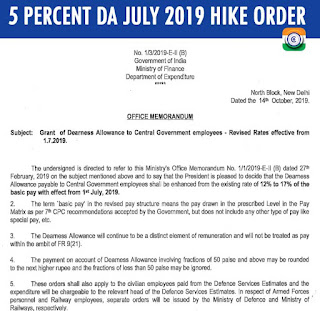
5 Percent DA July 2019 Hike Order - Grant of Dearness Allowance to Central Government employees

Grant of Dearness Allowance to Central Government employees 5 Percent DA July 2019 Hike Order  No. 1/3/2019-E- II (B) Government of...

Blog Archive

About The Author