A complete reference blog for Indian Government Employees

Showing posts with label 7th CPC Report. Show all posts

Tuesday, 18 June 2019

7th CPC - Amendment in Rule-5 of Civilian Defence Service (Revised Pay) Rules, 2016

Gazette Notification

Amendment in Rule-5 of Civilian Defence Service (Revised Pay) Rules, 2016

GOVERNMENT OF INDIA
MINISTRY OF DEFENCE
OFFICE OF THE PRINCIPAL CONTROLLER OF ACCOUNTS
PAY TECH SECTION
10-A, S.K. BOSE ROAD, KOLKATA 700001

Part.I Office Order No. AT/06
Date: 11/06/2019
To
All CsFA

Subject: Amendment in Rule-5 of Civilian Defence Service (RP) Rules, 2016.

A copy of Gazette Notification (Extraordinary) dated 25.04.2019 on the above subject circulated vide CGDA No.AT/II/ 2701/ Orders-II dated 17/5/19 received through mail, is forwarded herewith for information, guidance and necessary compliance, please.
(Dr. DL Meena)
Deputy Controller of Accounts (Fys)
MINISTRY OF DEFENCE NOTIFICATION

New Delhi, the 25th April, 2019

S.R.O. 08(E).- In exercise of the powers conferred by the proviso to Article 309, and Clause (5) of Article 148 of the Constitution, the President hereby makes the following rules to amend the Civilians in Defence Services (Revised Pay) Rules, 2016, namely :-

(1) These rules may be called the Civilians in Defence Services (Revised Pay) (Amendment) Rules, 2019.

(2) They shall be deemed to have come into force on the 1st day of January, 2016.

In the Civilians in Defence Services (Revised Pay) Rules, 2016,-

(a) in Rule 5, the following amendment be made;

For:
“Provided further that in cases where a government servant has been placed in a higher grade pay or scale b/w I" day of January, 2016 and the date of notification of these rules on account of promotion or upgradation, the government servant may elect to switch over to the revised pay structure from the date of such promotion or upgradation, as the case may be.”

Read as:
“Provided further that in cases where a government servant has been placed in a higher grade pay or scale b/w 1" day of January, 2016 and the 25" day of July, 2016 on account of promotion or upgradation, the government servant may elect to switch over to the revised pay structure from the date of such promotion or upgradation, as the case may be.”

[F. No. 11(3)/ 2016-D (Civ-D]
DR. M. SUBBARAYAN, Jt. Secy.

Note: The Civilians in Defence Services (Revised Pay) Rules, 2016 were published in the Gazette of India, Extraordinary vide number S.R.O. 11(E), dated 09th August, 2016.

Source: pcafys.nic.in
Share:

Thursday, 20 September 2018

Wrong Analysis and recommendations about NDA under 7th CPC report


Wrong Analysis and recommendations about NDA under 7th CPC report
Board's attention is invited towards this federation's letter of even number dated 2nd April, 2018 (copy enclosed), vide which it was pointed out that, on implementation of new formula, recommended by the VII CPC, rates of Night Duty Allowance get reduced rather than any improvement therein……

AIRF

No.AIRF/405(VII CPC)
Dated: September 17, 2018
The Secretary(E),
Railway Board,
New Delhi

Dear Sir,
Sub: Wrong Analysis and recommendations about NDA under 7th CPC report

Ref.: (i) Report of 7th CPC(Para 8.17.71 to 77) reg. Night Duty Allowance
(ii) RBE No.61/2016(Last NDA Rate of 6th CPC when DA at 125%)
(iii) RBE No.36/2018 No.E(P&A)II-2017/HW-1 dated 08.03.2018

Board's attention is invited towards this federation's letter of even number dated 2nd April, 2018 (copy enclosed), vide which it was pointed out that, on implementation of new formula, recommended by the VII CPC, rates of Night Duty Allowance get reduced rather than any improvement therein.

A calculation table was also appended in our letter referred to above, explaining the actual reduction in Night Duty Allowance on implementation of current formula, recommended by the VII CPC, which we are again quoting hereunder for ready reference:-

Rates of Night Duty Allowance, as per 6th CPC formula (mean value of Pay Band + GP) + DA)/215, changed by the 7th CPC, i.e. (Basic Pay + DA)/200, will decline by 20% to 40% from the existing, i.e.

Pay ScalesAs on 01.01.2016 when DA 125% (as per 6th CPC)As on 01.07.2017 when DA 139% (as per 6thCPC, rate not declared by the Board)As on 01.07.2017 when DA 5% (as per 7th CPC)
5200-20200-1800151.75161.2094.50
5200-20200-1900152.80162.30104.48
5200-20200-2000153.85163.40113.93
5200-20200-2400158.00167.85133.88
5200-20200-2800162.20172.30153.30
9300-34800-4200274.70291.80185.85
9300-34800-4600 and above278.90296.25235.73

Also rates of the NDA were not declared by the Railway Board on 01.07.2016 and 01.01.2017 as per 6th CPC.

It is, therefore, reiterated that, the issue may be looked into afresh in the light of the foregoing, and improvement in the formula, recommended by the VII CPC, may be done, so that, rates of Night Duty Allowance get improved rather than any reduction therein.

This may kindly be treated as "Most Urgent" as there is serious discontentment brewing among the staff, particularly Running and Traffic Staff and other Safety Categories Staff who have to invariably perform night duty.
Yours faithfully,
sd/-
(Shiva Gopal Mishra)
General Secretary
Source: AIRF
Share:

Wednesday, 1 August 2018

7th Pay Commission Report, Burden On Finance/Exchequer, Productivity Linked Pay Hike And Any Alternative Of Future Pay Commission


7th Pay Commission Report, Burden On Finance/Exchequer, Productivity Linked Pay Hike And Any Alternative Of Future Pay Commission

GOVERNMENT OF INDIA
MINISTRY OF FINANCE
LOK SABHA

UNSTARRED QUESTION NO: 1652
ANSWERED ON: 27.07.2018

Pay Commission Reports
RAJENDRA AGRAWAL
Will the Minister of FINANCE be pleased to state:-

(a) whether the reports of successive Pay Commissions have been increasing the burden on Government finances/exchequer in partially accepting their recommendations for increase in wages and if so, the details thereof;

(b) whether the last Pay Commission has suggested productivity linked pay hike to the deserving employees to eliminate below average or mediocre performance and if so, the details thereof;

(c) whether such periodic hikes in wages resulting from Pay Commission recommendations trigger similar demands from the State Government/public utility employees, imposing burden on already strained State finances and if so, the details thereof; and

(d) whether the Government is considering an alternative for increasing the salaries and allowances of Central Government employees and pensioners in future instead of forming Pay Commission and if so, the details thereof?

ANSWER

MINISTER OF STATE IN THE MINISTRY OF FINANCE (SHRI P. RADHAKRISHNAN)

(a) The financial impact of the recommendations of the Central Pay Commission, as accepted by the Government, is normally pronounced in the initial year and gradually it tapers off as the growth in the economy picks up and fiscal space is widened. While implementing the recommendations of the last Central Pay Commission, i.e., the Seventh Central Pay Commission, the Government staggered its implementation in two financial years. While the recommendations on pay and pension were implemented with effect from 01.01.2016, the recommendations in respect of allowances after an examination by a Committee have been implemented with effect from 01.07.2017. This has moderated the financial impact of the recommendations. Moreover, unlike the previous 6th Pay Commission, which entailed substantial impact on account of arrears, the impact in the year 2016-17 on account of element of arrears of revised pay and pension on the present occasion of the 7th Central Pay Commission pertained to only 2 months of the previous financial year of 2015-16.

(b) The Seventh Central Pay Commission in Para 5.1.46 of its Report proposed withholding of annual increment in the case of those employees who are not able to meet the benchmark either for Modified Assured Career Progression (MACP) or regular promotion within the first 20 years of their service.

(c) The service conditions of employees of State Governments fall within the exclusive domain of the respective State Governments who are federally independent of the Central Government. Therefore, the concerned State Governments have to independently take a view in the matter.

(d) No such proposal is under consideration of the Government.

Source: http://nfpe.blogspot.com/
Share:

Wednesday, 27 December 2017

NFIR New Year Message


NFIR New Year Message

No.IV/NFIR/7 CPC(Imp)/Allowance/2016/Part I


Dated: 25/12/2017
MESSAGE

Dear Brothers/Sisters,

We Will be celebrating New Year Day on January 1, 208 with disappointment and  agony as the Government has done grave injustice by reducing the percentage or various  Allowances and also by not granting the Allowances from 1st January. 2016. Almost all Railway employees in all corners Of Indian Railways have been deprived Of their legitimate Allowances in terms Of percentages existed prior to acceptance Of 7th CPC report.

The Running Staff, Brothers/Sisters, are aware that NFIR has placed cogent case before the Railway Board for hiking Kilometrage rates on the basis of Running Allowance formula and revision of TA rates. Our presentation was admired by the Running Staff. The Railway Board has discussed with NFIR twice on revision of Running Allowance rates and on both the occasions we conveyed the logic for upward revision or mileage rates and also revision of other related Allowances.

It is sad to mention that the decisions reached negotiated settlement concerning various categories of employees are yet to be implemented while we are walking into New Year on 1st January, 2018. As part of celebrations, everyone of us should convey our deep sense Of disappointment and anguish to the Railway Ministry and the Government and at the same time urge the Government to respond to our issues quickly and positively.

Yours fraternally,

sd/-
(Dr. M.Raghavaiah)
General Secretary
Source: NFIR
Share:

Sunday, 22 October 2017

Clarification regarding pay fixation under 7th CPC for the post of 'Trainee' appointed on compassionate grounds


Clarification regarding pay fixation under 7th CPC for the post of 'Trainee' appointed on compassionate grounds

CGDA, Ulan Batar Road, Palam, DelhiCantt-110010
No.AN/XIV/14164/7th CPC/corrsp/Vol-II
Dated: 11/10/2017
To
All PCsDA/CsDA/PCof A(Fys) Kolkata

Subject: Clarification regarding pay fixation under 7th CPC for the post of 'Trainee' appointed on compassionate grounds.

Reference: This HQrs Circular of even no dated 01/02/2016.
With reference to the above cited circular, Ministry of Finance Dept. of Expenditure to whom the matter was referred has since clarified as under:

"Level -1 of the Pay Matrix introduced on implementation of the 7th CPC Report be the replacement for the pre-revised -IS scale. The pay of those governed by the IS scale may be revised by using the fitment factor of 2.57 for placement in Level -1 in conformity with the Rule 7 of the CCS(RP)Rules 2016. All pre-revised pay stages lower than pre-revised pay of Rs 7000 in the pre-revised -IS scale shall not be considered for determining the benefit of bunching, on the same lines as has been clarified by MoF(DoE)'s OM dated 3.08.2017 on application of the benefit on account of bunching".

2.This is for your information and necessary action please. All pay fixation cases may be regulated accordingly.
S/d,
(Kavita Garg)
Sr.Dy.CGDA(AN)
Source: CGDA
Share:

Wednesday, 11 October 2017

Fixation of the pay of the pre-revised pay scale of 1S scale granted to candidates appointed as trainees on compassionate grounds in the Seventh Central Pay Commission (7th CPC)


Fixation of the pay of the pre-revised pay scale of 1S scale granted to candidates appointed as trainees on compassionate grounds in the Seventh Central Pay Commission (7th CPC)
compassionate grounds in the Seventh Central Pay Commission (7th CPC)


No. 14014/2/2009-Estt,D
Government of India
Ministry of Personnel, Public Grievances and Pensions
(Department of Personnel & Training)
North Block, New Delhi
Dated the 09th October, 2017
OFFICE MEMORANDUM

Sub : Fixation of the pay of the pre-revised pay scale of 1S scale granted to candidates appointed as trainees on compassionate grounds in the Seventh Central Pay Commission (7th CPC) - reg.

The undersigned is directed to invite attention to this Department's 0.M.No.14014/02/2012-Estt(D) dated 16.01.2013 containing consolidated instructions on the subject of compassionate appointments. With regard to appointment of candidates not immediately meeting the educational standards as trainees these instructions provide as under:

"In exceptional circumstances Government may consider recruiting persons not immediately meeting the minimum educational standards. Government may engage them as trainees who will be given the regular pay bands and grade pay only on acquiring the minimum qualification prescribed under the recruitment rules. The emoluments of these trainees, during the period of their training and before they are absorbed in the Government as employees, will be governed by the minimum of the - 1S pay band Rs.4440-7440 without any grade pay. In addition, they will be granted all applicable Allowance, like Dearness Allowances, House Rent Allowance and Transport Allowance at the admissible rates. The same shall be calculated on the minimum -IS pay band without any grade pay. The period spent in the -1S pay band by the future recruits will not be counted as service for any purpose as their regular service will start only after they are placed in the pay band PB-1 or Rs.5200-20200 along with grade pay of Rs.1800."

2. The 7th CPC has not provided any replacement scale for 1S pay, band of Rs.4440- 7440 without any grade pay which is granted to trainees appointed under the scheme for compassionate appointment. The matter was taken up with the Department of Expenditure and it has now been decided by the Government that Level-1 of the Pay Matrix introduced on implementation of the 7th CPC Report be the replacement for the pre-revised- 1S scale. The pay of those governed by the 1S scale may be revised by using the Fitment Factor of 2.57 for placement in Level-1 in conformity with the Rule, 7 of the CCS (RP) Rules, 2016. All pre - revised pay stages lower than pre-revised pay of Rs.7,000 in the pre-revised 1S scale shall not be considered for determining the benefit of bunching, on the same lines as has been clarified by this Department's 0.M dated 03.08.2017 on application of the benefit on account of bunching.

3. This will be effective from 01.01.2016.
(G.Jayanthi)
Joint Secretary (E-I)
Download PDF
Share:

Monday, 4 September 2017

Recompute 7th CPC Minimum Pay & Multiplication Factor - Anomaly in computation of Minimum Wage: Agenda Item for NAC Meeting


Recompute 7th CPC Minimum Pay & Multiplication Factor - Anomaly in computation of Minimum Wage: Agenda Item for NAC Meeting

Item No 1

Anomaly in computation of Minimum Wage
In Para 1.29 of Chapter 1 of the 7th CPC report, the larned Chairman of the Commission Justice Shri AK Mathur has approvingly quoted the following observation their Lordship in the Supreme Court in the case of Bhupendranath Hazarika and Another Vs. State of Assam (SC 2013 (2) Sec.516)

"........ It should always be borne in mind that legitimate aspirations of the employees are not guillotined and a situation is not created where hopes end in despair. Hope for everyone is gloriously precious and that a model employer should not convert it to be deceitful and treacherous by playing a game of chess with their seniority. A sense of calm sensibility and concerned sincerity should be reflected in every step. An atmosphere of trust has to prevail and when the employees are absolutely sure that their trust shall not be betrayed and they shall be treated with dignified fairness then only the concept of good governance can be concretized. We say no more."

Naturally the recommendations of the 7th CPC ought to have been in consonance with the spirit of the observations made in Para 1.29, While determining the Minimum Pay (Chapter 4.2). The Commission is on record to state that it shall abide by the formula of Dr WR Aykroyd as amended by Supreme Court in the case of Workmen represented by Secretary Vs. Management of Reptakos Brett and Co. Ltd and Anr. on 31st October, 1991 (Equivalent citations: 1992 AIR 504, 1991 SCR Supl. (2) 129). In its submissions made to the Govt, the Staff Side had pointed out the errors and omissions crept in the computation of Minimum wage and its consequential impact. The Commission’s recommendations in this regard was clearly in violation of what has been stated in para 1.29 (quoted above). We annex for ready reference the extracts from our own submissions pertaining to this issue.

Our submission to Cabinet Secretary on 7th CPC:

"We are not in agreement with the methodology adopted by the 7th CPC in computing the minimum WAGE. We give hereunder briefly the reasons thereof.

The retail prices of the commodities quoted by the Labour bureau is irrational, imaginary and even absurd in respect of certain articles at certain places. The Staff Side had objected to the adoption of those rates in its meeting with the Commission on 9th June, 2015.

The adoption of 12 monthly average of the retail prices is contrary to Dr. Aykroyd formula. Same is the case with the reduction effected by the Commission on housing and social obligation factors. The house rent allowance is not a full compensation of the expenditure incurred by an employee for obtaining an accommodation. Therefore, no reduction on that count in arriving at the minimum wage is permissible. We may cite the minimum wage computation made by the 3rd CPC in this regard. The employees were in receipt of HRA even at that time. But still the 3rd CPC, and rightly so, adopted the 7.5% as the factor for housing. In respect of the addition to be made for children education and social obligation as per the Supreme Court judgement, (25%) the Commission has reduced the percentage to 15% on the specious plea that the employees are separately given children education allowance. The Children education allowance is not a full reimbursement of the expenses one has to incur. After the liberalization of the Education Sector where private parties were allowed to set up universities and colleges, the expenses for education had increased heavily. No concession or allowance is granted to the employees for educating the children beyond the higher secondary levels. The earlier Pay Commission has only tried to compensate a little in the increasing cost of education and that too at the primary level, since even the Governmental institutions had started charging abnormal tuition and other fees.

The website maintained for the Agriculture Ministry depicts the retail prices of commodities which go into the basket of minimum wage computation. Even though the rates quoted by them vary from the real retail prices in the market, it provides a different picture. If one is to take the rates quoted by them for different cities and make an all India average of the prices as on 1.7.2015, it will work out to Rs. 10810. It will result in the computation of the minimum wage of Rs. 19880. Adding 25% for arriving at the MTS scale, it will rise to Rs. 24850. To convert the same as on 1.1.2016, 3% will be added as suggested by the 7th CPC. The final computation will be Rs. 25,596, when rounded off shall be Rs. 26000.

The Andhra Pradesh State Pay Commission in its report has taken the commodity prices at Rs. 9830,- as on 1.7.2013 which works out to a minimum wage of Rs. 18080. The wage of MTS will then be Rs. 22600 as on 1.7.2013. The Corresponding figure for 1.1.2016 shall be Rs. 26758, rounded off to Rs. 27000.
The Staff side had computed the minimum wage as on 1.1.2014 at Rs. 26,000, taking the commodity price at Rs. 11344. The rates were taken on the basis of the actual retail prices in the market as on 1.1.2014 (average prices of 8 Cities in the country) substantiated by the documentary evidence of Cash bill obtained from the concerned vendors. As on 1.12016, the minimum wage work out to Rs. 29339, rounded off to Rs. 30,000.

The 5th CPC adopted the rate of growth in the economy (as reflected in the increase in the per capita net national produce at factor cost) over a period of ten years to arrive at the increase required to be made to arrive at the minimum wage. The per capita NNP at factor cost registered an increase of 65.28% over a period of ten years in 2013-14. If we apply the same percentage to the emoluments (Pay +DA) as on 1.1.2016 (assuming that DA will be 125% as on that date), the minimum wage as on 1.1.2016 for an MTS will have to be Rs. 26030, rounded off to Rs. 27000.

In para 4.2.9 of the report, the Commission has given a table depicting the percentage increase provided by the successive Pay Commissions, according to which the 2nd CPC had made a paltry increase of 14.2%. The 3rd CPC gave a rise of 20.6, 4th 27.6, 5th 31.0 and 6th CPC 54%. While the per centage increase had been in ascending order all along, the 7th CPC has sought to reverse that trend ostensibly for reasons unknown. It was the meager increase of 14% provided for by the 2nd CPC that triggered the volatile situation in the civil service and led to all India strike encompassing all employees which lasted for 5 days in 1960.

In the case of Bank, Insurance and many other Public Sector Undertakings wage revision takes place once in 5 years. In the recently concluded agreement, Bank employees were provided more than 15% increase.
After the implementation of the Pay Commission Report the AP State Employees have been given a wage structure based on a minimum wage for above the level of Central Government employees. In their case also wage revision does take place once in 5 years.

It could be seen from the above that the computation of minimum wage by the 7 CPC is prima facie wrong and computed on untenable premises and incorrect data. The minimum wage therefore requires re-computation and revision. Once the minimum wage gets revised, the fitment formula, the multiplication factor applied for determining the pay levels and the pay matrix itself will have to be consequently revised."

It could be seen from the above extract that the Minimum Wage as on 1.1.2016 could not have been computed at less than Rs 26000/- and consequently the multiplication factor ought to have been at 3.714. It is, therefore, demanded that the Minimum Wage and multiplication factor may be recomputed and Pay Level and Pay matrix changed in accordance with the revised minimum wage.
Share:

Sunday, 30 July 2017

7th CPC Promotion : Fixation of Pay on Promotion from the Date of Next Increment Option - Dopt Orders with Illustration

7th CPC Promotion : Fixation of Pay on Promotion from the Date of Next Increment Option - Dopt Orders with Illustration

Availability of option for fixation of pay on promotion from the Date of Next Increment (DNI) in the lower post and method of fixation of pay from DNI, if opted for, in context of CCS (RP) Rules, 2016-regarding.
No.13/02/2017-Estt.(Pay-I)
Government of India
Ministry of Personnel, Public Grievances and Pensions
Department of Personnel & Training

North Block, New Delhi Dated 27th July, 2017

OFFICE MEMORANDUM

Subject: Availability of option for fixation of pay on promotion from the Date of Next Increment (DNI) in the lower post and method of fixation of pay from DNI, if opted for, in context of CCS (RP) Rules, 2016-regarding.

Prior to implementation of 6th CPC Report, the pay fixation on promotion was governed by provisions of FR 22(I)(a)(1). In 6th CPC context, the first part of FR 22(I)(a)(1) was replaced by Rule 13 of CCS (RP) Rules, 2008. Similarly, consequent upon implementation of CCS (RP) Rules, 2016 in 7th CPC context, the pay fixation on promotion is regulated by the provisions of Rule 13 of CCS (RP) Rules, 2016. This rule regulates pay fixation on promotion if the same is opted by the employee from the date of promotion itself. The issue of relevancy of provisions of FR 22(I)(a)(1) as well as the methodology of fixation of pay on promotion to a post carrying duties and responsibilities of greater importance, of a Government Servant in case he opts for pay fixation from the Date of Next Increment (DNI) has been considered in this Department.

2. In this context, proviso under FR 22(I)(a)(1) inter-alia provides that the Government Servant (other than those appointed on deputation basis to ex-cadre post or on ad-hoc basis or on direct recruitment basis) shall have the option, to be exercised within one month from the date of promotion, to have the pay fixed under this rule from the date of such promotion or to have the pay fixed from the date of accrual of next increment in the scale of the pay in lower grade.

3. After due consideration in this matter, the President is pleased to decide as follows:

(i) FR 22(I)(a)(1) holds good with regard to availability of option clause for pay fixation, to a Government Servant holding a post, other than a tenure post, in a substantive or temporary or officiating capacity, who is promoted or appointed in a substantive, temporary or officiating capacity, as the case may be, subject to the fulfilment of the eligibility conditions as prescribed in the relevant Recruitment Rules,to another post carrying duties or responsibilities of greater importance than those attaching to the post held by him/her. Such Government Servant may opt to have his/her pay fixed from the Date of his/her Next Increment (either 1st July or 1st January, as the case may be) accruing in the Level of the post from which he/she is promoted, except in cases of appointment on deputation basis to an ex-cadre post or on direct recruitment basis or appointment/promotion on ad-hoc basis.

(ii) In case, consequent upon his/her promotion, the Government Servant opts to his/her pay fixed from the date of his/her next increment (either 1st July or 1st January, as the case may be) in the Level of the post from which Government Servant is promoted, then, from the date of promotion till his/her DNI, the Government Servant shall be placed at the next higher cell in the level of the post to which he/she is promoted.

7th CPC Promotion Chart


(iii) Subsequently, on DNI in the level of the post to which Government Servant is promoted, his//her Pay will be re-fixed and two increments (one accrued on accoun tof annual increment and the second accrued on account of promotion) may be granted in the Level from which the Government Servant is promoted and he/she shall be placed, at a Cell equal to the figure so arrived, in the Level of the post to which he/she is promoted; and if no such Cell is available in the Level to which he/she is promoted, he/she shall be placed at the next higher Cell in that Level.

Promotion Chart 7th CPC


(iv) In such cases where Government Servant opts to have his/her pay fixed from the date of his/her next increment in the Level of the post from which he/she is promoted, the next increment as well as Date of Next Increment (DNI) will be regulated accordingly.

4. It is further reiterated that in order to enable the officials to exercise the option within the time limit prescribed, the option clause for pay fixation on promotion with effect from date of promotion/DNI shall invariably be incorporated in the promotion/appointment order so that there are no cases of delay in exercising the options due to administrative lapse.

5. In so far as their application to the employees belonging to the Indian Audit and Accounts Department is concerned, these orders issue in consultation with the Comptroller &Auditor General of India.
sd/-
(Pushpender Kumar)
Under Secretary to the Government of India
Authority: www.dopt.gov.in
Share:

Friday, 31 March 2017

Grievances of the Central Government Employees : NC JCM


Grievances of the Central Government Employees : NC JCM

NC JCM writes to the Cabinet Secretary to settle various issues, including revision of HRA

Grievances of the Central Government Employees - Secy./Staff Side writes to Cabinet Secretary

Shiva Gopal Mishra
Secretary
Ph: 23382286
National Council (Staff Side)
Joint Consultative Machinery
for Central Government Employees
13-C, Ferozshah Road, New Delhi - 110001
E-Mail : nc.jcm.np@gmail.com
No.NC/JCM/2017
Dated: March 29, 2017
The Cabinet Secretary,
Government of India,
Cabinet Secretariat,
Rashtrapati Bhawan,
New Delhi

Dear Sir,
Sub: Grievances of the Central Government Employees

Owing to serious discontentment on various retrograde recommendations of the VII CPC, there had been countrywide resentment among the Central Government Employees, and the Staff Side(JCM), under the aegis of the NJCA, had decided for an "Indefinite Countrywide Strike", commencing from 6th July, 2016, which was deferred after negotiations with the GoMs, comprising of Hon'ble Minister for Home Affairs, Finance Minister, Railway Minister and State Minister for Railways, held on 30.06.2016, wherein it was assured that, demands of the Central Government Employees, viz. improvement in Minimum Wage and Fitment Formula, Rates of Allowances, Guaranteed Pension/Family Pension in lieu of NPS etc. would be resolved within a fixed time frame of four months, for which committees were constituted by the Government of India.

While substantial delay took place in setting-up of various committees itself, however, it is a matter of deep concern that, the committees have not yet finalized their reports despite lapse of more than eight months time.
The Staff Side had, at the very outset, opposed setting-up of Committee on Allowances, demanding upward revision and restoration of certain allowances which were recommended to be abolished by the 7th CPC, nevertheless, the government on the contrary constituted the said committee.

It may be recalled that, it has been an established convention in the past also that, payment of the revised rates of the allowances is done w.e.f. the date of implementation of the report of the Central Pay Commission, but this time, unlike previous occasion, the Central Government Employees are still being paid House Rent Allowance, Transport Allowance etc. on the pre-revised rates.

It was being expected that, Committee on Allowances would complete its proceedings within the fixed timeframe and the CGEs would be paid allowances on the revised rates w.e.f. the date of implementation of the 7th CPC report, but unfortunately, it is being delayed inordinately, owing to which there is serious resentment brewing among the CGEs.

While Committee on Allowances also met on the previous day, i.e. 28.03.2017, and we were expected that it would finalize its recommendations in the said meeting, but on enquiring we have been made to understand that, the issue of revision of rates of HRA was even not discussed in the said meeting.

We, therefore, take this opportunity to apprise you that, unjustified and inordinate delay in finalizing the reports of the committees is not only breach of the assurance given to the Staff Side by the GoMs, but also creating an uncongenial atmosphere among the CGEs.

It would, therefore, be quite appropriate that, the issue may be considered with all seriousness as per assurance given to the Staff Side, and revision of the rates of the allowances, NPS, Minimum Wage and Fitment Formula and Pension/Family Pension, along with restoration of certain allowances abolished by the 7th CPC, be finalized without further loss of time in the larger interest of industrial harmony in the country.
With Kind Regards!
Yours faithfully,
sd/-
(Shiva Gopal Mishra)
Secretary
Source: www.ncjcmstaffside.com
Share:

Grant of Dearness Allowance to Central Government employees - Revised Rates effective from 1.1.2017


Grant of Dearness Allowance to Central Government employees - Revised Rates effective from 1.1.2017
Grant of Dearness Allowance to Central Government employees

DA Order Jan 2017 - Finmin Released Dearness Allowance Order

No. 1/3/2017-E-II(B)
Government of India
Ministry of Finance
Department of Expenditure
North Block, New Delhi
Dated the 30th March, 2017.
OFFICE MEMORANDUM

Subject : Grant of Dearness Allowance to Central Government employees - Revised Rates effective from 1.1.2017.

The undersigned is directed to refer to this Ministry's Office Memorandum No. 1/2/2016-E-II (B) dated 4th November, 2016 on the subject mentioned above and to say that the President is pleased to decide that the Dearness Allowance payable to Central Government employees shall be enhanced from the existing rate of 2% to 4% of the basic pay with effect from 1st January, 2017.

2. The term 'basic pay' in the revised pay structure means the pay drawn in the prescribed Level in the Pay Matrix as per 7th CPC recommendations accepted by the Government, but does not include any other type of pay like special pay, etc.

3. The Dearness Allowance will continue to be a distinct element of remuneration and will not be treated as pay within the ambit of FR 9(21).

4. The payment on account of Dearness Allowance involving fractions of 50 paise and above may be rounded to the next higher rupee and the fractions of Tess than 50 paise may be ignored.

5. The payment of arrears of Dearness Allowance shall not be made before the date of disbursement of salary of March, 2017.

6. These orders shall also apply to the civilian employees paid from the Defence Services Estimates and the expenditure will be chargeable to the relevant head of the Defence Services Estimates. In respect of Armed Forces personnel and Railway employees, separate orders will be issued by the Ministry of Defence and Ministry of Railways, respectively.

7. In so far as the employees working in the Indian Audit and Accounts Department are concerned, these orders are issued with the concurrence of the Comptroller and Auditor General of India.
(Nirmala Dev)
Deputy Secretary to the Government of India
DA Order Jan 2017
Share:

Sunday, 8 January 2017

Meeting with the Staff Side (JCM) on the recommendations of the 7th CPC and their implementation


Meeting with the Staff Side (JCM) on the recommendations of the 7th CPC and their implementation.
Shiva Gopal Mishra
Secretary
No.NC/JCM/2016
Ph.: 23382286
National Council (Staff Side),
13-C, Ferozshah Road, New Delhi - 110001
E Mail : ncjcm.np@gmail.com
Dated: December 29, 2016
The Addl. Secretary(Exp.),
Department of Expenditure,
Ministry of Finance,
North Block,
New Delhi

Dear Sir,
Sub: Meeting with the Staff Side (JCM) on the recommendations of the 7th CPC and their implementation.

We had our last meeting on 24th October, 2016, wherein, while concluding, it was assured that, you would consult the Secretary (Expenditure) and would hold next meeting shortly. It is quite unfortunate that, so far much time have passed and nothing has been heard from your end.

Inordinate delay in Revision of Minimum Wage and Fitment Formula is creating lots of problems, and the Central Government Employees are agitated because this issue had been agitating their minds since implementation of 7th CPC Report

You are, therefore, requested to call a meeting with the Staff Side(JCM) to discuss and resolve these issues at the earliest.
With Kind Regards!
Sincerely yours,
(Shiva Gopal Mishra)
Source : ncjcmstaffside
Share:

Saturday, 7 January 2017

7th CPC Report : Revision of Minimum Wage and Multiplying Factor etc., Assurance given by Senior Ministers

7th CPC Report : Revision of Minimum Wage and Multiplying Factor etc., Assurance given by Senior Ministers

No.IVA {JCA (Ny2014/Part III)}
Dated: 27.12.2016
Shri Narendra Modiji,
Hon’ble Prime Minister of India.
South Block,
Raisina Hill,
New Delhi-110001

Respected Sir,

Sub: 7th CPC Report - Revision of Minimum Wage and Multiplying Factor etc., Assurance given by Senior Ministers-reg.

NFIR brings to your kind notice that the National Joint Council of Action (NJCA) - consisting JCM constituent organizations of Central Government employees have deferred the Indefinite Strike action on the assurance of Senior Cabinet Ministers on 30th June 2016 that a High Level Committee will be constituted to consider the demands of JCM (Staff Side) within four months for improving the minimum wage and applying revised multiplier factor for pay fixation in 7th CPC Pay Matrices to the Central Government employees which include over 1.3 million Railway employees.

Pursuant to the assurance of Group of Ministers as mentioned above, the decision to go on indefinite strike by Railway employees has been deferred, hoping that there shall be a negotiated settlement on the Charter of demands already submitted to the Cabinet Secretary by the JCM (Staff Side).

NFIR however expresses its deep sense of disappointment over breach of commitment as more than five months passed from the date of assurance given to the Leaders of JCM (Staff Side) by the Group of Ministers (Hon’ble Finance Minister, Home Minister, Railway Minister and Minister of State for Railways). The Railways specific issues on which agreement was reached between the Railway Board and the Federations have also not been implemented till date.

The Railway employees of all categories are greatly disappointed over non-fulfillment of assurances, consequently, there has been a feeling among Rail workforce that the Government is not sensitive towards resolving their genuine grievances and equally not sincere to honour its commitments.

NFIR also beings to your kind notice that even though the successive Railway Ministers have sent proposals to Finance Minister that Railways should be exempted from National Pension System (NPS) in view of complexities, unique nature of working of Railway employees and their arduous working conditions, the Government has not given its approval till now, resultantly, the Railway employees who had joined from 01/01/2004 are extremely agitated as there is no social security to them and their families in the form of guaranteed pension at par with those appointed prior to 0110112004. The unique nature of duties are comparable with Defence Forces Personnel. The death rate of Railway employees in the course of performing duties is 700 per aturum and the average number of staff injured on duty is about 3000 per annum as reported by the High Level Safety Review Committee headed by Dr. Anil Kakodkar.

NFIR further brings to your kind notice that the Indian Railways has the track record of dedicated working on account of unquestionable loyalty, dedication and devotion of Railway employees to Indian Railways. Most of them perform duties at remote places, jungle areas where minimum living facilities are not available. It needs to be appreciated that not a single man day was lost on employees’ account during the past four decades.

NFIR, therefore, requests your kind intervention in ensuring that the Government implements its commitments on revision of minimum wage and multiplier factor for the Central Governrirent employees which include rail workforce. Federation also requests that other issues which are pending before various Committees constituted by the Government may be got finalized on the basis of submissions made by JCM (Staff Side) before those Committees and also before the Cabinet Secretary. NFIR at the same time requests to kindly arrange to issue appropriate directive for solving Railways’ specific issues through negotiated settlement very soon. Also kind attention of Hon’ble Prime Minister is invited to NFIR's communication vide letter of even number dated 0111112016 and subsequent reference by the PMO to the Secretary, Department of Expenditure (Ministry of Finance) vide PMO ID No. PMOPG//D1201610326695 dated04lIl12016, endorsing copy to the Federation, in this regard.
With regards,
(Dr. M. Raghavaiah)
General Secretary

Copy to Shri Rajnath Singh, Union Home Minister, Government of India, Room No. 104, North Block, Central Secretariat, New Delhi-110001 for necessary action please.
Copy to Shri Arun Jaitley, Hon’ble Finance Minister, Government of lndia, North Block New Delhi- 1 I 000 I for necessary action please.
Copy to Shri Suresh Prabhu, Hon’ble Minister for Railways, Government of India, Rail Bhavan, New Delhi for necessary action please.
Copy to Shri Manoj Sinha, Hon’ble Minister of State for Railways, Government of India, Rail Bhavan, New Delhi for necessary action please.

Source: NFIR
Share:

Friday, 16 September 2016

INDIAN RAILWAYS TECHNICAL SUPERVISORS ASSOCIATION

INDIAN RAILWAYS TECHNICAL SUPERVISORS ASSOCIATION
(Estd. 1965, Regd. No.1329, Website http://www.irtsa.net )

M. Shanmugam,
Central President, IRTSA
# 4, Sixth Street, TVS Nagar, Padi, Chennai  600050.
Email: cpirtsa@yahoo.com
Mob: 09443140817
Harchandan Singh,
General Secretary, IRTSA,
C.Hq. 32, Phase 6, Mohali, Chandigarh-160055.
Email-gsirtsa@yahoo.com
(Ph:0172-2228306, 9316131598)
No: IRTSA/CHQ/Memo/CPC-All-2016-15
Date: 12-09-2016

1. Finance Secretary & Secretary (Expenditure), North Block, New Delhi- 110001. Email: secy-exp@nic.in
2. Secretaries of Home Affairs, North Block, New Delhi - 110001 Email: hshso@nic.in
3. Secretary Defence, 101 South Block, New Delhi - 110001 Email: defsecy@nic.in
4. Secretary Post, Deptt. of Post, Sanchar Bhawan, Sansad Marg, New Delhi 110001 Email: secy-posts@nic.in
5. Secretary Health & Family Welfare, Nirman Bhawan, New Delhi - 110001 Email: secyhfw@gmail.com
6. Secretary Personnel & Training, North Block, New Delhi - 110001 Email: secy_mop@nic.in
7. Chairman, Railway Board, Rail Bhawan, New Delhi - 110001. Email: crb@rb.rail.net.gov.in

For kind consideration of the Committee of Secretaries on Allowances

Respected Sir,

Subject: 7th CPC Report - Reg. Allowances

Reference: Para 7 of Resolution of MOF GOI Notification No. 1-2/2016-IC Dated 25-7-2016
We have to submit as under for the kind consideration of the Committee on Allowances:

1. Seventh CPC in its report has categorized 196 allowances under 15 categories. Common allowances viz., Dearness Allowance, House Rent Allowance, Transport Allowance, Tour Travelling Allowance and Children Education Allowance, which fall under 3 categories i.e. Common Allowances, Department Specific Allowances and Category Specific Allowances.

Allowances are administered in broadly four ways
i. Indexed fully DA
ii. Indexed partially DA
iii. No DA indexation
iv. Percentage of Basic Pay

2. UNJUST AND ARBITRARY RECOMMENDATIONS:

a) It is regretted that none of the Allowances were dealt in detail and the Commission had recommended for abolition of 52 allowances without even going into the merit or justification of either of them.

b) Recommendations made by 7th CPC on allowances were not based on a just approach and there is need to review & revise the recommendations of 7th CPC on all allowances.

3. None of the previous Pay Commissions had ever dealt with the issue in such a ruthless, arbitrary and unjust manner, without even applying its mind to such a vital issue which affected lakhs of employees. All these Allowances had been granted as per statutory provisions of law and specific justifications and on the recommendations of the previous Pay Commissions or High Powered Committees on the specific issues.

As such, no allowances should be abolished and it should be left to the respective departments for the continuance of allowances as per nature of duties & job requirements.

4. CLASSIFICATION OF EXISTING ALLOWANCES:

As mentioned by the Pay Commission, the existing Allowances can be broadly classified as under:
SlNo.CategoryNumber of Allowances
1Allowances payable for Additional/Extra Duty14
2Allowances related to Knowledge Updates3
3Allowances related to Deputation3
4Allowances related to Working on Holidays3
5Allowances related to Housing7
6Allowances related to Good Service4
7Qualification Allowances15
8Allowances related to Risk and Hardship51
9Allowances for Running Staff of Indian Railways13
10Allowances related to Sports2
11Sumptuary Allowances5
12Allowances related to Training2
13Allowances related to Travel13
14Allowances related to Uniform9
15Other Allowances52
Total196

5. UNJUST FACTOR OF 2 ADOPTED BY 7TH CPC TO CALCULATE ALLOWANCES IN 7TH CPC SCALE (Para 4 of Chapter 8.2.5)

a. 7th CPC has used unjust factors to arrive at quantum of allowances in new pay.
b. Multiple Factor (of 2.57 recommended by 7th CPC - as may be revised by the Govt.) for revision of pay by 7th CPC be used for revision of allowances paid in fixed amount.
c. Factor of 80% of MF be used for allowances that are indexed partially with DA.
d. Factor of 40% of MF be used for allowances that are indexed fully with DA.
e. Factor of 1 be used for allowances that are paid on percentage of Basic Pay.

SNNature of AllowanceFactor recommended by 7th   CPCFactor proposed   *
1Allowances that are paid in fixed amount not indexed with DA2.252.57
2Allowances that are paid in fixed amount indexed partially with DA1.52
3Allowances that are paid in fixed amount indexed fully with DANo change1.4
4Allowances that are paid in percentage of Basic Pay0.81
* Multiple factor recommended by 7th CPC (or) as may be revised by the Govt.

6. ALLOWANCES APPLICABLE TO RAILWAYS

1. Sub: PCO ALLOWANCE (para 8.17.101) - Reduction recommended by 7th CPC is unjust and should not be implemented:

a. Incentive system followed in Indian Railways is unique for its system & within Railway Budget. The system is cost effective since it improved the productivity by better utilization of men, machine & infrastructure. By introducing incentive system in the Production Units & Workshops, Indian Railways improved its efficiency.

b. Technicians, Junior Engineers, Senior Section Engineers & helpers working in shop / section are included in the incentive system. Direct Incentive (at piece rate) is being paid to Technicians working in four grades. Average incentive based on the performance of individual shop / section is being paid to helpers & Junior Engineers. Technicians, helpers and Junior Engineers are paid at hourly rates as per RBE No.194/2009. Senior Section Engineers working in shop floor are paid 15% of their basic pay as incentive.

c. Junior Engineers & Technicians who are posted in production control organization on tenure basis in the same grade are eligible for PCO allowance in lieu of incentive at the rate of 15% of their basic pay. Likewise Senior Section Engineers who are posted in production control organization on tenure basis are eligible for PCO allowance in lieu of incentive at the rate of 7.5% of their basic pay.

d. Revision of incentive rates along with productivity improvement by reducing allowed time is being done in Railways after the implementation of every Pay Commission recommendations in a holistic manner.

e. In the year 1999 while revising the incentive rates 12.5% fatigue & contingency allowances were reduced from the allowed time. In the year 2009 while revising the incentive rates 5% allowed time had been reduced across the board. Effectively 17.5% of additional man power and corresponding additional infrastructure were made available to improve the productivity.

f. Incentive rates & PCO allowance are integral part of Incentive system being followed in Railways. Revision of incentive rates & PCO allowance have to done at same time by taking all factors including productivity improvement into consideration.

g. Hence 7th CPC’s recommendations on PCO Allowance may please be ignored and the same be continued to be paid at the existing rates of 15% & 7.5% of new basic pay respectively.

2. BREAKDOWN ALLOWANCE (para 8.10.8 & 8.10.80) Recommended for abolition needs to be continued:

a. 7th CPC has recommended for abolition of Breakdown allowance stating that it is part of Government employees’ duty to respond to emergencies.

b. Breakdown Allowance is being paid to the employees who constitute breakdown squad. Work down during breakdown is not of routine nature and it requires special skill to restore railway operation in case of emergency.

c. It also fixes responsibility to breakdown squad to respond immediately to any emergencies as per laid down procedures.

d. It is therefore requested to continue Breakdown allowance atleast equal to one day basic pay rounded off to next hundreds as per the table given below.

Proposed Rates of Break Down Allowance:
S.No.CategoryRevised Pay StructureAmount of Break down Allowance/monthProposed
BD Allowance
Pay
Band
Grade
Pay
1Helper & Gr ‘D’ staffPB-11800Rs.80 p.m.Rs.600
2.Technician Gr.IIIPB-11900Rs.120 p.m.Rs.700
3Technician Gr.II Technician Gr.IPB-1PB-12400 & 2800Rs.160 p.m.Rs.900
4.Sr. Technicians  Junior Engineers and Senior Section EngineersPB-24200 & 4600Rs.200 p.m.Rs.1200

3. NATIONAL HOLIDAY ALLOWANCE (para 8.6.11):

a. National Holiday Allowance (NHA) is paid to the Group ‘C’ Staff - when they are required to work on National Holiday. Rate of NHA is already very marginal, 7th CPC has further reduced it in terms of percentage to entry basic pay.

b. It is requested that
i. National Holiday Allowance be paid at least equal to one day wage including DA (or)
ii. Percentage to entry basic pay applied in 6th CPC shall be applied for 7th CPC basic pay as given in the table. It should be paid for working on holidays including Sundays if the employees are not given compensatory rest, and NDA may please be raised further by 25% each time DA increases by 50%.
Desg
6th CPC7th CPC
Proposed
Entry BPNH% to BPPay LevelEntry  BPNH
Recommended
by 7th CPC
%to BPApplying 6th CPC%One Day
Pay 7th CPC
BP+DA
Helper70002563.7L1180003842.1658600+DA
TechGr
-III
77302563.3L2199003841.9659663+DA
TechGr
-II
99103183.2L4255004771.9818850+DA
TechGr
-I
113604203.7L5262004771.8969873+DA
Sr.Tech135004203.1L6354006301.811011180+DA
JE135004203.1L6354006301.811011180+DA
SSE171404202.5L7449006301.411001497+DA

4. TEACHING ALLOWANCE - be paid 30% of Basic pay (para 8.14.8 & 8.14.9):

a. Given to all non-permanent faculty members joining training institutions on deputation.

b. In 1986 when this allowance was introduced 30% of total emoluments were granted. Fourth CPC reduced it to 30% of basic pay. In the year 1991-92 due to the resource crunch, the allowance was reduced to 15 % of basic pay.

c. Training allowance is granted to non-faculty members, to attract more intelligent and knowledgeable persons to the training institutes. Due the availability of incentive schemes and other benefits the present rate of Training allowance does not motivate intelligent and knowledgeable persons to join Training institutions.

d. Even though Sixth Pay Commission had not recommended for any change in % of basic pay paid as Training Allowance, Railways / Government have made principle decision to increase the Training Allowance from 15% to 30% keeping in view the necessity to attract more talent & expertise faculty to the Training Institutions, but still the decision has not been implemented.

e. But, 7th CPC has proposed to reduce the teaching allowance for existing 15% to 12% for non permanent training faculties’ working in various training institutes for non Gazteed staff.

f. In the present fast technological improvement scenario to attract intelligent and knowledgeable persons to the training institutions, the Training allowance should be restored to 30 % of basic pay and Eligibility for maximum period of five years recommended by 7th CPC should be ignored since many of Railway training institutes are having eight year tenure for teaching faculties.

5. RISK & HARDSHIP ALLOWANCE (para 8.10.64):

Recommendations on Risk Allowance by previous Pay Commission a narration
SecondCPCRecommended Rs.3 to unskilled staff working in Defense and Railways whose work was exceptionally heavy or whose normal duty involved special risks such as those of chemical process or those who handled explosives. Also extended to sweepers working in underground sewers.
Third CPCRecommended Rs.10. Included semi skilled workers worked in boiler plants and cold storage plants.
Committee on Risk allowanceClassified   the   beneficiaries   into   four   categories,   namely,   Semi-skilled,   skilled, supervisors and Certain gazetted and non-gazetted officers. The rate ranged from Rs.15 to Rs.100 per month.
Fourth CPCRecommended 100% increase in the existing rates.
Fifth CPCa)   Contingent Risk Relate to one-time events where the event is uncertain.b)   Continuous  Risk  Situation  where  the  risk  is  inherent  and  continuous  in  the occupational itself with adverse effects on health.
c)   Fifth  CPC  recommended  Risk  allowance  for  those  categories  which  fall  under sl.no.2.
d)   It also de-notified some of categories.
e)   Recommended Risk allowance ranged from Rs.40 to Rs.300.
Sixth CPC6th  CPC opinioned that risk factors in any job should be removed instead of making  allowance for them and all other conditions of work should be taken care in the pay scale itself.
But Sixth CPC didn’t followed its own recommendations and granted common pay scales for all non technical, technical and staff who works in open to sky areas.
a. On the Railways, especially in open line depots and yards, exposure to hot sun, heavy rain, cold climate and unhygienic open to sky work areas particularly, presence of human excreta are having continues inherent health risks as part of their occupation itself, that cannot be eliminated.

b. There are other areas which are having continuous inherent risk in their occupation - for example:

i. In Welding shops, Paint shops, Forge & Smith shop, Electroplating shops in Workshops and Production Units of Indian Railways having adverse effects of health.

ii. In Diesel Shed exposure to high noise to the decibel level of 180, working temperature around 50 degree centigrade and air pollution beyond permissible levels.

iii. In Track maintenance exposure to hot sun, heavy rain, cold climate and unhygienic open to sky working, presence of human excreta and other non-biodegradable wastes having inherent health risks.

iv. C&M Staff exposed to radiations like X-ray and many Chemicals.

c. It is therefore requested to extend Risk & hardship allowance to sheds & depots and open line Technical staff &Technical Supervisors as per medium & low risk factors of Risk & hardship Matrix recommended by 7th CPC.

6. Internet Allowance, Mobile Phone Allowance (para 8.17.61):

a. 7th CPC left it to individual departments / ministries to deal with internet, mobile & newspaper allowance. Indian Most Railways employees are using their individual mobile and / or internet to perform the official duty.

b. It is therefore requested that all the non-supervisory employees may please be granted with Rs.500 and Technical Supervisors may please be granted Rs.1000 as communication allowance. Or all supervisors may please be provided with CUG connections with free talk time of Rs.1000 per month.

7. Night Duty Allowance (para 8.17.77):

a. 7th CPC recommended for continuing the present formulation of weightage of 10 minutes for every hour of duty performed between the hours of 22.00 and 06.00. Hourly rate of equal to (BP+DA)/200 also continued.

b. It is requested that Formulation of weightage of 10 minutes for every hour of duty performed between 22.00 and 6.00 hours may please be changed to 20 minutes for every hour of duty performed between 18.00 and 6.00 hours in view of hazards of work during Night Shift.

7. GENERAL ALLOWANCES APPLICABLE TO ALL CENTRAL GOVERNMENT EMPLOYEES

1. DEARNESS ALLOWANCE (para 8.17.37)

a. The existing formula for DA is weighed heavily against the employees in view of following reasons:

b. All India Consumer Price Index (Industrial Workers) on which the presently based, is itself defective in so far as the weightage give to various items is arbitrary and not based on present day requirement.

c. By changing the base year to 2016 whatever advantage that had emerge out of the 7th Pay commission will be neutralized. for example the DA as on 1-7-2016 works out to be 7% on previous base year which would have been Rs.490 on the old Basic Pay of Rs. 7000 but it would now be only Rs. 360 i.e. 2% of new Basic Pay of Rs.18000.

d. Most importantly, the fraction of %age rise is totally ignored while declaring the revised DA. This considerably erodes the real wage every time the DA is revised. (For example the %age rise of Price Index from 1-1-2016 works out to be 2.92 but the DA as per existing system would be only 2% thus resulting in 0.92% erosion of Pay & Pension in the very first year of 7th CPC)
e. This is against the Law of Averages which lays down the principle that for rounding off the fraction below half may be ignored and the fraction more than half should be rounded off to the next higher point.

f. In any case, the fraction ignored in previous half year should be added in the next half year (for example the Average Price Index was 125.83 at the end of December, 2016. But the fraction of 0.83 was ignored and Pay rise was given only on 125%. The balance of 0.83% should be added to 2.92 for calculation the DA from July, 2016 thus DA @ 3% instead of 2% fro 1-7-2016).
It is, therefore, requested as under)

a) Weight-age given to various items in the All India Consumer Price Index, may please be modified as per present day requirements.

2. HOUSE RENT ALLOWANCE (para 8.7.3 to 8.7.16)

House rent allowance recommended by 7th CPC is inadequate
Sl.No.Classof
City
Existing
Population criteria
Existing rates as percentage of BPProposed
Population criteria
Proposed
Ratesof H.R.A.
a“x” Class50 Lakhs & above30%“A1” 25 Lakhs &
above
40%ofPay
+D.A.
b‘y” Class50 -5 Lakhs20%“A” 5 to 25 Lakhs30%ofPay+
D.A.
c“Z”ClassBelow 5 lakhs10%“C” & UnclassifiedBelow 5 Lakhs20%ofPay
+D.A.

3. TRANSPORT ALLOWANCE (8.15.44 to 8.15.54)

10% of Pay + DA be granted as Transport Allowance uniformly for all cities in India since the cost of fuel is almost equal in all cities and other areas.
Transport Allowance may please be revised as under:
Pay LevelHigher TPTA CitiesOther PlacesProposed Rate  of Transport
Allowance per month
9 and above7200 + DA3600 + DA10%ofPay+DA
3 to 83600 + DA1800 + DA
1 and 21350 + DA900 + DA

4. CHILDREN EDUCATION ALLOWANCE SCHEME & HOSTEL SUBSIDY (para 8.17.11 to 8.17.17)

Grant of Children Education Assistance and Reimbursement of actual Tuition Fee or 2.57 times of existing rates & Extension of the scheme.

a. Under the Scheme of Children Education Allowance reimbursement is granted to Government Servants upto a maximum of two children and for children from classes nursery to twelve, including classes eleventh and twelfth held by junior colleges or schools affiliated to Universities or Boards of Education. Annual ceiling of Rs.12,000 per child has been increased to Rs.18,000 per child when the DA crossed 100% in 6th CPC scale.

b. Limiting the scheme only upto 12th standard is also graciously inadequate, since expenses for higher education & professional education are (even in Government institutions) very high and getting out of reach of salaried people.

c. It therefore requested that
i. Actual expenses incurred towards Children Education shall be reimbursed or the existing CEA Rs.18000 shall be indexed by 2.57 to Rs.46,260.
ii. The scheme may please be extended to college education also.
iii. Children Education Allowance & Hostel Subsidy shall be allowed to avail concurrently.

5. Fixed Medical Allowance (para 8.17.52):

Considering the high cost of medical treatment in old age FMA should be raised from the present level of Rs.500 to Rs.2000 and it should be paid to all the retired employees without any restriction.

6. Family Planning Allowance (para 8.17.50 ) Recommended for abolition needs to be continued

a. Family planning allowance initially granted the amount equal to one increment of the pay scale the employee belongs, but subsequently it has been reduced considerably and the rate granted after Sixth Pay Commission is very meagre as given below,

b. It requested to grant Family Planning Allowance at least equal to one increment in the revised scale, or it should be indexed by the factor of 2.57 and rounded off to next hundred as given in table below.

Sl.
No.
NameofPay
Band/Scale
PayBandsGrade
Pay
Existing rates of family planning allowanceProposed rate of family planning allowance
1-1S4440-74401300210600
2-1S4440-74401400
3-1S4440-74401600
4-1S4440-74401650
5PB-15200-202001800
6PB-15200-202001900
7PB-15200-202002000
8PB-15200-202002400
9PB-15200-202002800250700
10PB-29300-3480042004001100
11PB-29300-348004200
12PB-29300-348004200
13PB-29300-348004200
14PB-29300-348004200
15PB-29300-3480046004501200
16PB-29300-3480048005001300
17PB-29300-3480054005501500
18PB-315600-391005400
19PB-315600-391005400
20PB-315600-391005400
21PB-315600-3910066006501700
22PB-315600-391006600
23PB-315600-391006600
24PB-315600-3910076007502000
25PB-315600-391007600
26PB-315600-391007600
27PB-437400-6700087008002100
28PB-437400-670008700
29PB-437400-6700089009002400
30PB-437400-670008900
31PB-437400-670001000010002600
32PB-437400-6700010000

IV. ALLOWANCES WHICH ARE NOT CONSIDERED BY 7TH CPC.

1. Sub: Grant of PCO Allowance / Incentive Bonus to Technical Staff Supporting Shops / Sections (including  CMT / (C & M Lab), Drawing / Design, IT Power Supply & Stores etc)  in Railway Workshops & Production Units  Treating them as part of Inspection, Planning & Progress wings of PCO.

a. Technical Staff in Drawing / Design Office, CMT/ (M & C Lab), IT, Stores, Maintenance & Power Supply etc., in Railway Workshops & Production Units play important roles in improving the production & productivity through upkeep & maintenance of machinery, plants & equipments; improved Tools, Templates, Jigs & Fixtures & designing of components & prototypes of Rolling Stocks; ensuring uninterrupted supply of Power and requisite Stores; and effective quality control through intensive inspection & Testing (including 100% Testing in many areas of in house production) to ensure correct chemical composition & metallurgical qualities as per specifications etc.

b. But all these staffs are not paid either any Incentive Bonus or the PCO Allowance like the other Technical Supervisors & Staff in the PCO (Production Control Organisation). Thus they get less take home pay than the rest of the technical staff in the Workshops & Production Units, inspite of substantial contribution & technological inputs to the productivity. This is against the principle of “equal work equal pay” and discriminatory.

c. It is, therefore, requested that the Technical Staff in Supporting Shops / Sections (including CMT / (C & M Lab), Drawing / Design, IT, Maintenance, Power Supply & Stores etc) - in Workshops & Production Units be treated as part of Inspection Planning & Progress wings of PCO & paid either the PCO Allowance or Incentive Bonus as EIW Staff - at par with their counterparts working in PCO / Shop floor.

2. DESIGN ALLOWANCE

a. Fifth Pay Commission ( vide Para 50.19 ) had recommended for grant of Design Allowance of Rs.300 for Junior Engineers and Rs.600 for Assistant Engineers and the Recommendation was accepted by the Government and implemented in the CPWD ( vide their letter No. 15/4/98-DW(S&D)547-1000 dated 9.6.2000), but the same was not implemented by the Railways although the JEs & SSEs in the Drawing & Design Offices on the Railways do a lot of designing work as mentioned in details in annexure of this report. This is very unjust and discriminatory.
b. It is therefore requested to kindly recommend for grant of Design Allowance to the JEs & SSEs in the Drawing & Design Office on the Railways - at par with their counterparts in the CPWD.

3. GRANT OF SPECIAL PAY or IT ALLOWANCE

a. To get the maximum advantage from the latest Information Technology the Railways had to induct talented IT Engineers who are in possession of not only the domain knowledge of the functioning of the day to day working of the Zone, Division & workshop; but also additionally the skill and aptitude for and possessing I.T Skills for manning and administering the Computer Centres started in different Workshops and Divisions.

b. The different Zonal Railway Administrations have formed IT Centres by inducting good number of Technical Supervisors / Supervising Engineers and other Technical Personnel (in addition to staff from other categories) from the Workshops / Divisions - (preferably) possessing higher qualifications like B.E. / AMIE etc. Computer Aptitude Test and gave them specialized training in various computer aspects for efficient maintenance of EDP Centres as well as different M.I.S Application Packages. There is also element of Direct Recruit in the Grade Of Junior Engineer/IT & Senior Engineer/IT.

c. These IT Engineers have been performing the sophisticated jobs without any Special Pay which is in vogue for other categories of staff for performing special types of jobs like imparting training in the Training Organisation on Railways.
d. It is therefore requested that to grant Special Pay or IT Allowance to Junior Engineers/IT & Senior Engineer/IT to attract and retain talented personnel in this new horizon of Information Technology.

4. CCA - CITY COMPENSATORY ALLOWANCE

a. CCA - City Compensatory Allowance should be restored to meet the peculiar needs especially of the big cities and Metros, towards payment of Professional Taxes to the Local Governments/Local Authorities, Miscellaneous expenses, higher expenses of children for attending to distant schools and colleges, etc

b. CCA be linked to the Consumer Price Index or D.A. The rates of CCA be automatically increase by 25% whenever the Dearness Allowance goes up by 25%.
PROPOSED RATES OF C.C.A.

Sl.No.Class of CityProposed Rates of  C.C.A.
a“x” Class15%ofPay+D.A
b“y” Class10%ofPay+D.A
c“Z” Class8%ofPay+D.A
Thanking You
Yours faithfully,
sd/-
Harchandan Singh,
General Secretary, IRTSA
Source : IRTSA
Share:

Friday, 5 August 2016

7th CPC Pension Calculation : Implementation of First Option after Committee Report

7th CPC Pension Calculation : Implementation of First Option after Committee Report

“Revision of pension using the second option based on fitment factor of 2.57 be implemented immediately. The first option may be made applicable if its implementation is found feasible after examination by the Committee”

Revision of Pension of pre 7tn CPC retirees : The Commission recommends the following pension formulation for civil employees including CAPF personnel who have retired before 01.01.2016

(i) All the Civilian personnel including CAPF who retired prior to 01.01.2016 (expected date of implementation of the Seventh CPC recommendations ) shall first be fixed in the Pay Matrix being recommended by this Commission, on the basis of the Pay Band and Grade Pay at which they retired, at the minimum of the corresponding level in the matrix. This amount shall be raised, to arrive at the notional pay of the retiree, by adding the number of increments he / she had earned in that level while in service, at the rate of three percent. Fifty percent of the total amount so arrived at shall be the revised pension.

(ii) The second calculation to be carried out is as follows. The pension, as had been fixed at the time of implementation of the VI CPC recommendations, shall be multiplied by 2.57 to arrive at an alternate value for the revised pension.

(iii) Pensioners may be given the option of choosing whichever formulation is beneficial to them. It is recognized that the fixation of pension as per formulation in (i) above may take a little time since the records of each pensioner will have to be checked to ascertain the number of increments earned in the retiring level. It is therefore recommended that in the first instance the revised pension may be calculated as at (ii) above and the same may, be paid as an interim measure. In the event calculation as per (i) above yields a higher amount the difference may be paid subsequently.(Para 10.1.67 and Para 10.1.68 of the Report)
Both the options recommended by the 7th Central Pay Commission as regards pension revision be accepted subject to feasibility of the implementation. Revision of pension using the second option based on fitment factor of 2.57 be implemented immediately. The first option may be made applicable if its implementation is found feasible after examination by the Committee comprising Secretary (Pension) as Chairman and Member (Staff). Railway Board, Member (Staff), Department of Posts, Additional Secretary & Financial Adviser, Ministry of Home Affairs and Controller General of Accounts as Members

Authority: http://www.pensionersportal.gov.in/
Share:

Featured post

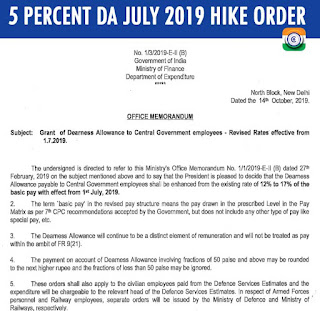
5 Percent DA July 2019 Hike Order - Grant of Dearness Allowance to Central Government employees

Grant of Dearness Allowance to Central Government employees 5 Percent DA July 2019 Hike Order  No. 1/3/2019-E- II (B) Government of...

Blog Archive

About The Author