A complete reference blog for Indian Government Employees

Showing posts with label Fitment Factor. Show all posts

Thursday, 20 December 2018

7th Pay Commission Fitment Factor and House Rent Allowance - No Change Therein is Envisaged


7th Pay Commission Fitment Factor and House Rent Allowance - No Change Therein is Envisaged

7th CPC Fitment and HRA - No Change Therein is Envisaged
In written reply to a question in Rajya Sabha on 11th December 2018 , Minister of State for Finance Shri P.Radhakrishnan said no change in 7th CPC Fitment Factor and House Rent Allowance.

Increase in Pay Fitment Factor and HRA
"The fitment factor for the purpose of fixation of pay in the revised pay structure based on the recommendations of the 7th Central Pay Commission is 2.57 which is uniformly applicable to all categories of employees. As the same is based on the specific and considered recommendations of the 7th Central Pay Commission, no change therein is envisaged.

The Government vide Resolution dated 6th July, 2017 decided that HRA shall be revised to 27%, 18% and 9% of Basic Pay in X, Y and Z cities when Dearness Allowance (DA) crosses 25% and further to 30%, 20% and 10% of Basic Pay in X,Y and Z cities when DA crosses 50%."

Current Rates of House Rent Allowance for CG Employees
7TH CPC HRA RATES W.E.F. 1.7.2017
City ClassificationHRA Rates
'X' Cities24% of Basic Pay
'Y' Cities16% of Basic Pay
'Z' Cities8% of Basic Pay
Share:

Tuesday, 26 December 2017

7th Pay Commission: Challenging year for Central Government Employees


7th Pay Commission: Challenging year for Central Government Employees

The central government employees passed a challenging year for a number of factors including hike in pay, minimum pay hike, raising of fitment factor, pay anomalies and non-payment of arrears on allowances, employees unions said.


The delayed implementation of allowances have saved the government nearly Rs 40,000 crore. The non-payment of arrears on allowances caused tremendous irritation and frustration among the central government employees, said a unions leader.

The government gave higher basic pay in August 2016 with arrears, effective from January 1, 2016 to its employees on the recommendations of the 7th pay commission but the allowances notified on June 6 without arrears, which came into effect from July 1, 2017.

The recommendations of the 7th Pay Commission got the Cabinet nod on June 29, 2016 in respect of basic pay, the pay panel had recommended a 14.27 per cent hike in basic pay. The previous 6th Pay Commission had recommended a 20 per cent hike, which the government doubled while implementing it in 2008.

All pay commissions made up pay gap in respect of basic pay between lower paid employees and top bureaucrats from second Pay Commission 1:41 ratio to Sixth pay commission 1:12, while 7th Pay Commission made it higher about to 1:14.

The 7th pay panel recommended minimum pay from Rs 7,000 to Rs 18,000 per month while the maximum pay from Rs 80,000 to Rs 2.5 lakh with a fitment factor of 2.57 times uniformly of basic pay of 6th pay commission.

However, the Unions have been demanding minimum pay Rs 26,000 instead of Rs 18,000 with 3.68 fitment factor.

The unions had claimed that the recommended pay hike was the lowest in the last 70 years and the Pay Commission award was not discussed with them, hence they had threatened to go on an indefinite strike over proper pay hike on July 11, 2016.

The unions had called off their indefinite strike after the government announced that a High Level Committee would be formed to address their demands.

So, the government formed the 22-member National Anomaly Committee (NAC) headed by Secretary, Department of Personnel and Training (DoPT) in September, 2016 instead of High Level Committee to look into pay anomalies arising out of the implementation of the 7th Pay Commission’s recommendations.

In the meantime, DoPT issued a letter on October 30 stating that the demand for increase in minimum Pay and fitment formula do not appear to be treated as anomaly, therefore, these do not come under the purview of NAC.

However, Finance Minister Arun Jaitley had said in Rajya Sabha on July 19, 2016, The minimum pay Rs 18,000 was made on recommendations of the 7th Pay Commission. But government will consider hiking it after discussions with all stakeholders, once the proposal in this regard will be submitted to government.

The sources in DoPT said, "The NAC is ready with it’s interim report and which will be submitted soon but no minimum pay and fitment formula will be included in the interim report."

"I would be lying if I said the DoPT letter doesn’t bother me at all, but the truth is, it doesn't bother me much because of the way of government made decisions. A hike in minimum pay has been one of the long-standing our demands. The 14.27 per cent hike in basic pay for us under the 7th Pay Commission is the lowest in 70 years. The government had issued statement on July 6, 2016 to assure us that the pay scales matter raised by us would be considered," a top union leader said.

"Our unions members often ask us what we should do to respond to the DoPT letter," he said.

"If government doesn't hike our pay, we will have no choice but to proceed on an indefinite strike," he added.

He considers 2017 a challenging year for central government employees and many of those challenges won't be going away just because 2018 calendars are hanging. He also says he's confident the government will make the right decisions during the next year.
Share:

Tuesday, 5 December 2017

Central government employees feel "frustrated and squeezed" by their pay - 7th CPC

Central government employees feel "frustrated and squeezed" by their pay - 7CPC

Central government employees feel "frustrated and squeezed" by their pay - 7CPC

Central government employees feel "frustrated and squeezed" by their pay, which has flatlined since implementation of the 7th Pay Commission recommendations.

But despite broad government stagnation in pay growth, it is still possible to maximise chances of getting minimum pay hike, he added.

The battle between the government and the central government employees unions is being seen because the government has decided not to give minimum pay hike for the central government employees.

A letter of Department of Personnel and Training (DoPT) dated October 30, states that the hike in minimum Pay and fitment formula do not appear to be treated as an anomaly, therefore, these do not come under the purview of the NAC.

However, the National Anomaly Committee (NAC) has been formed in September, 2016 to look into pay anomalies arising out of the implementation of the 7th Pay Commission's recommendations.

A day after the Cabinet cleared the 7th Pay Commission recommendations, three senior Cabinet Ministers including Finance Minister Arun Jaitley discussed this issue with the several central government employees' unions leaders for more than two hours on June 30, 2016 in home minister Rajnath Singh's house and they assured the leaders a High Level Committee would look into the increasing minimum Pay and fitment formula.

Their assurance had prevented several central government employees' unions to go indefinite strike over pay hike from July 11, 2016.

"The minimum pay of central government employees Rs.18,000 was made on recommendations of the 7th Pay Commission. But government will consider hiking it after discussions with all stakeholders, once the proposal in this regard will be submitted to government by the proposed High Level Committee," Jaitley had also said in Rajya Sabha on July 19, 2016.

While the High Level Committee has not yet been constituted. The government had said the NAC would discuss any pay hike agenda but DoPT letter now says minimum pay and fitment factor doesn't come under the purview of the NAC.

The central government employees unions, including the Confederation of Central Government Employees and Workers, have strongly criticized the government over the DoPT letter.

"The Confederation of Central Government Employees and Workers leaders said a meeting would be held on January 24, so they may ask employees to go on indefinite strike over pay hike," a union leader said.

The top official in the Finance Ministry said that the ministry would like to review the DoPT letter, because the DoPT has issued the letter against Finance Minister's promise to hike minimun pay. This is probably the first time that the Finance Ministry is likely to raise minimum pay while the government already approved the 7th Pay Commission recommendations.

The Finance Ministry is likely to remain committed to hike in minimum pay beyond the 7th Pay Commission recommendations for the central government employees, he confirmed.

Earlier, the government gave nod the 7th Pay Commission proposal of minimum basic pay from Rs.7,000 to Rs.18,000 per month while the maximum basic pay from Rs.80,000 to Rs.2.5 lakh with a fitment factor of 2.57 times uniformly of basic pay of 6th pay commission.

The Unions have been demanding minimum pay Rs. 26,000 instead of Rs 18,000 with 3.68 fitment factor.
Source: 7cpc.in
Share:

Wednesday, 29 November 2017

7th CPC: Minimum Pay and Fitment Factor Stories suddenly ended in anticlimax


Minimum Pay and Fitment Factor Stories suddenly ended in anticlimax

"There is no scope for them anymore to continue this story and decided to end this up with the note of 'there is no scope for change in Minimum Pay'.

There is a strong reason to come up with the title for this article as 'Minimum Pay and Fitment Factor Stories suddenly ended in anticlimax'. Because many websites kept writing that Minimum Pay will be increased to Rs.21000 in January 2018. As we didn't find any truth in that stories we haven't said anything about this as it may lead the people to have false hope. Instead, we published 4 articles which claimed firmly that there was no such proposal under consideration of Government.
Finally those who cooked up a story entitled 'Govt to Announce Minimum Pay Increase to Rs.21000' and writing about it on day to day basis, have come forward to end this story with a note of No Scope for change in Minimum Pay. Because they clearly know it was a fake news. But some news websites who believed that this cooked up story might be true, started writing numerous article about increasing of minimum pay from Rs.18000 to Rs. 21000 and said "Good news would come after January 2018"

As January 2018 is nearing, people started asking the Leaders of Unions and Associations the following questions. is it true? Is there any proposal as such under consideration of Central government? The NC JCM Staff Side Leaders hesitated to answer this question because they were afraid of that any negative reply will backfire them.

But there was no sign of announcing Minimum Pay increase. The rumour mongers smelled the frustration of Government servants on Minimum Pay increase as it is not going to happen in January 2018 . So they started writing again that Minimum Pay will be increased after April 2018 as Anomaly Committee is going to submit its report to the Government on Minimum Pay issue after January 2018.

Now all the bridges to Minimum wage issue are burnt for them after DoPT has clearly said in its Letter to NCJCM Staff Side that the issue of Minimum Pay Increase and Revising Fitment Factor and Allowances effect date are not anomalies. According to the DOPT Letter No. F.No.11/2/2016-JCA-1(Pt.) dated 30th October, 2017, it is stated that these three important issues are not in accord with the three postulates which, as described in DoPT's 0M. No. 11/2/2016-JCA dated 16th August, 2016 and 20th February, 2017 for treating them as Anomaly.

So Minimum pay and Fitment Factor issue will not be treated as a case of anomaly and it will not be taken up in national Anomaly Committee for discussion.

So there is no scope for them anymore to continue this story and decided to end this up with the note of 'there is no scope for change in Minimum Pay'.

But the Committee which is constituted to Examine the Demand of revising Minimum Pay has not held any meeting to discuss this important issue. And also, it was stated in the DoPT's Letter that Effect date of Allowances should be decided by the Central Government and hence the NC JCM Staff Side should take up this issue to the Government.

So the ways and means for settling these issues are not ruled out yet. Now it is up to the Federations, to what extent they are serious to pursue this issue to get this done either through negotiated settlement or protest.
Share:

Thursday, 16 November 2017

7th Pay Commission: New pay hike from April 2018


7th Pay Commission: New pay hike from April 2018


A top Finance Ministry official, who did not wish to be named told on Tuesday said that new pay hike for central government employees would come into effect from 1 April 2018.

He said that National Anomaly Committee (NAC) is likely to submit report on new pay hike by December.

The new pay hike will come into effect by April next year at the latest, he added.

Earlier, the government gave nod the 7th Pay Commission proposal of minimum basic pay from Rs 7,000 to Rs 18,000 per month while the maximum basic pay from Rs 80,000 to Rs 2.5 lakh with a fitment factor of 2.57 times uniformly of sixth pay commission's basic pay.

Expressing dissatisfaction over the recommendations of the 7th Pay Commission, various central government employees' unions had threatened to go on an indefinite strike from 11 July, 2016.
Finance Minister Arun Jaitley was under pressure to assure to hike minimum pay for the central government employees day after the cabinet approval of the 7th Pay Commission's recommendations, June 30, 2016, when he had met representatives of several central government employees' unions in home minister's house with other two cabinet ministers - Rajnath Singh and Suresh Prabhu.

The assurance had prevented several central government employees' unions to go ahead with the indefinite strike starting July 11, 2016.

The Unions had asked the government to set up a committee to look into issues raised by them in relation to pay hike.

Jaitley promised the Union leaders that the pay hike issue raised by them would be considered by a High Level Committee. Accordingly, he has formed National Anomaly Committee (NAC) in September, 2016 to look into pay anomalies arising out of the implementation of the 7th Pay Commission's recommendations.

The unions had said the government approved pay hike was the lowest in the last 70 years. They had also accused the government of announcing the awards "unilaterally" without any consultation with them.

The unions had also warned to make employees minimum pay Rs 18,000 to Rs 26,000 and asked to raising fitment factor 3.68 times from 2.57 times.

"The government may come out with a decision in next financial year in this regard on the recommendations of the National Anomaly Committee," he said.

"The government is likely to go ahead for hike in minimum pay Rs 21,000 from Rs 18,000 with fitment factor 3.00. The fitment formula with 3.00 times from 2.57 times, which will be gone up he salary and pension in general for all segments of employees" the official confirmed.

TST
Share:

Sunday, 10 September 2017

Is it possible to Increase the 7th CPC Minimum Pay and Improve the Fitment Factor?


Is it possible to Increase the 7th CPC Minimum Pay and Improve the Fitment Factor?

7th-CPC-Minimum-Pay


7th CPC Minimum Pay - Don't give false hope and drag the issues till next Pay Commission

Increasing of Minimum Pay and Improving of Fitment Factor is possible ?


Is it really possible to Increase the Minimum Pay and Improve the Fitment Factor even 18 Months after the resolution for Implementation of 7th CPC Recommendation issued ?

What is that NCJCM Staff Side really wanted to convey to the Central Government Employees by posting such letters regarding Increasing of Minimum Pay and Improving of Fitment formula.

NCJCM Staff Side is the only hope and Final Destination for Central Government staffs to ask to settle their issues under negotiated settlement. But it seems that the Staff Side is not using this forum effectively to resolve the issues pertaining to the Central Government Employees.

The issues of HRA and Minimum pay are perfect examples of the failure of NCJCM Staff Side.

The central Government employees wouldn’t have faced such huge loss in payment of HRA if the same rate is implemented with effect from the date of Notification i.e 25.7.2016

When the Central Government was not even ready to reinstate the HRA at Sixth CPC rates, how come one expect that the Government will increase the Minimum Pay to Rs. 21000 or fitment factor from 2.57 to 3. Don’t give false hope and drag the issues till next Pay Commission.
Share:

Monday, 7 August 2017

Latest News on GDS Pay Committee Report


Latest News on GDS Pay Committee Report 

With reliable information sourced from the Senior Officer of Finance Ministry that the following Proposals agreed by the Department and sent to Finance Ministry and also probably accepted by the FM by the end of August 2017.

1. Fitment factor will be 2.57 like Department employees
2. Increment will be 3%
3. Implemented i.e. 1.1.2016 and arrears will be paid from that.
4. DA formula will be old one.
5. Minimum BPM Scale is Rs.12000 i.e. Level 2 is Rs.14500
6. For ABPM/Dak Sevaks Level 1 Rs.10000 and for Level 2 is Rs.12000/-
7. Level 2 old scales are 363-65-5585, 4220-75-6470 for ABPM
8. Level 1 of ABPMs old scales are 2295-45-3695, 2870-50- 4370, 2665-50-4165 and 3330-60-5130
9. Level 2 for BPMs old scales are 4115-75-6365, and 4575-85 -7125
10.Level 1 for BPMs olds scales are 3635-65-5585 and 4220-75 -6470
11. Ex-gratia bonus will be paid on par with Department employees and issued orders every year.
12. Children Education Facilitation Allowance: Rs.6000/- per year per child.
13. CMA will be to the tune of Rs.180/-
14. Boat allowance will be Rs.125/-
15. BPM office Rent Rs.500/- for standard and Rs.200/- for non standard.
16. Office maintains allowances for Level 1 BPM will be .500/- and other Rs.200/-
17. Stationary Charges Rs.25/- P.M
18. Combined duty allowance Rs.45/- per day and max Rs.1170/- per month will be paid to BPM for delivery or Mail conveyance and Rs.2340/- For BPM for delivery and conveyance per day min 75 - Rs.1950/- to ABPM for additional work of another ABPMDak sevak per day min 45- (Note: These rates will be for combination of duties of two or more posts borne on the establishment of the office)
19. Risk and Hardship Allowance Rs.100/-p.m
20. Cash conveyance allowance Rs.50/- plus actual conveyance charges i.e. bus and auto
21. The Department should not order closing of any GDS Post Office
22. Two cadres will remain one is BPM and second one Asst.BPMDak Sevaks
23. Two scales for each cadre Level one and Level two. 4 hrs and 5 hrs. And there will be reduction from level 2 to Level 1.
24. Point system will be abolishment and delinking payment of wages from the work load.
25. Other source of livelihood will continue as maximum working hours are retained as 5 hours only
26. Voluntary retirement scheme accepted with condition of minimum service 10 years
27. Voluntary retirement on Medical grounds accepted
28. Accepted the proposal pay committee for division into A,B,C and D categories.
29. New BO will be opened with a distance of 5 Kms
30. Post of office building infrastructure proposal as it is accepted .
31. Administrative and vigilance reasons transfers will be given
32. Transfer will be given one time for Male and two times for female and pay will not be reduced on transfer. However number of increments and financial up gradation will be retained in the changed wage level. Transfer will be given by PMG within regional level.
33. Recruitment for GDS will be through online system
34. FG bond System will remain same.
35. Promotion to MTS Cadre: One year minimum service sufficient and 50% quota will be for GDS in direct recruitment and max. age limit for selection cum seniority quota abolished.
36. Postman and Mail Guard: Direct recruitment quota increased to 75% and minimum qualifying service is one year only.
37. POSTAL ASST./Sorting Asst: Minimum qualifying service is 3 years only and maximum age limit raised to 35 years.
38. Leave: Emergency leave 5 days in a colander year. Paid leave will be Maximum of 180 days accumulation also agreed and will be en- chased while discharge or quitting the GDS service on promotion. Regarding LWA there is no change in old conditions.
39.Women GDS should be given 26 weeks of maternity leave with FULL SALARY from salaries head instead Welfare fund. Paternity leave will not be granted.
40. All the additional disciplinary rules proposed by the committee accepted.
41. Ex-gratia payment for suspension period 25% will remain same.
42. Social Security Schemes:
(A) Severance amount enhanced to @4000/- from 1.1.2016 subject to Max.of Rs.150000/-
(B)SDBS subscription from GDS is Rs.300/- and department will credit Rs.300/- it will be manned like NPS system for Dept.employees.
(c) GDS Gratuity will be paid Rs.150000/- Minimum service 10 years it will also allowed to voluntary discharges GDS.
43. GDS GIS scheme will remain no change at present.
44. WELFARE..Circle welfare Fund subscription will be Rs.100/- and Department grant will be Rs.200/- per annum. CWF extended to family members and dependents.
45. Assistance or grants from CWF will be raised to 10%
46. Rs.10000/- will paid for purchase of tablet/Mobile phone
47. ESI,Group Health Insurance Proposal of OIC and EPF will be considered later.

NEW PAY SCALES ARE SAME AS RECOMMENDED BY THE KAMALESH CHANDRA COMMITTEE.
CH.LAKSHMI NARAYANA
ALL INDIA PRESIDENT
NUGDS CHQ
Source : http://nupeap.blogspot.in
Share:

Thursday, 25 August 2016

Implementation of the recommendations of 7th CPC – Fitment Factor and Pay Fixation for Running Staff


Implementation of the recommendations of 7th CPC – Fitment Factor and Pay Fixation for Running Staff
NFIR
National Federation of Indian Railwaymen
3, CHELMSFORD ROAD, NEW DELHI – 110 055
Affiliated to :
Indian National Trade Union Congress (INTUC)
International Transport Workers’ Federation (ITF)

No. IV/NFIR/7CPC( Imp)/2016/R.B.
Dated: 23/08/2016
The Secretary (E),
Railway Board,
New Delhi

Dear Sir,

Sub: Implementation of the recommendations of 7th CPC – Fitment Factor and Pay Fixation for Running Staff-reg.
Ref: (i) NFIR’s letter No. IV/NFIR/7CPC(Imp)/20161R.B. dated 13/07/2016.
(ii) Board’s letter No. PC-VII/2016/RSRP/2 dated 02/08/2016 (RBE No. 93/2016).
(iii) NFIR’s letter No. IV/NFIR/7CPC(Imp)/2016/R.B. dated 04/08/2016.
In continuation to NFIR’s letter of even number dated 04/08/2016, Federation desires to highlight some facts as mentioned below:-
  • The Fitment table issued by the Railway Board vide letter No. PC-VI/2008/1/RSRP/1 dated 12/09/2008 was very clear, consequently correct pay fixation was done in favour of Running Staff with effect from 01/01/2006.
    This time, no fitment table has been issued resulting disappointment among Loco and Traffic Running Staff in Railways.
  •  A statement showing the revised pay fixation on the 7th CPC Pay Matrices is enclosed. The statement shows that 14.29% hike is not ensured.
  •  According to the notification issued by Ministry of Finance (Department of Expenditure vide Para 12 of Resolution No. 1-2/2016-IC dated 25th July 2016, while revising the Pay of Running Staff it should be ensured that actual raise in Pay at the time of initial fixation of pay should be 14.29% as recommended by the 7th CPC. It is however, disappointing to note that the Railway Board’s decision communicated vide letter No. PC-VII/2016/ RSRP/2 dated 02/08/2016 (Annexure C) has not ensured Pay raise of 14.29%, consequently each Running Staff is deprived of more than Rs. 2000 p.m.
NFIR, therefore, requests the Railway Board to review and ensure pay raise of not less than 14.29% for the Running Staff while revising the pay in the 7th CPC Pay Matrices. Federation also urges the Railway Board to issue the revised fitment table duly ensuring 14.29% hike as was done on 12th September 2008 when 6th CPC Grade Pay/Pay Band was given effect from 01/01/2006.

Yours faithfully,
sd/-
(Dr. M. Raghavaiah)
General Secretary
Source: NFIR
Share:

Tuesday, 9 August 2016

Implementation of the recommendations of 7th CPC – Fitment Factor and Pay Fixation for Running Staff

Implementation of the recommendations of 7th CPC – Fitment Factor and Pay Fixation for Running Staff
NFIR
National Federation of Indian Railwaymen
3, CHELMSFORD ROAD, NEW DELHI – 110 055
Affiliated to :
Indian National Trade Union Congress (INTUC)
International Transport Workers’ Federation (ITF)

No. IV/NFIR/7CPC(Imp)/2016/R.B.
Dated: 04/08/2016
The Secretary (E),
Railway Board,
New Delhi

Dear Sir,

Sub: Implementation of the recommendations of 7th CPC – Fitment Factor and Pay Fixation for Running Staff-reg.

Ref: (i)NFIR’s letter No. IV/NFIR/7CPC(Imp)/2016/R.B. dated 13/07/2016.
(ii) Board’s letter No. PC-VII/2016/RSRP/2 dated 02/0811016 (RBE No. 93/2016).

The Federation vide its letter dated 13/07/2016 requested the Railway Board that in view of 30% pay element of Running Staff needed to be taken for arriving at the “multiplier factor”, it was suggested to maintain the same at “3” instead of “2.57”. Federation is however disappointed to note that the Railway Board instead of following the simple procedure has complicated and mutilated the pay fixation formula/procedure of Running Staff as per illustration given in Annexure ‘C’ of Board’s letter No. PC-VII/2016/RSRP/2 dated 02/08/2016 (RBE No. 93/2016).

In this connection, the Federation brings to the notice of the Railway Board that in the Resolution circulated by the Ministry of Finance (Department of Expenditure) vide No. 1-2/2016-IC on 25th July 2016 in Para 12, it has been mentioned that in respect of Railway employees to whom Running Allowance is admissible, it will be ensured that the actual rise in pay at the time of initial fixation is about 14.29% as recommended by the Pay Commission. Federation feels sad to convey that the said decision of the Ministry of Finance has not been complied with by the Railway Ministry particularly in respect of Running Staff.

In case of Running Staff with Rs.1000/- Basic Pay, he will get Dearness Allowance Rs.1,625/-, thus, the total would be Rs.2,625/-. In terms of Gazette Para 12, minimum benefit 14.29% should be given to Running Staff. 14.29% of Rs.2,625/- is Rs.375/-. Thus Basic Pay + Dearness Allowance + Minimum Guaranteed Benefit = 1000 + 1625 + 375 = Rs.3,000/-. From this, it is clear that the Running Staff having Basic Pay of Rs.1000/- should be fixed at Rs.3000/-. But in the illustration given in RBE 93/2016, Running Staff with Basic Pay of Rs.19,930/- is fixed at Rs.58,694/-, which works out 12.19% which is clear violation of Para 12 of Gazette Notification.

In view of the above, the Annexure of Board’s letter dated 02/08/2016 is needed to be redrawn to ensure justice to the Running Staff. NFIR, therefore, requests the Railway Board to consider the above points and issue modification immediately duly endorsing copy to the Federation.
Yours faithfully,
sd/-
(Dr. M. Raghavaiah)
General Secretary
Source : NFIR
Share:

Friday, 5 August 2016

7th CPC Pension Calculation : Implementation of First Option after Committee Report

7th CPC Pension Calculation : Implementation of First Option after Committee Report

“Revision of pension using the second option based on fitment factor of 2.57 be implemented immediately. The first option may be made applicable if its implementation is found feasible after examination by the Committee”

Revision of Pension of pre 7tn CPC retirees : The Commission recommends the following pension formulation for civil employees including CAPF personnel who have retired before 01.01.2016

(i) All the Civilian personnel including CAPF who retired prior to 01.01.2016 (expected date of implementation of the Seventh CPC recommendations ) shall first be fixed in the Pay Matrix being recommended by this Commission, on the basis of the Pay Band and Grade Pay at which they retired, at the minimum of the corresponding level in the matrix. This amount shall be raised, to arrive at the notional pay of the retiree, by adding the number of increments he / she had earned in that level while in service, at the rate of three percent. Fifty percent of the total amount so arrived at shall be the revised pension.

(ii) The second calculation to be carried out is as follows. The pension, as had been fixed at the time of implementation of the VI CPC recommendations, shall be multiplied by 2.57 to arrive at an alternate value for the revised pension.

(iii) Pensioners may be given the option of choosing whichever formulation is beneficial to them. It is recognized that the fixation of pension as per formulation in (i) above may take a little time since the records of each pensioner will have to be checked to ascertain the number of increments earned in the retiring level. It is therefore recommended that in the first instance the revised pension may be calculated as at (ii) above and the same may, be paid as an interim measure. In the event calculation as per (i) above yields a higher amount the difference may be paid subsequently.(Para 10.1.67 and Para 10.1.68 of the Report)
Both the options recommended by the 7th Central Pay Commission as regards pension revision be accepted subject to feasibility of the implementation. Revision of pension using the second option based on fitment factor of 2.57 be implemented immediately. The first option may be made applicable if its implementation is found feasible after examination by the Committee comprising Secretary (Pension) as Chairman and Member (Staff). Railway Board, Member (Staff), Department of Posts, Additional Secretary & Financial Adviser, Ministry of Home Affairs and Controller General of Accounts as Members

Authority: http://www.pensionersportal.gov.in/
Share:

Sunday, 24 July 2016

7th CPC Notification – CG employees are Expecting Eagerly

7th CPC Notification – CG employees are Expecting Eagerly


It is expected that Finance Ministry will issue necessary order and Notifications to implement the 7th Pay Commission recommendations as soon as possible.

7th Pay Commission is become interesting news for not only CG employees but the people across the country. Very important reason for this is Press Media. Every day at least one Daily writes an Article about 7th CPC news based on hearsay and it never missed to attract everyone.

To defuse the Indefinite strike called by NJCA , the Central Government assured NJCA that the Govt will constitute four committees to look into the important demands raised by NJCA. Based on the Press release issued by Finance Ministry, NJCA decided to defer the Indefinite Strike.

Though there are 26 Demands placed before the government, the issues of Minimum Pay, Fitment factor and HRA are mostly expected to be settled.

How much it will be increased from 18000 is the main point of discussion among CG employees and it is noteworthy that Govt also approved the uniform Fitment factor 2.57 to All grades as recommended by 7th Pay Commission.

In case the Proposed Committee recommends to increase the Minimum Pay to 19000 or more than this, subsequently Fitment factor also may be revised. As recommended by 7th Pay commission, the Committee also can use the following method to arrive the Fitment factor as per the increase in Minimum Pay

18000/7000 = 2.57
19000/7000 = 2.71

20000/7000 = 2.85
21000/7000 = 3.00

If the Minimum Pay is increased, the Fitment factor also has to be increased. Based on the New Fitment factor, the existing pay of CG employees will be revised.


For example If, Basic Pay of a Govt Servant is Rs.10000(including Grade Pay of Rs.1900), His revised pay as per 7 th CPC will be 10000 x 2.57 = 25700 ( to be fixed as 26000 as per Pay Matrix Table)

As per the above fitment factors, the Basic Pay will be revised like this..

10000 x 2.71 =27100
10000 x 2.85 = 28500
10000 x 3 = 30000

From the above example it is obvious that Pay matrix also to be modified as per fitment factor.

There is also expectation on HRA that the 7th CPC recommended rates i.e 8%, 16% and 24% would be restored to the existing rates of 10, 20 and 30 percent respectively.

In the meantime, everybody is thinking about what are all the Provisions are incorporated in the 7th CPC Notification. We will have to wait to see the impact of the Notification to be issued by Finance ministry amidst expectations and doubts.

Share:

Friday, 15 July 2016

NFIR – Implementation of the recommendations of 7th CPC – Fitment Factor and pay Fixation for Running Staff

NFIR – Implementation of the recommendations of 7th CPC – Fitment Factor and pay Fixation for Running Staff
NFIR


No. IV/NFIR/7CPC(Imp)/2016/R.B.
Dated : 13/07/2016
The Secretary (E),
Railway Board,
New Delhi

Dear Sir.
Sub: Implementation of the recommendations of 7th CPC – Fitment Factor and pay Fixation for Running Staff – reg.

The Railway Board is aware that the Union Cabinet has decided on 29th June 2016 for implementation of revised Pay Matrices of the 7th Central Pay Commission w.e.f. 01/01/2016 duly applying 2.57 multiplier factor. The notification, in this regard, is expected from the Ministry of Finance in due course.

In this connection, the NFIR invites Railway Board’s attention to letter No. PC- VI/2008/1/RSRP/1 dated 12/09/2008 relating to Pay Fixation tables for Running Staff which were given effect from 01/01/2006 and wherein the Fitment Factor was 2.118 for Running Staff (in view of pay element) instead of 1.86.
Considering the 30% pay element of Running Stuff which is needed to be taken for arriving at multiplier factor, the Federation is of the view that the Fitment Factor for Pay Fixation of Running Staff in the 7th CPC Pay Matrix shall be “3” instead of “2.57”.

NFIR, therefore, urges upon the Railway Board to take the above points into consideration for the purpose of determining the Fitment Factor as “3” in the case of Running Staff for granting 7th CPC Pay Fixation w.e.f. 01/01/2016.
Yours faithfully
sd/-
(Dr. M. Raghavaiah)
General Secretary
Source : NFIR
Share:

Monday, 4 July 2016

Inadequate Fitment Benefit recommended by 7th CPC and accepted by the Govt

Inadequate Fitment Benefit recommended by 7th CPC and accepted by the Govt

7th CPC – BPS appeals to the Finance Minister Sh. Arun Jaitlely for revision of minimum salary & fitment factor of 2.57


No. SG/BPS/PC/FM/02

Dt: 4.7.2016

Sh. Arun Jaitley ji,

Honbfe Minister of Finance Govt. of India

Sub: Inadequate Fitment Benefit recommended by 7th CPC and accepted by the Govt.

Respected Sir.

   1.The 2.57 fitment factor recommended by the 7th CPC and accepted by the Govt. is essentially a multiple factor which is the ratio of the new minimum pay arrived at by the 7th Pay Commission (18,000) and the existing minimum pay (7,000). { Para 5.2.7 of 7th CPC report} This provides only 14 29% rise in Salary as well as in Pension which is the historically lowest raise given by any Govt. in the past seventy years. This has happened because of incorrect calculation of minimum revised salary resulted not only by adopting lower prices of commodities but also due to adoption of Aykroyd formula without updating it.

   2. It is surprising as to how a gender biased formula of Dr Aykroyd adopted by ILC in 1957 is applied, without updating, in digital India of 2016. In today’s scenario how can Indian civil society accept a formula for Minimum requirement including just 2700 food calories for a family of four with moderate physical activities which treat the lady of the house as 0.8 compared to the adult male of the house, Further more so this formula does not at all take into consideration the minimum requirement of todays digital India i.e. a smart mobile phone with an internet connection.

    3. Considering wife to be .80 unit is nothing but gender bias indicating a colonial mindset of Dr Aykroyd. In the present scenario a wife too puts in the same amount rather more of physical and intellectual work as compared to the husband. She needs more nutrients & healthcare to keep herself fit to be a mother and as an educationist for her school going children. She needs more better clothing than 1957. A lady whether she is a wife of a labourer or of a Secretary to Govt. of India, has a basic right to keep herself reasonably presentable for which she needs some minimum add-ons. As such treating her to be less than a unit is gross injustice, gender bias and unconstitutional. Similarly growing children of less than 14 years need more of proteins, fats& carbohydrates, need to take sufficient exercise & field activities for healthy growth. Today they need much better and more clothing, better education & healthcare compared to 50s. The Nation needs healthy & stout young citizens. It is against the National interest to restrict their need based minimum requirement to .6 unit.

   4. Sir, in view of the facts enumerated in lore going pares, minimum Salary & consequently the fitment factor for both Pensioners & employees need upwards revision. ‘Bharat Pensioners Samaj’ therefore, appeal to you to revisit the issue to take a favourable decision.

Thanking you in anticipation.

Yours faithfully,
S.C.Maheshwari
Secy. Genl. Bharat Pensioners Samaj

Source: http://scm-bps.blogspot.in/
Share:

Thursday, 30 June 2016

7th Pay Commission calculator to highlights, here’s all you want to know

7th Pay Commission calculator to highlights, here’s all you want to know

The 7th Pay Commission report recommendations have been cleared today by the Cabinet. Earlier in its report, in November last year, the commission itself had recommended 14.27 per cent hike in basic pay at junior levels, the lowest in 70 years.

Here are the 7th Pay Commission report highlights:

1. Recommended Date of implementation: 01.01.2016

2. Minimum Pay – Calculator: Based on the Aykroyd formula, the minimum pay in government is recommended to be set at Rs 18,000 per month.

3. Maximum Pay: Rs 2,25,000 per month for Apex Scale and Rs 2,50,000 per month for Cabinet Secretary and others presently at the same pay level.

4. Financial Implications:
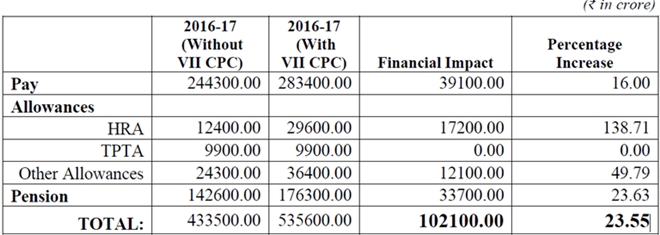
a) The total financial impact in the FY 2016-17 is likely to be Rs 1,02,100 crore, over the expenditure as per the ‘Business As Usual’ scenario. Of this, the increase in pay would be Rs 39,100 crore, increase in allowances would be Rs 29,300 crore and increase in pension would be Rs 33,700 crore.

b) Out of the total financial impact of Rs 1,02,100 crore, Rs 73,650 crore will be borne by the General Budget and Rs 28,450 crore by the Railway Budget.

c) In percentage terms the overall increase in pay & allowances and pensions over the „Business As Usual‟ scenario will be 23.55 percent. Within this, the increase in pay will be 16 percent, increase in allowances will be 63 percent, and increase in pension would be 24 percent.

d) The total impact of the Commission‟s recommendations are expected to entail an increase of 0.65 percentage points in the ratio of expenditure on (Pay+Allowances+ Pension) to GDP compared to 0.77 percent in case of VI CPC.
5. New Pay Structure: Considering the issues raised regarding the Grade Pay structure and with a view to bring in greater transparency, the present system of pay bands and grade pay has been dispensed with and a new pay matrix has been designed. Grade Pay has been subsumed in the pay matrix. The status of the employee, hitherto determined by grade pay, will now be determined by the level in the pay matrix.

6. Fitment: A fitment factor of 2.57 is being proposed to be applied uniformly for all employees.

7. Annual Increment: The rate of annual increment is being retained at 3 percent.

8. Modified Assured Career Progression (MACP):
a. Performance benchmarks for MACP have been made more stringent from “Good” to “Very Good”.
b. The Commission has also proposed that annual increments not be granted in the case of those employees who are not able to meet the benchmark either for MACP or for a regular promotion in the first 20 years of their service.
c. No other changes in MACP recommended.
9. Military Service Pay (MSP): The Military Service Pay, which is a compensation for the various aspects of military service, will be admissible to the Defence forces personnel only. As before, Military Service Pay will be payable to all ranks up to and inclusive of Brigadiers and their equivalents. The current MSP per month and the revised rates recommended are as follows:

7th Pay Commission Report

Present
Proposed
i.Service OfficersRs 6,000Rs 15,500
ii.Nursing OfficersRs 4,200Rs 10,800
iii.JCO/ORsRs 2,000Rs 5,200
iv.Non Combatants (Enrolled) in the Air ForceRs 1,000Rs 3,600

10. Short Service Commissioned Officers: Short Service Commissioned Officers will be allowed to exit the Armed Forces at any point in time between 7 and 10 years of service, with a terminal gratuity equivalent of 10.5 months of reckonable emoluments. They will further be entitled to a fully funded one year Executive Programme or a M.Tech. programme at a premier Institute.

11. Lateral Entry/Settlement: The Commission is recommending a revised formulation for lateral entry/resettlement of defence forces personnel which keeps in view the specific requirements of organization to which such personnel will be absorbed. For lateral entry into CAPFs an attractive severance package has been recommended.

12. Headquarters/Field Parity: Parity between field and headquarters staff recommended for similar functionaries e.g Assistants and Stenos.

13. Cadre Review: Systemic change in the process of Cadre Review for Group A officers recommended.
14. Allowances: The 7th Pay Commission has recommended abolishing 52 allowances altogether. Another 36 allowances have been abolished as separate identities, but subsumed either in an existing allowance or in newly proposed allowances. Allowances relating to Risk and Hardship will be governed by the proposed Risk and Hardship Matrix.
a. Risk and Hardship Allowance: Allowances relating to Risk and Hardship will be governed by the newly proposed nine-cell Risk and Hardship Matrix, with one extra cell at the top, viz., RH-Max to include Siachen Allowance.
The current Siachen Allowance per month and the revised rates recommended are as follows:

7th Pay Commission Table

Present
Proposed
i.Service OfficersRs 21,000Rs 31,500
iii.JCO/ORsRs 14,000Rs 21,000
This would be the ceiling for risk/hardship allowances and there would be no individual RHA with an amount higher than this allowance.
b. House Rent Allowance: Since the Basic Pay has been revised upwards, the Commission recommends that HRA be paid at the rate of 24 percent, 16 percent and 8 percent of the new Basic Pay for Class X, Y and Z cities respectively. The Commission also recommends that the rate of HRA will be revised to 27 percent, 18 percent and 9 percent respectively when DA crosses 50 percent, and further revised to 30 percent, 20 percent and 10 percent when DA crosses 100 percent.
c. In the case of PBORs of Defence, CAPFs and Indian Coast Guard compensation for housing is presently limited to the authorised married establishment hence many users are being deprived. The HRA coverage has now been expanded to cover all.
d. Any allowance not mentioned in the report shall cease to exist.
e. Emphasis has been placed on simplifying the process of claiming allowances.
15. Advances:
a. All non-interest bearing Advances have been abolished.
b. Regarding interest-bearing Advances, only Personal Computer Advance and House Building Advance (HBA) have been retained. HBA ceiling has been increased to Rs 25 lakhs from the present Rs 7.5 lakhs.
16. Central Government Employees Group Insurance Scheme (CGEGIS):  The Rates of contribution as also the insurance coverage under the CGEGIS have remained unchanged for long. They have now been enhanced suitably. The following rates of CGEGIS are recommended:

7th Pay Commission Table

Present
Proposed
i.Service OfficersRs 21,000Rs 31,500
iii.JCO/ORsRs 14,000Rs 21,000

17. Medical Facilities:
a. Introduction of a Health Insurance Scheme for Central Government employees and pensioners has been recommended.

b. Meanwhile, for the benefit of pensioners residing outside the CGHS areas, CGHS should empanel those hospitals which are already empanelled under CS (MA)/ECHS for catering to the medical requirement of these pensioners on a cashless basis.

c. All postal pensioners should be covered under CGHS. All postal dispensaries should be merged with CGHS.
18. Pension: The Commission recommends a revised pension formulation for civil employees including CAPF personnel as well as for Defence personnel, who have retired before 01.01.2016. This formulation will bring about parity between past pensioners and current retirees for the same length of service in the pay scale at the time of retirement.

The past pensioners shall first be fixed in the Pay Matrix being recommended by the Commission on the basis of Pay Band and Grade Pay at which they retired, at the minimum of the corresponding level in the pay matrix.

This amount shall be raised to arrive at the notional pay of retirees, by adding number of increments he/she had earned in that level while in service at the rate of 3 percent.

In the case of defence forces personnel this amount will include Military Service Pay as admissible.
Fifty percent of the total amount so arrived at shall be the new pension.

An alternative calculation will be carried out, which will be a multiple of 2.57 times of the current basic pension.

The pensioner will get the higher of the two.
The financial impact of the recommendations of this Commission will be reflected through increases in expenditure on Pay, Allowances and on Pension. The likely quantum of increase on account of each of these is summarised below:


7CPC TABLE


The total financial impact in the FY 2016-17 is likely to be Rs 1,02,100 crore, an increase of nearly 23.55 percent over the Business As Usual scenario. Based on the current trend, the total expenditure on Pay (including DA, but excluding other allowances), during the year 2016-17, without factoring in the recommendations being made by this Commission, is expected to be Rs 2,44,300 crore. After implementation of the recommendations of the VII CPC, this is likely to rise to Rs 2,83,400 crore, reflecting an increase of Rs 39,100 crore (16.00%).

19. Gratuity: Enhancement in the ceiling of gratuity from the existing Rs 10 lakh to Rs 20 lakh. The ceiling on gratuity may be raised by 25 percent whenever DA rises by 50 percent.

20. Disability Pension for Armed Forces: The Commission is recommending reverting to a slab based system for disability element, instead of existing percentile based disability pension regime.

21. Ex-gratia Lump sum Compensation to Next of Kin: The Commission is recommending the revision of rates of lump sum compensation for next of kin (NOK) in case of death arising in various circumstances relating to performance of duties, to be applied uniformly for the defence forces personnel and civilians including CAPF personnel.

22. Martyr Status for CAPF Personnel: The Commission is of the view that in case of death in the line of duty, the force personnel of CAPFs should be accorded martyr status, at par with the defence forces personnel.

23. New Pension System: The Commission received many grievances relating to NPS. It has recommended a number of steps to improve the functioning of NPS. It has also recommended establishment of a strong grievance redressal mechanism.

24. Regulatory Bodies: The Commission has recommended a consolidated pay package of Rs 4,50,000 and Rs 4,00,000 per month for Chairpersons and Members respectively of select Regulatory bodies. In case of retired government servants, their pension will not be deducted from their consolidated pay. The consolidated pay package will be raised by 25 percent as and when Dearness Allowance goes up by 50 percent. For Members of the remaining Regulatory bodies normal replacement pay has been recommended.

25. Performance Related Pay: The Commission has recommended introduction of the Performance Related Pay (PRP) for all categories of Central Government employees, based on quality Results Framework Documents, reformed Annual Performance Appraisal Reports and some other broad Guidelines. The Commission has also recommended that the PRP should subsume the existing Bonus schemes.

26. There are few recommendations of the Commission where there was no unanimity of view and these are as follows:
i. The Edge: An edge is presently accordeded to the Indian Administrative Service (IAS) and the Indian Foreign Service (IFS) at three promotion stages from Senior Time Scale (STS), to the Junior Administrative Grade (JAG) and the NFSG. is recommended by the Chairman, to be extended to the Indian Police Service (IPS) and Indian Forest Service (IFoS).
Vivek Rae, Member is of the view that financial edge is justified only for the IAS and IFS. Dr. Rathin Roy, Member is of the view that the financial edge accorded to the IAS and IFS should be removed.

ii. Empanelment: The Chairman and Dr. Rathin Roy, Member, recommend that All India Service officers and Central Services Group A officers who have completed 17 years of service should be eligible for empanelment under the Central Staffing Scheme and there should not be “two year edge”, vis-à-vis the IAS. Shri Vivek Rae, Member, has not agreed with this view and has recommended review of the Central Staffing Scheme guidelines.

iii. Non Functional Upgradation for Organised Group ‘A’ Services: The Chairman is of the view that NFU availed by all the organised Group `A‟ Services should be allowed to continue and be extended to all officers in the CAPFs, Indian Coast Guard and the Defence forces. NFU should henceforth be based on the respective residency periods in the preceding substantive grade. Shri Vivek Rae, Member and Dr. Rathin Roy, Member, have favoured abolition of NFU at SAG and HAG level.

iv. Superannuation: Chairman and Dr. Rathin Roy, Member, recommend the age of superannuation for all CAPF personnel should be 60 years uniformly. Shri Vivek Rae, Member, has not agreed with this recommendation and has endorsed the stand of the Ministry of Home Affairs.
Share:

Sunday, 19 June 2016

7th Pay Commission Latest News – Likely Minimum Pay 23,000 and fitment factor 2.7


7th Pay Commission Latest News – Likely Minimum Pay 23,000 and fitment factor 2.7

7th-Pay-Commission-Latest-News

7th Pay Commission Empowered Committee headed by Mr.Shri. Pradeep Kumar Sinha is in favour of increasing minimum pay and the fitment of factor – Zee News reports

7th Pay Commission Latest News – Likely Minimum Pay 23,000 and fitment factor 2.7 – Zee News Reports on 7th CPC Empowered Committee’s proposal to Govt

All Central Government Employees would be rejoicing at the news that is published by Zee News if it turns to be a reality.

Empowered Committee that studies to suggest suitably on 7th Pay Commission recommendations is reported to have proposed a minimum basic pay of Rs. 23,000 in the place of Rs. 18,000 recommended by 7th Pay Commission.

As far as fitment factor is concerned by which the the basic pay of existing employees is to be revised, Zee News reports that fitment factor of around 2.7 has been proposed by Empowered Committee as against 2.57 recommended by 7th CPC.

Source: Zee News

The Empowered Committee of Secretaries under the chairmanship of Mr.P K Sinha, Cabinet Secretary convened a meeting on 14th June 2016 and discussed for increase in basic pay of Central Government Employees up to 30%.

As per Zee News report quoting Dainik Jagran, the Cabinet Secretary called on higher ups in Prime Minister Office on 15th June 2016 and discussed with them relating to report of Committee of Secretaries prepared so far with regard to 7th CPC related increase in pay and allowances of Central government employees.

It is also reported by Zee News that the secretaries panel which is reviewing the 7th pay commission’s recommendations submitted its report to the Finance Ministry. The Finance Ministry will prepare a note and present it before the Cabinet in the next 15 days.

While All Central Government Employees, Railway Employees Civilian Defence Employees have announced for All India Strike from 11th July 2016, it may have an impact on Govt in finalization of its decision on 7th Pay Commission recommendations as early as possible.

The central government employees and pensioners are likely to get their 6 months of arrears just ahead of the Dusshera festival in October.

As per media report, increased salary of July will be credited to the 47 lakh central government employees and 52 lakh pensioners’ accounts on August 1, 2016. But the arrears of last 6 months will be credited in one installment ahead of the Dusshera in October.

As per sources, the Empowered Committee of Secretaries headed by the Cabinet Secretary Pradeep Kumar Sinha has recommended a 30 percent increase in minimum and maximum basic pay structures along with doubling of existing rates of allowances and advances.

The 7th Pay Commission had suggested a maximum basic pay of Rs 2,50,000 and a minimum of Rs 18,000. A 30 percent increase would translate into maximum salary of Rs 3,25,000 and minimum at Rs 23,400, respectively.

Sources, further state that after getting final nod from the Empowered Committee of Secretaries, Finance Ministry will take only a few days to implement the higher pay package for central government employees.

Source: Times Group
Share:

Monday, 28 December 2015

Demand of Central Government Employees to increase the Fitment Factor recommended by 7th CPC

Demand of Central Government Employees to increase the Fitment Factor recommended by 7th CPC

The demand to increase the 2.57 Fitment Factor along with the hike of 14.29 percent is growing among the Central Government Employees

The 900-page long report of the 7th Pay Commission was submitted to the government on November 19. One of the most important recommendation on the report is the Fitment Factor. It is the most important factor deciding the hike of salaries of the Central Government employees.

Fitment Factor is used to calculate the revised basic pay of existing employees with effect from the implementation of 7th CPC. The new revised basic pay of a Central Government employee is calculated by multiplying his/her current (Pre-revised) basic pay with the Fitment Factor.

The 7th Pay Commission has recommended a uniform Fitment Factor of 2.57 for all. The actual raise/fitment recommended by the Commission is 14.29 percent only. The report says that the fitment includes a factor of 2.25 on account of DA neutralisation, assuming that the rate of D.A. would be 125 percent at the time of implementation of the new pay.

The 7th Pay Commission has evolved a new pay fitment table by merging the existing Grade Pay and Pay Bands for all group of Central Government employees, which is called as Pay Matrix Table. The Pay Matrix comprises two dimensions. It has a “horizontal range” in which each level corresponds to a ‘functional role in the hierarchy’ and has been assigned the numbers 1, 2, 3, and so on till 18. The “vertical range” for each level denotes ‘pay progression’ within that level. These indicate the steps of annual financial progression of three percent within each level. The starting point of the matrix is the minimum pay which has been arrived based on 15th Indian Labour Congress (ILC) norms or the Aykroyd formula.

7th-CPC-FITMENT-FACTOR-TABLE


On recruitment, an employee joins at a particular level and progresses within the level as per the vertical range. The movement is usually on an annual basis, based on annual increments till the time of their next promotion. When the employee receives a promotion or a non-functional financial upgrade, he/she progresses one level ahead on the horizontal range.

The Pay Matrix chart has included a number of Fitment Factors. 6 types of Fitment Factor, including 2.57, 2.62, 2.67, 2.72, 2.78, and 2.81, have been listed. Under the heading of ‘Index,’ all the Central Government employees have been divided into 18 categories. Since different Fitment Factors have been used for all these categories, it leads one to believe that the new factor will apply for the existing employees too.

Criticism has come from all the circles over the addition of a mere 14.29%, leading to 2.57, while the employees were currently drawing a dearness allowance of 125% of their basic pay. The minimum wages have been decided on this criterion alone (the 6th Pay Commission had fixed the minimum wages as Rs.7000. The 7th CPC minimum wages of 18,000 has been arrived at by multiplying the previous number by 2.57).

One might remember that similar requests were presented at the time of the 6th Pay Commission too. The commission had recommended the Fitment Factor of 1.74, but, due to constant pressure from the NC JCM Staff Side members, it was increased to 1.86. The demand to increase the 2.57 Fitment Factor along with the 14.29 percent hike is growing among the Central Government employees.

Source: 7thpaycommissionnews.in
Share:

Featured post

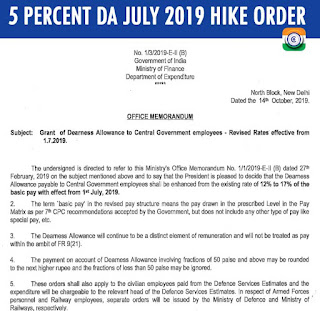
5 Percent DA July 2019 Hike Order - Grant of Dearness Allowance to Central Government employees

Grant of Dearness Allowance to Central Government employees 5 Percent DA July 2019 Hike Order  No. 1/3/2019-E- II (B) Government of...

Blog Archive

About The Author