A complete reference blog for Indian Government Employees

Showing posts with label Swachh Bharat Mission. Show all posts

Sunday, 17 September 2017

Maximum Governance Minimum Government is the government's motto: Dr. Jitendra Singh


Maximum Governance Minimum Government is the government's motto: Dr. Jitendra Singh
Swachh Bharat Mission Manual launched
Two Day Regional Conference on Good Governance and Replication of Best Practices concludes in Goa
'Maximum Governance, Minimum Government' is the motto of the Central Government. To achieve this motto Government is concentrated on "Citizen-First" mantra, said Dr. Jitendra Singh, Union Minister of State for Development of North Eastern Region (Independent Charge), MoS for PMO, Personnel, Public Grievances and Pensions, Atomic Energy and Space. He was speaking at the valedictory session of the two-day regional conference on 'Good Governance and Replication of Best Practices' which concluded in Goa today.

"Our dream is to bring Government closer to citizens so that they become active participants in the governance process. An important step for Good Governance is the simplification of procedures and processes in the Government so as to make the entire system transparent and faster. To this end Government has taken the decision to scrap 1,500 obsolete rules, started the self-certification process etc. To achieve this, the Department of Administrative Reforms & Public Grievances has a key role to play," said Dr. Jitendra Singh.

Dr. Jitendra Singh said the Prime Minister's Awards for Excellence in Public Administration were instituted 10 years back and first awards were presented on the 2nd Civil Services Day on April 21, 2007 to the Civil Servants for their innovative ideas and efforts in addressing the problems locally. This motivation is required for improving governance and delivery of services. He said the Priority Programmes for PM’s Award to be presented next year are (i) Pradhan Pradhan Mantri Fasal Bima Yojana (PMFBY); (ii) Deen Dayal Upadhyaya Grameen Kaushalya Yojana (DDU-GKY); (iii) Promoting Digital Payments; and (iv) Pradhan Mantri Awas Yojana (Rural &Urban).

Talking about Grievance cell, he informed that Department of Administrative Reforms and Public Grievances (DARPG) enabled a quantum shift in Online Government Service delivery across the country. This aims to further Government’s efforts at revamping of Public Administration system, Public Grievance Redress Mechanism, ushering in e-Governance, Digital India, more so in the context of the goal of ‘Minimum Government with Maximum Governance’ through e-Governance based Citizen Centric End-to-End Online Services. Compared to 2.70 lakh grievances in 2014, 11.94 lakh grievances were received on CPGRAMS (Central Public Grievance Redress and Monitoring System) in 2016. In 2017, 9.32 lakhs grievances have already been received till 25.8.17. Due to higher expectations, the grievances have increased more than 4 times in 2016, compared to 2014. However, due to intensive monitoring, the disposal rate has also increased significantly and is presently more than the rate of receipt of grievances. Action on grievances can be tracked with the help of unique grievance registration number. A timeline of two months has been prescribed for disposal of grievances. In case it is not possible, an interim reply with reasons for delay has to be provided.
Right to Information Act (RTI) is now online and from last six months it is available on mobile also, he informed.

Development Manual for District level functionaries by DARPG Swachh Bharat Mission [Gramin] was also launched during the Valedictory function. The purpose of the Development Role manual is to create an enabling mechanism for improved implementation of the Centrally sponsored schemes at the cutting edge, leading to enhanced outcomes in nature and extent. The manual is prepared with inputs from a combination of sources, including interaction with the Ministry of Drinking Water and Sanitation (MDWS), review of extant scheme guidelines and circulars issued by MDWS and discussions with the key personnel involved in the implementation of the scheme.

Chief Minister of Goa, Shri Manohar Parrikar also shared his thoughts on Good Governance, Swachh Bharat, and Grievance redressal mechanisms during the valedictory session.

Shri C. Viswanath, Secretary DARPG in his address said that conferences like these are useful for promoting meaningful confluence of interactions and insights, cross-fertilization of ideas and exchange of constructive views among the policy makers, public figures, peers, practitioners and professionals who may have championed and facilitated the successful implementation of innovations in government processes, administrative reforms, and public service delivery.

With this, the two-day Regional Conference on 'Good Governance and Replication of Best Practices' concluded. The DARPG has so far organized 26 such regional conferences to share experiences in the formulation and successful implementation of good governance practices and to facilitate speedy and efficient delivery of public services

PIB
Share:

Thursday, 10 August 2017

Dr Jitendra Singh administers the New India Pledge to DoPT employees


Dr Jitendra Singh administers the New India Pledge to DoPT employees

Union Minister of State (Independent Charge) for Development of North Eastern Region (DoNER), MoS PMO, Personnel, Public Grievances, Pensions, Atomic Energy and Space, Dr Jitendra Singh administered the New India Pledge 'Sankalp se Siddhi' to the employees of the Department of Personnel & Training on the occasion of Commemoration of 75th Anniversary of the Quit India Movement, here today. The pledge commits to create a New India that is strong, prosperous and inclusive; an India that will make our freedom fighters proud.

On the occasion, presentations were made by Joint Secretary, DoPT, Shri Devesh Chaturvedi on Strategy for Anti-Corruption: Initiatives taken by the Government of India and OSD, Ministry of Drinking Water and Sanitation, Shri Akshay Rout on Swachh Bharat Mission.

Addressing the gathering, Dr. Jitendra Singh said it's a unique privilege for us all to be part of the 75th Anniversary of the Quit India Movement. He said that the rapid pace of events unfolded from 1942 to 1947, beginning with the Quit India Movement and resulting in India's Independence five years later. Let us pledge to carry on with the same spirit in the next five years to drive out poverty, corruption, terrorism, communalism, casteism and build a Clean and New India by 2022 when the country will mark its 75th Anniversary of Independence, he added.

Dr. Jitendra Singh said the Government has lived up to its commitments by acting against corruption and creating a work friendly atmosphere. This day marks our rededication to our commitments, he added.

Click here for DoPT Presentation on Strategy for Anti-Corruption
Click here for Ministry of Drinking Water and Sanitation Presentation on Swachh Bharat Mission

PIB
Share:

Sunday, 15 March 2015

Railway takes steps under “swachh rail swachh bharat mission”

Railway takes steps under “swachh rail swachh bharat mission”

Ministry of Railways
13-March, 2015

Under the “Swachh Rail Swachh Bharat Mission”, regular events on cleanliness are planned to be organized Railways at all railway premises. The focus of Indian Railways is to ensure clean and hygienic toilets, maintenance of cleanliness at stations, trains etc., tree plantation, and removal of encroachments, improving drainage, public awareness campaign and periodic monitoring of the mission. ”

Detailed instructions regarding waste management have been issued to Zonal Railways for prompt disposal of waste arising out of catering services at stations and in trains in order to maintain hygiene and cleanliness at all catering units. In order to segregate the garbage, the refuse bins (with three colours) so nominated are prominently painted in Green (for Bio-degradable waste), White (for recyclable waste) and Black (all other waste i.e. other than bio-degradable waste and recyclable waste) of sufficient size to ensure all collections. ”

Disposal of garbage is done by handling over the garbage to Municipal Authorities, through incineration, dumping in identified landfill sites and composing pit etc. Similarly, hazardous waste is also disposed off as per extant statutory guidelines. ”

This information was given by the Minister of State for Railways Shri Manoj Sinha in written reply to a question in Rajya Sabha today. ”

PIB
Share:

Tuesday, 17 February 2015

Swachh Bharat Mission-RWAs: Indian Government News

Swachh Bharat Mission-RWAs
No.10/01/2.0 14-Dir(C)
Government of India
Ministry of Personnel, PG & Pensions
Department of Personnel and Training
Director (Canteens)
****
Lok Nayak Shawan, Khan Market
New Delhi, dated 13th February, 2015
To,
All Central Government Employees
Resident Welfare Associations
(as per list enclosed)

Subject: Swachh Bharat Mission-RWAs

An appeal was made to all RWAs alongwith AWOs to join together toward achieving the Mission of Swachh Bharat through letter No.10/1/2014-Dir(C) dated 29.9.2014. It is once again reiterated that Resident Welfare Association (RWA) along with Area Welfare Officers(AWO) have been playing very vital role in promoting Social, Cultural and other Welfare Activities of the residents. They also actively coordinate with a various civic authorities to provide civic amenities and services.

2. All RWAs and AWOs were requested to launch cleanliness drive through various programmes like voluntary participation of residents in cleaning (Shramdaan), ensuring disposal of garbage, awareness programmes etc. It is pertinent to point out that in accordance with existing instructions recognized RWAs frame Annual Action Plan for various activities. The achievement with reference to Annual Action Plan is required to be indicated by RWAs while applying for grants-in-aid. RWAs are requested to include cleanliness drive as one of the important targets in their Annual Action Plan and periodically inform DOPT about their achievements on this aspect. RWAs and AWOs are requested to carry out cleanliness drives voluntarily and also in association/coordination with respective civic authorities.

3. All these activities would go long way to make city clean. Let all Resident Welfare Associations and Area Welfare Officers join together towards achieving the Mission of Swachh Bharat.
(Pratima Tyagi)
Director( Canteens)
Tele:24624722
Copy to:·
All Area Welfare Officers (as per list enclosed)
Dir(Adm) w.r.t. letter No. 1-28011/101./2014-Coord dated. 27.01.2015.
Source: http://ccis.nic.in/WriteReadData/CircularPortal/D2/D02adm/sbr.pdf
Share:

Indian Government News: Swachh Bharat Mission-Departmental Canteen

Indian Government News: Swachh Bharat Mission-Departmental Canteen

No.10/01/2014-Dir(C)
Government of India
Ministry of Personnel, PG & Pensions
Department of Personnel and Training
Director(Canteens)
****
Lok Nayak Bhawan, Khan Market
New Delhi, dated 13th February, 2015

OFFICE MEMORANDUM

Subject: Swachh Bharat Mission-Departmental Canteen

Reference is invited to this Department’s O.M. of even No. dated 26.09.2014 and 09.10.2014 wherein all Ministries/Departments were requested to carry out periodical cleanliness campaign in respect of Departmental Canteens under their administrative control through respective Management Committees. Detailed guidelines with reference to observation and maintenance of cleanliness in Departmental Canteens were also circulated. All Ministries/Departments were requested to carry out periodical cleanliness campaign at least once in a month in respect of Departmental Canteens under their administrative control and furnish report thereon in the prescribed Proforma. So far only few Departments have furnished this report. All Ministries/Departments are requested to furnish report on cleanliness campaign carried out by them in respect of Departmental Canteen by 15th of every month.
(Pratima Tyagi)
Director (Canteens)
Tele: 24624722
Copy to:-
1. All Ministries/Departments of the Government of India
(Director/Deputy Secretaries Incharge, Administrative Division/Wing as per Standard List)
2. President’s Secretariat, Rashtrapati Bhawan, New Delhi.
3. Cabinet Secretariat, New Delhi.
4. Director (Admn.) DOP&T, North Block, New Delhi-w.r.t letter No. 1-28011/101/2014-Coord dated. 27.01.2015.
5. Comptroller & Auditor Genecal of India, New Delhi.
6. Director of Audit, Central Revenue, New Delhi.
7. Controller General of Accounts, Ministry of Finance, New Delhi.
8. Supreme Court of India, Tilak lVIarg, New Delhi.
9. High Court of Delhi, Sher Shah Road, New Delhi.
10. Controller General of Defence Accounts, R.K.Puram, West Block, New Delhi.
11. CAO’s Office, Ministry of Defence, DHQ, PO, New Delhi-ll0011.
12. Administrator, all Union Territories as per standard list.

Copy for information to:-
1.. PSO to Secretary(p)
2. PS to Joint Secretary (AT&A).
Share:

Monday, 9 February 2015

Five Year Action Plan on “Swachh Bharat Mission”

Five Year Action Plan on “Swachh Bharat Mission”

• The ‘Swachh Bharat Mission’ which waS launched on 2nd October 2014 should be sustained in a vigorous manner to achieve the goals set for the year 2019.

• Development of adequate infrastructur~ like washable aprons, waste disposal system, effluent treatment plants, sewer lines/septic tanks and amenities such as platform surface, circulating area favourable to mechanized cleaning

• Development of modern tools, plants and equipments for platform surfaces and circulating area and drainage. At all “A-i” and “A” category stations adequate number of dustbins, segragated for biodegradable and nonbiodegradable garbage shall be provided.

• Regular awarding of contracts i.e. rag picking, garbage disposal, pest control and one time, cleaning contracts.

• Periodic drives should be conducted at station to keep the momentum high. DRMs should be advised to participate in these drives so that a spirit of ownership of the campaign in generated.

• In the next five years regular events on cleanliness to be organized.

• Public awareness campaign should be continued through the various media available with IR including posters at stations and announcements through public address system. Campaign should also include action under the Railway’s anti-littering rules of 2012.

• Campaign should also include action under the Railway’s anti-littering rules of 2012.

• More and more mechanized cleaning gadgets will be introduced along with better types of cleaning agents. Periodic contracts for rag picking and garbage disposal to be awarded.

• More and more toilets will be brought under the purview of ‘Pay & Use’ toilets;

• Regular inspections to be conducted at various levels viz. GMs, DRMS, SIGs (Service Improvement Groups) and at other Officers level to check the standard of cleanliness. During these inspections, deficiencies if noticed in various areas such as drainage, availability of dustbin, sewerage, water supply, washable apron and garbage disposal, will be wiped out.

• Monitoring cleanliness through CCTV cameras installed at major stations .

• An award to recognize the best efforts made by the zonal railways at stations towards the cause of cleanliness shall be introduced. Such an award shall be called “Swachh Station” award and shall be given on All India basis in each category of station.

In line with the above, the following action shall be taken:
(i) Each Zonal Railway shall prepare a division-wise Action Plan which shall indicate the mechanism of cleaning (departmental or outsourced) and the frequency prescribed for cleaning at each station.

• SIG inspections report and feedback from the public should value and acted upon immediately.

• All newly manufactured coaches by the coach Production Units shall be compulsorily fitted with Bio-toilets before they are turned out by 2016-17 and all existing in-service coaches running on Indian Railways shall be retrofitted with Bio-toilets by 2021-22.

• The focus of the five year plan shall be on developing cleanliness oriented infrastructure and system improvements for sustainable cleanliness.

• Zonal Railways and Production Units shall formulate five-year plans indicating allocations of funds to bring about a radical change in the public perception about the cleanliness orientation of Indian Railways at all locations, particularly the customer interface areas namely, stations, trains, offices, etc.

Source: Indian Railways
Share:

Indian Railway: Swachh Bharat Mission- Annual Action Plan

Indian Railway: Swachh Bharat Mission- Annual Action Plan

Annual Action Plan for the Year 2014-15

• In terms of the mega-initiatives taken by Zonal Railways under the Swachh Bharat Mission, regular events on cleanliness are to be organized, including periodic cleanliness drives.

• All aspects of the campaign shall be continued including tree plantation, removal of encroachments, painting of road kerbs, clearing posters, repairing street lights, improving drainage, improving signage, whitewashing of buildings etc. shall be continued.

• Focus on clean and hygienic toilets and in particular those located at railway stations.

• Main sources of garbage generation should be identified at stations and station specific solutions should be put in place.

• Dust bins should be provided at all locations in the stations and the public should be advised and encouraged to use the same. Garbage generated by vendors/stalls/catering units should be promptly disposed off by the stall/unit holders into the earmarked refuse bins.

• Under this mission it shall be ensured that stations, tracks, colonies and offices are maintained in a clean and hygienic condition.

• There will be sustained ‘Public Awareness Campaign’ to promote Swachh Bharat Mission.

• Campaign should also include action under the Railway’s anti-littering rules of 2012.

• More and more mechanized cleaning gadgets will be introduced along with better types of cleaning agents. Periodic contracts for rag picking and garbage disposal to be awarded.

• More and more toilets will be brought under the purview of ‘Pay & Use’ toilets.

• Regular inspections to be conducted at various levels viz. GMs, DRMS, SIGs (Service Improvement Groups) and at other Officers level to check the standard of cleanliness. During these inspections, deficiencies if noticed in various areas such as drainage, availability of dustbin, sewerage, water supply, washable apron and garbage disposal, will be wiped out.

• Monitoring cleanliness through CCTV cameras installed at major stations.

• An award to recognize the best efforts made by the zonal railways at stations towards the cause of cleanliness shall be introduced. Such an award shall be called “Swachh Station” award and shall be given on All India basis in each category of station.

In line with the above, the following action shall be taken:
(i) Each Zonal Railway shall prepare a division-wise Action Plan which shall indicate the mechanism of cleaning (departmental or outsourced) and the frequency prescribed for cleaning at each station.

(ii) Mechanism for monitoring cleanliness at the station along with the inspection schedule at the station where the monitoring shall be done through CCTVs.

(iii) At all ‘A-1″ category stations under the cleanliness contract, Service Level Agreements (SLAs) prescribing measurement of cleanliness shall be gradually introduced. A sample SLA may be obtained from Delhi Metro Rail Corporation.

(iv) The divisions shall upload photographs of cleanliness drives to the website at a specified periodicity.

(v) Zonal Railways shall indicate the Action Plan, allocation of assessed funds for cleanliness drives for implementing the Swachh Bharat Mission.

(vi) Each division should identify vulnerable areas between stations for clearing encroachment and dumping of wastes and shall take coordinated action with local bodies. The RPF in coordination with GRP should ensure that trespassing is checked to prevent dumping of wastes in the railway area.

(vii) The mechanism of cleaning of trains under OBHS, CTS, etc., should be laid down clearly.

(viii) Public awareness campaign and public education campaign should be carried out on a regular basis. Apart from the media available with the railways, such as public announcement system, CCTVs, advertisement space at stations, etc., division should also issue press releases in the newspapers. Interviews to press and media by senior officers should be given to ensure adequate coverage of the action taken.
(ix) Use of social media should also be made to interact with the public and seeking their support on the endeavour of Indian Railways in the Swachh Bharat Mission.

(x) The progress of the Swachh Bharat Mission should be monitored on a daily basis by the ADRMs at the divisional and AGM at the Zonal level. Monthly reports should be sent to Railway Board.
Source: http://www.indianrailways.gov.in/
Share:

Wednesday, 15 October 2014

Swachh Bharat Mission – Railway Compartments to have Bio-toilets

Swachh Bharat Mission – Railway Compartments to have Bio-toilets

In a move to strengthen the ‘Swachh Bharat’ Mission, ICF’s General Manager, Ashok K Agarwal said that henceforth railway compartments will be made with bio-toilets.

In the Financial Year 2013-14, ICF had achieved its target of producing 1622 railway compartments. Among the 8 factories in India, it has won the award for the best railway compartment manufacturing factory in the country. The award was given by the Railway Minister, Sadananda Gowda, on October 10. Railway employees and their families are the reason why we won the award. It was their hard work that made this award possible. In the current financial year, until September, we have manufactured 824 railway compartments. Target has been fixed to manufacture 1710 railway compartments by March 2015.

In order to ensure that Swachh Bharat mission continues to be effective, railway compartments will be manufactured with bio-toilets. These toilets convert human excreta into water and dispose of it. In addition to this, in order to avoid fire accidents, railway compartments will be produced, in future, with rust-proof alloys. If, despite these precautions, accidents occur, then there will be emergency exits and swing doors on both sides of the compartments. There are also plans to produce engines with superfast capabilities in future.

Currently, special railway compartments are being produced for the Kolkata Metro Rail trains. We have not been approached by Chennai Metro Rail officials. If they do, we are ready to produce railway compartments for them.

ICF Chief Mechanical Engineer, Pankaj Kumar; Chief Electrical Engineer, Hande Giri and others were present during the meeting.

Source: 7thpaycommissionnews.in
#Cleanliness Pledge, #Indian Railways, #Modi Government, #Swachh Bharat Mission, #Indian Government News
Share:

Featured post

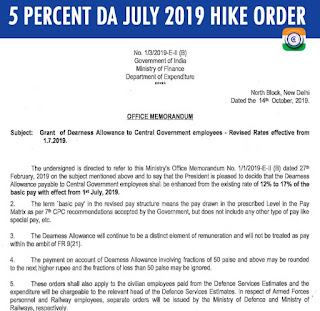
5 Percent DA July 2019 Hike Order - Grant of Dearness Allowance to Central Government employees

Grant of Dearness Allowance to Central Government employees 5 Percent DA July 2019 Hike Order  No. 1/3/2019-E- II (B) Government of...

Blog Archive

About The Author