A complete reference blog for Indian Government Employees

Showing posts with label 6th Pay Commission. Show all posts

Sunday, 15 September 2019

WB 6th PC implementation - Revised Pay Structure from January 2020

WB 6th PC implementation - Revised Pay Structure from January 2020

West Bengal 6th Pay Commission implementation - Revised Pay Structure from January 2020


On 13th September 2019, the State Chief Minister Mamta Banerjee stated in Kolkata that the Pay Panel Committee submitted its first report to the Government and the recommendations of the report will accept, she added.

The minimum basic pay may be raised to Rs.17.990 from the existing of level of Rs. 7000.
As per the recommendations of the Pay Commission report, the minimum gross salary will be more than Rs. 20,000 and the Gratuity ceiling will be increased to 10 lakh.


The Pay Commission also recommended to Dearness allowance merge with basic pay with new pay bands.

About then thousand crore rupees will be spent additionally from State exchequer for implementing all the recommendations of 6th pay commission including new pay structure to West Bengal Government Employees.

Share:

Monday, 6 August 2018

Increment Date in Rule 10 of CCS (RP) Rules 2016 - Clarification

Increment Date in Rule 10 of CCS (RP) Rules 2016 - Clarification
F.No. 4-21/2017-IC/E.III(A)
Government of India
Ministry of Finance Department of Expenditure
North Block, New Delhi
Dated 31st July, 2018
OFFICE MEMORANDUM

Subject: Date of next increment- Rule 10 of CCS (RP) Rules, 2016- regarding.

The undersigned is directed to invite attention to Rule 10 of CCS (RP) Rules 2016 which provides, inter alia, that there shall be two dates for increment namely 1st January and 1st July of every year, instead of the provision of one date of increment on the 1st July during the 6th Pay Commission pay structure. The Rule further provides that an employee shall be entitled to only one annual increment either on 1st January or 1st July depending on the date of appointment, promotion or grant of financial upgradation. The Sub-Rule (2) thereof provides that increment in respect of an employee appointed or promoted or granted financial upgradation including upgradation under MACP during the period between the 2nd day of January and 1st day of July (both inclusive) shall be granted on 1st day of January and the increment in respect of an employee appointed or promoted or granted financial upgradation including upgradation under MACP during the period between 2nd day of July and 1st day of January (both inclusive) shall be granted on 1st day of July.

2. The proviso to Sub-Rule 2 of Rule 10 of CCS (PR) Rules, 2016 provides that the next increment after drawal of increment on 1st day of July 2016 shall accrue as on 1st day of July 2017.

3. A number of references has been received in the Ministry of Finance seeking clarification whether in case of an employee promoted on 1st July 2016, whose pay was fixed on 01/07/2016 in terms of the rules governing fixation of pay on promotion, the next increment may be allowed on 1st January 2017 or on 1st July 2017.

4. The matter has been considered. During the regime of pay structure obtaining immediately prior to 01/01/2016, when the annual increment was admissible uniformly on 1st July every year, the increment was admissible on 1st July, provided the condition of 6 months service was fulfilled. Thereafter, the next increment used to be given after a period of 12 months.

5. Accordingly, keeping in view the principle followed during the period before 1.1.2016 immediately prior to coming into force of the CCS(RP) Rules, 2016, which has been modified in the revised pay structure in terms of Rule 10 thereof by way of 2 dates of increment on 1st January and 1st July, it is clarified that in case an employee is promoted or granted financial upgradation including upgradation under the MACP scheme on 1st January or 1st July, where the pay is fixed in the Level applicable to the post on which promotion is made in accordance with the Rule 13 of the CCS(RP) Rules, 2016, the first increment in the Level applicable to the post on which promotion is made shall accrue on the following 1st July or 1st January, as the case may be, provided a period of 6 months qualifying service is strictly fulfilled. The next increment thereafter shall, however, accrue only after completion of one year.

6. This order is issued in consultation with office of C&AG in its application to employees working in Indian Audit and Accounts Department.

7. Hindi version of this order is also attached.
sd/-
(Ram Gopal)
Under Secretary to the Government of India
Share:

Wednesday, 28 March 2018

6th CPC DA Order: Enhanced from 139% to 142%

6th CPC DA Order: Enhanced from 139% to 142%
Rate of Dearness Allowance applicable w.e.f. 1.1.2018 to employees of Central Government and Central Autonomous Bodies continuing to draw their pay in the pre-revised pay scale/Grade Pay as per 6th Central Pay Commission.
6th-CPC-Dearness-Allowance-Central-Government-Employees

No.1/3/2008-E.II(B)
Government of India
Ministry of Finance
Department of Expenditure
New Delhi, dated the 28th March, 2018.
Office Memorandum

Subject: Rate of Dearness Allowance applicable w.e.f. 1.1.2018 to employees of Central Government and Central Autonomous Bodies continuing to draw their pay in the pre-revised pay scale/Grade Pay as per 6th Central Pay Commission.

The undersigned is directed to refer to this Department's O.M. of even No. dated 26th September, 2017 regarding revision of the rate of Dearness Allowance w.e.f 1.7.2017 in respect of employees of Central Government and Central Autonomous Bodies continuing to draw their pay in the pre-revised pay scale/Grade Pay as per 6th Central Pay Commission.

2. The rate of DA admissible to above categories of employees of Central Government and Central Autonomous Bodies shall be enhanced from the existing 139% to 142% w.e.f. 1.1.2018.

3. The provisions contained in paras 3, 4 and 5 of this Ministry's O.M.No.1 (3)/2008-E.11(B) dated 29th August, 2008 shall continue to be applicable while regulating Dearness Allowance under these orders.

4. The contents of this Office Memorandum may also be brought to the notice of all organisations under the administrative control of the Ministries/Departments which have adopted the Central Government scales of pay.
sd/-
(Nirmala Dev)
Deputy Secretary to the Govt. of India
Source: www.doe.gov.in
Share:

Saturday, 22 July 2017

Pension to IAF Veterans

Pension to IAF Veterans 

Pension of pre-2006 retired Junior Commissioned Officers/ Other Ranks (JCOs / ORs) have been assessed on the basis of rank continuously held for 10 months or more. However, protection of minimum of fitment table under 6th Pay Commission for the last rank held has been provided.

A Junior Warrant Officer (JWO) who has not served for 10 months or more continuously in the rank is entitled to receive initial pension in the rank of Sergeant. However, where the revised pension as on 01.07.2014 worked out in terms of OROP order, happens to be less than the existing pension as on 01.07.2014, the pension has not been revised to the disadvantage of the pensioner.

Further, the issue whether in the case of JCOs / ORs, the pension is to be paid on the basis of the last rank held instead of last rank pensioned under OROP was referred to the Judicial Committee on OROP. The Committee has submitted its report to the Ministry which is under examination.

This information was given by Minister of State for Defence Dr. Subhash Bhamre in a written reply to Dr. P. Venugopal in Lok Sabha today.

PIB
Share:

Sunday, 9 April 2017

Rate of Dearness Allowance applicable w.e.f.1.1.2017 to employees of Central Government and Central Autonomous Bodies continuing to draw their pay in the pre-revised pay scale/grade pay as per 6th Central Pay Commission


Rate of Dearness Allowance applicable w.e.f.1.1.2017 to employees of Central Government and Central Autonomous Bodies continuing to draw their pay in the pre-revised pay scale/grade pay as per 6th Central Pay Commission
No. 1/3/2008-E.II(B)
Government of India
Ministry of Finance
Department of Expenditure
New Delhi, dated the 7th April, 2017.

OFFICE MEMORANDUM

Subject: Rate of Dearness Allowance applicable w.e.f.1.1.2017 to employees of Central 
Government and Central Autonomous Bodies continuing to draw their pay in the pre-revised pay scale/grade pay as per 6th Central Pay Commission

The undersigned is directed to refer to this Department’s O.M.of even No. dated 9th November, 2016 revising the rates of Dearness Allowance w.e.f.01.07.2016 in respect of employees of Central Government and Central Autonomous Bodies continuing to draw their pay in the pre-revised pay scale/grade pay as per 6th Central Pay Commission.

2. The rate of DA admissible to above categories of employees of Central Government and Central Autonomous Bodies shall be enhanced from the existing rate of 132% to 136% w.e.f.1.1.2017.

3. The provisions contained in paras 3,4 and 5 of this Ministry's O.M.No. 1(3)/2008-E.II(B) dated 29th August, 2008 shall continue to be applicable while regulating Dearness Allowance under these orders.

4. The contents of this Office Memorandum may also be brought to the notice of all organisations under the administrative control of the Ministries/Departments which have adopted the Central Government scales of pay
(Nirmala Dev)
Deputy Secretary to the Govt. of India
Original Order Copy
Share:

Wednesday, 6 July 2016

COMPARISON OF PAY AS ON 31.12.2015 AND AS ON 01.01.2016

COMPARISON OF PAY AS ON 31.12.2015 AND AS ON 01.01.2016


PAY ON 31.12.2015PAY ON 01.01.2016
01Pay in Pay Band 5200.007000.00 18000.00
Grade Pay – GP1800.00
Total Basic Pay- BP
02DA @ 125% as on 01.01.20168750.000
03Total Pay15750.0018000.00

DEDUCTION

04Income Tax0.000.00
05CGEIS30.0030.00
06CHSS @ 1% of BP70.00180.00
07Professional Tax175.00225.00
08GPF @ 8.33% of BP583.001499.00
09License Fee135.00135.00
10Total deduction993.002069.00
11Take Home Salary:14757.0015931.00
12Increase in Salary = 18000 – 157502250.00
13% of Increase in Salary14.28%
14Increase in Take Home Salary = 15931 – 147571174.00
15% of Increase in Take Home Salary7.9%
COMPARISON OF PAY AS ON 31.12.2015 AND AS ON 01.01.2016


PAY ON 31.12.2015PAY ON 01.01.2016
01Pay in Pay Band 5200.00 7730.00 19900.00
Grade Pay – GP1900.00
Total Basic Pay- BP
02DA @ 125% as on 01.01.20169125.000
03Total Pay16855.0019900.00

DEDUCTION

04Income Tax0.000.00
05CGEIS30.0030.00
06CHSS @ 1% of BP77.00199.00
07Professional Tax175.00225.00
08GPF @ 8.33% of BP644.001658.00
09License Fee135.00135.00
10Total deduction1061.002125.00
11Take Home Salary:15794.0017775.00
12Increase in Salary = 19900 – 168553045.00
13% of Increase in Salary18.06%
14Increase in Take Home Salary = 17775 – 157941981.00
15% of Increase in Take Home Salary12.54%
COMPARISON OF PAY AS ON 31.12.2015 AND AS ON 01.01.2016


PAY ON 31.12.2015PAY ON 01.01.2016
01Pay in Pay Band 5200.00 8460.00 21700.00
Grade Pay – GP2000.00
Total Basic Pay- BP
02DA @ 125% as on 01.01.201610575.000
03Total Pay19035.0021700.00

DEDUCTION

04Income Tax0.000.00
05CGEIS30.0030.00
06CHSS @ 1% of BP85.00217.00
07Professional Tax175.00225.00
08GPF @ 8.33% of BP707.001808.00
09License Fee135.00135.00
10Total deduction1132.002415.00
11Take Home Salary:17903.0019285.00
12Increase in Salary = 21700 – 190352665.00
13% of Increase in Salary14%
14Increase in Take Home Salary = 19285 – 179031382.00
15% of Increase in Take Home Salary7.72%


COMPARISON OF PAY AS ON 31.12.2015 AND AS ON 01.01.2016


PAY ON 31.12.2015PAY ON 01.01.2016
01Pay in Pay Band 5200.00 9910.00 25500.00
Grade Pay – GP2400.00
Total Basic Pay- BP
02DA @ 125% as on 01.01.201612388.000
03Total Pay22298.0025500.00

DEDUCTION

04Income Tax0.000.00
05CGEIS30.0030.00
06CHSS @ 1% of BP99.00255.00
07Professional Tax175.00225.00
08GPF @ 8.33% of BP826.002124.00
09License Fee310.00310.00
10Total deduction1440.002944.00
11Take Home Salary:20858.0022556.00
12Increase in Salary = 25500 – 222983202.00
13% of Increase in Salary14.36%
14Increase in Take Home Salary = 22556 – 208581698.00
15% of Increase in Take Home Salary8.14%
COMPARISON OF PAY AS ON 31.12.2015 AND AS ON 01.01.2016


PAY ON 31.12.2015PAY ON 01.01.2016
01Pay in Pay Band 5200.00 11360.00 29200.00
Grade Pay – GP2800.00
Total Basic Pay- BP
02DA @ 125% as on 01.01.201614200.000
03Total Pay25565.0029200.00

DEDUCTION

04Income Tax473.00836.00
05CGEIS30.0030.00
06CHSS @ 1% of BP114.00292.00
07Professional Tax225.00225.00
08GPF @ 8.33% of BP946.002432.00
09License Fee310.00310.00
10Total deduction2098.004125.00
11Take Home Salary:23467.0025075.00
12Increase in Salary = 29200 – 255653635.00
13% of Increase in Salary14.22%
14Increase in Take Home Salary = 25075 – 234671608.00
15% of Increase in Take Home Salary6.8%


COMPARISON OF PAY AS ON 31.12.2015 AND AS ON 01.01.2016


PAY ON 31.12.2015PAY ON 01.01.2016
01Pay in Pay Band 9300.0013500.00 35400.00
Grade Pay – GP4200.00
Total Basic Pay- BP
02DA @ 125% as on 01.01.201616875.000
03Total Pay30375.0035400.00

DEDUCTION

04Income Tax954.001416.00
05CGEIS60.0060.00
06CHSS @ 1% of BP135.00354.00
07Professional Tax225.00225.00
08GPF @ 8.33% of BP1125.002948.00
09License Fee370.00370.00
10Total deduction2869.005373.00
11Take Home Salary:27506.0030027.00
12Increase in Salary = 35400 – 303755025.00
13% of Increase in Salary16.54%
14Increase in Take Home Salary = 30027 – 275062521.00
15% of Increase in Take Home Salary9.16%


COMPARISON OF PAY AS ON 31.12.2015 AND AS ON 01.01.2016


PAY ON 31.12.2015PAY ON 01.01.2016
01Pay in Pay Band 9300.00 17140.00 44900.00
Grade Pay – GP4600.00
Total Basic Pay- BP
02DA @ 125% as on 01.01.201621425.000
03Total Pay38565.0044900.00

DEDUCTION

04Income Tax1773.002730.00
05CGEIS60.0060.00
06CHSS @ 1% of BP171.00449.00
07Professional Tax225.00225.00
08GPF @ 8.33% of BP1428.003740.00
09License Fee370.00370.00
10Total deduction4027.007574.00
11Take Home Salary:34538.0037326.00
12Increase in Salary = 44900- 385656335.00
13% of Increase in Salary16.4%
14Increase in Take Home Salary = 17788 – 154032788.00
15% of Increase in Take Home Salary8.07%


COMPARISON OF PAY AS ON 31.12.2015 AND AS ON 01.01.2016


PAY ON 31.12.2015PAY ON 01.01.2016
01Pay in Pay Band 9300.00 18150.00 47600.00
Grade Pay – GP4800.00
Total Basic Pay- BP
02DA @ 125% as on 01.01.201622688.000
03Total Pay40838.0047600.00

DEDUCTION

04Income Tax2000.003270.00
05CGEIS60.0060.00
06CHSS @ 1% of BP182.00476.00
07Professional Tax225.00225.00
08GPF @ 8.33% of BP1512.003965.00
09License Fee370.00370.00
10Total deduction4349.008366.00
11Take Home Salary:36489.0039234.00
12Increase in Salary =  47600 – 408386762.00
13% of Increase in Salary16.56%
14Increase in Take Home Salary = 17788 – 154032745.00
15% of Increase in Take Home Salary7.52%


COMPARISON OF PAY AS ON 31.12.2015 AND AS ON 01.01.2016


PAY ON 31.12.2015PAY ON 01.01.2016
01Pay in Pay Band 15600.00 22100.00 56100.00
Grade Pay – GP5400.00
Total Basic Pay- BP
02DA @ 125% as on 01.01.201627625.000
03Total Pay49725.0056100.00

DEDUCTION

04Income Tax3695.004970.00
05CGEIS120.00120.00
06CHSS @ 1% of BP221.00561.00
07Professional Tax225.00225.00
08GPF @ 8.33% of BP1841.004673.00
09License Fee500.00500.00
10Total deduction6602.0011049.00
11Take Home Salary:43123.0045051.00
12Increase in Salary = 56100 – 497256375.00
13% of Increase in Salary12.82%
14Increase in Take Home Salary = 45051 – 431231928.00
15% of Increase in Take Home Salary4.47%


COMPARISON OF PAY AS ON 31.12.2015 AND AS ON 01.01.2016


PAY ON 31.12.2015PAY ON 01.01.2016
01Pay in Pay Band 15600.00 25350.00 67700.00
Grade Pay – GP6600.00
Total Basic Pay- BP
02DA @ 125% as on 01.01.201631688.000
03Total Pay57038.0067700.00

DEDUCTION

04Income Tax5158.007290.00
05CGEIS120.00120.00
06CHSS @ 1% of BP254.00677.00
07Professional Tax225.00225.00
08GPF @ 8.33% of BP2112.005639.00
09License Fee500.00500.00
10Total deduction8369.0014451.00
11Take Home Salary:48669.0053249.00
12Increase in Salary =  67700- 5703810662.00
13% of Increase in Salary18.69%
14Increase in Take Home Salary = 17788 – 154034580.00
15% of Increase in Take Home Salary9.41%


Source : http://nfaeehq.blogspot.in/
Share:

Tuesday, 5 July 2016

COMPARISON OF PAY between 6th Pay Commission & 7th Pay Commission

COMPARISON OF PAY between 6th Pay Commission & 7th Pay Commission

COMPARISON OF PAY AS ON 31.12.2015 AND AS ON 01.01.2016
PAY ON 31.12.2015 PAY ON 01.01.2016
01 Pay in Pay Band  5200.00 7000.00  
18000.00
Grade Pay – GP 1800.00
Total Basic Pay- BP
02 DA @ 125% as on 01.01.2016 8750.00 0
03 Total Pay 15750.00 18000.00
DEDUCTION
04 Income Tax 0.00 0.00
05 CGEIS 30.00 30.00
06 CHSS @ 1% of BP 70.00 180.00
07 Professional Tax 175.00 225.00
08 GPF @ 8.33% of BP 583.00 1499.00
09 License Fee 135.00 135.00
10 Total deduction 993.00 2069.00
11 Take Home Salary: 14757.00 15931.00
12 Increase in Salary = 18000 – 15750 2250.00
13 % of Increase in Salary 14.28%
14 Increase in Take Home Salary = 15931 – 14757 1174.00
15 % of Increase in Take Home Salary 7.9%
COMPARISON OF PAY AS ON 31.12.2015 AND AS ON 01.01.2016
PAY ON 31.12.2015 PAY ON 01.01.2016
01 Pay in Pay Band  5200.00  
7730.00
 
19900.00
Grade Pay – GP 1900.00
Total Basic Pay- BP
02 DA @ 125% as on 01.01.2016 9125.00 0
03 Total Pay 16855.00 19900.00
DEDUCTION
04 Income Tax 0.00 0.00
05 CGEIS 30.00 30.00
06 CHSS @ 1% of BP 77.00 199.00
07 Professional Tax 175.00 225.00
08 GPF @ 8.33% of BP 644.00 1658.00
09 License Fee 135.00 135.00
10 Total deduction 1061.00 2125.00
11 Take Home Salary: 15794.00 17775.00
12 Increase in Salary = 19900 – 16855 3045.00
13 % of Increase in Salary 18.06%
14 Increase in Take Home Salary = 17775 – 15794 1981.00
15 % of Increase in Take Home Salary 12.54%
COMPARISON OF PAY AS ON 31.12.2015 AND AS ON 01.01.2016
PAY ON 31.12.2015 PAY ON 01.01.2016
01 Pay in Pay Band  5200.00  
8460.00
 
21700.00
Grade Pay – GP 2000.00
Total Basic Pay- BP
02 DA @ 125% as on 01.01.2016 10575.00 0
03 Total Pay 19035.00 21700.00
DEDUCTION
04 Income Tax 0.00 0.00
05 CGEIS 30.00 30.00
06 CHSS @ 1% of BP 85.00 217.00
07 Professional Tax 175.00 225.00
08 GPF @ 8.33% of BP 707.00 1808.00
09 License Fee 135.00 135.00
10 Total deduction 1132.00 2415.00
11 Take Home Salary: 17903.00 19285.00
12 Increase in Salary = 21700 – 19035 2665.00
13 % of Increase in Salary 14%
14 Increase in Take Home Salary = 19285 – 17903 1382.00
15 % of Increase in Take Home Salary 7.72%
COMPARISON OF PAY AS ON 31.12.2015 AND AS ON 01.01.2016
PAY ON 31.12.2015 PAY ON 01.01.2016
01 Pay in Pay Band  5200.00  
9910.00
 
25500.00
Grade Pay – GP 2400.00
Total Basic Pay- BP
02 DA @ 125% as on 01.01.2016 12388.00 0
03 Total Pay 22298.00 25500.00
DEDUCTION
04 Income Tax 0.00 0.00
05 CGEIS 30.00 30.00
06 CHSS @ 1% of BP 99.00 255.00
07 Professional Tax 175.00 225.00
08 GPF @ 8.33% of BP 826.00 2124.00
09 License Fee 310.00 310.00
10 Total deduction 1440.00 2944.00
11 Take Home Salary: 20858.00 22556.00
12 Increase in Salary = 25500 – 22298 3202.00
13 % of Increase in Salary 14.36%
14 Increase in Take Home Salary = 22556 – 20858 1698.00
15 % of Increase in Take Home Salary 8.14%
COMPARISON OF PAY AS ON 31.12.2015 AND AS ON 01.01.2016
PAY ON 31.12.2015 PAY ON 01.01.2016
01 Pay in Pay Band  5200.00  
11360.00
 
29200.00
Grade Pay – GP 2800.00
Total Basic Pay- BP
02 DA @ 125% as on 01.01.2016 14200.00 0
03 Total Pay 25565.00 29200.00
DEDUCTION
04 Income Tax 473.00 836.00
05 CGEIS 30.00 30.00
06 CHSS @ 1% of BP 114.00 292.00
07 Professional Tax 225.00 225.00
08 GPF @ 8.33% of BP 946.00 2432.00
09 License Fee 310.00 310.00
10 Total deduction 2098.00 4125.00
11 Take Home Salary: 23467.00 25075.00
12 Increase in Salary = 29200 – 25565 3635.00
13 % of Increase in Salary 14.22%
14 Increase in Take Home Salary = 25075 – 23467 1608.00
15 % of Increase in Take Home Salary 6.8%
COMPARISON OF PAY AS ON 31.12.2015 AND AS ON 01.01.2016
PAY ON 31.12.2015 PAY ON 01.01.2016
01 Pay in Pay Band  9300.00 13500.00  
35400.00
Grade Pay – GP 4200.00
Total Basic Pay- BP
02 DA @ 125% as on 01.01.2016 16875.00 0
03 Total Pay 30375.00 35400.00
DEDUCTION
04 Income Tax 954.00 1416.00
05 CGEIS 60.00 60.00
06 CHSS @ 1% of BP 135.00 354.00
07 Professional Tax 225.00 225.00
08 GPF @ 8.33% of BP 1125.00 2948.00
09 License Fee 370.00 370.00
10 Total deduction 2869.00 5373.00
11 Take Home Salary: 27506.00 30027.00
12 Increase in Salary = 35400 – 30375 5025.00
13 % of Increase in Salary 16.54%
14 Increase in Take Home Salary = 30027 – 27506 2521.00
15 % of Increase in Take Home Salary 9.16%
COMPARISON OF PAY AS ON 31.12.2015 AND AS ON 01.01.2016
PAY ON 31.12.2015 PAY ON 01.01.2016
01 Pay in Pay Band  9300.00  
17140.00
 
44900.00
Grade Pay – GP 4600.00
Total Basic Pay- BP
02 DA @ 125% as on 01.01.2016 21425.00 0
03 Total Pay 38565.00 44900.00
DEDUCTION
04 Income Tax 1773.00 2730.00
05 CGEIS 60.00 60.00
06 CHSS @ 1% of BP 171.00 449.00
07 Professional Tax 225.00 225.00
08 GPF @ 8.33% of BP 1428.00 3740.00
09 License Fee 370.00 370.00
10 Total deduction 4027.00 7574.00
11 Take Home Salary: 34538.00 37326.00
12 Increase in Salary = 44900- 38565 6335.00
13 % of Increase in Salary 16.4%
14 Increase in Take Home Salary = 17788 – 15403 2788.00
15 % of Increase in Take Home Salary 8.07%
COMPARISON OF PAY AS ON 31.12.2015 AND AS ON 01.01.2016
PAY ON 31.12.2015 PAY ON 01.01.2016
01 Pay in Pay Band  9300.00  
18150.00
 
47600.00
Grade Pay – GP 4800.00
Total Basic Pay- BP
02 DA @ 125% as on 01.01.2016 22688.00 0
03 Total Pay 40838.00 47600.00
DEDUCTION
04 Income Tax 2000.00 3270.00
05 CGEIS 60.00 60.00
06 CHSS @ 1% of BP 182.00 476.00
07 Professional Tax 225.00 225.00
08 GPF @ 8.33% of BP 1512.00 3965.00
09 License Fee 370.00 370.00
10 Total deduction 4349.00 8366.00
11 Take Home Salary: 36489.00 39234.00
12 Increase in Salary =  47600 – 40838 6762.00
13 % of Increase in Salary 16.56%
14 Increase in Take Home Salary = 17788 – 15403 2745.00
15 % of Increase in Take Home Salary 7.52%
COMPARISON OF PAY AS ON 31.12.2015 AND AS ON 01.01.2016
PAY ON 31.12.2015 PAY ON 01.01.2016
01 Pay in Pay Band  15600.00  
22100.00
 
56100.00
Grade Pay – GP 5400.00
Total Basic Pay- BP
02 DA @ 125% as on 01.01.2016 27625.00 0
03 Total Pay 49725.00 56100.00
DEDUCTION
04 Income Tax 3695.00 4970.00
05 CGEIS 120.00 120.00
06 CHSS @ 1% of BP 221.00 561.00
07 Professional Tax 225.00 225.00
08 GPF @ 8.33% of BP 1841.00 4673.00
09 License Fee 500.00 500.00
10 Total deduction 6602.00 11049.00
11 Take Home Salary: 43123.00 45051.00
12 Increase in Salary = 56100 – 49725 6375.00
13 % of Increase in Salary 12.82%
14 Increase in Take Home Salary = 45051 – 43123 1928.00
15 % of Increase in Take Home Salary 4.47%
COMPARISON OF PAY AS ON 31.12.2015 AND AS ON 01.01.2016
PAY ON 31.12.2015 PAY ON 01.01.2016
01 Pay in Pay Band  15600.00  
25350.00
 
67700.00
Grade Pay – GP 6600.00
Total Basic Pay- BP
02 DA @ 125% as on 01.01.2016 31688.00 0
03 Total Pay 57038.00 67700.00
DEDUCTION
04 Income Tax 5158.00 7290.00
05 CGEIS 120.00 120.00
06 CHSS @ 1% of BP 254.00 677.00
07 Professional Tax 225.00 225.00
08 GPF @ 8.33% of BP 2112.00 5639.00
09 License Fee 500.00 500.00
10 Total deduction 8369.00 14451.00
11 Take Home Salary: 48669.00 53249.00
12 Increase in Salary =  67700- 57038 10662.00
13 % of Increase in Salary 18.69%
14 Increase in Take Home Salary = 17788 – 15403 4580.00
15 % of Increase in Take Home Salary 9.41%

Source : http://nfaeehq.blogspot.in/
Share:

Sunday, 29 November 2015

West Bengal Government Sets Up Pay Commission

West Bengal Government Sets Up Pay Commission

Kolkata: The West Bengal Government has constituted the 6th Pay Commission for its own staff members and certain other categories of employees in the state to revise their salaries.

Economist Abhirup Sarkar, who is a professor of the Indian Statistical Institute, has been appointed chairman of the eight-member Pay Commission, which is scheduled to submit its report within six months.
The state Assembly elections are slated for next year and the setting up of the pay panel was made eight days after the Central Pay Commission submitted its report.

A Finance Department resolution yesterday said the decision was taken considering changes taken place in the structure of emoluments of state government employees in several respects since the 5th Pay Commission submitted its report.

The Commission will also cover employees of local bodies, panchayats, public undertakings, teaching and non-teaching staff of government aided and sponsored educational institutions.

As per its Terms and Reference, the Pay Commission would examine the present structure of pay and conditions of service, among other things.

It would examine the existing promotion policies and related issues and suggest suitable changes.
It would also examine various allowances, besides issues relating to retirement benefits.

To make recommendations on each of the above, the factors which will be considered included the prevailing pay structure under Central government, PSUs and other state governments, the economic condition of the country and the resources of the state government.

The Pay Commission will devise its own procedures and may take help of other departments and make estimate of the cost involved in implementing their recommendations.

“The Commission will submit their recommendations as expeditiously as practicable but preferably within a period of six months from the date of order notifying the constitution of the Commission,” the resolution said.
The Pay Commission may submit interim recommendations if found necessary or if so desired by the state government, it added.
PTI
Share:

Thursday, 24 September 2015

Status of MACP in the 7th pay commission

Status of MACP in the 7th pay commission

Newspapers continuously update us with news about the recommendation of the 7th Pay Commission which holds the highest expectation levels at present. From such sources, we come to know that the recommendations of the 7th Pay Commission are going to be submitted on 31st of October and they may come to force from 1/4/2016.

Pay structure is very important and equally important is the promotion policy.

Assured Career Progression (ACP) which was introduced in the 5th Pay Commission, provided some comfort for the employees who suffered from lack of promotions for long years. Before this, promotion was just an illusion. Labour Unions and Federations of the Central government employees got these benefits for us after much struggle.

In the recommendations of the 6th Pay Commission, which came after this, ACP was changed to MACP (Modified Assured Career Progression) and it provided an opportunity for employees who were not promoted for the last ten years to enter the next Grade Pay.

In this, the benefit was very small as 1800, 1900, 2000, 2400, 2800, 4200, 4600, 4800 (excluding 2800-4200). Many issues in this method of Grade Pay still lie unresolved before the National Anomaly Committee.

Hence, lakhs of Central Government employees expect a favourable change in MACP at least through 7th Pay Commission. During his or her service period, an employee must have at least five promotions. This has been an important plea of the Central Trade Unions.

The benefit of the first MACP has to be given after 8 years of continuous service and the benefit of the successive MACP has to be given after 7,6,5 and 4 years of continuous service.

If the benefits of MACP were such, certainly all the central government employees will be highly encouraged and will work hard to make all the Central Government plans and activities a great success.

This will definitely increase the productivity of the Central Government and the associated industries. Due to this, the relationship between the government and the employees will become more harmonious and there will be a peaceful working environment.

Source-http://centralgovernmentemployeesportal.blogspot.in/2015/09/status-of-macp-in-7th-pay-commission.html
Share:

Thursday, 17 September 2015

Finance Minister Arun Jaitley to receive Sixth Pay Commission report in December

Finance Minister Arun Jaitley to receive Sixth Pay Commission report in December

New Delhi,: The Seventh Pay Commission headed by Justice Ashok Kumar Mathur is likely to submit its report to Union Finance Minister Arun Jaitley in December, presumably recommending a 40 per cent hike in salary for the central government employees.


Justice Mathur already told PTI on August 25, “The Commission may submit its report by the end of September.”

“We are likely to recommend something for the good of central government employees, after observation of inflation, the government’s financial position and salary structure of government employees in other countries. The Finance Minister will give the latest highlights,” a top official of the pay panel said, speaking on condition of anonymity.

He also said it has been mandated to recommend incentive schemes to reward excellence in productivity, performance and integrity, which it will do.

“Though previous Pay Commissions have talked about linking pay with productivity, the earlier governments have not accepted such recommendations. Since this government has shown strong political will, we hope they will accept our recommendations,” he added.

Over 5 million central government employees are expecting a bounty from the report which is likely to recommend major changes in salaries and terms of employment, including performance-linked pay and incentives.

“A joint secretary gets now Rs 128,000 as monthly salary with dearness allowance. I do not expect it to go up to more than Rs 160,000,” a joint secretary-level official of the Central Government said.

In his pre-budget speech in February, Jaitley said,“the Seventh Pay Commission impact may have to be absorbed in financial year 2016-17.”

The salary outgo of central government employees will increase in financial year 2016-17 at 15.79 per cent to Rs 1.16 lakh crore with the likely implementation of the Seventh Pay Commission award, said the statement tabled by Finance Minister Arun Jaitley in Parliament on August 12.

The Seventh Pay Commission, which was set up by the UPA government, was required to submit its report by August-end. The government constitutes the Pay Commission almost every 10 years to revise the pay scale of its employees and often these are adopted by states after some modifications.

The Commission has already completed discussions with various stakeholders, including organisations, federations, groups representing civil employees as well as Defence services and is in the process of finalising its recommendations.

The recommendations of the Seventh Pay Commission are scheduled to come into effect from January 1, 2016.

The Sixth Pay Commission was implemented with effect from January 1, 2006, the fifth from January 1, 1996 and the fourth from January 1, 1986.
Share:

Tuesday, 11 August 2015

Benefits of Sixth Pay Commission to the employees who retired before 1.1.2006

Benefits of Sixth Pay Commission to the employees who retired before 1.1.2006

In Rajya Sabha on 6.8.2015, Minister of DoPT Shri Jitendra Singh replied in a writeen form to the subsequent questions regarding the benefit of minimum pension to the pensioners retired before 01.01.2006.

He said, In its order dated 01.11.2011, Hon’ble Central Administrative Tribunal (CAT), Principal Bench allowed some petitions granting the benefit of minimum pension to the pensioners retired before 01.01.2006 as per the fitment tables applicable to the employees serving as on 01.01.2006. The order dated 01.11.2011 of Hon’ble CAT was upheld by the Hon’ble High Court of Delhi vide its order dated 29.04.2013 in Writ Petition (C) No. 2348-50/2012.

The Special Leave Petition No.36148-50/2013 filed by the Government against the order dated 29.04.2013 of Hon’ble High Court of Delhi has been dismissed by Hon’ble Supreme Court on 17.03.2015.

Following the dismissal of the SLPs filed by the Government, Department of Pension & Pensioners’ Welfare has issued orders vide OM No.38/37/08-P&PW(A) dated 30.07.2015 in implementation of the orders of the Hon’ble Supreme Court.
Share:

Monday, 6 July 2015

7th CPC News – Media require specialised approach rather than a hype

7th CPC News – Media require specialised approach rather than a hype
Need for quality information while reporting actual increase out of 6th CPC and Projection in 7th Pay Commission Pay
After 7CPC itself announced in last week of June 2015 to the effect that it has started finalising the report to be submitted to the Govt, News on 7th Pay Commission has started becoming popular.

It would be Needless to say all Government Employees would be interested in 7th CPC report. Though common man may not show much interest in the elaboration and technicalities of 7CPC report, he/she will also be curious to know the quatum of increase in Pay of Central Government Employees in General. At the same time, a common man will always be depending on various News media such as News Prints and Television channels to get these type of news.

But we could see that Pay Commission related news provided by News Media nowadays are misleading in the sense that they are only projecting the number of times the pay was hiked by previous Pay commissions and likely hike by 7th Pay Commission.

Missing information will always be misleading


Media reports on Pay Commission For instance, it was reported by a daily news paper recently, which was quoted later by many blogs that Govt Salaries are set to increase by 2 to 3 times and that 6th Pay Commission suggested 3 times increase in Salaries. It was also reported that 5th CPC recommended 2.6 times in increase in pay of lower Grade Officials.

A common man who is reading this news would be easily mislead and he/she would come to a conclusion that Salary of Government Employees was increased by 3 times by 6th CPC.

But the factual information’s such as 86% of basic Pay paid as Dearness Allowance separately was merged with Pay and increase in pay by 1.86 times is only because of merger of DA with Pay, are missing in this media report.

It is not expected that a news item should report all the intricacies of a pay commission report. But the fact that the net increase in the Pay of Central Government Employees after implementation of 6th Pay Commission report which was around 25% and 40% for most of lower / middle level employees and Higher level employees respectively, should have been correctly reported in the public interest.  This net increase in Pay was made effective from 01.01.2006 after 10 years as the earlier pay revision for Central Government Employees was made on implementation of 5th CPC in 1996.

Even this net increase in pay was only due to introduction of a new pay head called Grade Pay and as far as pre-revised basic Pay is concerned (now called as Pay in Pay band) there is no real increase except merger of DA with Pay.

In the case of Bank Employees wage revision after 10th Wage Settlement signed recently, it was correctly reported in news media that Bank Employees would be getting net increase in pay to the extent of 15%.  This net increase in Pay is exclusive of merger of Dearness Allowance as on Nov 2012 with Pay.  Salary Revision of Bank Employees as per 10th Bipartite Settlement is effective from 01.11.2012 and the same will be valid for 5 Years.

Media Report on Bank Employees Salary revision as per 10th Bipartite Wage Settlement

Source: gconnect.in
Share:

Thursday, 5 February 2015

Highlights of the 6th Central Pay Commission

Highlights of the 6th Central Pay Commission

The Union Cabinet today gave its approval for implementation of the recommendations of the Sixth Central Pay Commission. The revised pay scales will come into effect from 1/1/2006 and revised rates of allowances from 1/9/2008. The Cabinet has also decided that arrears will be paid in cash in two instalments – first instalment of 40% during the current year (2008-09) and the remaining 60% in the next financial year (2009-10).

2. The Cabinet has broadly accepted the recommendations of Sixth CPC with some modifications in the wake of representations received from various sections/Associations of Central Government employees. The new system of four Pay Bands with 20 Grade Pays recommended by the Commission has been accepted with some minor modifications.

3. The minimum Basic Pay for a Government servant has been increased to Rs.7000 from Rs.6660 recommended by the Sixth CPC. Consequently, the total emoluments of an employee at the lowest level will exceed Rs.10,000 p.m., including allowances.

4. The other highlights of the Cabinet decision covering all Government employees including the Defence Forces are:-
(i) Enhancement in the fitment in revised pay bands, which was recommended by the Sixth CPC to be based on multiplication factor of 1.74 to 1.86. This would result in increased emoluments for Government employees.

(ii) Increase in the rate of annual increment from 2.5% to 3%.

(iii) Removal of Campus restriction for grant of Transport Allowance.

(iv) Increase in Transport Allowance at the lowest level to Rs.600 (from Rs.400 in A-1/A class cities recommended by the Sixth CPC) and Rs.400 (from Rs.300 in other cities recommended by the Sixth CPC).

(v) At least three promotions have been assured for all Defence Forces’ personnel and civilian employees under the modified Assured Career Progression (ACP) Scheme. While the civilians would get it after 10, 20 and 30 years of service, the Defence Forces Jawans would get ACP in 8, 16 and 24 years.
5. For the Armed Forces personnel, the Commission, for the first time recommended a Military Service Pay (MSP). The Cabinet has increased the rate of MSP for PBORs to Rs.2000 from Rs.1000 recommended by the Commission. The Officers of the Defence Forces would get an MSP of Rs.6000 over and above their Pay.

6. The middle level officers of the Defence Forces namely Colonels and Brigadiers have been placed in the highest Pay Band of PB-4.

7. Senior Lt. Generals overlooked for promotion as Army Commanders due to lack of residual service would now get the grade of Army Commander (Secretary’s grade). In the case of existing Major Generals/Lt. Generals, MSP will be taken into account notionally for fixation of pay on 1/1/2006.

8. As replacement of the pay scale of Rs.24050-26000, a separate pay scale has been carved for DGPs, PCCFs, GM (Railways), members of the Boards of Income Tax, Customs & Central Excise, Postal and Ordnance Factories, among others, who were in this pre-revised scale. This would take them to the level of Rs.80000 in two years as against three years in the pre-revised scale.

9. Further, the IPS Pay Rules and the Indian Forest Service Pay Rules will be appropriately modified to provide in each State cadre one post of DGP and one post of PCCF at the apex level of Rs.80000 for heading their respective Forces.

10. Middle level Police and Civilian officers i.e. DIGs, Conservator of Forests, Scientists E & F, Superintending Engineers, Directors, Additional Commissioners of Income Tax and Central Excise and posts in equivalent grades have also been placed in PB-4.

11. Other salient decisions taken by the Cabinet are:-
(i) The lower limits of Disability Pension for Defence personnel to be doubled from Rs.1550 to Rs.3100. War Disability Pension to be granted at 60%;

(ii) The rates of Special Forces Allowance for Army and Air Force to be equated with navy’s Marine Commando Allowance;

(iii) For the officers of Central Para Military Forces, all the posts of Additional DIG upgraded to DIG level by the Pay Commission to continue to be manned by the cadre officers of CPMFs;

(iv) For the Railway employees who are in receipt of Running Allowance, this allowance will be taken into account while fixing their pay in revised pay bands;

(v) Government has continued the present position of granting Group A scale to Group B officers after 4 years of service and these officers would be placed in PB-3 instead of PB-2 recommended by the Sixth CPC. This would benefit Group B officers of the Railways, Accounts Services, CSS, CSSS and DANICS & DANIPS.

(vi) For Doctors, the Cabinet has approved promotions under the Dynamic ACP Scheme upto Senior Administrative Grade (Joint Secretary level) for Doctors with 20 years of service. Counting of Dearness Allowance (DA) on Non-Practicing Allowance (NPA) as on 01.01.2006 for fixing their pay in revised pay bands has also been approved;

(vii) For the scientists, continuation of the existing system of grant of Special Pay of Rs.2000 p.m. to Scientists G on promotion and doubling of the amount to Rs.4000 p.m. in Departments of Space and Atomic Energy and Defence Research & Development Organisation (DRDO) has been recommended.
12. The financial implications in 2008-09 on account of the implementation of the recommendations of the Sixth Central Pay Commission as modified by the Cabinet will be around Rs.15700 crore on the Central Budget and Rs.6400 crore on the Railway Budget.

Source : PTI

KEY REPORTS OF THE CENTRAL PAY COMMISSION:

Leave Travel Concession (LTC) Central Government employees should be allowed to travel to their home town along with their families on three occasions in a block of four years and to any place in India on the fourth occasion. This facility shall be available to the Government officers only for the first two blocks of four years applicable after joining the Government for the first time.

The blocks of 4 years shall apply with reference to the initial date of joining the Government even though the employee changes the job within Government subsequently. The existing blocks will remain the same but the entitlements of the new recruit will be different in the first eight years of service.

All other provisions concerning frequency of travel under LTC are to be retained. (Para No. 4.3.5) Travel entitlements, whether for the purpose of official tour/transfer or LTC, should be same but no daily allowance will be payable for travel on LTC.

Further, the facility shall be admissible only in respect of journeys performed in vehicles operated by the Government or any Corporation in the public sector run by the Central or State Government or a local body. (Para No. 4.3.6) Parents and/or step parents (stepmother and stepfather) who are wholly dependent on the Government employee shall be included in the definition of family for the purpose of LTC irrespective of whether they are residing with the Government employee or not. The definition of dependency is being linked to the minimum family pension for all purposes. Accordingly, all parents and/or step parents whose total income from all sources is less than the minimum family pension prescribed in Central Government and dearness relief thereon would be included in the definition of family for this purpose.

The extant conditions in respect of other relations included in the family including married /divorced /abandoned /separated /widowed daughters shall continue without any change. (Para No. 4.3.7) While encashment of Earned Leave upto 10 days along with LTC to the extent of total of 60 days may be continued, the leave encashed at the time of availing LTC should not be deducted from the maximum amount of Earned Leave encashable at the time of retirement. Consequently, the employees would be eligible to encash 300 days of Earned Leave at the time of their retirement, even though they may have encashed Earned Leave of upto 60 days during their career while availing LTC, whether to their home town or to any place in India.

Insofar as Railways is concerned, the employees shall be allowed to avail of this encashment at the time of availing of passes for a maximum of 60 days in the entire career subject to the condition that successive encashment cannot be made before a minimum period of two years has elapsed. (Para No. 4.3.8)

Recommendations of Sixth CPC which will be examined separately List of Recommendations

1.Recommendation related to Bonus and Over Time Allowance.

2.Recommendation related to General Provident Fund for Central Government employees and Central Government Employees Group Insurance Scheme.

3.Recommendation related to lateral shift of Defence personnel to Central Para Military Forces.

4.Introduction of Health Insurance Scheme for Central Government employees and pensioners.

5.Upgradation of the posts of Additional Deputy Comptroller & Auditor General of India, Members, CBEC and Members, CBDT to the Apex Scale of Rs.80,000 (fixed).

6.Merger of all accounts services.

7.Corporatization of Indian Railways.

8.Abolition of Indian Telecom Service and Telecom Commission.

9.Outsourcing the process of commutation of pension to a PSU Bank/Institution.

10.Up-gradation of the post of Director, Indira Gandhi National Forest Academy in Ministry of Environment & Forests to the higher pre-revised grade of Rs.26000 (fixed)

Source: 90paisa.blogspot.in
Share:

Monday, 2 February 2015

Expected Dearness Allowance: Two More Instalments for the tenure of 6th Pay Commission

Expected Dearness Allowance: Two More Instalments for the tenure of 6th Pay Commission

Expected or Additional Dearness Allowance: Two More Instalments for the tenure of 6th Pay Commission i.e., July 2015 and Jan 2016.
After releasing the CPI(IW) for the month of December 2014, the second instalment of additional Dearness Allowance for the year of 2014 is confirmed to hike by 6%. This calculation effective from 1.1.2015 for the purpose of DA / DR to CG Employees and Pensioners upto June 2014. The total DA and DR will go up to 113%.
After the completion of 2014, two more instalments are balance for the year of 2015. These additional instalments are effective from 1.7.2015 and 1.1.2016. The index of ‘All India Consumer Price Index for Industrial Workers Base Year 2001=100′ upto December 2015 is essential to arrive the additional percentage of dearness allowance for the tenure of Jan to June 2014 and July to Dec 2014.
The 6th Pay Commission recommended the calculation method of additional DA for the period of 2006 to 2015, and from Jan 2016 is expected to begin with the recommendation of 7th Pay Commission.
A table is given for better understand the position of dearness allowance and remaining the additional DA…
Two More Instalments for the tenure of 6th Pay Commission
Source: www.cgstaffnews.in
Share:

Saturday, 10 January 2015

Merger of 4600 and 4800 grade pay to the employees of Public Sector Undertakings

Merger of 4600 and 4800 grade pay to the employees of Public Sector Undertakings

Government have not merged grade pay of Rs.4600 and Rs.4800 as per the 6th Pay Commission recommendations to the employees of Public Sector Undertakings so far.

In Parliament the Minister DR.Jitendra Singh replied in a written form to a question above quoted, that the employees of Public Sector Undertakings were not covered under the Terms of Reference of the 6th Central Pay Commission.

“The employees of Public Sector Undertakings and Autonomous Bodies were not covered under the Terms of Reference of the 6th Central Pay Commission. Though the pay scales based on the recommendations of the 6th Central Pay Commission were later extended to employees of Autonomous Bodies subject to appropriate stipulations, the same are not applicable to employees of Public Sector Undertakings.

The 6th Central Pay Commission made recommendations inter-alia for revision of pre-revised pay scales which were in operation before 1.1.2006, i.e. prior to the date of effect of the recommendations of the 6th Central Pay Commission. The Grade Pay-based system of pay scales is based on the recommendations of the 6th Central Pay Commission in the revised pay structure effective from 1.1.2006. The Grade Pays of Rs.4600/- and Rs.4800/- are applicable to two different categories of posts on the basis of the recommendations of the 6th Central Pay Commission only.

Most of the Central Public Sector Enterprises are following Industrial Dearness Allowance pattern of pay scales. Only a few of them are on Central Dearness Allowance pattern of pay scales.

Department of Public Enterprises extended the notification dated 29.8.2008 by the Department of Expenditure, Ministry of Finance to the Central Public Sector Enterprises following Central Dearness Allowance pattern for pay revision w.e.f. 1.1.2006. Implementation of Department of Public Enterprises guidelines, including those related to pay revision, is with the Central Public Sector Enterprises concerned and their respective administrative Ministry / Department.”
Share:

Friday, 2 January 2015

Benefits derived by Central Government Employees from 6th Pay Commission

Benefits derived by Central Government Employees from 6th Pay Commission
ADDENDUM TO EARLIER ARTICLE ” WHAT WE EXPECT FROM 7TH PAY COMMISSION” WRITTEN BY MR.M.DORAI, DEPUTY DIRECTOR, ESIC MODEL HOSPITAL, BANGALORE (MINISTRY OF LABOUR, GOVERNMENT OF INDIA)
Although I stand by what I said about the anomalies under 6th Pay Commission in my article “What we expect from 7th Pay Commission?’’ especially with regard to the 3 methods of pay fixation policy, pay band concepts, and vast variations in fitment benefits, but I retreat from the conclusion drawn by me in the above article that the earlier Pay Commission recommendations upto 5th Pay Commission were far better than 6th Pay Commission recommendations because a thorough analysis of the various recommendations of the 6th Pay Commission undoubtedly shows that the 6th Pay Commission actually championed the cause of the central government employees in many matters in providing various benefits and welfare measures. I would like to cite few of those recommendations by which the central government employees have been deriving immense benefits:
1. In earlier Pay Commission recommendations up to 5th Pay Commission, the employees with long years of service in a particular cadre were not given pay fixation in the revised pay at the stage relevant to them for the number of increments earned by them. They got very little benefit in pay fixation because the revised initial pay scale (after merger of Pay, D.A. Interim Relief and fitment benefit) was either almost equal or little higher than what they were drawing. This was because of wrong bunching formula adopted by the earlier pay commissions. The newly joined as well as the employees with very less number of years of service were the real beneficiaries to a large extent. Whereas the 6th Pay Commission had taken care to fix the pay of the employees as on 1/1/2006 at the relevant stage in 6th Pay Commission Fitment Table taking into account the number of increments drawn by an employee in the pre-revised 5th Pay Commission pay scale.

2. Not only that, the employees with long years of service in a particular cadre got very less arrears but the employees with less years of service got more arrears in the earlier Pay Commission recommendations upto 5th Pay Commission because of the unfair bunching formula for employees with long years of service. This was not the case under 6th Pay Commission.

3. The 6th Pay Commission had increased the percentage of HRA from (5%, 7.5%, 15% & 30% under 5th Pay Commission) to (10%, 20% and 30%). Those who were getting 5% HRA got 10%, those who were getting 7.5% and 15% HRA got 20% HRA.

4. The Transport Allowance was increased by 400%(i.e. 4 times than what was provided under 5th Pay Commission. For example those who were getting Rs.800 got Rs.3200/-

5. D.A on Transport Allowance: The 6 monthly increase in D.A as per Consumer Price Index have been granted on Transport Allowance also. This is a very new feature.

6. Children Education Allowance: Steep hike in tuition fee from Rs.40 upto X Std. and Rs.50 upto XII Std to Rs.1000/- per month plus 25% increase every time the D.A. crosses 50%(presently Rs.18000 since D.A. crossed 100%).

7. Hostel Subsidy: Increased from Rs.300 per month to Rs.3000 per month(Rs.36,000/- per annum) under 6th Pay Commission plus 25% increase every time the D.A. crosses 50%.

8. Encashment of 10 days EL during LTC upto 60 days in total career and non deduction of EL encashment period during LTC from the 300 days EL encashment on retirement. Liberalisation in LTC for fresh recruits.

9. Air travel for all cadres of employees( including their members of family) drawing Rs.5400 Grade pay and above for LTCs, Transfers, and Official tours.

10. Child Care Leave for women employees with full pay for 2 years to take care of children upto 18 years of age.

11. Increase of Maternity Leave from 135 days to 180 days.

12. Full pension for 20 years of service by doing away with the 33 years of service condition.

13. Increase in Gratuity amount from Rs.3.5 lakhs to Rs.10.00 lakhs.

14. Steep hike in Insurance Cover under Central Government Employees Group Insurance Scheme(CGEGIS)

15. Steep increase in Hotel D.A: The Daily Allowance upto 5th Pay Commission were very merger for food and hotel accommodation. It has been increased by many fold by 6th Pay Commission almost to the extent of Corporate level.

The details of benefits heaped upon the central government employees by the 6th Pay Commission goes on. Therefore the anomaly in pay fixation policy under 6th Pay Commission does not appear to be a deliberate one to put the employees in a disadvantageous position. Perhaps the 6th Pay Commission would not have anticipated the anomalies that may result.

Mr.M.Dorai, Deputy Director, ESIC Model Hospital, Bangalore (Ministry of Labour, Government of India, is the author of this article.
THE VIEWS EXPRESSED IN THIS ARTICLE ARE THOSE OF THE GUEST AUTHOR AND THE SAME MAY NOT REPRESENT THE VIEWS OF GCONNECT.
Share:

Featured post

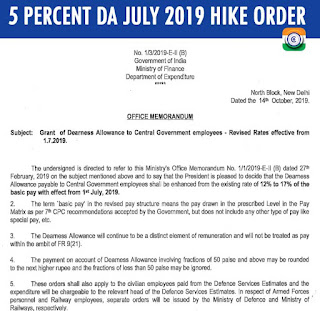
5 Percent DA July 2019 Hike Order - Grant of Dearness Allowance to Central Government employees

Grant of Dearness Allowance to Central Government employees 5 Percent DA July 2019 Hike Order  No. 1/3/2019-E- II (B) Government of...

Blog Archive

About The Author