A complete reference blog for Indian Government Employees

Showing posts with label Union News. Show all posts

Saturday, 13 February 2016

Draft Memorandum of NFPE to be submitted on GDS Issue to the Chairman, GDS Committee

Draft Memorandum of NFPE to be submitted on GDS Issue to the Chairman, GDS Committee

From: – …………………………………………
…………………………………………
…………………………………………
…………………………………………
To Shri Kamlesh Chandra
Chairman,
Gramin Dak Sevak Committee
Ministry of Communication & IT
Government of India
Malcha Marg Post office Building
New Delhi – 110021
Sub: – Memorandum on GDS issues,

With due respects and regards, we submit the following for your kind consideration and favourable recommendations to the Government.
  1. Departmentalization of GDS by declaring them as Civil Servants and grant all benefits of regular employees on pro rata basis.
  1. Change the nomenclature of GDS as “Gramin Dak Karmachari” or “Rural Postal Employees”
  1. Considering the need and requirement of Rural Post Offices after modernization viz., Core Banking Solutions (CBS), Core Insurance Solution (CIS) and introduction of handheld computers at BOs and additional responsibilities, the working hours of all BOs may be extended to 8 hours and all GDS may be granted full time Civil Servant status. There should no combination of duties. The illegal condition that GDS shall not on duty for more than five hours should be removed.
  1. Minimum five hour wages should be paid even if the work load is less than 5 hours and if work load is more than five hours wages for full time (8hours) should be paid. Nomenclature of TRCA should be changed and it should be called as ‘Pay’. There should not be any reduction in wages under any circumstances.
  1. The Branch Postmaster shall be paid at the pro rata wages of Postal Assistants; GDSMD/GDSSV shall be paid equal to Postmen; and all other categories with the comparison of MTS. GDS shall be appointed and not engaged and the word ‘engagement’ shall be deleted in the existing rules.
  1. Time bound promotion (ACP) to higher pay scale on completion of 10 years, 20 years and 30 years may be granted to GDS. Point to Point fixation is requested for senior GDS. The pay shall be fixed to the seniors in the revised pay based on the number of years of service rendered to that extent by granting notional annual increments. The percentage of annual increment shall be at par with regular employees to whom the comparison is being made. The nomenclature of increment shall be introduced in the place of ‘future entitlement’.
  1. The GDS may be considered for grant of HRA, Transport Allowance, Split duty Allowance on pro rata basis at par with regular departmental employees whom we are comparing for wage fixation. The rent of the building in which BO is housed may be paid by the department.
  1. TA/DA may be granted to GDS if ordered in the interest of service and all other Allowance like Boat Allowance, SDA, may be extended to GDS.
  1. The GDS shall be covered with the Children Education Allowance and hostel subsidy at par with regular employees.
  1. The GDS shall be covered under the CS (MA) Rules or a new set of rules equal to that which provide full reimbursement of medical expenses to the GDS and their families.
  1. The GDS may be granted leave on the following norms.
(i)           E.L – One Day for each completed calendar month with accumulation.
(ii)          HPL – 20 days per year, with accumulation facility.
(iii)        Commuted leave may be introduced.
(iv)         Maternity leave – 180 days at par with regular employees with full pay & allowances. Pay shall be made from salary head and not from the welfare fund of GDS.
(v)          Child care leave shall be granted at par with regular employees.
(vi)         Special Disability Leave – As applicable to regular employees.
  1. Notwithstanding our claim of introduction of pension scheme at par with regular employees prior to 01-01-2004, we request to modify the S.D.B.S scheme to the extent of 10% recovery from the officials; 20% from the department. Ex-gratia gratuity shall be granted on completion 10 years service. Family pension shall also be introduced.
  1. All vacancies in the departmental posts viz. MTS, Postmen, shall be filled only by GDS and there shall be no other open market direct recruitment. In respect of PA cadre, the GDS possessing Qualifications and computer knowledge shall be permitted to write the competitive exam along with postman & MTS for the Departmental Quota vacancies.
  1. The GDS Conduct & Engagement rules 2011 shall be scrapped and CCS (Conduct) Rules 1964 may be made applicable to GDS also. It shall be covered under Article 309 of the Union Constitution.
  1. 50% of the past services of GDS shall be counted as regular service on promotion for pensionary benefits including gratuity.
  1. GDS shall also be covered under LTC Scheme to have recreation in life.
  1. GDS may be provided with uniforms and also grant of Washing Allowance.
  1. All advances like festival, medical, LTC, Tour TA, scooter, HBA, Motor Cycle Advance shall be extended to the GDS. All incentives, honorariums shall be introduced for the excess work performed by GDS.
  1. Furnishing of security band shall be dropped. Similarly the residential condition may also be dropped in the recruitment rules.
  1. Transfer facilities may further be liberalized; there shall be no loss of service or pay on transfer. Identity cards to GDSs are a must and that shall be supplied to GDS free of cost of the Department.
  1. Compassionate appointment may be granted to the dependents of deceased GDS, removing the existing conditions.
  1. GDS may be granted all Trade Union rights at par with regular employees.
  1. The amount payable under Group Insurance Scheme may be enhanced to five lakhs.
  1. The 50 years age limit for appearing for departmental examination may be removed.
  1. One point may be granted for Rs.4000- of cash handling in BOs.
We submit that these poor and down trodden 2.76 lakhs of Gramin Dak Sevaks should not be neglected and shall be extended with all benefits applicable to departmental employees. As Justice Talwar Quoted that ‘the weak and downtrodden need protection’. We hope that the respected Chairman, GDS Committee will look in to the prayers made by the All India Postal employees Union GDS (NFPE) also we made in the pre paras and render justice to this down-trodden section of the Postal employees.

With profound regards,
Yours sincerely,
Place: -
Date:-
(Name of the GDS with Designation)
Share:

Sunday, 27 October 2013

Postal: General Secretary Meet and appealed all the NJCM top leaders for their support for inclusion of GDS in 7th CPC

Postal: General Secretary Meet and appealed all the NJCM top leaders for their support for inclusion of GDS in 7th CPC

ALL INDIA POSTAL EXTRA DEPARTMENTAL EMPLOYEES UNION
(Central Head Quarter)
First Floor, Post Office Building, Padamnagar, Delhi 110007

President                 :     D.N. Giri
General Secretary   :     S.S. Mahadevaiah

GDS/CHQ/1/10/2013                                       
Dated: 23.10.2013
To

Com. Umraomal Purohit,
Secretary (Staff Side), JCM,
National Council of the JCM,
13-C, Ferozesha Road,
New Delhi-110001.

Com. Shiv Gopal Mishra,
General Secretary,
All India Railwaymen’s Federation,
4, State Entry Road,
Near New Delhi Railway Station,
New Delhi-110055.

Com. M. Raghavaiah,
General Secretary,
National Federation Indian Railwaymen,
4, Chemsford Road,
New Delhi.

Com. C. Sreekumar,
General Secretary, AIDEF,
No.2, Valluvar Street,
Rani Annanagar,
Arumbakkam (PO)
Chennai-600106.

Dear Comrade,

          The Govt. of India have always kept Gramin Dak Sevaks (GDS) of the Postal Department numbering more than 3 lakhs outside the purview of the Pay Commission. It is a deliberate attempt to deprive them of their rights. This has been the policy all along. The Govt. have been confusing the issue of legal status of GDS as Govt. servants and taking negative stand. After sustained agitation by GDS, a Committee headed by justice Talwar was constituted by the Govt. The Committee came to the conclusion that GDS are Central Govt. employees and Recommended accordingly. This was also earlier the view of the First and Fourth Pay Commissions. In fact first CPC considered their claims & made recommendations accordingly. Disregarding bureaucratic attempts at confusing the legal status of GDS, both these commissions refused to toe the official line and took an independent view that GDS are Central Govt. employees. The following points need specific attention.

The GDS have always been counted & treated as part & parcel of total Postal workforce. In fact they are more than 55% of the total postal workforce and are running more than 80% post offices in the country, whereas regular Postal employees are only 45%. Justice Talwar committee was firmly of the view Commission. The most important recommendation which Justice Talwar Committee made was that in future these employees should be included within the purview of the Pay Commissions, keeping in view their number, their work profile, effectiveness to the postal system and the services rendered to the public.

Attention is also invited to the landmark judgement of the Hon’ble Supreme Court in Gokulananda Dass case decided on 22.4.77 wherein it has categorically been held that GDS are holders of civil post under the union which means they are Central Govt. employees. Recently Central Administrative Tribunal Bench in Tamilnadu and Chandigarh have also held that GDS are Central Govt. employees.

The Gramin Dak Sevaks of the Postal Deptt. have made representation to the Govt. that their claims regarding revision of their pay scales and service conditions may be included in the Terms of Reference of Seventh Pay Commission and Commission may be asked to make recommendations as in the case of other Central Govt. employees. We are soliciting your kind support to our Demand with the request that you may kindly raise our demand when Govt. invites you for discussion to finalise Terms of Reference.

With greetings,
                                                                                          Yours comradely,
                                                                                             
(S.S. Mahadevaiah)
 General Secretary
Share:

Saturday, 6 July 2013

Bhartiya POST Subscription

Bhartiya POST Subscription

Dear Comrades,

All of you are aware that Bhartiya POST monthly journal is published by CHQ for conveying our detailed union news up to the Grass root level . It is the responsibility of our divisional / branch Secretaries to ensure every member to subscribe and be updated. Please start a drive to enroll all to get a copy of Bhartiya POST in their hands.

Annual Subscription : Rs 100 /-

Source : http://www.aipeup3chq.com/
Share:

Tuesday, 25 June 2013

SPEECH MADE BY MRS. SANDHYA RANI, IPS, POSTMASTER GENERAL, (BUSINESS DEVELOPMENT & TECHNOLOGY) AP CIRCLE, AS CHIEF GUEST IN THE WOMEN’S CONVENTION HELD AT HYDERABAD ON 09.06.2013

SPEECH MADE BY MRS. SANDHYA RANI, IPS, POSTMASTER GENERAL, (BUSINESS DEVELOPMENT & TECHNOLOGY) AP CIRCLE, AS CHIEF GUEST IN THE WOMEN’S CONVENTION HELD AT HYDERABAD ON 09.06.2013 


sPEECH MADE BY MRS. SANDHYA RANI, IPS, POSTMASTER GENERAL,
(BUSINESS DEVELOPMENT & TECHNOLOGY) AP CIRCLE, AS CHIEF GUEST IN THE WOMEN’S CONVENTION HELD AT HYDERABAD ON 09.06.2013, IN CONNECTION WITH THE 9TH FEDERAL COUNCIL OF NFPE
President of the National Federation of Postal Employees Women’s Convention, Mrs. Shakunthala, distinguished guests on the dais, leaders and invitees who have come from across the country to attend the 9th Federal Council meeting of the National Federation of Postal Employees, ladies and gentlemen, my heartfelt greetings to all of you. It is a pleasure to be here with you today and I would like to thank the organizers for inviting me.
From the time I joined the Department of Posts as an young officer some 25 years ago, many changes have come in, especially in the role, approach and scope of Trade union activism. The nature of industrial relations and collective bargaining has also changed in the light of globalization, technology, changed business processes, etc.
I would like to share, my thoughts with you today in the context of three broad themes 
i.      The first one relates to Women & Trade Union movement in the Indian context,
ii.     The 2nd one is about women in Department of posts,
iii.    Thirdly I will touch briefly upon about the significant organizational changes underway in Dept.of Posts and possible responses while balancing our personal aspirations and staff unions’ concerns.
In the context of Women and Trade Union movement, the questions that are often asked are: inadequate women’s participation, equality of women, discrimination in workplace, lack of adequate safeguards for women employees, continuing with the responsibility of housework, etc. Women in our country, as elsewhere in the world, have been discriminated against in every sphere – within the family, at the workplace, in society and in public/political participation. Women are increasingly joining the workforce to supplement family income, especially in urban areas. In rural areas they have always participated in agriculture labour and related works.
According to the Directorate General of Employment and Training in 2005, among the 393 lakh job-seekers enrolled with them, only 106 lakhs are female job seekers. In other words female job seekers account for only about 27% of the total job seekers. This is also indicative of the fact that much of the employment of women is in unorganized sector pushing them into exploitative and low end jobs.
Increased employment in organized sector, while empowering women to earn higher incomes, and take up challenging jobs, has also made them to more vulnerable to stress, struggle to balance work and home life and sometimes to sexual harassment in different forms. Further, either due to personal choices or due to the intangible glass ceiling operating very few women are found in higher managerial positions.
Overall the unionized labour is a very small number in our country, (less than 2% according to ILO in year 2000). According to the National Sample Survey Organisation (NSSO), in 1999-2000 out of total workforce of 397 million, only 28 million workers were employed in the formal sector and thus formally unionized. Active participation of women in labour union movement has been historically very low. In recent times with overall decreasing union memberships, far lesser number of women join them or actively participate in the TU deliberations on regular basis. With few of them attending regular TU meetings it is not unexpected that issues of concern to women employees do not get center stage in union items. Women are also under-represented at all levels of union leadership and decision-making.
I believe that Trade Union leadership can and should do much more to encourage and facilitate participation of women in trade union activities. Being effective home makers ensures that women have certain refined skills, especially at balancing competing interests/concerns, negotiating impossible situations. Hence, they should be encouraged to take up leadership roles in the Union actively. Issues relating to women should also get center stage, like lack of amenities in work places, exploitation, especially of unorganized contingent women employees, often working long hours and not drawing even minimum wages, etc. should be taken up actively. At the policy level, Trade Unions can also take up the case of special investment opportunities for female employees with say higher interest rates. This will help the women become more secure and empowered as well as greater productive investments will be made for development of the country. Another area that TUs can also pushing for a special bench or special sessions of CAT and higher Courts to be held periodically to handle cases field by Women employees on priority, so that they are not required to miss office or use personal/home time in running around CAT and other courts. Trade Unions should facilitate greater leadership development and Training for its Women members.
My second theme relates to women employees in Department of Posts. As per census of Central Govt. Employees, only 7.53% of total Central Govt. Employees are women. However, an interesting aspect of this is that in Communications and IT sector, the share of women employees is 12.20%. It is p[ossible that in some Circles, especially in South India, the percentage of women employees could be 30-50%. Surprisingly in Railways Women employees are only 4.63% of the total work-force. Considering the number of railway employees being the largest of the central govt. work force, in actual numbers this would be much higher than many departments. It is seen that in AP postal Circle less than 15% of total departmental staff are women.
In the Department of Posts there are several issues of concern to women employees working as GDSPost Women, Postal Assistants, Post masters, Supervisors, Inspectors & OfficersSome of these are lack of basic amenities in post offices, restrictions relating to rule-38 or rotational transfers under spouse category, child care leave not being granted on administrative grounds, posting of women in night sets, increasing number of cases of sexual harassment at work place etc. Issues relating to women GDS employees and especially of the unorganized sector contingent women employees like sweepers, water women, scavengers, etc. which do not even form part of the Trade Union activism.
Women employees face typical unreasonable biases in the department like the perception of not being as capable as men at work. Sometimes one comes across Supervisors asking for male members in the team so that they can sit late hours to complete work! I do not obviously agree with that view. Women employees are by and large committed and sincerely attend to their work. They are the best asset that the department has. However, we do come across instances of lack of adequate sensitivity in dealing with women employees in the department.
For instance, majority of our POs are C class POs, usually located in rural areas, which lack basic amenities or facilities. Instructions exist about hiring good buildings. But sometimes practically such buildings are not available. Ideally, as a policy all Departmental POs should have own buildings with proper facilities, considering that Government is a model employer. While this is not always feasible, considering the resource gaps, the Divisional Heads should ensure that buildings with basic amenities are hired, or landlord should be insisted upon to provide basic amenities. Further, Divisional Head should also keep in mind availability of basic facilities in a PO, while considering posting women employees there.
While the Central govt. rules require posting of spouses to the same station, as far as possible, in practice there are lot of gaps in implementing these instructions. The restrictive handling of Rule 38 requests under Spouse category based on lack of vacancy, non-fulfillment of minimum 5 years condition for granting Rule-38 transfer, etc. should be used sparingly by the competent authority. Sometimes adequate managerial posts may not be available, but for the operative staff as far as possible spouse category requests should be accommodated.
Another service condition that comes to mind is the recognition that women as the principal home maker and allows themchild care leave. Though every women employee is entitled to avail 730 days of child-care leave during her entire service, in practicality it is not being granted owing to various administrative reasons. While the shortage of staff is one reason, the other one is the reluctance of the fellow employees to undertake additional responsibility if one among them is badly in need of child-care leave and wants to avail it immediately. I must confess that I am personally not a great advocate of child care leave as an entitlement, and that it should be taken with great responsibility. However, I do recognize that there will be certain conditions in an employee’s life that may require granting of the same without delay. Women employees should use this privilege judiciously and should be allowed to do so.
It is true that there are certain areas of work where women are given priority in the department. One such thing that comes to my mind relates to Compassionate appointments. Such appointments are restricted to 5% in case of departmental employees, but for Grameen Dak Sewaks there are no such restrictions. While assessing eligibility for compassionate appointment special consideration is given to wife of the deceased employee in terms of calculation of points, as well as selection. Under the definite, accurate and transparent yard-sticks to assess the extent of indigent circumstances of the family of the deceased employee, points are awarded to various attributes relating to indigent circumstances. Any case which scores 51 points merit selection. IN an obvious and encouraging policy guidelines for ensuring that dependent women get a better chance, if the wife of the deceased is the claimant for compassionate appointment and not her children; 15 additional points are awarded in her case automatically. This boosts her chances of getting the compassionate appointment. Trade Unions can do much to promote awareness about this provision among all GDS employees and their families.
There are many women centric issues that TUs should take up provision of Crèche/day care facility at or near work place with more than 10 women employees; rest room/change room facility, annual medical checkup for over 40 years women, taking a clear and uncompromising stand against sexual harassment at work place, etc.
The third and last theme that I would like to touch upon today relates to the significant organizational changes that Department of Posts is undergoing. The issues that I would like to highlight relate to the approach of all officers and employees, especially women employees in meeting the emerging challenges. With an aim to retain the existing customer base and also win new clientele and businesses several innovative technologies are being put in place. Huge amount of technological changes are emerging in the department. The Core System Integration applications, Core Banking Solutions, the new initiatives relating to mail operations are going to herald major changes in the way we do work in the Department. With this, the work culture of the Department will see a sea-change. The departmental employees and GDS at different levels need to rise to the challenge and do their best to make this as smooth as possible. Officers, Post Masters and Supervisors need to work with their SystemAdministrators and PAs as a team to reach higher standards of performance. With an aspiration to provide the last mile connectivity to all kinds of services, 1,30,000 Branch Post Offices are going to be provided with Hand held devises. It will certainly make the life of GDS Branch Post Masters relatively easy, especially in terms of book keeping. But it would also mean greater responsibility.
In the emerging changes in the technological and business environment, we need to work in teams, understand our individual roles, educate and skill our fellow colleagues. Unfair expectations of the administration, if any, could surely be challenged. But we all should work towards realizing the positive objectives of the major projects underway in the Department of Posts. That is the only hope for us to remain relevant as an organization and play significant role in the development of our country.
While at the micro level we all should work towards making work places more safe and secure for women employees, there is an extra responsibility on all of us to welcome the inevitable changes in a positive manner and skill ourselves adequately to meet the changing needs of the internal and external environment. I am sure in the Federal Council meetings all related issues will be discussed in thread bare and based on your respective ideological positions certain policy decisions will be taken. I request that while balancing personal expectations/aspirations of the cross section of employees, the organizational interests/requirements need to be kept in mind.
In the final I believe each one of us should ask ourselves the question to what extent we are making work places safe, empowering and invigorating to women employees. And we each need to do our bit to enhance the same in which ever office we are working in.
I wish all the participants at the Federal Council meeting and especially women employees interesting discussions and courage to take challenging decisions and work towards achieving the same.
thank the organizers once again for inviting me to this Women’s Convention.
(E-mail ID of Mrs. Sandhya Rani, IPS is pmgbdap@gmail.com)
Source : www.aipeup3chq.com
Share:

Featured post

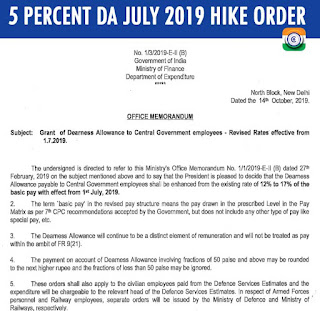
5 Percent DA July 2019 Hike Order - Grant of Dearness Allowance to Central Government employees

Grant of Dearness Allowance to Central Government employees 5 Percent DA July 2019 Hike Order  No. 1/3/2019-E- II (B) Government of...

Blog Archive

About The Author