A complete reference blog for Indian Government Employees

Showing posts with label FAQ. Show all posts

Monday, 19 August 2019

FAQ - Entitlement of Travel Allowance for Indian Navy Officers

FAQ
Entitlement of Travel Allowance for Indian Navy Officers

Frequently Asked Questions

1. What TA/DA is admissible for moves on permanent duty within Indian limit?
For self
  • By road - one mileage allowance as given in Rule 61 TR.
  • By rail - On warrant, travel on cash TA is not normally authorised as no public interest is thereby served.
  • By Air - Captain, IN and above are entitled to travel by air or ACC I Class at their option. If travelling by ACC, warrant is to be issued for I Class and the extra charges for ACC are re-imbursed. However, Officers of the rank of Cdr may also Travel on their own discretion by air if the distance involved is more than 500 Kms and the journey cannot be performed overnight by a direct train or sleeper coach service.
For Family
  • By Road - One mileage if two members accompanying the officer and one more mileage if more than two members accompany him as per rates given in Rule 61 TR.
  • By Rail – On Warrant. However, if journey is performed on cash TA, one fare of the class in which traveled will be re-imbursed.
  • By Air – Same as that of the Officers.
Composite Transfer Grant Married Single When transfer involves 1 months 80 % of basic pay change of station located at basic pay for a month a distance of 20 Kms or more (Govt. of India, Ministry of Defence letter No 12630/Q MovC/3198/D(Mov)/98 dated 28 Oct 1998).

Additional Journey to previous duty station. An additional fare/free warrant by the entitled class i.e. the class at the time of initial moves for both onward and return journey will be allowed for journey to previous duty station in case the officer has to leave his family behind due to non-availability of Govt. accommodation at the new duty station.

Transportation of private conveyance at public expenses
  • All first grade officers are entitled for conveyance at public of one motor car or one motor cycle/scooter or one expenses horse on permanent transfer.
  • As there is no provision in Military Tariff for booking of private cars on railway warrant, such vehicle to the extent authorised will be transported against cash payment.
  • The car may be transported by passenger or goods train. In the case of goods train, the cost of packing and of transporting the car to and from the goods shed at the station of departure and arrival may also be allowed provided the total cost claimed will not exceed the freight by passenger train.
  • When an officer transports his motor car by road under its own power between stations connected by rail he may draw an allowance at the rates for taxi approved by Director of Transport at the starting point limited to the expenditure on transportation by passenger train. If, however, the car is moved between stations connected by road only, (including those where the road journey is in continuation of the rail or steamer journey) he may draw an allowance at the rates for taxi approved by Director of Transport at the starting point.
  • In case of the car transported by loading on a truck between stations connected by rail the officer may be allowed the actual expenditure on transportation limited to the rates for taxi approved by Director of Transport at the starting point or the freight charges by passenger train whichever is less. If however, the car is moved between stations not connected by rail, he may draw actual expenditure limited to the rates for taxi approved by Director of Transport at the starting point.
  • If an officer owned a car at a station other than from which he is transferred, he may draw the cost of transportation of the car from that station to which he is transferred, limited to the cost of its conveyance from his old to the new duty station, provided it is conveyed within prescribed time limit of 6 months extendable to one year with the sanction of the competent authority. In the case of an officer who does not own a motor car at the time of his transfer from one station to another but purchases one to take it to the new duty station from some other place, the above expenses may be allowed with the sanction of the Government.
  • Advance for the transportation of car may be drawn if the prior sanction of the competent authority is obtained.
2. What elements of pay are reckoned for calculating the entitlement of daily allowance?
Basic pay and rank pay where applicable, are treated as pay for determining the rate of daily allowance. In the case of Surgeons, non practicing allowance is also to be taken into account.

3. How is DA on Ty duty to be calculated?
DA for the entire absence from headquarters will be calculated as given below: - Full DA is to be granted for each completed calendar day of absence reckoned from mid night to mid night. For absence from headquarters for less than 24 hours the DA will be admissible at the following rates
  • If the stay is up to six hours - Nil
  • If stay is more than 6 hrs but does not exceed 12 hours - 70%.
  • If the stay exceeds 12 hrs - full DA (Rule 114 TR) Note : In case the period of absence from Headquarters falls on two calendars days it is reckoned as two days and DA is calculated for each day as above. Similarly, DA for days of departure from and arrival at headquarters will be regulated accordingly.
4. From what point of time will absence entire the entire absence from HQs be counted for the purpose of grant of DA?
Journey by Rail - The from HQs will be reckoned with reference to the scheduled departure / arrival time of the train from / at the Railway Station. However, where the train is late by more than 15 minutes,. actual arrival times will be taken into account. Journeys by Bus - The entire absence will be reckoned with reference to the actual departure/arrival time from/at the bus stand. Journey by Air - The entire absence from HQs will be reckoned with reference to scheduled reporting/arrival time from/ at the airport. However, where the plane is late by more than 15 minutes actual arrival time will be taken into account. (Authority : Para 5(a) to Govt of India, Min of Def OM No B/89621/II/Q Mov C/4214/ D(Civ-ii) dated 16 May 75.)

Source: Indian Navy
Share:

Tuesday, 9 April 2019

Scheme Preference under NPS for Central Government Subscribers - FAQ


Scheme Preference under NPS for Central Government Subscribers - FAQ


Is the choice of Pension Fund and Investment Pattern available for Subscriber under Tier I?
As per Ministry of Finance Gazette Notification dated January 31, 2019, the Central Government Subscribers, from April 1, 2019, will have the option of selecting the Pension Funds (PFs) and Investment Pattern in Tier I account. A Subscriber can choose anyone of the available PFs and Investment Option as per their choice. If the choice is not exercised by the Sub scriber, NPS contributions will be invested in the existing schemes - LIC, SBI and UTI will act jointly as default P Fs as per the guidelines issued by the Government of India/ PFRDA. For more details on 'Investment Option ', please refer 'Information on Scheme Preference' available on CRA website (www.npscra.nsdl.co.in).

Is the choice o f Pension Fund and Investment Pattern can be exercised at the time of registration under NPS?
Yes, a Subscriber is allowed to select the Pens ion Fund and Investment Pattern as per his/ her choice at the time of registration under NPS. The Subscriber is required to provide the relevant details in the Subscriber Registration Form (CSRF).

What are the Investment Options available for Subscriber under Tier I?
The Subscriber can select anyone of the following investment schemes:
  • Scheme G - 100% of contribution will be invested in Government Bonds and related instruments.
  • Scheme LC 25 - It is the Life cycle fund w here the Cap to Equity investments is 25% of the total asset.
  • Scheme LC 50 - It is the Life cycle fund w here the Cap to Equity investments is 50% of the total asset.
If the choice is not exercised by tile Subscriber, NPS contributions will be invested in the existing schemes - LIC, SBI a/ld UTI as per the guidelines issued by the Government of India/ PFRDA. For more details on 'Investment Option', please refer 'Information on Scheme Preference' available on CRA Website (www.npscra.nsdl.co.in).

How can a Subscriber change a Scheme Preference?
There are two options available to the Subscriber - Online as well as offline.
Online: The Subscriber can change Scheme Preference online through his/her NPS account log-in.

Subscriber Call follow the simple steps as given below :

a. Go to your NPS account and log-in .
b. Click on sub menu "Scheme Preference Change" under main menu "Transaction".
c. Select Tier type and Change the Scheme Preference as you intended to do.

Alternatively, the Subscriber can also submit physical request (Form GOS-S3) to his/her associated Nodal Office. The form GOS-S3 can be freely downloaded from CRA Website. On receipt of physical request, the Nodal Office will update the Scheme Preference in the CRA system.

How many times a Subscriber can change 'Scheme Preference' ?
Yes, you have the option to change your Pension Fund manager. At present, the Subscriber can change the Pension Fund Manager once in a Financial Year.

'What will happen to the contributions accumulated in NPS account till March 31,2019?
The legacy contributions i.e. contributions accumulated in NPS account till March 31,2019 will remain invested in the existing schemes - LIC, SBI and UTI will act jointly as default PFs as per the guidelines issued by the Government of India (GOI)/ PFRDA. Redemption and transfer of accumulated contributions will be carried out once guidelines and modalities are provided by GOI/ PFRDA.

Will there be any change in the Transaction Statement?
Yes. Transaction Statement will undergo a change for the PRANs having legacy contributions i.e. contributions accumulated in NPS account till March 31, 2019. For the Subscribers who have opted new schemes, the Investment details of the legacy schemes, and of the new scheme will be shown it two separate tables in the Transaction Statement.

Whether Subscriber can select 'Scheme Preference' at the time of shifting to Central Government?
The Subscriber will have the option of selecting the Pension Funds (PFs) and Investment Pattern in Tier I account at the time of shifting to Central Government. The Subscriber is required to provide the relevant details in Inter Sector Shifting (ISS) Form.

Whether a Non-IRA Subscriber can change 'Scheme Preference' under NPS?
At present, Non-IRA Subscribers do not have the option of 'Scheme Preference' change. A Non-IRA Subscriber should first submit the physical registration form to become an IRA compliant Subscriber. Once he / she becomes IRA, the Subscriber can change the Scheme Preference .

Is the choice of Pension Fund and Investment Pattern available for Subscribers under Central Autonomous Bodies (CABs)?
At present, the Subscribers under CABs do no t have the option of selection of Pension Fund and Investment Pattern under NPS. In case of CABs, NPS contributions will be invested in the existing schemes - LIC, SBI and UTI as per the guidelines issued by the Government of India / PFRDA.

Via : NPS
Share:

Wednesday, 27 March 2019

Frequently Asked Questions (FAQs) on reservation to Persons with Benchmark Disabilities in posts/services under Central Government

FAQ on reservations for disabled persons in Central Government posts / services

No.36035/02/2017-Estt (Res)
Government of India
Ministry of Personnel, Public Grievances & Pensions
Department of Personnel & Training
North Block, New Delhi
dated the 25 March, 2019
Subject: Frequently Asked Questions (FAQs) on reservation to Persons with Benchmark Disabilities in posts/services under Central Government - reg.

This Department receives references from various Ministries/Departments seeking clarification on instructions with regard to reservation for Persons with Benchmark Disabilities issued vide OM of even number dated 15.1.2018; therefore, a set of Frequently Asked Questions (FAQs) have been answered as under for their use:

Q.1 Whether the reservation for Persons with Benchmark Disabilities are vacancy based or post based?
Answer: Reservation for. Persons with Benchmark Disabilities is vacancy based as per Section 34 of the Rights of Persons with Disabilities Act, 2016.

Q.2 What categories of specified disabilities are covered for reservation and what is the percentage allocation of reservation for each category of persons with benchmark disabilities?
Answer: As provided in Para .2 of the OM of even number dated 15.1.2018, categories of specified disabilities covered under reservation in posts and services of the Central Government vis-a-vis category wise percentage of reservation is as under:
a)blindness and low vision;1%
b)deaf and hard of hearing;1%
c)locomotor disability including cerebral palsy, leprosy cured, dwarfism, acid attack victims and muscular dystrophy;1%
d)autism, intellectual disability, specific learning disability and mental illness;1%
e)multiple disabilities from amongst persons under clauses (a) to (d) including deaf-blindness,1%

Q.3 Whether the Persons with Benchmark Disabilities can apply against the posts, which are not identified suitable for Persons with Benchmark Disabilities?
Answer: Persons with Benchmark Disabilities can apply only against the posts identified suitable for the relevant category.

Q.4 Whether any priority has been given in selection to any category of
disability?

Answer: Priority has not been given in selection to any category of Persons with Benchmark disability.

Q.5 Whether a Benchmark Disability candidate can compete for appointment against an unreserved vacancies?
Answer: Yes, Benchmark Disability candidates can compete for appointment by direct recruitment against an unreserved vacancy if selected without relaxed standards along with other candidates for those posts/services which are identified suitable for them.

Q.6 Whether the vacancies which are to be earmarked reserved for Persons with Benchmark Disabilities is to be computed on the total number of vacancies in the cadre strength in identified categories of posts as well as unidentified categories of posts.
Answer: Yes, vacancies which are to be earmarked reserved for Persons with Benchmark Disabilities is to be computed on the total number of vacancies in the cadre strength in identified categories of posts as well as unidentified categories of posts. However, recruitment of persons with benchmark disabilities would only be against the category of posts identified suitable for them.

Q.7 Whether a separate roster is to be maintained for Persons with Benchmark Disabilities irrespective of the post based roster applicable for SC/ST/OBC?
Answer: Yes, every Central Government establishment shall maintain group-wise separate 100 point vacancy based reservation roster register in the prescribed format for determining/effecting reservation for the Persons with Benchmark Disabilities – one each for Group ‘A’ posts filled by direct recruitment, Group ‘B’ posts filled by direct recruitment and Group ‘C’ posts filled by direct recruitment.

Q.8 What to do with vacancies reserved for any particular category(s) of Persons with Benchmark Disabilities cannot be filled due to non-availability of a suitable candidate, or for any other sufficient reasons?
Answer: As per Section 34(2) of the Rights of Persons with Disabilities Act, 2016, if in any recruitment year any vacancy cannot be filled up due to non-availability of a suitable person with benchmark disability or for any other sufficient reasons, such vacancy shall be carried forward in the succeeding recruitment year and if in the succeeding recruitment year also suitable person with benchmark disability is not available, it may first be filled by interchange among the five categories and only when there is no person with disability available for the post in that year, the employer shall fill up the vacancy by appointment of a person, other than a person with disability.
(G. Srinivasan)
Director (Res)
faq_reservation_disabled_persons_central_govt_posts

Share:

Sunday, 25 November 2018

FAQ for Pensioners Regarding Digital Life Certificate (DLC)


FAQ for Pensioners Regarding Digital Life Certificate (DLC)


Frequently asked questions for Pensioners regarding Jeevan Pramaan / Digital

Life Certificate (DLC)

What is Jeevan Pramaan/Digital Life Certificate (DLC) ?
Jeevan Pramaan is a biometric enabled Aadhaar-based Digital Life Certificate for pensioners. Jeevan Pramaan i.e DLC is generated for individual pensioner using his/her Aadhaar number and Biometrics.

How is this different from traditional Life Certificate issued by Govt Officers/ Agencies?
For Jeevan Pramaan (DLC) the pensioner is not required to present himself/ herself personally before the Pension Disbursing Officer. DLC does not have to be submitted physically to the Pension Disbursing Agency ( Bank/Post Office etc ) as it is available to them digitally and. is automatically processed by the Pension Disbursing Agency. Also each DLC has a unique id called the Pramaan-Id.

Is the Pramaan ID / Jeevan Pramaan i.e DLC valid for life ?
The Pramaan ID/Jeevan Pramaan is not valid for life. The validity period of the certificate is as per rules specified by the Pension Sanctioning Authority. Once the validity period is over a new JeevanPramaan Certificate i.e a new Pramaan Id needs to be obtained.

Who is eligible for Jeevan Pramaan i.e Digital Life Certificate ?
A pensioner whose Pension Sanctioning Authority (PSA) is onboarded on to JeevanPramaan is eligible for Jeevan Pramaan. List of onboarded PSA, can be found under 'Circulars' tab on the https://jeevanpramaan.gov.in portal.
From where can I obtain a JeevanPramaan i.e Digital Life Certificate
You can obtain a DLC from
  1. various Citizen Service Centre (CSC) located across India
  2. office of Pension Disbursing Agencies (PDA) such as Post Office, Banks, Treasury etc
  3. It can also be generated from home/any location on a Windows PC/Laptop( ver 7 & above) or Android Mobile ( KitKat & above ), for more details click here
What is required, if I want to generate DLC on my PC/Laptop/Mobile
  1. A STQC certified Biometric Device is required.
  2. 'RD Service' of the Biometric Device being used should be installed on the PC/Laptop/mobile.
  3. The 'JeevanPramaan Application' has to be installed on your PC/mobile. It can be downloaded from the 'Download' tab from https://jeevanpramaan.gov.in 4. An Internet Connection is required.
How can I find a Citizen Service Centre (CSC) ?
You can search nearest CSC by clicking on 'Locate a Centre' on https://jeevanpramaan.gov.in portal or alternately you can send SMS to 7738299899. The SMS body must start with keyword “JPL” and after space write your pin-code. e.g. JPL 110003 and send it to 7738299899.

What information is required to be provided by a pensioner to generate the Jeevan Pramaan?
 The Pensioner has to provide Aadhaar Number, Name, Mobile Number and self declared Pension Related Information like PPO Number, Pension Account number, Bank details, Name of Pension Sanctioning Authority, Pension Disbursing Authority, etc. The pensioner has to also provide his/her biometrics either Iris or Fingerprint. Note : Incorrect information may lead to rejection of the DLC by the authorities.

What is the procedure for generating a JeevanPramaan from a CSC/office of PDA?
  1. Pensioner visits a CSC or office of PDA
  2. He/She provides the required information to the operator. The operator feeds/enters this information into the system i.e JeevanPramaan Application
  3. The pensioner has to then provide his/her biometrics by placing his/her finger on the finger print scanner or eye in front of the Iris scanner.
  4. On successful aadhaar based biometric authentication, JeevanPramaan is generated with a unique id called Pramaan Id.
  5. An acknowledgement message quoting the Pramaan Id is sent as an SMS to the mobile number provided by the pensioner. Note - The JeevanPramaan/DLC thus generated is subject to approval of the Pension Sanctioning/Disbursing Authority as provided by the pensioner.
Do I have to submit the Jeevan Pramaan i.e DLC to my bank/post office etc?
No, You do not have to submit the DLC to the bank/post office/pension disbursing agency. The DLC is automatically available to them electronically.

Can I get my Digital Life Certificate i.e JeevanPramaan downloaded online, after it is generated?
Yes, once your praman-id is generated, you can download the Digital Life Certificate by following the link https://jeevanpramaan.gov.in/ppouser/login.

How can I know the status of my Digital Life Certificate, whether it has been accepted/rejected ?
You need to download the DLC from the https://jeevanpramaan.gov.in portal to know the status.

I have received SMS on my mobile that my JeevaanPramaan is rejected, what should I do?
Contact your Pension Disbursing Agency. JeevanPramaan is rejected in case wrong particulars are provided by pensioner while generating the DLC. It is recommended that a new JeevanPramaan i.e Pramaan-ID be generated by providing all correct information and biometrics.

Is Electronic Jeevan Pramaan i.e DLC a must for the pensioner?
JeevanPramaan i.e DLC is an add on facility to the already existing ways of submission of Life Certificate.

What is the procedure for getting Aadhaar Number?
Contact nearest Aadhaar Enrolment Centre in your city for getting a Aadhaar Number. You can find permanent Aadhaar Enrolment Centres from UIDAI website https://appointments.uidai.gov.in

Is this certificate valid?
Yes, Digital Life Certificate is a valid certificate and recognized under the IT Act. The system benefits the pensioner from having to go before the Pension disbursing Authority to prove that he/she is alive.

Source: http://www.irtsa.net/
Share:

Friday, 9 November 2018

FAQ on Allowance, Leave, MACP, LTC, Seniority and Reservation

FAQ on Allowance, Leave, MACP, LTC, Seniority and Reservation

FAQ on Allowance, Leave, ACP, MACP, LTC, Seniority, Sexual Harassment, Administrative Tribunals, Compassionate Appointment, Non Functional Upgradation, Joint Consultative and Arbitration and Reservation
FAQ on Various Subjects

TitleDetails
AllowanceDownload
Allowance (Supplement)Download
Allowance (CEA, OTA/NDA, Honorarium/Fee, Leave)Download
LeaveDownload
Policy of Reservation to SCs, STs and OBCsDownload
Policy of Reservation to Ex-ServicemanDownload
Policy of Reservation to Persons with DisabilitiesDownload
ACP/MACP SchemesDownload
Sexual Harassment of Women at Working PlaceDownload
Flexible Complementing SchemeDownload
Time limit for disposal of Disciplinary CasesLink
Administrative TribunalsDownload
Compassionate AppointmentDownload
Compassionate Appointment (New)Download
Recruitment RulesDownload
Non Functional Upgradation (NFU)Download
LTCDownload
LTC (NEW)Download
SeniorityDownload
Joint Consultative and ArbitrationDownload
Related to UPSC, APAR and Commercial Employment after RetirementDownload

Share:

Thursday, 8 November 2018

FAQ for Central Civil Services - Pension Procedure


FAQ for Central Civil Services - Pension Procedure

Frequently Asked Questions (FAQs)
(Central Civil Services)

6. PENSION PROCEDURE
(6.1) What is the meaning of the following terms?
(a) Pension Disbursing Authority
(b) Pension Sanctioning Authority
(c) PPO Issuing Authority
(a) Pension Disbursing Authority : Bank Branch/Treasury/Post/PAO Office paying your pension
(b) Pension Sanctioning Authority: The authority who sanctioned your pension before forwarding the case to Accounts.
(c) PPO Issuing Authority: Generally, the Pay & Account Officer is the PPO issuing authority.

(6.2) What should a Government servant do to claim his pension?
During service each Govt. servant should satisfy himself that service is being verified and recorded so in the service book and that there are no gaps in this. He should also ensure that nomination for all payments due to him are current and valid. Six months prior to the retirement date, a Government servant is required to furnish certain information (e.g. joint photo with spouse, family details, name of the branch of the authorized bank through which he desires to draw his pension etc.) to his Head of Office in the prescribed Form No. 5. The Head of Office is required to undertake the work of preparation of pension papers in Form No. 7 one year before the date on which a Government servant is due to retire on superannuation. After complying with the requirements of CCS Pension Rules 59 & 60, the Head of Office has to forward to the Pay & Accounts Officer Form 5 and Form 7 duly completed with a covering letter in Form 8 along with service book of the Government servant duly completed up-to-date and any other documents relied upon for the verification of service, not later than six months before the date of retirement of the Government servant.

(6.3) Who is to authorize the pension?
On receipt of pension papers from Head of Office, the Pay & Accounts Officer concerned will, after applying requisite checks, assess the amount of pension and issue the Pension Payment Order (both halves of Pension Payment Order, i.e. disburser's portion and pensioner’s portion) not later than one month in advance of the date of retirement of the Government servant with forwarding authority letter, duly inksigned and embossed, to Central Pension Accounting Office (CPAO) who in turn will generate on computer a Special Seal Authority on the basis of details given in the Pension Payment Order and authority letter of the Pay & Accounts Officer and forward disburser’s half of PPO with Special Seal Authority to the Central Pension Processing Centre (CPPC) of the concerned authorized Bank. The Pay & Accounts officer after ascertaining that the special seal of authority has been issued shall send pensioners’ half of PPO to be handed over to the retiring employee. However, if the employee opts to take the PPO from bank, both halves shall be sent to CPAO. All records will be maintained in the CPPC and the disbursing branch, will make the payments to the pensioner on authorization of payment of pension by the CPPC. The CPPC however is only the back office for processing pensions, all pension related problems/grievances of the pensioners will continue to be handled by the concerned paying branch as before.

(6.4) What is to be done in case the pension has not been fixed correctly?
The Pay & Accounts Officer while issuing the pension authorization will forward one copy of the pension calculation sheet (out of three received by him from the Head of Office) as certified by the Head of Office and countersigned by him (Pay & Accounts Officer) to the pensioner along with the intimation of his having sent the pension payment authority/PPO to the CPAO. In case it is found from the pension calculation sheet that pension has been fixed incorrectly, the matter may be taken-up with the Head of Office. PAO concerned, if necessary, will issue an amendment authority letter to Central Pension Accounting Office for onward transmission to the CPPC to carry out necessary amendments in both halves of PPO.
Share:

Thursday, 15 February 2018

UJALA - Unnat Jyoti By Affordable LEDs for All : FAQ


UJALA - Unnat Jyoti By Affordable LEDs for All : FAQ

UJALA-UNNAT-JYOTI-LED-BULB

1. What is the UJALA scheme?

Hon'ble Prime Minister Sh. Narendra Modi described the LED bulb as "Prakash Path" - "way to light". A simple act of change of one light bulb to LED at South Block Prime Minister's office heralded a movement in the entire country for considering the same change. The initiative is part of the Government of India's efforts to spread the message of energy efficiency in the country. UJALA scheme aims to promote efficient use of energy at the residential level; enhance the awareness of consumers about the efficacy of using energy efficient appliances and aggregating demand to reduce the high initial costs thus facilitating higher uptake of LED lights by residential users. It may be noted that the scheme was initially labelled DELP (Domestic Efficient Lighting Program) and was relaunched as UJALA.

2. Who is eligible to get LEDs under the UJALA scheme and what are the requirements to purchase the LEDs?

Every domestic household having a metered connection from their respective Electricity Distribution Company is eligible to get the LED bulbs under the UJALA Scheme.The consumer can purchase the LED on EMI payment (monthly/bimonthly instalments in electricity bill) or on upfront payment by paying the full amount. The consumer needs to carry the following documents to get the UJALA LED bulb:

1) For EMI - Copy of latest electricity bill and copy of Government authorized ID proof

2) For Upfront - Copy of Government authorized ID proof.

3. Where and how can the LED bulb be procured?

UJALA LED bulbs are being distributed through special counters (kiosks) set up at designated places in a city. These will not be available at retail stores. The location details of distributioncounters is available at www.ujala.gov.in, wherein the locations are geo-tagged for consumer convenience.

4. What is the price of LED bulbs?

UJALA appliances can be purchased at Rs 70 per LED bulb, Rs 220 per LED tubelight and Rs 1200 per Fan. The price of appliances consist of component such as price of bulb, distribution, awareness cost, which is discovered through competitive bidding, Annual Maintenance Cost (AMC), cost of capital and administrative costs.

5. What if the LED bulb fuses? Is there any warranty?

If the LED bulb stops working due to a technical defects, EESL provides free-of-cost replacements for a period of three years. All replacements are done through designated replacement/ distribution kiosks as mentioned on www.ujala.gov.in. During the distribution period these LEDs can be replaced from any of the UJALA kiosks. Post distribution, there are state specific replacement drives that will indicate the retails shops/locations where replacement will be available.

6. Where can I register my complaints?

There are 4 types of redressal mechanisms available to the consumer:

1) Complaints during distribution can be addressed at our distribution agency’s customer care centre number which is publicised in our advertisements and awareness drives. EESL has ensured that a toll-free helpline number, corresponding to the manufacturer, is printed on the UJALA LED bulb box as well as the consent deed (payment receipt).Once the duration of the distribution is over the consumers can contact the respective manufacturer via these helpline numbers and seek replacement of the bulb. The respective manufacturer will guide the consumer to the nearest retail outlet, at which the bulbs with technical flaws can be replaced

2) EESL maintains a robust social media response system, where users can Tweet their complaint to EESL's Twitter handle @EESL_India.

3) A detailed email with description and contact details may also be sent to info@eesl.co.in.

4) UJALA Dashboard (www.ujala.gov.in) also has a complaint/ grievance resolution tab on the top right. Consumers are free to lodge their concerns on this platform.All complaints are usually addressed within 48 hours of receipt and a satisfactory resolution follows.

7. What does white and blue colour represent on the UJALA dashboard?

The blue colour indicates stateswhere UJALA distribution scheme has been launched and opened up to the consumers. The white colour indicates the states where the scheme is still in process of being implemented. UJALA being a government scheme has to follow stringent protocolsbefore it is launched in any state.

Source:www.ujala.gov.in
Share:

Friday, 5 January 2018

FAQs on deputation of DoP staff to India Post Payments Bank (IPPB)

FAQs on deputation of DoP staff to India Post Payments Bank (IPPB)
Sl.No.Frequently Asked QuestionResponse/Clarification
1.What is IPPB ? What are its Objectives? How it will operate?(i) India Post Payments Bank Limited ("IPPB") was incorporated as a company on August 17, 2016 under The Companies Act, 2013, with 100% equity from the Department of Posts (DoP), Ministry of Communications, Govt. Of India and as a payments banking company under Section 22 (1) of the Banking Regulation Act, 1949.(ii) IPPB is visualized as a vehicle of financial inclusion that would complement the existing banking, financial services and payments network in the country to improve overall efficiency, accessibility and convenience in delivery of banking services including Direct Benefits Transfer and social security payments. IPPB, as an organization, is designed to leverage the field network of the Department of Posts and is required to carry out its sales and operations through the workforce of the DoP. IPPB will be responsible for designing the products and services, defining the technology and service delivery platforms, undertaking marketing and third-party tie-ups, setting and monitoring the service quality standards, handling customer grievances, managing the risks of the banking operations, and dealing with statutory and regulatory compliances, etc.
2.Why IPPB is looking for positions on deputation/ foreign service/ engagement for DoP?Requirement of positions on deputation/ Foreign Service from DoP to IPPB is based on IPPB’s business requirements, as success of IPPB hinges significantly on its ability to leverage field-level resources of DoP. In this context, it is imperative, especially in the initial stages, that the persons who are acting on behalf of IPPB at the field level, have a strong understanding of DoP as an organization.
3.Which authority has approved the policy of deputation?Board of Directors of IPPB approved the policy of deputation of regular employees from DoP to IPPB, which is also agreed by Postal Services Board.
4.What is the period of deputation? What is the job profile of posts offered ? What are the employment terms and conditions / service rules?Details are available in the Notification released by IPPB.
5.Will there be any relaxation provided in the eligibility criteria?No relaxation will be provided in the eligibility criteria on age, experience and education. Kindly ensure that you fill the correct information. In case, any incorrect information is provided, your application is liable to be cancelled.
6.Can any details of submitted application be modified/ removed/ addedNo. Any changes to the application cannot be made after submission of the application.
7.Whether ASPs can apply for Scale- II ?All regularly appointed ASPs, if they fulfill the eligibility criteria can apply for scale –II position.
8.Whether all PAs will be eligible for deputation?All regular PAs who fulfill the eligibility criteria can apply for scale-I position, irrespective of their present place of posting .
9.Whether officials working in LSG /HSG- II /HSG-I/ Post Master cadre can apply for deputation?All LSG PAs/ HSG-II/Postmaster cadre officials who fulfill eligibility criteria can apply for Scale I.
10.Is the experience of CBS/Sanchay Post mandatory to apply for Scale I?As per Section C of notification at least two years hands on experience is mandatory in POSB CBS/ Sanchay Post operations.
11.Whether all GDS will be eligible for deputation?All regularly appointed GDS candidates meeting eligibility criteria will be eligible.
12.Whether DoP official working in deputation in IPPB is allowed to appear in DoP departmental exams for promotion?Yes, subject to fulfilment of eligibility criteria of that particular exam.
13.Whether reservation is applicable in the selection?Being the deputation posts, rules of reservation are not applicable.
14.Will any model question papers be made available?To be notified in due course of time.
15.Where can I download the Admit card for the examinationAdmit card can be downloaded after the date of examination is announced from www.indiapost.gov.in
16.When will the results be available for the examsResults will be published on www.indiapost.gov.in in due course of time.
Note: The Last date for registration of application has been extended to 15.01.2018

Sd/-
Abhishek Jain
ADG (PBI)
Dated 05.01.2018
Source: India Post
Share:

Wednesday, 2 August 2017

CSD : FAQ on Implementation of GST


CSD : FAQ on Implementation of GST

FREQUENTLY ASKED QUESTIONS IMPLEMENTATION OF GST

ISSUES CONCERNING DEPOTS

Q. What will be the format of Purchase Orders in GST Regime?
A. Purchase orders in the existing VAT regime will continue after removing the columns such as VAT columns VAT, CST etc and by adding the following fields :-
(a) GSTN of respective depot
(b) GST rate applicable for the index.
(c) HSN Code for each index etc.,

Q. To whom to approach for obtaining GSTIN of suppliers, HSN Code & GST rate for each index?
A. Stores Branches have been collecting the GSTIN details of each Company and their Distribution Centres, HSN Code and GST rate for each index of all the Companies. The data will be shared in
due course of time.

Q. What is going to be the Unique Identification Number (UIN) of CSD for refund mechanism?
A. The clarification in this regard is awaited from Ministry of Finance. Applicability of UIN for obtaining 50% GST refund will be clarified at the earliest.

Q. Will 50% exemption of GST rates apply on sale of non CSD items at URC?
A. Ministry of Finance vide Notification No 06/2017 & 07/2017 both dated 28 June 2017 has exempted sale / supply of goods by URCs to end customers. No URC is entitled to sell non CSD items in the same premises including INCS. Hence, non CSD items sold by any URCs to end customers are not eligible for exemption of GST rates extended by Govt of India.

Q. What will be the format of Form 2 and Return Form 2?
A. These formats under the VAT regime should continue in the GST regime after removing fields such as VAT, CST Octroi etc and by adding the following fields :-
(a) HSN code by each index
(b) GST rate of each index
(c) GSTN of supplier as well as CSD depot and etc.

Q. Are Debit Note and Credit Note raised on companies required to be uploaded on GST network?
A. The depots will raise the debit notes and credit notes against the Companies towards short supply of goods, damaged goods and life expired goods which will be further uploaded to GST network clearly quoting the corresponding purchase invoice details. However, the debit notes and credit notes for non-supply, late supply, part supply, non- extension on CPS etc are not to be uploaded to GST network since these are raised towards the penalties and not related to the quantum of goods supplied.

Q. Change of HSN Code and GST rate?
A. HSN Code and GST rate is being mentioned in all circulars sent to suppliers with copy to all depots. For any changes/revision from time to time depots should maintain proper record and update regularly on receipt of circulars from HO.

Q. What is to be done in case of difference between GSTIN of firm circulated by HO and as annotated on invoice?
A. Though HO is complying data for GSTIN of each firm and will be shared later on, the correct GSTIN data will be available on bills received from firms and same data be complied by each depot depending upon its source of supply and regular checked/updated for each bill so received so that there is no mismatch in returns.

Q. Is sale of stores to URC located outside State will attract CST in GST Regime?
A. CST charged in VAT regime is subsumed in GST. Hence, interstate sale made by CSD Depots to URCs or any inter Depot transfer will not attract CST. The sales to URCs by CSD Depots are outside the scopes of GST. Hence, CSD Depots have to sale URCs situated within the state or outside the State at whole sale rates issued by F&A Branch. However, liquor is outside the purview of GST, hence sale of liquor made to interstate URCs will be loaded with CST.

Q. Is separate Notifications by State Govt towards SGST is required?
A. A letter duly signed by GM (CSD) addressed to State Govt. will be forwarded for passing of Notification by State Govt. for extending exemption of 50% SGST. Depots are to liaise with concerned authorities for issue of notification in this regard.

Q. What is the mechanism for filing of GST returns?
A. GST returns to be filed by depots can be uploaded to GST network through excel files. Hence, all the depots to record their purchases and sales meticulously in the existing automated environment viz ICSDS Phase-I, Fox Pro etc., and to prepare excel files at the end of each month and file the following returns through their respective Chartered Accountants (CAs).

GSTR-I
(Clearly showing sales to URCs as business to customers)
GSTR-2
GSTR-3

Q. Is filing of GST returns through Chartered Accountants mandatory?
A. Filing of GST Returns through Chartered Accountants is not mandatory. Depots can file all the GST Returns after preparing the same in Excel File. However, due to limitation of expertise at Depots and new system related to GST, it is advisable to file GST Returns through Chartered Accountants. This procedure will be akin to the procedure followed in the VAT regime. The Competent Authority has stopped hiring of Tax Consultants/Advocates who are not a qualified Chartered Accountant, as defined in Companies Act & CA Act.

Q. Is 50% exemption of GST applicable to CSD Staff at Depots?
A. 50% of GST rates exemption is extended to all the supplies by CSD to its authorized customers and to the URCs as per the Notification No. 07/2017 dated 28 June 2017 issued by Ministry of Finance. CSD Staff are authorized customers to purchase goods at CSD Depots as per existing procedure. Hence, there should not be any doubt on eligibility of 50% exemption of GST rates to the sales made to CSD Staff at depots.

Q. Is 50% exemption of GST applicable for Defence Civilians for purchase of AFD-I items like TV, Refrigerator, Two Wheelers and Four Wheelers?
A. 50% GST rate exemption has been extended to all the authorized customers vide Notification No. 07/2017 dated 28 June 2017. Hence all the authorized customers who purchase AFD-I items like TV, Refrigerator, Two Wheelers and Four Wheelers etc. including Defence Civilians will be authorized for 50% exemption in GST rates. Hence, rates applicable to Armed Forces Personnel will be equally applicable to all eligible authorized customers.

Q. Is QD to be calculated without 50% of GST rates inclusive in selling prices?
A. 50% of GST will be the cost to CSD after filing/accounting the exemption operation of 50% GST rate. Hence, it becomes cost for CSD and not any tax element. Hence, it should be considered for computation of QD. However, the same is being sent for clarification to CDA (CSD). After receipt of clarification, a separate instruction will be issued to all the Depots.

Q. What is billing mechanism for AFD-I items in GST regime?
A. AFD-I suppliers are to bill to the respective Depots by adding corresponding GST rate (100%). CSD Depot will make payment towards AFD-I items supplied by the companies including 100% GST amount. Further, Depots have to claim refund of 50% of GST rate by filing necessary GST Returns.

Q. Which account is to be used for GST refund purpose?
A. “Main Account” of Depot will be used for the purpose of GST Refund.

Q. Can HSN Code be same for two or more than two items?
A. HSN Code can be same for similar category of items.

Q. How to resolve different HSN Code intimated by Store Branch Circulars and HSN Code mentioned in the suppliers bill?
A. Different HSN Code as intimated by circulars issued by Store Branches and as mentioned in suppliers Bill can be resolved by referring to concerned Store Branch directly. However, HSN Code with dot in between as happened in case of HUL (3401.11.90) should be accepted since it is different way of presentation of HSN Code.

Q. Should HSN Code with 4 digit to be accepted?
A. As per notification No. 12/2017 dated 28 June 2017 issued by Ministry of Finance, a company with annual turnover in the preceding Financial Year of more than one crore fifty lakhs and up to 5 crores shall mention first 2 digits of HSN Code and annual turnover of more than 05 crores shall mention first 4 digits of HSN Code. Thus, HSN code with first 4 digits can also be accepted though the Store Branch circulars convey 8 digits.

Q. Can firm raise Debit/Credit Notes on CSD?
A. Yes. The firms can raise Debit/Credit Notes on CSD. Debit/Credit Notes raised by the firm will be on account of correcting errors in invoice amount due to factors such as short/excess supply, wrong pricing etc. Such Debit/Credit Notes will be part of GST returns filing in GSTR-I uploaded by firms.

Q. Can one Invoice contain items having different GST rates?
A. An invoice can contain items having different GST rates say 5%, 12%, 18% and 28%. An invoice should not be rejected on the grounds that items falling under different GST rates have been included in one invoice. However, companies have been advised to segregate the supplies to feature each category of GST rate at one place for easy accounting at Depots vide letter No. 6/F&A/C&C/GST/6335 dated 27 July 2017.

Q. Rejection of supplies from companies due to mismatch of invoice formats from the format issued by F&A Branch vide letter No.6/F&A/C&C/419 dated 16 June 2017
A. Complaints have been received from many companies stating that Depots are refusing delivery of goods against the orders on the pretext that invoice format are not matching with format circulated by F&A Branch vide above quoted letter. In this regard it is once again clarified that invoice format circulated by this office was “PURELY ADVISORY IN NATURE” covering small scale sole proprietorship to HUL. Hence, if the invoice is meeting basic requirements of GST law such as GSTIN, GST rate, CGST, SGST, IGST, and etc., all the depots are to accept the goods.

ISSUES CONCERNING SUPPLIERS

Q. What is going to be the Unique Identification Number (UIN) of CSD for refund mechanism?
A. The clarification in this regard is awaited from Ministry of Finance. Applicability of UIN for obtaining 50% GST refund will be clarified at the earliest.

Q. Are Debit Note and Credit Note raised on companies required to be uploaded on GST network?
A. The depots will raise the debit notes and credit notes against the Companies towards short supply of goods, damaged goods and life expired goods which will be further uploaded to GST network clearly quoting the corresponding purchase invoice details. However, the debit notes and credit notes for non-supply, late supply, part supply, non- extension on CPS etc are not to be uploaded to GST network since these are raised towards the penalties and not related to the quantum of goods supplied.

Q. What is to be done in case of difference between GSTIN of firm circulated by HO and as annotated on invoice?
A. Though HO is complying data for GSTIN of each firm and will be shared later on, the correct GSTIN data will be available on bills received from firms and same data be complied by each depot depending upon its source of supply and regular checked/updated for each bill so received so that there is no mismatch in returns.

Q. What is billing mechanism for AFD-I items in GST regime?
A. AFD-I suppliers are to bill to the respective Depots by adding corresponding GST rate (100%). CSD Depot will make payment towards AFD-I items supplied by the companies including 100% GST amount. Further, Depots have to claim refund of 50% of GST rate by filing necessary GST Returns.

Q. Should HSN Code with 4 digit to be accepted?
A. As per notification No. 12/2017 dated 28 June 2017 issued by Ministry of Finance, a company with annual turnover in the preceding Financial Year of more than one crore fifty lakhs and up to 5 crores shall mention first 2 digits of HSN Code and annual turnover of more than 05 crores shall mention first 4 digits of HSN Code. Thus, HSN code with first 4 digits can also be accepted though the Store Branch circulars convey 8 digits.

Q. Can firm raise Debit/Credit Notes on CSD?
A. Yes. The firms can raise Debit/Credit Notes on CSD. Debit/Credit Notes raised by the firm will be on account of correcting errors in invoice amount due to factors such as short/excess supply,
wrong pricing etc. Such Debit/Credit Notes will be part of GST returns filing in GSTR-I uploaded by firms.

Q. Can one Invoice contain items having different GST rates?
A. An invoice can contain items having different GST rates say 5%, 12%, 18% and 28%. An invoice should not be rejected on the grounds that items falling under different GST rates have been included in one invoice. However, companies have been advised to segregate the supplies to feature each category of GST rate at one place for easy accounting at Depots vide letter No. 6/F&A/C&C/GST/dated 27 July 2017.

Q. Rejection of supplies from companies due to mismatch of invoice formats from the format issued by F&A Branch vide letter No.6/F&A/C&C/419 dated 16 June 2017
A. Complaints have been received from many companies stating that Depots are refusing delivery of goods against the orders on the pretext that invoice format are not matching with format circulated by F&A Branch vide above quoted letter. In this regard it is once again clarified that invoice format circulated by this office was “PURELY ADVISORY IN NATURE” covering small scale sole proprietorship to HUL. Hence, if the invoice is meeting basic requirements of GST law such as GSTIN, GST rate, CGST, SGST, IGST, and etc., all the depots are to accept the goods.

ISSUES CONCERNING URCs

Q. Will 50% exemption of GST rates apply on sale of non CSD items at URC?
A. Ministry of Finance vide Notification No 06/2017 & 07/2017 both dated 28 June 2017 has exempted sale / supply of goods by URCs to end customers. No URC is entitled to sell non CSD items in the same premises including INCS. Hence, non CSD items sold by any URCs to end customers are not eligible for exemption of GST rates extended by Govt of India.

Q. Is sale of stores to URC located outside State will attract CST in GST Regime?
A. CST charged in VAT regime is subsumed in GST. Hence, interstate sale made by CSD Depots to URCs or any inter Depot transfer will not attract CST. The sales to URCs by CSD Depots are outside the scopes of GST. Hence, CSD Depots have to sale URCs situated within the state or outside the State at whole sale rates issued by F&A Branch. However, liquor is outside the purview of GST, hence sale of liquor made to interstate URCs will be loaded with CST.

Q. Is QD to be calculated without 50% of GST rates inclusive in selling prices?
A. 50% of GST will be the cost to CSD after filing/accounting the exemption operation of 50% GST rate. Hence, it becomes cost for CSD and not any tax element. Hence, it should be considered for computation of QD. However, the same is being sent for clarification to CDA (CSD). After receipt of clarification, a separate instruction will be issued to all the Depots.

Authority: www.csdindia.gov.in
Share:

Sunday, 11 December 2016

Benefits of Debit Card Activation - FAQ


Benefits of Debit Card Activation - FAQ

QUESTION 1. Why it is important to have active debit cards?

ANSWER: Debit Card makes your payments much more convenient and secure through an
electronic payment facility directly from your bank account. Debit card can be used for purchases online or at shops by directly debiting your Bank account. Debit cards can also be used to withdraw cash from an ATM.

QUESTION 2: How is a customer benefited by debit cards?

ANSWER: Major benefits to customers are
It is more convenient to carry a small, plastic card instead of a bulky Cheque book or a large amount of cash.

Easy to obtain: Once you open an account most institutions will issue you a debit card upon request.
Convenience: Purchases can be made using a chip-enabled terminal or by swiping the card rather than filling out a paper cheque.

Safety: You don't have to carry cash or a Cheque book. Debit cards are protected by a four digit pin number that you set yourself. This pin is needed to make any purchase with your debit card.

Readily accepted: When out of town (or out of the country), debit cards are usually widely accepted (make sure to tell your financial institution you’re leaving your city; to not have an interruption in service).

It’s a Cash Card Too: Debit cards still have the ability to give you cash, you can take them to an ATM and use them there to withdraw the cash.

Insurance: National Payment Corporation of India has introduced Insurance cover in case of accidental death or permanent disablement of Rs 1 Lac for NonPremium cards (RuPay Classic) and Rs 2 Lac for Premium cards (RuPay Platinum) to eligible RuPay card holders. The RuPay Insurance programme will continue for financial year 2016-17, i.e. from April 01, 2016 to March 31, 2017.

QUESTION 3: Can I use my debit card if I have not used it for long?

ANSWER: Yes. It may however require activation. Please check the forwarding letter that came with your debit card. Please check your Bank website.

QUESTION 4: How do I generate a PIN ?

ANSWER: Banks provide PIN by mail, which is either dispatched by bank to the cardholder address. Some banks also offer Green Pin facility online. Banks also facilitate change of PIN to suit your requirements.

QUESTION 5: What are the recent steps taken for promoting debit card payments?

ANSWER: Some of the recent initiatives towards popularizing Debit card usage are:
MDR (Merchant Discount Rate) which a merchant (Shopkeeper) pays the Bank for POS transaction are reduced to zero on debit cards till 31th, December 2016. Excise duty payable on acquisition of POS machine which was earlier 16.5% has been waived till 31st March 2017.

QUESTION 6: What should you do if a shop asks you for an additional amount for use of your debit card?

Answer: As per the norms prescribed by card networks, shops should not ask for any additional amount called surcharge or convenience fee. You can refuse to pay an additional amount for use of your card and register complaint to your bank on its website or otherwise.

QUESTION 7: Can one refuse to pay additional amount as banks have waived their charges on one of debit cards till 31st December 2016.

Answer: Although all banks have waived MDR up to Dec 31, 2016, customers are not required to pay additional amount even after that if demanded by the shopkeeper, as this is to be paid by the shopkeeper.

QUESTION 8: Why should Merchant encourage card use?

ANSWER: Merchant are benefitted to encourage debit card transaction as:
Cost of Digital transaction is lower than handling Cash.

Deposition of cash in bank is not required as the amount will be automatically credited to account.
Credit History is created for the merchant which will help him in taking more support from banks and other financial initiatives of government time to time.

Manual reconciliation is not required at merchant side. He can always refer to his account.
Accepting payment cards can enable merchants to increase their revenues
Increased sales: Cards enable consumers to make quicker and easier payments.

Better customer service: Electronic payments offer customers more flexible payment options - faster checkout times for customers and a more efficient way of paying. Also, innovations such as Equated Monthly Instalment (EMI) payments, allow consumers the ability to purchase and take possession.

Source: http://financialservices.gov.in
Share:

Wednesday, 9 November 2016

FAQ on Withdrawal of Legal Tender Character of the Old High Denomination Bank Notes

FAQ on Withdrawal of Legal Tender Character of the Old High Denomination Bank Notes

FREQUENTLY ASKED QUESTIONS

Frequently Asked Questions (FAQs) on Withdrawal of Legal Tender Character of the Old High Denomination Bank Notes

1. Why is this scheme?
The incidence of fake Indian currency notes in higher denomination has increased. For ordinary persons, the fake notes look similar to genuine notes, even though no security feature has been copied. The fake notes are used for anti national and illegal activities. High denomination notes have been misused by terrorists and for hoarding black money. India remains a cash based economy hence the circulation of Fake Indian Currency Notes continues to be a menace. In order to contain the rising incidence of fake notes and black money, the scheme to withdraw has been introduced.

2. What is this scheme?
The legal tender character of the notes in denominations of Rs.500 and Rs.1000 stands withdrawn. In consequence thereof withdrawn old high denomination (OHD) notes cannot be used for transacting business and/or store of value for future usage. The OHD notes can be exchanged for value at any of the 19 offices of the Reserve Bank of India or at any of the bank branches or at any Head Post Office or Sub-Post Office.

3. How much value will I get?
You will get value for the entire volume of notes tendered at the bank branches / RBI offices.

4. Can I get all in cash?
No. You will get upto Rs.4000 per person in cash irrespective of the size of tender and anything over and above that will be receivable by way of credit to bank account.

5. Why I cannot get the entire amount in cash when I have surrendered everything in cash?
The Scheme of withdrawal of old high denomination(OHD) notes does not provide for it, given its objectives.

6. Rs.4000 cash is insufficient for my need. What to do?
You can use balances in bank accounts to pay for other requirements by cheque or through electronic means of payments such as Internet banking, mobile wallets, IMPS, credit/debit cards etc.

7. What if I don't have any bank account?
You can always open a bank account by approaching a bank branch with necessary documents required for fulfilling the KYC requirements.

8. What if, if I have only JDY account?
A JDY account holder can avail the exchange facility subject to the caps and other laid down limits in accord with norms and procedures.

9. Where can I go to exchange the notes?
The exchange facility is available at all Issue Offices of RBI and branches of commercial banks/RRBS/UCBs/State Co-op banks or at any Head Post Office or Sub-Post Office.

10. Need I go to my bank branch only?
For exchange upto 4000 in cash you may go to any bank branch with valid identity proof.
For exchange over 4000, which will be accorded through credit to Bank account only, you may go to the branch where you have an account or to any other branch of the same bank.

In case you want to go to a branch of any other bank where you are not maintaining an account, you will have to furnish valid identity proof and bank account details required for electronic fund transfer to your account.

11. Can I go to any branch of my bank?
Yes you can go to any branch of your bank.

12. Can I go to any branch of any other bank?
Yes, you can go to any branch of any other bank. In that case you have to furnish valid identity proof for exchange in cash; both valid identity proof and bank account details will be required for electronic fund transfer in case the amount to be exchanged exceeds Rs.4000.

13. I have no account but my relative / friend has an account, can I get my notes exchanged into that account?
Yes, you can do that if the account holder relative/friend etc gives you permission in writing. While exchanging, you should provide to the bank, evidence of permission given by the account holder and your valid identity proof.

14. Should I go to bank personally or can I send the notes through my representative?
Personal visit to the branch is preferable. In case it is not possible for you to visit the branch you may send your representative with an express mandate i.e. a written authorisation. The representative should produce authority letter and his / her valid identity proof while tendering the notes.

15. Can I withdraw from ATM?
It may take a while for the banks to recalibrate their ATMs. Once the ATMs are functional, you can withdraw from ATMs upto a maximum of Rs.2,000/- per card per day upto 18th November, 2016. The limit will be raised to Rs.4000/- per day per card from 19th November 2016 onwards.

16. Can I withdraw cash against cheque?
Yes, you can withdraw cash against withdrawal slip or cheque subject to ceiling of Rs.10,000/- in a day within an overall limit of Rs.20,000/- in a week (including withdrawals from ATMs) for the first fortnight i.e. upto 24th November 2016.

17. Can I deposit withdrawn notes through ATMs, Cash Deposit Machine or cash Recycler?
Yes, OHD notes can be deposited in Cash Deposits machines / Cash Recyclers.

18. Can I make use of electronic (NEFT/RTGS /IMPS/ Internet Banking / Mobile banking etc.) mode?
You can use NEFT/RTGS/IMPS/Internet Banking/Mobile Banking or any other electronic/ non-cash mode of payment.

19. How much time do I have to exchange the notes?
The scheme closes on 30th December 2016. The OHD banknotes can be exchanged at branches of commercial banks, Regional Rural Banks, Urban Cooperative banks, State Cooperative Banks and RBI till 30th December 2016. For those who are unable to exchange their Old High Denomination Banknotes on or before December 30, 2016, an opportunity will be given to them to do so at specified offices of the RBI, along with necessary documentation as may be specified by the Reserve Bank of India.

20. I am right now not in India, what should I do?
If you have OHD banknotes in India, you may authorise in writing enabling another person in India to deposit the notes into your bank account. The person so authorised has to come to the bank branch with the OHD banknotes, the authority letter given by you and a valid identity proof (Valid Identity proof is any of the following: Aadhaar Card, Driving License, Voter ID Card, Pass Port, NREGA Card, PAN Card, Identity Card Issued by Government Department, Public Sector Unit to its Staff)

21. I am an NRI and hold NRO account, can the exchange value be deposited in my account?
Yes, you can deposit the OHD banknotes to your NRO account.

22. I am a foreign tourist, I have these notes. What should I do?
You can purchase foreign exchange equivalent to Rs.5000 using these OHD notes at airport exchange counters within 72 hours after the notification, provided you present proof of purchasing the OHD notes.

23. I have emergency needs of cash (hospitalisation, travel, life saving medicines) then what I should do?
You can use the OHD notes for paying for your hospitalisation charges at government hospitals, for purchasing bus tickets at government bus stands for travel by state government or state PSU buses, train tickets at railway stations, and air tickets at airports, within 72 hours after the notification.

24. What is proof of identity?
Valid Identity proof is any of the following: Aadhaar Card, Driving License, Voter ID Card, Pass Port, NREGA Card, PAN Card, Identity Card Issued by Government Department, Public Sector Unit to its Staff.

25. Where can I get more information on this scheme?
Further information is available at our website (www.rbi.org.in) and GoI website (www.rbi.org.in)

26. If I have a problem, whom should I approach?
You may approach the control room of RBI by email or on Telephone Nos 022 22602201/022 22602944

Share:

Wednesday, 3 August 2016

Frequently Asked Questions (FAQs) on Goods and Services Tax (GST)

Frequently Asked Questions (FAQs) on Goods and Services Tax (GST)
Following are the answers to the various frequently asked questions relating to GST:

Question 1.What is GST? How does it work?
Answer: GST is one indirect tax for the whole nation, which will make India one unified common market.
GST is a single tax on the supply of goods and services, right from the manufacturer to the consumer. Credits of input taxes paid at each stage will be available in the subsequent stage of value addition, which makes GST essentially a tax only on value addition at each stage. The final consumer will thus bear only the GST charged by the last dealer in the supply chain, with set-off benefits at all the previous stages.


Question 2. What are the benefits of GST?
Answer: The benefits of GST can be summarized as under:
For business and industry
Easy compliance: A robust and comprehensive IT system would be the foundation of the GST regime in India. Therefore, all tax payer services such as registrations, returns, payments, etc. would be available to the taxpayers online, which would make compliance easy and transparent.
  • Uniformity of tax rates and structures: GST will ensure that indirect tax rates and structures are common across the country, thereby increasing certainty and ease of doing business. In other words, GST would make doing business in the country tax neutral, irrespective of the choice of place of doing business.
  • Removal of cascading: A system of seamless tax-credits throughout the value-chain, and across boundaries of States, would ensure that there is minimal cascading of taxes. This would reduce hidden costs of doing business.
  • Improved competitiveness: Reduction in transaction costs of doing business would eventually lead to an improved competitiveness for the trade and industry.
  • Gain to manufacturers and exporters: The subsuming of major Central and State taxes in GST, complete and comprehensive set-off of input goods and services and phasing out of Central Sales Tax (CST) would reduce the cost of locally manufactured goods and services. This will increase the competitiveness of Indian goods and services in the international market and give boost to Indian exports. The uniformity in tax rates and procedures across the country will also go a long way in reducing the compliance cost.
For Central and State Governments
  • Simple and easy to administer: Multiple indirect taxes at the Central and State levels are being replaced by GST. Backed with a robust end-to-end IT system, GST would be simpler and easier to administer than all other indirect taxes of the Centre and State levied so far.
  • Better controls on leakage: GST will result in better tax compliance due to a robust IT infrastructure. Due to the seamless transfer of input tax credit from one stage to another in the chain of value addition, there is an in-built mechanism in the design of GST that would incentivize tax compliance by traders.
  • Higher revenue efficiency: GST is expected to decrease the cost of collection of tax revenues of the Government, and will therefore, lead to higher revenue efficiency.
For the consumer
  • Single and transparent tax proportionate to the value of goods and services: Due to multiple indirect taxes being levied by the Centre and State, with incomplete or no input tax credits available at progressive stages of value addition, the cost of most goods and services in the country today are laden with many hidden taxes. Under GST, there would be only one tax from the manufacturer to the consumer, leading to transparency of taxes paid to the final consumer.
  • Relief in overall tax burden: Because of efficiency gains and prevention of leakages, the overall tax burden on most commodities will come down, which will benefit consumers.
Question 3. Which taxes at the Centre and State level are being subsumed into GST?
Answer:
At the Central level, the following taxes are being subsumed:
a. Central Excise Duty,
b. Additional Excise Duty,
c. Service Tax,
d. Additional Customs Duty commonly known as Countervailing Duty, and
e. Special Additional Duty of Customs.
At the State level, the following taxes are being subsumed:
a. Subsuming of State Value Added Tax/Sales Tax,
b. Entertainment Tax (other than the tax levied by the local bodies), Central Sales Tax (levied by the Centre and collected by the States),
c. Octroi and Entry tax,
d. Purchase Tax,
e. Luxury tax, and
f. Taxes on lottery, betting and gambling.


Question 4. What are the major chronological events that have led to the introduction of GST?
Answer: GST is being introduced in the country after a 13 year long journey since it was first discussed in the report of the Kelkar Task Force on indirect taxes. A brief chronology outlining the major milestones on the proposal for introduction of GST in India is as follows:
a. In 2003, the Kelkar Task Force on indirect tax had suggested a comprehensive Goods and Services Tax (GST) based on VAT principle.
b. A proposal to introduce a National level Goods and Services Tax (GST) by April 1, 2010 was first mooted in the Budget Speech for the financial year 2006-07.
c. Since the proposal involved reform/ restructuring of not only indirect taxes levied by the Centre but also the States, the responsibility of preparing a Design and Road Map for the implementation of GST was assigned to the Empowered Committee of State Finance Ministers (EC).
d. Based on inputs from Govt of India and States, the EC released its First Discussion Paper on Goods and Services Tax in India in November, 2009.
e. In order to take the GST related work further, a Joint Working Group consisting of officers from Central as well as State Government was constituted in September, 2009.
f. In order to amend the Constitution to enable introduction of GST, the Constitution (115th Amendment) Bill was introduced in the Lok Sabha in March 2011. As per the prescribed procedure, the Bill was referred to the Standing Committee on Finance of the Parliament for examination and report.
g. Meanwhile, in pursuance of the decision taken in a meeting between the Union Finance Minister and the Empowered Committee of State Finance Ministers on 8th November, 2012, a ‘Committee on GST Design’, consisting of the officials of the Government of India, State Governments and the Empowered Committee was constituted.
h. This Committee did a detailed discussion on GST design including the Constitution (115th) Amendment Bill and submitted its report in January, 2013. Based on this Report, the EC recommended certain changes in the Constitution Amendment Bill in their meeting at Bhubaneswar in January 2013.
i. The Empowered Committee in the Bhubaneswar meeting also decided to constitute three committees of officers to discuss and report on various aspects of GST as follows:-
(a) Committee on Place of Supply Rules and Revenue Neutral Rates;
(b) Committee on dual control, threshold and exemptions;
(c) Committee on IGST and GST on imports.
j. The Parliamentary Standing Committee submitted its Report in August, 2013 to the Lok Sabha. The recommendations of the Empowered Committee and the recommendations of the Parliamentary Standing Committee were examined in the Ministry in consultation with the Legislative Department. Most of the recommendations made by the Empowered Committee and the Parliamentary Standing Committee were accepted and the draft Amendment Bill was suitably revised.
k. The final draft Constitutional Amendment Bill incorporating the above stated changes were sent to the Empowered Committee for consideration in September 2013.
l. The EC once again made certain recommendations on the Bill after its meeting in Shillong in November 2013. Certain recommendations of the Empowered Committee were incorporated in the draft Constitution (115th Amendment) Bill. The revised draft was sent for consideration of the Empowered Committee in March, 2014.
m. The 115th Constitutional (Amendment) Bill, 2011, for the introduction of GST introduced in the Lok Sabha in March 2011 lapsed with the dissolution of the 15th Lok Sabha.
n. In June 2014, the draft Constitution Amendment Bill was sent to the Empowered Committee after approval of the new Government.
o. Based on a broad consensus reached with the Empowered Committee on the contours of the Bill, the Cabinet on 17.12.2014 approved the proposal for introduction of a Bill in the Parliament for amending the Constitution of India to facilitate the introduction of Goods and Services Tax (GST) in the country. The Bill was introduced in the Lok Sabha on 19.12.2014, and was passed by the Lok Sabha on 06.05.2015. It was then referred to the Select Committee of Rajya Sabha, which submitted its report on 22.07.2015.
Question 5.How would GST be administered in India?
Answer: Keeping in mind the federal structure of India, there will be two components of GST – Central GST (CGST) and State GST (SGST). Both Centre and States will simultaneously levy GST across the value chain. Tax will be levied on every supply of goods and services. Centre would levy and collect Central Goods and Services Tax (CGST), and States would levy and collect the State Goods and Services Tax (SGST) on all transactions within a State. The input tax credit of CGST would be available for discharging the CGST liability on the output at each stage. Similarly, the credit of SGST paid on inputs would be allowed for paying the SGST on output. No cross utilization of credit would be permitted.

Question 6.How would a particular transaction of goods and services be taxed simultaneously under Central GST (CGST) and State GST (SGST)?
Answer :The Central GST and the State GST would be levied simultaneously on every transaction of supply of goods and services except on exempted goods and services, goods which are outside the purview of GST and the transactions which are below the prescribed threshold limits. Further, both would be levied on the same price or value unlike State VAT which is levied on the value of the goods inclusive of Central Excise.
A diagrammatic representation of the working of the Dual GST model within a State is shown in Figure 1 below.

Figure 1: GST within State
Dual GST


Question 7.Will cross utilization of credits between goods and services be allowed under GST regime?
Answer : Cross utilization of credit of CGST between goods and services would be allowed. Similarly, the facility of cross utilization of credit will be available in case of SGST. However, the cross utilization of CGST and SGST would not be allowed except in the case of inter-State supply of goods and services under the IGST model which is explained in answer to the next question.

Question 8. How will be Inter-State Transactions of Goods and Services be taxed under GST in terms of IGST method?
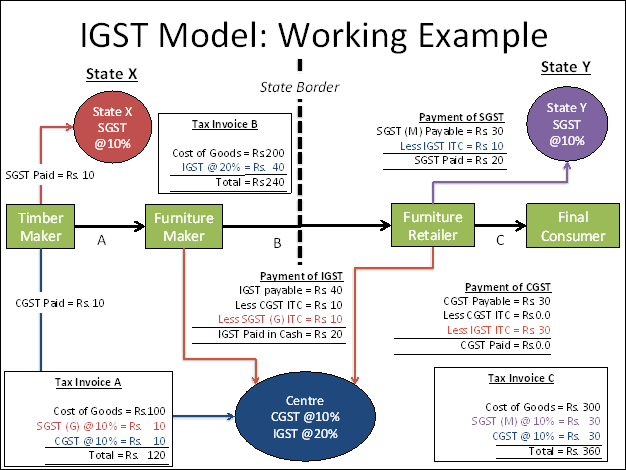
Answer: In case of inter-State transactions, the Centre would levy and collect the Integrated Goods and Services Tax (IGST) on all inter-State supplies of goods and services under Article 269A (1) of the Constitution. The IGST would roughly be equal to CGST plus SGST. The IGST mechanism has been designed to ensure seamless flow of input tax credit from one State to another. The inter-State seller would pay IGST on the sale of his goods to the Central Government after adjusting credit of IGST, CGST and SGST on his purchases (in that order). The exporting State will transfer to the Centre the credit of SGST used in payment of IGST. The importing dealer will claim credit of IGST while discharging his output tax liability (both CGST and SGST) in his own State. The Centre will transfer to the importing State the credit of IGST used in payment of SGST.Since GST is a destination-based tax, all SGST on the final product will ordinarily accrue to the consuming State.

A diagrammatic representation of the working of the IGST model for inter-State transactions is shown in Figure 2 below.

IGST


Question 9. How will IT be used for the implementation of GST?
Answer: For the implementation of GST in the country, the Central and State Governments have jointly registered Goods and Services Tax Network (GSTN) as a not-for-profit, non-Government Company to provide shared IT infrastructure and services to Central and State Governments, tax payers and other stakeholders. The key objectives of GSTN are to provide a standard and uniform interface to the taxpayers, and shared infrastructure and services to Central and State/UT governments.

GSTN is working on developing a state-of-the-art comprehensive IT infrastructure including the common GST portal providing frontend services of registration, returns and payments to all taxpayers, as well as the backend IT modules for certain States that include processing of returns, registrations, audits, assessments, appeals, etc. All States, accounting authorities, RBI and banks, are also preparing their IT infrastructure for the administration of GST.

There would no manual filing of returns. All taxes can also be paid online. All mis-matched returns would be auto-generated, and there would be no need for manual interventions. Most returns would be self-assessed.


Question 10. How will imports be taxed under GST?
Answer : The Additional Duty of Excise or CVD and the Special Additional Duty or SAD presently being levied on imports will be subsumed under GST. As per explanation to clause (1) of article 269A of the Constitution, IGST will be levied on all imports into the territory of India. Unlike in the present regime, the States where imported goods are consumed will now gain their share from this IGST paid on imported goods.

Question 11. What are the major features of the Constitution (122nd Amendment) Bill, 2014?
Answer : The salient features of the Bill are as follows:
g. Conferring simultaneous power upon Parliament and the State Legislatures to make laws governing goods and services tax;
h. Subsuming of various Central indirect taxes and levies such as Central Excise Duty, Additional Excise Duties, Service Tax, Additional Customs Duty commonly known as Countervailing Duty, and Special Additional Duty of Customs;
i. Subsuming of State Value Added Tax/Sales Tax, Entertainment Tax (other than the tax levied by the local bodies), Central Sales Tax (levied by the Centre and collected by the States), Octroi and Entry tax, Purchase Tax, Luxury tax, and Taxes on lottery, betting and gambling;
j. Dispensing with the concept of ‘declared goods of special importance’ under the Constitution;
k. Levy of Integrated Goods and Services Tax on inter-State transactions of goods and services;
l. GST to be levied on all goods and services, except alcoholic liquor for human consumption. Petroleum and petroleum products shall be subject to the levy of GST on a later date notified on the recommendation of the Goods and Services Tax Council;
m. Compensation to the States for loss of revenue arising on account of implementation of the Goods and Services Tax for a period of five years;
n. Creation of Goods and Services Tax Council to examine issues relating to goods and services tax and make recommendations to the Union and the States on parameters like rates, taxes, cesses and surcharges to be subsumed, exemption list and threshold limits, Model GST laws, etc. The Council shall function under the Chairmanship of the Union Finance Minister and will have all the State Governments as Members.
Question 12. What are the major features of the proposed registration procedures under GST?
Answer: The major features of the proposed registration procedures under GST are as follows:
i. Existing dealers: Existing VAT/Central excise/Service Tax payers will not have to apply afresh for registration under GST.
ii. New dealers: Single application to be filed online for registration under GST.
iii. The registration number will be PAN based and will serve the purpose for Centre and State.
iv. Unified application to both tax authorities.
v. Each dealer to be given unique ID GSTIN.
vi. Deemed approval within three days.
vii. Post registration verification in risk based cases only.
Question 13. What are the major features of the proposed returns filing procedures under GST?
Answer: The major features of the proposed returns filing procedures under GST are as follows:
a. Common return would serve the purpose of both Centre and State Government.
b. There are eight forms provided for in the GST business processes for filing for returns. Most of the average tax payers would be using only four forms for filing their returns. These are return for supplies, return for purchases, monthly returns and annual return.
c. Small taxpayers: Small taxpayers who have opted composition scheme shall have to file return on quarterly basis.
d. Filing of returns shall be completely online. All taxes can also be paid online.
Question 14. What are the major features of the proposed payment procedures under GST?
Answer: The major features of the proposed payments procedures under GST are as follows:
i. Electronic payment process- no generation of paper at any stage
ii. Single point interface for challan generation- GSTN
iii. Ease of payment – payment can be made through online banking, Credit Card/Debit Card, NEFT/RTGS and through cheque/cash at the bank
iv. Common challan form with auto-population features
v. Use of single challan and single payment instrument
vi. Common set of authorized banks
vii. Common Accounting Codes
PIB
Share:

Featured post

5 Percent DA July 2019 Hike Order - Grant of Dearness Allowance to Central Government employees

Grant of Dearness Allowance to Central Government employees 5 Percent DA July 2019 Hike Order  No. 1/3/2019-E- II (B) Government of...

Blog Archive

About The Author