A complete reference blog for Indian Government Employees

Showing posts with label Central government women employees. Show all posts

Thursday, 26 September 2019

DoPT Orders 2019 – Encouraging Sports among Central Government Female Employees

DoPT Orders 2019


Promotion of Sports in Central Government Women Employees


F.No. 198/1/2019-20-CCSCSB
Government of India
Ministry of Personnel, Public Grievances and Pensions
Department of Personnel &. Training
(Central Civil Services Cultural and Sports Board)

Lok Nayak Bhawan
Dated 23rd September, 2019

CIRCULAR

Subject : – Promotion of Sports in Central Government Women Employees

Central Civil Services Cultural & Sports Board (CCSCSB) is the Central Agency for promotion of Cultural and Sports activities amongst Central Government employees. CCSCSB ensures larger and effective participation of the Central Government employees in the said activities for physical fitness and recreation. With these objectives in view, the CCSCSB holds Inter- Ministry and All India Civil Services in various sports disciplines.

Check this: DOPT – Scheme for Promotion of Adventure Sports and Similar Activities amongst Central Government Employees

It has been observed that participation of Women employees is very less in the Inter-Ministry Tournaments especially in team games such as Basketball, Volleyball, Wrestling, Cricket, Football, Hockey, Kabaddi and individual events i.e. Lawn Tenn is, Swimming, and Weightlifting & Power lifting.

In order to increase the participation of Women employees in the above games, CCSCSB is planning to orga nise Women Sports Awareness Programmes in various buildings of Ministries/ Departments located in Delhi.

The Board is also planning to organise Women Sports Meet in Nov/ Dec 2019 at Vinay Marg Sports Complex. The Central Govt. Women employees who are willing to participate can contact the following persons for the games mentioned against each . Also any Ministry/Department keen to organise women sports awareness programme in their building /office can contact the following persons.

Check this Latest DoPT Orders 2019

S.No.Sport/ GameNameMinistry/ Deptt.M.NO.
1Power liftingMs. Sonika KhattarI&B9810875891
2CricketMs. Manju MaanDepartment of Biotechnoloqy7503964092
3VolleyballMs. Sita TiwariDefence9990026930
4KabaddiMs. Alpana KaritiHealth & Family Welfare9654673235
5WrestlingMs. JyotiIncome Tax Department7827653570
6All Other Team GamesShri T.K. RawatDefence9899232337

All the Welfare Officers are requested to give wide publicity to the Circular amongst their women employees in the Ministries/ Departments and attached/ subordinate offices and help/ intimate the Board to organise women sports awareness programme in their Ministry/ Department.

(Kulbhushan Malhotra)
Under Secretary to the Government of India
Tele No. 011-24646961

To,
The Welfare Officers of all Ministries/Department

Source: DoPT
Share:

Wednesday, 24 July 2019

Maternity Benefits to the Women Employees – PIB

Maternity Benefits to the Women Employees – PIB

Ministry of Labour & Employment
Maternity Benefits to the Women Employees

24 JUL 2019

Government is working on an incentive Scheme of reimbursement of 07 weeks wages for entities that provide 26 weeks maternity benefits to their woman employees as provided for in the Maternity Benefit (Amendment) Act, 2017. To enable an entity to avail of the incentive, the women employees working in their entity should be a wage earner of less than Rs.15,000/- per month and a member of Employees’ Provident Fund Organisation (EPFO) for at least one year and not covered by Employees’ State Insurance Corporation (ESIC). The scheme is proposed to be administered through Employees’ Provident Fund Organisation and shall be implemented after obtaining the approval of the competent authority.

This information was given by Shri Santosh Kumar Gangwar, Minister of State (I/C) for Labour and Employment in written reply to a question in Rajya Sabha today.

PIB
Share:

Sunday, 25 November 2018

Maternity Leave Incentive Scheme - Clarification by Ministry of Labour & Employment


Maternity Leave Incentive Scheme - Clarification by Ministry of Labour & Employment

Ministry of Labour & Employment
Clarification regarding Maternity Leave Incentive Scheme
16 NOV
In a section of media, there have been some reports about Maternity Leave Incentive Scheme. In this regard, the Ministry of Labour & Employment has clarified the following:-

Background-
(i) The Maternity Benefit Act, 1961 applies to establishments employing 10 or more than 10 persons in Factories, Mines, Plantation, Shops & Establishments and other entities. The main purpose of this Act is to regulate the employment of women in certain establishments for certain period before and after child birth and to provide maternity benefit and certain other benefits. The Act was amended through the Maternity Benefit (Amendment) Act, 2017 which, inter alia, has increased the paid maternity leave to women employees from 12 weeks to 26 weeks.
(ii) While the implementation of the provision is good in Public Sector, there are reports that it is not good in Private Sector and in contract jobs. There is also a wide perception that private entities are not encouraging women employees because if they are employed, they may have to provide maternity benefit to them, particularly 26 weeks of paid holiday. In addition, the Ministry of Labour Employment is also getting complaints from various quarters that when the employers come to know that their women employee is in the family way or applies for maternity leave, the contracts are terminated on some flimsy grounds. There have been several representations before the Labour Ministry on how the extended maternity leave has become a deterrent for female employees who are asked to quit or retrenched on flimsy grounds before they go on maternity leave.
(iii) Therefore, the Ministry of Labour & Employment is working on an incentive scheme wherein 7 weeks' wages would be reimbursed to employers who employ women workers with wage ceiling upto Rs. 15000/- and provide the maternity benefit of 26 weeks paid leave, subject to certain conditions. It is estimated that approximately an amount of Rs. 400 crores would be the financial implication for Government of India, Ministry of Labour & Employment for implementing the proposed incentive scheme.
Major Impact:
The proposed Scheme, if approved and implemented shall ensure the women in this country an equal access to employment and other approved benefits alongwith adequate safety and secure environment. Also, the women shall continue to bear the major share of household work as well as child care. The work places will be more and more responsive to the family needs of the working women.

Current Stage of the Proposal:
There are some media reports that this Scheme has been approved/notified. However, it is clarified that Ministry of Labour & Employment is in the process of obtaining necessary budgetary grant and approvals of Competent Authorities. The reports that it will be funded from Labour Welfare Cess, is also incorrect, as no such cess exists under this Ministry.

Source: PIB
Share:

Thursday, 15 November 2018

Government to refund employers for seven weeks of maternity leave given to employees: WCD

National Minimum Guidelines for setting up and running creches under Maternity Benefit Act, 2017

Government to refund employers for seven weeks of maternity leave given to employees: WCD

The government will give employers the salaries for seven of the 26 weeks of maternity leave for women earning more than Rs 15,000 a month, the Women and Child Development ministry announced on Thursday.

The announcement, which covers the government as well as the private sector, comes in the wake of complaints that many companies were reluctant hire pregnant women after maternity leave was extended from 12 to 26 weeks and some were even firing women employees.

WCD Secretary Rakesh Srivastava said it has been decided to utilise the funds lying in the labour welfare cess to pay the employers.

"The utilisation of the labour welfare cess lying with the state governments has been very less. After talks with the Labour Ministry it has been decided that the seven of the 26 weeks of maternity leave for all women employees in the private and government sector getting more than Rs 15,000 a month would be paid from that fund," Srivastava told reporters here.

The labour welfare cess has been given to state governments to ensure the welfare of workers.

Maternity leave was extended from 12 weeks to 26 weeks last year.

According to Srivastava, there were complaints from women that they were getting fired from their jobs due to the increased duration of maternity leave.

“The government has now decided that out of the 14 extra weeks, half of the amount of salary paid to the pregnant woman would be refunded to the employer from the funds of the labour welfare cess,” he said.

Till March 2017, there was Rs 32,632 crore in the fund. Of this, just Rs 7,500 crore has been utilised, he said.

"We would be refunding the salary of seven weeks to the employer so women do not face problems upon returning to work," he said.

"The labour minister has agreed to the proposal and we are now carrying it forward. There will soon be a notification from the Labour Ministry with further details," he added.

Source: wcd.nic.in
Share:

Friday, 10 August 2018

Alternative Arrangement in Place of Employees on Child Care Leave


Alternative Arrangement in Place of Employees on Child Care Leave

GOVERNMENT OF INDIA
MINISTRY OF PERSONNEL, PUBLIC GRIEVANCES AND PENSIONS
LOK SABHA

UNSTARRED QUESTION NO: 3587
ANSWERED ON: 08.08.2018

Alternative Arrangement in Place of Employees on Child Care Leave

NAGARAJAN P.  Will the Minister of
PERSONNEL, PUBLIC GRIEVANCES AND PENSIONS be pleased to state:-

(a) whether the Union Government is aware of the fact that the office work is being totally disrupted due to absence of women employees on account of the long paid maternity leave and child care leave;
(b) if so, the details thereof;

(c) whether the Government has calculated days and assessed working during maternity/child care leave for making provisions of staff to overcome the shortage or cope up with the work in the absence of women employees who are on maternity and child care leave;
(d) if so, the details thereof; and

(e) if not, the reasons therefor?

ANSWER

MINISTER OF STATE IN THE MINISTRY OF PERSONNEL, PUBLIC GRIEVANCES AND PENSIONS AND MINISTER OF STATE IN THE PRIME MINISTER’S OFFICE
(DR. JITENDRA SINGH)

(a) to (e) : Disruption in the office work due to absence of women employees on account of the long paid Maternity Leave and Child Care Leave has not come to the notice of the Government. Ministries/Departments are authorized to make suitable leave arrangements to cope up the loss of work hours when an employee proceeds on any kind of leave including Maternity and Child Care Leave. There is also provision for creation of leave reserve posts to cover the leave vacancies. No centralized data is maintained in this regard.

Source : LokSabha
Share:

Thursday, 8 March 2018

International Women’s Day – 8th March 2018 : Confederation of Central Government Employees

International Women’s Day - 8th March 2018
WE WILL MAKE IT HAPPEN
Usha Bonepalli.
Chairperson,
Women’s Committee,
Confederation of Central Government Employees and Workers
International-Womens-Day

Dear comrades,
Hearty wishes to every one of you on International Women’s Day 2018. We celebrate this day in honour of the great struggles that are waged by women, throughout the history of working class. We also mark this occasion to acknowledge and appreciate the wonderful roles that women play in making this world habitable, livable and lovable place of living. We utilize this occasion to reflect on the problems that prevent women from achieving gender parity, oppressions faced by them, and work out measures that lead to progress of women in all spheres of life.

One of the first organized struggles for women in modern times was held at Lowell Cotton Mills in Massachussets in 1834. Women worked for 14 hrs per day in mills in confinement, noise, lint filled air, for 1/3rd wages as compared to men. When these wages were also cut, they organized and went on strike. Women in several other mills joined them and an organised movement started for the first time in history. A second strike followed in 1836. Both the strikes were crushed by management, but that is how pioneering struggles start. Defeat gives spirit for better and more organized action. Women began Labour Reform Associations and started huge petition campaigns and political action, asking the Massachussets state legislature to cap working hours in mills at 10 hours. In 1847, New Hampshire became the 1st state to pass a 10 hour working day. This was the first success for organized working women in any part of the world. This success fuelled organized women movements throughout the world’s working class. Today, we remember that struggle with a sense of pride and honour.

The first National Womens Day was held in NewYork in 1909 to commemorate the 1908 garments workers strike. On 8th March 1908, 15000 women garment workers marched through Union Square to demand economic and political rights. The three month strike against Triangle Shirtwaist and other mills became hugely successful. This success was celebrated throughout Europe and Soviet. Clara Zeitkin, a German socialist proposed designating a day as ‘International Women’s Day’ at International Socialist Congress in Copenhagen in 1910. From 1911, we are observing International Womens Day. From 1975, UNO began celebrating International Womens Day on March 8th.
Comrades, the working conditions and safeguards that are available to women today, are a result of many such glorious struggles across the world. We have an 8 hour working day, equal pay for equal work, at least in the government sector, and statutory framework for women like Maternity Benefit Act 1961, Factories Act 1948, Equal Remuneration Act 1976, Sexual Harrassment of Women at Workplace (Prevention, Prohibition and Redressal) Act 2013 etc. None of these acts were made by way of compassion, but were a result of prolonged struggle of the working women. The latest Act in 2013 against sexual harassment at workplace was a result of Supreme Court guidelines in the Visakha case. Everyone knows that women are subject to sexual harassment in all spheres of life, but it took till 2013, and only after a long and concerted legal struggle before the Supreme Court, that guidelines were issued and Government found it fit to pass an Act on this issue. We should keep this in mind that nothing could be achieved unless we organize and wage struggles. We should realize that, though the working women’s movement has achieved significant results, there is a lot lot more to be achieved.

Nagaland, which went to polls recently, did not have a single woman MLA in its 54 years of statehood and 12 assembly elections. The situation is not much rosy in other states and even in the Parliament. Women representation in Lok Sabha is barely 11.3 % - 62 women out of 543 MPs. Take any elected body, including the trade unions, the presence of women in leadership positions is barely minimum. There are two reasons, resistance to give opportunities to women as men are entrenched in leadership positions, and lack of enough strength from women to push themselves ahead. Let us address the second issue, which is the only way to repulse the first issue.

Women are bogged down by multiple commitments, they have the inescapable responsibility of household duties. A working woman needs to get up early, cook food, pack lunches for everyone, layout breakfast and clothes for the boys, then commute to work, spend the day in office, and commute back to home, to cook again, help in homework, and then retire to bed, trying to look beautiful. This is the story of every working woman, either in Postal department, or in Dept of Atomic Energy, either as a clerk or in a higher cadre. There is no CL or EL to this duty. Good health or bad health, there is no escape from this routine. Added to this, women face stigma, violence and harassment at workplace, in society, on the streets, during commute, and some times, even at home. Women face deficit in respect in all walks of life. Media and commerce address women as a commodity. They stereotype women, erect standards of medieval morality and even resort to body-shaming. The invisible chains that tie up women are too heavy and too arresting, to unshackle. It’s a herculean task for any woman to unshackle herself, free herself and make her voice count, in public discourse and organized struggles. But we have to realize, and there is no better day that today, that struggle is the only way. It is only because of our organized struggles that we have achieved so far.
One way to derive inspiration and strength to unshackle ourselves is to celebrate the success stories of women, big or small, in all walks of life. Look around for icons and celebrate them. When our daughters submit a project in school and get two stars, lets celebrate that at home, with all the vigour. When Harmanpreet Kaur hits 171 in 115 balls in Cricket World Cup, lets put her posters (over Sachin’s posters) in our rooms and celebrate that with joy. When we come to know that global Chairman/MD/CEOs of General Motors, Pepsico, IBM, Lockheed Martin are all women, lets celebrate that. When we realize that the superstar of male-centric Bollywood during 1980s was not a man but a woman, lets celebrate that. Every woman who achieved something in life, would have achieved against all odds, facing many difficulties. Lets be proud of all of them, lets gain inspiration from them. And lets help our colleagues, our relatives, our neighbours, our fellow women, in whatever they are aspiring to achieve. And stand by her in all her difficulties. Unless a woman supports a woman, no one supports her.

Another way to unshackle ourselves is to resist media stereotypes. Media is obsessed with stereotyping women as loud viragoes. Social media is obsessed with posting comments on women in the form of jokes, which insult and denigrate the attitude of women. And the commercial industry insults women by portraying women as beautiful only if they are slim or if they have certain body statistics. Why is a man’s figure or his tummy not an object of shame but a woman’s figure or tummy is shamed. A woman becomes a mother, has a rebirth herself when she gives birth to children, undergoes many body changes and fights to come back to normal. Whatever shape she eventually has, the society should make her feel proud of it, not ashamed of it. But because of the intense media standards on what is beautiful and what is not, women are psychologically forced to follow some fad diets, starve themselves and spoil their health. Even school going girls are doing dieting. This is a very dangerous trend. Yes, we need to have fitness. We should do exercise or yoga if it fits in our daily routine, or at least some walking, but beauty doesn’t mean looking like a pencil. We need a movement, first in our minds, and then in the society, to stop this trend. Because of our workload at home and at workplace, women need to eat well, be healthy, and feel confident about whatever shape they are in. One report says that 80 % of present day women above 40 are cases for bone related ailments like osteoporosis. So I request all women to take your health seriously, get some sunlight for Vit D, have iron and calcium supplements and above all, eat well. Don’t starve. We are ourselves. We will not allow the media to judge us.

Friends, the sure way to unshackle ourselves is to develop the confidence in our abilities. Seek responsibilities, take active part in leadership positions in your workplace, in administration, and in unions. If you develop the will and confidence, there is nothing that a woman cannot do, as good as, if not better than, her male counterpart. We have an immense task cut out before us. Once women gain employment, they should be endowed with right to equality, right against discrimination in workplace. Women should be assured dignity of labour, equal wages, beneficial facilities and additional safeguards which compensate for their lack of level playing field. These safeguards and benefits should be made statutory, institutionalised, and implemented thoroughly. We should make relentless fight for safegaurds that we are yet to achieve. We should be very vigilant. Because there will always be attempts to mock, sneer, and trample on the safeguards and the genuine benefits that we rightfully deserve.

“Achieving gender equality and empowering women and girls is the unfinished business of our time, and the greatest human rights challenge in our world.” These are the words of our present UN Secretary General Antonio Guterres. In recognition of this ‘unfinished business’ and ‘greatest human rights challenge’, the campaign theme for International Women’s Day for 2018 is selected as ‘Press for Progress’. The campaign requires that the following activities are taken up:
a. Maintain a gender parity mindset (question any lack of womens’ participation, identify alternatives that are more inclusive, nominate women for opportunities, always include and support women, think 50/50 as goal),
b. Challenge stereotypes and bias (question assumptions about women, challenge statements that limit women, always use inclusive language, work to remove barriers to women’s progress, bur from retailers who position women in positive ways),
c. Forge positive visibility of women (identify ways to make women more visible, extend opportunities to women first, assume women want opportunities until declined, select women as spokepersons and leaders, support visible women),
d. Influence others’ beliefs/actions (supportively call-out inappropriate behavior, campaign for equality in meaningful ways, lead by example via inclusive actions, be a role model for equality, actively contribute to change the status quo) and
e. Celebrate women’s achievements (believe achievement comes in many forms, value women’s individual and collective success, ensure credit is given for women’s contributions, celebrate women role models and their journeys, support awards showcasing women’s success).
Lets do that comrades. As Chairperson of the Womens Committee of Confederation of Central Government Employees and Workers, I call upon everyone to join hands and rededicate ourselves to this call – Press for Progress. We will make it happen.
Source: Confederation
Share:

Wednesday, 14 February 2018

Menstruation Benefits to Central Government Women Employees


Menstruation Benefits to Central Government Women Employees

There is no such proposal for grant of any menstrual leave or introduction of any legislation in this regard. However, under the centrally sponsored scheme of Rashtriya Madhyamik Shiksha Abhiyan (RMSA), activities such as adolescent health awareness programme for girls, provision of separate toilet blocks for girls as part of schools and installation of incinerator machine and sanitary napkin & vending machine for girls at schools and girl’s hostels are undertaken for general hygiene management. National Council of Educational Research and Training (NCERT) has developed syllabus on health and physical education for classes I-XII as a follow up of National Curriculum Framework, 2005, which provides adequate space for menstrual hygiene.

Ministry of Health and family Welfare is implementing the scheme for Promotion of Menstrual Hygiene for Adolescent Girls residing primarily in rural areas of the country. Adolescent girls are provided with sanitary napkins at subsidized rates by Accredited Social Health Activists (ASHA’s) within the community and through the platform of Government and Government aided school. Ministry of Drinking Water and Sanitation has also developed National Guidelines on Menstrual Hygiene Management (MHM) which aims to support all adolescent girls and women.

The above information was given by Union Minister of State for Women and Child Development Dr.Virendra Kumar in a written reply in Lok Sabha on 9.2.2018.
Share:

Friday, 22 December 2017

SHe-Box portal set up for registering complaints of sexual harassment of women employees at workplace, of both Government and Private sector


SHe-Box portal set up for registering complaints of sexual harassment of women employees at workplace,  of both Government and Private sector

More than 350 complaints of inappropriate behaviour received by WCD Ministry including those through SHe-Box portal

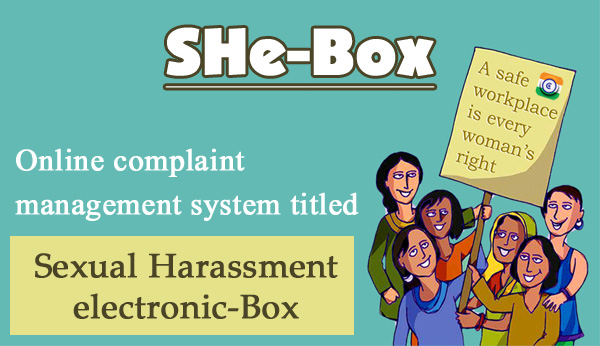
In order to ensure the effective implementation of the Sexual Harassment of Women at Workplace (Prevention, Prohibition and Redressal) Act, 2013, the Ministry of Women & Child Development has launched an online complaint management system titled Sexual Harassment electronic-Box (SHe-Box) for registering complaints related to sexual harassment at workplace of all women employees in the country, including government and private employees.

More than 350 complaints relating to inappropriate behaviour have been received in the Ministry which includes complaint received through portal 'SHe- box'.

Ministry of Corporate Affairs has been requested for mandatory disclosure of Internal Complaints Committee (ICCs) in the Annual Report of the Companies. Ministry of Corporate Affairs along with the industry bodies, Associated Chambers of Commerce & Industry of India (ASSOCHAM), Federation of Indian Chambers of Commerce and Industry (FICCI), Confederation of Indian Society, Chamber of Commerce & Industry (CCI), and National Association of Software and Services Companies (NASSCOM) have also been requested to ensure effective implementation of the Act amongst their members in private sectors.

This information was given by Minister of State for Women and Child Development, Dr. Virendra Kumar in reply to a question in Rajya Sabha today.

PIB
Share:

Thursday, 2 November 2017

Online complaint management system titled "Sexual Harassment electronic-Box (SHe-Box)"

Online complaint management system titled "Sexual Harassment electronic-Box (SHe-Box)" - regarding
SHe-Box-Sexual-Harassment-Electronic-Box-DoPT

 
F. No. 11013/7/2016-Estt.A-III
Government of India
Ministry of Personnel, Public Grievances and Pensions
Department of Personnel & Training
Establishment A-III Desk
North Block, New Delhi - 110001
Dated 1st November, 2017
OFFICE MEMORANDUM

Subject: Online complaint management system titled "Sexual Harassment electronic-Box (SHe-Box)" - regarding

The undersigned is directed to say that Ministry of Women & Child Development launched an online complaint management system titled Sexual Harassment electronic-Box (SHe-Box) on 24th July, 2017 for registering complaints related to sexual harassment at workplace. The She-Box is; an initiative to provide a platform to the women working or visiting any office of Central Government (Central Ministries, Departments, Public Sector Undertakings, Autonomous Bodies and Institutions etc.) to file complaints related to sexual harassment at workplace under the Sexual Harassment of Women at Workplace (Prevention, Prohibition and Redressal) Act, 2013.

2. Once a complaint is submitted to SHe-Box, it wiil be directly sent to the Internal Complaint Committee (ICC) of the concerned Ministry / Department/ PSU / Autonomous Body etc. having jurisdiction to inquire into the complaint. The She-Box also provides an opportunity to both the complainant and nodal administrative authority to monitor the progress of inquiry conducted by the ICCs. The SHe-Box portal can be accessed at the link given below:

http://www.shebox.nic.in/

3. Features of the SHe-Box are as under:
(i) SHe-Box is an online Complaint Management System for lodging complaints related to sexual harassment of women at workplace. The steps required for filing of complaint through SHe-Box can be downloaded from the link:

http://www.shebox.nic.in/assets/site/downloads/manual.pdf

(ii) Any woman working or visiting any office of Central Government (Central Ministries, Departments, Public Sector Undertakings, Autonomous Bodies an.d Institutions etc.) can file complaint related to sexual harassment at workplace through this SHe-Box.

(iii) Once a complaint is submitted to the SHe-Box, it will directly send the complaint to the Internal Complaints Committee. (ICC) of the concerned Ministry /Department/PSU / Autonomous Body etc; having jurisdiction to inquire into the complaint. The Internal Complaints Committee will take action as prescribed under the Sexual Harassment of Women at Workplace (Prevention, Prohibition and Redressal) Act, 2013 and update the status of the complaint through 'Administrator Login'

(iv) The status of complaint can be viewed at any time by pressing the tab 'View Status of Your Complaint' within SHe-Box.
4. The complaint registered in the She-Box contains only a brief description of the incident of sexual harassment at workplace. The Internal Complaints Committee (ICC) is required to initiate inquiry as prescribed under Section 11 of the Sexual Harassment of Women at Workplace (Prevention, Prohibition and Redressal) Act, 2013 read with Department of Personnel & Training's  O.M. No. 1l013/2/2014-Estt.(A-III) dated 16th July, 2015 by calling upon the complainant to provide detailed complaint along with all the relevant evidences (documentary or otherwise).

5. All the Ministries/Departments are requested to bring the contents of this OM to the notice of all officers and staff working under them. The Ministries/ Departments are also requested to advise the PSEs / Autonomous Bodies under their administrative control to bring the content of SHe-Box to all officers and staff.

6. Hindi version will follow.
(Nitin Gupta)
Under Secretary to the Govt of India
Tel: 23040264
To
The Secretaries of All Ministries/Departments
(as per the standard list)

Source: DoPT
Share:

Thursday, 3 August 2017

Employment of women and girls in Government organisations/Agencies


Employment of women and girls in Government organisations/Agencies

Employment of women and girls in Government organisations/Agencies

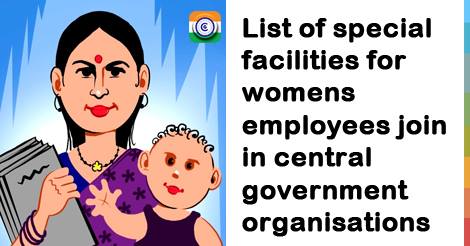
The Government has been making concerted efforts to encourage the women to join Government service by providing some special facilities as enumerated below:
(i) maternity leave
(ii) child care leave
(iii) child adoption leave
(iv) special allowance to women with disability
(v) provision of crèche facility
(vi) posting of husband and wife at the same station
(vii) special priority in allotment of residential accommodation
(viii) provision for protection of women from acts of sexual harassment
(ix) special Leave connected with inquiry on sexual harassment
(x) age relaxation for appointment of widows, divorced woman and women judicially separated from their husbands and who are not remarried
(xi) special dispensation for woman officers of All India Services of North East cadre
(xii) exemption from payment of fee for examinations conducted by the Union Public Service Commission and Staff Selection Commission.
(xiii) Nomination of a women employee in Department Promotion Committee (DPCs). Institutional mechanisms, besides the Committees to prevent sexual harassment, exist in Government service for redressal of grievances of various nature of the women employees.
(xiv) Association of a lady member in Selection Committee/Board for 10 or more vacancies (at all levels).
This was stated by the Minister of State (Independent Charge) for Development of North Eastern Region (DoNER), MoS PMO, Personnel, Public Grievances, Pensions, Atomic Energy and Space, Dr. Jitendra Singh in written reply to a question by Shri Parimal Nathwani in the Rajya Sabha today.

PIB
Share:

Thursday, 30 March 2017

Women to get 26 weeks maternity leave, President nod to new law


Women to get 26 weeks maternity leave, President nod to new law

New Delhi: Women employees will now be able to get paid maternity leave of 26 weeks, up from 12 weeks, as per a new law.

President Pranab Mukherjee has given assent to the Maternity Benefit (Amendment) Act, 2017 that has made changes in some of the provisions of over 55-year-old law entitling certain benefit to women employees.

The new law makes it mandatory for every establishment with fifty or more employees to have the facility of creche within a prescribed distance.

The employer is also bound to allow four visits a day to the creche by a woman.

Every establishment shall intimate in writing and electronically to every woman at the time of her initial appointment regarding every benefit available under the new law, the statute says.

An employer can also permit a woman to work from home after she has availed maternity leave.
"In case where the nature of work assigned to a woman is of such nature that she may work from home, the employer may allow her to do so after availing of the maternity benefit for such period and on such conditions as the employer and the woman may mutually agree," it says.

The law also allows maternity leave of 12 weeks for a woman who adopts a child below the age of three months, and for commissioning mother (a biological mother who uses her egg to create an embryo implanted in any other woman).

The entitlement of 26 weeks paid leave under the law is only for first two children. A woman with two or more children will be entitled to 12 weeks of maternity leave, says the law which will apply to all establishments employing 10 or more people.

The statute that will help approximate 1.8 million women workforce in organised sector, has amended Maternity Benefit Act, 1961 that regulates grant of maternity benefit to women employees in certain establishments.

The Maternity Benefit (Amendment) Bill was passed by Lok Sabha on March 9 and Rajya Sabha on March 20.

India is at third position globally in terms of the number of weeks of maternity leave after Canada (50 weeks) and Norway (44 weeks).

The president gave his assent on Monday.

PTI
Share:

Tuesday, 27 December 2016

Central Civil Services (Conduct) Rules 1961 - Guidelines regarding prevention of sexual harassment of women at the workplace


No.11013/7/2016-Estt.A-III
Government of India
Ministry of Personnel, Public Grievances & Pensions
Department of Personnel & Training
Establishment A- III Desk
North Block, New Delhi,
Dated the 22nd December, 2016
OFFICE MEMORANDUM

Subject:- Central Civil Services (Conduct) Rules 1961 - Guidelines regarding prevention of sexual harassment of women at the workplace - regarding.

The undersigned is directed to refer to the DoPT OM number No.11013/2/2014-Estt.A-III, dated the 16th July, 2015 etc., vide which need for effective mechanism to ensure that inquiries in the case of allegations of sexual harassment are conducted as per the prescribed procedure and that they are monitored have been issued. Recently, a meeting was held under the Chairmanship of Minister, Women and Child Development wherein concern was expressed that the inquiries in such cases are taking unduly long time. It has, therefore, been decided that the following further steps may be taken to ensure that the inquiries are conducted expeditiously and the aggrieved women are not subjected to victimization:
(1) As already conveyed vide OM dated 2nd February, 2015 all Ministries/Departments shall include in their Annual Reports information related to the number of such cases and their disposal.
(2) As far as practicable, the inquiry in such cases should be completed within 1 month and in no case should it take more than 90 days as per the limit prescribed under the Sexual Harassment of Women at Workplace (Prevention, Prohibition and Redressal) Act, 2013.
(3) It should be ensured that the aggrieved women are not victimized in connection with the complaints filed by them. For a period of five years after a decision in a proven case of sexual harassment, a watch should be kept to ensure that she is not subjected to vendetta. She should not be posted under the Respondent, or any other person where there may be a reasonable ground to believe that she may be subjected to harassment on this account. In case of any victimization the complainant may submit a representation to the Secretary in the case of Ministries/Departments and Head of the Organization in other cases. These representations should be dealt with sensitivity, in consultation with the Complaints Committee, Ministries/Departments and Head of the Organization in other cases. These representations should be dealt with sensitivity, in consultation with the Complaints Committee, and a decision taken within 15 days of the submission of the same.
(4) All Ministries/Departments shall furnish a monthly report to the Ministry of Women and Child Development giving details of number of complaints received, disposed of and action taken in the case.
(Mukesh Chaturvedi)
Director (E)
Tele: 23093176
DoPT Order 2016
Share:

Sunday, 17 July 2016

Central government sexual harassment victim employees now get 90 days paid leave

Central government sexual harassment victim employees now get 90 days paid leave

No. 13026/2/2016-Estt(L)
Government of India
Ministry of Personnel, Public Grievances and Pensions
Department of Personnel & Training 

Old JNU Campus, New Delhi 110 067
Dated: 14.07.2016 
OFFICE MEMORANDUM 

Subject: Implementation of leave provision under the Sexual Harassment of Women at Workplace (Prevention, Prohibition & Redressal) Act, 2013 — Reg.

Consequent to the enactment of the 'Sexual Harassment of Women at  Workplace (Prevention, Prohibition and Redressal) Act, 2013', this Department is  considering issuing instructions for the grant of leave to the aggrieved woman during  pendency of inquiry up to a period of three months in addition to the leave which she  is otherwise entitled to.

2. In this regard, it is proposed to insert/incorporate a new Rule in the CCS  (Leave) Rules, 1972. The new rule may read as follows:

"Special Leave connected with inquiry on sexual harassment — Leave up to a maximum of 90 days may be granted to an aggrieved female Government Servant on the recommendation of the Internal Committee or the Local Committee, as the case may be, during the pendency of inquiry under Sexual Harassment of Women at Workplace (Prevention, Prohibition and Redressal) Act, 2013. 

(2) The leave so granted to the aggrieved woman under this rule shall not be debited against the leave account."

(Navneet Misra)
Under Secretary to the Government of India 

Copy to: NIC, DoPT for uploading on the website of the Ministry.
Share:

Thursday, 27 August 2015

Women Employee needs Eight month maternity leave to be thought through

Women Employee needs Eight month maternity leave to be thought through

New Delhi: Women and child development minister Maneka Gandhi’s proposal to extend three-month maternity leave to eight months needs to be thought through.

Women and Child Development Minister Maneka Gandhi

There is no doubt that newborns need their mothers, but extending maternity leave for eight months is not the right solution.

No company or government can afford an employee to be away for eight months, and if they are made to do so, they may not be eager to hire or promote women.

Encouraging mothers with young children to remain in the workforce is a challenge no company or government has worked out yet.

Last year, Facebook and Apple came under criticism when they offered cash incentives to their female employees to freeze and store their eggs. This, the companies claimed, was done so that women could focus on their careers.

But this idea has not caught on yet, and with many people doubtful about tampering with the ‘natural order’ it is not likely to do so anytime soon.

So what is the solution? There is no ideal one, but what is clear is the government must give companies some leeway.

Training a new person, employing them for eight months and getting rid of them when the woman returns to work is unfair to the employee, the company and to the woman herself.

Why? Because one cannot assume in today’s fast moving world, that her role would have remained the same as it was eight months ago. New skills may be required.

Therefore it is better to ask pregnant women upfront if they would like to return to work post-pregnancy. If they do, they must devote a certain number of hours to work.

The government must support this by helping to set up creches, and allowing women to work part time from home. This is better than having a woman return to work after eight months.

Via: tkbsen
Share:

Thursday, 13 August 2015

3.37 lakh women employees in central government

3.37 lakh women employees in central government

New Delhi: Over three lakh women employees are working in various central government departments across the country, Lok Sabha was informed today.

Replying to a question, Minister of State for Personnel Jitendra Singh said there are various historical and social reasons for women employees being lesser in number.

“Estimated women employment in major central government offices as on March 31, 2011 is 3.37 lakh,” he said in a written reply.

There are about 48 lakh central government employees.

“There are various historical and social reasons for the women employees being lesser in number,” the Minister said.

In reply to another question, Singh said there was no proposal under the consideration of the government to provide 33 per cent reservation to women in central government offices.
PTI
Share:

Tuesday, 17 March 2015

Maternity Benefit Act for Women Employees

Maternity Benefit Act for Women Employees

The main provisions of the Maternity Benefit Act are:
i) No employer shall knowingly employ a woman in any establishment during the six weeks immediately following the day of her delivery or her miscarriage. Also, no woman shall work in any establishment during the six weeks immediately following the day of her delivery or her miscarriage.

ii) Every woman shall be entitled to, and her employer shall be liable for, the payment of maternity benefit at the rate of the average daily wage for the period of her actual absence immediately preceding and in- cluding the day of her delivery and for the six weeks immediately following that day.

iii) No woman shall be entitled to maternity benefit unless she has actually worked in an establishment of the employer from whom she claims maternity benefit, for a period of not less than eighty days in the twelve months immediately preceding the date of her expected delivery.

iv) The maximum period for which any woman shall be entitled to maternity benefit shall be twelve weeks, that is to say, six weeks up to and including the day of her delivery and six weeks immediately following that day.

v) No deduction from the normal and usual daily wages of a woman entitled to maternity benefit shall be made by reason only of –
(i) the nature of work assigned to her by virtue of the provisions of the Act; or
(ii) breaks for nursing the child allowed to her under the provisions of the Act.

vi) If a woman works in any establishment after she has been permitted by her employer to absent herself for any period, during such authorised absence, she shall forfeit her claim to the maternity benefit for such period.
The above said statement is the part of undermentioned Lok Sabha Q&A:-

GOVERNMENT OF INDIA
MINISTRY OF LABOUR AND EMPLOYMENT
LOK SABHA
STARRED QUESTION NO 167
ANSWERED ON 09.03.2015
AMENDMENT TO MATERNITY BENEFITS ACT
167 . Pal Shri Jagdambika
Will the Minister of LABOUR AND EMPLOYMENT be pleased to state:-
(a) the key provisions of the Maternity Benefits Act, 1961;
(b) whether the Government has any proposal to bring amendments to the Act;
(c) if so, the details thereof and the reasons therefor; and
(d) the time by which the proposed amendments are likely to be implemented along with the extent to which the same would be beneficial for working women in the country?

ANSWER

MINISTER OF STATE (IC) FOR LABOUR AND EMPLOYMENT (SHRI BANDARU DATTATREYA)

(a) to (d): A statement is laid on the Table of the House.
STATEMENT RERERRED TO IN REPLY TO PARTS (a) TO (d) OF LOK SABHA STARRED QUESTION NO.167 FOR 09.03.2015 BY SHRI JAGDAMBIKA PAL REGARDING AMENDMENT TO MATENITY BENEFITS ACT.
(a): The main provisions of the Maternity Benefit Act are: —As mentioned above
(b): No, Madam.
(c) & (d): Does not arise in view of facts mentioned at (b) above.

Source: http://164.100.47.132/LssNew/psearch/QResult16.aspx?qref=12590
Share:

Thursday, 17 April 2014

Central Government women employees can get 730 days leave for child care: Supreme Court

Central Government women employees can get 730 days leave for child care: Supreme Court

The Supreme Court on Tuesday held that a woman employee of central government can get uninterrupted leave for two years for child care, which also includes needs like examination and sickness. A bench of justices SJ Mukhopadhaya and V Gopala Gowda set aside the order of Calcutta High Court which had held that Central Civil Services (Leave) Rules do not permit uninterrupted CCL(Child Care Leave) for 730 days.

“On perusal of circulars and Rule 43-C, it is apparent that a woman government employee having minor children below 18 years can avail CCL for maximum period of 730 days i.e. during the entire service period for taking care of upto two children. The care of children is not for rearing the smaller child but also to look after any of their needs like examination, sickness etc,” the bench said.

It said that CCL even beyond 730 days can be granted by combining other leave if due and the finding of the High Court was based neither on Rule 43-C nor on guidelines issued by the central government. The court passed the order on a petition filed by a woman government employee Kakali Ghosh challenging government’s decision not to grant her leave of 730 for preparing her son for secondary/senior examinations.
She had first approached Central Administrative Tribunal Calcutta for getting leave. The tribunal had ordered in her favour but the High Court reversed the order after which she moved the apex court.

The apex court set aside the High Court’s order. “We set aside the impugned judgement dated September 18, 2012 passed by the Division Bench of Calcutta High Court, Circuit Bench at Port Blair and affirm the judgement and order dated April 30, 2012 passed by the Tribunal with a direction to the respondents to comply with the directions issued by the Tribunal within three months from the date of receipt/ production of this judgement,” it said.

Source: Central Government News
Share:

Featured post

5 Percent DA July 2019 Hike Order - Grant of Dearness Allowance to Central Government employees

Grant of Dearness Allowance to Central Government employees 5 Percent DA July 2019 Hike Order  No. 1/3/2019-E- II (B) Government of...

Blog Archive

About The Author