A complete reference blog for Indian Government Employees

Showing posts with label 7th CPC Projected Pay. Show all posts

Sunday, 10 April 2016

7th Pay Commission: Guess who else is going to benefit from Central Government Employees Pay Hike!

7th Pay Commission: Guess who else is going to benefit from Central Government Employees Pay Hike!

It is not just Central government employees eagerly anticipating implementation of the 7th pay commission and take home higher monthly pay package.

Your next-door real estate agent, car dealer and consumer durables seller are also seen gaining from the pay commission hike. According to reports, almost 3.4 crore individuals (employees and pensioners) will witness increase in their incomes, resulting in a multiplier effect on a couple of professions.

Real estate agent: Realty sector is expected to eventually succeed in shaking off the sluggish demand and witness spurt in the sale of houses in tier 1 and tier 2 cities as more than 80 percent of Central government employees lives in these cities

As a result of the foreseen demand, the Reserve Bank of India expects sharp, quick and continuous spurt in the housing index.

Car dealer: With implementation of the 7th CPC, your next door car or two wheeler dealer may rejoice too. The industry expects double digit increase in automobile sales especially two-wheeler, the mini and the compact hatch back segment.

Consumer durables seller: The increase in disposable income will no doubt boost the disposable income leading to increased demand for consumer durables goods like refrigerators, TV etc

Banker: Of course, peaking demand for automobiles, real estate and consumer durable will create demand for consumer loans. The consumer loans section of banks and NBFCs will vie to get the larger share of the indirect gain from the 7th CPC salary hike.

The scenario of crores of potential customers and falling interest rate will announce a win win situation for the banks and consumers both.

Via:  Zee News
Share:

Wednesday, 18 November 2015

Report of 7th pay panel may not be having satisfying recommendations

Report of 7th pay panel may not be having satisfying recommendations:
 
 
7th pay commission is going to submit its report on 20th November 2015 and 15 % hike is recommended
 
Report from news circle says that 7th pay commission is going to submit its report on 20th November 2015 and 15% hike is recommended
 
After submission, it is believed that the outcome of 7th cpc recommendation will be unexpected and disappointment for bapus as Central Government deliberately influenced the Pay commission to be cautious about upward revision of pay and allowances of govt servants.
 
When the commission itself was ready to submit the report in stipulated time initially, the Central government gave four months extension upto December 2015.
 
 
The reason cited by Federation leaders for the extension was ‘ NDA government didn’t want to put itself in a mess before Bihar Election, because the Recommendation will not fulfil the expectation of Govt servants. The NDA government felt that disappointed central government employees may protest over 7th pay commission recommendation if it does not meet their expectation which , it felt, may reflect in Election Results. So the Central Government decided to postpone the date of submission of the report after the Bihar election.
 
 
But unexpectedly the NDA has failed to yield fruitful results in Bihar election. Now opposite parties found the reason to be united against the NDA Government, since the election result gave them faith and beleif to over power the NDA in coming elections.’
 
 
Further they added, “The winter session of Parliament going to start from 26 November 2015, opposite parties waiting to stall the proceedings of Parliament based on handful of sensitive issues which will be a bitter experience for NDA government.
 
 
So submission of 7th pay commission report before the winter session of parliament may help the govt to divert the attention of media and public from the sensitive issues”.
 
 
The Pay Commission, if it followed the methods adopted by previous pay commissions to compute the increase to be recommended for revision of pay and allowances of government servants, minimum 40% increase can be recommended.
 
 
But According to the Medium-Term Expenditure Framework Statement tabled by Finance Minister Arun Jaitley in Parliament said
 
“The salary outgo of central government employees will go up by 9.56 per cent to Rs 1,00,619 crore in current fiscal.
The pace will increase further in 2016-17 at 15.79 per cent to Rs 1.16 lakh crore with the likely implementation of the 7th Pay Commission award”
 
So there are two possibilities for calculating Fitment Formula
 
 
1. As per the Finance Minister Statment the increase will be 15 %
 
2. All the Fedrartion demanded for 40 to 60 % hike, but minimum 30 % increase is expected.
 
 
Accordingly The Fitment formula for the above two estimates are worked out below
 
Present DA = 119%
Expected DA from from January 2016 =6%
Total Da =125 %
 
DA has to be neutralised to arrive Revised Pay from 1.1.2016, if so Multiplication factor will be 2.25
 
If 30% increase is recommended-
 
The Fitment formula = 2.25 + (2.25×30/100)  = 2.92
Minimum Basic will be Rs.7000 x 2.92 = Rs.20440
 
If 15% increase is recommended-
 
The Fitment formula = 2.25 + (2.25×15/100)   = 2.58
Minimum Basic will be Rs.7000 X 2.58 = Rs.18060
 
Minimum Pay to be recommended according to the above estimates by 7th Pay commission will be either Rs.20000 or Rs.18000
 
 
How ever both of the above figures will not satisfy the central government employees since the increase is not going to match their expectation. We have to wait to know the exact increase recommended by 7th pay commission till the date of the report is made public.
Read at: GServant
Share:

Thursday, 12 November 2015

7th Pay Commission report – estimated pay scales and multiplication factor

7th Pay Commission Pay Scales and 7th CPC Pay Calculator – Revisit by GConnect

After taking in to account the expected DA of 125% from January 2016,  estimated 7th Pay Commission Pay Scales, 7th CPC pay and 7CPC Grade Pay as follows:
7th Pay Commission Pay Scales, and 7th CPC pay Using the multiplication factor of 2.25
7th Pay Commission Grade Pay By Providing 40% fitment Benefit

7th Pay Commission Pay Scales and Fitment Benefit (7th CPC Grade Pay Structure)

PB 6 CPCPay bands 7th CPC Pay Band 6th CPC GradePay 7th CPCGradePay 6CPC Minimum Basic pay 7CPC Minimum Basic pay
1 5200-20200 13880-47480 1800 7380 7000 21240
1 5200-20200 14010-47610 1900 7540 7100 21520
1 5200-20200 14130-47730 2000 7680 7200 21790
1 5200-20200 14630-48230 2400 8280 7600 22890
1 5200-20200 15120-48720 2800 8880 8000 23970
2 9300-34800 26040-83160 4200 14680 13500 40660
2 9300-34800 26540-83660 4600 15280 13900 41760
2 9300-34800 26790-83910 4800 15580 14100 42310
2 9300-34800 27530-84650 5400 16480 14700 43950
3 15600-39100 41640-94250 5400 22140 21000 63700
3 15600-39100 43130-95770 6600 23940 22200 66990
3 15600-39100 44370-97010 7600 25440 23200 69720
4 37400-67000 94570-160870 8700 46720 46100 141100
4 37400-67000 94820-161120 8900 47020 46300 141650
4 37400-67000 96180-162480 10000 48660 47400 144660
4 37400-67000 98660-164960 12000 51660 49400 150130

Meanwhile, we have also made a comparison of 7th Pay Commission Pay estimated by GConnect by adopting 6th CPC methods and 7CPC Pay proposed by National Council, Staff Side JCM and Confederation of Central Government Employees and Workers.
In this comparison, we have arrived at the Net increase in pay out of 7CPC Pay for employees in each grade pay which is calculated on the basis of present 6CPC pay along with DA as on January 2016 (125%).
This increase in Percentage has been calculated for 7th Pay Commission Pay estimated by GConnect and also for 7th CPC Pay proposed by JCM Seperately.
Present PB and GP 6CPC Minimum Basic pay 7th PayCommissionPay estimated by GConnect JCM / Confederation proposed 7CPC Basic Pay % increase in 7cpc pay estimated by GConnect % increase in 7cpc pay as proposed by JCM
PB-1 GP 1800 7000 21240 26000 35% 65%
PB-1 GP 1900 7100 21520 31000 35% 94%
PB-1 GP 2000 7200 21790 33000 35% 104%
PB-1 GP 2400 7600 22890 41000 34% 140%
PB-1 GP 2800 8000 23970 46000 33% 156%
PB-2 GP 4200 13500 40660 56000 34% 84%
PB-2 GP 4600 13900 41760 66000 34% 111%
PB-2 GP 4800 14100 42310 74000 33% 133%
PB-2 GP 5400 14700 43950 78000 33% 136%
PB-3 GP 5400 21000 63700 88000 35% 86%
PB-3 GP 6600 22200 66990 102000 34% 104%
PB-3 GP 7600 23200 69720 120000 34% 130%
PB-4 GP 8700 46100 141100 139000 36% 34%
PB-4 GP 8900 46300 141650 148000 36% 42%
PB-4 GP 10000 47400 144660 162000 36% 52%
PB-4 GP 12000 49400 150130 193000 35% 74%

Originally published by GConnect
Share:

Monday, 12 October 2015

Seventh Pay Commission likely to propose highest pay hike since 1947

7th Pay Commission likely to propose highest pay hike since 1947

7th pay commission
New Delhi: The Seventh Pay Commission is likely to propose pay hike for central government employees, which will be highest since first pay commission’s proposal in 1947.
 
 
The first pay commission was constituted in 1946, while its submitted its report on May, 1947 to the interim government of India. ‘Living wage’ — the guiding principle for the first Pay Commission — is long past.
 
 
‘Now is Seventh Pay Commission time’, which is also to take in to account living cost of central government employees cost of their appraisal.
 
 
The cost of living measures the annual cost of necessities for one adult to live a secure, yet modest, lifestyle by estimating the costs of housing, food, transportation, health care, other necessities, and taxes.
 
Every government employee likely has a six-member family including his parents. So, Seventh Pay Commission is likely to increase salaries and allowances to minimise the impact on the cost of living for 50 lakh central government employees and 56 lakh pensioners including dependents.
 
 
Inflation pushes living cost, inflation, is an economic concept. The effect of inflation is the prices of everything going up year by year. A central government employee got salary Rs 3000 in 1987 under Sixth pay commission, now he gets Rs 80,000 with two promotion, this is called inflation, the price of everything goes up. When the price goes up, the salaries go up.
 
 
Every successive Pay Commission has roughly tripled pay. This means that simply by hiking up living cost for 10 years, a government employee would have tripled his pay.
 
 
The first pay commission was recommended Rs 55 salary to the lowest earning employee, second Rs 80, third Rs 185, fourth Rs 750, fifth Rs 2550 and sixth Rs 6660.
 
 
Accordingly, the Seventh Pay Commission is likely to propose minimum basic salary Rs 20,000 of central government employees, sources in the pay panel said.
 
 
The main reason behind the proposal of Seventh Pay Commission is to hike highest pay since 1947 on the account of Dearness Allowance (DA). The central government employees will get Dearness Allowance likely 125 percent at the time implementation of Seventh pay Commission. They never got such type of Dearness Allowance hike before implementation of any Pay Commission.
 
 
Dearness Allowance always merges with salaries and allowances under every pay commission’s proposal.
 
“The Seventh Pay Commission is ready with recommendations and the report will be submitted soon,” according to sources.
 
 
Headed by Justice Ashok Kumar Mathur, the Seventh Pay Commission was appointed in February 2014 and its recommendations are scheduled to take effect from January 1, 2016.
 
 
The government constitutes the Pay Commission almost every 10 years to revise the pay scale of its employees and often states also implement the panel’s recommendations after some modifications. The first pay commission was constituted in 1946, second in 1957, third in 1970, fourth in 1983, fifth in 1994, sixth in 2006 and seventh in 2014.
 
 
As part of the exercise, the Seventh Pay Commission holds discussions with various stakeholders, including organisations, federations, groups representing civil employees as well as defence services.
 
 
Meena Agarwal is the secretary of the Commission. Other members are Vivek Rae, a retired IAS officer of 1978 batch and Rathin Roy, an economist.
 
 
The Sixth Pay Commission was implemented with effect from January 1, 2006, the fifth from January 1, 1996 and the fourth from January 1, 1986.
TST
Share:

Monday, 14 September 2015

Minimum Salary 25,000, Fitment Formula 3.5 & Wage Hike 60% should be in 7th CPC: Jaago Employee Jaago by Karnataka COC

Minimum Salary 25,000, Fitment Formula 3.5 & Wage Hike 60% should be in 7th CPC: Jaago Employee Jaago by Karnataka COC
Minimum Wages Fitment Formula and Wage Hike. 
Comrades,
           There are number of unwanted articles on minimum wage, fitment formula and wage hike on many websites which are not true and create confusion among the Central Government Employees. This type of the articles also give wrong impressions and give wrong signals to the Government, these articles are written without having basic knowledge of the price rise and minimum wage calculation.
 
 
The minimum wage calculation is given below.  Hence it is requested to go through the below calculation of minimum wages, as the 7th CPC has indicated the use of using Dr. Aykroyd formula and 15th ILO norms for calculation of minimum wages. The rates are taken from Government shops (retail prices are 10% more than Government prices). The rates to be taken up by the 7th CPC may vary only marginally.
 
We should actually wait for the 7th CPC to give its report and then we should react and staff side JCM shall take necessary steps in this regard. Let us stop all such unwanted gossips of minimum wage, fitment formula and wage hike. The model minimum wage calculated using Dr. Aykroyd formula and 15th ILO norms as on 1st July 2015 is given below.
Item Per Month
3 units

in Kgs/ mt
Average
Rate
Amount
Rice  (fine) & Wheat atta 42.75401710
Dal  7.21401008
Raw Vegetables 941369
Green Vegetables 11.2545507
Other Vegetables 6.7555372
Fruits 10.875810
Milk Dairy 1833594
Sugar539.5198
Edible Oil 3.6114410
Fish 2.54101025
Meat Mutton54502250
Egg905450
Detergents* 1161.58162
Clothes5.52501375
Total11241
Miscellaneous @ 20%2248.2
Total13489
Additional @ 25%3372.3
Total 16861.5
Add 10% housing 1686
Minimum pay for unskilled worker in the erstwhile Group “D”18547.5
Add 25% for Group "C" ( as proposed by 6th CPC )4636.875
Total23184.375
Add 6% more prices from 1st July  2015 to 1st Jan 20161391.04
Total amountRs 24575/-
Minimum pay for skilled worker in Group "C"Say  Rs 25,000/-

Fitment formula = Rs 25000/7000 = 3.5
The main goal is to educate the Central Government Employees and prepare for the struggle path in case the  important demands expected of the 7th CPC are not met.

A) Minimum wage of Rs 25,000/- as per Government prices. 
B) Fitment formula of 3.5
C) Wage hike of more than 60%.
D) Proper pay scales with proper increment rate.
E)  Proper promotion policy and proper allowances.
F) Wage revision from 1/1/2014.
DA as likely on 1st Jan 2016 is likely at 125%.
After 7th CPC implementation it will DA will be zero %
Existing Basic Minimum wage is Rs 7000/- as on 1/1/06
Add 125% DA as on 1/1/2016 =Rs 8750/-
Total existing Minimum Wage as on 1/1/2016 is Rs 15750/-
If the Minimum wage is fixed at Rs 25,000/-
Net Increase shall be Rs 9250/-
Net Increase should be 60%.
Comradely yours
 
(P.S.Prasad)
General Secretary
Source: http://karnatakacoc.blogspot.in/
Share:

Saturday, 22 August 2015

Big Expectations from 7th CPC and Low possibilities projected by Union Finance Minister!

Big Expectations from 7th CPC and Low possibilities projected by Union Finance Minister!

Honourable Finance Minister Shri.Arun Jaitely had spoken about the possible impact of 7th CPC recommendations in Parliament.
 
The Speech is critically reviewed by Comrade Elangovan of DREU.
 
7TH CPC WILL INCREASE CENTRAL GOVERNMENT PAY ONLY BY 15%.
 
SHOULD WE ACCEPT?
 
R.ELANGOVAN,
WORKING PRESIDENT, DREU
 
1.     The Medium Term Expenditure Framework statement has not yet been uploaded in Finance Ministry’s website.However I have taken the figures provided by print media including The Hindu.As per their statement the expenditure on salaries will rise by 9.56% in the fiscal 2015-16 as a result of 7th CPC implementation over the normal estimated expenditure in the 2015-16 budget to Rs.100619 crores. This means that the expenditure projected was Rs.91,839cr which if increased by 9.56% becomes Rs.100619 crores.
 

2.     While going through the earlier framework statements I have come to the conclusion that the ‘salaries’ shown is pay with normal increments plus DA projected.
 
3.     As per the estimated strength and provision there of statement laid as part of finance budget,the normal projection as PAY was Rs.60731 cr and so DA is Rs 31,108 as deducted from Rs 91 839 cr. The budget document does not give the DA expenditure separately. It gives the total expenditure on all allowances. I have therefore arrived at the figure based on calculations. However I have sought the expenditure on DA, HRA, and Transport Allowance separately through RTI.
 
4.     The increase proposed is Rs.100619 cr from Rs.91,839cr  which means that there will be an increase of Rs.8780 cr. There won’t be any DA after 1-1-2016 up to 31-3-2016 in the fiscal 2015-16. Therefore the whole increase is on basic pay in this fiscal.
 
5.     As we have already seen that the basic pay is Rs.60731 cr. the increase of Rs.8780 cr. is over this Rs.60731.This increase is 14.45% only.The expenditure projected for 2016-17 is Rs.1,12,000cr which is Rs.11,400 more over 2015-16 which works out to 11.32%. This is due to Increment, DA,HRA, TRA etc.The projection for 2017-18 is 1,16,000 cr.
 
6.     If 40%  of Basic Pay is to be given,the increase of expenditure in the fiscal 2015-16  must  be Rs. 24000 cr as against the Rs. 8780 cr. The demand of JCM Staff side is that there must be an increase of 371% of basic pay as on 1-1-2016. With the 119% DA we would be drawing 219% already. The real increase demanded is 152% of Basic Pay.So not the 152% or 40% of 5th and 6th CPC is intended to be given to us. Only around 15% is going to be given.As The Terms Of Reference of 7TH CPC directs them to recommend only what is‘FEASIBLE AND DESIRABLE’ to the Government.Now the Government In Parliament states only 15% is FEASIBLE AND DESIRABLE. ARE WE TO ACCEPT IT.? Some PSUs got 15%. But that is for 5 years. But for Central Government Employees it is for Ten Years.Are We To Accept?
 
7.     Pension expenditure for civilian pensioners was estimated to be Rs.27,145cr and defence pension Rs.54,500 cr. The total is Rs.81645 cr. This is expected to go up to Rs.88521 cr, which is an increase of Rs.6876 cr.As there will be no Dearness Relief for the fiscal 2015-16 the increase is to be accounted only to Basic Pension.
 
8.     I have sought the expenditure break up for dearness relief under RTI. However the rough calculation shows a near increase of same 15% in Pension.
 
9.     The impact of 6th CPC on expenditure as per estimated strength of establishment and provision there of in respect of Central Government civilian employees was as follows:
 
ARREARS Rs 26084 cr.  For three  years mostly on Pay and DA regular PAY Increase per annum:   Rs 8685 cr.  These are actual figures. The 219% of Rs. 8685 cris  Rs.19000 cr.  EVEN THIS IS NOT GIVEN.
 
10.We must issue a warning to the government afresh demanding acceptance of our demand.I recall my earlier note where in I had quoted BibekDebroy’s report that the 7th CPC will not be that destabilising to the Government as that of 6th CPC. GOVERNMENT PROVES THAT.
 
Source:http://postalpensioners.blogspot.in/2015/08/big-expectations-from-7th-cpc-and-low.html
Share:

Friday, 7 August 2015

7th CPC Salary hike: Bank of America estimates 15%, Religare puts it 30%, Credit Suisse expects 40% - International Business Times Report

7th CPC Salary hike: Bank of America estimates the salary raise to be at 15%, Religare puts it at 28 to 30%. Credit Suisse expects a salary hike of 40%. - International Business Times Report
7th+cpc+salary+hike+ibt+report
How Pay Commissions Play a Key Role in Boosting India's Growth
Pay Commissions, which are regularly constituted to review salaries of Central government employees, give a fillip to the Indian economy, according to analysts.
 
The sixth Pay Commission partly offset the after-effects of the 2008 Lehman crisis on India because of the 35% increase recommended.
 
The implementation of the hike boosted two-wheeler and car sales and increased demand in the cement sector, according to global brokerage firm Bank of America Merrill Lynch.
 
 
Pay packages of government employees rose by an average of 35% as per the recommendations of 6th Pay Commission. They also received arrears of more than 30 months due to delay in the implementation.
 
 
"The arrears resulted in robust demand for consumer discretionary products that resulted in sustained stock performance over 3-5 years," Jai Shankar, chief India economist of Religare, told NDTV Profit.
 
 
Due to this co-relation between Pay Commissions and economic growth, many analysts are eagerly awaiting the 7th Pay Commission report.
 
 
The 7th Pay Commission was appointed in February last year by the outgoing Congress-led UPA government, is likely to submit its recommendations by August-end or latest by October. The recommendations are likely to be implemented by the Central government next year.
 
 
About 50 lakh central government employees (including 15 lakh defence personnel) and more than one crore state and local government employees will gain from the recommendations to be made by 7th Pay Commission, according to Religare.
 
Besides, it will also result in an upward revision of pension for about 30 lakh retired Central government employees.
 
While there is no consensus on the amount of salary hike likely to be recommended by the 7th Pay Commission, analyst expects it to be in the range of 15 to 40%.
 
 
While Bank of America estimates the salary raise to be at 15%, Religare puts it at 28 to 30%. Credit Suisse expects a salary hike of 40%.
 
 
Economists see the 7th Pay Commission as improving the economic activity in the country by increasing consumption.
 
 
"The most important factor is economic activity itself which is gaining pace and, together with greater employment generation and policy reform, the 7th Pay Commission salary hike may help India enter a larger virtuous cycle," said Religare.
 
 
"A 15 per cent salary increase would push up the central government's salary bill by Rs 25,000 crore (or $4 billion), which is 0.2 per cent of India's GDP. This will help in a consumption-driven recovery in the domestic economy," said Indranil Sen Gupta of Bank of America Merrill Lynch.
Read at: International Business Times
Share:

Saturday, 1 August 2015

Railway Minister seeks higher pay scale from 7th CPC for railway officers

Railway Minister seeks higher pay scale from 7th CPC for railway officers

Suresh Prabhu seeks higher pay scale for railway top brass

NEW DELHI: Seeking higher salary for top brass of the national transporter, Railway Minister Suresh Prabhu has written to Chairman of the Seventh Pay Commission, recommending elevation of senior most officials of railways at par with IAS cadres in terms of status and rank.

Minister has written to 7th Pay Commission for higher pay scale for the posts of Chairman Railway Board (CRB), Members of Railway Board and General Managers (GM) of zonal railways, a senior Railway Ministry official involved with the development said today.

Though it is a an old demand from Railway Board to make the GM’s post equal to that of a state’s chief secretary and the CRB’s pay scale same as that of the Cabinet Secretary but getting the Railway Minister to recommend for it has made the case stronger, the officer said.

The CRB and Members the Railway Board, who belong to various cadres like the Railway Mechanical/Electrical/ Traffic/Engineering Services and the Indian Audits and Accounts Service, are currently ranked equivalent to a secretary to the government of India.

Besides the CRB, the Railway Board as the top most body of the public transporter includes six Members including the Financial Commissioner, Member Traffic, Member Mechanical, Member Engineering, Member Electrical and Member Staff.

Director Generals of Railway Health Services and Railway Protection Force are also considered to be part of the top railway bureaucracy.

If the 7th Pay Commission headed by justice Ashok Kumar Mathur accepts the recommendation, then the CRB will get the rank of the Chief of Army, who enjoy near-parity with the Cabinet Secretary, the country’s top most IAS officer.

At present, CRB is an ex-officio Principal Secretary to the government, his pay scale is equal to that of any other departmental secretary and the other six members of the Railway Board who have the rank of ex-officio secretary to the Government of India.

Prabhu has also recommended for GMs, railway zonal chiefs to be elevated to the rank of chief secretaries of the States.

Read at Economic Times
Share:

Tuesday, 23 June 2015

BENEFITS & DRAWBACKS OF PAY BAND & GRADE PAY SYSTEMINTRODUCED BY SIXTH CENTRAL PAY COMMISSION

SUPPLEMENTARY MEMORANDUM SUBMITTED BY IRTSA
TO SEVENTH CENTRAL PAY COMMISSION

Chapter – 13

BENEFITS & DRAWBACKS OF PAY BAND & GRADE PAY SYSTEMINTRODUCED BY SIXTH CENTRAL PAY COMMISSION
13.1. Benefits& Drawbacks of Pay Band and Grade Pay system introduced by 6th CPC
Benefits & Drawbacks of Pay Band & Grade Pay System

  • Problem of Pay stagnation eliminated
  • Quantum of increment increases exponentially, but the difference is too large at higher levels.
  • Grade Pay decides the hierarchy.
  • Increase of Pay in Pay Band & Grade Pay is not uniform – in favour of higher scales.
  • Arbitrary adoption of formula of 40% of maximum of the merged scales for deciding the Grade Pay.
  • Inadequate rate on annual increment & increment during promotion.
  • Situation of senior promotes getting less pay than Junior direct recruits, is in violation of basic principle of Pay Band system.

i. Problem of stagnation in pay is eliminated, since pay bands are having long spans.

ii. If employees are stagnated at the maximum of any pay band for more than one year, continuously, he/she shall be placed in the immediate next higher pay band without change in the Grade Pay.

iii. Point to point fixation was facilitated by the pay band system, (with one increment in the revised pay cale for every three increments in the pre-revised scale)

  • But the employees with more years of service were placed in a disadvantageous position.

iv. Quantum of increment increases exponentially, instead of fixed rate of increment attached to every pay scale

  • But the difference became very large at higher levels – thus causing discrimination with those at middle & lower levels.
v. Grade Pay decides hierarchy / seniority of the post.
13.2. Main Draw backs of Pay Band and Grade Pay system introduced by 6th CPC

i. Increase between minimum basic pay of prerevised scale and minimum of every Revised Pay Band is not uniform. There is much greater increase in favour of PB-3 & PB-4.

ii. Arbitrary adoption of formula of 40% of maximum of the merged scales for deciding the Grade Pay – instead of progressive and proportionate rise of Grade Pay from one scale to the next.

iii. Disproportionate rise of pay after Sixth Pay commission – due to grant of disproportionate Higher Grade pays in higher scales (S-24 & above) as compared to S-4 to S-23 (Please see details in the following Table and also the table in next page)


iii. Disproportionate rise of pay after Sixth Pay commission – due to grant of disproportionate Higher Grade pays in higher scales (S-24 & above) as compared to S-4 to S-23 (Please see details in the following Table and also the table in next page)

Pay Band Minimum of V CPC scale Minimum of pay band No. of times increase of Pay after 6th CPC
1 2 3 4 (Col. 3 / 2)
S-1 2550 4440 1.74
PB-1 2750 5200 1.89
PB-2 5000 9300 1.86
PB-3 8000 15600 1.95
PB-4 14300 37400 2.62


Rise is 3 to 3.37 times at higher levels. (Please see Table at the end of this Chapter)

iv. Rate of annual increment (3% of basic pay) is inadequate.

v. Increment on promotion (difference in grade pay + one additional increment) is inadequate.

vi. Situation of senior promotes getting less pay than Junior direct recruits, is in violation of basic principle of Pay Band system. For example,

a. A JE with five years of service while getting regular promotion from Grade Pay Rs.4200 in PB-2 to Grade Pay Rs.4600 as SSE is fixed at a Basic pay of Rs. 16120 compared to the Direct recruit’s basic pay of Rs.17140.

b. A JE with five years of service while getting promotion (through LDCE) from Grade Pay Rs.4200 in PB-2 to Grade Pay Rs.4800 as AWM/AME/AE is fixed a Basic pay of Rs. 16120 compared to the Direct recruit’s basic pay of Rs.18150.

c. Pay on Promotion should be fixed at least at par with Entry Pay in the Revised Pay Structure for direct recruits.

Table for Para 13.2.iii

DISPROPORTIONATE RISE OF PAY AFTER SIXTH PAY COMMISSION
Pay
Band
Pay + GP V CPC minimum pay Sixth CPC Scale No. of times increase from V CPC to
VI CPC
Starting pay in Pay band Grade
Pay
Revised Basic pay
PB-1 5200-20200+1800 2750 5200 1800 7000 2.55
PB-1 5200-20200+1900 3050 5880 1900 7780 2.55
PB-1 5200-20200+2000 3200 6060 2000 8060 2.52
PB-1 5200-20200+2400 4000 7440 2400 9840 2.46
PB-1 5200-20200+2800 4500 8370 2800 11170 2.48
PB-2 9300-34800+4200 5000 9300 4200 13500 2.70
PB-2 9300-34800+4200 5500 10230 4200 14430 2.62
PB-2 9300-34800+4200 6500 12090 4200 16290 2.51
PB-2 9300-34800+4600 7450 13860 4600 18460 2.48
PB-2 9300-34800+4800 7500 13950 4800 18750 2.50
PB-2 9300-34800+5400 8000 14880 5400 20280 2.54
PB-3 15600-39100+5400 8000 15600 5400 21000 2.63
PB-3 15600-39100+5400 9000 16740 5400 22140 2.46
PB-3 15600-39100+6600 10325 19210 6600 25810 2.50
PB-3 15600-39100+6600 10000 18600 6600 25200 2.52
PB-3 15600-39100+6600 10650 19810 6600 26410 2.48
PB-3 15600-39100+7600 12000 22320 7600 29920 2.49
PB-3 15600-39100+7600 12750 23720 7600 29920 2.35
PB-3 15600-39100+7600 12000 22320 7600 29920 2.49
PB-4 37400-67000+8700 14300 37400 8700 46100 3.22
PB-4 37400-67000+8700 15100 39690 8700 48390 3.20
PB-4 37400-67000+8900 15400 39690 8900 48590 3.16
PB-4 37400-67000+8900 16400 39690 8900 48590 2.96
PB-4 37400-67000+10000 14300 37400 10000 47400 3.31
PB-4 37400-67000+10000 18400 44700 10000 54700 2.97
HAG 67000-79000 22400

67000 2.99
HAG+ Scale 775500-80000 22400

75500 3.37
HAG+ Scale 775500-80000 24050

75500 3.14
Apex 80000 (Fixed) 26000

80000 3.08
Cab.
Sec.
90000 (Fixed) 30000

90000 3.00
benefit+drawback+grade+pay+pay+band+system
[http://www.staffnews.in/2015/06/benefits-drawbacks-of-pay-band-and.html]
Share:

Wednesday, 15 April 2015

Four times increase in pay expected in 7th Pay Commission: News by Tapas Joshi

Four times increase in pay expected in 7th Pay Commission: News by Tapas Joshi
 
pay+expected+7th+pay+commission
 
Seventh Pay Commission: Four times increase in pay for Central Government Employees expected.
New Delhi: Tapas Joshi
2016 is a year expected to bring unbound happiness to the Central Government Employees. This year will end a long wait of 10 years, because the recommendations of the Pay Commission will be implemented in January 2016.
 
The Pay commission was established during the Manmohan Singh Government in February 2014. The deadline for the Pay commission was set to be 15 months. This leads to an expectation for the release of the Pay Commission report by September 2015. If the Memorandum submitted by the Various Employee Organisations is considered, the Pay Commission should provision recommendation for a four-fold increase in the current pay. During its tenure, the Pay Commission will travel to various cities, in addition to meeting the staff of various Employee Organisations. Here it is essential to note that during the sixth pay commission it was recommended to increase the pay of the Central Government Employees three-fold of their current pay.

Primary considerations in Pay Judgement:

The Pay of the Central Government Employees are compared with the Public sector employees such as BHEL, ONGC, etc and also with the Private sector employees. The minimum pay scale of the International Labor Union (ILO) is also considered as a norm. Further, the price of the various daily utility objects is taken into consideration. In the sixth pay commission the Inflation rate as on 01.01.2006 was also considered before putting up recommendations for the fresh Pay scales.

Things to be kept in mind by the Pay commission:

If we talk about the sixth pay commission the ratio of the minimum and maximum Pay was worked around as 1:12 and the minimum pay was decided to be Rs 7100. If in Rs 7100 we include House Rent Allowance, Transport Allowance, Education Allowance etc the figure increases up to Rs 10000.
 
This time the Dearness Allowance has crossed the figure of 100 percent, and according the Indian Labor Ministry the minimum pay should be Rs 15000 per month. If the inflation and minimum pay are considered, on today’s date the minimum pay should be increased from Rs 7100 to Rs 30000. If in this we include House Rent Allowance, Transport Allowance, Education Allowance etc the figure increases up to Rs 45000.
 
Thus the Pay of the Central Government Employees is expected to have a four-fold rise. The Central Government Employees are impatiently waiting for 2016, and we are also waiting to see how much do the Pay Commission stand up to the Expectations of the Central Government Employees.
 
Source: www.cgstaffnews.in
Share:

Tuesday, 24 March 2015

7th pay commission calculators give imaginary answers

7th pay commission calculators give imaginary answers

There is lot of calculators available in blogs and social media to calculate pay and allowance of 7th pay commission. People who saw these calculators wonder ‘did the 7th pay commission submit its Recommendation to the Government?’. OMG… When did the 7th pay commission submit its report to the central government? The Babus started enquire about these calculators from everybody who are in Federations and Associations. Even they don’t know how the pay scales would be recommended by 7th pay commission? How much percentage of increase the 7th pay commission would recommend in its report? But calculators do keep coming in day to day basis. Does it worth to calculate our basic pay through this so called 7th pay commission calculators?

Everybody should understand that to review and recommend the revised pay scales for 30 Lakhs Central Government employees is not a joke. It is just more than serious business.
The 7th pay commission comprises many Bureaucrats and many officials headed by renowned Supreme Court Judge, require more than 18 months’ time to interview hundreds of officials from Departments / Ministries and Representatives of Unions /Federations to get their views. The whole team of the 7th pay commission has to handle huge volumes of data to analyse the Service Condition and Socio Economic Conditions of the government servants before it start to recommend Pay and Allowance to entire community of the central government employees. The pay commission while recommending revision in pay and allowances has to take into account various factors like the economic conditions in the country, the resources of the Central Government and the global economic scenario as well as the impact upon the finances of the States, if the recommendations are adopted by them.

To recommend revised pay scales for 30Lakhs Central Government Employees is indeed an arduous Journey to perform. The 7th Pay commission, since its constitution, is doing commendable job. The Commission issued a Questionnaire and invited comments for their questionnaire invariably from government organizations, unions/ federations and from the Public also. Federations and Unions and Govt organization have been asked by the pay commission to submit the Memorandum to the commission.

The Seventh pay commission engaged with a variety of stakeholders, on issues which it has been mandated to cover, through series of Meetings from 16-6-2014. The Commission so far held 235 Meetings in 38 days from the Month of June 2014 to February 2015 with various Association/ Federations/Unions and Representatives of Ministries/ Departments. They have to go through all the inputs received from the above sources. All the Federations and Associations have been meeting with the 7th pay commission for the past eight months submitted their views and proposals to the commission. Since the federations, who knew their service conditions and department issues very well, have come across many pay commission, they would have discussed about their service condition and their departmental specific issues with 7th pay commission and discussed about their expectation over pay and allowances. So the only reliable source to tell anything about the Pay commission’s perspective is Pay commission officials or those who met with them. But none of them come forward to say anything about the views of 7th pay commission and never disclosed anything about the Pay Structure since they are not supposed to do so.

But so many 7th pay commission calculators keep coming in blogs. Did the Calculators do anything said above before it was made? Have these so called 7th pay commission calculators taken all the above factors in to the account before it was made? The Principles Applied for revising pay scales in each pay commission was entirely different. But, as for as sixth pay commission is concerned, the pay Structure itself was entirely different from previous Pay Structures of last 5 pay commissions. All the Unions, Associations and Federations have insisted 7th Pay Commission, through their memorandum, that the Running Pay Band and Grade Pay system to be dropped and Pre Revised Pay scale system to be adopted. So until now nobody knows what would be the principle to be adopted for revising pay scales for 7th pay commission? And what is the pay structure that 7th pay commission would recommend?

Read at: Gservants
Share:

Monday, 9 February 2015

Expected Pension / Family Pension Table in 7th Pay Commission

Expected Pension / Family Pension Table in 7th Pay Commission

Now, we have attempted to estimate 7th Pay Commission Pension for Central Government Pensioners and Railway Pensioners on the basis of 6th CPC Pension Fixation. Pensioners may please note that this is only an approximate estimation of pension based on the factors taken into account by Government while implementing 6th Pay Commission. So, if 7th Pay Commission adopts different set of principles for determining 7th Pay Commission pension then this estimation may not be correct. Also, due to non-availability of fitment table for 7th Pay Commission Pay revision as of now, 50% of minimum of 7th CPC pay band equivalent to pay scale in which pensioner retired which will be assured by every pay commission could not be calculated.

Government issued Office Memorandum F.No.38/37/08-P&PW(A) dated 01.09.2008 (Click here to read this OM), for implementing 6th CPC recommendations on revised Pension for Pre-2006 Pensioners and Family Pensioners. As per this OM, revised pension / Family Pension with effect from 01.01.2006 is worked out by adding together:
1. Pension / Family Pension and Dearness Pension / Family Pension as on 31.12.2005
2. Dearness Relief of 24% applicable as on 31.12.2005
3. Fitment weigtage at the rate of 40% of Pension / Family Pension as on 31.12.2005.

In addition to the above pension fixation method, as per Para 2 and 3 of OM F.No.38/37/08-P&PW(A) dated 28.01.2013, Pension has to be stepped up to 50% of the sum of minimum of the pay in the pay band plus the grade pay corresponding to the pre-revised pay scale from which the pensioner had retired as arrived at with reference to the fitment tables given in OM No.1/1/2008-IC dated 30th August 2008 (Fitment Table applicable to Central Government Employees for 6CPC revision)

In these lines, we have attempted here to estimate 7th Pay Commission Pension as follows
7th Pay Commission Pension / Family Pension will be the sum of following values.
1. Pension / Family pension as on 01.01.2016
2. Dearness Relief as on 01.01.2016 (Dearness Relief of 120% has been estimated as on 01.01.2016)
3. Fitment benefit of 40% on Pension / Family Pension as on 01.01.2016.

 In respect of Pensioners who retire before 01.01.2016, 7CPC Pension has been calculated as maximum of A and B detailed below:

A. Pension received as on January 2015 is merged with 120% DA as on 01.01.2016 and added with 40% of basic pension as on 01.01.2016 as fitment benefit
B. Revised Pension ordered for Pre-2006 Pensioners as per Department of Pension F.No.38/37/08-P&PW(A) dated 28.01.2013 (Click here to download this OM)
Pay Scale / Pay band wise 7th Pay Commission Pension and Family Pension in respect of Pre-2006 Pensioners (whose pension as on January 2015 is less than the minimum pension stipulated in revised concordance table as per OM dated 28.01.2013
Pay scale w.e.f.1.1.1986 Post/ Grade and Pay scale w.e.f. 1.1.1996 Corresponding 6th CPC Pay Bands and Grade Pay Pension= 50% of Sum of minimum pay in the pay band and grade pay/ minimum pay in the pay scale as per fitment table Family Pension = 30% of Sum of minimum pay in the pay band and grade pay/ minimum pay in the pay scale as per fitment table 7th Pay CPC Pension (after merger of 120% Dearness Relief andaddition of 40% of pension as on 01.01.2016) 7th Pay CPC Family Pension (after merger of 120% Dearness Relief and
addition of 40% of pension
as on 01.01.2016)
750-12-870-14-940 2550-55-2660-60-3200 4440-7440 GP -1300 3500 3500 9100 9100
775-12-871-12-1025 2610-60-3150-65-3540 4440-7440 GP 1400 3500 3500 9100 9100
775-12-871-14-955-15-1030-20-1150 2610-60-2910-65-3300-70-4000 4440-7440 GP 1600 3500 3500 9100 9100
800-15-1010-20-1150 2650-65-3300-70-4000 4440-7440 GP 1650 3500 3500 9100 9100
825-15-900-20-1200 2750-70-3800-75-4400 5200-20200 GP 1800 3665 3500 9529 9100
950-20-1150-25-1400 950-20-1150-25-1500 3050-75-3950-80-4590 5200-20200 GP 1900 3890 3500 10114 9100
975-25-1150-30-1540 975-25-1150-30-1660 3200-85-4900 5200-20200 GP 2000 4030 3500 10478 9100
1200-30-1440-30-1800 1200-30-1560-40-2040
1320-30-1560-40-2040
4000-100-6000 5200-20200 GP 2400 4920 3500 12792 9100
1350-30-1440-40-1800-50-2200 1400-40-1800-50-2300 4500-125-7000 5200-20200 GP 2800 5585 3500 14521 9100
1400-40-1600-50-2300-60-2600 1600-50-2300-60-2660 5000-150-8000 9300-34800 GP 4200 6750 4050 17550 10530
1640-60-2600-75-2900 5500-175-9000 9300-34800 GP 4200 7215 4329 18759 11255
2000-60-2120 6500-200-6900 9300-34800 GP 4200 8145 4887 21177 12706
2000-60-2300-75-3200 2000-60-2300-75-3200-3500 6500-200-10500 9300-34800 GP 4200 8145 4887 21177 12706
2375-75-3200-100-3500 2375-75-3200-100-3500-125-3750 7450-225-11500 9300-34800 GP 4600 9230 5538 23998 14399
2500-4000 7500-250-12000 9300-34800 GP 4800 9375 5625 24375 14625
2200-75-2800-100-4000 2300-100-2800 8000-275-13500 9300-34800 GP 5400 10140 6084 26364 15818
2200-75-2800-100-4000 8000-275-13500 (Group A Entry) 15600-39100 GP 5400 10500 6300 27300 16380
2630/- FIXED 9000 15600-39100 GP 5400 11070 6642 28782 17269
2630-75-2780 9000-275-9550 15600-39100 GP 5400 11070 6642 28782 20132
3150-100-3350 10325-325-10975 15600-39100 GP 6600 12905 7743 33553 20132
3000-125-3625 3000-100-3500-125-4500
3000-100-3500-125-5000
10000-325-15200 15600-39100 GP 6600 12600 7560 32760 19656
3200-100-3700-125-4700 10650-325-15850 15600-39100 GP 6600 13205 7923 34333 20600
3700-150-4450 3700-125-4700-150-5000 12000-375-16500 15600-39100 GP 7600 14960 8976 38896 23338
3950-125-4700-150-5000 12750-375-16500 15600-39100 GP 7600 15660 9396 40716 24430
3700-125-4950-150-5700 12000-375-18000 15600-39100 GP 7600 14960 8976 38896 23338
4100-125-4850-150-5300 4500-150-5700 14300-400-18300 37400-67000 GP 8700 23050 13830 59930 35958
4800-150-5700 15100-400-18300 37400-67000 GP 8700 24195 14517 62907 37744
5100-150-57005100-150-6150 5100-150-5700-200-6300 16400-450-20000 37400-67000  GP 8900 24295 14577 63167 37900
5100-150-6300-200-6700 16400-450-20900 37400-67000  GP 8900 24295 14577 63167 37900
4500-150-5700-200-7300 14300-450-22400 37400-67000 GP 10000 23700 14220 61620 36972
5900-200-6700 5900-200-7300 18400-500-22400 37400-67000 GP 10000 27350 16410 71110 42666
7300-100-7600 22400-525-24500 67000-79000NIL 33500 20100 87100 52260
7300-200-7500-250-8000 22400-600-26000 75500–80000 GP NIL 37750 22650 98150 58890
7600/- FIXED 7600-100-8000 24050-650-26000 75500–80000 GP NIL 38883 23330 101096 60658
8000/- FIXED 26000(FIXED) 80000(FIXED) GP NIL 40000 24000 104000 62400
9000/- FIXED 30000(FIXED) 90000(FIXED) GP NIL 45000 27000 117000 70200

Read at 7th Pay Commission Pension Calculator by GConnect
Share:

Featured post

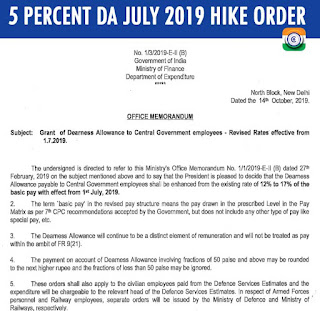
5 Percent DA July 2019 Hike Order - Grant of Dearness Allowance to Central Government employees

Grant of Dearness Allowance to Central Government employees 5 Percent DA July 2019 Hike Order  No. 1/3/2019-E- II (B) Government of...

Blog Archive

About The Author