A complete reference blog for Indian Government Employees

Showing posts with label 7th CPC Charter of Demands. Show all posts

Tuesday, 10 September 2019

Pending demands of Central Government Employees - One day Hunger Strike on 14.10.2019

Pending demands of Central Government Employees - One day Hunger Strike on 14.10.2019

BPMS

Bharatiya Pratiraksha Mazdoor Sangh
(AN ALL INDIA FEDERATION OF DEFENCE WORKERS)
(AN INDUSTRIAL UNIT OF B.M.S.)
(RECOGNISED BY MINISTRY OF DEFENCE, GOVT. OF INDIA)

REF: BPMS/ Cir/18th TC/ 17
Dated: 04.09.2019
To,
The Office Bearers & CEC Members
Bharatiya Pratiraksha Mazdoor Sangh
&
The General Secretaries/ Presidents
Unions affiliated to this federation

Subject: One day Hunger Strike on 14.10.2019 at Atal Samadhi (Sadaiv Atal), Delhi.

Dear Brothers and Sisters,

Sadar Namaskar,

I hope all of you are quite well and busy in accelerating trade union activities to uplift the organization. It is for your kind information that Government Employees National Confederation has decided to conduct one day Hunger Strike on 14.10.2019 from 10:30 hrs to 15:30 hrs at Atal Samadhi (Sadaiv Atal), Near Rajghat, Delhi for various burning issues/ pending demands of Government employees like-
  • Eradication of unemployment and filling of vacant posts through permanent employees in various offices/ establishments of Central/ States/ Autonomous Bodies
  • Corruption free Government Departments
  • No efforts should be made regarding corporatization of establishments of Defence/ Railway/ Postal or any other Government Department
  • Restoration of Old Pension Scheme/ Removal of New Pension Scheme Extension of slab for Nil income tax liability upto 8 lakh
  • Calculation limit of Bonus should be extended upto 18000 based on recommendation of 7th CPC on Minimum Pay
  • Total abolition of Contract Worker System/ Outsourcing System for job of permanent nature in all Govt Departments
  • All Allowance should be paid as per 7th CPC recommendations from 01.01.2016
  • All employees of State Govt/ Autonomous Bodies should be granted Pay Structure of Central Government, wherever it is less beneficial to the Pay Structure of Central Government etc.
All the unions are requested to mark its presence by at least 5 members so that the hunger strike may be made successful.

With regards,
Brotherly Yours
(Mukesh Singh)
General Secretary
Source: Central Government Employees News

Share:

Wednesday, 26 October 2016

7th CPC Minimum Pay and Fitment Formula: Gist of Meeting held on 25.10.2016 about Allowances, 7th CPC to Autonomous Bodies, GDS Bonus and other issues


7th CPC Minimum Pay and Fitment Formula: Gist of Meeting held on 25.10.2016 about Allowances, 7th CPC to Autonomous Bodies, GDS Bonus and other issues

CONFEDERATION OF CENTRAL GOVT. EMPLOYEES & WORKERS
1st Floor, North Avenue PO Building, new Delhi - 110001

CIRCULAR DATED 26TH OCTOBER 2016

REVISION OF MINIMUM PAY AND FITMENT FORMULA
2ND MEETING OF THE GROUP OF SENIOR OFFICERS WITH JCM (NC) STAFF SIDE

DISAPPOINTING

2nd Meetings of the Group of Senior Officers (Constituted as per the assurance given by Group of Minister to NJCA) to discuss the grievances arising out of recommendations related to 7th Central Pay Commission, was held with JCM (NC) staff side on 24.10.2016 at 4 PM. The staff side explained in detail the justification for modification in the minimum pay and fitment formula, which was already explained in the memorandum submitted to Cabinet Secretary on 10th December 2015 and also in the presentation made before Joint Secretary Implementation Cell and Empowered Committee of Secretaries headed by Cabinet Secretary.

From the response of the Senior Officers, it is not clear whether they are mandated to submit a proposal on increasing the Minimum Pay and Fitment formula to Government, as assured by the Group of Ministers on 30th June 2016. Eventhough, the time frame of four months is almost over, the urgency and seriousness was lacking on the part of the Group of officers. It seems that that Government is adopting a delaying tactics or to deny the assured increase. Perhaps, they may recommend an increase in minimum pay and fitment formula at a later date, but it is quite uncertain.

Confederation National Secretariat after reviewing these developments has decided to intensify the campaign and agitational programmes demanding the Government to honour its assurance given to NJCA leadership and also to settle the 20 point charter of demands. Make the 7th November 2016 mass dharna programme a grand success. Ensure maximum participation of employees in the 15th December 2016 massive Parliament March. Get ready for strike.

ALLOWANCE COMMITTEE MEETING ON DOP&T SPECIFIC ALLOWANCES
Meeting of the Allowance Committee to discuss the DOP&T Specific allowances was held on 25.10.2016. Secretary, Department of Personnel Chaired the meeting. Important allowances like Children Education Allowance, Night Duty Allowance, Overtime Allowance, Cash Handling Allowance, Dress Allowance, Nursing Allowance, Patient Care Allowance, Family planning Allowance, Risk Allowance etc. are discussed. The Secretary, Department of Personnel gave a patient hearing and interacted with staff side on certain points. No commitment on any allowance was given.


JCM NATIONAL COUNCIL : STANDING COMMITTEE MEETING
The JCM (NC) Standing Committee meeting under the Chairmanship of Secretary, Department of Personnel was held on 25.10.2016. All agenda items were discussed. Some of the items are - JCM functioning, Compassionate appointments, amendment to the definition of anomaly, Changing MACP conditions, Ex-Servicemen pay fixation, Pay fixation option on promotion after the date of notification of CCS (RP) Rules 2016, GDS bonus enhancement to 7000/-, casual labour regularization and bonus enhancement, filling up of vacancies, upgradation of LDCs to UDCs, one time relaxation of LTC-80 availed by air by purchasing tickets from other than authorized agents, Restoration of Festival Advance, Natural Calamity Advance and Advance of leave salary, grant of entry pay recommended by 6th CPC to the promotes, reimbursement of actual medical expenditure incurred by the employees in a recognised hospital etc.

Secretary, Department of Personnel gave a patient hearing and clarified certain points. No final decision was taken on any of the agenda items. Gist published below. Minutes will be published later. It was informed that based on the discussion, each item will be examined further and decision will be taken.


AUTONOMOUS BODIES : EXTENSION OF 7TH CPC REVISED PAY STRUCTURE AND PENSIONARY BENEFITS
The issue was raised in the JCM Standing Committee meeting held on 25.10.2016 by the staff side. The official side informed that an overall review regarding the performance and financial viability etc. of each Autonomous body is being carried out by the Government. Only after completing the process decision regarding extension of 7th CPC revised pay structure and pensionary benefits, Bonus etc. will be taken. Extension of the benefits depends upon the policy decision of the Government. Hence the official side has not told any time frame for final decision. It is likely to be delayed.

Confederation has already included the demands of the employees of the autonomous bodies in its 20 point charter of demands. All Unions/Associations/Federation and employees of all autonomous bodies are requested to understand the gravity of the situation and make the 7th November 2016 mass dharna programme and 15th December 2016 Parliament March a grand success. Join the Parliament March with your flags, banners and placard with demands. Let the Government understand the discontentment and protest of employees and pensioners of Autonomous bodies. There is no short-cut to get our justified demand accepted by the Government.


GDS BONUS ENHANCEMENT TO 7000
This issue was discussed in the JCM Standing Committee meeting as a notified agenda. The official side informed that the file is still under process in the Finance Ministry and a decision is yet to be taken. Once the approval of the Finance Ministry is given the proposal is to be submitted to Cabinet for approval.
All affiliates and C-O-Cs are once again requested to extend full support and solidarity to the proposed Postal Strike on 9th & 10th November 2016, demanding bonus calculation ceiling limit enhancement to 7000/- for GDS and immediate payment of revised wages to casual labourers from 01.01.2006. Conduct solidarity demonstration in front of important Postal/RMS office on 9th & 10th November 2016.

GIST OF THE JCM STANDING COMMITTEE MEETING HELD ON 25.10.2016

Meeting was held under the chairmanship of Secretary, Department of Personnel. Items discussed and outcome is given below.

1. JCM FUNCTIONING
Decision: After discussion Secretary (P), assured that the JCM would be activated and steps may be taken to hold regular meetings of JCM at National and Departmental level.

2. COMPASSIONATE APPOINTMENT:
Decision: The demand of the staff side to remove 5% ceiling would be considered after studying the various. Supreme Court Judgments and the decisions of previous National Council JCM meetings.

3. RESTORATION OF INTEREST FREE ADVANCES WITHDRAWN BY THE GOVERNMENT BASED ON 7TH CPC RECOMMENDATIONS
Decision: The demand of the staff side to restore Festival advance, Natural Calamity advance and leave salary advance will be examined further.

4. AMENDMENT TO THE DEFINITION OF THE TERM “ANOMALY”
Decision: The proposal given by the staff side would be considered is consultation with Department of Expenditure.

5. FIXATION OF PAY OF RE-EMPLOYED EX-SERVICEMEN
Decision: The anomalies in the fixation of pay of re-employed Ex-Servicemen is under consideration of DOP&T.

6. OPTION FOR THOSE TO BE PROMOTED AFTER 25.07.2016, I.E. AFTER THE NOTIFICATION OF CS (REVISED PAY) RULES 2016.

Decision: This issue would be considered by the Implementation Cell of 7th CPC.

7. WITHDRAWL OF NEW CONDITIONS FOR THE GRANT OF MACP
Decision: The demand of the Staff Side for withdrawl of “Very Good” grading would be re-examined. Some more items related to Ministry of Defence was also discussed.

8. BONUS CEILING TO BE RAISED TO 7000 FOR GRAMIN DAK SEVAK EMPLOYEES OF POSTAL DEPARTMENT
Decision: Revision of Bonus ceiling for GDS and Casual Labourers would be considered by Department of Expenditure.

9. REGULARISATION OF CASUAL LABOURERS
Decision: The proposal of the staff side for regularization of all casual labourers would be considered after considering various Supreme Court judgements.

10. FILLING UP OF EXISTING VACANT POSTS
Decision: Since there is no ban on recruitment, vacancies can be filled up. Instructions in this regard will be issued once again.

11. UPGRADATION OF THE POSTS OF LOWER DIVISION CLERKS TO UPPER DIVISION CLERKS
Decision: The demand of the staff side would be considered in consultation with other Ministries.

12. GRANT OF ONE TIME RELAXATION TO THE CENTRAL GOVERNMENT EMPLOYEES WHO HAVE AVAILED LTC-80 AND TRAVELLED BY AIR BY PURCHASING TICKETS FROM OTHER THAN AUTHORIZED AGENCIES
Decision: The proposal of Ministry of Defence in this regard is under examination of DOP&T

13. GRANT OF ENTRY PAY RECOMMENDED BY 6TH CPC TO THE PROMOTEES UNDER THE PROVISION OF CCS (RP) RULES 2008
Decision: - The Judgment of Chennai CAT and Principal Bench New Delhi would be examined by DOP&T and Department of Expenditure.

14. REIMBURSEMENT OF ACTUAL MEDICAL EXPENDITURE INCURRED BY THE EMPLOYEES IN A RECOGNIZED HOSPITAL
Decision:  A separate meeting would be held by the Health Ministry with the staff side to discuss this demand.
Fraternally yours,
(M. Krishnan)
Secretary General
Mob: 09447068125
E-mail: mkrishnan6854@gmail.com
Source: Confederationhq blog
Share:

Friday, 16 September 2016

7th Pay Commission: NCJCM staff side gives it views on allowances to Govt. of India and committee on allowances NC JCM

7th Pay Commission: NCJCM staff side gives it views on allowances to Govt. of India and committee on allowances NC JCM

Shiva Gopal Mishra
Secretary
National Concil (Staff Side)
Joint Consultative Machinery
for Central Government Employees
13-C, Ferozshah Road, New Delhi-110001
No.NC/JCM/2016(Allowances)

Dated: September 12, 2016
The Secretary(Expenditure),
Ministry of Finance,
(Government of India),
North Block,
New Delhi-110 001

Dear Sir,

This is in continuation of the discussions, the Staff Side had with you on 1st September, 2016. We send herewith brief notes on the allowances, which are required to be retained or wherever the quantum has to be enhanced.

As presented before the Committee, we have dealt with the subject in the following manner:-
(i) General Allowances, which are of general nature, covering the Central Government employees across the Departments.(10)
(ii) Area Specific Allowances  The allowances which are granted to all Central Government employees who are posted to a particular location.(2)
(iii) Department Specific Allowances which are granted to a section of the employees in a Department/Ministry taking into account the special nature of jobs assigned to them. (4)
We have received the notes from the Postal, Defence and Railway Organisations. We have requested the Associations/Federations of other departments to send us the notes in the matter. We hope to receive the same soon. As and when the same is received, it will be submitted.

We have endorsed a copy of this letter to the Joint Secretary(Implementation Cell). We have also asked the Departmental Associations to submit their notes on the Department Specific Allowances to the Implementation Cell as also to their Heads of Departments. We request you to kindly convene the meeting of the Committee to discuss the allowances on which Notes are presented to you through this letter.

Comradely yours
(Shiva Gopal Mishra)
Secretary (Staff Side)
NC/JCM
&
Convener
Source:  ncjcmstaffside.com
Share:

7th Pay Commission: NCJCM staff side gives it views on allowances to Govt. of India and committee on allowances NC JCM

7th Pay Commission: NCJCM staff side gives it views on allowances to Govt. of India and committee on allowances NC JCM

Shiva Gopal Mishra
Secretary
National Concil (Staff Side)
Joint Consultative Machinery
for Central Government Employees
13-C, Ferozshah Road, New Delhi-110001
No.NC/JCM/2016(Allowances)

Dated: September 12, 2016
The Secretary(Expenditure),
Ministry of Finance,
(Government of India),
North Block,
New Delhi-110 001

Dear Sir,

This is in continuation of the discussions, the Staff Side had with you on 1st September, 2016. We send herewith brief notes on the allowances, which are required to be retained or wherever the quantum has to be enhanced.

As presented before the Committee, we have dealt with the subject in the following manner:-
(i) General Allowances, which are of general nature, covering the Central Government employees across the Departments.(10)
(ii) Area Specific Allowances  The allowances which are granted to all Central Government employees who are posted to a particular location.(2)
(iii) Department Specific Allowances which are granted to a section of the employees in a Department/Ministry taking into account the special nature of jobs assigned to them. (4)
We have received the notes from the Postal, Defence and Railway Organisations. We have requested the Associations/Federations of other departments to send us the notes in the matter. We hope to receive the same soon. As and when the same is received, it will be submitted.

We have endorsed a copy of this letter to the Joint Secretary(Implementation Cell). We have also asked the Departmental Associations to submit their notes on the Department Specific Allowances to the Implementation Cell as also to their Heads of Departments. We request you to kindly convene the meeting of the Committee to discuss the allowances on which Notes are presented to you through this letter.

Comradely yours
(Shiva Gopal Mishra)
Secretary (Staff Side)
NC/JCM
&
Convener
Source:  ncjcmstaffside.com
Share:

Saturday, 1 August 2015

Railway Minister seeks higher pay scale from 7th CPC for railway officers

Railway Minister seeks higher pay scale from 7th CPC for railway officers

Suresh Prabhu seeks higher pay scale for railway top brass

NEW DELHI: Seeking higher salary for top brass of the national transporter, Railway Minister Suresh Prabhu has written to Chairman of the Seventh Pay Commission, recommending elevation of senior most officials of railways at par with IAS cadres in terms of status and rank.

Minister has written to 7th Pay Commission for higher pay scale for the posts of Chairman Railway Board (CRB), Members of Railway Board and General Managers (GM) of zonal railways, a senior Railway Ministry official involved with the development said today.

Though it is a an old demand from Railway Board to make the GM’s post equal to that of a state’s chief secretary and the CRB’s pay scale same as that of the Cabinet Secretary but getting the Railway Minister to recommend for it has made the case stronger, the officer said.

The CRB and Members the Railway Board, who belong to various cadres like the Railway Mechanical/Electrical/ Traffic/Engineering Services and the Indian Audits and Accounts Service, are currently ranked equivalent to a secretary to the government of India.

Besides the CRB, the Railway Board as the top most body of the public transporter includes six Members including the Financial Commissioner, Member Traffic, Member Mechanical, Member Engineering, Member Electrical and Member Staff.

Director Generals of Railway Health Services and Railway Protection Force are also considered to be part of the top railway bureaucracy.

If the 7th Pay Commission headed by justice Ashok Kumar Mathur accepts the recommendation, then the CRB will get the rank of the Chief of Army, who enjoy near-parity with the Cabinet Secretary, the country’s top most IAS officer.

At present, CRB is an ex-officio Principal Secretary to the government, his pay scale is equal to that of any other departmental secretary and the other six members of the Railway Board who have the rank of ex-officio secretary to the Government of India.

Prabhu has also recommended for GMs, railway zonal chiefs to be elevated to the rank of chief secretaries of the States.

Read at Economic Times
Share:

Monday, 13 July 2015

Restoration of the erstwhile Group-D posts and regularization of the services of Contract/Casual Employees

Restoration of the erstwhile Group-D posts and regularization of the services of Contract/Casual Employees
Shiva Gopal Mishra
Secretary
Ph: 23382286
National Council (Staff Side)
Joint Consultative Machinery
for Central Government Employees
13-C, Ferozshah Road, New Delhi – 110001
E Mail: nc.jcm.np@gmail.com
No.NC/JCM/7th CPC/2015 Dated: July 6, 2015
7th Central Pay Commission,
Chatrapathi Shivaji Bhawan,
Qutup Institutional Area,
New Delhi

Dear Madam,
Sub: Restoration of the erstwhile Group-D posts and regularization of the services of Contract/Casual Employees

Introduction

During the course of oral evidence of the Staff Side of the National Council(JCM), with the 7th CPC, while discussing on Chapter 17, para No.17.1, 17.4.2 to 17.5.5 of the memorandum submitted by the Staff Side of the National Council(JCM), the Staff Side stated that a large number of contract/casual, contingent and daily rated workers are deployed in various Central Govt. Establishments including Railways, Defence, postal, Income Tax and Accounts & Audit etc. especially in the jobs performed by the erstwhile Group-D Employees such as Chowkidar, Safaiwalas, Peons, Mali, Washerman etc. The Chairman of the 7th CPC after listening to the views put forth by the Staff Side in this regard has desired that the Staff Side may give their views in writing for restoration of the erstwhile Group-D posts in Central Govt. Establishments. Accordingly the following note is submitted for the favourable consideration of the 7th CPC

Background

Till the beginning of the 1980’s the nature of duties like sweeping, gardening, Watch Ward, Peon, Orderly, Messenger, Duftry etc., were performed by permanent Group-D Employees. However, after imposition of ban on recruitment from 1984 onwards, many Government Department, as mentioned above, stopped recruitment in the above mentioned posts and have started outsourcing all these jobs, resulting in large scale scam and corruption and also exploitation of labour. It is reliably learnt that more than 35% contract/casual workers are employed in all the Central Govt. Departments. The 6th CPC after considering the fact that the above mentioned Group- D posts also require certain amount of skill recommended for upgradation of all Group-D posts to Group-C by upgrading the pay scales. Acco~dingly these employees after suitable training were re-designated as Multi Tasking Staff (MTS). The 6th CPC further recommended that recruitment in the erstwhile Group-D posts will be from amongst Candidates possessing minimum qualification of either 10th pass or ITI certificates.

Although the pay scales of erstwhile Group-D employees were upgraded, the recommendation relating to multi tasking could not be given effect in letter and spirit in many of the Central Govt. Departments due to
practical problems and functional difficulties in view of the fact that the job profile of all the erstwhile Group-D categories has not only been distinctly different from each other, but majority of the posts have full time jobs leaving very little scope for carryout multi tasks.

Employment opportunities for School dropouts

Prior to implementation of recommendation of 6th CPC, the educational qualification required for most of the erstwhile Group-D posts with 8th Std. passed or less qualification as the job profile of these posts did not demand high standards of education. The maximum education qualification for the erstwhile Group-D posts was prescribed at 8th Std. passed in keeping with the aims and principles of inclusive growth and economic empowerment of poor and the downtrodden who are unable to afford higher education due to socio economic reasons and conditions. Recently the Skill Development Ministry has taken a decision to impart training for the school dropouts, so as to make them eligible for employment opportunities.

Proposal of Staff Side

In view of the facts mentioned above the Staff Side propose the following for the consideration of the 7th CPC:-
(i) Minimum qualification for all the posts shall be 8th standard pass or less and that persons possessing educational qualification beyond 10th Std. may be debarred from seeking employment in all the above posts.
(ii) All the outsourced workers at present employed in various erstwhile Group-D posts either through contractors or through the system of outsourcing, Casual/daily rated workers may be absorbed against the existing vacancies subject to possessing the educational qualification or by imparting them in-house training. This will go a long way in curbing corruption and also exploitation of the poor contract and casual workers.
We hope that the 7th CPC may consider our proposals in its true perspective.
Yours faithfully,
(Shiva Gopal Mishra)
Secretary(Staff Side)
NC/JCM
Copy to: All Constituents of JCM(Staff Side) – for information.
https://drive.google.com/file/d/0B0rqvSYMJv2IcGNLZFhHQjdsTWc/view?pli=1
Share:

Sunday, 10 May 2015

7th Pay Commission: CPWD engineers want pay, rank parity with IAS

7th Pay Commission: CPWD engineers want pay, rank parity with IAS: The Indian Express – By Shalini Narayan

They demanded that Group ‘A’ engineers be treated at par, in terms of pay scale and career progression, with IAS officers.

Representatives of the Central Public Works Department’s (CPWD) Central Engineering Service Group ‘A’ association, on Thursday, approached the Seventh Central Pay Commission.

They demanded that Group ‘A’ engineers be treated at par, in terms of pay scale and career progression, with IAS officers.

The association has also demanded that they be given an additional 25 per cent of their basic pay as “non-practicing allowance”.

It has also asked that engineers be imparted at least a two-year international training exposure, just as it is done for IAS officers.

Representatives of the Indian Telecom Services and the Central Power Engineering Services too made their submissions before the commission.

In a written submission, the association says, “The engineering fraternity has been denied their due importance in government jobs… The career progression of engineers joining the engineering services is very slow.”

It further stated, “Most of the members of the engineering services more often report to the officers of other services who are much junior in terms of year of joining. These officers recruited through engineering services also end up drawing lesser pay and perks as compared to their counter parts in civil services.”

Reportedly, the fifth pay commission had recommended that all organised group ‘A’ services — including those of the engineering services — should have a model cadre structure which should be achieved by carrying out the cadre reviews.

However, the letter states, “These recommendations were not implemented in the right spirit. It has taken 10 to 15 years to implement cadre reviews for engineering services. On the other hand, most of the civil services have cadre structure either on par or much above the model cadre structure.”

The association has demanded that promotional aspects should be made at par with the civil services, a strict batch parity be maintained in respect of promotions and director-general of CPWD be declared the ex-officio secretary to the Government of India, among others.

Read at: The Indian Express
Share:

7th Pay Commission: IPS, IRS want end to ‘IAS raj’ in secretary posts, seek pay hike

7th Pay Commission: IPS, IRS want end to ‘IAS raj’ in secretary posts, seek pay hike

IPS, IRS want end to ‘IAS raj’ in secretary posts, seek pay hike: The Times of India News by Pradeep Thakur

NEW DELHI: Officers of the police and revenue services have petitioned the 7th Pay Commission seeking scrapping of the Centre’s empanelment process for appointments to the posts of secretary, additional secretary and joint secretary.

The Indian Revenue Service (IRS) association has demanded scrapping of the empanelment process which is dominated by the IAS and sought higher pay. The IPS association has quoted statistics to demonstrate how other services have always been discriminated both in pay and positions compared to the ‘elite’ Indian Administrative Service (IAS).

About 75% of the joint secretaries, 85% of the additional secretaries and 90% of the secretaries are from IAS. The proportion of IAS dramatically increases from 10-12% at the level of directors to 75% at the JS level, a presentation from the IPS association says.

The 7th Pay Commission was constituted in February 2014 and is expected to give its report by October this year. Its recommendation will guide how the salary and various allowances of central staff will be revised besides improving their service condition.

“Strong entry barriers have been erected for other services, with 5-10 years gap in empanelment to prevent them from reaching JS level,” the IPS officers have pleaded before the pay commission, saying this is causing frustration among the forces that is leading country’s fight against terror and left-wing terrorism.

Out of 20 joint secretaries in the home ministry, only one is from the IPS and the department of internal security is not even headed by an IPS. “The system over a period of time created the ruling class who occupy JS and above posts and the working class which are compelled to remain at directors’ level and below,” the presentation says.

The IRS officers have asked the pay panel to consider giving them more pay over the IAS as they are “performing the most important sovereign function of revenue collection.” The two-year edge being enjoyed by the IAS should be reconsidered in the present context when they are no longer handling revenue collection for central government, the IRS presentation says.

The IRS officers have also questioned the two-year edge enjoyed by the Indian Foreign Service, seeking the pay panel to reconsider this “in the light of service conditions particularly whether any hardships are faced by them.”

A change in the composition of the civil services board, committee of secretaries and the special committee of secretaries has been sought with representation of members of other cadres.
“A rule should be made which prevents no two persons belonging to a single service to be appointed as members of these three bodies,” the IRS officers have demanded to bring in the required change in the central staffing scheme.

The IPS officers have claimed that the present system of batch-wise empanelment for senior posts is causing huge discrimination. Merit and right man for the right post is not the norm followed for selection, they said, demanding transparency in empanelment.

Read at: The Times of India
Share:

Monday, 9 February 2015

7th Central Pay Commission: The Services should ensure a better deal for the Short Service Commission Scheme

The 7th Central Pay Commission: The Services should ensure a better deal for the Short Service Commission Scheme – Article by Maj Navdeep Singh on IndianMilitaryInfo.in
Now that the issues tagged with the 7th Central Pay Commission are gaining momentum, it is very important to again bring to light the matters related to the scheme of Short Service Commission, which arguably is being thought of as the backbone of the officer cadre of the defence services for the future.
A few years ago, the Short Service Commission Scheme of the Army was regressively tweaked from the earlier 5+5+4 system to the 10+4 system making service of 10 years compulsory in the Army for such officers. This was ostensibly done to make the scheme more ‘attractive’, but ironically, this is the greatest disservice that could ever be rendered and has had just the opposite effect. The reasons why I say so can be fathomed from this old post of mine:

A. There is no seniority protection in the civil services for former SS officers anymore, which means that an ex-SSCO starts his/her civil career alongwith civil direct recruits 10 years younger to him/her and atleast two ranks junior to his/her former status in the Army.

B. If joining the corporate world, the ex-SS officer again starts at a point of the ladder where he/she competes with youngsters who already have had a head-start which the former SS officer missed out due to his/her joining the Army.

C. Ex-Servicemen benefits are entitled only on completion of terms of engagement which means that the said benefits which were earlier available after 5 years, are now available after serving for 10.

D. 10% of appointments at Assistant Commandant (Lieutenant equivalent) level in the CAPFs are reserved for SSCOs. There is no protection of seniority. Hence, ex-SSCOs of Major and Lt Col level are expected to join at Lieut level (GP 5400) in the CAPFs which makes the entire reservation redundant.

E. After completing 10 years of service, an SSCO is in his/her 30s and to expect him/her to then look around for a fruitful career, in my opinion, is otiose.

It may be important to point out that in the civil services, in accordance with Rule 49 (2) (b) of the Central Civil Services (Pension) Rules, 1972, civil employees become eligible for pension after serving the govt for 10 years, whereas our SSCOs are released without a pension and are only granted a gratuity even after serving 14 years. After the 6th CPC, civil employees are now entitled to full pension after serving 10 years under the ibid rule (it was 33 years for full pension prior to 6th CPC). Of course the 10 year rule on the civil side only applies to those who are released or retired after completing 10 years and not to voluntary retirees.
On learning that the defence services had made no recommendation of a proper pension scheme for SSCOs to the 7th CPC, I had duly pointed out its very pertinent requirement if we were to ensure retention of talent in this very important cadre of the defence services.

In short, the top brass of the Ministry of Defence and also the defence services, without being unduly guided by personal opinions of their staff, must take a holistic view and address the following issues to retain talent in the Short Service Commission and to maintain the izzat and sheen of the military rank in the civil society in general:
(1) Reverting back to the system of 5+5+4 years terms of engagement rather than the 10+4 years which leaves our officers neither here nor there.

(2) Introduction of pension after 10 years for those who opt to continue beyond 5 years on the lines of Rule 49 (2)(b) on the civil side, or a suitable contributory pension scheme.

(3) Ensuring retention and protection of seniority and status in the civil services for SSCOs.
(4) Restoration of outpatient medical facilities to released SSCOs and ECOs whichwere illegally withdrawn by the Director General of Armed Forces Medical Services.
Though the above steps are not exhaustive, it is only now that putting our brains together could make any positive dent, otherwise, the matter would further be postponed for another 10 years to the next pay commission. The Services HQ should stand up and take a call!

Share:

Wednesday, 4 February 2015

Implement 7th Pay Commission report with effect from January 1, 2014: BSNL Pensioners Welfare Association

Implement 7th Pay Commission report with effect from January 1, 2014: BSNL Pensioners Welfare Association

The All India BSNL Pensioners Welfare Association urged the Centre to implement the Seventh Pay Commission report with effect from January 1, 2014.

A resolution to this effect was adopted at the 10th annual general body meeting of the Salem West district branch of the association held here recently. M. Amirthalingam, former DGM, BSNL, and president of the association, presided.

Another resolution demanded creation of a permanent Statutory Wage Board for revising the pay and pension periodically. The meeting also demanded the Government to restore commutation of pension after 12 years as already recommended.

The other resolutions include increasing fixed medical allowance from Rs.500 to Rs. 2,000 a month, extending the admissibility of C.C.S (M.A) Rules, 1944 to the Central Government pensioners not covered under CGHS as already recommended, sanctioning funeral grant of Rs.10,000 on the death of pensioner/family pensioner to the family; provision of 50 per cent of concession in all public transport system and creation of CGHS Hospitals in all district headquarters.

The association also demanded merger of 50 per cent IDA / CDA with basic pension immediately and scraping the New Pension Scheme and cover all employees under Old Pension and Family Pension Scheme.
M. Mani, General Manager, BSNL Salem, spoke.
Share:

Monday, 21 July 2014

Merger of DA & Interim Relief: Strong Argument before 7th CPC by Karnataka CG Pensioners Association

Merger of DA & Interim Relief: Strong Argument before 7th CPC by Karnataka CG Pensioners Association

The Karnataka Central Government Pensioners’ Association writes to 7th CPC on Merger of DA, Interim Relief, Re-employment as Consultant, Pensioner Grievances, Court cases pertaining to Pensionary benefits etc.:-
THE
KARNATAKA
CENTRAL GOVERNMENT PENSIONERS’ ASSOCIATION (REGD.)

( Estd: 1974; Regn. S.No.143/1983-84 d/ 9th August 1983 ) “Swarna”, 120/1,
2nd Main, Gayatri Devi Park Extension, Vyalikaval, Bangalore 56000
(Affliated to BPS New Delhi, AIFPA Chennai & KCCCGPAs Bangalore)
Email ID: cgpakarn@gmail.com Tel: 23468438

RNI Regn No: KRENG/2008/27233 Postal Regn No: KRNA/BGE/200/2012-14
President S SRamanatha Rao
Tel: 2661 9394
Vice-President S SKargudri
Tel:
25837178
Secretary Ashok S Kololgi
Tel:
9448469351
Treasurer K S Menon
Tel: 9743771933
Respected Chairman and Members of the 7th CPC –
At the outset, I wish the Commission easy going in its work and hope the Commission comes out with useful recommendations. Presumably, the recommendations apply to the members or some of the members of the Commission too.
Wherever we go and whenever we approach officers for certain help or concessions, as pensioners’ associations; in majority of the cases, the reply has been that they (the presently serving officers) too retire at some time, and that they would like to help out. But help does remain afar. The Ministry of Personnel & Pensions has been doing a great deal to liberalise the situation; but they have their handicaps, as the duty-departments remain lethargic. Not much can be done in this domain, perhaps.
The Point
Several pensioners’ associations/pensioners have written to the Commission on the pensioners’ interests and requirements – I refrain from calling them as ‘demands’ as this is the lot of the beggars. The two imminent issues for favourable consideration by the Commission, nay, the Government are: the Grant of Interim Relief, and the Merger of 50% of DA/DR with pay/pension, both retrospectively.

Both these requirements in principle have been acceded to in the past by the past Pay Commissions as well as the Government; and hence there should be no qualms at all in recommending/granting the two Requirements, in the interest of social justice, whether the Government has specifically made provision for this or not in the Terms of Reference.

(To recall, the Terms of Reference to the Commission by the Government stated clearly “(Item) (h) To recommend the date of effect of its recommendations on all the above. The Commission will make its recommendations within 18 months of the date of its constitution. It may consider, if necessary, sending interim reports on any of the matters as and when the recommendations are finalised. The decision will result in the benefit of improved pay and allowances as well as rationalization of the pay structure in case of Central Government employees and other employees included in the scope of the 7th Central Pay Commission.”

About a year back, the Tamil Nadu Government, while constituting its Pay Commission, granted two months’ pay as Interim Relief. One of the Central Pay Commissions in the past announced two instalments of Interim Relief. This explains the need for Interim Relief. As such, the two Appeals should be sanctioned without much time being wasted, as there are many pensioners in advanced age-rangewho desire to have this benefit.

The other point
I write this from experience. Over the last 50 (fifty) years,there has been a high and steady rise in the number of posts created in several departments of the Government, particularly so in the Class I senior-cadre, who belong to the All-India Services, in contrast to the number of creation of posts in the junior cadres. There is rise in the volume of work admittedly; but not as much as to have a high number of senior officers. Earlier, the Departments functioned with Section Officer (who managed office), Deputy Secretary (who initiated notings), Joint Secretary(who gave opinions) and Secretary (who took decisions), in the higher rank; and they did well in dealing with papers and in deciding the issues. The file-notings used to be clear, committed, fast and final.

In the past few decades, the ranks of Additional Secretary, Special Secretary and Consultants have crept into the Govt service, with more number of Joint Secretaries. It is my contention that these posts are superfluous and their salary/allowance bills are a dent on the Exchequer. More routine tasks are done after consultations over phone. Too many officers and too much time in dealing with disposal of papers – has been the practice in the Government. I therefore strongly opine that the number of such Class I officers in all the Departments of the Government, including the Ministries, must be drastically brought down. The work will be faster, and the responsibility for decisions is fixed on limited number of officers. The Hon’ble Prime Minister has shown the way. He has cut down on the number of Ministries.

There is a whisper that thirty percent of the retired officers are re-employed in their respective departments/offices after retirement, as Consultants or other-wise, continuing to do the same job! This is something difficult to be gulped. Perhaps, this should be examined and checked. The Dept of Personnel & Training in the Ministry of Personnel may help to know the facts. The Commission may kindly take a decision.

The third
Heading the Karnataka Central Government Pensioners’Association, Bangalore, during the last 12-15 years, the Assn has recently projected many Grievances of the pensioners/members with us; and none of them has been conclusively solved. Various Ministries have come up with Grievances cells; and these have become show-cases or postoffices, with just forwarding the complaints to some nodal officers, who remain unhelpful. The Ministry of Personnel and Pensions contemplated on time-frame for redressal of such grievances; but this has been a far cry. The mechanism to get Redressal to the home of the aggrieved pensioners must therefore be fast and satisfactory. It must be remembered that the pensioners are aged, and they need results quick. A good debate on this is required within the Government, and a result-orientation infused into these Grievances cells/portals.
The fourth point
In the last few years, it is experienced that the pensioners have been forced to go to different Courts in respect of their dues and needs. These mainly refer to fixation of pension, fixation of cut-off dates and implementation of Court verdicts by the Governments. This is a situation that the pensioners cannot happily face. A good lot of time and money is wasted. The Government must rationalise and liberalise its attitude, when the learned Judges of the Court have given their verdicts after due hearings from both the parties involved. Can the Commission say something on this point, please?

Grateful Regards to a Great Commission.
n S SRamanathaRao,
n President,
n Karnataka CGPA.
Bangalore,
D/ July 18, 2014.

Source: http://scm-bps.blogspot.in/2014/07/presiden-karnataka-central-government.html
Share:

Sunday, 5 January 2014

7th CPC Pay Scale – Minimum wage & Pay fixation forumala for 7th CPC worked out by COC Karnataka

7th CPC Pay Scale – Minimum wage & Pay fixation forumala for 7th CPC worked out by COC Karnataka

Minimum wage & Pay fixation formula for 7th CPC worked out

Providing proper minimum wage of Rs 27000/- for CG Employees including that of GDS employees and pay fixation formula for 7th CPC worked out .

Providing proper minimum wage of Rs 27000/- for CG Employees including that of GDS employees and pay fixation formula:

The staff side of the JCM had given representation demanding Rs 10,000/- as minimum wage for Central Government Employees. The 6th CPC in its report vide para no 2.2.15 had calculated a minimum wage of Rs 5478/- today if we are calculate the minimum wage it should be more than Rs 21,000/- apart from HRA and other allowances. Hence there is three times increase in actual prices calculated by the 6th CPC and the current prices. The current wages of the CG Employees should be doubled at least including that of GDS.

The most comprehensive criteria for covering all the basic needs were evolved by the 15th Indian Labour Conference (ILC) in 1957 for fixing minimum wages. The norms are that a need-based minimum wage for a single worker should cover all the needs of a worker’s family consisting of a spouse and two children.

The food requirement was to be 2,700 calories, 65 grams of protein and around 45-60 grams of fat as recommended by Dr Wallace Aykroyd for an average Indian adult of moderate activity. Dr Aykroyd pointed out that  animal proteins, such as milk, eggs, fish, liver and meat, are biologically more efficient than vegetable proteins and suggested that they should form at least one-fifth of the total protein.

Dr Aykroyd worked on nutrition for nearly 30 years and was director of the Nutrition Division, Food and Agriculture Organisation, United Nations. In 1935, he was appointed Director of the Government’s Nutritional Research Centre in India, situated in Coonoor in the south. The 15th ILC further resolved that clothing requirements should be based on per capita consumption of 18 yards per annum, which gives 72 yards per annum for the average worker’s family. For housing, the rent corresponding to the minimum area provided under the government’s industrial housing schemes was to be taken. Fuel, lighting and other items of expenditure were to constitute an additional 20% of the total minimum wage.

The Supreme Court upheld these criteria in the case of Unichoy vs State of Kerala in 1961. In the later Raptakos Brett Vs Workmen case of 1991, the SC went one step further, and held that besides the five components enunciated by the 15th ILC, minimum wages should include a sixth component, amounting to 25% of the total minimum wage, to cover children’s education, medical treatment, recreation, festivals and ceremonies. The SC also observed that a wage structure including the above six components would be “nothing more than minimum wage at subsistence level” which the workers must get “at all times and under all circumstances”.

Minimum Salary-Analysis &Recommendations para 2.2.15

The Commission, however, agrees that the norms set by the 15th International Labour Conference (ILC) are appropriate for computing minimum salary. It is also observed that the minimum salary is applicable at the time a person joins the Government which will usually be at a young age when a person may be just married and will not have responsibility of parents or many children. Accordingly, the family unit for minimum salary can only be taken as three.

The Minimum Salary should be based on 6 units not three units as per 6th CPC calculation. As both parents and two children are depending on the salary of Government servant apart from spouse. the additional burden the employees will carry after a few years of service as his parents would have retired from service and are wholly dependent on him also his children would have stepped into school / college level, even small baby requirements are much unlike in the past years, the hence the minimum wage he gets will not compensate with the family financial burden Hence the whole calculations needs a undergo a drastic change in next CPC taking into account of 6 units rather than 3 units.

The Sixth Central Pay Commission has recommended a minimum wage of Rs 6600/- per month against the demand of Rs 10,000/- per month as worked out by Staff side of JCM. Today the minimum need based wage works out to Rs 21,000/ per month+ HRA+ allowances. The general minimum expenses per month for a family of four members are as follows when a Government servant joins the duty with two small children:

a) Vegetables Rs 3000/-
b) Food Grains /Groceries Rs 7000/-.
c) House rent single room Rs 6000/-
d) Clothing Rs 3000/-
e) Children education and their expenses Rs 2000/-
f) Electricity Chargers Rs 800/-
g) Water Charges Rs 250/-
h) Transportation charges Rs 1000/-
i) TV cable rent Rs 300/-
j) Medical Expenses Rs 500/-
k) Mobile expenses Rs 250/-
l) Cooking Gas Rs 450/-
m) Recreation charges Rs 500/-
n) Personal expenses Rs 1000/-

Total Rs 26500/-Hence minimum wage works out to Rs 27,000/-

 The expenses will increase as the age of Government servant goes up and family responsibility will increase as he has to educate the children in professional courses, marriage of his children has to be performed, his medical expenses will increase, his parents will stay with him and now there are quite dependant on the Government servant for their lively hood. As such the salary should be more to meet his expenses. The Government is a model employer hence the wages should be provided with the needs.

Table: Fixation of Minimum wage as on 1.1.2006 as per 15 ILC norms as per Table 2.2.1 of the 6th compare minimum wage should be three times the 6th recommendations.

ItemsPer day PCU (In grams)Per month 3CU (In kg)Price per kg. taken by 6th CPC (In Rs)Total cost as per rates of 6th CPC (in Rs) As on 1/1/2006Price per kg. as per prevailing market rates (in Rs) 1/6/13 At BangaloreTotal cost as per prevailing rates (in Rs) 1/6/2013
Rice/wheat47542.7518769.5552351
Dal (Toor/ Urad / moong807.24028880576
Raw Veg.1009.00109060600
Greenleaf Veg12511.2510112.540400
Other Veg.756.751067.545450
Fruits12010.803032480864
Milk200 Ml18 Lt.24.0043235630
Sugar and Jaggery565.0024.0012045225
Edible Oil403.650180100360
Fish 2.5120300180450
Meat 5.001206003751875
Egg 900218004360
Detergents etc 200 200400400
Clothing 5.5 Mt.80/Mt4402001100
Total   4103.5 10641
Misc. @ 20%*   827 2660
Total   4930.5 13301
Addl. Exp @ 25%**   400 3325
Total   5330.5 16626
Housing @ 10%***   148 600^
Grand Total   5478.5 17226

Source: Average market rates in Kolkata, Chennai, Delhi and Mumbai as indicated in the Economic Times & Other major dailies (element of 20% has been added to cover the increase in cost in retail sale).

Notes PCU = Per day Consumption Unit 3CU = Three Consumption Units that is wife, husband and a child no parents or second child is taken into account.

* 20% Miscellaneous charges towards fuel, electricity, water etc.

** Additional Expense at the rate of 25% includes expenditure towards education, Medical treatment, housing, recreation, festivals etc.

# Has been taken as Rs.400 because separate allowances for education, medical Treatment and housing exist in the Government. Consequently, only the expenditure

Towards recreation & festivals need to be taken in account.
^ Being the license fee chargeable for government accommodation at an average rate of 3% of the basic pay.

Total minimum wage is Rs 17225+ HRA Rs 7000/- + Transportation Allowance Rs 2500/-= Rs 26725 that is Rs 27,000/-.

The fixation of minimum basic pay of Rs 21000/- is taking into the account of minimum skill and education requirement as 10th Standard as prescribed by the 6th CPC. As the education requirement is more such as Diploma in Engineering or Degree in Science or Commerce, then the minimum basic pay should be Rs 40,000/- (8700+4200) X 3 = Rs 39,000/-. For Engineering Graduates and Master Degree it should be Rs 65,000/- .
The pay scales should start with a minimum basic pay including Grade Pay of Rs 21,000/- to end with 2, 10,000 with a ratio of 1:10 of minimum scale and maximum scale. Since government is a model employer they should provide minimum wages as per the 15 ILO conference and other wages as per the educational qualification & skill requirement of the job.

The multiplying factor is calculated as below:
The existing basic pay + Grade pay + DA 100% + weightage of 100% ( that is the difference between the actual price rise and the DA paid) that is the multiplying factor works out to three.

Note: The actual price rise is over 200% the DA is only 90%.
Or

The existing basic pay + grade pay+ DA 100%+DA merger = Net wage + weightage of 70% (that is the difference between the actual price rise and the DA paid).

The pay scales should have a multiplying factor of three, that means the existing pay scales and pay (basic pay + GP) should be multiplied by three. The pay scales arrived should not have any bunching of basic pay as done in the 5th CPC. The time scales should last for more than 10 years so that there is no stagnation.

The concept of fair wages has been deprived to CG Employees. Usually pay commissions had adopted a multiplying factor of 3.2 to 3.8 to arrive at the new scales compared to earlier scales. But the VI CPC adopted conversion factor of about 2.6 at the lowest where as it was about 3.6 at the highest scale. By this method well established ration 1:12 between the lowest scale and highest scale was disturbed by the VI CPC.

The minimum pay & band pay fixed by the 6th compared all other pay commissions for example a new recruit for the post of LDC his pay is Rs 5200+ 1900 = Rs 7100/- + allowances, that should have been actually Rs 3050 multiplied by 3.6 times which works out to Rs 11000/- .

In case of a Graduate or Diploma holder as per 6th + 4200= Rs 13500/- + allowances, that should have been actually Rs 5000 multiplied by 3.6 times which works out to Rs 18000/- .

In case of a Master degree holder as per 6th 4800= Rs 14100/- + allowances, that should have been actually Rs 6500 multiplied by 3.6 times which works out to Rs 23000/- .

Hence the justification of multiplying factor of three is justified.  The ratio between the lowest and highest scales should not more than 1:10

III PAY COMMISSION VS IV PAY COMMISSION GROUP D,C and B

IV CPC PAY SCALES VS V CPC PAY SCALES

Comparison of pay scales of the 4th CPC , 5th CPC and 6th CPC

SIXTH CPC PAY STRUCTURE & PAY STRUCTURE FOR NEXT (VII) PAY COMMISSION DEMANDED

The existing basic pay should be multiplied by factor three, so that there is no bunching of basic pay. The existing GP of Rs 2000/- and Rs 2800/- should be removed. Likewise there are GP of Rs 5400/- in both PB-2 and PB-3 one of them is to be removed.

There are 34 scales recommended by the 6th Pay has been not in existence, as such 30 GP are right now available.

With the merger of pay scale from S9 to S12 into Grade Pay of Rs 4200/-.

There are many pay scales which was merged into single GP of Rs 4200/- which has created anomalies, the promotions have been made in same grade pay without financial benefits.

There should be time scale rather than grade pay system, these time scales should long enough.

Source: http://karnatakacoc.blogspot.in/
Share:

Featured post

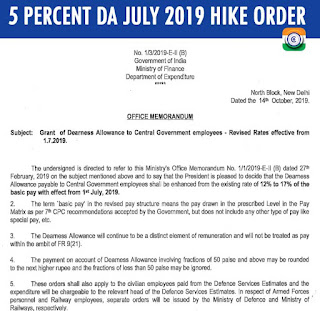
5 Percent DA July 2019 Hike Order - Grant of Dearness Allowance to Central Government employees

Grant of Dearness Allowance to Central Government employees 5 Percent DA July 2019 Hike Order  No. 1/3/2019-E- II (B) Government of...

Blog Archive

About The Author