A complete reference blog for Indian Government Employees

Tuesday, 17 September 2019

51st anniversary of the historic strike conducted by Central Government Employees - Confederation

51st anniversary of the historic strike conducted by Central Government Employees - Confederation

51st year of 1968 September 19th strike

M.Krishnan
Secretary General, Confederation of Central Govt. Employees & Workers

2019 September 19th is the 51st Anniversary of 1968 September 19th one day strike. All leaders and workers who led and participated in that historic strike have either retired from service or are no more.

The indefinite strike of Central Govt. Employees in1960 was the first major strike of Central Govt. Employees after independence. The five days strike from 1960 July 11 midnight was brutally suppressed by the Central Government declaring it as “Civil Rebellion”. The main demand of the strike was improvement and modifications in the 2nd CPC recommendations. The Need Based Minimum Wage, though adopted by the 15th Indian Labour Conference in 1957, was rejected by the 2nd CPC.

Also read: 53rd anniversary of ‘Glorious Strike’ of the Central Government Employees

The Joint Consultative Machinery (JCM) was constituted in 1966 by then Home Minister Guljarilal Nanda, as per the decision of the Government. The apprehension of the progressive leadership that this negotiating machinery may not settle any major demands of the Central Govt. employees and may become just a talking shop or a time killing business, ultimately resulting in abnormally delaying the genuine demands, came true within a year of its formation. In the very first meeting of the National Council JCM, the following three demands were notified by the staff side.
  1. Grant of Need Based Minimum Wage as approved by the 1957 Tripartite Labour Conference.
  2. Merger of DA with Pay
  3. Revision of DA formula
After prolonged discussion for about one and a half year, disagreement was recorded. As per JCM Scheme once disagreement is recorded, the item should be referred to compulsory arbitration. But Govt. rejected the demand for arbitration. Protesting against this arbitrary stand of the Govt. the staff side leadership walked out of the JCM and decided to go for one day’s strike. A Joint Action Committee was formed and the date of the strike was decided as 19th September 1968. Even though, the INTUC affiliated organisations were initially a part of the strike decision, later on they decided not to join the strike due to the intervention of the then Congress Government headed by Smt. Indira Gandhi.

The following were the main demands of the strike charter of demands.
  1. Need Based Minimum Wage.
  2. Full neutralisation of rise in prices.
  3. Merger of DA with Basic Pay
  4. Withdrawal of proposal to retire employees with 50 years of age or on completion of 25 years of service.
  5. Vacate victimisation and reinstate victimised workers.
  6. No retrenchment without equivalent alternative jobs.
  7. Abolition of Contract and Casual Labour System.
Also check: Long pending demands of the Central Government employees – CHARTER OF DEMANDS OF CONFEDERATION

Strike notice was served and the Joint Action Council (JAC) decided to commence the strike at 06:00 AM on 19th September 1968. Intensive campaign was conducted throughout the country. AIRF, AIDEF and Confederation was the major organisations in the JAC. Govt. invoked Essential Services Maintenance Ordinance (ESMO) to deal with the strike. Govt. also issued detailed instructions to impose heavy penalty including suspension, dismissal, termination, Break-in-service etc. on the striking employees. Para-military force (CRPF) and Police were deployed to deal with the strike. Central Govt. gave orders to all state Governments to suppress the strike at any cost. It was a war-like situation. Arrest of Leaders started on 18th September itself. About 3000 employees and leaders were arrested from Delhi alone. All over India about 12000 Central Government employees and leaders were arrested and jailed.

Inspite of all these brutal repressive measures the strike commenced on 18th after noon itself at many places and was a thundering success all over India and in all departments including Railway, Defence, P&T etc. About 64000 employees were served with termination notices, thousands removed from service and about 40000 employees suspended. Seventeen (17) striking employees had been brutally killed at Pathankot, Bikaner, Delhi Indraprastha Bhavan and in Upper Assam lathi charge, firing by police and military and by running the train over the bodies of employees who picketed the trains.

Though the strike was only for one day on 19th September 1968, the victimisation and repression continued for days together. Struggle against victimisation also continued including work-to-rule agitation, hunger fast of leaders from 10th October 1968. There was unprecedented support to the strike and relief work and also to agitation for reinstatement of the victimized workers, from National Trade Unions, state employees and teachers Unions / Federations etc. A mass rally was organised before the residence of Prime Minister of India Smt. Indira Gandhi on 17th October, 1968.

Kerala was ruled by the Communist Govt. during the strike. Chief Minister Com. E.M.S.

Namboodiripad declared Kerala Govt’s full support to the strike of Central Government employees. The Central Govt. threatened dismissal of the Kerala Govt. for defying the Centre’s directive to suppress the strike.

1968 September 19th strike is written in red letters in the history of Indian Working Class. The demand raised by the Central Govt. employees - Need Based Minimum Wage - was the demand of entire working people of India. Even today, the Central Govt. employees and other section of the working class are on struggle path for realization of the Need Based Minimum Wage. The demand of the Central Govt. employees to modify the recommendations of the 7th Central Pay Commission to ensure Need Based Minimum Wage is not yet conceded by the BJP-led NDA Government. Even the assurance given by three Cabinet Ministers including Home Minister, Finance Minister and Railway Minister regarding increase in Minimum Pay and Fitment formula is not honoured by the Govt. even after a lapse of three years and entire Central Government employees feel cheated.

It is in this background, last year we have celebrated the 50th year of 1968 September 19th strike all over the country in a befitting manner. On the 51st anniversary of the historic strike, let us pledge that we shall continue our struggle for realization of the demands raised by the martyrs of the 1968 strike. Let us pay respectful homage to those valiant fighters who sacrificed their life for the posterity. Let us salute and honour all those who participated in the historic strike, especially those who had been victimized severely for joining the strike.

central-government-employes-strike-confederation


Source: confederationhq
Share:

Monday, 16 September 2019

Grant of Transport Allowance @Rs.7000/-p.m. + DA thereon to the IRMS officers drawing Grade Pay of Rs.10,000/- under DACP Scheme

 IRMS - Indian Railway Medical Service

Grant of Transport Allowance @Rs.7000/-p.m. + DA thereon to the IRMS officers drawing Grade Pay of Rs.10,000/- under DACP Scheme

GOVERNMENT OF INDIA
MINISTRY OF RAILWAYS
(Railway Board)
S.No.PC-VI/ 397
No. PC-V/2010/A/TA/1

RBE No.138/2019
New Delhi, dated 21-08-2019

The General Manager/CAO(R)
All Zonal Railways & PUs
(As per mailing list)


Grant of Transport Allowance @Rs.7000/-p.m. + DA thereon to the IRMS officers drawing Grade Pay of Rs.10,000/- under DACP Scheme.

Also check: Regarding Payment of Conveyance Allowance to IRMS Doctors

Attention is invited to Board’s letter of even number dated 25-08-2015 whereby Railways were advised to keep in abeyance the payment of Transport Allowance @ Rs.7000/-p.m. + DA thereon to IRMS officers drawing Grade Pay of Rs.10,000/- under DACP Scheme. Subsequently, as per the interim order dated 27-10-2015 of Hon’ble CAT/New Delhi in O.A No.3528/2015, Railways were advised vide this office letter of even number dated 06-11-2015 that the payment of Transport Allowance to IRMS officers @Rs.7000/-p.m. + DA thereon, be continued till further orders.

2. The Hon’ble CAT/ New Delhi vide order dated 28-05-2019 has now disposed of the said O.A No. 3528/2015 has observed as under :-

    "The OA is, therefore, disposed of directing the respondents to take a final decision regarding extension or otherwise of the Transport Allowance at the rate of Rs: 7000/- per month plus DA, to the members of the applicant Association, within a period of three months from the receipt of this order. However, the amount already paid towards the said allowance shall not be recovered, and the respondents shall not be under an obligation to pay the said allowance until a final decision is taken. There shall be no orders as to costs."

3. The matter has been accordingly considered by the competent authority and in view of fact that IRMS officers drawing Grade Pay of Rs.10,000/- (now pay level -14) under DACPS except those who are holding pinpointed administrative SAG posts mentioned in Board’s letter No.2009/H/16/1DACP dated 26-02-2009, are not entitled for use of official car in terms of Board’s letter No.E(G)95AL4-9, dated 06-11-1995, it has been decided that such officer shall not be eligible to opt for higher rate of Transport Allowance @Rs.7000/- p.m.+DA thereon (which now stands revised to Rs.15750/- p.m.+DA thereon based on the recommendations of the 7th CPC). These officers are entitled for Transport Allowance @Rs.7200/3600 + D.A thereon as per row- 2 of Board’s letter of even number dated 3-8-2017.

Check this: Designations of doctors belonging to IRMS and Dental Doctors under the Ministry of Railways on posting to clinical posts

4. This issues with the concurrence of Finance Directorate of Railway Board.

5. Hindi version will follow.

Subhankar Dutta
Dy. Director, Pay Comission-5
Railway Board
Source: Indian Railways

Share:

HBA - Central Government employees have a low-interest house construction advance

House Building Advance (HBA)

Central Government employees have a low-interest house construction advance
Finance Minister Nirmala Sitharaman said the lowering of interest rates will encourage more government employees to buy new houses as they were “a major contributor” to the overall demand.
Also Read: 7th Pay Commission House Building Advance

New Measures to Boost Housing Sector

Relaxation of ECB guidelines for Affordable housing
  • ECB guidelines will be relaxed to facilitate financing for home buyers who are eligible under the PMAY, in consultation with RBI.
  • This is in addition to the existing norms for ECB for affordable housing.
House Building Advance
  • The interest rate on House Building Advance shall be lowered and linked with the 10 Year G Sec Yields.
  • Government servants contribute to a major component of demand for houses. This will encourage more government servants to buy new houses
Also Check: Clarifications regarding House Building Advance - HBA

house-building-advance-central-government-employees


Share:

Revised Pattern for promotion to Postal Services (PS) Group B cadre - Limited Departmental Competitive Examination

LDCE

Revised Pattern for promotion to Postal Services (PS) Group B cadre

No. 9-04/2018-SPG -II
Government of India
Ministry of Communications
Department of Posts
(Personnel Division)
Dak Bhawan, Sansad Marg,
New Delhi - 110 001.
Dated : 5 Sep, 2019.
To
All Chief Postmasters General
Sub : Revision of syllabus for promotion to PS Group 'B' cadre - Regarding.

Sir/Madam,
I am directed to say that the syllabus for Limited Departmental Competitive Examination (LDCE) for promotion to Postal Services Group 'B' cadre has been revised with the approval of the Competent Authority and the same is enclosed herewith.

The date for holding the Examination will be communicated separately by the DE Branch from time to time.

Yours faithfully,
Encl : as above.
(Vinayak Mishra)
Assistant Director General (SPG)

Also check: Grant of benefit of pay fixation at time of promotion to Inspector posts

Revised syllabus for promotion to PS Group 'B' cadre.

Paper - I
Acts
1) Consumer Protection Act, 1986
2) Prevention of Money Laundering Act, 2002

Inland/ Foreign Post
1) Indian Post Office Rules, 1933
2) Post Office Guide Part I
3) Post Office Guide Part II
4) Domestic/ Foreign Post guidelines issued by Directorate
5) Book of BO Rules

Mail Operations -
1) Postal Manual Volume V
2) Guidelines issued by Directorate from time to time on Mail Network optimization Project I PNOP I Business Development

Money Remittance -
Guidelines issued by Directorate on eMO, iMO, IMTS and IFS MO

Saving Bank Scheme and Certificates
 1) Post Office Saving Bank General Rules, 1981.
2) Post Office Saving Account Rules, 1981
3) National Savings Recurring Deposit Rules, 1981.
4) National Savings Time Deposit rules, 1981.
5) National Savings MIS Rules, 1987.
6) National Savings Certificates Rules, 1960.
7) Senior Citizen Savings Scheme Rules, 2004.
8) National Savings Certificates (VIII Issue), 1989
9) Kisan Vikas Patra Rules, 2014
10) Public Provident Fund Scheme, 1968 ll) Sukanya Samridhi Yojana Rules, 2014
12) Post Office Saving Bank Manual Volume I & II
13) SB orders issued by Directorate from 01.01.2007 onwards.
14) Guidelines issued by Directorate from time to time on Core Banking Services
15) Post Office Saving Bank (CBS) Manual

Postal Life Insurance and Rural PLI -

Check this: Promotion and Posting Orders – Merit List of AAO LDCE 2018

1) Post Office Life Insurance Rules, 2011
2) Guidelines issued by Directorate from time to time on PLI/ RPLI and Core Insurance solution

Organization of the Department -
1) Postal Manual Volume II (Chapter - I- organization),
2) Citizen Charter of Department of Posts.
3) Guidelines and instructions on complaint grievances handling in Department of Posts.

Guidelines issued by Directorate from time to time on IT modernization Project of Department of Posts
  1. Handbook on Philately
  2. Directorate instructions on Philately
Office Procedure -
1) Postal Manual Volume II - Chapter XI -Misc. Rules
2) Manual of Office Procedure
3) Annual Reoorts and Book of Information of D/o Posts

Material Management -
1) Postal Manual Volume II - Chapter VI (Stock), VIII(Printing), IX(Contracts), XII (Budget Estimates and control)
2) Chapter 6 of General Financial Rules,2017
3) CVC guidelines on Public procurement, guide-lines and instructions on e­ procurement.
4) Manual on policies and procedure for purchase of goods and services available on website of Ministry of Finance.

Establishment and Administrative matters -
1) Postal Manual Volume IV.
2) Instructions issued by Directorate and DoP&T on maintenance of APAR.
3) Schedule of Financial Powers of Divisional Heads, Head of the Circle, etc.
4) Welfare measures available to Departmental Employees and Gramin Dak Sevak of DoP.
5) DoP&T instructions issued from time to time on Establishment and administration.
6) Brochure on reservation, instructions regarding sports person reservation, compassionate appointment guidelines issued by DoP and DoP&T from time to time.
7) Recruitment Rules relating to various cadres in D/o Posts
8) Establishment Norms

Current Affairs 15 questions for 30 marks
Noting and Drafting for 25 marks each

Paper - II

Subjects
  1. Central Civil Services (Conduct) Rules, 1964
  2. Central Civil Services (Classification, Control and Appeal) Rules, 1965
  3. Postal Manual Volume III
  4. Central Civil Services (Temporary Service Rules), 1965
  5. Brochure on Casual labourer
  6. Central Civil Services (Pension) Rules, 1972
  7. New Pension Scheme, 2004
  8. Central Civil Services (Commutation of Pension) Rules, 1981
  9. Central Civil Services (Leave) Rules, 1972
  10. Central Civil Services (Joining Time) Rules, 1979
  11. General Provident Fund (Central Service) Rules, 1960
  12. Central Services (Medical Attendance) Rules, 1944
  13. Fundamental and Supplementary Rules
  14. Central Civil Services (Leave Travel Concession) Rules, 1988
  15. Central Civil Services (Revised Pay) Rules, 2016
  16. Postal Financial Handbook Volume I and II
  17. General Financial Rules 20 17 other than public procurement
  18. Rules relating to Children Education allowance and reimbursement of Hostel Subsidy
  19. Central Government Employees Group Insurance Scheme, 1980
  20. Gramin Dak Sevak (Conduct and Engagement) Rules, 2011.
  21. Central Administrative Tribunal Act, 1985 and its Rules
  22. Right to Information Act 2005 and RTI Rules 2012
  23. Sexual Harassment of Women at Workplace (Prevention, Prohibition and Redressal) Act, 2013
  24. Public Accountants Default Act, 1850
  25. Revenue Recovery Act, 1890
  26. Prevention of corruption Act, 1890
  27. Central Civil Services (Recognition of Service Association) Rules, 1993
  28. Goods and Services Tax (GST) Act, 2017
  29. Postal Manual Volume II Chapter III -Appeals and Petitions,
    Chapter IV - Personal matters,
    Chapter V - Security Deposits ,
    Chapter VII - Forged counterfeit stamps and defaced postage stamps, coins and currency notes
  30. Interface with India Post Payment Bank
  31. Preservation and Disposal of Postal Records
  32. Swatchh Bharat
  33. Inspection questionnaires.
  34. CSI Operating Manuals
Note : In both the papers, circular/ order/ guidelines/ Rules issued upto 31st December of the year preceding the year of examination will be part of the syllabus except the Annual Report and Book of Information for which latest report and information available in India Post Website will be taken for the purpose.

Revised Pattern for the promotion to PS Group "B" cadre


S. No. Heading Revised Pattern
  1. Marks Each paper will carry 300 marks
  2. Duration Duration for each paper is 3 hours
  3. No. of Questions 125 Questions of MCQ type in Paper I and Noting & Drafting for 25 marks each. 150 Questions of MCQ type in Paper II.
  4. Qualifying Marks 40% marks in each paper subject to an overall average of 45% for General category and 33% marks in each paper subject to overall average of 38% for SC/ST categories.
  5. Whether books allowed or not Both the papers of the examination will be conducted without books.
Source: Dept of Posts
Share:

Sunday, 15 September 2019

How to download of Arrear calculation sheet for pensioners

How to download of Arrear calculation sheet for pensioners

Pension seva SBI (state bank of India)

SBI has launch a website, where pensioners drawing pension from SBI can check their pension-related details instantly. One can view the pension payment details from the first pension onwards as well as other details.

Check this: 7th CPC DA Arrears Ready Reckoner Tables for Level-7

What are the services available in pension seva SBI
SBI Pension Seva is a website where pensioners of SBI can login and check their pension related details instantly.

The services available on pension seva sbi website include:
  • Download of Arrear calculation sheets
  • Download of Pensionslip/ Form 16
  • Pension Profile Details
  • Investment related details
  • Life Certificate status
  • Transactions Details
Also read: 7th CPC DA Arrears Ready Reckoner Tables for Level-13A
  • Senior Citizen Savings Scheme (SCSS)
  • EPPO provision for Defence/ Railway/ CPAO/ Rajasthan pensioners
Extended Benefits to Pensioners
  • SMS alert on mobile phone with pension payment details.
  • Pension slip through email/pension paying branch.
  • Facility to submit life certificate at any branch of State Bank of India.
  • Jeevan Pramaan facility available at branches.
  • Senior Citizen Savings Scheme (SCSS)
  • EPPO provision for Defence/ Railway/ CPAO/ Rajasthan pensioners
Share:

WB 6th PC implementation - Revised Pay Structure from January 2020

WB 6th PC implementation - Revised Pay Structure from January 2020

West Bengal 6th Pay Commission implementation - Revised Pay Structure from January 2020


On 13th September 2019, the State Chief Minister Mamta Banerjee stated in Kolkata that the Pay Panel Committee submitted its first report to the Government and the recommendations of the report will accept, she added.

The minimum basic pay may be raised to Rs.17.990 from the existing of level of Rs. 7000.
As per the recommendations of the Pay Commission report, the minimum gross salary will be more than Rs. 20,000 and the Gratuity ceiling will be increased to 10 lakh.


The Pay Commission also recommended to Dearness allowance merge with basic pay with new pay bands.

About then thousand crore rupees will be spent additionally from State exchequer for implementing all the recommendations of 6th pay commission including new pay structure to West Bengal Government Employees.

Share:

Thursday, 12 September 2019

National Pension Scheme for Traders and Self Employed Persons

NPS

Ministry of Labour & Employment
Prime Minister launches National Pension Scheme for Traders and Self Employed Persons
12 SEP 2019

The Prime Minister of India, Shri Narendra Modi launched at Ranchi today, the National Pension Scheme for Traders and Self Employed Persons, a pension scheme for the Vyaparis (shopkeepers /retail traders and self-employed persons) with annual turnover not exceeding Rs 1.5 crore. The Governor of Jharkhand Smt. Draupadi Murmu, Chief Minister of Jharkhand Shri Raghubar Das, Minister of Tribal Affairs Shri Arjun Munda, Minister of State for Labour & Employment (I/C) Shri Santosh Kumar Gangwar and other dignitaries were also present on the occasion. With this nation-wide launch, the facility for enrollment under the scheme has been made available to the prospective beneficiaries through 3.50 lakh Common Service Center (CSCs) across the country. In addition people can also self-enroll by visiting the portal maandhan.in/vyapari. The eligible Vyaparis can visit their nearest CSCs and get enrolled under the scheme. At the time of enrollment, the beneficiary is required to have an Aadhaar card and a saving bank/ Jan-dhan Account passbook only. He/ She should be within 18 to 40 years of age group. GSTIN is required only for those with turnover above Rs. 40 lakhs. The enrolment under the scheme is free of cost for the beneficiaries. The enrolment is based upon self- certification.

Government has approved National Pension Scheme for Traders and Self Employed Persons in acknowledgement of notable contribution of Vyaparis (shopkeepers/ retail traders and self-employed persons). It is a voluntary and contributory pension scheme for entry age of 18 to 40 years with a provision for minimum assured pension of Rs 3,000/- monthly on attaining the age of 60 years. The beneficiary should not be income tax payer and also not a member of EPFO/ ESIC/ NPS (Govt.)/ PM-SYM. The Central Government shall give 50 % share of the monthly contribution and remaining 50% contribution shall be made by the beneficiary. The monthly contribution is kept low to make it affordable. For example, a beneficiary is required to contribute as little as Rs.100/- per month at a median entry age of 29 years.

This pension scheme is one of the top priorities of Prime Minister Narendra Modi’s Government in its second term. According to the Ministry’s 100-day plan, this scheme will target enrolling 25 lakh subscribers in 2019-20 and 2 crore subscribers by 2023-2024. An estimated 3 crore Vyaparis in the country are expected to be benefited under the pension scheme.

PIB
Share:

Featured post

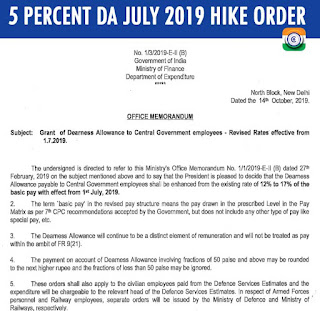
5 Percent DA July 2019 Hike Order - Grant of Dearness Allowance to Central Government employees

Grant of Dearness Allowance to Central Government employees 5 Percent DA July 2019 Hike Order  No. 1/3/2019-E- II (B) Government of...

Blog Archive

About The Author