A complete reference blog for Indian Government Employees

Showing posts with label Banks. Show all posts

Tuesday, 15 May 2018

E-Pension Payment Order: New Step in the Right Direction


Ministry of Defence
E-Pension Payment Order: New Step in the Right Direction
14 MAY 2018
Furthering the Digital India-initiatives of Govt. of India, Principal Controller of Defence Accounts(Pensions), Allahabad has startedissuance of electronic-Pension Payment Orders (e-PPOs) to the pensioners along with their Pension Disbursement Agencies viz., Banks, Defence Pension Disbursement Offices, Post Offices, etc. What began in the first phase, for all Commissioned Officers and JCOs/ORs of Armed Forces from the month of October 2017, has now been extended to all defence pensioners including defence civilians.
E-Pension Payment Order


Principal Controller of Defence Accounts (Pensions), Allahabad is the sole agency under Ministry of Defence which sanctions Pensions for the Defence Services viz., Army, Coast Guard, Defence Research and Development Organization,General Reserve Engineer Force, Border Roads Organization, Military Engineering Services and other Defence organisations including Defence Account Department and Defence Civilians.

The shift from manual system to e-PPO system is expected to minimize delays in pension disbursement and further revision as and when needed. This initiative also eliminates the occurrence of human errors in data entry at multiple levels.

PIB
Share:

Friday, 1 September 2017

Cabinet approves equivalence of posts in Central Public Sector Undertakings (PSUs), Banks, Insurance Institutions with Posts in Government so that the children of those serving in lower categories in PSUs and other institutions can get the benefit of OBC reservations


Cabinet approves equivalence of posts in Central Public Sector Undertakings (PSUs), Banks, Insurance Institutions with Posts in Government so that the children of those serving in lower categories in PSUs and other institutions can get the benefit of OBC reservations 

The Union Cabinet chaired by Prime Minister Shri Narendra Modi has given its approval to the norms for establishing equivalence of posts in Government and posts in PSUs, PSBs etc. for claiming benefit of OBC reservations. This addresses an issue pending for nearly 24 years. This will ensure that the children of those serving in lower categories in PSUs and other institutions can get the benefit of OBC reservations, on par with children of people serving in lower categories in Government. This will also prevent children of those in senior positions in such institutions, who, owing to absence of equivalence of posts, may have been treated as non Creamy Layer by virtue of wrong interpretation of income standards from cornering government posts reserved for OBCs and denying the genuine non creamy layer candidates a level playing field.

The Union Cabinet also approved the increase in the present income criterion of Rs. 6 lakh per annum for applying the Creamy Layer restriction throughout the country, for excluding Socially Advanced Persons/Sections (Creamy Layer) from the purview of reservation of Other Backward Classes (OBCs). The new income criterion will be Rs. 8 lakh per annum. The increase in the income limit to exclude the Creamy Layer is in keeping with the increase in the Consumer Price Index and will enable more persons to take advantage of reservation benefits extended to OBCs in government services and admission to central educational institutions.

These measures are a part of the Government's efforts to ensure greater social justice and inclusion for members of the Other Backward Classes. The Government has already introduced in Parliament, a bill to provide Constitutional status to the National Commission for Backward Classes. It has also decided to set up a Commission, under section 340 of the Constitution, to sub categorize the OBCs, so that the more backward among the OBC communities can also access the benefits of reservation for educational institutions and government jobs. All these decisions, taken together, are expected to ensure greater representation of OBCs in educational institutions and jobs, while also ensuring that the more under-privileged within the category are not denied their chance of social mobility.

Background:
In its judgment dated 16.11.1992 in WP(C) 930/1990 (IndraSawhney case) the Supreme Court had directed the Government to specify the basis, for exclusion of socially and economically advanced persons from Other Backward Classes by applying the relevant and requisite socio-economic criteria.
An Expert Committee was constituted in February 1993 which submitted its report on 10.03.1993 specifying the criteria for identification of socially advanced persons among OBCs i.e. the Creamy Layer. The report was accepted by the then Ministry of Welfare and forwarded to DoPT which issued an OM dated 08.09.1993 on exclusion from the Creamy Layer.

The OM of 08.09.1993 specifies six categories for identifying Creamy Layer (a) Constitutional/Statutory post (b) Group 'A' and Group 'B' Officers of Central and State Governments, employees of PSUs and Statutory bodies, universities, (c) Colonel and above in armed forces and equivalent in paramilitary forces (d) professionals like Doctors, Lawyers, Management Consultants, Engineers etc. (e) Property owners with agricultural holdings or vacant land and/or buildings and (f) income/wealth tax asessee.

The OM further stipulates that the said parameters would apply mutatis mutandis to officers holding equivalent or comparable posts in PSUs, Banks, Insurance Organizations, Universities, etc. and Government was required to determine equivalence of positions in these organizations with those in Government.
Pending the equivalence to the established in these institutions Income criteria would apply for the officers in these Institutions.

However, this exercise of determining the equivalence of posts in Government and posts in PSUs, PSBs etc. had not been initiated. The determination of equivalence of posts has been thus pending for almost 24 years.
The matter of formulating equivalence has since been examined in detail. In PSUs, all Executive level posts i.e. Board level executives and managerial level posts would be treated as equivalent to group 'A' posts in Government and will be considered Creamy Layer. Junior Management Grade Scale-1 and above of Public Sector Banks, Financial Institutions and Public Sector Insurance Corporations will be treated as equivalent to Group 'A' in the Government of India and considered as Creamy Layer. For Clerks and Peons in PSBs, FIs and PSICs, the Income Test as revised from time to time will be applicable. These are the broad guidelines and each individual Bank, PSU, Insurance Company would place the matter before their respective board to identify individual posts.

PIB
Share:

Wednesday, 30 August 2017

Cabinet approves equivalence of posts in Central Public Sector Undertakings (PSUs), Banks, Insurance Institutions with Posts in Government so that the children of those serving in lower categories in PSUs and other institutions can get the benefit of OBC reservations


Cabinet approves equivalence of posts in Central Public Sector Undertakings (PSUs), Banks, Insurance Institutions with Posts in Government so that the children of those serving in lower categories in PSUs and other institutions can get the benefit of OBC reservations 

The Union Cabinet chaired by Prime Minister Shri Narendra Modi has given its approval to the norms for establishing equivalence of posts in Government and posts in PSUs, PSBs etc. for claiming benefit of OBC reservations. This addresses an issue pending for nearly 24 years. This will ensure that the children of those serving in lower categories in PSUs and other institutions can get the benefit of OBC reservations, on par with children of people serving in lower categories in Government. This will also prevent children of those in senior positions in such institutions, who, owing to absence of equivalence of posts, may have been treated as non Creamy Layer by virtue of wrong interpretation of income standards from cornering government posts reserved for OBCs and denying the genuine non creamy layer candidates a level playing field.

The Union Cabinet also approved the increase in the present income criterion of Rs. 6 lakh per annum for applying the Creamy Layer restriction throughout the country, for excluding Socially Advanced Persons/Sections (Creamy Layer) from the purview of reservation of Other Backward Classes (OBCs). The new income criterion will be Rs. 8 lakh per annum. The increase in the income limit to exclude the Creamy Layer is in keeping with the increase in the Consumer Price Index and will enable more persons to take advantage of reservation benefits extended to OBCs in government services and admission to central educational institutions.

These measures are a part of the Government's efforts to ensure greater social justice and inclusion for members of the Other Backward Classes. The Government has already introduced in Parliament, a bill to provide Constitutional status to the National Commission for Backward Classes. It has also decided to set up a Commission, under section 340 of the Constitution, to sub categorize the OBCs, so that the more backward among the OBC communities can also access the benefits of reservation for educational institutions and government jobs. All these decisions, taken together, are expected to ensure greater representation of OBCs in educational institutions and jobs, while also ensuring that the more under-privileged within the category are not denied their chance of social mobility.

Background:
In its judgment dated 16.11.1992 in WP(C) 930/1990 (IndraSawhney case) the Supreme Court had directed the Government to specify the basis, for exclusion of socially and economically advanced persons from Other Backward Classes by applying the relevant and requisite socio-economic criteria.
An Expert Committee was constituted in February 1993 which submitted its report on 10.03.1993 specifying the criteria for identification of socially advanced persons among OBCs i.e. the Creamy Layer. The report was accepted by the then Ministry of Welfare and forwarded to DoPT which issued an OM dated 08.09.1993 on exclusion from the Creamy Layer.

The OM of 08.09.1993 specifies six categories for identifying Creamy Layer (a) Constitutional/Statutory post (b) Group 'A' and Group 'B' Officers of Central and State Governments, employees of PSUs and Statutory bodies, universities, (c) Colonel and above in armed forces and equivalent in paramilitary forces (d) professionals like Doctors, Lawyers, Management Consultants, Engineers etc. (e) Property owners with agricultural holdings or vacant land and/or buildings and (f) income/wealth tax asessee.

The OM further stipulates that the said parameters would apply mutatis mutandis to officers holding equivalent or comparable posts in PSUs, Banks, Insurance Organizations, Universities, etc. and Government was required to determine equivalence of positions in these organizations with those in Government.
Pending the equivalence to the established in these institutions Income criteria would apply for the officers in these Institutions.

However, this exercise of determining the equivalence of posts in Government and posts in PSUs, PSBs etc. had not been initiated. The determination of equivalence of posts has been thus pending for almost 24 years.
The matter of formulating equivalence has since been examined in detail. In PSUs, all Executive level posts i.e. Board level executives and managerial level posts would be treated as equivalent to group 'A' posts in Government and will be considered Creamy Layer. Junior Management Grade Scale-1 and above of Public Sector Banks, Financial Institutions and Public Sector Insurance Corporations will be treated as equivalent to Group 'A' in the Government of India and considered as Creamy Layer. For Clerks and Peons in PSBs, FIs and PSICs, the Income Test as revised from time to time will be applicable. These are the broad guidelines and each individual Bank, PSU, Insurance Company would place the matter before their respective board to identify individual posts.

PIB
Share:

Wednesday, 1 March 2017

Timely commencement of family pension in favour of spouse by banks in the event of death of the pensioners


Timely commencement of family pension in favour of spouse by banks in the event of death of the pensioners

Government Of India
Ministry Of Finance
Department of Expenditure
Central Pension Accounting Office
Trikoot-II, Bhikaji Cama Place
New Delhi : 110 066
Phones: 26174596,26174456,26174438
CPAO/IT&Tech/Bank Performance/2016-17/255

Office Memorandum

Subject: Timely commencement of family pension in favour of spouse by banks in the event of death of the pensioners.

Attention is invited to this Office OM No. CPAO/Tech/Banks Performance/2015­16/45 dated-02.06.2016[Sl. No. (i) a & (i) b] followed by minutes of the meeting dated­22.08.2016[Para II-(b)] on the above subject whereby Heads of all the CPPCs and Government Business Divisions of the Banks were advised to Commence the family pension to the spouse immediately on receipt of death certificate of the pensioner, proof of spouse age/date of birth and undertaking of recovery of excess payment latest within a month. However, analysis of reports prepared in CPAO regarding time taken in conversion of pension to family pension in favour of spouse of deceased pensioners shows inordinate delay in many cases. The details of these cases are available in CPPC logins on http://eppo.nic.in.

In view of the above, Heads of CPPCs and Government Business Divisions of the banks are advised to review the attached delay report and ensure compliance of the above instructions and submit the status report to CPAO along with reasons for delay by 8th March, 2017 positively by e-mail at vijay.17@gov.in

S/d,
(Subhash Chandra)
Controller of Accounts
Phone No. 26174809
Encl: As above
Central-Pension-Accounting-Office

Signed copy
Share:

Saturday, 4 February 2017

Indian Banks Association has issued Circular regarding Increase in DA for Bank Employees and officers from February 2017


Indian Banks' Association has issued Circular regarding Increase in DA for Bank Employees and officers from February 2017

Indian  Banks' Association
HR & Industrial Relations
No.CIR/HR&IR/76/D/2016-1711996
February 1, 2017
All Members  of the Association
(Designated  Officers)

Dear Sirs,
Dearness  Allowance  for Workmen and Officer Employees  in banks  for the months of February, March  & April  2017 under X BPS/ Joint Note dated 25.5.2015

The confirmed All India Average Consumer Price Index Numbers for Industrial Workers (Base1960= 100) for the quarter ended December 2016 are as follows:-

October 20166345.60
November 20166322.77
December 20166277.12

The average CPI of the above is 6315 and accordingly the number of DA slabs are 469(6315-4440= 1875/4= 469  Slabs) The last quarterly Payment of DA was at 478 Slabs.  Hence there is a decrease in DA slabs of 9, i.e 469 Slabs for payment of DA for the quarter February, March & April 2017.

In terms of clause 7 of the 101h  Bipartite Settlement dated 25.05.2015 and clause 3 of the Joint Note dated 25.05.2015, the rate of Dearness Allowance payable to workmen and officer employees for the months of February, March & April  2017 shall be 46.90  % of  'pay'. While arriving at dearness  allowance payable, decimals from third  place  may please  be ignored.

We advise banks to pay the difference between the old and revised salary and allowance to officers on an ad hoc basis, pending amendments to Officers' Service Regulations.
Yours faithfully,
K S Chauhan
Senior Vice President
Source : IBA
Share:

Saturday, 19 November 2016

Instruction to Banks for Advance Salary to Central Government Employees

Instruction to Banks for Advance Salary to Central Government Employees

Government of India
Department of Expenditure
Office of Controller General of Accounts
Mahalekha Niyantrak Bhawan
Block-E, G.P.O. Complex, I.N.A., New Delhi-110023
Ph:No.011-24665337-40/Fax No.011-24627678

No.S-11012/1(6)/Banks/2016-17/RBD/1815-47
Dated: 18.11.2016
To
Shri P.Vijaya Kumar,
Chief General Manager,
Reserve Bank of India
Department of Currency Management,
Central Office, 4th Floor, Amar Building,
Sr.P.M.Road, P.B.No.1379,
MUMBAI - 400001
FAX NO:022-22662442
Sir,
This is with reference to Ministry of Finance, Department of Expenditure OM No.25(30)/E.Coord/2016, dated 17th November 2016 regarding release of Part Salary in advance amounting to Rs.10000/- form the salary for the month of November 2016 in the form of Cash Pay-out to all Non Gazetted Employees of Central Government. Also refer your office letter dated 11.11.2016 which mentions that Government Departments may be allowed to draw cash beyond the stipulated limit of Rs.10,000/- in exceptional cases only on production of evidence justifying their cash requirements in writing.

Necessary instructions may please be issued immediately to all the banks in view of the Ministry of Finance OM dated 17.11.2016 referred above to enable Govt. offices to release advance salary as per above mentioned OM.
Yours faithfully,
sd/-
(Dr.Shakuntla)
Joint Controller General of Accounts
Click to view the order
Authority: www.finmin.nic.in
Share:

Friday, 18 November 2016

Banks to not exchange Rs. 2000 notes tomorrow, exception for senior citizens only

Banks to not exchange Rs. 2000 notes tomorrow, exception for senior citizens only

Mumbai: Keeping in view that all banks have been working on overdrive since the Centre announced demonetisation, the Indian Bank Association (IBA) on Friday announced that all banks across the nation will not exchange over the counter the new 2000 rupee notes on Saturday in order to update their pending works and tend to their respective customers.

Speaking to ANI here, IBA Chairman Rajeev Rishi stated that ever since demonetisation was announced, all banks have been working for extended hours including holidays to ensure the public at large was not inconvenienced.

“In fact, we have diverted all human resource to make sure that all those who stood in queues got their money exchanged, deposited and withdrawn. In the process what we have felt is that in the last one week our own customers have actually suffered. Routine works are not done and routine works are pending in banking activities,” he said.

However, senior citizens are exempted from the directive and banks will be accepting all their requests.

“We have taken a view that on Saturday, the banks shall not be doing exchange over the counter of 2000 rupees. We will make an exception for senior citizens. But tomorrow we will spend trying to update our works and do the works in relation to our own customers,” Rishi added.

Asserting that the time tomorrow will be used for meeting the needs of their own customers, the chairman further said that all banks will be observing their normal hours and will ensure their patrons get the full service and undivided attention in other matters.

ANI
Share:

Wednesday, 13 July 2016

Bank employees to observe one-day strike on July 29

Bank employees to observe one-day strike on July 29

Chennai: Public and private sector bank employees have decided to observe a day-long strike on July 29 to oppose the “anti-people” banking reform policies of the Centre, AIBEA said today.

The United Forum of Bank Unions (UFBU) consisting of nine trade unions across the country representing 10 lakh bank employees and officers would observe the strike.

They are pressing for various demands including not to privatise public sector banks and increase private capital in such banks, and also protesting against FDI in banking sector.

Besides, the unions oppose move to privatise regional rural banks, co-operative banks, consolidate and merging banks among others, All India Bank Employees Association (AIBEA) General Secretary C H Venkatachalam said in a statement.

The decision to go on strike was taken at the meeting here organised by UFBU.

PTI
Share:

Friday, 15 April 2016

All Banks asked to calculate 6% Dearness Relief for central government pensioners

All Banks asked to calculate 6% Dearness Relief for central government pensioners

All banks have been asked to calculate revised amount of pension following the recent six per cent hike in Dearness Relief (DR), the Centre has said.

The President is pleased to decide that the DR payable to central government pensioners and family pensioners shall be enhanced from the existing rate of 119 per cent to 125 per cent with effect from January 1, 2016,” an order issued by Ministry of Personnel, Public grievances and Pensions said.

“It will be the responsibility of the pension disbursing authorities, including the nationalised banks, etc. to calculate the quantum of DR payable in each individual case,” the order F.No.42/06/2016-P&PW(G) issued on Monday said.

There are about 58 lakh pensioners.

The Union Cabinet had on March 23, approved release of an additional instalment of Dearness Allowance (DA) to central government employees and DR to pensioners from this year onwards to compensate for price rise.

The combined impact on the exchequer on account of both DA and DR would be of Rs 6,796.50 crore per annum and Rs 7,929.24 crore respectively, in the financial year 2016-17 (for a period of 14 months from January, 2016 to February, 2017).

The offices of Accountant General and authorised pension disbursing banks are requested to arrange payment of relief to pensioners etc. on the basis of this instruction without waiting for any further orders from the Comptroller and Auditor General of India and the Reserve Bank of India, the order said.

PTI
Share:

Saturday, 14 November 2015

Use of modified format of Life Certificate by all banks

Use of modified format of Life Certificate by all banks

CENTRAL PENSION ACCOUNTING OFFICE
TRIKOOT-II, BHIKAJI CAMA PLACE,
NEW DELHI-110066
PHONES : 26174596, 26174456, 26174436
CPAO/IT&Tech/Jeevan Praman/2015-16/1680
dated 09.11.2015
Office Memorandum

Subject:- Use of modified format of Life Certificate by all banks

Attention is invited to this office OM No. CPAO/IT&Tech/Scheme Booklet/2015-16/1666 dated 16.10.2015 directing the banks to ensure that modified format of Life Certificate is used by all paying branches which also provides for acknowledgment to Pensioners. Vide Correction slip no. 24, dated 12.10.2015, the Life Certificate has been modified and circulated to all concerned. The updated format of Life Certificate has also been provided on CPAO’s website i.e. www.cpao.nic.in.

It has been noticed that some banks are still using their own or old format of Life Certificate which is not proper. Therefore, Heads of Government Accounts/Business Department/Head of CPPCs of all the banks are requested once again to issue urgent instructions to all their branches to use only modified format of Life Certificate prescribed by CPAO and provide acknowledgment to Pensioners.

This issues with the approval competent authority.
(Vijay Singh)
Sr. Accounts Officer (Tech)
Signed copy Click here
Share:

Sunday, 15 March 2015

Bank News: Over 3.70 lakh complaints against banks in 5 years

Bank News: Over 3.70 lakh complaints against banks in 5 years

New Delhi: Over 3.70 lakh complaints have been received by the banking ombudsman during last five years with highest number of complaints, 1.02 lakh, against State Bank of India, reveals an RTI response.

The data received shows that 3,70,543 complaints have been received by 15 banking ombudsman during 2009-10 to 2013-14.

During 2013-14, 76573 complaints have been received against Public Sector Banks, Private Banks and Foreign Banks operational in the country with maximum number of complaints, 21,206, against largest bank State Bank of India, it says.

Punjab and Sind bank recorded least number of complaints during the year in the Public Sector Banks category.

Among the foreign banks operational in the country Standard Chartered recorded highest number of 3357 complaints during the year while the least number of complaints were against BNP Paribas, State Bank of Mauritius and JP Morgan Chase Bank National Association with one complaint each, the response to Ramesh Sharma said.

In the Private Bank category, ICICI Bank recorded highest number of complaints during 2013-14 with 5325 complaints against it while the least number of complaints were against Nainital Bank with just 15 complaints during the year, it said.

PTI
Share:

Thursday, 20 June 2013

Posts of General Managers/Deputy General Managers/Asstt. General Managers in Nationalized Banks – guidelines regarding.

Posts of General Managers/Deputy General Managers/Asstt. General Managers in Nationalized Banks – guidelines regarding.
F.No.2/19/2004-IR
Government of India
Ministry of Finance
Department of Financial Services
Jeevan Deep, Parliament Street,
New Delhi-110001.
Dated the June 14, 2013
To
CEOs of all Nationalized Banks
Subject : Posts of General Managers/Deputy General Managers/Asstt. General Managers in Nationalized Banks – guidelines regarding.
Sir,
In continuation of this Department’s letters No.2/19/2011-IR dated 23.12.2011 and 16.3.2012 on the subject cited above, I am directed to state that after careful consideration, the following parameters have been decided based on the business mix as on 31.3.2013 for determining the posts of GMs :-

(i) The number of GMs in Nationalized Banks will be as under:-

For the Banks with BusinessNumber of GMs
Up to Rs. 1,50,000 croresNumber of GMs is 12
Beyond Rs 1,50,000 crores and less than Rs 4,00,000 croresOne additional GM for every Rs 18,000 crores
Beyond Rs 4,00,000 croresOne additional GM for every Rs 24,000 crores

(ii) Accordingly, the number of GMs in respective Banks will be as under:
Name of the BankBusiness mix as on 31.03.2013
(Figures in Crores of Rupees)
No. of GMs
now proposed
Punjab and Sind Bank12248512
Dena Bank16366413
Vijaya Bank16753113
United Bank of India17035913
Bank of Maharashtra17073413
Andhra Bank22393416
Indian Bank24913618
Corporation Bank28535920
UCO Bank30500021
OBC30608421
Allahabad Bank30967821
Syndicate Bank33477822
Indian Overseas Bank36650124
Central Bank of India40227126
Union Bank of India47567329
Canara Bank59979238*
Bank of India67480838*
Punjab National Bank70028541*
Bank of Baroda80669643
TOTAL
442
*These banks may, however, retain the existing number of GMs.

(iii) The ratio of GM/DGM/AGM shall continue to be as before i.e 1:3:9.

(iv) The guidelines shall henceforth, be reviewed based on the business mix as on 31.03.2015 and the ceiling provided in Para (ii) above shall remain effective till next 
review.
2. Banks are advised to take appropriate action in the matter with due approval of the respective Board of Directors.
3. This issues with the approval of Secretary(FS).
Yours faithfully,
sd/-
(Manish Kumar)
Under Secretary to the Government of India
Copy to (i). All Government Nominee Directors (ii) Website of DFS.

Source: www.financialservices.gov.in
[http://financialservices.gov.in/download.asp?rec=265&NotificationType=C]
Share:

Featured post

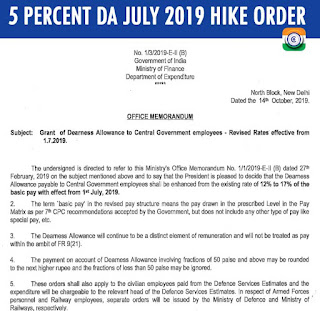
5 Percent DA July 2019 Hike Order - Grant of Dearness Allowance to Central Government employees

Grant of Dearness Allowance to Central Government employees 5 Percent DA July 2019 Hike Order  No. 1/3/2019-E- II (B) Government of...

Blog Archive

About The Author