A complete reference blog for Indian Government Employees

Showing posts with label Gramin Dak Sewaks. Show all posts

Saturday, 28 September 2019

CGHS facilities to NPS covered Pensioners


NPS covered pensioners allowed to use CGHS facilities without any bar of minimum qualification service

CGHS facilities to NPS covered Pensioners

NPS-CGHS-Pensioners

 National Council (Staff Side)


The Secretary,
Ministry of Health & Family Welfare,
Nirman Bhawan,
New Delhi-110011
Dated: September 26, 2019
Dear Sir,

Sub: CGHS facilities to NPS covered Pensioners - Req.
Ref.: Ministry of Health & Family Welfare, Government of India’s G.O.No.S.11011/ 10/2012- CGHS(P)/ EHS dated 28.03.2017

Your kind attention is invited towards the above referred to O.M. dated 28th March, 2017, wherein a condition of Minimum Qualifying Service of 10 years has been laid down for availing CGHS facilities for NPS covered pensioners.

Also check: Good news for NPS employees

In this connection, it would not be out of context to mention that, a substantial number of Gramin Dak Sewaks became regular employees of the Postal Department, crossing age of 50 years. All these CDSs, on having been regularised as Postal Employees after 50 years of age, are thus deprived of CGHS facilities on account of above-mentioned condition of minimum 10 years Qualifying Service, as such, the said condition is uncalled for an irrational.

It is, therefore, requested that, the matter may please be looked into in the foregoing, and the same be dispensed with, so that, any regular Government Employee on superannuation, may be NPS covered pensioners, should be allowed to avail CGHS facilities without any bar of Minimum Qualifying Service in the larger interest of justice.

Also check: Guidelines regarding Merger of 33 Postal dispensaries with CGHS
Yours faithfully,
(Shiva Gopal Mishra)
Secretary
CGHS-facilities-to-NPS-covered-Pensioners


Share:

Wednesday, 29 August 2018

Cabinet approves Revised Cost Estimate for setting up of India Post Payments Bank


India-Post-Payments-Bank-IPPB
Cabinet
Cabinet approves Revised Cost Estimate for setting up of India Post Payments Bank
Boost to Banking Services at Post Offices across the country
29 AUG 2018
The Union Cabinet chaired by Prime Minister Shri Narendra Modi has given its approval for revision of the project outlay for setting up of India Post Payments Bank (IPPB) from Rs. 800 crore to Rs. 1,435 crore. The additional sum of Rs. 635 crore in the revised cost estimates is on account of Rs 400 crore for Technology Costs and Rs 235 crore for Human Resource Costs.

Details:
  • IPPB services shall be available at 650 IPPB branches and 3250 Access Points from 1st September 2018 and in all 1.55 lakh post offices (Access Points) by December 2018.
  • The project will generate new employment opportunity for about 3500 skilled banking professionals and other entities engaged in propagating financial literacy across the country.
  • The objective of the project is to build the most accessible, affordable and trusted bank for the common man; spearhead the financial inclusion agenda by removing the barriers for the unbanked and reduce the opportunity cost for the under banked populace through assisted doorstep banking.
  • The project will supplement Government's vision of "less cash" economy and at the same time promote both economic growth and financial inclusion.
  • The robust IT architecture of IPPB has been built taking into consideration bank grade performance, fraud and risk mitigation standards and in line with the best practices from payments & banking domain
IPPB services:
The IPPB will provide bouquet of payments/financial services through its technology enabled solutions which will be distributed by the Department of Posts (DoP) employees/last mile agents transforming them from mail deliverer to harbinger of financial services.
The IPPB shall pay incentive/commission to the last mile agents ( Postal Staff and Gramin Dak Sewaks) directly in their accounts for providing IPPB services so as to motivate them to promote IPP8 digital services to the customers.

A part of commission to be paid by IPPB to Department of Posts will be used for increasing the wherewithal of Post office.

PIB
Share:

Thursday, 6 October 2016

Charter of Demands Especially increase in minimum wage and fitment factor


Charter of Demands Especially increase in minimum wage and fitment factor

1. Settle the demands raised by NJCA regarding modifications of 7th CPC recommendations as submitted in the memorandum to Cabinet Secretary on 10th December 2015. (See Annexure-I). Honour the assurance given by the Group of Ministers to NJCA on 30th June 2016 and 6th July 2016, especially increase in minimum wage and fitment factor. Grant revised HRA at the existing percentage itself i.e. 30%, 20% and 10%. Accept the proposal of the staff side regarding Transport Allowance. Settle all anomalies arising out of implementation of 7th CPC recommendations, in a time bound manner.

2. Implement option-I recommended by 7th CPC and accepted by the Government regarding parity in pension of pre-2016 pensioners, without any further delay. Settle the pension related issues raised by NJCA against item 13 of its memorandum submitted to Cabinet Secretary on 10th December 2015. (See Annexure-I).

3. Scrap PFRDA Act and New Pension System (NPS) and grant pension and Family Pension to all Central Government employees recruited after 01.01.2004, under CCS (Pension) Rules 1972.

4. Treat Gramin Dak Sewaks of Postal department as Civil Servants, and extend all benefits like pay, pension, allowances etc. of departmental employees to GDS. Enhance bonus calculation ceiling of GDS also to 7000 from 01.04.2014.

5. Regularise all casual, contract, part-time, contingent and Daily rated mazdoors and grant equal pay and other benefits. Revise the wages as per 7th CPC minimum pay.

6. No Downsizing, Privatisation, outsourcing and contractorisation of Government functions.

7. Withdraw the arbitrary decision of the Government to enhance the bench mark for performance appraisal for promotion and financial upgradations under MACP from “GOOD” to VERY GOOD” and also decision to withhold annual increments in the case of those employees who are not able to meet the bench march either for MACP or for regular promotion within the first 20 years of service. Grant MACP pay fixation benefits on promotional hierarchy and not on pay-matrix hierarchy. Personnel promoted on the basis of examination should be treated as fresh entrants to the cadre for grant of MACP.

8. Withdraw the draconian FR 56 (J) and Rule 48 of CCs (Pension) Rules 1972 which is being misused as a short cut as purity measure to punish and victimize the employees.

9. Fill up all vacant posts including promotional posts in a time bound manner. Lift ban on creation of posts. Undertake cadre Review to access the requirement of employees and their cadre prospects. Modify recruitment rules of Group-‘C’ cadre and make recruitment on Reginal basis.

10. Remove 5% ceiling on compassionate appointments and grant appointment in all deserving cases.

11. Grant five promotions in the service carreer to all Central Govt. employees.

12. Abolish and upgrade all Lower Division Clerks to Upper Division Clerks.

13. Ensure parity in pay for all stenographers, Assistants, Ministerial Staff in subordinate offices and in all organized Accounts cadres with Central Secretariat staff by upgrading their pay scales. Grant pay scale of Drivers in Loksabha Secretariat to Drivers working in all other Central Government Departments.

14. Reject the stipulation of 7th CPC to reduce the salary to 80% for the second year of Child Care leave and retain the existing provision.

15. Introduce Productivity Linked bonus in all department and continue the existing bi-lateral agreement on PLB wherever it exists.

16. Ensure cashless medical treatment to all Central Government employees & Pensioners in all recognized Government and Private hospitals.

17. Revision of Overtime Allowance (OTA) and Night Duty Allowance (NDA) w.e.f 01.01.2016 based on 7th CPC pay scale.

18. Revision of wages of Central Government employees in every five years.

19. Revive JCM functioning at all levels. Grant recognition to the unions/Associations under CCS (RSA) Rules 1993 within a time frame to facilitate effective JCM functioning.

Source: http://confederationhq.blogspot.in
Share:

Sunday, 14 September 2014

Charter of Demands submitted to Cabinet Secretary by Confederation

Charter of Demands submitted to Cabinet Secretary by Confederation

CHARTER OF DEMANDS
  1. Merger of DA with pay for all employees w.e.f. 01.01.2014 including Gramin Dak Sewaks and Pensioners.
  2. Grant of Interim Relief to all employees including Gramin Dak Sewaks and Pensioners.
  3. Inclusion of Gramin Dak Sewaks under the purview of 7th Central Pay Commission
  4. Scrap PFRDA Act and grant statutory defined pension to all including those appointed on or after 01.01.2004.
  5. Date of effect of 7th CPC recommendation should be 01.01.2014.
  6. Regularisation and Revision of wages of casual labourers and contract workers.
  7. Removal of 5% condition for compassionate appointment.
  8. Fill up all vacant post and creation of New Post wherever justified.
  9. Stop Downsizing, Outsourcing, Contractorisation and Privatisation of Government function.
  10. Grant productivity Linked Bonus to all without ceiling; Compute bonus as weighted average of PLB for those not covered by PLB agreement.
  11. Revise OTA and NDA and implement arbitration awards.
  12. Settle all pending anomalies of 5th and 6th Pay Commission.
Source : http://confederationhq.blogspot.in/2014/09/memorandum-to-be-submitted-to-cabinet.html
Share:

Friday, 27 June 2014

Corrected version of Draft of JCM’s Memorandum to be submitted to 7th CPC

Corrected version of Draft of JCM’s Memorandum to be submitted to 7th CPC – Please give your valuable suggestions
PREFACE

The 6th CPC submitted its report in March 2008. It made major changes in the structure of pay scales by introducing the concept of Pay band and Grade Pay. Their recommendations were implemented with effect from 1.1.2006. There were plethora of anomalies, common as well as department specific. None of these anomalies were removed despite several rounds of discussions.

1.2. On 1.1.2011, the percentage of DA entitlement crossed over 50%. Since the erosion of the value of wages by that time had become enormous, the demand for merger of DA was raised by the employees. Some of them demanded setting up of the 7th CPC on the plea that the residency period of any wage structure must not exceed 5 years, especially in the background that the pay revision in most of the PSUs takes place at the interval of 5 years.They also pointed out that unlike the 5th CPC the 6th CPC had not suggested as to when the next wage revision must be attempted. The Government ignored those demands, despite well knowing that the inflation and abnormal price rise of food and other essential commodities had reduced the purchasing capacity of the government employees significantly.

1.3 Government refused to discuss these demands either bilaterally or at the forum of JCM. A section of the employees went on a day’s strike action, while the industrial workers in the Railways and Defence took the strike ballot. Climate of confrontation emerged. Taking note of these developments, Government in September 2013 announced the setting up of the 7th CPC. The Standing Council of JCM, National Council met on 24th October, 2013 to discuss various issues connected with the finalisation of the terms of reference of the Commission. The following suggestions were made for incorporation in the Terms of Reference (TOR):

The Commission should have a labour representative.
  • DA (the extent of percentage as on 1.1.2014) to be merged and treated as pay for all purposes.
  • To include Gramin Dak Sewaks within the ambit of 7th CPC.
  • To grant Interim Relief @ 25% of Pay + GP.
  • To ensure that the 7th CPC recommendation will be effective from 1.1.2014.
  • To ensure parity in pension for all pensioners as per the 5th CPC recommendation.
1.4 In spite of holding out assurance, no further discussions were held. The Government unilaterally notified the Terms of Reference. The Staff Side has now submitted a memorandum to the 7th Central Pay Commission on the twin issues, i.e. the need to grant interim relief and merger of Dearness Allowance.

1.5 It will be the endeavour of the Staff Side to bring about commonality of approach on all issues concerning the wages, allowances and other relevant matters, as was the case on the previous occasions. We are hopeful that all the Associations/ Federations/Unions of Central Government employees will endorse this memorandum, prepared by the Staff Side, National Council, JCM on their behalf. No doubt they will submit separate memoranda on department specific issues.

1.6 With this introduction, we submit this memorandum to the 7th CPC for their consideration.

Click here to download JCM’s Memorandum [1.5 MB .pdf]
Share:

Featured post

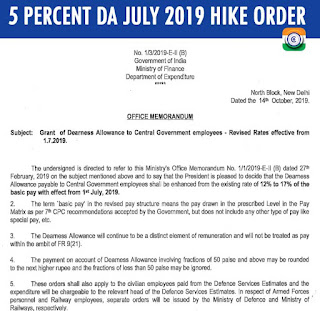
5 Percent DA July 2019 Hike Order - Grant of Dearness Allowance to Central Government employees

Grant of Dearness Allowance to Central Government employees 5 Percent DA July 2019 Hike Order  No. 1/3/2019-E- II (B) Government of...

Blog Archive

About The Author