A complete reference blog for Indian Government Employees

Showing posts with label budget 2016. Show all posts

Wednesday, 2 March 2016

Government provides fund for pay commission implementation in Budget

Government provides fund for pay commission implementation in Budget

Central Government provided the fund of excess Rs 28,300 crore for the implementation of Seventh Pay Commission recommendations on Monday in the Budget estimates of fiscal 2016-17, presented by the Finance Minister Arun Jaitley.

The government has provided a fat allowances bill of Rs 88,932 crore in the Budget, almost as much as the total basic pay bill of Rs 90,598 crore for one crore central government employees, including pensioners.
According to the budget estimates of 2016-17, the total pay bill has increased by Rs 28,300 crore to Rs 90,598 crore in the next financial year as compared to Rs 62,230 crore in 2015-16.

The allowances bill has gone up by Rs 37,000 crore, taking the amount to Rs 88,932 crore in next fiscal.
The total provision towards pay, allowances and travel expenses of central government employees has been to the tune of Rs 1,83,935 crore in the next fiscal as against the Rs 1,18,248 crore in this financial year.
The government has made provisions as per the recommendations of the 7th Pay Commission, though the actual disbursement would depend on the suggestions of the empowered committee of secretaries which has been constituted for the implementation of the Pay Commission recommendations.

The Pay Commission had calculated the total impact of the increase in salaries and allowances at Rs 1.02 lakh crore of which it had estimated the increase in pay to be at Rs 39,100 crore and allowances at Rs 29,300 crore. In percentage terms, the overall increase according to the Pay Commission was about 23.5% where the increase in pay was 16% and the allowances at 63%.

The significant jump in allowances could be on account of house rent, which has been recommended at 24% of the basic pay, besides others. The minimum pay as per the pay panel report was set at Rs 18,000 and the maximum at Rs 2.25 lakh for secretary-level officers. Accordingly, the house rent allowance (HRA) for secretaries would be more than Rs 56,000.

However, this is not the first time that allowances bill is likely to be as much or more than the pay bill. In 2014-15, the salary bill as per actual expenditure was Rs 53,371 crore while the allowances was Rs 76,613 crore.
Inputs with TNN
Share:

Pay commission award budgeted for in ministries allocations: Government

Pay commission award budgeted for in ministries allocations: Government

With absence of an explicit overall provision for the 7th Pay Commission in Budget raising questions, government today said the once-in-a-decade pay hike has been built in as interim allocation for different ministries and Budget numbers were credible.

The voluminous Budget documents state that “the implementation of the 7th Pay Commission due from January 1, 2016 is to be implemented during the financial year 2016-17 as also the revised One Rank One Pension scheme for Defence services.”

“The government has made provisions for the additional liabilities on these count,” it said, without giving the amount allocated for implementation.

Economic Affairs Secretary Shaktikanta Das said the number cannot be quantified and it has been built up in budget of various ministries.

“We cannot really quantify how much we require in 2016-17. Because the Secretaries Committee have to first give its recommendations, then government will take a decision and then only we will know what is the requirement in FY17,” he said here.

Implementation of the pay commission report is to cost the government Rs 1.02 lakh crore.

“We have the Pay Commission recommendations with us, we have analysed the likely requirement and it has been built into the Budget of various ministries. Some suitable interim provisions have been made,” he said without elaborating. “Hence the expenditure and revenue numbers are credible.”

Das said Finance Minister Arun Jaitley in his Budget speech stated that interim provisions have been made. “And these provisions are there in the Demands for Grants for individual departments and ministries. It is built into and subsumed into those allocations.”

“The Budget reaffirmed the commitment of the government to continue with the process of fiscal consolidation as projected in the Medium Term Fiscal Policy Statement of 2015-16 despite a tough external environment,” the Budget documents said.

Accordingly, fiscal deficit has been projected at 3.5 per cent of GDP in 2016-17. “In accordance with the amended FRBM targets, the fiscal deficit of 3 per cent is projected to be achieved in 2017-18 onwards.”
“Keeping in view the challenge of reduction of fiscal deficit by 0.4 per cent of GDP in a difficult year in 2016-17 with substantial additional liabilities on pay revision etc, the government is quite optimistic of fully achieving the fiscal deficit target of 3 per cent or below by March 2018,” the documents said.
Inputs with PTI
Share:

Tuesday, 1 March 2016

House Rent Paid : 80GG has also been raised to 60,000 from 24,000

House Rent Paid : 80GG has also been raised to 60,000 from 24,000

The limit of deduction of house rent paid under section 80GG has also been raised to Rs. 60,000 from the existing Rs. 24,000 per annum to give relief to employees who live in rented houses.

Certain Tax Reliefs announced for small tax payers and others

While presenting the General Budget 2016-17 in Lok Sabha here today, the Union Finance Minister Shri Arun Jaitley said that the taxation is a major tool available to Government for removing poverty and inequality and this has to be cautiously exercised. But, he would like to give relief to small tax payers, the Finance Minister added.

Thus the ceiling of tax rebate under Section 87A of IT Act has been proposed to be raised to Rs. 5,000 from Rs. 2,000 for individuals with income less than Rs. 5 lakhs. He said that above 2 crore tax payers would get a relief of Rs. 3,000. The limit of deduction of house rent paid under section 80GG has also been raised to Rs. 60,000 from the existing Rs. 24,000 per annum to give relief to employees who live in rented houses.

Under the presumptive taxation scheme under Section 44AD of the Income tax Act, the limit of turnover or gross receipts has been raised to two crore rupees from the exiting one crore rupees to benefit about 33 lakh small business people. It frees a large number of such assesses in the MSME category from the burden of maintaining detailed books of account and getting audit done.

The presumptive taxation scheme is to be now extended to professionals with gross receipts up to Rs. 50 lakh with the presumption of profit being 50% of the gross receipts.
Share:

Key Features of Budget 2016-2017

Key Features of Budget 2016-2017

INTRODUCTION : Growth of Economy accelerated to 7.6% in 2015-16

CHALLENGES IN 2016-17 : Risks of further global slowdown and turbulence.

ROADMAP & PRIORITIES :  ‘Transform India’ to have a significant impact on economy and lives of people

AGRICULTURE AND FARMERS’ WELFARE : Allocation for Agriculture and Farmers’ welfare is Rs. 35,984 crore

RURAL SECTOR : Allocation for rural sector – Rs.87,765 crore.

SOCIAL SECTOR INCLUDING HEALTH CARE : Allocation for social sector including education and health care – Rs.1,51,581 crore.

EDUCATION, SKILLS AND JOB CREATION : 62 new Navodaya Vidyalayas will be opened

SKILL DEVELOPMENT : Allocation for skill development – Rs. 1804. crore.

JOB CREATION : GoI will pay contribution of 8.33% for of all new employees enrolling in EPFO for the first three years of their employment. Budget provision of Rs. 1000 crore for this scheme

INFRASTRUCTURE AND INVESTMENT : Total investment in the road sector, including PMGSY allocation, would be Rs. 97,000 crore during 2016-17.

FINANCIAL SECTOR REFORMS  : A comprehensive Code on Resolution of Financial Firms to be introduced.

GOVERNANCE AND EASE OF DOING BUSINESS : A Task Force has been constituted for rationalisation of human resources in various Ministries

FISCAL DISCIPLINE : Fiscal deficit in RE 2015-16 and BE 2016-17 retained at 3.9% and 3.5%

RELIEF TO SMALL TAX PAYERS : Raise the ceiling of tax rebate under section 87A fromRs. 2000 to Rs. 5000 to lessen tax burden on individuals with income upto Rs.5 laks

BOOST EMPLOYMENT AND GROWTH : Increase the turnover limit under Presumptive taxation scheme under section 44AD of the Income Tax Act to Rs. 2 crores to bring big relief to a large number of assessees in the MSME category.

MAKE IN INDIA : Changes in customs and excise duty rates on certain inputs to reduce costs and improve competitiveness of domestic industry

MOVING TOWARDS A PENSIONED SOCIETY : Withdrawal up to 40% of the corpus at the time of retirement to be tax exempt in the case of National Pension Scheme (NPS).

PROMOTING AFFORDABLE HOUSING : 100% deduction for profits to an undertaking in housing project for flats upto 30 sq. metres in four metro cities and 60 sq. metres in other cities

RESOURCE MOBILIZATION FOR AGRICULTURE, RURAL ECONOMY AND CLEAN 
ENVIRONMENT : Additional tax at the rate of 10% of gross amount of dividend will be payable by the recipients receiving dividend in excess of Rs.10 lakh per annum

PROVIDING CERTAINITY IN TAXATION : Committed to providing a stable and predictable taxation regime and reduce black money.

SIMPLIFICATION AND RATIONALIZATION OF TAXES : 13 cesses, levied by various Ministries in which revenue collection is less than ` 50 crore in a year to be abolished.

TECHNOLOGY FOR ACCOUNTABILITY : Expansion in the scope of e-assessments to all assessees in 7 mega cities in the coming years.

Authority: www.indiabudget.nic.in
Share:

Monday, 29 February 2016

Union Budget 2016-17: I-T slabs remain unchanged

Union Budget 2016-17: I-T slabs remain unchanged
HRA deduction increased to Rs. 60,000 per annum; 40% of withdrawal under NPS to be tax exempt; additional exemption for housing loans.
union-budget-2016-17-higlights

Finance Minister Arun Jaitley presents his third Union Budget. With an eye on supporting the small tax-payer and the small investor, the Minister announced a slew of schemes, and income tax exemptions.

As it happened:

12.41 p.m.: Finance Minister Arun Jaitley tables the Union Budget 2016 and the Finance Bill.
12.40 p.m.: Rs. 1,060 crore revenue loss through direct tax proposals, and Rs. 20,670 crore revenue gain through indirect tax proposals. Revenue gain of Rs 19,600 crore in Union Budget 2016 proposals.
12.39 p.m.: 13 different cesses levied by various ministries with collections less than Rs.50 crore a year to be done away with.
12.38 p.m.: No Service Tax for houses built under 60 square metres.
12.35 p.m.: Excise duty on tobacco increased by 10-15 per cent.
12.34 p.m.: Committed to stable taxation regime. No more retrospective amendments.
12.29 p.m.: 4% high capacity tax for SUVs.
12.28 p.m.: Limited period compliance window for domestic taxpayers to declare undisclosed income. Declarations to have immunity from prosecutions.
12.26 p.m.: No changes have been made to existing income tax slabs.
12.25 p.m.: Infrastructure and agriculture cess to be levied.
12.23 p.m.: 1 per cent service charge on purchase of luxury cars over Rs. 10 lakh and in-cash purchase of goods and services over Rs. 2 lakh.
12.22 p.m.: Additional exemption of Rs. 50,000 for housing loans up to Rs. 35 lakh, provided cost of house is not above Rs. 50 lakh.
12.20 p.m.: 40% of withdrawal at the time of retirement under National Pension Scheme to be tax exempt.
12.19 p.m.: Tax holiday for startups for three of five years of setting up the company
12.13 p.m.: Lowering of Corporate IT rate for companies not exceeding Rs. 5 crore turnover to 25% plus surcharge.
12.09 p.m.: People with income less than Rs 5 lakh to get deduction of Rs 5,000, up from Rs 2,000 last year. HRA deduction up from Rs. 24,000 to Rs. 60,000 p.a.
12.08 p.m.: Rs. 100 crore for Deendayal Upadhyay’s birthday celebrations and Guru Gobind Singh 300th birth anniversary.
12.07 p.m.: Classification of expenditure as plan and non-plan to be done away with.
12.06 p.m.: Govt plans to spend Rs 19.78 lakh crore in 2016-17 — Rs 5.5 lakh crore under plan head, Rs 14.28 lakh crore under non-plan head.
12.06 p.m.: Fiscal deficit at 3.5% of GDP in 2016-17.
12.04 p.m.: A bill on targeted delivery of financial services using Aadhar to be introduced.
12.03 p.m.: Amendment to the Companies Act to ensure speedy registration and boost start-ups.
12.02 p.m.: Rs. 900 crore for buffer stock of pulses.
12.01 p.m.: Dept of Disinvestment renamed as Dept of Investment and Public Asset Management.
12 noon: Direct Benefit Transfer for fertiliser subsidy.
11.59 a.m.: EPF at 8.33 per cent for new employees joining the scheme.
11.58 a.m.: Rs. 25,000 crore for recapitalisation of public sector banks. General insurance companies owned by the govt to be listed in stock exchanges.
11.56 a.m.: Amendmends to boost Asset Reconstruction Companies to manage NPAs of public sector banks.
11.55 a.m.: RBI Act to be amended to set up monetary policy committee.
11:53 a.m.: 100% FDI through FAPB route in marketing of food products produced and manufactured in India.
11.49 a.m.: Total outlay on infrastructure in 2016-17 is Rs. 2,21,246 crore
11.47 a.m.: In the power sector, the govt is drawing up a plan for 15-20 years to augment investment in nuclear power. Rs. 3,000 crore per annum for this.
11.45 a.m.: There are 160 airports and airstrips which can be revived.
11.44 a.m.: Motor Vehicles Act to be amended to enable entrepreneurship in the road transport sector.
11.43 a.m.: Total outlay for infrastructure is at Rs. 2.31 lakh crore.
11.42 a.m.: Rs. 97,000 crore for all roads. Total outlay on roads and rails will be Rs. 2.80 lakh crore. 10,000 km of national highways in 2016-17 and 50,000 km state highways to be converted to NH roads.
11.41 a.m.: More than 70,000 road projects were languishing at the beginning of the year. Nearly 85% of these projects have been put back on track.
11.39 a.m.: Small shops should be given the choice to remain open on all 7 days a week.
11.37 a.m.: Rs. 1,700 crore for 1500 multi-skill development centres.
11.35 a.m.: 10 public and 10 private educational institutions to be made world-class. Digital repository for all school leaving certificates and diplomas. Rs. 1,000 crore for higher education financing.
11.34 a.m.: Hub to support SC/ST entrpreneurs.
11.33 a.m.: National dialysis service programme under PPP model. LPG connection for women members of rural homes.
11.30 a.m.: Government to provide health insurance of upto Rs. 1 lakh per family; top up of Rs. 35,000 for people above 60 years. 3,000 stores to be opened for generic drugs.
11.30 a.m.: Total rural sector allocation Rs. 87,769 crore.
11.27 a.m.: Two schemes for digital literacy for rural India to cover 6 crore households in the next three years.
11.26 a.m.: Rs. 9,000 crore for Swachch Bharat Abhiyan.
11.25 a.m.: 5,542 villages have been electrified, more than the last three years combined.
11.24 a.m.: Rs. 38,500 crore for MNREGA. Highest ever for the rural employment scheme.
11.23 a.m.: Rs. 2.87 lakh crore for gram panchayats as per recommendation of 14th finance commission.
11.22 a.m.: Four schemes for animal welfare.
11.19 a.m.: Agricultural credit target of Rs. 9 lakh crore. Govt to allocate Rs 5,500 crore for crop insurance scheme.
11.19 a.m.: Unified e-platform for farmers to be inaugurated on Ambedkar’s birthday.
11.17 a.m.: Paramparagat Krishi Vikas Yojana to bring 5 lakh acres under organic farming.
11.14 a.m.: 28.5 lakh hectares to be brought under irrigation.
11.13 a.m.: Govt will reorganise agricultural policy to double farmer income in five years.
11.11 a.m.: Jaitley announces the nine pillars of his Budget — Agriculture and farmers’ welfare, rural sector, social sector including healthcare, education, skills and job creation, infrastructure, financial sector reforms, ease of doing business, fiscal discipline, tax reforms to reduce compliance burden.
11.11 a.m.: New scheme for BPL families for gas connections. Staturtory backing for Aadhaar platform to ensure delivery of benefits.
11.10 a.m.: CAD is 1.4% of GDP.
11.10 a.m.: FY 16-17 will have the additional burden of implementing the VII pay commission and the defence OROP.
11.08 a.m.: FY 15-16 and 16-17 will be challenging for the government.
11.07 a.m.: Forex reserves are at the highest ever levels — $350 billion.
11.05 a.m.: GDP growth has accelerated to 7.6%. CPI inflation has come down to 5.4%.
11.05 a.m.: Mr. Jaitley says the Indian economy has held strong despite a global slowdown.
11 a.m.: Arun Jaitley rises to present the Budget.
10:46 am: Mr. Jaitley’s Budget speech to begin in 15 minutes.
10:43 am: Union Cabinet clears General Budget for 2016-17.
10:29 am: Cabinet meeting in Parliament ends.
10:05 am: The Sensex falls 59 points in early trade on reduced bets by cautious retail investors amid continued capital outflows by foreign funds ahead of the Budget. More…
9:53 am: Pre-Budget Cabinet meet to begin shortly.
9:40 am: Mr. Jaitley, MoS Jayant Sinha arrive in Parliament.
9:19 am: The stock markets don’t seem very enthused ahead of the Budget — Sensex opens 38.86 points lower, currently at 23,115.44.
9:10 am: The Budget may be given a dash of green with many environment-friendly measures to reduce the carbon footprint, official sources tell The Hindu. The budget is likely to provide incentives to encourage local manufacture and Research & Development (R&D) of electric vehicle components, including lithium-iron batteries.
9:00 am: About 8.5 crore employees whose retirement savings are managed by the Employees’ Provident Fund Organisation (EPFO) could get an option to transfer over a third of their EPF contributions to the National Pension System, regulated by the Pension Fund Regulatory and Development Authority or PFRDA. Read more…
8:54 am: How well do you know your budget history? Here are 11 landmark Union Budgets that you should know about.
8:45 am: Here’s a ready reckoner for some of the terms that will be a part of Mr. Jaitley’s long speech, that some of us may not be familiar with.
8:30 am: How long will this year’s Budget speech be? Which Finance Minister holds the dubious honour of presenting the longest budget speech, in terms of word count? Here’s a clue: it was an 18,650-word speech given 25 years ago!
8:00 am: Budgets are about numbers and best understood using charts and graphics. In case you missed it, here are the highlights of the previous Budget, captured in eight interactive charts.
7:30 am: The event provides us an opportunity to reflect on the proposals and promises that were made during last year’s Budget. We looked at some of them and checked the status of their implementation. Here’s what we found.
7:00 am: Here’s some interesting information. For Budget 2016-17, the government invited suggestions from citizens through Twitter for the first time, even conducting a series of polls to gauge public priorities and expectations from the Budget.

Source: The Hindu
Share:

Limit of Deduction of Rent Increased from Rs.24,000 to Rs.60,000

Limit of Deduction of Rent Increased from Rs.24,000 to Rs.60,000
100% Deduction of Profits for 3 out of 5 Years for Start-Ups

Withdrawal upto 40% of the Corpus to be Tax-Free at the time of Retirement

Deduction of Additional Interest of Rs.50,000 Per Annum for First-Time Home buyers
New Dispute Resolution Scheme to be Introduced

Thirteen Cesses Levied by Various Ministries having Revenue Collection less than Rs.50 Crore to be Abolished

‘E-Sahyog’ and ‘E-Assessment’ to be Expanded Further

100% Deductions for Profits to an undertaking in Housing Project for Flats up to 30 Sq. Mtrs.
The Union Finance Minister Shri Arun Jaitley said that taxation is a major tool available to government for removing poverty and inequality from the society. He enlisted 09 categories of thrust in his text proposals which include (1) Relief to small tax payers (2) Measures to boost growth and employment generation (3) Incentivizing domestic value addition to help Make in India (4) Measures for moving towards a pensioned society (5) Measures for promoting affordable housing (6) Additional resource mobilization for agriculture, rural economy and clean environment (7) Reducing litigation and providing certainty in taxation (8) Simplification and rationalization of taxation (9) Use of technology for creating accountability.

Announcing relief to small tax payers Shri Jaitley proposed to raise the ceiling of tax rebate U/s. 87A from Rs.2000 to Rs.5000. With this, individuals having income up to Rs.5 lakh will get a relief of Rs.3000 in their tax liability. He also proposed to increase the limit of deduction of rent paid U/s.80 GG from Rs.24,000 per annum to Rs.60,000 to provide relief to those who live in rented houses. Shri Jaitley proposed to increase the turnover limit under presumptive taxation scheme U/s.44 AD of the Income Tax Act to Rs.2 Crores from existing limit of Rs.1 Crore which will benefit more than 30 lakh small business people. He also proposed to extend the presumptive taxation scheme with profit deemed to be 50%, to professionals with gross receipts up to Rs.50 lakh.

PIB
Share:

Highlights of General Budget 2016: Indian Government News

Highlights of General Budget 2016: Indian Government News

union-budget-2016-higlights


Union Finance Minister Shri Arun Jaitley spoke on the Key Reform Measures in his Budget speech 2016-17

1. The Government is firm on its course towards fiscal consolidation without compromising on its development agenda. 3.5% fiscal deficit is targeted for FY 2017.

2. Total allocation for Agriculture, Farmers’ welfare and Irrigation set at Rs. 47,912 cr, which is nearly twice the allocation of the previous year.

3. New Health Protection scheme will provide health cover up to Rs. 1 lakh per family and additional Rs. 30,000 for senior citizens.

4. Free LPG connections will be provided in the name of woman member of a family to 1.5 cr BPL households in 2016-17 and to continue for two more years to cover 5 cr households in total.

5. Massive increase in public spending on infrastructure to Rs. 2.21 lakh cr, an increase of 22.5% over the previous year.

6. Higher Education Financing Authority set up, with an initial capital base of Rs. 1,000 cr to promote higher education. In addition, 10 public and 10 private institutions to emerge as world-class Teaching and Research Institutions.

7. Promoting a tax-friendly regime and minimizing hassles due to litigation through a New Dispute Resolution Scheme with low or zero penalties. Ongoing tax cases can be settled with ease.

8. Increased relief for middle-class tax-payers by raising the ceiling of tax rebate under Section 87A to Rs. 5,000 for individuals with income less than Rs. 5 lakhs and by raising the limit of deduction of rent paid under section 80GG to Rs. 60,000.

9. Directly providing financial and other subsidies benefits to people who deserve them by enacting a new law and developing a social security platform using Aadhar.

10. Boosting formal sector employment by provisioning Rs. 1,000 cr towards contributing 8.33% on behalf of all new employees enrolling in EPFO for the first three years of their employment.

11. Simplified and pro-market tax measures such as laying out the roadmap of phasing out of exemptions under Corporate Taxes, abolishing small cesses, providing complete pass through of income-tax to securitization trusts and reducing period of obtaining long-term capital gains treatment for unlisted companies to three years.

12. Promoting entrepreneurship by increasing the turnover limit under Presumptive taxation scheme to Rs. 2 cr, targeting to disburse loans worth Rs. 1.8 lakh cr under PM Mudra Yojana and providing 100% deduction of profits for 3 out of 5 years for start-ups.

13. Facilitating Affordable Housing by 100% tax exemption for profits from small projects, not subjecting distribution REITs and INVITs to Dividend Distribution Tax and encouraging small first-time home buyers by deducting ¬additional interest of Rs. 50,000.

14. Reducing black money through a scheme to declare undisclosed income by paying 45% tax in a given compliance window.

15. Strengthening the financial sector by allocating Rs. 25,000 cr towards recapitalising Public Sector Banks (PSBs), listing Government-owned General Insurance companies, and spelling out a roadmap for consolidating PSBs.

Source: PIB News
Share:

Sunday, 21 February 2016

Budget 2016 expectations: From OROP, 7th Pay Commission overhang to sectoral impact, here are 10 points to note

Budget 2016 expectations: From OROP, 7th Pay Commission overhang to sectoral impact, here are 10 points to note

1. The FM’s priority in the 2016-17 budget will be higher growth, with fiscal rectitude, we believe. With the private sector capex yet to pick up, he will budget for higher plan capital expenditure (investments), in addition to the higher spends on OROP and 7th Pay Commission, which need to be factored in. These will be proposed to be financed by higher revenues from divestment/privatisation, higher indirect tax rates, telecom auctions and better tax compliance, apart from a cut in non-plan expenditure (subsidies) via DBT.

2. A lower fiscal deficit will leave more money available for the private sector, help in easing inflation, and moderate interest rates further. We expect targets under the FRBM Act to be largely maintained. We expect the FM to target a fiscal deficit of 3.7% for FY17 and budget for a gradual reduction in fiscal deficit per annum to 2.5% by FY19.

3. Expect FM Arun Jaitley to target real GDP growth of 7.7% in FY17 and bring it to over 8% next year. Larger and targeted plan expenditure capital outlays, with strict implementation timelines, would likely be announced, to ensure economic recovery and sustainable growth. We expect plan expenditure target to increase by 30% over FY16RE.

4. The budget will aim to provide an investment – led supply aid to growth (with private sector participation via Make in India campaign) as well as a consumption – led demand pull growth via 7th Pay Commission, OROP and DBT of subsidies.

5. On taxation front, we expect the Government to initiate reform process in direct taxes, in line with the announcements of the previous budget. The tax rate is expected to gradually come down from 30% to 25%, with a corresponding removal of exemptions / deductions available currently. On indirect taxes, we expect increase in service tax rate to bring it in line with the proposed GST rate of about 17-18%. Similarly, excise duties will likely be levied on various exempt items and increased for various items which are currently taxed at concessional rates. We are not expecting change in base rate of excise duty.

6. FM Arun Jaitley will have to restrict non plan expenditure to meet his FD targets. While the food subsidy burden will be taken up, we believe the FM will budget for lower fuel subsidy bill on the back of lower crude prices. He will also better target subsidies through the JAM trinity. The government has already announced on January 1, the launch of DBT for kerosene subsidy in a bid to cut down the diversion and black marketing of the fuel. The kerosene subsidy in FY15 was pegged at about Rs.248bn. As per reports, Direct Benefit Transfer (DBT) for LPG had resulted in savings of about Rs.140bn in FY15. We expect DBT to be gradually used for more subsidies. Implementation of DBT for fertilizer and crop subsidy could result in substantial savings.

7. To provide higher employment opportunities and to make the workforce employable, we expect measures to promote the ‘Make in India’ and ‘Skill India’ initiative. We also expect higher allocations towards agriculture and rural sector to support rural growth, after two continuous drought years in the country.

8. We expect the divestment target to be increased to Rs 500bn in FY17 v/s the FY16RE of Rs.200bn. Tax revenue targets (net) may be set at Rs.10.2trn, an 8% growth over FY16RE. Customs duty may be tweaked on several items to further the ‘Make in India’ cause. We expect implementation of GAAR to be postponed to FY18. We also expect tax benefits for the export-oriented sectors, in view of the consistently falling exports and some measures to restrict dumping.

9. SENSEX AND NIFTY TODAY: The 30-share index on Thursday opened 154.60 points up at 23,536.47 on account of firm global markets.

10. We believe that, the budget may have the following implications for the sectors: BUDGET IMPACT POSITIVE: Sectors – Auto, Banking/NBFCs, Capital Goods, Cement, Construction, Metals & Mining, Oil & Gas, Paints, Power, Shipping & Logistics. BUDGET IMPACT NEUTRAL: Sectors – Agro Chemicals, Aviation, FMCG, Information Technology, Media, Pharmaceuticals, Real Estate.

PTI Via financialexpress
Share:

Thursday, 18 February 2016

Government may hike service tax to 16%: Budget 2016

Government may hike service tax to 16%: Budget 2016

To shore up its revenues in order to spend more, the government may increase service tax to 16 percent from the current 14 percent, a move that would make many services costlier, according to a report by business news channel CNBC-TV18.

“In addition to the Swachh Bharat Cess of 0.5 percent already levied, sources say the service tax rate is projected to rise by 2 percent to 16 percent,” the channel reported.

If the government does raise the service tax rate, one would have to pay higher for restaurant bills, air tickets, mobile phones, to name a few, as the tax is collected from the end user.

The Swachh Bharat cess of 0.5 percent was levied with effect from 15 November, 2015, on all services that attract service tax.

The government is hard pressed to shore up its revenues for a probable hike in social welfare spending in view of the upcoming state assembly polls in Kerala, Puducherry, West Bengal, Tamil Nadu and Assam, which are crucial for the ruling BJP at the Centre to increase its tally in the Rajya Sabha.

On Wednesday, the government estimated a shortfall of about Rs 40,000 crore in direct tax collections, though it said that the same would be managed by a rise in indirect tax collections. The total taxes collected stood at Rs 10.66 lakh crore, 73.5 percent of the budgeted estimates of Rs 14.49 lakh crore for FY2016, it said in a statement.

The government has utilised the fall in crude oil prices to raise excise duty on petrol and diesel during the past three months to mop up an additional Rs 17,000 crore during the current fiscal.

The Union Budget for FY2016-2017 will be presented by union Finance Minister Arun Jaitley on Feb. 29, 2016. The budget session of Parliament commences on Feb. 23, 2016.
Share:

Sunday, 7 February 2016

Budget session from Feb 23, General Budget on Feb 29

Budget session from Feb 23, General Budget on Feb 29

The Budget Session of Parliament will commence on February 23 that will focus largely on the financial business of the government, which will present the general budget on Feb 29.

But there will be no curtailment of the session or the recess period on account of Assembly elections in five states due shortly.

This was decided at a meeting of the Cabinet Committee on Parliamentary Affairs, chaired by Home Minister Rajnath Singh.

“The budget session of parliament will commence on February 23. The Rail Budget will be presented on February 25, the pre-budget economic survey on February 26 and the General budget on February 29.

“The first part of Budget session will end on March 16 and the second part will be convened from April 25 to May 13,” Parliamentary Affairs Minister M Venkaiah Naidu told reporters after the meeting of CCPA.

He said there were suggestions for curtailing the recess period due to assembly elections in five states but the government as well as political parties wanted a full session.

“In 2011, the then government had decided not to refer bills to Standing Committees in the budget session when states were going to polls and there were demands to curtail the session.

“But the government today decided that bills will be referred to standing committees for examination during recess period,” Naidu said.

PTI
Share:

Wednesday, 20 January 2016

AIRF’s Suggestions for the General Budget 2016-17

AIRF’s Suggestions for the General Budget 2016-17

All India Railwaymen’s Federation(AIRF), representing more than 1.3 million Railwaymen, has submitted significant suggestions to Hon’ble Finance Minister on General Budget which is going to be presented on Feb 29, 2015. Budget leaves great impact on the lives of Railwaymen and their families including pensioners.

Therefore it becomes mandatory to bring core issues of Railwaymen at forefront so that Railwaymen find some relief…….
A.I.R.F.
All India Railwaymen’s Federation
4, State Entry Road,
New Delhi – 110055
No.AIRF/60
Dated: January 13, 2016
Hon’ble Finance Minister,
Ministry of Finance,
(Government of India),
New Delhi

Respected Sir,

Sub: Suggestions for the General Budget 2016-17

All India Railwaymen’s Federation(AIRF), representing more 1.3 million Railwaymen, wish to submit the following significant suggestions for consideration in the ensuing General Budget 2016-17:-

Provision of Rs.35,000 crore for implementation of VII CPC Report in the Railways – Indian Railways is broadly functioning as social entity; serving the vast spectrum of the society, majority of whom belongs to lower income group. Railways, is therefore, facing financial crunch on account of little flexibility in freight and fare. To implement report of the VII CPC Indian Railways require Rs.35,000 crore during the coming financial year 2016-17. Keeping in view total scenario and financial health of the Indian Railways as also the aspirations of the people of this country to modernize the Railways, provision of at least Rs.35,000 crore should be made for implementation of VII CPC report for the Railwaymen.

2. Exemption of the Railwaymen from the purview of National Pension System(NPS) – Successive Hon’ble Minister for Railways, accepting the established fact that the Indian Railways is the second line of defence of this country, and the Railwaymen have always proved their worth during all wars, may be 1962, 1965 and 1971, have already recommended for exemption of the Railwaymen from the purview of National Pension System(NPS). Since Railways is an operational department, Railwaymen have to work round-the-clock throughout the year and also have to stay away from their families for long period time while performing duties in the areas where adequate facilities are not available. Railwaymen have to work throughout the year in all weather conditions and their duties are of such complex and critical as well as hazardous in nature and they have to sacrifice their lives, while performing duties, in large number every year, as already accepted by the High Power Committee constituted by the Ministry of Railways under the Chairmanship of Dr. Anil Kakodkar. Therefore, Railwaymen deserve exemption from the purview of National Pension System(NPS), irrespective of their date of appointment on par with armed forces. It would also be pertinent to point out here that, the Indian Railways is the only government department which is shouldering total burden of payment of Pension/Family from its own resources.

3. Raising the limit of exemption from Income Tax deduction – Despite several announcements, one of the major issues in the election manifesto, limit of exemption from Income Tax, could not be raised during the last General Budget(2015-16) as per aspiration of the people of this country. It would not be out of context to submit that, value of the Rupees has substantially devaluated over the years, as a result of which, Dearness Allowance, which is paid to compensate this devaluation of money, has already crossed 119% w.e.f. 1st July, 2015 and is further likely to be increased during this year. This largely justifies that, limit of exemption from Income Tax deduction should be raised to at least 5 lakh per annum. AIRF, therefore, urges that, this aspect needs to be considered in the ensuing General Budget.

4. Provision of adequate allocation of funds for Education and Healthcare – Education and medical facilities in the market have become quite costly, as such gradually going out of reach of the common man because of business type educational institutes and private hospitals. Public Education System and medical facilities have drastically deteriorated over the year due to paucity of funds being allocated under these heads. This is also creating huge imbalance in the Indian Society. There is, therefore, urgent need of augmenting education and healthcare for the common man of this country, for which allotment of funds under these heads needs to be raised to 6% and 4% respectively of the GDP.

5. Allotment of funds for Skilled India Mission of the Hon’ble Prime Minister – A number of railway stations are proposed to be developed for skill development of the youth, as already announced by the Hon’ble Prime Minister of India, for which, substantial fund would be required. Since this is a National Mission and the Indian Railways is not in a position to bear this burden due to financial crunch, adequate fund needs to be allotted for this purpose in the ensuing General Budget.

6. Budgetary support for modernization and augmentation of Indian Railways – Indian Railways is the cheapest and most convenient mode of transport for common man of this country and is virtually lifeline of the nation. To fulfill the aspirations of the rail users, services of the Indian Railways need to be augmented to run this organization more safely and efficiently. It may be appreciated that the Indian Railways is a government organization. As such, Dividend and Lease Charges need not be recovered from the Railways, rather budgetary support, which has drastically declined over the year, should be increased adequately for modernization and augmentation of the Indian Railways. It has been observed that, Service Charges are also being taken on many materials and components manufactured or purchased by the Railways. Being government organization, Service Charges must not be taken from the Indian Railways.

7. Implementation of “Own Your House Scheme” for the Railwaymen – Indian Railways is employing more than 13 lakh employees who work round-the-clock in all weathers throughout the year. Only a marginal number of railway staff is provided with railway quarters while others have to starve badly for residential accommodation or are forced to reside as tenant. Former Hon’ble Minister for Railways, considering this apathy of the railwaymen, had made announcement in the Rail Budget regarding “Own Your House Scheme”, which has not seen light of the day due to paucity of funds. AIRF, therefore, urges that, necessary funds be allotted for this purpose, which will not only help in providing accommodation to needy railwaymen, but also in rapid growth in construction industry and boost the GDP of the country.

8. Refund of Pension Charges born by the Indian Railways – Indian Railways is the only government organization which takes care of entire Pension/Family Pension and Retirement benefits to the Railway employees, whereas for the whole lot of government employees, Government of India owns responsibility. At present, Indian Railways is disbursing around Rs.28,000 in the form of retirement benefits, including Pension/Family Pension to their employees and their dependents. It would be appreciated, if this money should be refunded to Indian Railways to improve economic health, and by this way there will be at least some provision for improvement in the safety standard and passenger care of the Indian Railways.

9. Refund of subsidy – Indian Railways is spending around Rs.26,000 crore for the subsidized fare, being given to the passengers. It is cross subsidy from freight to passengers. It would be in all appropriateness if this amount should be refunded to Indian Railways, so that it could take various important projects pending since years.

AIRF earnestly hope that its aforementioned suggestions would be given due consideration while preparing ensuing General Budget 2016-17 by the government.

With kind regards!
Yours faithfully,
sd/-
(Shiva Gopal Mishra)
General Secretary
Source: AIRF

Share:

Sunday, 3 January 2016

Budget 2016: Assocham demands income tax exemption to Rs 2.5 lakh, re-introduce standard deduction

Budget 2016: Assocham demands income tax exemption to Rs 2.5 lakh, re-introduce standard deduction

New Delhi: Industry body Assocham demanded an increase in income tax exemption ceiling for salaried people to Rs 2.5 lakh and and re-introduce standard deduction for salaried employees to boost consumption in the upcoming Budget.

The income tax exemption ceiling at present is Rs 1.5 lakh.

“And re-introduce the concept of standard deduction for salaried employees who can then give a boost to consumption demand and boost economic growth,” Assocham said in a release.

Besides, Assocham has also pitched for revision of the deduction of interest on housing loans to at least Rs 3 lakh from the existing Rs 2 lakh and a similar limit be set for principal loan repayment from Rs 1 lakh at present.

Explaining the rationale for its demand for standard deduction, it said the salary of the employees has gone up moving along with inflation and other cost factors.

“So in order to benefit the salaried employees, the standard deduction should be reintroduced as one-third of salary or Rs 2,00,000 whichever is less”.

It has also suggested a depreciation allowance for salaried tax-payers in line with professionals.

Assocham said the deduction of depreciation is allowed under the head ‘Business and Profession’. No tax benefit is accrued to the salaried employees when they add assets. Though the assets get depreciated when owned by an employee, tax laws do not recognise this.

Moreover, to help salaried employees, it has suggested for leave encashment exemption limit for tax calculation to be raised to Rs 10 lakh.

“The current limit of Rs 3 lakh was notified by the CBDT way back in 1998 and needs to be raised substantially,” Assocham President Sunil Kanoria said.

Further, it has also asked for re-fixing of monetary limits under HRA/transport allowance and children education.

For the salaried employees, transport allowance is presently exempt from tax up to Rs 800 per month which should be raised to Rs 3,000 per month, it added.

Assocham pre-Budget memorandum to the Finance Ministry Arun Jaitley also suggested that a provision may be made in the Income Tax Act that any expenditure incurred by an employee for education of under-privileged children by making payment directly to a recognised school should be allowed as deduction from salary income up to Rs 1,000 per month for maximum of two children.
Inputs with PTI
Share:

Saturday, 21 February 2015

Budget: Government may relax LTC norms to boost tourism

Budget: Government may relax LTC norms to boost tourism

NEW DELHI: In order to give boost to the tourism sector, the Budget for 2015-16 is likely to expand the scope of LTA and LTC by including hotel and other expenses besides travel for the purpose of tax benefit.
The Ministry, sources said, it is also considering a proposal to allow employees to avail Leave Travel Concession (LTC)/ Leave Travel Allowance (LTA) every year as against the current practice of two times in a block of four years.
At present, LTA or LTC covers only economy class air travel or first class (AC I Class) rail fare. An announcement in this regard is likely to be made in the Budget to be presented by Finance Minister Arun Jaitley on February 28.
Prime Minister Narendra Modi had earlier expressed his keenness to promote tourism. Experts are of the view that encouragement to the tourism sector will promote development of different regions and create employment opportunities.
“To boost domestic tourism and also provide some tax relief to the individuals, the Leave Travel Concession benefit should be increased to one visit for every financial year,” KPMG (India) Partner Vikas Vasal said.
He further suggested that tax concessions should also be made available for stay in hotel may also be covered to help families avail of a holistic benefit.
The LTC/LTA is available to the individual and his family including spouse, two children, parents, brothers and sisters, who are wholly dependent on the assessee.
“There is a huge scope for developing the tourism industry in India which provides direct and indirect employment to millions of people. Therefore, an enhanced tax relief to individuals on LTC will benefit the overall economy,” Vasal said.
Share:

Monday, 16 February 2015

NMC urges FM to raise IT exemption limit to Rs 5 lakh, exclude DA from IT calculation, Merge DA in Basic Pay & Pension etc

NMC urges FM to raise IT exemption limit to Rs 5 lakh, exclude DA from IT calculation, Merge DA in Basic Pay & Pension etc

The National Mazdoor Conference today asked Union Finance Minister Arun Jaitley to raise the income tax exemption limit to Rs 5 lakh.

“We urged Union Finance Minister to raise the Income Tax exemption limit to Rs five lakh,” National Mazdoor Conference (NMC) President Subash Shastri said while addressing a series of rallies at Kanjali and Bomyal in Nagrota Block here today.

Shastri also appealed he Finance Minister to announce non inclusion of amount of DA to calculating income tax as the DA instalments are released by the government from time to time to utilise the impact of price rise and inflation.

Shastri emphasised the need for immediate merger of 50 per cent DA into basic pay and pension as per the recommendations of the Fourth Pay Commission.

He added that all these burning issues impacting both the Central and State Governments Employees and pensioners should be addressed by the Union Finance Minister while presenting the budget for 2015-16 in the coming Budget Session of Parliament beginning on 23rd of this month.

He also demanded immediate release two DA instalment of 17 per cent in favour of State Government Employees and pensioners, pointing out that while Central Government is about to release another instalment 6 per cent DA in favour of its employees and pensioners from Jammu 2015 but it is unfortunate that the salaried class in the state has not got the benefit previous two DA instalments.

He also demanded early regularisation of the 62,000 daily rated workers beside release of their wages without any further delay.

Read at: http://economictimes.indiatimes.com/
Share:

Thursday, 29 January 2015

Government refused interim relief and merger of dearness allowance, assured for 7th CPC report on time

Government refused interim relief and merger of dearness allowance, assured for 7th CPC report on time
    34 Lakhs employees are to affected
    JCM Staff Side has met with official of DOPT and Ministry for Finance
    Government employees to have nice budget this year
New Delhi, Government would have to bear burden of Rs. 10000 crore rupees in case deaness allowance of central government employees is merged and till the implementation of seventh pay commission report government will neither give interim relief nor merge dearness allowance in basic pay for central government employees. Central government has flatly refused to give two thousand interim relief to 34 lakhs of its employees. Chairman of seventh pay commission Justice Ashok Kumar Mathur has refused to oblige on this issue. He further reiterated that provision of giving interim or merger of dearness allowance hasn’t been there in the terms of reference for seventh pay commission. Pay commission has asked representatives of employee union to move to dopt or Ministry for Finance for interim or da merger. Representatives of Joint Consultative Machinery then met the oflicials of DOPT and Ministry of Finance on the issue, but both department refused to give any assurance on these issues, rather assured JCM members that pay commission report will be implemented on time.

But employees’ unions are not impressed; JCM says that no pay commission has ever presented its report before two years. Employees’ unions are also raising the demand to resolve the anomalies of sixth pay commission which are still lying pending. JCM members also demanded that interim relief may be taken into account in the report of seventh pay commission; this has also been out rightly rejected by government. JCM had requested to merger dearness allowance with effect from lst January 2014. Total expenditure on interim relief and merger of dear allowance will respectively be Rs. 800 crore and ten thousand crore. On the other hand pay commission is doing its work on the daily routine basis. Pay commission has recently visited Kolkatta and Andaman Nicobar islands on Jan 11 14 respectively. Now the pay commission has decided to have evidence meeting with JCM staff side in February.

Till date central government has notified six pay commissions before notifying seventh in February 2014. First central pay commission was notified in 1946, Second CPC in 1957, Third CPC in 1970, Fourth CPC in 1983, Fifth in 1994 and sixth in 2006.
    Government employees to have nice budget this year
Ahead of his first full fledged budget, the Finance Minister Arun Jaitley today said that the NDA government was against raising revenue by imposing higher taxes, instead it would want to leave more money in the hands of consumer to fuel demand and growth. The minister also pledged to make the budgetary process more transparent so as to present the real picture of public finances before the people. “High taxation is not the only route to achieve the target of larger revenue we are not going to take this route,” Jaitley said while speaking at a fianction of private news channel CNBC Awaaz. He was replying to a question whether it was possible to increase the income tax payer base from from 3.5 crore to 15 crore. “We believe that the consumer should have money in hand and by spending that money, production will increase and the country will be benefited,” the minister said. The government raised income tax exemption limit from Rs. 2 lakh to Rs. 2.5 lakh in the last budget, he said.

Share:

Tuesday, 27 January 2015

Will Central Government Employees, get 6% dearness allowance

Will Central Government Employees, get 6% dearness allowance

 Good days will come for Central Government Employees, get 6% dearness allowance
 Modi Government is set to big announcement on Budget in view of 7th Pay Commission
It is certain that 6% increase in DA is guaranteed. Here it is necessary to mention that the DA is increased twice in a year. Central government employees are paid from the first of January and July.  As we're told that the DA is 6 percent of total will be 113%. But it is also a provision that if the DA crossed 100 mark will be merged in the basic salary. The employee unions are pressing hard for the merger of DA in the basic pay. But neither the government nor the Seventh Pay Commission is committed at this point. The government has also not in mood to merge the DA in the basic pay. If that happens, this will be bad news for the employees.


Union workers are now engaged on the expected budget has to be presented in February. Employees are hoping that the finance minister will must bring good day for them. On the other side the employee organizations has started to pressure on government to merge the DA in basic pay. The employees union are also pressing for provision of fund for implementation of Seventh Pay Commission in the budget. Trade union leaders are confident that a big announcement can be in budget .


Share:

Featured post

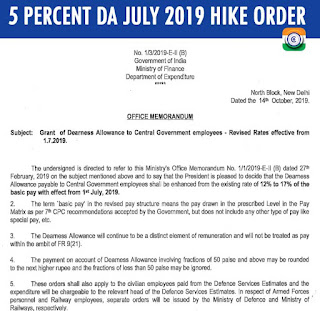
5 Percent DA July 2019 Hike Order - Grant of Dearness Allowance to Central Government employees

Grant of Dearness Allowance to Central Government employees 5 Percent DA July 2019 Hike Order  No. 1/3/2019-E- II (B) Government of...

Blog Archive

About The Author