A complete reference blog for Indian Government Employees

Showing posts with label PTI. Show all posts

Monday, 18 November 2019

Age of superannuation of the Central Government Employees, Government’s briefing to the PTI

Government’s briefing to the PTI on the age of superannuation of the Central Government Employees

Age of superannuation of the Central Government Employees, Government’s briefing to the PTI
No.NC/JCM/2019

Dated: September 25, 2019

All Constituents of the JCM (Staff Side)

Dear Comrades,

Government’s briefing to the PTI on the age of superannuation of the Central Government Employees

There are serious rumours in the air that the Department of Personnel & Training (Government of India) has mooted a proposal in regard to age of superannuation of the Central Government Employees, laying down condition of either 33 years of Qualifying Service or 60 years of age, whichever is earlier. It is also being claimed by several sources that, this proposal has already been sent to the Finance Ministry for their approval.

Also check: Central Government employees who have put in 33 years service or attained the age of 60 years, whichever is earlier, shall retire on superannuation

In this connection, it is clarified that, this has not to be given any cognizance since it is not possible without prior consultation with the JCM(Staff Side), being an important matter of the service condition, affecting the Central Government Employees.

Sincerely yours,
(Shiva Gopal Mishra)
Secretary(Staff Side)
National Council(JCM)
Share:

Friday, 26 July 2019

Reduction in number of vacancies in various departments of the central government

Reduction in number of vacancies in various departments of the central government

The government on Thursday told the Rajya Sabha that there has been a reduction in number of vacancies in various departments of the central government.

Replying to supplementaries during Question Hour, Minister of State for Personnel, Public Grievances and Pensions Jitendra Singh said filling up of vacancies in the government was a continuous process and efforts were being made to reduce them further.

“The government is already working in this direction. If you go by the vacancy figures, the percentage of the vacancy strength has been constantly reducing over the past five to six years.

“When this government came in, in the year 2013-14, ending March 31, 2014 before the government took over, the vacancy percentage was 16.2 per cent. The successive year it is 11.57 per cent. Then in 2015-16 it is 11.52 per cent, then in 2016-17 it is 11.36 per cent. In fact, the record is better in the central government than many of the states,” he said.

Singh said the record in the central government was far better than Karnataka where he said it had gone down from 27.3 per cent in 2014-15 to 32.56 per cent in 2018-19.

He also informed the House that steps to fill up almost 4 lakh vacancies in central government departments was underway and would be filled up by 2020.

The minister also pointed out that the Congress had claimed in its manifesto for the recent Lok Sabha polls that it will fill up the 4 lakh vacancies in the central government departments and the PSUs.

But, he said, the party did not mention that the process for filling up the vacancies had already started during the last NDA regime.

Singh said there is a total vacancy of 6,83,823 in all departments of central government, out of which almost half 3,89,069, almost 4 lakh, were already in the process of being filled up in the beginning of the year.

“All of 4 lakh vacancies in central government and PSUs, judiciary and Parliament will be filled up before March 2020.

But the catch is that the process of filling the vacancies had already been in the process. So we are already pro-active in filling up of vacancies,” the minister said.

In his written reply, the minister said vacancies in Central Government Ministries/Departments, their attached and subordinate offices arise due to retirement, resignation, voluntary retirement, promotion, transfer, transfer on deputation, termination of service, dismissal from service, death etc.

Based on the vacancies reported by the user Departments, the SSC has started recruitment process to fill up 1,05, 338 posts during the year 2019 and 2020, the minister said.

“During 2017-18, the Centralised Employment Notifications (CENs) for 1,27,573 combined vacancies of various Group C and Level-1 posts were notified by the Ministry of Railways For new and future vacancies to arise in two years time, another five CENs covering 1,56,138 vacancies of various Group C and Level-1 posts have been issued in 2018-19.

“Thus, recruitment process to fill up 3,89,069 vacancies has already started,” the minister said.

To reduce the recruitment cycle, some recruiting agencies have switched over to computer based on-line test and interview for non-gazetted posts has been discontinued, he said in a written reply.

The minister also said provisional appointment is being made pending verification of antecedents of the candidates.

PTI
Share:

Sunday, 17 March 2019

BSNL clears employees salaries in February 2019

BSNL clears employees salaries in February 2019

BSNL, a state - owned telecoms company, said that its 1,76 lakh employees were cleared of their pending february salaries.
The company also announced the launch of various schemes to increase its market share and revenue.
“We have disbursed salary of all employees that was pending for the month of February. BSNL employees have ensured that customers services run uninterrupted despite issues that they were facing. Now we will aggressively focus on increasing our market share and revenue with attractive schemes,” BSNL Chairman and Managing Director Anupam Shrivastava told PTI.

The BSNL CMD Thursday had said that the telco was using internal accruals of Rs 850 crore to clear the February salary.

He had stressed that with the telecom department’s support, there would be no delay in salary disbursement in coming months.

BSNL Friday announced free voice call on its ‘Wings’ mobile app and free broadband services for a period of 30 days to attract new customers.

Under the scheme, BSNL landline and mobile customers can make unlimited calls across India for free for a period of 30 days through its Wing mobile application and make calls to any landline or mobile number in India for Rs 1.2 per minute when they are travelling abroad.

“The Wings app annual activation charge is Rs 1,100 but we are giving it to all students at 20 per cent discount, all central and state government at 50 per cent discount and BSNL employees for 75 per cent discount,” BSNL Wings (OSD) AK Jain said.

Post the free offer, Wings users can make calls using any wifi network and will need to pay as per their landline or mobile subscription plan.

BSNL customers can divert incoming calls on their landline or mobile phone to the Wings app.
“We are not charging money for diverting calls to the app,” Jain said.

Besides voice calls, the state-run firm announced free broadband service for its landline and new customers for 30 days. Under the offer, customers availing broadband connection will get 5Gb per day data.

Though the scheme is not applicable for existing broadband customers, the company has announced “25 per cent cash back and Amazon prime subscription for a year on zero cost” for them.

Amid tariff war fuelled by Mukesh Ambani-led Reliance Jio, BSNL is the only company, apart from Jio, that gained new customers in mobile segment, according to the Trai data.

The company, however, had been losing landline customers and expects new schemes to check the decline.

PTI
Share:

Sunday, 27 January 2019

Supreme Court agrees to examine Centre's decision to grant 10 pc quota to poor in general category


Supreme Court agrees to examine Centre's decision to grant 10 pc quota to poor in general category

The Supreme Court Friday decided to examine the Centre's decision to grant 10 percent reservation in jobs and education to poor candidates belonging to general category.

A bench comprising Chief Justice Ranjan Gogoi and Justice Sanjiv Khanna issued notice to the central government on various petitions challenging the validity of the Constitution (103 Amendment) Act, 2019, which paved the way for grant of quota to poor belonging to general category.

"We are examining the matter and hence issuing notice returnable within four weeks," the bench said.
The bench, however, did not stay the operation of the Centre's decision granting quota to the poor in the general category.

In poll year, the Narendra Modi government had come out with the constitutional amendment bill giving quota benefits to the poor among general category candidates.

The petitions were filed by parties including organisations like Janhit Abhiyan and Youth For Equality challenging the Centre's decision.

The petition, filed by Youth For Equality, has sought the quashing of the bill saying that the economic criterion cannot be the sole basis for reservation.
The plea has said the bill violates basic feature of the Constitution as reservation on economic grounds cannot be limited to the general categories and the 50 per cent ceiling limit cannot be breached.

A similar plea has been filed by businessman Tehseen Poonawalla seeking to quash the bill, saying that backwardness for the purpose of reservation cannot be defined by "economic status alone".
The quota will be over and above the existing 50 per cent reservation to SCs, STs and Other Backward Classes (OBCs).

Lok Sabha and Rajya Sabha cleared the Bill on January 8 and 9 respectively and it has also been signed by President Ram Nath Kovind.

Source: PTINews
Share:

Monday, 22 October 2018

One lakh benefitted under PMJAY health insurance scheme in one month of its launch


One lakh benefitted under PMJAY health insurance scheme in one month of its launch

Nearly a month after the roll out of the Centre's PMJAY health insurance scheme, one lakh people have availed the benefits of the ambitious programme, Union Health Minister J P Nadda said Sunday.
The Pradhan Mantri Jan Arogya Yojana (previously Ayushman Bharat), touted as the world's largest health insurance programme, was launched pan-India by the prime minister from Jharkhand on September 23.

"Prime Minister Narendra Modi launched Pradhan Mantri Jan Arogya Yojana on September 23 and within a month, one lakh beneficiaries have benefitted from it. We are committed to ensure the benefits of the scheme reach the last man," Nadda said in a tweet in Hindi.

The scheme is expected to benefit up to 55 crore people, providing them an annual health cover of Rs 5 lakh for secondary and tertiary care hospitalisation through a network of Empanelled Health Care Providers (EHCP).

There is no cap on family size and age in the scheme.

On October 5, two weeks after the launch of the PMJAY, Indu Bhushan, CEO of National Health Agency, said around 38,000 people have availed the benefits of the scheme.

The health ministry has said the scheme will help in reducing expenditure on hospitalizations and help mitigate the financial risk arising out of catastrophic health episodes.

Over 9,000 hospitals have been empanelled for the scheme, and 32 states and Union territories have signed MoUs with the Centre and will implement the programme. Telangana, Odisha, Delhi and Kerala are not among the states which have opted for the scheme.

PTI
Share:

Friday, 19 October 2018

Government to allow data service initially under in-flight connectivity


Government to allow data service initially under in-flight connectivity

The telecom department is considering to allow only data services initially in flights and water vessels within Indian territorial boundaries, an official source said.

Under the proposed in-flight connectivity guidelines, both voice and data services would be provided to passengers on flights and maritime transport within the national boundaries.

"DoT will initially seek application for data services under IFC (in-flight connectivity) guidelines. There are some issues around gateway for voice so that will not start immediately," a Department of Telecom official told PTI.

In-flight connectivity service is available in most of the developed markets.

While mobile phone use will still be restricted during takeoff and landing, the Telecom Commission has approved lifting the ban on the use of mobile phones and internet services at cruising altitudes.

Globally, many airlines are offering wi-fi for passengers, but they have to switch off the facility when they enter Indian airspace.

AirAsia, Air France, British Airways, Egypt Air, Emirates, Air New Zealand, Malaysia Airlines, Qatar Airways and Virgin Atlantic are among 30 airlines that are already allowing mobile phone use on aircraft but not in Indian airspace.

The DoT is likely to approach the Law Ministry next week for the review of these guidelines before notifying them.

PTI
Share:

Wednesday, 17 October 2018

Government Hikes GPF Interest Rate To 8% For October-December quarter

Government Hikes GPF Interest Rate To 8% For October-December quarter.

The government has increased the rate of interest for General Provident Fund (GPF) and other related schemes by 0.4 percentage points to 8 per cent for the October-December quarter.
The rate is in line with that for Public Provident Fund.

The interest rate on GPF was 7.6 per cent for the July-September quarter of 2018-19.

"… during the year 2018-2019, accumulations at the credit of subscribers to the General Provident Fund and other similar funds shall carry interest at the rate of 8 per cent with effect from October 1, 2018, to December 31, 2018," a Department of Economic Affairs' notification said.

The interest rate would apply on Provident Funds of central government employees, railways and defence forces.

Last month, the government announced that the interest on small savings, including NSC and PPF, will be hiked by up to 0.4 percentage point for the October-December quarter, to align it with rising deposit rates in the banks.

PTI
Share:

Wednesday, 31 January 2018

Central Government plans to abolish posts vacant for 5 years


Central Government plans to abolish posts vacant for 5 years

The government is planning to abolish all posts which have been vacant for more than five years, and has directed all ministries and department to submit a comprehensive report on the matter.

In an office memorandum, the Finance Ministry said it had asked all ministries and departments to submit an action-taken report regarding abolition of posts vacant for more than five years.

Some departments and ministries have responded but some, instead of providing a comprehensive report, have submitted the requisite information in piecemeal manner, it said.

Therefore, financial advisors and joint secretaries (administration) of all ministries/ departments are requested to identify the posts which are vacant for more than five years and submit a comprehensive report on abolition of such posts in main ministry and their respective subordinate organisations at the earliest, the office memorandum, dated January 16, 2018, said.

Following this, the Ministry of Home Affairs has directed all its additional secretaries, joint secretaries, chiefs of paramilitary forces and other attached organisations to submit comprehensive reports, a home ministry official told PTI.

According to a preliminary estimate, there are several thousand central government posts which are lying vacant for five or more years, the official said.

PTI
Share:

Thursday, 16 November 2017

Government considering report on age limit for civil service exams


Government considering report on age limit for civil service exams

Nearly eight months after its submission, the report of Baswan committee that suggested changes in civil service exam pattern and age limit is under examination, the government has said.
The committee had submitted its report to the Union Public Service Commission (UPSC) on 9 August 2016.

"The Baswan Committee's report along with UPSC's recommendations on it has been received on 20 March 2017 and the same is under examination," the department of personnel and training (DoPT) said in response to an RTI query filed by a PTI correspondent.

Thousands of aspirants appear in the civil service exam conducted annually by the UPSC in three stages - preliminary, mains and interview - to select officers for Indian Administrative Service (IAS), Indian Foreign Service (IFS) and Indian Police Service (IPS), among others.

The UPSC had constituted the expert committee under the chairmanship of former human resource development secretary and retired IAS officer B S Baswan to review the scheme of civil service examination in August 2015.

The committee is understood to have recommended reduction in upper age limit of 32 years to appear in the civil service exam, officials said.

"The recommendations made by the committee including on pattern of civil service examination and age limit are presently under consideration of the UPSC," minister of state for personnel Jitendra Singh had told Rajya Sabha in a written reply in November last year.

In a related development, the UPSC has fixed a seven-day time frame for candidates to report mistakes or discrepancies in questions asked in the various examinations conducted by it.

PTI
Share:

Wednesday, 22 February 2017

Government launches free anti-virus for PC, mobile phones


Government launches free anti-virus for PC, mobile phones

New Delhi: The IT Ministry today launched botnet cleaning and anti-malware analysis centre for Rs 90 crore to provide free anti-virus to computers and mobile phones for removing malicious softwares "I would like ISPs (Internet Service Provider) to encourage their consumers to come on board, there is a free service available. Come and use it in the event some malware has sneaked in to the system," IT Minister Ravi Shankar Prasad said at the launch of Botnet Cleaning and Malware Analysis Centre.

The Indian Computer Emergency Response Team (Cert-In) will collect data of infected systems and send it to ISPs and banks. These ISPs and banks will identify the user and provide them the link of the centre, launched in name of Cyber Swachhta Kendra.

The user will be able to download anti-virus or anti-malware tools to disinfect their devices.

"The project has budget outlay of Rs 90 crore spread over period of 5 years," CertIn Director General Sanjay Bahl said.

As of now 58 ISPs and 13 banks have come on board to use this system.

The ministry also launched M-Kavach for security and anti-theft solution for mobile phones, USB Pratirodh to ensure only authorised person is able to access pen drive and AppSamvid for identifying genuine applications at the time of installations on computers.

The minister directed Cert-In to also set up National Cyber Coordination Centre (NCCC) by June.
The government has approved Rs 900 crore for NCCC which will monitor and handle cyber attacks on Indian internet space in real time.

"Safety and security is integral. As the Prime Minister said cyber threat is akin to bloodless war. I don’t have slightest doubt cyber security is not only going to be big area of Digital Swachh Bharat but also going to be big area of digital growth, digital employment and digital commerce," Prasad said.

To encourage startups in the field of cyber security, the minister announced that government has reduced testing fee for their product by half.

At present Standardisation Testing and Quality Certification (STQC), a division under the Ministry of Electronics and IT, charges testing fee in the range of Rs 8-10 lakh per case but startups in the field of cyber security will need to pay only around 4-5 lakhs.

To strengthen cyber security ecosystem in the country, Prasad said that CERTs will be set up at state level as well and 10 more STQC testing facilities will set up.

PTI
Share:

Thursday, 9 February 2017

Central government departments asked to inform the Cabinet Secretariat about agreements signed by them


Central government departments asked to inform the Cabinet Secretariat about agreements signed by them

New Delhi: All central government departments have been asked to inform the Cabinet Secretariat as soon as they sign any agreement and also get the nod from the Cabinet or its committee in a time-bound manner.

The directive came after it was noticed that certain ministries were informing the Cabinet Secretariat about accords signed with other stakeholders after the stipulated period of one month.

As per norms, any agreement related to culture and science and technology matters, not impacting the national security or India’s relations with other countries, which are duly approved by the Minister-in-Charge of the department concerned and the Minister of External Affairs, need to be circulated to the Cabinet for information.

“Ministries/departments are requested to send an intimation to this secretariat as soon as such agreements are entered into along with a copy of the signed agreement.

“Ministries/departments may also ensure that notes for information are forwarded to this secretariat well within the stipulated period of one month for timely consideration of such notes by the Cabinet/Cabinet Committee,” the Cabinet Secretariat said in an order.

Referring to its previous directive, it said that all the departments need to take ex-post facto approval on any decision already approved by the Prime Minister and on Memoranda of Understanding signed by them within a month.

In another order, the Cabinet Secretariat has asked all the secretaries to hold inter-ministerial consultations only with departments concerned with the matter and that too within the prescribed time limit of two weeks.

PTI
Share:

Thursday, 8 December 2016

Employees in India may get lower salary hike next year: Report

Employees in India may get lower salary hike next year: Report

New Delhi: Employees are expected to see an average 10 per cent increase in salary in 2017, lower than 10.3 per cent rise this year, and after taking inflation into account, the hike would be a paltry 4.8 per cent, says a report.

According to Korn Ferry Hay Group 2017 Salary Forecast, India salary growth is pegged at 10 per cent, while real wages are expected to rise by 4.8 per cent.

"Salary hikes in India, although still higher than many other countries across the globe, have stabilised and we expect them to be in the 9.5-10.5 per cent range in the next couple of years," Amer Haleem, Country Manager, Productized Services, Korn Ferry Hay Group said.

Haleem further noted, “We expect them to at the higher end of the range for entry level positions, given that our salaries are much lower at that level compared to most countries, even those within Asia”.

In Asia, salaries are forecast to increase by 6.1 per cent - down 0.3 per cent from last year, while real wages are expected to rise by 4.3 per cent - the highest globally.

The largest real wage increases are forecast in Vietnam (7.2 per cent), Thailand (5.6 per cent) and Indonesia (4.9 per cent).

The report noted that adjusted for inflation, workers around the world are expected to see real wage increases of 2.3 per cent, down slightly from last year’s prediction of 2.7 per cent.

“Although not as high as last year when we saw a three- year high, there are still positive real wage gains across the globe,” said Benjamin Frost, Korn Ferry Hay Group Global Manager - Pay.

Despite the turmoil following the Brexit decision, the United Kingdom is expected to see raises of 2.5 per cent (the same as the last three years). Adjusted for inflation, real wages are to increase by 1.9 per cent in 2017, which is slightly higher than the Western European average.

Workers in France and Germany are forecast to see real wage rises of 1.5 per cent and 2.2 per cent respectively.

“The global labor market is in flux as slower economic growth in mature economies keeps a check on pay rises. In emerging economies, upskilling workers is crucial for companies to maintain a competitive advantage - and those skilled employees can expect to see wages rise as talent shortages in certain regions drive salaries up,” Frost said.

The data was drawn from Hay Group PayNet which contains data for more than 20 million job holders in 25,000 organizations across more than 110 countries.

PTI
Share:

Monday, 5 December 2016

Government asks staff to become ambassadors for digital push

Government asks staff to become ambassadors for digital push

New Delhi: Government has asked its employees to maximise use of debit cards for personal transactions and become 'ambassadors' for promoting digital payments.

The Finance Ministry has asked all ministries/departments to encourage their employees to make use of debit cards for personal transactions instead of cash, an official statement said.

It said that given the progress made in banking technology, it is assumed that each employee would be in possession of a debit/ATM card linked to his/her bank account.

"Ensuring and encouraging government employees to maximise the usage of debit cards for personal related transactions instead of cash would go a long way, with the employees serving as ‘ambassadors’ for the digital push, and also motivate, encourage the general public in taking up the cause," the ministry added.

Government and PSUs have been disbursing salaries to majority of their employees through electronic mode into their bank accounts.

The ministry said that in the recent years, advancements in banking technology, progress in mobile banking and innovative technologies to facilitate digital payments have enabled large number of small denomination transactions to be handled smoothly in electronic mode.

Following the announcement of demonetisation of 500 and 1000 rupee notes on November 8, the government has been taking a slew of measures to promote digital transaction.

While the Finance Ministry has asked public and private sector banks to waive off transaction costs for all payments made through debit cards, the Road Transport Ministry has asked vehicle manufacturers to provide a digital tag on all new cars for e-payments at toll plazas and check posts.
The Finance Ministry has also asked government departments to liaise with their accredited banks and set up special camps to ensure that all its employees are in possession of debit cards.

It also asked other ministries/departments to issue similar advisories to their attached offices, PSUs and autonomous bodies.

PTI
Share:

Tuesday, 11 October 2016

Government notifies new disability pensions rule for armed forces

Government notifies new disability pensions rule for armed forces

New Delhi: The government has notified a new set of rules for disability pensions for the armed forces, a move that came in for criticism from the opposition parties and the security establishment.

The new rules replaces the decade-old system governed by the Sixth Central Pay Commission (6th CPC) instituted in 2006 under which disability pensions arising from battle injuries, or disabilities attributable to/aggravated by military service, were calculated on a percentage basis, related to the last pay drawn.

However, under the new scheme, disability pensions will be calculated according to a slab system that existed earlier.

What the military personnel are upset about is that civilians will continue to be paid pensions according to the earlier percentage system, which means that a civilian employee will have higher disability pension than his military counterpart.

This is very wrong. Our soldiers deserve better. I urge centre to increase disability pension n not decrease it, Delhi Chief Minister Arvind Kejriwal tweeted.

Congress spokesperson Randeep Surjewala also attacked the Modi government for what it termed as downgrading the armed forces.

On one hand, the government carries out a surgical strike and on the other it reduces the disability pension, thereby downgrading their morale. Why have you thrown into dustbin the recommendations of the three service chiefs, Surjewala said.

Sources said that until the September 30 notification, officers and soldiers who had suffered 100 per cent disability in battle were entitled disability pension that matched their last pay drawn.

In addition, they would draw a service component of pension, which amounted to 50 per cent of their last pay drawn.

Under the new rules, which come into effect retrospectively from January 1, 2016, the service component remains unchanged, but a slab system has been introduced for disability pension, which is lower than the percentage system  Rs 27,000 a month for officers, 17,000 for junior commissioned officers (JCOs), and Rs 12,000 for all other ranks (ORs).

Senior officers from the services also expressed their disappointment with the new pension rules.

PTI
Share:

Friday, 23 September 2016

FinMin issues instructions for Budget 2017-18


FinMin issues instructions for Budget 2017-18

New Delhi: With Centre deciding to advance Budget 2017-18 presentation by about a month, the Finance Ministry has come out with comprehensive instructions for different ministries for completion of the exercise.

The instructions were issued following the Cabinet decision to merge rail and general budgets, do away with distinction between plan and non-plan expenditure, and advance date of budget presentation with a view to complete the entire exercise before March 31, the fiscal year end.

"Several structural reforms being undertaken this year, including, removal of distinction between plan and non-plan expenditure, advancement of budget presentation by about an month and merger of demands of Railways.

“Due to these changes, the timelines and informational requirements from the Ministries have also changed. These have been duly incorporated in the Budget Circular," said the circular.

It also contains the compendium of instructions issued from time to time by Ministry of Finance on various issues.

FinMin issues instructions for Budget 2017 to 18

The RE (Revised Estimate) meetings of ministries/ departments will be scheduled from October 17.

The annual exercise of budgeting aims at detailing the roadmap for efficient use of public resources taking into account the socio-economic and political priorities. Budgeting involves determination of what is to be done and achieved, the manner in which it is to be done and the resources required for the same.

With government deciding to do away with the Five year Plans post 12th Plan ending 2016-17, the Finance Ministry will carry out resource estimation for funding of various Central schemes and programmes as well as central funding for the State/UT schemes/programmes.

The ministry will be guided by the vision document being prepared by the NITI Aayog, as this will help in setting out the resource priorities of the government.

It has also asked the ministries to come up with multi-year projections of budgetary resources.

"This will need to follow the resource estimation of tax, non-tax and other receipts of the Centre for the budget year and the projection period in the medium term as per the FRBM Act," the circular said.

PTI
Share:

Friday, 26 August 2016

7th Pay Commission report: New panel set up, controversy hit IAS cadre under scanner

7th Pay Commission report: New panel set up, controversy hit IAS cadre under scanner

The 7th Pay Commission report is still grabbing headlines as the various permutations and combinations are still being bandied about and discussed threadbare and now it spans a big controversy that has to do with the near monopoly currently enjoyed by the IAS and how to end it, once and for all. Moving forward, as per the requirement of the report, the Narendra Modi government has set up a task force to review the cadre structure of all Organised Group A Central Services. This controversy has acquired increased urgency after the turf war between the officers of the Indian administrative and revenue services (IAS and IRS) recently reached a flashpoint after several IRS officers huddled together in Mumbai last month bringing matters to a head and this set alarm bells ringing at the highest echelons of the government. (PTI)

The 7th Pay Commission task force will be headed by Department of Personnel and Training additional secretary T Jacob and he will submit the report in 3 months. What he will have on his hands will deal with 4 basic factors that include 1) the ideal structure for posts of joint secretary and above, 2) percentage of reserves in organised Group A services, 3) ideal recruitment policy and 4) way forward in mitigating stagnation level. There are 49 Organised Group A Services ranging from the IFS, the Indian Postal Service, the five Accounts services and Indian Revenue Service (IT) to the 13 engineering services under the railways, CPWD, telecom, power, water and defence forces. (PTI)

This move comes courtesy 7th Pay Commission panel chairman, Justice (retired) A K Mathur calling for an end to the dominance of IAS officials. However, there were divergent views in the panel on ending the IAS superiority. Under the scanner especially was the joint secretary-and-above-level positions in the central staff. The 7th Pay Commission threw up the data: out of a total of 91 secretary level posts, 73 (80%) were occupied by IAS; out of 107 additional secretary level posts, 98 (92%) were with the IAS and of 391 joint secretary level posts, 249 (64%) were with the IAS. (PTI)

The 7th Pay Commission said IAS officers get two extra increments at promotion stages and it wanted to extend the same to the IPS and the Indian Forest Service. Other all-India services and central services (Group A) are not getting proper representation either. The IAS officers always had a two-year edge compared to other services. (PTI)

The solution that the 7th Pay Commission panel unveiled said that all personnel who have put in 17 years of service should be given equal opportunity for central staff. The panel was overwhelmed by the reactions of Group A Services, who demanded that the services should have equal opportunities to man the senior-most posts and it should not be the preserve of a small group. (PTI)

Share:

Friday, 19 August 2016

10 central trade unions stick to plan for 1-day nation-wide strike on September 2

10 central trade unions stick to plan for 1-day nation-wide strike on September 2

NEW Delhi: As many as 10 central trade unions have decided to go ahead with their call for a 1-day pan-India strike on September 2, with no positive response from the government on their 12-point charter of demand.

“The 10 central trade unions have decided to go on strike on September 2, 2016, in a meeting of the coordination committee held yesterday,” All India Trade Union Congress Secretary D L Sachdev said.
“The mandatory 2-week notice in the case of essential services like transport and power has already been served by the local units of our unions earlier this week. We are expecting over 10 crore people to participate in the strike.”

However, RSS-affiliate Bharatiya Mazdoor Sangh is not part of this joint declaration as the next meeting with ministerial panel on labour issues headed by Finance Minister Arun Jaitley on August 22 is awaited.
The exclusive meeting between Jaitley-led ministerial panel and BMS representatives to discuss its demand remained “inconclusive” earlier this week on August 16. The other trade unions were not called for the meeting.

It was the first meeting of the ministerial panel with a central trade union over the 12-point charter of demands in almost a year. It had met trade unions on August 26-27, 2015.

PTI
Share:

OROP panel hearing ex-servicemen issues: Govt tells High Court

OROP panel hearing ex-servicemen issues: Govt tells High Court

New Delhi: The Centre today told the Delhi High Court that it has extended by six months the term of the one-member judicial commission on OROP which has commenced public hearings on grievances of ex-servicemen from yesterday.

The submission was made by the government before a bench of justices Badar Durrez Ahmed and Ashutosh Kumar which was hearing a PIL for public hearing of ex-servicemen’s grievances as well as extension of the term of the commission, headed by Justice (retired) L Narasimha Reddy.

Central government standing counsel Anurag Ahluwalia told the court that the first public hearing was held at Chandigarh yesterday and would be held at various other places across the country, ending on September 21.

He said the hearing in Delhi would be held on August 19, after which the petitioner’s lawyer, Satya Ranjan Swain, said details of the time and venue of the hearing have not been disclosed.

Pursuant to the submission by the petitioner’s lawyer, the court directed the government to provide the time and venue details of the public hearing in Delhi to the petitioner today itself and listed the matter for hearing on August 24.

After the hearing and order by the court, Swain said he received an email from the government stating that the public hearing in Delhi would be held on August 19 at 11 AM at Vasundhra Vatika, Raj Rif Centre, Delhi Cantonment here.

The petitioner, S P Singh, who is an ex-serviceman, has sought directions to the Ministry of Defence and the commission “to give an effective public hearing to those affected or aggrieved by implementation of One Rank One Pension (OROP)”.

According to the petition, as per a Ministry letter dated April 13, “Defence Forces pensioners/family pensioners, Defence Pensioners’ Associations can submit their suggestions/ views on the revised pension as notified, to the MoD, through post or by email within 15 days i.e. by April 29, 2016″.

The petitioner has contended that this information was not published in the newspapers and, therefore, people were not informed and added that even the time limit given to forward the representations was “very short”.

The Centre today told the court that the date for forwarding suggestions and representations was later extended to May 15.

It also told the court that the commission which was set up in December last year and had to give its report by June this year, can now do so by December.

PTI
Share:

Thursday, 21 July 2016

Over 5.5 lakh teaching posts in primary schools vacant: government

Over 5.5 lakh teaching posts in primary schools vacant: government


Over 5.5 lakh of the 33.08 lakh sanctioned posts of primary teachers in government schools across the country are vacant, Rajya Sabha was informed today.

HRD Minister Prakash Javadekar, in a written reply to a question on primary education, told the House that 5.56 lakh or 16.82 per cent of the total sanctioned posts in schools across states and union territories were vacant as on March 31.

Replying to another question, he gave details as per which out of 16,823 sanctioned teaching posts (2,386 professors, 4,747 associate professors and 9,690 assistant professors) in various central universities under University Grants Commission (UGC), 5,983 posts were vacant.

Among the vacancies as on June 30 are posts of 1,284 professors, 2,185 associate professors and 2,514 assistant professors.

The HRD minister also said that out of 454 total teaching posts in Indira Gandhi National Open University (IGNOU), 175 were vacant as on February 29.

PTI
Share:

Wednesday, 13 July 2016

Bank employees to observe one-day strike on July 29

Bank employees to observe one-day strike on July 29

Chennai: Public and private sector bank employees have decided to observe a day-long strike on July 29 to oppose the “anti-people” banking reform policies of the Centre, AIBEA said today.

The United Forum of Bank Unions (UFBU) consisting of nine trade unions across the country representing 10 lakh bank employees and officers would observe the strike.

They are pressing for various demands including not to privatise public sector banks and increase private capital in such banks, and also protesting against FDI in banking sector.

Besides, the unions oppose move to privatise regional rural banks, co-operative banks, consolidate and merging banks among others, All India Bank Employees Association (AIBEA) General Secretary C H Venkatachalam said in a statement.

The decision to go on strike was taken at the meeting here organised by UFBU.

PTI
Share:

Featured post

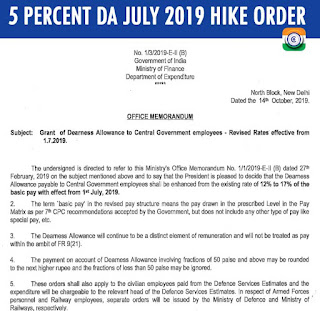
5 Percent DA July 2019 Hike Order - Grant of Dearness Allowance to Central Government employees

Grant of Dearness Allowance to Central Government employees 5 Percent DA July 2019 Hike Order  No. 1/3/2019-E- II (B) Government of...

Blog Archive

About The Author