A complete reference blog for Indian Government Employees

Showing posts with label Central Government Staff. Show all posts

Sunday, 26 March 2017

Government gives nod to 200% hike in salaries of Supreme Court, High Court judges


Government gives nod to 200% hike in salaries of Supreme Court, High Court judges

New Delhi: The government has accepted the Supreme Court proposal for raising emoluments given to judges of the Supreme Court and high courts, commensurate with the recent hike in pay for central government staff. The Chief Justice of India (CJI) is the highest-paid functionary in the judiciary with his current monthly emoluments at Rs 1 lakh, excluding dearness and other allowances. This is likely to be raised to Rs 2.8 lakh, in addition to perks such as official residence, cars, staff and allowances as applicable.
The government has pegged the salaries of the chief justices of High Courts and Supreme Court judges at Rs 2.5 lakh per month, in addition to allowances, at the level of the cabinet secretary, the service chiefs and some constitutional functionaries such as the CAG and the CEC. The salary of an High Court judge has been pegged at Rs 2.25 lakh per month, same as that of secretary- level officers in the central government.

The hikes proposed by the Supreme Court committee have not been accepted in full. The three-judge panel had recommended a salary of over Rs 3 lakh per month for the CJI, besides other perks. The government has set the salary for the CJI at Rs 2.8 lakh per month, a little above what the cabinet secretary draws. The judges’ panel had also recommended a higher pension benefit for retiring judges. This again has been brought to the Seventh Pay Commission level in an equivalent grade.

A three-judge committee had given its recommendations to the government a few months ago with regard to salary hikes for judges. The recommendations were submitted soon after the implementation of the Seventh Pay Commission recommendations for central employees last year. A Cabinet note has been prepared and may be approved by the Union Cabinet soon, sources said. After the Cabinet clears the proposal, the law minister will bring a related judges’ salary amendment bill before Parliament.

Any change in judges salary and service condition has to be passed by Parliament. The salaries of judges of the high courts and the Supreme Court are revised every 10 years, almost on the lines of the hikes given to senior government functionaries.

TNN
Share:

Thursday, 13 October 2016

7th Pay Commission: PNB joins SBI to woo Central government staff with cheaper loans


7th Pay Commission: PNB joins SBI to woo Central government staff with cheaper loans

Taking a cue from its bigger peer State Bank of India, public sector lender Punjab National Bank (PNB) has come out with special home and auto loan offers to attract Central government employees who are flush with cash after the bonanza handed out to them with the implementation of the recommendations of the 7th Central Pay Commission (CPC).

The scheme titled "PNB Pride" is effective from October 1, 2016, and comes with zero documentation and processing charges. Other terms and conditions applicable to existing home and vehicle loan borrowers will apply to those availing of loans under the "PNB Pride", according to the bank.

The aim of the scheme, according to the lender, is to "ensure availability of Housing Loan and Vehicle Loan at attractive rates and ensure a house and a car for all government employees."

The floating rate of interest for vehicle loans will be 9.55 percent (0.25 percent + marginal cost of lending rate, or MCLR). The fixed rate of interest is also the same, with a reset clause of three years.

As for home loans, the floating rate will be 9.30 percent and the fixed at 9.80 percent.

Earlier, State Bank of India (SBI) had announced flexible home loans to Central government employees (SBI Privilege Home Loan) and defence personnel (SBI Shaurya Home Loan") with pensionable service.
"Under the new schemes, employees of central/state governments, defence forces, public sector banks, public sector enterprises of central government and other individuals with pensionable service will be offered home loans tailored to their specific needs," the bank said in a statement in August this year.

"The launch of 'SBI Privilege Home Loan' and 'SBI Shaurya Home Loan' products is timed with the notification of 7th Pay Commission recommendations. Surplus income can thus be utilised by government employees and defence personnel towards purchase of new/better house," it added.

The bank gave an option to Central government employees to repay home loans up to the age of 75 years, as against 70 years applicable in other home loans given by the bank.

The recommendations of the 7th CPC cover 47 lakh Central government employees and 53 lakh pensioners, of which 14 lakh employees and 18 lakh pensioners are from the defence forces.

Source: Yahoo news
Share:

Sunday, 28 August 2016

7th Pay Commission: Salary hike likely for Karnataka govt employees; CM hints at setting up new panel

7th Pay Commission: Salary hike likely for Karnataka govt employees; CM hints at setting up new panel

Karnataka Chief Minister Siddaramaiah gave a strong indication to state government employees on Thursday when he hinted at setting up a pay panel to explore the possibility of salary hike that would benefit about 6.40 lakh employees.

“State government employees have been demanding salaries on a par with the Central government staff. The time has come to set up the next pay commission as the Centre is implementing the recommendations of the th pay commission,” Siddaramaiah was quoted as saying by Deccan Herald.

The chief minister spoke on the sidelines of the diamond jubilee celebration of the Karnataka Government Secretariat Employees’ Association (KGSEA) in Bengaluru.

The comment raised hopes of state government employees who had gone on a day-long strike on June 2 demanding pay parity with Central government staff.

“We are happy that the chief minister is keen on setting up a new pay commission. He also promised to look into our grievances,” KGSEA president Mahadevaiah Matapathii said. The last pay commission was set up by the state government five years ago.

Besides salary hike, the employees also want session allowance for all Vidhana Soudha employees and a site for the association’s building.

The 7th Pay Commission’s (CPC) recommendations hiking salary and allowances for Central government employees is a trigger for many state government employees to seek parity with their Central government counterparts.

The central government has accepted the recommendations pertaining to the hike in the salary component, while a decision on allowances is likely by November this year when a committee set up to examine raising allowances submits its report to the finance ministry.

The salary hike for Central government staff has also prompted employees of public sector undertakings (PSUs) to seek a similar hike for which they will be going on strike on September 2 in which state-run banks will also participate. Besides, pay hike, the strike is also in protest against “anti-labour” reforms of the government such as stake sale in PSUs.

Source: IBTIMES
Share:

Tuesday, 29 December 2015

7th Pay Commission did injustice to 98% of Central Government Employees

7th Pay Commission did injustice to 98% of Central Government Employees

Association for Administrative Staff states that while 7th CPC basic pay at lower level is 10 times of existing grade pay, it is 14 times in higher level.

7th Pay Commission did injustice to 98% of Central Government Employees – All India Association of Administrative Staff (Non-gazetted) provides comparative chart of increase in basic pay at lower level and higher level keeping Grade Pay as a factor

I am bringing the following to your knowledge and information of Central Government Staff that VIIth Pay commission has done injustice to 98% of the Central Government Staff by just giving a multiplication factor of around 10 times their existing Grade Pay but generously awarded more than 14 times multiplication benefit to higher officials. So please fight for uniform multiplication of 14 times of the Grade pay and for each year of service one increment at the new scale as recommended to retired employees to give justice to all.

PB I Rs 5200-20200
Grade Pay
Minimum recommended @ entry level by 7th CPC (Rs) in the Pay Matrix Multiplication factor by VII th pay Commission
1800 18000 10 times
1900 19900 (difference +1900) 10.47
2000 21700(difference +1800) 10.85
2400 25500(difference +3700) 10.62
2800 29200(difference +3800) 10.42

Initially for first 2 stages every Rs100/ in GP the corresponding proposed increase is 1800 0r 1900 but for GP difference of Rs 400/ at later 2 stages the corresponding increase is only Rs3700/ to Rs3800/- whereas it must be Rs1800 0r 1900 multiplied by 4times to Rs7200-7600/.

PB II Rs 9300-34800
Grade Pay
Minimum recommended @ entry level by 7th CPC (Rs) in pay matrix Multiplication factor by VII th pay Commission
4200 35400(difference +6200) 8.42 times
4600 44900 (difference +9500) 9.76
4800 47600(difference +2700) 9.91
5400 53100(difference +5500) 9.83

Initially for Rs1400/- GP difference the corresponding increase proposed is Rs6200/- but in next stage for Rs 400/- GP the proposed hike is mind blowing Rs 9500/-, in next stage for Rs 200/- GP the increase is Rs 2700/- and for Rs 600/- GP hike further increase is Rs5500/-

PB III Rs 15600-39100
Grade Pay
Minimum recommended @ entry level by 7th CPC (Rs) in the Pay matrix Multiplication factor by VII th pay Commission
5400 56100 10.38times
6600 67700 (difference +11600) 10.25
7600 78800(difference +11100) 10.36

For a GP of Rs1200/- difference the hike proposed is Rs11600/- and for another Rs1000/- GP increase the increase given by CPC is Rs 11100/-

PB IV Rs 37400-67000
Grade Pay
Minimum recommended @ entry level by 7th CPC (Rs)in the Pay matrix Multiplication factor by VII th pay Commission
8700 118500(difference +39700) 13.62 times
8900 131100 (difference +12600) 14.73
10000 144200(difference +13100) 14.42

For a GP increase of Rs1100/- the CPC proposed a hike of Rs39700/- and for a GP difference of Rs200/- the CPC recommended a increase of Rs12600/- and for a GP increase of Rs1100/- the CPC recommended a hike of Rs13100/-

It will easily understood the members of VIIth Pay commission done fixation and recommendation quite irrationally without any uniformity in a whimsical manner. If 14 times multiplication is awarded to all the staff uniformly Min.Basic will be Rs1800* 14 = 25200/-for entry level staff. Kindly publish this in your website.

Source: All India Association of Administrative Staff (Non-gazetted)
Share:

Tuesday, 1 December 2015

Check out top 10 points to clear all doubts in mind regarding the 7th Pay Commission pension, pay scales, MSP, MACP and more

7th Pay Commission pension, pay scales, MSP, MACP
Check out top 10 points to clear all doubts in mind regarding the 7th Pay Commission pension, pay scales, MSP, MACP and more:


7th Pay Commission pension, pay scales – highlights, more: 
The 7th Pay Commission report has recommended an average 23.55% hike in salaries and allowances of Central government staff and the same is likely to be replicated in all the states too, except Puducherry where the same system as in Centre is already applicable – minimum pay set at Rs 18,000 per month and maximum pay at Rs 2,50,000 per month – recommended date of implementation: 01, January, 2016.

Here we provide all you ever wanted to know in 10 points on most crucial aspects of the 7th Pay Commission report:
1. 7th Pay Commission pension, pay scales, allowances – Minimum Pay:
Based on the Dr Wallace Aykroyd formula (nutrition) , the minimum pay (salary) in government is recommended to be set at Rs 18,000 per month; Maximum Pay: Rs 2,25,000 per month for Apex Scale and Rs 2,50,000 per month for Cabinet Secretary and others presently at the same pay level. If passed, the salary hikes this report is recommending are likely to boost demand for consumer goods across the spectrum, even though it could also be inflationary. (Reuters)
2. 7th Pay Commission pension, pay scales, allowances – Advances:
a. All non-interest bearing Advances have been abolished; b. Regarding interest-bearing Advances, only Personal Computer Advance and House Building Advance (HBA) have been retained. HBA ceiling has been increased to Rs 25 lakhs from the present Rs 7.5 lakhs. (PTI)
3. 7th Pay Commission pension, pay scales, allowances – Pension:
The Commission recommends a revised pension formulation for civil employees including CAPF personnel as well as for Defence personnel, who have retired before 01.01.2016. This formulation will bring about parity between past pensioners and current retirees for the same length of service in the pay scale at the time of retirement. The 7th Pay Commission received many grievances relating to New Pension System (NPS). It has recommended a number of steps to improve the functioning of NPS. It has also recommended establishment of a strong grievance redressal mechanism. (PTI)
4. 7th Pay Commission pension, pay scales, allowances – Performance Related Pay:
The Commission has recommended introduction of the Performance Related Pay (PRP) for all categories of Central Government employees, based on quality Results Framework Documents, reformed Annual Performance Appraisal Reports and some other broad Guidelines. The Commission has also recommended that the PRP should subsume the existing Bonus schemes. (PTI)
5. 7th Pay Commission pension, pay scales, allowances – New Pay Structure:
Considering the issues raised regarding the Grade Pay structure and with a view to bring in greater transparency, the present system of pay bands and grade pay has been dispensed with and a new pay matrix has been designed. Grade Pay has been subsumed in the pay matrix. The status of the employee, hitherto determined by grade pay, will now be determined by the level in the pay matrix. The rate of Annual Increment is being retained at 3 percent. (PTI)
6. 7th Pay Commission pension, pay scales, allowances – Modified Assured Career Progression (MACP):
a. Performance benchmarks for MACP have been made more stringent from “Good” to “Very Good”; b. The Commission has also proposed that annual increments not be granted in the case of those employees who are not able to meet the benchmark either for MACP or for a regular promotion in the first 20 years of their service; c. No other changes in MACP recommended. (Thinkstock)
7. 7th Pay Commission pension, pay scales, allowances – Military Service Pay (MSP):
The Military Service Pay, which is a compensation for the various aspects of military service, will be admissible to the Defence forces personnel only. As before, Military Service Pay will be payable to all ranks up to and inclusive of Brigadiers and their equivalents. The current MSP per month and the revised rates recommended are as follows: (Reuters)
8. 7th Pay Commission pension, pay scales, allowances – Short Service Commissioned Officers:
Short Service Commissioned Officers will be allowed to exit the Armed Forces at any point in time between 7 and 10 years of service, with a terminal gratuity equivalent of 10.5 months of reckonable emoluments. The Seventh Pay Commission also says they will further be entitled to a fully funded one year Executive Programme or a M.Tech. programme at a premier Institute to better their prospects in later life. (PTI)
9. 7th Pay Commission pension, pay scales, allowances – Allowances:
The Commission has recommended abolishing 52 allowances altogether. Another 36 allowances have been abolished as separate identities, but subsumed either in an existing allowance or in newly proposed allowances. Allowances relating to Risk and Hardship will be governed by the proposed Risk and Hardship Matrix. a. Risk and Hardship Allowance: Allowances relating to Risk and Hardship will be governed by the newly proposed nine-cell Risk and Hardship Matrix, with one extra cell at the top, viz., RH-Max to include Siachen Allowance. (PTI)
10. 7th Pay Commission pension, pay scales, allowances – Financial Implications:
The total financial impact in the FY 2016-17 is likely to be Rs 1,02,100 crore, over the expenditure as per the “Business As Usual” scenario. Of this, the increase in pay would be Rs 39,100 crore, increase in allowances would be Rs 29,300 crore and increase in pension would be Rs 33,700 crore. In percentage terms the overall increase in pay & allowances and pensions over the “Business As Usual” scenario will be 23.55 percent. Within this, the increase in pay will be 16 percent, increase in allowances will be 63 percent, and increase in pension would be 24 percent. (Image by PTI)

Source:  financialexpress.com
Share:

Monday, 13 April 2015

Grant-in-aid for the provision of amenities or recreational or welfare facilities to the staff of the Central Government- regarding

Grant-in-aid for the provision of amenities or recreational or welfare facilities to the staff of the Central Government
F.No. 1/1/2014-Welfare
Government of India
M/o Personnel & Public Grievances & Pensions
D/o Personnel & Training
New Delhi, Dated 10 April, 2015
Office Memorandum

Subject: Grant-in-aid for the provision of amenities or recreational or welfare facilities to the staff of the Central Government- regarding.

The undersigned is directed to refer this Department’s O.M. No. 1/38/98-Welfare dated 14th October, 1999 (Copy enclosed) regarding grants-in-aid for the provision of amenities for recreation/ welfare activities to the staff of the Central Government Offices in as well as outside Delhi/ New Delhi.

2. The position has been reviewed and it has been decided that the grants-in-aid to the Recreation Clubs shall be admissible at the following rates from the current financial year 2015-2016.
(i) Grants-in-aid at the rate of Rs. 25/- per head per annum as against existing rate of Rs. 10/- per head per annum .
(ii) An additional grant-in-aid subject to a maximum of Rs. 25/- per head per annum, may be given as matching grant as against the existing rate of Rs. 15/- per head per annum.
(iii) A maximum grant of Rs. 25,000/- instead of Rs. 10,000/- may be sanctioned (after considering requirement on merits) for setting up of a recreation club.
3. Instructions issued from time to time on the subject may be adhered to.

4. This issues with the concurrence of Ministry of Finance, Department of Expenditure’s I.D. No. 8(41)/2014-E-II (A), 13th February, 2015 and SS&FA (Home) Dy No. 3111501, dated 04.03.2015.

(N.Sriraman)
Director (Welfare)
Click here to download Original DOPT Order
Share:

Tuesday, 3 March 2015

Central Government staff demand early implementation of wage revision

Central Government staff demand early implementation of wage revision

Members of the Joint Council of Action South Zone which represents employees from the Railway, Defence, Postal and other Central Government departments organised a protest meeting near the Collectorate premises here on Monday.

More than 300 members of various associations, including Southern Railway Mazdoor Union (SRMU), All India Defence Employees’ Federation (AIDEF) and National Federation of Postal Employees (NFPE), participated in the protest meeting. Zonal president Raja Sridhar and divisional secretary J.M. Rafiq addressed the meeting.

The members also submitted a petition at the Collectorate along with a copy of the demands adopted by the National Convention of the Central Government Employees in December 2014.

In their 37-point charter of demands, the employees asked for the implementation of wage revision for Central government employees, which should be done once in every five years.

‘No privatisation’

They also demanded that no privatisation or Foreign Direct Investment should be allowed in railways and defence establishments, and opposed corporatisation of postal services.

Among other things, they also opposed outsourcing and privatisation of governmental functions and asked the government to withdraw the proposed move to close down printing presses.

Stating that many residential quarters needed renovation, the employees urged the Central government to carry out repairs, not to compel staff to stay in inhabitable quarters, and pay house rent allowance.

Source: thehindu
Share:

Featured post

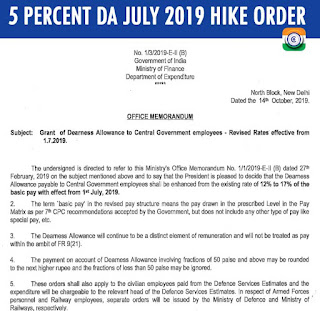
5 Percent DA July 2019 Hike Order - Grant of Dearness Allowance to Central Government employees

Grant of Dearness Allowance to Central Government employees 5 Percent DA July 2019 Hike Order  No. 1/3/2019-E- II (B) Government of...

Blog Archive

About The Author