A complete reference blog for Indian Government Employees

Showing posts with label Supreme Court. Show all posts

Monday, 27 April 2020

PIL Filed for Central Government Employees Freezing DA in Supreme Court

PIL Filed for Central Government Employees Freezing DA in Supreme Court

IN THE HON'BLE SUPREME COURT OF INDIA AT NEW DELHI.
PIL DATED 24th APRIL 2020 via Email regarding payment of DA or PIL DATED 24th APRIL 2020 via email regarding payment of DA or Dearness allowance with effect from 1st January 2020 atleast to veterans and to all employees if possible

Major Onkar Singh Guleria Retired, a Senior Citizen and CANCER PATIENT, aged 69 years, son of Late Shri Kikar Singh Guleria resident of village Jachh PO Jassur Tehsil Nurpur Distt Kangra Himachal Pradesh 176201.

VERSUS
  1. Union of India through Secretary Finance Govt of India New Delhi 110011.
  2. Union of India through Secretary Home Govt of India New Delhi 110011.
BEFORE CHIEF JUSTICE AND ALL HIS COMPANION JUSTICES OF SUPREME COURT OF INDIA TO DIRECT UNION OF INDIA TO PRACTICE WHAT PRIME MINISTER OF INDIA PREACHES TO 130 CRORES DESHWASI AND DEFREEZE DA or dearness allownce by paying with effect from 01st January 2020 to Veterans atleast if not to employees.

MOST RESPECTFULLY SHOWETH,

1. That the applicant a CANCER PATIENT, disabled of right foot and also suffering from hypertension and a Senior Citizen with no home but living in a rented building in my last span of life and also to take care of wife a senior citizen suffering from various ailments and my only source of income is my monthly military pension of the rank of Major that too on reduced scale. I and lakhs of Veterans are aggrieved by arbitrary act of Union of India through Secretary Finance Govt of India New Delhi who were committed to pay arrears of DA or dearness allowance in first week of April 2020 but purposely not payed and on 20th April 2020 has FREEZED "DA or dearness allowance" retrospectively with effect from 01st January 2020 to cause us Veterans an irreparable loss that too at a time when Pandemic of COVID 19 VIRUS (China Originated Virus in December 19) has been commiting genocide in entire world and we to survive honourably need every paisa due to us from Govt of India. I attache arbitrary orders of freezing of DA or dearness Allowances dated 20th April 2020 of Secretary Finance Govt of India as ready referance for the Hon'ble Court.

2. That DA or dearness allowance can be basically understood as a component of salary, aimed at hedging the impact of inflation. The DA or dearness allowance is calculated as a specific percentage of the basic salary which is then added to the basic salary. PENSION received by a retired individual is considered as salary and taxed as, income from salary. Generally whatever is received from the employer in cash including DA or dearness allowance is treated as salary.

3. That the Union of India itself after studying the impact of inflation had announced increased instalment of DA or dearness allowance with effect from 01st January 2020 and promised to pay its employees and Veterans receiving pension in first week of April 2020 which was illegally and arbitrarily withheld and as a afterthought issued malafied orders dated 20th April 2020 ordering of freez of DA or dearness allowance retrospectively from 01st January 2020. It has come as a big blow especially to pensioners at a time when all veterans are more vunerable to catching COVID 19 VIRUS (China Originated Virus in December 19 ) as being daily advocated by Prime Minister of India and all functionaries of Union of India and Doctors through media and advisory letters in black and white. When Union of India is doling out financial package after package from announced budget of 2020-21 in Parliament and later various stimulous financual packages gìven and planning to give to business houses for whom at drop of hat the Political and Administrative Governments of whom many are directly or indirectly associated with industry then huge financial stimulous is being passed even during this national rather international calamity of COVID 19 ( CHINA ORIGINATED VIRUS IN DECEMBER 19), Whereas, petty amount for Union of India but it is a large amount for its employees and Retired personnels who in last span of life are undergoing various hardships is being denied by freezing "DA or dearness allowance" that too retrospectively wef 01st January 2020. This arbitrary and illegal mechanical step of Union of India without applying mind must be struck down immediately and all beneficairies paid their legitmate authorised "DA or dearness allowance" wef 01st January 2020 and continued to be paid. Even Union of India has taken care of other classes of India but subjected the "MIDDLE CLASS" to this horible torture by freezing its "DA or dearness Allowances"at a time when we need every paisa in our last span of life. We by cutting our legitimate expenses have even made small contribution to "PM CARES FUND" which so far is not transparent.

Also check: Second National Judicial Pay Commission has filed the subject of Pay, Pension and Allowances, in Supreme Court on 29.01.2020

4. Then why does Prime Minister of India preaches to look after Senior citizens, not to cut salary when his own Govt is doing it. Atleast the Union of India must practice what its Prime Minster preaches.

5. Copy if this P.I.L., is being sent to all concerned by mail and all Chief Ministers are also requested to pay "DA or dearness Allowances" wef 01st January 2020 to their employees and Retired personnels."HAVES"Political and Administrative class and affluent families are nit in touch with reality. A prominent singer is heard on TV asking 130 Crore Deshwasi to donate atleast Rs.100 Per person to make it Rs13000Crores donations. Madam there are many who have not seen or handled Rs.100 note in their entire life. Then if five of family members donate then amount comes to Rs.500/- which is equivalent to one month amount given to BPL Families by Govt of India. Madam have a heart and producers allowing her to speak this in print media has never applied mind to these ground realities. Sad, how insensitive are our "HAVES"Class!

RELIEFS SOUGHT WITH SPEAKING ORDERS.

6. In the given premises it is respectfully prayed that the Hon'ble Court be pleased to direct Union of India through Secretary Finance Govt of India New Delhi and Secretary Home Govt of India to:

(A) Pay immediately "DA or dearness Allowances" to all employees and Retired personnels and same be done by respective States and Union Territories of India.

(B) Union of India be directed to immediately stop various financial stimulous package being given or are being planned to be given in near future to business houses as after freezing "DA or dearness Allowances" Union of India admits that financial health of the Nation is not sound and healthy. More over these business houses are directly or indirectly related to all Political class who like to enjoy all benefits even in national calamities. Some are seen distributing Govt or public donations of food etc to poor to ensure their own stamp on it. India with Lockdown has gone back to "SATJUG" in many ways and air and water is purified and need of the hour is purification of "HAVES", i.e., the Political cum business class. Union of India must practice what Prime Minister of India preaches to look after senior citizens and not to cut salary.

Also read: MACP ON PROMOTIONAL HIERARCHY - MACP Supreme Court Order - Heard & Reserved - Order dated 23 Jan 2020

7. Kindly direct registry to confirm receipt and action taken via revert Email.

NAMASTE INDIA! JAI HIND!

(MAJOR ONKAR SINGH GULERIA RETD)
(A CANCER PATIENT)
Mob: 7018748978, 9418009991.
Email: maj.onkarsinghguleria@gmail.com

Share:

Thursday, 6 February 2020

Second National Judicial Pay Commission has filed the subject of Pay, Pension and Allowances, in Supreme Court on 29.01.2020

Second National Judicial Pay Commission has filed the subject of Pay, Pension and Allowances, in Supreme Court on 29.01.2020.

Latest-Central-Government-Employees-News-pay-commission-pay-pension-allowances

Ministry of Labour & Employment
Second National Judicial Pay Commission submits its Report

06 FEB 2020

The Second National Judicial Pay Commission has filed the main part of the Report in 4 volumes covering the subject of Pay, Pension and Allowances, in the Registry of the Supreme Court on 29.01.2020. The Commission has been constituted pursuant to the Order of the Supreme Court in All India Judges Association case and the Government of India, Ministry of Law & Justice issued a Notification dated 16.11.2017 in this regard. Shri Justice P.V. Reddi, former Judge of the Supreme Court is the Chairman, Shri Justice R. Basant, former Judge of Kerala High Court is the Member and Shri Vinay Kumar Gupta, District Judge of Delhi Higher Judicial Service is the Member-Secretary of the Commission.

Also check: 7th Pay Commission Latest News 2020

The Interim Report was submitted by the Commission in 2018.

The salient recommendations are:

PAY: The Commission having considered various alternative methodologies has recommended the adoption of Pay Matrix which has been drawn up by applying the multiplier of 2.81 to the existing pay, commensurate with the percentage of increase of pay of High Court Judges. @ 3% cumulative has been applied.

As per the revised pay structure evolved by the Commission, the Junior Civil Judge / First Class Magistrate whose staring pay is Rs.27,700/- will now get Rs.77,840/-. The next higher post of Senior Civil Judge starts with the pay of Rs.1,11,000/- and that of the District Judge Rs.1,44,840/-. The highest pay which a District Judge (STS) will get, is Rs.2,24,100/-.

The percentage of Selection Grade and Super Time Scale District Judges proposed to be increased by 10% and 5% respectively.

The revised pay and pension will be effective from 01.01.2016. Arrears will be paid during the Calendar year 2020 after adjusting the interim relief.

PENSION: Pension at 50% of last drawn pay worked out on the basis of proposed revised pay scales is recommended w. e. f. 1-1-2016. The family pension will be 30% of the last drawn pay. Additional quantum of pension will commence on completing the age of 75 years (instead of 80 years) and percentages at various stages thereafter are increased. The existing ceiling of retirement gratuity and death gratuity will be increased by 25% when the DA reaches 50%.

Nodal officers will be nominated by the District Judges to assist the pensioners / family pensioners.
Recommendation has been made to discontinue the New Pension Scheme (NPS) which is being applied to those entering service during or after 2004. The old pension system, which is more beneficial, will be revived.

ALLOWANCES: The existing allowances have been suitably increased and certain new features have been added. However, the CCA is proposed to be discontinued.

Recommendations are made to improve the medical facilities and to simplify the reimbursement procedure. Medical facilities will be granted to pensioners and family pensioners also.

Certain new allowances viz. children education allowance, home orderly allowances, transport allowance in lieu of pool car facility, have been proposed. HRA proposed to be increased uniformly in all States. Steps to ensure proper maintenance of official quarters recommended.

The recommendations made by the Commission are applicable to the Judicial officers throughout the country.

Supreme Court will have to issue directions regarding the implementation of recommendations after hearing the stakeholders.

PIB
Share:

Sunday, 27 January 2019

Supreme Court agrees to examine Centre's decision to grant 10 pc quota to poor in general category


Supreme Court agrees to examine Centre's decision to grant 10 pc quota to poor in general category

The Supreme Court Friday decided to examine the Centre's decision to grant 10 percent reservation in jobs and education to poor candidates belonging to general category.

A bench comprising Chief Justice Ranjan Gogoi and Justice Sanjiv Khanna issued notice to the central government on various petitions challenging the validity of the Constitution (103 Amendment) Act, 2019, which paved the way for grant of quota to poor belonging to general category.

"We are examining the matter and hence issuing notice returnable within four weeks," the bench said.
The bench, however, did not stay the operation of the Centre's decision granting quota to the poor in the general category.

In poll year, the Narendra Modi government had come out with the constitutional amendment bill giving quota benefits to the poor among general category candidates.

The petitions were filed by parties including organisations like Janhit Abhiyan and Youth For Equality challenging the Centre's decision.

The petition, filed by Youth For Equality, has sought the quashing of the bill saying that the economic criterion cannot be the sole basis for reservation.
The plea has said the bill violates basic feature of the Constitution as reservation on economic grounds cannot be limited to the general categories and the 50 per cent ceiling limit cannot be breached.

A similar plea has been filed by businessman Tehseen Poonawalla seeking to quash the bill, saying that backwardness for the purpose of reservation cannot be defined by "economic status alone".
The quota will be over and above the existing 50 per cent reservation to SCs, STs and Other Backward Classes (OBCs).

Lok Sabha and Rajya Sabha cleared the Bill on January 8 and 9 respectively and it has also been signed by President Ram Nath Kovind.

Source: PTINews
Share:

Thursday, 4 October 2018

Government has no power to withhold Pensionary Benefits if departmental or judicial proceeding are pending: Supreme Court


Government has no power to withhold Pensionary Benefits if departmental or judicial proceeding are pending: Supreme Court

C.A. No.6770/2013 @ SLP (C) No. 1427 of 2009

REPORTABLE
IN THE SUPREME COURT OF INDIA
CIVIL APPELLATE JURISDICTION
CIVIL APPEAL NO. 6770 OF 2013

(Arising out of Special Leave Petition (Civil) No. 1427 of 2009)

State of Jharkhand & Ors. ---- Appellant(s)
Vs.
Jitendra Kumar Srivastava & Anr. --- Respondent(s)
WITH
C.A. No. 6771/2013
(arising out of SLP(C) No. 1428 of 2009)
J U D G M E N T
A.K. Sikri, J

1. Leave granted. pensionary

2. Crisp and short question which arises for consideration in these cases is as to whether, in the absence of any provision in the Pension Rules, the State Government can withhold a part of pension and/or gratuity during the pendency of departmental/ criminal proceedings? The High Court has - answered this question, vide the impugned judgment, in the negative and hence directed the appellant to release the withheld dues to the respondent. Not happy with this outcome, the State of Jharkhand has preferred this appeal.

3. For the sake of convenience we will gather the facts from Civil Appeal arising out of SLP(Civil) No. 1427 of 2009. Only facts which need to be noted, giving rise to the aforesaid questions of law, are the following:

The respondent was working in the Department of Animal Husbandry and Fisheries. He joined the said Department in the Government of Bihar on 2.11.1966. On 16.4.1996, two cases were registered against him under various Sections of the Indian Penal Code as well as Prevention of Corruption Act, alleging serious financial irregularities during the years 1990-1991, 1991-1992 when he was posted as Artificial Insemination Officer, Ranchi. On promulgation of the Bihar Reorganisation Act, 2000, State of Jharkhand (Appellant herein) came into existence and the Respondent became the employee of the appellant State. Prosecution, in respect of the aforesaid two criminal cases against the respondent is pending. On 30th January, 2002, the appellant also ordered initiation of disciplinary action against him. While these proceedings were still pending, on attaining the age of superannuation, the respondent retired from the post of Artificial Insemination Officer, Ranchi on 31.08.2002. The appellant sanctioned the release and payment of General Provident Fund on 25.5.2003. Thereafter, on 18.3.2004, the Appellant sanctioned 90 percent provisional pension to the respondent. Remaining 10 percent pension and salary of his suspension period (30.1.2002 to 30.8.2002) was withheld pending outcome of the criminal cases/ departmental inquiry against him. He was also not paid leave encashment and gratuity.

4. Feeling aggrieved with this action of the withholding of his 10 percent of the pension and non-release of the other aforesaid dues, the respondent preferred the Writ Petition before the High Court of Jharkhand. This Writ Petition was disposed of by the High Court by remitting the case back to the Department to decide the claim of the petitioner for payment of provisional pension, gratuity etc. in terms of Resolution No. 3014 dated 31.7.1980. The appellant, thereafter, considered the representation of the respondent but rejected the same vide orders dated 16.3.2006. The respondent challenged the rejection by filing another Writ Petition before the High Court. The said petition was dismissed by the learned Single Judge. The respondent filed C.A. No.6770/2013 @ SLP (C) No. 1427 of 2009 Intra Court Appeal which has been allowed by the Division Bench vide the - impugned orders dated 31.10.2007. The Division Bench has held that the question is squarely covered by the full Bench decision of that Court in the case of Dr. Dudh Nath Pandey vs. State of Jharkhand and Ors. 2007 (4) JCR 1. In the said full Bench Judgment dated 28.8.2007, after detailed discussions on the various nuances of the subject matter, the High Court has held:

" To sum up the answer for the two questions are as follows:

(i) Under Rule 43(a) and 43(b) of Bihar Pension Rules, there is no power for the Government to withhold Gratuity and Pension during the pendency of the departmental proceeding or criminal proceeding. It does not give any power to withhold Leave Encashment at any stage either prior to the proceeding or after conclusion of the Proceeding.

(ii) The circular, issued by the Finance Department, referring to the withholding of the leave encashment would not apply to the present facts of the case as it has no sanctity of law".

5. Mr. Amarendra Sharan, the learned Senior Counsel appearing for the petitioner accepted the fact that in so far as the Pension Rules are concerned, there is no provision for withholding a part of pension or gratuity. He, however, submitted that there are administrative instructions which permit withholding of a part of pension and gratuity. His submission was that when the rules are silent on a particular aspect, gap can be filled by the - administrative instructions which was well settled legal position, laid down way back in the year 1968 by the Constitution Bench Judgment of this Court in Sant Ram Sharma vs. Union of India 1968 (1) SCR 111. He, thus, argued that the High Court has committed an error in holding that there was no power with the Government to withhold the part of pension or gratuity, pending disciplinary/criminal proceedings.

6. The aforesaid arguments of the learned Senior Counsel based on the judgment in Sant Ram Sharma would not cut any ice in so far as present case is concerned, because of the reason this case has no applicability in the given case. Sant Ram judgment governs the field of administrative law wherein the Constitution Bench laid down the principle that the rules framed by the authority in exercise of powers contained in an enactment, would also have statutory force. Though the administration can issue administrative instructions for the smooth administrative function, such administrative instructions cannot supplant the rules. However, these administrative instructions can supplement the statutory rules by taking care of those situations where the statutory rules are silent. This ratio of that judgment is narrated in the following manner:

"It is true that there is no specific provision in the Rules laying down the principle of promotion of junior or senior grade - officers to selection grade posts. But that does not mean that till statutory rules are framed in this behalf the Government cannot issue administrative instructions regarding the principle to be followed in promotions of the officers concerned to selection grade posts. It is true that Government cannot amend or supersede statutory rules by administrative instructions, but if the rules are silent on any particular point Government can fill up the gaps and supplement the rules and issue instructions and inconsistent with the rules already framed".

There cannot be any quarrel on this exposition of law which is well grounded in a series of judgments pronounced post Sant Ram Sharma case as well. However, the question which is posed in the present case is altogether different.

7. It is an accepted position that gratuity and pension are not the bounties. An employee earns these benefits by dint of his long, continuous, faithful and un-blemished service. Conceptually it is so lucidly described in D.S. Nakara and Ors. Vs. Union of India; (1983) 1 SCC 305 by Justice D.A. Desai, who spoke for the Bench, in his inimitable style, in the following words:

"The approach of the respondents raises a vital and none too easy of answer, question as to why pension is paid. And why was it required to be liberalised? Is the employer, which expression will include even the State, bound to pay pension? Is there any obligation on the employer to provide for the erstwhile employee even after the contract of employment has come to an end and the employee has ceased to render service?

What is a pension? What are the goals of pension? What public interest or purpose, if any, it seeks to serve? If it does seek to serve some public purpose, is it thwarted by such artificial division of retirement pre and post a certain date? We need seek answer to these and incidental questions so as to render just justice between parties to this petition.

The antiquated notion of pension being a bounty a gratituous payment depending upon the sweet will or grace of the employer not claimable as a right and, therefore, no right to pension can be enforced through Court has been swept under the carpet by the decision of the Constitution Bench in Deoki Nandan Prasad v. State of Bihar and Ors.[1971] Su. S.C.R. 634 wherein this Court authoritatively ruled that pension is a right and the payment of it does not depend upon the discretion of the Government but is governed by the rules and a Government servant coming within those rules is entitled to claim pension. It was further held that the grant of pension does not depend upon any one’s discretion. It is only for the purpose of quantifying the amount having regard to service and other allied maters that it may be necessary for the authority to pass an order to that effect but the right to receive pension flows to the officer not because of any such order but by virtue of the rules. This view was reaffirmed in State of Punjab and Anr. V. Iqbal Singh (1976) IILLJ 377SC".

8. It is thus hard earned benefit which accrues to an employee and is in the nature of "property". This right to property cannot be taken away without the due process of law as per the provisions of Article 300 A of the Constitution of India.

9. Having explained the legal position, let us first discuss the rules relating to release of Pension. The present case is admittedly governed by -

Bihar Pension Rules, as applicable to the State of Jharkhand. Rule 43(b) of the said Pension Rules confers power on the State Government to withhold or withdraw a pension or part thereof under certain circumstances. This Rule 43(b) reads as under:

"43(b) The State Government further reserve to themselves the right of withholding or withdrawing a pension or any part of it, whether permanently or for specified period, and the right of ordering the recovery from a pension of the whole or part of any pecuniary loss caused to Government if the pensioner is found in departmental or judicial proceeding to have been guilty to grave misconduct, or to have caused pecuniary loss to Government misconduct, or to have caused pecuniary loss to Government by misconduct or negligence, during his service including service rendered on re-employment after retirement".
From the reading of the aforesaid Rule 43(b), following position emerges:-
(i) The State Government has the power to withhold or withdraw pension or any part of it when the pensioner is found to be guilty of grave misconduct either in a departmental proceeding or judicial proceeding.
(ii) This provision does not empower the State to invoke the said power while the department proceeding or judicial proceeding are pending.
(iii) The power of withholding leave encashment is not provided under this rule to the State irrespective of the result of the above proceedings.
(iv) This power can be invoked only when the proceedings are concluded finding guilty and not before.

10. There is also a Proviso to Rule 43(b), which provides that:-
"A. Such departmental proceedings, if not instituted while the Government Servant was on duty either before retirement or during re-employment.
i. Shall not be instituted save with the sanction of the State Government.
ii Shall be in respect of an event which took place not more than four years before the institution of such proceedings.
iii Shall be conducted by such authority and at such place or places as the State Government may direct and in accordance with the procedure applicable to proceedings on which an order of dismissal from service may be made:-

B. Judicial proceedings, if not instituted while the Government Servant was on duty either before retirement or during re-employment shall have been instated in accordance with sub clause (ii) of clause (a) and

C. The Bihar Public Service Commission, shall be consulted before final orders are passed.
It is apparent that the proviso speaks about the institution of proceedings. For initiating proceedings, Rule 43(b) puts some conditions, i.e, Department proceeding as indicated in Rule 43(b), if not instituted while the Government Servant was on duty, then it shall not be instituted except:-
(a) With the sanction of the Government,
(b) It shall be in respect of an event which took place not more than four years before the institution of the proceedings.
(c) Such proceedings shall be conducted by the enquiry officer in accordance with the proceedings by which dismissal of the services can be made.

Thus, in so far as the proviso is concerned that deals with condition for initiation of proceedings and the period of limitation within which such proceedings can be initiated.

11. Reading of Rule 43(b) makes it abundantly clear that even after the conclusion of the departmental inquiry, it is permissible for the Government to withhold pension etc. ONLY when a finding is recorded either in departmental inquiry or judicial proceedings that the employee had committed grave misconduct in the discharge of his duty while in his office. There is no provision in the rules for withholding of the pension/ gratuity when such departmental proceedings or judicial proceedings are still pending.

12. Right to receive pension was recognized as right to property by the Constitution Bench Judgment of this Court in Deokinandan Prasad vs. State of Bihar; (1971) 2 SCC 330, as is apparent from the following discussion:

"29. The last question to be considered, is, whether the right to receive pension by a Government servant is property, so as to attract Articles 19(1)(f) and 31(1) of the Constitution. This question falls to be decided in order to consider whether the writ petition is maintainable under Article 32. To this aspect, we have already adverted to earlier and we now proceed to consider the same.

30. According to the petitioner the right to receive pension is property and the respondents by an executive order dated June 12, 1968 have wrongfully withheld his pension. That order affects his fundamental rights under Articles 19(1)(f) and 31(1) of the Constitution. The respondents, as we have already indicated, do not dispute the right of the petitioner to get pension, but for the order passed on August 5, 1966. There is only a bald averment in the counter-affidavit that no question of any fundamental right arises for consideration. Mr. Jha, learned counsel for the respondents, was not prepared to take up the position that the right to receive pension cannot be considered to be property under any circumstances. According to him, in this case, no order has been passed by the State granting pension. We understood the learned counsel to urge that if the State had passed an order granting pension and later on resiles from that order, the latter order may be considered to affect the petitioner's right regarding property so as to attract Articles 19(1) (f) and 31(1) of the Constitution.

31. We are not inclined to accept the contention of the learned counsel for the respondents. By a reference to the material provisions in the Pension Rules, we have already indicated that the grant of pension does not depend upon an order being passed by the authorities to that effect. It may be that for the purposes of quantifying the amount having regard to the period of service and other allied matters, it may be necessary for the authorities to pass an order to that effect, but the right to receive pension flows to an officer not because of the said order but by virtue of the Rules. The Rules, we have already pointed out, clearly recognise the right of persons like the petitioner to receive pension under the circumstances mentioned therein.

32. The question whether the pension granted to a public servant is property attracting Article 31(1) came up for consideration before the Punjab High Court in Bhagwant Singh v. Union of India A.I.R. 1962 Pun 503. It was held that such a right constitutes 'property' and any interference will be a breach of Article 31(1) of the Constitution. It was further held that the State cannot by an executive order curtail or abolish altogether the right of the public servant to receive pension. This decision was given by a learned Single Judge. This decision was taken up in Letters Patent Appeal by the Union of India. The Letters Patent Bench in its decision in Union of India v. Bhagwant Singh I.L.R. 1965 Pun 1 approved the decision of the learned Single Judge. The Letters Patent Bench held that the pension granted to a public servant on his retirement is 'property' within the meaning of Article 31(1) of the Constitution and he could be deprived of the same only by an authority of law and that pension does not cease to be property on the mere denial or cancellation of it. It was further held that the character of pension as 'property' cannot possibly undergo such mutation at the whim of a particular person or authority.

33. The matter again came up before a Full Bench of the Punjab and Haryana High Court in K.R. Erry v. The State of Punjab I.L.R. 1967 P & H 278. The High Court had to consider the nature of the right of an officer to get pension. The majority quoted with approval the principles laid down in the two earlier decisions of the same High Court, referred to above, and held that the pension is not to be treated as a bounty payable on the sweet will and pleasure of the Government and that the right to superannuation pension including its amount is a valuable right vesting in a Government servant It was further held by the majority that even though an opportunity had already been afforded to the officer on an earlier occasion for showing cause against the imposition of penalty for lapse or misconduct on his part and he has been found guilty, nevertheless, when a cut is sought to be imposed in the quantum of pension payable to an officer on the basis of misconduct already proved against him, a further opportunity to show cause in that regard must be given to the officer. This view regarding the giving of further opportunity was expressed by the learned Judges on the basis of the relevant Punjab Civil Service Rules. But the learned Chief Justice in his dissenting judgment was not prepared to agree with the majority that under such circumstances a further opportunity should be given to an officer when a reduction in the amount of pension payable is made by the State. It is not necessary for us in the case on hand, to consider the question whether before taking action by way of reducing or denying the pension on the basis of disciplinary action already taken, a further notice to show cause should be given to an officer. That question does not arise for consideration before us. Nor are we concerned with the further question regarding the procedure, if any, to be adopted by the authorities before reducing or withholding the pension for the first time after the retirement of an officer. Hence we express no opinion regarding the views expressed by the majority and the minority Judges in the above Punjab High C.A. No.6770/2013 @ SLP (C) No. 1427 of 2009 Court decision, on this aspect. But we agree with the view of the majority when it has approved its earlier decision that pension is not a bounty payable on the sweet will and pleasure of the Government and that, on the other hand, the right to pension is a valuable right vesting in a government servant.

34. This Court in State of Madhya Pradesh v. Ranojirao Shinde and Anr. MANU/SC/0030/1968 : [1968]3SCR489 had to consider the question whether a 'cash grant' is 'property' within the meaning of that expression in Articles 19(1)(f) and 31(1) of the Constitution. This Court held that it was property, observing 'it is obvious that a right to sum of money is property'.

35. Having due regard to the above decisions, we are of the opinion that the right of the petitioner to receive pension is property under Article 31(1) and by a mere executive order the State had no power to withhold the same. Similarly, the said claim is also property under Article 19(1)(f) and it is not saved by Sub-article (5) of Article 19. Therefore, it follows that the order dated June 12, 1968 denying the petitioner right to receive pension affects the fundamental right of the petitioner under Articles 19(1) (f) and 31(1)of the Constitution, and as such the writ petition under Article 32 is maintainable. It may be that under the Pension Act (Act 23 of 1871) there is a bar against a civil court entertaining any suit relating to the matters mentioned therein. That does not stand in the way of a Writ of Mandamus being issued to the State to properly consider the claim of the petitioner for payment of pension according to law".

13. In State of West Bengal Vs. Haresh C. Banerjee and Ors. (2006) 7 SCC 651, this Court recognized that even when, after the repeal of Article 19(1)(f) and Article 31 (1) of the Constitution vide Constitution (Forty- Fourth Amendment) Act, 1978 w.e.f. 20th June, 1979, the right to property was no longer remained a fundamental right, it was still a Constitutional right, as provided in Article 300A of the Constitution. Right to receive pension was treated as right to property. Otherwise, challenge in that case was to the vires of Rule 10(1) of the West Bengal Services (Death-cum-- Retirement Benefit) Rules, 1971 which conferred the right upon the Governor to withhold or withdraw a pension or any part thereof under certain circumstances and the said challenge was repelled by this Court. Fact remains that there is an imprimatur to the legal principle that the right to receive pension is recognized as a right in "property".

14. Article 300 A of the Constitution of India reads as under:
"300A Persons not to be deprived of property save by authority of law. - No person shall be deprived of his property save by authority of law."

Once we proceed on that premise, the answer to the question posed by us in the beginning of this judgment becomes too obvious. A person cannot be deprived of this pension without the authority of law, which is the Constitutional mandate enshrined in Article 300 A of the Constitution. It follows that attempt of the appellant to take away a part of pension or gratuity or even leave encashment without any statutory provision and under the umbrage of administrative instruction cannot be countenanced.

15. It hardly needs to be emphasized that the executive instructions are not having statutory character and, therefore, cannot be termed as "law" within the meaning of aforesaid Article 300A. On the basis of such a circular, which is not having force of law, the appellant cannot withhold - even a part of pension or gratuity. As we noticed above, so far as statutory rules are concerned, there is no provision for withholding pension or gratuity in the given situation. Had there been any such provision in these rules, the position would have been different.

16. We, accordingly, find that there is no merit in the instant appeals as the impugned order of the High Court is without blemish. Accordingly, these appeals are dismissed with costs quantified at Rs. 10,000/- each.
……………………….J.
[K.S. Radhakrishnan]
………………………….J.
[A.K. Sikri]
New Delhi
August 14, 2013
Share:

Friday, 21 April 2017

Equal pay for equal work


Equal pay for equal work

In civil appeal number 213 of 2013 the issue for consideration of the Hon'ble Supreme Court was as under:
"whether temporarily engaged employees (daily-wage employees, ad- appointees, employees appointed on casual basis, contractual employees and the like), are entitled to minimum of the regular pay-scale, along-with dearness allowance (as revised from time to time) on account of their performing the same duties, which are discharged by those engaged on regular basis, against sanctioned posts".

The Hon'ble Supreme Court held that:

"There can be no doubt, that the principle of 'equal pay for equal work' would be applicable to all the concerned temporary employees, so as to vest in them the right to claim wages, at par with the minimum of the pay-scale of regularly engaged Government employees, holding the same post".

In so far as the contract labour is concerned, the Contract Labour (Regulation & Abolition) Act, 1970 and the rules framed thereunder regulate the employment of contract labour. Rule 25(2)(v)(a) of the Contract Labour (Regulation & Abolition) Central Rules, 1971 provides for parity as mentioned below:

in cases where the workmen employed by the contractor perform the same or similar kind of work as the workmen directly employed by the principal employer of the establishment, the wage rates, holidays, hours of work and other conditions of service of the workmen of the contractor shall be the same as applicable to the workmen directly employed by the principal employer of the establishment on the same or similar kind of work.

A well-established Central Industrial Relations Machinery (CIRM) is in place to enforce the Contract Labour (Regulation & Abolition) Act, 1970. The country-wide network of Deputy Chief Labour Commissioners (Central) and Regional Labour Commissioners (Central) under the control of Chief Labour Commissioner (Central) is mandated to settle the complaints/claims of the contract workers in terms of the provisions of the said Act and the Rules framed thereunder.

The above information given by the Minister of State for Labour and Employment Shri Bandaru Dattatreya in Parliament on 12.4.2017.
Share:

Saturday, 21 January 2017

Instructions on sealed cover procedure - where Government servant has been acquitted but appeal is contemplated/pending


F. No. 11012/6/2016-Estt.A-III
Government of India
Ministry of Personnel, Public Grievances and Pensions
Department of Personnel & Training
Establishment A-III Desk
North Block, New Delhi
Dated: 19th January, 2017
OFFICE MEMORANDUM

Subject: Instructions on sealed cover procedure - where  Government servant has been acquitted but appeal is  contemplated/pending - clarification regarding.

The undersigned is directed to refer to this Department's O.M. No.22011/4/91-Estt.A dated 14.09.1992 issued in the light of the Judgement dated 27.08.1991 of the Hon'ble Supreme Court in the case of Union of India v/ s K.V. Jankiraman etc. (AIR 1991 SC 2010). References have been received seeking clarification with regard to the course of action in cases where the Government servant is acquitted by trial court but an appeal against the judgment is either contemplated or has been filed. This issue
has been examined in the light of various court judgements including Bank of India and another vs. Degala Suryanarayana, Appeal (Civil) 3053-54 of 1997, (1999) 5 SCC 762 in consultation with Department of Legal Affairs and it is clarified as following:
i. Where the recommendation of DPC has been kept in sealed cover solely on account of pendency of the criminal case, the sealed cover may be opened in case of acquittal of the Government servant provided it has not been stayed by a superior court.

ii. In the order of promotion a mention may however be made that the promotion is provisional subject to the outcome of appeal that may be filed against, the acquittal of the Government servant. The promotion thus will be without prejudice to the action that may be taken if the judgement of the trial court acquitting the Government
servant is set-aside.

iii. In case on appeal the Government servant stands convicted, following action will be taken:
a. The provisional promotion shall be deemed non est, and the Government servant shall stand reverted;

b. In case of the Government servant being sentenced to imprisonment exceeding 48 hours, he will be deemed to be  under suspension in terms of rule 10(2)(b) from the date of conviction;

c. Action under rule 19 (i) of the CCS(CCA) Rules, 1965, read with OM No. 11012/11/85-Estt (A) dated the 11th November, 1985 and 4th April, 1986 shall be taken.

2. All Ministries/ Departments are requested to bring the aforesaid instructions to the notice of all concerned and take action accordingly.

3. Hindi version will follow.
(Mukesh Chaturvedi)
Director (E)
To
The Secretaries of All Ministries/ Departments (as per the standard list)
Source: ccis.nic.in
Share:

Saturday, 5 September 2015

Trade unions eye Rs 15,000 per month minimum wage as national baseline

Trade unions eye Rs 15,000 per month minimum wage as national baseline
By Subodh Varma, TNN

One of the key issues on which the negotiations between the government and the 10 central trade unions that had called for a general strike on Wednesday broke down was that of minimum wages. A labour ministry document circulated amongst the trade unions days before the strike, argued that by current norms, prices and calorific needs, Rs.6330 per month is the monthly wage adequate for an unskilled worker with a wife and two small children.

The trade unions and various other federations that represent 15 crore workers had demanded Rs.15,000 per month minimum wage as a national level floor wage. Striking a generous posture, the government modestly increased its proposal to Rs.7098 per month.

What the government had proposed was less than half of what was demanded. This was one of the contributory factors to the breakdown of negotiations. Other demands of the workers included social security coverage, non-interference with existing labour laws, etc.

How did the government calculate their proposal? A look at the fine print shows a slew of gross under-estimations and the use of an archaic formula first spelled out way back in 1957. Some of the food items' prices are far from reality. For instance dal is costed at Rs.65 but only one of the various dals in the market - chana or gram dal - comes in this range. Arhar (tur) is Rs.135 per kg, urad is Rs.117.5, masur is Rs.95. All these current retail prices are from the consumer affairs ministry's price monitoring data spanning 81 cities and towns.

Mutton is priced at a bizarre Rs.80 per kg, although it doesn't really matter because only 50 g is allowed. This is convertible to 250 grams of vegetables which are priced at an imaginary Rs.16 per kg. In the real world mutton is selling at anywhere between Rs.300 to Rs.400 per kg. And rarely if any vegetable sells at Rs.16 per kg.


 But the real rub comes in the non-food items. Just Rs.390 is supposed to be spent on rent every month. And, fuel for cooking and utilities like electricity etc. are all supposed to be covered under a meagre Rs.780.

All education, medical expenses, marriages, care of elderly, recreation etc. is lumped together and costed at 25 percent of the food expenditure. This practice started after the Supreme Court in a landmark judgement in 1991 directed as much saying that if such a minimum wage cannot be guaranteed then the managements have no right to run their business. But even this works out to a mere Rs.980 per month.

Costs of education and healthcare have risen tremendously in the past several years and even one major episode of sickness in the family would be devastating. The government's wage calculation seems to be blissfully unaware of this.

Recent government data shows that real wages, that is, after adjusting for inflation are dipping while the share of wages to profits is also dipping in the organized sector. In the unorganized sector which employs over 90 percent of India's workforce, wages are abysmally low and conditions of work onerous. Small wonder then that the trade unions were unwilling to accept the government's proposals.


Source : The Economic Times
Share:

Monday, 9 February 2015

THE CONSTITUTION (ONE HUNDRED AND TWENTY-FIRST AMENDMENT) BILL, 2014

THE CONSTITUTION (ONE HUNDRED AND TWENTY-FIRST AMENDMENT) BILL, 2014
 
AS INTRODUCED IN LOK SABHA
ON 11.8.2014
Bill No. 97 of 2014

THE CONSTITUTION (ONE HUNDRED AND TWENTY-FIRST AMENDMENT) BILL, 2014
A
BILL
further to amend the Constitution of India.
BE it enacted by Parliament in the Sixty-fifth Year of the Republic of India as follows:—
1. (1) This Act may be called the Constitution (One Hundred and Twenty-first Amendment) Act, 2014.
(2) It shall come into force on such date as the Central Government may, by notification in the Official Gazette, appoint.

2. In article 124 of the Constitution, in clause (2),––
(a) for the words “after consultation with such of the Judges of the Supreme Court and of the High Courts in the States as the President may deem necessary for the purpose”, the words, figures and letter “on the recommendation of the National Judicial Appointments Commission referred to in article 124A” shall be substituted;
(b) the first proviso shall be omitted;
(c) in the second proviso, for the words “Provided further that”, the words “Provided that” shall be substituted.

3. After article 124 of the Constitution, the following articles shall be inserted, namely:—
“124A. (1) There shall be a Commission to be known as the National Judicial Appointments Commission consisting of the following, namely:––

(a) the Chief Justice of India, Chairperson, ex officio;
(b) two other senior Judges of the Supreme Court next to the Chief Justice of India ––Members, ex officio;
(c) the Union Minister in charge of Law and Justice––Member, ex officio;
(d) two eminent persons to be nominated by the committee consisting of the Prime Minister, the Chief Justice of India and the Leader of Opposition in the House of the People or where there is no such Leader of Opposition, then, the Leader of single largest Opposition Party in the House of the People –– Members:
Provided that one of the eminent person shall be nominated from amongst the persons belonging to the Scheduled Castes, the Scheduled Tribes, Other Backward Classes, Minorities or Women:
Provided further that an eminent person shall be nominated for a period of three years and shall not be eligible for renomination.
(2) No act or proceedings of the National Judicial Appointments Commission shall be questioned or be invalidated merely on the ground of the existence of any vacancy or defect in the constitution of the Commission.
124B. It shall be the duty of the National Judicial Appointments Commission to—
(a) recommend persons for appointment as Chief Justice of India, Judges of the Supreme Court, Chief Justices of High Courts and other Judges of High Courts;
(b) recommend transfer of Chief Justices and other Judges of High Courts from one High Court to any other High Court; and
(c) ensure that the person recommended is of ability and integrity.
124C. Parliament may, by law, regulate the procedure for the appointment of Chief Justice of India and other Judges of the Supreme Court and Chief Justices and other Judges of High Courts and empower the Commission to lay down by regulations
the procedure for the discharge of its functions, the manner of selection of persons for appointment and such other matters as may be considered necessary by it.”.

4. In article 127 of the Constitution, in clause (1), for the words “the Chief Justice of India may, with the previous consent of the President”, the words “the National Judicial Appointments Commission on a reference made to it by the Chief Justice of India, may with the previous consent of the President” shall be substituted.

5. In article 128 of the Constitution, for the words “the Chief Justice of India”, the words “the National Judicial Appointments Commission” shall be substituted.

6. In article 217 of the Constitution, in clause (1), for the portion beginning with the words “after consultation”, and ending with the words “the High Court”, the words, figures and letter “on the recommendation of the National Judicial Appointments Commission referred to in article 124A” shall be substituted.

7. In article 222 of the Constitution, in clause (1), for the words “after consultation with the Chief Justice of India”, the words, figures and letter “on the recommendation of the National Judicial Appointments Commission referred to in article 124A” shall be substituted.

8. In article 224 of the Constitution,––
(a) in clause (1), for the words “the President may appoint”, the words “the President may, in consultation with the National Judicial Appointments Commission, appoint” shall be substituted;
(b) in clause (2), for the words “the President may appoint”, the words “the President may, in consultation with the National Judicial Appointments Commission, appoint” shall be substituted.

9. In article 224A of the Constitution, for the words ‘‘the Chief Justice of a High Court for any State may at any time, with the previous consent of the President’’, the words ‘‘the National Judicial Appointments Commission on a reference made to it by the Chief Justice of a High Court for any State, may with the previous consent of the President’’ shall be substituted.

10. In article 231 of the Constitution, in clause (2), sub-clause (a) shall be omitted.

STATEMENT OF OBJECTS AND REASONS

The Judges of the Supreme Court are appointed under clause (2) of article 124 and the Judges of the High Courts are appointed under clause (1) of article 217 of the Constitution, by the President. The Ad hoc Judges and retired Judges for the Supreme Court are appointed under clause (1) of article 127 and article 128 of the Constitution respectively. The appointment of Additional Judges and Acting Judges for the High Court is made under article 224 and the appointment of retired Judges for sittings of the High Courts is made under article 224A of the Constitution. The transfer of Judges from one High Court to another High Court is made by the President after consultation with the Chief Justice of India under clause (1) of article 222 of the Constitution.

2. The Supreme Court in the matter of the Supreme Court Advocates-on-Record Association Vs. Union of India in the year 1993, and in its Advisory Opinion in the year 1998 in the Third Judges case, had interpreted clause (2) of article 124 and clause (1) of article 217 of the Constitution with respect to the meaning of “consultation” as “concurrence”.

Consequently, a Memorandum of Procedure for appointment of Judges to the Supreme Court and High Courts was formulated, and is being followed for appointment.

3. After review of the relevant constitutional provisions, the pronouncements of the Supreme Court and consultations with eminent Jurists, it is felt that a broad based National Judicial Appointments Commission should be established for making recommendations for appointment of Judges of the Supreme Court and High Courts. The said Commission would provide a meaningful role to the judiciary, the executive and eminent persons to present their view points and make the participants accountable, while also introducing transparency in the selection process.

4. The Constitution (One Hundred and Twenty-first Amendment) Bill, 2014 is an enabling constitutional amendment for amending relevant provisions of the Constitution and for setting up a National Judicial Appointments Commission. The proposed Bill seeks to insert new articles 124A, 124B and 124C after article 124 of the Constitution. The said Bill also provides for the composition and the functions of the proposed National  Judicial Appointments Commission. Further, it provides that Parliament may, by law, regulate the procedure for appointment of Judges and empower the National Judicial
Appointments Commission to lay down procedure by regulation for the discharge of its functions, manner of selection of persons for appointment and such other matters as may be considered necessary.

5. The proposed Bill seeks to broad base the method of appointment of Judges in the Supreme Court and High Courts, enables participation of judiciary, executive and eminent persons and ensures greater transparency, accountability and objectivity in the appointment of the Judges in the Supreme Court and High Courts.

6. The Bill seeks to achieve the above objectives.
RAVI SHANKAR PRASAD.
NEW DELHI;
The 8th August, 2014.

PRESIDENT’S RECOMMENDATION UNDER ARTICLE 117 OF THE CONSTITUTION OF INDIA
————
[Copy of letter No. K-11016/1/2009-US.II, dated 8 August, 2014 from Shri Ravi Shankar Prasad, Minister of Law and Justice to the Secretary-General, Lok Sabha]
The President, having been informed of the subject matter of the proposed Constitution (One Hundred and Twenty-first Amendment) Bill, 2014, recommends to the House the  consideration of the Bill under article 117(3) of the Constitution of India.

ANNEXURE
EXTRACTS FROM THE CONSTITUTION OF INDIA
* * * * *
CHAPTER IV. —THE UNION JUDICIARY
124. (1) * * * * *

(2) Every Judge of the Supreme Court shall be appointed by the President by warrant under his hand and seal after consultation with such of the Judges of the Supreme Court and of the High Courts in the States as the President may deem necessary for the purpose and shall hold office until he attains the age of sixty-five years:
Provided that in the case of appointment of a Judge other than the Chief Justice, the Chief Justice of India shall always be consulted:
Provided futher that—
(a) a Judge may, by writing under his hand addressed to the President, resign his office;
(b) a Judge may be removed from his office in the manner provided in clause (4).
* * * * *
127. (1) If at any time there should not be a quorum of the Judges of the Supreme Court available to hold or continue any session of the Court, the Chief Justice of India may, with the previous consent of the President and after consultation with the Chief Justice of the High Court concerned, request in writing the attendance at the sittings of the Court, as an ad hoc Judge, for such period as may be necessary, of a Judge of a High Court duly qualified for appointment as a Judge of the Supreme Court to be designated by the Chief Justice of India.
* * * * *
128. Notwithstanding anything in this Chapter, the Chief Justice of India may at any time, with the previous consent of the President, request any person who has held the office of a Judge of the Supreme Court or of the Federal Court or who has held the office of a Judge of a High Court and is duly qualified for appointment as a Judge of the Supreme Court to sit and act as a Judge of the Supreme Court, and every such person so requested shall, while so sitting and acting, be entitled to such allowances as the President may by order determine and have all the jurisdiction, powers and privileges of, but shall not otherwise be deemed to be, a Judge of that Court:

Provided that nothing in this article shall be deemed to require any such person as aforesaid to sit and act as a Judge of that Court unless he consents so to do.
* * * * *
217. (1) Every Judge of a high Court shall be appointed by the President by warrant under his hand and seal after consultation with the Chief Justice of India, the Governor of the State, and, in the case of appointment of a Judge other than the Chief Justice, the Chief Justice of the High Court, and shall hold office, in the case of an additional or acting Judge, as provided in article 224, and in any other case, until he attains the age of sixty-two years:

Provided that—

(a) a Judge may, by writing under his hand addressed to the President, resign his office;

(b) a Judge may be removed from his office by the President in the manner provided in clause (4) of article 124 for the removal of a Judge of the Supreme Court;
(c) the office of a Judge shall be vacated by his being appointed by the President to be a Judge of the Supreme Court or by his being transferred by the President to any other High Court within the territory of India.
* * * * *
222. ( 1 ) The President may, after consultation with the Chief Justice of India, transfer a Judge form one High Court to any other High Court.
* * * * *
224. (1) If by reason of any temporary increase in the business of a High Court or by reason of arrears of work therein, it appears to the President that the number of the Judges of that Court should be for the time being increased, the President may appoint duly qualified persons to be additional Judges of the Court for such period not exceeding two years as he may specify.

(2) When any Judge of a High Court other than the Chief Justice is by reason of absence or for any other reason unable to perform the duties of his office or is appointed to act temporarily as Chief Justice, the President may appoint a duly qualified person to act as
a Judge of that Court until the permanent Judge has resumed his duties.
* * * * *

224A. Notwithstanding anything in this Chapter, the Chief Justice of a High Court for any State may at any time, with the previous consent of the President, request any person who has held the office of a Judge of that Court or of any other High Court to sit and act as a Judge of the High Court for that State, and every such person so requested shall, while so sitting and acting, be entitled to such allowances as the President may by order determine and have all the jurisdiction, powers and privileges of, but shall not otherwise be deemed to be, a Judge of that High Court:

Provided that nothing in this article shall be deemed to require any such person as aforesaid to sit and act as a Judge of that High Court unless he consents so to do.
* * * * *

231.(1) * * * * *
(2) In relation to any such High Court,—
(a) the reference in article 217 to the Governor of the State shall be construed as a reference to the Governors of all the States in relation to which the High Court exercises jurisdiction;

* * * * *
LOK SABHA
————
A
BILL
further to amend the Constitution of India

(Shri Ravi Shankar Prasad, Minister of Law and Justice)

Source: http://rajyasabha.nic.in
Share:

Wednesday, 21 August 2013

Government Employees Death does not entitle family for job: Supreme Court

Government Employees Death does not entitle family for job: Supreme Court

The Supreme Court has held that death of a government employee in harness does not entitle the family to claim compassionate employment and the person seeking appointment must possess the eligibility for the post.

A bench of justices B S Chauhan and S A Bobde also said that the competent authority should examine the financial condition of family of the deceased and job should be offered to the eligible family member only if it is satisfied that they would not be able to cope up with the crisis.

"Mere death of a government employee in harness does not entitle the family to claim compassionate employment. "The competent authority has to examine the financial condition of the family of the deceased employee and it is only if it is satisfied that without providing employment, the family will not be able to meet the crisis, that a job is to be offered to the eligible member of the family. More so, the person claiming such appointment must possess required eligibility for the post," it said.

The bench allowed an appeal filed by MGB Gramin Bank which had challenged a 2010 judgement of the Rajasthan High Court by which one Chakrawarti Singh, son of a deceased Bank employee, was directed to be appointed under a scheme of compassionate employment.

Singh's father, who was working as a Class III employee with the Bank, had died on April 19, 2006 while in harness. Singh had applied for compassionate appointment on May 12, 2006.

The bench set aside the judgements of the High Court, saying, "The reasoning given by the single judge as well as by the division bench is not sustainable in the eyes of law." It also said that "an ameliorating relief should not be taken as opening an alternative mode of recruitment to public employment".

PTI News via Central Government Staff New
Share:

Featured post

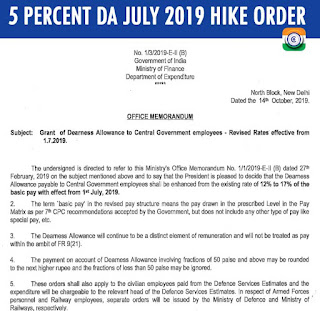
5 Percent DA July 2019 Hike Order - Grant of Dearness Allowance to Central Government employees

Grant of Dearness Allowance to Central Government employees 5 Percent DA July 2019 Hike Order  No. 1/3/2019-E- II (B) Government of...

Blog Archive

About The Author