Frequently Asked Questions (FAQs) on Goods and Services Tax (GST)
Following are the answers to the various frequently asked questions relating to GST:
Question 1.What is GST? How does it work?
Answer: GST is one indirect tax for the whole nation, which will make India one unified common market.
GST
is a single tax on the supply of goods and services, right from the
manufacturer to the consumer. Credits of input taxes paid at each stage
will be available in the subsequent stage of value addition, which makes
GST essentially a tax only on value addition at each stage. The final
consumer will thus bear only the GST charged by the last dealer in the
supply chain, with set-off benefits at all the previous stages.
Question 2. What are the benefits of GST?
Answer: The benefits of GST can be summarized as under:
For business and industry
Easy
compliance: A robust and comprehensive IT system would be the
foundation of the GST regime in India. Therefore, all tax payer services
such as registrations, returns, payments, etc. would be available to
the taxpayers online, which would make compliance easy and transparent.
- Uniformity
of tax rates and structures: GST will ensure that indirect tax rates
and structures are common across the country, thereby increasing
certainty and ease of doing business. In other words, GST would make
doing business in the country tax neutral, irrespective of the choice of
place of doing business.
- Removal of cascading: A system of
seamless tax-credits throughout the value-chain, and across boundaries
of States, would ensure that there is minimal cascading of taxes. This
would reduce hidden costs of doing business.
- Improved
competitiveness: Reduction in transaction costs of doing business would
eventually lead to an improved competitiveness for the trade and
industry.
- Gain to manufacturers and exporters: The subsuming of
major Central and State taxes in GST, complete and comprehensive set-off
of input goods and services and phasing out of Central Sales Tax (CST)
would reduce the cost of locally manufactured goods and services. This
will increase the competitiveness of Indian goods and services in the
international market and give boost to Indian exports. The uniformity in
tax rates and procedures across the country will also go a long way in
reducing the compliance cost.
For Central and State Governments
- Simple
and easy to administer: Multiple indirect taxes at the Central and
State levels are being replaced by GST. Backed with a robust end-to-end
IT system, GST would be simpler and easier to administer than all other
indirect taxes of the Centre and State levied so far.
- Better
controls on leakage: GST will result in better tax compliance due to a
robust IT infrastructure. Due to the seamless transfer of input tax
credit from one stage to another in the chain of value addition, there
is an in-built mechanism in the design of GST that would incentivize tax
compliance by traders.
- Higher revenue efficiency: GST is
expected to decrease the cost of collection of tax revenues of the
Government, and will therefore, lead to higher revenue efficiency.
For the consumer
- Single
and transparent tax proportionate to the value of goods and services:
Due to multiple indirect taxes being levied by the Centre and State,
with incomplete or no input tax credits available at progressive stages
of value addition, the cost of most goods and services in the country
today are laden with many hidden taxes. Under GST, there would be only
one tax from the manufacturer to the consumer, leading to transparency
of taxes paid to the final consumer.
- Relief in overall tax
burden: Because of efficiency gains and prevention of leakages, the
overall tax burden on most commodities will come down, which will
benefit consumers.
Question 3. Which taxes at the Centre and State level are being subsumed into GST?
Answer:
At the Central level, the following taxes are being subsumed:
a. Central Excise Duty,
b. Additional Excise Duty,
c. Service Tax,
d. Additional Customs Duty commonly known as Countervailing Duty, and
e. Special Additional Duty of Customs.
At the State level, the following taxes are being subsumed:
a. Subsuming of State Value Added Tax/Sales Tax,
b. Entertainment Tax (other than the tax levied by the local bodies),
Central Sales Tax (levied by the Centre and collected by the States),
c. Octroi and Entry tax,
d. Purchase Tax,
e. Luxury tax, and
f. Taxes on lottery, betting and gambling.
Question 4. What are the major chronological events that have led to the introduction of GST?
Answer:
GST is being introduced in the country after a 13 year long journey
since it was first discussed in the report of the Kelkar Task Force on
indirect taxes. A brief chronology outlining the major milestones on the
proposal for introduction of GST in India is as follows:
a.
In 2003, the Kelkar Task Force on indirect tax had suggested a
comprehensive Goods and Services Tax (GST) based on VAT principle.
b.
A proposal to introduce a National level Goods and Services Tax (GST)
by April 1, 2010 was first mooted in the Budget Speech for the financial
year 2006-07.
c. Since the proposal involved reform/
restructuring of not only indirect taxes levied by the Centre but also
the States, the responsibility of preparing a Design and Road Map for
the implementation of GST was assigned to the Empowered Committee of
State Finance Ministers (EC).
d. Based on inputs from Govt of
India and States, the EC released its First Discussion Paper on Goods
and Services Tax in India in November, 2009.
e. In order to take
the GST related work further, a Joint Working Group consisting of
officers from Central as well as State Government was constituted in
September, 2009.
f. In order to amend the Constitution to enable
introduction of GST, the Constitution (115th Amendment) Bill was
introduced in the Lok Sabha in March 2011. As per the prescribed
procedure, the Bill was referred to the Standing Committee on Finance of
the Parliament for examination and report.
g. Meanwhile, in
pursuance of the decision taken in a meeting between the Union Finance
Minister and the Empowered Committee of State Finance Ministers on 8th
November, 2012, a ‘Committee on GST Design’, consisting of the officials
of the Government of India, State Governments and the Empowered
Committee was constituted.
h. This Committee did a detailed
discussion on GST design including the Constitution (115th) Amendment
Bill and submitted its report in January, 2013. Based on this Report,
the EC recommended certain changes in the Constitution Amendment Bill in
their meeting at Bhubaneswar in January 2013.
i. The Empowered
Committee in the Bhubaneswar meeting also decided to constitute three
committees of officers to discuss and report on various aspects of GST
as follows:-
(a) Committee on Place of Supply Rules and Revenue Neutral Rates;
(b) Committee on dual control, threshold and exemptions;
(c) Committee on IGST and GST on imports.
j.
The Parliamentary Standing Committee submitted its Report in August,
2013 to the Lok Sabha. The recommendations of the Empowered Committee
and the recommendations of the Parliamentary Standing Committee were
examined in the Ministry in consultation with the Legislative
Department. Most of the recommendations made by the Empowered Committee
and the Parliamentary Standing Committee were accepted and the draft
Amendment Bill was suitably revised.
k. The final draft
Constitutional Amendment Bill incorporating the above stated changes
were sent to the Empowered Committee for consideration in September
2013.
l. The EC once again made certain recommendations on the
Bill after its meeting in Shillong in November 2013. Certain
recommendations of the Empowered Committee were incorporated in the
draft Constitution (115th Amendment) Bill. The revised draft was sent
for consideration of the Empowered Committee in March, 2014.
m.
The 115th Constitutional (Amendment) Bill, 2011, for the introduction of
GST introduced in the Lok Sabha in March 2011 lapsed with the
dissolution of the 15th Lok Sabha.
n. In June 2014, the draft Constitution Amendment Bill was sent to the Empowered Committee after approval of the new Government.
o.
Based on a broad consensus reached with the Empowered Committee on the
contours of the Bill, the Cabinet on 17.12.2014 approved the proposal
for introduction of a Bill in the Parliament for amending the
Constitution of India to facilitate the introduction of Goods and
Services Tax (GST) in the country. The Bill was introduced in the Lok
Sabha on 19.12.2014, and was passed by the Lok Sabha on 06.05.2015. It
was then referred to the Select Committee of Rajya Sabha, which
submitted its report on 22.07.2015.
Question 5.How would GST be administered in India?
Answer:
Keeping in mind the federal structure of India, there will be two
components of GST – Central GST (CGST) and State GST (SGST). Both Centre
and States will simultaneously levy GST across the value chain. Tax
will be levied on every supply of goods and services. Centre would levy
and collect Central Goods and Services Tax (CGST), and States would levy
and collect the State Goods and Services Tax (SGST) on all transactions
within a State. The input tax credit of CGST would be available for
discharging the CGST liability on the output at each stage. Similarly,
the credit of SGST paid on inputs would be allowed for paying the SGST
on output. No cross utilization of credit would be permitted.
Question
6.How would a particular transaction of goods and services be taxed
simultaneously under Central GST (CGST) and State GST (SGST)?
Answer
:The Central GST and the State GST would be levied simultaneously on
every transaction of supply of goods and services except on exempted
goods and services, goods which are outside the purview of GST and the
transactions which are below the prescribed threshold limits. Further,
both would be levied on the same price or value unlike State VAT which
is levied on the value of the goods inclusive of Central Excise.
A diagrammatic representation of the working of the Dual GST model within a State is shown in Figure 1 below.
Figure 1: GST within State
Question 7.Will cross utilization of credits between goods and services be allowed under GST regime?
Answer :
Cross utilization of credit of CGST between goods and services would be
allowed. Similarly, the facility of cross utilization of credit will be
available in case of SGST. However, the cross utilization of CGST and
SGST would not be allowed except in the case of inter-State supply of
goods and services under the IGST model which is explained in answer to
the next question.
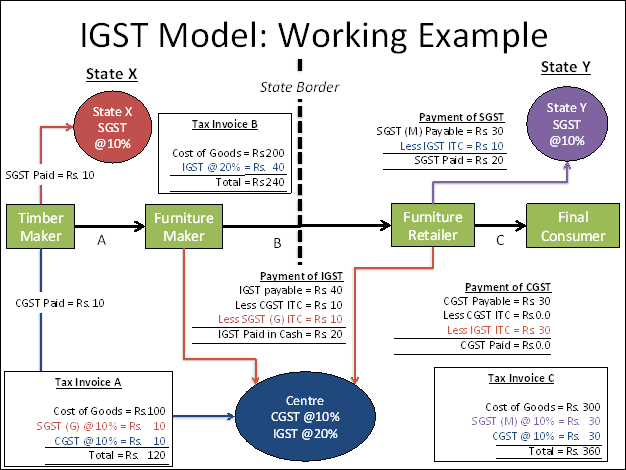
Question 8. How will be Inter-State Transactions of Goods and Services be taxed under GST in terms of IGST method?
Answer:
In case of inter-State transactions, the Centre would levy and collect
the Integrated Goods and Services Tax (IGST) on all inter-State supplies
of goods and services under Article 269A (1) of the Constitution. The
IGST would roughly be equal to CGST plus SGST. The IGST mechanism has
been designed to ensure seamless flow of input tax credit from one State
to another. The inter-State seller would pay IGST on the sale of his
goods to the Central Government after adjusting credit of IGST, CGST and
SGST on his purchases (in that order). The exporting State will
transfer to the Centre the credit of SGST used in payment of IGST. The
importing dealer will claim credit of IGST while discharging his output
tax liability (both CGST and SGST) in his own State. The Centre will
transfer to the importing State the credit of IGST used in payment of
SGST.Since GST is a destination-based tax, all SGST on the final product
will ordinarily accrue to the consuming State.
A diagrammatic representation of the working of the IGST model for inter-State transactions is shown in Figure 2 below.
Question 9. How will IT be used for the implementation of GST?
Answer:
For the implementation of GST in the country, the Central and State
Governments have jointly registered Goods and Services Tax Network
(GSTN) as a not-for-profit, non-Government Company to provide shared IT
infrastructure and services to Central and State Governments, tax payers
and other stakeholders. The key objectives of GSTN are to provide a
standard and uniform interface to the taxpayers, and shared
infrastructure and services to Central and State/UT governments.
GSTN
is working on developing a state-of-the-art comprehensive IT
infrastructure including the common GST portal providing frontend
services of registration, returns and payments to all taxpayers, as well
as the backend IT modules for certain States that include processing of
returns, registrations, audits, assessments, appeals, etc. All States,
accounting authorities, RBI and banks, are also preparing their IT
infrastructure for the administration of GST.
There would no
manual filing of returns. All taxes can also be paid online. All
mis-matched returns would be auto-generated, and there would be no need
for manual interventions. Most returns would be self-assessed.
Question 10. How will imports be taxed under GST?
Answer :
The Additional Duty of Excise or CVD and the Special Additional Duty or
SAD presently being levied on imports will be subsumed under GST. As
per explanation to clause (1) of article 269A of the Constitution, IGST
will be levied on all imports into the territory of India. Unlike in the
present regime, the States where imported goods are consumed will now
gain their share from this IGST paid on imported goods.
Question 11. What are the major features of the Constitution (122nd Amendment) Bill, 2014?
Answer : The salient features of the Bill are as follows:
g. Conferring simultaneous power upon Parliament and the State Legislatures to make laws governing goods and services tax;
h.
Subsuming of various Central indirect taxes and levies such as Central
Excise Duty, Additional Excise Duties, Service Tax, Additional Customs
Duty commonly known as Countervailing Duty, and Special Additional Duty
of Customs;
i. Subsuming of State Value Added Tax/Sales Tax,
Entertainment Tax (other than the tax levied by the local bodies),
Central Sales Tax (levied by the Centre and collected by the States),
Octroi and Entry tax, Purchase Tax, Luxury tax, and Taxes on lottery,
betting and gambling;
j. Dispensing with the concept of ‘declared goods of special importance’ under the Constitution;
k. Levy of Integrated Goods and Services Tax on inter-State transactions of goods and services;
l. GST to be levied on all goods and services, except alcoholic liquor
for human consumption. Petroleum and petroleum products shall be subject
to the levy of GST on a later date notified on the recommendation of
the Goods and Services Tax Council;
m. Compensation to the States
for loss of revenue arising on account of implementation of the Goods
and Services Tax for a period of five years;
n. Creation of Goods
and Services Tax Council to examine issues relating to goods and
services tax and make recommendations to the Union and the States on
parameters like rates, taxes, cesses and surcharges to be subsumed,
exemption list and threshold limits, Model GST laws, etc. The Council
shall function under the Chairmanship of the Union Finance Minister and
will have all the State Governments as Members.
Question 12. What are the major features of the proposed registration procedures under GST?
Answer: The major features of the proposed registration procedures under GST are as follows:
i. Existing dealers: Existing VAT/Central excise/Service Tax payers will not have to apply afresh for registration under GST.
ii. New dealers: Single application to be filed online for registration under GST.
iii. The registration number will be PAN based and will serve the purpose for Centre and State.
iv. Unified application to both tax authorities.
v. Each dealer to be given unique ID GSTIN.
vi. Deemed approval within three days.
vii. Post registration verification in risk based cases only.
Question 13. What are the major features of the proposed returns filing procedures under GST?
Answer: The major features of the proposed returns filing procedures under GST are as follows:
a. Common return would serve the purpose of both Centre and State Government.
b. There are eight forms provided for in the GST business processes for
filing for returns. Most of the average tax payers would be using only
four forms for filing their returns. These are return for supplies,
return for purchases, monthly returns and annual return.
c. Small taxpayers: Small taxpayers who have opted composition scheme shall have to file return on quarterly basis.
d. Filing of returns shall be completely online. All taxes can also be paid online.
Question 14. What are the major features of the proposed payment procedures under GST?
Answer: The major features of the proposed payments procedures under GST are as follows:
i. Electronic payment process- no generation of paper at any stage
ii. Single point interface for challan generation- GSTN
iii. Ease of payment – payment can be made through online banking,
Credit Card/Debit Card, NEFT/RTGS and through cheque/cash at the bank
iv. Common challan form with auto-population features
v. Use of single challan and single payment instrument
vi. Common set of authorized banks
vii. Common Accounting Codes
PIB