A complete reference blog for Indian Government Employees

Showing posts with label 7th Pay Commission award. Show all posts

Tuesday, 13 December 2016

RBI Governor Statement on 7th CPC issues

RBI Governor Statement on 7th CPC issues 

Comrades.

Dr. Urjit R. Patel - Governor, Reserve Bank of India has said in a media conversation has made following observations in respect of Central Government employees which is published in Reserve Bank of India website:

1) The disbursement of salaries and arrears under the 7th Pay Commission award has not been disruptive to inflation outcomes.

2) The extension of two months given to the Ministry of Finance to receive the notification on higher allowances under the Commission’s award, could push its fuller effect into the next financial year rather than this financial year.

The above statement by the Governor, Reserve Bank of India clearly indicates the following:
A) The 7th CPC effect on the Government expenditure is minimal and doesn’t have any impact on the inflation and prices and there is scope for further improvement in fitment formula provided the Government is ready to consider the staff side demands.
B) The allowances will be revised only after February 2017 and come into effect in next financial year.
Only struggle is only the solution for the Central Government employees to get our main demands resolved such as revision of fitment formula and allowances.

Click here for RBI details
(P.S.Prasad)
General Secretary
Share:

Sunday, 20 November 2016

Railways Earning: Impact of implementing recommendations of the 7th Central Pay Commission

Railways Earning: Impact of implementing recommendations of the 7th Central Pay Commission

GOVERNMENT OF INDIA
MINISTRY OF RAILWAYS
LOK SABHA

UNSTARRED QUESTION NO: 88
ANSWERED ON: 16.11.2016

Proposal for bail out


PRATHAP SIMHA
Will the Minister of
RAILWAYS be pleased to state:-

(a) whether railways has initiated a proposal for the bail out to foot higher wage bill from the Finance Ministry, including waiver of dividend payment;

(b) whether Railways is 8-10% short of revenue target during the 1st quarter of the current financial year;

(c) whether Railways has also requested Finance Ministry to share the Service Tax collected from railway services, if so, whether Finance Ministry has acceded to proposal of Railways;

(d) whether Railways has also requested Ministry of Defence and Ministry of Social Justice and Empowerment to provide for the concessional tickets offered to defence personnel and Persons with Disabilities, if so, response of these Ministries to share the subsidy burden; and

(e) the measures being taken by the Ministry to implement 7th Pay Commission award?


ANSWER

MINISTER OF STATE IN THE MINISTRY OF RAILWAYS
(SHRI RAJEN GOHAIN)

(a) & (b): Impact of implementing recommendations of the 7th Central Pay Commission on pay and pension assessed to be around Rs.20,000 crore annually has been provided in the expenditure budgeted for 2016-17. However, in view of trend of shortfall in earnings in the current year which in the Ist quarter fell short of the proportionate target by Rs.6,755 crore (14.8%), some steps need to be taken to avoid eventuality of having inadequate resources to meet the expenditure. These may, besides increasing earnings & economy measures to curb expenditure; include deferring the payment of dividend, seeking help of the Ministry of Finance for reimbursing cost of social services obligation being borne by the Railway, etc.

(c) & (d): No request as such has been made to Ministry of Finance, Ministry of Defence & Ministry of Social Justice and Empowerment.

(e): The recommendations of the 7th Central Pay Commission as approved by Government have been implemented on Railways.

Source: http://164.100.47.190/loksabhaquestions/annex/10/AU88.pdf
Share:

Tuesday, 16 August 2016

Madhya Pradesh State Government announces to give its employees 7th Pay Commission award


Madhya Pradesh State Government announces to give its employees 7th Pay Commission award

Bhopal: Madhya Pradesh Chief Minister Shivraj Singh Chouhan on the Independence Day announced to give state government employees salary and allowances as recommended by the 7th Pay Commission.
Presiding over the state-level function on the occasion of the 70th Independence Day at the Motilal Nehru Stadium in the state capital, he said the state government will soon give its employees the 7th Pay Commission award.

He also said the daily wagers confirmed in service would be suitably adjusted in various departments according to their qualifications.

Chouhan added that an ‘employment cabinet’ would be formed with an aim to provide more and better job opportunities to the youths in the state. This panel will work for job creation in the state.
Share:

Sunday, 3 July 2016

Finance Minister Promises 'Minimum Pay' 7th Pay Commission Hikes

Finance Minister Promises 'Minimum Pay' 7th Pay Commission Hikes

New Delhi: Finance Minister Arun Jaitley has promised to consider to hike the minimum pay of central government employees beyond Rs 18,000, a day after the cabinet cleared 7th Pay Commission award for its employees.

Central government employees have been demanding hike in minimum pay since November 19, when 7th Pay Commission headed by Justice A K Mathur submitted its report to Jaitley.

The Finance Minister said he was not ‘rigid’ on the issue and the government will try to rectify some of employees’ demands including minimum pay.

Jaitley met with representatives of central government employees unions at Home Minister Rajnath Singh’s house for two hours till 11pm on Thursday night.

Jaitley, Rajnath Singh and Railways Minister Suresh Prabhu attended the meeting and assured unions leaders of central government employees that their demand would be looked into.

“The minimum pay of central government employees Rs 18,000 was made on recommendations of the 7th Pay Commission. But government will consider hiking it after discussions with all stakeholders,” he said in the meeting.

“Three ministers called us and we met them at Home Minister Rajnath Singh’s house late on Thursday for almost two hours. We have been assured that the minimum pay issue is going to be referred to one of two committees that the government is setting up to rectify any anomalies in the pay commission recommendation implementation,” Shiv Gopal Mishra, General Secretary of the National Joint Council Action (NJCA), a confederation of several central government employees’ unions, told reporters after the meeting.

The council claims a membership of 3.3 million, including the central government employees – Railways, Defence, Postal, Income Tax, Central Customs and Central Excise etc.

NJCA already have rejected Modi government’s overall 23.5 percent pay hike bonanza based on 7th Pay Commission recommendations and would go on indefinite strike from 6 am, 11 July.

They have been demanding Rs 26,000 as minimum pay instead of Rs 18,000 approved by the government based on the 7th Pay Commission’s recommendations.

Mishra also said the Home Minister assured them that “their interaction with us has the blessings of PM Narendra Modi”.

“On minimum pay, we are for a negotiated settlement and it seems there is some consideration at the highest level,” he added.

The increasing the minimum pay will change the salary fitment factor. If the minimum pay is hiked from Rs.18,000 to even Rs.20,000, the fitment factor will be higher than the 2.57 times approved by the government based on the pay commission recommendations.

If the 2.57 fitment formula is tinkered with, then salary and pension in general for all central government employees will go up.

NJCA wrote to all central government employees unions that “government has proposed to refer the issue of minimum pay and fitment factor to a committee for reconsideration. The NJCA will await communication in this regard from the government”.

It said that it will meet on 6 July again to decide on the proposed indefinite strike from July 11.

Source : tkbsen.in
Share:

Tuesday, 21 June 2016

On 7th Pay Commission implementation, private investment, Air India and more, here’s what govt is mulling over

On 7th Pay Commission implementation, private investment, Air India and more, here’s what govt is mulling over

7thpay-orop-gdp


Besides the government staff, economic analysts are keenly awaiting when and how the Centre will implement 7th Pay Commission award, which has implications for government finances (with estimated outgo of Rs 74,000 crore in FY16) as well as on inflation.

Also, with private investments yet to show decisive signs of picking up, the government has the difficult task of keeping the tempo in public spending, especially capital investments, at a time it is losing the benefits of low crude oil prices.

Finance secretary Ashok Lavasa speaks on these issues in an interview to FE’s Prasanta Sahu. Excerpts.

GDP growth in FY16 was put by the Central Statistics Office at 7.6%, with the growth in the last quarter coming in at 7.9%. Private consumption has been the growth driver. Despite the efforts by the government, private investors are yet to shed their diffidence. Among infrastructure sectors, highways, railways etc. have seen a turnaround but mainly because of government investment. How far is this model sustainable given the Centre’s (limited) fiscal capacity?
Many infrastructure projects, in which private sector has been involved, have started moving. In highway sector, for example, the hybrid annuity model has started attracting investors. As we go forward, we feel that the initiatives that have been taken by the government – to improve the ease of doing business and integrate various clearances – would give a push to private-sector investments. In infrastructure sectors, where the government plays a key role in awarding contracts etc, we are seeing positive results too. If all the factors are favourable, the GDP growth could be close to 8% this year.

The questions about GDP data refuse to wither away. Manufacturing GDP growth and the IIP (industrial production) data aren’t quite compatible, even if one considers the fact that apart from output, value addition is now being captured more efficiently.

The Q4 results of some of the major companies show that their EBITDA has increased. The variation between manufacturing growth (9.3% in FY16) and IIP (2.4%) was mainly due to the fact that some sectors did well while some did not.

How important are lower interest rates in reviving demand?
I think it’s a question of giving a boost to demand. Sometimes people may have more expectation than what RBI could do (in terms of lowering rates). The RBI has had to consider various factors and take a considered view. It is not possible to please all people all times. It is fair to expect that whatever lowering (of rates) has been done by RBI, finds an expression in the retail lending rates. I think the governor is right in saying full transmission has not happened of the central bank’s (cumulative 150 bps) rate cut since January 2015.

What will be the guiding framework of the “prospective planning” that will replace five-year Plan?
We could divide it into three parts: the period till which one can have some predictability on availability of resources, that will be, say, a three-year action plan. Beyond this, there will be medium-term (seven-year) Plan. Besides, there can be a prospective plan for theb period till 2030. In the prospective plan, what you already have is sustainable development goals, which are part of the international commitments. Niti Aayog will look at integration of issues and prospective planning while department of expenditure will make the fund allocations for various programmes.

Will substantial additional provision be needed to meet the Pay Panel-related outgo in FY17?
It will be too early and premature to say whether budgetary provision is not adequate or not. No one knows to what extent the government will accept the Pay Commission’s report. But, there is a provision in the budget to take care of the impact of the pay commission award (According to sources, FY17 budget has provision of about Rs 54,000 crore for honouring the pay panel’s award, but Lavasa refused to comment on this ).

Will Niti Aayog’s reported suggestions on strategic disinvestments in a clutch of PSUs including Air India be taken forward this year?
We haven’t so far received the recommendations you are referring to. We have to explore all forms of divestment and strategic sale is of course one of them. The Department of Investment and Public Asset Management will be looking at all possibilities and deciding on which unit to be put on privatisation or disinvestment or strategic sale mode.

Is there any move to monetise surplus land with defence, railways and ports bodies?
This is not to be done as a central government policy. The railways have been trying to monetise land. Certainly, this is one source of revenue, but it may be not a very significant source. Whenever an entity decides to take up any piece of land for monetisation, it has to consider all the legal issues, physical condition, its own plans of utilising and ultimately, if there is a market for that (in case of sale/leasing out).

Source: FE
Share:

Sunday, 12 June 2016

7th Pay Commission review panel held on Saturday, regarding pay hike to be implemented by August

7th Pay Commission review panel held on Saturday, regarding pay hike to be implemented by August

The Empowered Committee of Secretaries, who is processing the recommendations of the 7th Pay Commission met Saturday to discuss the issue of pay hike of central government employees and pensioners.

Sources told that Empowered Committee agreed to implement to hike pay to 48 lakh of central government employees and and 52 lakh pensioners from August 1, However, the source declined to reveal details of the meeting.

The final decision on the matter has been taken in the meeting of the 7th Pay Commission review committe chaired by Cabinet Secretary P K Sinha in New Delhi on Saturday.

The meeting’s agenda also included adding final touches to the recommendations before they are handed to the Finance Minister Arun Jaitley.

7th Pay Commission award comes into effect with retrospective effect from January 1, 2016, salary packages of central government employees and pensioners will be impacted.

The Empowered Committee of Secretaries proposed to credit the arrears along with the revised pay.
The Secretaries’ group has recommended proposed a minimum salary at Rs 21,000 and the highest salary at Rs 2,70,000 for hiking salary around 30 per cent also recommended for doubling of existing rates of allowances and advances.

The 7th Pay Commission by headed Justice A K Mathur had recommended the minimum salary for central government employees at Rs 18,000 and maximum salary at Rs 2,50,000.

TST
Share:

Wednesday, 11 May 2016

FinMin to seek cabinet nod for 7th pay commission award by June-end

FinMin to seek cabinet nod for 7th pay commission award by June-end

The finance ministry may seek Cabinet nod by June end to implement 7th Pay Commission award, The Sen Times learns from sources. It is more or less confirmed that a Cabinet nod will be required to help central government employees to neutralise the impact of inflation. The government intends to approve 30 per cent salaries hike of central government employees.

The Secretaries group has reached the conclusion to propose 30 percent basic pay raise instead of 14.27 per cen, which recommended was recommended by 7th Pay Commission but Finance Minister Arun Jaitley has yet to see the workout of secretaries group, sources said.

The Secretaries group has to share the information with the Finance Minister to get his approval. Following the clearance from the Finance Minister the 7th pay commission award would be got cabinet nod.

Earlier, the Secretaries group sought suggestions from all the stakeholders for drafting of their report on the 7th Pay Commission recommendations to address the concerns of central government employees in an effective manner.

It used to be just a customary affair, sources said.

Pay Commission award usually happens every 10 years in line with central government employees’ pay hike.
The 7th pay commission was set up by the UPA government in February 2014 to revise remuneration of about 48 lakh central government employees and 52 lakh pensioners.

The Commission headed by Justice A K Mathur proposed the highest salary at Rs 250,000 and the lowest at Rs 18,000. The commission also recommended 14.27 per cent increase in basic pay, 23.55% overall increase in salary, allowances and pensions. The increase in allowances was recommended 63% while pension was proposed to rise 24%.

Apart from this, the Commission also recommended for abolition of allowances and advances like risk allowance, small family allowance, festival advance, motor cycle advance.

A 13 members secretary-level Empowered Committee or Secretaries group, led by cabinet Secretary P K Sinha was formed in January to review the recommendations of 7th Pay Commission before cabinet nod.
The Secretaries group is likely to purpose 30 percent basic pay hike of central government employees and it’s also advocating for doubling of existing rates of such allowances and advances, which has been recommended for abolition by the 7th Pay Commission.

The finance ministry sources said the pay hike is likely to be assumed greater importance since responsibility of central government employees have increased since the getting power of Prime Minister Narendra Modi.
Share:

Tuesday, 5 April 2016

7th Pay Commission award to stoke inflation, push up GDP: RBI report

7th Pay Commission award will put an upward pressure of 1-1.5 per cent on inflation, but is expected to boost GDP by around 40 bps during the current fiscal, RBI said in a report today.

7th-Pay-Commission-award-CG-Employees

At the same time, the central bank remained confident of meeting its March 2017 retail inflation target of 5 per cent.

“Assuming that the government implements the 7th Pay commission recommendations by the second quarter of 2016-17, CPI inflation could be, on average, 100-150 bps higher than the baseline in 2016-17. Its impact is expected to persist up to 24 months,” Governor Raghuram Rajan said in the a report released along with the monetary policy document.

The report, however, noted that the 7th Pay Commission award will boost GDP by around 40 bps during the current fiscal.

The 7th Pay Commission award impact will also jack up food prices, the report said, adding that “food prices could consequently increase, leading to inflation rising above the baseline by 80-100 bps in 2016-17, even assuming effective government policies relating to food stocks, procurement and minimum support prices”.

On achieving the inflation target (6 per cent in January this year), the Governor said inflation has evolved along the projected trajectory and the January 2016 target was met with a marginal undershoot.

“Going forward, CPI inflation is expected to decelerate modestly and remain around 5 per cent in FY17 with small inter-quarter variations,” he said, but warned that there are uncertainties surrounding this inflation path emanating from recent unseasonal rains, the likely spatial and temporal distribution of monsoons, the low reservoir levels by historical averages, and the strength of the recent upturn in commodity prices, especially oil.

Persistence of inflation in certain services warrants watching, mainly due to 7th Pay Commission award, he said, while there will be some offsetting downside pressures stemming from tepid demand in the global economy. But the government’s effective supply-side measures keeping a check on food prices, and “the government’s commendable commitment to fiscal consolidation” will have a salutary impact on inflation.

On growth, which it has retained at 7.6 percent for this fiscal, the report said, “The uneven recovery in growth in FY16 is likely to strengthen gradually in FY17, assuming normal monsoons, the likely boost to consumption demand from the implementation of the pay commission and OROP, and continuing monetary policy accommodation.”

The gross value add growth projection for 2016-17 is retained at 7.6 per cent, “with risks evenly balanced”.

PTI
Share:

Monday, 18 January 2016

Government may defer implementation of pay commission award

Government may defer implementation of pay commission award

The government is likely to defer of the Seventh Pay Commission award in a bid to improve financial resource crunch estimated for 2016-17.

The Union Cabinet approved last week the formation of an empowered committee of secretaries to work out ways for staggering the award through more than one financial year, instead of letting the Rs 1,02,100-crore bill from the implementation of the award come up at one go.

A source in Finance Ministry said one of the options for the empowered committee was to defer the increase in allowances for central government employees, while letting the rise in pay for all scales to go through.
According to finance ministry figures, the ratio of allowances to pay for these 4.7 million employees is 1:1.4. For instance, the Budget estimates in 2015-16 pegged the salary bill for all central government employees at Rs 60,731 crore, whereas the tab for allowances is Rs 84,437.4 crore.

The announcement of a deferral is expected to be part of Finance Minister Arun Jaitley’s Budget speech on February 29. The formation of an empowered committee for the pay panel recommendations, again a first for the central government, is meant to bring all stakeholders on board in the exercise.

The official explained ministry-wise consultations with the department of expenditure in the finance ministry, in the run up to the Budget, were mostly over. Those discussions had proceeded on the assumptions that the Pay Commission recommendations would be implemented. It was now necessary to bring the secretaries of key departments on board about the need for a drastic cut-back on those estimates.

The status quo on allowances would also allow the government to ignore the demand made by various staff associations to raise the minimum level of salary for employees. The Pay Commission has suggested that the minimum should be Rs 18,000 per month; the unions have demanded that it should be raised to a band of Rs 19,000 to Rs 21,000 a month. Such a change would have created a ripple effect.

About 70 per cent of the government employees are bunched in the non-executive ranks; the starting salary for them tops about Rs 42,000 a month, show calculations by the Commission. Even a modest increase in pay for them would cascade the bill for the government by another Rs 50,000 crore annually. The award of the Commission is slated to take effect from January 1 this year.

A key element in the plan to defer some elements of the Seventh Pay Commission recommendations will be the railway ministry. Government managers reckon the powerful unions of the Indian Railways need to be brought on board for this plan to be successful.

The higher wage bill for the Suresh Prabhu-led ministry works out to Rs 28,450 crore a year, only a shade less than the yearly loss it makes on its passenger services at present. No formal communications have been sent out to the railway unions by the committee.

“It will follow once the empowered committee has decided to take a call on which allowances to clip,” said the source.

In a recent television interview with NDTV, Minister of State for Finance Jayant Sinha had said the Pay Commission recommendations were the biggest headache for his ministry, struggling to keep the aggregate expenditure of the Union government under control.
Via  Business Standard
Share:

Friday, 8 January 2016

Pay Commission award to be implemented in April, no separate DA to be announced

Pay Commission award to be implemented in April, no separate DA to be announced

The recommendations of the 7th Pay Commission award to review salaries of central government employees, will be implemented in April and no separate DA will be announced, Finance Ministry sources said.

“The cabinet will give its nod to implement the 7th Pay Commission award in April after some modification and it will be effective from January 1, 2016,” the sources added.

After receiving the 7th Pay Commission report on November 19, the government had formed the implementation cell of the pay commission headed by ar Joint Secretary in Finance Ministry on November 20 last year.

With an eye on implementation of Pay Commission award, the government will not hike the dearness allowance (DA) to 1119% from existing 125%. The DA hike will be merged with the new pay as the Pay Commission made report, assuming that the rate of Dearness Allowance would be 125 percent at the time of implementation of the pay commission recommendation, i.e. on January 1.

Hence, the government has bound to implement the 7th Pay Commission award in April, they confirmed.

The notification to put into effect the Seventh pay commission recommendation will be issued in April before the announcement of West Bengal, Assam, Kerala and Tamil Nadu states assemblies’ election in May 2016, which will benefit 50 lakh central government employees and 52 lakh pensioners including dependents, sources of Finance Ministry said Wednesday.

“The BJP led central government decided execution time of the pay commission’s award in April, which will also be possible pre-election “special packages” for West Bengal, Assam, Kerala and Tamil Nadu to win sufficient seats of states Assemblies polls, sources told our reporters.

The 7th Pay Commission was set up by the UPA government in February 2014, The Commission headed by Justice A K Mathur submitted its 900-page final report to Finance Minister Arun Jaitley on February 19, recommending 23.55 per cent hike in salaries and allowances of Central government employees and pensioners.

The panel recommended a 14.27 per cent increase in basic pay, the lowest in 70 years. The previous 6th Pay Commission had recommended a 20 per cent hike, which the government doubled while implementing it in 2008.

The 7th pay commission recommended fixing the highest basic salary at Rs 250,000 and the lowest at Rs 18,000and its increased the pay gap between the minimum and maximum from existing 1:12 to 1: 13.8

The government constitutes the Pay Commission almost every 10 years to revise the pay scale of its employees and pensioners, often these are adopted by states after some modifications. However, the 7th Pay Commission suggested to discontinue the practice of appointing pay commissions in future.
Share:

Featured post

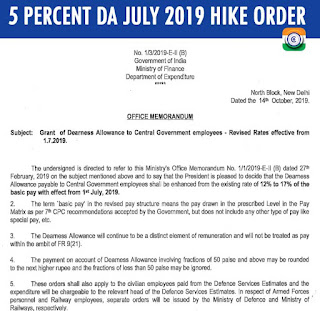
5 Percent DA July 2019 Hike Order - Grant of Dearness Allowance to Central Government employees

Grant of Dearness Allowance to Central Government employees 5 Percent DA July 2019 Hike Order  No. 1/3/2019-E- II (B) Government of...

Blog Archive

About The Author