Allotment of qualification based pay matrix – ECG Technicians in Railways.
No.II/1/2019/ Pt.I
Dated: 31/07/2020
The Secretary (E)
Railway Board,
New Delhi
Sub: Allotment of qualification based pay matrix – ECG Technicians in Railways.
Ref: (i) Railway Board’s reply to GS/ NFIR vide letter
No.PC-VII/2018/R-U/8 dated IR’s letter No.II/1/2019 dated 30th March,
2019 and 18th April, 2019 to the Railway Board.
(iii) NFIR’s PNM agenda item No.25 (sent to Railway Board on 29th May, 2019).
Dear Sir,
Kind attention is invited to the references cited above, on the above
subject relating to allotment of qualification based pay matrix to the
ECG Technicians in railways.
Federation once again furnishes below, the important facts relating to the demand for granting higher entry grade pay to the ECG
Technician category with appropriate cadre structure for their growth.
The ECG Technicians appointed in Dr. Ram Manohar Lohia Hospital,
New Delhi (under Ministry of Health and Family Welfare) have never been
in possession of the standard qualification relating to the job
expected from an ECG Technician, while in Railways, the ECG Technicians
possess “Diploma in ECG Lab Technology”.
ECG Technicians in
Railways have never been treated atleast equal to those working in the
Central Government Hospitals and have rather been treated inferior. This
negative situation has been prevailing since the period of 3rd CPC.
The
DR qualification prescribed for the post of Sr. ECG Technician pay
scale Rs.1400-2600 (IV CPC)/5000-8000) V CPC)/ PB-2 GP 4200 (VI CPC)/
Pay Level-6 in 7th CPC
in Dr. Ram Manohar Lohia Hospital is Bachelor’s Degree in Science with
Physics with one year experience in handling cardiological equipment or 3
years Diploma Course in Electronics/ Electrical communication
Engineering. Whereas in Railways, though the qualification for the post
of ECG Technician got revised during 6th CPC regime to Degree in Science
plus Diploma in ECG Lab Technology/ Cardiology/ Cardiology Technician/
Cardiology Techniques of reputed institution [refer Railway Board’s
letter No. E(NG)II/2001/RR/45 Pt. A dated 29/09/2015], this category has
not been treated at par with those ECG Technicians of Dr. Ram Manohar
Lohia Hospital.
NFIR therefore requests the Railway Board to take action for revising
the pay structure of ECG Technicians of railways for the purpose of
providing entry grade pay 4200/Level 6 of pay matrix with further avenue
of promotion to pay level 7, similar to the pay structure of ECG
Technicians of Dr Ram Manohar Lohia Hospital, New Delhi.
Subject: Protection of pay to the Central Government Servant
consequent to appointment to a new post in different service or cadre in
Central Government, through direct recruitment where either higher
duties and responsibilities are involved or not, as the case may be,
under FR 22-B(1), in the 7th CPC Scenario – Regarding.
The undersigned is directed to say that consequent to various references received
from Ministries/ Departments on protection of pay under FR 22-B(1), a
need has been felt to issue guidelines on the manner of fixation of pay
in respect of the Central Government Servant who after technical
resignation, is appointed to new post in the different service or cadre
in Central Government through direct recruitment where either higher
responsibilities are involved or not, as the case may be, in 7th Central
Pay Commission scenario.
2. Provisions of FR 22-B(1) inter-alia provide as under :
“P.R. 22-B.(1) Notwithstanding anything contained in these Rules, the following provisions shall govern the pay of a Government
servant who is appointed as a probationer in another service or cadre, and subsequently confirmed in that service or cadre –
(a) during the period of probation, he shall draw pay at the
minimum of the time scale or at the probationary stages of the time
scale of the service or post, as the case may be:
Provided that if the presumptive pay of the permanent post on which he holds a lien or would hold a lien had his lien not been suspended, should
at any time be greater than the pay fixed under the clause, he shall draw the presumptive pay of the permanent;
(b) on confirmation in the sen/ice or post after the expiry of
the period of probation, the pay of the Government servant shall be
fixed in the time-scale of the service or post in accordance with the
provisions of Rule 22 or Rule 22-C, as the case may be…”
3. Consequent upon the implementation of 7th CPC Report and CCS (RP) Rules,
2016, the President is pleased to allow protection of pay in the light
of the provisions laid down under FR 22-B(1) to Central Government
employee who is appointed as probationer in another service or cadre
either carrying higher responsibilities or not, as the case may be and
subsequently confirmed in that service or cadre, in the manner as
illustrated below:
(A) MANNER OF FIXATION OF PAY OF GOVERNMENT SERVANT UNDER FR 22-B(1) CONSEQUENT TO HIS APPOINTMENT IN LOWER POST THROUGH
DIRECT RECRUITMENT, WHERE HIGHER DUTIES AND RESPONSIBILITIES ARE NOT INVOLVED
A Central Government Employee on his appointment to a post in lower Level
in different service or cadre in Central Government which does not
carry duties and responsibilities of greater importance than those
attached to the post held earlier by him on regular basis before such
appointment and having a provision of probation period in new post, may
during probation draw the presumptive pay of the post held earlier by
him on regular basis, if it is higher than the minimum of the Time Scale
of the new post. He would also draw annual increments on such
presumptive pay. However, it is to be ensured that during probation,
presumptive pay should always be greater than the pay of the new post
after drawl of increment(s). Subsequently, on successful completion of
his probation, his pay will be fixed under FR 22(l)(a)(2).
Protection of Pay in the above manner should not, at any of these stages, exceed the maximum of the Level of the new post in Pay Matrix.
Illustration An officer was drawing pay of Rs.78,500 in Cell 6 in Level 11
(with DNI 01.07.2018) before his appointment to a post in Level 10 on
01.04.2018 which does not carry duties and responsibilities of greater
importance than those attached to the post held earlier by him before
such appointment. There is a provision of 2 years probation period in
new post.
Since the first Cell Value in Level 10 (Rs.56,100) is less than the Last Basic Pay i.e. Rs. 78,500/- in Level 11. Hence during probation, he
will draw the presumptive pay i.e. Rs.78,500/- in Level 11 and would also draw annual increments according to the pay drawn in his previous post
in Level II.
On 01 .04.2018- Rs. 78,500 (Level 11) On 01 .07.2018- Rs. 80,900 (Level 11) On 01.07.2019- Rs. 83,300 (Level 11)
On successful completion of his probation period and on confirmation
w.e.f. 01.04.2020, the pay of the officer would be fixed under FR
22(l)(a)(2). Since no such Cell of Rs. 83,300/- is available in Level
10, his pay would be fixed at next higher cell i.e. Cell 15 in Level 10
at Rs. 84,900 with next date of increment 01.01.2021.
(B) MANNER OF FIXATION OF PAY OF CENTRAL GOVERNMENT EMPLOYEE
UNDER FR 22-B(1) CONSEQUENT TO HIS APPOINTMENT TO A POST IN HIGHER LEVEL
THROUGH DIRECT RECRUITMENT, WHERE HIGHER DUTIES AND RESPONSIBILITIES
ARE INVOLVED
A Central Government Employee on his appointment to a post in higher
level in different service or cadre in Central Government carrying
duties and responsibilities of greater importance than those attached to
the post held earlier by him on regular basis before such appointment
and ha ing a provision of probation period in new post, may during
probation draw the presumptive pay of the post held earlier by him on
regular basis if it is higher than the minimum of the Time Scale of the
new post. He would also draw annual increments on such presumptive pay.
However, it is to be ensured that during probation presumptive pay
should always be greater than the pay of the new post after drawl of
increment(s). Subsequently, on successful completion of his probation,
his pay will be fixed under FR 22(l)(a)(1).
Protection of Pay in the above manner should not, at any of these stages, exceed the maximum of the Level of the new post in Pay Matrix.
Illustration
An officer was drawing pay of Rs.58,600 in Cell 10 of Level 7 before his appointment on 01.04.2018 in Level 10 (with DNI 01.07.2018) which
carries duties and responsibilities of greater importance than those attached to the post held earlier by him on regular basis before such
appointment. There is a provision of 2 years probation period in new post.
Since the first Cell Value of Level 10 (Rs. 56,100) is less than the Last Basic Pay
drawn in Cell 10 of Level 7 i.e. Rs. 58,600/-, hence during probation,
he will draw the presumptive pay of the post held earlier by him on
regular basis and would also draw annual increments in the Level 7 of
his previous post as shown below:-
On 01.04.2018- Rs. 58,600 (Level 7) On 01.07.2018- Rs. 60,400 (Level 7) On 01.07.2019- Rs. 62,200 (Level 7)
On successful completion of his probation period and on confirmation w.e.f.
01
.04.2020, the pay of the officer would be fixed under FR 22(l)(a)(1)
read with Rule 13 of CCS (RP) Rules, 2016. Accordingly, an increment
will be added in his pay in Level 7 and his pay will reach at Rs.
64,100/-. Since, there is no cell value equal to Rs. 64,100 available in
Level 10, his pay will be fixed in Level 10 in Cell 6 at Rs. 65,000/-
with next date of increment 01.01.2021.
(C) MANNER OF FIXATION OF PAY OF CENTRAL GOVERNMENT EMPLOYEE UNDER FR 22-B(1) CONSEQUENT TO HIS APPOINTMENT TO A POST IN EQUIVALENT
LEVEL POST THROUGH DIRECT RECRUITMENT, WHERE HIGHER DUTIES AND RESPONSIBILITIES ARE NOT INVOLVED
A Central Government Employee on his appointment to a post in
Equivalent Level in different service or cadre in Central Government
through direct recruitment where higher duties and responsibilities are
not involved and having a provision of probation period in new post,
may during probation draw the presumptive pay of the post held earlier
by him on regular basis. He would also get his increments on such
presumptive pay. On successful completion of his probation, his pay will
be fixed under FR 22(l)(a)(2). However, Protection of Pay in the above
manner should not, at any of these stages, exceed the maximum of the
Level of the new post in Pay Matrix.
Illustration An officer was drawing pay of Rs. 58,600 in Cell 10 of Level 7 before his
appointment on 01.04.2018 in the same Level 7 (with DNI 01.07.2018).
There is a provision of 2 years probation period in new post.
Since the first Cell Value of Level 7 (Rs. 44,900) is less than the Last Basic Pay i.e. Rs. 58,600/- in Level 7 drawn by Government Servant,
hence during probation, he will draw the presumptive pay and also get his increments in the same Level of his previous post as shown below:-
On 01.04.2018- Rs. 58,600 (Level 7) On 01.07.2018- Rs. 60,400 (Level 7) On 01.07.2019- Rs. 62,200 (Level 7)
On successful completion of his probation period and on confirmation w.e.f. 01.04.2020, the pay of the officer would be fixed under FR 22(I)(a)
(2).
Since
no increment would be admissible under FR 22(l)(a)(2), there will be no
change in his pay on the date of confirmation i.e. 01.04.2020.
Accordingly, his pay in Level 7 on 01 .04.2020 would be Rs. 62,200
(Level 7) with next date of increment on 01.07.2020, as Level remains
same.
The above mentioned pay protection under FR 22-B(1)
will.be available to the Government servant if he holds a lien on his
previous permanent post.
No stepping up of pay of senior
Government servant shall be allowed on the basis of the pay protection
granted under FR 22-B(1) to junior Government servants of that
particular service/ cadre.
This order takes effect from 01 .01 .2016.
In their application to the employees of Indian Audit and Accounts Department,
these orders are issued after consultation with the Comptroller &
Auditor General of India, as mandated under Article 148(5) of the
Constitution.
Hindi version will follow.
(Rajeev Bahree)
Under Secretary to the Government of India
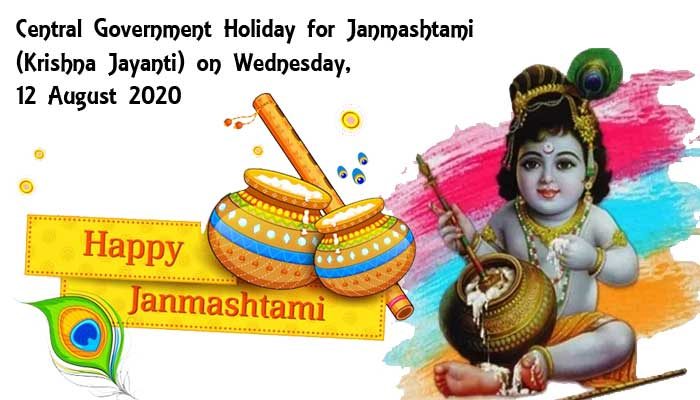
Janmashtami (Krishna Jayanti) Central Government holiday on 12 August 2020
Krishna Janmashtami, occurs on 12th August 2020 as a national holiday. [Dopt order holiday 2020]
This is Janmashtami (Krishna Jayanti), one of the most important Hindu
festivals. Janmashtami will be observed this year on 11 August 2020; it
will also be observed by others on 12 August.
Janmashtami History
Janmashtami (VAISHNAVI) is Lord Krishna ‘s Birthday.
Across other parts of India, Krishna Janmashtami is also recognised as
Krishnashtami, Gokulashtami, Ashtami Rohini, Srikrishna Jayanti and Sree
Jayanthi, and a Gazetted holiday. This holiday in Tamil Nadu is known
as Sri Krishna Jayanti Ceremonies and prayers will be offered in temples devoted to Krishna
in India. The day before that consist of fasting and prayer until
midnight, the time that Krishna was born was said to be.
Janmashtami Special
Devotees also practice ceremonial puja at midnight and all seventeen
steps that are part of Shodashopachara Puja Vidhi are included in this.
The statues in his image are cleaned, dressed and put in a cradle after
the hour of Krishna’s midnight birth passes. Women would draw tiny footprints outside the doors and kitchen of their house,
representing Krishna walking into their homes.
Why is Janmashtami held for 2 days?
After Raksha Bandhan, a festival celebrating the link between
brothers and sisters, his birthday is celebrated eight days after It
falls in Sravana’s Hindu month which usually matches August or
September. Celebrations are distributed over two days and are intense
and colorful.
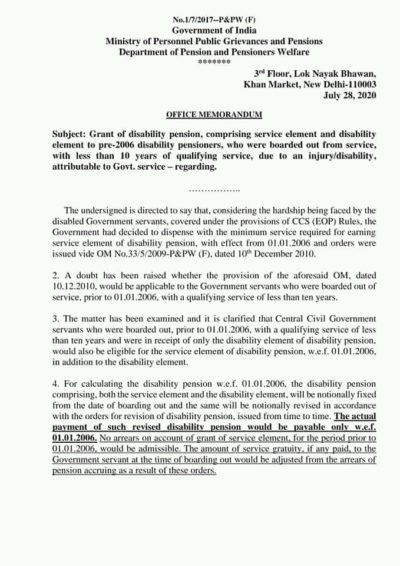
No.1/7/2017- P&PW (F) Government of India Ministry of Personnel Public Grievances and Pensions Department of Pension and Pensioners Welfare
3nd Floor, Lok Nayak Bhawan, Khan Market, New Delhi-110003 July 28, 2020
OFFICE MEMORANDUM
Subject: Grant of disability pension, comprising service
element and disability clement to pre-2006 disability pensioners, who
were boarded out from service, with less than 10 years of qualifying
service, due to an injury/ disability, attributable to Govt. service –
regarding.
The undersigned is directed to say that, considering the hardship
being faced by the disabled Government servants, covered under the
provisions of CCS (EOP) Rules, the Government had decided to dispense
with the minimum service required for earning service element of
disability pension, with effect from 01.01.2006 and orders were issued
vide OM No.33/5/2009-P&PW (F). dated 10th December 2010.
A doubt has been raised whether the provision of the
aforesaid OM, dated 10.12.2010, would be applicable to the Government
servants who were boarded out of service, prior to 01.01.2006, with a
qualifying service of less than ten years.
The matter has been
examined and it is clarified that Central Civil Government servants who
were boarded out, prior to 01.01.2006, with a qualifying service of less
than ten years and were in receipt of only the disability element of
disability pension, would also be eligible for the service element of
disability pension, w.e.f. 01.01.2006, in addition to the disability
clement.
For calculating the disability pension w.e.f.
01.01.2006, the disability pension comprising, both the service element
and the disability clement, will be notionally fixed from the date of
boarding out and the same will be notionally revised in accordance with
the orders tor revision of disability pension. issued from time to time.
The actual payment of such revised disability pension would be payable
only w.e.f. 01.01.2006, No arrears on account of grant of service
element, for the period prior to 01.01.2006, would be admissible. The
amount of service gratuity, if any paid, to the Government servant at
the time of boarding out would be adjusted from the arrears of pension
accruing as a result of these orders.
This issues with the
concurrence of the Ministry of Finance, Department of Expenditure, vide
their ILD. Note No. 1(9)/EV/2019 dated 25/06/2020.
In their
application to the persons belonging to Indian Audit and Accounts
Department, these orders are issued under Article 148(5) of the
Constitution and after consultation with the Comptroller and Auditor
General of India.
The Administrative Divisions of all Ministries
/ Department & attached / subordinate offices are requested to
bring the contents of these instructions to the notice of all concerned
for compliance.
7th Pay Commission Clarification regarding prescribed Benchmark while considering MACPs to Non-Gazetted Staff
EAST COAST RAILWAY
प्रधान मुख्य कार्मिक अधिकारी का कार्यालय Office of the Principal Chief Personnel Officer रेल सदन, द्वितीय तल, भुवनेश्वर – 751017 Rail Sadan, IInd Floor, Bhubaneswar – 751017
Date: 29.07.2020
No. ECor/Pers/R/ Clari-MACPs/2020
All PHODs/ CHODs, DRMs- SBP/WAT/KUR, Sr. SPOs-SBP/WAT/KUR & WPO/CRW/MCS.
Sub: Clarification regarding prescribed Benchmark while considering MACPs to Non-Gazetted Staff.
Reff: RBE No. 155/2016 and RBE-16/2020.
The comprehensive MACP Scheme on acceptance of Seventh Central Pay
Commission recommendations has been issued vide RBE No-16/2020. In the
light of the recommendations of the 7th CPC, the Modified Assured Carrier Progression Scheme (MACPs)
will continue to be administered at 10, 20 and 30 years as before. In
order to implement a uniform policy all over ECoR, the following staff.
In terms of RBE No.-155/2016 for grant of financial up gradation
under the MACPs the prescribed Benchmark has been revised for all level
to “Very Good” w.e.f 25th July, 2016.
In compliance to RBE No-16/2020, enclosing DOPT’s O.M. No-35034/3/2015-Estt. (D) dated-22.10.2019, Para-17, (i) the revised benchmark of APARs i.e. “Very Good” shall be applicable for the year 2016-17 and subsequent years.
White
assessing the suitability of and employee for grant of MACP, the DSC
(Departmental Screening Committee) shall assess the APARs in the
reckoning period, the benchmark for the APARs for the years 2016-2017
and thereafter shall be “Very Good”.
For Example, if a
particular MACP falls due on or after 25.07.2016, the following
benchmark for APARs are applicable for Level 11 and below:
APAR for the Year
Benchmark grading for MACP for Level-11 and below.
2015-16 and earlier
Good
2016-17
Very Good
2017-18 and subsequent year
Very Good
(R.N.A. Parida) Chairman Railway Recruitment Cell For Principal Chief Personnel Officer
AICPIN for the month of June, 2020 increased by 2 points
No. 5/1/2020-CPI GOVERNMENT OF INDIA MINISTRY OF LABOUR & EMPLOYMENT LABOUR BUREAU
‘CLEREMONT’, SHIMLA-171004 DATED: 31st July, 2020
Press Release
Consumer Price Index for Industrial Workers (CPI-IW) - June, 2020
The Labour Bureau, an attached office of the M/o Labour &
Employment, has been compiling Consumer Price Index for Industrial
Workers every month on the basis of the retail prices of selected items
collected from 289 markets spread over 78 industrially important centres
in the country. The index is compiled for 78 centres and All-India and
is released on the last working day of succeeding month. The index for
the month of June, 2020 is being released in this press release.
The All-India CPI-IW AICPIN for
June, 2020 increased by 2 points and stood at 332 (three hundred and
thirty two). On 1-month percentage change, it increased by (+) 0.61 per
cent between May and June, 2020 compared to (+) 0.64 per cent increase
between corresponding months of previous year.
The maximum upward pressure in current index came from Food group
contributing (+) 1.65 percentage points to the total change. At item
level, Rice, Groundnut Oil, Fish Fresh, Goat Meat, Poultry (Chicken),
Milk (Buffalo), Brinjal, Cauliflower, Green Coriander Leaves, Potato,
Tomato, Refined Liquor, Cooking Gas, Petrol, etc. are responsible for
the increase in index. However, this increase was checked by Wheat Atta,
Arhar Dal, Garlic, Onion, Arum, Coconut, Lady’s Finger, Lemon, Mango,
Kerosene Oil, etc., putting downward pressure on the index.
At centre level, Jharia recorded the maximum increase of 9 points.
Among others, 8 points increase was observed in 3 centres, 7 points in 2
centres, 6 points in 3 centres, 5 points in 7 centres, 4 points in 12
centres, 3 points in 7 centres, 2 points in 10 centres and 1 point in 12
centres. On the contrary, Ranchi-Hatia recorded the maximum decrease of
8 points. Among others, 3 points decrease was observed in 5 centres, 2
points in 2 centres and 1 point in 1 centre. Rest of 12 centres’ indices
remained stationary.
The indices of 31 centres are above All-India Index and 45 centres’
indices are below national average. The indices of Chhindwara and
Jalandhar centres remained at par with All-India Index.
Year-on-year inflation based on all-items stood at 5.06 per cent for
June, 2020 as compared to 5.10 per cent for the previous month and 8.59
per cent during the corresponding month of the previous. year.
Similarly, Food inflation stood at 5.49 per cent against 5.88 per cent
of the previous month and 5.47 per cent during the corresponding month a
year ago.
The next issue of CPI-IW for the month of July, 2020 will be released
on Monday 31st August, 2020. The same will also be available on the
office website www.labourbureaunew.gov.in
F.No.11013/9/2014-Estt. A.III Government of India Ministry of Personnel, Public Grievances and Pensions (Department of Personnel
and Training)
North Block, New Delhi Dated the 5th June, 2020
OFFICE MEMORANDUM
Subject: Preventive measures to be taken to contain the spread of Novel Coronavirus (COVID-19) – Attendance regarding.
The undersigned is directed to refer to OM of even number dated the
17th March, 2020, 18th May, 2020 and 19th May, 2020 whereby advisory for
well-being of Government employees and attendance in Government offices
with staggered timings were issued by Department of Personnel &
Training (DoPT).
2. Kind attention is also drawn to Ministry of Home Affairs’ Order
dated 30.05.2020 whereby ‘Additional Directives for Work Places’ have
been prescribed. Further, the Ministry of Health & Family Welfare
(MoH&FW) on 4th June, 2020 has issued Standard Operating Procedure
on preventive measures to contain spread of COVID-19 in workplace settings (copy enclosed).
3. It is emphasized that strict adherence to the practices of social
distancing norms and health & hygiene practices, as enunciated in
these guidelines, is of paramount importance and the Government servants
as responsible employees should abide by these practices so that the
Government offices function in the most efficient manner in the given
situation. All the Ministries / Departments/offices as well as the
Central Government employees are, therefore, directed to ensure strict
compliance of instructions issued by DoPT as well as MHA and MoH&FW.
(Umesh Kumar Bhatra) Deputy Secretary to the Govt. of India
4th June, 2020
Government of IndiaMinistry of Health & Family Welfare
SOP on preventive measures to contain spread of COVID-19 in offices
1. Background
Offices and other workplaces are relatively close settings, with
shared spaces like work stations, corridors, elevators & stairs,
parking places, cafeteria, meeting rooms and conference halls etc. and
COVID-19 infection can spread relatively fast among officials, staffs
and visitors.
There is a need to prevent spread of infection and to respond in a
timely and effective manner in case suspect case of COVID-19 is detected
in these settings, so as to limit the spread of infection.
2. Scope
This document outlines the preventive and response measures to be
observed to contain the spread of COVID-19 in office settings. The
document is divided into the following sub-sections
(i) Generic preventive measures to be followed at all times (ii) Measures specific to offices (iii) Measures to be taken on occurrence
of case(s) (iv) Disinfection procedures to be implemented in case of occurrence of suspect / confirmed case.
Offices in containment zones shall remain closed except for medical
& essential sevices. Only those outside containment zones will be
allowed to open up.
3. Generic preventive measures
Persons above 65 years of age, persons with comorbidities, pregnant
women are advised to stay at home, except for essential and health
purposes. Office management to facilitate the process.
The generic preventive measures include simple public health measures
that are to be followed to reduce the risk of infection with COVID-19.
These measures need to be observed by all (employees and visitors) at
all times. These include:
i. Individuals must maintain a minimum distance of 6 feet in public places as far as feasible. ii. Use of face covers/masks to be
mandatory. iii.
Practice frequent hand washing with soap (for at least 40-60 seconds)
even when hands are not visibly dirty. Use of alcohol-based hand
sanitizers (for at least 20 seconds) can be made wherever feasible. iv.
Respiratory etiquettes to be strictly followed. This involves strict
practice of covering one’s mouth and nose while coughing/sneezing with a
tissue / handkerchief / flexed elbow and disposing off used tissues
properly. v. Self-monitoring of health by all and reporting any illness at the earliest to the immediate supervisory officer. vi.
Spitting shall be strictly prohibited. vii. Installation & use of Aarogya Setu App by employees.
4. Specific preventive measures for offices:
i. Entrance to have mandatory hand hygiene (sanitizes dispenser) and thermal screening provisions.
ii. Only asymptomatic staff/visitors shall be allowed.
iii.
Any officer and staff residing in containment zone should inform the
same to supervisory officer and not attend the office till containment
zone is denotified. Such staff should be permitted to work from home and
it will not be counted as leave period.
iv. Drivers shall maintain
social distancing and shall follow required dos and don’ts related to
COVID-19. It shall be ensured by the service providers/ officers/ staff
that drivers residing in containment zones shall not be allowed to drive
vehicles.
v. There shall be provision for disinfection of the
interior of the vehicle using 1% sodium hypochlorite solution/ spray. A
proper disinfection of steering, door handles, keys, etc. should be
taken up.
vi. Advise all employees who are at higher risk i.e. older
employees, pregnant employees and employees who have underlying medical
conditions, to take extra precautions. They should preferably not be
exposed to any front-line work requiring direct contact with the public.
Office management to facilitate work from home wherever feasible. vii.
All officers and staff / visitors to be allowed entry only if using
face cover/masks. The face cover/mask has to be worn at all times inside
the office premises. viii. Routine issue of visitors/ temporary
passes should be suspended and visitors with proper permission of the
officer who they want to meet, should be allowed after being properly
screened. ix. Meetings, as far as feasible, should be done through video conferencing. x. Posters/ standees/ AV media on preventive
measures about COVID-19 to be displayed prominently.
xi. Staggering of office hours, lunch hours/coffee breaks to be done, as far as feasible.
xii. Proper crowd management in the parking lots and outside the premises – duly following social distancing norms be ensured. xiii.
Valet parking, if available, shall be operational with operating staff
wearing face covers/ masks and gloves as appropriate. A proper
disinfection of steering, door handles, keys, etc. of vehicles should be
taken up.
xiv. Any shops, stalls, cafeteria etc., outside and within
the office premises shall follow social distancing norms at all times.
xv. Specific markings may be made with sufficient distance to manage the queue and ensure social distancing in the premises.
xvi. Preferably separate entry and exit for officers, staff and visitors shall be organised.
xvii.
Proper cleaning and frequent sanitization of the workplace,
particularly of the frequently touched surfaces must be ensured.
xviii. Ensure regular supply of hand sanitisers, soap and running water in the washrooms.
xix. Required precautions while handling supplies, inventories and goods in the office shall be ensured.
xx. Seating arrangement to be made in such a way that adequate social distancing is maintained.
xxi. Number of people in the elevators shall be restricted, duly maintaining social distancing norms.
xxii.
For air-conditioning/ventilation, the guidelines of CPWD shall be
followed which inter alia emphasises that the temperature setting of all
air conditioning devices should be in the range of 24-30°C, relative
humidity should be in the range of 40¬70%, intake of fresh air should be
as much as possible and cross ventilation should be adequate.
xxiii. Large gatherings continue to remain prohibited.
xxiv.
Effective and frequent sanitation within the premises shall be
maintained with particular focus on lavatories, drinking and hand
washing stations/areas.
xxv. Cleaning and regular disinfection (using
1% sodium hypochlorite) of frequently touched surfaces (door knobs,
elevator buttons, hand rails, benches, washroom fixtures, etc.) shall be
done in office premises and in common areas
xxvi. Proper disposal of face covers / masks / gloves left over by visitors and/or employees shall be ensured.
xxvii. In the cafeteria/canteen/dining halls: a.Adequate crowd and queue management to be ensured to ensure social distancing norms. b. Staff / waiters to wear mask and hand gloves and take other required precautionary measures. c.The seating arrangement to ensure a
distance of at least 1 meter between patrons as far as feasible. d. In the kitchen, the staff to follow social distancing norms.
5. Measures to be taken on occurrence of case(s):
Despite taking the above measures, the occurrence of cases among the
employees working in the office cannot be ruled out. The following
measures will be taken in such circumstances:
i. When one or few person(s) who share a room/close office space
is/are found to be suffering from symptoms suggestive of COVID-19:
Place the ill person in a room or area where they are isolated
from others at the workplace. Provide a mask/face cover till such time
he/she is examined by a doctor.
Immediately inform the nearest medical facility (hospital/clinic) or call the state or district helpline.
A
risk assessment will be undertaken by the designated public health
authority (district RRT/treating physician) and accordingly further
advice shall be made regarding management of case, his/her contacts and
need for disinfection.
The suspect case if reporting very
mild/mild symptoms on assessment by the health authorities would be
placed under home isolation.
Suspect case, if assessed by health
authorities as moderate to severe, will be treated as per health
protocol in appropriate health facility.
The rapid response team of the concerned district shall be requisitioned and will undertake the listing of contacts.
The
necessary actions for contact tracing and disinfection of work place
will start once the report of the patient is received as positive. The
report will be expedited for this purpose.
ii. If there are large numbers of contacts from a pre-symptomatic /
asymptomatic case, there could be a possibility of a cluster emerging in
workplace setting. Due to the close environment in workplace settings
this could even be a large cluster (>15 cases). The essential
principles of risk assessment, isolation, and quarantine of contacts,
case referral and management will remain the same. However, the scale of
arrangements will be higher.
iii. Management of contacts:
The contacts will be categorised into high and low risk contacts by the District RRTas detailed in the Annexure I.
The high-risk exposure contacts shall be quarantined for 14 days.
These persons shall undergo testing as per ICMR protocol.
The low risk exposure contacts shall continue to work and closely monitor their health for next 14 days.
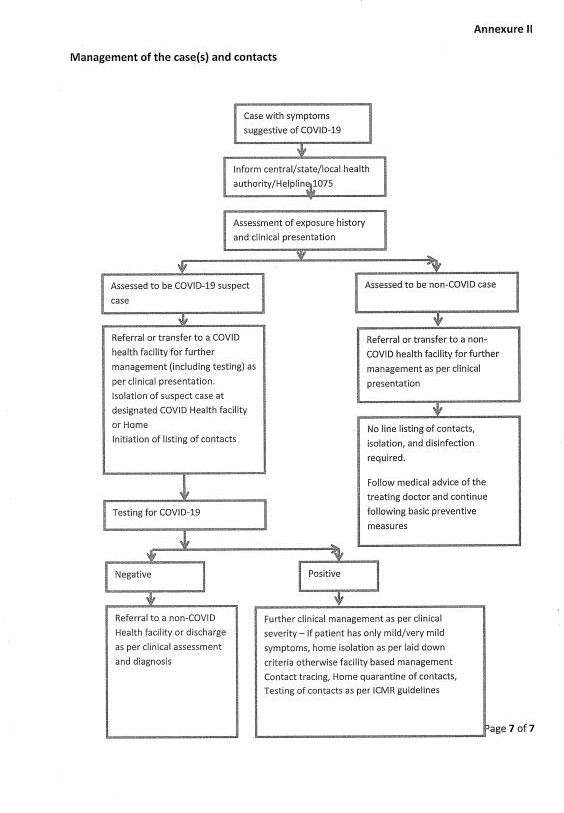
The flowchart for management of contact/ cases is placed at Annexure – II.
6. Closure of workplace
i. If there are one or two cases reported, the disinfection procedure
will be limited to places/areas visited by the patient in past 48 hrs.
There is no need to close the entire office building/halt work in other
areas of the office and work can be resumed after disinfection as per
laid down protocol. ii. However, if there is a larger outbreak, the
building/block will have to be closed for 48 hours after thorough
disinfection. All the staff will work from home, till the building/block
is adequately disinfected and is declared fit for re-occupation.
7. Disinfection Procedures in Offices
Detailed guidelines on the disinfection as already issued by Ministry
of Health & Family Welfare as available on their website shall be
followed.
Annexure I
Risk profiling of contacts
Contacts are persons who have been exposed to a confirmed case
anytime between 2 days prior to onset of symptoms (in the positive case)
and the date of isolation (or maximum 14 days after the symptom onset
in the case).
High-risk contact
Touched body fluids of the patient (respiratory tract
secretions, blood, vomit, saliva, urine, faeces; e.g. being coughed on,
touching used paper tissues with a bare hand)
Had direct physical contact with the body of the patient including physical examination without PPE
Touched or cleaned the linens, clothes, or dishes of the patient.
Lives in the same household as the patient.
Anyone in close proximity (within 1 meter) of the confirmed case without precautions.
Passengers
in close proximity (within 1 meter) in a conveyance with a symptomatic
person who later tested positive for COVID-19 for more than 6 hours.
Low-risk contact
Shared the same space (worked in same room/similar) but not having a high-risk exposure to confirmed case of COVID-19.
Travelled in same environment (bus/train/flight/any mode of transit) but not having a high-risk exposure.