A complete reference blog for Indian Government Employees

Tuesday, 24 May 2016

Reminder: Highlights of Recommendations of 7th Central Pay Commission

Reminder: Highlights of Recommendations of 7th Central Pay Commission 


Minimum Pay: Based on the Aykroyd formula, the minimum pay in government is recommended to be set at Rs.18,000 per month.
Maximum Pay: Rs.2,25,000 per month for Apex Scale and Rs.2,50,000 per month for Cabinet Secretary and others presently at the same pay level.
Financial Implications:
The total financial impact in the FY 2016-17 is likely to be Rs.1,02,100 crore, over the expenditure as per the ‘Business As Usual’ scenario.  Of this, the increase in pay would be Rs.39,100 crore, increase in allowances would be Rs. 29,300 crore and increase in pension would be Rs.33,700 crore.
Out of the total financial impact of Rs.1,02,100 crore, Rs.73,650 crore will be borne by the General Budget and Rs.28,450 crore by the Railway Budget.
In percentage terms the overall increase in pay & allowances and pensions over the ‘Business As Usual’ scenario will be 23.55 percent. Within this, the increase in pay will be 16 percent, increase in allowances will be 63 percent, and increase in pension would be 24 percent.
The total impact of the Commission’s recommendations are expected to entail an increase of 0.65 percentage points in the ratio of expenditure on (Pay+Allowances+ Pension) to GDP compared to 0.77 percent in case of VI CPC.
New Pay Structure: Considering the issues raised regarding the Grade Pay structure and with a view to bring in greater transparency, the present system of pay bands and grade pay has been dispensed with and a new pay matrix has been designed. Grade Pay has been subsumed in the pay matrix. The status of the employee, hitherto determined by grade pay, will now be determined by the level in the pay matrix.
Fitment: A fitment factor of 2.57 is being proposed to be applied uniformly for all employees.
Annual Increment: The rate of annual increment is being retained at 3 percent.
Modified Assured Career Progression (MACP): Performance benchmarks for MACP have been made more stringent from “Good” to “Very Good”.
The Commission has also proposed that annual increments not be granted in the case of those employees who are not able to meet the benchmark either for MACP or for a regular promotion in the first 20 years of their service.
No other changes in MACP recommended.
Military Service Pay (MSP): The Military Service Pay, which is a compensation for the various aspects of military service, will be admissible to the Defence forces personnel only. As before, Military Service Pay will be payable to all ranks up to and inclusive of Brigadiers and their equivalents. The current MSP per month and the revised rates recommended are as follows:
7th-CPC-Report-Highlights

Short Service Commissioned Officers: Short Service Commissioned Officers will be allowed to exit the Armed Forces at any point in time between 7 and 10 years of service, with a terminal gratuity equivalent of 10.5 months of reckonable emoluments. They will further be entitled to a fully funded one year Executive Programme or a M.Tech. programme at a premier Institute.
Lateral Entry/Settlement: The Commission is recommending a revised formulation for lateral entry/resettlement of defence forces personnel which keeps in view the specific requirements of organization to which such personnel will be absorbed. For lateral entry into CAPFs an attractive severance package has been recommended.
Headquarters/Field Parity: Parity between field and headquarters staff recommended for similar functionaries e.g Assistants and Stenos.
Cadre Review: Systemic change in the process of Cadre Review for Group A officers recommended.
Allowances: The Commission has recommended abolishing 52 allowances altogether. Another 36 allowances have been abolished as separate identities, but subsumed either in an existing allowance or in newly proposed allowances. Allowances relating to Risk and Hardship will be governed by the proposed Risk and Hardship Matrix.
Risk and Hardship Allowance: Allowances relating to Risk and Hardship will be governed by the newly proposed nine-cell Risk and Hardship Matrix, with one extra cell at the top, viz., RH-Max to include Siachen Allowance.
The current Siachen Allowance per month and the revised rates recommended are as follows:

This would be the ceiling for risk/hardship allowances and there would be no individual RHA with an amount higher than this allowance.
House Rent Allowance: Since the Basic Pay has been revised upwards, the Commission recommends that HRA be paid at the rate of 24 percent, 16 percent and 8 percent of the new Basic Pay for Class X, Y and Z cities respectively. The Commission also recommends that the rate of HRA will be revised to 27 percent, 18 percent and 9 percent respectively when DA crosses 50 percent, and further revised to 30 percent, 20 percent and 10 percent when DA crosses 100 percent.
In the case of PBORs of Defence, CAPFs and Indian Coast Guard compensation for housing is presently limited to the authorised married establishment hence many users are being deprived. The HRA coverage has now been expanded to cover all.
Any allowance not mentioned in the report shall cease to exist.
Emphasis has been placed on simplifying the process of claiming allowances.
Advances: All non-interest bearing Advances have been abolished.
Regarding interest-bearing Advances, only Personal Computer Advance and House Building Advance (HBA) have been retained. HBA ceiling has been increased to Rs.25 lakhs from the present Rs.7.5 lakhs.
Central Government Employees Group Insurance Scheme (CGEGIS): The Rates of contribution as also the insurance coverage under the CGEGIS have remained unchanged for long. They have now been enhanced suitably. The following rates of CGEGIS are recommended:
7th-CPC-Report

Medical Facilities: Introduction of a Health Insurance Scheme for Central Government employees and pensioners has been recommended.
Meanwhile, for the benefit of pensioners residing outside the CGHS areas, CGHS should empanel those hospitals which are already empanelled under CS (MA)/ECHS for catering to the medical requirement of these pensioners on a cashless basis.
All postal pensioners should be covered under CGHS. All postal dispensaries should be merged with CGHS.
Pension: The Commission recommends a revised pension formulation for civil employees including CAPF personnel as well as for Defence personnel, who have retired before 01.01.2016. This formulation will bring about parity between past pensioners and current retirees for the same length of service in the pay scale at the time of retirement.
The past pensioners shall first be fixed in the Pay Matrix being recommended by the Commission on the basis of Pay Band and Grade Pay at which they retired, at the minimum of the corresponding level in the pay matrix.
This amount shall be raised to arrive at the notional pay of retirees, by adding number of increments he/she had earned in that level while in service at the rate of 3 percent.
In the case of defence forces personnel this amount will include Military Service Pay as admissible.
Fifty percent of the total amount so arrived at shall be the new pension.
An alternative calculation will be carried out, which will be a multiple of 2.57 times of the current basic pension.
The pensioner will get the higher of the two.
Gratuity: Enhancement in the ceiling of gratuity from the existing Rs.10 lakh to Rs.20 lakh. The ceiling on gratuity may be raised by 25 percent whenever DA rises by 50 percent.
Disability Pension for Armed Forces: The Commission is recommending reverting to a slab based system for disability element, instead of existing percentile based disability pension regime.
Ex-gratia Lump sum Compensation to Next of Kin: The Commission is recommending the revision of rates of lump sum compensation for next of kin (NOK) in case of death arising in various circumstances relating to performance of duties, to be applied uniformly for the defence forces personnel and civilians including CAPF personnel.
Martyr Status for CAPF Personnel: The Commission is of the view that in case of death in the line of duty, the force personnel of CAPFs should be accorded martyr status, at par with the defence forces personnel.
New Pension System: The Commission received many grievances relating to NPS. It has recommended a number of steps to improve the functioning of NPS. It has also recommended establishment of a strong grievance redressal mechanism.
Regulatory Bodies:  The Commission has recommended a consolidated pay package of Rs.4,50,000 and Rs.4,00,000 per month for Chairpersons and Members respectively of select Regulatory bodies. In case of retired government servants, their pension will not be deducted from their consolidated pay. The consolidated pay package will be raised by 25 percent as and when Dearness Allowance goes up by 50 percent. For Members of the remaining Regulatory bodies normal replacement pay has been recommended.
Performance Related Pay: The Commission has recommended introduction of the Performance Related Pay (PRP) for all categories of Central Government employees, based on quality Results Framework Documents, reformed Annual Performance Appraisal Reports and some other broad Guidelines. The Commission has also recommended that the PRP should subsume the existing Bonus schemes.
There are few recommendations of the Commission where there was no unanimity of view and these are as follows: 

The Edge: An edge is presently accordeded to the Indian Administrative Service (IAS) and the Indian Foreign Service (IFS) at three promotion stages from Senior Time Scale (STS), to the Junior Administrative Grade (JAG) and the NFSG.  is recommended by the Chairman, to be extended to the Indian Police Service (IPS) and Indian Forest Service (IFoS).
Shri Vivek Rae, Member is of the view that financial edge is justified only for the IAS and IFS. Dr. Rathin Roy, Member is of the view that the financial edge accorded to the IAS and IFS should be removed.
Empanelment: The Chairman and Dr. Rathin Roy, Member, recommend that All India Service officers and Central Services Group A officers who have completed 17 years of service should be eligible for empanelment under the Central Staffing Scheme and there should not be “two year edge”, vis-à-vis the IAS. Shri Vivek Rae, Member, has not agreed with this view and has recommended review of the Central Staffing Scheme guidelines.
Non Functional Upgradation for Organised Group ‘A’ Services: The Chairman is of the view that NFU availed by all the organised Group `A’ Services should be allowed to continue and be extended to all officers in the CAPFs, Indian Coast Guard and the Defence forces. NFU should henceforth be based on the respective residency periods in the preceding substantive grade. Shri Vivek Rae, Member and Dr. Rathin Roy, Member, have favoured abolition of NFU at SAG and HAG level.
Superannuation: Chairman and Dr. Rathin Roy, Member, recommend the age of superannuation for all CAPF personnel should be 60 years uniformly. Shri Vivek Rae, Member, has not agreed with this recommendation and has endorsed the stand of the Ministry of Home Affairs.
The full report is available in the website http://7cpc.india.gov.in.

Share:

Pay Revision 2014 Payment of salary arrears detailed instructions/guidelines GOVERNMENT OF KERALA

Pay Revision 2014 —Payment of salary arrears -detailed instructions/guidelines — GOVERNMENT OF KERALA

GOVERNMENT OF KERALA
No:46/2016/Fin.
Finance (ARC) Department
Thiruvananthapuram
Dated: 19/05/2016
CIRCULAR

Sub:- Pay Revision 2014 —Payment of salary arrears -detailed instructions/guidelines — issued.
Ref:- G.0.(P) 7/2016/Fin dated 20/01/2016.

As per G.O read above Government have issued orders revising pay and allowances of State Government employees, staff of educational institutions, Teachers, Part Time Contingent employees and Casual Sweepers wherein it was ordered that the arrears on account of pay revision for the period from 01.07.2014 to 31.01.2016 will be paid in cash in four equal instalments each at 25% of the total amount on 01.04.2017,01.10.2017, 01.04.2018 and 01.10.2018 respectively along with interest at the rate applicable to General Provident Fund. Government are now pleased to issue the following guidelines for calculation, accounting and payment of Pay revision arrears for the period from 01.07.2014 to 31.01.2016:

1. All Drawing and Disbursing Officers should calculate month wise arrears of pay revision including surrender of earned leave of all employees for the period from 01.07.2014 to 31.01.2016 with interest from 01/02/2016 at the rate applicable to General Provident Fund as directed at para 46 of the GO read above in the proforma attached with this circular before 30.06.2016. Every employee will be served a copy of the statement of arrears due to him. The DDO should furnish a consolidated statement of pay revision arrears specifying the amount due on each instalment and the head of account from which salary is drawn before 31/07/2016 under his control to the head of the department.

2. In the case of employees who are on deputation to foreign service/Government of India for any period between 01.07.2014 to 31.01.2016 or as the case may be, their arrears should be credited to the Government account.

3. The foreign employer should remit the total amount of arrear in lump for the period from 01.07.2014 to 31.01.2016 or upto the period they have worked on deputation along with interest at the rate 8.7% per annum for the period from 01.02.2016 to the date of remittance, before 31.03.2017. The details of remittance to Government account along with the copy of Pay-in-slip should be forwarded to the Drawing and Disbursing Officer concerned in the parent department.

4. All Heads of Departments should consolidate the arrear amount payable and include the same in the budget proposal for the respective financial year in which the payment will be made.

5. First, second, third and fourth instalments of the arrear amount thus calculated will be paid along with salary for 03/2017,09/2017,03/2018 and 09/2018 respectively.

6. In the case of employees (including those who were on deputation) who retired on or after 01.07.2014 the arrear amonut will be drawn and disbursed by the Drawing and Disbursing Officer of the respective office of the parent department where the employee last worked.

7. In the case of an employee who expired/expires, the entire balance arrear amount along with interest accrued as on the date of death will be paid to the legal heir(s) of the employee.

8. In case where an employee will be on leave without allowance or under suspension as on the date of payment of arrears, arrear will be disbursed along with the first salary after rejoining duty. In such cases government will not be liable to pay interest for the period during which payment is deferred.

9. In case where an employee will be on deputation as on the date of payment of arrears the arrear amount will be drawn and disbursed by the Drawing and Disbursing Officer of the respective office of the parent department where the employee last worked.

10. No employee will be given relaxation on any point’s in the above direct ions and the Heads of Department should not entertain such request under any circumstances.

11. Proforma and illustration for calculation and payment of arrears are appended with this circular. All Drawing and Disbursing Officer should scrupulously follow the instructions in the circular.
sd/-
Dr.K.M.ABRAHAM
Additional chief Secretary (Finance)
Click Here to Download the Original Order
Share:

Monday, 23 May 2016

Good news for Central Government Pensioners

Good news for Central Government Pensioners

Provide your Aadhaar number to your bank now and be at ease in November every year

SPECIAL AADHAAR SEEDING AND REGISTRATION CAMP

At your own bank branch

From 30th May to 10th June, 2016
Bring PPO, Bank Pass Book and Aadhaar Card

If you do not have an Aadhaar number also carry a photo ID
********
With the Aadhaar option you can submit
Digital Life Certificate in November
From
  •  Home PC/Mobile Phone
  • Nearest Branch of your Bank
  • Nearest Common Service Centre
  • Anywhere in the Country or the World
Issued in the interest of Central Government Pensioners by:
Government of India,
Department of Pension and Pensioners Welfare


Share:

Under Secretaries appointed on ad-hoc basis – Extension of tenure for another one year beyond 30.06.2016

Under Secretaries appointed on ad-hoc basis – Extension of tenure for another one year beyond 30.06.2016 – reg.
No.5/8/2013-CS.I(U)
Government of India
Ministry of Personnel, PG and Pensions
(Department of Personnel & Training)
2nd Floor, Lok Nayak Bhavan,
Khan Market, New Delhi-110003
Dated the 20th May, 2016
ORDER

With the approval of the Competent Authority, the tenure of ad-hoc appointment of Under Secretaries covered under DoPT’s following orders is hereby extended for another one year beyond 30.06.2016 i.e. upto 30.06.2017 or till the posts are filled up on regular basis, whichever is earlier:

Sl. No.Orders no.Orders issued on
1.5/3/2010-CS.I(U)26.05.2010, 03.09.2010, 11.11.2010
2.5/7/2011-CS.I(U)11.08.2011,15.12.2011
3.5/9/2012-CS.I(U)30.10.2012, 30.11.2012, 06.12.2012, 12.12.2012,
19.12.2012,28.12.2012
4.5/8/2013-CS.I(U)18.06.2013, 08.08.2013, 24.12.2013, 24.02.2014,
28.02.2014, 11.06.2014, 02.07.2014
5.5/11/2014-CS.I(U)15.09.2014, 19.09.2014, 30.10.2014, 20.11.2014,
08.12.2014,10.12.2014,26.12.2014
6.5/3/2015-CS.I(U)20.02.2015,24.03.2015, 25.05.2015, 24.07.2015,
19.11.2015,26.11.2015,23.12.2015,3.1.12.2015,
29.01.2016,01.02.2016, 11.03.2016,28.03.2016,
02.05.2016

2. . This order will be applicable to all such officers who are continuously holding the post of Under Secretary on ad-hoc basis as per aforementioned orders. The continuation of the ad-hoc  promotion beyond 30.06.2016 is subject to the conditions as mentioned in this Department’s aforementioned orders.

(Raju Saraswat)
Under Secretary to the Government of India
Tele: 24629412
Copy To:
1. All Ministries/Departments (through website of DoPT)
2. Guard file

DoPT Order
Share:

7th Pay Commission: Euphoric Modi government to give final nod to Increment notification soon

7th Pay Commission: Euphoric Modi government to give final nod to 'Increment'; notification soon

7thCPC Increment notification

As high voltage State Assembly polls have ended now, Government is all set to implement the recommendations of Seventh Pay Commission.

Reportedly, Modi Government which is euphoric after party's victory in Assam and its good show in Kerala, looks in full mood to handover increased payout to Government staff anytime soon.

It is being believed that as model code of conduct is no longer a barrier in the way of implementing salary increment, Government could issue notification in the first week of June. Sources say that all the formalities regarding the implementation process will be done after a Cabinet meet which will be chaired by Prime Minister Narendra Modi soon. Read more: 7th Pay Commission: PMO orders early implementation of 'increment', wants 'maximum payout' for staff A website quoting Finance Ministry sources writes, "the BJP led central government is now in a pleasant mood, accordingly it may announce better pay package that recommended by Pay Commission to central government employees". Reportedly, Modi Government will give 25-30 per cent increment to Central Government employees, Sources say that increment will be handed over in July while arrears from January till that date will be paid in August.

OneIndia News
Share:

Sunday, 22 May 2016

7th Pay Commission: Government doctors threaten to go on strike want better salary, allowances

7th Pay Commission: Government doctors threaten to go on strike; want better salary, allowances

7th Pay Commission government doctors strike

The Seventh Pay Commission be implemented anytime now but before that everyone wants their demands to be met in regards with the allowances and wages. If reports are to be believed then, the doctors working in government hospitals in Delhi may go on strike if the Modi government does not meet their demands in connection with the seventh pay commission.

Government is deciding our pay scale, and does not even bother to listen to our demands. They do not even give us appropriate representation in the committee. While no doctor likes to go on strike, we will do exactly so if the existing recommendations of the 7th Pay commission are given a go ahead," Dr Pankaj Solanki, President, Federation of resident doctors association (FORDA) was quoted as saying in a ZeeNews report.

The report further adds, "FORDA is a body of 15000 resident doctors in the capital, and have said that government doctors from other organisations and states have shown their inclination towards the strike opposing the recommendations of the seventh pay commission." Doctors have said that either their demands be met by the end of or they will go on an indefinite strike. Earlier, the central government employees had also said that they are planning to strike work on July 11 so that they get higher wages and allowances under the 7th Pay Commission.

The central government employees lead by the National Council (Staff Side) Joint Consultative Machinery have also said that they will not accept unilateral decision on salary hikes under the seventh Pay Commission and would like to have more say in the way their monthly salaries and allowances are shaped up by the Empowered Committee of Secretaries.

Via OneIndia News
Share:

Government all set to launch special colour coded Aadhaar card for disabled

Government all set to launch special colour coded Aadhaar card for disabled

Aadhaar-card-color-disabled
Aadhaar card will be marked by three different colours — red, blue and yellow to indicate the degree of disability.

The government is all set to launch special colour-coded Aadhaar card for disabled for easy linkage to the government’s schemes and services.

The Social Justice and Empowerment Ministry is likely to launch the process for registration of disabled persons on a centralised e-platform to issue Unique Disabled Identity (UDID) cards.

The card will be marked by three different colours — red, blue and yellow to indicate the degree of disability.

First Aadhaar cards are likely to be delivered in August in Ratlam in Madhya Pradesh, which is the chosen district for the pilot project.

According to officials, rough estimates put the number of the disabled persons having disability certificate at not more than one crore. The UDID portal is expected to create real time data for planning and disbursal of benefits to the disabled.

The UDID portal will be launched in the public domain in June for registration at the district level and the first cards are likely to be handed out to eligible persons in mid-August. The cards will be marked by a colour bar at one end.

Red colour will indicate disability of 80% and above, blue for disability between 40% and 80% and yellow for disability below 40%.

It has been designed by National School of Design, Ahmedabad. It will have a hologram meshed in to prevent any attempts at duplication.

All applicants will be certified after due verification by the CMO and only then the UDID will be generated.

Considering that everyone may not have access to the online platform, offline applications will also be accepted. “The database will be unique hence there will be no chance of duplication,” an official explained.

The states that will be covered in the first phase include UP, Haryana, Chandigarh, Rajasthan, Gujarat, Madhya Pradesh, Maharashtra, Odisha, Telangana, Kerala, Tripura, Jharkhand and Tamil Nadu. The remaining states will be covered by 2018.
Share:

Featured post

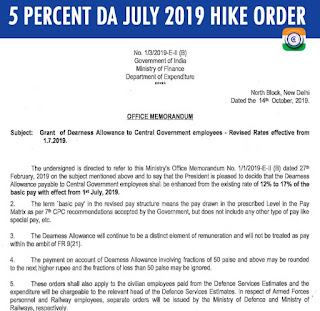
5 Percent DA July 2019 Hike Order - Grant of Dearness Allowance to Central Government employees

Grant of Dearness Allowance to Central Government employees 5 Percent DA July 2019 Hike Order  No. 1/3/2019-E- II (B) Government of...

Blog Archive

About The Author