A complete reference blog for Indian Government Employees

Thursday, 26 November 2015

Abolishing 12 Interest free advances recommended by 7th CPC

7th Pay Commission recommendations on LTC advance and Medical Advance

Abolishing 12 Interest free advances recommended by 7th CPC

The 7th Pay Commission has , in a casual manner, recommended that all interest free advances to be abolished. The impact of this recommendation is yet un noticed by the central government employees
There are 12 Interest free advances are listed in that table provided in the 7th CPC Report. When hearing the news that 7th cpc has recommended to abolish interest free advances , every body thought that some advances like festival advances only will be abolished. But if you read the names of advances recommended for abolishment, it will give you little bit shock.

In general opinion, the amount that is paid for government servants in some occasions and for specific purposes and the same will be recovered through monthly instalments are considered advances.

But the advance paid for Medical treatment and LTC are not supposed to be included this list, since it is reimbursable in nature and will not be recovered by Government.

The amount paid as advances to the Medical treatment and LTC are not recoverable by government if there is no any default in the claim. since the expenses incurred should be reimbursed to the Govt servants according to their entitlements, the amount paid in advance can be adjusted against the claim of reimbursement is sanctioned. So there is no need of repaying the advance to government in respect of Medical and LTC advances.These should not be included in the list of interest free advances.

Eventually abolishing these advances will make the central government employees not to avail LTC facility and medical treatment in Private hospital, since the amount of 90 % of the expenses paid in advance will not be available for them any more due to this recommendation. By availing this advances they were able to manage the Medical Expenses and by availing this advance only they were able to bye Air or Train Tickets to go on LTC.

Without these advances, the Group C and B employees cannot imagine availing of LTC to visit some places in India with their family.

The Central Government should not accept the proposal of Abolishing these advances.

Source: GServants.com
Share:

New Pension Scheme : Analysis of the Issues by the 7th Pay Commission

New Pension Scheme : Analysis of the Issues by the 7th Pay Commission

10.3.12 The Commission has examined these concerns raised by the stakeholders. The Commission also interacted with Chairman, PFRDA, and representatives of the Department of Pensions and Pensioners Welfare (DPPW), Department of Personnel and Training (DoPT), Department of Expenditure (DoE) and the Department of Financial Services (DFS).

10.3.13 In so far as the future value of pension under NPS is concerned, the Commission notes that this would depend upon a combination of factors:
(i) performance of the invested fund, which in turn would depend on the asset mix of the investment and general economic situation of the country,
(ii) cost of financial intermediation,
(iii) contribution rates,
(iv) period of contribution,
(v) performance of the fund manager and
(vi) development of the annuity market.
Grievances against the NPS

The NPS has now been in effect for over 10 years. During this period, there has been perceptible progress in putting together the architecture and providing information to subscribers. Major concerns, however, remain. Broadly, these are as under:
i. The larger federations and staff associations advocated scrapping the NPS on the ground that it discriminates between two sets of government employees.
ii. Individuals covered under NPS have pleaded for reverting to the OPS on the grounds of uncertainty regarding the actual value of their future pension in the face of market related risks.
iii. Individuals have pointed out that under NPS, the effective salary becomes less since the employee has to mandatorily contribute 10 percent of pay towards the pension fund.
iv. Individuals have stated that grievance redressal facility is not effective and consultation with stakeholders has been non-existent. This communication gap has generated insecurity in the minds of stakeholders including staff and Group ‘A’ officers of Central Government as well as All India Service Officers.
v. Associations have complained that Family Pension after the death of the employee is not ensured in the NPS. Moreover, if an employee dies at an early age, the family would suffer since annuity from the contribution would be grossly inadequate.
vi. Individuals have complained that NPS subscribers have no recourse to GPF for their savings. Their personal savings (10% of salary) are considered part of a larger corpus. It has been pointed out that the justify approach would be to consider only government’s contribution and the returns earned on it as the effective amount available for purchase of annuities.
vii. Associations have pointed out that unlike the facility under GPF, it is not possible to take refundable advances under NPS, even to meet obligatory social expenditure. This forces employees towards increased indebtedness as they have to borrow from elsewhere.

viii. Grievances also relate to tax treatment under NPS. While contributions and accumulations in NPS are exempt, lump sum withdrawals from NPS at any time are taxable at par with any other income. In addition, there is a service tax liability on any amount utilised for purchase of annuity.

ix. It has been pointed out that though NPS became effective from 2004, detailed instructions were issued only in late 2009 and in many cases the credit of contributions began from 2012. In the case of AIS officers in some States, contributions by the concerned State Government are yet to be fully made and deployed. The net result of this has been that contributions for the period 2004-2012 have not been made in full or have earned simple interest and did not get any market linked returns. Because of the prevailing confusion, contributions made by some AIS officer have been returned to them without interest. This will have a huge impact on the eventual corpus as the benefits of compounding were not available for the first 8 -9 years.

x. Individuals, in their presentation before the Commission, stated that annuities under NPS have no compensation for inflation unlike dearness relief under OPS. Further, in the case of OPS there is a revision in basic pension itself after every Pay Commission. This too is not available in respect of annuity of NPS subscribers.

xi. It has been pointed out that government employees are not given freedom of choice in choosing their fund manager based on performance and track record as the contributions are divided in a pre-specified ratio among selected Pension Fund Managers. It has been stated that government employees have no say in asset allocation
of their money.

xii. Concerns were raised that the contribution of 10% + 10% will not be sufficient to create a corpus which provides reasonable assurance that pension will be 50 percent of the last pay drawn.
Authority : http://7cpc.india.gov.in/
Share:

Railway Reservation for Physically Challenged made easier

Railway Reservation for Physically Challenged made easier

New Delhi: In a much-needed relief to the physically challenged persons availing concessional rail fares, Railways has rationalised provisions for allotment of berths in a sleeper class under such quota by earmarking middle seat for the accompanying passenger.

As per the revised provisions, which are to come into effect from December 22, there will be two types of physically-challenged quota of two berths each — one lower and one middle — in the same cabin.
One will be for physically challenged persons who can utilise concession only when accompanied by an escort and the second for those for whom it is optional to take an escort with them, Railways announced in a release today.

It has also been decided that whenever a physically handicapped person books ticket on concession and if no berth is available in handicapped quota, the system will automatically try to allot the lower berth to the travelling passenger and middle berth to escort, subject to availability of same at the time of booking, the release said.

These changes were necessitated following some cases of the handicapped persons for whom it is optional to take an escort were not allowed to book single berth against this quota on the ground that the second berth will go vacant (as middle berth cannot be allotted to physically handicapped persons) was brought to the notice of the Railway Ministry, it said.

This issue has now been examined by the Ministry of Railways and further rationalisation has been done to ensure optimum allotment and utilisation of handicapped quota, the release said.

According to Railways, the berths for the physically handicapped persons, who can utilise concession only when accompanied by an escort, can be booked on first come first serve basis.

Similarly, for those handicapped persons having option of taking an escort, the berths will be booked together (in the same cabin), it said.

The release also said that at the time of preparation of reservation charts, the untiled lower berths under this quota can be released to physically handicapped passenger(of either category who were kept in general waiting list due to exhaustion of their quota), single senior citizen travelling alone on priority or to waitlisted passengers as per priority.

PTI
Share:

Filling up posts of Director (Finance) in PB-3 Rs.15,600-39,100/- + Grade Pay-7600/- in Sports Authority of India (HQ), New Delhi on deputation on foreign services basis.

Filling up posts of Director (Finance) in PB-3 Rs.15,600-39,100/- + Grade Pay-7600/- in Sports Authority of India (HQ), New Delhi on deputation on foreign services basis.

No.21/3/2014-CS-I(D)
Government of India
Ministry of Personnel, Public Grievances and Pensions
(Department of Personnel and Training)
********

2nd Floor, Lok Nayak Bhavan, New Delhi-110003
The 21st November, 2015

 OFFICE MEMORANDUM

 Subject: Filling up posts of Director (Finance) in PB-3 Rs.15,600-39,100/- + Grade Pay-7600/- in Sports Authority of India (HQ), New Delhi on deputation on foreign services basis.


Department of Sports vide their letter No.1-16/2015-SP-V dated 29 th October, 2015 has desired the services of suitable officers for filling up the post of Director (Finance) in Sports Authority of India (Headquarter), New Delhi (an autonomous organization under Ministry of Youth Affairs and Sports) in PB-3 Rs.15.600-39,100/- f Grade pay of Rs.7600/- on deputation basis for a period of 3 (three) years extendable upto 5 (five) years.


2. Ministries / Departments of Government of India are requested to give wide publicity to the above vacancy among their employees and may forward duly signed applications, if any, to the Shri Vinod Kumar, Under Secretary, Department of Sports, Shastri Mayan, ‘C’ Wing, New Delhi-110001 under intimation to this Office.


3. Cadre Clearance in respect of CSS Officers at the level of Under Secretary and above may be obtained from this Division before the application is forwarded for such deputation post.

Encl.: As above.

(BISWAJIT BANERJEE)
Under Secretary to the Government of India

All Ministries / Departments
Source: http://ccis.nic.in/WriteReadData/CircularPortal/D2/D02csd/SAI26112015.pdf
Share:

Tuesday, 24 November 2015

Presenting the 7th CPC Report within the scheduled time and without much anomalies

Presenting the 7th CPC Report within the scheduled time and without much anomalies

One of our genuine reader Mr.M.Dorai says…

The Seventh Central Pay Commission have done an excellent job by presenting the VII CPC Report within the scheduled time and without much anomalies that were vastly found in VI CPC Report. Abolition of Pay Band and Grade Pay System deserve appreciation. Pay matrix have been worked out with brilliance which provide minimum entry scale as well as fitment table for existing employees according to the increments drawn unlike the 3 methods of fixation adopted by VI CPC among new recruits, promotees and existing employees which caused great disparity and anomaly in pay fixation.

The hike granted is also quite substantial which in fact is more than what VI CPC had granted. While the increase granted by VII CPC on pre-revised VI CPC basic pay actually ranges from 32% to 56% of the pre-revised Basic pay, the increase is projected as 15% wrongly by the media including the VII CPC in its comparison table which unnecessarily have been paving the way for resentment and unrest among the central government employees who would not have fully studied the report. While projecting the percentage of increase the VI CPC,had taken into account only the basic pay . Whereas the VII CPC had reckoned D.A. element to project the percentage of increase which gives a wrong picture of around 15% hike.

Therefore there should be no cause for resentment among the central government employees. They should rejoice over the benefits offered by the VII CPC. There is a overall increase of 25% to 40% in the gross emoluments which is more than what they received from the VI CPC. The retention of percentage of pension and percentage of commutation of pension and gratuity of 16.5 months and 300 days EL encashment on retirement shall steeply increase the take home retirement benefits by almost 60 to 70%.

In a nutshell the Chairman and Members of the VII CPC have done a commendable job and fulfilled their mission successfully ensuring justice to all levels of central government employees. Let us hope, the Government of India approve the recommendations without any changes and implement it .

Hats off to the Chairman and Members of the VII Central Pay Commission for presenting such an excellent report unseen in the history of pay commissions constituted so far.

Author: M.DORAI
Share:

7th CPC Pension Calculation : Fixation for Pre-2016 Pensioners

 7th CPC Pension Calculation : Fixation for Pre-2016 Pensioners
The 7th Pay Commission has recommended the fixation of pension for civil employees including CAPF personnel, who have retired before 01.01.2016, given two formulations with illustrations for fixing of pension. One for the pensioners retired before 2016 and another one is for the pensioners retired before 2006.
And also recommended, the first formulation of fixing the pension may take a little time since the records of each pensioner will have to be checked to ascertain the number of increments earned in the retiring level. The first instance the revised pension may be calculated as in the second formulation and the same may be paid as an interim measure. In the event calculation as per the formulation of fixing the pension yields a higher amount the difference may be paid subsequently.
And one more important recommendation of option given to the pensioners for choosing whichever is beneficial to them.
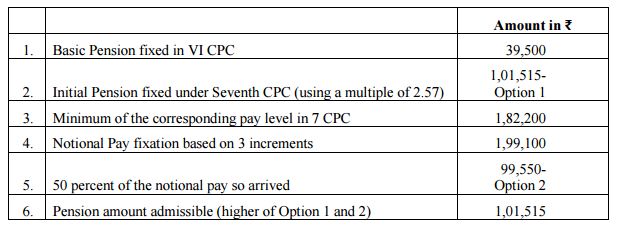
Recommendations on fixing of Pension by 7th CPC : All the civilian personnel including CAPF who retired prior to 01.01.2016 (expected date of implementation of the Seventh CPC recommendations) shall first be fixed in the Pay Matrix being recommended by this Commission, on the basis of the Pay Band and Grade Pay at which they retired, at the minimum of the corresponding level in the matrix.
1.This amount shall be raised, to arrive at the notional pay of the retiree, by adding the number of increments he/she had earned in that level while in service, at the rate of three percent. Fifty percent of the total amount so arrived at shall be the revised pension.
2. The second calculation to be carried out is as follows. The pension, as had been fixed at the time of implementation of the VI CPC recommendations, shall be multiplied by 2.57 to arrive at an alternate value for the revised pension.
Illustration on fixation of pension : Case I : Pensioner ‘A’ retired at last pay drawn of Rs.79,000 on 30 May, 2015 under the VI CPC regime, having drawn three increments in the scale Rs.67,000 to 79,000 :
Fixation-of-pension-calculation-7th-CPC

Case II : Pensioner ‘B’ retired at last pay drawn of Rs.4,000 on 31 January, 1989 under the IV CPC regime, having drawn 9 increments in the pay scale of Rs.3000-100-3500-125-4500 :
7th-CPC-Fixation-of-pension-calculation
Share:

7th pay commission recommends no change in retirement age

7th pay commission recommends no change in retirement age

New Delhi: The Seventh Pay Commission on Thursday recommended no change in retirement age of central government employees in its 900-page report, which was presented to Finance Minister Arun Jaitley by the commission, headed justice A K Mathur.

The central government employees’ bodies had pressed the Pay Commission to consider the possibility of enhancing the retirement age of central government employees.

The Pay Commission, after examining the issue and proposed a status quo on the retirement age of central government employees.

At present, the retirement age of central government employees is 60 years and the central government employees’ bodies were pressing hard to enhance it to 62 years.

The pay commission kept the retirement age of Central government employees unchanged based on many considerations including the large financial implications involved in implementing such a decision.

An official with the Commission said, “Raising the retirement age is a silly idea. if the elderly don’t retire, how will young people find job opportunities?”

“If we lower the age limit, the pension burden will bust the government’s medium-term fiscal targets,” he added.

The media had rumoured before submitting the pay panel report that the pay commission is planning to recommend the retirement age of Central government employees as the completion of 33 years of service, or at the age of 58, whichever comes first.

The age of retirement of Central government employees at the time of independence, 1947 was 55 years. It was made 58 years in 1962 after the Sino-Indian war and was again increased to 60 years in 1998, the BJP government led by Atal Bihari Bajpai, following implementation of the Fifth Pay Commission.

However, the panel recommended the retirement age of all paramilitary forces personnel should be 60 years. Earlier, those between the ranks of constable and commandant retired at 57 years while DIGs and above retired at 60 but
Vivek Rae, a former IAS officer and member of the Pay Commission, disagreed with this recommendation.

Citing view of Ministry of Home Affairs, Rae has differed, saying the age for superannuation cannot be raised from existing 57 years to 60 years for all ranks as force personnel up to the rank of Commandant have operational/combat roles in the field, which require higher physical fitness and efficiency than the higher ranks of DIG and above in paramilitary forces.

TST
Share:

Featured post

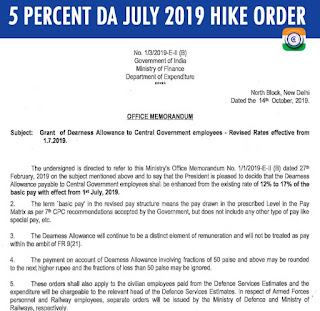
5 Percent DA July 2019 Hike Order - Grant of Dearness Allowance to Central Government employees

Grant of Dearness Allowance to Central Government employees 5 Percent DA July 2019 Hike Order  No. 1/3/2019-E- II (B) Government of...

Blog Archive

About The Author