A complete reference blog for Indian Government Employees

Monday, 30 March 2015

Sukanya Samriddhi Account / Yojana – Highest fetching interest scheme across all schemes.

Sukanya Samriddhi Account / Yojana – Highest fetching interest scheme across all schemes.
Disclaimer :- The information is compiled by Akula.Praveen Kumar, Marketing Executive, Medak HO, AP Circle. Author of blog does not accepts any responsibility in relation to the accuracy, completeness, usefullness or otherwise of the contents.
Sukanya Samriddhi Account/Yojana is a Small Savings Special deposit Scheme for girl child. This scheme is specially designed for girl’s higher education or marriage needs.
Highest fetching interest scheme across all schemes.
The Scheme launched for the welfare of the girl child, to save and educate the girl child.

Features of Sukanya Samriddhi Account (SSA):


  • Who can open the account? – Sukanya Samriddhi a/c (or Khata) can be opened on a girl child’s name by her natural (biological) parents or legal guardian.
  • What is the Age limit? – SSA can be opened in the name of a girl child from the birth of the girl child till she attains the age of  10 years.  ( As per SB Order No. 2/2015 : The Girl child who is born on or after  02.12.2003 can open account )
  • How many accounts can be opened? – A depositor may open and operate only one account in the name of same girl child under this scheme. The depositor (or) guardian can open only two SSA accounts. There is one exception to this rule. The natural or legal guardian can open two or three accounts if twin girls are born as second birth or triplets are born in the first birth itself.
  • How to open a SSA account? Accounts in name of the girl child can be opened in post offices or in any branch of a commercial bank that is authorized by the Central Government to open an account under this scheme rules.
  • What is the minimum deposit to open the account? – The account may be opened with an initial deposit of one thousand rupees. The minimum contribution in any financial year is Rs 1000. Thereafter the contributions can in multiples of one hundred rupees.
  • What is the maximum deposit amount? – a minimum of one thousand rupees shall be deposited in a financial year but the total money deposited in an account on a single occasion or on multiple occasions shall not exceed Rs 1.5 Lakh in a financial year.
  • Deposits in an account may be made till the child completes fourteen years, from the date of opening of the account.
  • Is there any penalty? – If minimum (Rs 1000 pa) amount is not deposited, the account will be treated as an irregular account. This can be regularized/renewed on payment of Rs 50 per year as penalty. Along with this, the minimum specified subscription for the year (s) of default should be paid.
  • What is the mode of deposit? – The deposits in Sukanya Samruddhi scheme can be made in the form of Cash or Demand Draft or Cheque. Where deposit is made by cheque or demand draft, the date of encashment of the cheque or demand draft shall be the date of credit to the account. The cheque or DD should be drawn in favour of the postmaster of the concerned post office or the Manager of the concerned bank.The depositor (parents or guardian) has to write the account holder’s name (child’s name) and the account number on the backside of the instrument.
  • What is the Rate of Interest on Sukanya Samriddhi Account? – The applicable rate of interest on SSA for the financial year 2014-2015 is 9.1%. This is one of the highest rates of interest offered by Government on small savings scheme
  • Is interest rate fixed or variable? – The rate of interest is not fixed and will be notified by the central government on a yearly basis.
  • The account can be transferred anywhere in India if the girl shifts to a place other than the city or locality where the account stands.
  • Is Premature withdrawal allowed? – 50 % (half of the fund) of the accumulated amount in SSA can be withdrawn for girl’s higher education and marriage after she attains 18 years of age. The account’s balance at the end of preceding financial year is used for the calculation.
  • Can the girl child operate the account? On attaining age of ten years, the account holder that is the girl child may herself operate the account, however, deposit in the account may be made by the guardian or parents.
  • Is premature closure allowed? In the event of death of the account holder, the account shall be closed immediately on production of death certificate. the balance at the credit of the account shall be paid along with interest till the month preceding the month of premature closure of the account , to the guardian of the account holder.
  • The scheme would mature on completion of 21 years of the girl child, from the date of opening of the account, with an option of keeping the account till marriage.
  • Can the girl child continue the account after her marriage? – The operation of the account shall not be permitted beyond the date of the girl’s marriage.
  • What are the required documents to open Sukanya Samriddhi Account? – Birth certificate of the girl child has to be produced. The depositor (parents or guardian) has to submit his/her identity and address proofs.
  • On opening an account, the depositor shall be given a pass book. It will have date of birth of the girl child, date of opening of account, account number, name and address of the account holder and the initial amount deposited. The depositor has to present the passbook to the post office or bank at the time of depositing/receiving the interest/on maturity.

Tax Benefits on Sukanya Samriddhi Account Scheme
The amount that is deposited under Sukanya Samriddhi Account will be eligible for income tax exemption under Section 80C of Income Tax Act, 1961.

At present, only the contribution of up to Rs 1.5 lakh toward Sukanya Samridhi Yojana is eligible for tax deduction under Section 80C. But discussions are on to also exempt the interest income and withdrawal amount. We can expect a formal announcement on this in the coming Union Budget 2015-16.

(Issue of making interest income and withdrawal exempt from taxation can be done by Department of Revenue (DoR) through legislative amendments. The matter is under examination of DoR)

Sukanya Samriddhi Account vs Public Provident Fund (PPF)

Both Sukanya Samriddhi Account (SSA) and Public Provident Fund (PPF) aims to seed the savings habit but both schemes have their own pros and cons.

Stressing on the girls role in making the India competitive and prosperous nation, Prime Minister Shri Narendra Modi has today launched a new small savings account for the girl child “Sukanya Samriddhi Account” as an integral part of the “Beti Bachao-Beti Padhao” campaign.

Sukanya Samriddhi Account was initially introduced by Shri Arun Jaitely in his maiden budget speech but has been officially launched today by Prime Minister Shri Narendra Modi. He has handed over bank account details to five girls under the “Sukanya Samridhi Yojna” (girl child prosperity scheme).
Sukanya Samridhi Yojna is a special deposit scheme for girl child only but one another popular scheme to benefit child (irrespective of girl or boy) is Public Provident Fund (PPF).

Let’s see the difference between Sukanya Samriddhi Account and Public Provident Fund (PPF)

Sukanya Samriddhi Account vs Public Provident Fund (PPF)

Points of Difference
Sukanya Samriddhi Account (SSA)
Public Provident Fund (PPF)
For whom
Only for Girl Child.
For every Indian Citizen.
  Age Limit
From the birth till she attains age of 10
years.
No age limit.
  By whom
By the girl child who has attained the age
of 10 years or by the natural or legal guardian.
By the Individual but by the natural or
legal guardian for the minor child.
  Where to open
Post office and nationalized banks but not
private banks.
Post office and nationalized banks,
including private banks.
  Number of Account
One account for each girl child, maximum up
to 2 or 3 accounts if twin girls are born in the second birth or triplets are
born in the first birth.
Each Individual can hold only one account in
his name.
  Minimum Contribution
    Rs.1,000
Rs.500
  Maximum Contribution
   Rs.1.5 lakhs in all accounts.
Rs.1.5 lakhs in all accounts.
Interest Rate
9.1% per annum for fiscal year 2014-15.
8.70% per annum for fiscal year 2014-15.
  Tax Benefit on the Contribution
Contributed Amount will be deductible u/s
80C.
Contributed Amount will be deductible u/s
80C.
  Tax Benefit on the interest earned
At present no tax benefit is announced for
the interest earned. A mere sum of Rs.1,5o0 will be deductible u/s 10(32) .
Interest Earned is tax free under PPF.
  Time Period of contribution
Minimum tenure of contribution is 14 years
from the date of opening of account.
Minimum 15 years and then in blocks of 5
years.
  Maturity
21 years from the date of opening of
account.
15 years from the fiscal year of opening of
account.
  Penalty
Rs.50 per year if minimum contribution is
not made.
Rs.50 per year if minimum contribution is
not made.
  Mode of Deposit
Cash or Demand Draft or Cheque
  Premature Withdrawal
Allowed up to 50% for the girl’s higher
education and marriage after she attains 18 years of age
No premature withdrawal is allowed except in
case of death of the account holder.
  Loan
No loan can be taken on the SSA balance.
Loan can be taken from the third year of
opening of account to the sixth year.
  Taxation on Maturity
No tax will be levied on the maturity
amount.
No tax will be levied on the maturity
amount.

Note:
  1. Interest rate under both the schemes will be notified each year by the Government.
    2. Interest will be compounded yearly under both schemes.
    3. Loan on the PPF balance is restricted to 25% of the balance at the end of 2nd year.
    4. At present interest earned on SSA account is taxable in the hands of guardian but it may get tax rebate in the upcoming budget.
    5. Contributed amount get deduction u/s 80c up to Rs.1.5 lakhs including all other eligible investments.
Source : http://akulapraveen.blogspot.in/ &  http://sapost.blogspot.in/
Share:

DOP Mobile Money Transfer Service www.dopmobile.in

DOP Mobile Money Transfer Service www.dopmobile.in

Department of Posts Mobile Money Transfer Service
http://www.dopmobile.in/

OVERVIEW

DOP Mobile Money Transfer is a service that enables instant money transfer from one place to another place using mobile, through Indian post offices. The consumer just needs to have a mobile while the actual transmission of the money is initiated by the Postal Assistant, using his/her special handset. The process for money transfer is very simple to understand and follow. The remitter (sender) can submit money (Cash In) at any of the covered post office and automatically, the amount is transferred to a central position, which can be collected by recipient customer (Cash Out) from any of the covered Post offices. As soon as the Cash in happens, both the sender and the recipient get a SMS on their mobile phones. The sender gets a Transaction ID and a Six (6) digit secret code in the SMS while the Recipient only gets the Transaction ID. Recipient can claim the money from any of the covered Post Offices by showing the Transaction ID that he receives on his mobile in the SMS and the Secret code, which he gets from the sender. In order to make process smooth and convenient, a notification sms is being sent to remitter as well as to recipient regarding transaction irrespective of their telecom operator.

 For this initiative, India’s pioneer and largest communication service provider (CSP), BSNL will provide mobile connections to DOP’s designated officials and BSNL will bring Global technology for Mobile Money Transfer. Each Post office shall be provided with a mobile handset with pre loaded application by BSNL’s technology partner M/s Maverick Mobile Solutions.

Important Note:
Solution uses encrypted SMS for communication between DOP mobile handset and central server.
Limit for transactions in a predetermined time, value of transaction and number of transactions per assistant, per post office etc, could be imposed as per requirements in order to reduce risk.

Certain data query services viz. Daily Transaction, Get balance, Get Transaction Details have been provided in mobile handset through the pre-loaded mobile application itself, on the Mobile.

FEATURES

ECONOMICAL
Economical as compared to traditional money order, where rate is 5% of the amount to be remitted.

SECURE AND QUICK DELIVERY
DOP Money Remittance process enables you with smart quick and safe money transfer.

WIDESPREAD REACH
Wide spread reach through larger number of Post Offices and ubiquitous BSNL GSM network as compared to similar other products from other banks/Telcos.

TRUSTED ORGANIZATION
Managed by the trusted organizations i.e. India Post, BSNL.

WORKPROCESS
DOP money remittance is a mobile application that enables us with immediate money transfer from one place to another place using mobile, through Indian post offices. The process for money transfer is very simple to understand and follow. For this initiative, India’s oldest and largest communication service provider (CSP), BSNL will provide mobile connections to DOP’s designated officials and BSNL will bring Global technology for Mobile Money Transfer.

FAQ

Q: In how much time money can be collected at the destination post office?
As soon as the recipient receives a notification sms with transaction Id and secret code from the sender, he/she can collect money at destination post office.

Q: Do I need to go to a specific Post Office to get the money?
You can go to any covered post office for Cash Out. It is not necessary to go to a particular post office. All you need to have is the Transaction ID and the Secret Code.

Q: What is the maximum limit for one transaction in one day?
No limit on the number of transactions. However the minimum amount is 1,000 rupees while the maximum is 10,000 rupees.

Q: Is there any transaction charges, if yes what are those?
As following:-
Slabs Fee (Rs.) Tax (Rs.)
1000 – 1500
40
5
1501 – 5000
70
9
5001 – 10000
100
12

Q: What if the sender/ the recipient does not receive sms notification?
The sender must inform to the Cash In postal assistant regarding this so that he/ she will resend the same.

Q: In how many days the recipient must collect money at destination post office?
The recipient must collect money within 14 days of transaction.

Q: What would happen with the money, in case the recipient does not collect it in predefined time?
In case the recipient does not Cash Out the amount within 14 days, the amount is sent back to the sender and a Cash In reversal SMS with new transaction-id will be sent to remitter. The remitter can withdraw money within 7 days (prescribed) after this SMS.
Share:

Sunday, 29 March 2015

Income Tax Exemption on LTC – Income Tax provision relating to Leave Travel Concession under Section 10 (5)

Income Tax Exemption on LTC – Income Tax provision relating to Leave Travel Concession under Section 10 (5)

Leave Travel Concession applicable to Central Government Employees and other Salaried Class Employees is exempted under Section 10 (13A) of Income Tax Act as a prequisite to an employee. However, Income Tax Exemption on LTC is not blanket one and involves many conditions such as spending of amount received under LTC for purpose of preforming holiday travel declared, restriction of exemption to economy fare of the national carrier by the shortest route to the place of destination in the case of Air Travel etc.

We have provided here a brief on eligibility criteria for availing Income Tax Exemption on LTC:

1. LTC / LTA granted by an employer is exempted from Income Tax only when the amount is spent for the purpose of performing holiday Travel to a place in India. While LTC for government employees is only an reimbursement of travel expenses, this restriction would apply only for employees of Private Companies which pay LTA as lumpsum irrespective of employee performing holiday travel.

Journey Performed by
Exemption Limit
Air Air Economy fare of the national carrier (Air India) by the
shortest route to the place of destination
Places   connected   by   rail
and  journey  performed  by any mode other than by air.
First Class Air conditioned rail fare by the shortest route to
the place of destination
Place      of      origin      and
destination or part
thereof  not  connected  by rail.
a)  Where  public  transport  system  exists,  first  class  or
deluxe class fare on such transport by the shortest route to the place of destination.
b) Where no public transport system exists, first class A/C rail fare, for the distance of the journey by the shortest route, as if the journey has been performed by rail

Foreign Travel – As per the provisions of the Rules, exemption is not allowable in case of travel abroad.
Obligation of the employer –The employer has to satisfy the obligation that leave travel (fare) concession is not taxable in view of section 10(5)  and he is not only required to be satisfied about the provisions of the said clause but also to keep and preserve evidence in support thereof.

2. In the case of air travel, Income Tax Exemption is restricted to economy fare of the national carrier by the shortest route to the place of destination. As LTC Rules of Central Government Employees provides for granting LTC by Air only if LTC 80 Tickets of Air India are purchased for the shortest route to the destination, this condition would again would apply only to Private Employees.

3. IT Exemption on LTC performed by self and family. The term Family includes – Spouse and children of the employee (not more than two surviving children born after October 1998). It also includes parents, brothers, sisters who are wholly or mainly dependant on the employee. The child includes step child and adopted child.

4. The exemption shall be available in respect of 2 journeys performed in the block of 4 calendar years.

5. Exemption is available only in respect of air fare, rail fare and bus fare. No exemption will be available in case of other expenses.

Extract of Section 10(5)
“Section 10(5)  in the case of an individual, the value of any travel concession or assistance received by, or due to, him,—

(a)  from his employer for himself and his family, in connection with his proceeding on leave to any place in India ;

(b)  from his employer or former employer for himself and his family, in connection with his proceeding to any place in India after retirement from service or after the termination of his service,

subject to such conditions as may be prescribed (including conditions as to number of journeys and the amount which shall be exempt per head) having regard to the travel concession or assistance granted to the employees of the Central Government :

Provided that the amount exempt under this clause shall in no case exceed the amount of expenses actually incurred for the purpose of such travel.

Explanation.—For the purposes of this clause, “family”, in relation to an individual, means—

(i)  the spouse and children of the individual ; and

(ii)  the parents, brothers and sisters of the individual or any of them, wholly or mainly dependent on the individual; ]”
Conditions for the purpose of section 10(5) as Prescribed in Rule 2B of Income Tax Rules- Extract of Rule 2B

2B. (1) The amount exempted under clause (5) of section 10 in respect of the value of travel concession or assistance received by or due to the individual from his employer or former employer for himself and his family, in connection with his proceeding,—

(a)  on leave to any place in India;

(b)  to any place in India after retirement from service or after the termination of his service,
Shall be the amount actually incurred on the performance of such travel subject to the following conditions, namely :—
[(i)  where the journey is performed on or after the 1st day of October, 1997, by air, an amount not exceeding the air economy fare of the national carrier by the shortest route to the place of destination;

(ii)  where places of origin of journey and destination are connected by rail and the journey is performed on or after the 1st day of October, 1997, by any mode of transport other than by air, an amount not exceeding the air-conditioned first class rail fare by the shortest route to the place of destination; and

(iii) where the places of origin of journey and destination or part thereof are not connected by rail and the journey is performed on or after the 1st day of October, 1997, between such places, the amount eligible for exemption shall be :—

(A)  where a recognised public transport system exists, an amount not exceeding the 1st class or deluxe class fare, as the case may be, on such transport by the shortest route to the place of destination; and

(B)  where no recognised public transport system exists, an amount equivalent to the air-conditioned first class rail fare, for the distance of the journey by the shortest route, as if the journey had been performed by rail.]
(2) The exemption referred to in sub-rule (1) shall be available to an individual in respect of two journeys performed in a block of four calendar years commencing from the calendar year 1986 :
[Provided that nothing contained in this sub-rule shall apply to the benefit already availed of by the assessee in respect of any number of journeys performed before the 1st day of April, 1989 except to the extent that the journey or journeys so performed shall be taken into account for computing the limit of two journeys specified in this sub-rule.]

(3) Where such travel concession or assistance is not availed of by the individual during any such block of four calendar years, an amount in respect of the value of the travel concession or assistance, if any, first availed of by the individual during first calendar year of the immediately succeeding block of four calendar years shall be eligible for exemption.

Explanation : The amount in respect of the value of the travel concession or assistance referred to in this sub-rule shall not be taken into account in deter-mining the eligibility of the amount in respect of the value of the travel con-cession or assistance in relation to the number of journeys under sub-rule (2).]

[(4) The exemption referred to in sub-rule (1) shall not be available to more than two surviving children of an individual after 1st October, 1998 :
Provided that this sub-rule shall not apply in respect of children born before 1st October, 1998, and also in case of multiple births after one child.]
Share:

DOP Mobile Money Transfer Service www.dopmobile.in

DOP Mobile Money Transfer Service www.dopmobile.in

Department of Posts Mobile Money Transfer Service
http://www.dopmobile.in/

OVERVIEW

DOP Mobile Money Transfer is a service that enables instant money transfer from one place to another place using mobile, through Indian post offices. The consumer just needs to have a mobile while the actual transmission of the money is initiated by the Postal Assistant, using his/her special handset. The process for money transfer is very simple to understand and follow. The remitter (sender) can submit money (Cash In) at any of the covered post office and automatically, the amount is transferred to a central position, which can be collected by recipient customer (Cash Out) from any of the covered Post offices. As soon as the Cash in happens, both the sender and the recipient get a SMS on their mobile phones. The sender gets a Transaction ID and a Six (6) digit secret code in the SMS while the Recipient only gets the Transaction ID. Recipient can claim the money from any of the covered Post Offices by showing the Transaction ID that he receives on his mobile in the SMS and the Secret code, which he gets from the sender. In order to make process smooth and convenient, a notification sms is being sent to remitter as well as to recipient regarding transaction irrespective of their telecom operator.

 For this initiative, India's pioneer and largest communication service provider (CSP), BSNL will provide mobile connections to DOP’s designated officials and BSNL will bring Global technology for Mobile Money Transfer. Each Post office shall be provided with a mobile handset with pre loaded application by BSNL’s technology partner M/s Maverick Mobile Solutions.

Important Note:
Solution uses encrypted SMS for communication between DOP mobile handset and central server.
Limit for transactions in a predetermined time, value of transaction and number of transactions per assistant, per post office etc, could be imposed as per requirements in order to reduce risk.

Certain data query services viz. Daily Transaction, Get balance, Get Transaction Details have been provided in mobile handset through the pre-loaded mobile application itself, on the Mobile.

FEATURES

ECONOMICAL
Economical as compared to traditional money order, where rate is 5% of the amount to be remitted.

SECURE AND QUICK DELIVERY
DOP Money Remittance process enables you with smart quick and safe money transfer.

WIDESPREAD REACH
Wide spread reach through larger number of Post Offices and ubiquitous BSNL GSM network as compared to similar other products from other banks/Telcos.

TRUSTED ORGANIZATION
Managed by the trusted organizations i.e. India Post, BSNL.

WORKPROCESS
DOP money remittance is a mobile application that enables us with immediate money transfer from one place to another place using mobile, through Indian post offices. The process for money transfer is very simple to understand and follow. For this initiative, India's oldest and largest communication service provider (CSP), BSNL will provide mobile connections to DOP̢۪s designated officials and BSNL will bring Global technology for Mobile Money Transfer.

FAQ

Q: In how much time money can be collected at the destination post office?
As soon as the recipient receives a notification sms with transaction Id and secret code from the sender, he/she can collect money at destination post office.

Q: Do I need to go to a specific Post Office to get the money?
You can go to any covered post office for Cash Out. It is not necessary to go to a particular post office. All you need to have is the Transaction ID and the Secret Code.

Q: What is the maximum limit for one transaction in one day?
No limit on the number of transactions. However the minimum amount is 1,000 rupees while the maximum is 10,000 rupees.

Q: Is there any transaction charges, if yes what are those?

As following:-
Slabs Fee (Rs.) Tax (Rs.)
1000 - 1500
40
5
1501 - 5000
70
9
5001 - 10000
100
12

Q: What if the sender/ the recipient does not receive sms notification?
The sender must inform to the Cash In postal assistant regarding this so that he/ she will resend the same.

Q: In how many days the recipient must collect money at destination post office?
The recipient must collect money within 14 days of transaction.

Q: What would happen with the money, in case the recipient does not collect it in predefined time?
In case the recipient does not Cash Out the amount within 14 days, the amount is sent back to the sender and a Cash In reversal SMS with new transaction-id will be sent to remitter. The remitter can withdraw money within 7 days (prescribed) after this SMS.
Share:

Saturday, 28 March 2015

Proposal to 7th CPC: Minimum Wage for 7th Pay Commission Rs.26000- and Open Ended Pay Scales - NCJCM

Proposal to 7th CPC: Minimum Wage for 7th Pay Commission Rs.26000- and Open Ended Pay Scales - NCJCM

JCM Delegation proposed before the 7th Central Pay Commission: Open Ended Pay Scale, 3.7 multiplication factor, Minimum Wage of Rs.26000/-, 5% Increment rate, 5 promotions, HRA - 60%, 40%, 20%, Wage ratio 1:8, CEA for Higher Studies, Minimum Pension 67%....

NFIR
National Federation of Indian Railwaymen
3, CHELMSFORD ROAD, NEW DELHI110 055
Affiliated to:
Indian National Trade Union Congress (INTUC)
International Transport Workers Federation (ITF)
Minimum Wage of Rs.26000- and Open Ended Pay Scales
JCM DELEGATION PROPOSED BEFORE THE 7th  CENTRAL PAY COMMISSION

During 2 days deliberations on 23rd & 24th March, 2015, the JCM (Staff Side) delegation have pleaded before the 7th Central Pay Commission to recommend minimum wage of Rs. 26,000/- per month on the basis of 15th ILC Norms/ Aykroyd Formula. Some of the important submissions made before the Pay Commission are listed below:
. Wage ratio between the lowest and highest should be 1:8.

. Revised pay scales and allowances should be given effect from 01/01/2014.


. 3.7 multiplication factor should be applied to arrive at the revised pay. Special Pay concept should be restored back.


. HRA should be revised to 60%, 40% and 20% of pay for ‘X’ ‘Y’ and ‘Z’ class localities/ cities respectively.


. Children Education Allowance should be revised and extended to cover higher studies

also.

. Increment rate should be 5% of pay.


. Five promotions during service.


. Special Duty Allowance for North Eastern Region be revised to 37-1/2%.


. House Building Amount should be increased and interest rate should be reduced.


. 6th CPC Anomalies may be got addressed through a special mechanism.

. Flexi timings for women employees besides additional leave facilities etc.,

Pension
. Pay Commission was urged to recommend panty in Pension.

. Minimum Pension should be fixed at 67% of last pay drawn.

. Gratuity amount should be upwardly revised.
All the issues contained in the JCM memorandum were explained to the Commission with cogent logic, merits and Precedents. S/Shri M. Raghavaiah, Leader JCM (Staff Side), Guman Singh. NFIR President, R.P. Bhatnagar, Working President and B.C. Sharma, Joint General Secretary have participated in the deliberations.

No.IV/NFIR/7th CPC/Corres/Pt.V
Dated : 28/03/2015

Forwarded to Affiliates & Media Centre/NFIR. .
(Dr M. Raghavaiah)
General Secretary
Source: NFIR
Share:

AIRF has demanded extension in validity of privilege passes and PTOs for five months

AIRF has demanded extension in validity of privilege passes and PTOs for five months

Extending the validity of full/half sets of Privilege Passes, Post Retirement Complimentary Passes, Widow Passes and Privilege Ticket Orders(PTOs)

Railway Board had enhanced period of the advance reservation to 120 days vide Commercial Circular No.12 of 2012 dated 06.02.2012, validity period of full/half sets of Privilege Passes, Post Retirement Complimentary Passes, Widow Passes and Privilege Ticket Orders(PTOs) was also extended to 05 months from the prevalent four months, i.e. one month more than advance reservation period(Ref. Board’s letter No.E(W) 2007/PS 5-1/9 dated 26.03.2012(RBE No.41/2012).

No.AIRF/82
Dated: March 26, 2015
The Secretary(E),
Railway Board,
New Delhi

Dear Sir,

Sub: Extending the validity of full/half sets of Privilege Passes, Post Retirement Complimentary Passes, Widow Passes and Privilege Ticket Orders(PTOs)

Reference above, on earlier occasion Railway Board had enhanced period of the advance reservation to 120 days vide Commercial Circular No.12 of 2012 dated 06.02.2012, validity period of full/half sets of Privilege Passes, Post Retirement Complimentary Passes, Widow Passes and Privilege Ticket Orders(PTOs) was also extended to 05 months from the prevalent four months, i.e. one month more than advance reservation period(Ref. Board’s letter No.E(W) 2007/PS 5-1/9 dated 26.03.2012(RBE No.41/2012).

The period of advance reservation is now again been enhanced to 120 days w.e.f. 01.04.2015, as already pronounced during Budget Speech of the Hon’ble MR while presenting Rail Budget 2015-16.

The Board are, therefore, requested to extend validity of full/half sets of Privilege Passes, Post Retirement Complimentary Passes, Widow Passes and Privilege Ticket Orders(PTOs) to 05 months as was done vide Board’s letter dated 26.03.2012 supra. All concerned may be advised accordingly.

-sd-
(Shiva Gopal Mishra)
General Secretary/AIRF
Source: AIRF
Share:

Rotational Transfer of CSS officers of DS Grade and above – Furnishing of personal information thereof.

Rotational Transfer of CSS officers of DS Grade and above – Furnishing of personal information thereof.
N0.4/4/2015-CS-I(D)
Government of India
Ministry of Personnel, Public Grievances and Pensions
(Department of Personnel & Training)

Lok Nayak Bhawan, New Delhi -110003
Dated the 27th March, 2015.
OFFICE MEMORANDUM

Subject: Rotational transfer of CSS officers of DS Grade and above. – Furnishing of personal information thereof.

The undersigned is directed to say that this Department has proposed a revised rotational transfer policy in respect of CSS Officers. It has been decided to carry out rotational transfers of CSS officers of the DS Grade and above on the basis of a proposed revised rotational transfer policy, on the following parameters:
(i) Ministries/Departments are categorized into Group A and Group 8 for posting/transfer;

(ii) The proposed RTP provides a tenure of five years for DS/Director in a Ministry/Department, including continuous tenure rendered in any other designation in the same Ministry/ Department;

(iii) In Group A, certain Ministries qualify for a reduced tenure by one year;

(iv) An officer on transfer shall ordinarily be posted from Group A-> Group B and Group B-> Group A, if they have completed the prescribed tenure. However, the officers presently posted in Group ‘A’ Ministries/Departments may opt for posting in the same Group. In that case on posting to a Ministry/Department in Group ‘A’ the tenure will be counted afresh. However, this option will not be available to officers currently posted in Group ‘B’ to remain in Group ‘B’.

(v) An officer who is to be transferred out from the current Ministry/Department on completion of prescribed tenure may also be allowed option for posting in a Ministry Department where he earlier served subject to the condition that there is a gap of period which is equal to tenure prescribed for the post.

(vi) Officers who are within two years of superannuation will be exempted from rotationaI transfers.

(vii) For calculation of residency in a Ministryl Department, the cutoff date has been taken as 31.03.2015.

(viii) The Placement Committee will decide posting of officers on the basis of preference, past postings etc.

3. Groupwise distribution of Ministries/Departments is at Annex.I.The list of brief details of officers who are likely to be considered for rotational transfer is at Annexure-II. Information relating to slots is at Annexure-III.

4. All the Ministries/Departments are requested to verify the list of officers (Annex.II) and any addition or deletion if required, may kindly be brought to the notice of this Department with out any delay.

5. The officers listed at Annex. II are requested to exercise their options for posting in the Ministries/ Departments in the other Group or as the case may be as per proposed revised RTP latest by 1.04.2015 in the format at Annexure-IV to Under Secretary, CS-I (D), Department of Personnel and Training through e-mail (uscsoned@gmail.com) or through fax number given below. Hard copies of the same may also be furnished immediately. Maximum three choices wit in the available slots may be exercised. If option is not received by 01.04.2015, it will be presumed that the officer has no specific choice and posting will be decided by the Placement Committee accordingly.

(Biswajit Banerjee)
Under Secretary to the Government of India
Telefax: 24629413
To
1. All Ministries/Departments
2. Officers Listed at Annex. II

Source: http://ccis.nic.in/WriteReadData/CircularPortal/D2/D02csd/RTP27032015.pdf
Share:

Featured post

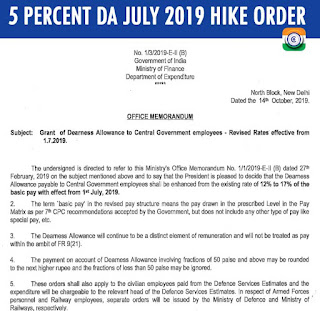
5 Percent DA July 2019 Hike Order - Grant of Dearness Allowance to Central Government employees

Grant of Dearness Allowance to Central Government employees 5 Percent DA July 2019 Hike Order  No. 1/3/2019-E- II (B) Government of...

Blog Archive

About The Author