A complete reference blog for Indian Government Employees

Showing posts with label additional increment. Show all posts

Tuesday, 25 December 2018

Stagnation Increment - Revision of Pension of Pre-2016 pensioners


Stagnation Increment - Revision of Pension of Pre-2016 pensioners
"Benefit of additional increment has been granted to those officers who were serving as on 1.1.2016. Those who retired/died before 1.1.2016 are, therefore, not eligible for increment after retirement for the purpose of pension."

No.38/37/2016-P&PW(A)
Government of India
Ministry of Personnel, PG & Pensions
Department of Pension & Pensioners' Welfare
3rd Floor, Lok Nayak Bhawan
Khan Market, New Delhi-110 003
Dated the 21st December, 2018
Office Memorandum

Subject: Revision of Pension of Pre-2016 pensioners - Stagnation Increment regarding

The undersigned is directed to say that in pursuance of the decision taken by the Government on the recommendations of the 7th CPC, orders were issued vide this Deptt's OM of even number dated 12.5.2017 for revision of pension/family pension in respect of pre-2016 pensioners/family pensioners by notionally fixing pay in the pay matrix recommended by the 7th CPC in the level corresponding to the pay in the pay scale/pay band and grade pay at which the Government servant / pensioner retired/died. Concordance tables for fixation of notional pay / pension of pre-2016 pensioners were issued vide this Department's OM of even number dated 6.7.2017.

2. References/representations have been received in this Department seeking clarification on the applicability of the OM dated 7.9.2016 for the purpose of notional pay fixation and revision of pension of pre-2016 pensioners and family pensioners w.e.f. 1.1.2016. The matter has been examined in consultation with the Ministry of Finance (Department of Expenditure). It is clarified that the benefit of additional increment has been granted to those officers who were serving as on 1.1.2016. Those who retired/died before 1.1.2016 are, therefore, not eligible for increment after retirement for the purpose of pension.

3. This issues with the approval of Department of Expenditure vide their I.D. No.1(3)/V-V/2018 dated 4.9.2018 and 1.D. No.1(3)/V-V/2018 dated 28.11.2018
sd/-
(S.K. Makkar)
Under Secretary to the Government of India
Share:

Tuesday, 30 June 2015

7th Pay Commission likely to recommend Jan 1, July 1 as Annual Increment issuing days

7th Pay Commission likely to recommend Jan 1, July 1 as Annual Increment issuing days

    “On July 1 of each year, annual increments are given for all the Central Government employees. So, tomorrow is the “Increment Day” for all.”

The 6th Pay Commission had introduced the practice of granting annual increment for all on the same day. Until then, increments were implemented for the employees based either on their date of joining or on their promotion dates.

In order to reduce the monthly work burden and for administrative expediency, suggestions from the various departments were presented to the 6th Pay Commission to recommend a single day as increment date. The 6th Pay Commission had recommend 1st July of earch year as increment day. From 01.01.2006 onwards, July 1 was made the day of implementation of annual increments to all CG staff.

Employees who are appointed after January 1st are not eligible for that year’s annual increment on July 1. They qualify for annual increment only the next year. And those who retire on 30th June, they are not eligible for annual increment.

The new increment rule continues to make a huge impact, when employees are joining duty and retire from duty, due to complex CCS (RP) rules on increment. Pointing out the practical difficulties in implementing this scheme, the National Council JCM suggested to the 7th Pay Commission may recommend that two specific dates, Viz January 1st and July 1st.

According to the NC JCM Staff Side suggestion, those recruited/appointed/promoted during the period between 1st January and 30th June will have their increment date on 1st January and those recruited/appointed/promoted between 1st July and 31st December will have it on 1st July next year.

It was also suggested to recommend that those who retire on June 30 and December 31 should be given one increment on the last day of their service.

Reliable sources confirm that, instead of granting 1st July, the 7th Pay Commission may recommend to implement a 2 Day annual increment method.

Source: CGEN.in
Share:

Monday, 18 May 2015

6th CPC INTRODUCES NEW METHOD OF CALCULATION FOR INCREMENTS

6th CPC INTRODUCES NEW METHOD OF CALCULATION FOR INCREMENTS
6th CPC has the honour of introducing a number of new changes.
Some of the most important changes introduced by the 6th CPC are GRADE PAY STRUCTURE, 3% INCREMENT, CHILDREN’S EDUCATION ALLOWANCE, and announcing July 1 as INCREMENT DAY FOR ALL. In addition, it also created new regulations to avoid smaller calculations – the method of “ROUNDED OFF TO THE NEXT MULTIPLE OF TEN.”

Even as the 7th CPC is fast approaching, doubts about the Increment Calculation on the basis of the 6th CPC persists, especially about the “ROUNDED OFF TO THE NEXT MULTIPLE OF TEN” method. It is obvious that doubts persist.

In order to avoid decimals, it is a usual practice to round off anything over 50 as 1, and less than 50 as 0. But, according to the Revised Pay Rules 2008 of the 6th CPC, 100.90 is to be taken as 101, and, 101 is to be rounded off as 110.

Let us assume that a person’s increment calculation results in 510.90. That has to be taken as 510. But, if the number is 511, then it has to be taken as 520.

Let us get to the interesting part of this concept:
For those with Band Pay higher than 7440, there are chances that Transport Allowance would rise from Rs. 400 to 800 or from Rs. 600 to 1600. There are possibilities that even 10 Paise could make a big impact.

The difference between Rs. 7430 and Rs. 7440 is huge..!
Many would have found themselves in critical junctures where these small differences would result in differences of Rs. 1000 per month, adding up to Rs. 12000 per year. That could be one of the reasons why some employees are upset with these calculations. The ones who had to lose due to these calculations will remember it for a very long time.

In the beginning of 2009, a few departments didn’t understand these calculations properly. They went about rounding off 50 Paise as Re. 1 and calculated increments on that basis.
Even when 6th CPC tried to remove the impact of Paise in the calculations, it somehow continues to have an effect!

Source: 7thpaycommissionupdates.blogspot.in
Share:

Increment benefit comparison between 5th & 6th Pay Commission – An overview about Central Government Employees’ Increment

Increment benefit comparison between 5th & 6th Pay Commission – An overview about Central Government Employees’ Increment

‘Increment’ is definitely one of the most popular words in the Central Government employee’s dictionary. It is a known fact that each year, without fail, increment brings considerable raise in salary for Central Govt employees. Until about the 5th CPC, there was no major change in the increment system. But, the 6th CPC brought in landmark reforms in the increment system.

Until then, increments were given in the form of a consolidated amount. The 6th CPC recommended that it be calculated on percentage basis. The Central Government ordered that it be calculated at 3% of the employee’s basic pay with effect from 1.1.2006.

The CG employees didn’t realize how useful this was going to be. They thought it wouldn’t amount for much. It was Rs.75 for Rs. 3050 and revised to Rs. 210 for Rs.7000 with simple calculation.
But that was not the end of the story. It was only after a number of years that they realized the true impact of this reform. Let us explain the benefits with an example:

Let us consider the examples of A, and B, two employees who had joined the Central Government services: In five years of getting recruited, B gets a promotion. A gets a promotion three years after B.
On the basis of the 6th CPC :

7th CPC

[BP-Basic Pay, Inc.-Increment, GP-Grade Pay, BP-Pay in Pay Band]

Can you understand the difference now?
In 6th CPC the difference between ‘A’ and ‘B’ will be Rs.70 only, whereas in 5th CPC it will be Rs.300.
The Junior doesn’t have to worry that the senior has a tremendous advantage over him. In the past, the Junior wouldn’t be able to attain the Senior’s basic pay until retirement.

Source: www.90paisa.blogspot.in
Share:

Increment issues – Why is Annual Increment denied to employees retiring in June?

Increment issues – Why is Annual Increment denied to employees retiring in June?

Why is Annual Increment denied to employees retiring in June?

Until 01.01.2006, the date of implementing employee’s annual increment was fixed on the basis of his/her date of appointment or promotion option. After the 6th CPC, it was decided that 1st July of each year would be the uniform date of implementation of annual increment for all Central Government employees.
Employees who are appointed after January 1st are not eligible for that year’s annual increment on July 1. They qualify for annual increment only the next year.

The revised pay rules said that “If an employee is on leave or is availing joining time on the 1st of July, the benefit of annual increment in pay will be drawn only from the date on which he resumes duty and not from the first of July. Each year, employees who retire in the month of June are not given the annual increment of the year since they do not report to work on 1st July. Only those employees who resume duty on July 1st are eligible to receive the annual increment. Or, the day they report back to work is taken as the date for implementing the annual increment. Since there are no possibilities for the retired employees to return to work, they are not considered as qualified to receive the annual increment.

The revised pay rules states that only those who have been receiving the same basic pay continuously for 6 months are considered as qualified for annual increment. According to the another rule of qualification for increment, the person should have complete one year in service after receiving the annual increment. Therefore, despite being qualified, these employees are denied their annual increment.

There is an order that states that those who retire on July 1st should complete the retirement formalities in the month of June.

Instead of strictly looking into such technicalities, it would be a nice gesture on the part of the Government to extend the benefits of annual increment to those senior employees too who retire from service in the month of June.

Source: www.90paisa.blogspot.in
Share:

Rounding off the amount of Increment to next multiple of 10

Rounding off the amount of Increment to next multiple of 10

Rounding off the amount of Increment to next multiple of 10 : Clarification regarding.

Attention is invited to this HQrs Circular No. AN/XIV/14162/6th CPC/Circular/Vol.IV, dt. 29/0212012 wherein it was directed to adopt the methodology stipulated in Rule 7(Note 2A), Rule 9 and Rule 11 of GoI, MoF notification, dated 29/08/2008 (RPR 2008) for rounding off at the time of fixation of pay while granting annual increment for the year 2006, 2007 and 2008 and implement the revised instructions issued by MoF, Department of Expenditure vide their OM, dated 29/01/2009 only for annual increments granted on or after 07/2009.

2. In this regard, a reference has been made by one of the controller offices bringing out the anomaly caused due to adoption of different methodologies by different controller offices in rounding off the amount of increment while carrying out refixation of pay due to implementation of MoF, Deptt. of Expenditure OM dated 19/03/2012.

3. To avoid any anomaly, it is reiterated that the instructions laid down under this HQrs circular dated 29/02/2012 are to be followed in-toto while refixation of pay on account of implementation of MoF, Dept. of Expenditure OM dated 19/03/2012 also. Accordingly, the instructions issued by MoF, Dept. of Expenditure vide their OM dated 29/01/2009 to round off any amount of a rupee or more to the next multiple of 10 is to be implemented only for calculation of increment under revise pay structure granted on or after 01/07/2009.

This is for your information, guidance and necessary action please.

Click to view the original order in both English and Hindi
Share:

Wednesday, 15 April 2015

Annual Increment for Central Government Employees

Annual Increment for Central Government Employees

Last week, the Central Government has issued orders regarding the release of an additional 6% Dearness Allowance to the central government employees and 6% Dearness Relief to the pensioners from 1st January 2015. It turned out to be a sigh of relief for all of them as the government was a bit late in announcing the DA. Now the total DA stands at 113% of the basic pay. The employees will be paid arrears for the months of January, February and March. As for now, expectations and excitement are temporarily over….

The next episode to begin is the Annual Increment, which has to be given in the month of July every year as recommended by the 6th Central Pay Commission. From July, central government employees are entitled to receive 3% of their basic pay as annual increment. As we are aware that 6th CPC had given more financial benefits than previous pay commissions, by introducing various changes in the pay structures and pay scales. The calculations regarding annual increment were also changed. In the past, the annual increment was a fixed amount and was given on the appointment month every year. But in the 6th CPC, the annual increment was fixed at 3% of the basic pay and that to be given on a common date for all central government employees irrespective of their appointment date. It also clarified that, any amount which falls between 1 and 10 rupees, the total should be rounded to the next 10 rupees. For eg: If an employee’s increment is Rs. 401.00, the fixation should be Rs.410.00, while for an employee, who gets Rs. 400.90, the fixation should be Rs.400.00 only. This increment is automatically added to their basic pay every year.

As far as the employees are concerned, this year’s annual increment will be the last in this particular pay commission. July also makes the date for announcing the next installment of DA to the employees. As per the data received till now, and the trend regarding price index, continues, another 6% of DA is expected from July 2015. This makes the total DA at 119%.

From the employees point of view, they are eagerly awaits the recommendations of the 7th CPC which has to be implemented from the 1st of January 2016. But till now, a crystal clear picture has not emerged about the new pay scales and pay structures, and the date of submission to the government. Nobody is in a position to come out with the details of the 7th CPC.
Let’s wait and see what happens in the coming months!!!

Source: www.govtstaffnewsportal.in
Share:

Featured post

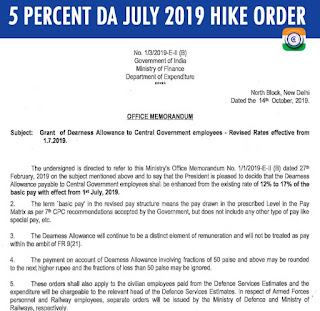
5 Percent DA July 2019 Hike Order - Grant of Dearness Allowance to Central Government employees

Grant of Dearness Allowance to Central Government employees 5 Percent DA July 2019 Hike Order  No. 1/3/2019-E- II (B) Government of...

Blog Archive

About The Author