A complete reference blog for Indian Government Employees

Showing posts with label Promotional Increment. Show all posts

Wednesday, 16 December 2015

Performance is the main constraint on Annual Increment in 7th CPC

Performance is the main constraint on Annual Increment in 7th CPC

Withholding Annual Increments of Non-performers after 20 Years

There is a widespread perception that increments as well as upward movement in the hierarchy happen as a matter of course. The perception is that grant of MACP, although subject to the employee attaining the laid down threshold of performance, is taken for granted. This Commission believes that employees who do not meet the laid down performance criterion should not be allowed to earn future annual increments. 

The Commission is therefore proposing withholding of annual increments in the case of those employees who are not able to meet the benchmark either for MACP or a regular promotion within the first 20 years of their service.

This will act as a deterrent for complacent and inefficient employees. However, since this is not a penalty, the norms for penal action in disciplinary cases involving withholding increments will not be applicable in such cases. This will be treated as an “efficiency bar”. Additionally, for such employees there could be an option to leave service on similar terms and conditions as prescribed for voluntary retirement.
Share:

Friday, 10 July 2015

Yearly Increment for Central Government Employees from July 2015, Will the 7th CPC continue the same formula?

Yearly Increment for Central Government Employees from July 2015, Will the 7th CPC continue the same formula?

“Will the 7th CPC continue the same formulae adopted by the 6th CPC, or it brings any changes in to it…!”
As we are in the last six months for the implementation of 7th Central Pay Commission, let us look at the calculation of yearly increment implemented in the 6th CPC.

The 6th Central Pay Commission which came in to effect from January 2006 and fully implemented with allowances like HRA, CCA, etc., from August 2008, presented a totally different look when compared to previous pay commissions. There were different types of decisions, ideas, information and recommendations in it.

The main change was that, it brought a new type of Pay Scales namely Pay in the Pay Band and Grade Pay. In order to maintain records and for easy calculation, the 6th CPC had fixed a common date for the yearly increment irrespective of their appointment date. In the previous pay commissions, the increment was given to an employee on his/her appointment month. For example, if an employee was appointed in the month of January, his/her increment month will be in the same month every year. But the 6th CPC recommended a common date and the month of July every year was fixed as the increment month for all Central Government Employees. This decision was widely appreciated by everyone. A point in the 6th CPC says that, ‘If an employee has completed six months or more in the revised pay structure as per 6th CPC, as on 1st July, he/she will be given one increment…’

In the 5th CPC, an employee’s pay is fixed in the Scale of Pay. If that individual’s scale of pay is – 3050-75-3950-80-4590, he/she gets yearly increment of Rs.75/- up to Rs.3950/- and Rs. 80/- from Rs.4590/-… If the employee reaches maximum of his pay scale, there is no further increment and get stagnated there. There were such instances of employees with no increment for three to four years.
Whereas in the 6th CPC, to remove stagnation, the commission introduced the running pay bands for all posts. If an employee reaches maximum of his pay band, after one year he will be placed in the next pay band providing him one increment. Thus, he/she moves up to the next pay band. It was a good recommendation as far as employees are concerned.

The 6th CPC also recommended that the yearly increment should not be fixed as in 5th CPC, but 3% of the employee’s basic pay should be calculated and added to the basic pay. The increment so calculated, should be rounded off to the next multiple of 10, ignoring the paise, and added to the pay band. For example, if the amount of increment comes to Rs. 1500.80, then the amount will be rounded off to Rs. 1500/- and if the amount comes to Rs. 1501.00, then it will be rounded off to Rs.1510/-.

As of now, no one can predict what will be the recommendations in the 7th CPC…The Commission in its website, said that it had stopped all type of interactions, meetings etc. and it is ready to submit its report to the Central Government in September 2015…

Will the 7th CPC continue the same formulae adopted by the 6th CPC, or it brings any changes in to it…!
Let’s all hope for the best……!

Source: www.govtstaffnewsportal.in
Share:

Monday, 18 May 2015

6th CPC INTRODUCES NEW METHOD OF CALCULATION FOR INCREMENTS

6th CPC INTRODUCES NEW METHOD OF CALCULATION FOR INCREMENTS
6th CPC has the honour of introducing a number of new changes.
Some of the most important changes introduced by the 6th CPC are GRADE PAY STRUCTURE, 3% INCREMENT, CHILDREN’S EDUCATION ALLOWANCE, and announcing July 1 as INCREMENT DAY FOR ALL. In addition, it also created new regulations to avoid smaller calculations – the method of “ROUNDED OFF TO THE NEXT MULTIPLE OF TEN.”

Even as the 7th CPC is fast approaching, doubts about the Increment Calculation on the basis of the 6th CPC persists, especially about the “ROUNDED OFF TO THE NEXT MULTIPLE OF TEN” method. It is obvious that doubts persist.

In order to avoid decimals, it is a usual practice to round off anything over 50 as 1, and less than 50 as 0. But, according to the Revised Pay Rules 2008 of the 6th CPC, 100.90 is to be taken as 101, and, 101 is to be rounded off as 110.

Let us assume that a person’s increment calculation results in 510.90. That has to be taken as 510. But, if the number is 511, then it has to be taken as 520.

Let us get to the interesting part of this concept:
For those with Band Pay higher than 7440, there are chances that Transport Allowance would rise from Rs. 400 to 800 or from Rs. 600 to 1600. There are possibilities that even 10 Paise could make a big impact.

The difference between Rs. 7430 and Rs. 7440 is huge..!
Many would have found themselves in critical junctures where these small differences would result in differences of Rs. 1000 per month, adding up to Rs. 12000 per year. That could be one of the reasons why some employees are upset with these calculations. The ones who had to lose due to these calculations will remember it for a very long time.

In the beginning of 2009, a few departments didn’t understand these calculations properly. They went about rounding off 50 Paise as Re. 1 and calculated increments on that basis.
Even when 6th CPC tried to remove the impact of Paise in the calculations, it somehow continues to have an effect!

Source: 7thpaycommissionupdates.blogspot.in
Share:

Increment benefit comparison between 5th & 6th Pay Commission – An overview about Central Government Employees’ Increment

Increment benefit comparison between 5th & 6th Pay Commission – An overview about Central Government Employees’ Increment

‘Increment’ is definitely one of the most popular words in the Central Government employee’s dictionary. It is a known fact that each year, without fail, increment brings considerable raise in salary for Central Govt employees. Until about the 5th CPC, there was no major change in the increment system. But, the 6th CPC brought in landmark reforms in the increment system.

Until then, increments were given in the form of a consolidated amount. The 6th CPC recommended that it be calculated on percentage basis. The Central Government ordered that it be calculated at 3% of the employee’s basic pay with effect from 1.1.2006.

The CG employees didn’t realize how useful this was going to be. They thought it wouldn’t amount for much. It was Rs.75 for Rs. 3050 and revised to Rs. 210 for Rs.7000 with simple calculation.
But that was not the end of the story. It was only after a number of years that they realized the true impact of this reform. Let us explain the benefits with an example:

Let us consider the examples of A, and B, two employees who had joined the Central Government services: In five years of getting recruited, B gets a promotion. A gets a promotion three years after B.
On the basis of the 6th CPC :

7th CPC

[BP-Basic Pay, Inc.-Increment, GP-Grade Pay, BP-Pay in Pay Band]

Can you understand the difference now?
In 6th CPC the difference between ‘A’ and ‘B’ will be Rs.70 only, whereas in 5th CPC it will be Rs.300.
The Junior doesn’t have to worry that the senior has a tremendous advantage over him. In the past, the Junior wouldn’t be able to attain the Senior’s basic pay until retirement.

Source: www.90paisa.blogspot.in
Share:

Increment issues – Why is Annual Increment denied to employees retiring in June?

Increment issues – Why is Annual Increment denied to employees retiring in June?

Why is Annual Increment denied to employees retiring in June?

Until 01.01.2006, the date of implementing employee’s annual increment was fixed on the basis of his/her date of appointment or promotion option. After the 6th CPC, it was decided that 1st July of each year would be the uniform date of implementation of annual increment for all Central Government employees.
Employees who are appointed after January 1st are not eligible for that year’s annual increment on July 1. They qualify for annual increment only the next year.

The revised pay rules said that “If an employee is on leave or is availing joining time on the 1st of July, the benefit of annual increment in pay will be drawn only from the date on which he resumes duty and not from the first of July. Each year, employees who retire in the month of June are not given the annual increment of the year since they do not report to work on 1st July. Only those employees who resume duty on July 1st are eligible to receive the annual increment. Or, the day they report back to work is taken as the date for implementing the annual increment. Since there are no possibilities for the retired employees to return to work, they are not considered as qualified to receive the annual increment.

The revised pay rules states that only those who have been receiving the same basic pay continuously for 6 months are considered as qualified for annual increment. According to the another rule of qualification for increment, the person should have complete one year in service after receiving the annual increment. Therefore, despite being qualified, these employees are denied their annual increment.

There is an order that states that those who retire on July 1st should complete the retirement formalities in the month of June.

Instead of strictly looking into such technicalities, it would be a nice gesture on the part of the Government to extend the benefits of annual increment to those senior employees too who retire from service in the month of June.

Source: www.90paisa.blogspot.in
Share:

Rounding off the amount of Increment to next multiple of 10

Rounding off the amount of Increment to next multiple of 10

Rounding off the amount of Increment to next multiple of 10 : Clarification regarding.

Attention is invited to this HQrs Circular No. AN/XIV/14162/6th CPC/Circular/Vol.IV, dt. 29/0212012 wherein it was directed to adopt the methodology stipulated in Rule 7(Note 2A), Rule 9 and Rule 11 of GoI, MoF notification, dated 29/08/2008 (RPR 2008) for rounding off at the time of fixation of pay while granting annual increment for the year 2006, 2007 and 2008 and implement the revised instructions issued by MoF, Department of Expenditure vide their OM, dated 29/01/2009 only for annual increments granted on or after 07/2009.

2. In this regard, a reference has been made by one of the controller offices bringing out the anomaly caused due to adoption of different methodologies by different controller offices in rounding off the amount of increment while carrying out refixation of pay due to implementation of MoF, Deptt. of Expenditure OM dated 19/03/2012.

3. To avoid any anomaly, it is reiterated that the instructions laid down under this HQrs circular dated 29/02/2012 are to be followed in-toto while refixation of pay on account of implementation of MoF, Dept. of Expenditure OM dated 19/03/2012 also. Accordingly, the instructions issued by MoF, Dept. of Expenditure vide their OM dated 29/01/2009 to round off any amount of a rupee or more to the next multiple of 10 is to be implemented only for calculation of increment under revise pay structure granted on or after 01/07/2009.

This is for your information, guidance and necessary action please.

Click to view the original order in both English and Hindi
Share:

Saturday, 4 April 2015

Grant of promotional increment under Rule 13 of RS (RP) Rules, 2008 to those promoted to identical Pay Band or Grade Pay shouldering higher responsibilities

Grant of promotional increment under Rule 13 of RS (RP) Rules, 2008 to those promoted to identical Pay Band or Grade Pay shouldering higher responsibilities:-

GOVT. OF INDIA
MINISTRY OF RAILWAYS
(Railway Board)
No.PC-VI/2014/IR-N/4
New Delhi, dated 01.04.2015.
General Secretary
National Federation of Indian Railwaymen
3, Chelmsford Road
New Delhi-110055.

Subject: Grant of promotional increment under rule 13 of RS(RP) Rules, 2008 to those promoted to identical Pay Band /Grade Pay shouldering higher responsibilities.

Ref: Item no.1/2014 of PNM.

Sir,

In terms of rule 13 of Railway Services (Revised Pay) Rules, 2008, fixation of pay with one additional increment is admissible in the situations of promotion from one Grade Pay to another. Prior to implementation of above rules, fixation of pay on appointment from one post to another was governed by Rule 1313(FR22)(1)(a)(1)R-II (still in force) which provides for fixation of pay involving additional increment appointment / promotion as per the provisions of Recruitment Rules in the situations involving assumption of duties and responsibilities of greater importance. Further, in terms of Rule 1313 (FR22)(III)R-II appointment in identical pay scale is not to be deemed as a case of assumption of duties and responsibilities of greater importance.

2. Consequent upon implementation of recommendations of 6th CPC there were various situations of appointment to identical Pay in the nominal promotional hierarchy of the employee and such posts could not be merged (in terms of recommendations of 6th CPC envisaging merger of various scales) and the posts continued to be feeder and promotional posts though in same Grade Pay. There was marked assumption of duties and responsibilities of greater importance. Such cases were examined with Ministry of Finance and DOP&T and consequently, as agreed, promotional benefit was extended to certain categories vide Board’s letter No.PC-VI/2011/IC/1 dated 12.9.2013 (copy enclosed).

3. Now there are demands from the Federations for grant of benefit to certain other situations viz;

S.No Feeder Category Promotional Categories Revised Pay structure(Pay Band, Grade Pay)
(i) Track Maintainers-IV Key man PB-1 GP Rs 1800
(ii) Peon Record Sorter/ Gastetner Operator PB-1 GP Rs 1800
(iii) Sr.ALP works under Loco Pilot Loco Pilot (Shunting) Works Independently. PB-1 GP Rs 2400
(iv) Commercial Clerk Enquiry-cum-Reservation Clerk PB-1 GP Rs 2800
(v) Sr. Goods Guard Passenger Guard PB-2 GP Rs 4200
(vi) Sr. Loco Pilot (Shunting) Loco Pilot (Goods) PB-2 GP Rs 4200
(vii) Station Master Section Controller PB-2 GP Rs 4200

4. The issue has been examined and it has been observed item wise as under:

Item No.(i) Track Man to Key Man
Item No.(ii) Peon to Record Sorter

Consequent to the implementation of 6th CPCs recommendations, the pre-revised scales of Rs. 2550-3200, Rs. 2610-3540, Rs. 2650-4000 and 2750-4400 in respect of Group ‘D’ posts have been replaced by Revised Pay structure of Pay Band PB I and Grade pay Rs. 1800 and the functions etc of the posts are deemed to have merged. The situation is common to all the erstwhile Group ‘D’ categories. Accordingly the question of fixation of pay under Rule 13 of Revised pay rules does not arise in these specific situations.
Further based on the report of the Committee set up by Board, the category of Track Man/ Keymen etc is now being operated in four Grade unified structure and in such a pay structure benefit is already available on promotion from one Grade Pay to another and there is no issue of non admissibility of fixation of pay under Rule 13 of RS(RP) Rules 2008. (Reference: Board’s letter No 2010/CE-l(Spl)/GNS/15{Pt) dated 17/08/2012) copy enclosed.

Item No. (iii) Sr. ALP to Loco Pilot (Shunting)
Item No. ( v) Sr. Goods Guard to Passenger Guard
Item No. (vi) Sr. Loco Pilot(Shunting) to Loco Pilot (Goods)

In respect of above situations of promotions in the identical scale of pay, consequent to consultation with Ministry of Finance a detailed clarification has been issued to zonal Railways vide Board’s letter No. PCVI/2011/IC/l dated 22/05/2014 (copy enclosed) explaining the detailed background, leading to admissibility of promotional pay fixation and the methodology adopted for fixation of pay on promotion to identical grade pay in different situations, in terms of Board’s letter No.PC-Vl/2011/IC/1 dated 22/05/2014.

Item No.( iv): Commercial Clerk to Enquiry cum Reservation Clerk
Item No. (vii) Station Master to Section Controller.

The above situations are result of lateral movement of employees from one cadre to another on their own volition based on the option furnished by them and not the cases of promotion in their normal hierarchy. As per norms being followed, such situations are not being considered for extension of benefit of fixation of pay under Rule 3 of RS(RP) Rules 2008.

5. Keeping in view above position it is not feasible to agree to the demand.

Encl: As above.
Yours Faithfully
For Secretary/Railway Board
Source: NFIR
[https://drive.google.com/file/d/0B40Q65NF2_7UcDd4R2tMSnd3TGs/view]
Share:

Thursday, 22 January 2015

Injustice to newly recruited Accountant in respect of 1st increment of service life – NFCAA

All India Civil Accounts Employees Association’s letter to CGA regarding redressal of injustice to newly recruited Accountant in respect of 1st increment of service life due to Confirmatory Examination

All India Civil Accounts Employees Association
(RECOGNISED BY GOVT. OF INDIA)
CENTRAL HEADQUARTER
No: AICAEA/HQ/A-2/2015/49-50
Dated: 19.01.2015
To,
Shri Jawahar Thakur,
Controller General of Accounts,
Ministry of Finance,
Department of Expenditure,
Loknayak Bhawan,
Khan Market,
New Delhi – 110003

Subject:- Injustice to newly recruited Accountant in respect of 1st increment of service life – Request for redressal regarding.

Sir,

I am directed to draw your kind attention to the fact that the newly recruited Accountants are allowed 1st increment of his service career from 1st day of July in any year that comes after passing of his departmental confirmatory Examination though they may otherwise eligible for such increment on the 1st day of July of the previous year. As illustration it can be said that if an Accountant joins in November – 2013, the present systems of examination etc. makes him eligible to sit for Departmental Confirmatory Examination only in the beginning of the year of 2014. This results his increment w.e.f. 1st July 2014 i.e. after 17/18 month from his date of joining service. This is grossly against sprit of all ideas related to such Confirmatory Examination and highly demoralizing.

Under such circumstances, I would request you to issue orders to effect the increment retrospectively i.e. from the 1st day of July that comes immediately after joining of six month of a newly recruited Accountant who qualified the Department Confirmatory Examination.

Thanking you,
Yours Sincerely,
(V. Bhattacharjee)
Secretary General
Source: www.nfcaahqnd.blogspot.in
Share:

Featured post

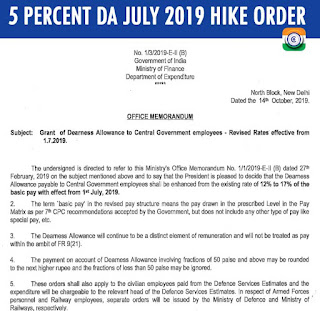
5 Percent DA July 2019 Hike Order - Grant of Dearness Allowance to Central Government employees

Grant of Dearness Allowance to Central Government employees 5 Percent DA July 2019 Hike Order  No. 1/3/2019-E- II (B) Government of...

Blog Archive

About The Author