A complete reference blog for Indian Government Employees

Showing posts with label Service rules. Show all posts

Wednesday, 25 July 2018

Amendment of Service Rules and Recruitment Rules as per 7th CPC - DoPT

Amendment of Service Rules and Recruitment Rules as per 7th CPC - DoPT

7th Central Pay Commissions Recommendations - Revision of Pay Scales - Amendment of Service Rules/Recruitment Rules

7th Central Pay Commissions Recommendations - Revision of Pay Scales - Amendment of Service Rules/Recruitment Rules

 F.No.AB-14017/13/2016-Estt.(RR)(Part-I)
Government of India
Ministry or Personnel, Public Grievances and Pensions
Department of Personnel and Training
Estt.-RR Division
North Block, New Delhi
Dated: 25th July 2018
OFFICE MEMORANDUM

Sub: Seventh Central Pay Commissions recommendations - revision of pay scales - amendment of Service Rules/Recruitment Rules.

The undersigned is directed to refer to this Department’s OM of even number dated 9th August 2016 regarding amendment of Service Rules/ Recruitment Rules by replacing the existing Pay Band and Grade Pay with the corresponding Level in the Pay Matrix in the revised pay structure recommended by the Seventh CPC and notified in the CCS (Revised Pay) Rules, 2016.

2. In the light of above all cadre controlling authorities of Organized Group A services are hereby requested to amend the SRs as per OM dated 30.08.2016 to bring them in-conformity with 7th CPC structure. The information in this regard may also be furnished to the undersigned latest by 31st July 2018 in the format enclosed.
sd/-
(Shukdeo Sah)
Under Secretary to Government of India
Source: https://dopt.gov.in/
Share:

Thursday, 10 May 2018

DoPT: Review of the Recruitment Rules/Service Rules (RRs/SRs)


DoPT: Review of the Recruitment Rules/Service Rules (RRs/SRs)

F.No.AB-14017/14/2018-Estt.(RR)(3139661)
Government of India
Ministry of Personnel, Public Grievances and Pensions
Department of Personnel and Training

Establishment-I Division
North Block, New Delhi
Dated: 08th May 2018

Office Memorandum

Subject: Review of the Recruitment Rules/Service Rules (RRs/SRs) - reg.

DOPT vide OM AB-14017/14/2018-Estt.(RR) dated 31.12.2010 issued instructions laying down guidelines for framing/ amendment/relaxation of Recruitment Rules. Para 3.1.5 Of the guidelines provide that the recruitment/ rules should be reviewed once in 5 years with a view effecting such change as are necessary to bring them in conformity with the changed position, including additions to or reductions in the strength of the lower and higher-level posts. Subsequently, this Division vide OM No. AB-14017/61/2008-Estt.(RR) dated 25.03.2014 re-iterated these instructions.

2. However, it has come to the notice of this Department that many Ministries/Departments are not undertaking the aforesaid exercise as stipulated. Resultantly, recruitment/promotion of officers/ employees are continued to be made on the basis of RRs which are not updated and continued to reflect old positions. It is a matter of concern that the decisions taken by the Government on the basis of pay Commission Recommendations, Court directions, Expert Committee Recommendations etc remain un-reflected in the relevant RRs/SRs

3. Since RRs are statutory in nature and all promotions/appointments are made as the provisions in the RRs/SRs, it is imperative that the RRs/SRs are updated in accordance with DoP&T instructions issued from time to lime. In view of this, Ministries/Departments are impressed upon to immediately undertake the exercise for review Of existing RRs/SRs which have not been amended in the last five years and intimate this Department about the outcome of the exercise so undertaken.

sd/-
(Shukdeo Sah)
Under Secretary to the Govt. or India
Source: DoPT
Share:

Saturday, 23 December 2017

7th Central Pay Commission's recommendations - revision of Pay Scales - Meeting regarding Amendment of Service Rules/Recruitment Rules


7th Central Pay Commission's recommendations - revision of Pay Scales - Meeting regarding Amendment of Service Rules/Recruitment Rules

7th-CPC-PAY-SCALE-SERVICE-RULES

F.No.AB-14017/13/2016-Estt.(RR)
Government of India
Ministry Of Personnel, Public Grievances and pensions
Department of Personnel and Training
Estt.-RR Division
North Block, New Delhi
Dated: 22nd December, 2017
MEMORANDUM

Sub: Seventh Central pay Commission's recommendations - revision of pay scales - amendment or Service Rules/Recruitment Rules.

The undersigned is directed to refer to this Department's OM or even number dated 9th August. 2016 the subject mentioned above wherein it was requested that as per the CCS (Revised pay) Rules, 2016 issued by Department or Expenditure vide Notification dated 25th July, 2016, consequential amendment in the existing Service Rules.'Recruitment Rules shall be made by the Ministries/Departments by substituting the existing pay Band and Grade pay by the new pay "LEVEL in the PAY MATRIX" straightaway without making a reference 10 the Department of Personnel and Training Public Service Commission (UPSC).

2. Further, DoP&T vide of even number dated 16.02.2017 sought information with regard to implementation of OM dated 09.08,2016. The issue is being monitored by higher authorities; however, so far this Department has not received any information from Ministries/Departments even a lapse of over a year. It has been decided to hold a meeting, under the Championship or JS (E), with all Ministries/Departments on 04.01.2018 in Room No.190, North Block, New Delhi.

3. All Ministries/Departments are requested to furnish a status report regarding amendment Of Recruitment Rules in pursuance of DoP&T OM dated 09/08/2016 in the annexure-II enclosed herewith. The schedule or the meeting is as per Annexure-I.

Encl. as above:
sd/-
(Shukdeo Sah)
Under Secretary (RR-II)
To,
All Cadre controlling Ministries/Departments
Annexure- I
Schedule of the meeting to be taken by Joint Secretary (Establishment) (Venue Room No.190, North Bloack New Delhi)
S.No.Ministies starting with alphabetsDate and Time
1.A-I04th January, 2018 at 03.00PM
2.J-Z04th January, 2018 at 03.30PM

Annexure- II
Status regarding amendment of Recruitment Rules in pursuance of OM dated 09.08.2016
Sl.NoPost / DesignationWhether notification issued for amendment of RRs as per DoPT OM dated 09.08.2016. (Yes/No)If answer is no, current status to be indicated. (pending in the Ministry / legislative Department / Any other Reason)

Authority: www.dopt.gov.in
Share:

Wednesday, 5 April 2017

Married Women Employees can show their parents as her dependents for CGHS, LTC etc


Married Women Employees can show their parents as her dependents for CGHS, LTC etc

GOVERNMENT OF INDIA
MINISTRY OF PERSONNEL,PUBLIC GRIEVANCES AND PENSIONS
RAJYA SABHA
QUESTION NO 3280
ANSWERED ON 30.03.2017

Making service rules gender neutral

3280 Shri Narayan Lal Panchariya
Will the Minister of PERSONNEL,PUBLIC GRIEVANCES AND PENSIONS be pleased to state :-

(a) whether, a married woman employee can show her own parents as her dependents under the service rules applicable to Central Government employees;

(b) if so, under what conditions;

(c) if not, the rationale therefor;

(d) whether Government has taken any action to make the aforesaid service rules gender neutral both in letter and spirit; and

(e) if so, the details thereof and if not, the reasons therefor?

ANSWER

Minister of State in the Ministry of Personnel, Public Grievances and Pensions and Minister of State in the Prime Minister's Office. (DR. JITENDRA SINGH)

(a) to (e): The service rules of the Government employees have been framed keeping in view their contextual purpose and with a view to make them gender neutral.

As per Rule 50 of Central Civil Services (CCS)(Pension) Rules, 1972, father and mother of a Government employee (which includes a female Government employee) come within the definition of family. For the purpose of gratuity, there is no condition of dependency or inclusion in family.

In respect of General Provident Fund (GPF) Rule, female employees can nominate their parents for the benefits of GPF. There is no dependency criterion for nominating parents for the benefits of GPF.
Under Central Government Health Scheme (CGHS) Rules, married women employees have the option either to opt their dependent parents or dependent parents-in-law for CGHS facilities.

As per All India Services (AIS) {Medical Attendance (MA) Rules}, 'family' definition includes the name of parents wholly dependent upon the member of service and normally residing with such member.

As per CCS {Leave Travel Concession (LTC)} Rules, 'family' definition includes parents or step parents wholly dependent on the Government servant irrespective of whether they are residing with the Government servant or not.

As per CCS(Conduct Rules), "Members of family" in relation to a Government servant include the wife or husband, son or daughter, parents, brothers or sisters or any person related to any of them by blood or marriage, whether they are dependent on the Government servant or not.

As per AIS (Conduct) Rules, any person related, whether by blood or marriage, to such member or to his or her wife or husband, as the case may be, and wholly dependent on such member is treated as member of family.

Source : RAJYA SABHA
Share:

Thursday, 19 January 2017

7th Central Pay Commission recommendations -amendment of Service Rules/Recruitment Rules


7th Central Pay Commission recommendations -amendment of Service Rules/Recruitment Rules
7th-Central-Pay-Commission-dopt2017

No. AB-14017/13//2016-Estt(RR)-Pt
Government of India
Ministry of Personnel P.G & pensions
Department of Personnel and Training
North Block, New Delhi
Dated: 18.01.2017
OFFICE MEMORANDUM

Subject: Seventh Central Pay Commission's recommendations -amendment of Service Rules/Recruitment Rules.

The undersigned is directed to refer to this Departments OM No AB.14017/61/2008-Estt. (RR) dated 24/03/2009 regarding amendment of Service Rules/ Recruitment Rules in pursuance of Sixth Pay Commission's recommendations. The revised pay structure recommended by 6th CPC and approved by the Government included a number of 'merged grades' with a common Pay Band and Grade Pay.
2. In order to regulate the service rendered in the pre-revised scale where there have been merger of more than one grade into one with a single grade pay, it was advised that a Note to the following effect may be inserted under relevant columns in the Schedule of RRs and under relevant provisions in Service Rules.
"Note: For the purpose of computing minimum qualifying service for promotion, the service rendered on a regular basis by an officer prior to 1.1.2006/the date from which the revised pay structure based on the 6th CPC recommendations has been extended, shall be deemed to be service rendered in the corresponding grade pay/pay scale extended based on the recommendations of the Commission. For purposes of appointment on deputation/ absorption basis, the service rendered on a regular basis by an officer prior to 1.1.2006/the date from which the revised pay structure based on the 6th CPC recommendations has been extended, shall be deemed to be service rendered in the corresponding grade pay/pay scale extended based on the recommendations of the Commission except where there has been merger of more than one pre-revised scale of pay into one grade with a common grade pay/pay scale, and where this benefit will extend only for the post(s) for which that grade pay/pay scale is the normal replacement grade without any upgradation."
3. It has been observed that after implementation of 7th CPC there are only a few cases of merger/upgradation of pay scale. However in cases where merger/ upgradation of pay is recommended in the 7th CPC and the same has been accepted, there is a need to provide a Note on similar lines as above with relevant changes i.e. the date 1.1.2006 needs to be replaced with 1.1.2016 and "6th CPC" is to be replaced with "7th CPC". In other cases the Note as referred above need not to be prescribed in the RRs/SRs where no merger/ upgradation are involved as per 7th CPC recommendations.

(G. Jayanthi)
Director (E-I)
To
All Ministries / Departments of Government of India

Source: 7th CPC Ordes 2017
Share:

Sunday, 11 December 2016

DoPT has issued an OM regarding Introduction of New Recruitment Rules

DoPT has issued an OM regarding Introduction of New Recruitment Rules

F.No. Misc-14017/19/2016-Estt.(RR)
Government of India
Ministry of Personnel, P.G. & Pensions
Department of Personnel and Training
Estt. RR Division
North Block, New Delhi
Dated: 08th Dec, 2016

OFFICE MEMORANDUM

Subject: Launching/Introduction of New Recruitment Rules Formulation, Amendment
Monitoring System (RRFAMS) Portal - reg.


At present, the proposals for framing/amendment of RRs are first processed in the on-line mode through RRFAMS portal. The proposal received on this portal is scrutinized in DOP&T and preliminary observations are conveyed through the system. Thereafter the Ministries/Departments send their proposals along with comments received in the RRFAMS and necessary Annexure, hierarchy chart etc. in the physical file.

2. It has been decided to launch a fully computerized/online system of examination of RRs and to dispense with the requirement of sending physical file to DOP&T. This system would further be extended in future so that a similar on line scrutiny/approval of the proposal of framing/amendment of RRs are undertaken by UPSC and DOLA without the need reference of physical file for finalization of RRs.

3. In this regard the existing RRFAMS system has been upgraded and following new features have been added:

    (i) Uploading of existing RRs/post creation/abolition etc.

    (ii) Hierarchy chart

    (iii) On line system for examination and approval of RRs for Group ‘C’ posts within the Ministry.

4. Before the launch of the above portal, it has been decided to have a preparatory meeting wherein a trial run of the new system will be made. All the Ministries/Departments are requested to nominate a nodal officer at the level of Under Secretary who may bring the relevant proposal along with all necessary documents to fill-up the proposal on the new RRFAMS portal, as per the schedule given in Annexure.
(G. Jayanthi)
Director (E-I)

Annexure
Schedule of the meeting to be taken by Joint Secretary (Establishment) before the launch of new RRFAMS portal (Venue Room No. 190, North Block New Delhi)
S.No. Ministries starting with alphabets Date and Time
1. A-E 18th December, 2016 at 4:30 PM
2. F-P 20th December, 2016 at 4:30 PM
3. Q-Z 22nd December, 2016 at 4:30 PM


Download DoPT OM No.Misc-14017/19/2016-Estt.(RR) dated 08.12.2016
Share:

Saturday, 5 November 2016

Technical Resignation : Highlights of consolidated instructions issued by DOPT.


Technical Resignation : Highlights of consolidated instructions issued by DOPT.

DOPT-Technical-Resignation


DoPT has issued an OM regarding Technical Resignation
TECHNICAL RESIGNATION & LIEN : CONSOLIDATED GUIDELINES.

Highlights of DoPT OM No. 28020/1/2010-Estt(C) Dated 17.08.2016

Compiled by K.V.Ramesh, Sr.JGS IRTSA.

1. Technical Resignation:
a. Government servant should have applied through proper channel for a post in same or some other Department.
b. If the conditions are met, it will be taken as Technical resignation, even if it was not mentioned as Technical Resignation while applying and all admissible benefits should be extended.
c. If competent authority not allowed the forwarding of application, it will not be treated as Technical resignation.
d. Benefits are admissible even if the employee applied before joining the service and application was not routed through proper channel, provided employee should intimate such application immediately after joining the service.
2. Balance leave credited:
a. Balance of utilized Child Care Leave and other leaves will be carried forward.
b. In case of permanent absorption in PSU/Autonomous Body/State Govt. employee is eligible for cash equivalent of leave salary in respect of EL & HPL at his credit subject to the limit of 300 days.
3. LTC carry forwarded: Entitlement for LTC will be carry forward.

4. Pay Protection: Protection of Pay will be given.

5. If employee rejoins his previous post:
a. In case employee rejoins his earlier post, he will be entitled for increments for the period of his absence from that post.
b. Transfer of GPF will be governed.
c. Seniority in the post held by the employee on substantive basis continues to be protected.
However the period spent in other department will not be counted for minimum qualifying service for promotion.

6. Past service counted for Pension: Employee originally joined before 1.1.2004, joined the new post on technical resignation after 1.1.2004, his past services are counted towards pension.

7. Transfer of NPS account: In case of NPS, the balance standing in Personal Retirement Account along with PRNA will be carried forward to new office.

8. Service Book transfer: Service Book from the date first appointment must be kept in the custody of head office in which employee is serving and transferred with him from office to office.

9. Medical Examination & verification:
a. If standard of medical examination is same for the new post, then employee need not to undergo fresh medical examination.
b. No need for verification of character & Antecedents of the employee, if period of discharging from previous post and appointment to new post is less than a year.
10. Lien will be maintained for two years normally, 3 years in exceptional cases.

11. Joining Time, Joining time pay & allowances:
a. Central & State Govt employees are eligible for joining time, which will be included as qualifying service in new Job.
b. During Joining Time, Eligible for pay equal to pay drawn in old post before relinquishment, DA & HRA. No Transport allowance.
c. Entitled for Transfer Travelling Allowance.
Download DoPT OM No. 28020/1/2010-Estt.(C) dated 17.08.2016
Share:

Wednesday, 11 May 2016

Pay Commission recommended Service Rules – DOPT instructions

Pay Commission recommended Service Rules – DOPT instructions

It has been observed by DoPT that several recommendations of Pay Commission have not been incorporated in the Service Rules.

Pay Commission recommended Service Rules – DoPT’s Instructions on Review of Service Rules as per recommendations of Pay Commission

CBDT notification of Review of service Rules as per recommendations of Pay Commission

GOVERNMENT OF INDIA
DIRECTORATE OF INCOME TAX
HUMAN RESOURCE DEVELOPMENT
CENTRAL BOARD OF DIRECT TAXES
ICADR Building, Plot No. 6, Vasant Kunj Institutional Area Phase-II,
New Delhi- 110070. Ph. 26139295, Fax 26130594.
F. No. HRD/AD/854/1/2015-16/760
06.05.2016
To,
All Pr. Chief Commissioner of Income Tax (CCA)/
Pr. Director General of Income Tax

Sub: Review of Service Rules reference received from DoPT-reg.

Ref: DoPT’s O.M. No. AB.14017/61l2008-Estt. (RR) dated 17.03.2016
Kindly refer to the above.

2. The administration of cadre(s) of the Organized Services of the Union is done based upon the provisions as contained in the Service Rules(s). The policy change(s) in terms of financial up-gradation, grant of promotion, composition of various Committee(s) for promotion, qualifying service in various grades, are brought for the benefit of the members of the Service. It has been observed by DoPT that several recommendations of Pay Commission have not been incorporated in the Service Rules. (Copy of OM is enclosed).

3. In this regard, I am directed to request all the Pr.CCITs(CCA)/Pr.DGITs to undertake revision of Service Rules of Organised Services under their administrative control. I am further directed to request all the Pr.CCITs(CCA)/ Pr.DGITs to indicate the time frame by which they would revise the Service Rules of organised Services under their administrative control.
Yours Faithfully,
(S.N. Meena)
DDIT(POL), HRD
No. AB-14017/61/2008-Estt.(RR)
Ministry of Personnel, Public Grievances and Pensions
Department of Personnel and Training
New Delhi
Dated: the 17th March, 2016
 OFFICE MEMORANDUM
Subject:- Review of Service Rules – regarding

The administration of cadre(s) of the Organized Services of the Union is done based upon the provisions as contained in the Service Rules(s). The policy change(s) in terms of financial up-gradation, grant of promotion, composition of various Committee(s) for promotion, qualifying service in various grades, are brought for the benefit of the members of the Service. it is seen that several recommendations of Pay Commission have not been incorporated in the Service Rules.

2. The Cadre Controlling Authorities are, therefore. requested to undertake revision of Service Rules of Organized Services under their administrative control. The Cadre Controlling Authorities may indicate the time frame by which they would revise the Service Rules of Organized Services under their administrative control.
(G. Jayanthi)
Director (E-I)
Share:

Saturday, 9 April 2016

Technical Resignation & Lien- Consolidated guidelines.

The resignation is treated as a technical formality where a Government servant has applied through proper channel for a post in the same or some other Department, and is on selection, required to resign the previous post for administrative reasons.

DoPT consolidated  guidelines/ instructions regarding Technical Resignation – Counting of past service towards pension, Carry forward  of Leave benefits, Carry forward of LTC, Pay  Protection, GPF transfer, transfer of existing NPS account etc are some of the benefits of technical resignation
 
No.28020/1/2010-Estt.(C)
Government of India
Ministry of Personnel, Public Grievances & Pensions
(Department of Personnel & Training)
North Block, New Delhi
 Dated the  & 8th April ,  2016
OFFICE MEMORANDUM

Subject: Technical Resignation & Lien- Consolidated guidelines.

    The undersigned is directed to refer to this Department’s OM of even number dated the 26th  December, 2013 on the above subject and to say that guidelines/ instructions regarding Technical Resignation have been issued from time to time. It is now proposed to further consolidate these instructions and clarify the related issues as the Department continues to receive frequent references on these issues.

2. Before these  clarifications  in the draft O.M are  finalized, it is requested to furnish comments/views in this regard, if any, by 22.04.2016 to the undersigned at the  e-mail address: dse@nic.in.
Director (Estt.)
Telefax: 23093176

Download  DoPT OM No.28020/1/2010-Estt.(C) dated 08.04.2016

No.28020/1/2010-Estt.(C)
Government of India
Ministry of Personnel, Public Grievances & Pensions
(Department of Personnel & Training)
North  Block, New Delhi
Dated  the  April,  2016
OFFICE MEMORANDUM

Subject: Technical Resignation & Lien- Consolidated guidelines.

The undersigned is directed to refer to this Department’s OM of even number dated the  26th December,  2013  on  the  above  subject and  to  say  that  guidelines/  instructions regarding Technical Resignation have been issued from time to time. It is now proposed to further  consolidate  these  instructions  and  clarify  the  related  issues  as  the  Department continues to receive frequent references on these issues.

2. Technical Resignation

1. As per the Ministry of Finance OM No.33 79-E.III (B)/65 dated the 17th June, 1965, the resignation  is treated as a technical formality where a Government servant has applied through proper channel for a post in the same or some other Department,  and is on selection, required to resign the previous post for administrative reasons. The resignation will be treated as technical resignation if these conditions are met, even if the Government servant has not mentioned the word “Technical” while submitting his resignation. The benefit of past service, if otherwise admissible under rules, may be given in such cases. Resignation in other cases including where competent authority has not allowed the Government servant to forward the application through proper channel will not be treated as a technical resignation and benefit of past service will not be admissible. Also, no question of benefit of a resignation being treated as a technical resignation arises in case of it being from a post held on ad hoc basis.

2.   This benefit  is  also  admissible to  Government servants who have applied before joining  the Government service and on that account the application was not routed through proper channel. The benefit of past service is allowed in such cases subject to the fulfillment of the following conditions:-
(i) the  Government  servant  should  intimate  the  details  of  such  application immediately on their joining;

(ii) the Government servant at the time of resignation should specifically make a request, indicating that he is resigning to take up another appointment under Government/ Government organisation for which he applied before joining the Government service;

(iii) the  authority  accepting  the  resignation  should  satisfy  itself  that  had  the employee been in service on the date of application for the post mentioned by the  employee,   his  application   would  have  been  forwarded   through   proper channel.
2.1  Carry forward  of Leave benefits

(i)    In terms of Rule 9(2) of the CCS (Leave) Rules, 1972,   technical resignation shall not result in the lapse of leave to the credit of the Government servant.  The balance of unutilised CCL as well as all other leaves of the kind due & admissible will be carried forward.

(ii)  As  per  rule  39-D  of  the  CCS(Leave)  Rules, 1972,   in  case  of  permanent absorption in PSUs/ Autonomous Bodies/ State Government etc.,  the Government servant shall be granted cash equivalent of leave salary in respect of EL & HPL at his credit subject to overall limit of 300 days.

2.2  Carry forward of LTC

Entitlement to L TC may be carried forward in case of a Central Government Servant who joins  another post after having submitted Technical Resignation.   In case of a Govt Servant  who  resigns  within  8   years  of  his  appointment  and joins  another  post  in  the Government after Technical Resignation, Govt Servant will be treated as a fresh recruit for a period of 8 years from the date of his initial appointment under Government.

2.3   Pay  Protection,  eligibility  of  past  service  for  reckoning of  the  minimum period for grant of Annual Increment

In cases of appointment of a Government servant to another post in Government on acceptance of technical resignation, the protection of pay is given in terms of the Ministry of Finance OM No. 3379-E.III (B)/65 dated the I J1h June, 1965 read with provisions of FR 22- B.  Past service rendered by such a Government servant is taken into account for reckoning of the minimum period for grant of annual increment in the new post/ service/ cadre in Government under the provisions of FR 26 read with Rule 10 of CCS (RP) Rules, 2008.   Pay of the substantive post held by the Government servant is protected. After Sixth Pay Commission, only the pay in the pay band is protected and the employee gets the grade pay of the post to which he is appointed after his resignation.

2.4   GPF transfer

Transfer  of  GPF on technical resignation would be governed by  Rule  35 of the General Provident Fund (Central Services) Rules, 1960.

2.5 Seniority

The tenure of periods spent in the past service does not get included in determining the eligibility for the next promotion. In case of employees who retain a lien on submitting Technical Resignation, in the event of their reversion to their previous job, the period spent in the  new job would  not  be  counted  for  calculation  of  minimum  qualifying service  for promotion in their previous job. The individual will however in case of his reversion to parent organisation regain his seniority with effect from the date of his reversion .

2.6 Applicability of Pension  Scheme

In cases  where  Government   servants,   who had  originally  joined government   service prior  to 01.01.2004,    apply  for posts  in the same  or other  Departments   and  on selection  they are asked to tender  technical  resignation,   the past  services   are counted towards pension  if the new  post  is  in a pensionable   establishment   in terms of  Rule  26(2)  of  CCS(Pension)  Rules 1972.

2.7  New Pension   Scheme

In  case  of  ‘Technical   Resignation   ‘of  Government   servant  covered  under  National Pension   System(NPS),    the  balance   standing   to  their  Personal   Retirement   Account   (PRA) along-with  their PRAN,  will be carried  forward  to the new office”.

2.8  Transfer  of Service  Book  from  parent   Department    to present   Department.

As per SR-  198, the Service  Book is to be maintained  for a Government  servant  from the date of his/her  first appointment   to Government  service and it must be kept in the custody of the Head of Office  in which  he is serving and transferred  with him from office to office.

2.9 Need  for Medical   examination.
In cases  where  a person  has already  been examined  by a Medical  Board  in respect  of his previous  appointment   and  if standard  of medical  examination   prescribed  for the new post  is the same, then he need not be required  to undergo  a fresh examination.

2.10  Verification of Character  & Antecedents

In the case of a person who was originally employed in an office of the Central Government, if the period intervening between date of discharge from his previous office and the date of securing a new appointment, is less than a year,  it would be sufficient if the appointing authority, before making the appointment, satisfies itself by a reference to the office in which the candidate was previously employed that, (a) that office have verified his character and antecedents; and (b) his conduct while in the employ in that office did not render him unsuitable for employment under Government.  If however, more than a year has lapsed after the discharge of the person from his previous office, verification should be carried out in full/afresh, in accordance with O.M.No.18011/9(s)/78-Estt(B) dated 2″d July,1982.

3 Lien

(i) Lien represents the right of a Government employee to hold a regular post, whether permanent or temporary, either immediately or on the termination of the period of absence. The benefit of having a lien in a post/service/cadre is enjoyed by all employees who are confirmed in the post/service/cadre of entry or who have been promoted to a higher post, declared as having completed the probation where it is prescribed. It is also available to those who have been promoted on regular basis to a higher post where no probation is prescribed under the rules, as the case may be.

(ii)  The above  right  will,  however,  be subject  to the condition  that the junior-most   person in the cadre  will  be liable  to be reverted  to the  lower  post/service/cadre    if at any  time  the number  of  persons   so  entitled   is more  than  the  posts  available   in  that  cadre/service.      For example,   if a person  who holds a lien to a post reverts  from deputation  or foreign  service   and if there  is no vacancy  in that post/service/cadre   to accommodate   him,  the junior-most   person will be reverted.   If, however, this officer himself is the junior-most, he will be reverted to the next lower post/service/cadre from which he was earlier promoted.

3.1 Lien on a post

A Government servant who has acquired a lien on a post retains a lien on that post-
(a)  while performing  the duties of that post;
(b)  while  on foreign  service,   or holding  a temporary  post or officiating  in another post;
(c)  during  joining   time   on  transfer   to  another   post;    unless   he  is  transferred substantively  to a post on lower pay,  in which case his lien is transferred  to the new post from the date on which he is relieved  of his duties in the old post;
( d)  while on leave; and
( e)  while under suspension.
A Government servant on acquiring a lien on a post will cease to hold any lien previously acquired on any other post.

3.2  Retention of lien for appointment in another central government office/ state government

(i)  A permanent Government servant appointed in another Central Government Department/Office/ State Government, has to resign from his parent department unless he reverts to that department within a period of 2 years, or 3  years in exceptional cases. An undertaking to abide by this condition may be taken from him at the time of forwarding of his application to other departments/offices.

(ii) The exceptional cases may be when the Government servant is not confirmed in the department/office where he has joined within a period of 2 years. In such cases he may be permitted to retain the lien in the parent department/ office for one more year. While granting such permission, a fresh undertaking similar to the one indicated above may be taken from the employee.

(iii)  Timely action  should  be taken to  ensure  extension/ reversion/ resignation  of the employees to their parent cadres on completion of the prescribed period of 2/3  years. In cases, where employees do not respond to instructions, suitable action should be initiated against them for violating the agreement/ undertaking given by them as per (3) and (4) above and for termination of their lien. Adequate opportunity may,  however, be given to the officer prior to such consideration.

(iv)  Temporary  Government  servants will be required to  severe connections  with the Government in case of their selection for outside posts.    No lien will be retained in such cases.

3.3 Termination Of Lien

(i) A Government servant’s  lien on a post may in no circumstances be terminated even with his consent if the result will be to leave him without a lien upon a permanent post. Unless his lien is transferred, a Government servant holding substantively a permanent post retains lien on that post. It will not be correct to deny a Government servant lien to a post he was holding substantively on the plea that he had not requested for retention of lien while submitting  his Technical  Resignation,  or to relieve such a Government  servant with   a condition  that no lien will be retained.

(ii)       A Government employee’s lien on a post shall stand terminated on his acquiring a lien on a permanent post (whether under the Central Government or a State Government) outside the cadre on which he is borne.

(iii)     No lien shall be retained:
(a) where  a Government   servant  has proceeded  on immediate  absorption  basis to a post  or service  outside  his service/  cadre/  post  in the  Government   from the date of absorption;   and

(b) on foreign service/ deputation beyond the maximum limit admissible under the orders of the Government issued from time to time.
3.4 Transfer Of Lien

The lien of a Government servant, who is not performing the duties of the post to which the lien pertains, can be transferred to another post in the same cadre subject to the provisions of Fundamental Rule 15.

4   Joining Time, Joining Time Pay &Travelling Allowance

Provisions relating to joining time are as follows:
(i) For appointment to posts under the Central Government on results of a competition and/or interview open to Government servants and others, Central Government employees and permanent/ provisionally permanent  State Government employees will be entitled to joining  time under the  CCS(Joining Time) Rules,1979.   Joining time will be included as qualifying service in the new job.

(ii)  A Government servant on joining time shall be regarded as on duty during that period and shall be entitled to be paid joining time pay equal to the pay which was drawn before relinquishment of charge in the old post. He will also be entitled to Dearness Allowance, if any,  appropriate  to  the joining  time  pay.  In  addition,  he  can  also  draw  compensatory allowances like House Rent Allowance as applicable to the old station from which he was transferred. He shall not be allowed Conveyance Allowance or permanent Transfer.

(iii) For appointments to posts under the Central Government on the basis of results of a competition and /or interview open to Government servants and others, Central Government employees   and permanent/   provisionally   permanent   State  Government  employees   shall  be entitled  to  Transfer   Travelling   Allowance (TT A).  However,  temporary   Central  Government employees  with less than 3  years of regular  continuous  service would not be entitled  for TT A, as they are not entitled joining time pay under Joining Time Rules.
5   All Ministries/ Departments are requested to bring the instructions/ guidelines to the notice of all concerned.
(Mukesh  Chaturvedi)
Director  (Estt.)
Telefax:  23093176
Share:

Friday, 4 March 2016

Recovery of wrongful / excess payment made to Government Employees

Recovery of wrongful / excess payment made to Government Employees

Recovery from employees belonging to Group ‘C’ and Group ‘D’ service, and Recovery from retired employees, are some of the situations of hardship as observed by Hon’ble Supreme Court

Department of Personnel & Training issued an OM for recovery of wrongful / excess payments made to Government servants in view of the law declared by Courts

F.No. 18/03/2015-Estt. (Pay-I)
Government of India
Ministry of Personnel, Public Grievances & Pensions
Department of Personnel & Training
New Delhi, the 2nd March, 2016
OFFICE MEMORANDUM

Sub: Recovery of wrongful / excess payments made to Government servants.

The undersigned is directed to refer to this Department’s OM No.18/26/2011-Estt (Pay-I) dated 6th February, 2014 wherein certain instructions have been issued to deal with the issue of recovery of wrongful / excess payments made to Government servants in view of the law declared by Courts, particularly, in the case of Chandi Prasad Uniyal And Ors. vs. State of Uttarakhand And ors., 2012 AIR SCW 4 742, (2012) 8 SCC 417. Para 3(iv) of the OM inter-alia provides that recovery should be made in all cases of overpayment barring few exceptions of extreme hardships.

2. The issue has subsequently come up for consideration before the Hon’ble Supreme Court in the case of State of Punjab & Ors vs Rafiq Masih (White Washer) etc in CA No.1152 7 of 2014 (Arising out of SLP(C) No.11684 of 2012) wherein Hon’ble Court on 18.12.2014 decided a bunch of cases in which monetary benefits were given to employees in excess of their entitlement due to unintentional mistakes committed by the concerned competent authorities, in determining the emoluments payable to them, and the employees were not guilty of furnishing any incorrect information / misrepresentation fraud, which had led the concerned competent authorities to commit the mistake of making the higher payment to the employees. The employees were as innocent as their employers in the wrongful determination of their inflated emoluments. The Hon’ble Supreme Court in its judgment dated 18th December, 2014 ibid has, inter-alia, observed as under:

“7. Having examined a number of judgments rendered by this Court, we are of the view, that orders passed by the employer seeking recovery of monetary benefits wrongly extended to employees, can only be interfered with, in cases where such recovery would result in a hardship of a nature, which would far outweigh, the equitable balance of the employer’s right to recover. In other words, interference would be called for, only in such cases where, it would be iniquitous to recover the payment made. In order to ascertain the parameters of the above consideration, and the test to be applied, reference needs to be made to situations when this Court exempted employees from such recovery, even in exercise of its jurisdiction under Article 142 of the Constitution of India. Repeated exercise of such power, “for doing complete justice in any cause would establish that the recovery being effected was iniquitous, and therefore, arbitrary. And accordingly, the interference at the hands of this Court.”

“10. In view of the aforestated constitutional mandate, equity and good conscience, in the matter of livelihood of the people of this country, has to be the basis of all governmental actions. An action of the State, ordering a recovery from an employee, would be in order, so long as it is not rendered iniquitous to the extent, that the action of recovery would be more unfair, more wrongful, more improper, and more unwarranted, than the corresponding right of the employer, to recover the amount. Or in other words, till such time as the recovery would have a harsh and arbitrary effect on the employee, it would be permissible in law. Orders passed in given situations repeatedly, even in exercise of the power vested in this Court under Article 142 of the Constitution of India, will disclose the parameters of the realm of an action of recovery (of an excess amount paid to an employee) which would breach the obligations of the State, to citizens of this country, and render the action arbitrary, and therefore, violative of the mandate contained in Article 14 of the Constitution of India.”

3. The issue that was required to be adjudicated by the Hon’ble Supreme Court was whether all the private respondents, against whom an order-of recovery (of the excess amount) has been made, should be exempted in law, from the reimbursement of the same to the employer. For the applicability of the instant order, and the conclusions recorded by them thereinafter, the ingredients depicted in paras 2& 3 of the judgment are essentially indispensable.

4. The Hon’ble Supreme Court while observing that it is not possible to postulate all situations of hardship which would govern employees on the issue of recovery, where payments have mistakenly been made by the employer, in excess of their entitlement has summarized the following few situations, wherein recoveries by the employers would be impermissible in law:-
(i) Recovery from employees belonging to Class-III and Class-IV service (or Group ‘C’ and Group ‘D’ service).
(ii) Recovery from retired employees, or employees who are due to retire within one year, of the order of recovery.
(iii) Recovery from employees, when the excess payment has been made for a period in excess of five years, before the order of recovery is issued.
(iv) Recovery in cases where an employee has wrongfully been required to discharge duties of a higher post, and has been paid accordingly, even though he should have rightfully been required to work against an inferior post.
(v) In any other case, where the Court arrives at the conclusion, that recovery if made from the employee, would be iniquitous or harsh or arbitrary to such an extent, as would far outweigh the equitable balance of the employer’s right to recover.
5. The matter has, consequently, been examined in consultation with the Department of Expenditure and the Department of Legal Affairs. The Ministries / Departments are advised to deal with the issue of wrongful / excess payments made to Government servants in accordance with above decision of the Hon’ble Supreme Court in CA No.11527 of 2014 (arising out of SLP (C) No.11684 of 2012) in State of Punjab and others etc vs Rafiq Masih (White Washer) etc. However, wherever the waiver of recovery in the above-mentioned situations is considered, the same may be allowed with the express approval of Department of Expenditure in terms of this Department’s OM No.18/26/2011-Estt (Pay-I) dated 6th February, 2014.

6. In so far as persons serving in the Indian Audit and Accounts Department are concerned, these orders are issued with the concurrence of the Comptroller and Auditor General of India.

7. Hindi version will follow.
(A.K. Jain)
Deputy Secretary to the Government of India
Download DoPT OM F.No. 18/03/2015-Estt. (Pay-I) dated 02.03.2016
Share:

Tuesday, 23 February 2016

Extension of Deputation Tenure up to 7 Years

Delegation of powers to Ministries / Departments / Borrowing Organisations to extend deputation tenure upto 7 years in cases of Deputations. No extension of deputation beyond 7 years is to be allowed unless provided in the relevant Recruitment Rules of such deputation post.

deputation-tenure-7years


Extension of Deputation Tenure up to seven years

Delegation of powers to Ministries / Departments/Borrowing Organisations to extend deputation tenure upto 7 years in cases of Deputations covered by DoP&T’s OM No. 6/8/2009-Estt(Pay-11) dated 17th June 2010

DoPT OM on Delegation of powers to Ministries / Departments/ Borrowing Organisations to extend deputation tenure upto 7 years in cases of Deputations covered by DoP&T’s OM No. 6/8/2009-Estt(Pay-11) dated 17th June 2010.

F.No. 2/6/2016-Estt. (Pay-II)
Government of India
Ministry of Personnel, Public Grievances and Pensions
Department of Personnel and Training
North Block, New Delhi
dated 17th February, 2016
OFFICE MEMORANDUM

Subject: Delegation of powers to Ministries / Departments/Borrowing Organisations to extend deputation tenure upto 7 years in cases of Deputations covered by DoP&T’s OM No. 6/8/2009-Estt(Pay-11) dated 17th June 2010 – regarding.

This Department’s OM No. 6/8/2009-Estt.(Pay-II) dated 17th June 2010 regulates Pay, Deputation (Duty) Allowance, Tenure of Deputation / Foreign Service and other terms and conditions on the subject of deputation / foreign service of Central Government employees to ex-cadre posts under the Central Government, State Governments, Public Sector Undertakings, Autonomous Bodies, Universities/ Union Territories Administration, Local Bodies etc. and vice-versa (copy enclosed). Subject to its applicability as provided in para 2 of the OM, these instructions cover cases of deputation/ foreign service where Central Government is either lending authority or borrowing authority or both. It provides for duration of maximum Deputation Tenure as 5 years at a stretch. As per para 8.3.1 (iii) of this OM, no further extension beyond the fifth year shall be considered.

2. Various administrative Ministries/ Departments/ Borrowing Organisations have been approaching this Department for relaxation of the 5 year deputation tenure condition, on case to case basis, citing exigencies, quoting provisions of para 10 of the OM dated 17.6.2010 ibid.

3. It has been decided that if the administrative Ministries / Departments and other borrowing organizations wish to retain an officer beyond 5 years, they may extend tenure of deputation covered by OM No. 6/8/2009-Estt.(Pay-II) dated 17th June 2010, where absolutely necessary in public interest, upto a period not exceeding 7 years at a stretch. This shall be done with the approval of the Minister of the borrowing Ministry / Department concerned and in respect of other organizations with the approval of the Minister of the borrowing Ministry/Department with which they are administratively concerned, keeping in view the exigencies and subject to fulfillment of all other requirements such as willingness and vigilance clearance of the Officer concerned, NOC of the lending authority, UPSC / ACC approval wherever applicable. Thus, no case of extension shall be referred to Department of Personnel & Training, New Delhi.

4. All other terms and conditions issued vide OM No. 6/8/2009-Estt.(Pay-II) dated 17th June 2010 will remain unchanged.

5. In cases where the necessity to have deputation tenures longer than seven years is felt, the concerned administrative Ministries / Departments/ borrowing organisations may amend the relevant Recruitment Rules of such deputation post accordingly, after following the requisite procedure. No extension of deputation beyond 7 years is to be allowed unless provided in the relevant Recruitment Rules of such deputation post. It is reiterated that no case for extension beyond five years shall be referred to DoPT.

6. It is also clarified that cases which are not covered by the OM dated 17.6.2010 including those where Central Government is neither lending authority nor borrowing authority, will continue to be decided in terms of the relevant provisions/ rules/ instructions etc. governing them.

7. These orders shall come into effect from the date of issue of this OM.
(Ashok Kumar Jain)
Deputy Secretary (Pay)
Download DoPT OM F.No. 2/6/2016-Estt. (Pay-II) dated 17.02.2016
Share:

Thursday, 12 November 2015

Consequent upon implementation of NPS from 01.01.2004 DoPT has issued an OM to fix admissibility and counting of Past Service under OPS and NPS.

Consequent upon implementation of NPS from 01.01.2004 DoPT has issued an OM to fix admissibility and counting of Past Service under OPS and NPS.
No.25011/6/2014-AIS(II)
Government of India
Ministry of Personnel, Public Grievances and Pensions
Department of Personnel & Training
North Block, New Delhi-110001
Dated : 04.11.2015
OFFICE MEMORANDUM

Subject: – Counting of past service fix admissibility in old pension scheme, new pension scheme, pay protection and leave accumulation to All India Services officers: clarification regarding.
*******
I am directed to say that while introducing the New Pension Scheme from 01/01/2004, amendments to various existing rules including second proviso to Rule l of the All India Services (Death Cum Retirement Benefits) Rules, 1958 were made whereby these rules became inapplicable to those appointed to All India Service and posts from 01/01/2004. The pension of the member of All India Services appointed on or after 01/01/2004 is regulated by the New Defined Contribution Pension Scheme (known as the New Pension Scheme), notified by the Ministry of Finance (Department of Economic Affairs) vide their Notification No.5/7/2003-ECB2 PR dated 22/12/2003 now rechristened as National Pension System as per Section 8 of Pension Fund Regulatory Development Authority Act, 2013. The guidelines for New Pension Scheme in respect of All India Services was issued by this Department vide letter No.25014/14/2001-AIS(II) dated 08/09/2009 in terms of the instruction/guidelines notified by the Ministry of Finance.

2. Therefore, in view of the above new and changed position, this Department has received references from the State Governments and member of services for Clarification in regard to counting of past services for the purpose of pensionary benefits, pay protection and leave accumulation. The matter has been examined by this Department in consultation with the Ministry of Finance (Department of Expenditure) and Department of Pension and Pensioners’ Welfare and has decided as under: –
(i) The member of All India Services who had been an employee in pensionable establishment viz. Central/State Governments or autonomous bodies as on 31/12/2003 and appointed to All India Services on or after 01/01/2004 with proper permission shall be covered under the old non-contribution pension scheme in terms of Office Memorandum No. 28/30/2004-P&PW(B) dated 28/10/2009,which has been made applicable Mutatis-Mutandis to members of All India Services by this Department vide letter No. 25014/1/2013-AIS(II) dated 18/3/2013. The pay protection and leave accumulation arising out of previous service would be admissible as per relevant rules of respective All India Services (Pay) Rules and All India Services (Leave) Rules 1955.
(ii) Those under CPF etc will not be allowed entry into the old pension scheme on appointments from 01/01/2004
(iii) The member of All India Services who were appointed to government service in the central/state governments or autonomous bodies, whether in a pensionable or non-pensionable establishment, on or after 01/01/2004 before being appointed to All India Services shall be governed by the New Pension Scheme. The pay protection and leave accumulation arising out of their previous service would be admissible as per the relevant rules of the respective All India Services (Pay) Rules and All India Services (Leave) Rules, 1955.
(iv) The admissibility of counting of past services for the purpose of benefits as mentioned at point (i) and (iii) above shall be subject to continuous service and technical resignation.
3. The State Governments are competent to determine the past service rendered by the member of service for such benefits as mentioned above. The service rendered by a member of All India Services before his appointment to the service under the Central Government or a State Government will count as continuous service for the said benefits subject to the fulfilment of the specific conditions provided in the All India Services (Leave) Rules, 1955 and the respective All India Services (Pay) Rules. Approval of the Central Government is not necessary for counting the previous service for such benefits. In such cases the Government of the State on whose cadre the member of service is borne/the Accountant General concerned, will have to take necessary action in consultation with the Central Department or the State Government, if the officer had worked under the Central Government or another State Government, as the case may before joining the All India Services, to count such service as qualifying service for the aforesaid benefit. If any clarification is required or condonation of break in service is involved, a reference may be set to the Department of Personnel and Training in the case of members of the Indian Administrative Services, the Police Division of the Ministry of Home Affairs in the case of Indian Police Service and the Ministry of Environment, Forest and Climate Change in the case of members of Indian Forest Service.
(Rajiv Jain)
Under Secretary to the Government of India

Download DoPT OM No.25011/6/2014-AIS(II) dated 04.11.2015

Share:

Wednesday, 28 August 2013

FAQ by DoPT of Recruitment Rules – Deputation, Qualifying Service, Promotions, Absorption etc.

FAQ by DoPT of Recruitment Rules – Deputation, Qualifying Service, Promotions, Absorption etc.


No. AB.14017/13/2013-Estt. (RR) (1349)
Government of India
Ministry of Personnel, PG & Pensions (Department of Personnel & Training)
North Block, New Delhi

FAQs on Recruitment Rules

 1. What are Recruitment Rules?

Ans. Recruitment Rules are rules notified under proviso to Article 309 or any specific statutes for post(s) prescribing inter alia the method of Recruitment and eligibility for such recruitment. It contains notification part having substantive rules and schedule part (as per prescribed Annexure-I). Recruitment Rules are subordinate legislation and so, they are statutory in nature.

2. What are Service Rules?
Ans. Service Rules are Recruitment Rules for any of the Organized Central Services covering many aspects including constitution of the Service, seniority, probation and other conditions of service.


3. Whether Recruitment Rules are applicable retrospectively?

Ans. The legal position is that the posts are to be filled up as per the eligibility conditions prescribed in the Recruitment Rules in force at the time of occurrence of vacancies unless the Recruitment Rules are amended retrospectively. The practice has however been to give effect to the Recruitment Rules prospectively.


4. Why are Recruitment Rules framed?

Ans. As soon as decision is taken to create a new post/ service to upgrade any post or re-structure any service, the Recruitment Rules/ Service Rules are framed. Any post is filled up as per the provisions of the Recruitment Rules/ Service Rules.
5. Why are Recruitment Rules amended?

Ans. Revision in the Recruitment Rules is made by way of amendment to incorporate changes due to implementation of Central Pay Commission Report, modification of orders/ instructions on the subject, creation/ abolition of posts etc. during the intervening period.


6. How Recruitment Rules are framed/ amended?

Ans. Recruitment Rules for Group ‘A’ & ‘B’ posts/ service are framed/amended by the administrative Ministry/Department in consultation with Department of Personnel & Training, Union Public Service Commission and Ministry of Law (Legislative Department) and approval of competent authority in the Ministry/ Department to be obtained.

7. Why and how are Recruitment Rules relaxed?

Ans. The power to relax clause in the Recruitment Rules/ Service Rules provides the authority to relax the rules in respect of class or category of person. The administrative Ministry/ Department may resort to relaxation of the rules consultation with Department of Personnel & Training and Union Public Service Commission.

8. Who is competent authority to frame/amend the Recruitment Rules?

Ans. All Recruitment Rules including their amendments should be approved at the level of Minister-in-charge, unless the Minister has by general or special order delegated such approval at a lower level(s).

9. Who is competent authority to frame/amend the Recruitment Rules of Group 'C' posts?

Ans. Administrative Ministries/ Departments are empowered to frame/ amend the Recruitment Rules in respect of Group 'C' posts keeping in view the guidelines/ Model Recruitment Rules issued by this Department on various aspects. In case of deviation from existing guidelines/ Model Recruitment Rules, the concurrence of Department of Personnel & Training is to be obtained.

10. Who is competent authority to relax the Recruitment Rules of Group 'C' posts?

Ans. The Ministries/ Departments are competent to relax the Recruitment Rules for Group 'C' posts. The provisions governing upper age limit or qualifications for direct recruitment should not however be relaxed without prior concurrence of Department of Personnel & Training.

11. What is the format/ procedure to send the proposal for consultation with Department of Personnel & Training for framing/amendment of Recruitment Rules?

Ans. Proposal for framing/ amendment of Recruitment Rules fs r Group 'A' & Group 'B' posts (except Service Rules) is sent to Department f Personnel & Training, first, on-line under Recruitment Rules Framing Amendment and Monitoring System (RRFAMS) of the on-line services of Department of Personnel & Training. After approval of on-line Recruitment Rules in Department of Personnel & Training, the proposal is referred by the Administrative Ministry/ Department in a file with a self-contained note accompanied inter alia the following: -
(i) Check-list for sending proposal to Department of Personnel & Training.
(ii) Copy of the report of freezed on-line Recruitment Rules.
(iii) Draft Recruitment Rules including notification and Schedule 1 (for posts other than those in the Organized Services) in the proforma in Annexure I.
(iv) Supporting particulars in Annexure II (for framing of Recruitment Rules)/ Annexure-III (for amendment of Recruitment Rules), as prescribed in Department of Personnel & Training OM No. AB.14017/48/2010-Estt.(RR) dated 31.12.2010.
(v) Recruitment Rules for the feeder posts(s) and the higher post, if any.
(vi) Present sanctioned strength of the post for which rules are being framed/ amended as also of the lower and higher posts.

12. What are model Recruitment Rules?

Ans. Model Recruitment Rules for a number of common categories of posts have been framed in consultation with Union Public Service Commission, wherever required. While framing/ amending Recruitment Rules for such posts, the model rules should be adhered to.

13. What is procedure for consultation with Union Public Service Commission?

Ans. After obtaining the concurrence of the Department of Personnel & Training, the Administrative Ministry / Department should refer the draft Recruitment Rules for posts/ services which are within the purview of the Union Public Service Commission in a self-contained letter to the Commission, along with the information in the prescribed proforma (Check list, Annexure II/ Annexure-III etc.). It should be stated in the letter to the Commission whether the clearance of the Department of Personnel & Training (and also the Department of Pension & Pensioners' Welfare were required) ha been obtained in respect of the proposals in question.

14. What is initial constitution clause in Recruitment Rules?

Ans. In cases where a new service is formed and the Recruitment Rules are framed for the first time and that there are officers already holding different categories of posts proposed to be included in the service on regular / long term basis, a suitable 'Initial Constitution' Clause may be inserted in the Notification so as to count the regular service rendered by such officers before the date of notification of the Rules.

15. Whether reservation, relaxation of age limit and other concessions for special categories of persons are applicable in Recruitment Rules?

Ans. These concessions in recruitments are made applicable by inserting the following 'Saving Clause' in the covering notification of the Recruitment Rules:-
"Nothing in those rules shall affect reservations, relaxation of age-limit and other concessions required to be provided for the Scheduled Castes, the Scheduled Tribes, Ex-servicemen and other special categories of persons, in accordance with the orders issued by the Central Government from time to time in this regard".
16. What is the schedule in Recruitment Rules?


Ans. The schedule of Recruitment Rules of post(s) is a 13 columns table as per prescribed Annexure-I (vide OM No. AB-14017/48/20l0-Esft. (RR) dated 3 1.12.2010) containing details of the post(s) along with method of recruitment and eligibility criteria. The prescribed schedule is used for post(s) which are not covered by any organized service.

17. What is notification part of Recruitment Rules?


Ans. Notification of Recruitment Rules contains the substantive rules which include the provisions related to title, date of commencement, enabling provision for applicability of schedule, disqualification clause, power to relax clause, saving clause and any other rule specific to a post viz, initial constitution clause, liability for all-India Service etc.

18. What are the upper age limits prescribed for Direct Recruitment?

Ans. The upper age limits for different posts depend upon the nature of duties, educational qualifications and experience requirements as prescribed in this Department OM No. AB- 14017/48/201 0-Estt (RR) dated 31 .1 2.2010 (Para 3.7.4.1 & 3.7.4.2).

19. What are relaxations available for upper age limit in direct Recruitment Rules?

Ans. A provision is prescribed in the recruitment rules for relaxation of the upper age-limit for departmental candidates up to 40 years for appointment by direct recruitment to Groups C posts and for Government servants up to 5 years for direct recruitment to Groups A and B posts:

20. How to calculate crucial date for age limit?

Ans. In the case of recruitment through the Union Public Service Commission and the Staff Selection Commission, the crucial date for determining the age- limit shall be as advertised by the UPSC / SSC. In the case of other recruitment, the crucial date for determining the age-limit shall be the closing date for receipt of applications from candidates in India (and not the closing date prescribed for those in Assam etc.).

21. How is the educational and other qualification required for direct recruit fixed?

Ans. The minimum educational qualifications and experience required for direct recruitment may be indicated as precisely as possible and if necessary, into two parts, viz., “Essential Qualifications” and “Desirable Qualifications” taking into account the pay band! grade pay and the nature of duties, and the provisions in the approved Recruitment Rules for similar higher and lower posts in the same hierarchy.

22. Whether the educational qualifications prescribed for direct recruits are applicable to promotees?

Ans. The educational qualifications are not generally insisted upon in the case of promotion to posts of non-technical nature; but for scientific and technical posts, these should be insisted upon, in the interest of administrative efficiency, at least in the case of senior Group A posts in the Pay Band-3 Grade Pay Rs. 6600 and above. Sometimes the qualifications for junior Group A posts and Group B posts may not be insisted upon in full but only the basic qualification in the discipline may be insisted upon.

23. Whether any age limit prescribed for promotion?

Ans. Unless there are any specific grounds, the age limit prescribed for direct recruits are not insisted upon in the case of promotees.

24. When probation for appointment to a post/service in Central Government is prescribed? What is the duration of probation?

Ans. The probation is prescribed when there is direct recruitment, promotion from one Group to another e.g. Group B to Group A or officers re-employed before the age of superannuation. There will be no probation for promotion from one grade to another but within the same group of posts e.g. from Group ‘C’ to Group ‘C’ and for appointment on contract basis, tenure basis, re-employment after superannuation and absorption. The period of probation is as prescribed in this Department OM No. AB-14017/48/2010-Estt (RR) dated 3 1.12.2010 (Para 3.10.1 & 3.10.2).

25. What are the methods of recruitments?

Ans. The different methods of recruitment are:
(a) Promotion
(b) Direct Recruitment
(c) Deputation
(d) Absorption
(e) Re-employment
(f) Short-term contract

26. How is the method of recruitment or percentage of vacancies to be filled by various methods of recruitment decided?


Ans. The percentage of vacancies to be filled by each method that may be prescribed for a particular post or Service depend on a judicious blending of several considerations, e.g.,
(i) the nature of duties, qualifications and experience required;
(ii) the availability of suitable personnel possessing, the requisite qualifications and experience within a cadre. .
(iii) The need for ensuring that suitable incentives exist for the maintenance of an adequate standard of efficiency in the cadre;
(iv) Consideration of the question whether, having regard to the role to be performed by a specified cadre or Service, it is necessary to provide for direct intake of officers at an appropriate level with a view to injecting fresh knowledge and experience that may not be normally available in a particular Service or Department etc.
(v) The proper mix of the six methods of recruitment i.e. (a) promotion (b) direct recruitment (c) deputation (d) absorption (e) re-employment (I) short-term contract (mentioned at (a) to (f) above).

27. What is promotion?


Ans. Promotion is method of recruitment from feeder grade post(s) to higher post in the hierarchy as per the provisions of the Recruitment Rules. If promotion is kept as a method of recruitment, it is also necessary to lay down the number of years of qualif5ring service before the persons in the field become eligible for promotion. Only regular, and not ad hoc, period of service is taken into account for purposes of computing this service.

28. What is Direct Recruitment?

Ans. Direct recruitment is the recruitment which is open to all candidates, eligible as per the provisions regarding age, educational qualification! experience etc. as prescribed in Recruitment Rules.

29. What is Deputation?

Ans. Deputation is a method of recruitment where officers of Central Government Departments or State! UT Governments from outside are appointed to post(s) in Central Government for a limited period, by the end of which they will have to return to their parent cadres. In case of isolated post, it is desirable to keep the method of recruitment of deputation! short term contract as otherwise the incumbents of such posts, if directly recruited, will not have any avenue of promotion! career progression.

30. What is short term contract?

Ans. Short term contract is also a form of deputation where officers from non-
Government bodies e.g. universities, research institutions, public sector undertakings for teaching, research, scientific and technical post(s) can come to Central Government posts.

31. Whether absorption and Deputation are synonymous? What is absorption?


Ans. Absorption and deputation are not synonymous. There is a substantial difference between absorption and deputation. Under the provision absorption, the officer, who initially comes on deputation, may be permanently absorbed in the post! grade if recruitment rules prescribe for absorption as mode of recruitment. Such absorption can be effected only in the case of officers who are on deputation from the Central I State Government.

32. What is composite method of recruitment?

Ans. In cases where the field of promotion or feeder grade consists of only one post, the method of recruitment by “deputation (including short-term contract) / promotion” is prescribed so that the eligible departmental officer is considered along with outsiders. If the departmental candidate is selected for appointment to the post; it is to be treated as having been filled by promotion; otherwise, the post is to be filled by deputation I short-term contract for the prescribed period of deputation / short-term contract at the end of which the departmental officer will again be afforded an opportunity to be considered for appointment to the post.

33. How is field of deputation decided?

Ans. The field for “deputation! short-term contract! absorption should, as far as possible, consist of officers holding analogous posts on regular basis but may be widened to include officers working in the next lower grade also with the qualifying service on regular basis normally prescribed for promotion.

34. How is the period of qualifying service for promotion decided?

Ans. The qualifying service for promotion from one grade to another is necessary so that there is no premature promotion or undue jump in pay and also to ensure that the officer has sufficient opportunity to demonstrate his competence/potential for holding the higher post. The period of qualifying service varies from post to post depending upon the scale of pay and the experience, required for manning the higher post. Broadly, the following qualifying service to be followed is prescribed in this Department OM No. AB1 4017/48/2010-Estt (R.R) dated 31.12.2010 (para 3.12.2).

35. What is the maximum age limit for Deputation?

Ans. The maximum age limit for appointment on deputation (including short term contract) or absorption shall be not exceeding 56 years as on the closing date of receipt of applications.

36. What is the crucial date for determination of eligibility of absorption) deputation?

Ans. The guidelines for crucial date for determination of eligibility for absorption! deputation are as follows: -
(i) In the case of a vacancy already existing at the time of issue of the communication inviting nominations, the eligibility may be determined with reference to the last date prescribed for receipt of nominations in the Ministry/ Department! Organization responsible for making appointment to the post i.e. originating Ministry etc.
(ii) In the case where a vacancy is anticipated, the crucial date for determining eligibility should be the date on which the vacancy is expected to arise.

37. How is Departmental Committee formed?

Ans. When promotion is kept as a method of recruitment, the detailed composition of the Departmental Promotion Committee, with minimum 3 officers, may be indicated. In the case of promotion to Group ‘A’ posts, the Union Public Service Commission shall also be associated. The total strength of DPC including Chairman need not necessarily be an odd number, as the decision is to be taken as a joint one.

38. What are the circumstances in which Union Public Service Commission is to be consulted for recruitment?

Ans. 1.JPSC is required to consult in case of recruitment to all Central Civil Services and Central Civil Posts. Exemption from Consultation with Union Public Service Commission is governed by the Union Public Service Commission (Exemption from Consultation) Regulations, 1958 as amended from time to time and the Central Civil Services and Civil Posts (Consultation with Union Public Commission) Rules, 1999 as amended. Some of the circumstances in which the Union Public Service Commission are to be consulted in making recruitment to the posts are illustrated below: (i) Direct Recruitment,
(ii) Re-employment,
(iii) Absorption,
(iv) Composite method of recruitment (i.e. where the departmental candidate
is to be considered along with outsiders),
(v) In case of deputation — (a) if the field for consideration includes State Government Officers or Group ‘A’ & ‘B’ officers of the Central Government simultaneously and (b) if the field for consideration consists of not only Central/State Government officers but also officers from nonG overnment institutions
(vi) Any relaxation or amendment of the provisions of the Recruitment Rules.

39. Whether recruitment to a post can be made in absence of recruitment rules of a post?


Ans. If there are overriding compulsions for filling any Group A or Group B post in the absence of Recruitment Rules, then the Ministries! Department may make reference to Union Public Service Commission for determination of method of recruitment as a onetime measure for filling up of a post on regular basis.

40. What are the limits for notification of Recruitment Rules?


Ans. The Recruitment Rules or amendment(s) thereto as finally approved by the Union Public Service Commission are required to be notified within a period of 10 weeks from the date of receipt of their advice letter. This time limit should be strictly adhered to.

41. What needs to be done in case where posts are transferred to some other Ministries/ Departments?

Ans. The Ministry/Departments concerned should mutually agree for transfer of the posts and the same should be concurred by Department of Expenditure. Thereafter, the existing RR needs to be de-notified in consultation of Department of Personnel & Training, Union Public Service Commission and Ministry of Law. Suitable recruitment rules in the transferred Department may be framed? amended following due procedure.

Source : www.persmin.nic.in
[http://ccis.nic.in/WriteReadData/CircularPortal/D2/D02est/AB.14017_13_2013-Estt-RR.pdf]
Share:

Featured post

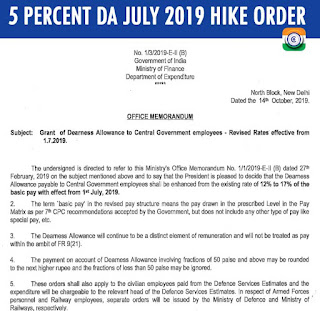
5 Percent DA July 2019 Hike Order - Grant of Dearness Allowance to Central Government employees

Grant of Dearness Allowance to Central Government employees 5 Percent DA July 2019 Hike Order  No. 1/3/2019-E- II (B) Government of...

Blog Archive

About The Author