A complete reference blog for Indian Government Employees

Tuesday, 24 November 2015

7th Pay Commission Report: Person with Disabilities

7th Pay Commission Report: Person with Disabilities

 Introduction
9.6.1 As per the Persons with Disabilities (Equal Opportunities, Protection of Rights and Full Participation) Act, 1995, a “person with disability” means a person suffering from not less than 40 percent of any disability as certified by a medical authority. “Disability” as defined in Section 2(i) of the Act means– (i) blindness (ii) low vision (iii) leprosy cured (iv) hearing impairment (v) locomotor disability (vi) mental retardation (vii) mental illness.
9.6.2 As per the Census of India, 2011, there are nearly 26.8 million Persons with Disabilities (PWDs) in the country, which is nearly 2.21 percent of the total population.

PWDs in Central Government
9.6.3 The government provides three percent reservation in jobs for PWDs. Apart from this reservation at the entry stage, DoPT has issued instructions regarding identification of jobs, post-recruitment and pre-promotion training, providing aids/ assistive devices, accessibility and barrier free environment at work place, preference in government accommodation, grievance redressal, and preference in transfer/posting for PWDs. In a recent notification, a provision has been made for ten years’ (fifteen years in case of SC/ST and thirteen years in case of OBC candidates) relaxation in the upper age limit for direct recruitment to civil posts/services under the Central Government.
9.6.4 Moreover, there are certain special entitlements as given below:
i. Special Allowance for Child Care for Women with Disabilities at the rate of Rs.1,500 pm;
ii. Transport Allowance at double the normal rate, subject to a minimum of Rs.1,000 pm; iii. Constant Attendance Allowance for retired employees with 100 percent disablement at the rate of Rs.4,500 per month;
iv. Special Casual Leave for four days in a calendar year for specific requirements relating to disabilities;
v. Special Casual Leave for ten days in a calendar year for participation in Conferences/ Seminars/Trainings/Workshops related to disability and development.

9.6.5 In case the disability is work related, the following additional provisions are available:
a. Special Disability Leave;
b. Disability Pension;
c. Educational Concession to children of Defence personnel who are disabled in action.

9.6.6 For employees with differently abled children, Children Education Allowance and Hostel Subsidy is granted at double rate.


Demands

9.6.7 Associations of employees with disabilities made the following demands before the Commission:
i. Suitable enhancement in the existing provisions
ii. Provision of Common Room in offices with suitable recreational facilities
iii. Additional rebate in House Building Advance and Automobile Advance
iv. Establishment of Welfare Committees in the ministries
Analysis and Recommendations

9.6.8 The National Policy for Persons with Disabilities, 2006, enunciates the measures that need to be taken by the government to ensure equal opportunities, protection of rights and full participation in society for PWDs, in consonance with the principles enshrined in the Indian Constitution. India is also a signatory to the UN Convention on the Rights for Persons with Disabilities. Thus, provision of appropriate measures for employees with disabilities is the responsibility of the Union Government.
9.6.9 The Commission has made various recommendations regarding PWDs at different places in the report. They are consolidated here for ready reference:
i. In recognition of the singular responsibility faced by differently abled women in raising their children, the Special Allowance for Child Care for Women with Disabilities has been enhanced from the present rate of Rs.1,500 pm to Rs.3,000 pm
ii. Transport Allowance at double the normal rate has been retained, and the minimum amount has been increased from Rs.1,000 pm to Rs.2,250 pm
iii. Children Education Allowance and Hostel Subsidy have been kept at double rate for differently abled children
iv. Constant Attendance Allowance has been enhanced from Rs.4,500 pm to Rs.6,750 pm
v. Special Disability Leave has been subsumed in Work Related Illness and Injury Leave (WRIIL), with improved provisions
vi. Educational Concession, hitherto available only to the children of Defence personnel killed/missing/disabled in action, has been extended to similarly placed personnel of CAPFs, Indian Coast Guard, RPF and police forces of Union Territories mutatis mutandis

9.6.10 Besides the above recommendations, there are a few suggestions that can go a long way in improving the working environment for these employees:
i. In our interactions, it has been highlighted that easy access, particularly to toilets, remains an issue of concern. Hence, it is suggested that Guidelines and Space Standard for Barrier Free Built Environment for Disabled and Elderly Persons, issued by CPWD, Ministry of Urban Affairs and Employment, should invariably be followed while designing new government premises. Their application in the existing offices may also be explored.
ii. Every ministry should have a Welfare Committee, with due representation of differently abled employees, to address their concerns.
iii. The grievance redressal machinery should be strengthened and made more effective.
Share:

Monday, 23 November 2015

7th Pay Commission Report: General Provident Fund (GPF) for Central Government employees

7th Pay Commission Report: General Provident Fund (GPF) for Central Government employees

9.4.1 General Provident Fund (GPF) for Central Government employees was started w.e.f. 1 April, 1960. It covers those government employees who joined service before 01.01.2004 and are not governed by the Contributory Provident Fund Scheme. The scheme was introduced to foster the habit of saving amongst government employees and to provide them financial help in times of need. The Commission has not received any demands regarding modifications in this scheme.

Analysis and Recommendations

9.4.2 The Commission has analyzed the views of the previous Pay Commissions regarding GPF. The IV CPC and the V CPC did not favour making the scheme optional on the grounds that the fund provided relief to employees in times of need and that accretions to the fund also improved the government’s ways and means position. The VI CPC had, however, recommended that the “future investments in GPF should be allowed purely on voluntary basis with no minimum being prescribed.” Their rationale was that the resource position of Central Government is comfortable and the revenues are showing a steady growth, employees have the option of a variety of market instruments to choose from for investment purposes, and with the proposed increase in monthly subscription under the CGEGIS (70% of which is for saving purposes), the government employees will, in any case, be making a much higher saving.

9.4.3 The Commission notes that the recommendations of the VI CPC regarding CGEGIS and GPF were not accepted by the government; neither the CGEGIS rates were revised, nor GPF was made voluntary.

9.4.4 This Commission is of the view that, with the introduction of NPS w.e.f. 01.01.2004, the number of subscribers under the GPF scheme will decrease as time goes by. Moreover, the scheme has worked well over the past 65 years and has provided pecuniary relief to the subscribers in times of need. Accordingly the Commission does not find merit in any disturbance at this point of time. Hence, status quo is recommended.
Share:

Massive demonstrations to protest against retrograde recommendations of the 7th CPC


Massive demonstrations to protest against retrograde recommendations of the VII CPC

Today, in the meeting held in the office of NC/JCM(Staff Side), 13-C, Ferozshah Road, New Delhi, it has been decided that, all the constituents of NJCA shall give direction to their affiliates to hold massive demonstrations, bearing black badges, on 27th November, 2015, against the following retrograde recommendations of the VII CPC

All India Railwaymen’s Federation
No.AIRF/24(C)
Dated: November 20, 2015
The General Secretaries,
All Affiliated Unions,

Dear Comrades,
Reg.: Massive demonstrations to protest against retrograde recommendations of the VII CPC

Today, in the meeting held in the office of NC/JCM(Staff Side), 13-C, Ferozshah Road, New Delhi, it has been decided that, all the constituents of NJCA shall give direction to their affiliates to hold massive demonstrations, bearing black badges, on 27th November, 2015, against the following retrograde recommendations of the VII CPC.

Against the demand of the Staff Side, National Council(JCM) for Minimum Wage Rs.26,000, the VII CPC has recommended Rs.18,000, thereby widening the gap between Minimum and Maximum Wage as 1:13.8 while our demand was to keep this ratio not more 1:8.
The present rate of HRA, i.e. 30%, 20% and 10% has been reduced to 24%, 16% and 8% respectively.
The number of interest-free advance, like Festival Advance, etc. have been recommended to be stopped.
Instead of removing the existing anomalies in the MACPS, the Pay Commission has introduced examination for granting MACP benefit.
The Pay Commission has also refused to make any recommendation against the NPS.
In case of Child Care Leave for women employees, leave wage shall be reduced to 80% for second spell of 365 days CCL.
All of you are requested to comply with the aforementioned decision of the NJCA, and the report of the same should be sent to NJCA Headquarters Office, i.e. 4 State Entry Road, New Delhi.
Yours faithfully,
sd/-
(Shiva Gopal Mishra)
General Secretary
Source: AIRF
Share:

7TH PAY COMMISSION RECOMMENDATION LDC-UDC ISSUE

7TH PAY COMMISSION RECOMMENDATION LDC-UDC ISSUE-GOVERNMENT STAND REITERATED

On the issue of LDC/UDC 7th Pay Commission reiterated the deceiving stand of the Government. Despite of realizing the issue as genuine, Government had not taken a positive decision at their level. The tens of thousands of LDC & UDC, solely responsible for the smooth running of many of the subordinate offices, were hoping that 7th Pay Commission will study the problem faced by them and take a positive decision. Staff Side JCM having convinced the importance of the issue, had also recommended merger & upgradation of the Grade Pay of LDC & UDC to Rs. 2800. But here we see that 7th Pay Commission has not taken any decision on the issue except giving some confusing and misleading statements to vindicate the stand taken by the Government as true. Extracts of some of their views on LDC UDC issue spread over various chapters of the reports is given below:

Higher GP 2400 to LDC and consequent upgradation of pay for other civilian posts in the Ministerial hierarchy.

11.22.100 The Academy has urged that LDC should be placed in higher GP 2400 as against the existing GP 1900 at par with grade pay of Data Entry Operator (DEO), on the grounds that both LDC and DEO enter service on the basis of same educational qualification i.e., Class XII and that the functions of LDC are more complex than that of a DEO. This issue has been dealt in Chapter 7.7. Recommendations made there would apply in this case also.

11.52.32 They have demanded upgradation in pay of certain category of non-industrial posts viz., LDC, UDC, Accountant, Junior Head Clerk, Head Clerk, Office Superintendent and Assistant Manager (Admin).


Analysis and Recommendations

11.52.33 The Commission has not received the views of the ministry/department on the issue. However, posts like LDC, UDC, Accountant are common to a number of ministries/ departments. Recommendations regarding their pay are contained in Chapter 7.7 and Chapter 11.35. The Commission does not find any justification for increase in pay scale of the other cadres.

But in Chapter 7.7 no direct recommendation except to decline the demand of LBSNAA to increase the promotional quota of MTS to LDC, is visible. The extract of Para 7.7.37 is give below:


Analysis and Recommendations

7.7.37 Looking at the qualification requirements and their job profile, the Commission does not recommend any changes in the pay structure or the promotional prospects of the MTS. Regarding MTS in Delhi Police, the Commission is of the view that since MTS is a common category, any special dispensation to MTS in Delhi Police is not justified. In so far as the MTS of LBSNAA are concerned, the Commission notes as per the recruitment rules for LDC, presently only 5 percent of MTS can get promoted to LDC through limited departmental examination. However, since the government has stopped direct recruitment for the clerical cadre and gradually phasing out the existing incumbents, their demand cannot be accepted.

LDCs

11.35.27 There are demands that 50 percent posts of LDCs be earmarked for filing up by promotion/departmental examination by MTS. It has been argued that the educational qualification for the post of MTS is Class X and they are recruited through SSC for performing the work of Peon, Mali, Cobbler, and Sweeper etc. Since most of the MTS join the post with higher qualification of Higher Secondary and Graduation, there is high rate of attrition in the MTS cadre.

Analysis and Recommendations

11.35.28 As per the recruitment rules for LDC, presently 5 percent of MTS can get promoted to LDC through limited departmental examination. Since government has already stopped direct recruitment for the clerical cadre and gradually phasing out the existing incumbents, this demand cannot be accepted. Moreover enhancement of promotional quota is an administrative matter to be considered by the relevant administrative ministry.

Between the lines it can be read that the Government prevented the 7th Pay Commission to not consider the LDC/UDC issue positively and reiterated the wrong statement of the Government that that Government of India has stopped direct recruitment of LDC through Staff Selection as its recommendation. But the fact is that Staff Selection Commission is frequently conducting recruitment for the post of LDC and without the permission of the Government how they can done at their own. Combined higher secondary examination for the selection of LDC also has been conducted recently. If we take the intention of Government of phasing out the LDC post as true, then where is the alternative recommendation? Who will do the arduous work done by the young and energetic LDCs in the subordinate offices? It is to be noted that the normal ratio of LDC and UDC in subordinate offices is 5:2 and thus LDCs have been allocated responsible sections and in many smaller offices LDC alone is handling the work of entire Administration.

On the other hand rejecting Central Secretariat Clerical service demand of parity with DEO the commission observes “Even though the entry requirements are similar, historically the pay scales of the two posts have been different. Besides, they comprise two distinct cadres with different set of roles and responsibilities. Hence, the demand for parity of pay of LDC with DEOs cannot be acceded to by the Commission.”(Para 11.35.38).

Our view is that historically these cadres may be different set of roles but the fact is that functions of LDC are more complex than that of DEO and same was brought before the commission by various  Associations/Administrative Authorities. Earlier pay Commissions have fixed Pay Scale to DEO considering their work on computer. But today LDCs are more expertise in computer than DEO for doing work in computer, but the demand of parity with DEO is rejected. Extract of Para 11.35.38 is given below:

Central Secretariat Clerical Service

11.35.38 The Central Secretariat Clerical Service (CSCS) consists of the following grades:

i. Upper Division Clerk (GP 2400)
ii. Lower Division Clerk (GP 1900)
LDC and Data Entry Operator (DEO)

11.35.39 It has been demanded that LDC of CSCS drawing pay in GP 1900 be placed in GP 2400 at par with the DEOs on the grounds that post VI CPC, the entry requirements for the two posts is almost similar.

Analysis and Recommendations

11.35.40 Even though the entry requirements are similar, historically the pay scales of the two posts have been different. Besides, they comprise two distinct cadres with different set of roles and responsibilities. Hence, the demand for parity of pay of LDC with DEOs cannot be acceded to by the Commission.
From the above it is clear that Government is adamant on not granting pay scale to LDC & UDCs in subordinate offices at par with the duties assigned to them. Even though the 7th CPC claimed that they have recommended pay scales on the principle of equal pay for equal work, the genuine issue of LDC/UDC is ignored. Thus we are forced to represent against the recommendation to the Government/JCM (Staff Side).

All our LDC/UDC friends are requested to raise the issue in their respective Association/Office to force them to represent the issue to the implementation committee for consideration. Also please join all action programmes including strike action, called by the JCM (Staff Side), as published in this web site from time to time, to combat the situation.
TKR Pillai
General Secretary
Mob: 09425372172
Source: http://aiamshq.blogspot.in/
Share:

Sunday, 22 November 2015

Pay Structure for Defence Forces Personnel – Pay Matrix

Pay Structure for Defence Forces Personnel – Pay Matrix

The Defence Services in their Joint Services Memorandum have contended that the emoluments in the Defence Services should stand a fair comparison with what is available in the Civil Services, otherwise the Defence Services will be denied their legitimate share of the available talent pool.

5.2.2 The Commission has devised pay matrices for civil and defence forces personnel, after wide ranging feedback from multiple stakeholders. The common aspects of the two matrices and the unique elements in the defence pay matrix are outlined in the succeeding paragraphs.
Pay-Matrix-Defence-Forces-Personnel
Share:

7th CPC Report: Military Service Pay (MSP) for Defence Forces Personnel

7th CPC Report: Military Service Pay (MSP) for Defence Forces Personnel

The defence forces personnel, in addition to their pay as per the Matrices above, will be entitled to payment of Military Service Pay for all ranks up to and inclusive of Brigadiers and their equivalents. The Commission recommends an MSP for the four categories of Defence forces personnel at Rs.15,500 for the Service Officers, Rs.10,800 for Nursing Officers, Rs.5,200 for JCO/ORs, and Rs.3,600 for Non Combatants (Enrolled) in the Air Force per month. MSP will continue to be reckoned as Basic Pay for purposes of Dearness Allowance, as also in the computation of pension. Military Service Pay will however not be counted for purposes of House Rent Allowance, Composite Transfer Grant and Annual Increment.

MSP-7th-CPC-Report
 
Authority: http://7cpc.india.gov.in/
Share:

Child Care Leave (CCL) for single male parent recommended by 7th Pay Commission report.

Child Care Leave (CCL) for single male parent recommended by 7th Pay Commission report.

New Delhi: The Seventh Pay Commission report has recommended Child Care Leave (CCL) for single male parent, which is currently given to only women employees.

CCL is granted to women employees for a maximum period of two years (730 days) during their entire service for taking care of their minor children (up to eighteen years of age).

The Pay Commission, headed by Justice A K Mathur, submitted its recommendations to Finance Minister Arun Jaitley yesterday.

“The Commission notes that in the event a male employee is single, the onus of rearing and nurturing the children falls squarely on his shoulders.

“Hence extension of CCL to single male parents is recommended,” the report said.

It also recommended CCL at 100 per cent of the salary for the first 365 days, and 80 per cent of the salary for the next 365 days.

CCL was first introduced by 6th Central Pay Commission.

The report also said there is a “palpable need” to bring in some inhibiting feature so as to ensure that only genuinely affected employees avail of this scheme.

“Towards this end, the Commission recommends that CCL should be granted at 100 per cent of the salary for the first 365 days, but at 80 per cent of the salary for the next 365 days,” the report said.

The report further said that the Commission recognises the additional responsibility on the shoulders of employees who are single mothers.

“Accordingly, it is recommended that for such employees, the conditionality of three spells in a calendar year should be relaxed to six spells in a calendar year,” the 900-page report said.

In making the recommendation, the Commission said it has also kept in mind the fact the concept of a paid (whether 100 per cent or 80 per cent) leave solely for child care for a period of two years, “is a liberal measure unmatched anywhere else”.

PTI
Share:

Featured post

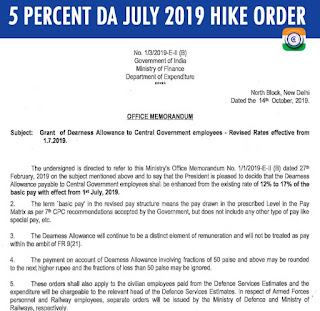
5 Percent DA July 2019 Hike Order - Grant of Dearness Allowance to Central Government employees

Grant of Dearness Allowance to Central Government employees 5 Percent DA July 2019 Hike Order  No. 1/3/2019-E- II (B) Government of...

Blog Archive

About The Author